EP0370367A2 - Carte d'identité, livret d'identité et sa méthode de fabrication - Google Patents
Carte d'identité, livret d'identité et sa méthode de fabrication Download PDFInfo
- Publication number
- EP0370367A2 EP0370367A2 EP89121069A EP89121069A EP0370367A2 EP 0370367 A2 EP0370367 A2 EP 0370367A2 EP 89121069 A EP89121069 A EP 89121069A EP 89121069 A EP89121069 A EP 89121069A EP 0370367 A2 EP0370367 A2 EP 0370367A2
- Authority
- EP
- European Patent Office
- Prior art keywords
- recording layer
- image
- resins
- image recording
- colorant
- Prior art date
- Legal status (The legal status is an assumption and is not a legal conclusion. Google has not performed a legal analysis and makes no representation as to the accuracy of the status listed.)
- Withdrawn
Links
Images


Classifications
-
- B—PERFORMING OPERATIONS; TRANSPORTING
- B42—BOOKBINDING; ALBUMS; FILES; SPECIAL PRINTED MATTER
- B42D—BOOKS; BOOK COVERS; LOOSE LEAVES; PRINTED MATTER CHARACTERISED BY IDENTIFICATION OR SECURITY FEATURES; PRINTED MATTER OF SPECIAL FORMAT OR STYLE NOT OTHERWISE PROVIDED FOR; DEVICES FOR USE THEREWITH AND NOT OTHERWISE PROVIDED FOR; MOVABLE-STRIP WRITING OR READING APPARATUS
- B42D25/00—Information-bearing cards or sheet-like structures characterised by identification or security features; Manufacture thereof
- B42D25/30—Identification or security features, e.g. for preventing forgery
- B42D25/36—Identification or security features, e.g. for preventing forgery comprising special materials
- B42D25/378—Special inks
-
- B—PERFORMING OPERATIONS; TRANSPORTING
- B41—PRINTING; LINING MACHINES; TYPEWRITERS; STAMPS
- B41M—PRINTING, DUPLICATING, MARKING, OR COPYING PROCESSES; COLOUR PRINTING
- B41M5/00—Duplicating or marking methods; Sheet materials for use therein
- B41M5/26—Thermography ; Marking by high energetic means, e.g. laser otherwise than by burning, and characterised by the material used
- B41M5/40—Thermography ; Marking by high energetic means, e.g. laser otherwise than by burning, and characterised by the material used characterised by the base backcoat, intermediate, or covering layers, e.g. for thermal transfer dye-donor or dye-receiver sheets; Heat, radiation filtering or absorbing means or layers; combined with other image registration layers or compositions; Special originals for reproduction by thermography
- B41M5/46—Thermography ; Marking by high energetic means, e.g. laser otherwise than by burning, and characterised by the material used characterised by the base backcoat, intermediate, or covering layers, e.g. for thermal transfer dye-donor or dye-receiver sheets; Heat, radiation filtering or absorbing means or layers; combined with other image registration layers or compositions; Special originals for reproduction by thermography characterised by the light-to-heat converting means; characterised by the heat or radiation filtering or absorbing means or layers
- B41M5/465—Infrared radiation-absorbing materials, e.g. dyes, metals, silicates, C black
-
- B—PERFORMING OPERATIONS; TRANSPORTING
- B41—PRINTING; LINING MACHINES; TYPEWRITERS; STAMPS
- B41M—PRINTING, DUPLICATING, MARKING, OR COPYING PROCESSES; COLOUR PRINTING
- B41M7/00—After-treatment of prints, e.g. heating, irradiating, setting of the ink, protection of the printed stock
- B41M7/0027—After-treatment of prints, e.g. heating, irradiating, setting of the ink, protection of the printed stock using protective coatings or layers by lamination or by fusion of the coatings or layers
-
- B—PERFORMING OPERATIONS; TRANSPORTING
- B42—BOOKBINDING; ALBUMS; FILES; SPECIAL PRINTED MATTER
- B42D—BOOKS; BOOK COVERS; LOOSE LEAVES; PRINTED MATTER CHARACTERISED BY IDENTIFICATION OR SECURITY FEATURES; PRINTED MATTER OF SPECIAL FORMAT OR STYLE NOT OTHERWISE PROVIDED FOR; DEVICES FOR USE THEREWITH AND NOT OTHERWISE PROVIDED FOR; MOVABLE-STRIP WRITING OR READING APPARATUS
- B42D25/00—Information-bearing cards or sheet-like structures characterised by identification or security features; Manufacture thereof
-
- B—PERFORMING OPERATIONS; TRANSPORTING
- B42—BOOKBINDING; ALBUMS; FILES; SPECIAL PRINTED MATTER
- B42D—BOOKS; BOOK COVERS; LOOSE LEAVES; PRINTED MATTER CHARACTERISED BY IDENTIFICATION OR SECURITY FEATURES; PRINTED MATTER OF SPECIAL FORMAT OR STYLE NOT OTHERWISE PROVIDED FOR; DEVICES FOR USE THEREWITH AND NOT OTHERWISE PROVIDED FOR; MOVABLE-STRIP WRITING OR READING APPARATUS
- B42D25/00—Information-bearing cards or sheet-like structures characterised by identification or security features; Manufacture thereof
- B42D25/20—Information-bearing cards or sheet-like structures characterised by identification or security features; Manufacture thereof characterised by a particular use or purpose
- B42D25/23—Identity cards
-
- B—PERFORMING OPERATIONS; TRANSPORTING
- B42—BOOKBINDING; ALBUMS; FILES; SPECIAL PRINTED MATTER
- B42D—BOOKS; BOOK COVERS; LOOSE LEAVES; PRINTED MATTER CHARACTERISED BY IDENTIFICATION OR SECURITY FEATURES; PRINTED MATTER OF SPECIAL FORMAT OR STYLE NOT OTHERWISE PROVIDED FOR; DEVICES FOR USE THEREWITH AND NOT OTHERWISE PROVIDED FOR; MOVABLE-STRIP WRITING OR READING APPARATUS
- B42D25/00—Information-bearing cards or sheet-like structures characterised by identification or security features; Manufacture thereof
- B42D25/30—Identification or security features, e.g. for preventing forgery
- B42D25/309—Photographs
-
- B—PERFORMING OPERATIONS; TRANSPORTING
- B42—BOOKBINDING; ALBUMS; FILES; SPECIAL PRINTED MATTER
- B42D—BOOKS; BOOK COVERS; LOOSE LEAVES; PRINTED MATTER CHARACTERISED BY IDENTIFICATION OR SECURITY FEATURES; PRINTED MATTER OF SPECIAL FORMAT OR STYLE NOT OTHERWISE PROVIDED FOR; DEVICES FOR USE THEREWITH AND NOT OTHERWISE PROVIDED FOR; MOVABLE-STRIP WRITING OR READING APPARATUS
- B42D25/00—Information-bearing cards or sheet-like structures characterised by identification or security features; Manufacture thereof
- B42D25/30—Identification or security features, e.g. for preventing forgery
- B42D25/36—Identification or security features, e.g. for preventing forgery comprising special materials
- B42D25/373—Metallic materials
-
- B—PERFORMING OPERATIONS; TRANSPORTING
- B42—BOOKBINDING; ALBUMS; FILES; SPECIAL PRINTED MATTER
- B42D—BOOKS; BOOK COVERS; LOOSE LEAVES; PRINTED MATTER CHARACTERISED BY IDENTIFICATION OR SECURITY FEATURES; PRINTED MATTER OF SPECIAL FORMAT OR STYLE NOT OTHERWISE PROVIDED FOR; DEVICES FOR USE THEREWITH AND NOT OTHERWISE PROVIDED FOR; MOVABLE-STRIP WRITING OR READING APPARATUS
- B42D25/00—Information-bearing cards or sheet-like structures characterised by identification or security features; Manufacture thereof
- B42D25/40—Manufacture
- B42D25/405—Marking
- B42D25/41—Marking using electromagnetic radiation
-
- B—PERFORMING OPERATIONS; TRANSPORTING
- B42—BOOKBINDING; ALBUMS; FILES; SPECIAL PRINTED MATTER
- B42D—BOOKS; BOOK COVERS; LOOSE LEAVES; PRINTED MATTER CHARACTERISED BY IDENTIFICATION OR SECURITY FEATURES; PRINTED MATTER OF SPECIAL FORMAT OR STYLE NOT OTHERWISE PROVIDED FOR; DEVICES FOR USE THEREWITH AND NOT OTHERWISE PROVIDED FOR; MOVABLE-STRIP WRITING OR READING APPARATUS
- B42D25/00—Information-bearing cards or sheet-like structures characterised by identification or security features; Manufacture thereof
- B42D25/40—Manufacture
- B42D25/405—Marking
- B42D25/415—Marking using chemicals
- B42D25/42—Marking using chemicals by photographic processes
-
- B—PERFORMING OPERATIONS; TRANSPORTING
- B42—BOOKBINDING; ALBUMS; FILES; SPECIAL PRINTED MATTER
- B42D—BOOKS; BOOK COVERS; LOOSE LEAVES; PRINTED MATTER CHARACTERISED BY IDENTIFICATION OR SECURITY FEATURES; PRINTED MATTER OF SPECIAL FORMAT OR STYLE NOT OTHERWISE PROVIDED FOR; DEVICES FOR USE THEREWITH AND NOT OTHERWISE PROVIDED FOR; MOVABLE-STRIP WRITING OR READING APPARATUS
- B42D25/00—Information-bearing cards or sheet-like structures characterised by identification or security features; Manufacture thereof
- B42D25/40—Manufacture
- B42D25/45—Associating two or more layers
- B42D25/455—Associating two or more layers using heat
-
- B—PERFORMING OPERATIONS; TRANSPORTING
- B42—BOOKBINDING; ALBUMS; FILES; SPECIAL PRINTED MATTER
- B42D—BOOKS; BOOK COVERS; LOOSE LEAVES; PRINTED MATTER CHARACTERISED BY IDENTIFICATION OR SECURITY FEATURES; PRINTED MATTER OF SPECIAL FORMAT OR STYLE NOT OTHERWISE PROVIDED FOR; DEVICES FOR USE THEREWITH AND NOT OTHERWISE PROVIDED FOR; MOVABLE-STRIP WRITING OR READING APPARATUS
- B42D25/00—Information-bearing cards or sheet-like structures characterised by identification or security features; Manufacture thereof
- B42D25/40—Manufacture
- B42D25/45—Associating two or more layers
- B42D25/46—Associating two or more layers using pressure
-
- B—PERFORMING OPERATIONS; TRANSPORTING
- B42—BOOKBINDING; ALBUMS; FILES; SPECIAL PRINTED MATTER
- B42D—BOOKS; BOOK COVERS; LOOSE LEAVES; PRINTED MATTER CHARACTERISED BY IDENTIFICATION OR SECURITY FEATURES; PRINTED MATTER OF SPECIAL FORMAT OR STYLE NOT OTHERWISE PROVIDED FOR; DEVICES FOR USE THEREWITH AND NOT OTHERWISE PROVIDED FOR; MOVABLE-STRIP WRITING OR READING APPARATUS
- B42D25/00—Information-bearing cards or sheet-like structures characterised by identification or security features; Manufacture thereof
- B42D25/40—Manufacture
- B42D25/45—Associating two or more layers
- B42D25/465—Associating two or more layers using chemicals or adhesives
- B42D25/47—Associating two or more layers using chemicals or adhesives using adhesives
-
- G—PHYSICS
- G03—PHOTOGRAPHY; CINEMATOGRAPHY; ANALOGOUS TECHNIQUES USING WAVES OTHER THAN OPTICAL WAVES; ELECTROGRAPHY; HOLOGRAPHY
- G03C—PHOTOSENSITIVE MATERIALS FOR PHOTOGRAPHIC PURPOSES; PHOTOGRAPHIC PROCESSES, e.g. CINE, X-RAY, COLOUR, STEREO-PHOTOGRAPHIC PROCESSES; AUXILIARY PROCESSES IN PHOTOGRAPHY
- G03C8/00—Diffusion transfer processes or agents therefor; Photosensitive materials for such processes
- G03C8/40—Development by heat ; Photo-thermographic processes
- G03C8/4013—Development by heat ; Photo-thermographic processes using photothermographic silver salt systems, e.g. dry silver
-
- Y—GENERAL TAGGING OF NEW TECHNOLOGICAL DEVELOPMENTS; GENERAL TAGGING OF CROSS-SECTIONAL TECHNOLOGIES SPANNING OVER SEVERAL SECTIONS OF THE IPC; TECHNICAL SUBJECTS COVERED BY FORMER USPC CROSS-REFERENCE ART COLLECTIONS [XRACs] AND DIGESTS
- Y10—TECHNICAL SUBJECTS COVERED BY FORMER USPC
- Y10S—TECHNICAL SUBJECTS COVERED BY FORMER USPC CROSS-REFERENCE ART COLLECTIONS [XRACs] AND DIGESTS
- Y10S428/00—Stock material or miscellaneous articles
- Y10S428/916—Fraud or tamper detecting
-
- Y—GENERAL TAGGING OF NEW TECHNOLOGICAL DEVELOPMENTS; GENERAL TAGGING OF CROSS-SECTIONAL TECHNOLOGIES SPANNING OVER SEVERAL SECTIONS OF THE IPC; TECHNICAL SUBJECTS COVERED BY FORMER USPC CROSS-REFERENCE ART COLLECTIONS [XRACs] AND DIGESTS
- Y10—TECHNICAL SUBJECTS COVERED BY FORMER USPC
- Y10T—TECHNICAL SUBJECTS COVERED BY FORMER US CLASSIFICATION
- Y10T428/00—Stock material or miscellaneous articles
- Y10T428/24—Structurally defined web or sheet [e.g., overall dimension, etc.]
- Y10T428/24802—Discontinuous or differential coating, impregnation or bond [e.g., artwork, printing, retouched photograph, etc.]
- Y10T428/24843—Discontinuous or differential coating, impregnation or bond [e.g., artwork, printing, retouched photograph, etc.] with heat sealable or heat releasable adhesive layer
Definitions
- ID cards satisfactorily function when they are used in normal forms. However, if, for example, they have been lost, the ID cards of this type, whose photograph can be peeled with ease and its mount and another photograph can be available in general, are sometimes misused, e.g., altered by replacing the photograph or forged through an illegal channel, causing social problems.
- ID cards operable in various spectral regions are used as described, for example, in JIS C6253-1983.
- OCR optical character reader
- the bar code or the characters read by an optical character reader must have a sufficient light-absorbing ability to infrared light so that an OCR having spectral light mainly in infrared wavelength regions can be operated to perform normal reading.
- a color recording material with a high image quality may preferably be used at the part of the photograph of face.
- the high image quality herein mentioned refers to a high resolving power as exemplified by a resolving power of about not less than 8 dots per 1 mm, and means that the recording material can continuously change its gradation or has a gradation of not less than 32 gradations, and preferably not less than 64 gradations.
- Those preferably used as such recording materials include silver salt color recording materials employing a silver halide or those so called as sublimation dye thermal transfer recording materials.
- the above silver salt color recording materials or sublimation dye thermal transfer recording materials are comprised of a colorant which is a dye. Hence, they have insufficient absorbance to infrared light and therefore, in order to enable reading with an infrared OCR, it becomes necessary to record an image by a method that enables reading with the infrared OCR.
- the present inventors have attempted various methods, where an image was recorded on a recording material on which a color image has been recorded, according to a method of recording characters capable of being read by the infrared OCR, and the resulting recording material was laminated on its surface with a laminate material to prepare an ID card.
- a method of recording characters capable of being read by the infrared OCR and the resulting recording material was laminated on its surface with a laminate material to prepare an ID card.
- an object of the present invention is to provide an ID card that can more effectively prevent alteration or forgery and on which both the characters readable also by the infrared OCR and the photograph of face can be obtained with a high image quality, and an ID booklet having such an ID card.
- the above object of the present invention can be achieved by an ID card in which a first image recording layer comprising a colorant capable of absorbing light of a visible wavelength region provided on a first support and a second image recording layer comprising a colorant capable of absorbing light of an infrared wavelength region provided on a second support are adhered to each other.
- a first image recording layer comprising a colorant capable of absorbing light of a visible wavelength region provided on a first support may preferably be a recording layer in which an image dye has been thermally transferred to an image-receiving layer having a dye receptivity.
- a recording layer in which an image is recorded on an image-receiving layer using a sublimation color thermal transfer recording material or the heat-development silver salt color recording material as disclosed in Japanese Patent Publication Open to Public Inspection (hereinafter referred to as Japanese Patent O.P.I. Publication) No. 88550/1968 or Japan Photographic Society, Vol. 50, No. 5, pp. 397-408 (1987).
- Disperse Yellow 14-1 TPY-56 (a product of Mitsubishi Chemical Industries Limited; C.I. Disperse Yellow 3), Miketon Polyester Red BSF (a product of Mitsui Toatsu Chemicals, Inc.; C.I. Disperse Red 111), Miketon Polyester Red T3B (a product of Mitsui Toatsu Chemicals, Inc.; C.I. Disperse Red 228(s), Kayaset Red B (a product of Nippon Kayaku Co., Ltd.; C.I. Disperse Red 135), Kayaset Red 126 (a product of Nippon Kayaku Co., Ltd.; C.I. Disperse Red 4), PTR-54 (a product of Mitsubishi Chemical Industries Limited; C.I.
- Solvent Blue 90 Kayaset Blue 906 (a product of Nippon Kayaku Co., Ltd.; C.I. Solvent Blue 112), and Kayaset Blue 141 (a product of Nippon Kayaku Co., Ltd.; C.I. Solvent Blue 114(S)).
- a basic dye may include, for example, methine (cyanine) basic dyes of a monomethine type, dimethine type or trimethine type, such as 3,3′-diethyloxathiacyanine iodide, Astrazone Pink FG (a product of Bayer AG; C.I. 48015), 2,2′-carbocyanine (C.I. 808), Atlas Phyoxine FF (C.I. Basic Yellow 21), Aizen Katiron Yellow 3GLH (a product of Hodogaya Chemical Co., Ltd.; C.I. 480 Kayaset), and Aizen Katiron Red 6BH (a product of Hodogaya Chemical Co., Ltd.; C.I.
- methine (cyanine) basic dyes of a monomethine type, dimethine type or trimethine type such as 3,3′-diethyloxathiacyanine iodide, Astrazone Pink FG (a product of Bayer AG; C.I. 480
- diphenylmethane basic dyes such as Auramine (C.I. 6 Kayaset); triphenylmethane basic dyes such as Malachite Green (C.I. 42000), Brilliant Green (C.I. 42040), Magenta (C.I. 42510), Methyl Violet (C.I. 42535), Crystal Violet (C.I. 684), and Victoria Blue B (C.I. Disperse 045); xanthene basic dyes such as Vinylon G (C.I. 739), Rhodamine (C.I. 45170),, and Rhodamine 6G (C.I. 45160); acrydine basic dyes such as Acrydine Yellow G (C.I.
- Binders to hold the above sublimation dyes include, for example, cellulose resins such as ethyl cellulose, hydroxyethyl cellulose, hydroxy ethyl cellulose, hydroxy cellulose, hydroxypropyl cellulose, methyl cellulose, cellulose acetate, and cellulose butyrate; and vinyl resins such as polyvinyl butyral, polyvinyl acetal, polyvinyl pyrrolidone, polyester, polyacryalmide, and polyphenylene oxide.
- cellulose resins such as ethyl cellulose, hydroxyethyl cellulose, hydroxy ethyl cellulose, hydroxy cellulose, hydroxypropyl cellulose, methyl cellulose, cellulose acetate, and cellulose butyrate
- vinyl resins such as polyvinyl butyral, polyvinyl acetal, polyvinyl pyrrolidone, polyester, polyacryalmide, and polyphenylene oxide.
- the support that constitutes the ink sheet includes, for example, papers or films such as condensor paper, polyester film, polystyrene film, polysulfone film, polyimide film, polyvinyl alcohol film, and cellophane. It may have a thickness of from 3 to 50 ⁇ m, and preferably from 3 to 15 ⁇ m. Of these papers or films, condensor paper is used when inexpensiveness and heat resistance before treatment are required. On the other hand, a polyethylene terephthalate or polyethylene-2,6-diphthalate support is particularly preferably used when importance is given to the requirements that the recording material has a mechanical strength, may not be broken during its handling in preparing ribbons or its travelling trough a thermal printer, and has a flat surface.
- papers or films such as condensor paper, polyester film, polystyrene film, polysulfone film, polyimide film, polyvinyl alcohol film, and cellophane. It may have a thickness of from 3 to 50 ⁇ m,
- the ink sheet is provided on its back side with a slippery layer so that the ink sheet may be prevented from being stuck to the thermal head at the time of heating.
- the slippery layer may preferably contain a lubricant of various types, or a matting agent such as silica so that the contact area can be lessened.
- Materials used as the image-receiving layer of the dye-receiving material used in pairs to the above ink sheet are polycarbonate, polyester, polyurethane, polyvinyl chloride, poly(caprolactam), copoly(styrene-acrylonitrile), etc.
- polymers having a number average molecular weight of from 500 to 1,000,000 are commonly used, within the range of which they are appropriately selected and put into use. Polymers having a number average molecular weight of from 10,000 to 500,000 are preferably used.
- the amount of polymers used in the image-receiving layer may be from 1 to 50 g/m2 , and preferably from 2 to 25 g/m2.
- Materials used for the support of the image-receiving material are papers, synthetic papers (laminated papers), aluminum foil, acetylcellulose film, cellulose triacetate film, polyester, etc., which may be of either reflection type or transparent type, but a transparent polyester film is preferred as described later.
- the heat-development silver salt color recording material used as the recording material having the first recording layer in the present invention will be described.
- the heat-development silver salt color recording material comprises a support and provided thereon by coating at least three light-sensitive layers containing a light-sensitive silver halide, a reducing agent, and a yellow, cyan or magenta dye-providing substance, and another support having thereon an image-receiving layer capable of receiving the dyes. This image-receiving layer is used as the present first image recording layer.
- the light-sensitive material may preferably comprise a support and provided thereon at least three light-sensitive layers (e.g., infrared-sensitive, red-sentive, and green-sensitive layers) each containing a polymer coupler as a dye-providing substance, a light-sensitive silver halide, an organic silver salt, a p-(N′,N′-dialkylamino)phenylsulfamate (a color developing agent precursor), a thermal solvent, and a binder (such as gelatin).
- a polymer coupler as a dye-providing substance
- a light-sensitive silver halide an organic silver salt
- a p-(N′,N′-dialkylamino)phenylsulfamate a color developing agent precursor
- thermal solvent such as gelatin
- the polymer coupler that can be preferably used is the compound as disclosed in Japanese Patent O.P.I. Publication No. 193844/1989.
- the light-sensitive silver halide used is silver halides each having an average grain size of from 0.05 to 0.5 ⁇ m and having independently different color sensitivity.
- an organic silver salt may preferably be used.
- Such an organic silver salt preferably used includes silver benzotriazole, silver 5-methylbenzotriazole, silver benzimidazole, silver benzothiazole, silver acetylide, silver salts of acetylene derivatives, and silver behenate.
- the thermal solvent preferably used is in the form of a solid at room temperature, and melts at the time of heat development, which includes, for example, benzamides such as p-toluamide., p-n-butoxybenzamide, p-(2-butanoyloxy)ethoxybenzamide, and p-n-butoxyphenylurea.
- benzamides such as p-toluamide., p-n-butoxybenzamide, p-(2-butanoyloxy)ethoxybenzamide, and p-n-butoxyphenylurea.
- the image-receiving layer used in combination with the above light-sensitive material has substantially the same constitution as the above sublimation thermal recording material.
- the image-receiving layer may be selected taking account of the adaptability to the light-sensitive material, but may preferably be selected from polycarbonate, polyester, and polyvinyl chloride.
- the support may also be selected from the same supports as those for the above sublimation thermal recording material. However, preferably used is a transparent polyester support with a thickness of from 30 to 200 ⁇ m.
- the recording layer on which an image has been recorded using the above-described sublimation thermal recording material or heat-development silver salt color recording material is used as the first recording layer of the present invention. This is preferably used for recording the photograph of face, color patterns or various color images. It, however, can also record information of characters in part, of the personal data or the like.
- the second recording layer of the present invention is a recording material in which a record is printed by type or a recording material in which a record is made using a thermofusible ink transfer recording material.
- thermofusible ink transfer recording material follows the same process as that employed in the sublimation thermal recording material, using an ink sheet comprising a support having thereon a colorant and a heat-fusible substance.
- an image can be obtained on an image-receiving material by thermal transfer.
- the heat-fusible substance may preferably include substances having a melting point or softening point of from 60 to 150°C, specifically including all sorts of waxes as exemplified by petroleum waxes such as carnauba wax, paraffin wax, microcrystalline wax, auricury wax, ester wax, and wax oxide; mineral waxes such as ozokerite, and ceresine; higher resin acids such as palmitic acid, and stearic acid; higher alcohols such as plamityl alcohol, stearyl alcohol, and behenyl alcohol; esters of higher fatty acids such as cetyl palmitate, myricyl palmitate, cetyl stearate, and myricyl stearate; amides such as acetamide, propionic acid amide, palmitic acid amide, and stearic acid amide; polymeric compounds such as ester gum, rosin maleic acid resin, rosin phenol resin, phenol resin, terpene resin, cyclopentadiene resin, and
- waxes having a melting point of from 60 to 120°C when measured using Yanagimoto JP-2 Type.
- This heat-fusible substance used in the thermofusible ink sheet may be contained in a proportion usually ranging from 5 to 80 %, and preferably ranging from 10 to 40 %.
- thermoplastic resin may include resins such as ethylene copolymers, polyamide resins, polyester resins, polyurethane resins, polyolefin resins, acrylate resins, vinyl chloride resins, cellulose resins, rosin resins, ionomer resins, and petroleum resins; elastomers such as natural rubber, styrene butadiene rubber, isoprene rubber, chloroprene rubber, and diene copolymers; rosin derivatives such as ester gum, rosin maleic acid resin, rosin phenol resin, and hydrogenated rosin; and polymeric compounds having a softening point of from 50 to 150°C, such as phenol resin, terpene resin, cyclopentadiene resin, and aromatic hydrocarbon resins.
- resins such as ethylene copolymers, polyamide resins, polyester resins, polyurethane resins, polyolefin resins, acrylate resins, vinyl chloride resins, cellulose resins
- the adhesives preferably used in the present invention include hot-melt adhesives as exemplified by an ethylene/vinyl acetate copolymer, and polyethylene, polyamide or polyester resins; thermoplastic resin adhesives as exemplified by a vinyl acetate type, a chloroprene type, and an acrylic emulsion type; rubber adhesives such as a chloroprene rubber type; thermo-curing resin adhesives such as a urea resin type, a melamine resin type, a phenol resin type, an epoxy resin type, and a polyurethane resin type; and photo-curing resin adhesives; natural product adhesives such as gelatin, starch, and glue.
- hot-melt adhesives as exemplified by an ethylene/vinyl acetate copolymer, and polyethylene, polyamide or polyester resins
- thermoplastic resin adhesives as exemplified by a vinyl acetate type, a chloroprene type, and an acrylic emulsion type
- At least one of the first recording layer and second recording layer may preferably be provided on its image-recording layer with an adhesive layer or a pressure-sensitive adhesive layer.
- the adhesive layer may be provided before the image recording, or may also be provided after the image recording.
- the image-recording layer may be provided with a hot melt layer that can achieve adhesion under application of heat or may be provided with a heat-sealing layer. This hot melt layer or heat-sealing layer can serve as the image-recording layer by itself, so that any particular adhesive layer is not additionally required when it is used as the second image-recording layer.
- the heat-sealing layer herein mentioned refers to a layer that can achieve heat-sealing to the binder of the image-receiving layer at least in part, in the state that no particular adhesive is used, when it is laminated on the image-receiving layer under application of heat and pressure.
- the support itself can also serve as the heat-sealing layer.
- the binder used in the heat-sealing layer may preferably be a thermoplastic resin, and may be any of those which can be melted and mixed with the binder of the image-receiving layer under application of heat.
- the binder of the image-receiving layer and the heat-sealing layer of the second recording layer are both comprised of thermoplastic resins, and the repeating units included in the chemical structural formulas of the respective resins are identical at least in part.
- the binder in the image-receiving layer and the thermoplastic resin used in the heat-sealing layer of the second recording layer are polycarbonates, polyacrylates, polyesters, polyvinyl chlorides, etc. Polyvinyl chlorides are particularly preferred.
- the heat sealing, carried out under application of heat, is carried out by internal heating or external heating.
- the internal heating includes the means that employ ultrasonic waves, high frequency oscillations, microwaves, etc.
- the external heating also includes the means that employ a heat roller, infrared rays, a heat seal, a laser, etc.
- the temperature, pressure and time used in the heat sealing may vary over a vast range depending on the manner of heat sealing.
- the heat sealing may be carried out at a temperature of from 80 to 180°C, and at a pressure of from 0.1 to 100 kg, and preferably from 0.2 to 30 kg, per 1 cm2.
- the heat sealing may be also carried out in a time of from 0.01 to 30 seconds, and preferably from 0.1 to 10 seconds, per one portion.
- the heat sealing may be carried out at any portion which is part or the whole of the contact area of the two image-recording layers.
- the heat sealing may be effected at the whole region at its peripheral area, at part of the peripheral area, or at the whole surface of the image-recording layers or part thereof.
- the heat sealing may preferably be effected at the whole area over which the two image-recording layers come into contact.
- the information of characters is recorded on the second image-recording layer different from the first recording layer, preferably by melt thermal recording to obtain an ID card with a high image quality.
- the smoothness of the surface of the first image-receiving layer and the surface of the second image-receiving layer is particularly important. It is particularly important to make higher the smoothness of the first image-receiving layer surface than that of the second image-receiving layer surface.
- the first recording material has an image-receiving layer that may give a high flatness
- the first image-receiving layer surface has a smoothness of not less than about 500 seconds according to the Beck's smoothness as defined by JIS, p-8119.
- the second image-receiving layer surface has such a smoothness that the surface is roughened to have a center face average roughness of not more than 0.5.
- d x dy where L Y L X S M .
- the center face average roughness (SRa) of the image-receiving layer can be measured in the following way: Using a three-dimensional roughness analyzer SPA-11, Surfcorder SE-30H, and 3D Controller AK-11, which are manufactured by K.K. Kosaka Kenkyusho, the roughness curved surface is measured with a pitch of 10 ⁇ m on an area of 5 mm2 by use of a diamond needle of 4 ⁇ m in diameter. In this measurement, the cut-off value ( ⁇ c) is set to be 0.8 mm, and the feed rate, 0.5 mm/sec.
- Figs. 1 and 3 illustrate finished ID card and ID booklet of the present invention, respectively.
- personal data such as name, address and membership, or common data 2 or 70 such as name of company or name of school and date of issuance are set out as character information together with image information such as the photograph of face 1 or 60.
- Figs. 2 and 4 each illustrate the state in which the ID card or ID booklet has not been finished (i.e., has not been laminated).
- the ID card (or ID booklet; hereinafter, both are called "ID card” together) is formed by lamination of the two image-recorded recording materials.
- a color image such as the photograph of face is recorded on the the first image-recording material 10, using the sublimation thermal dye recording material or the heat-developable silver salt recording material.
- the information of characters or the like is recorded on the second image recording material 20, using the thermofusible ink transfer recording material.
- the image-recording material 20 comprises a reflective support 21 and provided thereon a thermoplastic resin layer 22 serving as the image-receiving layer (made of polyvinyl chloride).
- the image-recording material 10 comprises a transparent polyester support 11 and provided thereon an image-receiving layer 12 (made of polyvinyl chloride).
- a cover 52 is formed, for example, with a plastic sheet that may not be readily broken. This plastic sheet is folded so that one half thereof may constitute a cover for the booklet portion 50 and the other half thereof a cover for the ID card portion 51.
- This booklet portion 50 is provided with a plurality of pages 53 having pages on which notes can be made with a pencil or pen.
- the ID card portion 51 comprises a portion 80 constituting the cover of the booklet and serving also as the second image-recording material and a first image-recording material 10 on which an image has been recorded.
- the portion 80 constituting the cover and serving also as the second image-recording material is comprised of a portion 81 constituting an outermost cover, the reflective support 21, and the thermoplastic resin layer 22.
- the portion 81 constituting the outermost cover may be made of any materials without limitations, and there may be used materials such as synthetic leather and natural leather that may constitute a pocketbook usually available.
- embossing may also be optionally made at the part as shown by 101 in Fig. 3 so that the countermeasure to prevent forgery and alteration can be more assured. It is further possible to use a hologram or the like so that the forgery and alteration can be more prevented.
- the images are recorded in the first recording layer and second recording layer and the image-recorded surfaces are laminated face-to-face.
- the recorded images are destroyed if both materials are stripped from each other, so that the forgery and alteration can be prevented more effectively.
- an image is recorded using the colorant having the light-absorbing power in the infrared region, and hence the information can be read by an OCR and also a high image quality can be achieved.
- a heat-development color light-sensitive material having the layer constitution as shown in the following Table 1 was prepared.
- the light-sensitive silver halide and silver 5-methylbenzotriazole are each indicated in the amount per 1 m2 in terms of silver. The same applies in all the following Examples.
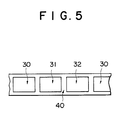
- the numeral 30 denotes an yellow ink area; 31, a magenta ink area; 32, a cyan ink area; and 40, the polyethylene terephthalate support.
- the polyethylene terephthalate support is provided with a heat-resistant slippery layer on its back side.
- dip coating was carried out so as to give 0.5 g of carbon black, 0.6 g of paraffin wax, 0.1 g of carnauba wax and 0.3 g of ethylene vinyl acetate to prepare an ink ribbon for thermofusible ink transfer recording.
Landscapes
- Engineering & Computer Science (AREA)
- Manufacturing & Machinery (AREA)
- Physics & Mathematics (AREA)
- Toxicology (AREA)
- Health & Medical Sciences (AREA)
- Chemical & Material Sciences (AREA)
- Chemical Kinetics & Catalysis (AREA)
- General Chemical & Material Sciences (AREA)
- General Health & Medical Sciences (AREA)
- Optics & Photonics (AREA)
- General Physics & Mathematics (AREA)
- Electromagnetism (AREA)
- Thermal Transfer Or Thermal Recording In General (AREA)
- Credit Cards Or The Like (AREA)
Applications Claiming Priority (2)
| Application Number | Priority Date | Filing Date | Title |
|---|---|---|---|
| JP293977/88 | 1988-11-21 | ||
| JP29397788 | 1988-11-21 |
Publications (2)
| Publication Number | Publication Date |
|---|---|
| EP0370367A2 true EP0370367A2 (fr) | 1990-05-30 |
| EP0370367A3 EP0370367A3 (fr) | 1991-09-18 |
Family
ID=17801646
Family Applications (1)
| Application Number | Title | Priority Date | Filing Date |
|---|---|---|---|
| EP19890121069 Withdrawn EP0370367A3 (fr) | 1988-11-21 | 1989-11-14 | Carte d'identité, livret d'identité et sa méthode de fabrication |
Country Status (2)
| Country | Link |
|---|---|
| US (1) | US5011570A (fr) |
| EP (1) | EP0370367A3 (fr) |
Families Citing this family (20)
| Publication number | Priority date | Publication date | Assignee | Title |
|---|---|---|---|---|
| WO1991017054A1 (fr) * | 1990-05-07 | 1991-11-14 | Dai Nippon Printing Co., Ltd. | Procede, dispositif et substance de formation d'images |
| JP2987648B2 (ja) * | 1991-04-22 | 1999-12-06 | コニカ株式会社 | ハロゲン化銀写真感光材料 |
| JPH04327998A (ja) * | 1991-04-26 | 1992-11-17 | Konica Corp | Idカードおよびその製造方法 |
| US5239314A (en) * | 1991-06-28 | 1993-08-24 | Dennison Manufacturing Company | Thermally inprintable media incorporating non-reusable adhesive |
| JP3004104B2 (ja) * | 1991-11-01 | 2000-01-31 | コニカ株式会社 | 画像記録方法および画像記録装置 |
| JPH05169692A (ja) * | 1991-12-19 | 1993-07-09 | Victor Co Of Japan Ltd | 熱転写印刷方法 |
| US5261987A (en) * | 1992-06-05 | 1993-11-16 | Eastman Kodak Company | Method of making an identification card |
| US5342672A (en) * | 1992-09-14 | 1994-08-30 | Weber Marking Systems, Inc. | Holographic thermal transfer ribbon |
| US5486397A (en) * | 1994-04-29 | 1996-01-23 | Polaroid Corporation | Protected reflection image |
| US6264321B1 (en) * | 1994-05-31 | 2001-07-24 | Eastman Kodak Company | Method of producing recorded images having enhanced durability on a variety of substrates |
| US6086707A (en) * | 1996-02-29 | 2000-07-11 | Raytheon Company | Method for making an identification document |
| US6220327B1 (en) * | 1998-04-27 | 2001-04-24 | Atlantek, Inc. | Apparatus for automated printing and assembly of passport booklets |
| US6221545B1 (en) | 1999-09-09 | 2001-04-24 | Imation Corp. | Adhesives for preparing a multilayer laminate featuring an ink-bearing surface bonded to a second surface |
| US6508171B1 (en) * | 2000-08-03 | 2003-01-21 | Chris Georges | Illuminated transparent article having a semi-transparent image thereon |
| US6958106B2 (en) * | 2003-04-09 | 2005-10-25 | Endicott International Technologies, Inc. | Material separation to form segmented product |
| US20080085775A1 (en) * | 2004-05-31 | 2008-04-10 | Kazuyoshi Kasai | Data Recording Medium and Game Device |
| US7763190B2 (en) * | 2005-04-07 | 2010-07-27 | Transilwrap Company, Inc. | Low-cost tough decorative printable film products having holographic-type images |
| EP1958790A1 (fr) * | 2007-02-19 | 2008-08-20 | Axalto SA | Document d'identification imprimé et procédé d'impression d'un tel document |
| WO2017025827A1 (fr) * | 2015-08-13 | 2017-02-16 | Assa Abloy Ab | Stratification par transfert |
| US20180170164A1 (en) * | 2016-12-21 | 2018-06-21 | Kate Wingard | Neoprene Protective Covers for Vehicles and Other Objects |
Family Cites Families (4)
| Publication number | Priority date | Publication date | Assignee | Title |
|---|---|---|---|---|
| BE792488A (fr) * | 1971-12-08 | 1973-03-30 | Dainippon Printing Co Ltd | Cartes d'identification et procede de fabrication de ces cartes |
| DE2546007B2 (de) * | 1975-10-14 | 1977-12-29 | Siemens AG, 1000 Berlin und 8000 München | Faelschungssichere ausweiskarte und verfahren zu ihrer herstellung |
| US4322461A (en) * | 1980-01-07 | 1982-03-30 | Polaroid Corporation | ID Card laminar structures and a method for preparation thereof using a transfered adhesive |
| US4653775A (en) * | 1985-10-21 | 1987-03-31 | Polaroid Corporation, Patent Dept. | Preprinted image-receiving elements for laminated documents |
-
1989
- 1989-11-13 US US07/435,945 patent/US5011570A/en not_active Expired - Fee Related
- 1989-11-14 EP EP19890121069 patent/EP0370367A3/fr not_active Withdrawn
Also Published As
| Publication number | Publication date |
|---|---|
| US5011570A (en) | 1991-04-30 |
| EP0370367A3 (fr) | 1991-09-18 |
Similar Documents
| Publication | Publication Date | Title |
|---|---|---|
| US5011570A (en) | ID card, ID booklet, and manufacturing method thereof | |
| US5322832A (en) | Image-receiving sheet for thermal-transfer recording medium | |
| AU691552B2 (en) | Image-receiving element for thermal dye transfer method | |
| JP3040716B2 (ja) | 画像記録体およびその製造方法 | |
| US5254525A (en) | Thermal transfer image recording material and method of its production | |
| CA1316039C (fr) | Feuille d'impression par transfert a chaud | |
| EP0431564B1 (fr) | Matériau d'enregistrement d'une image photographique. | |
| EP0755334B1 (fr) | Diapositive vierge | |
| JP3800568B2 (ja) | 保護層転写シート | |
| JP3707741B2 (ja) | Idカードおよびその作成方法 | |
| JP3207518B2 (ja) | 熱転写シート | |
| JPH04327998A (ja) | Idカードおよびその製造方法 | |
| JPH05504008A (ja) | 保護画像 | |
| WO1991007286A1 (fr) | Support recevant une image | |
| US6172002B1 (en) | Transfer-type laminate film for image protection, and thermal transfer ink sheet | |
| JPH05139059A (ja) | 医学診断像のハードコピーを得るための熱染料昇華転写受容材料 | |
| JP3012995B2 (ja) | Idカード及びid冊子並びにその作成装置 | |
| JPH04344289A (ja) | 画像記録体および画像記録体作成方法並びに画像記録体作成装置 | |
| JPH02223497A (ja) | Idカード及びid冊子並びにidカードの製造方法 | |
| JP2001010263A (ja) | 画像記録体及び画像記録体形成方法 | |
| JPH07117381A (ja) | Idカード | |
| JP3470243B2 (ja) | 認証識別カード | |
| JP3009101B2 (ja) | カード | |
| JP3121127B2 (ja) | Idカード | |
| JPH11277899A (ja) | 保護層転写シート |
Legal Events
| Date | Code | Title | Description |
|---|---|---|---|
| PUAI | Public reference made under article 153(3) epc to a published international application that has entered the european phase |
Free format text: ORIGINAL CODE: 0009012 |
|
| AK | Designated contracting states |
Kind code of ref document: A2 Designated state(s): DE GB |
|
| PUAL | Search report despatched |
Free format text: ORIGINAL CODE: 0009013 |
|
| AK | Designated contracting states |
Kind code of ref document: A3 Designated state(s): DE GB |
|
| 17P | Request for examination filed |
Effective date: 19920221 |
|
| 17Q | First examination report despatched |
Effective date: 19931004 |
|
| STAA | Information on the status of an ep patent application or granted ep patent |
Free format text: STATUS: THE APPLICATION HAS BEEN WITHDRAWN |
|
| 18W | Application withdrawn |
Withdrawal date: 19940111 |