EP0370446A2 - Polyoxyalkylendithiole und Polyamine enthaltende härtbare Epoxidharz-Stoffgemische - Google Patents
Polyoxyalkylendithiole und Polyamine enthaltende härtbare Epoxidharz-Stoffgemische Download PDFInfo
- Publication number
- EP0370446A2 EP0370446A2 EP89121472A EP89121472A EP0370446A2 EP 0370446 A2 EP0370446 A2 EP 0370446A2 EP 89121472 A EP89121472 A EP 89121472A EP 89121472 A EP89121472 A EP 89121472A EP 0370446 A2 EP0370446 A2 EP 0370446A2
- Authority
- EP
- European Patent Office
- Prior art keywords
- dithiol
- epoxy resin
- integer
- formula
- bis
- Prior art date
- Legal status (The legal status is an assumption and is not a legal conclusion. Google has not performed a legal analysis and makes no representation as to the accuracy of the status listed.)
- Granted
Links
Classifications
-
- C—CHEMISTRY; METALLURGY
- C08—ORGANIC MACROMOLECULAR COMPOUNDS; THEIR PREPARATION OR CHEMICAL WORKING-UP; COMPOSITIONS BASED THEREON
- C08G—MACROMOLECULAR COMPOUNDS OBTAINED OTHERWISE THAN BY REACTIONS ONLY INVOLVING UNSATURATED CARBON-TO-CARBON BONDS
- C08G65/00—Macromolecular compounds obtained by reactions forming an ether link in the main chain of the macromolecule
- C08G65/02—Macromolecular compounds obtained by reactions forming an ether link in the main chain of the macromolecule from cyclic ethers by opening of the heterocyclic ring
- C08G65/32—Polymers modified by chemical after-treatment
- C08G65/321—Polymers modified by chemical after-treatment with inorganic compounds
- C08G65/326—Polymers modified by chemical after-treatment with inorganic compounds containing sulfur
-
- C—CHEMISTRY; METALLURGY
- C08—ORGANIC MACROMOLECULAR COMPOUNDS; THEIR PREPARATION OR CHEMICAL WORKING-UP; COMPOSITIONS BASED THEREON
- C08G—MACROMOLECULAR COMPOUNDS OBTAINED OTHERWISE THAN BY REACTIONS ONLY INVOLVING UNSATURATED CARBON-TO-CARBON BONDS
- C08G59/00—Polycondensates containing more than one epoxy group per molecule; Macromolecules obtained by polymerising compounds containing more than one epoxy group per molecule using curing agents or catalysts which react with the epoxy groups
- C08G59/18—Macromolecules obtained by polymerising compounds containing more than one epoxy group per molecule using curing agents or catalysts which react with the epoxy groups ; e.g. general methods of curing
- C08G59/40—Macromolecules obtained by polymerising compounds containing more than one epoxy group per molecule using curing agents or catalysts which react with the epoxy groups ; e.g. general methods of curing characterised by the curing agents used
- C08G59/50—Amines
- C08G59/56—Amines together with other curing agents
-
- C—CHEMISTRY; METALLURGY
- C08—ORGANIC MACROMOLECULAR COMPOUNDS; THEIR PREPARATION OR CHEMICAL WORKING-UP; COMPOSITIONS BASED THEREON
- C08G—MACROMOLECULAR COMPOUNDS OBTAINED OTHERWISE THAN BY REACTIONS ONLY INVOLVING UNSATURATED CARBON-TO-CARBON BONDS
- C08G59/00—Polycondensates containing more than one epoxy group per molecule; Macromolecules obtained by polymerising compounds containing more than one epoxy group per molecule using curing agents or catalysts which react with the epoxy groups
- C08G59/18—Macromolecules obtained by polymerising compounds containing more than one epoxy group per molecule using curing agents or catalysts which react with the epoxy groups ; e.g. general methods of curing
- C08G59/40—Macromolecules obtained by polymerising compounds containing more than one epoxy group per molecule using curing agents or catalysts which react with the epoxy groups ; e.g. general methods of curing characterised by the curing agents used
- C08G59/66—Mercaptans
-
- C—CHEMISTRY; METALLURGY
- C08—ORGANIC MACROMOLECULAR COMPOUNDS; THEIR PREPARATION OR CHEMICAL WORKING-UP; COMPOSITIONS BASED THEREON
- C08G—MACROMOLECULAR COMPOUNDS OBTAINED OTHERWISE THAN BY REACTIONS ONLY INVOLVING UNSATURATED CARBON-TO-CARBON BONDS
- C08G65/00—Macromolecular compounds obtained by reactions forming an ether link in the main chain of the macromolecule
- C08G65/02—Macromolecular compounds obtained by reactions forming an ether link in the main chain of the macromolecule from cyclic ethers by opening of the heterocyclic ring
- C08G65/32—Polymers modified by chemical after-treatment
-
- C—CHEMISTRY; METALLURGY
- C08—ORGANIC MACROMOLECULAR COMPOUNDS; THEIR PREPARATION OR CHEMICAL WORKING-UP; COMPOSITIONS BASED THEREON
- C08L—COMPOSITIONS OF MACROMOLECULAR COMPOUNDS
- C08L63/00—Compositions of epoxy resins; Compositions of derivatives of epoxy resins
Definitions
- the invention relates to curable mixtures of epoxy resins, special polyoxyalkylene dithiols and polyamines with at least two primary amino groups, the crosslinked products obtainable therefrom and the use of the mixtures in particular for the production of sealing compounds and injection compounds.
- Epoxy resins are characterized by many good properties. However, hardened products have insufficient flexibility and toughness for certain applications. A large number of additives which have a flexibilizing effect are therefore described in the literature, including compounds containing thiol groups (see, for example, Lee and Neville "Handbook of Epoxy Resins", pages 16-21 to 16-30, McGraw-Hill, New York 1967). Of these, the liquid polysulfide polymers of the general formula received the most attention HS (CH2CH2OCH2OCH2CH2SS) n CH2CH2OCH2OCH2CH2SH, which are known under the trade name Thiokole® and are mostly used in combination with amine hardeners. Epoxy resins modified with such polysulfides and their properties are described in detail by KR Cranker and AJ Breslau in Industrial and Engineering Chemistry 48 : 1, 98-103 (1956).
- No. 3,090,798 describes polyesters containing mercaptan groups obtained by reacting mercapto alcohols, such as 2-mercaptoethanol, with polycarboxylic acids having at least 18 carbon atoms, in particular polymeric fatty acids, and the use of these products together with basic catalysts, preferably with tertiary amines, as hardeners for epoxy resins.
- the hardened systems have good mechanical and electrical properties, including increased flexibility.
- No. 3,352,810 also describes epoxy resins with improved flexibility which, in addition to the resin and the customary hardeners for epoxy resins, contain, as a flexibilizer, an ester of a mercaptocarboxylic acid with a polyol containing two or more SH groups.
- Preferred mercaptocarboxylic acids are thioglycolic acid or 3-mercaptopropionic acid
- preferred polyols are polyethylene glycols, polypropylene glycols and polypropylene triols.
- Primary, secondary and tertiary amines are used as hardeners.
- US 3,472,913 describes both hydroxyl and thiol group-containing polyethers with a molecular weight of at least 1000 and a theoretical thiol group to hydroxyl group ratio of greater than one.
- the number of thiol groups per molecule can vary as desired.
- These thiol group-containing polymers can be crosslinked with a variety of reagents, including epoxy resins. In the case of mixtures with epoxy resins, a basic catalyst, for example an amine, is preferably also used.
- the networked products are characterized by high toughness and elasticity.
- mixtures of substances containing (i) an epoxy resin, (ii) as a hardener for the epoxy resin, an amine with at least three H atoms which are bonded directly to an aliphatic or cycloaliphatic amine nitrogen atom, or certain tertiary amines, (iii) Polymercaptan and (iv) a polyene with at least two activated ethylenic double bonds.
- the substance mixtures are suitable as adhesives, which quickly form a rubber-like adhesive connection through the reaction of the polymercaptan with the polyene and then completely crosslink through the curing of the epoxy resin with the amine.
- mercaptan-terminated oxyalkylene compounds are also mentioned.
- No. 3,914,288 describes adducts obtained by reacting an epoxy resin with a polymercaptan with at least two SH groups, which are separated from one another by a chain of at least 6 carbon or carbon and oxygen atoms, and an amine. These adducts are used as hardeners for the production of flexible epoxy resins.
- Preferred polymercaptans for the preparation of the adducts are esters of mercaptocarboxylic acids and polyols, oligomers and polymers with repeating disulfide units, hydroxyl-containing polymercaptans obtained by reacting a chlorohydrin ether of a polyhydric alcohol with a hydrosulfide in an alcoholic medium, and polyesters containing thiol groups.
- DD 256 715 describes a process for the production of high-molecular thermoplastic epoxy-amine-dithiol polyadducts which are soluble in various solvents and have average molecular weights M n > 5000.
- Oxyalkylene dithiols, such as triglycol dithiol, are also used as the dithiol.
- the invention further relates to the crosslinked products obtainable by curing the mixture of substances. These are characterized by increased flexibility and tough elastic properties combined with still good strength and hardness values.
- epoxy resin (a) any compound customary in the art of epoxy resins can be used as epoxy resin (a).
- epoxy resins examples are:
- Polyglycidyl and poly ( ⁇ -methylglycidyl) esters obtainable by reacting a compound with at least two carboxyl groups in the molecule and epichlorohydrin or ⁇ -methyl-epichlorohydrin. The reaction is conveniently carried out in the presence of bases.
- Aliphatic polycarboxylic acids can be used as a compound having at least two carboxyl groups in the molecule.
- examples of these polycarboxylic acids are oxalic acid, succinic acid, glutaric acid, adipic acid, pimelic acid, suberic acid, azelaic acid or dimerized or trimerized linoleic acid.
- cycloaliphatic polycarboxylic acids can also be used, such as, for example, tetrahydrophthalic acid, 4-methyltetrahydrophthalic acid, hexahydrophthalic acid or 4-methylhexahydrophthalic acid.
- Aromatic polycarboxylic acids such as phthalic acid, isophthalic acid or terephthalic acid can also be used.
- Polyglycidyl or poly ( ⁇ -methylglycidyl) ether obtainable by reacting a compound with at least two free alcoholic hydroxyl groups and / or phenolic hydroxyl groups and epichlorohydrin or ⁇ -methylepichlorohydrin under alkaline conditions, or in the presence of an acidic catalyst and subsequent alkali treatment.
- Ethers of this type are derived, for example, from acyclic alcohols, such as ethylene glycol, diethylene glycol and higher poly (oxyethylene) glycols, propane-1,2-diol or poly (oxypropylene) glycols, propane-1,3-diol, butane-1,4 -diol, poly (oxytetramethylene) glycols, pentane-1,5-diol, hexane-1,6-diol, hexane-2,4,6-triol, glycerin, 1,1,1-trimethylolpropane, pentaerythritol, sorbitol, and of polyepichlorohydrins.
- acyclic alcohols such as ethylene glycol, diethylene glycol and higher poly (oxyethylene) glycols, propane-1,2-diol or poly (oxypropylene) glycols, propane-1,3-diol, butane-1,4 -d
- cycloaliphatic alcohols such as 1,4-cyclohexanedimethanol, bis (4-hydroxycyclohexyl) methane or 2,2-bis (4-hydroxycyclohexyl) propane, or they have aromatic nuclei, such as N, N-bis (2-hydroxyethyl) aniline or p, p'-bis (2-hydroxyethylamino) diphenylmethane.
- the epoxy compounds can also be derived from mononuclear phenols, such as, for example, resorcinol or hydroquinone; or they are based on polynuclear phenols, such as, for example, bis (4-hydroxyphenyl) methane, 4,4′-dihydroxybiphenyl, bis (4-hydroxyphenyl) sulfone, 1,1,2,2-tetrakis (4-hydroxyphenyl) ethane, 2, 2-bis (4-hydroxyphenyl) propane, 2,2-bis (3,5-dibromo-4-hydroxyphenyl) propane and novolaks obtainable by condensation of aldehydes such as formaldehyde, acetaldehyde, chloral or furfuraldehyde with phenols such as phenol , or with phenols, which are substituted in the core with chlorine atoms or C1-C im-alkyl groups, such as 4-chlorophenol, 2-methylphenol or 4-tert-butylphenol or by condensation with
- Poly (N-glycidyl) compounds obtainable by dehydrochlorination of the reaction products of epichlorohydrin with amines which contain at least two amine hydrogen atoms.
- amines are, for example, aniline, n-butylamine, bis (4-aminophenyl) methane, m-xylylenediamine or bis (4-methylaminophenyl) methane.
- poly (N-glycidyl) compounds also include triglycidyl isocyanurate, N, N'-diglycidyl derivatives of cycloalkylene ureas, such as ethylene urea or 1,3-propylene urea, and diglycidyl derivatives of hydantoins, such as of 5,5-dimethylhydantoin.
- Poly (S-glycidyl) compounds for example di-S-glycidyl derivatives, which are derived from dithiols, such as, for example, ethane-1,2-dithiol or bis (4-mercaptomethylphenyl) ether.
- Cycloaliphatic epoxy resins for example bis (2,3-epoxycyclopentyl) ether, 2,3-epoxycyclopentylglycidyl ether, 1,2-bis (2,3-epoxycyclopentyloxy) ethane or 3,4-epoxycyclohexylmethyl-3 ', 4'-epoxycyclohexane carboxylate.
- epoxy resins can also be used in which the 1,2-epoxy groups are bonded to different heteroatoms or functional groups; these compounds include, for example, the N, N, O-triglycidyl derivative of 4-aminophenol, the glycidyl ether glycidyl esters of salicylic acid, N-glycidyl-N ′ - (2-glycidyloxypropyl) -5,5-dimethylhydantoin or 2-glycidyloxy-1, 3-bis (5,5-dimethyl-1-glycidylhydantoin-3-yl) propane.
- these compounds include, for example, the N, N, O-triglycidyl derivative of 4-aminophenol, the glycidyl ether glycidyl esters of salicylic acid, N-glycidyl-N ′ - (2-glycidyloxypropyl) -5,5-dimethylhydantoin or 2-glycidyloxy
- Epoxy resins with an epoxy content of 2 to 10 equivalents / kg which are glycidyl ethers, glycidyl esters or N-glycidyl derivatives of aromatic, heterocyclic, cycloaliphatic or aliphatic compounds are preferably used.
- Polyglycidyl ethers of polyhydric phenols such as, for example, 2,2-bis (4-hydroxyphenyl) propane (bisphenol A) or bis (4-hydroxyphenyl) methane (bisphenol F), are particularly preferred as epoxy resins.
- epoxy resins are diglycidyl ethers of bisphenol A.
- the dithiols used as component (b) of the substance mixtures according to the invention are derived from polyoxyalkylene glycols. They can be obtained, for example, by reacting the corresponding polyoxyalkylene glycol with thionyl chloride to the corresponding dichloro derivative, followed by reaction of the dichloro derivative with thiourea and hydrolysis of the product to the desired dithiol.
- the reaction scheme can be represented as follows where R represents the polyoxyalkylene chain.
- the described conversion of alcohols to thiols is described, for example, in Organic Synthesis, Collective Volume 3, pages 698-700 and Collective Volume 4, pages 401-403, Wiley, Hew York 1955 and 1963, respectively.
- the starting compounds for the preparation of the dithiols (b) are commercially available in various molecular weight ranges.
- the dithiols of the formula I can be polyethylene glycol derivatives, polypropylene glycol derivatives or copolymers with oxyethylene and oxypropylene units.
- the copolymers can be block polymers or statistical polymers.
- the corresponding block polymers are sometimes also called polypropylene glycol ethoxylate or polyethylene glycol propoxylate, depending on whether they have terminal polyethylene glycol or polypropylene glycol blocks.
- the commercially available polypropylene glycols predominantly have secondary terminal hydroxyl groups, as is shown for the corresponding dithiols of the formula I. It goes without saying that polypropylene dithiols with primary thiol groups can also be used as component (b) of the substance mixtures according to the invention.
- the dithiols of the formula II which can be used according to the invention are derived from polytetrahydrofuran diols.
- Polytetrahydrofuran diols are known and are also commercially available. Examples of such products are Poly-THF 650®, Poly-THF 1000® or Poly-THF 2000® from BASF, which, after conversion to the corresponding dithiols, give compounds of the formula II where y is 7-8, 12-13 or 26- 27 correspond. These compounds are preferred among the dithiols of formula II.
- Dithiols of the formula I or II having a molecular weight are used in the substance mixtures according to the invention M n less than 2000, in particular less than 1000 preferred.
- Dithiols of the formula I in which x is an integer from 2 to 20, in particular from 2 to 12, and dithiols of the formula II in which y is an integer from 1 to 12, in particular from 2 to 8, are particularly preferred.
- the latter dithiol is also known as triglycol dimercaptan or 1,2-bis (2'-mercaptoethoxy) ethane.
- any amine having at least two primary amino groups i.e. at least 2 NH2 groups can be used.
- the amine can have two or more NH2 groups and can also contain secondary and / or tertiary amine nitrogen atoms.
- polyamines (c) are aliphatic, cycloaliphatic, aromatic and heterocyclic amines, such as bis (4-aminophenyl) methane, aniline-formaldehyde resins, bis (4-aminophenyl) sulfone, propane-1,3-diamine, 2,2 -Dimethyl-1,3-propanediamine (neopentanediamine), hexamethylenediamine, diethylenetriamine, bis (3-aminopropyl) amine, N, N-bis (3-aminopropyl) methylamine, triethylenetetramine, pentaethylene hexamine, 2,2,4-trimethylhexane-1, 6-diamine, m-xylylenediamine, 1,2- and 1,4-diaminocyclohexane, bis (4-aminocyclohexyl) methane, bis (4-amino-3-methylcyclohexyl) methane, 2,2-bis (4-
- glycidyl esters When using cycloaliphatic or aliphatic polyamines, preferably no glycidyl esters are used as the resin component.
- Preferred as component (c) of the substance mixtures according to the invention are aliphatic or cycloaliphatic polyamines.
- cycloaliphatic polyamines 3-aminomethyl-3,5,5-trimethylcyclohexylamine (isophoronediamine), bis (4-aminocyclohexyl) methane and Polyaminoimidazolines, such as the polyaminoimidazoline from Schering AG sold as Eurodur® 370.
- R2 is a straight-chain or branched C2-C10 alkylene radical
- a is an integer from 1-10, preferably 2
- b is an integer from 1-10, preferably 2-6
- c is independently an integer from 1 to 20, preferably 2 to 5
- f are an integer from 1 to 5
- g are an integer from 1 to 10, preferably 1 to 5
- R 3 is a trivalent radical of the formulas or in particular stands.
- the mixtures according to the invention can also contain smaller amounts, for example less than 50% by weight, of the polyamine (c) and other amines.
- An example of such an amine is 3- (N, N-dimethylaminopropyl) -3'-aminopropylamine.
- the mixtures of substances according to the invention can also contain curing accelerators, although mixtures without curing accelerators are preferred.
- curing accelerators are tertiary Amines, their salts or quaternary ammonium compounds, such as benzyldimethylamine, 2,4,6-tris (dimethylaminomethyl) phenol, 1-methylimidazole, 2-ethyl-4-methylimidazole, 4-aminopyridine, tripentylammonium phenolate or tetramethylammonium chloride; or alkali metal alcoholates, such as Na alcoholates of 2,4-dihydroxy-3-hydroxymethylpentane; or substituted ureas, such as N- (4-chlorophenyl) -N ', N'-dimethylurea or N- (3-chloro-4-methylphenyl) -N', N'-dimethylurea (chlorotoluron).
- the substance mixtures according to the invention can contain even smaller amounts, for example less than 50% by weight of the dithiol (b) of other di- or polythiols. However, preference is given to mixtures which contain only the compounds of the formula I or II as thiol component.
- the mixtures of substances according to the invention are generally cured even at low temperatures from about 0 ° C. to room temperature. If desired, curing can also be carried out, for example up to about 200 ° C., in particular at about 40 to 100 ° C., or if necessary post-curing.
- One of the advantages of the present mixtures of substances is that, depending on the choice of components (b) and (c) and, if appropriate, a curing accelerator and on the relative amount of components (b) and (c), the useful life of the curable mixtures is adjusted practically as desired can. The same applies to the properties of the hardened products.
- epoxy resin systems can be produced with a very wide range of flexibility and toughness.
- the total amount of hardener (b) plus (c) is preferably calculated so that it corresponds to the stoichiometrically required amount.
- the relative amounts of the components can vary widely.
- the amounts of components (b) and (c) used will also depend on the intended use, ie on the desired flexibility of the hardened product and on the desired duration of use of the mixture of substances. In space In general, both the flexibility and the service life increase with the increase in the relative amount of dithiol in the dithiol / polyamine mixture.
- the proportion of the hydrogen atoms bonded to the thiol groups of the dithiol (b) is 15-85, preferably 20-80, particularly preferably 25-75%, based on the total number of the thiol groups of the dithiol (b) and the active hydrogen atoms bonded to the amino groups of the polyamine (c).
- plasticizers can be added to the mixtures according to the invention to further increase flexibility.
- the invention thus also relates to mixtures which, in addition to components (a), (b) and (c), also contain (d) a plasticizer.
- plasticizers can be used.
- suitable plasticizers are phthalic acid esters, such as dibutyl phthalate, phosphoric acid esters, adipic and sebacic acid esters, glycols, glycolic acid esters or polyols.
- Benzyl alcohol and in particular 3-phenylpropanol have proven to be particularly suitable as plasticizers.
- the amount of the plasticizer (d) is preferably 4-25, in particular 6-20, parts by weight, based on 100 parts by weight of the epoxy resin (a).
- the curable mixtures for reducing the viscosity reactive diluents such as butanediol diglycidyl ether, monoglycidyl ethers of isomeric higher alcohols, such as Grilonit RV 1814® of the company. Ems-Chemie, or butyl glycidyl ether, 2,2,4-trimethylpentyl, phenyl glycidyl ether, cresyl glycidyl ether or glycidyl ester clog.
- the viscosity reactive diluents such as butanediol diglycidyl ether, monoglycidyl ethers of isomeric higher alcohols, such as Grilonit RV 1814® of the company. Ems-Chemie, or butyl glycidyl ether, 2,2,4-trimethylpentyl, phenyl glycidyl ether, cresyl glycidyl
- the substance mixtures according to the invention can also contain adhesion promoters.
- adhesion promoters can be used.
- Silanes such as e.g. ⁇ -glycidyloxypropyltrimethoxysilane (silane A-187 from Union Carbide) or ⁇ -mercaptopropyltrimethoxysilane (silane A-189 from Union Carbide) or titanium compounds such as tetraisopropyl-bis (dioctylphosphonato) titanate (KR 41B from Kenrich Petrochemical Inc. USA).
- the mixtures according to the invention may also include extenders, fillers and reinforcing agents, such as coal tar, bitumen, textile fibers, glass fibers, asbestos fibers, boron fibers, carbon fibers, mineral silicates, mica, quartz powder, aluminum oxide hydrate, bentonites, wollastonite, kaolin, Silica airgel or metal powder, e.g. Aluminum powder or iron powder, furthermore pigments and dyes, such as carbon black, oxide paints and titanium dioxide, flame retardants, thixotropic agents, flow control agents, such as silicones, waxes and stearates, some of which are also used as mold release agents, contain antioxidants and light stabilizers.
- extenders, fillers and reinforcing agents such as coal tar, bitumen, textile fibers, glass fibers, asbestos fibers, boron fibers, carbon fibers, mineral silicates, mica, quartz powder, aluminum oxide hydrate, bentonites, wollastonite, kaolin, Silica airgel or metal powder,
- mixtures of substances according to the invention can be prepared in a customary manner by mixing the components with the aid of known mixing units (stirrers, rollers).
- the hardened products are characterized by the advantageous properties described at the beginning. Cured epoxy resins with the flexibility and the viscoelastic properties of the products according to the invention were hitherto unknown. In addition, despite their high flexibility and toughness, the crosslinked products according to the invention also have excellent mechanical and thermal properties which are retained even after prolonged storage, even at elevated temperature. The networked products are also characterized by good chemical resistance.
- the mixtures according to the invention can be used, for example, as adhesives, matrix resins, lacquers, sealing compounds or injection compounds or quite generally for the production of hardened products. They can be adapted to the specific application lation, in the unfilled or filled state, for example as sealing compounds, paints, coating compositions, lacquers, immersion resins, casting resins, impregnating resins, laminating resins, matrix resins and adhesives.
- the invention therefore also relates to the use of the mixtures according to the invention for the production of sealing compounds, injection compounds, adhesives, tool resins, matrix resins, casting resins or coating compounds.
- This dithiol is prepared as described in (a) above.
- composition of the substance mixtures used in the examples and the properties of the hardened products can be seen from Tables 1 to 5.
- the roll peel strength was determined using ISO 4578-79.
- the tensile shear strength was determined using DIN 53283.
- the tear strength was determined by DIN 53,356th
- the glass transition temperature (Tg) was determined using a Mettler thermoanalytical system TA 3000.
- the Shore D hardness was determined using the FRANK hardness tester 38024.
- the gel time was determined using a "Beck-Koller Drying Recorder” from Hickle Laboratory Engineering Co, Gomshall, Surrey, GB.
- a freshly prepared resin / hardener mixture is applied to a glass plate (30 x 2.5 cm) with a layer thickness of approximately 200 ⁇ m.
- a 1 mm thick needle is moved vertically on the glass plate within 24 h from one end to the other of the glass plate (30 cm). As soon as the mixture begins to gel, the needle leaves clear marks on the glass plate. The time corresponding to the first visible traces is called the gel time.
- polyamines used in the mixtures and the plasticizers and adhesion promoters which may be used are shown in the following tables.
- Example 7 The mixture is then tested according to Example 7 after the hardener component consisting of the dithiol 1 and the amine 3 has been stored under the conditions specified below.
- the comparison values with freshly prepared hardener components are shown in Table 3 above.
- Property of the networked system Storage of the hardener component in daylight during 3 months at RT 6 months at RT 1 week at 50 ° C Elongation at break (%) 194 153 129
- Tensile strength (N / mm2) 18.3 21.5 20.9
- Example 27 Use of the curable mixtures as a flexible injection system and as a sealing compound
- Epoxy resin 1 100 g
- Epoxy resin 4 10.3 g
- Dithiol 1 29.6 g
- Amine 3 7.9 g
- Concrete prisms 4 x 4 x 16 cm are cut across the middle with a 2 mm wide diamond saw.
- the two parts of the concrete prisms are wrapped in a thin latex cover or plastic film and fastened in a PVC form so that a gap width of 1.5 mm or 15 mm is formed.
- the epoxy resin mixture which has a viscosity of 300 to 2000 mPa ⁇ s, is injected with a cannula into the 1.5 mm wide column.
- the fresh epoxy resin mixture with 3% by weight Aerosil, based on the total weight is thixotroped and then applied in the 15 mm wide column.
- composition II Composition II:
- compositions I and II are used to coat sandblasted steel sheets (layer thickness approx. 200 ⁇ m) and to store them in the respective medium for the time specified in the table.
- A attacked (blistering noticeable)
- Z destroyed (coating is so badly attacked that it no longer adheres).
- Examples 29-31 Epoxy resin substance mixtures containing polytetrahydrofuran dithiols A or B, or the polyethylene glycol dithiol D.
Landscapes
- Chemical & Material Sciences (AREA)
- Health & Medical Sciences (AREA)
- Chemical Kinetics & Catalysis (AREA)
- Medicinal Chemistry (AREA)
- Polymers & Plastics (AREA)
- Organic Chemistry (AREA)
- General Chemical & Material Sciences (AREA)
- Inorganic Chemistry (AREA)
- Epoxy Resins (AREA)
- Compositions Of Macromolecular Compounds (AREA)
- Organic Low-Molecular-Weight Compounds And Preparation Thereof (AREA)
- Polymers With Sulfur, Phosphorus Or Metals In The Main Chain (AREA)
Abstract
- (a) ein Epoxidharz,
- (b) ein Dithiol der Formel I oder II
 CH₂CH₂CH₂CH₂SH (II)
worin R¹ unabhängig voneinander Wasserstoff oder Methyl, x eine ganze Zahl von 2 bis 50 und y eine ganze Zahl von 1 bis 30 bedeuten, und - (c) ein Polyamin mit mindestens zwei primären Aminogruppen
Description
- Die Erfindung betrifft härtbare Stoffgemische aus Epoxidharzen, speziellen Polyoxyalkylendithiolen und Polyaminen mit mindestens zwei primären Aminogruppen, die daraus erhältlichen vernetzten Produkte sowie die Verwendung der Gemische insbesondere für die Herstellung von Dichtungsmassen und Injektionsmassen.
- Epoxidharze zeichnen sich durch viele gute Eigenschaften aus. Allerdings weisen gehärtete Produkte für gewisse Anwendungen ungenügende Flexiblität und Zähigkeit auf. Eine Vielzahl von Zusätzen, welche flexibilisierend wirken, ist daher in der Literatur beschrieben, darunter auch Thiolgruppen enthaltende Verbindungen (vgl. z.B. Lee und Neville "Handbook of Epoxy Resins", Seite 16-21 bis 16-30, McGraw-Hill, New York 1967). Darunter fanden am meisten Beachtung die flüssigen Polysulfidpolymere der allgemeinen Formel
HS(CH₂CH₂OCH₂OCH₂CH₂SS)nCH₂CH₂OCH₂OCH₂CH₂SH,
welche unter dem Handelsnamen Thiokole® bekannt sind und meistens in Kombination mit Aminhärtern verwendet werden. Mit solchen Polysulfiden modifizierte Epoxidharze und deren Eigenschaften werden von K.R. Cranker und A.J. Breslau in Industrial and Engineering Chemistry 48:1, 98 - 103 (1956) ausführlich beschrieben. - Die US 3,090,798 beschreibt Mercaptangruppen enthaltende Polyester erhalten durch Umsetzung von Mercaptoalkoholen, wie z.B. 2-Mercaptoethanol, mit Polycarbonsäuren mit mindestens 18 C-Atomen, insbesondere polymeren Fettsäuren, sowie die Verwendung dieser Produkte zusammen mit basischen Katalysatoren, vorzugsweise mit tertiären Aminen, als Härter für Epoxidharze. Die gehärteten Systeme weisen gute mechanische und elektrische Eigenschaften, u.a. auch eine erhöhte Flexibilität, auf.
- Auch die US 3,352,810 beschreibt Epoxidharze mit verbesserter Flexibilität, welche neben dem Harz und den üblichen Härtern für Epoxidharze als Flexibilisator einen zwei oder mehrere SH-Gruppen enthaltenden Ester einer Mercaptocarbonsäure mit einem Polyol enthalten. Bevorzugte Mercaptocarbonsäuren sind Thioglykolsäure oder 3-Mercaptopropionsäure, und bevorzugte Polyole sind Polyethylenglykole, Polypropylenglykole und Polypropylentriole. Als Härter werden unter anderem primäre, sekundäre und tertiäre Amine eingesetzt.
- Die US 3,472,913 beschreibt sowohl Hydroxyl- als auch Thiolgruppen enthaltende Polyether mit einem Molekulargewicht von mindestens 1000 und einem theoretischen Thiolgruppen zu Hydroxylgruppen Mengenverhältnis von grösser als eins. Die Anzahl der Thiolgruppen pro Molekül kann dabei beliebig variieren. Diese Thiolgruppen enthaltenden Polymere können mit einer Vielzahl von Reagenzien, darunter auch mit Epoxidharzen, vernetzt werden. Bei Gemischen mit Epoxidharzen wird vorzugsweise noch ein basischer Katalysator, beispielsweise ein Amin, verwendet. Die vernetzten Produkte zeichnen sich durch hohe Zähigkeit und Dehnbarkeit aus.
- In der US 4,126,305 werden Stoffgemische enthaltend (i) ein Epoxidharz, (ii) als Härter für das Epoxidharz ein Amin mit mindestens drei H-Atomen, welche direkt an ein aliphatisches oder cycloaliphatisches Aminstickstoffatom gebunden sind, oder bestimmte tertiäre Amine, (iii) ein Polymercaptan und (iv) ein Polyen mit mindestens zwei aktivierten ethylenischen Doppelbindungen beschrieben. Die Stoffgemische eignen sich als Klebstoffe, welche durch die Umsetzung des Polymercaptans mit dem Polyen schnell eine gummiartige Klebeverbindung bilden und dann durch die Härtung des Epoxidharzes mit dem Amin vollständig vernetzen. Unter einer Vielzahl von Polymercaptanen, wie mercaptanhaltige Polyester, mercaptanendständige Sulfide, mercaptanendständige Polybutadiene oder Butadien-Acrylnitril-Copolymere und Poly(monomercaptancarboxylate), welche als Komponente (iii) verwendet werden können, werden auch mercaptanendständige Oxyalkylenverbindungen erwähnt.
- Die US 3,914,288 beschreibt Addukte erhalten durch Umsetzung eines Epoxidharzes mit einem Polymercaptan mit mindestens zwei SH-Gruppen, welche durch eine Kette von mindestens 6 Kohlenstoff- oder Kohlenstoff-und Sauerstoffatomen voneinander getrennt sind, und einem Amin. Diese Addukte werden als Härter für die Herstellung von flexiblen Epoxidharzen eingesetzt. Für die Herstellung der Addukte bevorzugte Polymercaptane sind Ester von Mercaptocarbonsäuren und Polyolen, Oligomere und Polymere mit sich wiederholenden Disulfideinheiten, hydroxylgruppenhaltige Polymercaptane, erhalten durch Umsetzung eines Chlorhydrinethers eines mehrwertigen Alkohols mit einem Hydrosulfid in alkoholischem Medium, sowie thiolgruppenhaltige Polyester.
- Die DD 256 715 beschreibt ein Verfahren zur Herstellung von hochmolekularen thermoplastischen Epoxid-Amin-Dithiol-Polyaddukten, die in verschiedenen Lösungsmitteln löslich sind und mittlere Molekülmassen
M n > 5000 aufweisen. Als Dithiol werden auch Oxyalkylendithiole, wie z.B. Triglykoldithiol, eingesetzt. - Trotz der vielen im Stand der Technik vorgeschlagenen Lösungen vermag keine die Schwierigkeiten bei der Herstellung von flexiblen, zähelastischen Systemen auf Epoxidharzbasis voll zu bewältigen.
- Gegenstand vorliegender Erfindung sind härtbare Stoffgemische enthaltend
- (a) ein Epoxidharz,
- (b) ein Dithiol der Formel I oder II
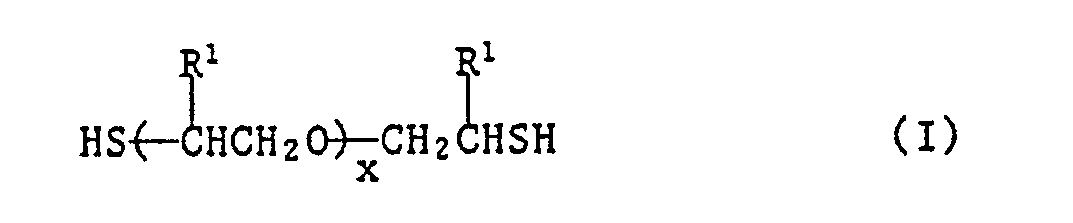 CH₂CH₂CH₂CH₂SH (II),
worin R¹ unabhängig voneinander Wasserstoff oder Methyl, x eine ganze Zahl von 2 bis 50 und y eine ganze Zahl von 1 bis 30 bedeuten, und - (c) ein Polyamin mit mindestens zwei primären Aminogruppen.
- Ein weiterer Gegenstand der Erfindung sind die durch Härtung des Stoffgemisches erhältlichen vernetzten Produkte. Diese zeichnen sich durch erhöhte Flexibilität und zähelastische Eigenschaften kombiniert mit noch immer guten Festigkeits- und Härte-Werten aus.
- Als Epoxidharz (a) kann im Prinzip jede in der Technik der Epoxidharze übliche Verbindung eingesetzt werden.
- I) Polyglycidyl- und Poly(β-methylglycidyl)ester erhältlich durch Umsetzung einer Verbindung mit mindestens zwei Carboxylgruppen im Molekül und Epichlorhydrin bzw. β-Methyl-epichlorhydrin. Die Umsetzung erfolgt zweckmässig in der Gegenwart von Basen.
- Als Verbindung mit mindestens zwei Carboxylgruppen im Molekül können aliphatische Polycarbonsäuren verwendet werden. Beispiele für diese Polycarbonsäuren sind Oxalsäure, Bernsteinstäure, Glutarsäure, Adipinsäure, Pimelinsäure, Korksäure, Azelainsäure oder dimerisierte bzw. trimerisierte Linolsäure.
- Es können aber auch cycloaliphatische Polycarbonsäuren eingesetzt werden, wie beispielsweise Tetrahydrophthalsäure, 4-Methyltetrahydrophthalsäure, Hexahydrophthalsäure oder 4-Methylhexahydrophthalsäure.
- Weiterhin können aromatische Polycarbonsäuren Verwendung finden, wie beispielsweise Phthalsäure, Isophthalsäure oder Terephthalsäure.
- II) Polyglycidyl- oder Poly(β-methylglycidyl)ether erhältlich durch Umsetzung einer Verbindung mit mindestens zwei freien alkoholischen Hydroxygruppen und/oder phenolischen Hydroxygruppen und Epichlorhydrin oder β-Methylepichlorhydrin unter alkalischen Bedingungen, oder in Anwesenheit eines sauren Katalysators und anschliessende Alkalibehandlung.
- Ether dieses Typs leiten sich beispielsweise ab von acyclischen Alkoholen, wie Ethylenglykol, Diethylenglykol und höheren Poly(oxyethylen)glykolen, Propan-1,2-diol oder Poly(oxypropylen)glykolen, Propan-1,3-diol, Butan-1,4-diol, Poly(oxytetramethylen)glykolen, Pentan-1,5-diol, Hexan-1,6-diol, Hexan-2,4,6-triol, Glycerin, 1,1,1-Trimethylolpropan, Pentaerythrit, Sorbit, sowie von Polyepichlorhydrinen.
- Sie leiten sich aber auch beispielsweise ab von cycloaliphatischen Alkoholen, wie 1,4-Cyclohexandimethanol, Bis(4-hydroxycyclohexyl)methan oder 2,2-Bis(4-hydroxycyclohexyl)propan, oder sie besitzen aromatische Kerne, wie N,N-Bis(2-hydroxyethyl)anilin oder p,p′-Bis(2-hydroxyethylamino)diphenylmethan.
- Die Epoxidverbindungen können sich auch von einkernigen Phenolen ableiten, wie beispielsweise von Resorcin oder Hydrochinon; oder sie basieren auf mehrkernigen Phenolen, wie beispielsweise Bis(4-hydroxyphenyl)methan, 4,4′-Dihydroxybiphenyl, Bis(4-hydroxyphenyl)sulfon, 1,1,2,2-Tetrakis(4-hydroxyphenyl)ethan, 2,2-Bis(4-hydroxyphenyl)propan, 2,2-Bis(3,5-dibrom-4-hydroxyphenyl)propan sowie von Novolaken erhältlich durch Kondensation von Aldehyden, wie Formaldehyd, Acetaldehyd, Chloral oder Furfuraldehyd, mit Phenolen, wie Phenol, oder mit Phenolen, die im Kern mit Chloratomen oder C₁-C₉-Alkylgruppen substituiert sind, wie beispielsweise 4-Chlorphenol, 2-Methylphenol oder 4-tert-Butylphenol oder durch Kondensation mit Bisphenolen, so wie oben beschrieben.
- III) Poly(N-glycidyl)verbindungen erhältlich durch Dehydrochlorierung der Reaktionsprodukte von Epichlorhydrin mit Aminen, die mindestens zwei Aminwasserstoffatome enthalten. Bei diesen Aminen handelt es sich zum Beispiel um Anilin, n-Butylamin, Bis(4-aminophenyl)methan, m-Xylylendiamin oder Bis(4-methylaminophenyl)methan.
- Zu den Poly(N-glycidyl)verbindungen zählen aber auch Triglycidylisocyanurat, N,N′-Diglycidylderivate von Cycloalkylenharnstoffen, wie Ethylenharnstoff oder 1,3-Propylenharnstoff, und Diglycidylderivate von Hydantoinen, wie von 5,5-Dimethylhydantoin.
- IV) Poly(S-glycidyl)verbindungen, beispielsweise Di-S-glycidylderivate, die sich von Dithiolen, wie beispielsweise Ethan-1,2-dithiol oder Bis( 4-mercaptomethylphenyl)ether ableiten.
- V) Cycloaliphatische Epoxidharze, beispielsweise Bis(2,3-epoxycyclopentyl)ether, 2,3-Epoxycyclopentylglycidylether, 1,2-Bis(2,3-epoxycyclopentyloxy)ethan oder 3,4-Epoxycyclohexylmethyl-3′,4′-epoxycyclohexancarboxylat.
- Es lassen sich aber auch Epoxidharze verwenden, bei denen die 1,2-Epoxidgruppen an unterschiedliche Heteroatome bzw. funktionelle Gruppen gebunden sind; zu diesen Verbindungen zählen beispielsweise das N,N,O-Triglycidylderivat des 4-Aminophenols, der Glycidylether-glycidylester der Salicylsäure, N-Glycidyl-N′-(2-glycidyloxypropyl)-5,5-dimethylhydantoin oder 2-Glycidyloxy-1,3-bis(5,5-dimethyl-1-glycidylhydantoin- 3-yl)propan.
- Bevorzugt verwendet werden Epoxidharze mit einem Epoxidgehalt von 2 bis 10 Aequivalenten/kg, welche Glycidylether, Glycidylester oder N-Glycidylderivate von aromatischen, heterocyclischen, cycloaliphatischen oder aliphatischen Verbindungen sind.
- Besonders bevorzugt als Epoxidharze werden Polyglycidylether von mehrwertigen Phenolen, wie beispielsweise von 2,2-Bis(4-hydroxyphenyl)propan (Bisphenol A) oder Bis(4-hydroxyphenyl)methan (Bisphenol F).
- Am meisten bevorzugt als Epoxidharze werden Diglycidylether von Bisphenol A.
- Die als Komponente (b) der erfindungsgemässen Stoffgemische verwendeten Dithiole werden von Polyoxyalkylenglykolen abgeleitet. Sie können zum Beispiel durch Umsetzung des entsprechenden Polyoxyalkylenglykols mit Thionylchlorid zum entsprechenden Dichlorderivat, gefolgt von Reaktion des Dichlorderivats mit Thioharnstoff und Hydrolyse des Produkts zum gewünschten Dithiol erhalten werden. Das Reaktionsschema kann wie folgt dargestellt werden

- Die Ausgangsverbindungen für die Herstellung der Dithiole (b) sind im Handel in verschiedenen Molekulargewichtsbereichen erhältlich.
- Bei den Dithiolen der Formel I kann es sich um Polyethylenglykol-Derivate, um Polypropylenglykol-Derivate oder auch um Copolymere mit Oxyethylen- und Oxypropyleneinheiten handeln. Die Copolymere können Blockpolymere oder statistische Polymere sein. Die entsprechenden Blockpolymere werden manchmal auch Polypropylenglykolethoxylat bzw. Polyethylenglykolpropoxylat genannt, je nachdem, ob sie endständige Polyethylenglykol- oder Polypropylenglykolblöcke aufweisen. Die im Handel erhältlichen Polypropylenglykole weisen vorwiegend sekundäre endständige Hydroxylgruppen auf, wie dies für die entsprechenden Dithiole der Formel I dargestellt ist. Es versteht sich von selber, dass auch Polypropylen-Dithiole mit primären Thiolgruppen als Komponente (b) der erfindungsgemässen Stoffgemische verwendet werden können. Die erfindungsgemäss verwendbaren Dithiole der Formel II werden von Polytetrahydrofurandiolen abgeleitet. Polytetrahydrofurandiole sind bekannt und auch im Handel erhältlich. Beispiele solcher Produkte sind Poly-THF 650®, Poly-THF 1000® oder Poly-THF 2000® der BASF, welche nach der Umsetzung zu den entsprechenden Dithiolen Verbindungen der Formel II mit y gleich 7-8, 12-13 bzw. 26-27 entsprechen. Diese Verbindungen werden unter den Dithiolen der Formel II bevorzugt.
- In den erfindungsgemässen Stoffgemischen werden Dithiole der Formel I oder II mit einem Molekulargewicht
M n kleiner als 2000, insbesondere kleiner als 1000 bevorzugt. - Besonders bevorzugt werden Dithiole der Formel I, worin x eine ganze Zahl von 2 bis 20, insbesondere von 2 bis 12 ist, sowie Dithiole der Formel II, worin y eine ganze Zahl von 1 bis 12, insbesondere von 2 bis 8 bedeutet.
- Am meisten bevorzugt wird das Dithiol der Formel I, worin R¹ Wasserstoff und x=7-8 und insbesondere 2 bedeuten. Das letztgenannte Dithiol ist auch als Triglykoldimercaptan oder 1,2-Bis(2′-Mercaptoethoxy)ethan bekannt.
- Als Polyamin-Komponente (c) der erfindungsgemässen Stoffgemische kann jedes beliebige Amin mit mindestens zwei primären Aminogruppen, d.h. mindestens 2 NH₂-Gruppen, verwendet werden. Das Amin kann zwei oder auch mehrere NH₂-Gruppen aufweisen und kann auch noch sekundäre und/oder tertiäre Amin-Stickstoffatome enthalten.
- Beispiele für Polyamine (c) sind aliphatische, cycloaliphatische, aromatische und heterocyclische Amine, wie Bis(4-aminophenyl)methan, Anilin-Formaldehyd-Harze, Bis(4-aminophenyl)sulfon, Propan-1,3-diamin, 2,2-Dimethyl-1,3-propandiamin (Neopentandiamin), Hexamethylendiamin, Diethylentriamin, Bis(3-aminopropyl)amin, N,N-Bis(3-aminopropyl)methylamin, Triethylentetramin, Pentaethylenhexamin, 2,2,4-Trimethylhexan-1,6-diamin, m-Xylylendiamin, 1,2- und 1,4-Diaminocyclohexan, Bis(4-aminocyclohexyl)methan, Bis(4-amino-3-methylcyclohexyl)methan, 2,2-Bis(4-aminocyclohexyl)propan und 3-Aminomethyl-3,5,5-trimethylcyclohexylamin (Isophorondiamin), Polyaminoimidazoline sowie Polyaminoamide, wie beispielsweise solche aus aliphatischen Polyaminen und dimerisierten oder trimerisierten Fettsäuren. Geeignete Polyamine (c) sind auch die als Jeffamine® bekannten Polyoxyalkylenamine der Firma Texaco, wie z.B. Jeffamine® EDR 148, D 230, D 400 oder T 403.
- Bei Verwendung von cycloaliphatischen oder aliphatischen Polyaminen werden vorzugsweise keine Glycidylester als Harzkomponente eingesetzt.
- Bevorzugt als Komponente (c) der erfindungsgemässen Stoffgemische sind aliphatische oder cycloaliphatische Polyamine. Unter den cycloaliphatischen Polyaminen besonders bevorzugt sind 3-Aminomethyl-3,5,5-trimethylcyclohexylamin (Isophorondiamin), Bis(4-aminocyclohexyl)methan und Polyaminoimidazoline, wie bispielsweise das als Eurodur® 370 vertriebene Polyaminoimidazolin der Firma Schering AG. Unter den aliphatischen Polyaminen (c) werden Verbindungen der Formeln IV bis IX bevorzugt


- Neben den Polyaminen (c) mit mindestens 2 NH₂-Gruppen können die erfindungsgemässen Gemische auch kleinere Mengen, beispielsweise weniger als 50 Gew. % des Polyamins (c), anderer Amine enthalten. Ein Beispiel eines solchen Amins ist 3-(N,N-Dimethylaminopropyl)-3′-aminopropylamin.
- Die erfindungsgemässen Stoffgemische können, falls erwünscht, auch Härtungsbeschleuniger enthalten, obwohl Gemische ohne Härtungsbeschleuniger bevorzugt werden. Beispiele für Härtungsbeschleuniger sind tertiäre Amine, deren Salze oder quaternäre Ammoniumverbindungen, wie Benzyldimethylamin, 2,4,6-Tris(dimethylaminomethyl)phenol, 1-Methylimidazol, 2-Ethyl-4-methylimidazol, 4-Aminopyridin, Tripentylammoniumphenolat oder Tetramethylammoniumchlorid; oder Alkalimetallalkoholate, wie Na-Alkoholate von 2,4-Dihydroxy-3-hydroxymethylpentan; oder substituierte Harnstoffe, wie N-(4-Chlorphenyl)-N′,N′-dimethylharnstoff oder N-(3-Chlor-4-methylphenyl)-N′,N′-dimethylharnstoff (Chlortoluron).
- Zusätzlich zu den Dithiolen (b) der Formel I oder II können die erfindungsgemässen Stoffgemische noch kleinere Mengen, beispielsweise weniger als 50 Gew.% des Dithiols (b) anderer Di- oder Polythiole enthalten. Bevorzugt werden aber Gemische, welche als Thiolkomponente nur die Verbindungen der Formel I oder II enthalten.
- Die Härtung der erfindungsgemässen Stoffgemische erfolgt im allgemeinen bereits bei tiefen Temperaturen von etwa 0°C bis Raumtemperatur. Falls erwünscht, kann auch bei höherer Temperatur beispielsweise bis zu etwa 200°C, insbesondere bei etwa 40 bis 100°C gehärtet oder gegebenenfalls nachgehärtet werden. Einer der Vorzüge der vorliegenden Stoffgemische ist, dass man je nach Wahl der Komponenten (b) und (c) und gegebenenfalls eines Härtungsbeschleunigers sowie je nach der relativen Menge der Komponenten (b) und (c) praktisch nach Belieben die Gebrauchsdauer der härtbaren Gemische einstellen kann. Dasselbe trifft auch für die Eigenschaften der gehärteten Produkte zu. Je nach Art und der relativen Menge des Dithiols (b) und des Polyamins (c) können Epoxidharzsysteme mit einer sehr breiten Spanne an Flexibilität und Zähigkeit hergestellt werden. Die Gesamtmenge des Härters (b) plus (c) wird vorzugsweise so berechnet, dass sie der stöchiometrisch benötigten Menge entspricht.
- Je nach Art des eingesetzten Epoxidharzes (a) bzw. dessen Epoxidäquivalents, sowie des verwendeten Dithiols (b) und Polyamins (c) können die relativen Mengen der Komponenten sehr stark variieren. Die eingesetzten Mengen der Komponenten (b) und (c) werden auch vom Anwendungszweck, d.h. von der erwünschten Flexibilität des gehärteten Produktes sowie von der gewünschten Gebrauchsdauer des Stoffgemisches abhängen. Im all gemeinen steigt sowohl die Flexibilität als auch die Gebrauchsdauer mit der Erhöhung der relativen Menge des Dithiols im Dithiol/Polyamin-Gemisch.
- Als besonders geeignet haben sich 5 - 30, vorzugsweise 10 - 25 Gew. % des Dithiols (b) und 3 - 35, vorzugsweise 5 - 20 Gew.% des Polyamins (c), bezogen auf die Gesamtmenge der Komponenten (a), (b) und (c), erwiesen.
- Besonders gute Eigenschaften der gehärteten Produkte werden auch erzielt, wenn der Anteil der an die Thiolgruppen des Dithiols (b) gebundenen Wasserstoffatome 15 - 85, vorzugsweise 20 - 80, besonders bevorzugt 25 - 75 %, bezogen auf die Gesamtzahl der an die Thiolgruppen des Dithiols (b) und der an die Aminogruppen des Polyamines (c) gebundenen aktiven Wasserstoffatome beträgt.
- Falls gewünscht, kann man den erfindungsgemässen Gemischen zur weiteren Erhöhung der Flexibilität noch Weichmacher zugeben. Gegenstand der Erfindung sind somit auch Gemische, welche zusätzlich zu den Komponenten (a), (b) und (c) noch (d) einen Weichmacher enthalten. Dabei können alle in der Technik als Weichmacher bekannte Verbindungen eingesetzt werden. Beispiele geeigneter Weichmacher sind Phthalsäureester, wie Dibutylphthalat, Phosphorsäureester, Adipin- und Sebacinsäureester, Glykole, Glykolsäureester oder Polyole.
- Besonders geeignet als Weichmacher haben sich Benzylalkohol und insbesondere 3-Phenylpropanol erwiesen.
- Die Menge des Weichmachers (d) beträgt vorzugsweise 4 - 25, insbesondere 6 - 20 Gewichtsteile, bezogen auf 100 Gewichtsteile des Epoxidharzes (a).
- Gewünschtenfalls kann man den härtbaren Gemischen zur Herabsetzung der Viskosität reaktive Verdünner, wie z.B. Butandioldiglycidylether, Monoglycidylether isomerer höherer Alkohole, wie z.B. Grilonit RV 1814® der Fa. Ems-Chemie oder Butylglycidylether, 2,2,4-Trimethylpentylglycidylether, Phenylglycidylether, Kresylglycidylether oder Glycidylester zusetzen.
- Die erfindungsgemässen Stoffgemische können auch Haftvermittler enthalten. Im Prinzip kann jeder bekannte Haftvermittler verwendet werden. Als besonders geeignete Haftvermittler haben sich Silane, wie z.B. γ-Glycidyloxypropyltrimethoxysilan (Silan A-187 der Fa. Union Carbide) oder γ-Mercaptopropyltrimethoxysilan (Silan A-189 der Fa. Union Carbide) oder Titanverbindungen, wie Tetraisopropyl-bis(dioctylphosphonato)-titanat (KR 41B der Fa. Kenrich Petrochemicals, Inc. USA), erwiesen.
- Als weitere übliche Zusätze können die erfindungsgemässen Gemische ferner Streck-, Füll- und Verstärkungsmittel, wie beispielsweise Steinkohlenteer, Bitumen, Textilfasern, Glasfasern, Asbestfasern, Borfasern, Kohlenstoff-Fasern, mineralische Silikate, Glimmer, Quarzmehl, Aluminiumoxidhydrat, Bentonite, Wollastonit, Kaolin, Kieselsäureaerogel oder Metallpulver, z.B. Aluminiumpulver oder Eisenpulver, ferner Pigmente und Farbstoffe, wie Russ, Oxidfarben und Titandioxid, Flammschutzmittel, Thixotropiemittel, Verlaufmittel ("flow control agents"), wie Silicone, Wachse und Stearate, die zum Teil auch als Formtrennmittel Anwendung finden, Antioxidantien und Lichtschutzmittel enthalten.
- Die Herstellung der erfindungsgemässen Stoffgemische kann in üblicher Weise durch Vermischen der Komponenten mit Hilfe bekannter Mischaggregate (Rührer, Walzen) erfolgen.
- Die gehärteten Produkte zeichnen sich durch die eingangs geschilderten vorteilhaften Eigenschaften aus. Ausgehärtete Epoxidharze mit der Flexibilität und den zähelastischen Eigenschaften der erfindungsgemässen Produkte waren bisher nicht bekannt. Zudem weisen die erfindungsgemässen vernetzten Produkte trotz ihrer hohen Flexibilität und Zähelastizität auch hervorragende mechanische und thermische Eigenschaften auf, welche auch nach längerer Lagerung, auch bei erhöhter Temperatur erhalten bleiben. Die vernetzten Produkte zeichnen sich auch durch gute Chemikalienbeständigkeit aus.
- Die erfindungsgemässen Gemische lassen sich beispielsweise als Klebstoffe, Matrixharze, Lacke, Dichtungsmassen oder Injektionmassen oder ganz allgemein zur Herstellung von gehärteten Produkten verwenden. Sie können in jeweils dem speziellen Anwendungsgebiet angepasster Formu lierung, in ungefülltem oder gefülltem Zustand, z.B. als Dichtungsmassen, Anstrichmittel, Beschichtungsmassen, Lacke, Tauchharze, Giessharze, Imprägnierharze, Laminierharze, Matrixharze und Klebemittel verwendet werden.
- Die Erfindung betrifft daher auch die Verwendung der erfindungsgemässen Gemische für die Herstellung von Dichtungsmassen, Injektionsmassen, Klebstoffen, Werkzeugharzen, Matrixharzen, Giessharzen oder Beschichtungsmassen.
- Die folgenden Beispiele erläutern die Erfindung.
Beispiele
Herstellungsbeispiel H1:
a) Herstellung der Polytetrahydrofurandithiole A-C
HS(̵CH₂CH₂CH₂CH₂O)̵CH₂CH₂CH₂CH₂-SH
- Zu 1 mol des entsprechenden Poly-THF (Handelsprodukt der BASF AG) und 1 ml Pyridin werden bei 40-50°C unter N₂ 500 ml Thionylchlorid zugetropft. Die klare, gelbliche Lösung wird 6 Stunden bei 80°C am Rückfluss gekocht. Ueberschüssiges Thionylchlorid wird im Vakuum abdestilliert und das gelbe viskose Poly-THF-Dichlorid am Hochvakuum bei 80°C getrocknet. Das auf diese Weise erhaltene Poly-THF-Dichlorid wird zu einer siedenden Lösung von 2,2 mol Thioharnstoff in 650 ml 95 % Ethylalkohol getropft und über Nacht bei 76°C am Rückfluss gekocht. Anschliessend wird der Ethylalkohol abdestilliert und der viskose Rückstand mit 0,5 g Benzyltrimethylammoniumchlorid und 600 ml 6H NaOH-Lösung versetzt. Es wird 2 Stunden bei 95°C gekocht, dann auf 600 abgekühlt und portionenweise mit 32 % HCl auf pH = 2 angesäuert. Nach Abkühlen auf Raumtemperatur wird mit 750 ml Ethylacetat versetzt, die Phasen werden getrennt, die organische Phase wird mit H₂O gewaschen, über Na₂SO₄ getrocknet und im Vakuum eingeengt.
Physikalische Daten Dithiol A B C Ausbeute 91 % 90 % 90 % M n(GPC in THF)1137 1719 3090 M w/M n1,68 1,87 2,78 Gehalt S1) (Gew.%) 7,7 5,7 2,68 Gehalt SH2) (mAeq..g) 2,07 1,56 0,68 Viskosität3) bei 40°C (mPa·s) 175 366 2420 Schmelzbereich bei Raumtemperatur flüssig 23-27°C 30-35°C 1) Elementaranalyse 2) Titration mit 0,1 N AgNO₃ 3) I.C.I. Cone and Plate Viscometer
b) Herstellung des Polyethylenglykoldithiols D
HS(̵CH₂CH₂O)̵CH₂CH₂SH
- Dieses Dithiol wird wie unter (a) oben beschrieben hergestellt.
- Die Zusammensetzung der in den Beispielen verwendeten Stoffgemische sowie die Eigenschaften der gehärteten Produkte sind aus den Tabellen 1 bis 5 ersichtlich.
- Falls nicht anders angegeben, erfolgte die Härtung jeweils während einer Woche bei Raumtemperatur.
- Die Reissdehnung, Reissfestigkeit und Zugfestigkeit wurden alle mittels DIN 53455 bestimmt.
- Die Rollenschälfestigkeit wurde mittels ISO 4578-79 bestimmt.
- Die Zugscherfestigkeit wurde mittels DIN 53283 bestimmt.
- Die Weiterreissfestigkeit wurde mittels DIN 53356 bestimmt.
- Die Bestimmung der Glasübergangstemperatur (Tg) erfolgte mittels Mettler thermoanalytisches System TA 3000.
- Die Bestimmung der Shore D Härte erfolgte mittels FRANK Härteprüfgerät 38024.
- Die Gelierzeit wurde mit einem "Beck-Koller Drying Recorder" der Hickle Laboratory Engineering Co, Gomshall, Surrey, GB bestimmt. Dabei wird eine frisch hergestellte Harz/Härter Mischung auf eine Glasplatte (30 x 2,5 cm) mit einer Schichtdicke von etwa 200 µm aufgetragen. Ein 1 mm-Dicke Nadel wird senkrecht auf der Glasplatte innerhalb von 24 h von einem zum anderen Ende der Glasplatte (30 cm) bewegt. Sobald die Mischung anfängt zu gelieren hinterlässt die Nadel deutliche Spuren auf der Glasplatte. Die den ersten sichtbaren Spuren entsprechende Zeit bezeichnet man als Gelierzeit.
- Die folgenden Epoxidharze und Dithiole wurden verwendet:
- Bisphenol-A-diglycidylether mit einem Epoxidäquivalentgewicht von 190,5 g/Val.
- Bisphenol-A-diglycidylether mit einem Epoxidäquivalentgewicht von 191,5 g/Val.
- Ein Gemisch aus 73,6 Gew.% Bisphenol-A-diglycidylether und 26,4 Gew.% Kresylglycidylether mit einem Epoxidäquivalentgewicht von 187 g/Val.
- Monoglycidylether eines höheren isomeren Alkohols mit einem Epoxidäquivalentgewicht von 286-312 g/Val und einer Viskosität bei 25°C von 10 mPa·s (Grilonit RV 1814® der Ems-Chemie).
- Triglykoldimercaptan der Formel HS(CH₂CH₂O)₂CH₂CH₂SH.
- Polyethylenglykoldithiol D der Formel HS(CH₂CH₂O)̵CH₂CH₂SH (hergestellt gemäss Beispiel H1).

- Polytetrahydrofurandithiol A der Formel HS(CH₂CH₂CH₂CH₂O)̵CH₂CH₂CH₂CH₂SH (hergestellt gemäss Beispiel H1).

- Polytetrahydrofurandithiol B der Formel

- Die in den Gemischen jeweils verwendeten Polyamine sowie die gegebenenfalls mitverwendeten Weichmacher und Haftvermittler sind aus den folgenden Tabellen ersichtlich.

- Mit dem Gemisch gemäss Beispiel 1 werden folgende Prüfungen durchgeführt:
- a) Rollenschälfestigkeit 6,9-7,9 N/mm (80 % Kohäsionsbruch)
- b) Zugscherfestigkeit (Verklebung auf Al-Anticorodal 100B)
- Nach 20 h bei 50°C: 20,9 N/mm²
- Nach 8 Wochen bei 50°C: 26,7 N/mm²
- Nach 6 Wochen bei 80°C: 23,8 N/mm²
- Nach 30 min bei 180°C gefolgt von 9 h in Wasser bei 100°C und 15 Tagen bei Raumtemperatur in der Luft: 12,4 N/mm² - c) Zugscherfestigkeit (Verklebung auf öligem Stahlblech)
- Nach 30 min bei 180°C und 18 Tagen bei Raumtemperatur: 10,0 N/mm² - d) Zu scherfestigkeit nach 2 Wochen bei Raumtemperatur
Verklebung auf SMC¹: 6,2 N/mm²
Verklebung auf ABS²: 6,9 N/mm² - (¹: Glasfaserlaminat hergestellt mit einer Formmasse aus ungesättigtem Polyester (Sheet Molding Compound).
²: Pfropfpolymer von Acrylnitril und Styrol auf Butadienpolymer)e) Temperaturbeständigkeit Nach 1 Monat bei Raumtemp. Nach 30 min bei 180°C und 9 Tagen bei Raumtemperatur Reissdehnung (%) 193 194 Reissfestigkeit (N/mm²) 17,2 14,1 Zugfestigkeit (N/mm²) 17,2 14,1 Weiterreissfestigkeit (N/mm) 42,3 - 
Tabelle 3: Beispiel 7 8 9 10 11 12 13 14 Epoxidharz 1 (g) 100 100 100 100 - - - - Epoxidharz 2 (g) - - - - 100 - - - Epoxidharz 3 (g) - - - - - 50,8 52,4 55,6 Dithiol 1 (g) 35,2 27,2 19,8 12,8 14,2 7,5 2,5 1,25 Amin 3* (g) 5,5 8,9 12,1 15,2 14,5 7,5 10,0 11,25 Benzylalkohol (g) - - - - - 6,6 7,7 6,8 3-Phenylpropanol (g) - - - - 13,1 - - - Reissdehnung (%) 188,5 20,5 9,6 9,7 53,5 160 124 33,8 Reissfestigkeit (N/mm²) 15,2 19,9 16,7 30,3 21,6 6,8 19,0 21,9 Zugfestigkeit (N/mm²) 17,9 49,9 61,2 67,6 24,6 6,8 25,8 37,7 Tg (°C) 28 39 n.b. n.b. 36 15 35 34 Shore D Härte 60 78 81 81 75 27 75 80 Gelierzeit bei RT (h) 5 1/2 2 1/4 1 1/2 1 1/2 n.b. n.b. n.b. n.b. *2,2,4-Trimethylhexan-1,6,-diamin n.b.: nicht bestimmt - Mit dem Gemisch gemäss Beispiel 7 werden folgende Prüfungen durchgeführt:
- a) Rollenschälfestigkeit 7,7-8,3 N/mm (100 % Kohäsionsbruch)
- b) Zugscherfestigkeit (Verklebung auf Al-Anticorodal 100B)
- Nach 20 h bei 50°C: 22,2 N/mm²
- Nach 8 Wochen bei 50°C: 18,4 N/mm²
- Nach 30 min bei 180°C: 22,2 N/mm² - c) Zugscherfestigkeit (Verklebung auf öligem Stahlblech)
- Nach 30 min bei 180°C und 18 Tagen bei Raumtemperatur: 7,1 N/mm² - d) Zugscherfestigkeit nach 2 Wochen bei Raumtemperatur
Verklebung auf SMC¹: 8,6 N/mm²
Verklebung auf ABS²: 7,4 N/mm²
Verklebung auf Glas: 7,4 N/mm²
Verklebung auf Polyamid: 3,4 N/mm² - (¹: Glasfaserlaminat hergestellt mit einer Formmasse aus ungesätigtem Polyester (Sheet Molding Compound).
²: Pfropfpolymer von Acrylnitril und Styrol auf Butadienpolymer) - Im folgenden wird das Gemisch nach Beispiel 7 geprüft, nachdem die Härterkomponente bestehend aus dem Dithiol 1 und dem Amin 3 unter den unten angegebenen Bedingungen gelagert wurde. Die Vergleichswerte mit frisch zubereiteter Härterkomponente sind aus Tabelle 3 oben ersichtlich.
Eigenschaft des vernetzten Systems Lagerung der Härterkomponente bei Tageslicht während 3 Monaten bei RT 6 Monaten bei RT 1 Woche bei 50°C Reissdehnung (%) 194 153 129 Reissfestigkeit (N/mm²) 18,3 21,5 20,9 Zugfestigkeit (N/mm²) 18,3 22,8 20,9 - Die gemessenen Werte zeigen, dass die Eigenschaften des vernetzten Systems auch nach längerer Lagerung der Härterkomponente nicht beeinträchtigt werden.
Tabelle 4: Beispiel 15 16 17 18 Epoxidharz 1 (g) 100 100 100 100 Dithiol (g) 35,2 27,4 28,4 21,3 Amin 4* (g) 5,8 9,5 9,1 12,4 3-Phenylpropanol (g) - - 4,5 8,3 Reissdehnung (%) 200,2 13,3 106 56,4 Reissfestigkeit (N/mm²) 19,0 18,1 20,1 18,7 Zugfestigkeit (N/mm²) 19,0 50,8 22,0 34,6 Tg (°C) 31 40 37 40 Shore D Härte 70 80 77 83 Gelierzeit bei RT (h) 5 3 1/2 3 3 *Isophorondiamin - Mit dem Gemisch gemäss Beispiel 15 werden folgende Prüfungen durchgeführt:
- a) Rollenschälfestigkeit 4,4-6 N/mm (70 % Kohäsionsbruch)
- b) Zugscherfestigkeit (Verklebung auf Al-Anticorodal 100B)
- Nach 20 h bei 50°C: 20,7 N/mm²
- Nach 30 min bei 180°C und 18 Tagen bei Raumtemperatur: 14,4 N/mm² - c) Zugscherfestigkeit (Verklebung auf öligem Stahl)
- Nach 30 min bei 180°C und 18 Tagen bei Raumtemperatur: 9,7 N/mm² -
Zusammensetzung Epoxidharz 1: 100 g Epoxidharz 4: 10,3 g Dithiol 1: 29,6 g Amin 3: 7,9 g - Betonprismen 4 x 4 x 16 cm werden mit einer 2 mm breiten Diamantsäge quer durch die Mitte geschnitten. Die beiden Teile der Betonprismen werden in eine dünne Latexhülle oder Kunststoffolie gewickelt und in einer PVC-Form so befestigt, dass sich eine Spaltbreite von 1,5 mm oder 15 mm bildet. Bei Anwendung als Injektionssystem wird die Epoxidharzmischung, welche eine Viskosität von 300 bis 2000 mPa·s hat, mit einer Kanüle in die 1,5 mm breite Spalte injiziert. Für die Anwendung als Dichtungsmasse wird die frische Epoxidharzmischung mit 3 Gew.% Aerosil, bezogen auf das Gesamtgewicht, thixotropiert und anschliessend in die 15 mm breite Spalte appliziert.
- Zugversuch mit der Maschine der Fa. Zwick, Typ 1484 ; Vorkraft 0,1 N/mm²; Prüfgeschwindigkeit 10 mm/min.
- Zwischen den Spannbacken und den Betonprismen werden 1 mm dicke Hartgummistücke gelegt, damit die Betonprismen nicht durch die Druckkraft der Spannbacken zerstört werden.
- a) Nach 3 Wochen Lagerung bei Raumtemperatur: (Tg der Masse = 21°C) Zugfestigkeit
- bei Spaltbreite 1,5 mm: 4,8 N/mm² (Betonbruch)
- bei Spaltbreite 15 mm: 4,2 N/mm² (zum Teil Betonbruch) - b) Nach 4 Wochen Lagerung bei 5°C (die Zusammensetzung enthält noch zusätzlich 1 Gew.%, bezogen auf das Gesamtgewicht, γ-Glycidyloxypropyltrimethoxysilan als Haftvermittler): (Tg der Masse = 15°C)
Zugfestigkeit
- bei Spaltbreite 1,5 mm: 5,4 N/mm² (Betonbruch)
- bei Spaltbreite 15 mm: 4,8 N/mm² (Betonbruch) -
Zusammensetzung I Eigenschaften nach 10 Tagen bei Raumtemperatur Epoxidharz 1: 100 g Reissdehnung (%) 183 Dithiol 1: 37,2 g Reissfestigkeit (N/mm²) 3,3 Amin 13*: 4 g Zugfestigkeit (N/mm²) 3,3 Benzylalkohol: 7,5 g Shore D Härte 14 Tg (°C) 14 * α,α′-Diamino-m-xylol - Entspricht der Zusammensetzung gemäss Beispiel 7.
- Mit den Zusammensetzungen I und II werden sandgestrahlte Stahlbleche beschichtet (Schichtdicke ca. 200 µm) und für die in der Tabelle angegebene Zeit im jeweiligen Medium gelagert. Die Beurteilung der Beschichtung ist wie folgt:
+ = beständig (keine Aenderung feststellbar)
A = angegriffen (Blasenbildung feststellbar)
Z = zerstört (Beschichtung ist so stark angegriffen, dass sie nicht mehr haftet).Zusammensetzung I II Testdauer in Wochen bei RT 1/2 1 2 4 8 12 1/2 1 2 4 8 Wasser, deionisiert + + + + + + + + + + + Salzsäure 20 % + + + + + + + + + + + 36 % Z Z Schwefelsäure 50 % + + + + + A + + + A Z Ammoniak + A A A A A + + + + A Xylol + + A A Z Z + + + + + Ethanol 95 % + A A A Z Z + + + + A 50 % + + A A A A + + + + A Essigsäure 10 % + + + + + + + A A A A 5 % + + + + + + + A A A A - Die Zusammensetzung der in den Beispielen verwendeten Stoffgemische sowie die Eigenschaften der gehärteten Produkte sind aus der Tabelle ersichtlich. Die Härtung erfolgt jeweils während einer Woche bei 80°C.
Beispiel 29 30 31 Epoxidharz 1 (g) 100 100 100 Dithiol 3 (g) 25,1 - - Dithiol 4 (g) - 13,7 - Dithiol 2 (g) 38,3 Amin 3 (vgl. Tabelle 3) (g) - - 14,8 Amin 2 (vgl. Tabelle 2) (g) 54,4 57,9 - Reissdehnung % 74 65 57 Reissfestigkeit (N/mm²) 11,8 23,5 20,7 Zugfestigkeit (N/mm²) 11,8 33,4 21,3 Shore D Härte 35 68 70 Tg (°C) 18 38 33

Claims (11)


worin R¹ unabhängig voneinander Wasserstoff oder Methyl, x eine ganze Zahl von 2 bis 50 und y eine ganze Zahl von 1 bis 30 bedeuten, und
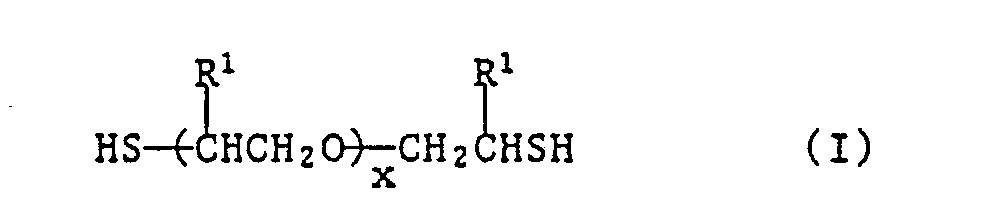
worin R¹ unabhängig voneinander Wasserstoff oder Methyl, x eine ganze Zahl von 2 bis 50 und y eine ganze Zahl von 1 bis 30 bedeuten, und
Applications Claiming Priority (4)
| Application Number | Priority Date | Filing Date | Title |
|---|---|---|---|
| CH4350/88 | 1988-11-23 | ||
| CH435088 | 1988-11-23 | ||
| CH3247/89 | 1989-09-07 | ||
| CH324789 | 1989-09-07 |
Publications (3)
| Publication Number | Publication Date |
|---|---|
| EP0370446A2 true EP0370446A2 (de) | 1990-05-30 |
| EP0370446A3 EP0370446A3 (en) | 1990-07-11 |
| EP0370446B1 EP0370446B1 (de) | 1996-05-15 |
Family
ID=25692555
Family Applications (2)
| Application Number | Title | Priority Date | Filing Date |
|---|---|---|---|
| EP89121472A Expired - Lifetime EP0370446B1 (de) | 1988-11-23 | 1989-11-20 | Polyoxyalkylendithiole und Polyamine enthaltende härtbare Epoxidharz-Stoffgemische |
| EP89121471A Withdrawn EP0370445A3 (de) | 1988-11-23 | 1989-11-20 | Polytetrahydrofurandithiole und deren Verwendung |
Family Applications After (1)
| Application Number | Title | Priority Date | Filing Date |
|---|---|---|---|
| EP89121471A Withdrawn EP0370445A3 (de) | 1988-11-23 | 1989-11-20 | Polytetrahydrofurandithiole und deren Verwendung |
Country Status (8)
| Country | Link |
|---|---|
| US (2) | US4990679A (de) |
| EP (2) | EP0370446B1 (de) |
| JP (2) | JPH02184663A (de) |
| KR (2) | KR900007907A (de) |
| AT (1) | ATE138084T1 (de) |
| CA (2) | CA2003425A1 (de) |
| DE (1) | DE58909681D1 (de) |
| ES (1) | ES2087069T3 (de) |
Cited By (11)
| Publication number | Priority date | Publication date | Assignee | Title |
|---|---|---|---|---|
| EP0429395A3 (en) * | 1989-11-21 | 1991-07-31 | Ciba-Geigy Ag | Curable epoxy resin composition containing a latent curing agent, an amine and a thiol |
| EP0514335A3 (de) * | 1991-05-17 | 1992-12-02 | Ciba-Geigy Ag | Härtbare Epoxidharz-Stoffgemische enthaltend einen latenten Härter, ein Amin und ein Dithiol |
| WO1999021907A1 (de) * | 1997-10-28 | 1999-05-06 | Siemens Aktiengesellschaft | Epoxidharzmischung, daraus hergestellte verbundwerkstoffe und deren verwendung |
| WO1999058591A1 (en) * | 1998-05-12 | 1999-11-18 | Jacob Woudsma | Products for repairing, filling, glueing, protecting, organic or anorganic materials by mixing curable reactive compositions |
| WO2000008086A1 (en) * | 1998-08-03 | 2000-02-17 | Lord Corporation | Primerless substrate repair composition and method |
| WO2000077067A1 (de) * | 1999-06-11 | 2000-12-21 | Cognis Deutschland Gmbh | Epoxidharzhärter-zusammensetzungen |
| FR2929616A1 (fr) * | 2008-04-08 | 2009-10-09 | Total France Sa | Procede de reticulation de compositions bitume/polymere presentant des emissions reduites d'hydrogene sulfure |
| WO2012016772A1 (de) * | 2010-08-02 | 2012-02-09 | Henkel Ag & Co. Kgaa | Härter für epoxidharze |
| WO2013041482A1 (de) * | 2011-09-23 | 2013-03-28 | Fraunhofer-Gesellschaft zur Förderung der angewandten Forschung e. V. | Seitenketten-funktionalisiertes peg |
| US8492488B2 (en) | 2004-12-21 | 2013-07-23 | Nektar Therapeutics | Stabilized polymeric thiol reagents |
| US10179831B2 (en) | 2014-02-13 | 2019-01-15 | tooz technologies GmbH | Amine-catalyzed thiol-curing of epoxide resins |
Families Citing this family (24)
| Publication number | Priority date | Publication date | Assignee | Title |
|---|---|---|---|---|
| JP2630173B2 (ja) * | 1992-06-25 | 1997-07-16 | 東レ株式会社 | 透水材用組成物及び透水材の製造方法 |
| US5663219A (en) * | 1994-05-27 | 1997-09-02 | Morton International, Inc. | Lightweight sealant having improved peel strength |
| JP3157408B2 (ja) * | 1994-12-06 | 2001-04-16 | 三洋化成工業株式会社 | 吸水性樹脂組成物 |
| US5712039A (en) * | 1995-04-11 | 1998-01-27 | Minnesota Mining And Manufacturing Company | Epoxy adhesives with dithiooxamide adhesion promoters |
| AU766332B2 (en) * | 1999-07-28 | 2003-10-16 | Vantico Ag | Amine hardener for epoxy resins |
| US6913798B2 (en) | 2000-06-21 | 2005-07-05 | Mitsui Chemicals, Inc. | Sealing material for plastic liquid crystal display cells including two-component epoxy resin composition |
| US6749721B2 (en) | 2000-12-22 | 2004-06-15 | Kimberly-Clark Worldwide, Inc. | Process for incorporating poorly substantive paper modifying agents into a paper sheet via wet end addition |
| JP4800495B2 (ja) * | 2001-02-13 | 2011-10-26 | 株式会社カネカ | 硬化性組成物 |
| US6916402B2 (en) | 2002-12-23 | 2005-07-12 | Kimberly-Clark Worldwide, Inc. | Process for bonding chemical additives on to substrates containing cellulosic materials and products thereof |
| US7670459B2 (en) | 2004-12-29 | 2010-03-02 | Kimberly-Clark Worldwide, Inc. | Soft and durable tissue products containing a softening agent |
| US7868132B2 (en) * | 2006-04-25 | 2011-01-11 | E. I. Du Pont De Nemours And Company | Method for preparing multi-arm poly (ethylene glycol) amines |
| US8642709B2 (en) | 2010-03-23 | 2014-02-04 | Henkel Ag & Co. Kgaa | Epoxy resin composition with reduced toxicity |
| DE102010028586A1 (de) | 2010-05-05 | 2011-11-10 | Henkel Ag & Co. Kgaa | 1K-Epoxidharzzusammensetzung mit verringerter Toxizität |
| WO2012077377A1 (ja) * | 2010-12-10 | 2012-06-14 | ナミックス株式会社 | 樹脂組成物 |
| BR112013014592A2 (pt) * | 2010-12-29 | 2016-09-20 | 3M Innovative Properties Co | adesivos híbridos estruturais |
| JP6130502B2 (ja) | 2012-07-03 | 2017-05-17 | スリーエム イノベイティブ プロパティズ カンパニー | 構造化ハイブリッド接着剤物品の製造方法 |
| EP2796484B1 (de) | 2013-04-26 | 2015-09-02 | InovaChem Engineering AG | Schnelles Epoxidharz zum Reparieren glasierter Oberflächen durch manuelle Laminierung |
| CN103755948A (zh) * | 2014-01-17 | 2014-04-30 | 金骄特种新材料(集团)有限公司 | 一种生物基聚亚烷基二醇及其制备方法 |
| BR112017017216B1 (pt) * | 2015-02-13 | 2022-09-27 | Chemetall Gmbh | Método para vedação, revestimento ou/e nivelamento aerodinâmico de pelo menos um elemento de conexão, aparelho automático, e, uso do método inventivo ou/e do aparelho inventivo |
| US20200165490A1 (en) * | 2017-06-12 | 2020-05-28 | 3M Innovative Properties Company | Epoxy/thiol resin compositions, methods, and tapes |
| EP4059972A4 (de) * | 2019-11-11 | 2023-07-05 | Toray Fine Chemicals Co., Ltd. | Epoxidharzzusammensetzung |
| WO2021096526A1 (en) | 2019-11-15 | 2021-05-20 | Zephyros, Inc. | Methods and compositions for adhering to low surface energy materials |
| KR102219587B1 (ko) * | 2020-05-26 | 2021-02-24 | (주)새론테크 | 구조 접착제용 중간체를 활용한 친환경 접착 코팅제 |
| CN112080238B (zh) * | 2020-09-07 | 2022-05-27 | 江苏矽时代材料科技有限公司 | 一种导热填充胶及其制备方法和应用 |
Family Cites Families (14)
| Publication number | Priority date | Publication date | Assignee | Title |
|---|---|---|---|---|
| DE256715C (de) * | ||||
| US3090793A (en) * | 1958-11-28 | 1963-05-21 | Minnesota Mining & Mfg | Curing of epoxy resins |
| GB1077997A (en) * | 1963-05-31 | 1967-08-02 | Bayer Ag | A process for the preparation of sulphur-containing derivatives of polymerization products of tetrahydrofuran |
| GB1031039A (en) * | 1963-07-16 | 1966-05-25 | Ici Ltd | Improvements in or relating to the manufacture of polymeric materials |
| GB1044715A (en) * | 1964-10-02 | 1966-10-05 | Ciba Ltd | New epoxy resin compositions |
| US3431239A (en) * | 1965-03-29 | 1969-03-04 | Prod Res & Chem Corp | Mercaptan terminated polyethers |
| US3472913A (en) * | 1967-12-14 | 1969-10-14 | Dow Chemical Co | Polythiol composition and preparation thereof |
| US3914288A (en) * | 1969-01-02 | 1975-10-21 | Ciba Geigy Ag | Reaction products of polyepoxides, mercaptoalkanoic acid esters and amines |
| US3728400A (en) * | 1970-09-17 | 1973-04-17 | Baker Chem Co J T | Process for preparation of polymercaptans |
| GB1460571A (en) * | 1973-11-16 | 1977-01-06 | Ciba Geigy Ag | Adhesive compositions |
| US4126505A (en) * | 1974-11-05 | 1978-11-21 | Ciba-Geigy Corporation | Adhesive compositions |
| US4092293A (en) * | 1976-06-24 | 1978-05-30 | Diamond Shamrock Corporation | Polymercaptans for curing epoxy resins and method of preparation thereof |
| DE2934948A1 (de) * | 1979-08-29 | 1981-03-19 | Agfa-Gevaert Ag, 5090 Leverkusen | Verfahren zur herstellung von 2-mercaptoalkylsulfiden und 2-mercaptoalkylethern |
| US4259474A (en) * | 1979-09-25 | 1981-03-31 | Gaf Corporation | Sulfur-containing polyoxyalkylenes |
-
1989
- 1989-11-20 EP EP89121472A patent/EP0370446B1/de not_active Expired - Lifetime
- 1989-11-20 DE DE58909681T patent/DE58909681D1/de not_active Expired - Fee Related
- 1989-11-20 AT AT89121472T patent/ATE138084T1/de not_active IP Right Cessation
- 1989-11-20 EP EP89121471A patent/EP0370445A3/de not_active Withdrawn
- 1989-11-20 ES ES89121472T patent/ES2087069T3/es not_active Expired - Lifetime
- 1989-11-21 CA CA002003425A patent/CA2003425A1/en not_active Abandoned
- 1989-11-21 KR KR1019890016884A patent/KR900007907A/ko not_active Withdrawn
- 1989-11-21 CA CA002003426A patent/CA2003426C/en not_active Expired - Fee Related
- 1989-11-22 JP JP1304576A patent/JPH02184663A/ja active Pending
- 1989-11-22 US US07/441,138 patent/US4990679A/en not_active Expired - Fee Related
- 1989-11-22 KR KR1019890017047A patent/KR0139210B1/ko not_active Expired - Fee Related
- 1989-11-22 US US07/441,133 patent/US5143999A/en not_active Expired - Fee Related
- 1989-11-22 JP JP1304577A patent/JP2794062B2/ja not_active Expired - Fee Related
Cited By (19)
| Publication number | Priority date | Publication date | Assignee | Title |
|---|---|---|---|---|
| EP0429395A3 (en) * | 1989-11-21 | 1991-07-31 | Ciba-Geigy Ag | Curable epoxy resin composition containing a latent curing agent, an amine and a thiol |
| EP0514335A3 (de) * | 1991-05-17 | 1992-12-02 | Ciba-Geigy Ag | Härtbare Epoxidharz-Stoffgemische enthaltend einen latenten Härter, ein Amin und ein Dithiol |
| WO1999021907A1 (de) * | 1997-10-28 | 1999-05-06 | Siemens Aktiengesellschaft | Epoxidharzmischung, daraus hergestellte verbundwerkstoffe und deren verwendung |
| WO1999058591A1 (en) * | 1998-05-12 | 1999-11-18 | Jacob Woudsma | Products for repairing, filling, glueing, protecting, organic or anorganic materials by mixing curable reactive compositions |
| WO2000008086A1 (en) * | 1998-08-03 | 2000-02-17 | Lord Corporation | Primerless substrate repair composition and method |
| AU764559B2 (en) * | 1998-08-03 | 2003-08-21 | Lord Corporation | Primerless substrate repair composition and method |
| WO2000077067A1 (de) * | 1999-06-11 | 2000-12-21 | Cognis Deutschland Gmbh | Epoxidharzhärter-zusammensetzungen |
| US8492488B2 (en) | 2004-12-21 | 2013-07-23 | Nektar Therapeutics | Stabilized polymeric thiol reagents |
| EP1827501B2 (de) † | 2004-12-21 | 2013-11-20 | Nektar Therapeutics | Stabilisierte polymer-thiol-reagenzien |
| US8765883B2 (en) | 2004-12-21 | 2014-07-01 | Nektar Therapeutics | Stabilized polymeric thiol reagents |
| US9308274B2 (en) | 2004-12-21 | 2016-04-12 | Nektar Therapeutics | Stabilized polymeric thiol reagents |
| WO2009133290A3 (fr) * | 2008-04-08 | 2009-12-23 | Total Raffinage Marketing | Procede de reticulation de compositions bitume/polymere presentan des emissions reduites d'hydrogene sulfure |
| US8202922B2 (en) | 2008-04-08 | 2012-06-19 | Total Raffinage Marketing | Process for cross-linking bitumen/polymer compositions having reduced emissions of hydrogen sulphide |
| FR2929616A1 (fr) * | 2008-04-08 | 2009-10-09 | Total France Sa | Procede de reticulation de compositions bitume/polymere presentant des emissions reduites d'hydrogene sulfure |
| RU2501818C2 (ru) * | 2008-04-08 | 2013-12-20 | Тоталь Раффинаж Маркетин | Способ сшивания битумно-полимерных композиций, обладающий уменьшенным выделением сероводорода |
| WO2012016772A1 (de) * | 2010-08-02 | 2012-02-09 | Henkel Ag & Co. Kgaa | Härter für epoxidharze |
| WO2013041482A1 (de) * | 2011-09-23 | 2013-03-28 | Fraunhofer-Gesellschaft zur Förderung der angewandten Forschung e. V. | Seitenketten-funktionalisiertes peg |
| US10179831B2 (en) | 2014-02-13 | 2019-01-15 | tooz technologies GmbH | Amine-catalyzed thiol-curing of epoxide resins |
| US10385160B2 (en) | 2014-02-13 | 2019-08-20 | tooz technologies GmbH | Amine-catalyzed thiol-curing of epoxy resins |
Also Published As
| Publication number | Publication date |
|---|---|
| ATE138084T1 (de) | 1996-06-15 |
| US5143999A (en) | 1992-09-01 |
| CA2003426A1 (en) | 1990-05-23 |
| JP2794062B2 (ja) | 1998-09-03 |
| ES2087069T3 (es) | 1996-07-16 |
| EP0370446A3 (en) | 1990-07-11 |
| EP0370445A3 (de) | 1990-07-04 |
| CA2003426C (en) | 2000-02-08 |
| EP0370445A2 (de) | 1990-05-30 |
| KR900007950A (ko) | 1990-06-02 |
| JPH02185518A (ja) | 1990-07-19 |
| EP0370446B1 (de) | 1996-05-15 |
| CA2003425A1 (en) | 1990-05-23 |
| JPH02184663A (ja) | 1990-07-19 |
| KR0139210B1 (ko) | 1998-05-01 |
| DE58909681D1 (de) | 1996-06-20 |
| US4990679A (en) | 1991-02-05 |
| KR900007907A (ko) | 1990-06-02 |
Similar Documents
| Publication | Publication Date | Title |
|---|---|---|
| EP0370446B1 (de) | Polyoxyalkylendithiole und Polyamine enthaltende härtbare Epoxidharz-Stoffgemische | |
| EP0353190B1 (de) | Flexibilisatorkombinationen für Epoxidharze | |
| EP0429395B1 (de) | Härtbare Epoxidharz-Stoffgemische enthaltend einen latenten Härter, ein Amin und ein Thiol | |
| DE69922073T2 (de) | Epoxidharzzusammensetzung | |
| EP2582740B1 (de) | Verwendung von cyclischen carbonaten in epoxidharzzusammensetzungen | |
| JP3367532B2 (ja) | エポキシ樹脂組成物 | |
| EP0379107A2 (de) | Verwendung von polyamidoaminen als Härter für Epoxidharze und diese enthaltende härtbare Mischungen | |
| EP0559033A1 (de) | Härtungsmittel für Epoxidharze | |
| EP2226347A1 (de) | Epoxidharzhärter, herstellungsverfahren dafür und epoxidharzzusammensetzung | |
| EP0675143A2 (de) | Amin-modifizierte Epoxidharz-Zusammensetzung | |
| EP0232225A2 (de) | Epoxidharz-Zusammensetzung | |
| DE69025025T2 (de) | Polysulfid-Polyether und härtbare Zusammensetzungen | |
| EP0108712B1 (de) | Heisshärtbare Epoxidharzmischungen | |
| EP0253339B1 (de) | Herstellung von Beschichtungen mit erhöhter Zwischenschichthaftung unter Verwendung von Epoxidharz/Härter-Mischungen | |
| DE2640408A1 (de) | Verfahren zur herstellung von formkoerpern und ueberzuegen | |
| DE1570382B2 (de) | Verwendung eines mercaptocarbonsaeureesters in massen auf basis von epoxidharz als flexibilisierungsmittel | |
| EP3894455A1 (de) | Polymermaterial mit einem uretdionhaltigen material, einer epoxidkomponente und einem beschleuniger, zweiteilige zusammensetzungen und verfahren | |
| US4879414A (en) | Polythiols and use as epoxy resin curing agents | |
| DE2949385A1 (de) | Addukte aus hydantoin-trisepoxiden und zweikernigen hydantoinen | |
| EP2764033B1 (de) | Epoxidharz-zusammensetzungen, enthaltend ein 2-oxo-[1,3]dioxolanderivat | |
| US4927902A (en) | Polythiols and use as epoxy resin curing agents | |
| CH632001A5 (en) | Process and compositions for the production of mouldings and coatings | |
| DE2429765A1 (de) | Verfahren zur herstellung von formkoerpern und ueberzuegen | |
| DE2105217A1 (de) | Neue Ester und härtbare Zusammensetzungen, in denen diese enthalten sind | |
| EP4678674A1 (de) | Mercapto-funktionelles addukt von trimercaptan und isocyanatgruppen-haltigem polymer |
Legal Events
| Date | Code | Title | Description |
|---|---|---|---|
| PUAI | Public reference made under article 153(3) epc to a published international application that has entered the european phase |
Free format text: ORIGINAL CODE: 0009012 |
|
| PUAL | Search report despatched |
Free format text: ORIGINAL CODE: 0009013 |
|
| 17P | Request for examination filed |
Effective date: 19891120 |
|
| AK | Designated contracting states |
Kind code of ref document: A2 Designated state(s): AT CH DE ES FR GB IT LI |
|
| AK | Designated contracting states |
Kind code of ref document: A3 Designated state(s): AT CH DE ES FR GB IT LI |
|
| 17Q | First examination report despatched |
Effective date: 19930504 |
|
| GRAH | Despatch of communication of intention to grant a patent |
Free format text: ORIGINAL CODE: EPIDOS IGRA |
|
| GRAA | (expected) grant |
Free format text: ORIGINAL CODE: 0009210 |
|
| AK | Designated contracting states |
Kind code of ref document: B1 Designated state(s): AT CH DE ES FR GB IT LI |
|
| REF | Corresponds to: |
Ref document number: 138084 Country of ref document: AT Date of ref document: 19960615 Kind code of ref document: T |
|
| REG | Reference to a national code |
Ref country code: ES Ref legal event code: BA2A Ref document number: 2087069 Country of ref document: ES Kind code of ref document: T3 |
|
| ITF | It: translation for a ep patent filed | ||
| REF | Corresponds to: |
Ref document number: 58909681 Country of ref document: DE Date of ref document: 19960620 |
|
| REG | Reference to a national code |
Ref country code: ES Ref legal event code: FG2A Ref document number: 2087069 Country of ref document: ES Kind code of ref document: T3 |
|
| GBT | Gb: translation of ep patent filed (gb section 77(6)(a)/1977) |
Effective date: 19960709 |
|
| ET | Fr: translation filed | ||
| REG | Reference to a national code |
Ref country code: CH Ref legal event code: PUE Owner name: CIBA-GEIGY AG TRANSFER- CIBA SC HOLDING AG |
|
| PLBE | No opposition filed within time limit |
Free format text: ORIGINAL CODE: 0009261 |
|
| STAA | Information on the status of an ep patent application or granted ep patent |
Free format text: STATUS: NO OPPOSITION FILED WITHIN TIME LIMIT |
|
| 26N | No opposition filed | ||
| REG | Reference to a national code |
Ref country code: CH Ref legal event code: PFA Free format text: CIBA SC HOLDING AG TRANSFER- CIBA SPECIALTY CHEMICALS HOLDING INC. |
|
| REG | Reference to a national code |
Ref country code: GB Ref legal event code: 732E |
|
| REG | Reference to a national code |
Ref country code: FR Ref legal event code: TP |
|
| REG | Reference to a national code |
Ref country code: ES Ref legal event code: PC2A |
|
| REG | Reference to a national code |
Ref country code: CH Ref legal event code: PUE Owner name: CIBA SPECIALTY CHEMICALS HOLDING INC. TRANSFER- VA |
|
| REG | Reference to a national code |
Ref country code: GB Ref legal event code: 732E |
|
| REG | Reference to a national code |
Ref country code: GB Ref legal event code: IF02 |
|
| REG | Reference to a national code |
Ref country code: FR Ref legal event code: TP |
|
| PGFP | Annual fee paid to national office [announced via postgrant information from national office to epo] |
Ref country code: GB Payment date: 20031029 Year of fee payment: 15 |
|
| PGFP | Annual fee paid to national office [announced via postgrant information from national office to epo] |
Ref country code: CH Payment date: 20031030 Year of fee payment: 15 |
|
| PGFP | Annual fee paid to national office [announced via postgrant information from national office to epo] |
Ref country code: DE Payment date: 20031103 Year of fee payment: 15 |
|
| PGFP | Annual fee paid to national office [announced via postgrant information from national office to epo] |
Ref country code: AT Payment date: 20031105 Year of fee payment: 15 |
|
| PGFP | Annual fee paid to national office [announced via postgrant information from national office to epo] |
Ref country code: FR Payment date: 20031107 Year of fee payment: 15 |
|
| PGFP | Annual fee paid to national office [announced via postgrant information from national office to epo] |
Ref country code: ES Payment date: 20031119 Year of fee payment: 15 |
|
| PG25 | Lapsed in a contracting state [announced via postgrant information from national office to epo] |
Ref country code: GB Free format text: LAPSE BECAUSE OF NON-PAYMENT OF DUE FEES Effective date: 20041120 Ref country code: AT Free format text: LAPSE BECAUSE OF NON-PAYMENT OF DUE FEES Effective date: 20041120 |
|
| PG25 | Lapsed in a contracting state [announced via postgrant information from national office to epo] |
Ref country code: ES Free format text: LAPSE BECAUSE OF NON-PAYMENT OF DUE FEES Effective date: 20041122 |
|
| PG25 | Lapsed in a contracting state [announced via postgrant information from national office to epo] |
Ref country code: LI Free format text: LAPSE BECAUSE OF NON-PAYMENT OF DUE FEES Effective date: 20041130 Ref country code: CH Free format text: LAPSE BECAUSE OF NON-PAYMENT OF DUE FEES Effective date: 20041130 |
|
| PG25 | Lapsed in a contracting state [announced via postgrant information from national office to epo] |
Ref country code: DE Free format text: LAPSE BECAUSE OF NON-PAYMENT OF DUE FEES Effective date: 20050601 |
|
| GBPC | Gb: european patent ceased through non-payment of renewal fee |
Effective date: 20041120 |
|
| REG | Reference to a national code |
Ref country code: CH Ref legal event code: PL |
|
| PG25 | Lapsed in a contracting state [announced via postgrant information from national office to epo] |
Ref country code: FR Free format text: LAPSE BECAUSE OF NON-PAYMENT OF DUE FEES Effective date: 20050729 |
|
| REG | Reference to a national code |
Ref country code: FR Ref legal event code: ST |
|
| PG25 | Lapsed in a contracting state [announced via postgrant information from national office to epo] |
Ref country code: IT Free format text: LAPSE BECAUSE OF NON-PAYMENT OF DUE FEES;WARNING: LAPSES OF ITALIAN PATENTS WITH EFFECTIVE DATE BEFORE 2007 MAY HAVE OCCURRED AT ANY TIME BEFORE 2007. THE CORRECT EFFECTIVE DATE MAY BE DIFFERENT FROM THE ONE RECORDED. Effective date: 20051120 |
|
| REG | Reference to a national code |
Ref country code: ES Ref legal event code: FD2A Effective date: 20041122 |