EP0370452A2 - Elektromagnetisches Relais mit einer verbesserten Anschlussklemmenanordnung - Google Patents
Elektromagnetisches Relais mit einer verbesserten Anschlussklemmenanordnung Download PDFInfo
- Publication number
- EP0370452A2 EP0370452A2 EP89121497A EP89121497A EP0370452A2 EP 0370452 A2 EP0370452 A2 EP 0370452A2 EP 89121497 A EP89121497 A EP 89121497A EP 89121497 A EP89121497 A EP 89121497A EP 0370452 A2 EP0370452 A2 EP 0370452A2
- Authority
- EP
- European Patent Office
- Prior art keywords
- terminal
- case
- pieces
- electromagnetic relay
- moveable
- Prior art date
- Legal status (The legal status is an assumption and is not a legal conclusion. Google has not performed a legal analysis and makes no representation as to the accuracy of the status listed.)
- Withdrawn
Links
- XEEYBQQBJWHFJM-UHFFFAOYSA-N Iron Chemical group [Fe] XEEYBQQBJWHFJM-UHFFFAOYSA-N 0.000 claims description 18
- 230000004888 barrier function Effects 0.000 claims description 14
- 230000000295 complement effect Effects 0.000 claims description 2
- 238000000034 method Methods 0.000 abstract description 8
- 238000009413 insulation Methods 0.000 abstract description 4
- 238000004519 manufacturing process Methods 0.000 description 5
- 238000000465 moulding Methods 0.000 description 5
- 230000000717 retained effect Effects 0.000 description 5
- 229920003002 synthetic resin Polymers 0.000 description 5
- 239000000057 synthetic resin Substances 0.000 description 5
- 239000000428 dust Substances 0.000 description 3
- 230000002349 favourable effect Effects 0.000 description 3
- 230000008030 elimination Effects 0.000 description 2
- 238000003379 elimination reaction Methods 0.000 description 2
- 238000003754 machining Methods 0.000 description 2
- 239000000463 material Substances 0.000 description 2
- 238000002788 crimping Methods 0.000 description 1
- 238000010586 diagram Methods 0.000 description 1
- WABPQHHGFIMREM-UHFFFAOYSA-N lead(0) Chemical compound [Pb] WABPQHHGFIMREM-UHFFFAOYSA-N 0.000 description 1
- 238000005476 soldering Methods 0.000 description 1
Images








Classifications
-
- H—ELECTRICITY
- H01—ELECTRIC ELEMENTS
- H01H—ELECTRIC SWITCHES; RELAYS; SELECTORS; EMERGENCY PROTECTIVE DEVICES
- H01H50/00—Details of electromagnetic relays
- H01H50/14—Terminal arrangements
-
- H—ELECTRICITY
- H01—ELECTRIC ELEMENTS
- H01H—ELECTRIC SWITCHES; RELAYS; SELECTORS; EMERGENCY PROTECTIVE DEVICES
- H01H50/00—Details of electromagnetic relays
- H01H50/02—Bases; Casings; Covers
- H01H50/021—Bases; Casings; Covers structurally combining a relay and an electronic component, e.g. varistor, RC circuit
-
- H—ELECTRICITY
- H01—ELECTRIC ELEMENTS
- H01H—ELECTRIC SWITCHES; RELAYS; SELECTORS; EMERGENCY PROTECTIVE DEVICES
- H01H50/00—Details of electromagnetic relays
- H01H50/16—Magnetic circuit arrangements
- H01H50/18—Movable parts of magnetic circuits, e.g. armature
- H01H50/24—Parts rotatable or rockable outside coil
-
- H—ELECTRICITY
- H01—ELECTRIC ELEMENTS
- H01H—ELECTRIC SWITCHES; RELAYS; SELECTORS; EMERGENCY PROTECTIVE DEVICES
- H01H50/00—Details of electromagnetic relays
- H01H50/02—Bases; Casings; Covers
- H01H50/026—Details concerning isolation between driving and switching circuit
Definitions
- the present invention relates to an electromagnetic relay which is easy to assemble and reliable in operation.
- a terminal case 103 is mounted on a box-shaped main case 102 accommodating an electromagnet unit 101 therein, and a free end portion 106a of an armature 106 which is actuated by the electromagnet unit 101 is engaged with a moveable insulated member 105 for opening and closing contacts in a contact unit 104 incorporated in the terminal case 103 in such a manner that fixed contacts 109 of screw terminal pieces 108 for fixed contacts ( Figure 22) interposed between barriers 107 provided in the terminal case 103 may be opened and closed by moveable contacts 110 carried by the moveable insulated member 105.
- the screw terminal pieces 108 are inserted from a lower end of the terminal case 103, and are pushed further therefrom towards their free ends until the free ends are placed upon a shelf portion 111 formed in the terminal case 102 as illustrated in Figure 22.
- the electromagnet unit 101 is inserted into the main case 102 from above and the terminal case 103 is also mounted on the main case 102 from above while the screw terminal pieces 108 are required to be inserted into the terminal case 103 from below, with the result that a considerable amount of effort is required for assembly work, and the screw terminal pieces 108 are not well stabilized as they simply sit on the shelf portion 111.
- the terminal case 103 must have an open bottom, and it creates the risk of breaking insulation between the contact unit 104 and the electromagnet unit 101 due to the difference in their voltage levels. Therefore, an insulating plate 112 is required to be placed between the terminal case 103 and the main case 102, and this increases the number of component parts and the effort required to assemble it.
- a primary object of the present invention is to provide an electromagnetic relay having a terminal piece structure which is easy to assemble.
- a second object of the present invention is to provide an electromagnetic relay which is provided with an insulating plate separating a contact piece from an electromagnet unit to achieve a better electric insulation therebetween without requiring a separate member therefor.
- a third object of the present invention is to provide an electromagnetic relay which offers a high reliability in its operation without complicating its structure.
- an electromagnetic relay comprising: a main case constructed substantially as a box having an open top to accommodate an electromagnet unit therein; a terminal case having an open top and mounted on the open top of the main case; a plurality of barriers consisting of a plurality of vertical walls provided in mutually parallel relationship in the terminal case; an insulated moveable member slidably received in the terminal case along a first direction perpendicular to the barriers so as to be urged by a spring in the first direction and selectively moved in an opposite direction by an armature of the electromagnet unit against a spring force of the spring; moveable contact pieces carrying moveable contacts and carried by the insulated moveable member; terminal pieces received and fixedly secured between the barriers; a cover member which is mounted on the terminal case; and fixed contact pieces which are integrally connected with the terminal pieces so as to selectively bring fixed contacts carried by the fixed contact pieces into and out of contact with the moveable contacts; the terminal pieces being each provided with an engagement piece which can be fitted into
- the screw terminal pieces may be inserted from the upper part of the terminal case to considerably improve the facility of assembling. Furthermore, this structure permits the terminal case to be enclosed at its bottom end with a bottom wall, and this provides a favorable insulation between the contact unit and the electromagnet unit without increasing the necessary number of component parts or the amount of work required for the assembly process.
- the engagement portions of the cover consist of projections each of which is adapted to be fitted into an associated hole provided in one of the terminal pieces, and the engagement piece of each of the terminal pieces consists of an inverted T-shaped extension thereof provided at its end remote from the fixed contact piece connected thereto so as to be engaged with an associated shoulder portion of the terminal case.
- a base end of the armature is provided with an elongated projection which is received by an associated recess provided in an adjoining end of a yoke of the electromagnet unit so as to form a hinge between the armature and the yoke.
- this hinge structure since this hinge structure does not require the armature and the yoke to be cut into complicated shapes as opposed to conventional hinge structures, some advantage can be gained in economy of the material and simplicity of the fabrication process. Further, absence of burrs due to elimination of the need for complicated machining processes contributes to the reliability of the operation of the electromagnetic relay, and a large contact area between the armature and the yoke contributes to a reduced magnetic resistance at the hinge portion.
- an iron core having a non-circular cross section at least at its end adjoining the armature By using an iron core having a non-circular cross section at least at its end adjoining the armature, relative rotation between a bobbin having a flange for securing coil wire ends and the iron core may be prevented, and the reliability of the electromagnetic relay may be improved. Further, by providing a pair of projections for elastically gripping an electronic component part therebetween, an electronic component part associated with the electromagnetic relay may be mounted in a reliable fashion without taking up much space and without complicating the assembly process.
- a bottom surface of the main case may be provided with a fixed pawl on one side thereof and an elastic pawl on the other side thereof, the elastic pawl being formed in a support portion which is elastically supported by a leg portion projecting perpendicularly from a bottom part of a recess provided in the mounting surface.
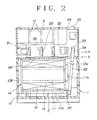
- FIGS 1 and 2 show an example of the electromagnetic relay according to the present invention.
- This electromagnetic relay basically consists of a main case 1, an electromagnet unit 2 accommodated in the main case 1, a terminal case 3 mounted upon the main case 1, a contact unit 4 accommodated in the terminal case 3, and a contact unit cover 5 mounted on the terminal case 3.
- the main case 1 is formed of a substantially box-shaped member having an open top and made of synthetic resin or the like, and the corner portions of its bottom end are provided with mounting holes 6 while a rail mount structure is visible at its one end as denoted by numeral 7 in Figure 1.
- Numeral 8 denotes rectangular openings which are provided in the upper ends of the lateral side walls of the main case 1 to be detachably engaged with engagement projections 9 provided in the terminal case 3.
- Numeral 10 denotes an L-shaped yoke consisting of a horizontal piece 10A and a vertical piece 10B, and a base end of an iron core 11 is securely attached to the free end of the vertical piece 10B by crimping or other means.
- Numeral 12 denotes a coil wound around the outer circumferential surface of the iron core 11 by way of a bobbin 13, and an electromagnet block 14 is formed by the yoke 10 and the iron core 11.
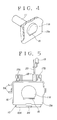
- a free end magnetic pole portion 11a of the iron core 11 which is exposed from and fixedly secured to a front flange 13a of the bobbin 13 is shaped into a non-circular shape with a portion thereof being removed, as illustrated in Figures 4 and 5.
- a ridge 15 is formed in the front flange 13a along the end surface of the removed part of the iron core pole portion 11a.
- the iron core 11 has a non-circular cross section and the bobbin 13 or the front flange 13a having a complementary inner bore is fitted thereon, the rotation of the front flange 13a relative to the iron core 11 is prevented, and the breaking of the coil lead wire of the coil 12 can be prevented.
- the shape of the cross section of the iron core 11 is not limited to the illustrated embodiment, but may also be polygonal or other non-circular shapes.
- the front flange 13a is integrally provided with an L-shaped axial flange 16, and its upper surface is provided with socket terminal portions 16A and 16B and a circuit board retaining piece 18.
- Numeral 19 denotes a light emitting diode serving as an indicator which is mounted on a circuit board 20 retained by the retaining piece 18, and this light emitting diode 19 may be connected, for instance, across the coil 12.
- the electromagnet block 14 is securely fixed in the main case 1 by fitting the vertical piece 10B of the yoke 10 into a fitting portion 21 provided in the inner surface of a side wall of the main case 1.
- Numeral 22 denotes an armature which forms the electromagnet unit 2 in cooperation with the electromagnet block 14, and is adapted to be attracted to and repelled from the magnetic pole portion 11a of the iron core 11.
- a central part of the base end portion of the armature 22 is provided with a ridge 23 projecting toward one side thereof or toward the yoke 10 by stamping, and a corresponding groove 24 is formed in a central part of the free end portion of the horizontal piece 10A of the yoke 10 also by stamping so that a hinge portion 25 of the armature 22 may be formed by the ridge 23 and the groove 24.
- this hinge structure does not require the armature 22 and the yoke 10 to be cut into complicated shapes as opposed to conventional hinge structures, some advantage can be gained in economy of the material and simplicity of the fabrication process. Further, absence of burrs due to elimination of the need for complicated machining processes contributes to the reliability of the operation of the electromagnetic relay, and a large contact area between the armature 22 and the yoke 10 contributes to a reduced magnetic resistance at the hinge portion.
- the terminal case 3 is made of electrically insulating synthetic resin or the like, and its upper end is provided with a plurality of upright barriers 17A and 17B on either side of a central recess 26 as shown in Figure 3.
- Numeral 28 denotes an L-shaped moveable insulated member made of electrically insulating synthetic resin which can be moved along the fore-and-aft direction (as indicated by the arrows a and b in Figure 1) within the recess 26, and elastically retains a plurality of moveable contact pieces 29 shaped like wings extending along the lateral direction by means of springs 30 as illustrated in Figure 3.
- Numeral 31 denotes a return spring which imparts a forward spring force to the movable insulated member 28.
- Moveable contacts 32 (32A and 32B) are fixedly attached to either end of each of the moveable contact pieces 29.
- the screw terminal pieces 36 and 37 are provided with threaded holes 39 for screws 38 as shown in Figure 7, and small notches 40 are formed on either side thereof.
- Inverted T-shaped engagement pieces 36 (37) depend from the free ends of the screw terminal pieces 41.
- Numeral 42 denotes fixed contact pieces extending from the screw terminal pieces 36, and each of the fixed contact pieces 42 is provided with a fixed contact 35 which cooperates with an associated moveable contact 32 carried by the associated moveable contact piece 29.
- Numeral 43 denotes coil end connecting pieces extending from the screw terminal pieces 37, and numeral 44 denotes washers.
- the mutually opposing surfaces of the barriers 17 are provided with guide ridges 45 for guiding the screw terminal pieces 36 and 37 to the positions indicated by the chain-dot lines in Figure 8 by engaging their small notches 40 therewith.
- the inner surfaces of the lateral side walls of the terminal case 3 are provided with shoulder portions or engagement projections 46 ( Figure 7) which engage the inverted T-shaped engagement pieces 41 from both sides, and recesses 26 ( Figures 3 and 7) are formed between the barriers 17 so as to accommodate the free ends of screws 38 which are threaded with the screw terminal pieces 36 and 37.
- the electromagnet unit 2 and the contact unit 4 are separated from each other by the bottom wall 48 of the terminal case 3 serving as an insulating wall ( Figure 2).
- Both sides of the contact unit cover 5 are provided with slits 49 so as to correspond to the barriers 17, and the contact unit cover 5 may be mounted on the terminal case 3 by being fitted into vertical grooves 50 ( Figure 7) of the terminal case 3.
- Numeral 51 denotes projections which are formed at the lower ends of the lateral side walls of the contact unit cover 5 to keep the screw terminal pieces 36 and 37 immobile by engaging engagement holes 52 formed in the screw terminal pieces 36 and 37.
- Numeral 53 denotes a window provided in the contact unit cover 5 to make the light emitting diode 19 serving as an operation indicator visible from outside, and numeral 54 denotes an opening to expose a projection 55 of the moveable insulated member 28.
- Numeral 56 denotes a safety cover which is provided with screw access openings 57 and an indicator window 58, and detachably mounted between the front and rear walls of the terminal case 3.
- Numeral 59 denotes a pair of elastic gripping pieces projecting from the axial flange 16 of the bobbin 13 to retain an electronic component.
- numeral 60 denotes pawls which are integrally formed with the contact unit cover 5 to be engaged by shoulder portions 61 of the terminal case 3.
- the state of contact between the contacts 32 and 35 are kept in favorable condition even when there is some play in the movement of the moveable insulated member 28.
- the indicator light emitting diode 19 is lighted up so as to indicate the above described operating condition.
- the screw terminal pieces 36 and 37 are so constructed that they may be inserted into the terminal case 3 from above, the assembling of the screw terminals 36 and 37 can be accomplished as a natural part of the processes of placing the electromagnet unit 2 into the main case 1 and mounting the terminal case 3 on the main case 1 both from above. This improves the efficiency of the assembly work.
- the screw terminal pieces 36 and 37 are placed between the barriers 17 of the terminal case 3, and are further pushed outwards from the inserted position indicated by the chain-dot lines in Figure 8 until they reach their prescribed mounting positions shown in Figure 9.
- the screw terminal pieces 36 and 37 are kept at their prescribed positions by the inverted T-shaped engagement pieces 41 being engaged by the engagement projections 46 of the terminal case 3 as illustrated in Figure 10, and a stable mounted state can be achieved as the movements in both lateral and vertical directions are positively prevented.
- the movement of the screw terminal pieces 36 and 37 in any direction perpendicular to the direction along which the screw terminals 36 and 37 were inserted to the mounting positions is prevented.
- the bottom wall 48 of the terminal case 3 separates the interior of the main case 1 from the interior of the terminal case 3 and the exterior of the main case 1, intrusion of dust into the main case 1 is avoided. Further, since recesses 47 are formed in the bottom wall 48 of the terminal case 3 so as to correspond to the screws 38 which are threaded into the screw terminal pieces 36 and 37, even when dust gets into the terminal case 3, it is caught in the recesses 47 and is prevented from migrating to other parts of the electromagnetic relay such as the contacts 32 and 35 where presence of such dust should be avoided.
- the insulating wall between the electromagnetic unit 2 and the contact unit 4 is formed by the bottom wall 48 of the terminal case 3, a conventional insulating plate is not required, and certain advantages can be obtained in the number of component parts, the facility of assembly work and manufacturing cost.
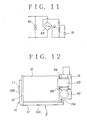
- a circuit including a varistor 62 and a rectifying bridge circuit device 63 such as the one shown in Figure 11 is typically used.
- the rectifying bridge circuit device 63 may be retained simply by pushing it between the gripping pieces 59 formed in the axial flange portion 13a of the spool 13 as illustrated in Figure 12.
- the wire ends of the coil 12 may be connected directly to the leads of the rectifying bridge circuit device 63 by soldering, and a circuit board for mounting such a device may be omitted so as to reduce the amount of work and the number of component parts required for the assembly work. Furthermore, the elasticity of the gripping pieces 59 ensures the mounted state of the circuit device 63 to be resistant against vibrations and impacts.
- the electronic component retained by the gripping pieces 59 was a rectifying bridge circuit element 63 in the above described embodiment, it goes without saying that any other circuit element may be retained thereby depending on each particular circuit structure.
- Figure 13 is a perspective bottom view of the electromagnetic relay of the present embodiment along with a rail member M on which the electromagnetic relay is to be mounted.
- the bottom surface 1a of the main case 1 is intended as a mounting surface 1a for the mounting rail member M, and is provided with the aforementioned rail mount structure 7.
- Numeral 68 (68A and 68B) denotes fixed engagement pawls projecting from the inner surface of one of the projecting wall 65 for engagement with a side portion Ma of the rail member M.
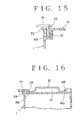
- a central portion of the other projecting wall 64 is provided with a notched part including a pair of trenches 69A and 69B as illustrated in Figures 14 and 15.
- Leg portions 70A and 70B project from the bottom surfaces of the trenches 69A and 69B, respectively, and the free ends of the leg portions 70A and 70B slightly protrude from the plane of the mounting surface 1a.
- Numeral 71 denotes a substantially trapezoidal moveable engagement piece which is bridged across the free ends of the leg portions 70A and 70B so as to be elastically displaced towards and away from the engagement pawls 68 on the opposite projecting wall 65 by way of the leg portions 70A and 70B.
- the inner end surface of the moveable engagement piece 71 is integrally formed with engagement pawls 72 (72A and 72B) which can detachably engage with the other side portion Mb of the rail member M.
- the engagement pawls 68A and 68B serve as substantially fixed pawls while the engagement pawls 72A and 72B serve as elastically displaceable pawls.
- Numeral 73 denotes a lateral groove defining a gap between the moveable engagement piece 71 and the mounting surface 1a.
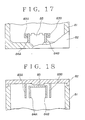
- metallic dies 81 and 82 for molding the main case 1 accommodates therein first cores 83 (83A and 83B) having a C-shaped cross section serving as first trench forming means for separating, a part of, for instance three sides of the outer circumferential surface of each of the leg portions 70A and 70B projecting from the main case 1.
- Planar second cores 84 (84A and 84B) serving as second trench forming means for separating the remaining side of the outer circumferential surface of each of the leg portions 70A and 70B is placed vertically with their end portions abutting the opposing surfaces of the first cores 83A and 83B.
- another planar core 85 serving as a lateral groove forming means for separating the inner side surfaces of the moveable engagement piece 71 is placed horizontally between the second cores 84A and 84B.
- the main case 1 is formed while the recess defined by the first cores 83 and the second cores 84 forms the leg portions 70A and 70B which are separated from the main case 1 by the trenches 69 as shown in Figures 19 and 20.
- the moveable engagement piece 71 is formed by the third core 85 so as to extend between the leg portions 70A and 70B and be separated from the mounting surface 1a by way of the lateral groove 73.
- the moveable engagement piece 71 is integrally formed with the main case 1 by way of the leg portions 70A and 70B, the number of component parts is reduced and the assembly work is simplified as compared with a conventional structure using a moveable engagement plate which is separately molded. Furthermore, since the leg portions 70A and 70B project from the bottom surface of the vertical grooves 69A and 69B, the necessary mounting space may be less than that for the structure in which a support portion for a moveable engagement plate is provided on a side surface of the main case 1.
- the moveable engagement piece 71 and the leg portions 70A and 70B By molding the moveable engagement piece 71 and the leg portions 70A and 70B so as to be separated from the main case 1 by the trenches 69 and the lateral groove 73 by using the first, second and third cores 83, 84 and 85 accommodated in the metallic dies 81 and 82 for the main case 1, the moveable engagement piece 71 and the leg portions 70 may be molded at the same time as molding the main case 1, and the efficiency of fabrication can be significantly improved.
- the moveable engagement piece 71 was supported by a pair of leg portions 70A and 70B in the above described embodiment, the moveable engagement piece 71 may be supported by a single leg portion 70.
Landscapes
- Physics & Mathematics (AREA)
- Electromagnetism (AREA)
- Switch Cases, Indication, And Locking (AREA)
- Electromagnets (AREA)
Applications Claiming Priority (6)
| Application Number | Priority Date | Filing Date | Title |
|---|---|---|---|
| JP152011/88U | 1988-11-22 | ||
| JP15201188U JPH0723872Y2 (ja) | 1988-11-22 | 1988-11-22 | 電磁継電器 |
| JP29791488A JPH02143496A (ja) | 1988-11-24 | 1988-11-24 | 電気機器の取付装置およびその製造方法 |
| JP297914/88 | 1988-11-24 | ||
| JP15321988U JPH0273704U (de) | 1988-11-24 | 1988-11-24 | |
| JP153219/88U | 1988-11-24 |
Publications (2)
| Publication Number | Publication Date |
|---|---|
| EP0370452A2 true EP0370452A2 (de) | 1990-05-30 |
| EP0370452A3 EP0370452A3 (de) | 1991-11-27 |
Family
ID=27320205
Family Applications (1)
| Application Number | Title | Priority Date | Filing Date |
|---|---|---|---|
| EP19890121497 Withdrawn EP0370452A3 (de) | 1988-11-22 | 1989-11-21 | Elektromagnetisches Relais mit einer verbesserten Anschlussklemmenanordnung |
Country Status (1)
| Country | Link |
|---|---|
| EP (1) | EP0370452A3 (de) |
Cited By (2)
| Publication number | Priority date | Publication date | Assignee | Title |
|---|---|---|---|---|
| WO1996023314A1 (de) * | 1995-01-26 | 1996-08-01 | Klöckner-Moeller Gmbh | Klappanker-magnetantrieb für elektrische schaltgeräte, und verfahren zu seiner vormontage |
| EP2469567A4 (de) * | 2009-08-20 | 2014-04-16 | Fuji Elec Fa Components & Sys | Elektromagnetisches schütz |
Family Cites Families (4)
| Publication number | Priority date | Publication date | Assignee | Title |
|---|---|---|---|---|
| DE3243266C2 (de) * | 1981-04-30 | 1986-06-26 | Sds Relais Ag | Polarisiertes Relais |
| DE3146739C2 (de) * | 1981-11-25 | 1985-10-24 | Siemens AG, 1000 Berlin und 8000 München | Elektromagnetisches Schaltgerät |
| DE3510588A1 (de) * | 1985-03-23 | 1986-09-25 | Brown, Boveri & Cie Ag, 6800 Mannheim | Elektromagnetisch betaetigbares schaltgeraet und verfahren zur herstellung von dessen anschlusskontaktstellen |
| DE3569060D1 (en) * | 1985-04-15 | 1989-04-27 | Square D Starkstrom Gmbh | Contactor, particularly auxiliary or motor contactor |
-
1989
- 1989-11-21 EP EP19890121497 patent/EP0370452A3/de not_active Withdrawn
Cited By (2)
| Publication number | Priority date | Publication date | Assignee | Title |
|---|---|---|---|---|
| WO1996023314A1 (de) * | 1995-01-26 | 1996-08-01 | Klöckner-Moeller Gmbh | Klappanker-magnetantrieb für elektrische schaltgeräte, und verfahren zu seiner vormontage |
| EP2469567A4 (de) * | 2009-08-20 | 2014-04-16 | Fuji Elec Fa Components & Sys | Elektromagnetisches schütz |
Also Published As
| Publication number | Publication date |
|---|---|
| EP0370452A3 (de) | 1991-11-27 |
Similar Documents
| Publication | Publication Date | Title |
|---|---|---|
| US5081436A (en) | Electromagnetic relay having an improved terminal structure | |
| USRE49236E1 (en) | Contact device and electromagnetic relay | |
| US4405911A (en) | Electromagnetic relay | |
| JP4471859B2 (ja) | 電磁継電器 | |
| US4386338A (en) | Remote control system | |
| US6903638B2 (en) | Complex electromagnetic relay | |
| US4101856A (en) | Electrical switching relay construction and housing therefor | |
| EP1487001B1 (de) | Elektromagnetisches Relais | |
| US4267540A (en) | Hinge-type electromagnetic relay | |
| CN113412528B (zh) | 继电器 | |
| KR880014608A (ko) | 전자기 릴레이 | |
| US4006322A (en) | Auxiliary interlock switch with interchangeable and reversible chisel-shaped contacts and spring biasing mechanism | |
| EP3780060A1 (de) | Steckbare verbindungsvorrichtung für schütz und schütz | |
| US5281937A (en) | Electromagnetic contactor and method for making same | |
| US4485365A (en) | Small contactor with a removable subset of auxiliary switches | |
| US10943751B2 (en) | Electromagnetic relay | |
| US4371855A (en) | Electrical contactor | |
| EP0051255A1 (de) | Elektromagnetisches Gerät | |
| US4345224A (en) | Contact spring arrangement | |
| KR100384341B1 (ko) | 전자기계식 컨택터 | |
| CA1136180A (en) | Electromagnetic switching apparatus | |
| EP0122291A1 (de) | Elektromagnetische kontakter | |
| US3319036A (en) | Relay contact block with interchangeable spring biased contact structure | |
| US4801908A (en) | Small relay for automated assembly | |
| EP0336445B1 (de) | Elektromagnetisches Relais |
Legal Events
| Date | Code | Title | Description |
|---|---|---|---|
| PUAI | Public reference made under article 153(3) epc to a published international application that has entered the european phase |
Free format text: ORIGINAL CODE: 0009012 |
|
| 17P | Request for examination filed |
Effective date: 19891212 |
|
| AK | Designated contracting states |
Kind code of ref document: A2 Designated state(s): AT BE CH DE ES FR GB GR IT LI NL SE |
|
| PUAL | Search report despatched |
Free format text: ORIGINAL CODE: 0009013 |
|
| AK | Designated contracting states |
Kind code of ref document: A3 Designated state(s): AT BE CH DE ES FR GB GR IT LI NL SE |
|
| 18W | Application withdrawn |
Withdrawal date: 19920317 |
|
| STAA | Information on the status of an ep patent application or granted ep patent |
Free format text: STATUS: THE APPLICATION HAS BEEN WITHDRAWN |
|
| R18W | Application withdrawn (corrected) |
Effective date: 19920317 |