EP0370670A2 - Aufzeichnungsgerät des Drehkopftyps - Google Patents
Aufzeichnungsgerät des Drehkopftyps Download PDFInfo
- Publication number
- EP0370670A2 EP0370670A2 EP89311714A EP89311714A EP0370670A2 EP 0370670 A2 EP0370670 A2 EP 0370670A2 EP 89311714 A EP89311714 A EP 89311714A EP 89311714 A EP89311714 A EP 89311714A EP 0370670 A2 EP0370670 A2 EP 0370670A2
- Authority
- EP
- European Patent Office
- Prior art keywords
- video
- audio
- recording
- signal
- tape
- Prior art date
- Legal status (The legal status is an assumption and is not a legal conclusion. Google has not performed a legal analysis and makes no representation as to the accuracy of the status listed.)
- Withdrawn
Links
Images


Classifications
-
- G—PHYSICS
- G11—INFORMATION STORAGE
- G11B—INFORMATION STORAGE BASED ON RELATIVE MOVEMENT BETWEEN RECORD CARRIER AND TRANSDUCER
- G11B5/00—Recording by magnetisation or demagnetisation of a record carrier; Reproducing by magnetic means; Record carriers therefor
- G11B5/48—Disposition or mounting of heads or head supports relative to record carriers ; arrangements of heads, e.g. for scanning the record carrier to increase the relative speed
- G11B5/52—Disposition or mounting of heads or head supports relative to record carriers ; arrangements of heads, e.g. for scanning the record carrier to increase the relative speed with simultaneous movement of head and record carrier, e.g. rotation of head
-
- G—PHYSICS
- G11—INFORMATION STORAGE
- G11B—INFORMATION STORAGE BASED ON RELATIVE MOVEMENT BETWEEN RECORD CARRIER AND TRANSDUCER
- G11B27/00—Editing; Indexing; Addressing; Timing or synchronising; Monitoring; Measuring tape travel
- G11B27/02—Editing, e.g. varying the order of information signals recorded on, or reproduced from, record carriers
- G11B27/022—Electronic editing of analogue information signals, e.g. audio or video signals
- G11B27/024—Electronic editing of analogue information signals, e.g. audio or video signals on tapes
-
- G—PHYSICS
- G11—INFORMATION STORAGE
- G11B—INFORMATION STORAGE BASED ON RELATIVE MOVEMENT BETWEEN RECORD CARRIER AND TRANSDUCER
- G11B15/00—Driving, starting or stopping record carriers of filamentary or web form; Driving both such record carriers and heads; Guiding such record carriers or containers therefor; Control thereof; Control of operating function
- G11B15/18—Driving; Starting; Stopping; Arrangements for control or regulation thereof
- G11B15/1808—Driving of both record carrier and head
- G11B15/1875—Driving of both record carrier and head adaptations for special effects or editing
-
- G—PHYSICS
- G11—INFORMATION STORAGE
- G11B—INFORMATION STORAGE BASED ON RELATIVE MOVEMENT BETWEEN RECORD CARRIER AND TRANSDUCER
- G11B27/00—Editing; Indexing; Addressing; Timing or synchronising; Monitoring; Measuring tape travel
- G11B27/02—Editing, e.g. varying the order of information signals recorded on, or reproduced from, record carriers
- G11B27/022—Electronic editing of analogue information signals, e.g. audio or video signals
- G11B27/029—Insert-editing
-
- G—PHYSICS
- G11—INFORMATION STORAGE
- G11B—INFORMATION STORAGE BASED ON RELATIVE MOVEMENT BETWEEN RECORD CARRIER AND TRANSDUCER
- G11B2220/00—Record carriers by type
- G11B2220/90—Tape-like record carriers
Definitions
- This invention relates generally to a rotary head, helical-scan video tape recorder that records a video signal and an audio signal in the same slant track and, more particularly, to a video tape recorder for editing the video and audio signals separately to perform "after-recording".
- VTR video tape recorder
- an audio signal is recorded in the same slant tracks as the corresponding video signal.
- a pair of heads are disposed on the record/playback head 180 o apart, and the tape is wrapped around the head through a wrap angle greater than 180 o for instance, about 210 o .
- an angular range of 180 o is used as the recording area for the video signal
- the remaining "overlap" angle range of about 30 o is used as the recording area for a time-base compressed digital audio signal.
- This kind of VTR is also used to perform so-called "after-recording", in which either the audio or video signal that has been recorded is changed or edited. Such after-recording involves playing back the video portion, for example, while recording a new audio signal in place of the audio signal that was originally associated with that video signal.
- One method that has been proposed to cope with such a problem involves providing a reproducing amplifier in the head drum, so that the reproduced output is amplified to the same level as the recording voltage at a point very near the head.
- a separate head is provided that is used only for after-recording and any possible recording and reproduction time overlap is prevented by using a memory.
- a video tape recording apparatus comprising;
- tape guide means having a cylindrical outer surface for guiding a magnetic tape in a helical fashion on said outer surface for an extent exceeding 180 o ;
- the total wrap angle is determined by ⁇ a + ⁇ v + ⁇ b and can be, for example, 210 o .
- the pair of rotary magnetic heads are arranged on the tape guide drum so as to be opposite each other and separated by 180 o .
- the angle range ⁇ a and the angle range ⁇ b are respectively located before and after the angle rang ⁇ v when viewed with the tape wrapped around the drum.
- the time-base compressed video signal is recorded in the angle range ⁇ v, which is less than 180 o .
- the time-base compressed audio signal that is originally supplied is recorded in one of the angle ranges ⁇ a and ⁇ b.
- the time when the magnetic tape is respectively scanned by the pair of rotary magnetic heads in the angle range ⁇ v does not overlap the time when the magnetic tape is respectively scanned over the angle range ⁇ a or ⁇ b.
- the other head is scanning the video track, so that the reproduced image will be deteriorated by the leakage from the former head to the latter head.
- the reproduced video signal is not lost or overpowered by the recording signal.
- the video signal is recorded in the angle range ⁇ v while reproducing the audio signal in the range ⁇ a or ⁇ b, the reproduced audio signal is not lost or overpowered by the recording signal.
- the present invention when one of the heads is supplied with a recording current for after-recording the other head is scanning the old audio track portion, so that the reproduced image will not be deteriorated. In the case of after-recording audio signals, the old audio tracks portions are not used.
- after-recording can be executed without providing a reproducing amplifier in the tape guide drum or providing a special magnetic head used only for after-recording.
- H1 and H2 indicate a pair of magnetic playback and recording heads arranged on a rotary drum D.
- the heads H1 and H2 are arranged on the drum D so as to be opposite each other and separated by an interval of 180 o .
- Heads H1 and H2 can be of the kind having a single gap or a pair of gaps that are extremely close.
- there is a predetermined angle between the inclination of the gap of head H1 and the inclination of the gap of head H2 so that oblique azimuth recording can be performed in the well-known manner.
- heads H1 and H2 are assumed to have a single gap.
- Heads H1 and H2 contact the magnetic tape T that runs at a constant velocity and that is obliquely wrapped around the peripheral surface of the drum D in the so-called helical manner. As shown in Fig. 2, the magnetic tape T is wrapped around the peripheral surface of the drum D for a predetermined extent.
- ⁇ v denotes a wrap angle of tape T about drum D corresponding to an area of a slant track in which a video signal is recorded;
- ⁇ a and ⁇ b indicate wrap angles corresponding to areas of a slant track where an audio signal might be recorded;
- ⁇ g indicates a wrap angle corresponding to a guard area located between the recording area of the video signal and the recording area of the audio signal in a slant track;
- ⁇ c indicates a wrap angle corresponding to an area of overlap between adjacent signal areas.
- the area denoted as ⁇ c represents a kind of safety margin area. Namely, even a 180° wrap VTR requires 180° plus a small additional angle to obtain an effective recording angle of 180°.
- heads H1 and H2 come into contact with magnetic tape T having phase relationships as shown in Figs. 3D and 3E, regardless of the rotational speed of drum D. That is, the time when head H1 scans the range of wrap angle ⁇ a coincides with the time when the other head H2 scans the range of wrap angle ⁇ b, at which time neither head scans the video signal. Similarly, the time when head H1 scans the range of the wrap angle ⁇ b coincides with the time when the other head H2 scans the range of wrap angle ⁇ a.
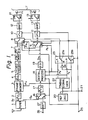
- a format of the recording signal for heads H1 and H2 will be described with reference to Fig. 1, in which a video signal Sv and an audio signal Sa of a received television broadcast are obtained from a tuner 1.
- the video signal Sv is converted into a digital signal by an analog-to-digital (A/D) converter 2 and is written into a frame memory 3.
- A/D analog-to-digital
- frame memory 3 the continuous video signal is time-base compressed so that it can be recorded in the space available in a slant track in accordance with wrap angle ⁇ v. Note that this is less than the 180° wrap angle normally provided for the video signal.
- the time-base compressing process is not limited to compressing all of the original video signal including the blanking period but it is also possible to use another approach in which only the effective video signal, excluding the blanking period, is fetched from the memory.
- the digital video signal that was time-base compressed in frame memory 3 is read out according to a timing signal Pv, shown in Fig. 3H, and returned to an analog signal by a digital-to-analog (D/A) converter 4.
- the analog signal is supplied to a video signal processing circuit 5, wherein the signal is subjected to processing such as emphasis, for example.
- the processed video signal is supplied to a frequency modulator 6 where it is frequency modulated.
- the modulated output signal of frequency modulator 6 is supplied through an equalizer circuit 7 to input terminals V of switching circuits 8 and 9, respectively.
- the output signals of switching circuits 8 and 9 are respectively supplied to the magnetic heads H1 and H2 through recording control switching circuits 10, 11, recording amplifiers 12, 13, and recording/playback change-over switches 14, 15, respectively.
- rotary transformers are provided between recording/playback change-over switches 14 and 15 and magnetic heads H1 and H2, however, a description of the rotary transformers is omitted here in the interest of clarity.
- the audio signal Sa from tuner 1 is supplied to another analog-to-digital (A/D) converter 17 through one input terminal N of a switching circuit 16 and converted into a digital audio signal that is supplied to a digital signal processing circuit 18, wherein the continuous audio signal is time-base compressed so that it can be recorded in the range of wrap angle ⁇ a.
- A/D analog-to-digital
- the continuous audio signal is time-base compressed so that it can be recorded in the range of wrap angle ⁇ a.
- Other forms of signal processing such as the encoding of an error correction code, digital modulation, and the like are also executed in digital signal processing circuit 18.
- the output signal from digital signal processing circuit 18 is supplied to an equalizer circuit 19 according to timing signals Pa and Pb.
- a digital audio signal Sb from equalizer circuit 19 is supplied to input terminals AU of both switching circuits 8 and 9.
- a servo reference signal Pr is formed by a servo reference signal generating circuit 20, and the servo reference signal Pr is fed to an output terminal 21 and also supplied to a timing signal generating circuit 22.
- the servo reference signal Pr is also supplied to a drum servo circuit (not shown) through output terminal 21.
- the rotational phase of drum D that is, of heads H1 and H2, is controlled synchronously with the servo reference signal Pr by the drum servo circuit in the well-known manner.
- Timing signal generating circuit 22 generates a timing signal Pa to control switching circuit 9 and a timing signal Pb to control switching circuit 8. Timing signal generating circuit 22 also generates the aforementioned timing signal Pv that controls frame memory 3.
- switching circuit 8 selects input terminal AU for the period of time when the timing signal Pa is at a high level, while switching circuit 8 selects the input terminal V for the period of time when the timing signal Pa is at a low level.
- switching circuit 9 selects the input terminal AU for the period of time when the timing signal Pb is at a high level, while switching circuit 9 selects the input terminal AU for the period of time when the timing signal Pb is at a low level.
- a switching circuit 23 selectively provides a control signal for recording control switching circuits 10 and 11.
- switches 23a and 23b of switching circuit 23 are connected with respective input terminals N.
- Input terminal N of switch 23a is supplied with the servo reference signal Pr that has been inverted by an invertor 24, whereas input terminal N of switch 23b is supplied directly with the servo reference signal Pr.
- the switching circuit 23 When it is desired to perform after recording, the switching circuit 23 is switched by an after recording mode signal fed in at an input terminal 25.
- the after recording mode signal is also supplied to switching circuit 8, switching circuit 10, switching circuit 16, and digital signal processing circuit 18.
- the audio signal to be after recorded is fed in at input terminal 26 and supplied to an input amplifier 27.
- the output signal of input amplifier 27 is supplied to the other input terminal A of switching circuit 16.
- the audio signal selected by switching circuit 16, in this case the after recording audio signal, is processed in a manner substantially identical to the original audio signal from tuner 1.
- Fig. 3A shows the video signal Sv and Fig. 3B shows the audio signal Sa, which are produced by tuner 1.
- the lengths of video signal corresponding to the periods of the rotational angles of 180° of the drum D are expressed as V1, V2 ..., and the audio signals of similar length are expressed by A1, A2, etc.
- Fig. 3C shows the servo reference signal Pr that controls the rotational phases of the heads H1 and H2.
- Fig. 3D shows the rotational phases of the head H1
- Fig. 3E shows the rotational phase of the other head H2.
- the head H1 sequentially scans the tape T in the angle ranges ⁇ a, ⁇ g, ⁇ v, and ⁇ g, which are represented in Fig. 2, for the period of time when the servo reference signal Pr is at a low level.
- the other head H2 sequentially scans the tape T in the angle ranges ⁇ a, ⁇ g, ⁇ v, and ⁇ g, which are represented in Fig. 2, for the period of time when the servo reference signal Pr is at a high level.
- the period of time when head H1 scans the tape in the angle ranges ⁇ a and ⁇ g coincides with the period of time when head H2 scans the tape in the angle ranges ⁇ b and ⁇ c.
- the period of time when head H1 scans the tape in the angle ranges ⁇ b and ⁇ c coincides with the period of time when head H2 scans the tape in the angle ranges ⁇ a and ⁇ g.
- timing signals Pa and Pb are shown in Figs. 3F and 3G, respectively, so that upon ordinary recording, switching circuits 8 and 9 select the input terminals AU for the periods of time when timing signals Pa and Pb are at a high level, respectively. Similarly, switching circuits 8 and 9 select the input terminals V for the periods of time when timing signals Pa and Pb are at a low level, respectively.
- the digital audio signal A1′ formed from the audio signal A1 is supplied through switching circuit 8, recording control switching circuit 10, recording amplifier 12, and recording/playback change-over switch 14 to magnetic head H1. Therefore, digital audio signal A1′ is recorded onto magnetic tape T by head H1 in the angle range ⁇ a.
- time-base compressed video signal V1′ formed from video signal V1 is recorded onto magnetic tape T by head H1 in the angle range ⁇ v. This represents normal or ordinary recording.
- recording control switching circuit 10 is supplied with servo reference signal Pr through invertor 24 so that it can be ON only for the period of time when servo reference signal Pr is at a low level.
- Fig. 3H represents timing signal Pv, which indicates the period of the time-base compressed video signal V1′.
- the digital audio signal A2′ is supplied through switching circuit 9, recording amplifier 13, and recording control switching circuit 15 to magnetic head H2 and recorded onto magnetic tape T.
- time-base compressed video signal V2′ is recorded onto magnetic tape T by head H2, as shown in Fig. 3K.
- Recording control switching circuit 11 is directly supplied with servo reference signal Pr and turned ON only for time when servo reference signal Pr is at a high level. Thereafter, operations similar to those described above are repeated.
- the digital audio signal and time-base compressed video signal are alternately recorded onto magnetic tape T by heads H1 and H2 at locations in each slant track corresponding to wrap angle ⁇ b.
- an after recording mode signal is supplied at input terminal 25 and fed to switching circuit 16, digital signal processing circuit 18, switching circuit 23, switching circuit 8, and switching circuit 9.
- switching circuit 16 and switching circuit 23 are respectively switched to select input terminal A, and switching circuits 8 and 9 are set to input terminal AU.
- the audio signal that is to be used for after recording is supplied to input terminal 26, so that digital audio signals A11′, A12′, ... for after recording are obtained.
- recording control switching circuit 10 is turned ON for the period of time when timing signal Pb is at a high level, while recording control switching circuit 11 is turned ON for the period of time when timing signal Pa is at a high level. Therefore, as shown in Fig.
- a digital audio signal A11′ is recorded on magnetic tape T by head H1 on the sheet track in the time corresponding to angle range ⁇ b.
- digital audio signal A12′ is recorded on magnetic tape T by head H2 in the next slant track i the period corresponding to angle range ⁇ b, as shown in Fig. 3K.
- the periods of time when the digital audio signals A11′, A12′, ... are recorded do not overlap the periods of time when the time base compressed video signals V1′, V2′, ... are recorded. Therefore, the reproduced output of the time-base compressed video signal is not lost or swamped by the after recording signal, and the audio signal can be after recorded while observing the reproduced video image. It is also generally necessary to supply the control signal to the recording/playback change-over switching circuits 14 and 15 to realize this function, however, explanation of this is omitted here in the interest of clarity and brevity.
- the original digital audio signal could also be recorded in the portion of the slant track corresponding to the area of angle range ⁇ b without instead of angle range ⁇ a. Either one of the two audio recording areas can be selected to contain the original audio on the basis of the phases of the switching signals Pa and Pb.
- the benefits provided by this invention are not limited only to after recording an audio signal, because even in the case of after recording an video signal, the reproduced output of the digital audio signal is not overpowered by the recording signal and after recording of the video signal can be performed while listening to the sound.
- the time during which the area for the video signal is scanned by the head does not overlap the time during which the area for the audio signal is scanned by the head. Therefore, a sound can be after recorded while observing the reproduced image or a video image can be after recorded while listening to the reproduced sound without using a special device, such as a reproducing amplifier in the drum, or a head used only for after recording, or the like.
- the two areas that are provided for the audio sounds have the same length and timing. Therefore, one of the two areas can be selectively used by merely operating a switch with a switching signal, so that the signal processing can be simplified.
Landscapes
- Engineering & Computer Science (AREA)
- Multimedia (AREA)
- Signal Processing (AREA)
- Recording Or Reproducing By Magnetic Means (AREA)
- Television Signal Processing For Recording (AREA)
Applications Claiming Priority (2)
| Application Number | Priority Date | Filing Date | Title |
|---|---|---|---|
| JP295270/88 | 1988-11-22 | ||
| JP63295270A JPH02141901A (ja) | 1988-11-22 | 1988-11-22 | 回転ヘッド型記録装置 |
Publications (2)
| Publication Number | Publication Date |
|---|---|
| EP0370670A2 true EP0370670A2 (de) | 1990-05-30 |
| EP0370670A3 EP0370670A3 (de) | 1994-01-26 |
Family
ID=17818421
Family Applications (1)
| Application Number | Title | Priority Date | Filing Date |
|---|---|---|---|
| EP19890311714 Withdrawn EP0370670A3 (de) | 1988-11-22 | 1989-11-13 | Aufzeichnungsgerät des Drehkopftyps |
Country Status (5)
| Country | Link |
|---|---|
| US (1) | US5121259A (de) |
| EP (1) | EP0370670A3 (de) |
| JP (1) | JPH02141901A (de) |
| KR (1) | KR900008449A (de) |
| CA (1) | CA2003195A1 (de) |
Cited By (1)
| Publication number | Priority date | Publication date | Assignee | Title |
|---|---|---|---|---|
| US5687158A (en) * | 1992-10-29 | 1997-11-11 | Kabushiki Kaisha Kenwood | Optical disk recording and reproducing apparatus for compressed signals |
Families Citing this family (8)
| Publication number | Priority date | Publication date | Assignee | Title |
|---|---|---|---|---|
| JPH04302863A (ja) * | 1991-03-29 | 1992-10-26 | Sharp Corp | データ記録装置 |
| EP0505983B1 (de) * | 1991-03-29 | 1997-06-18 | Sony Corporation | Magnetkopf und ein digitaler Magnetaufzeichnungskopf |
| JP3508138B2 (ja) * | 1991-06-25 | 2004-03-22 | ソニー株式会社 | 信号処理装置 |
| JPH0574007A (ja) * | 1991-09-17 | 1993-03-26 | Sony Corp | デイジタルvtr |
| JPH05101533A (ja) * | 1991-10-04 | 1993-04-23 | Sony Corp | Vtr |
| JPH0612788A (ja) * | 1992-06-29 | 1994-01-21 | Canon Inc | 記録/再生方法 |
| EP0693214A1 (de) | 1994-02-10 | 1996-01-24 | Koninklijke Philips Electronics N.V. | Einrichtung zur aufzeichnung oder wiedergabe eines digitalen videosignals und eines entsprechenden digitalen audiosignals |
| US9379688B2 (en) * | 2013-04-12 | 2016-06-28 | Garmin International, Inc. | Aircraft radio with improved standby performance |
Family Cites Families (8)
| Publication number | Priority date | Publication date | Assignee | Title |
|---|---|---|---|---|
| US4303950A (en) * | 1978-07-20 | 1981-12-01 | Matsushita Electric Industrial Co., Ltd. | Helical scan video tape recorder for recording video and audio signals on contiguous tracks |
| DE2921892A1 (de) * | 1979-05-30 | 1980-12-11 | Bosch Gmbh Robert | Verfahren zum speichern digitaler fernsehsignale |
| JPS57132486A (en) * | 1981-02-10 | 1982-08-16 | Sony Corp | Magnetic recorder and reproducer |
| JPS58164383A (ja) * | 1982-03-25 | 1983-09-29 | Sony Corp | ビデオ信号記録装置 |
| JPS61289791A (ja) * | 1985-06-18 | 1986-12-19 | Sony Corp | 映像・音声記録再生装置 |
| JP2568819B2 (ja) * | 1985-09-20 | 1997-01-08 | 三菱電機株式会社 | 間欠磁気記録再生装置 |
| US4819097A (en) * | 1987-05-13 | 1989-04-04 | Hitachi, Ltd. | Audio signal recording/reproducing system for use in time-lapse video tape recorder |
| JPH0793716B2 (ja) * | 1987-05-13 | 1995-10-09 | 株式会社日立製作所 | 間欠磁気記録再生装置 |
-
1988
- 1988-11-22 JP JP63295270A patent/JPH02141901A/ja active Pending
-
1989
- 1989-11-13 US US07/434,431 patent/US5121259A/en not_active Expired - Fee Related
- 1989-11-13 EP EP19890311714 patent/EP0370670A3/de not_active Withdrawn
- 1989-11-17 CA CA002003195A patent/CA2003195A1/en not_active Abandoned
- 1989-11-21 KR KR1019890016874A patent/KR900008449A/ko not_active Withdrawn
Cited By (1)
| Publication number | Priority date | Publication date | Assignee | Title |
|---|---|---|---|---|
| US5687158A (en) * | 1992-10-29 | 1997-11-11 | Kabushiki Kaisha Kenwood | Optical disk recording and reproducing apparatus for compressed signals |
Also Published As
| Publication number | Publication date |
|---|---|
| CA2003195A1 (en) | 1990-05-22 |
| JPH02141901A (ja) | 1990-05-31 |
| EP0370670A3 (de) | 1994-01-26 |
| US5121259A (en) | 1992-06-09 |
| KR900008449A (ko) | 1990-06-03 |
Similar Documents
| Publication | Publication Date | Title |
|---|---|---|
| US4768106A (en) | Apparatus for recording video and PCM audio signals with insert editing using axially displaced heads | |
| US4984104A (en) | Apparatus for recording an information signal at a second part of a given track by sampling and holding a tracking control signal used for tracking at a first part of the given track | |
| EP0727125A1 (de) | Gerät zur aufnahme und/oder wiedergabe von videosignalen und audiosignalen auf/von scrägspuren auf magnetband und magnetband für solch ein gerät | |
| US5065258A (en) | Transmitting information from producer to end users through slant-track tape-to-tape copying at higher-than-standard signal transmission | |
| JPS6362948B2 (de) | ||
| JPH0375953B2 (de) | ||
| EP0318038B1 (de) | Schaltung zur Trennung von gleichzeitig wiedergegebenen PCM- und ATF-Signalen mit mindestens sich partiel überlappenden Frequenzbändern | |
| US5121259A (en) | Video tape recorder with after-recording capability | |
| US5966496A (en) | Method of and apparatus for recording and reproducing digital information signal including sub-information | |
| CA1270942A (en) | Video and audio signal recording and reproducing apparatus | |
| US5072316A (en) | Recording apparatus | |
| EP0098727A2 (de) | Aufzeichnungs- und Wiedergabesysteme mit Schrägspurabtastung | |
| US5317412A (en) | Video tape recorder for recording and reproducing high-definition video signal and audio signal | |
| US6349012B1 (en) | Magnetic recording and/or reproducing apparatus | |
| US5539585A (en) | Apparatus for recording an information signal in a normal record mode and an edit mode | |
| JP2940093B2 (ja) | 記録再生装置 | |
| US5953172A (en) | High speed recording and reproducing apparatus for avoiding cross talk during insert-recording | |
| US6163427A (en) | Storing and reproducing digital video and audio on a magnetic tape having stored a signal readable by VHS analog apparatus | |
| JP2580583B2 (ja) | 記録再生装置 | |
| JPS641995B2 (de) | ||
| CA1209694A (en) | Helical scan recording and playback systems | |
| JP2769003B2 (ja) | 磁気記録再生装置 | |
| JP2508497B2 (ja) | ビデオ信号記録装置 | |
| JPH03265391A (ja) | カラー映像信号と音声信号の磁気記録再生装置 | |
| JPH0425629B2 (de) |
Legal Events
| Date | Code | Title | Description |
|---|---|---|---|
| PUAI | Public reference made under article 153(3) epc to a published international application that has entered the european phase |
Free format text: ORIGINAL CODE: 0009012 |
|
| AK | Designated contracting states |
Kind code of ref document: A2 Designated state(s): DE FR GB |
|
| PUAL | Search report despatched |
Free format text: ORIGINAL CODE: 0009013 |
|
| AK | Designated contracting states |
Kind code of ref document: A3 Designated state(s): DE FR GB |
|
| STAA | Information on the status of an ep patent application or granted ep patent |
Free format text: STATUS: THE APPLICATION IS DEEMED TO BE WITHDRAWN |
|
| 18D | Application deemed to be withdrawn |
Effective date: 19940727 |