EP0371771A2 - Procédé de production de nitrure d'aluminium et nitrure d'aluminium obtenu - Google Patents
Procédé de production de nitrure d'aluminium et nitrure d'aluminium obtenu Download PDFInfo
- Publication number
- EP0371771A2 EP0371771A2 EP89312384A EP89312384A EP0371771A2 EP 0371771 A2 EP0371771 A2 EP 0371771A2 EP 89312384 A EP89312384 A EP 89312384A EP 89312384 A EP89312384 A EP 89312384A EP 0371771 A2 EP0371771 A2 EP 0371771A2
- Authority
- EP
- European Patent Office
- Prior art keywords
- aluminum
- aluminum nitride
- nitrogen
- reaction
- dopant
- Prior art date
- Legal status (The legal status is an assumption and is not a legal conclusion. Google has not performed a legal analysis and makes no representation as to the accuracy of the status listed.)
- Withdrawn
Links
- 238000004519 manufacturing process Methods 0.000 title claims abstract description 7
- 229910017083 AlN Inorganic materials 0.000 title 2
- PIGFYZPCRLYGLF-UHFFFAOYSA-N Aluminum nitride Chemical compound [Al]#N PIGFYZPCRLYGLF-UHFFFAOYSA-N 0.000 title 2
- IJGRMHOSHXDMSA-UHFFFAOYSA-N Atomic nitrogen Chemical compound N#N IJGRMHOSHXDMSA-UHFFFAOYSA-N 0.000 claims abstract description 108
- PMHQVHHXPFUNSP-UHFFFAOYSA-M copper(1+);methylsulfanylmethane;bromide Chemical compound Br[Cu].CSC PMHQVHHXPFUNSP-UHFFFAOYSA-M 0.000 claims abstract description 59
- 229910052757 nitrogen Inorganic materials 0.000 claims abstract description 53
- XAGFODPZIPBFFR-UHFFFAOYSA-N aluminium Chemical compound [Al] XAGFODPZIPBFFR-UHFFFAOYSA-N 0.000 claims abstract description 51
- 239000002019 doping agent Substances 0.000 claims abstract description 48
- 229910052782 aluminium Inorganic materials 0.000 claims abstract description 45
- 239000011777 magnesium Substances 0.000 claims abstract description 30
- 238000005245 sintering Methods 0.000 claims abstract description 25
- 239000013078 crystal Substances 0.000 claims abstract description 24
- 229910052749 magnesium Inorganic materials 0.000 claims abstract description 21
- 239000011575 calcium Substances 0.000 claims abstract description 15
- FYYHWMGAXLPEAU-UHFFFAOYSA-N Magnesium Chemical compound [Mg] FYYHWMGAXLPEAU-UHFFFAOYSA-N 0.000 claims abstract description 14
- 239000002243 precursor Substances 0.000 claims abstract description 12
- 229910052788 barium Inorganic materials 0.000 claims abstract description 11
- 229910052791 calcium Inorganic materials 0.000 claims abstract description 11
- 229910052712 strontium Inorganic materials 0.000 claims abstract description 11
- 150000004767 nitrides Chemical class 0.000 claims abstract description 9
- OYPRJOBELJOOCE-UHFFFAOYSA-N Calcium Chemical compound [Ca] OYPRJOBELJOOCE-UHFFFAOYSA-N 0.000 claims abstract description 8
- DSAJWYNOEDNPEQ-UHFFFAOYSA-N barium atom Chemical compound [Ba] DSAJWYNOEDNPEQ-UHFFFAOYSA-N 0.000 claims abstract description 8
- CIOAGBVUUVVLOB-UHFFFAOYSA-N strontium atom Chemical compound [Sr] CIOAGBVUUVVLOB-UHFFFAOYSA-N 0.000 claims abstract description 8
- 230000015572 biosynthetic process Effects 0.000 claims abstract description 7
- 238000006243 chemical reaction Methods 0.000 claims description 64
- 238000000034 method Methods 0.000 claims description 42
- 239000002245 particle Substances 0.000 claims description 38
- 230000008569 process Effects 0.000 claims description 31
- 239000000463 material Substances 0.000 claims description 20
- 239000000843 powder Substances 0.000 claims description 19
- 239000000203 mixture Substances 0.000 claims description 16
- 229910045601 alloy Inorganic materials 0.000 claims description 15
- 239000000956 alloy Substances 0.000 claims description 15
- 238000010438 heat treatment Methods 0.000 claims description 11
- 239000003153 chemical reaction reagent Substances 0.000 claims description 8
- 239000012298 atmosphere Substances 0.000 claims description 4
- 238000002156 mixing Methods 0.000 claims description 4
- 238000002844 melting Methods 0.000 claims description 3
- 230000008018 melting Effects 0.000 claims description 3
- 238000004320 controlled atmosphere Methods 0.000 claims description 2
- 229910052751 metal Inorganic materials 0.000 abstract description 15
- 239000002184 metal Substances 0.000 abstract description 14
- 150000002739 metals Chemical class 0.000 abstract description 8
- 238000002161 passivation Methods 0.000 abstract description 6
- 239000000047 product Substances 0.000 description 58
- PNEYBMLMFCGWSK-UHFFFAOYSA-N aluminium oxide Inorganic materials [O-2].[O-2].[O-2].[Al+3].[Al+3] PNEYBMLMFCGWSK-UHFFFAOYSA-N 0.000 description 9
- 230000002829 reductive effect Effects 0.000 description 9
- 230000007423 decrease Effects 0.000 description 6
- 208000021017 Weight Gain Diseases 0.000 description 5
- 239000000919 ceramic Substances 0.000 description 5
- 238000002474 experimental method Methods 0.000 description 5
- 239000012299 nitrogen atmosphere Substances 0.000 description 5
- 239000007858 starting material Substances 0.000 description 5
- 230000004584 weight gain Effects 0.000 description 5
- 235000019786 weight gain Nutrition 0.000 description 5
- 229910000838 Al alloy Inorganic materials 0.000 description 4
- QGZKDVFQNNGYKY-UHFFFAOYSA-N Ammonia Chemical compound N QGZKDVFQNNGYKY-UHFFFAOYSA-N 0.000 description 4
- WHXSMMKQMYFTQS-UHFFFAOYSA-N Lithium Chemical compound [Li] WHXSMMKQMYFTQS-UHFFFAOYSA-N 0.000 description 4
- 238000011109 contamination Methods 0.000 description 4
- 239000007789 gas Substances 0.000 description 4
- 229910052744 lithium Inorganic materials 0.000 description 4
- 230000036961 partial effect Effects 0.000 description 4
- HCHKCACWOHOZIP-UHFFFAOYSA-N Zinc Chemical compound [Zn] HCHKCACWOHOZIP-UHFFFAOYSA-N 0.000 description 3
- 238000007792 addition Methods 0.000 description 3
- 239000000356 contaminant Substances 0.000 description 3
- 229910001873 dinitrogen Inorganic materials 0.000 description 3
- 230000000694 effects Effects 0.000 description 3
- 238000005121 nitriding Methods 0.000 description 3
- 230000002787 reinforcement Effects 0.000 description 3
- 239000007787 solid Substances 0.000 description 3
- 239000000758 substrate Substances 0.000 description 3
- 238000005303 weighing Methods 0.000 description 3
- 229910052725 zinc Inorganic materials 0.000 description 3
- 239000011701 zinc Substances 0.000 description 3
- XKRFYHLGVUSROY-UHFFFAOYSA-N Argon Chemical compound [Ar] XKRFYHLGVUSROY-UHFFFAOYSA-N 0.000 description 2
- 229910000600 Ba alloy Inorganic materials 0.000 description 2
- 229910000882 Ca alloy Inorganic materials 0.000 description 2
- OKTJSMMVPCPJKN-UHFFFAOYSA-N Carbon Chemical compound [C] OKTJSMMVPCPJKN-UHFFFAOYSA-N 0.000 description 2
- 239000000654 additive Substances 0.000 description 2
- 230000000996 additive effect Effects 0.000 description 2
- 150000001412 amines Chemical class 0.000 description 2
- 229910021529 ammonia Inorganic materials 0.000 description 2
- 229910052799 carbon Inorganic materials 0.000 description 2
- 230000001427 coherent effect Effects 0.000 description 2
- 150000001875 compounds Chemical class 0.000 description 2
- 238000001816 cooling Methods 0.000 description 2
- 229910052593 corundum Inorganic materials 0.000 description 2
- 230000003247 decreasing effect Effects 0.000 description 2
- 210000001787 dendrite Anatomy 0.000 description 2
- 238000009792 diffusion process Methods 0.000 description 2
- 239000012535 impurity Substances 0.000 description 2
- PQXKHYXIUOZZFA-UHFFFAOYSA-M lithium fluoride Chemical compound [Li+].[F-] PQXKHYXIUOZZFA-UHFFFAOYSA-M 0.000 description 2
- 238000004377 microelectronic Methods 0.000 description 2
- 230000003647 oxidation Effects 0.000 description 2
- 238000007254 oxidation reaction Methods 0.000 description 2
- 230000001590 oxidative effect Effects 0.000 description 2
- 239000008188 pellet Substances 0.000 description 2
- 238000012545 processing Methods 0.000 description 2
- 239000000376 reactant Substances 0.000 description 2
- 230000035484 reaction time Effects 0.000 description 2
- 239000000126 substance Substances 0.000 description 2
- 238000003786 synthesis reaction Methods 0.000 description 2
- 229910001845 yogo sapphire Inorganic materials 0.000 description 2
- RUDFQVOCFDJEEF-UHFFFAOYSA-N yttrium(III) oxide Inorganic materials [O-2].[O-2].[O-2].[Y+3].[Y+3] RUDFQVOCFDJEEF-UHFFFAOYSA-N 0.000 description 2
- 229910018134 Al-Mg Inorganic materials 0.000 description 1
- 229910018467 Al—Mg Inorganic materials 0.000 description 1
- 229910000861 Mg alloy Inorganic materials 0.000 description 1
- 229910052581 Si3N4 Inorganic materials 0.000 description 1
- 229910001278 Sr alloy Inorganic materials 0.000 description 1
- 230000002411 adverse Effects 0.000 description 1
- SNAAJJQQZSMGQD-UHFFFAOYSA-N aluminum magnesium Chemical compound [Mg].[Al] SNAAJJQQZSMGQD-UHFFFAOYSA-N 0.000 description 1
- 229910052786 argon Inorganic materials 0.000 description 1
- 238000000889 atomisation Methods 0.000 description 1
- 239000006227 byproduct Substances 0.000 description 1
- 229910010293 ceramic material Inorganic materials 0.000 description 1
- 239000011153 ceramic matrix composite Substances 0.000 description 1
- 239000007795 chemical reaction product Substances 0.000 description 1
- 239000002131 composite material Substances 0.000 description 1
- 239000012141 concentrate Substances 0.000 description 1
- 238000000354 decomposition reaction Methods 0.000 description 1
- 238000007865 diluting Methods 0.000 description 1
- 238000004880 explosion Methods 0.000 description 1
- 230000002349 favourable effect Effects 0.000 description 1
- 150000004673 fluoride salts Chemical class 0.000 description 1
- 230000008570 general process Effects 0.000 description 1
- 238000005247 gettering Methods 0.000 description 1
- 238000011534 incubation Methods 0.000 description 1
- 230000000670 limiting effect Effects 0.000 description 1
- 239000007788 liquid Substances 0.000 description 1
- 239000011159 matrix material Substances 0.000 description 1
- 239000011156 metal matrix composite Substances 0.000 description 1
- 238000001000 micrograph Methods 0.000 description 1
- 150000002829 nitrogen Chemical class 0.000 description 1
- QJGQUHMNIGDVPM-UHFFFAOYSA-N nitrogen group Chemical group [N] QJGQUHMNIGDVPM-UHFFFAOYSA-N 0.000 description 1
- -1 nitrogen ions Chemical class 0.000 description 1
- 239000011148 porous material Substances 0.000 description 1
- 238000011160 research Methods 0.000 description 1
- 229920006395 saturated elastomer Polymers 0.000 description 1
- HQVNEWCFYHHQES-UHFFFAOYSA-N silicon nitride Chemical compound N12[Si]34N5[Si]62N3[Si]51N64 HQVNEWCFYHHQES-UHFFFAOYSA-N 0.000 description 1
- 230000002269 spontaneous effect Effects 0.000 description 1
- 238000006557 surface reaction Methods 0.000 description 1
- 230000002194 synthesizing effect Effects 0.000 description 1
- 238000012360 testing method Methods 0.000 description 1
- 238000007669 thermal treatment Methods 0.000 description 1
- 231100000331 toxic Toxicity 0.000 description 1
- 230000002588 toxic effect Effects 0.000 description 1
- 230000001052 transient effect Effects 0.000 description 1
- 230000000007 visual effect Effects 0.000 description 1
- XLYOFNOQVPJJNP-UHFFFAOYSA-N water Substances O XLYOFNOQVPJJNP-UHFFFAOYSA-N 0.000 description 1
Images


Classifications
-
- C—CHEMISTRY; METALLURGY
- C30—CRYSTAL GROWTH
- C30B—SINGLE-CRYSTAL GROWTH; UNIDIRECTIONAL SOLIDIFICATION OF EUTECTIC MATERIAL OR UNIDIRECTIONAL DEMIXING OF EUTECTOID MATERIAL; REFINING BY ZONE-MELTING OF MATERIAL; PRODUCTION OF A HOMOGENEOUS POLYCRYSTALLINE MATERIAL WITH DEFINED STRUCTURE; SINGLE CRYSTALS OR HOMOGENEOUS POLYCRYSTALLINE MATERIAL WITH DEFINED STRUCTURE; AFTER-TREATMENT OF SINGLE CRYSTALS OR A HOMOGENEOUS POLYCRYSTALLINE MATERIAL WITH DEFINED STRUCTURE; APPARATUS THEREFOR
- C30B9/00—Single-crystal growth from melt solutions using molten solvents
-
- C—CHEMISTRY; METALLURGY
- C01—INORGANIC CHEMISTRY
- C01B—NON-METALLIC ELEMENTS; COMPOUNDS THEREOF; METALLOIDS OR COMPOUNDS THEREOF NOT COVERED BY SUBCLASS C01C
- C01B21/00—Nitrogen; Compounds thereof
- C01B21/06—Binary compounds of nitrogen with metals, with silicon, or with boron, or with carbon, i.e. nitrides; Compounds of nitrogen with more than one metal, silicon or boron
- C01B21/072—Binary compounds of nitrogen with metals, with silicon, or with boron, or with carbon, i.e. nitrides; Compounds of nitrogen with more than one metal, silicon or boron with aluminium
- C01B21/0722—Preparation by direct nitridation of aluminium
-
- C—CHEMISTRY; METALLURGY
- C04—CEMENTS; CONCRETE; ARTIFICIAL STONE; CERAMICS; REFRACTORIES
- C04B—LIME, MAGNESIA; SLAG; CEMENTS; COMPOSITIONS THEREOF, e.g. MORTARS, CONCRETE OR LIKE BUILDING MATERIALS; ARTIFICIAL STONE; CERAMICS; REFRACTORIES; TREATMENT OF NATURAL STONE
- C04B35/00—Shaped ceramic products characterised by their composition; Ceramics compositions; Processing powders of inorganic compounds preparatory to the manufacturing of ceramic products
- C04B35/515—Shaped ceramic products characterised by their composition; Ceramics compositions; Processing powders of inorganic compounds preparatory to the manufacturing of ceramic products based on non-oxide ceramics
- C04B35/58—Shaped ceramic products characterised by their composition; Ceramics compositions; Processing powders of inorganic compounds preparatory to the manufacturing of ceramic products based on non-oxide ceramics based on borides, nitrides, i.e. nitrides, oxynitrides, carbonitrides or oxycarbonitrides or silicides
- C04B35/581—Shaped ceramic products characterised by their composition; Ceramics compositions; Processing powders of inorganic compounds preparatory to the manufacturing of ceramic products based on non-oxide ceramics based on borides, nitrides, i.e. nitrides, oxynitrides, carbonitrides or oxycarbonitrides or silicides based on aluminium nitride
-
- C—CHEMISTRY; METALLURGY
- C30—CRYSTAL GROWTH
- C30B—SINGLE-CRYSTAL GROWTH; UNIDIRECTIONAL SOLIDIFICATION OF EUTECTIC MATERIAL OR UNIDIRECTIONAL DEMIXING OF EUTECTOID MATERIAL; REFINING BY ZONE-MELTING OF MATERIAL; PRODUCTION OF A HOMOGENEOUS POLYCRYSTALLINE MATERIAL WITH DEFINED STRUCTURE; SINGLE CRYSTALS OR HOMOGENEOUS POLYCRYSTALLINE MATERIAL WITH DEFINED STRUCTURE; AFTER-TREATMENT OF SINGLE CRYSTALS OR A HOMOGENEOUS POLYCRYSTALLINE MATERIAL WITH DEFINED STRUCTURE; APPARATUS THEREFOR
- C30B11/00—Single-crystal growth by normal freezing or freezing under temperature gradient, e.g. Bridgman-Stockbarger method
-
- C—CHEMISTRY; METALLURGY
- C30—CRYSTAL GROWTH
- C30B—SINGLE-CRYSTAL GROWTH; UNIDIRECTIONAL SOLIDIFICATION OF EUTECTIC MATERIAL OR UNIDIRECTIONAL DEMIXING OF EUTECTOID MATERIAL; REFINING BY ZONE-MELTING OF MATERIAL; PRODUCTION OF A HOMOGENEOUS POLYCRYSTALLINE MATERIAL WITH DEFINED STRUCTURE; SINGLE CRYSTALS OR HOMOGENEOUS POLYCRYSTALLINE MATERIAL WITH DEFINED STRUCTURE; AFTER-TREATMENT OF SINGLE CRYSTALS OR A HOMOGENEOUS POLYCRYSTALLINE MATERIAL WITH DEFINED STRUCTURE; APPARATUS THEREFOR
- C30B29/00—Single crystals or homogeneous polycrystalline material with defined structure characterised by the material or by their shape
- C30B29/10—Inorganic compounds or compositions
- C30B29/40—AIIIBV compounds wherein A is B, Al, Ga, In or Tl and B is N, P, As, Sb or Bi
- C30B29/403—AIII-nitrides
-
- C—CHEMISTRY; METALLURGY
- C01—INORGANIC CHEMISTRY
- C01P—INDEXING SCHEME RELATING TO STRUCTURAL AND PHYSICAL ASPECTS OF SOLID INORGANIC COMPOUNDS
- C01P2002/00—Crystal-structural characteristics
- C01P2002/50—Solid solutions
- C01P2002/52—Solid solutions containing elements as dopants
-
- C—CHEMISTRY; METALLURGY
- C01—INORGANIC CHEMISTRY
- C01P—INDEXING SCHEME RELATING TO STRUCTURAL AND PHYSICAL ASPECTS OF SOLID INORGANIC COMPOUNDS
- C01P2004/00—Particle morphology
- C01P2004/10—Particle morphology extending in one dimension, e.g. needle-like
-
- C—CHEMISTRY; METALLURGY
- C01—INORGANIC CHEMISTRY
- C01P—INDEXING SCHEME RELATING TO STRUCTURAL AND PHYSICAL ASPECTS OF SOLID INORGANIC COMPOUNDS
- C01P2004/00—Particle morphology
- C01P2004/20—Particle morphology extending in two dimensions, e.g. plate-like
-
- C—CHEMISTRY; METALLURGY
- C01—INORGANIC CHEMISTRY
- C01P—INDEXING SCHEME RELATING TO STRUCTURAL AND PHYSICAL ASPECTS OF SOLID INORGANIC COMPOUNDS
- C01P2004/00—Particle morphology
- C01P2004/54—Particles characterised by their aspect ratio, i.e. the ratio of sizes in the longest to the shortest dimension
-
- C—CHEMISTRY; METALLURGY
- C01—INORGANIC CHEMISTRY
- C01P—INDEXING SCHEME RELATING TO STRUCTURAL AND PHYSICAL ASPECTS OF SOLID INORGANIC COMPOUNDS
- C01P2004/00—Particle morphology
- C01P2004/60—Particles characterised by their size
- C01P2004/61—Micrometer sized, i.e. from 1-100 micrometer
-
- C—CHEMISTRY; METALLURGY
- C04—CEMENTS; CONCRETE; ARTIFICIAL STONE; CERAMICS; REFRACTORIES
- C04B—LIME, MAGNESIA; SLAG; CEMENTS; COMPOSITIONS THEREOF, e.g. MORTARS, CONCRETE OR LIKE BUILDING MATERIALS; ARTIFICIAL STONE; CERAMICS; REFRACTORIES; TREATMENT OF NATURAL STONE
- C04B2235/00—Aspects relating to ceramic starting mixtures or sintered ceramic products
- C04B2235/02—Composition of constituents of the starting material or of secondary phases of the final product
- C04B2235/30—Constituents and secondary phases not being of a fibrous nature
- C04B2235/40—Metallic constituents or additives not added as binding phase
-
- C—CHEMISTRY; METALLURGY
- C04—CEMENTS; CONCRETE; ARTIFICIAL STONE; CERAMICS; REFRACTORIES
- C04B—LIME, MAGNESIA; SLAG; CEMENTS; COMPOSITIONS THEREOF, e.g. MORTARS, CONCRETE OR LIKE BUILDING MATERIALS; ARTIFICIAL STONE; CERAMICS; REFRACTORIES; TREATMENT OF NATURAL STONE
- C04B2235/00—Aspects relating to ceramic starting mixtures or sintered ceramic products
- C04B2235/02—Composition of constituents of the starting material or of secondary phases of the final product
- C04B2235/50—Constituents or additives of the starting mixture chosen for their shape or used because of their shape or their physical appearance
- C04B2235/54—Particle size related information
- C04B2235/5418—Particle size related information expressed by the size of the particles or aggregates thereof
- C04B2235/5436—Particle size related information expressed by the size of the particles or aggregates thereof micrometer sized, i.e. from 1 to 100 micron
Definitions
- This invention relates to a process for preparing aluminum nitride and to the aluminum nitride so-produced.
- Aluminum nitride is attracting much attention nowadays as a material for use in substrates for microelectronic devices, structural materials, metal or ceramic matrix composite materials and for other specialized applications.
- aluminum nitride When used for microelectronic devices it has to be in highly pure form and should have good thermal conductivity but low electrical conductivity.
- the purity of the aluminum nitride When used for structural purposes, e.g. as high impact resistant materials, the purity of the aluminum nitride is less important, but the particles should be readily sinterable and capable of producing a dense product.
- the particles When used for matrix reinforcement, the particles should preferably be large and consist of single crystals.
- aluminum nitride powder is produced in bulk quantities by the carbonitridation of alumina (see, for example, U.S. Patent 2,835,566 granted to R. Perieres et. al. on May 20, 1958).
- the reaction proceeds at temperatures of about 1750°C according to the following equation: Al2O3(s) + 3C(s) + N2(g) ⁇ 2AlN(s) + 3CO(g)
- Examples of such methods include the nitriding of aluminum powder in a jet of nitrogen plasma (D.P. Zyatkevich, et. al., Poroshkovaya Metallurgica, No. 10 (178), pp 1-5, October, 1977); the nitriding of mixtures of aluminum powder and lithium fluoride powder (C.F. Cooper et. al., Special Ceramics 4, Proceedings of a Symposium of the British Ceramic Research Association, pp 1-13, 1968); and the nitriding of mixtures of aluminum powder and fluoride salts (British Patent 784,126 to Charlton and Evans, published on October 2, 1957).
- these methods have not been successful on a commercial scale.
- U.S. patent 3,395,981 which issued on August 6, 1968 to Werner Kischio discloses a similar process employing zinc as an additive for the aluminum in order to overcome the passivation of the aluminum.
- the amount of the additive metal which has to be employed is between 5 and 20% by weight of the alloy with the aluminum. This results in an aluminum nitride product which contains a large percentage of residual zinc, making the product unsuitable for many applications. Furthermore, the yield of the process is substantially reduced by the large alloy additions.
- the present invention is based in part on the finding that aluminum can be made to react rapidly. with nitrogen or a nitrogen precursor (such as ammonia or an amine), both at relatively low temperatures and at low pressures, to form desirable aluminum nitride products, when certain dopants are present during the nitridation reaction.
- nitrogen or a nitrogen precursor such as ammonia or an amine
- a process for preparing aluminum nitride which comprises: reacting molten aluminum with a reagent selected from the group consisting of nitrogen and nitrogen precursors, at a pressure of up to about 0.2 MPa (absolute), the reaction being carried out in the presence of less than 5% by weight of a dopant, based on the total weight of the aluminum and the dopant, selected from the group consisting of magnesium, calcium, strontium and barium.
- aluminum nitride in the form of single crystal particles having a size in the range of about 1 ⁇ m-10 ⁇ m.
- a main advantage of the present invention is that it provides a process which produces aluminum nitride particles in forms that are very desirable for certain specialized uses while enabling the particles to be produced relatively inexpensively in view of the low pressures and relatively low temperatures that can be employed. This is possible because quite small amounts of the selected dopants unexpectedly reduce the passivation of aluminum to nitridation without giving rise to handling and processing problems.
- an important advantage of the present invention is that the nitridation process can be carried out at a low pressure, i.e. a pressure below about 0.2 MPa and preferably at atmospheric pressure (0.1 MPa). Such pressures are considerably below the 1 MPa or more required for bulk nitridation required by Kudela in the article mentioned above. It is therefore possible to carry out the process of the present invention in relatively inexpensive ambient pressure apparatus, which is economically advantageous, especially when the reaction is carried out on a commercial scale.
- the total pressure in the reaction apparatus may be reduced or, alternatively, the partial pressure of the nitrogen may be reduced while the total pressure in the apparatus is maintained at about atmospheric pressure, e.g. by diluting the nitrogen with a non-reactive gas such as argon. Partial pressures as low as 0.005 MPa may be achieved in this way. If the option of reducing the total pressure in the apparatus is chosen, pressures of nitrogen lower than the vapour pressure of the aluminum nitride product phase at the reaction temperature should not be employed. As the reaction proceeds, it may be found that the partial and/or total pressure may decrease if the nitrogen is consumed at a rate faster than it is supplied.
- the molten aluminum must come into contact with nitrogen at the reaction temperature in the presence of the dopant.
- This may be achieved by supplying nitrogen gas or a gas mixture (as indicated above) to the reaction apparatus or by supplying a nitrogen precursor which decomposes to nitrogen at the reaction conditions, e.g. ammonia or an amine.
- the nitrogen may be supplied in the form of a nitrogen plasma containing monatomic nitrogen or nitrogen ions.
- the reaction is carried out at a temperature high enough to melt the aluminum or aluminum alloy and to bring about the nitridation reaction to a significant extent when the dopant is present.
- the lowest effective temperature is normally employed in order to make the process as economical as possible. Temperatures falling within the range of the melting point of the aluminum to the temperature at which the volatilization of the dopant becomes significant are normally suitable. In practice, the reaction temperature normally falls within the range of approximately 550°C to 1650°C, and preferably within the range of 800°C to 1450°C.
- the dopants used in the present invention are all metals but compounds of these metals may be employed as dopant precursors if the compounds decompose or are reduced to the metal under the nitridation conditions.
- the aluminum and the dopant are alloyed before the nitridation reaction is commenced but the dopant or dopant precursor may alternatively be coated on the surface of the aluminum prior to the reaction, positioned in such a manner that it flows onto the aluminum at the reaction temperature, or the reactant nitrogen gas flowing into the reaction zone may be saturated with the dopant either within or outside of the reaction apparatus.
- the dopant must be present at the reactive surface of the aluminum when the nitridation reaction takes place such that an alloy forms at the surface of the aluminum.
- Reaction times range from essentially instantaneous to 24 hours. The actual time depends on the process conditions because the temperature, pressure, particular dopant and reactor geometry can all affect the reaction time. In some instances, there is an incubation period before the aluminum reacts to any appreciable extent, whereas in other instances, the aluminum reacts as soon as it reaches the reaction temperature.
- the reaction is normally carried out by placing the aluminum and dopant (generally combined as an alloy) in an inert open container capable of resisting the temperatures employed in the reaction, and positioning the container in a furnace capable of being supplied with a nitrogen atmosphere at a predetermined pressure and capable of raising the temperature of the entire body of aluminum controllably to a predetermined value. As the temperature inside the furnace is raised, the metals melt and react with the nitrogen. At the temperatures and pressures employed, essentially all of the aluminum reacts and the nitride product remains in the container and can be collected when sufficiently cooled.
- the furnace and the container should be designed to function in controlled pressure nitrogen-containing atmospheres and should preferably not contribute contaminants to the metal or product.
- the reaction since the reaction is exothermic, it may not be necessary to use a conventional furnace.
- the molten aluminum and dopant may be sprayed into a nitrogen atmosphere at the desired temperature through a suitable nozzle. This causes an essentially spontaneous reaction and a solid nitride powder can be collected from the bottom of the reaction enclosure.
- Atomization of the metal may be brought about by directing a hot jet of nitrogen against a stream of the molten metals or by other methods well known to those skilled in the art as part of the nitridation process.
- the dopants used in the process of the present invention are the metals magnesium, calcium, strontium and barium. These metals have unexpectedly been found to have advantages over other metal dopants such as lithium and zinc as used, respectively, by Little and Kischio. These advantages are explained in detail below.
- the elements are all effective in relatively small amounts within the range of about 0.1 to 5% (preferably 0.1 to 3%) by weight based on the total weight of the aluminum and the dopant. This means that the aluminum nitride product is relatively uncontaminated with residual dopant and special additional steps to remove the dopant may not be required, depending on the intended use of the product.
- a bulk liquid nitrogen source can be employed if desired for reduced cost.
- Commercial purity aluminum can also be used as a starting material.
- magnesium when used as a dopant, produces aluminum nitride products that differ from those produced when Ca, Sr and Ba are used as dopants. Moreover, the products produced when Mg is employed can be made to differ according to the reaction conditions.
- the aluminum nitride product is produced in the form of relatively large single crystals which, although often loosely attached, can be separated by mild comminution.
- Large single crystals of this type are believed to be novel because conventional products usually consist of agglomerates of strongly adhering submicronic crystals.
- the shape and size of the single crystals resulting from the use of Mg vary according to the reaction conditions in a way that is not yet fully understood, but it seems that the use of higher reaction temperatures (e.g. about 1200°C) and lower magnesium contents (e.g.about 1% Mg) leads to the formation of equiaxial particles or platelets.
- the combination of lower magnesium contents with lower temperatures e.g.
- the acicular particles generally have a size of about 10 ⁇ m x 1 ⁇ m; the equiaxial particles generally have a size of about 1-2 ⁇ m; and platelets generally have a size of about 1-2 ⁇ m x 4-5 ⁇ m.
- Large single crystals of this kind are very useful as reinforcements for metal or ceramic matrices because they have great tensile strength.
- the platelets, needles and dendrites are especially useful for reinforcement purposes.
- Single crystals of aluminum nitride in the size range of about 1-10 ⁇ m are believed to be novel and form an aspect of this invention.
- the large single crystals do not usually give sintered products which have good thermal conductivity, and so may not be very useful for forming substrates for electronic components, it has been found that this disadvantage can be overcome by mixing the large single crystals with a conventional high purity aluminum nitride product normally used for such purposes. Unexpectedly, the large crystals do not reduce the good thermal conductivity obtainable from the conventional product to the extent that would be expected and products with desirable thermal properties can be obtained by using mixtures containing large proportions of the single crystal product of the invention.
- the use of 70% by weight of 10 ⁇ m particles with 30% by weight of a conventional product was converted to a sintered product having a thermal conductivity of 127 watts/metre/°K compared with 200 watts/metre/°K for the product produced from the conventional material itself and only 4.5 watts/metre/°K for the product produced from the large single crystal material of the invention.
- the conventional material being highly pure, is very expensive whereas the large single crystal material of the present invention can normally be produced much more cheaply (e.g. for about 10-15% of the cost) and so there is a large economic advantage.
- the large single crystals in the mixture with the smaller conventional particles make the mixture less likely to shrink during sintering.
- the resulting sintered product is cheaper and subject to better volume control than the conventional products.
- the relative proportions of the conventional material and the large single crystal material of the invention can be varied widely according to the characteristics required of the product and optimum proportions for any particular application can be determined by simple experimentation. It should of course also be noted that sintering aids, such as yttria, conventionally used for the sintering of the conventional aluminum nitride products may also be used for sintering the mixtures described above. The sintering aids are normally required in the conventional amounts.
- the concept of using mixtures of aluminum nitride of different particle size to produce desirable sintered products can be extended in the following way.
- the amount of high purity highly sinterable conventional product required to produce sintered bodies can be reduced without significantly adversely affecting the product characteristics by mixing the conventional product with a proportion of low surface area, large grain size or unreactive aluminum nitride of any kind (i.e. not necessarily that produced by the present invention). This is believed to be because the more reactive aluminum nitride particles, in reducing their surface area at the sintering temperature, help to bond the less sinterable particles together, thereby allowing the entire green body to sinter. Because this allows sintering to take place and removes porosity that would be present in a green body made of one type of particle alone, a highly dense product can be formed.
- the aluminum nitride products produced when Ca, Sr or Ba are used as dopants instead of Mg are rather different. Large single crystals of aluminum nitride are not usually formed and instead dense agglomerates of submicronic crystallites are commonly produced. These agglomerates can be ground to any desired size fraction.
- the aluminum nitride products resulting from the use of these dopants do, however, have a very distinct and unexpected advantage not observed when other dopants are employed, namely that the products can be sintered to high densities (usually at least 90% theoretical and often at least 95%) without the need for external sintering aids. Furthermore, the sintered products generally have optimal properties for use as electronic substrates, i.e. high thermal conductivity and low electrical conductivity.
- this may be because the dopant (or nitride thereof) remaining in the aluminum nitride product acts as a sintering aid and is present in sufficient quantities to scavenge impurities present on the surface of the AlN particles, and to "de-wet" (withdraw from the particle surfaces) during sintering and concentrate in the "triple points" between clusters of three adjacent particles.
- the dopants may act to adhere the particles together without preventing direct contact between the nitride particles at the main points of contact of the particles, which is required for good thermal conductivity.
- the contaminating materials may be removed by carrying out a beneficiation step after the nitridation step is complete. This normally involves a further heat treatment of the aluminum nitride product in a controlled atmosphere (oxidizing or non-oxidizing) at a suitably high temperature to cause decomposition or volatilization of the contaminant.
- the beneficiation step may merely be a continuation of the nitridation step, possibly at reduced pressure and/or higher temperature, or it may be a distinct second step. It is clearly advantageous in most cases to carry out the beneficiation step as a continuation of the nitridation procedure because the nitride product is already heated to a temperature approaching the desired treatment temperature.
- the time, temperature and pressure employed for the beneficiation depend on the particular dopant employed, the thermal history of the aluminum nitride product and the geometry of the reaction equipment, etc.
- the volatile contaminant will decrease in concentration with decreasing pressure, increasing temperature and decreasing diffusion distance.
- the use of a flowing gas or gettering atmosphere decreases the partial pressure of the volatile species and helps to drive the volatilization reaction to completion.
- the preferred pressure employed for the beneficiation step is in the range of 1.33 x 10 ⁇ 4 Pa to 0.2 MPa (absolute), the usual treatment time may be up to 24 hours and the usual temperature is in the range of 550-1650°C.
- Any residual carbon in the product e.g. carbon originating from the furnace or the container
- low temperature oxidation carried out as a final part of the nitridation or beneficiation step, or as a separate step.
- the product obtained by the above procedure is normally either a particulate solid or a coherent body that can easily be crushed to form a particulate solid.
- aluminum alloys containing one of the dopant materials is reacted at relatively low temperature and pressure with nitrogen to form aluminum nitride. If finely divided alloys of this type are mixed with aluminum nitride powder, and sintering of the powder is carried out under an atmosphere of nitrogen or a nitrogen precursor, the alloy will be converted to aluminum nitride and will bond together the particles of aluminum nitride from the original mixture and will fill the pores between these particles. This means that sintering can take place at much lower temperatures than is normally the case.
- Usual sintering temperatures for aluminum nitride are about 1700°C or more and, by employing a doped aluminum alloy in this way, the sintering temperature can be substantially reduced from temperatures in excess of 1700°C to temperatures desirable for the nitridation of the particular alloy, e.g. between about 600 and 1450°C.
- the doped aluminum alloy can also be used for the reaction sintering of other ceramic materials e.g. alumina.
- the doped alloy is mixed with the ceramic particles, the mixture is shaped as desired and then heating in a nitrogen atmosphere is carried out a temperature above the melting point of the alloy.
- the resulting product contains particles of the ceramic sintered together with aluminum nitride.
- reaction sintering Useful background information about reaction sintering can be obtained from an article entitled "REACTION-BONDED SILICON NITRIDE: ITS FORMATION AND PROPERTIES" by A.J. Moulson, Journal of Material Science, Vol 14, 1979. The disclosure of this reference is incorporated herein.
- Ingots of identical composition (99.999% Al alloyed with 3 wt % of Mg) were subject to nitridation reactions under different conditions as explained below.
- the ingot was placed within an open crucible made of high purity Al2O3 and was heated in a furnace under flowing nitrogen maintained at 0.112-0.115 MPa to the desired treatment temperature.
- the furnace was held at the desired treatment temperature either for a predetermined time or until nitrogen flow sensors indicated that the nitridation reaction was complete.
- the aluminum nitride product which was formed was in all cases coherent but porous and was easily comminuted to a powder. In all but one case, theoretical weight gains (51.9%) were achieved.
- the AlN sample was synthesized by placing an ingot of nominal composition of either Al-1 wt.% Mg or Al-3 wt.% Mg, weighing approximately 28 g into a high purity 30 mm I.D. alumina crucible and heating the assembly at a rate of 10°C/min in 4 L/min of flowing nitrogen to a target temperature of either 1000°C or 1200°C and holding for a time sufficient for nitridation of the aluminum to occur. The material was then cooled to room temperature, removed from the crucible, fractured, and viewed using a scanning electron microscope.
- Figure 1 shows the product prepared from Al-1% Mg at 1000°C.
- Figure 2 shows the product prepared from Al-3% Mg at 1000°C.
- Figure 3 shows the product prepared from Al-1% Mg at 1200°C.
- Figure 4 shows the product prepared from Al-3% Mg at 1200°C.
- the Figures illustrate that the degree of accicularity decreases with increasing temperature and/or Mg content of the alloy.
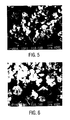
- Figures 5 and 6 show commercially available AlN powders synthesized by the two main processes used for the commercial production of AlN powder, the carbo-nitridation of alumina and the nitridation of aluminum powder, respectively.
- These AlN powders are essentially spherical in nature and are of a very small size (approximately 1 ⁇ m) which is typical for commercial high purity AlN powder.
- the powder produced by the process detailed in this Example is unique with respect to both shape and size, and furthermore the morphology of the particulates can be controlled by the proper choice of processing conditions.
- AlN from an Al-Ba alloy has also been demonstrated.
- the AlN was synthesized by placing a ingot of Al-1.7 wt.% Ba alloy weighing approximately 20 g into a high purity 30 mm I.D. alumina crucible and heating the assembly at a rate of 10°C/min in 4 L/min of flowing nitrogen to a target temperature of 1100°C and holding for a time sufficient for nitridation of the aluminum to occur. Throughout the experiment the flow of nitrogen entering and exiting the furnace was measured, and the nitrogen consumption monitored. The material was then cooled to room temperature and the weight gain was determined. The results are displayed in Table 3. TABLE 3 TEMPERATURE REACTION COMPLETION TIME % Wt. GAIN (°C) (h) (Al Basis) 1100 1.7 51.9
- a 150 g ingot of Al-2.5 wt.% Sr alloy was placed into a high purity alumina crucible and heated to 1200°C over 1 hour under 6 L/min of flowing nitrogen.
- the nitrogen inlet and exit flows were measured and the nitrogen consumption monitored.
- the nitrogen consumption data indicated that the reaction was complete after approximately 1.5 hours after the beginning of the experiment. Unfortunately, the weight gain could not be determined due to spillage, but visual observation coupled with the nitrogen consumption data indicated that the reaction appeared to be complete.
- AlN was synthesized from various doped aluminum starting materials.
- the products were then sintered either with or without sintering aids in a flowing atmosphere of nitrogen gas and the densities and thermal conductivities of the sintered shapes were measured.
- the thermal conductivity values were derived from thermal diffusivities of the AlN shapes, measured by the Laser Flash method.
- the latter involved uniform pulse heating of the front surfaces of disk shaped sintered AlN shapes with a CO2 laser pulse, and measuring the resulting temperature transient of the rear surface. The results are known to be accurate within the range of ⁇ 1%.
- Unreactive AlN powder was produced (lot #6196-26) from Al-Mg alloy using the process of the invention. Attempts to sinter a powder compact of this material under nitrogen at 1850°C for 3 hours yielded a pellet with a density of 2.031 g/cc. The addition of 3 wt % of Y2O3 as a sintering aid yielded a pellet with a density of 3.099 g/cc. This demonstrated the need for the use of a sintering aid with this powder.
Landscapes
- Chemical & Material Sciences (AREA)
- Organic Chemistry (AREA)
- Engineering & Computer Science (AREA)
- Materials Engineering (AREA)
- Crystallography & Structural Chemistry (AREA)
- Metallurgy (AREA)
- Inorganic Chemistry (AREA)
- Ceramic Engineering (AREA)
- Manufacturing & Machinery (AREA)
- Structural Engineering (AREA)
- Ceramic Products (AREA)
- Crystals, And After-Treatments Of Crystals (AREA)
- Chemically Coating (AREA)
Applications Claiming Priority (4)
| Application Number | Priority Date | Filing Date | Title |
|---|---|---|---|
| US27724888A | 1988-11-29 | 1988-11-29 | |
| US277248 | 1988-11-29 | ||
| US43351689A | 1989-11-08 | 1989-11-08 | |
| US433516 | 1989-11-08 |
Publications (2)
| Publication Number | Publication Date |
|---|---|
| EP0371771A2 true EP0371771A2 (fr) | 1990-06-06 |
| EP0371771A3 EP0371771A3 (fr) | 1990-09-19 |
Family
ID=26958381
Family Applications (1)
| Application Number | Title | Priority Date | Filing Date |
|---|---|---|---|
| EP19890312384 Withdrawn EP0371771A3 (fr) | 1988-11-29 | 1989-11-29 | Procédé de production de nitrure d'aluminium et nitrure d'aluminium obtenu |
Country Status (7)
| Country | Link |
|---|---|
| EP (1) | EP0371771A3 (fr) |
| JP (1) | JPH02196010A (fr) |
| KR (1) | KR900007723A (fr) |
| AU (1) | AU4573589A (fr) |
| CA (1) | CA2004172A1 (fr) |
| DK (1) | DK601189A (fr) |
| NO (1) | NO894770L (fr) |
Cited By (11)
| Publication number | Priority date | Publication date | Assignee | Title |
|---|---|---|---|---|
| FR2676459A1 (fr) * | 1991-05-17 | 1992-11-20 | Pechiney Electrometallurgie | Procede de raffinage du calcium par voie nitrure. |
| FR2681590A1 (fr) * | 1991-09-25 | 1993-03-26 | France Telecom | Procede de synthese a basse temperature de poudres de nitrures, en particulier de nitrure d'aluminium. |
| US5246683A (en) * | 1991-07-03 | 1993-09-21 | Alcan Internatonal Limited | Process for producing small particles of aluminum nitride and particles so-produced |
| WO1994025396A3 (fr) * | 1993-04-27 | 1994-12-22 | Ct Badan Wysokocisnieniowych | Procede de synthese d'une poudre d'aluminium a faible teneur en oxygene |
| WO1995004845A1 (fr) * | 1993-08-10 | 1995-02-16 | Centrum Badan Wysokocisnieniowych | Structure multicouche cristalline et son procede de fabrication |
| EP0615952A3 (fr) * | 1993-03-16 | 1995-02-22 | Yoshida Kogyo Kk | Particules composites ultrafines en nitrure d'aluminium et nitrure de terres rares, procédé de fabrication et corps fritté. |
| WO1997013891A1 (fr) * | 1995-10-13 | 1997-04-17 | Centrum Badan Wysokocisnieniowych | PROCEDE DE FABRICATION DE COUCHES EPITAXIALES DE GaN OU DE Ga(Al,In)N SUR DES SUBSTRATS MONOCRISTALLINS DE GaN OU MIXTES DE Ga(Al,In)N |
| EP0691943B1 (fr) * | 1993-04-02 | 1997-12-29 | The Dow Chemical Company | Nitrure d'aluminium, nitrure d'aluminium contenant des solutions solides et composes de nitrure d'aluminium prepares par synthese de combustion |
| RU2154019C1 (ru) * | 1999-05-26 | 2000-08-10 | Научно-исследовательский институт высоких напряжений при Томском политехническом университете | Способ получения нитрида алюминия |
| EP1310455A1 (fr) * | 2001-11-13 | 2003-05-14 | Ibaragi Laboratory Co., Ltd. | Procédé de préparation du nitrure d'aluminium |
| EP1394107A1 (fr) * | 2001-02-02 | 2004-03-03 | Ibaragi Laboratory Co., Ltd. | Procédé de préparation du nitrure d'aluminium |
Families Citing this family (5)
| Publication number | Priority date | Publication date | Assignee | Title |
|---|---|---|---|---|
| WO1999034037A1 (fr) * | 1997-12-25 | 1999-07-08 | Japan Energy Corporation | Procede de preparation de monocristaux de composes semi-conducteurs, equipement pour ce procede et monocristaux de composes semi-conducteurs |
| JP2008013627A (ja) * | 2006-07-04 | 2008-01-24 | Mitsubishi Chemicals Corp | 蛍光体の製造方法、蛍光体原料用合金粉末及びその製造方法 |
| JP4826849B2 (ja) * | 2009-04-20 | 2011-11-30 | 株式会社デンソー | Al−AlN複合材料、Al−AlN複合材料の製造方法及び熱交換器 |
| JP5342353B2 (ja) * | 2009-07-15 | 2013-11-13 | タマティーエルオー株式会社 | 窒化アルミニウム含有物の製造方法 |
| TWI401206B (zh) * | 2010-02-12 | 2013-07-11 | Univ Nat Cheng Kung | 氮化鋁之製備方法 |
Family Cites Families (6)
| Publication number | Priority date | Publication date | Assignee | Title |
|---|---|---|---|---|
| US3531245A (en) * | 1968-04-01 | 1970-09-29 | Du Pont | Magnesium-aluminum nitrides |
| JPS5773195A (en) * | 1980-10-23 | 1982-05-07 | Mitsui Alum Kogyo Kk | Production of aluminum powder |
| US4322395A (en) * | 1981-05-26 | 1982-03-30 | Honeywell Inc. | Process for the production of aluminum nitride needles |
| JPS60161314A (ja) * | 1984-02-02 | 1985-08-23 | Hitachi Metals Ltd | 窒化アルミ粉末の製造法 |
| JPS6168311A (ja) * | 1984-09-10 | 1986-04-08 | Chugai Ro Kogyo Kaisha Ltd | 窒化アルミニウム粉未の製造方法およびその装置 |
| JPS63156007A (ja) * | 1986-12-19 | 1988-06-29 | Denki Kagaku Kogyo Kk | 窒化アルミニウム粉末の製造方法 |
-
1989
- 1989-11-29 JP JP1312247A patent/JPH02196010A/ja active Pending
- 1989-11-29 KR KR1019890017581A patent/KR900007723A/ko not_active Withdrawn
- 1989-11-29 DK DK601189A patent/DK601189A/da not_active Application Discontinuation
- 1989-11-29 NO NO89894770A patent/NO894770L/no unknown
- 1989-11-29 AU AU45735/89A patent/AU4573589A/en not_active Abandoned
- 1989-11-29 CA CA002004172A patent/CA2004172A1/fr not_active Abandoned
- 1989-11-29 EP EP19890312384 patent/EP0371771A3/fr not_active Withdrawn
Cited By (17)
| Publication number | Priority date | Publication date | Assignee | Title |
|---|---|---|---|---|
| FR2676459A1 (fr) * | 1991-05-17 | 1992-11-20 | Pechiney Electrometallurgie | Procede de raffinage du calcium par voie nitrure. |
| EP0516558A1 (fr) * | 1991-05-17 | 1992-12-02 | Pechiney Electrometallurgie | Procédé de raffinage du calcium par voie nitrure |
| US5226952A (en) * | 1991-05-17 | 1993-07-13 | Pechiney Electrometallurgie | Nitride process for refining calcium |
| US5246683A (en) * | 1991-07-03 | 1993-09-21 | Alcan Internatonal Limited | Process for producing small particles of aluminum nitride and particles so-produced |
| FR2681590A1 (fr) * | 1991-09-25 | 1993-03-26 | France Telecom | Procede de synthese a basse temperature de poudres de nitrures, en particulier de nitrure d'aluminium. |
| WO1993006042A1 (fr) * | 1991-09-25 | 1993-04-01 | France Telecom | Procede de synthese a basse temperature de poudres de nitrures, en particulier de nitrure d'aluminium |
| EP0615952A3 (fr) * | 1993-03-16 | 1995-02-22 | Yoshida Kogyo Kk | Particules composites ultrafines en nitrure d'aluminium et nitrure de terres rares, procédé de fabrication et corps fritté. |
| EP0691943B1 (fr) * | 1993-04-02 | 1997-12-29 | The Dow Chemical Company | Nitrure d'aluminium, nitrure d'aluminium contenant des solutions solides et composes de nitrure d'aluminium prepares par synthese de combustion |
| WO1994025396A3 (fr) * | 1993-04-27 | 1994-12-22 | Ct Badan Wysokocisnieniowych | Procede de synthese d'une poudre d'aluminium a faible teneur en oxygene |
| WO1995004845A1 (fr) * | 1993-08-10 | 1995-02-16 | Centrum Badan Wysokocisnieniowych | Structure multicouche cristalline et son procede de fabrication |
| US5637531A (en) * | 1993-08-10 | 1997-06-10 | High Pressure Research Center, Polish Academy | Method of making a crystalline multilayer structure at two pressures the second one lower than first |
| WO1997013891A1 (fr) * | 1995-10-13 | 1997-04-17 | Centrum Badan Wysokocisnieniowych | PROCEDE DE FABRICATION DE COUCHES EPITAXIALES DE GaN OU DE Ga(Al,In)N SUR DES SUBSTRATS MONOCRISTALLINS DE GaN OU MIXTES DE Ga(Al,In)N |
| RU2154019C1 (ru) * | 1999-05-26 | 2000-08-10 | Научно-исследовательский институт высоких напряжений при Томском политехническом университете | Способ получения нитрида алюминия |
| EP1394107A1 (fr) * | 2001-02-02 | 2004-03-03 | Ibaragi Laboratory Co., Ltd. | Procédé de préparation du nitrure d'aluminium |
| US7022301B2 (en) | 2001-02-02 | 2006-04-04 | Ibaragi Laboratory Co., Ltd. | Process for producing aluminum nitride and aluminum nitride |
| EP1310455A1 (fr) * | 2001-11-13 | 2003-05-14 | Ibaragi Laboratory Co., Ltd. | Procédé de préparation du nitrure d'aluminium |
| US6986875B2 (en) | 2001-11-13 | 2006-01-17 | Ibaragi Laboratory Co., Ltd. | Process for producing aluminum nitride and aluminum nitride |
Also Published As
| Publication number | Publication date |
|---|---|
| EP0371771A3 (fr) | 1990-09-19 |
| KR900007723A (ko) | 1990-06-01 |
| AU4573589A (en) | 1990-06-07 |
| JPH02196010A (ja) | 1990-08-02 |
| NO894770D0 (no) | 1989-11-29 |
| DK601189D0 (da) | 1989-11-29 |
| CA2004172A1 (fr) | 1990-05-29 |
| DK601189A (da) | 1990-05-30 |
| NO894770L (no) | 1990-05-30 |
Similar Documents
| Publication | Publication Date | Title |
|---|---|---|
| Selvaduray et al. | Aluminium nitride: review of synthesis methods | |
| EP1268362B1 (fr) | Procede permettant de produire des materiaux a phase 312 et procede de frittage de ces materiaux | |
| CA1174083A (fr) | Methode de preparation de poudres d'alliages a base de titanium et pouvant etre frittees | |
| Bradshaw et al. | Combustion synthesis of aluminum nitride particles and whiskers | |
| CA2004172A1 (fr) | Methode de preparation de nitrure d'aluminium et produit ainsi obtenu | |
| US4778778A (en) | Process for the production of sintered aluminum nitrides | |
| EP1614776B1 (fr) | Procédé de fabrication d'un monocristal de nitrure d'alumine | |
| US5096860A (en) | Process for producing unagglomerated single crystals of aluminum nitride | |
| EP0186144B1 (fr) | Procédé pour préparer une poudre de nitrure d'aluminium | |
| US4346068A (en) | Process for preparing high-purity α-type silicon nitride | |
| US4643859A (en) | Process for the production of fine non-oxide powders from alkoxides | |
| EP4455078A1 (fr) | Poudre de nitrure de silicium | |
| US5338523A (en) | Method of making transition metal carbide and boride powders | |
| US3307908A (en) | Preparation of aluminum nitride | |
| Komeya et al. | Synthesis of AlN by direct nitridation of Al alloys | |
| Scholz et al. | Synthesis of high purity AlN by nitridation of Li-doped Al-melt | |
| JP3177278B2 (ja) | 低融点金属の直接窒化処理方法 | |
| EP0250163B1 (fr) | Procédé de préparation d'un alliage nickel-titane | |
| EP0615952B1 (fr) | Procédé de fabrication de particules composites ultrafines en nitrure d'aluminium et nitrure de terres rares | |
| Lee et al. | A novel process for combustion synthesis of AlN powder | |
| KR100386510B1 (ko) | 자전고온 합성법을 이용한 질화 알루미늄 분말 제조방법 | |
| EP0385096B1 (fr) | Procédé de fabrication de poudre de nitrure d'aluminium cristallin frittable | |
| US6908599B2 (en) | Process for the production of zirconium boride powder | |
| JPS62100403A (ja) | 高純度六方晶窒化硼素微粉末の製造方法 | |
| US5108967A (en) | Process for producing nonequiaxed silicon aluminum oxynitride |
Legal Events
| Date | Code | Title | Description |
|---|---|---|---|
| PUAI | Public reference made under article 153(3) epc to a published international application that has entered the european phase |
Free format text: ORIGINAL CODE: 0009012 |
|
| AK | Designated contracting states |
Kind code of ref document: A2 Designated state(s): BE DE FR GB IT NL SE |
|
| PUAL | Search report despatched |
Free format text: ORIGINAL CODE: 0009013 |
|
| AK | Designated contracting states |
Kind code of ref document: A3 Designated state(s): BE DE FR GB IT NL SE |
|
| STAA | Information on the status of an ep patent application or granted ep patent |
Free format text: STATUS: THE APPLICATION IS DEEMED TO BE WITHDRAWN |
|
| 18D | Application deemed to be withdrawn |
Effective date: 19910620 |