EP0372014B1 - Verfahren und vorrichtung zur herstellung von hoch-orientierten, amorphen polyesterfilamentfäden - Google Patents
Verfahren und vorrichtung zur herstellung von hoch-orientierten, amorphen polyesterfilamentfäden Download PDFInfo
- Publication number
- EP0372014B1 EP0372014B1 EP89902220A EP89902220A EP0372014B1 EP 0372014 B1 EP0372014 B1 EP 0372014B1 EP 89902220 A EP89902220 A EP 89902220A EP 89902220 A EP89902220 A EP 89902220A EP 0372014 B1 EP0372014 B1 EP 0372014B1
- Authority
- EP
- European Patent Office
- Prior art keywords
- cooling
- contact surface
- filament yarns
- spinneret
- roller
- Prior art date
- Legal status (The legal status is an assumption and is not a legal conclusion. Google has not performed a legal analysis and makes no representation as to the accuracy of the status listed.)
- Expired - Lifetime
Links
- 238000000034 method Methods 0.000 title claims abstract description 18
- 229920000728 polyester Polymers 0.000 title claims abstract description 14
- 238000004519 manufacturing process Methods 0.000 title claims abstract description 5
- 238000001816 cooling Methods 0.000 claims abstract description 47
- 238000009835 boiling Methods 0.000 claims abstract description 6
- XLYOFNOQVPJJNP-UHFFFAOYSA-N water Substances O XLYOFNOQVPJJNP-UHFFFAOYSA-N 0.000 claims description 14
- 238000004804 winding Methods 0.000 claims description 5
- 229910052751 metal Inorganic materials 0.000 claims description 4
- 239000002184 metal Substances 0.000 claims description 4
- 238000009987 spinning Methods 0.000 claims description 4
- 239000002826 coolant Substances 0.000 claims description 3
- RYGMFSIKBFXOCR-UHFFFAOYSA-N Copper Chemical compound [Cu] RYGMFSIKBFXOCR-UHFFFAOYSA-N 0.000 claims description 2
- 229910052802 copper Inorganic materials 0.000 claims description 2
- 239000010949 copper Substances 0.000 claims description 2
- 238000002074 melt spinning Methods 0.000 claims description 2
- 229910000881 Cu alloy Inorganic materials 0.000 claims 1
- 239000000155 melt Substances 0.000 claims 1
- 238000002360 preparation method Methods 0.000 claims 1
- 230000035939 shock Effects 0.000 abstract description 8
- IAZDPXIOMUYVGZ-UHFFFAOYSA-N Dimethylsulphoxide Chemical compound CS(C)=O IAZDPXIOMUYVGZ-UHFFFAOYSA-N 0.000 abstract 1
- 230000002093 peripheral effect Effects 0.000 description 5
- 238000010411 cooking Methods 0.000 description 3
- 238000005259 measurement Methods 0.000 description 3
- -1 polyethylene terephthalate Polymers 0.000 description 3
- 229920000139 polyethylene terephthalate Polymers 0.000 description 3
- 239000005020 polyethylene terephthalate Substances 0.000 description 3
- 229910045601 alloy Inorganic materials 0.000 description 2
- 239000000956 alloy Substances 0.000 description 2
- 239000004020 conductor Substances 0.000 description 2
- 230000000694 effects Effects 0.000 description 2
- 230000017525 heat dissipation Effects 0.000 description 2
- 239000006163 transport media Substances 0.000 description 2
- MMINFSMURORWKH-UHFFFAOYSA-N 3,6-dioxabicyclo[6.2.2]dodeca-1(10),8,11-triene-2,7-dione Chemical group O=C1OCCOC(=O)C2=CC=C1C=C2 MMINFSMURORWKH-UHFFFAOYSA-N 0.000 description 1
- 229910052782 aluminium Inorganic materials 0.000 description 1
- XAGFODPZIPBFFR-UHFFFAOYSA-N aluminium Chemical compound [Al] XAGFODPZIPBFFR-UHFFFAOYSA-N 0.000 description 1
- 238000011109 contamination Methods 0.000 description 1
- 238000010438 heat treatment Methods 0.000 description 1
- 239000007788 liquid Substances 0.000 description 1
- 239000002609 medium Substances 0.000 description 1
- 239000012768 molten material Substances 0.000 description 1
- 229920000642 polymer Polymers 0.000 description 1
- 230000000717 retained effect Effects 0.000 description 1
- 238000010583 slow cooling Methods 0.000 description 1
- 239000007921 spray Substances 0.000 description 1
Images
Classifications
-
- D—TEXTILES; PAPER
- D01—NATURAL OR MAN-MADE THREADS OR FIBRES; SPINNING
- D01F—CHEMICAL FEATURES IN THE MANUFACTURE OF ARTIFICIAL FILAMENTS, THREADS, FIBRES, BRISTLES OR RIBBONS; APPARATUS SPECIALLY ADAPTED FOR THE MANUFACTURE OF CARBON FILAMENTS
- D01F6/00—Monocomponent artificial filaments or the like of synthetic polymers; Manufacture thereof
- D01F6/58—Monocomponent artificial filaments or the like of synthetic polymers; Manufacture thereof from homopolycondensation products
- D01F6/62—Monocomponent artificial filaments or the like of synthetic polymers; Manufacture thereof from homopolycondensation products from polyesters
Definitions
- the invention relates to a method for producing highly oriented, amorphous polyester filament threads by melt spinning at take-off speeds> 4000 m / min and polyester filament threads produced by the method and a device for carrying out the method.
- EP-A-0 089 819 describes shock cooling using water.
- a polyethylene terephthalate filament thread is quenched at least 5000 m / min in a water bath. With high orientation, the resulting thread has only a low crystallinity, demonstrated by a boiling shrinkage of at least 45% and at most 68.5%.
- EP-A-0 244 216 describes a polyester filament yarn which is spun at more than 5000 m / min in an overpressure chamber, at the outlet of which a narrow tube is attached, the venturi effect causing shock cooling.
- air cooling As the number of filaments increases, uniform cooling of the bundled filament bundle in the cooling tube (Venturi) is no longer guaranteed.
- shock cooling with air means that no defined thread speed is possible in the area below the spinneret, especially where the molten material is most sensitive.
- the object of the invention is to provide a method for flash cooling a rapidly spun polyethylene terephthalate filament thread, which ensures a defined thread speed in the area between the spinneret and the cooling element.
- Another object is to provide a device for carrying out the method mentioned.
- Yet another object is to provide a polyester filament thread with a high birefringence and a relatively high cooking shrinkage as a feed yarn.
- the solution to the problem lies in a method which is characterized in that the melt-spun filament threads are cooled by means of a circumferential contact surface, then spin-prepared and wound up.
- a circumferential contact surface has the advantage that work can be carried out under defined conditions without a liquid or gaseous medium. Regardless of this, the cooling rate can be determined by specifying the distance of the cooling surface from the spinneret and the wrap angle of the thread on the cooling surface.
- a variety of yarn properties can be achieved by varying the two parameters alone.
- the contact times of the filament threads on the contact surface between 1x10 ⁇ 3 and 1x10 ⁇ 2 s, in particular 2x10 ⁇ 3 - 1x10 ⁇ 2 s, determined with a peripheral speed range of the contact surface between 800 to 2400 m / min, especially between 1600 to 2400 m / min.
- the contact length or the wrap angle of the filament thread can also be calculated from the time.
- the polyester thread produced by the process surprisingly has an undeformed, circular cross section without adhesions.
- a peripheral contact surface has proven to be suitable as a cooling element as a device for carrying out the method.
- a rotating contact surface has the advantage that a larger number of individual filaments can be cooled than is possible with known shock cooling processes. So it is easily possible to cool 30 and more filaments at the same time.
- the desired properties of the shrinking yarn (> 40% KS, in particular 40-70% KS) can be adjusted in a particularly simple manner by varying the distance from the spinneret and the speed of rotation of the contact surface.
- the contact surface is designed as a cooling roller.
- the cooling roller is preferably a hollow body made of a good heat-conducting material and can be provided with additional connections for a heat transport medium or coolant. Such a roller ensures almost any heat dissipation of the polyester filament threads.
- a cooling belt is also suitable for shock cooling polyester filament threads.
- the contact surface expediently consists of a highly thermally conductive material, preferably a metal or an alloy. Copper, aluminum and their alloys are particularly suitable.
- the thickness of the metal layer is 2-100 mm, preferably 10-80 mm, in particular 40-60 mm.
- the distance of the chill roll from the spinneret is 250-1500 mm, depending on the filament and total titer.
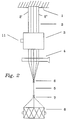
- FIG. 2 the arrangement shown in FIG. 1 is shown rotated by 90 °.
- connections 11 for a heat transport medium are specified.
- the course of the individual filaments up to the point of convergence 6 should be shown clearly from the illustration.
- the number of filament threads 2 is largely uncritical.
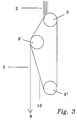
- a cooling belt 10 is shown, which is guided over rollers 9, 9 'and 9''and at least one of these rollers is driven by a motor, not shown.
- the filament thread bundle 2 meets the cooling belt 10 in the area of the roll 9 and leaves the cooling belt 10 in the area of the roll 9 'as a total thread 5 in the direction of the winder 8, not shown.
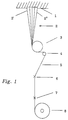
- a Polrester filament thread bundle 2 emerging from the spinneret 1 strikes the surface of the cooling roller 3, where it undergoes shock cooling during its contact with the roller surface.
- the cooling roller rotates at a peripheral speed of 1600 to 2400 m / min.
- the thread is fed over the deflection roller 4 and over the convergence point 6 to the winder 8 at a winding speed of at least 4000 m / min. Any stretching is determined by the difference between the winder speed and that of the cooling roll 3.
- the effect of the cooling roller can be enhanced by heat dissipation using a coolant.
- a standard polyester polymer with an intrinsic viscosity of 0.75 dl / g was galettlos with a constant winding speed of 5000 m / min to the two titers dtex 67 f 12 and 200 f 30 (nom. 55 dtex f 12 and 167 f 30) spun.
- the boiling shrinkage is given.
- the boiling shrinkage was determined by measuring the length before and after heat treatment in water [KS measurement: individual thread 50 cm long (unshrunk); at 98 ° C ⁇ 1 ° C in water for 2.5 minutes; Average of 3 measurements].
- KS measurement individual thread 50 cm long (unshrunk); at 98 ° C ⁇ 1 ° C in water for 2.5 minutes; Average of 3 measurements.
- the value of the shrinkage can be viewed as a measure of the crystallinity, verified by measuring the density of the threads.
- the optimal distance between spinneret and roller was determined for the respective spinning titer and its desired properties.
- the spinning result can be influenced by the distance between the spinneret / roller, the peripheral speed of the roller and the contact length of the thread / roller (corresponds to the cooling time).
- the cooking shrinkage is mainly influenced by the distance between the spinneret and the roller, while the orientation shows no clear tendency.
- Table 1 It can be seen from Table 1 that, as the distance between the KS increases, it initially drops slightly, when a limit value is reached, in the described case about 55-60 cm, suddenly drops very sharply.
- the contact and thus the cooling time can be varied through the variable wrap angle of the thread on the roller circumference. This parameter also essentially influences the KS of the spun yarns. If the cooling time, ie the contact length, is shortened, the same dependencies on the distance between the spinneret and the roller tend to be shown in Table 2, only at a lower level.
- the orientation of the spun thread can be adjusted within certain limits via the roller speed.
- Table 3 shows, the cooking shrinkage increases at the same time as the speed increases, strongly below 2000 m / min, and only above easy, with opposite tendency of orientation (birefringence).
- a particular advantage of the method according to the invention is seen in the fact that, in contrast to the known cooling methods with water or air, the yarn properties can be influenced in a targeted manner.
- the method according to the invention works more economically, since neither a system for cooling air and its complex operation nor precautions for occurring contamination by splash water have to be taken in wet operation.
Landscapes
- Chemical & Material Sciences (AREA)
- Chemical Kinetics & Catalysis (AREA)
- General Chemical & Material Sciences (AREA)
- Engineering & Computer Science (AREA)
- Textile Engineering (AREA)
- Spinning Methods And Devices For Manufacturing Artificial Fibers (AREA)
- Artificial Filaments (AREA)
Description
- Die Erfindung betrifft ein Verfahren zur Herstellung von hochorientierten, amorphen Polyesterfilamentfäden durch Schmelzspinnen mit Abzugsgeschwindigkeiten >4000 m/min sowie Polyesterfilamentfäden hergestellt nach dem Verfahren und eine Vorrichtung zur Durchführung des Verfahrens.
- Die Herstellung eines schnellgesponnenen Polyesterfilamentgarnes, das wenigstens zu 85 Gew.-% aus Ethylenterephthalateinheiten besteht, führt zu einem Vorlagegarn, welches zur Falschdralltexturierung durch seine hochorientierten, amorphen Eigenschaften hervorragend geeignet ist. Diese Eigenschaften sind aber nur erreichbar, wenn eine rasche Abkühlung bei hohen Aufspulgeschwindigkeiten erfolgen kann.
- Zur Realisierung einer derartigen Schockkühlung wurden im wesentlichen zwei unterschiedliche Verfahren vorgeschlagen.
- So beschreibt die EP-A-0 089 819 eine Schockkühlung mittels Wasser. Dabei wird ein Polyethylenterephthalat-Filamentfaden mit wenigstens 5000 m/min in einem Wasserbad abgeschreckt. Der resultierende Faden weist bei hoher Orientierung nur eine geringe Kristallinität auf, nachgewiesen durch einen Kochschrumpf von wenigstens 45 % und höchstens 68,5 %.
- Die Abkühlung in Wasser hat jedoch schwerwiegende Nachteile. Zunächst wird der Faden im Wasserbad gebremst, woraus hohe Spannungen resultieren. Es treten Probleme mit Spritzwasser und dem Auftrag einer Spinnpräparation auf den nassen Faden auf. Bei Verwendung einer Wasserkühlung steigt mit zunehmender Filamentzahl das mitgeschleppte, an der Oberfläche haftende Wasser und damit das Spritzwasser stark an.
- Gegenüber dem Schockkühlen mit Wasser wurde eine Verbesserung mit einer Luftkühlung erzielt. So beschreibt die EP-A-0 244 216 ein Polyesterfilamentgarn, welches bei mehr als 5000 m/min in einer Überdruckkammer gesponnen, an deren Ausgang ein enges Rohr angebracht ist, wobei durch den Venturieffekt eine Schockkühlung erfolgt. Bei Luftkühlung ist mit zunehmender Filamentzahl die gleichmässige Kühlung des zusammengefassten Filamentbündels im Kühlrohr (Venturi) nicht mehr gewährleistet.
- Neben dem Nachteil des hohen spezifischen Luftverbrauches bis etwa 70 Nm³/kg Polyethylenterephthalat, ist durch die Schockkühlung mit Luft keine definierte Fadengeschwindigkeit im Bereich unterhalb der Spinndüse möglich, gerade dort, wo das schmelzflüssige Material am empfindlichsten reagiert.
- Aufgabe der Erfindung ist es, ein Verfahren zur Schockkühlung eines schnellgesponnenen Polyethylenterephthalatfilamentfadens aufzuzeigen, welcher eine definierte Fadengeschwindigkeit im Bereich zwischen Spinndüse und Kühlelement gewährleistet.
- Eine weitere Aufgabe ist es, eine Vorrichtung zur Durchführung des genannten Verfahrens zur Verfügung zu stellen.
- Noch eine weitere Aufgabe ist es, einen Polyesterfilamentfaden mit einer hohen Doppelbrechung und einem relativ hohen Kochschrumpf als Vorlagegarn zur Verfügung zu stellen.
- Die Lösung der Aufgabe liegt in einem Verfahren, das gemäss Anspruch 1, dadurch gekennzeichnet ist, dass die schmelzgesponnenen Filamentfäden mittels einer umlaufenden Kontaktfläche abgekühlt, danach spinnpräpariert und aufgespult werden.
- Eine umlaufende Kontaktfläche hat den Vorteil, dass ohne ein flüssiges oder gasförmiges Medium ein Arbeiten unter definierteren Bedingungen erfolgen kann. Unabhängig davon lässt sich durch Festlegung des Abstandes der Kühlfläche von der Spinndüse und des Umschlingungswinkels des Fadens auf der Kühlfläche die Abkühlungsrate festlegen.
- Durch die Variation der beiden Parameter allein lässt sich eine Vielzahl von Garneigenschaften erzielen.
- Es hat sich als zweckmässig erwiesen, die Berührungszeiten der Filamentfäden auf der Kontaktfläche zwischen 1x10⁻³ und 1x10⁻² s, insbesondere 2x10⁻³ - 1x10⁻² s zu wählen, festgelegt bei einem Umfangsgeschwindigkeitsbereich der Kontaktfläche zwischen 800 bis 2400 m/min, insbesondere zwischen 1600 bis 2400 m/min. Aus der Zeitangabe kann selbstverständlich auch die Kontaktlänge oder der Umschlingungswinkel des Filamentfadens berechnet werden.
- Der nach dem Verfahren hergestellte Polyesterfaden weist in überraschender Weise einen undeformierten, kreisför-migen Querschnitt ohne Verklebungen auf. Die Doppelbrechungswerte liegen, abhängig von der Einstellung zwischen Δn=0,08 und Δn= 0,11 wobei das Garn gleichzeitig einen Kochschrumpf >40 %, insbesondere zwischen 40-70 %, bevorzugt 45-60 % aufweist, bezogen auf den ungeschrumpften Filamentfaden.
- Als Vorrichtung zur Durchführung des Verfahrens hat sich eine umlaufende Kontaktfläche als Kühlelement geeignet erwiesen.
- Eine rotierende Kontaktfläche hat den Vorteil, dass eine grössere Anzahl von Einzelfilamenten gekühlt werden kann, als dies bei bekannten Schockkühlverfahren möglich ist. So ist es ohne weiteres möglich 30 und mehr Filamente gleichzeitig zu kühlen. Die gewünschten Eigenschaften des Hochschrumpfgarnes (>40% KS, insbesondere 40-70 % KS) lassen sich in besonders einfacher Weise durch Variationen des Abstandes zur Spinndüse sowie der Umlaufgeschwindigkeit der Kontaktfläche einstellen.
- Nach einer bevorzugten Ausführungsform ist die Kontaktfläche als Kühlwalze ausgebildet. Die Kühlwalze ist bevorzugt ein Hohlkörper aus einem gut wärmeleitenden Material und kann mit zusätzlichen Anschlüssen für ein Wärmetransportmittel bzw. Kühlmittel versehen sein. Eine solche Walze gewährleistet eine nahezu beliebige Wärmeabfuhr der Polyesterfilamentfäden.
- Zur Schockkühlung von Polyesterfilamentfäden ist auch ein Kühlband geeignet, dessen Dicke von der Biegefähigkeit des Bandes abhängig ist.
- Die Kontaktfläche besteht zweckmässig aus einem gut wärmeleitfähigem Werkstoff, bevorzugt einem Metall oder einer Legierung. Besonders geeignet sind Kupfer, Aluminium und ihre Legierungen.
- Die Dicke der Metallschicht beträgt 2-100 mm, bevorzugt 10-80 mm, insbesondere 40-60 mm. Der Abstand der Kühlwalze von der Spinndüse beträgt 250-1500 mm, abhängig vom Filament- und Gesamttiter.
- Die Erfindung soll anhand von Zeichnungen näher beschrieben werden.
- Es zeigen:
- Fig. 1
- schematische Darstellung des erfindungsgemässen Verfahrens mit einer Kühlwalze
- Fig. 2
- eine um 90° gedrehte Ansicht nach Fig. 1
- Fig. 3
- schematische Darstellung eines Kühlbandes
- In Fig. 2 ist die nach Fig. 1 gezeigte Anordnung um 90° gedreht dargestellt. Neben den aus Fig. 1 bekannten Vorrichtungsteilen sind Anschlüsse 11 für ein Wärmetransportmittel angegeben. Aus der Darstellung soll der Verlauf der Einzelfilamente bis zum Konvergenzpunkt 6 anschaulich hervorgehen. Die Anzahl der Filamentfäden 2 ist weitgehend unkritisch.
- In Fig. 3 ist ein Kühlband 10 gezeigt, welches über Rollen 9, 9' und 9'' geführt und wenigstens eine dieser Rollen mittels eines nicht gezeigten Motors angetrieben wird. Das Filamentfadenbündel 2 trifft auf das Kühlband 10 im Bereich der Rolle 9 auf und verlässt das Kühlband 10 im Bereich der Rolle 9' als Gesamtfaden 5 in Richtung des nicht gezeigten Spulers 8.
- Im Betrieb trifft ein aus der Spinndüse 1 austretendes Polresterfilamentfadenbündel 2 auf die Oberfläche der Kühlwalze 3, wo es eine Schockkühlung während seiner Berührung mit der Walzenoberfläche erfährt. Dabei dreht sich die Kühlwalze mit einer Umfangsgeschwindigkeit von 1600 bis 2400 m/min. Der Faden wird über die Umlenkrolle 4 und über den Konvergenzpunkt 6 dem Spuler 8 mit einer Wickelgeschwindigkeit von mindestens 4000 m/min Zugeführt. Eine eventuelle Verstreckung wird von der Differenz der Spulergeschwindigkeit und derjenigen der Kühlwalze 3 bestimmt.
- Im Bedarfsfall kann die Wirkung der Kühlwalze durch Wärmeabfuhr mittels eines Kühlmittels verstärkt werden.
-

Ein Standard-Polyester-Polymer mit einer intrinsischen Viskosität von 0,75 dl/g wurde galettenlos mit einer konstanten Wickelgeschwindigkeit von 5000 m/min zu den zwei Titern dtex 67 f 12 und 200 f 30 (nom. 55 dtex f 12 und 167 f 30) versponnen. - Variiert wurden:
- der Abstand Spinndüse/Walze 30 - 100 cm - die Walzengeschwindigkeit 1600 - 2400 m/min - die Fadenkontaktlänge auf der Walze 12 - 16 cm 
Anstelle der Kristallinität ist der erreichte Kochschrumpf (KS) angegeben. Der Kochschrumpf wurde durch Längenmessung vor und nach einer Wärmebehandlung im Wasser bestimmt [KS-Messung: Einzelfaden von der Länge 50 cm (ungeschrumpft); bei 98°C ± 1°C im Wasser während 2,5 Minuten; Mittelwert von 3 Messungen]. Bei etwa gleicher Orientierung der Garne kann der Wert des Kochschrumpfes vergleichend als Mass für die Kristallinität angesehen werden, nachgewiesen mit Dichtemessungen der Fäden. Mit Hilfe dieser Messresultate wurde die für den jeweiligen Spinntiter und dessen gewünschte Eigenschaften der optimale Abstand Spinndüse/Walze festgelegt. Durch den Abstand Spinndüse/Walze, die Umfangsgeschwindigkeit der Walze und die Kontaktlänge Faden/Walze (entspricht der Kühlzeit) kann das Spinnergebnis beeinflusst werden. Bei konstanter Umfangsgeschwindigkeit der Walze und konstanter Kontaktlänge des Fadens auf deren Oberfläche wird vor allem der Kochschrumpf vom Abstand Spinndüse/Walze beeinflusst, während die Orientierung keine eindeutige Tendenz erkennen lässt. Die Versuchsergebnisse sind tabellarisch dargestellt. Aus der Tabelle 1 ist zu entnehmen, dass mit zunehmendem Abstand der KS zunächst leicht, bei erreichen eines Grenzwertes, im beschriebenen Fall ca. 55-60 cm, plötzlich sehr stark absinkt.

- Durch den variablen Umschlingungswinkel des Fadens am Walzenumfang lässt sich die Kontakt- und damit die Kühlzeit variieren. Durch diese Kenngrösse wird ebenfalls im wesentlichen der KS der gesponnenen Garne beeinflusst. Bei einer Verkürzung der Kühlzeit, d.h. der Kontaktlänge, zeigen sich gemäss Tabelle 2 tendenzmässig die gleichen Abhängigkeiten vom Abstand Spinndüse/Walze, nur auf tieferem Niveau.

- Anders als bei den schon genannten Einstellgrössen der Kühlwalze, bei deren Änderung die Orientierung nicht in eindeutiger Weise in eine bestimmte Richtung beeinflusst werden konnte, lässt sich über die Walzengeschwindigkeit die Orientierung des gesponnenen Fadens in gewissen Grenzen einstellen. Wie Tabelle 3 zeigt, vergrössert sich gleichzeitig mit zunehmender Geschwindigkeit der Kochschrumpf, unterhalb 2000 m/min stark, oberhalb nur noch leicht, bei gegenläufiger Tendenz der Orientierung (Doppelbrechung).

- Infolge verlangsamter Abkühlung vor der Walze muss beim Spinnen des Titers dtex 200 f 30 (nom. dtex 167 f 30) - höherer Filamenttiter und grössere Filamentanzahl - der Abstand Spinndüse/Walze auf ca. 80 cm vergrössert werden, um einen Kochschrumpf >40 % zu erhalten. Grundsätzlich bleiben die für dtex 67 f 12 gefundenen Abhängigkeiten aber erhalten, wie für das Beispiel der Walzengeschwindigkeit aus Tabelle 4 ersichtlich ist.

- Ein besonderer Vorteil des erfindungsgemässen Verfahrens wird darin gesehen, dass im Gegensatz zu den bekannten Kühlverfahren mit Wasser oder Luft, auf die Garneigenschaften gezielt Einfluss genommen werden kann. Darüber hinaus arbeitet das erfindungsgemässe Verfahren wirtschaftlicher, da weder eine Anlage für Kühlluft und deren aufwendigen Betrieb noch Vorkehrungen für auftretende Verschmutzungen durch Spritzwasser im Nassbetrieb getroffen werden müssen.
Claims (11)
- Verfahren zur Herstellung von hochorientierten, amorphen Polyesterfilamentfäden durch Schmelzspinnen mit Abzugsgeschwindigkeiten >4000 m/min, dadurch gekennzeichnet, dass die schmelzgesponnenen Filamentfäden (2) mittels einer umlaufenden Kontaktfläche abgekühlt, danach spinnpräpariert und aufgespult werden.
- Verfahren nach Anspruch 1, dadurch gekennzeichnet, dass die laufenden Filamentfäden (2) die Kontaktfläche während 1x10⁻³ bis 1x10⁻² s berühren.
- Polyesterfilamentfäden, hergestellt nach dem Verfahren gemäss den Ansprüchen 1 und 2, gekennzeichnet durch eine Doppelbrechung von Δn >0,08 und einen Kochschrumpf >40 %, bezogen auf die Länge des ungeschrumpften Fadens, bei 98°C ± 1°C, im Wasser, während 2,5 Minuten.
- Vorrichtung zur Durchführung des Verfahrens nach Anspruch 1, dadurch gekennzeichnet, dass die Kontaktfläche zwischen einer Spinndüse (1) und einem Spuler (8) angeordnet ist.
- Vorrichtung nach Anspruch 4, dadurch gekennzeichnet, dass die umlaufende Kontaktfläche eine drehbare Kühlwalze (3) ist.
- Vorrichtung nach Anspruch 4, dadurch gekennzeichnet, dass die umlaufende Kontaktfläche ein Kühlband (10) ist.
- Vorrichtung nach den Ansprüchen 4 bis 6, dadurch gekennzeichnet, dass die Kontaktfläche aus einem Metall besteht.
- Vorrichtung nach Anspruch 7, dadurch gekennzeichnet, dass die Metalloberfläche aus Kupfer oder einer Kupferlegierung besteht.
- Vorrichtung nach den Ansprüchen 7 und 8, dadurch gekennzeichnet, dass die Schichtdicke des Metalls 2 bis 100 mm beträgt.
- Vorrichtung nach den Ansprüchen 4 und 5, dadurch gekennzeichnet, dass die Kühlwalze (3) in einem Abstand von 250 mm bis 1500 mm zur Spinndüse (1) angeordnet ist.
- Vorrichtung nach den Ansprüchen 5 und 7 bis 10, dadurch gekennzeichnet, dass die Kühlwalze (3) als Hohlkörper mit Anschlüssen (11) für ein Kühlmittel versehen ist.
Applications Claiming Priority (3)
| Application Number | Priority Date | Filing Date | Title |
|---|---|---|---|
| CH72488 | 1988-02-26 | ||
| CH724/88 | 1988-02-26 | ||
| PCT/CH1989/000032 WO1989008159A1 (fr) | 1988-02-26 | 1989-02-20 | Procede et dispositif de fabrication de fils a filaments de polyester amorphes a orientation haute |
Publications (2)
| Publication Number | Publication Date |
|---|---|
| EP0372014A1 EP0372014A1 (de) | 1990-06-13 |
| EP0372014B1 true EP0372014B1 (de) | 1994-04-20 |
Family
ID=4193703
Family Applications (1)
| Application Number | Title | Priority Date | Filing Date |
|---|---|---|---|
| EP89902220A Expired - Lifetime EP0372014B1 (de) | 1988-02-26 | 1989-02-20 | Verfahren und vorrichtung zur herstellung von hoch-orientierten, amorphen polyesterfilamentfäden |
Country Status (5)
| Country | Link |
|---|---|
| EP (1) | EP0372014B1 (de) |
| CA (1) | CA1332263C (de) |
| DE (1) | DE58907506D1 (de) |
| ES (1) | ES2016875A6 (de) |
| WO (1) | WO1989008159A1 (de) |
Families Citing this family (2)
| Publication number | Priority date | Publication date | Assignee | Title |
|---|---|---|---|---|
| EP0423278B2 (de) * | 1989-05-01 | 1998-04-15 | Rhone-Poulenc Viscosuisse Sa | Verfahren zur herstellung von feinen monofilamenten |
| EP0408994A1 (de) * | 1989-07-10 | 1991-01-23 | Rhône-Poulenc Viscosuisse SA | Verfahren zur Herstellung von textilen Glattgarnen |
Family Cites Families (4)
| Publication number | Priority date | Publication date | Assignee | Title |
|---|---|---|---|---|
| US4425293A (en) * | 1982-03-18 | 1984-01-10 | E. I. Du Pont De Nemours And Company | Preparation of amorphous ultra-high-speed-spun polyethylene terephthalate yarn for texturing |
| ES2019285B3 (es) * | 1985-11-25 | 1991-06-16 | Schweizerische Viscose | Metodo y dispositivo para trenzado de hilos de poliester |
| US4687610A (en) * | 1986-04-30 | 1987-08-18 | E. I. Du Pont De Neumours And Company | Low crystallinity polyester yarn produced at ultra high spinning speeds |
| DE3623748A1 (de) * | 1986-07-14 | 1988-02-18 | Groebe Anneliese Dr | Schnellgesponnene polyethylenterephthalatfaeden mit neuartigem eigenschaftsprofil, verfahren zu ihrer herstellung und ihre verwendung |
-
1989
- 1989-02-20 EP EP89902220A patent/EP0372014B1/de not_active Expired - Lifetime
- 1989-02-20 DE DE58907506T patent/DE58907506D1/de not_active Expired - Fee Related
- 1989-02-20 WO PCT/CH1989/000032 patent/WO1989008159A1/de not_active Ceased
- 1989-02-22 ES ES8900641A patent/ES2016875A6/es not_active Expired - Lifetime
- 1989-02-23 CA CA 591849 patent/CA1332263C/en not_active Expired - Fee Related
Also Published As
| Publication number | Publication date |
|---|---|
| WO1989008159A1 (fr) | 1989-09-08 |
| ES2016875A6 (es) | 1990-12-01 |
| EP0372014A1 (de) | 1990-06-13 |
| DE58907506D1 (de) | 1994-05-26 |
| CA1332263C (en) | 1994-10-11 |
Similar Documents
| Publication | Publication Date | Title |
|---|---|---|
| DE3105087C2 (de) | Verfahren zum Herstellen hochfester, einen hohen Modul aufweisender Polyamidfilamente | |
| DE3332312C2 (de) | ||
| DE2445477A1 (de) | Verfahren zur schnelleren herstellung und strukturellen modifikation von polymeren faeden und folien | |
| DE69603945T2 (de) | Verfahren zum schnellspinnen von vollorientierten nylongarnen und daraus hergestellte garne | |
| DE2118316C3 (de) | Verfahren und Vorrichtung zur kontinuierlichen Herstellung hochverstreckter Polyäthylenterephthalat-Fäden | |
| DE69029756T2 (de) | On-Line-Faserbehandlung | |
| DE2117659A1 (de) | Verfahren zum Herstellen von Fäden und Fasern | |
| DE3026451A1 (de) | Verfahren zur herstellung hochfester technischer garne durch spinnstrecken und durch das verfahren hergestellte garne, insbesondere aus polyamid- und polyesterfaeden | |
| EP2171138B1 (de) | Spinnverfahren | |
| EP0173221B1 (de) | Hochfestes Polyestergarn und Verfahren zu seiner Herstellung | |
| DE3539185A1 (de) | Verfahren zur herstellung von polypropylen-faeden | |
| DE19506369A1 (de) | Verfahren und Vorrichtung zum Heizen eines synthetischen Fadens | |
| DE2855763C2 (de) | ||
| EP0892097B1 (de) | Verfahren zur Herstellung lufttexturierter Nähfäden | |
| WO1989008159A1 (fr) | Procede et dispositif de fabrication de fils a filaments de polyester amorphes a orientation haute | |
| DE1785502B2 (de) | Filament aus polyaethylenterephthalat | |
| DE1902213A1 (de) | Verfahren zur Herstellung von Polyamid-Kraeuselfaeden | |
| DE3323202C2 (de) | ||
| DE2514874A1 (de) | Verfahren zum schnellspinnen von polyamiden | |
| EP0466868B1 (de) | Verfahren zum schnellspinnen von monofilamenten und damit hergestellte monofilamente | |
| DE1660363C3 (de) | Verfahren zum gleichmäßigen Verstrecken von endlosen, unverstreckten Fäden aus thermoplastischen, synthetischen, organischen Polymeren mit hoher Geschwindigkeit | |
| DE2501564A1 (de) | Verfahren zur herstellung von faeden aus polyamid oder polypropylen | |
| DE2118593C3 (de) | Verfahren zur Herstellung von Garnen aus einem verstreckten Polymerfilm | |
| EP0519927B1 (de) | Verfahren zur herstellung eines präadhärisierten polyesterfilaments und reifenkord aus diesem polyesterfilament | |
| DD266598A1 (de) | Vorrichtung zur herstellung bauschfaehiger, synthetischer seiden |
Legal Events
| Date | Code | Title | Description |
|---|---|---|---|
| PUAI | Public reference made under article 153(3) epc to a published international application that has entered the european phase |
Free format text: ORIGINAL CODE: 0009012 |
|
| 17P | Request for examination filed |
Effective date: 19900302 |
|
| AK | Designated contracting states |
Kind code of ref document: A1 Designated state(s): CH DE FR GB IT LI NL |
|
| RAP1 | Party data changed (applicant data changed or rights of an application transferred) |
Owner name: RHONE-POULENC VISCOSUISSE SA |
|
| 17Q | First examination report despatched |
Effective date: 19930513 |
|
| GRAA | (expected) grant |
Free format text: ORIGINAL CODE: 0009210 |
|
| AK | Designated contracting states |
Kind code of ref document: B1 Designated state(s): CH DE FR GB IT LI NL |
|
| REF | Corresponds to: |
Ref document number: 58907506 Country of ref document: DE Date of ref document: 19940526 |
|
| ITF | It: translation for a ep patent filed | ||
| GBT | Gb: translation of ep patent filed (gb section 77(6)(a)/1977) |
Effective date: 19940712 |
|
| ET | Fr: translation filed | ||
| PLBI | Opposition filed |
Free format text: ORIGINAL CODE: 0009260 |
|
| PGFP | Annual fee paid to national office [announced via postgrant information from national office to epo] |
Ref country code: GB Payment date: 19950130 Year of fee payment: 7 |
|
| PGFP | Annual fee paid to national office [announced via postgrant information from national office to epo] |
Ref country code: FR Payment date: 19950203 Year of fee payment: 7 |
|
| PGFP | Annual fee paid to national office [announced via postgrant information from national office to epo] |
Ref country code: NL Payment date: 19950228 Year of fee payment: 7 |
|
| 26 | Opposition filed |
Opponent name: HOECHST TREVIRA GMBH & CO KG Effective date: 19950117 |
|
| PGFP | Annual fee paid to national office [announced via postgrant information from national office to epo] |
Ref country code: DE Payment date: 19950317 Year of fee payment: 7 |
|
| NLR1 | Nl: opposition has been filed with the epo |
Opponent name: HOECHST TREVIRA GMBH & CO KG |
|
| PGFP | Annual fee paid to national office [announced via postgrant information from national office to epo] |
Ref country code: CH Payment date: 19950501 Year of fee payment: 7 |
|
| RAP2 | Party data changed (patent owner data changed or rights of a patent transferred) |
Owner name: RHONE-POULENC VISCOSUISSE SA |
|
| PG25 | Lapsed in a contracting state [announced via postgrant information from national office to epo] |
Ref country code: GB Effective date: 19960220 |
|
| PG25 | Lapsed in a contracting state [announced via postgrant information from national office to epo] |
Ref country code: LI Free format text: LAPSE BECAUSE OF NON-PAYMENT OF DUE FEES Effective date: 19960228 Ref country code: CH Free format text: LAPSE BECAUSE OF NON-PAYMENT OF DUE FEES Effective date: 19960228 |
|
| NLT2 | Nl: modifications (of names), taken from the european patent patent bulletin |
Owner name: RHONE-POULENC VISCOSUISSE SA |
|
| PG25 | Lapsed in a contracting state [announced via postgrant information from national office to epo] |
Ref country code: NL Effective date: 19960901 |
|
| GBPC | Gb: european patent ceased through non-payment of renewal fee |
Effective date: 19960220 |
|
| REG | Reference to a national code |
Ref country code: CH Ref legal event code: PL |
|
| PG25 | Lapsed in a contracting state [announced via postgrant information from national office to epo] |
Ref country code: FR Effective date: 19961031 |
|
| NLV4 | Nl: lapsed or anulled due to non-payment of the annual fee |
Effective date: 19960901 |
|
| PG25 | Lapsed in a contracting state [announced via postgrant information from national office to epo] |
Ref country code: DE Effective date: 19961101 |
|
| REG | Reference to a national code |
Ref country code: FR Ref legal event code: ST |
|
| PLBL | Opposition procedure terminated |
Free format text: ORIGINAL CODE: EPIDOS OPPC |
|
| PLBM | Termination of opposition procedure: date of legal effect published |
Free format text: ORIGINAL CODE: 0009276 |
|
| STAA | Information on the status of an ep patent application or granted ep patent |
Free format text: STATUS: OPPOSITION PROCEDURE CLOSED |
|
| 27C | Opposition proceedings terminated |
Effective date: 19970131 |
|
| PG25 | Lapsed in a contracting state [announced via postgrant information from national office to epo] |
Ref country code: IT Free format text: LAPSE BECAUSE OF NON-PAYMENT OF DUE FEES;WARNING: LAPSES OF ITALIAN PATENTS WITH EFFECTIVE DATE BEFORE 2007 MAY HAVE OCCURRED AT ANY TIME BEFORE 2007. THE CORRECT EFFECTIVE DATE MAY BE DIFFERENT FROM THE ONE RECORDED. Effective date: 20050220 |