EP0372014B1 - Procede et dispositif de fabrication de fils a filaments de polyester amorphes a orientation haute - Google Patents
Procede et dispositif de fabrication de fils a filaments de polyester amorphes a orientation haute Download PDFInfo
- Publication number
- EP0372014B1 EP0372014B1 EP89902220A EP89902220A EP0372014B1 EP 0372014 B1 EP0372014 B1 EP 0372014B1 EP 89902220 A EP89902220 A EP 89902220A EP 89902220 A EP89902220 A EP 89902220A EP 0372014 B1 EP0372014 B1 EP 0372014B1
- Authority
- EP
- European Patent Office
- Prior art keywords
- cooling
- contact surface
- filament yarns
- spinneret
- roller
- Prior art date
- Legal status (The legal status is an assumption and is not a legal conclusion. Google has not performed a legal analysis and makes no representation as to the accuracy of the status listed.)
- Expired - Lifetime
Links
- 238000000034 method Methods 0.000 title claims abstract description 18
- 229920000728 polyester Polymers 0.000 title claims abstract description 14
- 238000004519 manufacturing process Methods 0.000 title claims abstract description 5
- 238000001816 cooling Methods 0.000 claims abstract description 47
- 238000009835 boiling Methods 0.000 claims abstract description 6
- XLYOFNOQVPJJNP-UHFFFAOYSA-N water Substances O XLYOFNOQVPJJNP-UHFFFAOYSA-N 0.000 claims description 14
- 238000004804 winding Methods 0.000 claims description 5
- 229910052751 metal Inorganic materials 0.000 claims description 4
- 239000002184 metal Substances 0.000 claims description 4
- 238000009987 spinning Methods 0.000 claims description 4
- 239000002826 coolant Substances 0.000 claims description 3
- RYGMFSIKBFXOCR-UHFFFAOYSA-N Copper Chemical compound [Cu] RYGMFSIKBFXOCR-UHFFFAOYSA-N 0.000 claims description 2
- 229910052802 copper Inorganic materials 0.000 claims description 2
- 239000010949 copper Substances 0.000 claims description 2
- 238000002074 melt spinning Methods 0.000 claims description 2
- 229910000881 Cu alloy Inorganic materials 0.000 claims 1
- 239000000155 melt Substances 0.000 claims 1
- 238000002360 preparation method Methods 0.000 claims 1
- 230000035939 shock Effects 0.000 abstract description 8
- IAZDPXIOMUYVGZ-UHFFFAOYSA-N Dimethylsulphoxide Chemical compound CS(C)=O IAZDPXIOMUYVGZ-UHFFFAOYSA-N 0.000 abstract 1
- 230000002093 peripheral effect Effects 0.000 description 5
- 238000010411 cooking Methods 0.000 description 3
- 238000005259 measurement Methods 0.000 description 3
- -1 polyethylene terephthalate Polymers 0.000 description 3
- 229920000139 polyethylene terephthalate Polymers 0.000 description 3
- 239000005020 polyethylene terephthalate Substances 0.000 description 3
- 229910045601 alloy Inorganic materials 0.000 description 2
- 239000000956 alloy Substances 0.000 description 2
- 239000004020 conductor Substances 0.000 description 2
- 230000000694 effects Effects 0.000 description 2
- 230000017525 heat dissipation Effects 0.000 description 2
- 239000006163 transport media Substances 0.000 description 2
- MMINFSMURORWKH-UHFFFAOYSA-N 3,6-dioxabicyclo[6.2.2]dodeca-1(10),8,11-triene-2,7-dione Chemical group O=C1OCCOC(=O)C2=CC=C1C=C2 MMINFSMURORWKH-UHFFFAOYSA-N 0.000 description 1
- 229910052782 aluminium Inorganic materials 0.000 description 1
- XAGFODPZIPBFFR-UHFFFAOYSA-N aluminium Chemical compound [Al] XAGFODPZIPBFFR-UHFFFAOYSA-N 0.000 description 1
- 238000011109 contamination Methods 0.000 description 1
- 238000010438 heat treatment Methods 0.000 description 1
- 239000007788 liquid Substances 0.000 description 1
- 239000002609 medium Substances 0.000 description 1
- 239000012768 molten material Substances 0.000 description 1
- 229920000642 polymer Polymers 0.000 description 1
- 230000000717 retained effect Effects 0.000 description 1
- 238000010583 slow cooling Methods 0.000 description 1
- 239000007921 spray Substances 0.000 description 1
Images
Classifications
-
- D—TEXTILES; PAPER
- D01—NATURAL OR MAN-MADE THREADS OR FIBRES; SPINNING
- D01F—CHEMICAL FEATURES IN THE MANUFACTURE OF ARTIFICIAL FILAMENTS, THREADS, FIBRES, BRISTLES OR RIBBONS; APPARATUS SPECIALLY ADAPTED FOR THE MANUFACTURE OF CARBON FILAMENTS
- D01F6/00—Monocomponent artificial filaments or the like of synthetic polymers; Manufacture thereof
- D01F6/58—Monocomponent artificial filaments or the like of synthetic polymers; Manufacture thereof from homopolycondensation products
- D01F6/62—Monocomponent artificial filaments or the like of synthetic polymers; Manufacture thereof from homopolycondensation products from polyesters
Definitions
- the invention relates to a method for producing highly oriented, amorphous polyester filament threads by melt spinning at take-off speeds> 4000 m / min and polyester filament threads produced by the method and a device for carrying out the method.
- EP-A-0 089 819 describes shock cooling using water.
- a polyethylene terephthalate filament thread is quenched at least 5000 m / min in a water bath. With high orientation, the resulting thread has only a low crystallinity, demonstrated by a boiling shrinkage of at least 45% and at most 68.5%.
- EP-A-0 244 216 describes a polyester filament yarn which is spun at more than 5000 m / min in an overpressure chamber, at the outlet of which a narrow tube is attached, the venturi effect causing shock cooling.
- air cooling As the number of filaments increases, uniform cooling of the bundled filament bundle in the cooling tube (Venturi) is no longer guaranteed.
- shock cooling with air means that no defined thread speed is possible in the area below the spinneret, especially where the molten material is most sensitive.
- the object of the invention is to provide a method for flash cooling a rapidly spun polyethylene terephthalate filament thread, which ensures a defined thread speed in the area between the spinneret and the cooling element.
- Another object is to provide a device for carrying out the method mentioned.
- Yet another object is to provide a polyester filament thread with a high birefringence and a relatively high cooking shrinkage as a feed yarn.
- the solution to the problem lies in a method which is characterized in that the melt-spun filament threads are cooled by means of a circumferential contact surface, then spin-prepared and wound up.
- a circumferential contact surface has the advantage that work can be carried out under defined conditions without a liquid or gaseous medium. Regardless of this, the cooling rate can be determined by specifying the distance of the cooling surface from the spinneret and the wrap angle of the thread on the cooling surface.
- a variety of yarn properties can be achieved by varying the two parameters alone.
- the contact times of the filament threads on the contact surface between 1x10 ⁇ 3 and 1x10 ⁇ 2 s, in particular 2x10 ⁇ 3 - 1x10 ⁇ 2 s, determined with a peripheral speed range of the contact surface between 800 to 2400 m / min, especially between 1600 to 2400 m / min.
- the contact length or the wrap angle of the filament thread can also be calculated from the time.
- the polyester thread produced by the process surprisingly has an undeformed, circular cross section without adhesions.
- a peripheral contact surface has proven to be suitable as a cooling element as a device for carrying out the method.
- a rotating contact surface has the advantage that a larger number of individual filaments can be cooled than is possible with known shock cooling processes. So it is easily possible to cool 30 and more filaments at the same time.
- the desired properties of the shrinking yarn (> 40% KS, in particular 40-70% KS) can be adjusted in a particularly simple manner by varying the distance from the spinneret and the speed of rotation of the contact surface.
- the contact surface is designed as a cooling roller.
- the cooling roller is preferably a hollow body made of a good heat-conducting material and can be provided with additional connections for a heat transport medium or coolant. Such a roller ensures almost any heat dissipation of the polyester filament threads.
- a cooling belt is also suitable for shock cooling polyester filament threads.
- the contact surface expediently consists of a highly thermally conductive material, preferably a metal or an alloy. Copper, aluminum and their alloys are particularly suitable.
- the thickness of the metal layer is 2-100 mm, preferably 10-80 mm, in particular 40-60 mm.
- the distance of the chill roll from the spinneret is 250-1500 mm, depending on the filament and total titer.
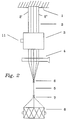
- FIG. 2 the arrangement shown in FIG. 1 is shown rotated by 90 °.
- connections 11 for a heat transport medium are specified.
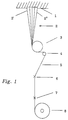
- the course of the individual filaments up to the point of convergence 6 should be shown clearly from the illustration.
- the number of filament threads 2 is largely uncritical.
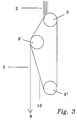
- a cooling belt 10 is shown, which is guided over rollers 9, 9 'and 9''and at least one of these rollers is driven by a motor, not shown.
- the filament thread bundle 2 meets the cooling belt 10 in the area of the roll 9 and leaves the cooling belt 10 in the area of the roll 9 'as a total thread 5 in the direction of the winder 8, not shown.
- a Polrester filament thread bundle 2 emerging from the spinneret 1 strikes the surface of the cooling roller 3, where it undergoes shock cooling during its contact with the roller surface.
- the cooling roller rotates at a peripheral speed of 1600 to 2400 m / min.
- the thread is fed over the deflection roller 4 and over the convergence point 6 to the winder 8 at a winding speed of at least 4000 m / min. Any stretching is determined by the difference between the winder speed and that of the cooling roll 3.
- the effect of the cooling roller can be enhanced by heat dissipation using a coolant.
- a standard polyester polymer with an intrinsic viscosity of 0.75 dl / g was galettlos with a constant winding speed of 5000 m / min to the two titers dtex 67 f 12 and 200 f 30 (nom. 55 dtex f 12 and 167 f 30) spun.
- the boiling shrinkage is given.
- the boiling shrinkage was determined by measuring the length before and after heat treatment in water [KS measurement: individual thread 50 cm long (unshrunk); at 98 ° C ⁇ 1 ° C in water for 2.5 minutes; Average of 3 measurements].
- KS measurement individual thread 50 cm long (unshrunk); at 98 ° C ⁇ 1 ° C in water for 2.5 minutes; Average of 3 measurements.
- the value of the shrinkage can be viewed as a measure of the crystallinity, verified by measuring the density of the threads.
- the optimal distance between spinneret and roller was determined for the respective spinning titer and its desired properties.
- the spinning result can be influenced by the distance between the spinneret / roller, the peripheral speed of the roller and the contact length of the thread / roller (corresponds to the cooling time).
- the cooking shrinkage is mainly influenced by the distance between the spinneret and the roller, while the orientation shows no clear tendency.
- Table 1 It can be seen from Table 1 that, as the distance between the KS increases, it initially drops slightly, when a limit value is reached, in the described case about 55-60 cm, suddenly drops very sharply.
- the contact and thus the cooling time can be varied through the variable wrap angle of the thread on the roller circumference. This parameter also essentially influences the KS of the spun yarns. If the cooling time, ie the contact length, is shortened, the same dependencies on the distance between the spinneret and the roller tend to be shown in Table 2, only at a lower level.
- the orientation of the spun thread can be adjusted within certain limits via the roller speed.
- Table 3 shows, the cooking shrinkage increases at the same time as the speed increases, strongly below 2000 m / min, and only above easy, with opposite tendency of orientation (birefringence).
- a particular advantage of the method according to the invention is seen in the fact that, in contrast to the known cooling methods with water or air, the yarn properties can be influenced in a targeted manner.
- the method according to the invention works more economically, since neither a system for cooling air and its complex operation nor precautions for occurring contamination by splash water have to be taken in wet operation.
Landscapes
- Chemical & Material Sciences (AREA)
- Chemical Kinetics & Catalysis (AREA)
- General Chemical & Material Sciences (AREA)
- Engineering & Computer Science (AREA)
- Textile Engineering (AREA)
- Spinning Methods And Devices For Manufacturing Artificial Fibers (AREA)
- Artificial Filaments (AREA)
Abstract
Claims (11)
- Procédé pour la fabrication dans la masse fondue de fils polyester amorphes hautement orientés avec des vitesses de filage > 4000 m/min, caractérisé en ce que les fils (2) filés dans la masse fondue sont refroidis au moyen d'une surface de contact tournante et par la suite, ils sont ensimés avec la préparation de filage et bobinés.
- Procédé selon la revendication 1, caractérisé en ce que les filaments filés (2) touchent la surface de contact pendant 1 x 10⁻³ jusqu' à 1 x 10⁻² s.
- Fils de polyester, fabriqués d'après le procédé selon les revendications 1 et 2, caractérisé par une biréfringence Δn > 0,08 et par un rétrécissement dans l'eau bouillante à 98°C ± 1°C pendant 2,5 minutes > 40 % par rapport à la longueur du fil non rétréci.
- Dispositif pour l'application du procédé selon la revendication 1, caractérisé en ce que la surface de contact est positionée entre une filère (1) et un bobinoir (8).
- Dispositif selon la revendication (4), caractérisé en ce que la surface de contact tournante est un cylindre de refroidissement (3) rotatif.
- Dispositif selon la revendication 4, caractérisé en ce que la surface de contact tournante est une bande de refroidissement (10).
- Dispositif selon les revendication 4 à 6, caractérisé en ce que la surface de contact est un métal.
- Dispositif selon la revendication 7, caractérisé en ce que la surface métallique est en cuivre ou est un alliage de cuivre.
- Dispositif selon les revendications 7 et 8 caractérisé en ce que l'épaisseur du métal comprend 2 à 100 mm.
- Dispositf selon les revendications 4 et 5, caractérisé en ce que le cylindre de refroidissement (3) soit positioné à une distance de 250 mm à 1500 mm de la filière (1).
- Dispositif selon les revendications 5 et 7 à 10, caractérisé en ce que le cylindre (3) a un corps creux comprenant des raccords (11) pour un médium de refroidissement.
Applications Claiming Priority (3)
| Application Number | Priority Date | Filing Date | Title |
|---|---|---|---|
| CH72488 | 1988-02-26 | ||
| CH724/88 | 1988-02-26 | ||
| PCT/CH1989/000032 WO1989008159A1 (fr) | 1988-02-26 | 1989-02-20 | Procede et dispositif de fabrication de fils a filaments de polyester amorphes a orientation haute |
Publications (2)
| Publication Number | Publication Date |
|---|---|
| EP0372014A1 EP0372014A1 (fr) | 1990-06-13 |
| EP0372014B1 true EP0372014B1 (fr) | 1994-04-20 |
Family
ID=4193703
Family Applications (1)
| Application Number | Title | Priority Date | Filing Date |
|---|---|---|---|
| EP89902220A Expired - Lifetime EP0372014B1 (fr) | 1988-02-26 | 1989-02-20 | Procede et dispositif de fabrication de fils a filaments de polyester amorphes a orientation haute |
Country Status (5)
| Country | Link |
|---|---|
| EP (1) | EP0372014B1 (fr) |
| CA (1) | CA1332263C (fr) |
| DE (1) | DE58907506D1 (fr) |
| ES (1) | ES2016875A6 (fr) |
| WO (1) | WO1989008159A1 (fr) |
Families Citing this family (2)
| Publication number | Priority date | Publication date | Assignee | Title |
|---|---|---|---|---|
| EP0423278B2 (fr) * | 1989-05-01 | 1998-04-15 | Rhone-Poulenc Viscosuisse Sa | Procede pour la fabrication de monofilaments fins |
| EP0408994A1 (fr) * | 1989-07-10 | 1991-01-23 | Rhône-Poulenc Viscosuisse SA | Procédé pour la fabrication de fil non texturé |
Family Cites Families (4)
| Publication number | Priority date | Publication date | Assignee | Title |
|---|---|---|---|---|
| US4425293A (en) * | 1982-03-18 | 1984-01-10 | E. I. Du Pont De Nemours And Company | Preparation of amorphous ultra-high-speed-spun polyethylene terephthalate yarn for texturing |
| ES2019285B3 (es) * | 1985-11-25 | 1991-06-16 | Schweizerische Viscose | Metodo y dispositivo para trenzado de hilos de poliester |
| US4687610A (en) * | 1986-04-30 | 1987-08-18 | E. I. Du Pont De Neumours And Company | Low crystallinity polyester yarn produced at ultra high spinning speeds |
| DE3623748A1 (de) * | 1986-07-14 | 1988-02-18 | Groebe Anneliese Dr | Schnellgesponnene polyethylenterephthalatfaeden mit neuartigem eigenschaftsprofil, verfahren zu ihrer herstellung und ihre verwendung |
-
1989
- 1989-02-20 EP EP89902220A patent/EP0372014B1/fr not_active Expired - Lifetime
- 1989-02-20 DE DE58907506T patent/DE58907506D1/de not_active Expired - Fee Related
- 1989-02-20 WO PCT/CH1989/000032 patent/WO1989008159A1/fr not_active Ceased
- 1989-02-22 ES ES8900641A patent/ES2016875A6/es not_active Expired - Lifetime
- 1989-02-23 CA CA 591849 patent/CA1332263C/fr not_active Expired - Fee Related
Also Published As
| Publication number | Publication date |
|---|---|
| WO1989008159A1 (fr) | 1989-09-08 |
| ES2016875A6 (es) | 1990-12-01 |
| EP0372014A1 (fr) | 1990-06-13 |
| DE58907506D1 (de) | 1994-05-26 |
| CA1332263C (fr) | 1994-10-11 |
Similar Documents
| Publication | Publication Date | Title |
|---|---|---|
| DE3105087C2 (de) | Verfahren zum Herstellen hochfester, einen hohen Modul aufweisender Polyamidfilamente | |
| DE3332312C2 (fr) | ||
| DE2445477A1 (de) | Verfahren zur schnelleren herstellung und strukturellen modifikation von polymeren faeden und folien | |
| DE69603945T2 (de) | Verfahren zum schnellspinnen von vollorientierten nylongarnen und daraus hergestellte garne | |
| DE2118316C3 (de) | Verfahren und Vorrichtung zur kontinuierlichen Herstellung hochverstreckter Polyäthylenterephthalat-Fäden | |
| DE69029756T2 (de) | On-Line-Faserbehandlung | |
| DE2117659A1 (de) | Verfahren zum Herstellen von Fäden und Fasern | |
| DE3026451A1 (de) | Verfahren zur herstellung hochfester technischer garne durch spinnstrecken und durch das verfahren hergestellte garne, insbesondere aus polyamid- und polyesterfaeden | |
| EP2171138B1 (fr) | Procédé de filage | |
| EP0173221B1 (fr) | Fil polyester à haute résistance et procédé pour sa fabrication | |
| DE3539185A1 (de) | Verfahren zur herstellung von polypropylen-faeden | |
| DE19506369A1 (de) | Verfahren und Vorrichtung zum Heizen eines synthetischen Fadens | |
| DE2855763C2 (fr) | ||
| EP0892097B1 (fr) | Méthode de fabrication de fils à coudre texturés par jet d'air | |
| WO1989008159A1 (fr) | Procede et dispositif de fabrication de fils a filaments de polyester amorphes a orientation haute | |
| DE1785502B2 (de) | Filament aus polyaethylenterephthalat | |
| DE1902213A1 (de) | Verfahren zur Herstellung von Polyamid-Kraeuselfaeden | |
| DE3323202C2 (fr) | ||
| DE2514874A1 (de) | Verfahren zum schnellspinnen von polyamiden | |
| EP0466868B1 (fr) | Procede de filage rapide de monofilaments et monofilaments fabriques par ce procede | |
| DE1660363C3 (de) | Verfahren zum gleichmäßigen Verstrecken von endlosen, unverstreckten Fäden aus thermoplastischen, synthetischen, organischen Polymeren mit hoher Geschwindigkeit | |
| DE2501564A1 (de) | Verfahren zur herstellung von faeden aus polyamid oder polypropylen | |
| DE2118593C3 (de) | Verfahren zur Herstellung von Garnen aus einem verstreckten Polymerfilm | |
| EP0519927B1 (fr) | Procede de fabrication d'un filament de polyester a pre-adherence et nappe de pneumatique realisee avec ce filament de polyester | |
| DD266598A1 (de) | Vorrichtung zur herstellung bauschfaehiger, synthetischer seiden |
Legal Events
| Date | Code | Title | Description |
|---|---|---|---|
| PUAI | Public reference made under article 153(3) epc to a published international application that has entered the european phase |
Free format text: ORIGINAL CODE: 0009012 |
|
| 17P | Request for examination filed |
Effective date: 19900302 |
|
| AK | Designated contracting states |
Kind code of ref document: A1 Designated state(s): CH DE FR GB IT LI NL |
|
| RAP1 | Party data changed (applicant data changed or rights of an application transferred) |
Owner name: RHONE-POULENC VISCOSUISSE SA |
|
| 17Q | First examination report despatched |
Effective date: 19930513 |
|
| GRAA | (expected) grant |
Free format text: ORIGINAL CODE: 0009210 |
|
| AK | Designated contracting states |
Kind code of ref document: B1 Designated state(s): CH DE FR GB IT LI NL |
|
| REF | Corresponds to: |
Ref document number: 58907506 Country of ref document: DE Date of ref document: 19940526 |
|
| ITF | It: translation for a ep patent filed | ||
| GBT | Gb: translation of ep patent filed (gb section 77(6)(a)/1977) |
Effective date: 19940712 |
|
| ET | Fr: translation filed | ||
| PLBI | Opposition filed |
Free format text: ORIGINAL CODE: 0009260 |
|
| PGFP | Annual fee paid to national office [announced via postgrant information from national office to epo] |
Ref country code: GB Payment date: 19950130 Year of fee payment: 7 |
|
| PGFP | Annual fee paid to national office [announced via postgrant information from national office to epo] |
Ref country code: FR Payment date: 19950203 Year of fee payment: 7 |
|
| PGFP | Annual fee paid to national office [announced via postgrant information from national office to epo] |
Ref country code: NL Payment date: 19950228 Year of fee payment: 7 |
|
| 26 | Opposition filed |
Opponent name: HOECHST TREVIRA GMBH & CO KG Effective date: 19950117 |
|
| PGFP | Annual fee paid to national office [announced via postgrant information from national office to epo] |
Ref country code: DE Payment date: 19950317 Year of fee payment: 7 |
|
| NLR1 | Nl: opposition has been filed with the epo |
Opponent name: HOECHST TREVIRA GMBH & CO KG |
|
| PGFP | Annual fee paid to national office [announced via postgrant information from national office to epo] |
Ref country code: CH Payment date: 19950501 Year of fee payment: 7 |
|
| RAP2 | Party data changed (patent owner data changed or rights of a patent transferred) |
Owner name: RHONE-POULENC VISCOSUISSE SA |
|
| PG25 | Lapsed in a contracting state [announced via postgrant information from national office to epo] |
Ref country code: GB Effective date: 19960220 |
|
| PG25 | Lapsed in a contracting state [announced via postgrant information from national office to epo] |
Ref country code: LI Free format text: LAPSE BECAUSE OF NON-PAYMENT OF DUE FEES Effective date: 19960228 Ref country code: CH Free format text: LAPSE BECAUSE OF NON-PAYMENT OF DUE FEES Effective date: 19960228 |
|
| NLT2 | Nl: modifications (of names), taken from the european patent patent bulletin |
Owner name: RHONE-POULENC VISCOSUISSE SA |
|
| PG25 | Lapsed in a contracting state [announced via postgrant information from national office to epo] |
Ref country code: NL Effective date: 19960901 |
|
| GBPC | Gb: european patent ceased through non-payment of renewal fee |
Effective date: 19960220 |
|
| REG | Reference to a national code |
Ref country code: CH Ref legal event code: PL |
|
| PG25 | Lapsed in a contracting state [announced via postgrant information from national office to epo] |
Ref country code: FR Effective date: 19961031 |
|
| NLV4 | Nl: lapsed or anulled due to non-payment of the annual fee |
Effective date: 19960901 |
|
| PG25 | Lapsed in a contracting state [announced via postgrant information from national office to epo] |
Ref country code: DE Effective date: 19961101 |
|
| REG | Reference to a national code |
Ref country code: FR Ref legal event code: ST |
|
| PLBL | Opposition procedure terminated |
Free format text: ORIGINAL CODE: EPIDOS OPPC |
|
| PLBM | Termination of opposition procedure: date of legal effect published |
Free format text: ORIGINAL CODE: 0009276 |
|
| STAA | Information on the status of an ep patent application or granted ep patent |
Free format text: STATUS: OPPOSITION PROCEDURE CLOSED |
|
| 27C | Opposition proceedings terminated |
Effective date: 19970131 |
|
| PG25 | Lapsed in a contracting state [announced via postgrant information from national office to epo] |
Ref country code: IT Free format text: LAPSE BECAUSE OF NON-PAYMENT OF DUE FEES;WARNING: LAPSES OF ITALIAN PATENTS WITH EFFECTIVE DATE BEFORE 2007 MAY HAVE OCCURRED AT ANY TIME BEFORE 2007. THE CORRECT EFFECTIVE DATE MAY BE DIFFERENT FROM THE ONE RECORDED. Effective date: 20050220 |