EP0372019B1 - ANTIGENE DE MEMBRANE DE RHOPTRIES DU $i(PLASMODIUM FALCIPARUM) - Google Patents
ANTIGENE DE MEMBRANE DE RHOPTRIES DU $i(PLASMODIUM FALCIPARUM) Download PDFInfo
- Publication number
- EP0372019B1 EP0372019B1 EP89902720A EP89902720A EP0372019B1 EP 0372019 B1 EP0372019 B1 EP 0372019B1 EP 89902720 A EP89902720 A EP 89902720A EP 89902720 A EP89902720 A EP 89902720A EP 0372019 B1 EP0372019 B1 EP 0372019B1
- Authority
- EP
- European Patent Office
- Prior art keywords
- antigen
- rma
- falciparum
- polypeptide
- rhoptry
- Prior art date
- Legal status (The legal status is an assumption and is not a legal conclusion. Google has not performed a legal analysis and makes no representation as to the accuracy of the status listed.)
- Expired - Lifetime
Links
- 241000223960 Plasmodium falciparum Species 0.000 title claims abstract description 35
- 101710181478 Envelope glycoprotein GP350 Proteins 0.000 title claims abstract description 4
- 229920001184 polypeptide Polymers 0.000 claims abstract description 44
- 108090000765 processed proteins & peptides Proteins 0.000 claims abstract description 44
- 102000004196 processed proteins & peptides Human genes 0.000 claims abstract description 44
- 210000003936 merozoite Anatomy 0.000 claims abstract description 26
- 239000012634 fragment Substances 0.000 claims abstract description 21
- 230000000890 antigenic effect Effects 0.000 claims abstract description 12
- 102000018697 Membrane Proteins Human genes 0.000 claims abstract description 10
- 108010052285 Membrane Proteins Proteins 0.000 claims abstract description 10
- 210000004369 blood Anatomy 0.000 claims abstract description 8
- 239000008280 blood Substances 0.000 claims abstract description 8
- 230000002209 hydrophobic effect Effects 0.000 claims abstract description 6
- 239000000427 antigen Substances 0.000 claims description 48
- 102000036639 antigens Human genes 0.000 claims description 48
- 108091007433 antigens Proteins 0.000 claims description 48
- 206010035500 Plasmodium falciparum infection Diseases 0.000 claims description 29
- 239000002773 nucleotide Substances 0.000 claims description 20
- 125000003729 nucleotide group Chemical group 0.000 claims description 20
- 108090000623 proteins and genes Proteins 0.000 claims description 18
- 210000004027 cell Anatomy 0.000 claims description 13
- 102000004169 proteins and genes Human genes 0.000 claims description 11
- 238000002415 sodium dodecyl sulfate polyacrylamide gel electrophoresis Methods 0.000 claims description 9
- 102000053602 DNA Human genes 0.000 claims description 7
- 108020004511 Recombinant DNA Proteins 0.000 claims description 7
- 239000002671 adjuvant Substances 0.000 claims description 7
- 239000000203 mixture Substances 0.000 claims description 7
- 229960005486 vaccine Drugs 0.000 claims description 5
- 230000028993 immune response Effects 0.000 claims description 4
- 238000010367 cloning Methods 0.000 claims description 3
- 238000004519 manufacturing process Methods 0.000 claims description 3
- 239000003981 vehicle Substances 0.000 claims description 3
- 239000003937 drug carrier Substances 0.000 claims description 2
- 230000001939 inductive effect Effects 0.000 claims 3
- 230000001681 protective effect Effects 0.000 claims 3
- 125000003275 alpha amino acid group Chemical group 0.000 claims 1
- 238000001727 in vivo Methods 0.000 claims 1
- 239000000546 pharmaceutical excipient Substances 0.000 claims 1
- 244000045947 parasite Species 0.000 description 23
- 210000001563 schizont Anatomy 0.000 description 20
- 241000283973 Oryctolagus cuniculus Species 0.000 description 18
- 150000001413 amino acids Chemical group 0.000 description 15
- 238000002372 labelling Methods 0.000 description 15
- 235000001014 amino acid Nutrition 0.000 description 12
- 239000002299 complementary DNA Substances 0.000 description 11
- 235000018102 proteins Nutrition 0.000 description 10
- 241000701447 unidentified baculovirus Species 0.000 description 10
- IDOQDZANRZQBTP-UHFFFAOYSA-N 2-[2-(2,4,4-trimethylpentan-2-yl)phenoxy]ethanol Chemical compound CC(C)(C)CC(C)(C)C1=CC=CC=C1OCCO IDOQDZANRZQBTP-UHFFFAOYSA-N 0.000 description 9
- 229920004929 Triton X-114 Polymers 0.000 description 9
- 238000002474 experimental method Methods 0.000 description 9
- 108020001507 fusion proteins Proteins 0.000 description 9
- 102000037865 fusion proteins Human genes 0.000 description 9
- 238000000034 method Methods 0.000 description 9
- 210000003743 erythrocyte Anatomy 0.000 description 8
- 238000003119 immunoblot Methods 0.000 description 8
- 229960004452 methionine Drugs 0.000 description 8
- 210000003812 trophozoite Anatomy 0.000 description 7
- 108020004414 DNA Proteins 0.000 description 6
- FFEARJCKVFRZRR-BYPYZUCNSA-N L-methionine Chemical compound CSCC[C@H](N)C(O)=O FFEARJCKVFRZRR-BYPYZUCNSA-N 0.000 description 6
- 241000224024 Plasmodium chabaudi Species 0.000 description 6
- 238000001114 immunoprecipitation Methods 0.000 description 6
- 239000012528 membrane Substances 0.000 description 6
- 239000008188 pellet Substances 0.000 description 6
- 239000012071 phase Substances 0.000 description 6
- 238000012545 processing Methods 0.000 description 6
- 241000588724 Escherichia coli Species 0.000 description 5
- 241000224026 Plasmodium chabaudi adami Species 0.000 description 5
- 239000008186 active pharmaceutical agent Substances 0.000 description 5
- 230000015572 biosynthetic process Effects 0.000 description 5
- 125000000151 cysteine group Chemical group N[C@@H](CS)C(=O)* 0.000 description 5
- 239000002609 medium Substances 0.000 description 5
- 230000001360 synchronised effect Effects 0.000 description 5
- 239000012980 RPMI-1640 medium Substances 0.000 description 4
- 210000004899 c-terminal region Anatomy 0.000 description 4
- 230000003053 immunization Effects 0.000 description 4
- 230000005847 immunogenicity Effects 0.000 description 4
- 239000000463 material Substances 0.000 description 4
- 230000004044 response Effects 0.000 description 4
- 238000003786 synthesis reaction Methods 0.000 description 4
- 239000013598 vector Substances 0.000 description 4
- FBPFZTCFMRRESA-FSIIMWSLSA-N D-Glucitol Natural products OC[C@H](O)[C@H](O)[C@@H](O)[C@H](O)CO FBPFZTCFMRRESA-FSIIMWSLSA-N 0.000 description 3
- 239000000020 Nitrocellulose Substances 0.000 description 3
- 108010076504 Protein Sorting Signals Proteins 0.000 description 3
- 229920002684 Sepharose Polymers 0.000 description 3
- 239000011543 agarose gel Substances 0.000 description 3
- NWMHDZMRVUOQGL-CZEIJOLGSA-N almurtide Chemical compound OC(=O)CC[C@H](C(N)=O)NC(=O)[C@H](C)NC(=O)CO[C@@H]([C@H](O)[C@H](O)CO)[C@@H](NC(C)=O)C=O NWMHDZMRVUOQGL-CZEIJOLGSA-N 0.000 description 3
- 239000008346 aqueous phase Substances 0.000 description 3
- 239000012228 culture supernatant Substances 0.000 description 3
- 239000003599 detergent Substances 0.000 description 3
- 239000000284 extract Substances 0.000 description 3
- 238000009472 formulation Methods 0.000 description 3
- PCHJSUWPFVWCPO-UHFFFAOYSA-N gold Chemical compound [Au] PCHJSUWPFVWCPO-UHFFFAOYSA-N 0.000 description 3
- 238000002649 immunization Methods 0.000 description 3
- 238000010166 immunofluorescence Methods 0.000 description 3
- 150000002632 lipids Chemical class 0.000 description 3
- 239000006166 lysate Substances 0.000 description 3
- 229920001220 nitrocellulos Polymers 0.000 description 3
- 238000012216 screening Methods 0.000 description 3
- 230000028327 secretion Effects 0.000 description 3
- 210000002966 serum Anatomy 0.000 description 3
- 239000000600 sorbitol Substances 0.000 description 3
- JDRAOGVAQOVDEB-KTKRTIGZSA-N (3-hydroxy-2,3,3a,5,6,6a-hexahydrofuro[3,2-b]furan-6-yl) (z)-octadec-9-enoate Chemical compound OC1COC2C(OC(=O)CCCCCCC\C=C/CCCCCCCC)COC21 JDRAOGVAQOVDEB-KTKRTIGZSA-N 0.000 description 2
- YYGNTYWPHWGJRM-UHFFFAOYSA-N (6E,10E,14E,18E)-2,6,10,15,19,23-hexamethyltetracosa-2,6,10,14,18,22-hexaene Chemical compound CC(C)=CCCC(C)=CCCC(C)=CCCC=C(C)CCC=C(C)CCC=C(C)C YYGNTYWPHWGJRM-UHFFFAOYSA-N 0.000 description 2
- 101710145634 Antigen 1 Proteins 0.000 description 2
- 238000002965 ELISA Methods 0.000 description 2
- LFQSCWFLJHTTHZ-UHFFFAOYSA-N Ethanol Chemical compound CCO LFQSCWFLJHTTHZ-UHFFFAOYSA-N 0.000 description 2
- OWYWGLHRNBIFJP-UHFFFAOYSA-N Ipazine Chemical compound CCN(CC)C1=NC(Cl)=NC(NC(C)C)=N1 OWYWGLHRNBIFJP-UHFFFAOYSA-N 0.000 description 2
- OUYCCCASQSFEME-QMMMGPOBSA-N L-tyrosine Chemical compound OC(=O)[C@@H](N)CC1=CC=C(O)C=C1 OUYCCCASQSFEME-QMMMGPOBSA-N 0.000 description 2
- 108091028043 Nucleic acid sequence Proteins 0.000 description 2
- 108700026244 Open Reading Frames Proteins 0.000 description 2
- ONIBWKKTOPOVIA-UHFFFAOYSA-N Proline Natural products OC(=O)C1CCCN1 ONIBWKKTOPOVIA-UHFFFAOYSA-N 0.000 description 2
- 241001620634 Roger Species 0.000 description 2
- 101100495436 Saccharomyces cerevisiae (strain ATCC 204508 / S288c) CSE4 gene Proteins 0.000 description 2
- BHEOSNUKNHRBNM-UHFFFAOYSA-N Tetramethylsqualene Natural products CC(=C)C(C)CCC(=C)C(C)CCC(C)=CCCC=C(C)CCC(C)C(=C)CCC(C)C(C)=C BHEOSNUKNHRBNM-UHFFFAOYSA-N 0.000 description 2
- 229920004890 Triton X-100 Polymers 0.000 description 2
- 239000013504 Triton X-100 Substances 0.000 description 2
- 239000011324 bead Substances 0.000 description 2
- 238000005119 centrifugation Methods 0.000 description 2
- 230000008859 change Effects 0.000 description 2
- 230000000295 complement effect Effects 0.000 description 2
- 230000001419 dependent effect Effects 0.000 description 2
- 229940042399 direct acting antivirals protease inhibitors Drugs 0.000 description 2
- PRAKJMSDJKAYCZ-UHFFFAOYSA-N dodecahydrosqualene Natural products CC(C)CCCC(C)CCCC(C)CCCCC(C)CCCC(C)CCCC(C)C PRAKJMSDJKAYCZ-UHFFFAOYSA-N 0.000 description 2
- 239000000499 gel Substances 0.000 description 2
- 239000010931 gold Substances 0.000 description 2
- 229910052737 gold Inorganic materials 0.000 description 2
- HNDVDQJCIGZPNO-UHFFFAOYSA-N histidine Natural products OC(=O)C(N)CC1=CN=CN1 HNDVDQJCIGZPNO-UHFFFAOYSA-N 0.000 description 2
- 125000001165 hydrophobic group Chemical group 0.000 description 2
- 238000010820 immunofluorescence microscopy Methods 0.000 description 2
- 230000009545 invasion Effects 0.000 description 2
- 230000004807 localization Effects 0.000 description 2
- 201000004792 malaria Diseases 0.000 description 2
- 230000035800 maturation Effects 0.000 description 2
- 229930182817 methionine Natural products 0.000 description 2
- 239000000137 peptide hydrolase inhibitor Substances 0.000 description 2
- 230000009257 reactivity Effects 0.000 description 2
- 238000011160 research Methods 0.000 description 2
- 239000011347 resin Substances 0.000 description 2
- 229920005989 resin Polymers 0.000 description 2
- 238000000638 solvent extraction Methods 0.000 description 2
- 241000894007 species Species 0.000 description 2
- 229940031439 squalene Drugs 0.000 description 2
- TUHBEKDERLKLEC-UHFFFAOYSA-N squalene Natural products CC(=CCCC(=CCCC(=CCCC=C(/C)CCC=C(/C)CC=C(C)C)C)C)C TUHBEKDERLKLEC-UHFFFAOYSA-N 0.000 description 2
- 238000010561 standard procedure Methods 0.000 description 2
- 238000001890 transfection Methods 0.000 description 2
- 238000011282 treatment Methods 0.000 description 2
- OUYCCCASQSFEME-UHFFFAOYSA-N tyrosine Natural products OC(=O)C(N)CC1=CC=C(O)C=C1 OUYCCCASQSFEME-UHFFFAOYSA-N 0.000 description 2
- CJDRUOGAGYHKKD-XMTJACRCSA-N (+)-Ajmaline Natural products O[C@H]1[C@@H](CC)[C@@H]2[C@@H]3[C@H](O)[C@@]45[C@@H](N(C)c6c4cccc6)[C@@H](N1[C@H]3C5)C2 CJDRUOGAGYHKKD-XMTJACRCSA-N 0.000 description 1
- MRXDGVXSWIXTQL-HYHFHBMOSA-N (2s)-2-[[(1s)-1-(2-amino-1,4,5,6-tetrahydropyrimidin-6-yl)-2-[[(2s)-4-methyl-1-oxo-1-[[(2s)-1-oxo-3-phenylpropan-2-yl]amino]pentan-2-yl]amino]-2-oxoethyl]carbamoylamino]-3-phenylpropanoic acid Chemical compound C([C@H](NC(=O)N[C@H](C(=O)N[C@@H](CC(C)C)C(=O)N[C@@H](CC=1C=CC=CC=1)C=O)C1NC(N)=NCC1)C(O)=O)C1=CC=CC=C1 MRXDGVXSWIXTQL-HYHFHBMOSA-N 0.000 description 1
- TUSDEZXZIZRFGC-UHFFFAOYSA-N 1-O-galloyl-3,6-(R)-HHDP-beta-D-glucose Natural products OC1C(O2)COC(=O)C3=CC(O)=C(O)C(O)=C3C3=C(O)C(O)=C(O)C=C3C(=O)OC1C(O)C2OC(=O)C1=CC(O)=C(O)C(O)=C1 TUSDEZXZIZRFGC-UHFFFAOYSA-N 0.000 description 1
- TWJNQYPJQDRXPH-UHFFFAOYSA-N 2-cyanobenzohydrazide Chemical compound NNC(=O)C1=CC=CC=C1C#N TWJNQYPJQDRXPH-UHFFFAOYSA-N 0.000 description 1
- 229920000936 Agarose Polymers 0.000 description 1
- SDNYTAYICBFYFH-UHFFFAOYSA-N Antipain (dihydrochloride) Chemical compound NC(N)=NCCCC(C=O)NC(=O)C(C(C)C)NC(=O)C(CCCN=C(N)N)NC(=O)NC(C(O)=O)CC1=CC=CC=C1 SDNYTAYICBFYFH-UHFFFAOYSA-N 0.000 description 1
- 101000583086 Bunodosoma granuliferum Delta-actitoxin-Bgr2b Proteins 0.000 description 1
- 241000282693 Cercopithecidae Species 0.000 description 1
- OLVPQBGMUGIKIW-UHFFFAOYSA-N Chymostatin Natural products C=1C=CC=CC=1CC(C=O)NC(=O)C(C(C)CC)NC(=O)C(C1NC(N)=NCC1)NC(=O)NC(C(O)=O)CC1=CC=CC=C1 OLVPQBGMUGIKIW-UHFFFAOYSA-N 0.000 description 1
- 108091026890 Coding region Proteins 0.000 description 1
- 238000001712 DNA sequencing Methods 0.000 description 1
- 239000001263 FEMA 3042 Substances 0.000 description 1
- SXRSQZLOMIGNAQ-UHFFFAOYSA-N Glutaraldehyde Chemical compound O=CCCCC=O SXRSQZLOMIGNAQ-UHFFFAOYSA-N 0.000 description 1
- 102000005720 Glutathione transferase Human genes 0.000 description 1
- 108010070675 Glutathione transferase Proteins 0.000 description 1
- 241000238631 Hexapoda Species 0.000 description 1
- 101000957351 Homo sapiens Myc-associated zinc finger protein Proteins 0.000 description 1
- ONIBWKKTOPOVIA-BYPYZUCNSA-N L-Proline Chemical compound OC(=O)[C@@H]1CCCN1 ONIBWKKTOPOVIA-BYPYZUCNSA-N 0.000 description 1
- HNDVDQJCIGZPNO-YFKPBYRVSA-N L-histidine Chemical compound OC(=O)[C@@H](N)CC1=CN=CN1 HNDVDQJCIGZPNO-YFKPBYRVSA-N 0.000 description 1
- KDXKERNSBIXSRK-YFKPBYRVSA-N L-lysine Chemical compound NCCCC[C@H](N)C(O)=O KDXKERNSBIXSRK-YFKPBYRVSA-N 0.000 description 1
- BVHLGVCQOALMSV-JEDNCBNOSA-N L-lysine hydrochloride Chemical compound Cl.NCCCC[C@H](N)C(O)=O BVHLGVCQOALMSV-JEDNCBNOSA-N 0.000 description 1
- GDBQQVLCIARPGH-UHFFFAOYSA-N Leupeptin Natural products CC(C)CC(NC(C)=O)C(=O)NC(CC(C)C)C(=O)NC(C=O)CCCN=C(N)N GDBQQVLCIARPGH-UHFFFAOYSA-N 0.000 description 1
- SJNZALDHDUYDBU-IHRRRGAJSA-N Lys-Arg-Lys Chemical compound NCCCC[C@H](N)C(=O)N[C@@H](CCCN=C(N)N)C(=O)N[C@@H](CCCCN)C(O)=O SJNZALDHDUYDBU-IHRRRGAJSA-N 0.000 description 1
- 239000004472 Lysine Substances 0.000 description 1
- KDXKERNSBIXSRK-UHFFFAOYSA-N Lysine Natural products NCCCCC(N)C(O)=O KDXKERNSBIXSRK-UHFFFAOYSA-N 0.000 description 1
- 241001465754 Metazoa Species 0.000 description 1
- 241001529936 Murinae Species 0.000 description 1
- 241000699670 Mus sp. Species 0.000 description 1
- 102100038750 Myc-associated zinc finger protein Human genes 0.000 description 1
- TUNFSRHWOTWDNC-UHFFFAOYSA-N Myristic acid Natural products CCCCCCCCCCCCCC(O)=O TUNFSRHWOTWDNC-UHFFFAOYSA-N 0.000 description 1
- 235000021360 Myristic acid Nutrition 0.000 description 1
- 125000000729 N-terminal amino-acid group Chemical group 0.000 description 1
- 108700020497 Nucleopolyhedrovirus polyhedrin Proteins 0.000 description 1
- 108091034117 Oligonucleotide Proteins 0.000 description 1
- LRBQNJMCXXYXIU-PPKXGCFTSA-N Penta-digallate-beta-D-glucose Natural products OC1=C(O)C(O)=CC(C(=O)OC=2C(=C(O)C=C(C=2)C(=O)OC[C@@H]2[C@H]([C@H](OC(=O)C=3C=C(OC(=O)C=4C=C(O)C(O)=C(O)C=4)C(O)=C(O)C=3)[C@@H](OC(=O)C=3C=C(OC(=O)C=4C=C(O)C(O)=C(O)C=4)C(O)=C(O)C=3)[C@H](OC(=O)C=3C=C(OC(=O)C=4C=C(O)C(O)=C(O)C=4)C(O)=C(O)C=3)O2)OC(=O)C=2C=C(OC(=O)C=3C=C(O)C(O)=C(O)C=3)C(O)=C(O)C=2)O)=C1 LRBQNJMCXXYXIU-PPKXGCFTSA-N 0.000 description 1
- 241001579055 Plasmodium falciparum D10 Species 0.000 description 1
- 241000223830 Plasmodium yoelii Species 0.000 description 1
- 102000055027 Protein Methyltransferases Human genes 0.000 description 1
- 108700040121 Protein Methyltransferases Proteins 0.000 description 1
- 239000012722 SDS sample buffer Substances 0.000 description 1
- 241000191967 Staphylococcus aureus Species 0.000 description 1
- 239000007983 Tris buffer Substances 0.000 description 1
- COQLPRJCUIATTQ-UHFFFAOYSA-N Uranyl acetate Chemical compound O.O.O=[U]=O.CC(O)=O.CC(O)=O COQLPRJCUIATTQ-UHFFFAOYSA-N 0.000 description 1
- 241001672648 Vieira Species 0.000 description 1
- 241000700605 Viruses Species 0.000 description 1
- 241000219094 Vitaceae Species 0.000 description 1
- 108091060592 XDNA Proteins 0.000 description 1
- JLCPHMBAVCMARE-UHFFFAOYSA-N [3-[[3-[[3-[[3-[[3-[[3-[[3-[[3-[[3-[[3-[[3-[[5-(2-amino-6-oxo-1H-purin-9-yl)-3-[[3-[[3-[[3-[[3-[[3-[[5-(2-amino-6-oxo-1H-purin-9-yl)-3-[[5-(2-amino-6-oxo-1H-purin-9-yl)-3-hydroxyoxolan-2-yl]methoxy-hydroxyphosphoryl]oxyoxolan-2-yl]methoxy-hydroxyphosphoryl]oxy-5-(5-methyl-2,4-dioxopyrimidin-1-yl)oxolan-2-yl]methoxy-hydroxyphosphoryl]oxy-5-(6-aminopurin-9-yl)oxolan-2-yl]methoxy-hydroxyphosphoryl]oxy-5-(6-aminopurin-9-yl)oxolan-2-yl]methoxy-hydroxyphosphoryl]oxy-5-(6-aminopurin-9-yl)oxolan-2-yl]methoxy-hydroxyphosphoryl]oxy-5-(6-aminopurin-9-yl)oxolan-2-yl]methoxy-hydroxyphosphoryl]oxyoxolan-2-yl]methoxy-hydroxyphosphoryl]oxy-5-(5-methyl-2,4-dioxopyrimidin-1-yl)oxolan-2-yl]methoxy-hydroxyphosphoryl]oxy-5-(4-amino-2-oxopyrimidin-1-yl)oxolan-2-yl]methoxy-hydroxyphosphoryl]oxy-5-(5-methyl-2,4-dioxopyrimidin-1-yl)oxolan-2-yl]methoxy-hydroxyphosphoryl]oxy-5-(5-methyl-2,4-dioxopyrimidin-1-yl)oxolan-2-yl]methoxy-hydroxyphosphoryl]oxy-5-(6-aminopurin-9-yl)oxolan-2-yl]methoxy-hydroxyphosphoryl]oxy-5-(6-aminopurin-9-yl)oxolan-2-yl]methoxy-hydroxyphosphoryl]oxy-5-(4-amino-2-oxopyrimidin-1-yl)oxolan-2-yl]methoxy-hydroxyphosphoryl]oxy-5-(4-amino-2-oxopyrimidin-1-yl)oxolan-2-yl]methoxy-hydroxyphosphoryl]oxy-5-(4-amino-2-oxopyrimidin-1-yl)oxolan-2-yl]methoxy-hydroxyphosphoryl]oxy-5-(6-aminopurin-9-yl)oxolan-2-yl]methoxy-hydroxyphosphoryl]oxy-5-(4-amino-2-oxopyrimidin-1-yl)oxolan-2-yl]methyl [5-(6-aminopurin-9-yl)-2-(hydroxymethyl)oxolan-3-yl] hydrogen phosphate Polymers Cc1cn(C2CC(OP(O)(=O)OCC3OC(CC3OP(O)(=O)OCC3OC(CC3O)n3cnc4c3nc(N)[nH]c4=O)n3cnc4c3nc(N)[nH]c4=O)C(COP(O)(=O)OC3CC(OC3COP(O)(=O)OC3CC(OC3COP(O)(=O)OC3CC(OC3COP(O)(=O)OC3CC(OC3COP(O)(=O)OC3CC(OC3COP(O)(=O)OC3CC(OC3COP(O)(=O)OC3CC(OC3COP(O)(=O)OC3CC(OC3COP(O)(=O)OC3CC(OC3COP(O)(=O)OC3CC(OC3COP(O)(=O)OC3CC(OC3COP(O)(=O)OC3CC(OC3COP(O)(=O)OC3CC(OC3COP(O)(=O)OC3CC(OC3COP(O)(=O)OC3CC(OC3COP(O)(=O)OC3CC(OC3COP(O)(=O)OC3CC(OC3CO)n3cnc4c(N)ncnc34)n3ccc(N)nc3=O)n3cnc4c(N)ncnc34)n3ccc(N)nc3=O)n3ccc(N)nc3=O)n3ccc(N)nc3=O)n3cnc4c(N)ncnc34)n3cnc4c(N)ncnc34)n3cc(C)c(=O)[nH]c3=O)n3cc(C)c(=O)[nH]c3=O)n3ccc(N)nc3=O)n3cc(C)c(=O)[nH]c3=O)n3cnc4c3nc(N)[nH]c4=O)n3cnc4c(N)ncnc34)n3cnc4c(N)ncnc34)n3cnc4c(N)ncnc34)n3cnc4c(N)ncnc34)O2)c(=O)[nH]c1=O JLCPHMBAVCMARE-UHFFFAOYSA-N 0.000 description 1
- 239000003463 adsorbent Substances 0.000 description 1
- 229940037003 alum Drugs 0.000 description 1
- ILRRQNADMUWWFW-UHFFFAOYSA-K aluminium phosphate Chemical compound O1[Al]2OP1(=O)O2 ILRRQNADMUWWFW-UHFFFAOYSA-K 0.000 description 1
- 229940001007 aluminium phosphate Drugs 0.000 description 1
- 229910000147 aluminium phosphate Inorganic materials 0.000 description 1
- 230000000078 anti-malarial effect Effects 0.000 description 1
- 239000003430 antimalarial agent Substances 0.000 description 1
- 238000003556 assay Methods 0.000 description 1
- 238000000376 autoradiography Methods 0.000 description 1
- 210000000170 cell membrane Anatomy 0.000 description 1
- 239000003795 chemical substances by application Substances 0.000 description 1
- 108010086192 chymostatin Proteins 0.000 description 1
- 238000003776 cleavage reaction Methods 0.000 description 1
- 238000010276 construction Methods 0.000 description 1
- 230000008878 coupling Effects 0.000 description 1
- 238000010168 coupling process Methods 0.000 description 1
- 238000005859 coupling reaction Methods 0.000 description 1
- ATDGTVJJHBUTRL-UHFFFAOYSA-N cyanogen bromide Chemical compound BrC#N ATDGTVJJHBUTRL-UHFFFAOYSA-N 0.000 description 1
- XUJNEKJLAYXESH-UHFFFAOYSA-N cysteine Natural products SCC(N)C(O)=O XUJNEKJLAYXESH-UHFFFAOYSA-N 0.000 description 1
- 235000018417 cysteine Nutrition 0.000 description 1
- 230000003247 decreasing effect Effects 0.000 description 1
- 239000003085 diluting agent Substances 0.000 description 1
- 238000009826 distribution Methods 0.000 description 1
- 238000001493 electron microscopy Methods 0.000 description 1
- 238000000605 extraction Methods 0.000 description 1
- 239000000834 fixative Substances 0.000 description 1
- 238000005194 fractionation Methods 0.000 description 1
- 230000004927 fusion Effects 0.000 description 1
- 235000021021 grapes Nutrition 0.000 description 1
- 230000001900 immune effect Effects 0.000 description 1
- 230000002163 immunogen Effects 0.000 description 1
- 239000012133 immunoprecipitate Substances 0.000 description 1
- 238000000338 in vitro Methods 0.000 description 1
- 208000015181 infectious disease Diseases 0.000 description 1
- 239000002198 insoluble material Substances 0.000 description 1
- PGLTVOMIXTUURA-UHFFFAOYSA-N iodoacetamide Chemical compound NC(=O)CI PGLTVOMIXTUURA-UHFFFAOYSA-N 0.000 description 1
- BWHLPLXXIDYSNW-UHFFFAOYSA-N ketorolac tromethamine Chemical compound OCC(N)(CO)CO.OC(=O)C1CCN2C1=CC=C2C(=O)C1=CC=CC=C1 BWHLPLXXIDYSNW-UHFFFAOYSA-N 0.000 description 1
- GDBQQVLCIARPGH-ULQDDVLXSA-N leupeptin Chemical compound CC(C)C[C@H](NC(C)=O)C(=O)N[C@@H](CC(C)C)C(=O)N[C@H](C=O)CCCN=C(N)N GDBQQVLCIARPGH-ULQDDVLXSA-N 0.000 description 1
- 108010052968 leupeptin Proteins 0.000 description 1
- 125000003473 lipid group Chemical group 0.000 description 1
- 125000003588 lysine group Chemical group [H]N([H])C([H])([H])C([H])([H])C([H])([H])C([H])([H])C([H])(N([H])[H])C(*)=O 0.000 description 1
- 238000010369 molecular cloning Methods 0.000 description 1
- MQUQNUAYKLCRME-UHFFFAOYSA-N n-(4-chloro-3-oxo-1-phenylbutan-2-yl)-4-methylbenzenesulfonamide Chemical compound C1=CC(C)=CC=C1S(=O)(=O)NC(C(=O)CCl)CC1=CC=CC=C1 MQUQNUAYKLCRME-UHFFFAOYSA-N 0.000 description 1
- 239000002245 particle Substances 0.000 description 1
- 238000005192 partition Methods 0.000 description 1
- 229950000964 pepstatin Drugs 0.000 description 1
- 108010091212 pepstatin Proteins 0.000 description 1
- FAXGPCHRFPCXOO-LXTPJMTPSA-N pepstatin A Chemical compound OC(=O)C[C@H](O)[C@H](CC(C)C)NC(=O)[C@H](C)NC(=O)C[C@H](O)[C@H](CC(C)C)NC(=O)[C@H](C(C)C)NC(=O)[C@H](C(C)C)NC(=O)CC(C)C FAXGPCHRFPCXOO-LXTPJMTPSA-N 0.000 description 1
- YBYRMVIVWMBXKQ-UHFFFAOYSA-N phenylmethanesulfonyl fluoride Chemical compound FS(=O)(=O)CC1=CC=CC=C1 YBYRMVIVWMBXKQ-UHFFFAOYSA-N 0.000 description 1
- 239000013600 plasmid vector Substances 0.000 description 1
- 229920002401 polyacrylamide Polymers 0.000 description 1
- 239000002243 precursor Substances 0.000 description 1
- 238000002360 preparation method Methods 0.000 description 1
- 125000002924 primary amino group Chemical group [H]N([H])* 0.000 description 1
- 230000008569 process Effects 0.000 description 1
- 238000000746 purification Methods 0.000 description 1
- 238000000163 radioactive labelling Methods 0.000 description 1
- 230000003252 repetitive effect Effects 0.000 description 1
- 230000002441 reversible effect Effects 0.000 description 1
- 150000003839 salts Chemical class 0.000 description 1
- 239000000523 sample Substances 0.000 description 1
- 230000007017 scission Effects 0.000 description 1
- 210000004929 secretory organelle Anatomy 0.000 description 1
- 230000004960 subcellular localization Effects 0.000 description 1
- 229920002258 tannic acid Polymers 0.000 description 1
- LRBQNJMCXXYXIU-NRMVVENXSA-N tannic acid Chemical compound OC1=C(O)C(O)=CC(C(=O)OC=2C(=C(O)C=C(C=2)C(=O)OC[C@@H]2[C@H]([C@H](OC(=O)C=3C=C(OC(=O)C=4C=C(O)C(O)=C(O)C=4)C(O)=C(O)C=3)[C@@H](OC(=O)C=3C=C(OC(=O)C=4C=C(O)C(O)=C(O)C=4)C(O)=C(O)C=3)[C@@H](OC(=O)C=3C=C(OC(=O)C=4C=C(O)C(O)=C(O)C=4)C(O)=C(O)C=3)O2)OC(=O)C=2C=C(OC(=O)C=3C=C(O)C(O)=C(O)C=3)C(O)=C(O)C=2)O)=C1 LRBQNJMCXXYXIU-NRMVVENXSA-N 0.000 description 1
- 229940033123 tannic acid Drugs 0.000 description 1
- 235000015523 tannic acid Nutrition 0.000 description 1
- GPRLSGONYQIRFK-MNYXATJNSA-N triton Chemical compound [3H+] GPRLSGONYQIRFK-MNYXATJNSA-N 0.000 description 1
- 229940124856 vaccine component Drugs 0.000 description 1
- 210000003934 vacuole Anatomy 0.000 description 1
- 230000003442 weekly effect Effects 0.000 description 1
- 238000001262 western blot Methods 0.000 description 1
Images








Classifications
-
- C—CHEMISTRY; METALLURGY
- C07—ORGANIC CHEMISTRY
- C07K—PEPTIDES
- C07K14/00—Peptides having more than 20 amino acids; Gastrins; Somatostatins; Melanotropins; Derivatives thereof
- C07K14/435—Peptides having more than 20 amino acids; Gastrins; Somatostatins; Melanotropins; Derivatives thereof from animals; from humans
- C07K14/44—Peptides having more than 20 amino acids; Gastrins; Somatostatins; Melanotropins; Derivatives thereof from animals; from humans from protozoa
- C07K14/445—Plasmodium
-
- A—HUMAN NECESSITIES
- A61—MEDICAL OR VETERINARY SCIENCE; HYGIENE
- A61K—PREPARATIONS FOR MEDICAL, DENTAL OR TOILETRY PURPOSES
- A61K39/00—Medicinal preparations containing antigens or antibodies
-
- Y—GENERAL TAGGING OF NEW TECHNOLOGICAL DEVELOPMENTS; GENERAL TAGGING OF CROSS-SECTIONAL TECHNOLOGIES SPANNING OVER SEVERAL SECTIONS OF THE IPC; TECHNICAL SUBJECTS COVERED BY FORMER USPC CROSS-REFERENCE ART COLLECTIONS [XRACs] AND DIGESTS
- Y02—TECHNOLOGIES OR APPLICATIONS FOR MITIGATION OR ADAPTATION AGAINST CLIMATE CHANGE
- Y02A—TECHNOLOGIES FOR ADAPTATION TO CLIMATE CHANGE
- Y02A50/00—TECHNOLOGIES FOR ADAPTATION TO CLIMATE CHANGE in human health protection, e.g. against extreme weather
- Y02A50/30—Against vector-borne diseases, e.g. mosquito-borne, fly-borne, tick-borne or waterborne diseases whose impact is exacerbated by climate change
Definitions
- This invention relates to the identification of an antigen of the asexual blood stages of Plasmodium falciparum, which is potentially capable of generating an immune response and antibodies which are able to inhibit the growth of the parasite, and to the use of this antigen and antibodies to it in immunization, diagnostic and treatment methods.
- Electronmicroscopy using tannic acid-containing fixatives has revealed multilamellar membraneous whorls derived from rhoptry secretions. This indicates that there is lipid in the rhoptry secretion and it has been suggested that this may contribute to the formation of the parasitophorous vacuole membrane.
- a number of different proteins have been identified in the rhoptries of P.falciparum. Two antigen complexes have been identified.
- a high molecular weight complex is composed of three antigenic polypeptides of -M, 105,000, M, 135,000 and M, 145,000 (Campbell et.al. 1984; Holden et.al. 1985; Cooper et.al. 1988 and Lustigman et.al. 1988) and a low molecular weight complex is composed of several polypeptides derived from a M, 83,000 protein and a doublet of approximate M, 40,000 (Campbell et.al, 1984; Howard et.al., 1985; Braun-Breton et.al., 1986; Schofield et.al. 1986; Bushell et.al. 1988).
- Rhoptry antigens are considered potential vaccine components, initially because a rhoptry antigen from P.yoelii (M, 235,000) effectively immunized mice against infection (Holder and Freeman, 1981). Subsequently, some monoclonal antibodies that inhibited the growth of P.falciparum in vitro were shown to be directed against rhoptry components (Schofield et.al., 1986). Furthermore, monkeys immunized with purified rhoptry antigens were partially protected against challenge with P.falciparum (Perrin et.al., 1985; Siddiqui et.al., 1987).
- a rhoptry membrane antigen of the asexual blood stages of Plasmodium falciparum which is characterised by:
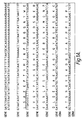
- the antigen is a polypeptide having a primary structure which includes the amino acid sequence set out in Figure 1, or an antigenic fragment thereof.
- the invention also provides a method for actively immunizing a host against Plasmodium falciparum which method comprises administering to the host an antigen according to the present invention, or an antigenic fragment thereof.
- the invention provides a vaccine comprising an antigen of the present invention, or an antigenic fragment thereof, a pharmaceutically acceptable carrier or diluent, and optionally an adjuvant.
- the present invention also extends to a recombinant DNA molecule comprising all or a portion of a nucleotide sequence which is capable of being expressed as a polypeptide having the antigenicity of an antigen as described above, or an antigenic fragment thereof, or a recombinant cloning vehicle or vector, or a host cell comprising a said recombinant DNA molecule.
- the recombinant DNA molecule, recombinant cloning vehicle or vector, or host cell comprises all or a portion of a nucleotide sequence as set out in Figure 1.
- the invention extends to a synthetic polypeptide prepared by expression of all or a portion of a nucleotide sequence as described above, and to a vaccine composition comprising a said synthetic polypeptide.
- the present invention relates to a previously unrecognized rhoptry antigen that has the solubility characteristics and primary structural features of an integral membrane protein.
- This antigen which has been designated rhoptry membrane antigen-1 (RMA-1)
- RMA-1 rhoptry membrane antigen-1
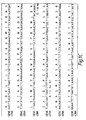
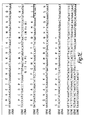
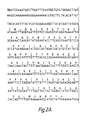
- the sequence of RMA-1 has been highly conserved between two isolates of P.falciparum and between P.falciparum and the murine malaria P.chabaudi.
- parasites were synchronized twice with sorbitol at an interval of 33 hours so that at the start of the experiment only ring-stage parasites 0-4 hours old were present. Aliquots of these synchronous parasite cultures were labelled for 30 mins with 60 ⁇ Ci/ml 35 S-methionine at 1,10,20,26,29,32, 35,38,41,44 and 48 hours after the second synchronization. After labelling, cells were washed twice in serum-free RPMI 1640 with 1.7mM cold methionine, and the pellets snap frozen. Duplicate cultures were harvested, washed three times in serum-free RPMI 1640 and smeared for subsequent immunofluorescence assay.
- pulse-chase labelling experiments were performed with parasites that had received two sorbitol treatments resulting in a 4-5 hour spread of maturation. These synchronous parasites wre labelled with 100 ⁇ Ci/ml 35 S-methionine for 15-45 minutes at 37°C. After the labelling period, the cells were harvested and an aliquot removed, washed twice in serum-free RPMI 1640 containing 1.7mM cold methinine and the cell pellet snap frozen. The remaining culture was washed twice in complete medium with 1.7mM cold methionine and incubated at 37 ° C in this same medium. Further aliquots were subsequently harvested, as described above, after various time intervals.
- Giemsa-stained smears were examined at each time point confirmed the stage of maturation of the parasites. Frozen cell pellets were extracted for 30 mins at 4 ° C in at least ten volumes of NaCI-EDTA-Tris buffer supplemented with Triton X-100 (T-NET) as described by Kessler (1975) containing a cocktail of protease inhibitors comprising 4mM phenylmethylsulphonyl fluoride (Sigma Chemical Co.), 5mM iodoacetamide (BDH), 1mM L-1-tosylamide-2-phenylethylch- loromethyl ketone (Sigma Chemical Co.), 1 mM N-a-p-tosyl-L-lysine chloromethyl ketone (Sigma Chemical Co.), 25 ⁇ g/ml leupeptin (hemisulphate salt) (Sigma Chemical Co.), 25 ⁇ g/ml antipain (dihydrochloride) (Sigma
- Insoluble material was removed by centrifugation at 10,000g for 10 mins at 4 ° C.
- the labelled extracts were precleared using formalin-fixed Staphylococcus aureus Cowan 1 strains (Commonwealth Serum Laboratories) and Sepharose 4B beads (Pharmacia) for 30 min at 4 ° C.
- Preclearing agents were removed by centrifugation for 5 min at 5,000g at 4 ° C.
- Specific antisera were added to aliquots of the labelled extracts and incubated at 4°C for 2-4 hours.
- Immune complexes were precipitated by the addition of Protein A-Sepharose 4B (Pharmacia).
- the beads were washed four times with T-NET containing protease inhibitors. Culture supernatants collected after labelling of parasites were centrifuged for 1 hour at 100,000g prior to immunoprecipitation.
- the construction and screening of the P.falciparum NF7 cDNA library in ⁇ gt11-Amp3 has been described previously (Stahl et.al. 1984).
- the P.falciparum partial Sau4AI genomic library in EMBL3 was made as follows: A partial Sau3AI digest of D10 genomic DNA was size fractionated (10-20 kb) on an agarose gel and ligated into BamHl digested, dephosphorylated XEMBL3. The resulting clones were screened with the NF7 cDNA clone, Ag352, using standard procedures (Maniatis et.al. 1982).
- the P.falciparum partial Sspl genomic library in ⁇ gt10 was made as follows: A partial Sspl digest of P.falciparum D10 genomic DNA was methylated with EcoRl methylase, ligated with EcoRl linkers and digested with EcoRl. Excess linkers were removed by size-fractionation on an agarose gel and the fragments were ligated into EcoRl digested, dephosphorylated ⁇ gt10. The resulting clones were screened with the NF7 cDNA clone, Ag352.
- the P.chabaudi adami DS sheared genomic library in ⁇ gt10 was made as follows: P.chabaudi adami DS genomic DNA was sheared through a 26 gauge needle, methylated with EcoRl methylase and ligated with EcoRl linkers. Excess linkers were removed and the fragments were size-fractionated (4-7 kb) on an agarose gel, then ligated into EcoRl digested, dephosphorylated ⁇ gt10. The resulting clones were screened with the NF7 cDNA clone, Ag352.
- Positively hybridizing clones were plaque purified through successive rounds of screening, XDNA prepared and the inserts isolated and subcloned using standard procedures (Maniatis et.al. 1982). DNA inserts were further subcloned into M13 vectors (Messing and Vieira, 1982) and sequenced using the chain termination method (Sanger et.al. 1977).
- the C-terminal 52 amino acids of RMA-1 were expressed in E.coli using the pGEX-2T plasmid vector described by Smith and Johnson (1988).
- the partially complementary oligonucleotides 5'GATCCGGAAAT-GCTGAAAAATATGATAAAATGGATGAACCACAAC and 5'TAATGTTGTGGTTCATCCATTTTATCATATTTT-TCAGCATTTCCG which encode the complementary strands of the 15 amino acids C-terminal to the transmembrane anchor region where annealed then ligated with a Fokl to EcoRl (linker) fragment (nucleotides 2083-2255, Fig. 1) from clone NF7, and BamHl and EcoRl digested pGEX-2T.
- the ligation was transformed into E.coli JPA101 and the correct recombinant selected. This clone is designated Ag352.24.
- a segment of RMA-1 consisting of the end filled HinPl to Rsal site nucleotides 366 to 1833 (from Fig.1) was inserted into the filled BamHl site of Ag352.24, transformed and selected as above. This clone is designated Ag352.2.
- the full length RMA-1 gene was removed as a BamHl/BgIII fragment (nucleotides 327-2247 in Fig.1) from a plC20H subclone (Marsh et.al., 1984) and was inserted into the unique BamHl site of the pAcRP23 (provided by Dr.R.Possee) baculovirus transfection vector behind the baculovirus polyhedrin gene promoter.
- the pAcRP23/Ag352 DNA was mixed with wild type baculovirus DNA and transfected into Sf9 insect cells. Plaques resulting from the transfection were screened microscopically and those lacking polyhedra were subjected to two further rounds of plaquing.
- Virus from recombinant plaques (designated baculovirus 352) was used to infect fresh cultures of Sf9 cells and production of Ag352 by infected cells examined by SDS-PAGE, Western blot and immunofluorescence.
- the FC27 genomic sequence extends the 1438 nucleotide NF7 cDNA sequence a further 514 nucleotides 3' and 809 nucleotides 5'.
- a single long open reading frame is present in the FC27 genomic sequence between nucleotides 333 to 2202 encoding a polypeptide of 622 residues with a predicted molecular weight of 71,929 daltons. Based on the subcellular localization results presented below, this polypeptide was termed rhoptry membrane antigen-1 (RMA-1).
- RMA-1 rhoptry membrane antigen-1
- FC27 genomic and the NF7 cDNA sequences are highly homologous with 9 nucleotide differences in 1438 nucleotides and 7 amino acid differences. Strikingly, only 1 nucleotide difference is silent and 5 of the amino acid differences result in charge changes. These data indicate strong selection, perhaps immunological, on the polypeptide sequence.
- RMA-1 polypeptide sequence has a number of striking features. Unlike most other blood stage antigens of P.falciparum, RMA-1 lacks repetitive sequences. The antigen has the primary structure expected for an integral membrane protein. It contains 2 hydrophobic stretches, one near the N-terminus, presumably part of a signal peptide, and a second located 55 amino acids from the C-terminus. This consists of 21 predominantly hydrophobic residues and lacks charged residues. It is preceded by a lysine residue and followed by the tripeptide Lys-Arg-Lys, consistent with this region being a membrane spanning domain.
- a P.chabaudi adami DS sheared genomic library in ⁇ gt10 was screened with the P.falciparum NF7 cDNA clone (described above) to identify the homologous gene in this species.
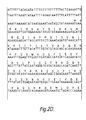
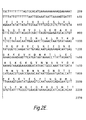
- the DNA sequence of the hybridizing region of a positive clone is shown in Figure 2.
- a single long open reading frame is present between nucleotides 556 and 2229 encoding a polypeptide of 558 amino acids with a predicted molecular weight of 63,901 daltons.
- RMA-1 partitions into Triton X-114.
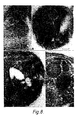
- RMA-1 is localized to the rhoptries and the merozoite surface.
- RMA-1 is present in all isolates of P.falciparum
- a previously identified rhoptry antigen, QF3 has polypeptide components of similar size to the two polypeptides recognized by anti-Ag352.24 antibodies.
- the monoclonal antibody 7H850 which recognizes QF3 (Schofield et.al. 1986; Bushell et.al. 1988), when used to probe an immunoblot of the 9 P.falciparum isolates also recognized polypeptides of -M, 80,000 and M, 62,000 that like the polypeptides recognized by anti-Ag352 antibodies were invariant in size among these isolates ( Figure 6b).
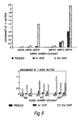
- RMA-1 is found in mature asexual blood-stages.
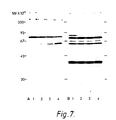
- the RMA-1, M r 80,000 polypeptide is rapidly processed to a M,62,000 form.
- RMA-1 and QF3 are in different regions of the rhoptry.
- RMA-1 Baculovirus expressed RMA-1 as a protein doublet of M, 84-87,000 with secondary bands of M, 67-77,000. The protein was recognized on immunoblots of baculovirus RMA-1 infected cells by rabbit antisera to RMA-1 and also by human antibodies. The protein was detectable as a minor band on Coomassie- stained gel (data not shown).
- RMA-1 appears to be located first in the rhoptry and then exported to the merozoite surface around the time of schizont rupture. Within the rhoptry RMA-1 appears to be particularly localized in the neck (or peduncle).
- One other rhoptry antigen, the M r 240,000 polypeptide described by Roger et.al.(1988) is also in this location but the other rhoptry antigens that have been studied using immunoelectronmicroscopy are located in the body of the rhoptry.
- RMA-1 located in the rhoptry neck
- M r 105,000 component of the high molecular weight rhoptry complex which is located in the body of the rhoptry (Culvenor et.al., 1986) lacks any structural or solubility characteristics of an integral membrane protein (H.Brown, unpublished results).
- integral membrane proteins are associated with lipid in the rhoptry neck.
- RMA-1 becomes associated with the mature merozoite surface after being released, possibly together with lipid, via the apical duct of the merozoite. Consistent with this, others have suggested that some release of rhoptry contents may occur at the time of schizont rupture (Bannister et.al., 1986). The presence of RMA-1 within rhoptries and then apparently associated with the merozoite surface provides strong support for RMA-1 as a potential vaccine component. RMA-1 is a natural immunogen which induces antibodies in individuals infected with P.falciparum.
Landscapes
- Health & Medical Sciences (AREA)
- Chemical & Material Sciences (AREA)
- Organic Chemistry (AREA)
- Life Sciences & Earth Sciences (AREA)
- Biophysics (AREA)
- Medicinal Chemistry (AREA)
- Zoology (AREA)
- Biochemistry (AREA)
- Toxicology (AREA)
- General Health & Medical Sciences (AREA)
- Genetics & Genomics (AREA)
- Gastroenterology & Hepatology (AREA)
- Molecular Biology (AREA)
- Proteomics, Peptides & Aminoacids (AREA)
- Tropical Medicine & Parasitology (AREA)
- Medicines Containing Antibodies Or Antigens For Use As Internal Diagnostic Agents (AREA)
- Peptides Or Proteins (AREA)
- Preparation Of Compounds By Using Micro-Organisms (AREA)
- Micro-Organisms Or Cultivation Processes Thereof (AREA)
Claims (12)
ou un fragment antigénique de celui-ci, capable d'induire une immunoréponse protectrice.


Applications Claiming Priority (3)
| Application Number | Priority Date | Filing Date | Title |
|---|---|---|---|
| AU6743/88 | 1988-02-12 | ||
| AUPI674388 | 1988-02-12 | ||
| PCT/AU1989/000056 WO1989007645A1 (fr) | 1988-02-12 | 1989-02-10 | Antigene de membrane de rhoptries du plasmodium falciparum |
Publications (3)
| Publication Number | Publication Date |
|---|---|
| EP0372019A1 EP0372019A1 (fr) | 1990-06-13 |
| EP0372019A4 EP0372019A4 (en) | 1990-09-12 |
| EP0372019B1 true EP0372019B1 (fr) | 1995-05-31 |
Family
ID=3772813
Family Applications (1)
| Application Number | Title | Priority Date | Filing Date |
|---|---|---|---|
| EP89902720A Expired - Lifetime EP0372019B1 (fr) | 1988-02-12 | 1989-02-10 | ANTIGENE DE MEMBRANE DE RHOPTRIES DU $i(PLASMODIUM FALCIPARUM) |
Country Status (11)
| Country | Link |
|---|---|
| EP (1) | EP0372019B1 (fr) |
| JP (1) | JPH02503149A (fr) |
| AT (1) | ATE123302T1 (fr) |
| CA (1) | CA1341115C (fr) |
| DE (1) | DE68922896T2 (fr) |
| GB (1) | GB2228936A (fr) |
| IL (1) | IL89266A (fr) |
| MY (1) | MY104081A (fr) |
| NZ (1) | NZ227943A (fr) |
| WO (1) | WO1989007645A1 (fr) |
| ZA (1) | ZA891071B (fr) |
Families Citing this family (4)
| Publication number | Priority date | Publication date | Assignee | Title |
|---|---|---|---|---|
| GB8905857D0 (en) * | 1989-03-14 | 1989-04-26 | Hoffmann La Roche | Plasmodium merozoite rhoptries antigen |
| CA2011031C (fr) * | 1989-03-14 | 2000-07-18 | Robert George Ridley | Antigene de rhoptries de merozoite de plasmodium et ses derives |
| JP2943106B1 (ja) | 1998-05-18 | 1999-08-30 | 株式会社東京機械製作所 | 走行ウエブの制振方法、制振装置及び紙継ぎ補助装置 |
| US7198791B2 (en) * | 2003-03-03 | 2007-04-03 | Pluschke, Gerd Et Al. | Compositions and methods for the generation of protective immune responses against malaria |
Family Cites Families (1)
| Publication number | Priority date | Publication date | Assignee | Title |
|---|---|---|---|---|
| AU569722B2 (en) * | 1983-01-28 | 1988-02-18 | Saramane Pty Ltd | Expression of plasmodium falciparum polypeptides from cloned cdna |
-
1989
- 1989-02-10 DE DE68922896T patent/DE68922896T2/de not_active Expired - Fee Related
- 1989-02-10 ZA ZA891071A patent/ZA891071B/xx unknown
- 1989-02-10 NZ NZ227943A patent/NZ227943A/xx unknown
- 1989-02-10 CA CA000590737A patent/CA1341115C/fr not_active Expired - Fee Related
- 1989-02-10 AT AT89902720T patent/ATE123302T1/de not_active IP Right Cessation
- 1989-02-10 GB GB8922665A patent/GB2228936A/en not_active Withdrawn
- 1989-02-10 EP EP89902720A patent/EP0372019B1/fr not_active Expired - Lifetime
- 1989-02-10 WO PCT/AU1989/000056 patent/WO1989007645A1/fr not_active Ceased
- 1989-02-10 JP JP1502517A patent/JPH02503149A/ja active Pending
- 1989-02-11 MY MYPI89000178A patent/MY104081A/en unknown
- 1989-02-12 IL IL8926689A patent/IL89266A/en not_active IP Right Cessation
Non-Patent Citations (1)
| Title |
|---|
| Am. J. Trop. Med. Hyg. (33)6: 1055-1059 (1984) Howard R. et al. * |
Also Published As
| Publication number | Publication date |
|---|---|
| GB8922665D0 (en) | 1990-06-13 |
| ATE123302T1 (de) | 1995-06-15 |
| IL89266A (en) | 1994-11-11 |
| WO1989007645A1 (fr) | 1989-08-24 |
| NZ227943A (en) | 1991-08-27 |
| DE68922896T2 (de) | 1995-11-16 |
| EP0372019A1 (fr) | 1990-06-13 |
| DE68922896D1 (de) | 1995-07-06 |
| CA1341115C (fr) | 2000-10-10 |
| ZA891071B (en) | 1990-04-25 |
| GB2228936A (en) | 1990-09-12 |
| EP0372019A4 (en) | 1990-09-12 |
| MY104081A (en) | 1993-11-30 |
| JPH02503149A (ja) | 1990-10-04 |
Similar Documents
| Publication | Publication Date | Title |
|---|---|---|
| Peterson et al. | Integral membrane protein located in the apical complex of Plasmodium falciparum | |
| Galinski et al. | Plasmodium vivax merozoite surface protein-3 contains coiled-coil motifs in an alanine-rich central domain | |
| Marshall et al. | A second merozoite surface protein (MSP-4) of Plasmodium falciparum that contains an epidermal growth factor-like domain | |
| Crewther et al. | Plasmodium falciparum: two antigens of similar size are located in different compartments of the rhoptry | |
| Duffy et al. | Pgs28 belongs to a family of epidermal growth factor-like antigens that are targets of malaria transmission-blocking antibodies. | |
| Williamson | Pfs230: from malaria transmission-blocking vaccine candidate toward function. | |
| US20110020387A1 (en) | Malaria vaccine | |
| Tian et al. | Comparison of protection induced by immunization with recombinant proteins from different regions of merozoite surface protein 1 of Plasmodium yoelii | |
| Jenkins et al. | cDNA encoding an immunogenic region of a 22 kilodalton surface protein of Eimeria acervulina sporozoites | |
| AU584881B2 (en) | Improvements in or relating to the production of malaria vaccines | |
| US4978621A (en) | Merozoite surface antigens | |
| EP0544781B1 (fr) | Nouveaux peptides et leur utilisation | |
| US5116755A (en) | Asexual blood stage antigens of plasmodium falciparum which encode a rhoptry protein | |
| CA1341115C (fr) | Antigene de membrane rhoptry de plasmodium falciparum | |
| US4835259A (en) | Merozoite surface glycoproteins | |
| Anders et al. | Candidate antigens for an asexual blood stage vaccine against falciparum malaria | |
| AU627448B2 (en) | Rhoptry membrane antigen of plasmodium falciparum | |
| US5393523A (en) | Plasmodium falciparum vaccine comprising a recombinant histidine-rich protein-HRP-II | |
| US5573943A (en) | Cloning and expression of a rhoptry associated protein of P. falciparum | |
| AU606042B2 (en) | Asexual blood stage antigens of plasmodium falciparum | |
| US5422428A (en) | Immunization against babesiosis using purified surface antigens of Babesia bigemina and similar immunogens | |
| US5008198A (en) | Merozoite surface glycoproteins | |
| DK175771B1 (da) | Rhoptrymembranantigen fra Plasmodium falciparum | |
| US5646247A (en) | Merozoite antigens localized at the apical end of the parasite | |
| WO1989005348A1 (fr) | Antigene toxonemique de plasmodium falciparum |
Legal Events
| Date | Code | Title | Description |
|---|---|---|---|
| PUAI | Public reference made under article 153(3) epc to a published international application that has entered the european phase |
Free format text: ORIGINAL CODE: 0009012 |
|
| 17P | Request for examination filed |
Effective date: 19891021 |
|
| AK | Designated contracting states |
Kind code of ref document: A1 Designated state(s): AT BE CH DE FR GB IT LI LU NL SE |
|
| A4 | Supplementary search report drawn up and despatched |
Effective date: 19900723 |
|
| AK | Designated contracting states |
Kind code of ref document: A4 Designated state(s): AT BE CH DE FR GB IT LI LU NL SE |
|
| 17Q | First examination report despatched |
Effective date: 19930727 |
|
| GRAA | (expected) grant |
Free format text: ORIGINAL CODE: 0009210 |
|
| AK | Designated contracting states |
Kind code of ref document: B1 Designated state(s): AT BE CH DE FR GB IT LI LU NL SE |
|
| REF | Corresponds to: |
Ref document number: 123302 Country of ref document: AT Date of ref document: 19950615 Kind code of ref document: T |
|
| REF | Corresponds to: |
Ref document number: 68922896 Country of ref document: DE Date of ref document: 19950706 |
|
| ITF | It: translation for a ep patent filed | ||
| ET | Fr: translation filed | ||
| PLBE | No opposition filed within time limit |
Free format text: ORIGINAL CODE: 0009261 |
|
| STAA | Information on the status of an ep patent application or granted ep patent |
Free format text: STATUS: NO OPPOSITION FILED WITHIN TIME LIMIT |
|
| 26N | No opposition filed | ||
| PGFP | Annual fee paid to national office [announced via postgrant information from national office to epo] |
Ref country code: AT Payment date: 20000217 Year of fee payment: 12 |
|
| PGFP | Annual fee paid to national office [announced via postgrant information from national office to epo] |
Ref country code: LU Payment date: 20000324 Year of fee payment: 12 |
|
| PG25 | Lapsed in a contracting state [announced via postgrant information from national office to epo] |
Ref country code: LU Free format text: LAPSE BECAUSE OF NON-PAYMENT OF DUE FEES Effective date: 20010210 Ref country code: AT Free format text: LAPSE BECAUSE OF NON-PAYMENT OF DUE FEES Effective date: 20010210 |
|
| REG | Reference to a national code |
Ref country code: GB Ref legal event code: IF02 |
|
| PGFP | Annual fee paid to national office [announced via postgrant information from national office to epo] |
Ref country code: FR Payment date: 20040210 Year of fee payment: 16 |
|
| PGFP | Annual fee paid to national office [announced via postgrant information from national office to epo] |
Ref country code: CH Payment date: 20040218 Year of fee payment: 16 |
|
| PGFP | Annual fee paid to national office [announced via postgrant information from national office to epo] |
Ref country code: DE Payment date: 20040219 Year of fee payment: 16 |
|
| PG25 | Lapsed in a contracting state [announced via postgrant information from national office to epo] |
Ref country code: IT Free format text: LAPSE BECAUSE OF NON-PAYMENT OF DUE FEES;WARNING: LAPSES OF ITALIAN PATENTS WITH EFFECTIVE DATE BEFORE 2007 MAY HAVE OCCURRED AT ANY TIME BEFORE 2007. THE CORRECT EFFECTIVE DATE MAY BE DIFFERENT FROM THE ONE RECORDED. Effective date: 20050210 |
|
| PGFP | Annual fee paid to national office [announced via postgrant information from national office to epo] |
Ref country code: GB Payment date: 20050216 Year of fee payment: 17 |
|
| PGFP | Annual fee paid to national office [announced via postgrant information from national office to epo] |
Ref country code: NL Payment date: 20050223 Year of fee payment: 17 |
|
| PG25 | Lapsed in a contracting state [announced via postgrant information from national office to epo] |
Ref country code: LI Free format text: LAPSE BECAUSE OF NON-PAYMENT OF DUE FEES Effective date: 20050228 Ref country code: CH Free format text: LAPSE BECAUSE OF NON-PAYMENT OF DUE FEES Effective date: 20050228 |
|
| PGFP | Annual fee paid to national office [announced via postgrant information from national office to epo] |
Ref country code: SE Payment date: 20050228 Year of fee payment: 17 |
|
| PGFP | Annual fee paid to national office [announced via postgrant information from national office to epo] |
Ref country code: BE Payment date: 20050408 Year of fee payment: 17 |
|
| PG25 | Lapsed in a contracting state [announced via postgrant information from national office to epo] |
Ref country code: DE Free format text: LAPSE BECAUSE OF NON-PAYMENT OF DUE FEES Effective date: 20050901 |
|
| REG | Reference to a national code |
Ref country code: CH Ref legal event code: PL |
|
| PG25 | Lapsed in a contracting state [announced via postgrant information from national office to epo] |
Ref country code: FR Free format text: LAPSE BECAUSE OF NON-PAYMENT OF DUE FEES Effective date: 20051031 |
|
| REG | Reference to a national code |
Ref country code: FR Ref legal event code: ST Effective date: 20051031 |
|
| PG25 | Lapsed in a contracting state [announced via postgrant information from national office to epo] |
Ref country code: GB Free format text: LAPSE BECAUSE OF NON-PAYMENT OF DUE FEES Effective date: 20060210 |
|
| PG25 | Lapsed in a contracting state [announced via postgrant information from national office to epo] |
Ref country code: SE Free format text: LAPSE BECAUSE OF NON-PAYMENT OF DUE FEES Effective date: 20060211 |
|
| PG25 | Lapsed in a contracting state [announced via postgrant information from national office to epo] |
Ref country code: BE Free format text: LAPSE BECAUSE OF NON-PAYMENT OF DUE FEES Effective date: 20060228 |
|
| PG25 | Lapsed in a contracting state [announced via postgrant information from national office to epo] |
Ref country code: NL Free format text: LAPSE BECAUSE OF NON-PAYMENT OF DUE FEES Effective date: 20060901 |
|
| EUG | Se: european patent has lapsed | ||
| GBPC | Gb: european patent ceased through non-payment of renewal fee |
Effective date: 20060210 |
|
| NLV4 | Nl: lapsed or anulled due to non-payment of the annual fee |
Effective date: 20060901 |
|
| BERE | Be: lapsed |
Owner name: *SARAMANE PTY. LTD Effective date: 20060228 |