EP0372608A1 - Verfahren und Einrichtung zur Bilddatenkompression mit einem neuronalen Netzwerk - Google Patents
Verfahren und Einrichtung zur Bilddatenkompression mit einem neuronalen Netzwerk Download PDFInfo
- Publication number
- EP0372608A1 EP0372608A1 EP89202941A EP89202941A EP0372608A1 EP 0372608 A1 EP0372608 A1 EP 0372608A1 EP 89202941 A EP89202941 A EP 89202941A EP 89202941 A EP89202941 A EP 89202941A EP 0372608 A1 EP0372608 A1 EP 0372608A1
- Authority
- EP
- European Patent Office
- Prior art keywords
- neural network
- attractors
- dictionary
- attractor
- image
- Prior art date
- Legal status (The legal status is an assumption and is not a legal conclusion. Google has not performed a legal analysis and makes no representation as to the accuracy of the status listed.)
- Withdrawn
Links
Images

Classifications
-
- G—PHYSICS
- G06—COMPUTING OR CALCULATING; COUNTING
- G06N—COMPUTING ARRANGEMENTS BASED ON SPECIFIC COMPUTATIONAL MODELS
- G06N3/00—Computing arrangements based on biological models
- G06N3/02—Neural networks
- G06N3/04—Architecture, e.g. interconnection topology
-
- G—PHYSICS
- G06—COMPUTING OR CALCULATING; COUNTING
- G06F—ELECTRIC DIGITAL DATA PROCESSING
- G06F18/00—Pattern recognition
- G06F18/20—Analysing
- G06F18/24—Classification techniques
- G06F18/241—Classification techniques relating to the classification model, e.g. parametric or non-parametric approaches
- G06F18/2413—Classification techniques relating to the classification model, e.g. parametric or non-parametric approaches based on distances to training or reference patterns
- G06F18/24133—Distances to prototypes
- G06F18/24137—Distances to cluster centroïds
-
- G—PHYSICS
- G06—COMPUTING OR CALCULATING; COUNTING
- G06N—COMPUTING ARRANGEMENTS BASED ON SPECIFIC COMPUTATIONAL MODELS
- G06N3/00—Computing arrangements based on biological models
- G06N3/02—Neural networks
- G06N3/04—Architecture, e.g. interconnection topology
- G06N3/0495—Quantised networks; Sparse networks; Compressed networks
-
- G—PHYSICS
- G06—COMPUTING OR CALCULATING; COUNTING
- G06N—COMPUTING ARRANGEMENTS BASED ON SPECIFIC COMPUTATIONAL MODELS
- G06N3/00—Computing arrangements based on biological models
- G06N3/02—Neural networks
- G06N3/08—Learning methods
- G06N3/082—Learning methods modifying the architecture, e.g. adding, deleting or silencing nodes or connections
-
- G—PHYSICS
- G06—COMPUTING OR CALCULATING; COUNTING
- G06T—IMAGE DATA PROCESSING OR GENERATION, IN GENERAL
- G06T9/00—Image coding
- G06T9/002—Image coding using neural networks
-
- H—ELECTRICITY
- H03—ELECTRONIC CIRCUITRY
- H03M—CODING; DECODING; CODE CONVERSION IN GENERAL
- H03M7/00—Conversion of a code where information is represented by a given sequence or number of digits to a code where the same, similar or subset of information is represented by a different sequence or number of digits
- H03M7/30—Compression; Expansion; Suppression of unnecessary data, e.g. redundancy reduction
- H03M7/3082—Vector coding
-
- H—ELECTRICITY
- H04—ELECTRIC COMMUNICATION TECHNIQUE
- H04N—PICTORIAL COMMUNICATION, e.g. TELEVISION
- H04N19/00—Methods or arrangements for coding, decoding, compressing or decompressing digital video signals
- H04N19/90—Methods or arrangements for coding, decoding, compressing or decompressing digital video signals using coding techniques not provided for in groups H04N19/10-H04N19/85, e.g. fractals
- H04N19/94—Vector quantisation
-
- H—ELECTRICITY
- H04—ELECTRIC COMMUNICATION TECHNIQUE
- H04N—PICTORIAL COMMUNICATION, e.g. TELEVISION
- H04N7/00—Television systems
- H04N7/24—Systems for the transmission of television signals using pulse code modulation
Definitions
- the invention relates to a method and a device for compressing image data by vector quantization according to a pre-coding by blocks formed of several picture elements, then comparison by a neural network of the pre-coded blocks with words of reference stored in the form of a dictionary in the neural network in order to transmit to a receiver selected indexes corresponding to the indexes of the reference words closest to the precoded blocks.
- the invention also relates to a structure for compressing image data using several of these devices.
- Such a data compression device is known from the document "Building a hierarchy with neural networks: an example - image vector quantization " LD JACKEL, RE HOWARD, JS DENKER, W. HUBBARD and SA SOLLA. Applied Optics vol 26 no 23 December 1987 page 5081.
- This document describes the use of a neural network which performs the coding of image data by vector quantization. It concerns high definition television images in order to carry out their digital transmission in real time. Given the limitation of the transmission channels, it is necessary to perform data compression. For this, an image is pre-coded in blocks each formed from several image elements (pixel in English). To limit the amount of data to be transmitted, each block is compared to a list of reference words (relating to reference blocks) placed in a dictionary (Codebook in English) and on a criterion of similarity, a word is selected. reference dictionary most the block to be coded and only its index is transmitted, thus making it possible to find it in the list of the same dictionary placed at the reception.
- this recognition operation is carried out using a neural network in order to be able to operate at the rate necessary for coding a video image.
- This document implements a fixed dictionary which is pre-established. It therefore cannot adapt to multiple image configurations.
- the problem posed is to improve the quality of the dictionary in order to be able to effectively code almost all of the image configurations to be processed, and to ensure a high intrinsic quality of image reproduction.
- This process can be implemented using a programmed computer.
- a structure for compressing image data which comprises two image compression devices in order to process television type images in real time, the structure further comprising an image sequence counter which during a given sequence puts one of the devices in the phase of generation of the adaptive dictionary, while the other device is put in the phase of coding of the global image, then vice versa during the following sequence.
- a neural network is a set of elementary automata which determine the state V i at time t + 1 of an output neuron i from the states V j , at time t, of the input neurons j which are connected to it according to synapses by synaptic coefficients C ij such that: where F is a nonlinear function.
- the cited prior art document only implements resolution steps which consist in determining the states V i of all the output neurons according to the preceding expression.
- the invention also implements learning steps which consist in adapting the synaptic coefficients C ij to the coding to be performed.
- the neural network is put into a relaxation dynamic so that it converges towards stable configurations of neuron states. For this, it is locked in on itself, its exit neurons becoming its entry neurons.
- the neural network automatically converges to stable configurations.
- Some are chosen as prototypes used during the generation of the dictionary. Initially, the prototypes (input data) are prescribed by determining the appropriate synaptic coefficients.
- the neural network is then presented with test vectors which are blocks randomly selected throughout the image to be coded. When a test vector (input neuron states) is presented to the neural network, it evolves towards a stable state which takes the name of attractor (output neuron states).
- metastable induced in the invention.
- induced refers to the mechanism of generation of secondary attractors arising from prescription of prototypes.
- attractors can understand induced metastable states on which the neural network stabilizes.
- a first aspect to analyze concerns this distance. For this when all the test vectors have been used, an overall average of all the distances is carried out. When the overall average is less than a predetermined value, the attractors are satisfactory and can be used as reference words from the dictionary.
- the attractors are not satisfactory and it is necessary to carry out again at least one complete cycle of the process.
- the selected attractors which have essentially been optimized are reintroduced at the start of a subsequent cycle of the process as prescribed prototypes.
- the neural network using a learning phase, determines each time the corresponding synaptic coefficients. The process can thus repeating itself over several cycles until the overall average of the distances is less than a predetermined value indicating that the final attractors obtained are satisfactory.
- the entire population of final attractors, which is thus stored in the neural network at the end of this learning phase, then constitutes the reference words of the dictionary which is used by an indexing circuit to process the whole picture.
- the same neural network is thus used first to generate and then to use the adaptive dictionary.
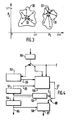
- FIG. 1a represents an image 10 in which a block 11 is isolated, itself formed of several image elements such as P1, P2, P3. For the pre-coding of the image, the entire image is thus cut out according to such blocks.
- the luminance levels of the picture elements will be coded for example on 8 bits, ie 256 levels. These can be represented according to a thermometric coding indicated in FIG. 1B, that is to say that in a graduation from 1 to 256 the level to be coded will be represented by 1 until the value of these levels then by the opposite value (for example -1 or 0 depending on the precoding used) above this value.
- a block is coded by forming a vector consisting of the coding of all the picture elements which compose it. Test vectors, prototypes and neuron states are coded according to this representation.
- FIG. 2 represents a diagram of the essential organs of a neural network 50. It includes a memory of synaptic coefficients 20 which delivers its data to a computing organ 21 which receives states of input neurons stored in a memory of states 22.
- the calculating member 21 performs the calculations of equation 1 by determining the states of output neurons V i (t + 1). The output states thus determined are reintroduced as input when the neural network is in the resolution phase with the test vectors to operate according to a relaxation dynamic during which the neural network stabilizes on determined output states called attractors ( control signal CR1).
- control signal CR1 determines the states of output of the computing member 21 without the application of the function.
- nonlinear F in learning means 23 for example a host computer. This determines new synaptic coefficients C ij by correcting them according to a known learning algorithm.
- Such an algorithm is for example the minimal recovery algorithm described in the document "Learning algorithms with optimal stability in neural networks” W. KRAUTH and M. MEZARD J. Phys. A: Math. Gen. 20 (1987) page 745.
- a selector 24 makes it possible to load the memory 22 either with the prescribed prototypes (connection 25) during the learning phase, or by the test vectors (connection 26).
- the control signal CR1 makes it possible to put the neural network in a dynamic of relaxation by looping it on itself.
- the control signal C makes it possible to select either the mode of generation of the dictionary or the mode of using the dictionary to code the global image whose data enter via the connection 29.
- FIG. 3 is a very simplified representation of two clouds 30, 31 of test vectors around respectively two attractors 32, 33 in a simple example with two picture elements, which allows a representation in a plane.
- the cloud is characterized by its number of test vectors (therefore the rate of frequentation of the attractor) and by the distance which separates each test vector from its attractor.
- the overall average distance is determined. There are two cases: - when this distance is less than a predetermined value the population of attractors is satisfactory and can be used to generate the adaptive dictionary. - when this distance is greater than a predetermined value the population of attractors is not satisfactory and a process cycle must be started again by modifying the batch of prescribed prototypes.
- the repositioner is repositioned by calculating the center of gravity of the cloud which becomes the optimal attractor.
- a limited number of prescribed prototypes are introduced as input, which are chosen for their attendance rate from among the optimal attractors corrected possibly after refocusing which can themselves be derived from either prototypes prescribed in the previous cycle. either of induced metastable states.
- FIG. 4 shows an image data compression device according to the invention. It includes the neural network 50 described above combined with a memory of prototypes 51 and a memory of test vectors 52 which also performs the selection of test vectors from the image.
- the states of output neurons V i enter an adaptation circuit 53 which supplies all the attractors to the memory of attractors 54.
- the prototype memory 51 receives the attractors which have been selected to constitute the new prototypes .
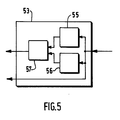
- the adaptation circuit 53 shown in FIG. 5 includes: - a counter 55 for determining the attendance rates, - a calculation means 56 for averaging all the distances and calculating the centers of gravity of clouds, - a comparator 57 to compare: . attendance rates at a predetermined rate, . the overall average to a predetermined value.
- the images are organized in blocks of several image elements coded in luminance levels, for example in thermometric notation by a pre-coder 59 (FIG. 4).
- the attractors are read from the memory of attractors 54 and introduced into an indexing circuit 58 which determines the indexes of the image coded by the neural network 50 switched to the indexing circuit 58 using the switch 80
- the indexes are transmitted (connection 87) to the receiver which also receives (connection 86) from time to time an update of the adaptive dictionary.
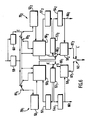
- FIG. 6 represents a diagram of an image data compression structure according to the invention for encoding television type images in real time. It comprises two devices 701, 702 as described in FIG. 4, each having: . a neuron circuit 501, 502 . a prototype memory 511, 512 . a memory for test vectors 521, 522 . a memory of attractors 541, 542 . an adaptation circuit 531 532 . an indexing circuit 581, 582
- the two devices operate simultaneously, one to generate an adaptive dictionary and the other to use the dictionary generated during the previous sequence.
- an image sequence counter 60 generates a control signal C which operates alternately on one or the other circuit (switches 801, 802, 811, 812, 82).
- a device successively performs phases learning and adaptation.
- the other device performs successive resolution phases using the dictionary generated in the previous sequence.
- the process reverses to the next sequence.
- the indexes are transmitted by the connections 871, 872 and the updates of the dictionaries are carried out by the connections 861, 862.
Landscapes
- Engineering & Computer Science (AREA)
- Theoretical Computer Science (AREA)
- Physics & Mathematics (AREA)
- Data Mining & Analysis (AREA)
- Artificial Intelligence (AREA)
- General Physics & Mathematics (AREA)
- Evolutionary Computation (AREA)
- General Engineering & Computer Science (AREA)
- Life Sciences & Earth Sciences (AREA)
- Multimedia (AREA)
- Molecular Biology (AREA)
- General Health & Medical Sciences (AREA)
- Signal Processing (AREA)
- Health & Medical Sciences (AREA)
- Biomedical Technology (AREA)
- Biophysics (AREA)
- Computational Linguistics (AREA)
- Software Systems (AREA)
- Mathematical Physics (AREA)
- Computing Systems (AREA)
- Bioinformatics & Computational Biology (AREA)
- Evolutionary Biology (AREA)
- Bioinformatics & Cheminformatics (AREA)
- Computer Vision & Pattern Recognition (AREA)
- Image Processing (AREA)
- Compression Or Coding Systems Of Tv Signals (AREA)
Applications Claiming Priority (2)
| Application Number | Priority Date | Filing Date | Title |
|---|---|---|---|
| FR8815427 | 1988-11-25 | ||
| FR8815427A FR2639739B1 (fr) | 1988-11-25 | 1988-11-25 | Procede et dispositif de compression de donnees d'image utilisant un reseau de neurones |
Publications (1)
| Publication Number | Publication Date |
|---|---|
| EP0372608A1 true EP0372608A1 (de) | 1990-06-13 |
Family
ID=9372258
Family Applications (1)
| Application Number | Title | Priority Date | Filing Date |
|---|---|---|---|
| EP89202941A Withdrawn EP0372608A1 (de) | 1988-11-25 | 1989-11-20 | Verfahren und Einrichtung zur Bilddatenkompression mit einem neuronalen Netzwerk |
Country Status (4)
| Country | Link |
|---|---|
| US (1) | US5005206A (de) |
| EP (1) | EP0372608A1 (de) |
| JP (1) | JPH02244887A (de) |
| FR (1) | FR2639739B1 (de) |
Cited By (2)
| Publication number | Priority date | Publication date | Assignee | Title |
|---|---|---|---|---|
| FR2655450A1 (fr) * | 1989-12-06 | 1991-06-07 | Thomson Csf | Procede de compression d'images par auto-organisation d'un reseau neuronal. |
| EP0490606A3 (en) * | 1990-12-08 | 1992-08-05 | Dowty Communications Limited | An adaptive data compression system |
Families Citing this family (25)
| Publication number | Priority date | Publication date | Assignee | Title |
|---|---|---|---|---|
| US5293459A (en) * | 1988-12-23 | 1994-03-08 | U.S. Philips Corporation | Neural integrated circuit comprising learning means |
| DE69123991T2 (de) * | 1990-03-23 | 1997-05-22 | Canon Kk | Bildverarbeitung mit neuronalem Netzwerk |
| US5161014A (en) * | 1990-11-26 | 1992-11-03 | Rca Thomson Licensing Corporation | Neural networks as for video signal processing |
| US5259064A (en) * | 1991-01-25 | 1993-11-02 | Ricoh Company, Ltd. | Signal processing apparatus having at least one neural network having pulse density signals as inputs and outputs |
| JP3119371B2 (ja) * | 1991-03-29 | 2000-12-18 | キヤノン株式会社 | 画像処理方法 |
| US5105468A (en) * | 1991-04-03 | 1992-04-14 | At&T Bell Laboratories | Time delay neural network for printed and cursive handwritten character recognition |
| FR2685109A1 (fr) * | 1991-12-11 | 1993-06-18 | Philips Electronique Lab | Processeur numerique neuronal operant avec une approximation d'une fonction d'activation non lineaire. |
| FR2687814A1 (fr) * | 1992-02-26 | 1993-08-27 | Philips Electronique Lab | Processeur neuronal a cellules synaptiques reparties. |
| US5337085A (en) * | 1992-04-10 | 1994-08-09 | Comsat Corporation | Coding technique for high definition television signals |
| FR2695743A1 (fr) * | 1992-09-16 | 1994-03-18 | Philips Electronique Lab | Système de traitement d'images texturées, analyseur de textures et synthétiseur de textures. |
| DE4239506A1 (de) * | 1992-11-25 | 1994-05-26 | Inst Rundfunktechnik Gmbh | Verfahren zur bitratenreduzierenden Quellcodierung für die Übertragung und Speicherung von digitalen Tonsignalen |
| US5376963A (en) * | 1993-03-31 | 1994-12-27 | Panasonic Technologies, Inc. | Neural network video image processor |
| EP0636991A3 (de) * | 1993-07-29 | 1997-01-08 | Matsushita Electric Industrial Co Ltd | Informationsverarbeitungsgerät zur Durchführung eines neuronalen Netzwerkes. |
| US7251637B1 (en) | 1993-09-20 | 2007-07-31 | Fair Isaac Corporation | Context vector generation and retrieval |
| US6173275B1 (en) * | 1993-09-20 | 2001-01-09 | Hnc Software, Inc. | Representation and retrieval of images using context vectors derived from image information elements |
| KR0139154B1 (ko) * | 1994-07-08 | 1998-06-15 | 김광호 | 신경망을 이용한 부호화방법 및 그 장치 |
| US5812700A (en) * | 1994-09-26 | 1998-09-22 | California Institute Of Technology | Data compression neural network with winner-take-all function |
| US6049793A (en) * | 1996-11-15 | 2000-04-11 | Tomita; Kenichi | System for building an artificial neural network |
| US5781128A (en) * | 1997-02-18 | 1998-07-14 | Rockwell International Corporation | Data compression system and method |
| US6798914B1 (en) | 1999-05-07 | 2004-09-28 | Galaxy Ip Source, Llc | Neural-network-based method of image compression |
| US6912250B1 (en) | 1999-11-12 | 2005-06-28 | Cornell Research Foundation Inc. | System and methods for precursor cancellation of intersymbol interference in a receiver |
| US6578020B1 (en) * | 1999-12-07 | 2003-06-10 | International Business Machines Corporation | Method and system for converting code to executable code using neural networks implemented in a very large scale integration (VLSI) integrated circuit |
| GB2362055A (en) * | 2000-05-03 | 2001-11-07 | Clearstream Tech Ltd | Image compression using a codebook |
| NZ515527A (en) * | 2001-11-15 | 2003-08-29 | Auckland Uniservices Ltd | Method, apparatus and software for lossy data compression and function estimation |
| US7689005B2 (en) * | 2004-03-10 | 2010-03-30 | Yingbin Wang | Apparatus and method for biometric database management system |
Citations (1)
| Publication number | Priority date | Publication date | Assignee | Title |
|---|---|---|---|---|
| EP0037164A2 (de) * | 1980-03-27 | 1981-10-07 | Nestor, Inc. | Selbstorganisierender Trenner und Identifizierer von allgemeinen Formklassen |
Family Cites Families (3)
| Publication number | Priority date | Publication date | Assignee | Title |
|---|---|---|---|---|
| US4764973A (en) * | 1986-05-28 | 1988-08-16 | The United States Of America As Represented By The Secretary Of The Air Force | Whole word, phrase or number reading |
| US4773024A (en) * | 1986-06-03 | 1988-09-20 | Synaptics, Inc. | Brain emulation circuit with reduced confusion |
| US4884216A (en) * | 1987-11-09 | 1989-11-28 | Michael Kuperstein | Neural network system for adaptive sensory-motor coordination of multijoint robots for single postures |
-
1988
- 1988-11-25 FR FR8815427A patent/FR2639739B1/fr not_active Expired - Lifetime
-
1989
- 1989-11-20 US US07/439,725 patent/US5005206A/en not_active Expired - Fee Related
- 1989-11-20 EP EP89202941A patent/EP0372608A1/de not_active Withdrawn
- 1989-11-22 JP JP1302262A patent/JPH02244887A/ja active Pending
Patent Citations (1)
| Publication number | Priority date | Publication date | Assignee | Title |
|---|---|---|---|---|
| EP0037164A2 (de) * | 1980-03-27 | 1981-10-07 | Nestor, Inc. | Selbstorganisierender Trenner und Identifizierer von allgemeinen Formklassen |
Non-Patent Citations (3)
| Title |
|---|
| APPLIED OPTICS, vol. 26, no. 23, 1 décembre 1987, pages 5081-5084, Optical Society of America, New York, US; L.D. JACKEL et al.: "Building a hierarchy with neural networks: an example - image vector quantization" * |
| ICASSP'85 PROCEEDINGS, Tampa, Florida, 26-29 mars 1985, vol. 1, pages 339-342, IEEE, New York, US; H.F. SUN et al.: "Adaptive vector quantization for image sequence coding" * |
| NEURAL NETWORKS, no. 1, supplément 1, 1988, page 399; J.J. PAULOS et al.: "A VLSI architecture for feedforward networks with integral back-propagation" * |
Cited By (3)
| Publication number | Priority date | Publication date | Assignee | Title |
|---|---|---|---|---|
| FR2655450A1 (fr) * | 1989-12-06 | 1991-06-07 | Thomson Csf | Procede de compression d'images par auto-organisation d'un reseau neuronal. |
| WO1991008546A1 (fr) * | 1989-12-06 | 1991-06-13 | Thomson-Csf | Procede de compression d'images par auto-organisation d'un reseau neuronal |
| EP0490606A3 (en) * | 1990-12-08 | 1992-08-05 | Dowty Communications Limited | An adaptive data compression system |
Also Published As
| Publication number | Publication date |
|---|---|
| FR2639739B1 (fr) | 1991-03-15 |
| US5005206A (en) | 1991-04-02 |
| FR2639739A1 (fr) | 1990-06-01 |
| JPH02244887A (ja) | 1990-09-28 |
Similar Documents
| Publication | Publication Date | Title |
|---|---|---|
| EP0372608A1 (de) | Verfahren und Einrichtung zur Bilddatenkompression mit einem neuronalen Netzwerk | |
| US10452977B2 (en) | Neural network method and apparatus | |
| CN112565777B (zh) | 基于深度学习模型视频数据传输方法、系统、介质及设备 | |
| FR2575351A1 (fr) | Procede adaptatif de codage et de decodage d'une suite d'images par transformation, et dispositifs pour la mise en oeuvre de ce procede | |
| WO2022207573A1 (fr) | Autoencodeur multimodal a fusion de donnees latente amelioree | |
| US20220207353A1 (en) | Methods and systems for generating recommendations for counterfactual explanations of computer alerts that are automatically detected by a machine learning algorithm | |
| EP0125168A1 (de) | Multiplexer, Demultiplexer und Multiplexier-Demultiplexier-Einrichtung mit umstellbaren Rahmen | |
| EP0372613A1 (de) | Verfahren zur Rückführung von Fehlern und neuronale Netzstruktur | |
| EP4006786A1 (de) | Methode zum trainieren eines neuronalen netzes, um es durch widersprüchliche beispiele robust gegen angriffe zu machen | |
| FR3134363A1 (fr) | Procédé de prédiction de trajectoires de piétons pour le renforcement de la sécurité de la conduite autonome d’un véhicule, véhicule muni de moyens pour la mise en œuvre de ce procédé | |
| EP0276603B1 (de) | Kodierungs- und Übertragungsverfahren eines digitalen Signals durch zeitlich selektive Auffrischung eines vektoriellen Quantifizierers | |
| EP0449353A1 (de) | Datenverarbeitungsgerät und Verfahren um in einem Wörterbuch enthaltene Datenwörter auszuwählen | |
| WO2025082022A1 (zh) | 深度图补全方法、装置、计算机设备及存储介质 | |
| EP0365405B1 (de) | Verfahren zur Kodierung, geeignet zur Erkennung von Synchronisations-Worten in einer Folge von kodierten Worten, die mittels eines Kodes mit variabler Länge kodiert sind | |
| EP0456804B1 (de) | Bildkompressionsverfahren durch autoorganisation von einem neuronalen netz | |
| CN114756425B (zh) | 智能监控方法、装置、电子设备及计算机可读存储介质 | |
| EP0396171A1 (de) | Verfahren zur Texturanalyse und Analysator | |
| EP0348321B1 (de) | Verfahren zur Regelung von Hilfsdatenraten für die Rekonstruktion unterabgetasteter, elektronischer Bilder | |
| Hassani et al. | Chameleons Do Not Forget: Prompt–Based Online Continual Learning for Next Activity Prediction | |
| KR102616081B1 (ko) | 깊이 맵의 특징점을 획득하기 위한 방법 | |
| JP2025534033A (ja) | データ生成のためのボソンサンプラおよびニューラルネットワーク | |
| FR2655444A1 (fr) | Reseau neuronal a circuits neuronaux electroniques a apprentissage de coefficients, et procede d'apprentissage. | |
| CN121502099A (zh) | 一种残差向量量化的多模态推荐语义令牌建模方法 | |
| WO2025088034A1 (en) | Method and data processing system for lossy image or video encoding, transmission and decoding | |
| FR3167473A1 (fr) | Procédé et dispositif de codage et de décodage audio |
Legal Events
| Date | Code | Title | Description |
|---|---|---|---|
| PUAI | Public reference made under article 153(3) epc to a published international application that has entered the european phase |
Free format text: ORIGINAL CODE: 0009012 |
|
| AK | Designated contracting states |
Kind code of ref document: A1 Designated state(s): DE FR GB SE |
|
| 17P | Request for examination filed |
Effective date: 19901211 |
|
| STAA | Information on the status of an ep patent application or granted ep patent |
Free format text: STATUS: THE APPLICATION IS DEEMED TO BE WITHDRAWN |
|
| 18D | Application deemed to be withdrawn |
Effective date: 19930602 |