EP0373345B1 - Eine von einem Laser unterstützte Heizstange zum Mehrfachverbinden von Leitern - Google Patents
Eine von einem Laser unterstützte Heizstange zum Mehrfachverbinden von Leitern Download PDFInfo
- Publication number
- EP0373345B1 EP0373345B1 EP89120348A EP89120348A EP0373345B1 EP 0373345 B1 EP0373345 B1 EP 0373345B1 EP 89120348 A EP89120348 A EP 89120348A EP 89120348 A EP89120348 A EP 89120348A EP 0373345 B1 EP0373345 B1 EP 0373345B1
- Authority
- EP
- European Patent Office
- Prior art keywords
- cavity
- heater
- comprised
- radiation
- bar
- Prior art date
- Legal status (The legal status is an assumption and is not a legal conclusion. Google has not performed a legal analysis and makes no representation as to the accuracy of the status listed.)
- Expired - Lifetime
Links
Images


Classifications
-
- B—PERFORMING OPERATIONS; TRANSPORTING
- B23—MACHINE TOOLS; METAL-WORKING NOT OTHERWISE PROVIDED FOR
- B23K—SOLDERING OR UNSOLDERING; WELDING; CLADDING OR PLATING BY SOLDERING OR WELDING; CUTTING BY APPLYING HEAT LOCALLY, e.g. FLAME CUTTING; WORKING BY LASER BEAM
- B23K26/00—Working by laser beam, e.g. welding, cutting or boring
- B23K26/02—Positioning or observing the workpiece, e.g. with respect to the point of impact; Aligning, aiming or focusing the laser beam
- B23K26/06—Shaping the laser beam, e.g. by masks or multi-focusing
- B23K26/064—Shaping the laser beam, e.g. by masks or multi-focusing by means of optical elements, e.g. lenses, mirrors or prisms
- B23K26/0643—Shaping the laser beam, e.g. by masks or multi-focusing by means of optical elements, e.g. lenses, mirrors or prisms comprising mirrors
-
- B—PERFORMING OPERATIONS; TRANSPORTING
- B23—MACHINE TOOLS; METAL-WORKING NOT OTHERWISE PROVIDED FOR
- B23K—SOLDERING OR UNSOLDERING; WELDING; CLADDING OR PLATING BY SOLDERING OR WELDING; CUTTING BY APPLYING HEAT LOCALLY, e.g. FLAME CUTTING; WORKING BY LASER BEAM
- B23K1/00—Soldering, e.g. brazing, or unsoldering
- B23K1/005—Soldering by means of radiant energy
- B23K1/0056—Soldering by means of radiant energy soldering by means of beams, e.g. lasers, electron beams [EB]
-
- B—PERFORMING OPERATIONS; TRANSPORTING
- B23—MACHINE TOOLS; METAL-WORKING NOT OTHERWISE PROVIDED FOR
- B23K—SOLDERING OR UNSOLDERING; WELDING; CLADDING OR PLATING BY SOLDERING OR WELDING; CUTTING BY APPLYING HEAT LOCALLY, e.g. FLAME CUTTING; WORKING BY LASER BEAM
- B23K26/00—Working by laser beam, e.g. welding, cutting or boring
- B23K26/02—Positioning or observing the workpiece, e.g. with respect to the point of impact; Aligning, aiming or focusing the laser beam
- B23K26/06—Shaping the laser beam, e.g. by masks or multi-focusing
-
- B—PERFORMING OPERATIONS; TRANSPORTING
- B23—MACHINE TOOLS; METAL-WORKING NOT OTHERWISE PROVIDED FOR
- B23K—SOLDERING OR UNSOLDERING; WELDING; CLADDING OR PLATING BY SOLDERING OR WELDING; CUTTING BY APPLYING HEAT LOCALLY, e.g. FLAME CUTTING; WORKING BY LASER BEAM
- B23K26/00—Working by laser beam, e.g. welding, cutting or boring
- B23K26/02—Positioning or observing the workpiece, e.g. with respect to the point of impact; Aligning, aiming or focusing the laser beam
- B23K26/06—Shaping the laser beam, e.g. by masks or multi-focusing
- B23K26/064—Shaping the laser beam, e.g. by masks or multi-focusing by means of optical elements, e.g. lenses, mirrors or prisms
-
- H—ELECTRICITY
- H05—ELECTRIC TECHNIQUES NOT OTHERWISE PROVIDED FOR
- H05K—PRINTED CIRCUITS; CASINGS OR CONSTRUCTIONAL DETAILS OF ELECTRIC APPARATUS; MANUFACTURE OF ASSEMBLAGES OF ELECTRICAL COMPONENTS
- H05K3/00—Apparatus or processes for manufacturing printed circuits
- H05K3/30—Assembling printed circuits with electric components, e.g. with resistors
- H05K3/32—Assembling printed circuits with electric components, e.g. with resistors electrically connecting electric components or wires to printed circuits
- H05K3/34—Assembling printed circuits with electric components, e.g. with resistors electrically connecting electric components or wires to printed circuits by soldering
- H05K3/341—Surface mounted components
- H05K3/3421—Leaded components
-
- H—ELECTRICITY
- H05—ELECTRIC TECHNIQUES NOT OTHERWISE PROVIDED FOR
- H05K—PRINTED CIRCUITS; CASINGS OR CONSTRUCTIONAL DETAILS OF ELECTRIC APPARATUS; MANUFACTURE OF ASSEMBLAGES OF ELECTRICAL COMPONENTS
- H05K3/00—Apparatus or processes for manufacturing printed circuits
- H05K3/30—Assembling printed circuits with electric components, e.g. with resistors
- H05K3/32—Assembling printed circuits with electric components, e.g. with resistors electrically connecting electric components or wires to printed circuits
- H05K3/34—Assembling printed circuits with electric components, e.g. with resistors electrically connecting electric components or wires to printed circuits by soldering
- H05K3/3494—Heating processes for reflow soldering
Definitions
- This invention relates to a heater apparatus and to a method of simultaneously soldering a plurality of leads each to an associated electrical terminal.
- Some conventional electronic lead attachment apparatus employ a laser beam to deliver a high energy pulse to a lead which is to be attached.
- the lead is thereby bonded to a metallic terminal, such as a bonding pad, by the melting and subsequent freezing of eutectic solder material.
- a soldering operation wherein where either the solder is heated directly or a lead is heated to melt the solder, is that only a relatively small portion of the laser energy is utilized for heating while a significant portion of the energy is reflected or scattered.
- the reflected laser radiation may pose a safety hazard to personnel in the immediate vicinity. Wavelength optimization of the laser beam to maximize absorption has been found to reduce but not eliminate the energy losses.
- Another problem which is encountered with conventional laser soldering methodology is related to the sequential nature of the process and the significant amount of time required to solder all of the leads of an electronic device.
- modern electronic components may have one hundred or more leads, and a typical assemblage of such components may comprise some arbitrarily large number of components, a significant amount of time and cost is required to attach all of the leads to bonding pads.
- Related to this problem is the necessary repositioning of either the laser beam or the leads between soldering operations. That is, each lead is individually exposed to the laser beam by either an x-y positioning of the component or by optically scanning the beam over stationary leads. In both cases, the maximum rate of lead attachment has been found to be only approximately 10 leads per second.
- soldering apparatus such as electrically heated tools may deliver too much heat to a localized area of a component or a printed circuit board, resulting in failure of the component or physical damage to the printed circuit board.
- US-A-3 509 317 which shows the closest prior art, discloses an apparatus for simultaneously soldering a plurality of circuit component leads to pads. Radiant heat is applied to heat exchange elements which are in pressure contact with, and conduct absorbed radiant heat to the component leads.
- the heat exchange element comprises a through of heat conductive, non-solder adherent metal having an inner coating exhibiting high heat absorptivity.
- the heating is accomplished by a lamp which radiation is directed via an inner reflective surface of a housing to the material.
- the form of the reflective surface of the housing is a truncated ellipse where the lamp is arranged in the first and the heating point in the second focal point on the longitudinal axis.
- a heater apparatus and a method of simultaneously soldering a plurality of leads each to an associated electrical terminal are provided, which utilize a significantly greater portion of the laser beam power than conventional techniques while also eliminating the possibility that laser radiation will be reflected or scattered into the environment.
- a support member may be centered perpendicular over the hollow structure or may be inclined at an angle to the structure.
- the interior surfaces of the cavity are reflective to the laser radiation such that the radiation undergoes repetitive internal reflections along a longitudinal axis of the structure while being absorbed.
- the absorption of the laser radiation induces a uniform heating of the structure to a temperature which exceeds the melting temperature of eutectic solder.
- the outer surface of the hollow structure when placed in contact with a plurality of component leads which are each adjacent to a respective solder-bearing bonding pad, induces a melting of the solder and the physical and electrical coupling of the leads to their associated bonding pads.
- the invention provides an apparatus and method which is capable of simultaneously soldering a plurality of leads to associated bonding pads, thereby significantly increasing the speed and reducing the costs associated with conventional laser soldering techniques.
- a laser assisted miniature heater 10 which includes an elongated hollow structure, or bar, 12 having a high thermal conductivity and a supporting member 14 for conveying an optical fiber 16 which transmits laser radiation, indicated by the arrows A, to an interiorly disposed hollow chamber region or cavity 18.
- the support member 14 may be centered perpendicular over the bar 12 or may be offset and/or inclined at an angle, as shown in Fig. 1a, to the bar 12.
- the interior surfaces 20 of the cavity 18 are prepared to be reflective to the laser radiation such that the radiation undergoes repetitive internal reflections along a longitudinal axis of the bar 12. While repetitively reflecting within the cavity 18 the laser radiation is gradually absorbed into the walls of the cavity 18.
- the absorption of the laser radiation induces a uniform heating of the bar 12 to a temperature which exceeds the melting temperature of eutectic solder, or approximately 183°C.
- the outer surface 22 of the bar 12 when placed in contact with a plurality of component leads which are each adjacent to a respective solder-bearing bonding pad, induces a melting of the solder and the physical and electrical coupling of the leads to their associated bonding pads.
- the outer surface of the bar 12 is coated with a material which resists wetting with solder.
- the substrate material of the bar 12 can be constructed of any suitable material which will provide mechanical strength to the bar, is thermally conductive, and does not interdiffuse with the internal and external coatings. Aluminum and copper are two examples. Good adhesion of the interior and exterior coatings to the substrate is also highly desirable.
- the bar 12 and support 14 are machined from copper stock in a T-like configuration to form a copper substrate 24.
- the bar 12 may have a total length of approximately one to approximately 2.5 centimeters and a width and height of approximately 1.25 mm.
- the length should be at least long enough to simultaneously contact a plurality of adjacently disposed component leads while not having a length which induces a substantial thermal gradient between the center of the bar and the ends. This latter consideration is of course a function of the magnitude of the input laser energy.
- a hole or channel is bored through the copper substrate 24 from one end to another to form the cavity 18 therein, the cavity having a typical diameter of approximately 0.8 mm.
- the interior surfaces of the cavity 18 are chemically polished and coated with a reflective layer 26, such as layer of gold, to a depth of approximately one micron.
- a reflective layer 26 such as layer of gold
- a conventional gold immersion process may be employed to coat the interior surfaces. In that the channel is bored completely through the bar 12 the flowing of the gold plating solution through the bar is facilitated.
- a barrier layer 28 such as a nickel flash or a layer of platinum, is first applied to prevent the interdiffusion of the copper substrate and the gold coating. Such interdiffusion is undesirable in that over time the reflectivity of the surface 20 would be diminished.
- An external non-wetting coating 32 such as titanium, is applied to prevent the adhesion of molten solder to the exterior of the copper bar 12.
- the open ends of the cavity 18 are sealed to prevent the escape of laser radiation therefrom.
- the sealing can be accomplished by inserting a metal paste into the ends of the bar 12, the paste subsequently being cured and hardened.
- the ends are sealed with a reflective material, such as a layer of gold foil 12a, to reflect back into the cavity any laser radiation that reaches the ends of the cavity 18 without being absorbed.
- the support member 14 has an opening made therethrough of a diameter suitable for accommodating the optical fiber 16 therein.
- the end of fiber 16 which may be polished flat or otherwise modified to alter the delivery characteristics of the beam, communicates with cavity 18 for coupling the optical radiation into the cavity.
- the fiber 16 is fixed in position by a suitable adhesive or by a mechanical means such as one or more O-rings.
- a thermal insulator such as a thermally insulating gasket or pad 30, can be employed to insulate the heater 10 from other structure, such as a clamp (not shown), which is attached to the support 14.
- the support 14 is comprised of a material having a lower thermal conductivity, such as stainless steel, to reduce heat loss from the bar 12.
- the bar 12 is fabricated and coated as previously described and the support 14 subsequently attached by, for example, a brazing operation.
- Fig. 4 there is shown the miniature heater 10 in an illustrative application for soldering a plurality of component leads 33, seen on end, each to a respective bonding pad 34.
- the leads 33 may be attached to an electronic device, such as a memory device (not shown).
- the bonding pads 34 are typically provided on the surface of an insulating substrate 36, such as a printed circuit board. Each of the pads 34 is typically initially prepared by a conventional screening or plating operation to deposit a layer of solder paste 38 upon the pads 34.
- the bar 12 is contacted to the leads 33 and laser radiation is applied to the cavity 18 via the optical fiber 16.
- the bar 12 is rapidly and uniformly heated by the successive internal reflections and absorption of the laser radiation.
- the heat is transferred from the bar 12 to the pads 34 through the intervening leads 33 and solder 38.
- the solder is melted and subsequently cools after removal of the bar 12 or the removal of the laser radiation.
- a plurality of leads are simultaneously soldered.
- the heater 10 may be attached to a conventional 3-axes positioning means for positioning the heater at predetermined locations relative to a stationary assemblage of components.
- the heater 10 may be translated in a single vertical axis while the substrate 36 is translated in one or two horizontal axes beneath the heater.
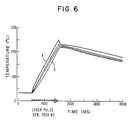
- Fig. 5 illustrates the positions of four thermocouples (A-D) which were placed along the length of the bar 12, the bar 12 having a length of approximately 1.25 cm.
- a YAG (1.06 ⁇ m) laser 40 operating in a CW mode was used to deliver 50 watts of laser energy for 1000 milliseconds (ms) to the heater 10.
- the resulting temperature profile is shown in the graph of Fig. 6.
- the bar 12 is observed to heat up at a substantially uniform rate of 223 °C per second with a substantially constant temperature variation of approximately 40 °C until the temperature of the bar exceeds 200 °C.
- eutectic solder melts at 183°C it can be realized that the heater 10 is operable for soldering leads along its entire length.
- Nd:YAG laser has been shown as the source of optical energy it should be appreciated that the heater of the invention may be powered by any suitable source of optical radiation.
- argon ion and excimer lasers both have an output wavelength suitable for transmission through conventional optical fibers.
- the laser be capable of operating in a CW mode for an interval of time sufficient to raise the temperature of the heater to the desired point.
- Nd:YAG lasers operating in a CW mode and having an output wavelength suitable for transmission through an optical fiber are readily available.
- the heater of the invention has been found to provide soldering attachment rates that are approximately one order of magnitude faster than the maximum rates associated with conventional direct laser soldering techniques. Similarly, when compared with conventional electrically operated heating devices ("hot blades") the heater of the invention is capable of greatly superior heating rates.
- the heating tool of the invention is significantly more compact than an equivalent electrical heater due to the nature of the power delivery. That is, the power is delivered through a hair-like optical fiber as opposed to the relatively much thicker electrical cables in an electrical heater. Physical size, weight and power delivery connections are considered to be critical factors in automating a component attachment process, especially for small devices with fine lead spacings.
- the heater of the invention is especially applicable in situations where small component sizes and geometries limit the use of conventional heating devices and in situations where localized heating is required to prevent unnecessary heating of heat sensitive devices or printed circuit board material.
- the heater of the invention is also advantageous where the previous features need to be combined with high thruput levels. Examples of such applications include the soldering of surface mount components and Tape Automated Bonding (TAB) component attachment where lead spacing is typically 508 ⁇ m (20 mils) or less.
- TAB Tape Automated Bonding
Landscapes
- Physics & Mathematics (AREA)
- Optics & Photonics (AREA)
- Engineering & Computer Science (AREA)
- Mechanical Engineering (AREA)
- Plasma & Fusion (AREA)
- Electric Connection Of Electric Components To Printed Circuits (AREA)
- Laser Beam Processing (AREA)
Claims (9)
- Heizvorrichtung (10) enthaltend:
einen wärmeleitenden Heizstab (12) mit einem darin eingeschlossenen inneren Hohlraum (18), wobei dieser Hohlraum Flächen (20) aufweist, die im wesentlichen für die einfallende optische Strahlung reflektierend und teilweise für die einfallende optische Strahlung absorbierend sind; und
Mittel an diesen Hohlraum gekoppelt sind zum Leiten der optischen Strahlung in denselben, wobei dieses Leitmittel aus einer optischen Faser (16) besteht, deren Ausgangsende in optischer Verbindung mit dem Hohlraum steht und deren Eingangsende in optischer Verbindung mit einer optischen Strahlungsquelle (40) steht;
wobei die Strahlung wiederholt internen Reflexionen entlang einer Längsachse dieses Heizstabs (12) unterworfen wird, während denen sie absorbiert wird, wobei dieser Heizstab durch die absorbierte optische Strahlung gleichmäßig erwärmt wird. - Heizvorrichtung gemäß Anspruch 1, in dem dieser Heizstab besteht aus:
Einem wärmeleitenden metallischen Träger (24), innerhalb dessen dieser Hohlraum angeordnet ist;
einer reflektierenden Metallbeschichtung (26), die auf die Flächen dieses Hohlraums aufgebracht ist; und
einer Außenbeschichtung (32), die auf den Außenflächen dieses Heizstabs aufgebracht ist, wobei die Außenschicht aus einem Werkstoff besteht, der im wesentlichen vom geschmolzenen Lot nicht benetzbar ist. - Heizvorrichtung gemäß Anspruch 2 bei dem dieser metallische Träger (24) aus Kupfer besteht, die reflektierende Metallbeschichtung (26) aus Gold und die Außenbeschichtung (32) aus Titan besteht.
- Heizvorrichtung gemäß Anspruch 3, bei dem ferner zwischen dem Kupferträger und der Goldschicht eine Sperrschicht (28) aufgebracht ist, wobei diese Sperrschicht aus einem Werkstoff besteht, der geeignet ist, die gegenseitige Diffusion zwischen dem Kupferträger und der Goldschicht im wesentlichen zu verhindern, und die vorzugsweise aus Nickel oder Platin besteht.
- Heizvorrichtung gemäß einem beliebigen der vorstehenden Ansprüche, bei dem dieses Leitmittel ferner ein Halteglied (14) für eine an diesem Heizstab befestigte optische Faser umfaßt, und zwar vorzugsweise als einstückige Erweiterung dieses Körperteils ausgebildet ist.
- Heizvorrichtung gemäß Anspruch 5, bei dem dieses Halteglied aus einem Werkstoff besteht, der eine geringere Wärmeleitfähigkeit als die Wärmeleitfähigkeit des Heizstabs aufweist, und vorzugsweise aus rostfreiem Stahl besteht.
- Verfahren zum gleichzeitige Löten einer Vielzahl von Leitern jeweils an eine zugehörige elektrische Klemme, bestehend aus folgenden Schritten:
Inberührungbringen eines jeden einer Vielzahl von Leitern mit der jeweils zugehörigen elektrischen Klemme und mit einer bestimmten Lotmenge (38);
Inberührungbringen jedes einzelnen einer Vielzahl von Leitern mit einem langgestreckten wärmeleitenden Glied (12);
Übertragen von Laserstrahlung aus einer Laserstrahlungsquelle (40) in einen langgestreckten Hohlraum (18), der in dem Glied eingeschlossen ist, wobei der Hohlraum im wesentlichen entlang der gesamten Länge dieses Glieds angeordnet ist und Flächen (20) aufweist, die im wesentlichen auf die einfallende optische Strahlung reflektierend und teilweise absorbierend wirken;
wiederholtes Reflektieren der Laserstrahlung an diesen Flächen (20) des Hohlraums, so daß die Laserstrahlung im wesentlichen gleichmäßig über die ganze Länge des Hohlraums absorbiert wird, um das Glied im wesentlichen gleichmäßig über seine ganze Länge aufzuheizen; und
Übertragen der Wärme von diesem Glied gleichzeitig auf eine Vielzahl von Leitern (33), so daß das jedem Leiter zugeordnete Lot geschmolzen wird. - Verfahren gemäß Anspruch 7, in dem der Schritt zur Übertragung durch die Aktivierung eines Nd:YAG-Lasers für eine genügend lange Zeit erzielt wird, die ausreicht, um das Glied auf eine Temperatur zu erwärmen, die höher liegt als der Schmelzpunkt des Lots.
- Verfahren gemäß Anspruch 7 oder 8, in dem der Schritt zur Übertragung durch die Übertragung der Laserstrahlung durch eine optische Faser erfolgt, die ein Ausgangsende in optischer Verbindung mit dem Hohlräum hat.
Applications Claiming Priority (2)
| Application Number | Priority Date | Filing Date | Title |
|---|---|---|---|
| US07/283,668 US4894509A (en) | 1988-12-13 | 1988-12-13 | Laser assisted heater bar for multiple lead attachment |
| US283668 | 1988-12-13 |
Publications (2)
| Publication Number | Publication Date |
|---|---|
| EP0373345A1 EP0373345A1 (de) | 1990-06-20 |
| EP0373345B1 true EP0373345B1 (de) | 1993-01-27 |
Family
ID=23087049
Family Applications (1)
| Application Number | Title | Priority Date | Filing Date |
|---|---|---|---|
| EP89120348A Expired - Lifetime EP0373345B1 (de) | 1988-12-13 | 1989-11-03 | Eine von einem Laser unterstützte Heizstange zum Mehrfachverbinden von Leitern |
Country Status (4)
| Country | Link |
|---|---|
| US (1) | US4894509A (de) |
| EP (1) | EP0373345B1 (de) |
| JP (1) | JPH02217162A (de) |
| DE (1) | DE68904640T2 (de) |
Families Citing this family (25)
| Publication number | Priority date | Publication date | Assignee | Title |
|---|---|---|---|---|
| US5814784A (en) * | 1992-01-13 | 1998-09-29 | Powerlasers Ltd. | Laser-welding techniques using pre-heated tool and enlarged beam |
| GB9401998D0 (en) * | 1994-02-02 | 1994-03-30 | Powerlasers Ltd | A laser heated tool for thermal processing of material |
| GB9200622D0 (en) * | 1992-01-13 | 1992-03-11 | Duley Walter W | Improved means of co2 laser welding of a1 7075 |
| US5604831A (en) * | 1992-11-16 | 1997-02-18 | International Business Machines Corporation | Optical module with fluxless laser reflow soldered joints |
| US5904868A (en) * | 1994-06-16 | 1999-05-18 | International Business Machines Corporation | Mounting and/or removing of components using optical fiber tools |
| US5565119A (en) * | 1995-04-28 | 1996-10-15 | International Business Machines Corporation | Method and apparatus for soldering with a multiple tip and associated optical fiber heating device |
| US6236015B1 (en) | 1995-10-31 | 2001-05-22 | Hewlett-Packard Company | Method for predicting and avoiding a bad bond when utilizing fiber push connect laser bonding |
| TW309483B (de) * | 1995-10-31 | 1997-07-01 | Hewlett Packard Co | |
| US5847356A (en) * | 1996-08-30 | 1998-12-08 | Hewlett-Packard Company | Laser welded inkjet printhead assembly utilizing a combination laser and fiber optic push connect system |
| US5948286A (en) * | 1997-02-06 | 1999-09-07 | International Business Machines Corporation | Diffusion bonding of lead interconnections using precise laser-thermosonic energy |
| DE19832774B4 (de) * | 1998-07-22 | 2008-01-24 | Siemens Ag | Schutzvorrichtung zum Herstellen von Kleinstbohrungen in rohrartigen Bauteilen sowie Verfahren zum Herstellen von in einen Hohlraum mündenden Bohrungen |
| US6680457B2 (en) * | 2002-01-15 | 2004-01-20 | Agilent Technologies, Inc. | Reflowing of solder joints |
| US6776328B2 (en) † | 2002-09-17 | 2004-08-17 | The Boeing Company | Radiation assisted friction welding |
| FR2878185B1 (fr) * | 2004-11-22 | 2008-11-07 | Sidel Sas | Procede de fabrication de recipients comprenant une etape de chauffe au moyen d'un faisceau de rayonnement electromagnetique coherent |
| US10857722B2 (en) * | 2004-12-03 | 2020-12-08 | Pressco Ip Llc | Method and system for laser-based, wavelength specific infrared irradiation treatment |
| US7425296B2 (en) * | 2004-12-03 | 2008-09-16 | Pressco Technology Inc. | Method and system for wavelength specific thermal irradiation and treatment |
| GB0701509D0 (en) * | 2007-01-26 | 2007-03-07 | Rolls Royce Plc | Apparatus and method for manufacture |
| FR2913210B1 (fr) * | 2007-03-02 | 2009-05-29 | Sidel Participations | Perfectionnements a la chauffe des matieres plastiques par rayonnement infrarouge |
| FR2917005B1 (fr) * | 2007-06-11 | 2009-08-28 | Sidel Participations | Installation de chauffage des corps de preformes pour le soufflage de recipients |
| DE102008002910A1 (de) * | 2008-06-26 | 2010-01-07 | Reis Lasertec Gmbh | Verfahren und Vorrichtung zum Verbinden von Bauteilen mittels Laserstrahlung |
| JP5710592B2 (ja) * | 2009-04-21 | 2015-04-30 | コーニンクレッカ フィリップス エヌ ヴェ | プレフォームのボディを加熱する加熱システム及び方法 |
| JP6064388B2 (ja) * | 2012-06-28 | 2017-01-25 | 澁谷工業株式会社 | ボンディングヘッド |
| DE102019124332A1 (de) * | 2019-09-11 | 2021-03-11 | Hesse Gmbh | Vorrichtung und Verfahren zum Erfassen einer Temperatur eines Bondwerkzeugs beim laserunterstützen Ultraschallbonden |
| CN116038121B (zh) * | 2022-11-30 | 2025-08-29 | 浙江珏芯微电子有限公司 | 一种红外探测器组件的激光焊接装置和方法 |
| CN116695604B (zh) * | 2023-08-08 | 2023-10-13 | 生态环境部华南环境科学研究所(生态环境部生态环境应急研究所) | 一种交通噪声防治的生态降噪声屏障 |
Family Cites Families (9)
| Publication number | Priority date | Publication date | Assignee | Title |
|---|---|---|---|---|
| US3509317A (en) * | 1967-08-01 | 1970-04-28 | North American Rockwell | Indirect radiant heat soldering apparatus |
| US3718800A (en) * | 1968-03-05 | 1973-02-27 | Argus Eng Co | Infrared heating apparatus |
| US3522407A (en) * | 1968-03-05 | 1970-08-04 | Argus Eng Co | Heating method |
| US3657508A (en) * | 1970-11-18 | 1972-04-18 | Western Electric Co | Method of and radiant energy transmissive member for reflow soldering |
| GB1365289A (en) * | 1970-12-22 | 1974-08-29 | Plessey Co Ltd | Infrared soldering apparatus |
| US3742181A (en) * | 1971-02-25 | 1973-06-26 | Argus Eng Co | Method and apparatus for heatbonding in a local area using combined heating techniques |
| DE2826383A1 (de) * | 1978-06-16 | 1979-12-20 | Eichler Juergen | Sonde fuer die laser-chirurgie |
| US4534811A (en) * | 1983-12-30 | 1985-08-13 | International Business Machines Corporation | Apparatus for thermo bonding surfaces |
| US4785156A (en) * | 1987-12-18 | 1988-11-15 | American Telephone And Telegraph Company | Soldering method using localized heat source |
-
1988
- 1988-12-13 US US07/283,668 patent/US4894509A/en not_active Expired - Fee Related
-
1989
- 1989-11-03 EP EP89120348A patent/EP0373345B1/de not_active Expired - Lifetime
- 1989-11-03 DE DE8989120348T patent/DE68904640T2/de not_active Expired - Fee Related
- 1989-12-12 JP JP1320697A patent/JPH02217162A/ja active Granted
Also Published As
| Publication number | Publication date |
|---|---|
| US4894509A (en) | 1990-01-16 |
| DE68904640D1 (de) | 1993-03-11 |
| JPH0585260B2 (de) | 1993-12-06 |
| DE68904640T2 (de) | 1993-08-12 |
| EP0373345A1 (de) | 1990-06-20 |
| JPH02217162A (ja) | 1990-08-29 |
Similar Documents
| Publication | Publication Date | Title |
|---|---|---|
| US4894509A (en) | Laser assisted heater bar for multiple lead attachment | |
| US4807956A (en) | Opto-electronic head for the coupling of a semi-conductor device with an optic fiber, and a method to align this semi-conductor device with this fiber | |
| US5829125A (en) | Method of manufacturing circuit module | |
| US4615031A (en) | Injection laser packages | |
| US5948286A (en) | Diffusion bonding of lead interconnections using precise laser-thermosonic energy | |
| JP3077125B2 (ja) | 光モジュールの形成方法 | |
| EP0196875B1 (de) | Montage für optisches Bauteil | |
| US5298715A (en) | Lasersonic soldering of fine insulated wires to heat-sensitive substrates | |
| EP0100086A2 (de) | Verfahren zur Herstellung von Einkapselungen von Laserdioden und Einkapselungen, die nach einem solchen Verfahren hergestellt sind | |
| US4997253A (en) | Electro-optical transducer module and a method of fabricating such a module | |
| US5055652A (en) | Laser soldering of flexible leads | |
| EP0689073A1 (de) | Verfahren zur Justierung und Verbindung | |
| RU2095206C1 (ru) | Способ пайки | |
| US6353202B1 (en) | Apparatus and method for producing a chip-substrate connection | |
| US5123074A (en) | Substrate for mounting optical components and electric circuit components thereon and method for making same | |
| EP0367705A2 (de) | Laserunterstützte Ultraschallverbindung | |
| JPH0479135B2 (de) | ||
| US5744848A (en) | Package for housing a photosemiconductor device | |
| US6160239A (en) | Laser soldering procedure applicable to the joining of pins over printed circuit boards | |
| CA1123920A (en) | Laser soldering apparatus | |
| US5553182A (en) | Alignment fixture and associated method for controllably positioning on optical fiber | |
| PL177294B1 (pl) | Sposób wytwarzania złożonej z kilku warstw szyby ze szkła wielowarstwowego z drutami ułożonymi wewnątrz termoplastycznej warstwy pośredniej oraz szyba wielowarstwowa grzewcza | |
| CN100523883C (zh) | 精密光纤连接 | |
| Cheng et al. | Effect of Au thickness on laser beam penetration in semiconductor laser packages | |
| EP0316026A1 (de) | Verfahren zum Löten eines Halbleiterbauelementes (Chip) an eine Trägereinheit |
Legal Events
| Date | Code | Title | Description |
|---|---|---|---|
| PUAI | Public reference made under article 153(3) epc to a published international application that has entered the european phase |
Free format text: ORIGINAL CODE: 0009012 |
|
| AK | Designated contracting states |
Kind code of ref document: A1 Designated state(s): DE FR GB |
|
| 17P | Request for examination filed |
Effective date: 19901025 |
|
| 17Q | First examination report despatched |
Effective date: 19910711 |
|
| GRAA | (expected) grant |
Free format text: ORIGINAL CODE: 0009210 |
|
| AK | Designated contracting states |
Kind code of ref document: B1 Designated state(s): DE FR GB |
|
| REF | Corresponds to: |
Ref document number: 68904640 Country of ref document: DE Date of ref document: 19930311 |
|
| ET | Fr: translation filed | ||
| PLBE | No opposition filed within time limit |
Free format text: ORIGINAL CODE: 0009261 |
|
| STAA | Information on the status of an ep patent application or granted ep patent |
Free format text: STATUS: NO OPPOSITION FILED WITHIN TIME LIMIT |
|
| 26N | No opposition filed | ||
| PGFP | Annual fee paid to national office [announced via postgrant information from national office to epo] |
Ref country code: FR Payment date: 19951107 Year of fee payment: 7 |
|
| PGFP | Annual fee paid to national office [announced via postgrant information from national office to epo] |
Ref country code: DE Payment date: 19951123 Year of fee payment: 7 |
|
| PGFP | Annual fee paid to national office [announced via postgrant information from national office to epo] |
Ref country code: GB Payment date: 19961028 Year of fee payment: 8 |
|
| PG25 | Lapsed in a contracting state [announced via postgrant information from national office to epo] |
Ref country code: FR Effective date: 19970731 |
|
| PG25 | Lapsed in a contracting state [announced via postgrant information from national office to epo] |
Ref country code: DE Effective date: 19970801 |
|
| REG | Reference to a national code |
Ref country code: FR Ref legal event code: ST |
|
| PG25 | Lapsed in a contracting state [announced via postgrant information from national office to epo] |
Ref country code: GB Free format text: LAPSE BECAUSE OF NON-PAYMENT OF DUE FEES Effective date: 19971103 |
|
| GBPC | Gb: european patent ceased through non-payment of renewal fee |
Effective date: 19971103 |