EP0373482B1 - Bahnführungsrolle aus Aluminium und Verfahren zu deren Herstellung - Google Patents
Bahnführungsrolle aus Aluminium und Verfahren zu deren Herstellung Download PDFInfo
- Publication number
- EP0373482B1 EP0373482B1 EP89122409A EP89122409A EP0373482B1 EP 0373482 B1 EP0373482 B1 EP 0373482B1 EP 89122409 A EP89122409 A EP 89122409A EP 89122409 A EP89122409 A EP 89122409A EP 0373482 B1 EP0373482 B1 EP 0373482B1
- Authority
- EP
- European Patent Office
- Prior art keywords
- roller
- web
- plateaus
- features
- grinding
- Prior art date
- Legal status (The legal status is an assumption and is not a legal conclusion. Google has not performed a legal analysis and makes no representation as to the accuracy of the status listed.)
- Expired - Lifetime
Links
- 238000000034 method Methods 0.000 title claims description 15
- 230000008569 process Effects 0.000 title claims description 15
- 229910052782 aluminium Inorganic materials 0.000 title claims description 8
- XAGFODPZIPBFFR-UHFFFAOYSA-N aluminium Chemical compound [Al] XAGFODPZIPBFFR-UHFFFAOYSA-N 0.000 title claims description 8
- 238000004519 manufacturing process Methods 0.000 title description 5
- 238000005422 blasting Methods 0.000 claims description 14
- 238000000227 grinding Methods 0.000 claims description 14
- 238000005498 polishing Methods 0.000 claims description 9
- 229910000831 Steel Inorganic materials 0.000 claims description 7
- 239000010959 steel Substances 0.000 claims description 7
- 230000005465 channeling Effects 0.000 claims description 6
- TWNQGVIAIRXVLR-UHFFFAOYSA-N oxo(oxoalumanyloxy)alumane Chemical compound O=[Al]O[Al]=O TWNQGVIAIRXVLR-UHFFFAOYSA-N 0.000 claims description 3
- 239000002002 slurry Substances 0.000 claims description 3
- XLYOFNOQVPJJNP-UHFFFAOYSA-N water Substances O XLYOFNOQVPJJNP-UHFFFAOYSA-N 0.000 claims description 3
- 230000009471 action Effects 0.000 claims description 2
- 239000004020 conductor Substances 0.000 claims description 2
- 238000007739 conversion coating Methods 0.000 claims description 2
- 238000006748 scratching Methods 0.000 claims description 2
- 230000002393 scratching effect Effects 0.000 claims description 2
- 239000010410 layer Substances 0.000 description 4
- 230000007547 defect Effects 0.000 description 3
- 239000000463 material Substances 0.000 description 3
- 230000037361 pathway Effects 0.000 description 3
- 230000002411 adverse Effects 0.000 description 2
- 150000001875 compounds Chemical class 0.000 description 2
- 239000000047 product Substances 0.000 description 2
- 230000009467 reduction Effects 0.000 description 2
- 239000000725 suspension Substances 0.000 description 2
- 241000951498 Brachypteraciidae Species 0.000 description 1
- 241000168096 Glareolidae Species 0.000 description 1
- 230000008859 change Effects 0.000 description 1
- 238000004140 cleaning Methods 0.000 description 1
- 230000006835 compression Effects 0.000 description 1
- 238000007906 compression Methods 0.000 description 1
- 238000005520 cutting process Methods 0.000 description 1
- 230000001419 dependent effect Effects 0.000 description 1
- 238000001035 drying Methods 0.000 description 1
- 239000012467 final product Substances 0.000 description 1
- 229910052751 metal Inorganic materials 0.000 description 1
- 239000002184 metal Substances 0.000 description 1
- 238000002360 preparation method Methods 0.000 description 1
- 238000003825 pressing Methods 0.000 description 1
- 238000000926 separation method Methods 0.000 description 1
- 229910052709 silver Inorganic materials 0.000 description 1
- 239000004332 silver Substances 0.000 description 1
- 239000002344 surface layer Substances 0.000 description 1
- 238000011179 visual inspection Methods 0.000 description 1
Images

Classifications
-
- B—PERFORMING OPERATIONS; TRANSPORTING
- B41—PRINTING; LINING MACHINES; TYPEWRITERS; STAMPS
- B41N—PRINTING PLATES OR FOILS; MATERIALS FOR SURFACES USED IN PRINTING MACHINES FOR PRINTING, INKING, DAMPING, OR THE LIKE; PREPARING SUCH SURFACES FOR USE AND CONSERVING THEM
- B41N7/00—Shells for rollers of printing machines
-
- B—PERFORMING OPERATIONS; TRANSPORTING
- B65—CONVEYING; PACKING; STORING; HANDLING THIN OR FILAMENTARY MATERIAL
- B65H—HANDLING THIN OR FILAMENTARY MATERIAL, e.g. SHEETS, WEBS, CABLES
- B65H27/00—Special constructions, e.g. surface features, of feed or guide rollers for webs
-
- B—PERFORMING OPERATIONS; TRANSPORTING
- B41—PRINTING; LINING MACHINES; TYPEWRITERS; STAMPS
- B41N—PRINTING PLATES OR FOILS; MATERIALS FOR SURFACES USED IN PRINTING MACHINES FOR PRINTING, INKING, DAMPING, OR THE LIKE; PREPARING SUCH SURFACES FOR USE AND CONSERVING THEM
- B41N2207/00—Location or type of the layers in shells for rollers of printing machines
- B41N2207/02—Top layers
-
- B—PERFORMING OPERATIONS; TRANSPORTING
- B65—CONVEYING; PACKING; STORING; HANDLING THIN OR FILAMENTARY MATERIAL
- B65H—HANDLING THIN OR FILAMENTARY MATERIAL, e.g. SHEETS, WEBS, CABLES
- B65H2404/00—Parts for transporting or guiding the handled material
- B65H2404/10—Rollers
- B65H2404/18—Rollers composed of several layers
- B65H2404/181—Rollers composed of several layers with cavities or projections at least at one layer
-
- B—PERFORMING OPERATIONS; TRANSPORTING
- B65—CONVEYING; PACKING; STORING; HANDLING THIN OR FILAMENTARY MATERIAL
- B65H—HANDLING THIN OR FILAMENTARY MATERIAL, e.g. SHEETS, WEBS, CABLES
- B65H2404/00—Parts for transporting or guiding the handled material
- B65H2404/50—Surface of the elements in contact with the forwarded or guided material
- B65H2404/52—Surface of the elements in contact with the forwarded or guided material other geometrical properties
- B65H2404/521—Reliefs
-
- Y—GENERAL TAGGING OF NEW TECHNOLOGICAL DEVELOPMENTS; GENERAL TAGGING OF CROSS-SECTIONAL TECHNOLOGIES SPANNING OVER SEVERAL SECTIONS OF THE IPC; TECHNICAL SUBJECTS COVERED BY FORMER USPC CROSS-REFERENCE ART COLLECTIONS [XRACs] AND DIGESTS
- Y10—TECHNICAL SUBJECTS COVERED BY FORMER USPC
- Y10T—TECHNICAL SUBJECTS COVERED BY FORMER US CLASSIFICATION
- Y10T29/00—Metal working
- Y10T29/49—Method of mechanical manufacture
- Y10T29/4998—Combined manufacture including applying or shaping of fluent material
- Y10T29/49982—Coating
- Y10T29/49986—Subsequent to metal working
Definitions
- the present invention relates to a web conveying roller, and a process for the manufacture of a roller used for conveying a web, so that dynamic air entrained between the roller surface and the web can be vented from the roller surface when the roller and web are in contact.
- a web is trained around a plurality of rollers as it is conveyed through a series of stations.
- Some of the rollers are drive rollers used for advancing the web and other rollers are simply idler rollers.
- the web conveyance system is designed to avoid relative movement between the surface of the rollers and the web in order to avoid scratching or other damage to the web. This is especially important during the manufacture of sensitive materials, such as photographic film, paper and magnetic media where such relative movement can produce a surface defect in the final product.
- the surface of the rollers be sufficiently smooth to avoid damage to the web by the rollers whether the rollers are drive rollers or idler rollers.
- air can become entrained between the roller and the surface of the web. More specifically, movement of the web can force air into the entrance nip between the web and the surface of the roller, especially when the web is moving at high speeds. This boundary layer of air can cause at least partial separation between the surface of the web and the surfaces of the rollers. When this occurs, there is a change in the ability of the drive rollers to advance the web, and the web cannot efficiently rotate the idler rollers. As a result, relative movement can occur between the rollers and the web, causing quality defects in the web.
- the grooves can leave thermal defects caused, for example, by the portion of a web in contact with the roller surface drying differently than the portion of the web over the grooves.
- the resulting patterned marks are more readily observed by the human eye than a random pattern of marks. Thus these marks are clearly undesirable, especially in photographic products such as film or paper.
- This object is accomplished by a process for finishing the surface of a roller characterized by the steps of blasting the surface of the roller with steel shot to create on the surface a deep texture with well rounded down features and very sharp up features, grinding the surface to remove the sharp up features but without removing more than about 50% of the pattern depth formed by the blasting step to produce plateaus surrounded by interconnected channels, and hardcoating the surface.
- the object also is accomplished by an aluminum web conveyance roller characterized by generally spherical down features in the surface, many of the down features overlapping to form interconnected channels comprising at least 50% of the surface area of the roller, a plurality of plateaus between the channels comprising at least 20% of the surface area of the roller, and a coverage of a hard, durable metal layer.
- a web conveyance roller of the invention is rotatable about its longitudinal axis in a clockwise direction as indicated by the arrow.
- a web 12 is trained around a portion of the roller.
- Roller 10 can be either a drive roller or an idler roller. In either instance, the velocity of the roller surface and the linear velocity of the web should be equal to each other so that there is no slippage between the roller and the web. This is especially important when the web 12 comprises a material which is easily damaged, such as photographic film, paper, or magnetic media.
- Surface 14 of roller 10 is especially prepared in accordance in the process described later to avoid relative movement between the roller and the web.
- the process for manufacturing roller 10 can be applied to cylindrical shells or base rollers of various kinds.
- the process is especially applicable to an aluminum base roller generally designated 16.
- the length and the diameter of the roller 16 can very and may, for example, be of a length sufficient to accommodate webs of 2.4 meters (8 feet) or more in width.
- roller 16 is shot blasted with steel shot to create on the surface a deep texture generally designated 20 in Fig.2.
- Surface texture 20 has well rounded down features 22 and very sharp up features designated 24 having peaks.
- the down features are genrally hemispherical in configuration and they extend the full length and circumference of the roller 16.
- the hemispherical down features 22 formed during the blasting operation have a depth that is determined by the momentum of the steel shot as its strikes the roller surface.
- the size of the steel shot is substantially uniform so that the mass of each piece of steel shot is also constant.
- the momentum of the steel shot is dependent only on the velocity of the shot.
- the velocity of the shot is influenced by the nozzle geometry and the blasting pressure utilized. Since the nozzle geometry is constant during the blasting operation, the air pressure used is the only variable that determines the depth of the down features 22. Air pressure is controlled so that it is substantially constant during the blasting operation. Thus the depth of the down features is accurately controlled and a substantially uniform depth is obtained.
- the number of down features 22 is determined by the shot size and the pattern depth. The larger the shot size and the deeper the pattern the fewer number of down features 22 will be present on the surface. Thus the number of down features 22 is inherently determined by the shot size and the pattern depth which are held within tight limits.
- the shot size can range from about 152 ⁇ m (0.006 inches) to about 2.032 ⁇ m (0.080 inches) which will produce about 2 to 20 down features per millimeter (50 to 500 down features per linear inch).
- Many down patterns 22 at least partially overlap so that a random pattern of interconnected channels are formed in the surface of the finished roller surface, as described later in regard to Fig. 5.
- the next step in preparation of the roller surface is to remove the peaks of the up features 24 and produce plateaus on the surface surrounded by the interconnected channels formed by the down patterns 22. More specifically, the surface shown in Fig. 2 is subject to a superfinishing operation comprising an aggressive multi-direction grinding action which removes peaks 24 from the up features and produces a series of randomly extending plateaus designated 30 in Fig. 3.
- the roller is rotates during this operation, and the roller rotation rate, the force exerted during grinding, and the grinding rate in the longitudinal direction along the roller surface are all controlled, and are substantially constant, so that there is uniformity in height and smoothness in the plateaus throughout substantially the entire surface of the roller.
- the superfinishing step comprises grinding the surface with a series of tapes of successively smaller grit sizes.
- the surface can initially be ground using a 15 micron tape which establishes the plateaus shown at 30. This is followed by grinding with a 9 micron tape which eliminates scratches on the plateaus caused by use of the courser 15 micron tape.
- the surface is ground using a 3 micron tape to remove the smaller scratches produced by the 9 micron tape.
- the final step of the superfinishing operation comprises polishing the surface and round the edges of the plateaus so they do not scratch the web. This is preferably accomplished using a slurry comprising a suspension of 9 micron aluminum oxide polishing compound in water.
- the final pattern depth and the amount of channeling formed by interconnection of the down patter 22 is controlled by removing a predictable amount of material from the blasted pattern shown in Fig. 2.
- the reduction in channeling may be excessive if more than 50% of the depth of the down patterns 22 is removed by the superfinishing operation.
- Hardcoating is a conversion coating process that creates an extremely hard and durable surface layer 34 (Fig. 4) on the aluminum roller.
- the hardcoating process will reduce the volume of the channels formed by down patterns 22.
- the shot blasting step should be adjusted so that the amount of channeling and down pattern remaining after the hardcoating step falls within the parameters identified above.
- the step of hardcoating the roller surface leaves a very fine roughness on the roller surface. This roughness is removed by polishing.
- the polishing step can be carried out by using a slurry comprising a suspension of 9 micron aluminum oxide polishing compound in water.
- the polishing step removes the roughness from the plateaus 30. It also leaves well rounded edges on the plateaus so that the plateaus and edges thereof will not scratch or otherwise adversely affect a web traveling along the roller surface.
- the final roller surface is electrically conductive. Accordingly, immediately after the hardcoating and polishing steps the aluminum roller is impregnated with an electrical conductor, such as silver, to increase the electrical conductivity of the surface.
- an electrical conductor such as silver
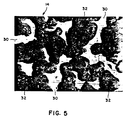
- Fig. 5 is a photomicrograph of a fragmentary portion of a surface 14 of the roller of the invention.
- the surface comprises the plateaus 30 and a plurality of channels 32.
- the channels are produced by connection of the down features 22 formed by the shot blasting operation.
- Most of the channels are interconnected to form pathways for air entrapped between the web 12 (Fig. 1) and the surface 14 of the roller. These pathways extend in a random manner both circumferentially and longitudinally along the roller.
- air can travel both axially and circumferentially along the roller to escape from between the roller and the web.
- the traction between the roller and the web is predictable because very little air is entrained or trapped between the roller and the web. If significant amounts of air became trapped between the roller and the web the traction characteristics of the roller would be adversely affected.
- the shot blasted pattern of down features 22 preferably is greater than 12.7 ⁇ m (500 microinches) deep as determined by a 10Rz parameter, and the surface pattern should have greater than 50% channeling (or less than 50% plateau ares 30) as determined by visual inspection of the surface.
- the depth of down features 22 in the final surface is less than about 25.4 ⁇ m (1000 microinches) in order to facilitate cleaning of the roller surface. Except for concerns relating to cleanability, somewhat greater pattern depth could be used.
- the plateaus 30 preferably comprise greater than 20% of the surface area in order to eliminate the scratch potential of the pattern. The required pattern depth increases with increasing web velocity.
Landscapes
- Registering, Tensioning, Guiding Webs, And Rollers Therefor (AREA)
- Grinding Of Cylindrical And Plane Surfaces (AREA)
- Rolls And Other Rotary Bodies (AREA)
- Finish Polishing, Edge Sharpening, And Grinding By Specific Grinding Devices (AREA)
Claims (8)
- Verfahren zum Bearbeiten der Oberfläche einer zum Transport eines Bandes (12) dienenden Aluminiumrolle (10), wobei die Oberfläche (14) abgestrahlt wird, so daß Vertiefungen (22) entstehen, und die abgestrahlte Oberfläche abgeschliffen wird, um scharfkantige Erhöhungen (24) zu entfernen, dadurch gekennzeichnet, daß
die Oberfläche (14) der Rolle (10) mit Stahlschrot abgestrahlt wird, so daß auf der Oberfläche eine vertiefte Struktur (20) mit einem Muster aus (a) abgerundeten Vertiefungen (22), die im wesentlichen eine gleichförmige Tiefe aufweisen und von denen viele sich zumindest teilweise überlagern, sowie (b) scharfkantigen Erhöhungen (24) entsteht, daß
die abgestrahlte Oberfläche abgeschliffen wird, damit die scharfkantigen Ernöhungen (24) entfernt werden und dadurch auf der Oberfläche Plateaus (30) entstehen, ohne daß dabei mehr als 50 % der beim Abstrahlen entstandenen Mustertiefe wegfallen, so daß die Plateaus (30) von den aus den sich überlagernden Vertiefungen (22) resultierenden, miteinander verbundenen Kanälen (32) umgeben sind, und daß
die Oberfläche nach dem Abschieifen hartbeschichtet wird, damit die Rolle (10) eine harte und haltbare Oberfläche erhält, und die hartbescbichtete Oberfläche (34) poliert wird. - Verfahren nach Anspruch 1, dadurch gekennzeichnet, daß die Oberfläche mit einer Reihe von Schleifbändern mit fortschreitend abnehmender Korngröße abgeschliffen und anschließend mit einer Schleifmittellosung poliert wird, die aus Aluminiumoxid in Wasser besteht.
- Verfahren nach Anspruch 2, dadurch gekennzeichnet, daß die Oberfläche in mehreren Richtungen grob abgeschliffen wird, wobei die fortschreitend abnehmende Korngröße etwa zwischen 15 µm und 3 µm liegt.
- Verfahren nach Anspruch 1, dadurch gekennzeichnet, daß die Oberfläche mit Stahlschrot im wesentlichen konstanter Größe und mit einem solchen Druck abgestrahlt wird, daß ein Muster entsteht, das tiefer als 12,7 µm ist, und daß aufgrund der sich überlagernden Vertiefungen (22) mindestens 50 % der Oberfläche mit Kanälen durchzogen sind und die Plateaus (30) mindestens 20 % der Oberfläche ausmachen.
- Verfahren nach Anspruch 1, dadurch gekennzeichnet, daß beim Hartbeschichten eine dünne, harte und haltbare Oberfläche (34) entsteht, indem ein Konversionsbeschichtungsverfahren angewendet wird.
- Bahnführungsrolle (10) aus Aluminium, deren Oberfläche im allgemeinen sphärische Vertiefungen (22) aufweist, von denen viele sich überlagern und dadurch miteinander verbundene Kanäle (32) bilden, sowie eine Vielzahl von Plateaus (30) umfaßt, die glatt sind, damit ein von der Rolle (10) transportiertes Band nicht verkratzt wird, dadurch gekennzeichnet, daß
die sich überlagernden Vertiefungen (22), die die miteinander verbundenen Kanäle (32) bilden, mindestens 50 % der Oberfläche der Rolle (10) ausmachen, daß die zwischen den Kanälen (32) befindlichen Plateaus (30) mindestens 20 % der Oberfläche der Rolle (10) ausmachen und die Oberflächen der Plateaus (30) und die der Vertiefungen (22) hartbeschichtet sind. - Bahnführungsrolle (10) nach Anspruch 6, dadurch gekennzeichnet, daß die Vertiefungen (22) tiefer als etwa 12,7 µm, jedoch höchstens 25,4 µm tief sind.
- Bahnführungsrolle (10) nach Anspruch 6 oder 7, dadurch gekennzeichnet, daß die Rollenoberfläche mit einem elektrisch leitfähigen Material beschichtet ist.
Applications Claiming Priority (2)
| Application Number | Priority Date | Filing Date | Title |
|---|---|---|---|
| US07/282,662 US4910844A (en) | 1988-12-12 | 1988-12-12 | Method for finishing the surface of an aluminum roller |
| US282662 | 1999-03-31 |
Publications (3)
| Publication Number | Publication Date |
|---|---|
| EP0373482A2 EP0373482A2 (de) | 1990-06-20 |
| EP0373482A3 EP0373482A3 (en) | 1990-11-28 |
| EP0373482B1 true EP0373482B1 (de) | 1994-04-13 |
Family
ID=23082555
Family Applications (1)
| Application Number | Title | Priority Date | Filing Date |
|---|---|---|---|
| EP89122409A Expired - Lifetime EP0373482B1 (de) | 1988-12-12 | 1989-12-05 | Bahnführungsrolle aus Aluminium und Verfahren zu deren Herstellung |
Country Status (4)
| Country | Link |
|---|---|
| US (1) | US4910844A (de) |
| EP (1) | EP0373482B1 (de) |
| JP (1) | JP2683123B2 (de) |
| DE (1) | DE68914614T2 (de) |
Families Citing this family (8)
| Publication number | Priority date | Publication date | Assignee | Title |
|---|---|---|---|---|
| US5229813A (en) * | 1991-08-30 | 1993-07-20 | Xerox Corporation | Composite backup roller assembly |
| US6177141B1 (en) * | 1998-11-03 | 2001-01-23 | Eastman Kodak Company | Method for coating a liquid composition to a web using a backing roller with a relieved surface |
| RU2147945C1 (ru) * | 1999-04-26 | 2000-04-27 | Открытое акционерное общество "Новолипецкий металлургический комбинат" | Способ подготовки к эксплуатации валков листопрокатной клети кварто |
| RU2184631C2 (ru) * | 2000-07-03 | 2002-07-10 | Открытое акционерное общество "Северсталь" | Способ эксплуатации валков листопрокатной клети кварто |
| EP1358044B1 (de) * | 2001-02-08 | 2008-12-03 | REM Technologies, Inc. | Chemisch-mechanische bearbeitung und oberflächen endbearbeitung |
| US20030089819A1 (en) * | 2001-11-14 | 2003-05-15 | Bloomquist Darrel R. | Irregular surfaced tape guide |
| JP4064899B2 (ja) * | 2003-09-09 | 2008-03-19 | 千代田第一工業株式会社 | フィルム基材またはテープ基材の加工機械に設置するローラーの製造方法 |
| TW200848345A (en) * | 2007-03-26 | 2008-12-16 | Fujifilm Corp | Web guide roller, web guide device, and method for guiding web |
Family Cites Families (19)
| Publication number | Priority date | Publication date | Assignee | Title |
|---|---|---|---|---|
| US1932168A (en) * | 1930-07-07 | 1933-10-24 | James R Adams | Roll for making rolled products and method for producing it |
| US2114072A (en) * | 1935-05-07 | 1938-04-12 | Ralph E Cleveland | Press roll for paper making machines and the method of making same |
| US2958742A (en) * | 1956-03-08 | 1960-11-01 | United States Steel Corp | Conductor roll and method of making the same |
| US3069769A (en) * | 1958-07-28 | 1962-12-25 | Armco Steel Corp | Process of making aluminum coated steel of high reflectivity |
| US3177558A (en) * | 1962-08-20 | 1965-04-13 | Du Pont | Metal articles having smooth hemispheroidal indentations |
| US3405855A (en) * | 1966-03-11 | 1968-10-15 | Beloit Corp | Paper guide and drive roll assemblies |
| US3412479A (en) * | 1966-03-25 | 1968-11-26 | Du Pont | Roll structure for drying of cellophane |
| IE32416B1 (en) * | 1967-10-20 | 1973-07-25 | Libbey Owens Ford Co | Textured conveyor roll and method of finishing the same |
| US3723083A (en) * | 1970-12-23 | 1973-03-27 | Libbey Owens Ford Co | Textured conveyor roll and method of finishing the same |
| US3752731A (en) * | 1971-09-08 | 1973-08-14 | Du Pont | Plastic film made by a film casting article |
| US4026007A (en) * | 1975-05-19 | 1977-05-31 | Monsanto Company | Roll finishing process |
| US4035549A (en) * | 1975-05-19 | 1977-07-12 | Monsanto Company | Interlayer for laminated safety glass |
| GB1562455A (en) * | 1977-09-30 | 1980-03-12 | Retolaza Ibarguengoitia J | Process for friction surface of tubular metalli articles such as liners and cylinders |
| JPS5492747A (en) * | 1977-12-29 | 1979-07-23 | Minolta Camera Co Ltd | Pressure fixing device of powder lmages |
| JPS54153940U (de) * | 1978-03-23 | 1979-10-26 | ||
| US4217769A (en) * | 1978-10-10 | 1980-08-19 | Consolidated Papers, Inc. | Method of forming a coating application roll |
| US4189815A (en) * | 1979-01-15 | 1980-02-26 | Am International, Inc. | Developer transport roll |
| DE3030917A1 (de) * | 1980-08-16 | 1982-04-01 | Agfa-Gevaert Ag, 5090 Leverkusen | Bahnleitwalze fuer hohe geschwindigkeiten und verfahren zu ihrer herstellung |
| JPS5791816A (en) * | 1980-11-26 | 1982-06-08 | Nippon Steel Corp | Descaling method for hot rolled stainless steel strip |
-
1988
- 1988-12-12 US US07/282,662 patent/US4910844A/en not_active Expired - Lifetime
-
1989
- 1989-12-05 EP EP89122409A patent/EP0373482B1/de not_active Expired - Lifetime
- 1989-12-05 DE DE68914614T patent/DE68914614T2/de not_active Expired - Fee Related
- 1989-12-12 JP JP1322475A patent/JP2683123B2/ja not_active Expired - Lifetime
Also Published As
| Publication number | Publication date |
|---|---|
| EP0373482A2 (de) | 1990-06-20 |
| JP2683123B2 (ja) | 1997-11-26 |
| JPH03124657A (ja) | 1991-05-28 |
| EP0373482A3 (en) | 1990-11-28 |
| DE68914614D1 (de) | 1994-05-19 |
| US4910844A (en) | 1990-03-27 |
| DE68914614T2 (de) | 1994-10-13 |
Similar Documents
| Publication | Publication Date | Title |
|---|---|---|
| EP0373481B1 (de) | Bahnführungsrolle und Verfahren zu dessen Herstellung | |
| US4426757A (en) | Web guide roller for use at high speeds and process for producing the same | |
| EP0373480B1 (de) | Bahnführungsrolle aus Stahl und Verfahren zu deren Herstellung | |
| US4910844A (en) | Method for finishing the surface of an aluminum roller | |
| US4970768A (en) | Shot blasted web conveying roller | |
| EP0718088A2 (de) | Einseitiges mechanisches Kalträndeln | |
| US4977656A (en) | Nickel coated shot blasted web conveying roller | |
| US4964203A (en) | Aluminum shot blasted web conveying roller | |
| JP4460257B2 (ja) | 塗工用ロッド及びその製造方法 | |
| US6423259B1 (en) | Process for finishing the surface of a corona discharge treatment roller | |
| EP0084263B1 (de) | Fertigungsverfahren für eine gebogene Kassettengleitfolie | |
| EP0360192A1 (de) | Ein Verfahren zur Herstellung einer körnigen Kühlwalze | |
| EP0553429A1 (de) | Transportrolle mit gestrahlter Oberfläche | |
| US6884205B2 (en) | Non-marking web conveyance roller | |
| EP1013586B1 (de) | Vorrichtung zur Reduzierung der Übertragung von elektrostatischen Mustern in Beschichtungsverfahren | |
| US6436191B1 (en) | Corona discharge treatment roller and surface finishing process | |
| JP2818630B2 (ja) | 感光体ドラム基盤及びその製造方法 | |
| DE2258610A1 (de) | Verfahren zur herstellung einer walze oder rolle mit einer auf stahl aufgebrachten oberflaechenschicht aus chrom mit vertiefungen | |
| JPH05162912A (ja) | 張力保持用ゴムローラ | |
| WO1998008765A1 (de) | Bahnführungswalze für eine warenbahn | |
| US4840818A (en) | Method of making magnetic recording medium | |
| JPH03281784A (ja) | 搬送マットロールの製造法 | |
| JPH08104444A (ja) | 給排紙用弾性体ロール | |
| US4562028A (en) | Method for producing a bowed cassette shim | |
| JPH03256964A (ja) | 薄手ウエブ搬送ロール |
Legal Events
| Date | Code | Title | Description |
|---|---|---|---|
| PUAI | Public reference made under article 153(3) epc to a published international application that has entered the european phase |
Free format text: ORIGINAL CODE: 0009012 |
|
| AK | Designated contracting states |
Kind code of ref document: A2 Designated state(s): DE FR GB |
|
| PUAL | Search report despatched |
Free format text: ORIGINAL CODE: 0009013 |
|
| AK | Designated contracting states |
Kind code of ref document: A3 Designated state(s): DE FR GB |
|
| 17P | Request for examination filed |
Effective date: 19901217 |
|
| 17Q | First examination report despatched |
Effective date: 19920907 |
|
| GRAA | (expected) grant |
Free format text: ORIGINAL CODE: 0009210 |
|
| AK | Designated contracting states |
Kind code of ref document: B1 Designated state(s): DE FR GB |
|
| REF | Corresponds to: |
Ref document number: 68914614 Country of ref document: DE Date of ref document: 19940519 |
|
| ET | Fr: translation filed | ||
| PLBE | No opposition filed within time limit |
Free format text: ORIGINAL CODE: 0009261 |
|
| STAA | Information on the status of an ep patent application or granted ep patent |
Free format text: STATUS: NO OPPOSITION FILED WITHIN TIME LIMIT |
|
| 26N | No opposition filed | ||
| PGFP | Annual fee paid to national office [announced via postgrant information from national office to epo] |
Ref country code: FR Payment date: 19991202 Year of fee payment: 11 |
|
| PGFP | Annual fee paid to national office [announced via postgrant information from national office to epo] |
Ref country code: GB Payment date: 20001107 Year of fee payment: 12 |
|
| PG25 | Lapsed in a contracting state [announced via postgrant information from national office to epo] |
Ref country code: FR Free format text: LAPSE BECAUSE OF NON-PAYMENT OF DUE FEES Effective date: 20010831 |
|
| REG | Reference to a national code |
Ref country code: FR Ref legal event code: ST |
|
| PG25 | Lapsed in a contracting state [announced via postgrant information from national office to epo] |
Ref country code: GB Free format text: LAPSE BECAUSE OF NON-PAYMENT OF DUE FEES Effective date: 20011205 |
|
| PGFP | Annual fee paid to national office [announced via postgrant information from national office to epo] |
Ref country code: DE Payment date: 20011228 Year of fee payment: 13 |
|
| REG | Reference to a national code |
Ref country code: GB Ref legal event code: IF02 |
|
| GBPC | Gb: european patent ceased through non-payment of renewal fee |
Effective date: 20011205 |
|
| PG25 | Lapsed in a contracting state [announced via postgrant information from national office to epo] |
Ref country code: DE Free format text: LAPSE BECAUSE OF NON-PAYMENT OF DUE FEES Effective date: 20030701 |