EP0374855A2 - Matériaux isolants acoustiques - Google Patents
Matériaux isolants acoustiques Download PDFInfo
- Publication number
- EP0374855A2 EP0374855A2 EP89123491A EP89123491A EP0374855A2 EP 0374855 A2 EP0374855 A2 EP 0374855A2 EP 89123491 A EP89123491 A EP 89123491A EP 89123491 A EP89123491 A EP 89123491A EP 0374855 A2 EP0374855 A2 EP 0374855A2
- Authority
- EP
- European Patent Office
- Prior art keywords
- soundproofing material
- material according
- whisker
- soundproofing
- particles
- Prior art date
- Legal status (The legal status is an assumption and is not a legal conclusion. Google has not performed a legal analysis and makes no representation as to the accuracy of the status listed.)
- Granted
Links
Images
Classifications
-
- C—CHEMISTRY; METALLURGY
- C04—CEMENTS; CONCRETE; ARTIFICIAL STONE; CERAMICS; REFRACTORIES
- C04B—LIME, MAGNESIA; SLAG; CEMENTS; COMPOSITIONS THEREOF, e.g. MORTARS, CONCRETE OR LIKE BUILDING MATERIALS; ARTIFICIAL STONE; CERAMICS; REFRACTORIES; TREATMENT OF NATURAL STONE
- C04B14/00—Use of inorganic materials as fillers, e.g. pigments, for mortars, concrete or artificial stone; Treatment of inorganic materials specially adapted to enhance their filling properties in mortars, concrete or artificial stone
- C04B14/38—Fibrous materials; Whiskers
-
- E—FIXED CONSTRUCTIONS
- E04—BUILDING
- E04C—STRUCTURAL ELEMENTS; BUILDING MATERIALS
- E04C5/00—Reinforcing elements, e.g. for concrete; Auxiliary elements therefor
- E04C5/07—Reinforcing elements of material other than metal, e.g. of glass, of plastics, or not exclusively made of metal
- E04C5/073—Discrete reinforcing elements, e.g. fibres
-
- C—CHEMISTRY; METALLURGY
- C04—CEMENTS; CONCRETE; ARTIFICIAL STONE; CERAMICS; REFRACTORIES
- C04B—LIME, MAGNESIA; SLAG; CEMENTS; COMPOSITIONS THEREOF, e.g. MORTARS, CONCRETE OR LIKE BUILDING MATERIALS; ARTIFICIAL STONE; CERAMICS; REFRACTORIES; TREATMENT OF NATURAL STONE
- C04B14/00—Use of inorganic materials as fillers, e.g. pigments, for mortars, concrete or artificial stone; Treatment of inorganic materials specially adapted to enhance their filling properties in mortars, concrete or artificial stone
- C04B14/005—Inorganic fillers with a shape other than granular or fibrous
-
- C—CHEMISTRY; METALLURGY
- C04—CEMENTS; CONCRETE; ARTIFICIAL STONE; CERAMICS; REFRACTORIES
- C04B—LIME, MAGNESIA; SLAG; CEMENTS; COMPOSITIONS THEREOF, e.g. MORTARS, CONCRETE OR LIKE BUILDING MATERIALS; ARTIFICIAL STONE; CERAMICS; REFRACTORIES; TREATMENT OF NATURAL STONE
- C04B14/00—Use of inorganic materials as fillers, e.g. pigments, for mortars, concrete or artificial stone; Treatment of inorganic materials specially adapted to enhance their filling properties in mortars, concrete or artificial stone
- C04B14/38—Fibrous materials; Whiskers
- C04B14/46—Rock wool ; Ceramic or silicate fibres
-
- C—CHEMISTRY; METALLURGY
- C04—CEMENTS; CONCRETE; ARTIFICIAL STONE; CERAMICS; REFRACTORIES
- C04B—LIME, MAGNESIA; SLAG; CEMENTS; COMPOSITIONS THEREOF, e.g. MORTARS, CONCRETE OR LIKE BUILDING MATERIALS; ARTIFICIAL STONE; CERAMICS; REFRACTORIES; TREATMENT OF NATURAL STONE
- C04B14/00—Use of inorganic materials as fillers, e.g. pigments, for mortars, concrete or artificial stone; Treatment of inorganic materials specially adapted to enhance their filling properties in mortars, concrete or artificial stone
- C04B14/38—Fibrous materials; Whiskers
- C04B14/46—Rock wool ; Ceramic or silicate fibres
- C04B14/4618—Oxides
-
- C—CHEMISTRY; METALLURGY
- C04—CEMENTS; CONCRETE; ARTIFICIAL STONE; CERAMICS; REFRACTORIES
- C04B—LIME, MAGNESIA; SLAG; CEMENTS; COMPOSITIONS THEREOF, e.g. MORTARS, CONCRETE OR LIKE BUILDING MATERIALS; ARTIFICIAL STONE; CERAMICS; REFRACTORIES; TREATMENT OF NATURAL STONE
- C04B35/00—Shaped ceramic products characterised by their composition; Ceramics compositions; Processing powders of inorganic compounds preparatory to the manufacturing of ceramic products
- C04B35/71—Ceramic products containing macroscopic reinforcing agents
- C04B35/78—Ceramic products containing macroscopic reinforcing agents containing non-metallic materials
- C04B35/80—Fibres, filaments, whiskers, platelets, or the like
-
- C—CHEMISTRY; METALLURGY
- C08—ORGANIC MACROMOLECULAR COMPOUNDS; THEIR PREPARATION OR CHEMICAL WORKING-UP; COMPOSITIONS BASED THEREON
- C08K—Use of inorganic or non-macromolecular organic substances as compounding ingredients
- C08K7/00—Use of ingredients characterised by shape
- C08K7/02—Fibres or whiskers
- C08K7/04—Fibres or whiskers inorganic
- C08K7/08—Oxygen-containing compounds
-
- C—CHEMISTRY; METALLURGY
- C22—METALLURGY; FERROUS OR NON-FERROUS ALLOYS; TREATMENT OF ALLOYS OR NON-FERROUS METALS
- C22C—ALLOYS
- C22C49/00—Alloys containing metallic or non-metallic fibres or filaments
-
- C—CHEMISTRY; METALLURGY
- C04—CEMENTS; CONCRETE; ARTIFICIAL STONE; CERAMICS; REFRACTORIES
- C04B—LIME, MAGNESIA; SLAG; CEMENTS; COMPOSITIONS THEREOF, e.g. MORTARS, CONCRETE OR LIKE BUILDING MATERIALS; ARTIFICIAL STONE; CERAMICS; REFRACTORIES; TREATMENT OF NATURAL STONE
- C04B2111/00—Mortars, concrete or artificial stone or mixtures to prepare them, characterised by specific function, property or use
- C04B2111/52—Sound-insulating materials
-
- Y—GENERAL TAGGING OF NEW TECHNOLOGICAL DEVELOPMENTS; GENERAL TAGGING OF CROSS-SECTIONAL TECHNOLOGIES SPANNING OVER SEVERAL SECTIONS OF THE IPC; TECHNICAL SUBJECTS COVERED BY FORMER USPC CROSS-REFERENCE ART COLLECTIONS [XRACs] AND DIGESTS
- Y10—TECHNICAL SUBJECTS COVERED BY FORMER USPC
- Y10T—TECHNICAL SUBJECTS COVERED BY FORMER US CLASSIFICATION
- Y10T428/00—Stock material or miscellaneous articles
- Y10T428/25—Web or sheet containing structurally defined element or component and including a second component containing structurally defined particles
-
- Y—GENERAL TAGGING OF NEW TECHNOLOGICAL DEVELOPMENTS; GENERAL TAGGING OF CROSS-SECTIONAL TECHNOLOGIES SPANNING OVER SEVERAL SECTIONS OF THE IPC; TECHNICAL SUBJECTS COVERED BY FORMER USPC CROSS-REFERENCE ART COLLECTIONS [XRACs] AND DIGESTS
- Y10—TECHNICAL SUBJECTS COVERED BY FORMER USPC
- Y10T—TECHNICAL SUBJECTS COVERED BY FORMER US CLASSIFICATION
- Y10T428/00—Stock material or miscellaneous articles
- Y10T428/25—Web or sheet containing structurally defined element or component and including a second component containing structurally defined particles
- Y10T428/256—Heavy metal or aluminum or compound thereof
-
- Y—GENERAL TAGGING OF NEW TECHNOLOGICAL DEVELOPMENTS; GENERAL TAGGING OF CROSS-SECTIONAL TECHNOLOGIES SPANNING OVER SEVERAL SECTIONS OF THE IPC; TECHNICAL SUBJECTS COVERED BY FORMER USPC CROSS-REFERENCE ART COLLECTIONS [XRACs] AND DIGESTS
- Y10—TECHNICAL SUBJECTS COVERED BY FORMER USPC
- Y10T—TECHNICAL SUBJECTS COVERED BY FORMER US CLASSIFICATION
- Y10T428/00—Stock material or miscellaneous articles
- Y10T428/31504—Composite [nonstructural laminate]
- Y10T428/31551—Of polyamidoester [polyurethane, polyisocyanate, polycarbamate, etc.]
- Y10T428/31605—Next to free metal
-
- Y—GENERAL TAGGING OF NEW TECHNOLOGICAL DEVELOPMENTS; GENERAL TAGGING OF CROSS-SECTIONAL TECHNOLOGIES SPANNING OVER SEVERAL SECTIONS OF THE IPC; TECHNICAL SUBJECTS COVERED BY FORMER USPC CROSS-REFERENCE ART COLLECTIONS [XRACs] AND DIGESTS
- Y10—TECHNICAL SUBJECTS COVERED BY FORMER USPC
- Y10T—TECHNICAL SUBJECTS COVERED BY FORMER US CLASSIFICATION
- Y10T428/00—Stock material or miscellaneous articles
- Y10T428/31504—Composite [nonstructural laminate]
- Y10T428/31551—Of polyamidoester [polyurethane, polyisocyanate, polycarbamate, etc.]
- Y10T428/31609—Particulate metal or metal compound-containing
Definitions
- This invention relates to soundproofing materials and more particularly, to the use of tetrapod-shaped whisker particles of zinc oxide as a soundproofing or vibration-damping or deadening material utilizable in the fields of sound insulation, sound absorption, vibration damping and vibration insulation.
- noises can be classified into two categories including sounds or noises transmitted through air and noises transmitted though solid matter.
- the sound insulation and sound absorption are a kind of measure against the air transmitted sounds.
- the vibration damping and insulation are against the solid transmitted sounds. From an angle of noise control, the absorption of sound or vibration energy leads to sound absorption or vibration damping. The reflection of the energy results in sound or vibration insulation.
- soundproofing relating to both sound and vibration may be classified into sound insulation, sound absorption, vibration damping and vibration insulation which depend on the type of energy and how the energy is dealt with.
- the sound insulation is to intercept sound waves on the way of their transmission so that a transmitted sound level is made smaller than an initial sound level.
- Materials capable of reducing the sound energy are usable as a sound insulating material whose characteristics are determined by surface density, rigidity in bending and internal loss. In a given frequency region, a larger weight results in a higher sound-insulating effect.
- high density resin mixtures in which large amounts of metallic powder, calcium carbonate or glass fibers are incorporated, or asphalt sheets have conventionally been in use.
- the sound absorption is an absorption of vibration energy of sound as a heat energy by utilizing a viscosity resistance or frictional resistance of material so that reflection of sound waves is made small.
- materials having high voids such as open cell foamed plastics are used as a sound-absorbing material.
- Examples of such a sound-absorbing material include masses or boards of glass wool, asbestos, foamed urethane and the like, which are employed as shaped in conformity with various forms of surface material.
- the vibration damping is to absorb an energy of vibrations or sounds transmitted through material as a heat energy converted as a result of deformation in shear or compression of the material.
- the vibration-damping material should favorably have a high loss coefficient and a high modulus of elasticity.
- the vibration-damping material is usually used after attachment to or coating on vibrating plates.
- Two types of the damping are known including a restriction type where a panel is attached on the vibration-damping material and a non-restriction type where no panel is used.
- Typical of the restriction type are vibration-damping steel sheets or plates of various types.
- Other vibration-damping materials include resins in which large amounts of particles such as of ferrites, metals, ceramics and the like, flakes such as of talc, mica and the like, and various fibers such as wollastonite and glass fibers.
- the vibration insulation is achieved, for example, by inserting an appropriate spring between a vibration source and an object to be vibrated.
- the vibration insulating material acts as the spring, typical of which is vibration-insulating rubber.
- the soundproofing material of the invention consists essentially of zinc oxide whisker particles each having a nucleus or central body and a plurality of needle crystals extending radially from the nucleus body in different directions.
- the zinc oxide whisker particles are of the tetrapod shape having four needle crystals extending or projecting from the central body.
- Each needle crystal should preferably have a length of from its basal part contacting the central body to the tip of not smaller than 3 micrometers.
- whisker particles may be used as they are by encasing or placing them in suitable means such as various types of containers or boxes, or by placing them between sheets or plates of various materials such as metals, resins, paper and the like. In the latter case, the sheets or plates should be fixed by any suitable means to keep the whisker particles therein.
- the whisker particles may be carried with suitable supports or incorporated in suitable materials to provide soundproofing compositions which are used in the form of thin or thick sheets, plates and the like.
- the zinc oxide whisker particles used in the present invention have several features.
- One of the features resides in their specific shape which is characterized by a three-dimensional tetrapod shape having a central or nucleus body and a plurality of needle crystals radially projecting from the body, which is quite unique as this kind of filler.
- the needle crystal fibers of the zinc oxide whisker particles are very flexible and have a high modulus of elasticity, and the ZnO whisker particles are wooly as a whole.
- the whisker is made of ZnO, it does not suffer any corrosion in air and has a very high specific density of about 5.8 as will not be expected among metal oxides.
- the ZnO whisker particles used in the present invention are made of a complete single crystal of ZnO which is a semiconductive material having piezoelectric properties.
- the ZnO whisker particles can be applied to the fields of sound insulation, sound absorption, vibration damping and vibration insulation with the following advantages in the respective fields.
- the whisker particles should preferably be used in combination with resins or ceramics.
- Such compositions are effective in obtaining a high internal loss produced by the mechanical resistance ascribed to the "anchoring effect" of the tetrapod-shaped structure and a high loss coefficient ascribed to the high specific density and the piezoelectric loss.
- a high modulus of elasticity can be attained by filling the whisker particles. Good vibration-damping effects are obtained.
- the whisker ensures efficient vibration insulation attained by the flexibility of the tetrapod-shaped ZnO whiskers, high specific gravity and the piezoelectric loss.
- the tetrapod-shaped ZnO whisker particles can prevent anisotropy in physical properties and provide a soundproofing material which exhibits uniform soundproofing properties in all directions.
- the zinc oxide whisker particles of the invention are described in more detail.
- Such whisker particles can be prepared by thermally treating metallic zinc power having on oxide layer thereon in an atmosphere containing oxygen.
- the thermal treatment is generally carried out at a temperature ranging from 700 to 1100°C, preferably from 800 to 1050°C and more preferably from 900 to 1000°C for 10 seconds or over, preferably 30 seconds to 1 hours and more preferably from 1 to 30 minutes.
- the resultant particles have an apparent bulk density of from 0.02 to 0.1 and are obtained at a high yield of not less than 70 wt% and are thus mass-producible.
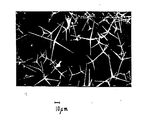
- the whisker particles have a tetrapod-shaped structure as is particularly shown in the sole figure, from which the inherent shape and dimension of the whisker will be clearly seen.
- the ZnO whiskers may contain those whiskers which have three, two or one needle crystal. These whiskers are considered to result from breakage of part of the needle crystals of the tetrapod-shaped ZnO whiskers.
- the whisker particles which have been partly broken and the broken needle crystals are both useful in the present invention.
- the X-ray diffraction analysis of the whiskers reveals that all the peaks correspond to those of ZnO.
- the electron beam diffraction analysis indicates that the whiskers exhibit complete single crystallinity with a reduced degree of transformation and lattice defects.
- the content of impurities is very small and the results of atomic absorption spectroscopy reveal that the content of ZnO is 99.98%.
- a whisker product wherein a major proportion, e.g. not less than 80 wt%, of the ZnO whisker particles have needle crystal portions whose length of from the basal part to the tip is smaller than 3 micrometers is not favorable.
- a major proportiont e.g. not less than 80 wt%, of the whisker particles should preferably have a length of the needle crystal portion, of not less than 3 micrometers.
- the soundproofing material of the invention may be used in various forms.
- the ZnO whisker particles may be used in the form of a powder, in a deposited state or in a sintered state, or may be held on or in various types of supports.
- the ZnO whisker powder may be encased or contained in containers or bags made of woven or non-woven fabrics, ceramics, glass, resins, rubbers, concrete, mortar, wax, semi-solid gels, foamed materials and the like. Alternatively, the powder may be covered with those materials mentioned above in a desired fashion.
- the ZnO whisker powder in deposited state includes a whisker paper fabricated according to a paper-making technique or a filter cake of ZnO whisker obtained according to a wet filtration procedure (vacuum filtration).
- a whisker paper fabricated according to a paper-making technique or a filter cake of ZnO whisker obtained according to a wet filtration procedure (vacuum filtration).
- inorganic or organic binders may be used in combination in order to impart high mechanical strength to the sheet or filter cake.
- the ZnO whisker powder, whisker paper or filter cake mentioned above may be sintered at an appropriate temperature of from 500 to 1600°C while or after pressing at an appropriate pressure, thereby obtaining a sintered product.
- Sintering aids ordinarily used for this purpose may be appropriately used. Examples of such sintering aids include Al(NO3)3 ⁇ 9H2O, LiCO3, SbCl3, MnCl2 ⁇ 4H2O, Bi2O3, CoCl2 ⁇ 6H2O, CrCl3 ⁇ 6H2O and the like.
- the pressure is not critical and the whisker product is generally pressed at a pressure of from 1 to 2000 kg/cm2, preferably from 10 to 400 kg/cm2.
- the whisker powder may be used in combination with other various support materials by incorporation or dispersion of the powder in the support materials or by supporting the whisker powder in fibers or meshworks.
- support materials include, for example, metals or alloys, various natural or synthetic resins or rubbers, inorganic materials, concrete or mortar, waxes, semi-solid gels or pastes, and foamed plastic materials. This is more particularly described.
- support material is intended to mean a material which is capable of supporting the whisker powder by incorporation or dispersion in the material or capable of spatially supporting the powder such as in spaces of fibers or meshworks.
- whisker powder or particles may be placed between metal plates such as vibration-damping steel plates, or may be dispersed in metal matrices or may be dispersed in metallic powder.
- the whisker powder may be dispersed in various resins and molded or shaped as a sheet, plate, block or board for use as a soundproofing material.
- the resins may be thermoplastic or thermosetting in nature.
- examples of the thermosetting resin include various epoxy resins, unsaturated polyester resins, urethane resins, silicone resins, melamine-urea resins, phenolic resins, and blends or resin alloys thereof.
- thermoplastic resins are not critical in kind and include, for example, polyvinyl chloride, polyethylene, chlorinated polyethylene, polypropylene, polyethylene terephthalate, polybutylene terephthalate, polyamides, polysulfones, polyether imides, polyether sulfones, polyphenylene sulfides, polyether ketones, polyethyer ether ketones, ABS resins, polystyrene, polybutadiene, polymethylmethacrylate, polyacrylnitrile, polyacetals, polycarbonates, polyphenylene oxide, ethylene-vinyl acetate copolymers, polyvinyl acetate, ethylene-tetrafluoroethylene copolymer, aromatic polyesters, polyvinyl fluoride, polyvinylidene fluoride, polyvinylidene chloride, teflons, and blends or alloys thereof.
- the tetrapod-shaped ZnO whisker powder should preferably be kept as it is in the resin.
- a variety of methods which have been conventionally employed for such purposes may be used. Mixing, kneading, extruding and molding procedures wherein stress or shear force against the ZnO whisker is reduced to an extent as small as possible should be used.
- a preferred method is that the ZnO whisker powder is mixed with a liquid thermosetting resin, such as an epoxy resin, an unsaturated polyester resin, a urethane resin or a silicone resin, having a relatively low viscosity, followed by molding and curing.
- resins may be dissolved in an appropriate solvent to obtain a solution with a low viscosity, to which the ZnO whisker powder is added, followed by evaporation of the solvent to obtain a whisker-dispersed resin sheet or the like articles.
- a fine powder of resin having a size of several micrometers to seven tens micrometers and the ZnO whisker powder are mixed, which is heated or dissolved in solvent to cause the powder to be uniformly dispersed in the resin.
- dispersions of finely divided polyethylene in water and various polyner emulsions may be used.
- Rubber materials such as natural and synthetic rubbers or elastomers may also be used as a support material.
- Such rubber materials used in the present invention are those which should not adversely influence the ZnO whisker powder and should preferably have good soundproofing characteristics. In this sense, polyurethane rubbers are most preferably used.
- acrylic rubbers, silicone rubbers, butadiene rubbers, isobutylene rubbers, polyether rubbers, isobutylene-isoprene copolymers and isocyanate rubbers are preferably used.
- nitrile rubbers, chloroprene rubbers, chlorosulfonated polyethylene, polysulfide rubbers and fluorine rubbers may be used.
- solutions of natural rubbers in solvents may also be used.
- the breakage of the whisker should be suppressed to a minimum by the procedures set out with respect to the resin supports.
- resins or rubbers when used as a support material, such resins or rubbers may be in the form of paints. Paints of epoxy resins, acrylic resins, urethane resins and the like are readily available and are, in fact, useful for dispersing the whisker powder therein thereby giving a soundproofing thick film with a high heat resistance and good weatherability.
- the whisker powder may be dispersed in various inorganic solid materials in the form of powder, fibers, flakes, granules and the like thereby forming soundproofing mixtures. These mixtures may be used by incorporation in suitable containers or by placing them in spaces requiring soundproofing.
- the whisker powder may be dispersed in powders or enamels of various ceramics and glasses.
- the whisker powder may be mixed with clay, glass fibers, asbestos, mica, sand and the like to obtain soundproofing powder mixtures or fiber materials such as woven or non-woven fabrics.
- whisker powder is dispersed in cements or mortars, building materials having soundproofing properties can be obtained.
- the whisker powder may be dispersed in or mixed with waxes such as paraffin wax, polyethylene wax, microcrystalline wax and the like.
- the whisker powder may be dispersed or supported in gel-like semi-solid materials such as agar-agar or gelatin, or in highly viscous materials such as pastes of natural or synthetic polymeric or high molecular weight substances, rubber pastes, highly viscous polybutene, and the like.
- the whisker powder may be supported in foamed materials such as polyurethane foams, epoxy resin foams or styrene foams.
- foamed materials such as polyurethane foams, epoxy resin foams or styrene foams.
- urethane foams are the best, followed by the epoxy resin foams and then the styrene foams.
- the greatest effect is expected when the whisker powder supported or dispersed in the various support materials or matrices is used as keeping the tetrapod shape.
- the tetrapod-shaped whisker powder may be partly or even wholly broken during working operations to such an extent that simple needle crystals are formed. Even in this state, good soundproofing effects will be expected.
- the whisker powder should preferably be used in amounts of not less than 1 wt% of the total of the whisker powder and the support or matrix material, within which soundproofing properties are significantly improved. More preferably, the amount should be not less than 5 wt%. A great soundproofing effect can be achieved only in very small amounts of the whisker powder.
- the combination with other fillers is very advantageous from the standpoint of costs and productivity, especially when the whisker powder is dispersed in resins, rubbers and the like materials.
- particulate fillers include metallic powders such as iron, nickel, stainless steel and the like, ferrite powder, calcium carbonate, carbon black, aluminium silicate, and beads and microballons of various types of materials.
- Flaky fillers include, for example, metallic flakes such as aluminum flakes, mica, talc, glass flakes and the like.
- Fibrous fillers include, for example, metallic fibers such as iron, stainless steel and the like, mineral fibers, gypsum fibers, carbon fibers, glass fibers, wollastronite fibers, SiC fibers, boron fibers, potassium titanate whisker, SiC whisker, and the like.
- fillers may be used singly or in combination.
- the mixing ratio of the ZnO whisker in the total of the ZnO whisker and the fillers is not less than 1 wt%, preferably not less than 10 wt%.
- the range of frequency for which the soundproofing material of the invention is suitably used covers from a sound with a very low frequency to a supersonic wave.
- the soundproofing material is particularly effective for sounds and vibrations having on audible range of from 10 Hz to 20 KHz, preferably from 100 Hz to 10 KHz, more preferably from 300 Hz to 5 Hz.
- Tetrapod-shaped ZnO whisker powder (having a needle crystal length of 100 to 200 micrometers) was filled in a cloth bag to make a soundproofing mat having a thickness of 10 cm, a width of 1 meter and a length of 1 meter. The bulk density was 0.06 g/cc.
- Six soundproofing mats were combined to give a hollow cubic assembly used to check a soundproofing effect. At the center of the cubic sample was provided a sound-generating source and a soundproofing effect was measured at a position of 1 m away from the sound-generating source and at 50 cm from the floor. The frequency being measured was 400 Hz with the results shown in Table 1.
- Tetrapod-shaped ZnO whisker powder having an average length of needle crystals ranging from the basal part to the tip of 20 micrometers, an average diameter of the basal part of 0.7 micrometers and a bulk density of 0.09 were mixed with a polyamide (6-nylon) resin in an amount of 30 wt% of the mixture and injection molded to obtain a 3 mm thick plate.
- This plate was subjected to a vibration-damping test at 4 KHz to evaluate a loss coefficient at 20°C.
- the vibration-damping property of -13 dB as compared with a filler-free polyamide resin was obtained.
- Example 2 ZnO whisker powder as used in Example 2 and other fillers were mixed and dispersed in a polyamide (6-nylon) resin in amounts indicated in Table 2, followed by the procedure of Example 2 to obtain plates. The respective plates were subjected to measurement of vibration-damping with the results shown in Table 2.
- the ZnO whisker powder has good vibration-damping properties.
- the electrophotographic observation in section of the resin plate revealed that the remaining rate of the tetrapod-shaped whisker is about 4% on average and most whisker particles suffer breakage into simple needle whiskers.
- Tetrapod-shaped ZnO whisker powder having an average length of needle crystals ranging from the basal part to the tip of 50 to 150 micrometers, an average diameter of the basal part of 3 to 8 micrometers and a bulk density of 0.04 was formulated in a solvent-free epoxy resin paint in an amount of 5 wt% based on the total solid, followed by application onto a 2 mm thick iron plate in a wet thickness of 400 micrometers, drying and curing.
- the vibration-damping effect (loss coefficient at 20°C) of -10 dB at 500 Hz was achieved.
- Soundproofing materials consisting essentially of zinc oxide whisker particles having a nucleus body and needle crystal portions extending radially from the central body in different plural directions.
- the materials may comprise a support material for supporting the zinc oxide whisker particles.
- support materials include inorganic materials such as metals, ceramics, glasses, cements, mortars and various fillers in the form of powder, flakes, fibers and the like, and organic materials such as resins, rubbers, waxes and the like. These materials are particularly suitable for sound insulation, sound proofing, vibration damping and vibration insulation.
Landscapes
- Chemical & Material Sciences (AREA)
- Engineering & Computer Science (AREA)
- Ceramic Engineering (AREA)
- Organic Chemistry (AREA)
- Materials Engineering (AREA)
- Structural Engineering (AREA)
- Civil Engineering (AREA)
- Architecture (AREA)
- Chemical Kinetics & Catalysis (AREA)
- Nanotechnology (AREA)
- Mechanical Engineering (AREA)
- Health & Medical Sciences (AREA)
- Metallurgy (AREA)
- Medicinal Chemistry (AREA)
- Polymers & Plastics (AREA)
- Manufacturing & Machinery (AREA)
- Compositions Of Macromolecular Compounds (AREA)
- Vibration Prevention Devices (AREA)
- Soundproofing, Sound Blocking, And Sound Damping (AREA)
- Inorganic Compounds Of Heavy Metals (AREA)
- Shielding Devices Or Components To Electric Or Magnetic Fields (AREA)
Applications Claiming Priority (2)
| Application Number | Priority Date | Filing Date | Title |
|---|---|---|---|
| JP32100488 | 1988-12-19 | ||
| JP321004/88 | 1988-12-19 |
Publications (3)
| Publication Number | Publication Date |
|---|---|
| EP0374855A2 true EP0374855A2 (fr) | 1990-06-27 |
| EP0374855A3 EP0374855A3 (en) | 1990-12-27 |
| EP0374855B1 EP0374855B1 (fr) | 1996-05-15 |
Family
ID=18127714
Family Applications (1)
| Application Number | Title | Priority Date | Filing Date |
|---|---|---|---|
| EP89123491A Expired - Lifetime EP0374855B1 (fr) | 1988-12-19 | 1989-12-19 | Matériaux isolants acoustiques |
Country Status (5)
| Country | Link |
|---|---|
| US (2) | US5164260A (fr) |
| EP (1) | EP0374855B1 (fr) |
| KR (1) | KR920003021B1 (fr) |
| CA (1) | CA2005746C (fr) |
| DE (1) | DE68926494T2 (fr) |
Cited By (4)
| Publication number | Priority date | Publication date | Assignee | Title |
|---|---|---|---|---|
| EP0379746A3 (fr) * | 1988-11-30 | 1992-04-01 | Nippon Paint Co., Ltd. | Composition de revêtement contenant des trichites d'oxyde de zinc de type tétrapode |
| EP0851402A3 (fr) * | 1996-12-26 | 2000-12-20 | Ishikawajima-Harima Heavy Industries Co., Ltd. | Absorbeur acoustique léger à céramique et procédé de son fabrication |
| EP3024795A4 (fr) * | 2013-07-29 | 2017-04-12 | Seels Technology Pty Ltd | Matériau structural composite, et agrégat à destiné à ce matériau |
| US10071912B2 (en) | 2012-12-12 | 2018-09-11 | Tutech Innovation Gmbh Patentverwertungsagentur | Carbon nanomaterial |
Families Citing this family (38)
| Publication number | Priority date | Publication date | Assignee | Title |
|---|---|---|---|---|
| EP0374795B1 (fr) * | 1988-12-19 | 1995-10-18 | Matsushita Electric Industrial Co., Ltd. | Matériau absorbant pour ondes radioélectriques |
| JP2677870B2 (ja) * | 1989-07-13 | 1997-11-17 | ソニー株式会社 | 音響振動材料 |
| US5304415A (en) * | 1991-04-15 | 1994-04-19 | Matsushita Electric Works, Ltd. | Sound absorptive material |
| US5262232A (en) * | 1992-01-22 | 1993-11-16 | Minnesota Mining And Manufacturing Company | Vibration damping constructions using acrylate-containing damping materials |
| JPH07316546A (ja) * | 1994-05-23 | 1995-12-05 | Matsushita Electric Ind Co Ltd | 撥水表面構造及びその形成方法 |
| US5526324A (en) * | 1995-08-16 | 1996-06-11 | Poiesis Research, Inc. | Acoustic absorption and damping material with piezoelectric energy dissipation |
| JP3123431B2 (ja) * | 1996-06-03 | 2001-01-09 | 株式会社村田製作所 | 圧電スピーカ |
| US6130951A (en) * | 1997-04-28 | 2000-10-10 | Murata Manfacturing Co., Ltd. | Speaker having multiple sound bodies and multiple sound openings |
| GB9723148D0 (en) * | 1997-11-04 | 1998-01-07 | Eurotex Thermal Engineering Li | Sound muffling material and method of making thereof |
| WO1999024290A1 (fr) | 1997-11-12 | 1999-05-20 | Collins & Aikman Products Co. | Stratifie antivibrations |
| US6110985A (en) * | 1998-10-30 | 2000-08-29 | Soundwich, Inc. | Constrained layer damping compositions |
| IT1316041B1 (it) * | 2000-12-22 | 2003-03-26 | Umbra Cuscinetti Spa | Albero a vite per circolazione di sfere con aumentata frequenza divibrazione e migliorata dissipazione delle vibrazioni. |
| US7585559B2 (en) * | 2003-06-03 | 2009-09-08 | Intellectual Property Holdings, Llc | Foam barrier heat shield |
| KR100501682B1 (ko) * | 2003-06-20 | 2005-07-18 | 현대자동차주식회사 | 연료전지용 가스켓 및 그 제조방법 |
| US7748184B1 (en) * | 2005-02-09 | 2010-07-06 | Intellectual Property Holdings, Llc | Body panel having improved stiffness and method of making |
| EP1726556B1 (fr) * | 2005-05-25 | 2010-06-23 | Inventio Ag | Ascenseur comprenant un dispositif de réduction de bruit |
| WO2007053571A2 (fr) * | 2005-11-01 | 2007-05-10 | Techfilm, Llc | Materiau d'interface thermique avec garnissages conducteurs de chaleur a granulometrie multiple |
| US8017308B2 (en) * | 2006-08-11 | 2011-09-13 | Battelle Memorial Institute | Patterning non-planar surfaces |
| US7799840B2 (en) | 2006-09-12 | 2010-09-21 | Intellectual Property Holdings, Llc | Thermoplastic vibrational damper with constraining layer |
| US20090277593A1 (en) * | 2008-05-09 | 2009-11-12 | Stewart Grant W | Acoustic window shade |
| JP4171038B2 (ja) * | 2006-10-31 | 2008-10-22 | 株式会社東芝 | 超音波プローブおよび超音波診断装置 |
| JP5028075B2 (ja) * | 2006-12-04 | 2012-09-19 | キヤノン株式会社 | 撮像装置及び撮像方法 |
| CN101423618B (zh) * | 2008-12-19 | 2011-05-11 | 中国航空工业第一集团公司北京航空材料研究院 | 一种刚性三维晶须层间改性连续纤维复合材料的制备方法 |
| US7981222B2 (en) * | 2009-01-27 | 2011-07-19 | Electrolux Home Prducts, Inc. | Dishwasher having sound attenuating structures |
| US20110232701A1 (en) * | 2009-01-27 | 2011-09-29 | Electrolux Home Products, Inc. | Mastic-less dishwasher providing increasing energy efficiency and including a recyclable and reclaimable tub |
| WO2010118358A2 (fr) * | 2009-04-10 | 2010-10-14 | Saint-Gobain Performance Plastics Corporation | Compositions d'amortissement acoustique |
| TWI504655B (zh) * | 2009-04-10 | 2015-10-21 | Saint Gobain Performance Plast | 含有彈性體微粒之聲阻尼組合物 |
| DE102010012385B4 (de) * | 2010-03-22 | 2012-12-06 | Christian-Albrechts-Universität Zu Kiel | Verfahren zur Erzeugung eines elastischen Materials mit einem auf Partikelebene durch Nanobrücken zwischen Partikeln überbrückten Porenraum |
| CN101899708B (zh) * | 2010-07-23 | 2012-02-01 | 北京航空航天大学 | 一种四角状氧化锌/铁氧体薄膜材料及其制备方法 |
| FR3028447B1 (fr) * | 2014-11-14 | 2017-01-06 | Hutchinson | Panneau composite a matrice thermodurcissable cellulaire, procede de fabrication et structure de revetement de paroi formee d'un assemblage de panneaux. |
| CN104844778B (zh) * | 2015-05-05 | 2018-01-09 | 中科院广州化学有限公司 | 一种有机硅和四针状氧化锌双重改性的聚酯型水性聚氨酯分散体及制备和应用 |
| CN105175908A (zh) * | 2015-08-14 | 2015-12-23 | 芜湖真空科技有限公司 | Low-e玻璃用夹层材料及其制备方法和应用 |
| CN105671463A (zh) * | 2016-02-01 | 2016-06-15 | 东莞品派实业投资有限公司 | 一种四针状氧化锌晶须增强铝合金轮毂及其制备方法 |
| US11167999B2 (en) * | 2018-02-22 | 2021-11-09 | The Regents Of The University Of Michigan | Biomimetic composite materials for vibration isolation |
| US11052633B2 (en) * | 2018-05-17 | 2021-07-06 | Safran Cabin Inc. | Honeycomb core with improved acoustic properties and method for making same |
| CN111849048B (zh) * | 2020-07-23 | 2022-04-12 | 陕西师范大学 | 一种金属粉-橡胶颗粒复合的声子材料、制备方法及应用 |
| CN113912924A (zh) * | 2021-11-05 | 2022-01-11 | 杭州老板电器股份有限公司 | 复合降噪材料及其制备方法、设备壳体和设备 |
| CN115109468B (zh) * | 2022-08-03 | 2023-09-08 | 浙江工业大学 | 一种多功能水性阻尼涂料及其制备方法 |
Family Cites Families (18)
| Publication number | Priority date | Publication date | Assignee | Title |
|---|---|---|---|---|
| US1984190A (en) * | 1928-07-27 | 1934-12-11 | Banner Rock Corp | Mineral fiber soundproof panel |
| US2052517A (en) * | 1930-07-10 | 1936-08-25 | United States Gypsum Co | Acoustic corrective material |
| US2177393A (en) * | 1937-06-08 | 1939-10-24 | Johns Manville | Sound absorbing structure |
| US2331599A (en) * | 1939-07-26 | 1943-10-12 | New Jersey Zinc Co | Manufacture of zinc oxide |
| US2668123A (en) * | 1948-09-25 | 1954-02-02 | Certain Teed Prod Corp | Method of producing acoustical tile |
| US2694025A (en) * | 1951-06-27 | 1954-11-09 | Owens Corning Fiberglass Corp | Structural panel |
| US3313076A (en) * | 1963-12-19 | 1967-04-11 | Owens Corning Fiberglass Corp | Suspension system for ceilings |
| US3396070A (en) * | 1964-02-28 | 1968-08-06 | Owens Corning Fiberglass Corp | Automobile headliner |
| US3470977A (en) * | 1968-02-21 | 1969-10-07 | Owens Corning Fiberglass Corp | Fire resistant glass fiberboard and method of making same |
| US3706601A (en) * | 1970-01-28 | 1972-12-19 | Mc Donnell Douglas Corp | Method of producing an electrode with a polymer binder by rolling |
| US3915917A (en) * | 1971-01-08 | 1975-10-28 | Tile Council Of America | Mortar compositions |
| US3782495A (en) * | 1972-06-08 | 1974-01-01 | M Nassof | Ceiling tile |
| JPS55118940A (en) * | 1979-03-08 | 1980-09-12 | Daiwa:Kk | Composite resin composition |
| JPS5938999B2 (ja) * | 1980-03-14 | 1984-09-20 | ニチアス株式会社 | ジヨイントシ−ト |
| US4452841A (en) * | 1982-12-20 | 1984-06-05 | The Goodyear Tire & Rubber Company | Unsupported shaped sound barrier component |
| JPS61117200A (ja) * | 1984-11-13 | 1986-06-04 | Alps Electric Co Ltd | 酸化テルルウイスカ−およびその製造方法 |
| KR920009567B1 (ko) * | 1987-12-29 | 1992-10-19 | 마쯔시다덴기산교 가부시기가이샤 | 산화아연위스커 및 그 제조방법 |
| DE68906740T2 (de) * | 1988-08-29 | 1993-12-16 | Matsushita Electric Ind Co Ltd | Metallische Zusammensetzung enthaltend Zinkoxyd-Whisker. |
-
1989
- 1989-12-18 CA CA002005746A patent/CA2005746C/fr not_active Expired - Fee Related
- 1989-12-19 KR KR1019890018886A patent/KR920003021B1/ko not_active Expired
- 1989-12-19 EP EP89123491A patent/EP0374855B1/fr not_active Expired - Lifetime
- 1989-12-19 US US07/452,441 patent/US5164260A/en not_active Expired - Lifetime
- 1989-12-19 DE DE68926494T patent/DE68926494T2/de not_active Expired - Fee Related
-
1991
- 1991-12-17 US US07/809,623 patent/US5318837A/en not_active Expired - Fee Related
Cited By (5)
| Publication number | Priority date | Publication date | Assignee | Title |
|---|---|---|---|---|
| EP0379746A3 (fr) * | 1988-11-30 | 1992-04-01 | Nippon Paint Co., Ltd. | Composition de revêtement contenant des trichites d'oxyde de zinc de type tétrapode |
| EP0851402A3 (fr) * | 1996-12-26 | 2000-12-20 | Ishikawajima-Harima Heavy Industries Co., Ltd. | Absorbeur acoustique léger à céramique et procédé de son fabrication |
| US10071912B2 (en) | 2012-12-12 | 2018-09-11 | Tutech Innovation Gmbh Patentverwertungsagentur | Carbon nanomaterial |
| EP3024795A4 (fr) * | 2013-07-29 | 2017-04-12 | Seels Technology Pty Ltd | Matériau structural composite, et agrégat à destiné à ce matériau |
| US11718560B2 (en) | 2013-07-29 | 2023-08-08 | Seels Technology Pty Ltd | Composite structural material and aggregate therefor |
Also Published As
| Publication number | Publication date |
|---|---|
| US5318837A (en) | 1994-06-07 |
| EP0374855A3 (en) | 1990-12-27 |
| US5164260A (en) | 1992-11-17 |
| KR900009478A (ko) | 1990-07-04 |
| DE68926494D1 (de) | 1996-06-20 |
| EP0374855B1 (fr) | 1996-05-15 |
| CA2005746C (fr) | 1994-05-31 |
| KR920003021B1 (ko) | 1992-04-13 |
| CA2005746A1 (fr) | 1990-06-19 |
| DE68926494T2 (de) | 1996-10-31 |
Similar Documents
| Publication | Publication Date | Title |
|---|---|---|
| EP0374855B1 (fr) | Matériaux isolants acoustiques | |
| US4447345A (en) | Thermal insulating flexible ceramic containing flame hydrolysis produced microporous oxide aerogel | |
| CA2139288A1 (fr) | Attenuateurs acoustiques perfores | |
| US3056707A (en) | Sound deadener and absorber | |
| US3510392A (en) | Glass nodules in cellular polyurethane | |
| EP0375391A1 (fr) | Catalyseur pour éliminer des oxydes d'azote et méthode pour sa production | |
| US5505870A (en) | Piezoelectric ceramic-polymer composite material and method for preparing the same | |
| WO2011005535A1 (fr) | Composites céramique-polymère | |
| JP4375987B2 (ja) | 電波吸収体用成型体およびその製造方法、ならびに電波吸収体 | |
| Gebhardt et al. | Fine scale 1-3 composites fabricated by the soft mold process: preparation and modeling | |
| JPH054312A (ja) | 制振複合体及びその製造方法 | |
| US6002196A (en) | Piezoelectric dispersion type organic damping composite | |
| KR100241481B1 (ko) | 도전성 흑연 시멘트판 및 그 제조 방법 | |
| JPH03188165A (ja) | エネルギー変換性組成物 | |
| US4874727A (en) | Particulate lead titanate ceramic and composite material containing same | |
| Saini et al. | Dynamic mechanical properties of highly loaded ferrite‐filled thermoplastic elastomer | |
| JP3105122B2 (ja) | 吸音性複合成形体およびその製法 | |
| EP3511153A1 (fr) | Matériau composite renforcé par des fibres poreuses, et procédé pour sa préparation | |
| JPS6123648A (ja) | 耐熱性制振材 | |
| US4743392A (en) | Piezoelectric composite material | |
| CA1305283C (fr) | Materiau composite | |
| JPS6117783B2 (fr) | ||
| JP2624329B2 (ja) | 珪酸カルシウム組成物 | |
| JPS621589B2 (fr) | ||
| JP2849783B2 (ja) | 制振体、制振複合体及びそれらの製造方法 |
Legal Events
| Date | Code | Title | Description |
|---|---|---|---|
| PUAI | Public reference made under article 153(3) epc to a published international application that has entered the european phase |
Free format text: ORIGINAL CODE: 0009012 |
|
| 17P | Request for examination filed |
Effective date: 19891219 |
|
| AK | Designated contracting states |
Kind code of ref document: A2 Designated state(s): DE FR GB IT NL SE |
|
| PUAL | Search report despatched |
Free format text: ORIGINAL CODE: 0009013 |
|
| AK | Designated contracting states |
Kind code of ref document: A3 Designated state(s): DE FR GB IT NL SE |
|
| 17Q | First examination report despatched |
Effective date: 19920715 |
|
| GRAH | Despatch of communication of intention to grant a patent |
Free format text: ORIGINAL CODE: EPIDOS IGRA |
|
| GRAA | (expected) grant |
Free format text: ORIGINAL CODE: 0009210 |
|
| AK | Designated contracting states |
Kind code of ref document: B1 Designated state(s): DE FR GB IT NL SE |
|
| ET | Fr: translation filed | ||
| REF | Corresponds to: |
Ref document number: 68926494 Country of ref document: DE Date of ref document: 19960620 |
|
| ITF | It: translation for a ep patent filed | ||
| PLBE | No opposition filed within time limit |
Free format text: ORIGINAL CODE: 0009261 |
|
| STAA | Information on the status of an ep patent application or granted ep patent |
Free format text: STATUS: NO OPPOSITION FILED WITHIN TIME LIMIT |
|
| 26N | No opposition filed | ||
| PGFP | Annual fee paid to national office [announced via postgrant information from national office to epo] |
Ref country code: FR Payment date: 19971209 Year of fee payment: 9 |
|
| PGFP | Annual fee paid to national office [announced via postgrant information from national office to epo] |
Ref country code: GB Payment date: 19971210 Year of fee payment: 9 |
|
| PGFP | Annual fee paid to national office [announced via postgrant information from national office to epo] |
Ref country code: SE Payment date: 19971218 Year of fee payment: 9 |
|
| PGFP | Annual fee paid to national office [announced via postgrant information from national office to epo] |
Ref country code: NL Payment date: 19971223 Year of fee payment: 9 |
|
| PGFP | Annual fee paid to national office [announced via postgrant information from national office to epo] |
Ref country code: DE Payment date: 19971230 Year of fee payment: 9 |
|
| PG25 | Lapsed in a contracting state [announced via postgrant information from national office to epo] |
Ref country code: GB Free format text: LAPSE BECAUSE OF NON-PAYMENT OF DUE FEES Effective date: 19981219 |
|
| PG25 | Lapsed in a contracting state [announced via postgrant information from national office to epo] |
Ref country code: SE Free format text: LAPSE BECAUSE OF NON-PAYMENT OF DUE FEES Effective date: 19981220 |
|
| PG25 | Lapsed in a contracting state [announced via postgrant information from national office to epo] |
Ref country code: NL Free format text: LAPSE BECAUSE OF NON-PAYMENT OF DUE FEES Effective date: 19990701 |
|
| GBPC | Gb: european patent ceased through non-payment of renewal fee |
Effective date: 19981219 |
|
| PG25 | Lapsed in a contracting state [announced via postgrant information from national office to epo] |
Ref country code: FR Free format text: LAPSE BECAUSE OF NON-PAYMENT OF DUE FEES Effective date: 19990831 |
|
| NLV4 | Nl: lapsed or anulled due to non-payment of the annual fee |
Effective date: 19990701 |
|
| REG | Reference to a national code |
Ref country code: FR Ref legal event code: ST |
|
| PG25 | Lapsed in a contracting state [announced via postgrant information from national office to epo] |
Ref country code: DE Free format text: LAPSE BECAUSE OF NON-PAYMENT OF DUE FEES Effective date: 19991001 |
|
| PG25 | Lapsed in a contracting state [announced via postgrant information from national office to epo] |
Ref country code: IT Free format text: LAPSE BECAUSE OF NON-PAYMENT OF DUE FEES;WARNING: LAPSES OF ITALIAN PATENTS WITH EFFECTIVE DATE BEFORE 2007 MAY HAVE OCCURRED AT ANY TIME BEFORE 2007. THE CORRECT EFFECTIVE DATE MAY BE DIFFERENT FROM THE ONE RECORDED. Effective date: 20051219 |