EP0374969A2 - Procédé pour réduire le dépôt de polymères dans des appareils de polymérisation d'alpha-oléfines - Google Patents
Procédé pour réduire le dépôt de polymères dans des appareils de polymérisation d'alpha-oléfines Download PDFInfo
- Publication number
- EP0374969A2 EP0374969A2 EP89123846A EP89123846A EP0374969A2 EP 0374969 A2 EP0374969 A2 EP 0374969A2 EP 89123846 A EP89123846 A EP 89123846A EP 89123846 A EP89123846 A EP 89123846A EP 0374969 A2 EP0374969 A2 EP 0374969A2
- Authority
- EP
- European Patent Office
- Prior art keywords
- coating
- tubes
- heat exchanger
- reactor
- amino silicone
- Prior art date
- Legal status (The legal status is an assumption and is not a legal conclusion. Google has not performed a legal analysis and makes no representation as to the accuracy of the status listed.)
- Granted
Links
Images
Classifications
-
- C—CHEMISTRY; METALLURGY
- C08—ORGANIC MACROMOLECULAR COMPOUNDS; THEIR PREPARATION OR CHEMICAL WORKING-UP; COMPOSITIONS BASED THEREON
- C08F—MACROMOLECULAR COMPOUNDS OBTAINED BY REACTIONS ONLY INVOLVING CARBON-TO-CARBON UNSATURATED BONDS
- C08F2/00—Processes of polymerisation
-
- C—CHEMISTRY; METALLURGY
- C08—ORGANIC MACROMOLECULAR COMPOUNDS; THEIR PREPARATION OR CHEMICAL WORKING-UP; COMPOSITIONS BASED THEREON
- C08F—MACROMOLECULAR COMPOUNDS OBTAINED BY REACTIONS ONLY INVOLVING CARBON-TO-CARBON UNSATURATED BONDS
- C08F2/00—Processes of polymerisation
- C08F2/002—Scale prevention in a polymerisation reactor or its auxiliary parts
- C08F2/004—Scale prevention in a polymerisation reactor or its auxiliary parts by a prior coating on the reactor walls
-
- B—PERFORMING OPERATIONS; TRANSPORTING
- B01—PHYSICAL OR CHEMICAL PROCESSES OR APPARATUS IN GENERAL
- B01J—CHEMICAL OR PHYSICAL PROCESSES, e.g. CATALYSIS OR COLLOID CHEMISTRY; THEIR RELEVANT APPARATUS
- B01J8/00—Chemical or physical processes in general, conducted in the presence of fluids and solid particles; Apparatus for such processes
- B01J8/18—Chemical or physical processes in general, conducted in the presence of fluids and solid particles; Apparatus for such processes with fluidised particles
- B01J8/24—Chemical or physical processes in general, conducted in the presence of fluids and solid particles; Apparatus for such processes with fluidised particles according to "fluidised-bed" technique
- B01J8/26—Chemical or physical processes in general, conducted in the presence of fluids and solid particles; Apparatus for such processes with fluidised particles according to "fluidised-bed" technique with two or more fluidised beds, e.g. reactor and regeneration installations
-
- C—CHEMISTRY; METALLURGY
- C08—ORGANIC MACROMOLECULAR COMPOUNDS; THEIR PREPARATION OR CHEMICAL WORKING-UP; COMPOSITIONS BASED THEREON
- C08F—MACROMOLECULAR COMPOUNDS OBTAINED BY REACTIONS ONLY INVOLVING CARBON-TO-CARBON UNSATURATED BONDS
- C08F10/00—Homopolymers and copolymers of unsaturated aliphatic hydrocarbons having only one carbon-to-carbon double bond
Definitions
- the invention relates to the polymerization of alpha-olefins such as ethylene and propylene. More particularly, the present invention relates to a process for reducing the rate of heat exchanger fouling during the polymerization of alpha-olefins, especially during the copolymerization of propylene with alpha-olefins such as ethylene.
- Polylene impact copolymers are polymers which are composed of a polypropylene homopolymer phase which is intimately mixed with one or more ethylene-propylene copolymer phases. This mixture results in a product which has good impact resistance and good stiffness.
- Impact copolymers are typically produced by two or more reactors in series.
- the first reactor typically produces polypropylene homopolymer which is then fed to a second reactor.
- the first reactor can be used to produce random copolymer which would then be fed to the second reactor.
- the reactant composition is varied such that copolymers with varying fractions of ethylene and propylene are produced in each reactor and intimately mixed with the polymer from the previous reactors.
- the reaction in the reactors which can be gas phase reactors is catalyzed by a transition metal catalyst.
- the transition metal is titanium.
- the equipment for producing propylene impact copolymers is conventional equipment such as two or more reactors, heat exchangers, compressors, discharge systems and piping connected to the various equipment.
- the present invention provides a method for the prevention of fouling of metallic surfaces exposed to reactive alpha-olefin gases during the production of polymeric resins which comprises coating said metallic surfaces with an amino silicone fluid of the general formula: wherein: each R is independently a lower alkyl of from 1 to 4 carbon atoms; A is an alkylene group having from 2 to 6 carbon atoms; and n is a number ranging from about 5 to about 600 preferably about 10 to about 500, and thereafter curing said coating by hydrolysis to form a continuous solid coating.
- amino silicone fluids which are useful according to the invention are those of the general formula: wherein: each R is independently a lower alkyl of from 1 to 4 carbon atoms; A is an alkylene group having from 2 to 6 carbon atoms; and n is a number ranging from about 5 to about 600 preferably about 10 to about 500.
- the preferred aminosilicone fluids useful in the practice of this invention are those of the formula: where n is as defined above. These amino silicone fluids are easily prepared by the reaction between a hydroxylterminated polymethylsiloxane and an appropriately substituted aminoalkyl trialkoxysilane, which in the case of the preferred aminosilicone fluids is amino propyl trimethoxysilane.
- the preferred aminosilicone fluids are available from several different commercial sources, among them being Union Carbide Corporation's product called UCAR Fluid AFL-40.
- amino silicone fluids employed in the practice of this invention all have terminal alkoxy, preferably methoxy groups, which are readily hydrolysable forming silanol groups which can then condense or cross-link to form a continuous solid coating on the metallic surfaces treated with aminosilicone liquid.
- Recycled gas is preferably routed inside the heat exchanger tubes and cooled water or other cooling media is outside the tubes.
- the amino silicone coating can be applied to the interior surfaces of the tubes of the heat exchanger in a variety of ways.
- the amino silicone can be sprayed, brushed, dipped, flooded and the like.
- a particularly preferred technique is to pull a soaked porous flexible material i.e., a material which has absorbed the amino silicone, through the tubes to be treated.
- the interior surfaces of tubes Prior to application of the coating material to the inner surfaces of the tubes of the heat exchanger, it is preferred that the interior surfaces of tubes be cleaned which can be accomplished by a variety of conventional techniques with hydroblasting being the preferred technique.
- the amino silicone is applied to the metallic surface in an appropriate solvent. It has been found that application of amino silicone diluted with about 50% of an appropriate solvent, such as hexane, provides acceptable interlayer adhesion and a potentially more uniform coating. Any solvent which is inert to the reaction which is to take place can be utilized such as isopentane, hexane, higher molecular weight alkane or mineral spirits.
- the amount of coating applied, or the thickness thereof, is not particularly critical. However, for economic reasons, as thin a coating as possible should be applied to the surfaces to be protected while still insuring complete coverage.
- other parts of the reaction system can if desired be coated, such as piping, compressor parts, reactor walls, baffles, agitator shaft and blades, heating coils, temperature probes, and the like. Suffice it to say that a sufficient amount of coating should be employed to obtain a continuous film over all interior surfaces of the heat exchanger tubes with no areas of said surfaces remaining unprotected.
- the coating can then be cured by passing moist air through the tubes for several hours while heating.
- the curing results from the fact that the amino silicone contains residual alkoxy groups e.g. methoxy groups which are subject to hydrolysis.
- the silanol groups produced by this reaction can then condense.
- the following generally depicts the reaction responsible for cross-linking the polymer containing methoxy groups;
- the reaction to be carried out in the equipment may be commenced immediately, no particular modification of processing techniques being required due to the presence of the coating.
- utilization of the internally coated tubes of the present invention does not adversely affect the heat stability or other physical and chemical properties of the polymers produced therein. Ordinary care should, of course, be exercised to avoid rough, physical contact with the coated surfaces because of the damage to the film which may result from such contacts.
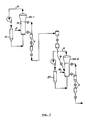
- two reactor systems of the type illustrated in Fig. 1 typically provide a catalyzed exothermic reaction (e.g, a fluidized bed 14) within a first reactor RX-1 for converting gaseous raw materials into solid product.
- the coating tubes of the heat exchanger can be cleaned if desired by hydroblasting as explained previously and the aminosilicone coating was applied to the internal surfaces of the tubes by a porous flexible materials.
- Raw materials such as propylene, ethylene, nitrogen, hydrogen, catalyst, cocatalyst and a selectivity control agent
- the heat of reaction is removed from the reactor RX-1 by circulating a stream of gaseous raw materials 12 through a cooler 10.
- Reaction temperature may be controlled by adjusting water flow in cooler 10 which removes heat from the circulating gas stream 12.
- Solid product in the form of polypropylene homopolymer or random copolymer containing active catalyst, is removed from reactor (RX-1) by periodically discharging a small portion of the fluidized bed 14 into a product discharge system 4.
- the second reactor (RX-2) of the two reactor system of Fig. 1 is designed to produce a copolymer of propylene and ethylene in intimate mixture with the solid homopolymer or random copolymer material produced by the first reactor (RX-1).
- the product stream 16 from the first reactor (RX-1) (including e.g., homopolymer and active catalyst) is fed to the second reactor (RX-2).
- Raw materials e.g., ethylene and propylene
- RX-2 to be polymerized by the still active catalyst in the homopolymer or random copolymer material within the reactor (RX-1) product stream 16.
- ethylene and propylene are copolymerized in intimate mixture with the propylene homopolymer or random copolymer to produce impact copolymer.
- the process is maintained by the addition of ingredients from RX-1 and input stream 18 and cooling is provided by the circulation of the gaseous stream 8 through a cooler 20.
- Typical objectives for the operation of a second or subsequent reactor RX-2 in a multi-reactor chain process such as shown in Fig. 1 include maintaining prescribed values for the fraction (hereinafter called "F c ”) of the final product (e.g., impact polypropylene) that is created in the second reactor and for the fraction (hereinafter called "E c ”) of ethylene contained in the copolymer fraction which is produced in reactor RX-2.
- F c the fraction of the final product
- E c fraction of ethylene contained in the copolymer fraction which is produced in reactor RX-2.
- F c (the fraction of total product that is created in the second reaction (RX-2) depends in general upon the combination of partial pressures of propylene (C3H6, hereinafter “C3”) and ethylene (C2H4), hereinafter "C2") that exist in the reaction system RX-2. With some catalyst systems, however, catalyst or cocatalyst may be added to the second reactor to control F c .
- E c (the fraction of ethylene that is incorporated in the copolymer produced in reactor RX-2) depends upon the relative partial pressures of ethylene and propylene.
- UCAR Fluid AFL-40 an amino silicone produced by Union Carbide Corporation UCON AW-32 a gear oil produced by Union Carbide Corporation Formula SIC-520 a phosphate containing detergent produced by Hunter Chemical Co. WO-1 a phosphoric acid based surfactant produced by Turco Products, Inc. Zonyl-FSP A fluorocarbon based surfactant produced by DuPont Co., Inc. Delaware Tetronic 304 and 504 Polyglycol amines produced by BASF-Wyandotte. AS-196 A liquid silicone type lubricating oil spray produced by Union Carbide Corporation. M-416 A liquid silicone spray mold release agent produced by IMS Blue Label.
- Impact copolymer polypropylene was produced in powder form in two gas phase fluidized bed reactors operated in series.
- a gas phase consisting of nitrogen was circulated prior to starting the polymerization.
- the gas was circulated by a cycle gas compressor through the tube side of a conventional shell and tube heat exchanger where heat was removed from the system.
- the insides of the heat exchanger tubes were cleaned prior to conducting the polymerization by hydroblasting and shell blasting to a smooth bare metal surface. No coating or treatment was applied. Four tubes were left uncleaned for comparison.
- Reaction was established by transferring homopolymer polypropylene containing active Ziegler-Natta polymerization catalyst from the first reactor to the second reactor; by feeding triethyl aluminum to the second reactor; and by establishing the proper concentration of ethylene, propylene, and hydrogen in the gas phase of the second reactor.
- Triethylaluminum feed rate and gas phase composition were adjusted to produce an impact copolymer product having and Ec (ethylene content of the copolymer) of approximately 60% and an F c (fraction copolymer) of approximately 18%.
- Ec ethylene content of the copolymer
- F c fraction copolymer
- the reactor was operated for 9 days producing impact copolymer with an F c of about 18%, one day with an F c of about 21% and three days with an F c of about 14.5%.
- the second reactor was shut down in order to switch the plant to the production of homopolymer polypropylene.
- the heat exchanger pressure drop had increased to 28 psi.
- the rate of pressure drop increase was 1.7 psi/day.
- Example 1 Prior to conducting a polymerization, the tube side of the heat exchanger of Example 1 was cleaned by hydroblasting. Before placing the reactor in operation, several tube surface treatments were applied:
- the reactor was started up as in Example 1 and operating conditions were adjusted to produce initially an impact copolymer product having an Ec of approximately 60% and an F c of approximately 18%.
- the heat exchanger pressure drop was 11.5 psi and the overall heat transfer coefficient was 220 Btu/hr. sq.ft.°F.
- the reactor was operated for 7 days producing 18% F c impact copolymer and 3 1/2 days producing 25% F c impact copolymer.
- the cooler tubes had thick (3/32 inch) film on them.
- the film was rough (almost blistery). Two of the cooler tubes were plugged.
- the tube side of the heat exchanger of Example 1 Prior to conducting a polymerization in the second reactor, the tube side of the heat exchanger of Example 1 was cleaned by hydroblasting. However, in this case, the tubes were coated with a phosphate-containing detergent solution (Hunter Chemical Company detergent formula SIC-520). The reactor was then placed in operation to produce impact copolymer with an F c of about 14.5% for 1 day, 18% F c for 4 days and 21% F c for 3 days. After operation for 8 days, the reactor was shut down due to high pressure drop across the heat exchanger which had increased to 50.4 psi (an average rise of 5.36 psi/day).
- a phosphate-containing detergent solution Hunter Chemical Company detergent formula SIC-520
- Example 1 Prior to conducting a polymerization in the second reactor, the tube side of the heat exchanger of Example 1 was cleaned by hydroblasting. The tubes were then treated with the phosphate containing detergent (SIC-520) mentioned in Example 3. However, in this case, the tubes were treated by circulating detergent solution through the tubes for 2 hours at 45°C. Four tubes were treated with another detergent, i.e., WO-1.
- SIC-520 phosphate containing detergent
- Tube inserts 3 feet long were designed to fit inside the heat exchanger tubes. Inserts were placed inside six tubes. The inserts were treated before insertion as follows: Insert Material Treatment Carbon Steel Zonyl-FSP (Fluoro Surfactant) Copper Nickel UCAR-AFL-40 (Amino Silicone) Copper-Nickel Amino-glycol (Tetronic 504) Carbon Steel WO-1 Stainless Steel Zonyl-FSP (Fluoro Surfactant) Copper-Nickel Amino-glycol (Tetronic 304)
- the reactor was then placed in operation to product impact-copolymer for 13.5 days, with 4.5 days on 14% F c products, 6.5 days on 18% F c product, and 2.5 days on 25% F c product.
- the reactor was then shut down in order to switch the plant to the production of homopolymer polypropylene.
- the heat exchanger pressure drop had increased to 34.5 psi (an average of 2.1 psi/day).
- the heat transfer coefficient decreased from about 210 Btu/hr. sq. ft. °F at the beginning of the run to about 110 Btu/hr. sq. ft. °F at the end of the run.
- the following was observed.
- Tube Inserts Treatment Appearance of Build-Up Amino glycol (Tetronic 304) Thin but rough coating Amino glycol (Tetronic 504) Thin but rough coating WO-1 Thin but rough coating Zonyl-FSP (Carbon Steel) Thin but rough coating Zonyl-FSP (Stainless Steel) Thin but rough coating Amino-silicone (UCAR-AFL-40) Clean (Shiny)
- the heat exchanger tubes treated with the detergent SIC-520 were found to have a thin but rough coating at the inlet of the tubes. The coating appeared to get thicker about 4 to 6 inch into tubes. The outlet end of the tubes had an irregular pattern of "beady" build-up with some visible clean spots.
- the four heat exchanger tubes swabbed with detergent WO-1 were found to have similar build-up at the tube inlet; however, the outlet of the tubes were found to be much more heavily fouled with a continuous, rough rubbery layer.
- Tube Insert Treatment (Material of Construction) Cu/Ni Treated with UCAR-AFL-40 (from previous example) Cu/Ni Control (no treatment) Cu/Ni Zonyl FSA (Fluoro Surfactant) Cu/Ni WO1 (surfactant) Cu/Ni UCAR-AFL-40 (amino silicone) CS UCAR-AFL-40 (amino silicone) CS SIC-520 (detergent) SS UCAR-AFL-40 (amino silicone)
- the reactor was started up as in Example 1 and operating conditions were adjusted to produce initially an impact copolymer with 14% F c for 7 days and 18% F c for another 4 days.
- the second reactor was then shutdown in order to switch the plant to the production of homopolymer polypropylene.
- the heat exchanger pressure drop increased to 22.7 psi (at an average of 1.4 psi/day).
- the overall heat transfer coefficient had dropped from 190 Btu/hr. sq. ft. °F to about 120 Btu/hr. sq. ft. °F at the end of the run.
- Tube inserts Treatment Appearance 1. Cu/Ni - Control Continuous build-up. Similar to untreated tubes. 2. Cu/Ni-WO1 Continuous build-up. Similar to control. 3. Cu/Ni-Zonyl FSP Similar to 1 & 2 above. 4. CS-SIC-520 Treated Similar to control. 5. Cu/Ni-UCAR-AFL-40 (treated in previous example) Thin build-up with streaks of clean areas Almost as coated as the control 6. Cu/Ni-UCAR-AFL-40 Treated Clean, shiny except for minor "beady" build-up in the middle. 7. SS-UCAR-AFL-40 Treated Partially clean on the ends. Some build-up in the middle. 8. CS-UCAR-AFL-40 Treated Had some build-up. It looked better than control.
- Example 1 Prior to conducting polymerization in the second reactor, the tube side of the heat exchanger of Example 1 was cleaned by hydroblasting. Approximately 2/3 of the tubes were then treated with UCAR-AFL-40 by either pulling a soaked squeegee or blowing it through the tube. The reactor was then started up as in Example 1 to make impact copolymer for 26 days (with 16 days on 14% F c , 7.5 days on 18-21% F c and 2.5 days on 25% F c ). The reactor was then shutdown in order to switch the plant to the production of homopolymer polypropylene. At this time the heat exchanger pressure drop increased to only 22.6 psi (at an average of only 0.56 psi/day). The overall heat transfer coefficient dropped from about 170 to about 100 Btu/hr. sq. ft. °F. Upon inspection of the heat exchanger tubes, the following was observed:
- the untreated tubes had a uniform coating similar to that of Example 1.
Landscapes
- Chemical & Material Sciences (AREA)
- Chemical Kinetics & Catalysis (AREA)
- Organic Chemistry (AREA)
- Health & Medical Sciences (AREA)
- Medicinal Chemistry (AREA)
- Polymers & Plastics (AREA)
- Engineering & Computer Science (AREA)
- Combustion & Propulsion (AREA)
- Addition Polymer Or Copolymer, Post-Treatments, Or Chemical Modifications (AREA)
- Polymerisation Methods In General (AREA)
Applications Claiming Priority (2)
| Application Number | Priority Date | Filing Date | Title |
|---|---|---|---|
| US07/289,266 US4956427A (en) | 1988-12-23 | 1988-12-23 | Process for reducing polymer build-up in polymerization equipment during polymerization of alpha-olefins |
| US289266 | 1988-12-23 |
Publications (3)
| Publication Number | Publication Date |
|---|---|
| EP0374969A2 true EP0374969A2 (fr) | 1990-06-27 |
| EP0374969A3 EP0374969A3 (fr) | 1991-08-28 |
| EP0374969B1 EP0374969B1 (fr) | 1994-08-10 |
Family
ID=23110779
Family Applications (1)
| Application Number | Title | Priority Date | Filing Date |
|---|---|---|---|
| EP89123846A Expired - Lifetime EP0374969B1 (fr) | 1988-12-23 | 1989-12-22 | Procédé pour réduire le dépôt de polymères dans des appareils de polymérisation d'alpha-oléfines |
Country Status (9)
| Country | Link |
|---|---|
| US (1) | US4956427A (fr) |
| EP (1) | EP0374969B1 (fr) |
| JP (1) | JPH02263802A (fr) |
| KR (1) | KR940006444B1 (fr) |
| AU (1) | AU615128B2 (fr) |
| BR (1) | BR8906728A (fr) |
| CA (1) | CA2006589A1 (fr) |
| DE (1) | DE68917441T2 (fr) |
| MY (1) | MY105881A (fr) |
Cited By (2)
| Publication number | Priority date | Publication date | Assignee | Title |
|---|---|---|---|---|
| EP0431626A1 (fr) * | 1989-12-07 | 1991-06-12 | Union Carbide Chemicals And Plastics Company, Inc. | Procédé pour réduire le dépôt de polymères dans des échangeurs de chaleur pendant la polymérisation d'alpha-oléfines |
| WO2004029098A1 (fr) * | 2002-09-27 | 2004-04-08 | Univation Technologies, Llc | Revetements de parois de reacteur et procedes appropries pour produire des revetements de ce type |
Families Citing this family (14)
| Publication number | Priority date | Publication date | Assignee | Title |
|---|---|---|---|---|
| US5421865A (en) * | 1993-10-29 | 1995-06-06 | United Technologies Corporation | Water based silicone coating compositions |
| US5416175A (en) * | 1993-12-17 | 1995-05-16 | Union Carbide Chemicals & Plastics Technology Corporation | Method for reducing sheeting during polymerization of α-olefins |
| US5733988A (en) * | 1994-06-29 | 1998-03-31 | Union Carbide Chemicals & Plastics Technology Corporation | Process for reducing polymer build-up in recycle lines and heat exchangers during polymerizations employing butadiene, isoprene, and/or styrene |
| DE69518423T2 (de) * | 1995-10-10 | 2000-12-14 | Bayer Ag | Kontinuierliches Verfahren zur Herstellung von sehr stabilen, feinstteiligen, niedrig viskösen Polymerpolyolen mit niedriger durchmittlicher Teilchengrösse |
| US5969061A (en) * | 1995-10-16 | 1999-10-19 | Eastman Chemical Company | Suppression of fines in a fluid bed polyethylene process |
| US7919561B2 (en) * | 1996-09-04 | 2011-04-05 | Exxonmobil Chemical Patents Inc. | Process of producing thermoplastic polymer blends |
| US6359083B1 (en) | 2000-05-02 | 2002-03-19 | Eastman Chemical Company | Olefin polymerization process |
| EP2089223A4 (fr) * | 2006-12-04 | 2010-04-14 | Univation Tech Llc | Revêtements semi-conducteurs pour un système de réaction de polyoléfines |
| US8124697B2 (en) * | 2008-02-27 | 2012-02-28 | Westlake Longview Corporation | Method of preventing or reducing agglomeration on grid in fluidized-bed vessel |
| US8129482B2 (en) * | 2008-02-27 | 2012-03-06 | Westlake Longview Corporation | Method of preventing or reducing polymer agglomeration on grid in fluidized-bed reactors |
| CN102015090B (zh) * | 2008-04-22 | 2014-03-12 | 尤尼威蒂恩技术有限公司 | 反应器系统和使用该反应器系统的方法 |
| KR101462466B1 (ko) | 2013-03-07 | 2014-11-17 | 대림산업 주식회사 | 올레핀의 중합 방법 |
| KR102018279B1 (ko) | 2017-03-23 | 2019-09-04 | 에스케이이노베이션 주식회사 | 파울링 방지제 및 이를 이용한 올레핀의 올리고머화 방법 |
| KR102284949B1 (ko) | 2017-06-16 | 2021-08-03 | 에스케이이노베이션 주식회사 | 파울링 방지방법 및 올레핀의 올리고머화 방법 |
Family Cites Families (8)
| Publication number | Priority date | Publication date | Assignee | Title |
|---|---|---|---|---|
| US3637570A (en) * | 1969-02-25 | 1972-01-25 | Us Air Force | Process for producing protective coating of siloxane resin and product produced |
| JPS5813564B2 (ja) * | 1976-07-30 | 1983-03-14 | 信越化学工業株式会社 | ジエン系単量体の重合方法 |
| JPS5341386A (en) * | 1976-09-28 | 1978-04-14 | Mitsubishi Chem Ind Ltd | Preparation of acrylamide polymer |
| JPS5950269B2 (ja) * | 1980-05-23 | 1984-12-07 | 住友軽金属工業株式会社 | 熱交換器の伝熱管内面防食用被覆組成物 |
| DE3149320A1 (de) * | 1981-12-12 | 1983-06-16 | Hoechst Ag, 6230 Frankfurt | Verfahren zur herstellung von vinylchlorid-polymerisaten |
| US4675368A (en) * | 1982-10-04 | 1987-06-23 | Solvay & Cie. | Process for inhibiting crust formation in reactors during alpha-olefin prepolymerization modification of Ziegler catalyst |
| JPS62273202A (ja) * | 1986-05-21 | 1987-11-27 | Kanegafuchi Chem Ind Co Ltd | スケ−ル防止剤の製法 |
| DE3751734T2 (de) * | 1986-07-22 | 1996-09-19 | Mitsubishi Chem Corp | Verfahren zur Herstellung von alpha-Olefin-Blockcopolymeren |
-
1988
- 1988-12-23 US US07/289,266 patent/US4956427A/en not_active Expired - Fee Related
-
1989
- 1989-12-22 DE DE68917441T patent/DE68917441T2/de not_active Expired - Fee Related
- 1989-12-22 KR KR1019890019219A patent/KR940006444B1/ko not_active Expired - Fee Related
- 1989-12-22 BR BR898906728A patent/BR8906728A/pt not_active Application Discontinuation
- 1989-12-22 EP EP89123846A patent/EP0374969B1/fr not_active Expired - Lifetime
- 1989-12-22 MY MYPI89001855A patent/MY105881A/en unknown
- 1989-12-22 JP JP1331480A patent/JPH02263802A/ja active Pending
- 1989-12-22 CA CA002006589A patent/CA2006589A1/fr not_active Abandoned
- 1989-12-22 AU AU47075/89A patent/AU615128B2/en not_active Ceased
Cited By (3)
| Publication number | Priority date | Publication date | Assignee | Title |
|---|---|---|---|---|
| EP0431626A1 (fr) * | 1989-12-07 | 1991-06-12 | Union Carbide Chemicals And Plastics Company, Inc. | Procédé pour réduire le dépôt de polymères dans des échangeurs de chaleur pendant la polymérisation d'alpha-oléfines |
| WO2004029098A1 (fr) * | 2002-09-27 | 2004-04-08 | Univation Technologies, Llc | Revetements de parois de reacteur et procedes appropries pour produire des revetements de ce type |
| US6870023B2 (en) | 2002-09-27 | 2005-03-22 | Exxonmobil Chemical Patents Inc. | Reactor wall coating and processes |
Also Published As
| Publication number | Publication date |
|---|---|
| JPH02263802A (ja) | 1990-10-26 |
| AU615128B2 (en) | 1991-09-19 |
| CA2006589A1 (fr) | 1990-06-23 |
| BR8906728A (pt) | 1990-09-11 |
| AU4707589A (en) | 1990-06-28 |
| DE68917441T2 (de) | 1994-12-08 |
| KR940006444B1 (ko) | 1994-07-20 |
| EP0374969B1 (fr) | 1994-08-10 |
| MY105881A (en) | 1995-02-28 |
| KR900009703A (ko) | 1990-07-05 |
| DE68917441D1 (de) | 1994-09-15 |
| EP0374969A3 (fr) | 1991-08-28 |
| US4956427A (en) | 1990-09-11 |
Similar Documents
| Publication | Publication Date | Title |
|---|---|---|
| EP0374969B1 (fr) | Procédé pour réduire le dépôt de polymères dans des appareils de polymérisation d'alpha-oléfines | |
| EP0431626B1 (fr) | Procédé pour réduire le dépôt de polymères dans des échangeurs de chaleur pendant la polymérisation d'alpha-oléfines | |
| AU694830B2 (en) | Method for preventing fouling in polymerization reactors | |
| EP0820474B1 (fr) | Procede pour prevenir l'encrassement et le depot de strates dans des reacteurs en phase gazeuse | |
| EP0889066B1 (fr) | Copolymères amorphes contenant de l'hexafluoropropène | |
| CN1332810A (zh) | 1-烯烃高压聚合反应器的涂覆方法 | |
| JPH05214007A (ja) | 耐衝撃性共重合体の製造方法 | |
| JP2908675B2 (ja) | オレフィン重合触媒用失活剤試薬 | |
| JPH07224109A (ja) | 残留モノマー除去処理法およびそれに用いる残留モノマー除去処理塔 | |
| CN118721502A (zh) | 一种聚烯烃弹性体粗品中挥发份的脱除方法 | |
| US5445743A (en) | Methacrylate polymers as antifoulants in quench water systems | |
| US7282544B2 (en) | Olefin polymerisation process in the presence of an anti-fouling agent | |
| FR2538397A1 (fr) | Procede continu de fabrication d'homopolymeres ou de copolymeres de l'ethylene | |
| US20230331641A1 (en) | Process For Production of Linear Alpha Olefins With Parallel Reactors | |
| EP4372016A1 (fr) | Procédé de polymérisation d'oléfines comprenant l'utilisation d'une composition antistatique | |
| US20060129007A1 (en) | Method of inhibiting coke formation in ethylene dichloride pyrolysis cracker | |
| US4673768A (en) | Separation of polymer from hydrocarbon solvent in the manufacture of polymers of ethylene | |
| JPS58104910A (ja) | ビニルクロライド重合体の製造方法 | |
| WO2025193268A1 (fr) | Procédé d'élimination d'encrassement chimique pour procédés de polymérisation | |
| CN116848153A (zh) | 用于减轻聚合物积垢的系统和方法 | |
| JPS6063205A (ja) | α−オレフィン重合用管式環状反応器 | |
| HK1023133A (en) | Methods and apparatus for removing residual monomers |
Legal Events
| Date | Code | Title | Description |
|---|---|---|---|
| PUAI | Public reference made under article 153(3) epc to a published international application that has entered the european phase |
Free format text: ORIGINAL CODE: 0009012 |
|
| AK | Designated contracting states |
Kind code of ref document: A2 Designated state(s): BE DE FR |
|
| 17P | Request for examination filed |
Effective date: 19901228 |
|
| PUAL | Search report despatched |
Free format text: ORIGINAL CODE: 0009013 |
|
| AK | Designated contracting states |
Kind code of ref document: A3 Designated state(s): BE DE FR |
|
| 17Q | First examination report despatched |
Effective date: 19930527 |
|
| GRAA | (expected) grant |
Free format text: ORIGINAL CODE: 0009210 |
|
| AK | Designated contracting states |
Kind code of ref document: B1 Designated state(s): BE DE FR |
|
| PGFP | Annual fee paid to national office [announced via postgrant information from national office to epo] |
Ref country code: DE Payment date: 19940913 Year of fee payment: 6 |
|
| REF | Corresponds to: |
Ref document number: 68917441 Country of ref document: DE Date of ref document: 19940915 |
|
| PGFP | Annual fee paid to national office [announced via postgrant information from national office to epo] |
Ref country code: FR Payment date: 19941004 Year of fee payment: 6 |
|
| ET | Fr: translation filed | ||
| PGFP | Annual fee paid to national office [announced via postgrant information from national office to epo] |
Ref country code: BE Payment date: 19941110 Year of fee payment: 6 |
|
| PLBE | No opposition filed within time limit |
Free format text: ORIGINAL CODE: 0009261 |
|
| STAA | Information on the status of an ep patent application or granted ep patent |
Free format text: STATUS: NO OPPOSITION FILED WITHIN TIME LIMIT |
|
| 26N | No opposition filed | ||
| PG25 | Lapsed in a contracting state [announced via postgrant information from national office to epo] |
Ref country code: BE Effective date: 19951231 |
|
| BERE | Be: lapsed |
Owner name: SHELL OIL CY Effective date: 19951231 Owner name: UNION CARBIDE CHEMICALS AND PLASTICS CY INC. Effective date: 19951231 |
|
| PG25 | Lapsed in a contracting state [announced via postgrant information from national office to epo] |
Ref country code: FR Effective date: 19960830 |
|
| PG25 | Lapsed in a contracting state [announced via postgrant information from national office to epo] |
Ref country code: DE Effective date: 19960903 |
|
| REG | Reference to a national code |
Ref country code: FR Ref legal event code: ST |