EP0376029A2 - Afficheur à cristal liquide pour la représentation noir/blanc - Google Patents
Afficheur à cristal liquide pour la représentation noir/blanc Download PDFInfo
- Publication number
- EP0376029A2 EP0376029A2 EP89122764A EP89122764A EP0376029A2 EP 0376029 A2 EP0376029 A2 EP 0376029A2 EP 89122764 A EP89122764 A EP 89122764A EP 89122764 A EP89122764 A EP 89122764A EP 0376029 A2 EP0376029 A2 EP 0376029A2
- Authority
- EP
- European Patent Office
- Prior art keywords
- display
- liquid crystal
- twist
- orientation
- layer
- Prior art date
- Legal status (The legal status is an assumption and is not a legal conclusion. Google has not performed a legal analysis and makes no representation as to the accuracy of the status listed.)
- Granted
Links
Images
Classifications
-
- G—PHYSICS
- G02—OPTICS
- G02F—OPTICAL DEVICES OR ARRANGEMENTS FOR THE CONTROL OF LIGHT BY MODIFICATION OF THE OPTICAL PROPERTIES OF THE MEDIA OF THE ELEMENTS INVOLVED THEREIN; NON-LINEAR OPTICS; FREQUENCY-CHANGING OF LIGHT; OPTICAL LOGIC ELEMENTS; OPTICAL ANALOGUE/DIGITAL CONVERTERS
- G02F1/00—Devices or arrangements for the control of the intensity, colour, phase, polarisation or direction of light arriving from an independent light source, e.g. switching, gating or modulating; Non-linear optics
- G02F1/01—Devices or arrangements for the control of the intensity, colour, phase, polarisation or direction of light arriving from an independent light source, e.g. switching, gating or modulating; Non-linear optics for the control of the intensity, phase, polarisation or colour
- G02F1/13—Devices or arrangements for the control of the intensity, colour, phase, polarisation or direction of light arriving from an independent light source, e.g. switching, gating or modulating; Non-linear optics for the control of the intensity, phase, polarisation or colour based on liquid crystals, e.g. single liquid crystal display cells
- G02F1/137—Devices or arrangements for the control of the intensity, colour, phase, polarisation or direction of light arriving from an independent light source, e.g. switching, gating or modulating; Non-linear optics for the control of the intensity, phase, polarisation or colour based on liquid crystals, e.g. single liquid crystal display cells characterised by the electro-optical or magneto-optical effect, e.g. field-induced phase transition, orientation effect, guest-host interaction or dynamic scattering
- G02F1/139—Devices or arrangements for the control of the intensity, colour, phase, polarisation or direction of light arriving from an independent light source, e.g. switching, gating or modulating; Non-linear optics for the control of the intensity, phase, polarisation or colour based on liquid crystals, e.g. single liquid crystal display cells characterised by the electro-optical or magneto-optical effect, e.g. field-induced phase transition, orientation effect, guest-host interaction or dynamic scattering based on orientation effects in which the liquid crystal remains transparent
- G02F1/1396—Devices or arrangements for the control of the intensity, colour, phase, polarisation or direction of light arriving from an independent light source, e.g. switching, gating or modulating; Non-linear optics for the control of the intensity, phase, polarisation or colour based on liquid crystals, e.g. single liquid crystal display cells characterised by the electro-optical or magneto-optical effect, e.g. field-induced phase transition, orientation effect, guest-host interaction or dynamic scattering based on orientation effects in which the liquid crystal remains transparent the liquid crystal being selectively controlled between a twisted state and a non-twisted state, e.g. TN-LC cell
- G02F1/1397—Devices or arrangements for the control of the intensity, colour, phase, polarisation or direction of light arriving from an independent light source, e.g. switching, gating or modulating; Non-linear optics for the control of the intensity, phase, polarisation or colour based on liquid crystals, e.g. single liquid crystal display cells characterised by the electro-optical or magneto-optical effect, e.g. field-induced phase transition, orientation effect, guest-host interaction or dynamic scattering based on orientation effects in which the liquid crystal remains transparent the liquid crystal being selectively controlled between a twisted state and a non-twisted state, e.g. TN-LC cell the twist being substantially higher than 90°, e.g. STN-, SBE-, OMI-LC cells
Definitions
- the invention relates to a liquid crystal display for black and white display. Strictly speaking, such displays are those for light / dark display, since with such displays not only white light but also colored light can be switched without a significant color shift.
- Liquid crystal displays for black and white display can be realized using various physical effects. Most of these displays use a liquid crystal cell which is arranged between two crossed polarizers and which contains a nematic liquid crystal which is twisted by means of orientation layers on the cell plates and by means of chiral doping. The most common display is the TN display. For him, the twist ⁇ is 90 ° and the product ⁇ of cell thickness d and anisotropy of the refractive index ⁇ n is over 1 ⁇ m. TN displays are cheap and easy to manufacture, have good contrast, but are difficult to multiplex.
- a simple STN cell has a twist of 240 ° and a value ⁇ of approximately 1 ⁇ m.
- the pretilt ⁇ ie the angle of attack of the molecules with respect to the neighboring cell plate, is only a few degrees.
- These cells are easy to multiplex, have less angular dependence of the contrast than TN cells, but are colored.
- two STN cells are connected in series with the opposite twist, creating a color-neutralized STN display with a double cell.
- color neutrality only exists within a very narrow viewing angle of around 10 °.
- a simple SBE cell is in the article by T. J. Scheffer and J. Nehring in Apple Phys. Let. 45 (10), 1984, pp. 1021-1023 under the title "A new highly multiplexable liquid crystal display".
- This cell also has a strong color, namely it appears yellow or blue. Therefore, to achieve color neutrality when using the Supertwisted Birefrigence Effect as well as with STN cells, two cells are connected in series with the opposite twist.
- Each individual SBE cell has a twist of 270 °, a pretilt> 5 ° and a ⁇ value of approximately 0.8 ⁇ m.
- the multiplexability and the angle dependence of contrast and color are even better than with STN double cells, but the production is considerably more difficult. In addition, despite the improved angle dependence of the color impression, this angle dependency is still unsatisfactory.
- STN and SBE cells work with polarizers that are rotated at 30 and 60 ° against the orientation directions.
- OMI displays have a very good white impression over a large angular range. However, the angle dependence of the contrast is unsatisfactory.
- OMI displays have cells with a twist of up to 210 ° and ⁇ values down to 0.4 ⁇ m, preferably 0.55 ⁇ m. Such cells are described in two articles by M. Schadt and F. Leenhouts under the title "Electro-optical performance of a new black-white and highly multiplexable liquid crystal display" in Apple Phys. Let. 50 (5) 1987, pp. 236-238 and under the title "The optical mode interference liquid crystal display: dependence on material and cell parameters" in SID 87 Digest, pp. 372-375.
- the liquid crystal display for black and white display according to the invention has a nematic liquid crystal layer with a twist of at least 240 ° between an upper and a lower cell plate.
- the cell thickness and the liquid crystal material are chosen so that the ⁇ value is not greater than about 0.6.
- the material of the orientation layer is chosen such that, in addition to the orientation of the liquid crystal molecules, it additionally causes a pretilt thereof of at least about 7 °.
- the ⁇ value is advantageously between 0.35 and 0.45, the twist is essentially 270 ° and the pretilt is at least about 10 °. Optimal multiplexability is achieved in the latter arrangement when the polarizers are rotated by approximately 45 ° with respect to the orientation directions.
- Displays according to the invention are characterized above all by an extraordinarily low angle dependence of contrast and white impression. Compared to cells with a similarly good angular dependence of the contrast, i.e. double STN or SBE cells, the almost non-existent win falls above all dependent on the white impression. Even with a very flat viewing angle, there is hardly any color change compared to looking at the display at right angles. Because of the very wide viewing angle range with a very constant impression, displays according to the invention were given the name "Extended Viewing Angle Display", abbreviated EVA display.
- pretilt For high optical homogeneity, it is advantageous to select the pretilt as high as possible. For a twist of 360 ° it should be stable at over 20 °. Such high twist angles can be achieved stably with obliquely evaporated SiO. For displays with a lower twist, however, it is advantageous to use polyphenylene as the material for the orientation and pretile layer, since this material can be coated with a conventional spin coat method, that is to say a method which is also used for applying other layers, e.g. B. of photoresist layers, is used during the manufacturing process of liquid crystal displays. With a very careful procedure, however, pretilt angles of up to 24 ° can also be achieved with polyphenylene.
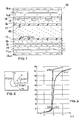
- FIG. 1 The cross section through an EVA display 10 according to FIG. 1 is not drawn to scale for the sake of clarity.
- An upper cell plate 11.o and a lower cell plate 11.u and a liquid crystal layer 12 with a comparable thickness are shown, although the thickness of the cell plates is approximately 1.1 mm, while the thickness of the liquid crystal layer is only approximately 4 ⁇ m.
- Each cell plate carries a polarizer on its side facing away from the liquid crystal layer 12, i. H. the upper cell plate 11.o carries an upper polarizer 13.o and the lower cell plate 11.u carries a lower polarizer 13.u. These two polarizers are crossed at 90 ° to each other and are at 45 ° to the orientation directions explained below. This is represented by arrows which point in the upper polarizer 13.o in the opposite direction to those in the lower polarizer 13.u.
- the two cell plates each carry four layers, firstly a barrier layer 14 made of SiO2, an electrode layer 15 with structured electrodes made of ITO, then an insulating layer 16 which, like the barrier layer 14, consists of SiO2 and finally an orientation layer 17 out Polyphenylene.
- the barrier layer 14 is a thin layer that is applied by the manufacturer of the ITO layer. It serves to prevent sodium ions from diffusing from the glass of the cell plates into the ITO.
- this barrier layer 14 reduces the diffusion of sodium ions to such an extent that the ITO layer does not suffer from it, so much sodium ion can still diffuse through that an important property of the polyphenylene of the orientation layer 17 suffers, namely the property of being able to set a high pretilt ⁇ .
- the insulating layer 16 is therefore present. This also contributes to the fact that there is good electrical insulation of the electrodes in the electrode layer 15 from the liquid crystal of the liquid crystal layer 12.
- Liquid crystal is a nematic material.
- the exemplary embodiment is the liquid crystal mixture 4940 from Hoffmann-La Roche with an anisotropy of the refractive index of approximately 0.094. 1.75% of the chiral doping material CB 15, also from Hoffmann-La Roche, is mixed into this liquid crystal.
- the thickness d of the liquid crystal layer is 4 ⁇ m.
- the result is 0.376.
- the polyphenylene layer forming the orientation layer 17 is rubbed with a velvet roller so that it causes not only the pretilt alia mentioned, but also an orientation of the liquid crystal molecules 18 adjacent to it.
- the orientation direction for the molecules 18 on the lower cell plate 11.u is designated in FIG. 2 with Mu, while the orientation direction on the upper cell plate 11.o is designated with Mo.
- the two directions are at right angles on each other. Between the two liquid boundaries, the molecules 18 of the liquid crystal layer 12 are rotated to the right, that is, in plan view, counterclockwise, twisted by the twist ⁇ of 270 °. However, this only applies as long as there is no drive voltage at the electrodes of the two electrode layers 15. If an electric field acts on the liquid crystals, they stand parallel to it, which eliminates the screw connection mentioned.
- a black / white effect is achieved with the help of the two polarizers 13.o and 13.u.
- the liquid crystal layer 12 converts linearly polarized light, as it enters it through one of the two polarizers, into circularly polarized light. As a result, light emerges through the other polarizer.
- the cell is activated, i. H. if the liquid crystal molecules 18 have risen in the electric field between the electrodes, the irradiated, linearly polarized light remains unchanged, which is why it is blocked by the other polarizer; the controlled areas accordingly appear dark.
- the light / dark contrast is approximately 10: 1 to 12: 1 when viewed at a right angle to the cell level.
- the color impression corresponds to a white with a very slight blue cast. This very good white impression remains essentially unchanged even when the display is viewed from a very flat angle.
- the very good contrast and white properties largely independent of the viewing angle, as already mentioned above, led to the name of the display (EVA Extended Viewing Angle).
- FIG. 3 shows the transmission-voltage characteristic curve for a display according to the exemplary embodiment of FIGS. 1 and 2.
- the maximum transmission is set to 100%. 10% transmission results at a control voltage of 2.8 V and 90% transmission at 2.95 V. According to the formula of Alt and Pleshko (see IEEE Trans. Electron Devices ED 21, 146, 1974, 146) this results in a Multiplex rate Nmax of 350, which means that at a refresh rate of 50 Hz, 350 lines can be controlled in multiplex mode, it being possible to switch each line between 10% and 90% transmission.
- Characteristic curves typically have a profile as it is recorded in FIG. 3 for an EVA display, which differs from that of the exemplary embodiment in that the polarization directions P1 and P2 lie parallel to the orientation directions, that is to say the angle ⁇ instead of 45 ° now Is 0 ° or 90 °.
- the multiplex rate for the display with polarizers arranged in this way is considerably worse than that for the display with the polarizers rotated by 45 ° with respect to the orientation directions.
- the twist is 360 ° instead of 270 °.
- the transmission increases with increasing twist and the dependence of the contrast on the viewing angle is reduced.
- the twist should therefore not be less than 240 °. Multiples of 90 ° are preferred because the contrast becomes optimal at these values, that is 270 ° and 360 °.
- the pretilt produced by the polyphenylene layer decreased by diffusing sodium ions below that which is required to stabilize homogeneous twist over the entire display area.
- the value ⁇ should not be greater than about 0.6 ⁇ m, since otherwise the deviation from a white color impression becomes too great. The smaller this value becomes, the less the display changes the color of the incident light. However, the transmission is getting worse. With a value ⁇ of 0.2 ⁇ m, the transmission is only about 1/4 of that of the described cell with an otherwise identical structure.
- the pretilt In order to stabilize a twist of 240 ° satisfactorily, the pretilt must be at least about 7 °. The higher it is, the less critical the display's sensitivity to changes in layer thickness or the effects of temperature becomes. It is known that vocalized textures can occur in twisted nematic liquid crystals if the ratio of layer thickness to pitch reaches unfavorable values to be determined experimentally.
- the pitch is the pitch that is achieved on a liquid crystal by a chiral dopant. Only so much chiral dopant is added that the pitch P is greater than the layer thickness d of the liquid crystal layer 12. The problem is that the pitch is temperature-dependent. The higher the pretilt, the larger the range of the quotient d / P can be without focal-cone textures. The display is then very stable against changes in thickness and temperature. With a twist of 270 °, the pretilt is preferably at least about 10 °; in the exemplary embodiment at about 15 °.
- a sodium-free glass e.g. a borosilicate glass or a quartz glass is used.
- the distance between the two cell plates is set in the usual way with the aid of spacers between the plates.
- the plates are held together by an adhesive edge made from a conventional adhesive.
Landscapes
- Physics & Mathematics (AREA)
- Nonlinear Science (AREA)
- Chemical & Material Sciences (AREA)
- Crystallography & Structural Chemistry (AREA)
- General Physics & Mathematics (AREA)
- Optics & Photonics (AREA)
- Liquid Crystal (AREA)
- Liquid Crystal Substances (AREA)
- Inks, Pencil-Leads, Or Crayons (AREA)
- Devices For Indicating Variable Information By Combining Individual Elements (AREA)
Applications Claiming Priority (2)
| Application Number | Priority Date | Filing Date | Title |
|---|---|---|---|
| DE3843767 | 1988-12-24 | ||
| DE3843767A DE3843767A1 (de) | 1988-12-24 | 1988-12-24 | Fluessigkristalldisplay fuer schwarz/weiss-darstellung |
Publications (3)
| Publication Number | Publication Date |
|---|---|
| EP0376029A2 true EP0376029A2 (fr) | 1990-07-04 |
| EP0376029A3 EP0376029A3 (en) | 1990-12-05 |
| EP0376029B1 EP0376029B1 (fr) | 1994-07-27 |
Family
ID=6370166
Family Applications (1)
| Application Number | Title | Priority Date | Filing Date |
|---|---|---|---|
| EP89122764A Expired - Lifetime EP0376029B1 (fr) | 1988-12-24 | 1989-12-09 | Afficheur à cristal liquide pour la représentation noir/blanc |
Country Status (7)
| Country | Link |
|---|---|
| US (1) | US5071228A (fr) |
| EP (1) | EP0376029B1 (fr) |
| JP (1) | JPH02238437A (fr) |
| AT (1) | ATE109287T1 (fr) |
| CA (1) | CA2005903C (fr) |
| DE (2) | DE3843767A1 (fr) |
| ES (1) | ES2060732T3 (fr) |
Cited By (1)
| Publication number | Priority date | Publication date | Assignee | Title |
|---|---|---|---|---|
| DE4340271A1 (de) * | 1993-11-26 | 1995-06-01 | Nokia Deutschland Gmbh | Flüssigkristallanzeige |
Families Citing this family (9)
| Publication number | Priority date | Publication date | Assignee | Title |
|---|---|---|---|---|
| DE4011116A1 (de) * | 1990-04-06 | 1991-10-10 | Nokia Unterhaltungselektronik | Verfahren zur bestimmung des anstellwinkels von fluessigkristall-molekuelen einer fluessigkristall-zelle |
| JP2502802B2 (ja) * | 1990-10-15 | 1996-05-29 | インターナシヨナル・ビジネス・マシーンズ・コーポレーシヨン | 液晶表示装置 |
| US5172257A (en) * | 1991-11-08 | 1992-12-15 | Bell Communications Research, Inc. | Twisted ferroelectric liquid crystal modulator for providing gray scale |
| EP0977078B1 (fr) * | 1993-01-29 | 2004-07-28 | Sharp Kabushiki Kaisha | Méthode pour la fabrication d'un appareil d'affichage à cristal liquide |
| TW259845B (fr) * | 1993-07-30 | 1995-10-11 | Sharp Kk | |
| US5689322A (en) * | 1993-07-30 | 1997-11-18 | Sharp Kabushiki Kaisha | Liquid crystal display device having regions with different twist angles |
| JP3673906B2 (ja) * | 1997-12-26 | 2005-07-20 | 株式会社ノリタケカンパニーリミテド | 抵抗器及びこれを用いた陰極線管用電子銃、並びに抵抗器の製造方法 |
| US6693694B2 (en) * | 1999-05-14 | 2004-02-17 | Koninklijke Philips Electronics N.V. | Electro-optic display device with reduced electrical asymmetry |
| EP2128688A1 (fr) * | 2008-05-31 | 2009-12-02 | Saint-Gobain Glass France S.A. | Feuille de verre de discretion commutable életriquement |
Family Cites Families (9)
| Publication number | Priority date | Publication date | Assignee | Title |
|---|---|---|---|---|
| IN161652B (fr) * | 1983-07-12 | 1988-01-09 | Bbc Brown Boveri & Cie | |
| JPH0656459B2 (ja) * | 1985-04-05 | 1994-07-27 | 株式会社日立製作所 | 液晶表示素子 |
| JPS6231822A (ja) * | 1985-08-02 | 1987-02-10 | Hitachi Ltd | 液晶表示素子 |
| JPS636524A (ja) * | 1986-06-26 | 1988-01-12 | Stanley Electric Co Ltd | 液晶表示素子 |
| JP2676508B2 (ja) * | 1986-09-12 | 1997-11-17 | コニカ株式会社 | 液晶表示装置 |
| JPS63220221A (ja) * | 1987-03-10 | 1988-09-13 | Sharp Corp | カラ−液晶表示素子 |
| JPS63274925A (ja) * | 1987-05-07 | 1988-11-11 | Asahi Glass Co Ltd | 液晶表示素子 |
| JPH01120527A (ja) * | 1987-11-04 | 1989-05-12 | Sharp Corp | 液晶表示装置 |
| JPH01214818A (ja) * | 1988-02-23 | 1989-08-29 | Alps Electric Co Ltd | 液晶素子 |
-
1988
- 1988-12-24 DE DE3843767A patent/DE3843767A1/de not_active Withdrawn
-
1989
- 1989-12-09 ES ES89122764T patent/ES2060732T3/es not_active Expired - Lifetime
- 1989-12-09 EP EP89122764A patent/EP0376029B1/fr not_active Expired - Lifetime
- 1989-12-09 DE DE58908106T patent/DE58908106D1/de not_active Expired - Fee Related
- 1989-12-09 AT AT89122764T patent/ATE109287T1/de active
- 1989-12-18 CA CA002005903A patent/CA2005903C/fr not_active Expired - Fee Related
- 1989-12-19 US US07/454,753 patent/US5071228A/en not_active Expired - Fee Related
- 1989-12-25 JP JP1336156A patent/JPH02238437A/ja active Pending
Cited By (2)
| Publication number | Priority date | Publication date | Assignee | Title |
|---|---|---|---|---|
| DE4340271A1 (de) * | 1993-11-26 | 1995-06-01 | Nokia Deutschland Gmbh | Flüssigkristallanzeige |
| US5561540A (en) * | 1993-11-26 | 1996-10-01 | Nokia Technology Gmbh | Liquid crystal display |
Also Published As
| Publication number | Publication date |
|---|---|
| EP0376029A3 (en) | 1990-12-05 |
| US5071228A (en) | 1991-12-10 |
| EP0376029B1 (fr) | 1994-07-27 |
| ATE109287T1 (de) | 1994-08-15 |
| CA2005903A1 (fr) | 1990-06-24 |
| DE3843767A1 (de) | 1990-07-05 |
| ES2060732T3 (es) | 1994-12-01 |
| DE58908106D1 (de) | 1994-09-01 |
| JPH02238437A (ja) | 1990-09-20 |
| CA2005903C (fr) | 1995-12-19 |
Similar Documents
| Publication | Publication Date | Title |
|---|---|---|
| EP0131216B1 (fr) | Affichage à cristaux liquides | |
| DE4000451B4 (de) | Elektrooptisches Flüssigkristallschaltelement | |
| EP0509025B1 (fr) | Element de circuit electro-optique a cristaux liquides | |
| DE3608911C2 (fr) | ||
| DE3148447C2 (fr) | ||
| DE3852863T2 (de) | Flüssigkristall-Anzeigevorrichtung. | |
| DE3543235C2 (fr) | ||
| DE69418261T2 (de) | Flüssigkristallvorrichtung | |
| DE69029529T2 (de) | Flüssigkristallvorrichtung | |
| DE2847320C3 (de) | Feldeffektsteuerbare Flüssigkristall-Anzeigezelle mit einem gedreht-nematischen Flüssigkristall | |
| DE2617924A1 (de) | Farbige fluessigkeitskristall-anzeigevorrichtung | |
| DD264303A5 (de) | Fluessigkristallanzeigezelle | |
| DE69518912T2 (de) | Elektrooptische farbvorrichtungen | |
| DE3887995T2 (de) | Farbige Flüssigkristall-Anzeigeeinrichtung. | |
| DE102004031440A1 (de) | Kompensationsfilm, Herstellverfahren für einen solchen sowie LCD unter Verwendung eines solchen | |
| DE69315921T2 (de) | Flüssigkristall-Anzeigevorrichtung | |
| DE2853639B2 (de) | Passive elektrooptische Anzeigezelle | |
| DE3614113C2 (fr) | ||
| EP0376029B1 (fr) | Afficheur à cristal liquide pour la représentation noir/blanc | |
| DE69216548T2 (de) | Flüssigkristallvorrichtung und Anzeigevorrichtung | |
| DE19626159B4 (de) | Flüssigkristall-Sichtanzeigevorrichtung mit optischen Kompensationsplatten | |
| DE68920516T2 (de) | Vorrichtung mit einem Flüssigkristall. | |
| DE2408389A1 (de) | Elekkrooptisches verfahren unter verwendung von fluessigkristallen | |
| DE69225302T2 (de) | Flüssigkristallanzeigegerät | |
| DE3138518C1 (de) | Feldeffekt-Flüssigkristallzelle |
Legal Events
| Date | Code | Title | Description |
|---|---|---|---|
| PUAI | Public reference made under article 153(3) epc to a published international application that has entered the european phase |
Free format text: ORIGINAL CODE: 0009012 |
|
| AK | Designated contracting states |
Kind code of ref document: A2 Designated state(s): AT DE ES FR GB GR IT NL |
|
| PUAL | Search report despatched |
Free format text: ORIGINAL CODE: 0009013 |
|
| AK | Designated contracting states |
Kind code of ref document: A3 Designated state(s): AT DE ES FR GB GR IT NL |
|
| 17P | Request for examination filed |
Effective date: 19901224 |
|
| RAP1 | Party data changed (applicant data changed or rights of an application transferred) |
Owner name: NOKIA (DEUTSCHLAND) GMBH |
|
| 17Q | First examination report despatched |
Effective date: 19920817 |
|
| GRAA | (expected) grant |
Free format text: ORIGINAL CODE: 0009210 |
|
| AK | Designated contracting states |
Kind code of ref document: B1 Designated state(s): AT DE ES FR GB GR IT NL |
|
| PG25 | Lapsed in a contracting state [announced via postgrant information from national office to epo] |
Ref country code: GR Free format text: LAPSE BECAUSE OF FAILURE TO SUBMIT A TRANSLATION OF THE DESCRIPTION OR TO PAY THE FEE WITHIN THE PRESCRIBED TIME-LIMIT Effective date: 19940727 |
|
| REF | Corresponds to: |
Ref document number: 109287 Country of ref document: AT Date of ref document: 19940815 Kind code of ref document: T |
|
| ITF | It: translation for a ep patent filed | ||
| GBT | Gb: translation of ep patent filed (gb section 77(6)(a)/1977) |
Effective date: 19940727 |
|
| REF | Corresponds to: |
Ref document number: 58908106 Country of ref document: DE Date of ref document: 19940901 |
|
| ET | Fr: translation filed | ||
| REG | Reference to a national code |
Ref country code: ES Ref legal event code: FG2A Ref document number: 2060732 Country of ref document: ES Kind code of ref document: T3 |
|
| PLBE | No opposition filed within time limit |
Free format text: ORIGINAL CODE: 0009261 |
|
| STAA | Information on the status of an ep patent application or granted ep patent |
Free format text: STATUS: NO OPPOSITION FILED WITHIN TIME LIMIT |
|
| 26N | No opposition filed | ||
| PGFP | Annual fee paid to national office [announced via postgrant information from national office to epo] |
Ref country code: FR Payment date: 19981209 Year of fee payment: 10 |
|
| PGFP | Annual fee paid to national office [announced via postgrant information from national office to epo] |
Ref country code: GB Payment date: 19981211 Year of fee payment: 10 |
|
| PGFP | Annual fee paid to national office [announced via postgrant information from national office to epo] |
Ref country code: AT Payment date: 19981214 Year of fee payment: 10 |
|
| PGFP | Annual fee paid to national office [announced via postgrant information from national office to epo] |
Ref country code: ES Payment date: 19981218 Year of fee payment: 10 |
|
| PGFP | Annual fee paid to national office [announced via postgrant information from national office to epo] |
Ref country code: NL Payment date: 19981229 Year of fee payment: 10 |
|
| PGFP | Annual fee paid to national office [announced via postgrant information from national office to epo] |
Ref country code: DE Payment date: 19990211 Year of fee payment: 10 |
|
| PG25 | Lapsed in a contracting state [announced via postgrant information from national office to epo] |
Ref country code: GB Free format text: LAPSE BECAUSE OF NON-PAYMENT OF DUE FEES Effective date: 19991209 Ref country code: AT Free format text: LAPSE BECAUSE OF NON-PAYMENT OF DUE FEES Effective date: 19991209 |
|
| PG25 | Lapsed in a contracting state [announced via postgrant information from national office to epo] |
Ref country code: NL Free format text: LAPSE BECAUSE OF NON-PAYMENT OF DUE FEES Effective date: 20000701 |
|
| GBPC | Gb: european patent ceased through non-payment of renewal fee |
Effective date: 19991209 |
|
| PG25 | Lapsed in a contracting state [announced via postgrant information from national office to epo] |
Ref country code: FR Free format text: LAPSE BECAUSE OF NON-PAYMENT OF DUE FEES Effective date: 20000831 |
|
| NLV4 | Nl: lapsed or anulled due to non-payment of the annual fee |
Effective date: 20000701 |
|
| PG25 | Lapsed in a contracting state [announced via postgrant information from national office to epo] |
Ref country code: DE Free format text: LAPSE BECAUSE OF NON-PAYMENT OF DUE FEES Effective date: 20001003 |
|
| REG | Reference to a national code |
Ref country code: FR Ref legal event code: ST |
|
| PG25 | Lapsed in a contracting state [announced via postgrant information from national office to epo] |
Ref country code: ES Free format text: LAPSE BECAUSE OF NON-PAYMENT OF DUE FEES Effective date: 20001210 |
|
| REG | Reference to a national code |
Ref country code: ES Ref legal event code: FD2A Effective date: 20010113 |
|
| PG25 | Lapsed in a contracting state [announced via postgrant information from national office to epo] |
Ref country code: IT Free format text: LAPSE BECAUSE OF NON-PAYMENT OF DUE FEES;WARNING: LAPSES OF ITALIAN PATENTS WITH EFFECTIVE DATE BEFORE 2007 MAY HAVE OCCURRED AT ANY TIME BEFORE 2007. THE CORRECT EFFECTIVE DATE MAY BE DIFFERENT FROM THE ONE RECORDED. Effective date: 20051209 |