EP0376862A2 - Une combinaison supraconductrice d'oxyde céramique - Google Patents
Une combinaison supraconductrice d'oxyde céramique Download PDFInfo
- Publication number
- EP0376862A2 EP0376862A2 EP89420511A EP89420511A EP0376862A2 EP 0376862 A2 EP0376862 A2 EP 0376862A2 EP 89420511 A EP89420511 A EP 89420511A EP 89420511 A EP89420511 A EP 89420511A EP 0376862 A2 EP0376862 A2 EP 0376862A2
- Authority
- EP
- European Patent Office
- Prior art keywords
- combination according
- further characterized
- ceramic oxide
- superconductive
- polymer
- Prior art date
- Legal status (The legal status is an assumption and is not a legal conclusion. Google has not performed a legal analysis and makes no representation as to the accuracy of the status listed.)
- Withdrawn
Links
- AVPAYFOQPGPSCC-UHFFFAOYSA-N COC1CNC1 Chemical compound COC1CNC1 AVPAYFOQPGPSCC-UHFFFAOYSA-N 0.000 description 1
Images


Classifications
-
- H—ELECTRICITY
- H10—SEMICONDUCTOR DEVICES; ELECTRIC SOLID-STATE DEVICES NOT OTHERWISE PROVIDED FOR
- H10N—ELECTRIC SOLID-STATE DEVICES NOT OTHERWISE PROVIDED FOR
- H10N60/00—Superconducting devices
- H10N60/01—Manufacture or treatment
- H10N60/0268—Manufacture or treatment of devices comprising copper oxide
- H10N60/0661—Processes performed after copper oxide formation, e.g. patterning
- H10N60/0716—Passivating
-
- Y—GENERAL TAGGING OF NEW TECHNOLOGICAL DEVELOPMENTS; GENERAL TAGGING OF CROSS-SECTIONAL TECHNOLOGIES SPANNING OVER SEVERAL SECTIONS OF THE IPC; TECHNICAL SUBJECTS COVERED BY FORMER USPC CROSS-REFERENCE ART COLLECTIONS [XRACs] AND DIGESTS
- Y10—TECHNICAL SUBJECTS COVERED BY FORMER USPC
- Y10S—TECHNICAL SUBJECTS COVERED BY FORMER USPC CROSS-REFERENCE ART COLLECTIONS [XRACs] AND DIGESTS
- Y10S428/00—Stock material or miscellaneous articles
- Y10S428/922—Static electricity metal bleed-off metallic stock
- Y10S428/9265—Special properties
- Y10S428/93—Electric superconducting
-
- Y—GENERAL TAGGING OF NEW TECHNOLOGICAL DEVELOPMENTS; GENERAL TAGGING OF CROSS-SECTIONAL TECHNOLOGIES SPANNING OVER SEVERAL SECTIONS OF THE IPC; TECHNICAL SUBJECTS COVERED BY FORMER USPC CROSS-REFERENCE ART COLLECTIONS [XRACs] AND DIGESTS
- Y10—TECHNICAL SUBJECTS COVERED BY FORMER USPC
- Y10S—TECHNICAL SUBJECTS COVERED BY FORMER USPC CROSS-REFERENCE ART COLLECTIONS [XRACs] AND DIGESTS
- Y10S505/00—Superconductor technology: apparatus, material, process
- Y10S505/70—High TC, above 30 k, superconducting device, article, or structured stock
- Y10S505/701—Coated or thin film device, i.e. active or passive
- Y10S505/702—Josephson junction present
-
- Y—GENERAL TAGGING OF NEW TECHNOLOGICAL DEVELOPMENTS; GENERAL TAGGING OF CROSS-SECTIONAL TECHNOLOGIES SPANNING OVER SEVERAL SECTIONS OF THE IPC; TECHNICAL SUBJECTS COVERED BY FORMER USPC CROSS-REFERENCE ART COLLECTIONS [XRACs] AND DIGESTS
- Y10—TECHNICAL SUBJECTS COVERED BY FORMER USPC
- Y10S—TECHNICAL SUBJECTS COVERED BY FORMER USPC CROSS-REFERENCE ART COLLECTIONS [XRACs] AND DIGESTS
- Y10S505/00—Superconductor technology: apparatus, material, process
- Y10S505/70—High TC, above 30 k, superconducting device, article, or structured stock
- Y10S505/701—Coated or thin film device, i.e. active or passive
- Y10S505/703—Microelectronic device with superconducting conduction line
-
- Y—GENERAL TAGGING OF NEW TECHNOLOGICAL DEVELOPMENTS; GENERAL TAGGING OF CROSS-SECTIONAL TECHNOLOGIES SPANNING OVER SEVERAL SECTIONS OF THE IPC; TECHNICAL SUBJECTS COVERED BY FORMER USPC CROSS-REFERENCE ART COLLECTIONS [XRACs] AND DIGESTS
- Y10—TECHNICAL SUBJECTS COVERED BY FORMER USPC
- Y10S—TECHNICAL SUBJECTS COVERED BY FORMER USPC CROSS-REFERENCE ART COLLECTIONS [XRACs] AND DIGESTS
- Y10S505/00—Superconductor technology: apparatus, material, process
- Y10S505/70—High TC, above 30 k, superconducting device, article, or structured stock
- Y10S505/704—Wire, fiber, or cable
-
- Y—GENERAL TAGGING OF NEW TECHNOLOGICAL DEVELOPMENTS; GENERAL TAGGING OF CROSS-SECTIONAL TECHNOLOGIES SPANNING OVER SEVERAL SECTIONS OF THE IPC; TECHNICAL SUBJECTS COVERED BY FORMER USPC CROSS-REFERENCE ART COLLECTIONS [XRACs] AND DIGESTS
- Y10—TECHNICAL SUBJECTS COVERED BY FORMER USPC
- Y10T—TECHNICAL SUBJECTS COVERED BY FORMER US CLASSIFICATION
- Y10T428/00—Stock material or miscellaneous articles
- Y10T428/24—Structurally defined web or sheet [e.g., overall dimension, etc.]
- Y10T428/24802—Discontinuous or differential coating, impregnation or bond [e.g., artwork, printing, retouched photograph, etc.]
- Y10T428/24917—Discontinuous or differential coating, impregnation or bond [e.g., artwork, printing, retouched photograph, etc.] including metal layer
-
- Y—GENERAL TAGGING OF NEW TECHNOLOGICAL DEVELOPMENTS; GENERAL TAGGING OF CROSS-SECTIONAL TECHNOLOGIES SPANNING OVER SEVERAL SECTIONS OF THE IPC; TECHNICAL SUBJECTS COVERED BY FORMER USPC CROSS-REFERENCE ART COLLECTIONS [XRACs] AND DIGESTS
- Y10—TECHNICAL SUBJECTS COVERED BY FORMER USPC
- Y10T—TECHNICAL SUBJECTS COVERED BY FORMER US CLASSIFICATION
- Y10T428/00—Stock material or miscellaneous articles
- Y10T428/25—Web or sheet containing structurally defined element or component and including a second component containing structurally defined particles
- Y10T428/254—Polymeric or resinous material
-
- Y—GENERAL TAGGING OF NEW TECHNOLOGICAL DEVELOPMENTS; GENERAL TAGGING OF CROSS-SECTIONAL TECHNOLOGIES SPANNING OVER SEVERAL SECTIONS OF THE IPC; TECHNICAL SUBJECTS COVERED BY FORMER USPC CROSS-REFERENCE ART COLLECTIONS [XRACs] AND DIGESTS
- Y10—TECHNICAL SUBJECTS COVERED BY FORMER USPC
- Y10T—TECHNICAL SUBJECTS COVERED BY FORMER US CLASSIFICATION
- Y10T428/00—Stock material or miscellaneous articles
- Y10T428/31504—Composite [nonstructural laminate]
Definitions
- the present invention relates to combinations of stabilized superconductive ceramic oxide and passivant polymer and to processes for their preparation.
- the present invention has as its purpose to protect superconductive and similar ceramic oxides which are unstable in the presence of water, including moisture in the atmosphere.
- the invention is broadly applicable to these ceramic oxides in all possible physical forms-e.g., particles, pellets, thin or thick films, rods, wire, hollow tubes, and sintered, extruded, pressed, cast, or otherwise shaped articles. Further, the protection afforded by the present invention to these ceramic oxides is independent of the process employed for the formation of the ceramic oxide.
- the present invention has as its purpose to make available superconductive and similar ceramic oxide particles, such as particles of the rare earth alkaline earth copper oxide type, which are stable in the presence of water. That is, the novel particles do not readily react with water molecules or hydroxyl ions so that the degradation of the conductive properties of the particles normally observed with similar prior art particles in the presence of water is substantially lessened or eliminated, allowing the novel particles to be stored under normal atmospheric conditions for extended periods and further allowing processing of the novel particles with aqueous media.
- superconductive and similar ceramic oxide particles such as particles of the rare earth alkaline earth copper oxide type
- the invention lends itself to the fabrication of thick films employing protected ceramic oxide particles in an aqueous medium.
- the invention can, of course, also be applied to protecting the thick film after its fabrication, regardless of the technique by which the thick film is fabricated.
- rare earth alkaline earth copper oxide refers to a composition of matter containing at least one rare earth element, at least one alkaline earth element, copper, and oxygen.
- rare earth is employed to designate yttrium and lanthanides ⁇ i.e., elements of the lanthanide series. Lanthanum, samarium, europium, gadolinium, dysprosium, holmium, erbium, and ytterbium are particularly preferred lanthanides.
- alkaline earth indicates elements of Group 2 of the Periodic Table of elements as adopted by the American Chemical Society. Calcium, strontium and barium are preferred alkaline earth elements for the practice of this invention.
- RAC is hereinafter employed to indicate generically rare earth alkaline earth copper oxides.
- a superconductive ceramic oxide which exhibits degradation of conductivity in ambient air (or more rapidly in water) is treated with a polymer which forms a coating over the superconductive ceramic oxide surface that would otherwise be exposed to air or moisture contact.
- the present invention is particularly suitable for use with superconducting oxide powders which exhibit phase separation upon contact with water.
- the RAC oxide perovskites and particularly YBa2Cu3O 7-x are typical of such superconducting powders.
- alkyl cellulose polymers and polyester ionomer polymers are effective to stabilize superconductive ceramic oxides while other polymers are ineffective.
- Polyester ionomers are polyesters which contain at least one ionic moiety.
- Such ionic moieties can be provided by either ionic diol recurring units or ionic dicarboxylic acid recurring units, but preferably by the latter. Such ionic moieties can be anionic or cationic in nature, but preferably, they are anionic. Exemplary ionic groups include carboxylic acid, sulfonic acid, quaternary ammonium, disulfonylimino groups, and their salts.
- the amorphous polyesters comprise from about 2 to about 25 mole percent, based on total moles of dicarboxylic acid recurring units, of ionic dicarboxylic acid recurring units.
- Ionic dicarboxylic acids found to be particularly useful in the practice of this invention are those having units represented by the formula: wherein each of m and n is 0 or 1 and the sum of m and n is 1; each X is carbonyl; Q has the formula: Q′ has the formula: Y is a divalent aromatic radical, such as arylene (e.g. phenylene, naphthalene, xylylene, etc.) or arylidyne (e.g. phenenyl, naphthylidyne, etc.); Y′ is a monovalent aromatic radical, such as aryl, aralkyl or alkaryl (e.g.
- Exemplary preferred dicarboxylic acids and functional equivalents from which such ionic recurring units are derived are 3,3′-[(sodioimino)disulfonyl]dibenzoic acid; 3,3′-[(potassioimino)disulfonyl]dibenzoic acid; 3,3′-[(lithioimino)disulfonyl]dibenzoic acid; 4,4′-[(lithioimino)disulfonyl]dibenzoic acid; 4,4′-[(sodioimino)disulfonyl]dibenzoic acid; 4,4′-[(potassioimino)disulfonyl]dibenzoic acid; 3,4′-[(lithioimino)disulfonyl]dibenzoic acid; 3,4′-[(sodioimino)disulfonyl]dibenz
- Ionic dicarboxylic acid recurring units can also be derived from 5-sodiosulfobenzene-1,3-dicarboxylic acid, 5-sodiosulfocyclohexane-1,3-dicarboxylic acid, 5-(4-sodiosulfophenoxy)benzene-1,3-dicarboxylic acid, 5-(4-sodiosulfophenoxy)cyclohexane-1,3-dicarboxylic acid, similar compounds and functional equivalents thereof and others described in U.K. Patent Specification No. 1,470,059 (published April 14, 1977).
- the amorphous polyesters preferably comprise from about 75 to about 98 mole percent, based on total moles of dicarboxylic acid recurring units, of dicarboxylic acid recurring units which are nonionic in nature.
- Such nonionic units can be derived from any suitable dicarboxylic acid or functional equivalent which will condense with a diol as long as the resulting polyester is substantially amorphous.
- such units have the formula: - -R- - wherein R is a saturated or unsaturated divalent hydrocarbon.
- R is alkylene of 2 to 20 carbon atoms, (e.g.
- R is alkylene of 2 to 20 carbon atoms.
- Such recurring units are derived from, for example, phthalic acid, isophthalic acid, terephthalic acid, malonic acid, succinic acid, glutaric acid, adipic acid, suberic acid, and 1,3-cyclohexane dicarboxylic acid and functional equivalents thereof.
- Dicarboxylic acids which have moieties that are sensitive to actinic radiation are also useful.
- Exemplary radiation sensitive dicarboxylic acids or functional equivalents thereof are described in Arcesi et al U.S. Patent No. 3,929,489.
- the dicarboxylic acid recurring units are linked in a polyester by recurring units derived from difunctional compounds capable of condensing with a dicarboxylic acid or a functional equivalent thereof.
- difunctional compounds include diols of the formula HO-R1-OH wherein R1 is a divalent aliphatic, alicyclic or aromatic radical of from 2 to 12 carbon atoms and includes hydrogen, carbon, and, optionally, ether oxygen atoms.
- Such aliphatic, alicyclic, and aromatic radicals include alkylene, cycloalkylene, arylene, alkylenearylene, alkylenecycloalkylene, alkylenebisarylene, cycloalkylenebisalkylene, arylenebisalkylene, alkylene-oxyalkylene, alkylene-oxy-arylene-oxy-alkylene, arylene-oxy-alkylene, alkylene-oxy-cycloalkylene-oxy-alkylene, etc.
- R1 contains an ether linkage, such as in cycloalkylene-oxy-alkylene or alkylene-oxy-alkylene.
- Exemplary diols include ethylene glycol, diethylene glycol, triethylene glycol, 1,3-propanediol, 1,4-butanediol, 2-methyl-1,5-pentanediol, neopentyl glycol, 1,4-cyclohexanedimethanol, 1,4-bis( ⁇ -hydroxyethoxy)-cyclohexane, quinitol, norcamphanediols, 2,2,4,4-tetraalkylcyclobutane-1,3-diols, p-xylene diol and Bisphenol A.
- the substantially amorphous polyesters described herein comprise diol recurring units of either of the formulae -O( ⁇ CH2CH2) ⁇ or wherein p is an integer from 1 to 4.
- Such recurring units are present in the polyesters in an amount of at least 50 mole percent, and most preferably from about 50 to 100 mole percent, based on total moles of diol recurring units.
- Amorphous polyesters particularly useful in the practice of this invention include poly[1,4-cyclohexylenedi(oxyethylene)-3,3′-[sodioimino)disulfonyl]dibenzoate-co-succinate (5:95 molar ratio)] poly[1,4-cyclohexylenedi(oxy-ethylene )-co-ethylene (75:25 molar ratio)] poly ⁇ 3,3′-[(potassioimino)disulfonyl]dibenzoate-co-azelate (10:90 molar ratio) ⁇ poly ⁇ 1,4-cyclohexylenedi(oxyethylene)-3,3′-[(sodioimino)disulfonyl]-dibenzoate-co-adipate (95:5 molar ratio) ⁇ poly ⁇ 1,4-cyclohexylenedi(oxyethylene)- 3,3′-[(sodio imino)disul
- alkyl cellulose polymers are also effective to stabilize the superconductive ceramic oxides.
- any soluble alkyl cellulose can be employed.
- Preferred alkyl cellulose polymers are those in which the alkyl moiety contains from 1 to 10 carbon atoms, optimally from about 1 to 6 carbon atoms. These polymers are generally recognized to be soluble in most common organic solvents.
- Specific preferred examples of useful alkyl cellulose are methyl cellulose, ethyl cellulose, n -propyl cellulose, isobutyl cellulose, and n -hexyl cellulose.
- the invention can best be appreciated by first describing the method of preparing conductive powders having a passivating or stabilizing coating on the surface thereof and then describing the process of preparing intermediate articles and conductive articles utilizing such stabilized powders as schematically shown in Figure 1.
- a superconducting compound powder is prepared by mixing the oxides and/or carbonates of the constituent metals in the compound in appropriate proportions and then calcining, grinding and sintering to form a single phase superconductive compound and grinding the compound to form an uncoated superconductive powder 1 as is known in the art.
- Any other convenient conventional technique for preparing the ceramic oxide powder such as the spray drying of carboxylates (e.g., oxalates), nitrates, chlorides, and the like, can also be used.
- the particle size of the powder can be of any size convenient for coating.
- the particles can exhibit a mean diameter up to the thickness of the coating to be formed, but more uniform films are realized when the mean particle diameters are relatively small in relation to the thickness of the final film to be formed.
- the particles are preferably less than about 2 ⁇ m in mean diameter, optimally less than 1 ⁇ m in mean diameter.
- the minimum mean diameter of the particles is limited only by synthetic convenience.
- Step B the single phase superconducting oxide powder is mixed with a solution containing a passivating polymer.
- the solution may be an aqueous or nonaqueous solution of the polymer, depending upon the particular polymer and its solubility in water or other solvents.
- the powder is then dried, e.g. in an oven or by means of a heat lamp, resulting in a passivated superconducting powder 2 comprising powder particles 1 having a polymer coating 3 thereon.
- the powder may be stored under atmospheric conditions for future use or used immediately. If it is used immediately, then the drying step described above may be eliminated.
- the quantity of polymer required is dependent upon the surface area of the powder to be passivated.
- the minimum quantity of polymer to achieve adequate coverage for passivation is about 1 mg. polymer per square meter of surface area presented by the superconductive ceramic oxide.
- the maximum quantity of polymer is about 200 mg/m2 of superconductive ceramic oxide surface area. Quantities above this amount do not add to stabilization and may adversely limit the desired loading of the superconductor in subsequent process steps.
- the passivant polymer can also be relied upon to increase viscosity. This facilitates coating by powder compositions, such as are employed in thick film coating and screen printing.
- powder compositions such as are employed in thick film coating and screen printing.
- viscosity control agents as a separate component in the composition is, of course, an alternative.
- Step C a small amount of a liquid vehicle is mixed with the passivated powder 2 to form a coatable slurry or paste. Passivation of the powder allows for the use of aqueous vehicles without the danger of degradation of the powder. Only a very small amount of liquid is required to promote particle cohesion and thereby form a paste.
- the liquid constitutes less than 20 percent of the total composition by weight and preferably less than 15 percent of the total composition by weight. While optimum paste consistencies can vary depending upon the selection of processes for coating the paste, it is generally contemplated that the paste viscosity will be in the range of from 5 X 10⁴ to 3 X 10⁶ centipoise, preferably from 1 X 10⁵ to 2.5 X 10⁶ centipoise.
- the paste is then applied to a substrate 4, e.g. single crystal magnesia or polycrystalline alumina, in the form of a thick film 5.
- a substrate e.g. single crystal magnesia or polycrystalline alumina
- Any of the known techniques, for example, spraying, screen printing or doctor blading can be utilized to apply the paste to the substrate 4.
- the film can be a uniform continuous film or a patterned film, as desired.
- Contemplated film thicknesses are from 5-200 ⁇ m and preferably in the order of about 10-100 um. However, film thickness is not critical and may be greater or less than the above mentioned thicknesses.
- Step B As an alternative to first forming a passivated polymer as in Step B and then forming a paste or slurry which is applied to a substrate as in Step C, it is also contemplated that where no extended time exists between passivation and use of the powder, e.g. for making a thick film article, one can apply the powder-polymer solution slurry formed in Step B directly to a substrate in a manner as described in Step C. This will eliminate the need to first dry the passivated powder and then reconstitute a slurry before applying the slurry as a coating on the substrate.
- Step C involves forming a thick film on a substrate
- the powder-polymer solution slurry formed in Step B could alternatively be employed to form any desired type of shaped article, such as any of the forms noted above, and than any convenient conventional shaping process, including hot pressing, extrusion, slip casting, tape casting, wire drawing, and the like, can be employed.
- Step D the thick film 5 is dried leaving a stable article of manufacture 6 comprising the dried thick passivated superconductive particle film 7 on the substrate 4.
- This article 6 can be sold to subsequent manufacturers for further processing, e.g., as shown in Step E wherein the article 6 is heated at temperatures above about 600°C and preferably about 850°C to remove the passivating polymer film from the superconductive particles and sinter the particles to form the final superconductive article 8 consisting of a dense superconductive thick film 9 on the substrate 4.
- the superconductive oxide layer is formed entirely on an insulative substrate, it is appreciated that in many practical applications only a portion of the superconductive oxide layer will be formed directly on a surface of the substrate.
- first coat metal pads (conductive areas) on an insulative substrate for the purpose of facilitating external lead (pin) connections.
- the superconductive oxide layer or several portions of the superconductive oxide layer can be formed on the insulative substrate to provide a conduction path or paths between spaced pads or other conductive regions previously formed on the substrate. Any conductive material can be precoated on the substrate which is capable of withstanding the temperatures required to form the superconductive oxide layer.
- gold pads are commonly used in electrical circuit component fabrication and are entirely compatible with fabricating superconductive oxide layers as required by this invention. Electrical connection to the surface of a thick film which has already been coated on the substrate and fired to produce the electrically conductive superconductive oxide phase is also possible.
- Metal pads e.g., indium
- ⁇ 200°C relatively low temperatures
- Subsequent electrical connection to the overlying metal pad can be made using conventional bonding techniques.
- Soldered wire connections to metal pads are, of course, most common. We have observed that wire can be bonded directly to indium metal pads without employing solder. We have also been successful in bonding wire to superconductive ceramic oxides without first forming bonding pads on the ceramic oxide body.
- Electrically conductive crystalline ceramic oxide layers can be formed on a wide variety of substrates.
- any conventional electrical conductor substrate capable of withstanding processing temperatures can be employed.
- metal, glass, ceramic, and semiconductor substrates all possess sufficient thermal stability to accept crystalline superconductive oxide layers applied by one or more of the procedures described above. Substrates in both polycrystalline and monocrystalline form have been successfully employed.
- the articles referred to above are in the form of either patterned or continuous thick films wherein patterns can take the form of a desired circuit or article, e.g. a coil
- the passivated superconducting powders can be utilized for the manufacture of other types of conductive articles, such as any of those mentioned above, and that the passivant polymer can be brought in contact with exposed ceramic oxide surfaces of any of these devices for stabilization of intermediate or end-use articles.
- This example illustrates the formation of a single phase superconducting YBa2Cu3O 7-x compound in the form of a single phase orthorhombic powder having a mean particle size of ⁇ 1 micron average particle size.
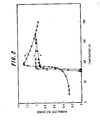
- the powder is formed by conventional mixed oxide ceramic processing as shown in Figure 3.
- the effect of water on the nonpassivated powder prepared in accordance with Example 1 was determined by mixing a quantity of the powder with 20 wt.% of deionized water and then drying the mixture under a heat lamp. X-ray diffraction studies of this water treated powder indicated a multiphase structure comprising the superconducting orthorhombic phase, CuO phase and a BaCO3 phase.
- single phase superconducting powder of Example 1 was mixed with 20 weight percent, based on total weight, of an aqueous solution of poly[p-phenylenebis(oxyethylene)-5-(4-sodiosulfophenoxy)-1,3-benzenedicarboxylate-co-terephthalate (30:70 molar ratio)], the polyester ionomer being present in concentration of 15 percent by weight, based on the weight of water, and dried under a heat lamp.
- the X-ray diffraction pattern of the polyester ionomer treated powder showed the presence of the same single phase orthorhombic crystalline structure as the original powder. This indicates that the ionomer protected the powder from degradation by the water.
- single phase superconducting powder of Example 1 was mixed with 20 weight percent, based on total weight, ethyl cellulose dissolved in trimethylpentyl isobutyrate (15 weight percent cellulose acetate, based on the weight of solvent, the solution being purchased from Electro Science Laboratories). This mixture was also dried under a heat lamp. X-ray diffraction patterns of the dried ethyl cellulose treated powder also showed a single phase orthorhombic crystal structure indicating the absence of degradation of the powder.
- the respective treated powders were mixed with 20 wt.% deionized water to make viscous pastes and doctor blade coated onto single crystal magnesia substrates by well known doctor blading technique to form thick films ( ⁇ 30 ⁇ m).
- the films were then heated in oxygen at 950°C for five minutes and then cooled down to room temperature in oxygen environment. The oxygen environment aids in balancing the oxygen content of the superconducting film.
- the untreated superconducting powders and the powders passivated with the polyester ionomer and the ethyl cellulose as set forth above were subjected to an environmental stability test at 70% relative humidity and 50°C for 1 hour, 24 hours, 3 days, 3 months, and 6 months.
- X-ray diffraction patterns again indicate a degradation of the untreated powder as evidenced by the formation of BaCO3 and CuO phases which increased with time in the test chamber while no such degradation was found with the powders treated in accordance with this invention even after six months.
Landscapes
- Engineering & Computer Science (AREA)
- Manufacturing & Machinery (AREA)
- Inorganic Compounds Of Heavy Metals (AREA)
- Superconductors And Manufacturing Methods Therefor (AREA)
- Compositions Of Oxide Ceramics (AREA)
- Oxygen, Ozone, And Oxides In General (AREA)
- Polyesters Or Polycarbonates (AREA)
- Superconductor Devices And Manufacturing Methods Thereof (AREA)
Applications Claiming Priority (2)
| Application Number | Priority Date | Filing Date | Title |
|---|---|---|---|
| US290670 | 1988-12-27 | ||
| US07/290,670 US4997808A (en) | 1988-12-27 | 1988-12-27 | Superconductive ceramic oxide combination |
Publications (2)
| Publication Number | Publication Date |
|---|---|
| EP0376862A2 true EP0376862A2 (fr) | 1990-07-04 |
| EP0376862A3 EP0376862A3 (fr) | 1990-08-29 |
Family
ID=23117064
Family Applications (1)
| Application Number | Title | Priority Date | Filing Date |
|---|---|---|---|
| EP19890420511 Withdrawn EP0376862A3 (fr) | 1988-12-27 | 1989-12-22 | Une combinaison supraconductrice d'oxyde céramique |
Country Status (4)
| Country | Link |
|---|---|
| US (1) | US4997808A (fr) |
| EP (1) | EP0376862A3 (fr) |
| JP (1) | JPH02229701A (fr) |
| CA (1) | CA2004702A1 (fr) |
Families Citing this family (3)
| Publication number | Priority date | Publication date | Assignee | Title |
|---|---|---|---|---|
| JP2674688B2 (ja) * | 1995-11-14 | 1997-11-12 | 九州大学長 | 湿式グレインコーティングによるYBa2Cu3Oxの焼結方法 |
| AU2002241771A1 (en) * | 2000-10-23 | 2002-06-11 | The Trustees Of Columbia University In The City Of New York | Thick film high temperature superconducting device supporting high critical currents and method for fabricating same |
| DE10111938A1 (de) * | 2001-03-13 | 2002-09-26 | Merck Patent Gmbh | Herstellung von Hochtemperatur-Supraleiter-Pulvern in einem Pulsationsreaktor |
Family Cites Families (7)
| Publication number | Priority date | Publication date | Assignee | Title |
|---|---|---|---|---|
| US4097282A (en) * | 1976-10-15 | 1978-06-27 | Eastman Kodak Company | Anionic imino-containing polymeric adhesives for photographic materials |
| US4252921A (en) * | 1979-10-03 | 1981-02-24 | Eastman Kodak Company | Polyesterionomers having utility in liquid electrographic developer compositions |
| US4291153A (en) * | 1980-08-01 | 1981-09-22 | Eastman Kodak Company | Water-dispersible polyester adhesives for photographic materials |
| US4419437A (en) * | 1981-02-11 | 1983-12-06 | Eastman Kodak Company | Image-forming compositions and elements containing ionic polyester dispersing agents |
| US4395475A (en) * | 1981-07-20 | 1983-07-26 | Eastman Kodak Company | Condensation polymeric photoconductors containing pendant arylamines |
| CA1329952C (fr) * | 1987-04-27 | 1994-05-31 | Yoshihiko Imanaka | Substrat pour circuit supraconducteur multicouche et procede de fabrication connexe |
| US4942142A (en) * | 1987-07-27 | 1990-07-17 | Sumitomo Electric Industries Ltd. | Superconducting thin film and a method for preparing the same |
-
1988
- 1988-12-27 US US07/290,670 patent/US4997808A/en not_active Expired - Fee Related
-
1989
- 1989-12-06 CA CA 2004702 patent/CA2004702A1/fr not_active Abandoned
- 1989-12-22 EP EP19890420511 patent/EP0376862A3/fr not_active Withdrawn
- 1989-12-26 JP JP1335217A patent/JPH02229701A/ja active Pending
Also Published As
| Publication number | Publication date |
|---|---|
| CA2004702A1 (fr) | 1990-06-27 |
| EP0376862A3 (fr) | 1990-08-29 |
| JPH02229701A (ja) | 1990-09-12 |
| US4997808A (en) | 1991-03-05 |
Similar Documents
| Publication | Publication Date | Title |
|---|---|---|
| EP0290357B1 (fr) | Procédé de fabrication pour objets supraconducteurs en céramique à base d'oxyde de cuivre | |
| US4920093A (en) | Fabrication of superconducting oxide thin films by sol-gel method | |
| US4908346A (en) | Crystalline rare earth alkaline earth copper oxide thick film circuit element with superconducting onset transition temperature in excess of 77% | |
| CA1329952C (fr) | Substrat pour circuit supraconducteur multicouche et procede de fabrication connexe | |
| KR20010079820A (ko) | 희토류 바륨-코퍼 혼합 조성을 갖는 초전도 구조체 | |
| US4956335A (en) | Conductive articles and processes for their preparation | |
| KR880014017A (ko) | 박막 초전도 산화물 필림의 제조방법 | |
| US4950643A (en) | Metalorganic deposition process for preparing heavy pnictide superconducting oxide films | |
| US5081070A (en) | Superconducting circuit board and paste adopted therefor | |
| US5272132A (en) | Apparatus comprising a ceramic superconductive body and method for producing such a body | |
| EP0328464A2 (fr) | Disposition de couches de barrières pour couches conductrices sur substrat en silicium | |
| US4997808A (en) | Superconductive ceramic oxide combination | |
| KR930004727B1 (ko) | 초전도체 배선의 구조 | |
| US4994434A (en) | Method of forming a barrier layer arrangement for conductive layers on silicon substrates | |
| US5087607A (en) | Process for preparing superconductive thick films | |
| EP0283197A2 (fr) | Appareil comprenant un élément supraconducteur et méthode pour produire cet élément | |
| US5189010A (en) | Process for preparing superconductive thick films | |
| EP0303083A2 (fr) | Couche barrière contenant des éléments conducteurs | |
| EP0290271A2 (fr) | Carte à circuit supraconducteur et procédé de sa fabrication | |
| US5286713A (en) | Method for manufacturing an oxide superconducting circuit board by printing | |
| EP0299796A2 (fr) | Additifs en argent pour céramiques supraconductives | |
| EP0376865A2 (fr) | Couches épaisses supraconductrices pour applications en circuits hybrides | |
| US5041417A (en) | Conductive articles and intermediates containing heavy pnictide mixed alkaline earth oxide layers | |
| JPS63279521A (ja) | 超電導体装置 | |
| JP2703227B2 (ja) | 超電導体装置 |
Legal Events
| Date | Code | Title | Description |
|---|---|---|---|
| PUAI | Public reference made under article 153(3) epc to a published international application that has entered the european phase |
Free format text: ORIGINAL CODE: 0009012 |
|
| AK | Designated contracting states |
Kind code of ref document: A2 Designated state(s): AT BE CH DE ES FR GB GR IT LI LU NL SE |
|
| PUAL | Search report despatched |
Free format text: ORIGINAL CODE: 0009013 |
|
| AK | Designated contracting states |
Kind code of ref document: A3 Designated state(s): AT BE CH DE ES FR GB GR IT LI LU NL SE |
|
| 17P | Request for examination filed |
Effective date: 19901222 |
|
| 17Q | First examination report despatched |
Effective date: 19930421 |
|
| STAA | Information on the status of an ep patent application or granted ep patent |
Free format text: STATUS: THE APPLICATION IS DEEMED TO BE WITHDRAWN |
|
| 18D | Application deemed to be withdrawn |
Effective date: 19931103 |