EP0377080A2 - Elektrischer Leiter, der mit einem Polymer isoliert ist - Google Patents
Elektrischer Leiter, der mit einem Polymer isoliert ist Download PDFInfo
- Publication number
- EP0377080A2 EP0377080A2 EP89117457A EP89117457A EP0377080A2 EP 0377080 A2 EP0377080 A2 EP 0377080A2 EP 89117457 A EP89117457 A EP 89117457A EP 89117457 A EP89117457 A EP 89117457A EP 0377080 A2 EP0377080 A2 EP 0377080A2
- Authority
- EP
- European Patent Office
- Prior art keywords
- adhesive
- insulated conductor
- polymer
- peroxide
- conductor according
- Prior art date
- Legal status (The legal status is an assumption and is not a legal conclusion. Google has not performed a legal analysis and makes no representation as to the accuracy of the status listed.)
- Granted
Links
- 239000004020 conductor Substances 0.000 title claims description 39
- 238000009413 insulation Methods 0.000 title description 6
- 239000000853 adhesive Substances 0.000 claims abstract description 37
- 230000001070 adhesive effect Effects 0.000 claims abstract description 37
- 229920000642 polymer Polymers 0.000 claims abstract description 27
- 239000002904 solvent Substances 0.000 claims abstract description 19
- -1 polyphenylene Polymers 0.000 claims abstract description 15
- 239000000463 material Substances 0.000 claims abstract description 13
- 238000000034 method Methods 0.000 claims abstract description 13
- 229920001721 polyimide Polymers 0.000 claims abstract description 13
- 239000004642 Polyimide Substances 0.000 claims abstract description 11
- 150000001451 organic peroxides Chemical class 0.000 claims abstract description 9
- 239000004696 Poly ether ether ketone Substances 0.000 claims abstract description 8
- 238000000576 coating method Methods 0.000 claims abstract description 8
- 238000010438 heat treatment Methods 0.000 claims abstract description 8
- 229920002530 polyetherether ketone Polymers 0.000 claims abstract description 8
- 239000012790 adhesive layer Substances 0.000 claims abstract description 6
- 239000011248 coating agent Substances 0.000 claims abstract description 6
- 239000010410 layer Substances 0.000 claims description 21
- 239000012774 insulation material Substances 0.000 claims description 12
- 238000004132 cross linking Methods 0.000 claims description 11
- 239000000243 solution Substances 0.000 claims description 11
- ZFSLODLOARCGLH-UHFFFAOYSA-N isocyanuric acid Chemical group OC1=NC(O)=NC(O)=N1 ZFSLODLOARCGLH-UHFFFAOYSA-N 0.000 claims description 7
- XMNIXWIUMCBBBL-UHFFFAOYSA-N 2-(2-phenylpropan-2-ylperoxy)propan-2-ylbenzene Chemical compound C=1C=CC=CC=1C(C)(C)OOC(C)(C)C1=CC=CC=C1 XMNIXWIUMCBBBL-UHFFFAOYSA-N 0.000 claims description 6
- HKMVWLQFAYGKSI-UHFFFAOYSA-N 3-triethoxysilylpropyl thiocyanate Chemical compound CCO[Si](OCC)(OCC)CCCSC#N HKMVWLQFAYGKSI-UHFFFAOYSA-N 0.000 claims description 6
- 239000004734 Polyphenylene sulfide Substances 0.000 claims description 6
- BLRPTPMANUNPDV-UHFFFAOYSA-N Silane Chemical compound [SiH4] BLRPTPMANUNPDV-UHFFFAOYSA-N 0.000 claims description 6
- 125000002496 methyl group Chemical group [H]C([H])([H])* 0.000 claims description 6
- 239000000203 mixture Chemical group 0.000 claims description 6
- 229920000069 polyphenylene sulfide Polymers 0.000 claims description 6
- 229910000077 silane Inorganic materials 0.000 claims description 6
- 230000003081 coactivator Effects 0.000 claims description 5
- 229910052751 metal Inorganic materials 0.000 claims description 5
- 239000002184 metal Substances 0.000 claims description 5
- 239000003960 organic solvent Substances 0.000 claims description 5
- 125000001997 phenyl group Chemical group [H]C1=C([H])C([H])=C(*)C([H])=C1[H] 0.000 claims description 5
- BJELTSYBAHKXRW-UHFFFAOYSA-N 2,4,6-triallyloxy-1,3,5-triazine Chemical compound C=CCOC1=NC(OCC=C)=NC(OCC=C)=N1 BJELTSYBAHKXRW-UHFFFAOYSA-N 0.000 claims description 4
- URDOJQUSEUXVRP-UHFFFAOYSA-N 3-triethoxysilylpropyl 2-methylprop-2-enoate Chemical compound CCO[Si](OCC)(OCC)CCCOC(=O)C(C)=C URDOJQUSEUXVRP-UHFFFAOYSA-N 0.000 claims description 4
- WOXXJEVNDJOOLV-UHFFFAOYSA-N ethenyl-tris(2-methoxyethoxy)silane Chemical group COCCO[Si](OCCOC)(OCCOC)C=C WOXXJEVNDJOOLV-UHFFFAOYSA-N 0.000 claims description 4
- 239000003063 flame retardant Substances 0.000 claims description 4
- 239000011521 glass Substances 0.000 claims description 4
- 239000004005 microsphere Substances 0.000 claims description 4
- 229920001187 thermosetting polymer Polymers 0.000 claims description 4
- RNFJDJUURJAICM-UHFFFAOYSA-N 2,2,4,4,6,6-hexaphenoxy-1,3,5-triaza-2$l^{5},4$l^{5},6$l^{5}-triphosphacyclohexa-1,3,5-triene Chemical compound N=1P(OC=2C=CC=CC=2)(OC=2C=CC=CC=2)=NP(OC=2C=CC=CC=2)(OC=2C=CC=CC=2)=NP=1(OC=1C=CC=CC=1)OC1=CC=CC=C1 RNFJDJUURJAICM-UHFFFAOYSA-N 0.000 claims description 3
- OMPJBNCRMGITSC-UHFFFAOYSA-N Benzoylperoxide Chemical group C=1C=CC=CC=1C(=O)OOC(=O)C1=CC=CC=C1 OMPJBNCRMGITSC-UHFFFAOYSA-N 0.000 claims description 3
- 125000001931 aliphatic group Chemical group 0.000 claims description 3
- 235000019400 benzoyl peroxide Nutrition 0.000 claims description 3
- 125000004432 carbon atom Chemical group C* 0.000 claims description 3
- LSXWFXONGKSEMY-UHFFFAOYSA-N di-tert-butyl peroxide Chemical compound CC(C)(C)OOC(C)(C)C LSXWFXONGKSEMY-UHFFFAOYSA-N 0.000 claims description 3
- 229910052739 hydrogen Inorganic materials 0.000 claims description 3
- 239000001257 hydrogen Substances 0.000 claims description 3
- 125000003944 tolyl group Chemical group 0.000 claims description 3
- 125000002947 alkylene group Chemical group 0.000 claims description 2
- 125000004435 hydrogen atom Chemical group [H]* 0.000 claims description 2
- 239000004342 Benzoyl peroxide Substances 0.000 claims 2
- 229920006254 polymer film Polymers 0.000 claims 2
- 239000012190 activator Substances 0.000 claims 1
- 238000004026 adhesive bonding Methods 0.000 claims 1
- 238000001704 evaporation Methods 0.000 claims 1
- 239000011810 insulating material Substances 0.000 claims 1
- 238000005304 joining Methods 0.000 abstract description 2
- 229920000265 Polyparaphenylene Polymers 0.000 abstract 1
- UCKMPCXJQFINFW-UHFFFAOYSA-N Sulphide Chemical compound [S-2] UCKMPCXJQFINFW-UHFFFAOYSA-N 0.000 abstract 1
- YMWUJEATGCHHMB-UHFFFAOYSA-N Dichloromethane Chemical compound ClCCl YMWUJEATGCHHMB-UHFFFAOYSA-N 0.000 description 36
- 150000002978 peroxides Chemical class 0.000 description 10
- 150000003254 radicals Chemical class 0.000 description 10
- 239000000047 product Substances 0.000 description 8
- 238000006243 chemical reaction Methods 0.000 description 7
- 238000010276 construction Methods 0.000 description 5
- 239000007787 solid Substances 0.000 description 5
- 239000004952 Polyamide Substances 0.000 description 4
- QXJJQWWVWRCVQT-UHFFFAOYSA-K calcium;sodium;phosphate Chemical compound [Na+].[Ca+2].[O-]P([O-])([O-])=O QXJJQWWVWRCVQT-UHFFFAOYSA-K 0.000 description 4
- 239000012530 fluid Substances 0.000 description 4
- 125000000524 functional group Chemical group 0.000 description 4
- 239000011159 matrix material Substances 0.000 description 4
- 229920002647 polyamide Polymers 0.000 description 4
- 239000000126 substance Substances 0.000 description 4
- 125000003903 2-propenyl group Chemical group [H]C([*])([H])C([H])=C([H])[H] 0.000 description 3
- 239000004215 Carbon black (E152) Substances 0.000 description 3
- KFZMGEQAYNKOFK-UHFFFAOYSA-N Isopropanol Chemical compound CC(C)O KFZMGEQAYNKOFK-UHFFFAOYSA-N 0.000 description 3
- 239000002131 composite material Substances 0.000 description 3
- 229930195733 hydrocarbon Natural products 0.000 description 3
- 150000003949 imides Chemical class 0.000 description 3
- 238000004519 manufacturing process Methods 0.000 description 3
- 239000004033 plastic Substances 0.000 description 3
- 229920003023 plastic Polymers 0.000 description 3
- 238000010998 test method Methods 0.000 description 3
- 238000012360 testing method Methods 0.000 description 3
- 229920001169 thermoplastic Polymers 0.000 description 3
- 239000004416 thermosoftening plastic Substances 0.000 description 3
- VYZAMTAEIAYCRO-UHFFFAOYSA-N Chromium Chemical compound [Cr] VYZAMTAEIAYCRO-UHFFFAOYSA-N 0.000 description 2
- RYGMFSIKBFXOCR-UHFFFAOYSA-N Copper Chemical compound [Cu] RYGMFSIKBFXOCR-UHFFFAOYSA-N 0.000 description 2
- 239000004971 Cross linker Substances 0.000 description 2
- XUIMIQQOPSSXEZ-UHFFFAOYSA-N Silicon Chemical group [Si] XUIMIQQOPSSXEZ-UHFFFAOYSA-N 0.000 description 2
- BQCADISMDOOEFD-UHFFFAOYSA-N Silver Chemical compound [Ag] BQCADISMDOOEFD-UHFFFAOYSA-N 0.000 description 2
- 150000001408 amides Chemical class 0.000 description 2
- 229920001400 block copolymer Polymers 0.000 description 2
- 239000007795 chemical reaction product Substances 0.000 description 2
- 229910052804 chromium Inorganic materials 0.000 description 2
- 239000011651 chromium Substances 0.000 description 2
- 229910052802 copper Inorganic materials 0.000 description 2
- 239000010949 copper Substances 0.000 description 2
- KPUWHANPEXNPJT-UHFFFAOYSA-N disiloxane Chemical group [SiH3]O[SiH3] KPUWHANPEXNPJT-UHFFFAOYSA-N 0.000 description 2
- 230000007613 environmental effect Effects 0.000 description 2
- 125000002887 hydroxy group Chemical group [H]O* 0.000 description 2
- 150000002739 metals Chemical class 0.000 description 2
- 230000006855 networking Effects 0.000 description 2
- 125000005375 organosiloxane group Chemical group 0.000 description 2
- 239000000049 pigment Substances 0.000 description 2
- 229920000728 polyester Polymers 0.000 description 2
- 238000012545 processing Methods 0.000 description 2
- 239000001054 red pigment Substances 0.000 description 2
- 150000004756 silanes Chemical class 0.000 description 2
- 229910052710 silicon Inorganic materials 0.000 description 2
- 229910052709 silver Inorganic materials 0.000 description 2
- 239000004332 silver Substances 0.000 description 2
- UOCLXMDMGBRAIB-UHFFFAOYSA-N 1,1,1-trichloroethane Chemical compound CC(Cl)(Cl)Cl UOCLXMDMGBRAIB-UHFFFAOYSA-N 0.000 description 1
- 229920001875 Ebonite Polymers 0.000 description 1
- 239000004812 Fluorinated ethylene propylene Substances 0.000 description 1
- UFHFLCQGNIYNRP-UHFFFAOYSA-N Hydrogen Chemical compound [H][H] UFHFLCQGNIYNRP-UHFFFAOYSA-N 0.000 description 1
- 239000002318 adhesion promoter Substances 0.000 description 1
- 230000032683 aging Effects 0.000 description 1
- 125000000217 alkyl group Chemical group 0.000 description 1
- 238000013459 approach Methods 0.000 description 1
- 125000003118 aryl group Chemical group 0.000 description 1
- QVGXLLKOCUKJST-UHFFFAOYSA-N atomic oxygen Chemical compound [O] QVGXLLKOCUKJST-UHFFFAOYSA-N 0.000 description 1
- 238000005452 bending Methods 0.000 description 1
- 230000015572 biosynthetic process Effects 0.000 description 1
- 125000006267 biphenyl group Chemical group 0.000 description 1
- 230000015556 catabolic process Effects 0.000 description 1
- 238000003776 cleavage reaction Methods 0.000 description 1
- 239000008199 coating composition Substances 0.000 description 1
- 238000009833 condensation Methods 0.000 description 1
- 230000005494 condensation Effects 0.000 description 1
- 239000007822 coupling agent Substances 0.000 description 1
- 238000002425 crystallisation Methods 0.000 description 1
- 230000008025 crystallization Effects 0.000 description 1
- 230000001419 dependent effect Effects 0.000 description 1
- 238000011161 development Methods 0.000 description 1
- 230000018109 developmental process Effects 0.000 description 1
- 125000004427 diamine group Chemical group 0.000 description 1
- 150000001990 dicarboxylic acid derivatives Chemical class 0.000 description 1
- XMEORSGHQPZTCP-UHFFFAOYSA-N dichloromethane;1,1,1-trichloroethane Chemical compound ClCCl.CC(Cl)(Cl)Cl XMEORSGHQPZTCP-UHFFFAOYSA-N 0.000 description 1
- 238000001035 drying Methods 0.000 description 1
- 229920001971 elastomer Polymers 0.000 description 1
- 230000005670 electromagnetic radiation Effects 0.000 description 1
- 238000005516 engineering process Methods 0.000 description 1
- 125000001495 ethyl group Chemical group [H]C([H])([H])C([H])([H])* 0.000 description 1
- 239000001056 green pigment Substances 0.000 description 1
- 239000010720 hydraulic oil Substances 0.000 description 1
- 238000009434 installation Methods 0.000 description 1
- 239000007788 liquid Substances 0.000 description 1
- FPYJFEHAWHCUMM-UHFFFAOYSA-N maleic anhydride Chemical compound O=C1OC(=O)C=C1 FPYJFEHAWHCUMM-UHFFFAOYSA-N 0.000 description 1
- UMRZSTCPUPJPOJ-KNVOCYPGSA-N norbornane Chemical compound C1C[C@H]2CC[C@@H]1C2 UMRZSTCPUPJPOJ-KNVOCYPGSA-N 0.000 description 1
- 125000003518 norbornenyl group Chemical group C12(C=CC(CC1)C2)* 0.000 description 1
- 125000000962 organic group Chemical group 0.000 description 1
- 229910052760 oxygen Inorganic materials 0.000 description 1
- 239000001301 oxygen Substances 0.000 description 1
- 229920009441 perflouroethylene propylene Polymers 0.000 description 1
- 230000000704 physical effect Effects 0.000 description 1
- 229920003192 poly(bis maleimide) Polymers 0.000 description 1
- 229920001281 polyalkylene Polymers 0.000 description 1
- 229920000412 polyarylene Polymers 0.000 description 1
- 229920001296 polysiloxane Polymers 0.000 description 1
- 230000005855 radiation Effects 0.000 description 1
- 229920005989 resin Polymers 0.000 description 1
- 239000011347 resin Substances 0.000 description 1
- 238000007363 ring formation reaction Methods 0.000 description 1
- 239000005060 rubber Substances 0.000 description 1
- 230000007017 scission Effects 0.000 description 1
- 238000007086 side reaction Methods 0.000 description 1
- 239000007858 starting material Substances 0.000 description 1
- 230000035882 stress Effects 0.000 description 1
- 230000008961 swelling Effects 0.000 description 1
- 238000005494 tarnishing Methods 0.000 description 1
- 230000001988 toxicity Effects 0.000 description 1
- 231100000419 toxicity Toxicity 0.000 description 1
- 230000001960 triggered effect Effects 0.000 description 1
- 239000002966 varnish Substances 0.000 description 1
- 125000000391 vinyl group Chemical group [H]C([*])=C([H])[H] 0.000 description 1
- DXZMANYCMVCPIM-UHFFFAOYSA-L zinc;diethylphosphinate Chemical compound [Zn+2].CCP([O-])(=O)CC.CCP([O-])(=O)CC DXZMANYCMVCPIM-UHFFFAOYSA-L 0.000 description 1
Classifications
-
- H—ELECTRICITY
- H01—ELECTRIC ELEMENTS
- H01B—CABLES; CONDUCTORS; INSULATORS; SELECTION OF MATERIALS FOR THEIR CONDUCTIVE, INSULATING OR DIELECTRIC PROPERTIES
- H01B3/00—Insulators or insulating bodies characterised by the insulating materials; Selection of materials for their insulating or dielectric properties
- H01B3/18—Insulators or insulating bodies characterised by the insulating materials; Selection of materials for their insulating or dielectric properties mainly consisting of organic substances
- H01B3/30—Insulators or insulating bodies characterised by the insulating materials; Selection of materials for their insulating or dielectric properties mainly consisting of organic substances plastics; resins; waxes
- H01B3/303—Macromolecular compounds obtained by reactions forming a linkage containing nitrogen with or without oxygen or carbon in the main chain of the macromolecule, not provided for in groups H01B3/38 or H01B3/302
- H01B3/306—Polyimides or polyesterimides
-
- H—ELECTRICITY
- H01—ELECTRIC ELEMENTS
- H01B—CABLES; CONDUCTORS; INSULATORS; SELECTION OF MATERIALS FOR THEIR CONDUCTIVE, INSULATING OR DIELECTRIC PROPERTIES
- H01B3/00—Insulators or insulating bodies characterised by the insulating materials; Selection of materials for their insulating or dielectric properties
- H01B3/18—Insulators or insulating bodies characterised by the insulating materials; Selection of materials for their insulating or dielectric properties mainly consisting of organic substances
- H01B3/30—Insulators or insulating bodies characterised by the insulating materials; Selection of materials for their insulating or dielectric properties mainly consisting of organic substances plastics; resins; waxes
- H01B3/301—Macromolecular compounds obtained by reactions forming a linkage containing sulfur with or without nitrogen, oxygen or carbon in the main chain of the macromolecule, not provided for in group H01B3/302
-
- H—ELECTRICITY
- H01—ELECTRIC ELEMENTS
- H01B—CABLES; CONDUCTORS; INSULATORS; SELECTION OF MATERIALS FOR THEIR CONDUCTIVE, INSULATING OR DIELECTRIC PROPERTIES
- H01B3/00—Insulators or insulating bodies characterised by the insulating materials; Selection of materials for their insulating or dielectric properties
- H01B3/18—Insulators or insulating bodies characterised by the insulating materials; Selection of materials for their insulating or dielectric properties mainly consisting of organic substances
- H01B3/30—Insulators or insulating bodies characterised by the insulating materials; Selection of materials for their insulating or dielectric properties mainly consisting of organic substances plastics; resins; waxes
- H01B3/46—Insulators or insulating bodies characterised by the insulating materials; Selection of materials for their insulating or dielectric properties mainly consisting of organic substances plastics; resins; waxes silicones
Definitions
- This invention relates to insulated electrical conductors, particularly those conductors that are insulated with polymers. Round cables as well as flat and coaxial cables are to be used as electrical conductors.
- the siloxanes have 1.3 to 1.95 phenyl and methyl groups per silicon atom, up to half of the phenyl groups can be biphenyl groups and up to 10% of the organic groups can be tolyl, alkyl, ethyl or other groups.
- the siloxanes are soluble in aromatic, organic solvents or mixtures.
- the polyamide is denoted by ⁇ -NH - R - NH - (CH2) m - [- NH - R1 - NH - (CH2) m ] n ⁇ -, where m is two or more, n 0 or an integer, R the The residue of an ethylenically unsaturated dicarboxylic acid after removal of the hydroxyl groups and R1 represents the residue of isophthalic, terephthalic or saturated aliphatic acids with 4 to 10 carbon atoms, the hydroxyl groups of which have been removed.
- a wire is coated with this mixture and cured by removal of the solvent and by heating to form an insulating varnish coating on the wire.
- Composite materials could be made by firmly joining two sheet members made of the same or different materials, e.g. glass, metals or polymers, by converting the organosilanamide block copolymers described in U.S. Patent No. 3,740,305 to the corresponding polyimides in order to to form firmly bonded materials.
- the organosilane imides were applied to the surfaces of the sheet members to be bonded, the solvent was removed, and the cyclization reaction was effected by heat.
- organosiloxanes have the formula wherein R is a monovalent hydrocarbon radical, usually methyl, and n is 0 to 150.
- organosiloxaneimide block copolymers A much broader and wider variety of organosiloxaneimide block copolymers than those mentioned above has been provided by U.S. Patent 4,522,985; according to this publication, the norbornane and norbornene cores have been used extensively for both the siloxane and diamine regions of the starting materials.
- Curing under heat for example to cyclize a polyamide into a polyimide directly on the cable, was not a good solution. It is now common to coat a fully cured polyimide tape with a thermoplastic adhesive material, such as a fluorinated ethylene-propylene copolymer. This works very well unless halogen-free insulation is required due to reduced toxicity when burned; it is desirable to remove the outer layer of the thermoplastic adhesive after processing, or to subject the cable to electromagnetic radiation, in which case a halogenated polymer will not work very well under such radiation and a halogenated material must be avoided.
- a thermoplastic adhesive material such as a fluorinated ethylene-propylene copolymer
- the invention has for its object to provide an insulation material which has good insulating properties and good adhesiveness when it is applied to the material to be insulated. Furthermore, a method for isolating an electrical conductor is to be specified by means of which the insulation material can be applied to the conductor with good adhesion.
- the insulation material according to the invention consists of a high temperature-resistant polymer which surrounds an electrical conductor. A completely heat-cured organosiloxaneimide adhesive is applied to this polymer, which surprisingly ensures a good polymer-polymer connection.
- the polymer is preferably a polyimide, polyphenylene sulfide (PPS) or a polyether ether ketone (PEEK).
- PPS polyphenylene sulfide
- PEEK polyether ether ketone
- the cables according to the invention are particularly suitable for use at high temperatures and under aggressive environmental conditions.
- the new composite material can be used both as primary insulation and as a jacket.
- the organopolysiloxaneimide is dissolved in an organic solvent, possibly with organic peroxides and pigments, and the solution is applied to a layer of the fully cured polymer.
- the solvent is then evaporated and the polymer layer is wrapped around an electrical conductor with the adhesive on top.
- the polymer layer is preferably cut into a band shape and wound spirally around the electrical conductor.
- the conductor wrapped in the tape is first of all for a relatively short time heated to a higher temperature to seal the layers of polymer. It is then held at a low temperature for an extended period of time to increase the cross-link curing reaction and to prevent problems such as tarnishing of metal conductors, which can occur at higher temperatures and longer heating times.
- the preferred organopolysiloxaneimide adhesive is a fully cured material with the formula where Q is a tetravalent radical selected from where D is selected from wherein R4 is a bivalent radical selected from and divalent organic radicals of the general formula wherein R1 and R2 represent alkylenes, usually - (CH2) 3 -, or R4, wherein R represents methyl, phenyl, tolyl or a mixture of aliphatic and aromatic radicals, wherein R3 represents hydrogen or an alkyl radical with 1 to 8 carbon atoms , X from bivalent radicals -CR 3rd 2nd -, C y H 2y -, - CO -, - SO2-, -O-, and -S-, is selected, where y 1 to 5, k 1 to 7, n 1 to 7, m is an integer greater than 1 and p are 0 or 1.
- the crosslinking reaction is preferably carried out in the presence of a peroxide.
- Benzoyl peroxides such as bis-2,4-dichlorobenzoyl peroxide, dicumyl peroxide or t-butyl peroxide are particularly suitable as peroxides.
- the presence of peroxide accelerates the crosslinking reaction and increases chemical resistance to solvents.
- the crosslinking reaction is initiated by cleavage of the peroxide, as can be seen from the formula below.
- the radicals formed in this way generate a polymer radical by splitting off hydrogen from the polymer chain. Two of the polymer radicals generated in this way can saturate to form a CC bond, as can be seen from the formula below.
- a coactivator such as, for example, triallyl cyanurate
- three-dimensional crosslinking can be achieved, which leads to a thermally more stable product which also has better chemical resistance due to the multiplication of the crosslinking sites.
- the polymer radical reacts with an allyl group of the cyanurate. The formula is shown below.
- the crosslinking is only started when the finished product is exposed to a higher temperature, which ensures that no pre-crosslinking takes place during the drying and further processing of the product.
- the reaction is only triggered when the product is held at 300 ° C for a period of 1 to 3 minutes.
- the finished products are subjected to post-heating, which normally takes place at 200 ° C for 2 to 3 hours. Insulation produced using this method can be used for mechanical loads up to a permanent temperature of 150 ° C and for only electrical loads up to a permanent temperature of 170 ° C.
- a low dielectric constant is required to use the insulation material for flat or coaxial cables.
- the adhesive approach must be modified. This can be done, for example, by adding expanded glass spheres, preferably microspheres, which are hollow on the inside in addition to the mixture mentioned.
- a coupling agent based on silane is added give.
- vinyl tris (2-methoxyethoxy) silane (1); 3,4 epoxybutyltriethoxysilane (2); 3-thiocyanatopropyltriethoxysilane (3) or 3-methacryloxypropyltriethoxysilane (4) can be used.
- the amount of silane used in each case is approximately 0.1 to 0.8% of the weight of glass spheres.
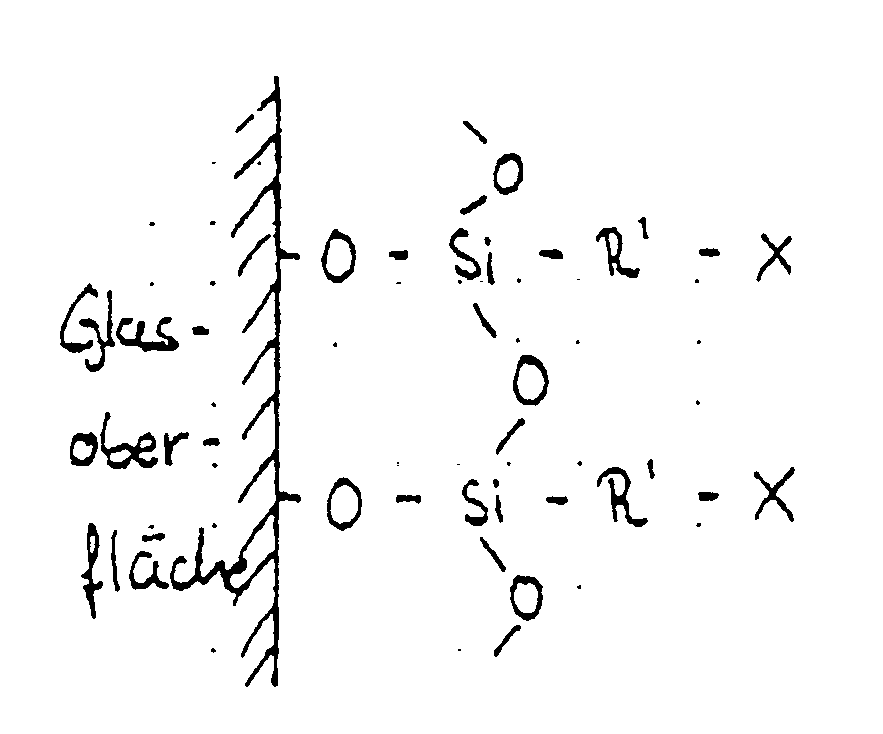
- the silanes that can be used have the following general formula y-Si-R'-X, where y and X represent the two different reactive centers.
- the functional group X is linked to an organic intermediate piece R 'with the four-bonded silicon atom.
- the functional group y is a removable group, in this case either a trimethoxy or a trieethoxysilyl group.
- the function of silanes as an adhesion promoter is based on the formation of a monomolecular silane layer on the surface of the glass spheres, the functional group y reacting here.
- the remaining functional group X can react chemically with the plastic matrix or with the crosslinker / coactivator system.
- a halogen-free flame retardant can also be added.
- the proportion of the flame retardant can be up to approx. 20 percent by weight. This also makes it possible to obtain a higher layer thickness of the adhesive application and thus to use the coated polymer layer, for example in the form of a film, for the production of ribbon cables.
- the thickness of the adhesive layer is preferably 50 to 100 microns. This enables the embedding of bare conductors or of fully insulated wires.
- a roll of polyimide film (DuPont Kapton H-50) is coated with a 2.54 ⁇ m (0.0001 inch) thick layer of an organopolysiloxanimide adhesive which has been dissolved in methylene chloride to give a 5% solids solution .
- 20% by weight of a green pigment in polyester based on the organopolysiloxaneimide was added to the solution of organopolysiloxaneimide and methylene chloride to color the film. The solvent is evaporated to a to produce dry film.
- the roll is then cut into evenly wound bobbins with an approximately 1.83 mm (0.072 inch) wide band.
- the tape is wrapped around a 30 AWG silver plated copper conductor to give a 2.1 wrap construction with a 0.3048 mm (0.012 inch) end diameter.
- This wrapped structure is connected in an air oven at 300 ° C with a residence time of 50 seconds.
- the outer adhesive layer which is not covered with a film layer, is washed off the assembly by passing the assembly through a methylene chloride bath to give a green, insulated wire assembly. Tests are carried out on this wire construction with regard to the dielectric in a moist environment, with regard to aging when heated and with regard to the resistance to solvents.
- the test procedure for dielectric in a humid environment is carried out according to the provisions of MIL-W-81822A, section 4.6.20; the heat resistance test procedure is in accordance with the provisions of MIL-W-81822A, section 4.6.22; and resistance to fluids is determined by the provisions of MIL-W-8l822A, section 4.6.25.
- the heat resistance of the construction using an organosiloxaneimide adhesive is greater than the heat resistance of a comparable polyester adhesive, but the solvent resistance to 1,1,1-trichloroethane is insufficient.
- a roll of polyimide film (DuPont Kapton H-100) is covered with a 2.54 ⁇ m (0.0001 inch) thick layer coated from an organopolysiloxaneimide adhesive which was dissolved in methylene chloride to give a 5% solids solution.
- a red pigment containing chromium is added to the adhesive solution to color the tape. The solvent is evaporated to give a dry film.
- Another tape is coated exactly as above, except that an organic peroxide (e.g. Luprox 500R dicumyl peroxide) is added in an amount of 10% by weight based on the organopolysiloxaneimide adhesive.
- an organic peroxide e.g. Luprox 500R dicumyl peroxide
- Both tapes are cut into evenly wound coils approximately 2.64 mm (0.104 inch) wide.
- the tapes are wrapped around a 30 AWG silver plated copper conductor to create a 3.2 wrap construction with a finished 0.4064 mm (0.016 inch) diameter.
- the wrapped superstructures are fired in an air oven with a temperature of 320 ° C and a residence time of 100 seconds.
- the outer layer of adhesive that is not covered by the film is washed off the assembly by passing the assembly through a methylene chloride bath. A red, insulated wire structure is obtained.
- the adhesive is more resistant to some solvents than to other solvents.
- the curing of samples in the presence of peroxide accelerates the crosslinking and thus increases the solvent resistance of the adhesive with respect to solvents which more easily dissolve the adhesive, for example methylene chloride.
- a roll of PEEK (polyether ether ketone) film is coated with a 0.00254 mm (0.0001 inch) thick layer of an organopolysiloxanimide adhesive dissolved in methylene chloride to form a 5% solids solution. to surrender.
- a chromium-containing red pigment is added at 25% by weight, based on the organopolysiloxanimide adhesive, in order to color the tape.
- the solvent is evaporated to give a 5.0 wrap construction with a final diameter of 0.508 mm (0.020 inch).
- the wrapped structure is heated in an air oven at 300 ° C with a residence time of 100 seconds.
- the outer adhesive layer which is not covered by a film layer, is washed off the assembly by passing it through a methylene chloride bath so that a red, insulated conductor assembly is obtained.
- the finished composite insulation material had a tensile strength of 25,000 psi and an elongation of 110%. It also had good heat resistance and good electrical properties.
- a polyphenylene sulfide film with a layer thickness of about 12 to 100 microns is coated with an adhesive solution.
- the adhesive solution used as a coating composition contains organopolysiloxane imide as the plastic matrix, bis-2,4-dichlorobenzoyl peroxide as the crosslinker, triallyl cyanurate as the coactivator, and color pigments and methylene chloride as the solvent.
- the solids concentration is about 20 to 25% by weight, depending on the required layer thickness.
- the solvent is evaporated, the crosslinking reaction takes place at 300 ° C and a time of 1 to 3 minutes.
- the finished product is subjected to post-heating, which takes place at 200 ° C for a period of 2 to 3 hours.
- the end product is a primary insulation material for electrical parts, can be used mechanically for a continuous temperature of at least 150 ° C and electrically for a temperature of at least 170 ° C.
- Methylene chloride was found to be the best solvent for the uncured organopolysiloxaneimide adhesive.
- the improved resistance to methylene chloride by means of an organopolysiloxaneimide hardened with the help of peroxide thus eliminates a weak point in the use of this adhesive for the production of wires and cables.
Landscapes
- Physics & Mathematics (AREA)
- Spectroscopy & Molecular Physics (AREA)
- Chemical & Material Sciences (AREA)
- Chemical Kinetics & Catalysis (AREA)
- Adhesives Or Adhesive Processes (AREA)
- Organic Insulating Materials (AREA)
- Insulated Conductors (AREA)
- Insulators (AREA)
Abstract
Description
- Diese Erfindung betrifft isolierte elektrische Leiter, insbesondere solche Leiter, die mit Polymeren isoliert sind. Als elektrische Leiter sollen sowohl Rundkabel als auch Flach- und Koaxialkabel verwendet werden.
- Bei der Überzugs- und Isoliertechnik von elektrischen Leitern ist es bekannt, daß zur Erzeugung von zufriedenstellenden isolierten Schaltungen bzw. Installationen, harte und feste Überzüge bzw. Isolierungen, die einem hohem Verschleiß, Biegungsbeanspruchungen, hohen Temperaturen, aggresiven Umweltbedingungen und einem chemischen Angriff von Flüssigkeiten widerstehen, erforderlich sind.
- Unter den Materialien, die zur Isolierung von Leitern für den Gebrauch unter derartigen Bedingungen verwendet werden, sind Mischungen aus lösungsmittellöslichen, hitzehärtbaren Phenylmethylsiloxanen und organischen Polyamiden genannt, die in US-PS 2,983,700 offenbart sind. Die Siloxane weisen 1,3 bis 1,95 Phenyl- und Methylgruppen pro Siliziumatom auf, bis zur Hälfte der Phenylgruppen können Biphenylgruppen sein und bis zu 10 % der organischen Gruppen können Tolyl-, Alkyl-, Ethyl- oder andere Gruppen sein. Die Siloxane sind in aromatischen, organischen Lösungsmitteln oder Mischungen löslich. Das Polyamid wird mit {-NH - R - NH - (CH₂)m -[-NH - R1 - NH - (CH₂)m]n}- bezeichnet, worin m zwei oder mehr, n 0 oder eine ganze Zahl, R der Rest einer ethylenisch ungesättigten Dicarbonsäure nach der Entfernung der Hydroxylgruppen und R1 der Rest von Isophthal-, Terephtal- oder gesättigten aliphatischen Säuren mit 4 bis 10 Kohlenstoffatomen darstellt, deren Hydroxylgruppen entfernt sind.
- Ein Draht wird mit dieser Mischung überzogen und durch Entfernung des Lösungsmittels sowie durch Erhitzen ausgehärtet, um auf dem Draht einen Isolierlacküberzug zu bilden.
- Nachfolgend wurden Polyamide mit der Formel


- Verbundmaterialien konnten hergestellt werden durch ein festes Verbinden von zwei Flachmaterialelementen aus dem gleichen oder aus unterschiedlichen Materialien, beispielsweise Glas, Metalle oder Polymere, indem die Organosilanamid-Blockcopolymere, die in US-PS 3,740,305 beschrieben sind, in die entsprechenden Polyimide umgewandelt wurden, um die fest verbundenen Materialien zu bilden. Die Organosilanimide wurden auf die Oberflächen der Flachmaterialelemente, die verbunden werden sollten, aufgebracht, das Lösungsmittel wurde entfernt und die Zyklisierungsreaktion wurde durch Wärme bewirkt.
- Ein anderer Weg zur Erreichung guter Eigenschaften bei den Siloxanimid-Harzen wurde in US-PS 3,763,081 dargelegt, wo ungesättigte Vinylgruppen, die auf Organosiloxanen substituiert waren, zu einem ausgehärteten Produkt durch Hitze und Sauerstoff oder Peroxid mit ungesättigten Gruppen auf Bismaleinsäureimiden vernetzt wurden, die durch Kondensation von Maleinsäureanhydrid mit p, p¹-Methylendianilin hergestellt wurden.
- Derartige Organosiloxane haben die Formel

- Eine wesentlich umfassendere und breitere Vielfalt von Organosiloxanimid-Blockcopolymeren als die oben erwähnten, wurde durch die US-PS 4,522,985 zur Verfügung gestellt; gemäß dieser Veröffentlichung wurden die Norbornan- und Norbornenkerne sowohl für die Siloxan- als auch die Diaminbereiche der Ausgangsmaterialien umfassend verwendet. Die Endprodukte, die Organosiloxanimide, sind Gummis, die unter Hitzeeinwirkung mit Peroxiden zu harten Elastomeren aushärtbar sind.
- Wo Bandumwickelverfahren verwendet werden, um bei der Herstellung von isolierten, elektrischen Kabeln auf Leitern Schichten aufzubauen, haben die isolierenden und die physikalischen Eigenschaften von Polyimid, Polyetheretherketon und Polyphenylensulfid die Verwendung dieser Materialien wünschenswert gemacht, wenn sie erfolgreich mit sich selbst verbunden werden können.
- Das Aushärten unter Hitze, um beispielsweise ein Polyamid in ein Polyimid direkt auf dem Kabel zu zyklisieren, erwies sich nicht als eine gute Lösung. Es ist nun üblich, ein vollständig ausgehärtetes Polyimidband mit einem thermoplastischen Klebstoffmaterial zu überziehen, beispielsweise mit einem fluorierten Ethylen-PropylenCopolymer. Dies funktioniert sehr gut, wenn nicht eine halogenfreie Isolierung wegen einer verminderten Toxizität beim Verbrennen verlangt wird; es ist wünschenswert, die äußere Schicht aus dem thermoplastischen Klebstoff nach der Bearbeitung zu entfernen, oder das Kabel, einer elektromagnetischen Strahlung zu unterwerfen, wobei in diesem Fall ein halogeniertes Polymer unter einer derartigen Strahlung nicht sehr gut funktioniert und ein halogeniertes Material vermieden werden muß.
- Der Erfindung liegt die Aufgabe zugrunde, ein Isolationsmaterial zur Verfügung zu stellen, das gute isolierende Eigenschaften und eine gute Haftfähigkeit aufweist, wenn es auf dem zu isolierenden Material aufgebracht ist. Weiterhin soll ein Verfahren zum Isolieren eines elektrischen Leiters angegeben werden, durch das das Isolationsmaterial mit guter Haftfähigkeit auf den Leiter aufgebracht werden kann.
- Lösungen dieser Aufgaben sind in den Ansprüchen 1, 11 und 13 angegeben. Vorteilhafte Weiterbildungen sind Gegenstand der Unteransprüche.
- Das erfindungsgemäße Isolationsmaterial besteht aus einem hochtemperaturfesten Polymer, das einen elektrischen Leiter umgibt. Auf diesem Polymer ist ein vollständig hitzegehärteter Organosiloxanimid-Klebstoff aufgebracht, der überraschenderweise für eine gute Polymer-Polymer-Verbindung sorgt. Das Polymer ist vorzugsweise ein Polyimid, Polyphenylensulfid (PPS) oder ein Polyether-etherketon (PEEK) Die erfindungsgemäßen Kabel sind besonders für den Einsatz bei hohen Temperaturen und unter aggresiven Umweltbedingungen geeignet. Der neuartige Verbundwerkstoff kann sowohl als Primärisolierung aber auch als Mantel eingesetzt werden.
- Das Organopolysiloxanimid wird in einem organischen Lösungsmittel evtl. mit organischen Peroxiden und Pigmenten gelöst, und die Lösung wird auf eine Schicht des vollständig ausgehärteten Polymers aufgetragen. Das Lösungsmittel wird dann verdampft, und die Polymerschicht wird um einen elektrischen Leiter gewickelt, wobei der Klebstoff oben liegt. Vorzugsweise wird die Polymerschicht bandförmig zugeschnitten und spiralförmig um den elektrischen Leiter gewickelt. Der mit dem Band umwickelte Leiter wird zunächst für eine verhältnismäßig kurze Zeit auf eine höhere Temperatur erhitzt, um die Schichten aus dem Polymer abzudichten. Er wird dann für eine längere Zeit auf einer niedrigen Temperatur gehalten, um die Vernetzungs-Aushärt-Reaktion zu erhöhen und um Probleme wie das Anlaufen von Metalleitern zu verhindern, was bei höheren Temperaturen und längeren Aufheizzeiten auftreten kann.
- Der bevorzugte Organopolysiloxanimid-Klebstoff ist ein vollständig ausgehärtetes Material mit der Formel


- Da es sich bei dem Polyimidsiloxan um ein Thermoplast handelt, ist die chemische Beständigkeit und die Wärmebeständigkeit des Materials stark begrenzt. Um diese Nachteile teilweise zu kompensieren, ist es notwendig, die Matrix chemisch zu vernetzen. Die Vernetzungsreaktion wird vorzugsweise in Gegenwart eines Peroxids durchgeführt. Als Peroxide sind insbesondere Benzoylperoxide wie Bis-2,4-dichlorbenzoylperoxid, Dicumylperoxid oder t-Butylperoxid geeignet. Die Gegenwart von Peroxid beschleunigt die Vernetzungsreaktion und erhöht die chemische Resistenz gegenüber Lösungsmitteln.
- Die Vernetzungsreaktion wird durch die Spaltung des Peroxids eingeleitet, wie aus nachstehender Formel ersichtlich ist.

- Die auf diese Weise gebildeten Radikale erzeugen durch Abspalten von Wasserstoff aus der Polymerkette ein Polymerradikal. Zwei der auf diese Weise entstandenen Polymerradikale können sich zu einer C-C-Bindung absättigen, wie aus nachstehender Formel ersichtlich ist.

- In Gegenwart eines Coaktivators, wie beispielsweise Triallylcyanurat kann eine dreidimensionale Vernetzung erreicht werden, die zu einem thermisch stabileren Produkt füht, das durch eine Vervielfachung der Vernetzungsstellen auch eine bessere chemische Beständigkeit aufweist. Das Polymerradikal reagiert in diesem Fall mit einer Allylgruppe des Cyanurats. Die Formel ist nachfolgend wiedergegeben.

- An den Radikalen der Allylgruppen des Cyanurats, die mit der Hauptkette verknüpft sind, können sich andere Peroxidradikale, Polymerradikale oder Allylreste eines anderen Cyanurats anlagern und somit gegenseitig absättigen. Dies führt zu einer Vermehrung der Vernetzungsstellen und somit zu einer Erhöhung des Vernetzungsgrades. Neben diesen bevorzugten Vernetzungsreaktionen können natürlich noch zahlreiche andere Nebenreaktionen auftreten, die insgesamt zu einem räumlich vernetzten, thermisch stabilen und chemisch resistenten Produkt führen.
- Die Vernetzung wird erst bei Beaufschlagung des fertigen Produkts mit höherer Temperatur in Gang gesetzt, womit gewährleistet ist, daß während des Trocknens und weiterverarbeiten des Produkts keine Vorvernetzung erfolgt. Die Reaktion wird erst dann ausgelöst, wenn das Produkt über eine Zeitspanne von 1 bis 3 Minuten bei 300° C gehalten wird. Um die entstandenen Kristallisationsbereiche in der Mikrostruktur des Materials zu egalisieren, werden die fertigen Produkte einer Nachtemperierung unterworfen, was normalerweise bei 200° C für die Dauer von 2 bis 3 Stunden geschieht. Eine nach diesem Verfahren hergestellte Isolierung kann bei mechanischer Belastung bis zu einer Dauertemperatur von 150° C und bei einer nur elektrischen Belastung bis zu einer Dauertemperatur von 170° C verwendet werden.
- Für die Verwendung des Isolationsmaterials für Flachoder Coaxialkabel ist eine niedrige Dielektrizitätskonstante notwendig. Dazu muß der Klebstoffansatz modifiziert werden. Dies kann beispielsweise erfolgen, indem zusätzlich zu der genannten Mischung expandierte Glaskugeln, vorzugsweise Mikrokugeln, die innen hohl sind, zugegeben werden. Um eine bessere Haftung zwischen der Kunststoffmatrix und den Glaskugeln zu erreichen, wird ein Kupplungsmittel auf Silanbasis zuge geben. Als Silan kann insbesondere Vinyltris-(2-methoxyethoxy-)silan (1); 3,4 Epoxybutyltriethoxysilan (2); 3-Thiocyanatopropyltriethoxysilan (3) oder 3-Methacryloxypropyltriethoxysilan (4) verwendet werden.

- Die Menge an jeweils verwendetem Silan beträgt ungefähr 0,1 bis 0,8 % des Gewichts an Glaskugeln. Die verwendbaren Silane haben die folgende allgemeine Formel y-Si-R′-X, wobei y und X die zwei verschiedenen reaktiven Zentren darstellen. Die funktionelle Gruppe X ist mit einem organischen Zwischenstück R′ mit dem vierbindigen Siliziumatom verknüpft. Die funktionelle Gruppe y ist eine abspaltbare Gruppe, in diesem Fall entweder eine Trimethoxy- oder eine Trieethoxysilyl-Gruppe. Die Funktion der Silane als Haftvermittler
- Neben den Glaskugeln, die die Dielektrizitätskonstante des Isolationsmaterials auf etwa 2,1 bis 1,8 herabsetzen, kann auch ein halogenfreies Flammschutzmittel zugegeben werden. Dies führt einerseits zur verbesserten Flammwidrigkeit des Isolationsmaterials und andererseits zur wesentlichen Erhöhung der Viskosität des Beschichtungsmaterials. Der Anteil des Flammschutzmittels kann bis ca. 20 Gewichtsprozent betragen. Dadurch ist es auch möglich, eine höhere Schichtdicke des Klebstoffauftrages zu erhalten und somit die beschichtete Polymerschicht, beispielsweise in Form einer Folie, für die Herstellung von Flachbandkabeln zu verwenden. Dabei beträgt die Dicke der Klebstoffschicht vorzugsweise 50 bis 100 µm. Dies ermöglicht das Einbetten von blanken Leitern oder von fertig isolierten Adern.
- Eine Rolle aus Polyimidfilm (DuPont Kapton H-50) wird mit einer 2,54 µm (0,0001 inch) dicken Schicht aus einem Organopolysiloxanimid-Klebstoff überzogen, der in Methylenchlorid gelöst wurde, um eine Lösung mit einem Feststoffanteil von 5 % zu ergeben. 20 Gew.-% eines grünen Pigmentes in Polyester, bezogen auf das Organopolysiloxanimid, wurden zu der Lösung aus Organopolysiloxanimid und Methylenchlorid zugegeben, um den Film zu färben. Das Lösungsmittel wird verdampft, um einen trockenen Film zu erzeugen.
- Die Rolle wird dann in gleichmäßig gewundene Spulen mit einem etwa 1,83 mm (0,072 inch) breiten Band zerteilt. Das Band wird um einen 30 AWG, mit Silber plattierten Kupferleiter gewickelt, um einen Aufbau mit 2,1 Umwicklungen mit einem Enddurchmesser von 0,3048 mm (0,012 inch) zu ergeben. Dieser umwickelte Aufbau wird in einem Luftofen bei 300° C mit einer Verweilzeit von 50 Sekunden verbunden. Die äußere Klebstoffschicht, die nicht mit einer Filmschicht bedeckt ist, wird von dem Aufbau abgewaschen, indem der Aufbau durch ein Methylenchloridbad geführt wird, um einen grünen, isolierten Drahtaufbau zu ergeben. An diesem Drahtaufbau werden Tests hinsichtlich der Dielektrizität in feuchter Umgebung, hinsichtlich der Alterung bei Erhitzen sowie hinsichtlich der Lösungsmittelresistenz durchgeführt. Das Testverfahren bezüglich der Dielektrizität in feuchter Umgebung erfolgt nach den Bestimmungen von MIL-W-81822A, Abschnitt 4.6.20; das Testverfahren hinsichtlich der Hitzebeständigkeit erfolgt nach den Bestimmungen von MIL-W-81822A, Abschnitt 4.6.22; und die Widerstandfähigkeit gegenüber Fluiden erfolgt nach den Bestimmungen von MIL-W-8l822A, Abschnitt 4.6.25. Die Hitzebeständigkeit des Aufbaus, bei dem ein Organosiloxanimid-Klebstoff verwendet wird, ist größer als die Hitzebeständigkeit von einem vergleichbaren Polyester-Klebstoff, jedoch ist die Lösungsmittelwiderstandsfähigkeit hinsichtlich 1,1,1-Trichlorethan unzulänglich.
- Eine Rolle aus Polyimidfilm (DuPont Kapton H-100) wird mit einer 2,54 um (0,0001 inch) dicken Schicht aus einem Organopolysiloxanimid-Klebstoff überzogen, der in Methylenchlorid gelöst wurde, um eine Lösung mit einem Feststoffanteil von 5 % zu ergeben. Ein chromhaltiges, rotes Pigment wird zu der Klebstofflösung zugefügt um das Band zu färben. Das Lösungsmittel wird verdampft, um einen trockenen Film zu ergeben.
- Ein weiteres Band wird genau wie oben überzogen, mit der Ausnahme, daß ein organisches Peroxid (zum Beispiel Luprox 500R Dicumylperoxid) in einer Menge von 10 Gew.-%, bezogen auf den Organopolysiloxanimid-Klebstoff, zugegeben wird.
- Beide Bänder werden in gleichmäßig gewundene Spulen mit einer Breite von etwa 2,64 mm (0,104 inch) zerteilt. Die Bänder werden um einen 30 AWG, mit Silber plattierten Kupferleiter gewickelt, so daß sich ein Aufbau mit 3,2 Umwicklungen und einem fertigen Durchmesser von 0,4064 mm (0,016 inch) ergibt. Die umwickelten Aufbauten werden in einem Luftofen mit einer Temperatur von 320° C und einer Verweilzeit von 100 Sekunden gebrannt. Die äußere Schicht aus Klebstoff, die nicht von dem Film bedeckt ist, wird von dem Aufbau abgewaschen, indem der Aufbau durch ein Methylenchloridbad geleitet wird. Es wird ein roter, isolierter Drahtaufbau erhalten.
- Proben von jedem Aufbau werden bei 225°C 3,5 Stunden lang ausgehärtet. Sowohl mit der ausgehärteten Probe als auch mit der nicht ausgehärteten Probe werden physikalische Testverfahren durchgeführt. Die Widerstandsfähigkeit gegenüber Fluiden wird entsprechend den Bestimmungen von MIL-W-8l822A, Abschnitt 4.6.25 durchgeführt, mit der Ausnahme, daß Methylenchlorid zu der Liste von Testfluiden hinzugefügt wird, und daß die Testspannung erhöht wird, bis ein Durchschlag erfolgt. Die Ergebnisse sind in der nachfolgenden Tabelle zusammengefaßt (KV = Kilovolt).
Tabelle Zugfestigkeit des Isolationsmaterials Dehnung des Isolationsmaterials Physikalische Widerstandsfähigkeit gegenüber Fluiden Zusammenbruch Spannung nach 24 Stunden Quellzeit Isopropylalkohol Hydrauliköl Freon Trichlorethan Methylenchlorid Vor dem Aushärten -Gew. 10% Dicumylperoxid 54000 50 % 15kV 11kV 11kV 14kV 8,5 kV -kein Peroxid 52000 48 % 16kV 13,5kV 11kV 16kV 7,5 kV Nach dem Aushärten -Gew. 10% Dicumylperoxid 52000 54 % 15 kV 17,5kV 14kV 17,5kV 15 kV -kein Peroxid 51000 49 % 17,5kV 12,5kV 16kV 16kV 11 kV - Aus den Beispielen ist ersichtlich, daß der Klebstoff hinsichtlich einiger Lösungsmittel widerstandsfähiger ist als hinsichtlich anderer Lösungsmittel. Das Aushärten von Proben in der Gegenwart von Peroxid beschleunigt die Vernetzung und erhöht somit die Lösungsmittelwiderstandsfähigkeit des Klebstoffs bezüglich solcher Lösungsmittel, die den Klebstoff leichter lösen, beispielswiese Methylenchlorid.
- Eine Rolle aus einem PEEK-(Polyether-etherketon)-Film wird mit einer 0,00254 mm (0,0001 inch) dicken Schicht aus einem Organopolysiloxanimid-Klebstoff überzogen, der in Methylenchlorid gelöst wurde, um eine Lösung mit einem Feststoffanteil von 5 % zu ergeben. Ein chromhaltiges, rotes Pigment wird mit 25 Gew.-%, bezogen auf den Organopolysiloxanimid-Klebstoff, zugegeben, um das Band zu färben. Das Lösungsmittel wird verdampft, um einen Aufbau mit 5,0 Umwicklungen mit einem Enddurchmesser von 0,508 mm (0,020 inch) zu ergeben. Der umwickelte Aufbau wird in einem Luftofen bei 300° C mit einer Verweilzeit von 100 Sekunden erhitzt. Die äußere Klebstoffschicht, die nicht durch eine Filmschicht bedeckt ist, wird von dem Aufbau abgewaschen, indem dieser durch ein Methylenchloridbad geleitet wird, so daß sich ein roter, isolierter Leiteraufbau ergbit.
- Das fertige, zusammengesetzte Isolationsmaterial wies eine Zugfestigkeit von 25000 psi und eine Dehnung von 110 % auf. Ebenso hatte es eine gute Wärmebeständigkeit und gute elektrische Eigenschaften.
- Eine Polyphenylensulfid-Folie mit einer Schichtdicke von etwa 12 bis 100 µm wird mit einer Klebstofflösung beschichtet. Die Klebstofflösung, die als Beschichtungsmasse verwendet wird, enthält als Kunststoffmatrix Organopolysiloxanimid, als Vernetzer Bis-2,4-dichlorbenzoylperoxid, als Coaktivator Triallylcyanurat sowie Farbpigmente und Methylenchlorid als Lösungsmittel. Die Feststoffkonzentration beträgt etwa 20 bis 25 Gew.-%, je nach erforderlicher Schichtdicke. Das Lösungsmittel wird verdampft, die Vernetzungsreaktion erfolgt bei 300° C und einer Zeit von 1 bis 3 Minuten. Das fertige Produkt wird einer Nachtemperierung unterworfen, was bei 200° C für die Dauer von 2 bis 3 Stunden geschieht.
- Das Endprodukt stellt ein Primärisolationsmaterial für elektrische Teile dar, ist mechanisch für eine Dauertemperatur von mindestens 150° C und elektrisch für eine Temperatur von mindestens 170° C zu verwenden.
- Methylenchlorid erwies sich als das beste Lösungsmittel für den ungehärteten Organopolysiloxanimid-Klebstoff. Die verbesserte Resistenz gegenüber Methylenchlorid durch ein mit Hilfe von Peroxid ausgehärtetes Organopolysiloxanimid eliminiert somit einen schwachen Punkt beim Gebrauch dieses Klebstoffes für die Herstellung von Drähten und Kabeln.
Claims (23)


R¹ und R² sind Alkylen, für gewöhnlich -(CH₂)₃ -, oder R⁴, R ist Methyl, Phenyl, Tolyl oder eine Mischung aus aliphatischen und aromatischen Radikalen, R³ ist Wasserstoff oder ein Alkylradikal mit 1-8 C-Atomen, ist ausgewählt aus bivalenten radikalen -CR


Applications Claiming Priority (2)
| Application Number | Priority Date | Filing Date | Title |
|---|---|---|---|
| US28804888A | 1988-12-21 | 1988-12-21 | |
| US288048 | 1988-12-21 |
Publications (3)
| Publication Number | Publication Date |
|---|---|
| EP0377080A2 true EP0377080A2 (de) | 1990-07-11 |
| EP0377080A3 EP0377080A3 (de) | 1991-12-18 |
| EP0377080B1 EP0377080B1 (de) | 1995-12-06 |
Family
ID=23105529
Family Applications (1)
| Application Number | Title | Priority Date | Filing Date |
|---|---|---|---|
| EP89117457A Expired - Lifetime EP0377080B1 (de) | 1988-12-21 | 1989-09-21 | Elektrischer Leiter, der mit einem Polymer isoliert ist |
Country Status (4)
| Country | Link |
|---|---|
| EP (1) | EP0377080B1 (de) |
| AT (1) | ATE131310T1 (de) |
| DE (2) | DE377080T1 (de) |
| ES (1) | ES2080058T3 (de) |
Cited By (6)
| Publication number | Priority date | Publication date | Assignee | Title |
|---|---|---|---|---|
| EP0551747A1 (de) * | 1992-01-10 | 1993-07-21 | General Electric Company | Flexible Polyätherimidefilme |
| EP0568923A1 (de) * | 1992-05-08 | 1993-11-10 | PIRELLI CAVI S.p.A. | Hochtemperaturkabel |
| EP2544194A1 (de) * | 2011-07-07 | 2013-01-09 | Nitto Denko Corporation | Abdeckmaterial, abgedeckter rechteckiger Elektrodraht und elektrische Vorrichtung |
| EP2544193A3 (de) * | 2011-07-07 | 2014-11-19 | Nitto Denko Corporation | Abdeckmaterial, supraleitender Elektrodraht und elektrische Vorrichtung |
| EP2544192A3 (de) * | 2011-07-07 | 2014-11-19 | Nitto Denko Corporation | Abdeckmaterial, supraleitender Elektrodraht und elektrische Vorrichtung |
| EP2544191A3 (de) * | 2011-07-07 | 2014-11-26 | Nitto Denko Corporation | Abdeckmaterial, abgedeckter rechteckiger Elektrodraht und elektrische Vorrichtung |
Family Cites Families (1)
| Publication number | Priority date | Publication date | Assignee | Title |
|---|---|---|---|---|
| JPH0727966B2 (ja) * | 1986-07-04 | 1995-03-29 | 日立化成工業株式会社 | 半導体装置 |
-
1989
- 1989-09-21 EP EP89117457A patent/EP0377080B1/de not_active Expired - Lifetime
- 1989-09-21 DE DE198989117457T patent/DE377080T1/de active Pending
- 1989-09-21 AT AT89117457T patent/ATE131310T1/de not_active IP Right Cessation
- 1989-09-21 DE DE58909529T patent/DE58909529D1/de not_active Expired - Fee Related
- 1989-09-21 ES ES89117457T patent/ES2080058T3/es not_active Expired - Lifetime
Cited By (7)
| Publication number | Priority date | Publication date | Assignee | Title |
|---|---|---|---|---|
| EP0551747A1 (de) * | 1992-01-10 | 1993-07-21 | General Electric Company | Flexible Polyätherimidefilme |
| EP0568923A1 (de) * | 1992-05-08 | 1993-11-10 | PIRELLI CAVI S.p.A. | Hochtemperaturkabel |
| US5437930A (en) * | 1992-05-08 | 1995-08-01 | Pirelli Cavi S.P.A. | Cable for high operating temperatures |
| EP2544194A1 (de) * | 2011-07-07 | 2013-01-09 | Nitto Denko Corporation | Abdeckmaterial, abgedeckter rechteckiger Elektrodraht und elektrische Vorrichtung |
| EP2544193A3 (de) * | 2011-07-07 | 2014-11-19 | Nitto Denko Corporation | Abdeckmaterial, supraleitender Elektrodraht und elektrische Vorrichtung |
| EP2544192A3 (de) * | 2011-07-07 | 2014-11-19 | Nitto Denko Corporation | Abdeckmaterial, supraleitender Elektrodraht und elektrische Vorrichtung |
| EP2544191A3 (de) * | 2011-07-07 | 2014-11-26 | Nitto Denko Corporation | Abdeckmaterial, abgedeckter rechteckiger Elektrodraht und elektrische Vorrichtung |
Also Published As
| Publication number | Publication date |
|---|---|
| DE58909529D1 (de) | 1996-01-18 |
| EP0377080A3 (de) | 1991-12-18 |
| ATE131310T1 (de) | 1995-12-15 |
| EP0377080B1 (de) | 1995-12-06 |
| DE377080T1 (de) | 1990-10-18 |
| ES2080058T3 (es) | 1996-02-01 |
Similar Documents
| Publication | Publication Date | Title |
|---|---|---|
| CA1110998A (en) | Insulation system for conductors | |
| DE1520012C3 (de) | Verfahren zur Herstellung von Polykondensaten mit wiederkehrenden Imideinheiten | |
| DE2439490C2 (de) | Äthylenvinylacetat-Copolymermasse | |
| DE2832893A1 (de) | Siliconharze enthaltende polymermischungen | |
| DE69005936T2 (de) | In der Schmelze verarbeitbare, halogenfreie und raucharme Drahtbeschichtungsmasse auf Basis von Silikon-Imid. | |
| DE69328285T2 (de) | Thermoplastisches Polyimid, Polyamidsäureee, und thermoschmelzbarer Verbundfilm zum Beziehen von leitenden Drähten | |
| DE602004001781T2 (de) | Elektrische leitung beschichtet mit einer haftenden schicht und herstellungsprozess davon | |
| DE3538527A1 (de) | Verfahren zur herstellung eines mit vernetzten polyolefinen isolierten kabels | |
| JPS5828688B2 (ja) | 導体の被覆方法 | |
| EP0377080B1 (de) | Elektrischer Leiter, der mit einem Polymer isoliert ist | |
| DE2453436C3 (de) | Elektrischer Isolierstoff | |
| DE69305563T2 (de) | Lackbeschichteter Elektro-Draht und Verfahren zu seiner Herstellung | |
| DE1795638A1 (de) | Polyimide | |
| EP0348795A2 (de) | Verbundmaterialien aus einem Trägermaterial und elektrisch leitfähigen Polymerfilmen | |
| EP1026187A1 (de) | Backlack | |
| DE3873128T2 (de) | Verfahren zur herstelung eines elektrischen uebertragungslinie. | |
| EP0006509A1 (de) | Verfahren zur Herstellung eines abdichtenden Überzugs auf elektronischen Schaltkreisen und Beschichtungsmaterial | |
| DE60314528T2 (de) | Verfahren zur herstellung eines modifizierten diisocyanats, verfahren zur herstellung eines selbstschmierenden emaillelackes, verfahren zur herstellung eines lackisolierten elektrischen leiters | |
| JPS58501235A (ja) | 難燃性組成物、その製造方法ならびにそのワイヤおよびケ−ブル製品 | |
| DE1284336B (de) | Verfahren zur Herstellung von hitzegehaerteten Lackisolierungen fuer elektrische Leiter | |
| EP0883881A1 (de) | Metallackdrähte | |
| US4404331A (en) | Enamel having improved coatability and insulated electrical articles produced therefrom | |
| DE3853710T2 (de) | Siliciumatome und Imidogruppen enthaltende Oligomere, härtbare Zusammensetzungen und deren Herstellung. | |
| DE1947030C (de) | Isoliertes elektrisches Bauteil | |
| DE2409655B2 (de) | Verfahren zum umkleiden von elektrischen leitern aus aluminium |
Legal Events
| Date | Code | Title | Description |
|---|---|---|---|
| PUAI | Public reference made under article 153(3) epc to a published international application that has entered the european phase |
Free format text: ORIGINAL CODE: 0009012 |
|
| AK | Designated contracting states |
Kind code of ref document: A2 Designated state(s): AT BE CH DE ES FR GB GR IT LI LU NL SE |
|
| GBC | Gb: translation of claims filed (gb section 78(7)/1977) | ||
| ITCL | It: translation for ep claims filed |
Representative=s name: JACOBACCI CASETTA & PERANI S.P.A. |
|
| EL | Fr: translation of claims filed | ||
| DET | De: translation of patent claims | ||
| 17P | Request for examination filed |
Effective date: 19901213 |
|
| PUAL | Search report despatched |
Free format text: ORIGINAL CODE: 0009013 |
|
| AK | Designated contracting states |
Kind code of ref document: A3 Designated state(s): AT BE CH DE ES FR GB GR IT LI LU NL SE |
|
| 17Q | First examination report despatched |
Effective date: 19940801 |
|
| GRAA | (expected) grant |
Free format text: ORIGINAL CODE: 0009210 |
|
| AK | Designated contracting states |
Kind code of ref document: B1 Designated state(s): AT BE CH DE ES FR GB GR IT LI LU NL SE |
|
| PG25 | Lapsed in a contracting state [announced via postgrant information from national office to epo] |
Ref country code: GR Free format text: LAPSE BECAUSE OF FAILURE TO SUBMIT A TRANSLATION OF THE DESCRIPTION OR TO PAY THE FEE WITHIN THE PRESCRIBED TIME-LIMIT Effective date: 19951206 Ref country code: BE Effective date: 19951206 |
|
| REF | Corresponds to: |
Ref document number: 131310 Country of ref document: AT Date of ref document: 19951215 Kind code of ref document: T |
|
| REF | Corresponds to: |
Ref document number: 58909529 Country of ref document: DE Date of ref document: 19960118 |
|
| REG | Reference to a national code |
Ref country code: ES Ref legal event code: FG2A Ref document number: 2080058 Country of ref document: ES Kind code of ref document: T3 |
|
| GBT | Gb: translation of ep patent filed (gb section 77(6)(a)/1977) |
Effective date: 19960122 |
|
| ITF | It: translation for a ep patent filed | ||
| ET | Fr: translation filed | ||
| PG25 | Lapsed in a contracting state [announced via postgrant information from national office to epo] |
Ref country code: AT Effective date: 19960921 |
|
| PG25 | Lapsed in a contracting state [announced via postgrant information from national office to epo] |
Ref country code: LU Free format text: LAPSE BECAUSE OF NON-PAYMENT OF DUE FEES Effective date: 19960930 Ref country code: LI Effective date: 19960930 Ref country code: CH Effective date: 19960930 |
|
| PLBE | No opposition filed within time limit |
Free format text: ORIGINAL CODE: 0009261 |
|
| STAA | Information on the status of an ep patent application or granted ep patent |
Free format text: STATUS: NO OPPOSITION FILED WITHIN TIME LIMIT |
|
| 26N | No opposition filed | ||
| REG | Reference to a national code |
Ref country code: CH Ref legal event code: PL |
|
| PGFP | Annual fee paid to national office [announced via postgrant information from national office to epo] |
Ref country code: FR Payment date: 20000901 Year of fee payment: 12 |
|
| PGFP | Annual fee paid to national office [announced via postgrant information from national office to epo] |
Ref country code: SE Payment date: 20000905 Year of fee payment: 12 Ref country code: GB Payment date: 20000905 Year of fee payment: 12 Ref country code: DE Payment date: 20000905 Year of fee payment: 12 |
|
| PGFP | Annual fee paid to national office [announced via postgrant information from national office to epo] |
Ref country code: NL Payment date: 20000920 Year of fee payment: 12 |
|
| PGFP | Annual fee paid to national office [announced via postgrant information from national office to epo] |
Ref country code: ES Payment date: 20001006 Year of fee payment: 12 |
|
| PG25 | Lapsed in a contracting state [announced via postgrant information from national office to epo] |
Ref country code: GB Free format text: LAPSE BECAUSE OF NON-PAYMENT OF DUE FEES Effective date: 20010921 |
|
| PG25 | Lapsed in a contracting state [announced via postgrant information from national office to epo] |
Ref country code: SE Free format text: LAPSE BECAUSE OF NON-PAYMENT OF DUE FEES Effective date: 20010922 Ref country code: ES Free format text: LAPSE BECAUSE OF NON-PAYMENT OF DUE FEES Effective date: 20010922 |
|
| REG | Reference to a national code |
Ref country code: GB Ref legal event code: IF02 |
|
| PG25 | Lapsed in a contracting state [announced via postgrant information from national office to epo] |
Ref country code: NL Free format text: LAPSE BECAUSE OF NON-PAYMENT OF DUE FEES Effective date: 20020401 |
|
| PG25 | Lapsed in a contracting state [announced via postgrant information from national office to epo] |
Ref country code: DE Free format text: LAPSE BECAUSE OF NON-PAYMENT OF DUE FEES Effective date: 20020501 |
|
| EUG | Se: european patent has lapsed |
Ref document number: 89117457.5 |
|
| GBPC | Gb: european patent ceased through non-payment of renewal fee |
Effective date: 20010921 |
|
| PG25 | Lapsed in a contracting state [announced via postgrant information from national office to epo] |
Ref country code: FR Free format text: LAPSE BECAUSE OF NON-PAYMENT OF DUE FEES Effective date: 20020531 |
|
| NLV4 | Nl: lapsed or anulled due to non-payment of the annual fee |
Effective date: 20020401 |
|
| REG | Reference to a national code |
Ref country code: FR Ref legal event code: ST |
|
| NLV4 | Nl: lapsed or anulled due to non-payment of the annual fee |
Effective date: 20020401 |
|
| REG | Reference to a national code |
Ref country code: ES Ref legal event code: FD2A Effective date: 20021011 |
|
| PG25 | Lapsed in a contracting state [announced via postgrant information from national office to epo] |
Ref country code: IT Free format text: LAPSE BECAUSE OF NON-PAYMENT OF DUE FEES;WARNING: LAPSES OF ITALIAN PATENTS WITH EFFECTIVE DATE BEFORE 2007 MAY HAVE OCCURRED AT ANY TIME BEFORE 2007. THE CORRECT EFFECTIVE DATE MAY BE DIFFERENT FROM THE ONE RECORDED. Effective date: 20050921 |