EP0377334B1 - Bild-im-Bild-Systeme - Google Patents
Bild-im-Bild-Systeme Download PDFInfo
- Publication number
- EP0377334B1 EP0377334B1 EP89313689A EP89313689A EP0377334B1 EP 0377334 B1 EP0377334 B1 EP 0377334B1 EP 89313689 A EP89313689 A EP 89313689A EP 89313689 A EP89313689 A EP 89313689A EP 0377334 B1 EP0377334 B1 EP 0377334B1
- Authority
- EP
- European Patent Office
- Prior art keywords
- screen
- channel
- display
- received
- signal
- Prior art date
- Legal status (The legal status is an assumption and is not a legal conclusion. Google has not performed a legal analysis and makes no representation as to the accuracy of the status listed.)
- Expired - Lifetime
Links
Images


Classifications
-
- H—ELECTRICITY
- H04—ELECTRIC COMMUNICATION TECHNIQUE
- H04N—PICTORIAL COMMUNICATION, e.g. TELEVISION
- H04N5/00—Details of television systems
- H04N5/44—Receiver circuitry for the reception of television signals according to analogue transmission standards
- H04N5/445—Receiver circuitry for the reception of television signals according to analogue transmission standards for displaying additional information
-
- H—ELECTRICITY
- H04—ELECTRIC COMMUNICATION TECHNIQUE
- H04N—PICTORIAL COMMUNICATION, e.g. TELEVISION
- H04N5/00—Details of television systems
- H04N5/44—Receiver circuitry for the reception of television signals according to analogue transmission standards
- H04N5/445—Receiver circuitry for the reception of television signals according to analogue transmission standards for displaying additional information
- H04N5/45—Picture in picture, e.g. displaying simultaneously another television channel in a region of the screen
-
- H—ELECTRICITY
- H04—ELECTRIC COMMUNICATION TECHNIQUE
- H04N—PICTORIAL COMMUNICATION, e.g. TELEVISION
- H04N21/00—Selective content distribution, e.g. interactive television or video on demand [VOD]
- H04N21/40—Client devices specifically adapted for the reception of or interaction with content, e.g. set-top-box [STB]; Operations thereof
- H04N21/41—Structure of client; Structure of client peripherals
- H04N21/426—Internal components of the client ; Characteristics thereof
- H04N21/42607—Internal components of the client ; Characteristics thereof for processing the incoming bitstream
- H04N21/4263—Internal components of the client ; Characteristics thereof for processing the incoming bitstream involving specific tuning arrangements, e.g. two tuners
-
- H—ELECTRICITY
- H04—ELECTRIC COMMUNICATION TECHNIQUE
- H04N—PICTORIAL COMMUNICATION, e.g. TELEVISION
- H04N21/00—Selective content distribution, e.g. interactive television or video on demand [VOD]
- H04N21/40—Client devices specifically adapted for the reception of or interaction with content, e.g. set-top-box [STB]; Operations thereof
- H04N21/43—Processing of content or additional data, e.g. demultiplexing additional data from a digital video stream; Elementary client operations, e.g. monitoring of home network or synchronising decoder's clock; Client middleware
- H04N21/431—Generation of visual interfaces for content selection or interaction; Content or additional data rendering
- H04N21/4312—Generation of visual interfaces for content selection or interaction; Content or additional data rendering involving specific graphical features, e.g. screen layout, special fonts or colors, blinking icons, highlights or animations
- H04N21/4316—Generation of visual interfaces for content selection or interaction; Content or additional data rendering involving specific graphical features, e.g. screen layout, special fonts or colors, blinking icons, highlights or animations for displaying supplemental content in a region of the screen, e.g. an advertisement in a separate window
-
- H—ELECTRICITY
- H04—ELECTRIC COMMUNICATION TECHNIQUE
- H04N—PICTORIAL COMMUNICATION, e.g. TELEVISION
- H04N21/00—Selective content distribution, e.g. interactive television or video on demand [VOD]
- H04N21/40—Client devices specifically adapted for the reception of or interaction with content, e.g. set-top-box [STB]; Operations thereof
- H04N21/43—Processing of content or additional data, e.g. demultiplexing additional data from a digital video stream; Elementary client operations, e.g. monitoring of home network or synchronising decoder's clock; Client middleware
- H04N21/44—Processing of video elementary streams, e.g. splicing a video clip retrieved from local storage with an incoming video stream or rendering scenes according to encoded video stream scene graphs
- H04N21/4402—Processing of video elementary streams, e.g. splicing a video clip retrieved from local storage with an incoming video stream or rendering scenes according to encoded video stream scene graphs involving reformatting operations of video signals for household redistribution, storage or real-time display
- H04N21/440263—Processing of video elementary streams, e.g. splicing a video clip retrieved from local storage with an incoming video stream or rendering scenes according to encoded video stream scene graphs involving reformatting operations of video signals for household redistribution, storage or real-time display by altering the spatial resolution, e.g. for displaying on a connected PDA
-
- H—ELECTRICITY
- H04—ELECTRIC COMMUNICATION TECHNIQUE
- H04N—PICTORIAL COMMUNICATION, e.g. TELEVISION
- H04N21/00—Selective content distribution, e.g. interactive television or video on demand [VOD]
- H04N21/40—Client devices specifically adapted for the reception of or interaction with content, e.g. set-top-box [STB]; Operations thereof
- H04N21/47—End-user applications
- H04N21/482—End-user interface for programme selection
-
- H—ELECTRICITY
- H04—ELECTRIC COMMUNICATION TECHNIQUE
- H04N—PICTORIAL COMMUNICATION, e.g. TELEVISION
- H04N21/00—Selective content distribution, e.g. interactive television or video on demand [VOD]
- H04N21/80—Generation or processing of content or additional data by content creator independently of the distribution process; Content per se
- H04N21/81—Monomedia components thereof
- H04N21/8146—Monomedia components thereof involving graphical data, e.g. 3D object, 2D graphics
- H04N21/8153—Monomedia components thereof involving graphical data, e.g. 3D object, 2D graphics comprising still images, e.g. texture, background image
Definitions
- This invention generally relates to picture-in-picture (PIP) systems, such as are used in, for example, video cassette recorders (hereinafter referred to as VCRs) and television sets.
- PIP picture-in-picture
- a known PIP system of a VCR displays a certain picture as a main screen and a given number of sub-screens, all of which have the same image source, may be arranged at predetermined positions on the main screen by pressing a PIP key.
- a PIP key Upon pressing a PLAY key, the image from the video tape of the VCR will replace the existing main screen, whilst the sub-screens keep on displaying the previous pictures.
- a channel UP/DOWN key is input to change the sub-screen display at a user's choice, then all the sub-screens will display the same new picture whilst the main screen displays the existing picture from the VCR tape.
- Preferred embodiments of the present invention aim to provide a multi-screen PIP system which is able to provide a plurality of PIP screens displaying different pictures.
- a video display system comprising:
- the OSD unit is arranged to display simultaneously the channel numbers of a plurality of different channels that are available for broadcasting, and the microcomputer is arranged to display one of said channel numbers in such a manner as to distinguish it from the other channel numbers.
- said microcomputer is arranged to display said one of said channel numbers by causing said channel number to flash or flicker.
- said microcomputer is arranged to receive a channel UP/DOWN signal and, in response thereto, cause said plurality of channel numbers and/or said one of said channel numbers to be varied.
- a portion of said main screen may be visible simultaneously with said sub-screens, on the same screen.
- a line input is provided to said input selectors in addition to signals from said first and second tuners.
- said microcomputer is arranged to receive a ROTATE signal and, in response thereto, cause an image from the channel of a selected one of the channel numbers to be displayed, such that, in response to successive ROTATE signals, different images from different channels corresponding to different selected ones of said channel numbers may be displayed successively in different ones of said sub-screens, with said sub-screens then displaying said different images simultaneously.
- said microcomputer is arranged to display at least one moving image and a plurality of still images in different ones of said sub-screens.
- a system as above may further comprise a visual display means for displaying a visual image corresponding to a signal output from said mixer.
- the present invention provides use of a system according to any of the preceding aspects of the invention to provide a visual display, by :
- said on-screen-display is called by the steps of:
- said step (a) comprises the sub-steps of:
- the step (b) comprises the sub-steps of:
- the step (c) comprises the sub-steps of:
- a signal from a remote controller (not shown) is amplified by a pre-amplifier 17 and applied to a microcomputer 10.
- the microcomputer 10 decodes the received signal to determine which key of the remote controller has been pressed.
- First and second tuners 15, 16 are used to perform a picture-in-picture operation, and make it possible to configure a multi-screen display freely as a user desires. Selection of the first or the second tuner 15, 16 is controlled via first and second strobe terminals STS 1 and STB 2 of the microcomputer 10.
- Data output from a data terminal DATA, of the microcomputer 10 affects the channel to be selected.
- Output terminals T 3 , T 4 of the first and second tuners 15, 16 are connected respectively to input terminals T 1' T 2 of input selectors 12, 13.
- Aline Lconnected to both of the input selectors 12,13 is used to connect external equipment to the VCR.
- Each of the input selectors 12,13 is controlled by given data Q 0 .Q 1 and Q 2 .Q 3 generated from the microcomputer 10 to select one of the signals applied from the input terminals T1, T2 and the line L.
- the input selector 12 is used to select a main screen, while the input selector 13 is used to select sub-screens.
- the signals selected by the input selectors 12, 13 are applied to a luminance/colour (Y/C) unit 14 and a picture-in-picture (PIP) unit 11, respectively.
- Y/C luminance/colour
- PIP picture-in-picture
- the Y/C unit 14 is used to create the main screen.
- the signals selected for the main screen by the input selector 12 will be a first screen image source from the first tuner 15 if a playback (PB) key is not input, and an image source from tape if the playback key (PB) is input.
- the main screen and the sub-screen selected by the input selectors 12, 13 are applied to the PIP unit 11.
- the PIP screen generated under the control of signals from clock SCK, data DATA and strobe STB terminals of the microcomputer 10 is applied into a mixer 19.
- An On-Screen-Display (OSD) 18 displays characters under the control of signals from the clock SCK, data DATA and strobe STB terminals of the microcomputer 10.
- the character data is sent to the mixer 19 to be superimposed upon the screen.
- the mixer 19 superimposes the characters upon the screen to provide a video signal output.
- the PIP unit 11 is controlled by exchanging data in series with the microcomputer 10. As is shown in Table 1 hereinbelow, if the microcomputer 10 outputs the data (0000 0010), the PIP unit 11 performs a rotation function.
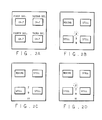
- the microcomputer Upon pressing a ROTATE key (for example, in a 4-PIP system), the microcomputer will stop strobing. To achieve this strobe-stop condition, the strobe data should be output in series to the PIP unit 11 from the microcomputer 10. To configure the PIP screen, it is necessary to press a SCREEN PROGRAM key, when the screen display has the normal condition illustrated in Figure 2A.
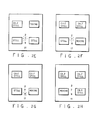
- strobing upon pressing the SCREEN PROGRAM key, strobing will be stopped and, as shown in the example of Figure 2B, a skip channel is displayed by the OSD 18, such that the upper-most channel number flickers. Strobing transfers the position of the moving screen in a given direction, rotationally. Only one of the four sub-screens is a moving screen, while the others remain as still screens.
- the strobe-stop state is the state where the system remains in one of the strobing states, i.e., any one of the four sub-screens is a moving screen and the others are still screens.
- a skip channel represents a channel that is available for actual broadcasting.
- a memory which stores the skip channel numbers is called a skip memory.
- Configuring a third location (bottom right) with channel 9 and a fourth location with channel 11 is carried out in the same way as the configuration procedures for the first and second locations.
- the resulting screens are depicted in Figures 2G and 2H, respectively.
- step 1 a "1" is assigned to a screen mode flag and at step 1 b, the microcomputer 10 checks whether the SCREEN PROGRAM key is pressed. If it is pressed, strobing will be stopped and step 1c will be executed. Otherwise, the step 1 b will be repeated.
- step 1c the microcomputer 10 checks for 4-PIP screen mode. If 4-PIP screen mode is selected, step 1d will be executed. Otherwise, step 1e will be executed. At step 1d, the rotation data will be output and step 2a will be executed. The 4-PIP data will be output at step 1e and the rotation data will be output at step 1f; then the step 2a will be executed.
- Step 2a calls the skip channel OSD and step 2b checks whether the channel UP/DOWN key is pressed. If it is pressed, the skip memory pointer value will be increased by a designated value and the step 2a will be performed again. If it is not pressed, whether the ROTATE key is pressed will be checked at step 2d. If the ROTATE key is pressed, step 2e will be executed or, otherwise, step 3a will be executed. The channel which is flickering on the skip channel OSD 18 is selected at the step 2e and then step 2f will be performed. At the step 2f, the rotation data is generated and then step 2a is executed again.
- step 3a whether the SCREEN PROGRAM key is pressed will be checked. If it is not pressed, the step 2a will be executed again. Otherwise, it clears the skip channel OSD 18 at step 3b and executes step 3c. The strobe-stop condition that outputs the strobing data will be released at the step 3c and then step 3d will be executed. At the step 3d, the screen mode flag will be set to "0" to complete the procedure.
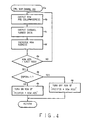
- Figure 4 shows a flow diagram for indicating the channel on the screen, wherein the following steps will be executed upon calling the skip channel OSD 18 at the step 2a.
- the skip channel OSD 18 will be called and the data for row address and column address will be output at step 4b and then step 4c will be performed.
- the step 4c outputs the channel number data stored in the skip memory and step 4d increases the row address.
- step 4e will be executed.
- step 4e determines whether the row address is the same as a last address will be checked. If it is not the same as the last address, the step 4b will be executed again. If it is the last address, step 4f will be executed.
- the step 4f checks whether display-on flag DSPON is set to "1 ". If it is not “1", step 4h will be executed. If it is "1", step 4g will be performed.
- the line corresponding to the pointer value which is added with the row address will be turned off to return.
- the line corresponding to the pointer value plus the row address will be turned on to return to the main procedure.
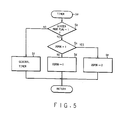
- FIG. 5 shows a flow diagram to show the time for the skip channel flickering interval.
- Step 5b checks whether the screen mode is "1" or not. If it is “1”, step 5c will be executed. If not “1", step 5f will be performed.
- the step 5c checks whether the display-on flag DSPON is set to "1" or not. If it is not “1”, the display-on flag DSPON is set to "1” at step 5d and then returns. If it is “1”, the display-on flag DSPON is set to "0" at step 5e and then returns.
- the general timer operates for a predetermined period and then returns.
- the user directly configures the desired PIP screen using the skip channel OSD. Therefore, the user is provided with various PIP screens which may show different channels, rather than all the same one.
Landscapes
- Engineering & Computer Science (AREA)
- Multimedia (AREA)
- Signal Processing (AREA)
- Human Computer Interaction (AREA)
- Computer Graphics (AREA)
- Business, Economics & Management (AREA)
- Marketing (AREA)
- Studio Circuits (AREA)
- Processing Of Color Television Signals (AREA)
Claims (15)
wobei der Mikrocomputer (10) so angeordnet ist, um den Kanal eines ausgewählten der Unterbildschirme auf eine Kanalnummer hin zu ändern, die durch die OSD-Einheit (18) angezeigt ist.
Applications Claiming Priority (2)
| Application Number | Priority Date | Filing Date | Title |
|---|---|---|---|
| KR1019880018101A KR920002049B1 (ko) | 1988-12-31 | 1988-12-31 | 멀티 스크린 수행방법 |
| KR1810188 | 1988-12-31 |
Publications (4)
| Publication Number | Publication Date |
|---|---|
| EP0377334A2 EP0377334A2 (de) | 1990-07-11 |
| EP0377334A3 EP0377334A3 (de) | 1991-04-24 |
| EP0377334B1 true EP0377334B1 (de) | 1995-06-21 |
| EP0377334B2 EP0377334B2 (de) | 1998-07-29 |
Family
ID=19281117
Family Applications (1)
| Application Number | Title | Priority Date | Filing Date |
|---|---|---|---|
| EP89313689A Expired - Lifetime EP0377334B2 (de) | 1988-12-31 | 1989-12-29 | Bild-im-Bild-Systeme |
Country Status (4)
| Country | Link |
|---|---|
| US (1) | US5045946A (de) |
| EP (1) | EP0377334B2 (de) |
| KR (1) | KR920002049B1 (de) |
| DE (1) | DE68923165T3 (de) |
Cited By (3)
| Publication number | Priority date | Publication date | Assignee | Title |
|---|---|---|---|---|
| US6181335B1 (en) | 1992-12-09 | 2001-01-30 | Discovery Communications, Inc. | Card for a set top terminal |
| US8095949B1 (en) | 1993-12-02 | 2012-01-10 | Adrea, LLC | Electronic book with restricted access features |
| US8548813B2 (en) | 1999-06-25 | 2013-10-01 | Adrea, LLC | Electronic book with voice emulation features |
Families Citing this family (49)
| Publication number | Priority date | Publication date | Assignee | Title |
|---|---|---|---|---|
| IT1241338B (it) * | 1990-12-06 | 1994-01-10 | Sisvel Spa | Ricevitore perfezionato di trasmissioni teletext |
| JPH04314278A (ja) * | 1991-04-12 | 1992-11-05 | Sony Corp | 映像信号受信装置 |
| KR930003720A (ko) * | 1991-07-09 | 1993-02-24 | 강진구 | 자동 pip 채널 탐색 방법 |
| JPH0575944A (ja) * | 1991-09-10 | 1993-03-26 | Sony Corp | テレビジヨン受像機 |
| EP0536828A1 (de) * | 1991-10-07 | 1993-04-14 | Koninklijke Philips Electronics N.V. | Fernsehempfänger |
| US20020091850A1 (en) | 1992-10-23 | 2002-07-11 | Cybex Corporation | System and method for remote monitoring and operation of personal computers |
| US7336788B1 (en) | 1992-12-09 | 2008-02-26 | Discovery Communicatoins Inc. | Electronic book secure communication with home subsystem |
| US7849393B1 (en) | 1992-12-09 | 2010-12-07 | Discovery Communications, Inc. | Electronic book connection to world watch live |
| US7509270B1 (en) | 1992-12-09 | 2009-03-24 | Discovery Communications, Inc. | Electronic Book having electronic commerce features |
| US7401286B1 (en) | 1993-12-02 | 2008-07-15 | Discovery Communications, Inc. | Electronic book electronic links |
| DE69331715T2 (de) | 1992-12-09 | 2002-10-24 | Discovery Communications, Inc. | Fernbedienung für Kabelfernsehverteilsysteme |
| US7835989B1 (en) | 1992-12-09 | 2010-11-16 | Discovery Communications, Inc. | Electronic book alternative delivery systems |
| US7168084B1 (en) | 1992-12-09 | 2007-01-23 | Sedna Patent Services, Llc | Method and apparatus for targeting virtual objects |
| US9286294B2 (en) | 1992-12-09 | 2016-03-15 | Comcast Ip Holdings I, Llc | Video and digital multimedia aggregator content suggestion engine |
| US5659350A (en) | 1992-12-09 | 1997-08-19 | Discovery Communications, Inc. | Operations center for a television program packaging and delivery system |
| US7269841B1 (en) | 1992-12-09 | 2007-09-11 | Sedna Patent Services, Llc | Digital cable headend for cable television delivery system |
| KR950008122B1 (ko) * | 1992-12-17 | 1995-07-25 | 주식회사금성사 | 티브이의 입력화면 탐색방법 |
| KR950008124B1 (ko) * | 1992-12-23 | 1995-07-25 | 주식회사금성사 | 픽쳐 아웃 픽쳐(pop)를 이용한 채널자동 기억장치 및 방법 |
| US9053640B1 (en) | 1993-12-02 | 2015-06-09 | Adrea, LLC | Interactive electronic book |
| US7861166B1 (en) | 1993-12-02 | 2010-12-28 | Discovery Patent Holding, Llc | Resizing document pages to fit available hardware screens |
| US7865567B1 (en) | 1993-12-02 | 2011-01-04 | Discovery Patent Holdings, Llc | Virtual on-demand electronic book |
| IT1273150B (it) * | 1994-04-15 | 1997-07-04 | S E I Societa Elettronica Ital | Ricevitore di segnali televisivi con telecomando e possibilita' di visualizzazione contemporanea di una pluralita' di immagini corrispondenti ad altrettanti segnali ricevuti |
| US6215467B1 (en) * | 1995-04-27 | 2001-04-10 | Canon Kabushiki Kaisha | Display control apparatus and method and display apparatus |
| US5721842A (en) | 1995-08-25 | 1998-02-24 | Apex Pc Solutions, Inc. | Interconnection system for viewing and controlling remotely connected computers with on-screen video overlay for controlling of the interconnection switch |
| US6480238B1 (en) * | 1996-10-16 | 2002-11-12 | Thomson Licensing S.A. | Apparatus and method for generating on-screen-display messages using field doubling |
| KR100225063B1 (ko) * | 1996-10-17 | 1999-10-15 | 윤종용 | 다중비디오출력장치(Multiple Video Displayer) |
| US6028643A (en) * | 1997-09-03 | 2000-02-22 | Colorgraphic Communications Corporation | Multiple-screen video adapter with television tuner |
| US6429903B1 (en) | 1997-09-03 | 2002-08-06 | Colorgraphic Communications Corporation | Video adapter for supporting at least one television monitor |
| CA2345084C (en) | 1998-09-22 | 2004-11-02 | Cybex Computer Products Corporation | System for accessing personal computers remotely |
| US6519283B1 (en) | 1999-01-25 | 2003-02-11 | International Business Machines Corporation | Integrated video processing system having multiple video sources and implementing picture-in-picture with on-screen display graphics |
| US6753928B1 (en) | 1999-11-17 | 2004-06-22 | Thomson Licensing S.A. | Method and apparatus for providing feedback during programming of a television apparatus |
| JP2002246881A (ja) * | 2001-02-16 | 2002-08-30 | Funai Electric Co Ltd | 放送受信機のチャンネル選択装置及び同装置を有した放送受信機 |
| US7908628B2 (en) | 2001-08-03 | 2011-03-15 | Comcast Ip Holdings I, Llc | Video and digital multimedia aggregator content coding and formatting |
| US7793326B2 (en) | 2001-08-03 | 2010-09-07 | Comcast Ip Holdings I, Llc | Video and digital multimedia aggregator |
| KR100365839B1 (en) * | 2002-08-22 | 2002-12-31 | Huwell Technology Inc | System for real time service using interactive data communication and method thereof |
| US8869206B2 (en) | 2002-12-10 | 2014-10-21 | Lg Electronics Inc. | Digital television and channel editing method thereof |
| KR100518874B1 (ko) * | 2002-12-10 | 2005-10-04 | 엘지전자 주식회사 | 디지털 티브이 및 그 채널편집 방법 |
| GB0229245D0 (en) * | 2002-12-13 | 2003-01-22 | Koninkl Philips Electronics Nv | Television display unit |
| KR101015412B1 (ko) * | 2003-01-17 | 2011-02-22 | 톰슨 라이센싱 | 비디오 신호를 생성하는 방법 및 전자장치 |
| KR100580174B1 (ko) * | 2003-08-21 | 2006-05-16 | 삼성전자주식회사 | 회전 가능한 디스플레이 장치 및 화면 조정 방법 |
| JP2006067063A (ja) * | 2004-08-25 | 2006-03-09 | Fujitsu Ltd | 切り換え装置、電子装置、データ転送方法およびその方法をコンピュータに実行させるプログラム |
| JP4270130B2 (ja) * | 2005-01-11 | 2009-05-27 | カシオ計算機株式会社 | テレビ受信装置およびその制御プログラム |
| KR100689474B1 (ko) * | 2005-01-27 | 2007-03-08 | 삼성전자주식회사 | 다중 화면을 제공하는 트랜스포트 스트림 수신 장치 및 그제어 방법 |
| US7532253B1 (en) * | 2005-07-26 | 2009-05-12 | Pixelworks, Inc. | Television channel change picture-in-picture circuit and method |
| KR100696723B1 (ko) * | 2005-08-03 | 2007-03-20 | 경북대학교 산학협력단 | 패턴 생성 장치 |
| KR101295567B1 (ko) * | 2006-09-28 | 2013-08-12 | 엘지전자 주식회사 | 티브이 및 이를 이용한 선호 채널 제공 방법 |
| US9210468B2 (en) * | 2011-03-22 | 2015-12-08 | Sony Corporation | System and method for effectively implementing a stroboscopic visual effect |
| US10158904B2 (en) | 2015-09-23 | 2018-12-18 | Rovi Guides, Inc. | Systems and methods to combine programming from multiple channels |
| CN108353207A (zh) * | 2015-09-23 | 2018-07-31 | 乐威指南公司 | 在来自多频道的节目中检测事件的系统和方法 |
Family Cites Families (7)
| Publication number | Priority date | Publication date | Assignee | Title |
|---|---|---|---|---|
| JPH0748834B2 (ja) * | 1986-11-04 | 1995-05-24 | 松下電器産業株式会社 | 映像信号処理装置 |
| US4897727A (en) * | 1988-05-09 | 1990-01-30 | Thomson Consumer Electronics, Inc. | Television tuning system allowing rapid response to user initiated commands |
| DE3920119A1 (de) * | 1988-06-20 | 1989-12-21 | Samsung Electronics Co Ltd | Vielkanaleditor vom menue-typ |
| US4918531A (en) * | 1988-10-25 | 1990-04-17 | Thomson Consumer Electronics, Inc. | Commercial message timer |
| US4959719A (en) * | 1988-12-21 | 1990-09-25 | North American Philips Corporation | Picture-in-picture television receiver control |
| US4959720A (en) * | 1989-04-06 | 1990-09-25 | Rca Licensing Corporation | Tuner control apparatus having tune-by-label capability |
| US4996597A (en) * | 1989-04-20 | 1991-02-26 | Rca Licensing Corporation | User programmable switching arrangement |
-
1988
- 1988-12-31 KR KR1019880018101A patent/KR920002049B1/ko not_active Expired
-
1989
- 1989-11-21 US US07/439,323 patent/US5045946A/en not_active Expired - Lifetime
- 1989-12-29 DE DE68923165T patent/DE68923165T3/de not_active Expired - Fee Related
- 1989-12-29 EP EP89313689A patent/EP0377334B2/de not_active Expired - Lifetime
Cited By (3)
| Publication number | Priority date | Publication date | Assignee | Title |
|---|---|---|---|---|
| US6181335B1 (en) | 1992-12-09 | 2001-01-30 | Discovery Communications, Inc. | Card for a set top terminal |
| US8095949B1 (en) | 1993-12-02 | 2012-01-10 | Adrea, LLC | Electronic book with restricted access features |
| US8548813B2 (en) | 1999-06-25 | 2013-10-01 | Adrea, LLC | Electronic book with voice emulation features |
Also Published As
| Publication number | Publication date |
|---|---|
| EP0377334A2 (de) | 1990-07-11 |
| KR900011269A (ko) | 1990-07-11 |
| US5045946A (en) | 1991-09-03 |
| EP0377334A3 (de) | 1991-04-24 |
| KR920002049B1 (ko) | 1992-03-10 |
| EP0377334B2 (de) | 1998-07-29 |
| DE68923165T3 (de) | 1999-02-25 |
| DE68923165T2 (de) | 1996-02-08 |
| DE68923165D1 (de) | 1995-07-27 |
Similar Documents
| Publication | Publication Date | Title |
|---|---|---|
| EP0377334B1 (de) | Bild-im-Bild-Systeme | |
| US4959719A (en) | Picture-in-picture television receiver control | |
| US5867227A (en) | Television receiver | |
| EP0550911B1 (de) | Programmierbare Bild-ausserhalb-Bild-Anzeige | |
| US5602598A (en) | Television receiver with caption display | |
| KR930007255A (ko) | 텔레비전 수상기 | |
| US5506628A (en) | Menu-type multi-channel system having a page up/down mode feature | |
| US5093726A (en) | Multi-type multi-channel selector | |
| JPH09182033A (ja) | 閉じた見出しデータを固定するシステム | |
| JP3008416B2 (ja) | 映像出力装置 | |
| JP2751270B2 (ja) | Avtcシステム | |
| JPH0296486A (ja) | マルチチャンネルシステムのページアップ/ダウンモード遂行方法 | |
| JP2562211B2 (ja) | マルチスクリーン遂行方法 | |
| CN101223777B (zh) | 在电视上进行转换期间显示原频道的视频系统 | |
| JPH1051709A (ja) | テレビジョン受信機 | |
| JP2001257970A (ja) | 磁気記録再生装置 | |
| JPH0832892A (ja) | ディスプレイ装置 | |
| JPH04334180A (ja) | 予約録画予告ディスプレー装置 | |
| JPH04132475A (ja) | オンスクリーン表示装置 | |
| JPH06274139A (ja) | ウインドゥ画面選択方法 | |
| KR100207622B1 (ko) | 비디오프린터의 다중입력선택장치 | |
| JP2790252B2 (ja) | 選局装置 | |
| JPH08335857A (ja) | チャンネルサーチ装置 | |
| KR0134333B1 (ko) | 다화면 표시장치의 상호 혼신 제거장치 | |
| JPH02184185A (ja) | 文字多重放送受信機 |
Legal Events
| Date | Code | Title | Description |
|---|---|---|---|
| PUAI | Public reference made under article 153(3) epc to a published international application that has entered the european phase |
Free format text: ORIGINAL CODE: 0009012 |
|
| AK | Designated contracting states |
Kind code of ref document: A2 Designated state(s): DE FR GB NL |
|
| PUAL | Search report despatched |
Free format text: ORIGINAL CODE: 0009013 |
|
| AK | Designated contracting states |
Kind code of ref document: A3 Designated state(s): DE FR GB NL |
|
| 17P | Request for examination filed |
Effective date: 19910503 |
|
| 17Q | First examination report despatched |
Effective date: 19930408 |
|
| GRAA | (expected) grant |
Free format text: ORIGINAL CODE: 0009210 |
|
| AK | Designated contracting states |
Kind code of ref document: B1 Designated state(s): DE FR GB NL |
|
| ET | Fr: translation filed | ||
| REF | Corresponds to: |
Ref document number: 68923165 Country of ref document: DE Date of ref document: 19950727 |
|
| PLBQ | Unpublished change to opponent data |
Free format text: ORIGINAL CODE: EPIDOS OPPO |
|
| PLBI | Opposition filed |
Free format text: ORIGINAL CODE: 0009260 |
|
| PLBF | Reply of patent proprietor to notice(s) of opposition |
Free format text: ORIGINAL CODE: EPIDOS OBSO |
|
| 26 | Opposition filed |
Opponent name: INTERESSENGEMEINSCHAFT FUER RUNDFUNKSCHUTZRECHTE G Effective date: 19960321 |
|
| NLR1 | Nl: opposition has been filed with the epo |
Opponent name: INTERESSENGEMEINSCHAFT FUER RUNDFUNKSCHUTZRECHTE G |
|
| PLBF | Reply of patent proprietor to notice(s) of opposition |
Free format text: ORIGINAL CODE: EPIDOS OBSO |
|
| PLBF | Reply of patent proprietor to notice(s) of opposition |
Free format text: ORIGINAL CODE: EPIDOS OBSO |
|
| PLAW | Interlocutory decision in opposition |
Free format text: ORIGINAL CODE: EPIDOS IDOP |
|
| PLAW | Interlocutory decision in opposition |
Free format text: ORIGINAL CODE: EPIDOS IDOP |
|
| PUAH | Patent maintained in amended form |
Free format text: ORIGINAL CODE: 0009272 |
|
| STAA | Information on the status of an ep patent application or granted ep patent |
Free format text: STATUS: PATENT MAINTAINED AS AMENDED |
|
| 27A | Patent maintained in amended form |
Effective date: 19980729 |
|
| AK | Designated contracting states |
Kind code of ref document: B2 Designated state(s): DE FR GB NL |
|
| NLR2 | Nl: decision of opposition | ||
| NLR3 | Nl: receipt of modified translations in the netherlands language after an opposition procedure | ||
| ET3 | Fr: translation filed ** decision concerning opposition | ||
| REG | Reference to a national code |
Ref country code: GB Ref legal event code: IF02 |
|
| PGFP | Annual fee paid to national office [announced via postgrant information from national office to epo] |
Ref country code: NL Payment date: 20071203 Year of fee payment: 19 |
|
| PGFP | Annual fee paid to national office [announced via postgrant information from national office to epo] |
Ref country code: GB Payment date: 20071227 Year of fee payment: 19 Ref country code: FR Payment date: 20071210 Year of fee payment: 19 |
|
| PGFP | Annual fee paid to national office [announced via postgrant information from national office to epo] |
Ref country code: DE Payment date: 20071231 Year of fee payment: 19 |
|
| GBPC | Gb: european patent ceased through non-payment of renewal fee |
Effective date: 20081229 |
|
| NLV4 | Nl: lapsed or anulled due to non-payment of the annual fee |
Effective date: 20090701 |
|
| REG | Reference to a national code |
Ref country code: FR Ref legal event code: ST Effective date: 20090831 |
|
| PG25 | Lapsed in a contracting state [announced via postgrant information from national office to epo] |
Ref country code: DE Free format text: LAPSE BECAUSE OF NON-PAYMENT OF DUE FEES Effective date: 20090701 |
|
| PG25 | Lapsed in a contracting state [announced via postgrant information from national office to epo] |
Ref country code: NL Free format text: LAPSE BECAUSE OF NON-PAYMENT OF DUE FEES Effective date: 20090701 Ref country code: GB Free format text: LAPSE BECAUSE OF NON-PAYMENT OF DUE FEES Effective date: 20081229 |
|
| PG25 | Lapsed in a contracting state [announced via postgrant information from national office to epo] |
Ref country code: FR Free format text: LAPSE BECAUSE OF NON-PAYMENT OF DUE FEES Effective date: 20081231 |