EP0377366A1 - Solin pour relevé d'étanchéité - Google Patents
Solin pour relevé d'étanchéité Download PDFInfo
- Publication number
- EP0377366A1 EP0377366A1 EP89403522A EP89403522A EP0377366A1 EP 0377366 A1 EP0377366 A1 EP 0377366A1 EP 89403522 A EP89403522 A EP 89403522A EP 89403522 A EP89403522 A EP 89403522A EP 0377366 A1 EP0377366 A1 EP 0377366A1
- Authority
- EP
- European Patent Office
- Prior art keywords
- profile
- cover
- groove
- flashing according
- concrete
- Prior art date
- Legal status (The legal status is an assumption and is not a legal conclusion. Google has not performed a legal analysis and makes no representation as to the accuracy of the status listed.)
- Granted
Links
- 230000000630 rising effect Effects 0.000 claims abstract description 14
- 239000000463 material Substances 0.000 claims abstract description 4
- 230000035515 penetration Effects 0.000 claims abstract description 4
- 238000009434 installation Methods 0.000 claims description 6
- 238000003466 welding Methods 0.000 claims description 6
- 230000008595 infiltration Effects 0.000 claims description 5
- 238000001764 infiltration Methods 0.000 claims description 5
- XLYOFNOQVPJJNP-UHFFFAOYSA-N water Substances O XLYOFNOQVPJJNP-UHFFFAOYSA-N 0.000 claims description 5
- 230000003313 weakening effect Effects 0.000 claims description 5
- 239000011248 coating agent Substances 0.000 claims description 4
- 238000000576 coating method Methods 0.000 claims description 4
- 238000007789 sealing Methods 0.000 claims description 4
- 238000001125 extrusion Methods 0.000 claims description 3
- 238000004078 waterproofing Methods 0.000 claims description 3
- 238000000926 separation method Methods 0.000 claims description 2
- 238000010276 construction Methods 0.000 abstract 1
- 238000009415 formwork Methods 0.000 description 6
- 229920000915 polyvinyl chloride Polymers 0.000 description 3
- 239000004800 polyvinyl chloride Substances 0.000 description 3
- 229920003023 plastic Polymers 0.000 description 2
- 239000004033 plastic Substances 0.000 description 2
- 229920001084 poly(chloroprene) Polymers 0.000 description 2
- 230000001681 protective effect Effects 0.000 description 2
- 239000007787 solid Substances 0.000 description 2
- 238000004873 anchoring Methods 0.000 description 1
- 239000003000 extruded plastic Substances 0.000 description 1
- 238000010348 incorporation Methods 0.000 description 1
- 238000000034 method Methods 0.000 description 1
- 239000002985 plastic film Substances 0.000 description 1
- 230000000750 progressive effect Effects 0.000 description 1
- 230000004224 protection Effects 0.000 description 1
- 239000011253 protective coating Substances 0.000 description 1
- 239000000565 sealant Substances 0.000 description 1
Images
Classifications
-
- E—FIXED CONSTRUCTIONS
- E04—BUILDING
- E04D—ROOF COVERINGS; SKY-LIGHTS; GUTTERS; ROOF-WORKING TOOLS
- E04D13/00—Special arrangements or devices in connection with roof coverings; Protection against birds; Roof drainage ; Sky-lights
- E04D13/14—Junctions of roof sheathings to chimneys or other parts extending above the roof
- E04D13/1407—Junctions of roof sheathings to chimneys or other parts extending above the roof for flat roofs
- E04D13/1415—Junctions to walls extending above the perimeter of the roof
Definitions
- the present invention relates to a flashing for waterproofing of a structure.
- Certain structures such as a terrace slab, an outdoor parking space, a casing, a tank, etc., a tunnel veil, a roof, etc., include a waterproof coating covering the surface to be protected and with a statement especially at the periphery.
- the coating consists of plastic sheets such as polyvinyl chloride, neoprene or the like which are applied to the surface of the structure to be protected and welded together edge to edge. This coating is extended, in particular at the periphery, by a statement which is applied to a rising part of the structure, generally made of concrete.
- an extruded plastic section is anchored in this section flush with its surface and the upper edge of this statement is welded to this section.
- the anchoring is generally carried out during the pouring of the concrete of said rising part of the structure, the profile being for this purpose nailed to the formwork. Then, when the bonding is finished and filling materials are placed on the covering, a protective sealant is applied to the head of the statement, the profile and the rising part of the work.
- the object of the present invention is to remedy these disadvantages by opposing the fact that the laitance reaches the surface to be welded to the profile and by eliminating the puttying operation.
- the profile has a flattened tubular body of which a hidden flank constitutes the bottom of a groove and of which an apparent flank constitutes a cover, which cover closes the groove to protect the bottom against any penetration by laitance as long as the concrete of the structure is not consolidated and this cover being capable of being separated from the lower edge of the groove to allow the welding of the edge of the covering statement on the bottom and then to cover said edge and protect it against any water infiltration.
- the profile comprises two identical weakening grooves extending substantially in line with the sides of this profile, the direction of laying of the profile being indifferent and the groove located at the bottom constituting the aforementioned tearable part.
- a tearable weakening groove and an integrated hinge extending substantially in line with the sides of this profile, the profile to be placed with the hinge located at the top.
- the separation of the lower edge of the cover is carried out by slicing following that which corresponds to it of two ridges formed by extrusion on the apparent flank of the flattened tubular body, substantially in line with the edges of this body. .
- the profile can have a symmetrical section so that the direction of its installation is indifferent, or it can have a bottom extending downwardly and outward.
- the profile may include at least one re-entrant and rising edge to prevent water infiltration.
- the covering comprises a sealing sheet 5 made of plastic, such as polyvinyl chloride or neoprene, and a protective sheet 6 made of anti-puncture felt for example.
- the profile 3 is made of extrudable plastic material and weldable on the sheet 5; it can in particular be made of polyvinyl chloride.
- the profile 3 has a flattened tubular body 7 having a hidden flank 8, an apparent flank 9 and connecting edges 10 and 11.
- the apparent flank 9 is connected to the edges 10, 11 by thinned parts 12, 13 obtained by providing extrusion in the profile of the grooves.
- This visible sidewall 9 is intended to constitute an opening cover which is released when the lower thinned part 12 is broken by tearing or slicing and which is capable of pivoting while remaining linked to the edge 11 thanks to the integrated hinge formed by the upper thinned part 13 .
- the hidden flank 8 is intended to constitute a bottom for the groove 8, 10 and 11.
- This groove is closed by the cover 9 when the tearable part 12 is not broken, thus preventing the penetration of laitance to the bottom 8 , which is capable of being welded with the upper edge 4 of the statement when said cover is open and gives access to said groove.
- the profile 3 to be fixed on the formwork of the rising part 1 of the structure, it has a coplanar extension of the side 9 of the edges 14 and 15 through which nails 16 can be driven. Furthermore, this profile having to be anchored in the concrete, it also has protruding ribs 17, 18 and re-entrant flanges 19, 20.
- the ribs 17, 18 extend the edges 11, 12 so that the bottom 8 can bulge under the thrust of the concrete ( Figure 2).
- Figure 2 shows that the profile 3 is fixed by means of the nails 16 on the formwork 21 and the concrete is poured. When it is consolidated, the rising part 1 of the structure is removed from the mold and the profile 3 is trapped in the concrete. The cover 9 closes the groove and prevents the laitance reaching the convex bottom 8 of said profile.
- Figure 3 shows that the tearable part 12 is broken and that the cover 9 is raised to allow passage at the edge upper 4 of the covering slip 2.
- Figure 4 shows that this border 4 is welded at 22 to the curved bottom 8 without having to clean it and that the cover 9 is folded down to protect the connection thus obtained.
- the profile 3 ( Figure 1) is symmetrical so that its installation on the formwork has no preferred meaning; in fact, the thinned part 12 can be at the bottom to be tearable and the thinned part 13 at the top to form a hinge; conversely, part 12 can be at the top and part 13 at the bottom.
- the profile 3 is asymmetrical so that the bottom 8 is sloping downward and outward, thereby joining the lower edge 14 near the tear-off thinned portion 12.
- the bottom 8 is curved, it is relatively close to the upper edge 4 of the covering 2 covering, which facilitates the welding 22 and makes it possible to better apply the cover 9 in overlap of said border 4.
- the upper edge 15 of the profile 3 instead of being provided with a re-entrant flange 20, can be extended by a raised flange 23 projecting inwards and upwards. .
- the rim 23 makes it possible to oppose water infiltration.
- the upper thinned part 24 of the profile 3 instead of being defined by a V-shaped groove, can be delimited by at least one very progressive curved groove 24, so that the hinge thus obtained causes an elastic return of the cover towards the closing.
- the apparent flank 9 is free from grooves 12 and 13.
- connection of the cover 9 with the edges 10 and 11 is therefore very solid and, in order to separate the lower edge 25 of this cover relative to the body 7, one proceeds by slicing. For this, streaks 26 and 27 are extruded on the apparent flank 9, so that it is easy for the installer of the seal to follow the cutting line with the cutting tool.
- this tool comprises, in front of its slicer blade 28, a spout 29 or other prominent guide element.
- This spout is intended to be engaged at the end in the internal conduit 30 of the tubular body 7 and to bear for guiding the tool against the lower edge, for example 10.
- the laying direction is indifferent and the cover is still integral with the profile in its upper part after it has been cut in its lower part.
Landscapes
- Engineering & Computer Science (AREA)
- Architecture (AREA)
- Civil Engineering (AREA)
- Structural Engineering (AREA)
- Forms Removed On Construction Sites Or Auxiliary Members Thereof (AREA)
- Bridges Or Land Bridges (AREA)
- Lining And Supports For Tunnels (AREA)
- Building Environments (AREA)
Abstract
Description
- La présente invention concerne un solin pour relevé d'étanchéité d'un ouvrage.
- Certains ouvrages tels qu'une dalle de terrasse, de parking extérieur, d'un cuvelage, d'un réservoir etc.., un voile de tunnel, de toiture etc... comportent un revêtement d'étanchéité recouvrant la surface à protéger et présentant un relevé notamment à la périphérie.
- Le revêtement est constitué par des feuilles en matière plastique telle que du polychlorure de vinyle, du néoprène ou autre qui sont appliquées sur la surface de l'ouvrage à protéger et soudées entre elles bord à bord. Ce revêtement est prolongé, notamment à la périphérie, par un relevé qui est appliqué sur une partie montante de l'ouvrage généralement en béton.
- Pour assurer l'étanchéité entre le relevé et la partie montante de l'ouvrage, un profilé en matière plastique extrudée est ancré dans cette partie au ras de sa surface et la bordure supérieure de ce relevé est soudée sur ce profilé. L'ancrage est généralement exécuté lors de la coulée du béton de ladite partie montante de l'ouvrage, le profilé étant à cet effet cloué sur le coffrage. Puis, lorsque le collage est terminé et que des matériaux de garnissage sont disposés sur le revêtement, un mastic de protection est appliqué sur la tête du relevé, le profilé et la partie montante de l'ouvrage.
- Cette technique connue présente un inconvénient majeur résultant du fait que la laitance du béton peut s'infiltrer entre le coffrage et le profilé. La surface apparente de ce profilé est salie et doit être nettoyée avant soudage. Outre que cette opération est longue, fastidieuse et finalement coûteuse, il n'est cependant pas garanti que la soudure du relevé sur le profilé sera solide, étanche et fiable.
- Par ailleurs, l'opération de masticage est également longue et relativement coûteuse. Son efficacité n'est pas garantie et de toute façon, l'aspect final est inesthétique.
- La présente invention a pour but de remédier à ces inconvénients en s'opposant à ce que la laitance parvienne jusqu'à la surface à souder du profilé et en supprimant l'opération de masticage.
- Dans ce but et conformément à l'invention, le profilé présente un corps tubulaire aplati dont un flanc caché constitue le fond d'une rainure et dont un flanc apparent constitue un couvercle, lequel couvercle ferme la rainure pour protéger le fond contre toute pénétration de laitance tant que le béton de l'ouvrage n'est pas consolidé et ce couvercle étant susceptible d'être séparé du bord inférieur de la rainure pour permettre le soudage de la bordure du relevé de revêtement sur le fond et ensuite pour recouvrir ladite bordure et la protéger contre toute infiltration d'eau.
- Suivant une première forme de réalisation, le profilé comporte deux saignées d'affaiblissement identiques s'étendant sensiblement au droit des flancs de ce profilé, le sens de pose du profilé étant indifférent et la saignée située en bas constituant la partie déchirable précitée.
- Suivant une deuxième forme de réalisation, une saignée d'affaiblissement déchirable et une charnière intégrée s'étendant sensiblement au droit des flancs de ce profilé, le profilé devant être posé avec la charnière située en haut.
- Suivant une troisième forme de réalisation particulièrement avantageuse, la séparation du bord inférieur du couvercle est exécutée par tranchage en suivant celle qui lui correspond de deux stries formées d'extrusion sur le flanc apparent du corps tubulaire aplati, sensiblement au droit des chants de ce corps.
- Le profilé peut présenter une section symétrique pour que le sens de sa pose soit indifférent, ou bien il peut comporter un fond s'étendant en pente vers le bas et l'extérieur.
- Dans tous les cas, le profilé peut comporter au moins un rebord rentrant et montant pour s'opposer aux infiltrations d'eau.
- Divers autres caractéristiques et avantages de l'invention ressortent d'ailleurs de la description détaillée qui suit.
- Des formes de réalisation de l'objet de l'invention sont représentées, à titre d'exemples non limitatifs, sur le dessin annexé.
- Sur ce dessin :
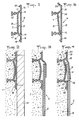
- - la figure 1 est une coupe transversale illustrant, avant pose, une première forme de réalisation d'un profilé de solin selon l'invention,
- - la figure 2 est une coupe verticale montrant, pendant la coulée du béton, une partie montante d'ouvrage dans laquelle le profilé de la figure 1 est incorporé
- - la figure 3 est une vue analogue à la figure 2, faisant ressortir, après décoffrage, la pose du relevé de la feuille d'étanchéité,
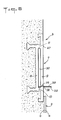
- - la figure 4 est une vue analogue à la figure 3 après soudage à l'air chaud du relevé sur le profilé,
- - la figure 5 est une vue analogue à la figure 1, illustrant une deuxième forme de réalisation du profilé selon l'invention,
- - la figure 6 est une vue analogue à la figure 1, illustrant une troisième forme de réalisation du profilé selon l'invention.
- 1 désigne la partie montante d'un ouvrage en béton,
- 2, le relevé d'un revêtement d'étanchéité et de protection de l'ouvrage, relevé qui est normalement appliqué contre la partie montante 1 et
- 3, un profilé incorporé dans le béton pour constituer un solin destiné à coopérer avec la bordure supérieure 4 du relevé 2.
- Le revêtement comporte une feuille d'étanchéité 5 en matière plastique, telle que du polychlorure de vinyle ou un néoprène, et une feuille de protection 6 en feutre antipoinçonnant par exemple.
- Le profilé 3 est en matière plastique extrudable et soudable sur la feuille 5; il peut être en particulier en polychlorure de vinyle.
- Suivant la première forme de réalisation illustrée par la figure 1, le profilé 3 comporte un corps tubulaire aplati 7 présentant un flanc caché 8, un flanc apparent 9 et des chants de liaison 10 et 11.
- Le flanc apparent 9 est relié aux chants 10, 11 par des parties amincies 12, 13 obtenues en ménageant d'extrusion dans le profilé des saignées. Ce flanc apparent 9 est destiné à constituer un couvercle ouvrant qui est libéré lorsque la partie amincie inférieure 12 est rompue par déchirement ou tranchage et qui est susceptible de pivoter en restant lié au chant 11 grâce à la charnière intégrée formée par la partie amincie supérieure 13.
- Le flanc caché 8 est destiné à constituer un fond pour la rainure 8, 10 et 11. Cette rainure est fermée par le couvercle 9 lorsque la partie déchirable 12 n'est pas rompue, en empêchant ainsi la pénétration de laitance jusqu'au fond 8, lequel est susceptible d'être soudé avec la bordure supérieure 4 du relevé lorsque ledit couvercle est ouvert et livre accès à ladite rainure.
- Le profilé 3 devant être fixé sur le coffrage de la partie montante 1 de l'ouvrage, il présente en prolongement coplanaire du flanc 9 des bordures 14 et 15 à travers lesquelles des clous 16 peuvent être enfoncés. Par ailleurs, ce profilé devant être ancré dans le béton, il comporte également des nervures à saillies 17, 18 et des rebords rentrants 19, 20.
- Avantageusement, les nervures 17, 18 prolongent les chants 11, 12 afin que le fond 8 puisse se bomber sous la poussée du béton (figure 2).
- Pour réaliser le solin, on peut procéder comme cela ressort des figures 2 à 5.
- La figure 2 montre que le profilé 3 est fixé au moyen des clous 16 sur le coffrage 21 et le béton est coulé. Lorsque celui-ci est consolidé, la partie montante 1 de l'ouvrage est démoulée et le profilé 3 est prisonnier du béton. Le couvercle 9 obture la rainure et empêche que la laitance parvienne jusqu'au fond bombé 8 dudit profilé.
- La figure 3 montre que la partie déchirable 12 est rompue et que le couvercle 9 est relevé pour livrer passage à la bordure supérieure 4 du relevé 2 de revêtement.
- La figure 4 montre que cette bordure 4 est soudée en 22 sur le fond bombé 8 sans avoir à nettoyer celui-ci et que le couvercle 9 est rabattu pour protéger la liaison ainsi obtenue.
- Dans cette première forme de réalisation, le profilé 3 (figure 1) est symétrique de sorte que sa pose sur le coffrage n'a pas de sens privilégié; en effet, la partie amincie 12 peut être en bas pour être déchirable et la partie amincie 13 en haut pour former charnière; inversement, la partie 12 peut être en haut et la partie 13 en bas.
- Il s'agit évidemment d'un avantage dont la contrepartie est que le poseur du profilé peut, s'il n'y prête pas attention, déchirer les deux parties 12 et 13 en même temps, et détacher la bande 9 qui ne peut plus alors faire fonction de couvercle.
- Suivant la deuxième forme de réalisation illustrée par la figure 5, le profilé 3 est dissymétrique de façon que le fond 8 soit en pente vers le bas et l'extérieur, en rejoignant ainsi la bordure inférieure 14 près de la partie amincie déchirable 12. Lorsqu'après incorporation du profilé 3 dans la partie montante 1 en béton le fond 8 est bombé, il est relativement proche de la bordure supérieure 4 du relevé 2 de revêtement, ce qui facilite la soudure 22 et permet de mieux appliquer le couvercle 9 en recouvrement de ladite bordure 4.
- Par ailleurs, quelle que soit la forme de réalisation choisie, la bordure supérieure 15 du profilé 3, au lieu d'être munie d'un rebord rentrant 20, peut être prolongée par un rebord relevé 23 faisant saillie vers l'intérieur et le haut. Le rebord 23 permet de s'opposer aux infiltrations d'eau.
- Quelle que soit la forme de réalisation choisie, la partie amincie supérieure 24 du profilé 3, au lieu d'être définie par une saignée en V, peut être délimitée par au moins une gorge incurvée très progressive 24, de façon que la charnière ainsi obtenue provoque un rappel élastique du couvercle vers la fermeture.
- Un tel profilé dissymétrique ne comportant qu'une seule partie déchirable 12 (fig. 5) nécessite certainement beaucoup plus d'attention à la pose, mais le couvercle ne peut jamais être détaché complètement.
- Suivant la troisième forme de réalisation illustrée par la fig. 6, le flanc apparent 9 est exempt des saignées 12 et 13.
- La liaison du couvercle 9 avec les chants 10 et 11 est donc très solide et, pour séparer le bord inférieur 25 de ce couvercle relativement au corps 7, on procède par tranchage. Pour cela, des stries 26 et 27 sont venues d'extrusion sur le flanc apparent 9, de façon qu'il soit facile au poseur de l'étanchéité de suivre la ligne de tranchage avec l'outil de coupe.
- Avantageusement, cet outil, quel que soit son type, comporte, devant sa lame trancheuse 28, un bec 29 ou autre élément proéminent de guidage. Ce bec est destiné à être engagé en bout dans le conduit interne 30 du corps tubulaire 7 et à prendre appui pour le guidage de l'outil contre le chant inférieur, 10 par exemple.
- Dans cette troisième forme de réalisation, le sens de pose est indifférent et le couverle fait toujours corps avec le profilé dans sa partie haute après qu'il a été tranché dans sa partie basse.
Claims (9)
Priority Applications (1)
| Application Number | Priority Date | Filing Date | Title |
|---|---|---|---|
| AT89403522T ATE74988T1 (de) | 1989-01-03 | 1989-12-18 | Anschlussschiene fuer eine ansteigende dichtung. |
Applications Claiming Priority (4)
| Application Number | Priority Date | Filing Date | Title |
|---|---|---|---|
| FR8900034 | 1989-01-03 | ||
| FR8900034A FR2641300B1 (fr) | 1989-01-03 | 1989-01-03 | Solin pour releve d'etancheite d'un ouvrage |
| FR8914183 | 1989-10-27 | ||
| FR8914183A FR2653799B2 (fr) | 1989-01-03 | 1989-10-27 | Solin pour releve d'etancheite d'un ouvrage. |
Publications (2)
| Publication Number | Publication Date |
|---|---|
| EP0377366A1 true EP0377366A1 (fr) | 1990-07-11 |
| EP0377366B1 EP0377366B1 (fr) | 1992-04-15 |
Family
ID=26227089
Family Applications (1)
| Application Number | Title | Priority Date | Filing Date |
|---|---|---|---|
| EP19890403522 Expired - Lifetime EP0377366B1 (fr) | 1989-01-03 | 1989-12-18 | Solin pour relevé d'étanchéité |
Country Status (4)
| Country | Link |
|---|---|
| EP (1) | EP0377366B1 (fr) |
| DE (1) | DE68901255D1 (fr) |
| ES (1) | ES2031700T3 (fr) |
| FR (1) | FR2653799B2 (fr) |
Cited By (2)
| Publication number | Priority date | Publication date | Assignee | Title |
|---|---|---|---|---|
| FR2715954A1 (fr) * | 1994-02-08 | 1995-08-11 | Couvraneuf | Profilé de fixation d'une membrane d'étanchéité et procédé de fixation d'une telle membrane à l'aide d'un tel profilé. |
| FR2759403A1 (fr) * | 1997-02-10 | 1998-08-14 | Dixa | Dispositif pour le coffrage d'un becquet formant larmier |
Citations (8)
| Publication number | Priority date | Publication date | Assignee | Title |
|---|---|---|---|---|
| US2807222A (en) * | 1952-08-22 | 1957-09-24 | Fry Reglet Corp | Flashing reglet assembly |
| FR1438816A (fr) * | 1964-07-08 | 1966-05-13 | Perfectionnements apportés à la fixation des bavettes pour murs | |
| US3319384A (en) * | 1964-09-08 | 1967-05-16 | Edward T Berg | Construction for extruded reglets |
| US3793795A (en) * | 1971-09-23 | 1974-02-26 | C Annand | Waterproofing receiver |
| US4156993A (en) * | 1978-04-04 | 1979-06-05 | Mm Systems Corporation | Reglet and counterflashing |
| GB1568728A (en) * | 1976-09-24 | 1980-06-04 | Veith Pirelli Ag | Means for connecting a flat-roof wall connection strip to a wall |
| FR2455659A1 (fr) * | 1979-05-04 | 1980-11-28 | Siplast Soc Nouvelle | Feuille d'etancheite adaptee pour former une membrane d'etancheite monocouche a joints de haute securite |
| EP0269969A2 (fr) * | 1983-11-11 | 1988-06-08 | Colt International Holdings A.G. | Elément superposé pour ouvertures de toit dans des constructions |
-
1989
- 1989-10-27 FR FR8914183A patent/FR2653799B2/fr not_active Expired - Lifetime
- 1989-12-18 ES ES89403522T patent/ES2031700T3/es not_active Expired - Lifetime
- 1989-12-18 DE DE8989403522T patent/DE68901255D1/de not_active Expired - Fee Related
- 1989-12-18 EP EP19890403522 patent/EP0377366B1/fr not_active Expired - Lifetime
Patent Citations (8)
| Publication number | Priority date | Publication date | Assignee | Title |
|---|---|---|---|---|
| US2807222A (en) * | 1952-08-22 | 1957-09-24 | Fry Reglet Corp | Flashing reglet assembly |
| FR1438816A (fr) * | 1964-07-08 | 1966-05-13 | Perfectionnements apportés à la fixation des bavettes pour murs | |
| US3319384A (en) * | 1964-09-08 | 1967-05-16 | Edward T Berg | Construction for extruded reglets |
| US3793795A (en) * | 1971-09-23 | 1974-02-26 | C Annand | Waterproofing receiver |
| GB1568728A (en) * | 1976-09-24 | 1980-06-04 | Veith Pirelli Ag | Means for connecting a flat-roof wall connection strip to a wall |
| US4156993A (en) * | 1978-04-04 | 1979-06-05 | Mm Systems Corporation | Reglet and counterflashing |
| FR2455659A1 (fr) * | 1979-05-04 | 1980-11-28 | Siplast Soc Nouvelle | Feuille d'etancheite adaptee pour former une membrane d'etancheite monocouche a joints de haute securite |
| EP0269969A2 (fr) * | 1983-11-11 | 1988-06-08 | Colt International Holdings A.G. | Elément superposé pour ouvertures de toit dans des constructions |
Cited By (2)
| Publication number | Priority date | Publication date | Assignee | Title |
|---|---|---|---|---|
| FR2715954A1 (fr) * | 1994-02-08 | 1995-08-11 | Couvraneuf | Profilé de fixation d'une membrane d'étanchéité et procédé de fixation d'une telle membrane à l'aide d'un tel profilé. |
| FR2759403A1 (fr) * | 1997-02-10 | 1998-08-14 | Dixa | Dispositif pour le coffrage d'un becquet formant larmier |
Also Published As
| Publication number | Publication date |
|---|---|
| FR2653799B2 (fr) | 1992-02-14 |
| FR2653799A2 (fr) | 1991-05-03 |
| ES2031700T3 (es) | 1992-12-16 |
| EP0377366B1 (fr) | 1992-04-15 |
| DE68901255D1 (de) | 1992-05-21 |
Similar Documents
| Publication | Publication Date | Title |
|---|---|---|
| EP1324892B1 (fr) | Utilisation d'un vitrage comportant un cordon profile pour son installation dans une baie | |
| FR2507702A1 (fr) | ||
| FR2538434A1 (fr) | Lucarne de couverture avec dispositif d'etancheite | |
| EP2065944A1 (fr) | Dispositif support de panneaux de couverture de toiture | |
| FR2600017A1 (fr) | Entourage de vitre collee et notamment de vitre fixe de vehicule automobile | |
| EP0354149A1 (fr) | Procédé et dispositif de jonction étanche de panneaux exposés au ruissellement | |
| EP0258158B1 (fr) | Système d'ouverture d'un caisson pour la mise en attente d'armatures de liaison entre deux parties d'ouvrage et caisson muni d'un tel système | |
| EP0377366B1 (fr) | Solin pour relevé d'étanchéité | |
| EP0333536B1 (fr) | Profil d'étanchéité de bas de glace mobile | |
| FR2641300A1 (fr) | Solin pour releve d'etancheite d'un ouvrage | |
| CA3024759A1 (fr) | Vitrage a joint profile et enjoliveur et procede de fabrication du vitrage | |
| EP1219758B1 (fr) | Dispositif de liaison étanche pour panneaux composites de couverture | |
| FR2483992A1 (fr) | Fermeture de plinthe pour un revetement mural vertical et procede de mise en place de ce revetement | |
| FR2857388A1 (fr) | Bandeau de protection d'un releve d'etancheite | |
| FR2857911A1 (fr) | Profile de garniture pour vitre fixe, a bourrelet d'etancheite rabattable | |
| EP3744940B1 (fr) | Bride de liaison pour volet roulant | |
| EP3943684B1 (fr) | Bavette et dispositif d'étanchéité pour une toiture, et procédé d'assemblage d'un tel dispositif | |
| FR2698902A1 (fr) | Sortie de toiture pour ventilation. | |
| FR2801922A1 (fr) | Arrangement de joint pour vitrage | |
| EP0258152A1 (fr) | Dispositif pour assurer l'étanchéité à l'eau et à l'air d'une fenêtre ou porte-fenêtre à deux ouvrants, et fenêtres ou porte-fenêtres équipées de ce dispositif | |
| FR2674272A1 (fr) | Profile en caoutchouc ou materiau thermoplastique destine a assurer l'etancheite d'une menuiserie, muni d'une bordure de protection detachable. | |
| FR3065020B1 (fr) | Closoir de bas de pente pour une toiture en tuiles, procede de pose dudit closoir et toiture de batiment le comportant | |
| FR2814483A1 (fr) | Caisson de reservation pour armatures de liaison | |
| FR2797930A1 (fr) | Profile d'etancheite a section tranversale en u, en elastomere ou en plastomere, depourvu d'armature rigide | |
| FR2546949A1 (fr) | Dispositif pour recouvrir de facon etanche le sommet d'un mur et notamment d'un mur d'acrotere |
Legal Events
| Date | Code | Title | Description |
|---|---|---|---|
| PUAI | Public reference made under article 153(3) epc to a published international application that has entered the european phase |
Free format text: ORIGINAL CODE: 0009012 |
|
| AK | Designated contracting states |
Kind code of ref document: A1 Designated state(s): AT BE CH DE ES GB IT LI LU NL |
|
| 17P | Request for examination filed |
Effective date: 19900917 |
|
| 17Q | First examination report despatched |
Effective date: 19910125 |
|
| GRAA | (expected) grant |
Free format text: ORIGINAL CODE: 0009210 |
|
| AK | Designated contracting states |
Kind code of ref document: B1 Designated state(s): AT BE CH DE ES GB IT LI LU NL |
|
| REF | Corresponds to: |
Ref document number: 74988 Country of ref document: AT Date of ref document: 19920515 Kind code of ref document: T |
|
| REF | Corresponds to: |
Ref document number: 68901255 Country of ref document: DE Date of ref document: 19920521 |
|
| ITF | It: translation for a ep patent filed | ||
| GBT | Gb: translation of ep patent filed (gb section 77(6)(a)/1977) | ||
| REG | Reference to a national code |
Ref country code: ES Ref legal event code: FG2A Ref document number: 2031700 Country of ref document: ES Kind code of ref document: T3 |
|
| PLBE | No opposition filed within time limit |
Free format text: ORIGINAL CODE: 0009261 |
|
| STAA | Information on the status of an ep patent application or granted ep patent |
Free format text: STATUS: NO OPPOSITION FILED WITHIN TIME LIMIT |
|
| 26N | No opposition filed | ||
| EPTA | Lu: last paid annual fee | ||
| REG | Reference to a national code |
Ref country code: GB Ref legal event code: IF02 |
|
| REG | Reference to a national code |
Ref country code: CH Ref legal event code: PFA Owner name: C/S FRANCE Free format text: C/S STEEL#1, RUE DE LA CRESSONNIERE#27950 SAINT MARCEL (FR) -TRANSFER TO- C/S FRANCE#1, RUE DE LA CRESSONNIERE#27950 SAINT MARCEL (FR) Ref country code: CH Ref legal event code: PUE Owner name: C/S STEEL Free format text: COUVRANEUF#43-45, RUE CHABROL#LA COURNEUVE (FR) -TRANSFER TO- C/S STEEL#1, RUE DE LA CRESSONNIERE#27950 SAINT MARCEL (FR) |
|
| BECA | Be: change of holder's address |
Owner name: *C/S FRANCE S.A.R.L.1 RUE DE LA CRESSONNIERE, F-27 Effective date: 20030508 |
|
| BECH | Be: change of holder |
Owner name: *C/S FRANCE S.A.R.L. Effective date: 20030508 |
|
| BECN | Be: change of holder's name |
Owner name: *C/S FRANCE S.A.R.L.1 RUE DE LA CRESSONNIERE, F-27 Effective date: 20030508 |
|
| PGFP | Annual fee paid to national office [announced via postgrant information from national office to epo] |
Ref country code: NL Payment date: 20051129 Year of fee payment: 17 |
|
| PGFP | Annual fee paid to national office [announced via postgrant information from national office to epo] |
Ref country code: AT Payment date: 20051202 Year of fee payment: 17 |
|
| PGFP | Annual fee paid to national office [announced via postgrant information from national office to epo] |
Ref country code: GB Payment date: 20051214 Year of fee payment: 17 |
|
| PGFP | Annual fee paid to national office [announced via postgrant information from national office to epo] |
Ref country code: ES Payment date: 20051226 Year of fee payment: 17 |
|
| PGFP | Annual fee paid to national office [announced via postgrant information from national office to epo] |
Ref country code: CH Payment date: 20051227 Year of fee payment: 17 |
|
| PGFP | Annual fee paid to national office [announced via postgrant information from national office to epo] |
Ref country code: LU Payment date: 20051230 Year of fee payment: 17 |
|
| PGFP | Annual fee paid to national office [announced via postgrant information from national office to epo] |
Ref country code: DE Payment date: 20060131 Year of fee payment: 17 |
|
| PGFP | Annual fee paid to national office [announced via postgrant information from national office to epo] |
Ref country code: BE Payment date: 20060202 Year of fee payment: 17 |
|
| PG25 | Lapsed in a contracting state [announced via postgrant information from national office to epo] |
Ref country code: LI Free format text: LAPSE BECAUSE OF NON-PAYMENT OF DUE FEES Effective date: 20061231 Ref country code: BE Free format text: LAPSE BECAUSE OF NON-PAYMENT OF DUE FEES Effective date: 20061231 Ref country code: CH Free format text: LAPSE BECAUSE OF NON-PAYMENT OF DUE FEES Effective date: 20061231 |
|
| PGFP | Annual fee paid to national office [announced via postgrant information from national office to epo] |
Ref country code: IT Payment date: 20061231 Year of fee payment: 18 |
|
| PG25 | Lapsed in a contracting state [announced via postgrant information from national office to epo] |
Ref country code: NL Free format text: LAPSE BECAUSE OF NON-PAYMENT OF DUE FEES Effective date: 20070701 |
|
| PG25 | Lapsed in a contracting state [announced via postgrant information from national office to epo] |
Ref country code: DE Free format text: LAPSE BECAUSE OF NON-PAYMENT OF DUE FEES Effective date: 20070703 |
|
| REG | Reference to a national code |
Ref country code: CH Ref legal event code: PL |
|
| GBPC | Gb: european patent ceased through non-payment of renewal fee |
Effective date: 20061218 |
|
| NLV4 | Nl: lapsed or anulled due to non-payment of the annual fee |
Effective date: 20070701 |
|
| PG25 | Lapsed in a contracting state [announced via postgrant information from national office to epo] |
Ref country code: GB Free format text: LAPSE BECAUSE OF NON-PAYMENT OF DUE FEES Effective date: 20061218 Ref country code: AT Free format text: LAPSE BECAUSE OF NON-PAYMENT OF DUE FEES Effective date: 20061218 |
|
| BERE | Be: lapsed |
Owner name: *C/S FRANCE S.A.R.L. Effective date: 20061231 |
|
| REG | Reference to a national code |
Ref country code: ES Ref legal event code: FD2A Effective date: 20061219 |
|
| PG25 | Lapsed in a contracting state [announced via postgrant information from national office to epo] |
Ref country code: ES Free format text: LAPSE BECAUSE OF NON-PAYMENT OF DUE FEES Effective date: 20061219 |
|
| PG25 | Lapsed in a contracting state [announced via postgrant information from national office to epo] |
Ref country code: LU Free format text: LAPSE BECAUSE OF NON-PAYMENT OF DUE FEES Effective date: 20061218 |
|
| PG25 | Lapsed in a contracting state [announced via postgrant information from national office to epo] |
Ref country code: IT Free format text: LAPSE BECAUSE OF NON-PAYMENT OF DUE FEES Effective date: 20071218 |