EP0377903A2 - Substituierte Hexahydro-1,2,4-triazindione, Verfahren zu ihrer Herstellung, Zwischenprodukte dafür und ihre Verwendung - Google Patents
Substituierte Hexahydro-1,2,4-triazindione, Verfahren zu ihrer Herstellung, Zwischenprodukte dafür und ihre Verwendung Download PDFInfo
- Publication number
- EP0377903A2 EP0377903A2 EP89124122A EP89124122A EP0377903A2 EP 0377903 A2 EP0377903 A2 EP 0377903A2 EP 89124122 A EP89124122 A EP 89124122A EP 89124122 A EP89124122 A EP 89124122A EP 0377903 A2 EP0377903 A2 EP 0377903A2
- Authority
- EP
- European Patent Office
- Prior art keywords
- formula
- compounds
- meaning given
- alkyl
- preparation
- Prior art date
- Legal status (The legal status is an assumption and is not a legal conclusion. Google has not performed a legal analysis and makes no representation as to the accuracy of the status listed.)
- Withdrawn
Links
- 238000000034 method Methods 0.000 title claims abstract description 106
- 230000008569 process Effects 0.000 title claims abstract description 82
- 238000002360 preparation method Methods 0.000 title claims abstract description 39
- ZVIOKRWHGOILAU-UHFFFAOYSA-N 1,2,4-triazinane-3,5-dione Chemical class O=C1CNNC(=O)N1 ZVIOKRWHGOILAU-UHFFFAOYSA-N 0.000 title claims abstract description 12
- 239000000543 intermediate Substances 0.000 title abstract description 3
- 150000001875 compounds Chemical class 0.000 claims abstract description 188
- 229910052739 hydrogen Inorganic materials 0.000 claims abstract description 34
- 239000001257 hydrogen Substances 0.000 claims abstract description 33
- 241000251468 Actinopterygii Species 0.000 claims abstract description 22
- 125000000217 alkyl group Chemical group 0.000 claims abstract description 18
- 125000004435 hydrogen atom Chemical class [H]* 0.000 claims abstract description 18
- 229910052760 oxygen Inorganic materials 0.000 claims abstract description 17
- 229910052717 sulfur Inorganic materials 0.000 claims abstract description 17
- 229910052736 halogen Inorganic materials 0.000 claims abstract description 16
- 150000002367 halogens Chemical class 0.000 claims abstract description 13
- 244000045947 parasite Species 0.000 claims abstract description 12
- 230000003071 parasitic effect Effects 0.000 claims abstract description 11
- 125000000547 substituted alkyl group Chemical group 0.000 claims abstract description 11
- 125000003342 alkenyl group Chemical group 0.000 claims abstract description 8
- 125000003710 aryl alkyl group Chemical group 0.000 claims abstract description 8
- 125000000304 alkynyl group Chemical group 0.000 claims abstract description 7
- 125000000449 nitro group Chemical group [O-][N+](*)=O 0.000 claims abstract description 7
- 125000003545 alkoxy group Chemical group 0.000 claims abstract description 6
- 125000004414 alkyl thio group Chemical group 0.000 claims abstract description 6
- 125000004438 haloalkoxy group Chemical group 0.000 claims abstract description 6
- 125000001188 haloalkyl group Chemical group 0.000 claims abstract description 6
- 125000004995 haloalkylthio group Chemical group 0.000 claims abstract description 6
- OKTJSMMVPCPJKN-UHFFFAOYSA-N Carbon Chemical compound [C] OKTJSMMVPCPJKN-UHFFFAOYSA-N 0.000 claims abstract description 5
- 229910052799 carbon Inorganic materials 0.000 claims abstract description 5
- 125000001544 thienyl group Chemical group 0.000 claims abstract description 5
- -1 radicals halogen Chemical class 0.000 claims description 37
- 239000002585 base Substances 0.000 claims description 25
- HHLFWLYXYJOTON-UHFFFAOYSA-N glyoxylic acid Chemical compound OC(=O)C=O HHLFWLYXYJOTON-UHFFFAOYSA-N 0.000 claims description 18
- 239000002253 acid Substances 0.000 claims description 17
- 238000010438 heat treatment Methods 0.000 claims description 11
- 229910052500 inorganic mineral Inorganic materials 0.000 claims description 10
- 239000011707 mineral Substances 0.000 claims description 10
- UFHFLCQGNIYNRP-UHFFFAOYSA-N Hydrogen Chemical compound [H][H] UFHFLCQGNIYNRP-UHFFFAOYSA-N 0.000 claims description 9
- FYSNRJHAOHDILO-UHFFFAOYSA-N thionyl chloride Chemical compound ClS(Cl)=O FYSNRJHAOHDILO-UHFFFAOYSA-N 0.000 claims description 9
- 150000007513 acids Chemical class 0.000 claims description 8
- 125000003118 aryl group Chemical group 0.000 claims description 7
- 150000002576 ketones Chemical class 0.000 claims description 7
- 150000007524 organic acids Chemical class 0.000 claims description 7
- 239000003513 alkali Substances 0.000 claims description 6
- 235000005985 organic acids Nutrition 0.000 claims description 6
- JOYRKODLDBILNP-UHFFFAOYSA-N Ethyl urethane Chemical compound CCOC(N)=O JOYRKODLDBILNP-UHFFFAOYSA-N 0.000 claims description 5
- YTPLMLYBLZKORZ-UHFFFAOYSA-N Thiophene Chemical compound C=1C=CSC=1 YTPLMLYBLZKORZ-UHFFFAOYSA-N 0.000 claims description 4
- IOJUPLGTWVMSFF-UHFFFAOYSA-N benzothiazole Chemical compound C1=CC=C2SC=NC2=C1 IOJUPLGTWVMSFF-UHFFFAOYSA-N 0.000 claims description 4
- 239000003795 chemical substances by application Substances 0.000 claims description 4
- 150000007522 mineralic acids Chemical class 0.000 claims description 4
- 125000003178 carboxy group Chemical group [H]OC(*)=O 0.000 claims description 3
- 239000004094 surface-active agent Substances 0.000 claims description 3
- BCMCBBGGLRIHSE-UHFFFAOYSA-N 1,3-benzoxazole Chemical compound C1=CC=C2OC=NC2=C1 BCMCBBGGLRIHSE-UHFFFAOYSA-N 0.000 claims description 2
- ZCQWOFVYLHDMMC-UHFFFAOYSA-N Oxazole Chemical compound C1=COC=N1 ZCQWOFVYLHDMMC-UHFFFAOYSA-N 0.000 claims description 2
- FZWLAAWBMGSTSO-UHFFFAOYSA-N Thiazole Chemical compound C1=CSC=N1 FZWLAAWBMGSTSO-UHFFFAOYSA-N 0.000 claims description 2
- 150000001913 cyanates Chemical class 0.000 claims description 2
- 125000003107 substituted aryl group Chemical group 0.000 claims description 2
- 229930192474 thiophene Natural products 0.000 claims description 2
- DBLWFHXFMPRRFC-UHFFFAOYSA-N 1,2,4-triazinane-3,6-dione Chemical class O=C1CNC(=O)NN1 DBLWFHXFMPRRFC-UHFFFAOYSA-N 0.000 claims 5
- 239000004606 Fillers/Extenders Substances 0.000 claims 1
- 238000004519 manufacturing process Methods 0.000 abstract description 5
- 241000224483 Coccidia Species 0.000 abstract description 4
- 239000004480 active ingredient Substances 0.000 description 40
- LFQSCWFLJHTTHZ-UHFFFAOYSA-N Ethanol Chemical compound CCO LFQSCWFLJHTTHZ-UHFFFAOYSA-N 0.000 description 38
- 239000000203 mixture Substances 0.000 description 38
- XLYOFNOQVPJJNP-UHFFFAOYSA-N water Substances O XLYOFNOQVPJJNP-UHFFFAOYSA-N 0.000 description 28
- 235000019441 ethanol Nutrition 0.000 description 23
- 239000000243 solution Substances 0.000 description 21
- 239000002904 solvent Substances 0.000 description 21
- 238000006243 chemical reaction Methods 0.000 description 18
- 239000003085 diluting agent Substances 0.000 description 18
- IAZDPXIOMUYVGZ-UHFFFAOYSA-N Dimethylsulphoxide Chemical compound CS(C)=O IAZDPXIOMUYVGZ-UHFFFAOYSA-N 0.000 description 17
- 235000019688 fish Nutrition 0.000 description 16
- 125000002496 methyl group Chemical group [H]C([H])([H])* 0.000 description 16
- CSCPPACGZOOCGX-UHFFFAOYSA-N Acetone Chemical compound CC(C)=O CSCPPACGZOOCGX-UHFFFAOYSA-N 0.000 description 15
- XEKOWRVHYACXOJ-UHFFFAOYSA-N Ethyl acetate Chemical compound CCOC(C)=O XEKOWRVHYACXOJ-UHFFFAOYSA-N 0.000 description 15
- 241001465754 Metazoa Species 0.000 description 15
- ZMXDDKWLCZADIW-UHFFFAOYSA-N N,N-Dimethylformamide Chemical compound CN(C)C=O ZMXDDKWLCZADIW-UHFFFAOYSA-N 0.000 description 15
- YXFVVABEGXRONW-UHFFFAOYSA-N Toluene Chemical compound CC1=CC=CC=C1 YXFVVABEGXRONW-UHFFFAOYSA-N 0.000 description 15
- 235000014113 dietary fatty acids Nutrition 0.000 description 15
- 239000000194 fatty acid Substances 0.000 description 15
- 229930195729 fatty acid Natural products 0.000 description 15
- 238000011282 treatment Methods 0.000 description 15
- QTBSBXVTEAMEQO-UHFFFAOYSA-N Acetic acid Chemical compound CC(O)=O QTBSBXVTEAMEQO-UHFFFAOYSA-N 0.000 description 14
- VEXZGXHMUGYJMC-UHFFFAOYSA-N Hydrochloric acid Chemical compound Cl VEXZGXHMUGYJMC-UHFFFAOYSA-N 0.000 description 14
- HEMHJVSKTPXQMS-UHFFFAOYSA-M Sodium hydroxide Chemical compound [OH-].[Na+] HEMHJVSKTPXQMS-UHFFFAOYSA-M 0.000 description 14
- 239000000126 substance Substances 0.000 description 14
- DNIAPMSPPWPWGF-UHFFFAOYSA-N Propylene glycol Chemical compound CC(O)CO DNIAPMSPPWPWGF-UHFFFAOYSA-N 0.000 description 12
- 239000007787 solid Substances 0.000 description 12
- PEDCQBHIVMGVHV-UHFFFAOYSA-N Glycerine Chemical compound OCC(O)CO PEDCQBHIVMGVHV-UHFFFAOYSA-N 0.000 description 11
- 238000002347 injection Methods 0.000 description 11
- 239000007924 injection Substances 0.000 description 11
- 125000004178 (C1-C4) alkyl group Chemical group 0.000 description 9
- WEVYAHXRMPXWCK-UHFFFAOYSA-N Acetonitrile Chemical compound CC#N WEVYAHXRMPXWCK-UHFFFAOYSA-N 0.000 description 9
- YMWUJEATGCHHMB-UHFFFAOYSA-N Dichloromethane Chemical compound ClCCl YMWUJEATGCHHMB-UHFFFAOYSA-N 0.000 description 9
- OKKJLVBELUTLKV-UHFFFAOYSA-N Methanol Chemical compound OC OKKJLVBELUTLKV-UHFFFAOYSA-N 0.000 description 9
- VYPSYNLAJGMNEJ-UHFFFAOYSA-N Silicium dioxide Chemical compound O=[Si]=O VYPSYNLAJGMNEJ-UHFFFAOYSA-N 0.000 description 9
- WYURNTSHIVDZCO-UHFFFAOYSA-N Tetrahydrofuran Chemical compound C1CCOC1 WYURNTSHIVDZCO-UHFFFAOYSA-N 0.000 description 9
- 150000001298 alcohols Chemical class 0.000 description 9
- MTHSVFCYNBDYFN-UHFFFAOYSA-N diethylene glycol Chemical compound OCCOCCO MTHSVFCYNBDYFN-UHFFFAOYSA-N 0.000 description 9
- 235000010755 mineral Nutrition 0.000 description 9
- 229920001223 polyethylene glycol Polymers 0.000 description 9
- 0 C*C(C1)C=CC(*CCN)=C*1C(C)C Chemical compound C*C(C1)C=CC(*CCN)=C*1C(C)C 0.000 description 8
- 206010023076 Isosporiasis Diseases 0.000 description 8
- 125000001495 ethyl group Chemical group [H]C([H])([H])C([H])([H])* 0.000 description 8
- 239000003921 oil Substances 0.000 description 8
- 235000019198 oils Nutrition 0.000 description 8
- 239000003960 organic solvent Substances 0.000 description 8
- 239000011541 reaction mixture Substances 0.000 description 8
- 239000002562 thickening agent Substances 0.000 description 8
- CWERGRDVMFNCDR-UHFFFAOYSA-N thioglycolic acid Chemical compound OC(=O)CS CWERGRDVMFNCDR-UHFFFAOYSA-N 0.000 description 8
- GQHTUMJGOHRCHB-UHFFFAOYSA-N 2,3,4,6,7,8,9,10-octahydropyrimido[1,2-a]azepine Chemical compound C1CCCCN2CCCN=C21 GQHTUMJGOHRCHB-UHFFFAOYSA-N 0.000 description 7
- 208000003495 Coccidiosis Diseases 0.000 description 7
- DGAQECJNVWCQMB-PUAWFVPOSA-M Ilexoside XXIX Chemical compound C[C@@H]1CC[C@@]2(CC[C@@]3(C(=CC[C@H]4[C@]3(CC[C@@H]5[C@@]4(CC[C@@H](C5(C)C)OS(=O)(=O)[O-])C)C)[C@@H]2[C@]1(C)O)C)C(=O)O[C@H]6[C@@H]([C@H]([C@@H]([C@H](O6)CO)O)O)O.[Na+] DGAQECJNVWCQMB-PUAWFVPOSA-M 0.000 description 7
- QAOWNCQODCNURD-UHFFFAOYSA-N Sulfuric acid Chemical compound OS(O)(=O)=O QAOWNCQODCNURD-UHFFFAOYSA-N 0.000 description 7
- 239000003963 antioxidant agent Substances 0.000 description 7
- 235000006708 antioxidants Nutrition 0.000 description 7
- 150000002431 hydrogen Chemical class 0.000 description 7
- CDBYLPFSWZWCQE-UHFFFAOYSA-L sodium carbonate Substances [Na+].[Na+].[O-]C([O-])=O CDBYLPFSWZWCQE-UHFFFAOYSA-L 0.000 description 7
- UHOVQNZJYSORNB-UHFFFAOYSA-N Benzene Chemical compound C1=CC=CC=C1 UHOVQNZJYSORNB-UHFFFAOYSA-N 0.000 description 6
- SECXISVLQFMRJM-UHFFFAOYSA-N N-Methylpyrrolidone Chemical compound CN1CCCC1=O SECXISVLQFMRJM-UHFFFAOYSA-N 0.000 description 6
- ZMANZCXQSJIPKH-UHFFFAOYSA-N Triethylamine Chemical compound CCN(CC)CC ZMANZCXQSJIPKH-UHFFFAOYSA-N 0.000 description 6
- 229960000583 acetic acid Drugs 0.000 description 6
- 239000000975 dye Substances 0.000 description 6
- 150000004665 fatty acids Chemical class 0.000 description 6
- 238000009472 formulation Methods 0.000 description 6
- 125000001997 phenyl group Chemical group [H]C1=C([H])C([H])=C(*)C([H])=C1[H] 0.000 description 6
- 238000010992 reflux Methods 0.000 description 6
- YLQBMQCUIZJEEH-UHFFFAOYSA-N tetrahydrofuran Natural products C=1C=COC=1 YLQBMQCUIZJEEH-UHFFFAOYSA-N 0.000 description 6
- ZWEHNKRNPOVVGH-UHFFFAOYSA-N 2-Butanone Chemical group CCC(C)=O ZWEHNKRNPOVVGH-UHFFFAOYSA-N 0.000 description 5
- 239000002202 Polyethylene glycol Substances 0.000 description 5
- GSEJCLTVZPLZKY-UHFFFAOYSA-N Triethanolamine Chemical compound OCCN(CCO)CCO GSEJCLTVZPLZKY-UHFFFAOYSA-N 0.000 description 5
- 239000000460 chlorine Substances 0.000 description 5
- 239000000839 emulsion Substances 0.000 description 5
- 150000002148 esters Chemical class 0.000 description 5
- RTZKZFJDLAIYFH-UHFFFAOYSA-N ether Substances CCOCC RTZKZFJDLAIYFH-UHFFFAOYSA-N 0.000 description 5
- 150000002170 ethers Chemical class 0.000 description 5
- 239000012362 glacial acetic acid Substances 0.000 description 5
- 229940093915 gynecological organic acid Drugs 0.000 description 5
- INQOMBQAUSQDDS-UHFFFAOYSA-N iodomethane Chemical compound IC INQOMBQAUSQDDS-UHFFFAOYSA-N 0.000 description 5
- 239000000843 powder Substances 0.000 description 5
- 239000003755 preservative agent Substances 0.000 description 5
- 239000000047 product Substances 0.000 description 5
- 150000003254 radicals Chemical class 0.000 description 5
- 229910052708 sodium Inorganic materials 0.000 description 5
- 235000002639 sodium chloride Nutrition 0.000 description 5
- RFFLAFLAYFXFSW-UHFFFAOYSA-N 1,2-dichlorobenzene Chemical compound ClC1=CC=CC=C1Cl RFFLAFLAYFXFSW-UHFFFAOYSA-N 0.000 description 4
- HZAXFHJVJLSVMW-UHFFFAOYSA-N 2-Aminoethan-1-ol Chemical compound NCCO HZAXFHJVJLSVMW-UHFFFAOYSA-N 0.000 description 4
- 241000272517 Anseriformes Species 0.000 description 4
- LCGLNKUTAGEVQW-UHFFFAOYSA-N Dimethyl ether Chemical compound COC LCGLNKUTAGEVQW-UHFFFAOYSA-N 0.000 description 4
- 241000287828 Gallus gallus Species 0.000 description 4
- FXHOOIRPVKKKFG-UHFFFAOYSA-N N,N-Dimethylacetamide Chemical compound CN(C)C(C)=O FXHOOIRPVKKKFG-UHFFFAOYSA-N 0.000 description 4
- LRHPLDYGYMQRHN-UHFFFAOYSA-N N-Butanol Chemical compound CCCCO LRHPLDYGYMQRHN-UHFFFAOYSA-N 0.000 description 4
- JUJWROOIHBZHMG-UHFFFAOYSA-N Pyridine Chemical compound C1=CC=NC=C1 JUJWROOIHBZHMG-UHFFFAOYSA-N 0.000 description 4
- WQDUMFSSJAZKTM-UHFFFAOYSA-N Sodium methoxide Chemical compound [Na+].[O-]C WQDUMFSSJAZKTM-UHFFFAOYSA-N 0.000 description 4
- 125000001931 aliphatic group Chemical group 0.000 description 4
- 229910052784 alkaline earth metal Inorganic materials 0.000 description 4
- 238000009395 breeding Methods 0.000 description 4
- 230000001488 breeding effect Effects 0.000 description 4
- 239000004359 castor oil Substances 0.000 description 4
- 235000019438 castor oil Nutrition 0.000 description 4
- 235000010980 cellulose Nutrition 0.000 description 4
- 239000001913 cellulose Substances 0.000 description 4
- 229920002678 cellulose Polymers 0.000 description 4
- 235000013330 chicken meat Nutrition 0.000 description 4
- 229910052801 chlorine Inorganic materials 0.000 description 4
- MVPPADPHJFYWMZ-UHFFFAOYSA-N chlorobenzene Chemical compound ClC1=CC=CC=C1 MVPPADPHJFYWMZ-UHFFFAOYSA-N 0.000 description 4
- 239000012141 concentrate Substances 0.000 description 4
- 229920001577 copolymer Chemical class 0.000 description 4
- LZCLXQDLBQLTDK-UHFFFAOYSA-N ethyl 2-hydroxypropanoate Chemical compound CCOC(=O)C(C)O LZCLXQDLBQLTDK-UHFFFAOYSA-N 0.000 description 4
- LYCAIKOWRPUZTN-UHFFFAOYSA-N ethylene glycol Natural products OCCO LYCAIKOWRPUZTN-UHFFFAOYSA-N 0.000 description 4
- 235000013305 food Nutrition 0.000 description 4
- 235000011187 glycerol Nutrition 0.000 description 4
- ZEMPKEQAKRGZGQ-XOQCFJPHSA-N glycerol triricinoleate Natural products CCCCCC[C@@H](O)CC=CCCCCCCCC(=O)OC[C@@H](COC(=O)CCCCCCCC=CC[C@@H](O)CCCCCC)OC(=O)CCCCCCCC=CC[C@H](O)CCCCCC ZEMPKEQAKRGZGQ-XOQCFJPHSA-N 0.000 description 4
- WGCNASOHLSPBMP-UHFFFAOYSA-N hydroxyacetaldehyde Natural products OCC=O WGCNASOHLSPBMP-UHFFFAOYSA-N 0.000 description 4
- 239000004611 light stabiliser Substances 0.000 description 4
- 210000003250 oocyst Anatomy 0.000 description 4
- 150000007530 organic bases Chemical class 0.000 description 4
- WVDDGKGOMKODPV-ZQBYOMGUSA-N phenyl(114C)methanol Chemical compound O[14CH2]C1=CC=CC=C1 WVDDGKGOMKODPV-ZQBYOMGUSA-N 0.000 description 4
- 239000001267 polyvinylpyrrolidone Substances 0.000 description 4
- 229920000036 polyvinylpyrrolidone Polymers 0.000 description 4
- 235000013855 polyvinylpyrrolidone Nutrition 0.000 description 4
- BWHMMNNQKKPAPP-UHFFFAOYSA-L potassium carbonate Chemical compound [K+].[K+].[O-]C([O-])=O BWHMMNNQKKPAPP-UHFFFAOYSA-L 0.000 description 4
- 239000004540 pour-on Substances 0.000 description 4
- 150000003839 salts Chemical class 0.000 description 4
- 239000011734 sodium Substances 0.000 description 4
- 229910000104 sodium hydride Inorganic materials 0.000 description 4
- 235000011121 sodium hydroxide Nutrition 0.000 description 4
- LPXPTNMVRIOKMN-UHFFFAOYSA-M sodium nitrite Chemical compound [Na+].[O-]N=O LPXPTNMVRIOKMN-UHFFFAOYSA-M 0.000 description 4
- 239000000725 suspension Substances 0.000 description 4
- RYHBNJHYFVUHQT-UHFFFAOYSA-N 1,4-Dioxane Chemical compound C1COCCO1 RYHBNJHYFVUHQT-UHFFFAOYSA-N 0.000 description 3
- WVDDGKGOMKODPV-UHFFFAOYSA-N Benzyl alcohol Chemical compound OCC1=CC=CC=C1 WVDDGKGOMKODPV-UHFFFAOYSA-N 0.000 description 3
- ZAMOUSCENKQFHK-UHFFFAOYSA-N Chlorine atom Chemical compound [Cl] ZAMOUSCENKQFHK-UHFFFAOYSA-N 0.000 description 3
- 241000223782 Ciliophora Species 0.000 description 3
- 108010010803 Gelatin Proteins 0.000 description 3
- KFZMGEQAYNKOFK-UHFFFAOYSA-N Isopropanol Chemical compound CC(C)O KFZMGEQAYNKOFK-UHFFFAOYSA-N 0.000 description 3
- 241000243190 Microsporidia Species 0.000 description 3
- KWYUFKZDYYNOTN-UHFFFAOYSA-M Potassium hydroxide Chemical compound [OH-].[K+] KWYUFKZDYYNOTN-UHFFFAOYSA-M 0.000 description 3
- KEAYESYHFKHZAL-UHFFFAOYSA-N Sodium Chemical compound [Na] KEAYESYHFKHZAL-UHFFFAOYSA-N 0.000 description 3
- 229920002472 Starch Polymers 0.000 description 3
- 235000010443 alginic acid Nutrition 0.000 description 3
- 229920000615 alginic acid Polymers 0.000 description 3
- 150000008044 alkali metal hydroxides Chemical class 0.000 description 3
- 125000001164 benzothiazolyl group Chemical group S1C(=NC2=C1C=CC=C2)* 0.000 description 3
- 230000037396 body weight Effects 0.000 description 3
- 150000004649 carbonic acid derivatives Chemical class 0.000 description 3
- 150000001735 carboxylic acids Chemical class 0.000 description 3
- 239000000969 carrier Substances 0.000 description 3
- 239000008119 colloidal silica Substances 0.000 description 3
- 238000006193 diazotization reaction Methods 0.000 description 3
- 238000007598 dipping method Methods 0.000 description 3
- 239000003651 drinking water Substances 0.000 description 3
- 235000020188 drinking water Nutrition 0.000 description 3
- 238000001035 drying Methods 0.000 description 3
- 239000003995 emulsifying agent Substances 0.000 description 3
- 230000029142 excretion Effects 0.000 description 3
- 150000002191 fatty alcohols Chemical class 0.000 description 3
- 235000013312 flour Nutrition 0.000 description 3
- 239000000499 gel Substances 0.000 description 3
- 239000008273 gelatin Substances 0.000 description 3
- 229920000159 gelatin Polymers 0.000 description 3
- 235000019322 gelatine Nutrition 0.000 description 3
- 235000011852 gelatine desserts Nutrition 0.000 description 3
- 150000008282 halocarbons Chemical class 0.000 description 3
- 150000007857 hydrazones Chemical class 0.000 description 3
- 229930195733 hydrocarbon Natural products 0.000 description 3
- 150000002430 hydrocarbons Chemical class 0.000 description 3
- 230000007062 hydrolysis Effects 0.000 description 3
- 238000006460 hydrolysis reaction Methods 0.000 description 3
- 229910052987 metal hydride Inorganic materials 0.000 description 3
- 150000004681 metal hydrides Chemical class 0.000 description 3
- 150000002825 nitriles Chemical class 0.000 description 3
- GKKCIDNWFBPDBW-UHFFFAOYSA-M potassium cyanate Chemical compound [K]OC#N GKKCIDNWFBPDBW-UHFFFAOYSA-M 0.000 description 3
- 239000002244 precipitate Substances 0.000 description 3
- 238000007363 ring formation reaction Methods 0.000 description 3
- 229920006395 saturated elastomer Polymers 0.000 description 3
- 229910000029 sodium carbonate Inorganic materials 0.000 description 3
- 239000012312 sodium hydride Substances 0.000 description 3
- 235000019698 starch Nutrition 0.000 description 3
- HXJUTPCZVOIRIF-UHFFFAOYSA-N sulfolane Chemical compound O=S1(=O)CCCC1 HXJUTPCZVOIRIF-UHFFFAOYSA-N 0.000 description 3
- 125000003396 thiol group Chemical class [H]S* 0.000 description 3
- 125000002023 trifluoromethyl group Chemical group FC(F)(F)* 0.000 description 3
- 229960004418 trolamine Drugs 0.000 description 3
- 235000013311 vegetables Nutrition 0.000 description 3
- 239000008096 xylene Substances 0.000 description 3
- WRIDQFICGBMAFQ-UHFFFAOYSA-N (E)-8-Octadecenoic acid Natural products CCCCCCCCCC=CCCCCCCC(O)=O WRIDQFICGBMAFQ-UHFFFAOYSA-N 0.000 description 2
- ZORQXIQZAOLNGE-UHFFFAOYSA-N 1,1-difluorocyclohexane Polymers FC1(F)CCCCC1 ZORQXIQZAOLNGE-UHFFFAOYSA-N 0.000 description 2
- WSLDOOZREJYCGB-UHFFFAOYSA-N 1,2-Dichloroethane Chemical compound ClCCCl WSLDOOZREJYCGB-UHFFFAOYSA-N 0.000 description 2
- DURPTKYDGMDSBL-UHFFFAOYSA-N 1-butoxybutane Chemical compound CCCCOCCCC DURPTKYDGMDSBL-UHFFFAOYSA-N 0.000 description 2
- VBICKXHEKHSIBG-UHFFFAOYSA-N 1-monostearoylglycerol Chemical compound CCCCCCCCCCCCCCCCCC(=O)OCC(O)CO VBICKXHEKHSIBG-UHFFFAOYSA-N 0.000 description 2
- LZILFXHGPBJADI-UHFFFAOYSA-N 2-(2-hydroxypropoxy)propan-1-ol;nonanoic acid Chemical compound CC(O)COC(C)CO.CCCCCCCCC(O)=O LZILFXHGPBJADI-UHFFFAOYSA-N 0.000 description 2
- HFBLWGLNUCHVLH-UHFFFAOYSA-N 2-(3,5-dichloro-4-pyridin-2-ylphenyl)-5,5-dimethyl-1,2,4-triazolidin-3-one Chemical compound O=C1NC(C)(C)NN1C1=CC(Cl)=C(C=2N=CC=CC=2)C(Cl)=C1 HFBLWGLNUCHVLH-UHFFFAOYSA-N 0.000 description 2
- WRMNZCZEMHIOCP-UHFFFAOYSA-N 2-phenylethanol Chemical compound OCCC1=CC=CC=C1 WRMNZCZEMHIOCP-UHFFFAOYSA-N 0.000 description 2
- 125000004105 2-pyridyl group Chemical group N1=C([*])C([H])=C([H])C([H])=C1[H] 0.000 description 2
- LQJBNNIYVWPHFW-UHFFFAOYSA-N 20:1omega9c fatty acid Natural products CCCCCCCCCCC=CCCCCCCCC(O)=O LQJBNNIYVWPHFW-UHFFFAOYSA-N 0.000 description 2
- HIQIXEFWDLTDED-UHFFFAOYSA-N 4-hydroxy-1-piperidin-4-ylpyrrolidin-2-one Chemical compound O=C1CC(O)CN1C1CCNCC1 HIQIXEFWDLTDED-UHFFFAOYSA-N 0.000 description 2
- SSPYSWLZOPCOLO-UHFFFAOYSA-N 6-azauracil Chemical class O=C1C=NNC(=O)N1 SSPYSWLZOPCOLO-UHFFFAOYSA-N 0.000 description 2
- QSBYPNXLFMSGKH-UHFFFAOYSA-N 9-Heptadecensaeure Natural products CCCCCCCC=CCCCCCCCC(O)=O QSBYPNXLFMSGKH-UHFFFAOYSA-N 0.000 description 2
- QGZKDVFQNNGYKY-UHFFFAOYSA-N Ammonia Chemical compound N QGZKDVFQNNGYKY-UHFFFAOYSA-N 0.000 description 2
- 241000239241 Amphipoda Species 0.000 description 2
- 241000252087 Anguilla japonica Species 0.000 description 2
- PAYRUJLWNCNPSJ-UHFFFAOYSA-N Aniline Chemical compound NC1=CC=CC=C1 PAYRUJLWNCNPSJ-UHFFFAOYSA-N 0.000 description 2
- XKRFYHLGVUSROY-UHFFFAOYSA-N Argon Chemical compound [Ar] XKRFYHLGVUSROY-UHFFFAOYSA-N 0.000 description 2
- CIWBSHSKHKDKBQ-JLAZNSOCSA-N Ascorbic acid Chemical compound OC[C@H](O)[C@H]1OC(=O)C(O)=C1O CIWBSHSKHKDKBQ-JLAZNSOCSA-N 0.000 description 2
- WKBOTKDWSSQWDR-UHFFFAOYSA-N Bromine atom Chemical compound [Br] WKBOTKDWSSQWDR-UHFFFAOYSA-N 0.000 description 2
- VTYYLEPIZMXCLO-UHFFFAOYSA-L Calcium carbonate Chemical compound [Ca+2].[O-]C([O-])=O VTYYLEPIZMXCLO-UHFFFAOYSA-L 0.000 description 2
- 241000282472 Canis lupus familiaris Species 0.000 description 2
- KXDHJXZQYSOELW-UHFFFAOYSA-M Carbamate Chemical compound NC([O-])=O KXDHJXZQYSOELW-UHFFFAOYSA-M 0.000 description 2
- HEDRZPFGACZZDS-UHFFFAOYSA-N Chloroform Chemical compound ClC(Cl)Cl HEDRZPFGACZZDS-UHFFFAOYSA-N 0.000 description 2
- 241000723298 Dicentrarchus labrax Species 0.000 description 2
- XTHFKEDIFFGKHM-UHFFFAOYSA-N Dimethoxyethane Chemical compound COCCOC XTHFKEDIFFGKHM-UHFFFAOYSA-N 0.000 description 2
- 241000223934 Eimeria maxima Species 0.000 description 2
- 241000223932 Eimeria tenella Species 0.000 description 2
- 241000011458 Epistylis Species 0.000 description 2
- 241000282326 Felis catus Species 0.000 description 2
- PXGOKWXKJXAPGV-UHFFFAOYSA-N Fluorine Chemical compound FF PXGOKWXKJXAPGV-UHFFFAOYSA-N 0.000 description 2
- 241001508494 Glugea Species 0.000 description 2
- OAKJQQAXSVQMHS-UHFFFAOYSA-N Hydrazine Chemical compound NN OAKJQQAXSVQMHS-UHFFFAOYSA-N 0.000 description 2
- 241000124008 Mammalia Species 0.000 description 2
- NTIZESTWPVYFNL-UHFFFAOYSA-N Methyl isobutyl ketone Chemical compound CC(C)CC(C)=O NTIZESTWPVYFNL-UHFFFAOYSA-N 0.000 description 2
- UIHCLUNTQKBZGK-UHFFFAOYSA-N Methyl isobutyl ketone Natural products CCC(C)C(C)=O UIHCLUNTQKBZGK-UHFFFAOYSA-N 0.000 description 2
- 229920000881 Modified starch Polymers 0.000 description 2
- 241001494191 Myxobolus Species 0.000 description 2
- 241001126829 Nosema Species 0.000 description 2
- CTQNGGLPUBDAKN-UHFFFAOYSA-N O-Xylene Chemical compound CC1=CC=CC=C1C CTQNGGLPUBDAKN-UHFFFAOYSA-N 0.000 description 2
- 239000005642 Oleic acid Substances 0.000 description 2
- ZQPPMHVWECSIRJ-UHFFFAOYSA-N Oleic acid Natural products CCCCCCCCC=CCCCCCCCC(O)=O ZQPPMHVWECSIRJ-UHFFFAOYSA-N 0.000 description 2
- 241000286209 Phasianidae Species 0.000 description 2
- XBDQKXXYIPTUBI-UHFFFAOYSA-M Propionate Chemical compound CCC([O-])=O XBDQKXXYIPTUBI-UHFFFAOYSA-M 0.000 description 2
- 241001500087 Trichodina Species 0.000 description 2
- 240000008042 Zea mays Species 0.000 description 2
- 235000005824 Zea mays ssp. parviglumis Nutrition 0.000 description 2
- 235000002017 Zea mays subsp mays Nutrition 0.000 description 2
- 150000001242 acetic acid derivatives Chemical class 0.000 description 2
- KXKVLQRXCPHEJC-UHFFFAOYSA-N acetic acid trimethyl ester Natural products COC(C)=O KXKVLQRXCPHEJC-UHFFFAOYSA-N 0.000 description 2
- 125000004442 acylamino group Chemical group 0.000 description 2
- 239000000654 additive Substances 0.000 description 2
- 239000000853 adhesive Substances 0.000 description 2
- 230000001070 adhesive effect Effects 0.000 description 2
- 229910052783 alkali metal Inorganic materials 0.000 description 2
- 150000001340 alkali metals Chemical class 0.000 description 2
- 150000001342 alkaline earth metals Chemical class 0.000 description 2
- 150000001408 amides Chemical class 0.000 description 2
- 238000010171 animal model Methods 0.000 description 2
- 238000003287 bathing Methods 0.000 description 2
- 235000012216 bentonite Nutrition 0.000 description 2
- SESFRYSPDFLNCH-UHFFFAOYSA-N benzyl benzoate Chemical compound C=1C=CC=CC=1C(=O)OCC1=CC=CC=C1 SESFRYSPDFLNCH-UHFFFAOYSA-N 0.000 description 2
- GDTBXPJZTBHREO-UHFFFAOYSA-N bromine Substances BrBr GDTBXPJZTBHREO-UHFFFAOYSA-N 0.000 description 2
- 229910052794 bromium Inorganic materials 0.000 description 2
- 239000002775 capsule Substances 0.000 description 2
- 239000003638 chemical reducing agent Substances 0.000 description 2
- 229910052681 coesite Inorganic materials 0.000 description 2
- 235000005822 corn Nutrition 0.000 description 2
- 230000008878 coupling Effects 0.000 description 2
- 238000010168 coupling process Methods 0.000 description 2
- 238000005859 coupling reaction Methods 0.000 description 2
- 229910052906 cristobalite Inorganic materials 0.000 description 2
- 239000012043 crude product Substances 0.000 description 2
- 125000004093 cyano group Chemical group *C#N 0.000 description 2
- 230000034994 death Effects 0.000 description 2
- 231100000517 death Toxicity 0.000 description 2
- DIOQZVSQGTUSAI-UHFFFAOYSA-N decane Chemical compound CCCCCCCCCC DIOQZVSQGTUSAI-UHFFFAOYSA-N 0.000 description 2
- 239000012954 diazonium Substances 0.000 description 2
- 150000001989 diazonium salts Chemical class 0.000 description 2
- 125000004177 diethyl group Chemical group [H]C([H])([H])C([H])([H])* 0.000 description 2
- 239000012895 dilution Substances 0.000 description 2
- 238000010790 dilution Methods 0.000 description 2
- XBDQKXXYIPTUBI-UHFFFAOYSA-N dimethylselenoniopropionate Natural products CCC(O)=O XBDQKXXYIPTUBI-UHFFFAOYSA-N 0.000 description 2
- 239000002270 dispersing agent Substances 0.000 description 2
- SNRUBQQJIBEYMU-UHFFFAOYSA-N dodecane Chemical compound CCCCCCCCCCCC SNRUBQQJIBEYMU-UHFFFAOYSA-N 0.000 description 2
- 229940079593 drug Drugs 0.000 description 2
- 239000003814 drug Substances 0.000 description 2
- HSOGVWWWGVFXGF-UHFFFAOYSA-N ethyl n-(2-cyanoacetyl)carbamate Chemical compound CCOC(=O)NC(=O)CC#N HSOGVWWWGVFXGF-UHFFFAOYSA-N 0.000 description 2
- MVLVMROFTAUDAG-UHFFFAOYSA-N ethyl octadecanoate Chemical compound CCCCCCCCCCCCCCCCCC(=O)OCC MVLVMROFTAUDAG-UHFFFAOYSA-N 0.000 description 2
- 210000003608 fece Anatomy 0.000 description 2
- 238000001914 filtration Methods 0.000 description 2
- 239000011737 fluorine Substances 0.000 description 2
- 229910052731 fluorine Inorganic materials 0.000 description 2
- 239000008187 granular material Substances 0.000 description 2
- 125000004441 haloalkylsulfonyl group Chemical group 0.000 description 2
- GNOIPBMMFNIUFM-UHFFFAOYSA-N hexamethylphosphoric triamide Chemical compound CN(C)P(=O)(N(C)C)N(C)C GNOIPBMMFNIUFM-UHFFFAOYSA-N 0.000 description 2
- NUKZAGXMHTUAFE-UHFFFAOYSA-N hexanoic acid methyl ester Natural products CCCCCC(=O)OC NUKZAGXMHTUAFE-UHFFFAOYSA-N 0.000 description 2
- 230000002209 hydrophobic effect Effects 0.000 description 2
- 150000004679 hydroxides Chemical class 0.000 description 2
- 208000015181 infectious disease Diseases 0.000 description 2
- 238000002955 isolation Methods 0.000 description 2
- QXJSBBXBKPUZAA-UHFFFAOYSA-N isooleic acid Natural products CCCCCCCC=CCCCCCCCCC(O)=O QXJSBBXBKPUZAA-UHFFFAOYSA-N 0.000 description 2
- JVTAAEKCZFNVCJ-UHFFFAOYSA-N lactic acid Chemical compound CC(O)C(O)=O JVTAAEKCZFNVCJ-UHFFFAOYSA-N 0.000 description 2
- 239000007788 liquid Substances 0.000 description 2
- 239000000314 lubricant Substances 0.000 description 2
- HQKMJHAJHXVSDF-UHFFFAOYSA-L magnesium stearate Chemical compound [Mg+2].CCCCCCCCCCCCCCCCCC([O-])=O.CCCCCCCCCCCCCCCCCC([O-])=O HQKMJHAJHXVSDF-UHFFFAOYSA-L 0.000 description 2
- 239000000463 material Substances 0.000 description 2
- 235000012054 meals Nutrition 0.000 description 2
- 229910052751 metal Inorganic materials 0.000 description 2
- 239000002184 metal Substances 0.000 description 2
- BDAGIHXWWSANSR-UHFFFAOYSA-N methanoic acid Natural products OC=O BDAGIHXWWSANSR-UHFFFAOYSA-N 0.000 description 2
- 229920000609 methyl cellulose Polymers 0.000 description 2
- SYBYTAAJFKOIEJ-UHFFFAOYSA-N methyl iso-propyl ketone Natural products CC(C)C(C)=O SYBYTAAJFKOIEJ-UHFFFAOYSA-N 0.000 description 2
- 235000010981 methylcellulose Nutrition 0.000 description 2
- 239000001923 methylcellulose Substances 0.000 description 2
- 235000013336 milk Nutrition 0.000 description 2
- 239000008267 milk Substances 0.000 description 2
- 210000004080 milk Anatomy 0.000 description 2
- 238000002156 mixing Methods 0.000 description 2
- 235000019426 modified starch Nutrition 0.000 description 2
- FBUKVWPVBMHYJY-UHFFFAOYSA-N nonanoic acid Chemical compound CCCCCCCCC(O)=O FBUKVWPVBMHYJY-UHFFFAOYSA-N 0.000 description 2
- QIQXTHQIDYTFRH-UHFFFAOYSA-N octadecanoic acid Chemical compound CCCCCCCCCCCCCCCCCC(O)=O QIQXTHQIDYTFRH-UHFFFAOYSA-N 0.000 description 2
- ZQPPMHVWECSIRJ-KTKRTIGZSA-N oleic acid Chemical compound CCCCCCCC\C=C/CCCCCCCC(O)=O ZQPPMHVWECSIRJ-KTKRTIGZSA-N 0.000 description 2
- 229920000058 polyacrylate Polymers 0.000 description 2
- 229920000151 polyglycol Polymers 0.000 description 2
- 239000010695 polyglycol Substances 0.000 description 2
- 229920002451 polyvinyl alcohol Polymers 0.000 description 2
- 235000019422 polyvinyl alcohol Nutrition 0.000 description 2
- SCVFZCLFOSHCOH-UHFFFAOYSA-M potassium acetate Chemical compound [K+].CC([O-])=O SCVFZCLFOSHCOH-UHFFFAOYSA-M 0.000 description 2
- 229910000027 potassium carbonate Inorganic materials 0.000 description 2
- MKNZKCSKEUHUPM-UHFFFAOYSA-N potassium;butan-1-ol Chemical compound [K+].CCCCO MKNZKCSKEUHUPM-UHFFFAOYSA-N 0.000 description 2
- 125000002924 primary amino group Chemical group [H]N([H])* 0.000 description 2
- 230000000069 prophylactic effect Effects 0.000 description 2
- FVSKHRXBFJPNKK-UHFFFAOYSA-N propionitrile Chemical compound CCC#N FVSKHRXBFJPNKK-UHFFFAOYSA-N 0.000 description 2
- UMJSCPRVCHMLSP-UHFFFAOYSA-N pyridine Natural products COC1=CC=CN=C1 UMJSCPRVCHMLSP-UHFFFAOYSA-N 0.000 description 2
- 125000004076 pyridyl group Chemical group 0.000 description 2
- 238000001953 recrystallisation Methods 0.000 description 2
- 230000009467 reduction Effects 0.000 description 2
- 239000000377 silicon dioxide Substances 0.000 description 2
- 235000012239 silicon dioxide Nutrition 0.000 description 2
- 229920002545 silicone oil Polymers 0.000 description 2
- 239000001632 sodium acetate Substances 0.000 description 2
- 235000017281 sodium acetate Nutrition 0.000 description 2
- 235000010288 sodium nitrite Nutrition 0.000 description 2
- 239000011877 solvent mixture Substances 0.000 description 2
- 241000894007 species Species 0.000 description 2
- 238000005507 spraying Methods 0.000 description 2
- 239000008107 starch Substances 0.000 description 2
- 238000003756 stirring Methods 0.000 description 2
- 229910052682 stishovite Inorganic materials 0.000 description 2
- 239000003826 tablet Substances 0.000 description 2
- VZGDMQKNWNREIO-UHFFFAOYSA-N tetrachloromethane Chemical compound ClC(Cl)(Cl)Cl VZGDMQKNWNREIO-UHFFFAOYSA-N 0.000 description 2
- NBOMNTLFRHMDEZ-UHFFFAOYSA-N thiosalicylic acid Chemical compound OC(=O)C1=CC=CC=C1S NBOMNTLFRHMDEZ-UHFFFAOYSA-N 0.000 description 2
- 229940103494 thiosalicylic acid Drugs 0.000 description 2
- 150000003626 triacylglycerols Chemical class 0.000 description 2
- 229910052905 tridymite Inorganic materials 0.000 description 2
- IMNIMPAHZVJRPE-UHFFFAOYSA-N triethylenediamine Chemical compound C1CN2CCN1CC2 IMNIMPAHZVJRPE-UHFFFAOYSA-N 0.000 description 2
- 125000005034 trifluormethylthio group Chemical group FC(S*)(F)F 0.000 description 2
- 125000000876 trifluoromethoxy group Chemical group FC(F)(F)O* 0.000 description 2
- 238000005406 washing Methods 0.000 description 2
- 239000003021 water soluble solvent Substances 0.000 description 2
- 239000000080 wetting agent Substances 0.000 description 2
- JNYAEWCLZODPBN-JGWLITMVSA-N (2r,3r,4s)-2-[(1r)-1,2-dihydroxyethyl]oxolane-3,4-diol Polymers OC[C@@H](O)[C@H]1OC[C@H](O)[C@H]1O JNYAEWCLZODPBN-JGWLITMVSA-N 0.000 description 1
- NIDFPYWJKONOJN-UHFFFAOYSA-N (3,5-dichloro-4-pyridin-2-yloxyphenyl)hydrazine Chemical compound ClC1=CC(NN)=CC(Cl)=C1OC1=CC=CC=N1 NIDFPYWJKONOJN-UHFFFAOYSA-N 0.000 description 1
- WARSFMZWPJPIJW-UHFFFAOYSA-N (3,5-dichloro-4-pyridin-2-ylphenyl)hydrazine Chemical compound ClC1=CC(NN)=CC(Cl)=C1C1=CC=CC=N1 WARSFMZWPJPIJW-UHFFFAOYSA-N 0.000 description 1
- FEOHYDSNGHIXOM-WLDMJGECSA-N (3R,4R,5S,6R)-3-amino-6-(hydroxymethyl)-2-methyloxane-2,4,5-triol Chemical compound CC1(O)[C@H](N)[C@@H](O)[C@H](O)[C@H](O1)CO FEOHYDSNGHIXOM-WLDMJGECSA-N 0.000 description 1
- ALSTYHKOOCGGFT-KTKRTIGZSA-N (9Z)-octadecen-1-ol Chemical compound CCCCCCCC\C=C/CCCCCCCCO ALSTYHKOOCGGFT-KTKRTIGZSA-N 0.000 description 1
- 125000004765 (C1-C4) haloalkyl group Chemical group 0.000 description 1
- 125000004771 (C1-C4) haloalkylsulfinyl group Chemical group 0.000 description 1
- 125000000229 (C1-C4)alkoxy group Chemical group 0.000 description 1
- 125000004169 (C1-C6) alkyl group Chemical group 0.000 description 1
- SGUVLZREKBPKCE-UHFFFAOYSA-N 1,5-diazabicyclo[4.3.0]-non-5-ene Chemical compound C1CCN=C2CCCN21 SGUVLZREKBPKCE-UHFFFAOYSA-N 0.000 description 1
- IIZPXYDJLKNOIY-JXPKJXOSSA-N 1-palmitoyl-2-arachidonoyl-sn-glycero-3-phosphocholine Chemical compound CCCCCCCCCCCCCCCC(=O)OC[C@H](COP([O-])(=O)OCC[N+](C)(C)C)OC(=O)CCC\C=C/C\C=C/C\C=C/C\C=C/CCCCC IIZPXYDJLKNOIY-JXPKJXOSSA-N 0.000 description 1
- ICETWLGKJXCIDX-UHFFFAOYSA-N 2,4-dichloro-1,3-thiazole Chemical compound ClC1=CSC(Cl)=N1 ICETWLGKJXCIDX-UHFFFAOYSA-N 0.000 description 1
- JNYAEWCLZODPBN-UHFFFAOYSA-N 2-(1,2-dihydroxyethyl)oxolane-3,4-diol Polymers OCC(O)C1OCC(O)C1O JNYAEWCLZODPBN-UHFFFAOYSA-N 0.000 description 1
- ZCSSCCNATAHVMY-UHFFFAOYSA-N 2-(3,5-dichloro-4-hydroxyphenyl)-1,2,4-triazine-3,5-dione Chemical compound C1=C(Cl)C(O)=C(Cl)C=C1N1C(=O)NC(=O)C=N1 ZCSSCCNATAHVMY-UHFFFAOYSA-N 0.000 description 1
- XNWFRZJHXBZDAG-UHFFFAOYSA-N 2-METHOXYETHANOL Chemical compound COCCO XNWFRZJHXBZDAG-UHFFFAOYSA-N 0.000 description 1
- NGNBDVOYPDDBFK-UHFFFAOYSA-N 2-[2,4-di(pentan-2-yl)phenoxy]acetyl chloride Chemical compound CCCC(C)C1=CC=C(OCC(Cl)=O)C(C(C)CCC)=C1 NGNBDVOYPDDBFK-UHFFFAOYSA-N 0.000 description 1
- MSWZFWKMSRAUBD-IVMDWMLBSA-N 2-amino-2-deoxy-D-glucopyranose Chemical compound N[C@H]1C(O)O[C@H](CO)[C@@H](O)[C@@H]1O MSWZFWKMSRAUBD-IVMDWMLBSA-N 0.000 description 1
- POAOYUHQDCAZBD-UHFFFAOYSA-N 2-butoxyethanol Chemical compound CCCCOCCO POAOYUHQDCAZBD-UHFFFAOYSA-N 0.000 description 1
- OKDGRDCXVWSXDC-UHFFFAOYSA-N 2-chloropyridine Chemical compound ClC1=CC=CC=N1 OKDGRDCXVWSXDC-UHFFFAOYSA-N 0.000 description 1
- RFVNOJDQRGSOEL-UHFFFAOYSA-N 2-hydroxyethyl octadecanoate Chemical compound CCCCCCCCCCCCCCCCCC(=O)OCCO RFVNOJDQRGSOEL-UHFFFAOYSA-N 0.000 description 1
- CRWNQZTZTZWPOF-UHFFFAOYSA-N 2-methyl-4-phenylpyridine Chemical compound C1=NC(C)=CC(C=2C=CC=CC=2)=C1 CRWNQZTZTZWPOF-UHFFFAOYSA-N 0.000 description 1
- QCDWFXQBSFUVSP-UHFFFAOYSA-N 2-phenoxyethanol Chemical compound OCCOC1=CC=CC=C1 QCDWFXQBSFUVSP-UHFFFAOYSA-N 0.000 description 1
- BVMWROFZSRBWNR-UHFFFAOYSA-N 3,5-dioxo-2h-1,2,4-triazine-6-carbonitrile Chemical compound O=C1NN=C(C#N)C(=O)N1 BVMWROFZSRBWNR-UHFFFAOYSA-N 0.000 description 1
- QCAHUFWKIQLBNB-UHFFFAOYSA-N 3-(3-methoxypropoxy)propan-1-ol Chemical compound COCCCOCCCO QCAHUFWKIQLBNB-UHFFFAOYSA-N 0.000 description 1
- BMYNFMYTOJXKLE-UHFFFAOYSA-N 3-azaniumyl-2-hydroxypropanoate Chemical compound NCC(O)C(O)=O BMYNFMYTOJXKLE-UHFFFAOYSA-N 0.000 description 1
- IFGRZFHRYBMOPI-UHFFFAOYSA-N 4-(1,3-benzothiazol-2-yloxy)-3-methylaniline Chemical compound CC1=CC(N)=CC=C1OC1=NC2=CC=CC=C2S1 IFGRZFHRYBMOPI-UHFFFAOYSA-N 0.000 description 1
- OSWFIVFLDKOXQC-UHFFFAOYSA-N 4-(3-methoxyphenyl)aniline Chemical compound COC1=CC=CC(C=2C=CC(N)=CC=2)=C1 OSWFIVFLDKOXQC-UHFFFAOYSA-N 0.000 description 1
- 229940090248 4-hydroxybenzoic acid Drugs 0.000 description 1
- IPNSJXMIKIHEKM-UHFFFAOYSA-N 6-(2-hydroxyphenyl)-1H-1,3,5-triazine-2,4-dione Chemical compound OC1=NC(O)=NC(C=2C(=CC=CC=2)O)=N1 IPNSJXMIKIHEKM-UHFFFAOYSA-N 0.000 description 1
- UUSNCBSKDCXYMB-UHFFFAOYSA-N 6-[2-(1,3-benzothiazol-2-yloxy)phenyl]-1H-1,3,5-triazine-2,4-dione Chemical compound S1C(=NC2=C1C=CC=C2)OC1=C(C=CC=C1)C1=NC(NC(N1)=O)=O UUSNCBSKDCXYMB-UHFFFAOYSA-N 0.000 description 1
- 241001519451 Abramis brama Species 0.000 description 1
- 244000215068 Acacia senegal Species 0.000 description 1
- 241000224424 Acanthamoeba sp. Species 0.000 description 1
- 235000019489 Almond oil Nutrition 0.000 description 1
- PNEYBMLMFCGWSK-UHFFFAOYSA-N Alumina Chemical class [O-2].[O-2].[O-2].[Al+3].[Al+3] PNEYBMLMFCGWSK-UHFFFAOYSA-N 0.000 description 1
- 206010001935 American trypanosomiasis Diseases 0.000 description 1
- QGZKDVFQNNGYKY-UHFFFAOYSA-O Ammonium Chemical compound [NH4+] QGZKDVFQNNGYKY-UHFFFAOYSA-O 0.000 description 1
- 241001056488 Anatis Species 0.000 description 1
- 241000252073 Anguilliformes Species 0.000 description 1
- 241000224482 Apicomplexa Species 0.000 description 1
- 241000256844 Apis mellifera Species 0.000 description 1
- 241000473391 Archosargus rhomboidalis Species 0.000 description 1
- ODKSFYDXXFIFQN-UHFFFAOYSA-N Arginine Chemical compound OC(=O)C(N)CCCNC(N)=N ODKSFYDXXFIFQN-UHFFFAOYSA-N 0.000 description 1
- 241000239267 Arguloida Species 0.000 description 1
- 241000972773 Aulopiformes Species 0.000 description 1
- 241000271566 Aves Species 0.000 description 1
- 241000223836 Babesia Species 0.000 description 1
- 241000223838 Babesia bovis Species 0.000 description 1
- 241000223846 Babesia canis Species 0.000 description 1
- 241001235572 Balantioides coli Species 0.000 description 1
- 241000283690 Bos taurus Species 0.000 description 1
- 241000239265 Branchiura <Crustacea> Species 0.000 description 1
- 241000283698 Bubalus Species 0.000 description 1
- 241000389783 Bulbonaricus brucei Species 0.000 description 1
- DKPFZGUDAPQIHT-UHFFFAOYSA-N Butyl acetate Natural products CCCCOC(C)=O DKPFZGUDAPQIHT-UHFFFAOYSA-N 0.000 description 1
- 239000004255 Butylated hydroxyanisole Substances 0.000 description 1
- 239000004322 Butylated hydroxytoluene Substances 0.000 description 1
- NLZUEZXRPGMBCV-UHFFFAOYSA-N Butylhydroxytoluene Chemical compound CC1=CC(C(C)(C)C)=C(O)C(C(C)(C)C)=C1 NLZUEZXRPGMBCV-UHFFFAOYSA-N 0.000 description 1
- 241000191796 Calyptosphaeria tropica Species 0.000 description 1
- 241000282832 Camelidae Species 0.000 description 1
- 241000282465 Canis Species 0.000 description 1
- 241000283707 Capra Species 0.000 description 1
- 241000276694 Carangidae Species 0.000 description 1
- 229920002134 Carboxymethyl cellulose Polymers 0.000 description 1
- 241001222696 Caryophyllaeus laticeps Species 0.000 description 1
- 241000700198 Cavia Species 0.000 description 1
- 241001185735 Chilodonella cyprini Species 0.000 description 1
- 241000700112 Chinchilla Species 0.000 description 1
- VEXZGXHMUGYJMC-UHFFFAOYSA-M Chloride anion Chemical compound [Cl-] VEXZGXHMUGYJMC-UHFFFAOYSA-M 0.000 description 1
- 241000272201 Columbiformes Species 0.000 description 1
- 241000239250 Copepoda Species 0.000 description 1
- 241000238424 Crustacea Species 0.000 description 1
- 241000223935 Cryptosporidium Species 0.000 description 1
- XDTMQSROBMDMFD-UHFFFAOYSA-N Cyclohexane Chemical compound C1CCCCC1 XDTMQSROBMDMFD-UHFFFAOYSA-N 0.000 description 1
- 241000252233 Cyprinus carpio Species 0.000 description 1
- 241000205707 Cystoisospora belli Species 0.000 description 1
- 241000303991 Cystoisospora canis Species 0.000 description 1
- 241000205706 Cystoisospora felis Species 0.000 description 1
- 241000495917 Cystoisospora ohioensis Species 0.000 description 1
- 241000209630 Cystoisospora suis Species 0.000 description 1
- FBPFZTCFMRRESA-FSIIMWSLSA-N D-Glucitol Natural products OC[C@H](O)[C@H](O)[C@@H](O)[C@H](O)CO FBPFZTCFMRRESA-FSIIMWSLSA-N 0.000 description 1
- FBPFZTCFMRRESA-JGWLITMVSA-N D-glucitol Chemical compound OC[C@H](O)[C@@H](O)[C@H](O)[C@H](O)CO FBPFZTCFMRRESA-JGWLITMVSA-N 0.000 description 1
- 241001262815 Dactylogyrus Species 0.000 description 1
- 241000283014 Dama Species 0.000 description 1
- 241000238557 Decapoda Species 0.000 description 1
- 241001137876 Diphyllobothrium Species 0.000 description 1
- 241000331520 Diplozoon Species 0.000 description 1
- 241001098070 Echinorhynchus truttae Species 0.000 description 1
- 241000223931 Eimeria acervulina Species 0.000 description 1
- 241000289819 Eimeria adenoeides Species 0.000 description 1
- 241000994379 Eimeria anseris Species 0.000 description 1
- 241001043461 Eimeria arloingi Species 0.000 description 1
- 241001218115 Eimeria auburnensis Species 0.000 description 1
- 241000223933 Eimeria bovis Species 0.000 description 1
- 241000499566 Eimeria brunetti Species 0.000 description 1
- 241000646177 Eimeria chinchillae Species 0.000 description 1
- 241001327860 Eimeria dispersa Species 0.000 description 1
- 241001662550 Eimeria falciformis Species 0.000 description 1
- 241000013739 Eimeria faurei Species 0.000 description 1
- 241001485867 Eimeria flavescens Species 0.000 description 1
- 241001327857 Eimeria gallopavonis Species 0.000 description 1
- 244000309702 Eimeria hagani Species 0.000 description 1
- 241001485866 Eimeria intestinalis Species 0.000 description 1
- 241000221513 Eimeria irresidua Species 0.000 description 1
- 241001485852 Eimeria magna Species 0.000 description 1
- 241001485868 Eimeria media Species 0.000 description 1
- 241001452550 Eimeria meleagridis Species 0.000 description 1
- 241001278028 Eimeria meleagrimitis Species 0.000 description 1
- 241000179199 Eimeria mitis Species 0.000 description 1
- 241000499563 Eimeria necatrix Species 0.000 description 1
- 241001485851 Eimeria perforans Species 0.000 description 1
- 241001485850 Eimeria piriformis Species 0.000 description 1
- 241000499544 Eimeria praecox Species 0.000 description 1
- 241000886136 Eimeria scabra Species 0.000 description 1
- 241001485873 Eimeria stiedai Species 0.000 description 1
- 241001218082 Eimeria zuernii Species 0.000 description 1
- LVGKNOAMLMIIKO-UHFFFAOYSA-N Elaidinsaeure-aethylester Natural products CCCCCCCCC=CCCCCCCCC(=O)OCC LVGKNOAMLMIIKO-UHFFFAOYSA-N 0.000 description 1
- 241000224432 Entamoeba histolytica Species 0.000 description 1
- 241001133637 Entamoeba suis Species 0.000 description 1
- 241001464848 Entamoebidae Species 0.000 description 1
- 241001584862 Enterococcus canis Species 0.000 description 1
- 241000194028 Enterococcus columbae Species 0.000 description 1
- 241000283086 Equidae Species 0.000 description 1
- 241000283074 Equus asinus Species 0.000 description 1
- 241001245650 Eragrostis truncata Species 0.000 description 1
- PIICEJLVQHRZGT-UHFFFAOYSA-N Ethylenediamine Chemical compound NCCN PIICEJLVQHRZGT-UHFFFAOYSA-N 0.000 description 1
- 241000356197 Euphorbia contorta Species 0.000 description 1
- 241000073845 Eysarcoris aeneus Species 0.000 description 1
- 229920000926 Galactomannan Polymers 0.000 description 1
- 241000204888 Geobacter sp. Species 0.000 description 1
- 241000224467 Giardia intestinalis Species 0.000 description 1
- 244000068988 Glycine max Species 0.000 description 1
- 235000010469 Glycine max Nutrition 0.000 description 1
- 229920000084 Gum arabic Polymers 0.000 description 1
- 241001523601 Gyrodactylus Species 0.000 description 1
- 241000224492 Hartmannella Species 0.000 description 1
- 241000149124 Hepatozoon canis Species 0.000 description 1
- 241000238631 Hexapoda Species 0.000 description 1
- CMBYOWLFQAFZCP-UHFFFAOYSA-N Hexyl dodecanoate Chemical compound CCCCCCCCCCCC(=O)OCCCCCC CMBYOWLFQAFZCP-UHFFFAOYSA-N 0.000 description 1
- 241001011968 Hoferellus Species 0.000 description 1
- 241000248482 Ichthyophthirius multifiliis Species 0.000 description 1
- 241000252498 Ictalurus punctatus Species 0.000 description 1
- 241001149911 Isopoda Species 0.000 description 1
- 241000624722 Isospora rivolta Species 0.000 description 1
- DJOWTWWHMWQATC-KYHIUUMWSA-N Karpoxanthin Natural products CC(=C/C=C/C=C(C)/C=C/C=C(C)/C=C/C1(O)C(C)(C)CC(O)CC1(C)O)C=CC=C(/C)C=CC2=C(C)CC(O)CC2(C)C DJOWTWWHMWQATC-KYHIUUMWSA-N 0.000 description 1
- 241000442132 Lactarius lactarius Species 0.000 description 1
- 241000222740 Leishmania braziliensis Species 0.000 description 1
- 241000222727 Leishmania donovani Species 0.000 description 1
- 208000004554 Leishmaniasis Diseases 0.000 description 1
- 241001375804 Mastigophora Species 0.000 description 1
- 241000699673 Mesocricetus auratus Species 0.000 description 1
- 229920000168 Microcrystalline cellulose Polymers 0.000 description 1
- 241001524040 Monogenea Species 0.000 description 1
- 241000212850 Mugil cephalus Species 0.000 description 1
- 241000699670 Mus sp. Species 0.000 description 1
- 241000693084 Mycoplasma ovis Species 0.000 description 1
- 241001494190 Myxidium Species 0.000 description 1
- 241001494182 Myxosporea Species 0.000 description 1
- 241001494184 Myxozoa Species 0.000 description 1
- 239000007832 Na2SO4 Substances 0.000 description 1
- 241000772415 Neovison vison Species 0.000 description 1
- IOVCWXUNBOPUCH-UHFFFAOYSA-M Nitrite anion Chemical compound [O-]N=O IOVCWXUNBOPUCH-UHFFFAOYSA-M 0.000 description 1
- 241001492486 Nosema apis Species 0.000 description 1
- 241000131095 Oniscidea Species 0.000 description 1
- 241000283973 Oryctolagus cuniculus Species 0.000 description 1
- 229910019142 PO4 Inorganic materials 0.000 description 1
- 241001282110 Pagrus major Species 0.000 description 1
- 241000238127 Pagurus Species 0.000 description 1
- 241001494479 Pecora Species 0.000 description 1
- 241000021737 Pezicula sp. 1-40 Species 0.000 description 1
- 241001222612 Phyllobothrium Species 0.000 description 1
- 240000009188 Phyllostachys vivax Species 0.000 description 1
- 241001364006 Plagioscion Species 0.000 description 1
- 241000963804 Plasmodiidae Species 0.000 description 1
- 241000224016 Plasmodium Species 0.000 description 1
- 241001505293 Plasmodium ovale Species 0.000 description 1
- 206010035502 Plasmodium ovale infection Diseases 0.000 description 1
- 241001600434 Plectroglyphidodon lacrymatus Species 0.000 description 1
- 241001492488 Pleistophora Species 0.000 description 1
- 241000269907 Pleuronectes platessa Species 0.000 description 1
- 241000269980 Pleuronectidae Species 0.000 description 1
- 241000233872 Pneumocystis carinii Species 0.000 description 1
- 239000004721 Polyphenylene oxide Substances 0.000 description 1
- 239000004372 Polyvinyl alcohol Substances 0.000 description 1
- ZLMJMSJWJFRBEC-UHFFFAOYSA-N Potassium Chemical compound [K] ZLMJMSJWJFRBEC-UHFFFAOYSA-N 0.000 description 1
- 241000282330 Procyon lotor Species 0.000 description 1
- 241000521939 Proteocephalus Species 0.000 description 1
- 241000216893 Pseudodactylogyrus Species 0.000 description 1
- 241001318898 Pseudopaludicola falcipes Species 0.000 description 1
- 241001137874 Pseudophyllidea Species 0.000 description 1
- 241000283011 Rangifer Species 0.000 description 1
- 241000700159 Rattus Species 0.000 description 1
- 241000231739 Rutilus rutilus Species 0.000 description 1
- 241000277331 Salmonidae Species 0.000 description 1
- 241000223929 Sarcocystidae Species 0.000 description 1
- 241000224003 Sarcocystis Species 0.000 description 1
- 241001473628 Sarcocystis suihominis Species 0.000 description 1
- 241000269796 Seriola quinqueradiata Species 0.000 description 1
- PMZURENOXWZQFD-UHFFFAOYSA-L Sodium Sulfate Chemical compound [Na+].[Na+].[O-]S([O-])(=O)=O PMZURENOXWZQFD-UHFFFAOYSA-L 0.000 description 1
- VMHLLURERBWHNL-UHFFFAOYSA-M Sodium acetate Chemical compound [Na+].CC([O-])=O VMHLLURERBWHNL-UHFFFAOYSA-M 0.000 description 1
- FAPWRFPIFSIZLT-UHFFFAOYSA-M Sodium chloride Chemical compound [Na+].[Cl-] FAPWRFPIFSIZLT-UHFFFAOYSA-M 0.000 description 1
- DBMJMQXJHONAFJ-UHFFFAOYSA-M Sodium laurylsulphate Chemical compound [Na+].CCCCCCCCCCCCOS([O-])(=O)=O DBMJMQXJHONAFJ-UHFFFAOYSA-M 0.000 description 1
- HVUMOYIDDBPOLL-XWVZOOPGSA-N Sorbitan monostearate Chemical compound CCCCCCCCCCCCCCCCCC(=O)OC[C@@H](O)[C@H]1OC[C@H](O)[C@H]1O HVUMOYIDDBPOLL-XWVZOOPGSA-N 0.000 description 1
- 108010073771 Soybean Proteins Proteins 0.000 description 1
- 241000269809 Sparus aurata Species 0.000 description 1
- 241000269319 Squalius cephalus Species 0.000 description 1
- 235000021355 Stearic acid Nutrition 0.000 description 1
- 241000282887 Suidae Species 0.000 description 1
- 241000921519 Syrrhopodon sp. Species 0.000 description 1
- NSOXQYCFHDMMGV-UHFFFAOYSA-N Tetrakis(2-hydroxypropyl)ethylenediamine Chemical compound CC(O)CN(CC(C)O)CCN(CC(C)O)CC(C)O NSOXQYCFHDMMGV-UHFFFAOYSA-N 0.000 description 1
- 241000556740 Tetraphyllidea Species 0.000 description 1
- 241000223777 Theileria Species 0.000 description 1
- 241000223779 Theileria parva Species 0.000 description 1
- 241001248640 Thelohania Species 0.000 description 1
- 241000276707 Tilapia Species 0.000 description 1
- 229910021626 Tin(II) chloride Inorganic materials 0.000 description 1
- 241000223997 Toxoplasma gondii Species 0.000 description 1
- 201000005485 Toxoplasmosis Diseases 0.000 description 1
- 241000869417 Trematodes Species 0.000 description 1
- 241001061558 Trichomonadidae Species 0.000 description 1
- 241000893962 Trichophyton equinum Species 0.000 description 1
- 241000223104 Trypanosoma Species 0.000 description 1
- 241000223107 Trypanosoma congolense Species 0.000 description 1
- 241000223109 Trypanosoma cruzi Species 0.000 description 1
- 241000223095 Trypanosoma evansi Species 0.000 description 1
- 241000223091 Trypanosoma lewisi Species 0.000 description 1
- 241000557167 Trypanosoma percae Species 0.000 description 1
- 241000224553 Trypanosoma simiae Species 0.000 description 1
- 241000223099 Trypanosoma vivax Species 0.000 description 1
- 241000222714 Trypanosomatidae Species 0.000 description 1
- 241000545760 Unio Species 0.000 description 1
- 206010047505 Visceral leishmaniasis Diseases 0.000 description 1
- FZNCGRZWXLXZSZ-CIQUZCHMSA-N Voglibose Chemical compound OCC(CO)N[C@H]1C[C@](O)(CO)[C@@H](O)[C@H](O)[C@H]1O FZNCGRZWXLXZSZ-CIQUZCHMSA-N 0.000 description 1
- 241000607479 Yersinia pestis Species 0.000 description 1
- HCHKCACWOHOZIP-UHFFFAOYSA-N Zinc Chemical class [Zn] HCHKCACWOHOZIP-UHFFFAOYSA-N 0.000 description 1
- 235000010489 acacia gum Nutrition 0.000 description 1
- 239000000205 acacia gum Substances 0.000 description 1
- 239000000370 acceptor Substances 0.000 description 1
- 125000000738 acetamido group Chemical group [H]C([H])([H])C(=O)N([H])[*] 0.000 description 1
- 230000002378 acidificating effect Effects 0.000 description 1
- 150000001252 acrylic acid derivatives Chemical class 0.000 description 1
- 230000009471 action Effects 0.000 description 1
- 239000013543 active substance Substances 0.000 description 1
- 239000000443 aerosol Substances 0.000 description 1
- 150000001338 aliphatic hydrocarbons Chemical class 0.000 description 1
- 229910001860 alkaline earth metal hydroxide Inorganic materials 0.000 description 1
- 125000006193 alkinyl group Chemical group 0.000 description 1
- 150000003973 alkyl amines Chemical class 0.000 description 1
- 125000003282 alkyl amino group Chemical group 0.000 description 1
- 239000008168 almond oil Substances 0.000 description 1
- 235000001014 amino acid Nutrition 0.000 description 1
- 150000001413 amino acids Chemical class 0.000 description 1
- 229910021529 ammonia Inorganic materials 0.000 description 1
- 150000001448 anilines Chemical class 0.000 description 1
- 238000003975 animal breeding Methods 0.000 description 1
- 239000003674 animal food additive Substances 0.000 description 1
- 235000019728 animal nutrition Nutrition 0.000 description 1
- 239000003945 anionic surfactant Substances 0.000 description 1
- 229910052786 argon Inorganic materials 0.000 description 1
- 150000004945 aromatic hydrocarbons Chemical class 0.000 description 1
- 235000010323 ascorbic acid Nutrition 0.000 description 1
- 239000011668 ascorbic acid Substances 0.000 description 1
- 229960005070 ascorbic acid Drugs 0.000 description 1
- 201000008680 babesiosis Diseases 0.000 description 1
- 208000007456 balantidiasis Diseases 0.000 description 1
- 239000000440 bentonite Substances 0.000 description 1
- 229910000278 bentonite Inorganic materials 0.000 description 1
- SVPXDRXYRYOSEX-UHFFFAOYSA-N bentoquatam Chemical compound O.O=[Si]=O.O=[Al]O[Al]=O SVPXDRXYRYOSEX-UHFFFAOYSA-N 0.000 description 1
- 239000012965 benzophenone Substances 0.000 description 1
- 150000008366 benzophenones Chemical class 0.000 description 1
- 125000004541 benzoxazolyl group Chemical group O1C(=NC2=C1C=CC=C2)* 0.000 description 1
- 229960004217 benzyl alcohol Drugs 0.000 description 1
- 235000019445 benzyl alcohol Nutrition 0.000 description 1
- 229960002903 benzyl benzoate Drugs 0.000 description 1
- MSWZFWKMSRAUBD-UHFFFAOYSA-N beta-D-galactosamine Natural products NC1C(O)OC(CO)C(O)C1O MSWZFWKMSRAUBD-UHFFFAOYSA-N 0.000 description 1
- 239000011230 binding agent Substances 0.000 description 1
- 239000008280 blood Substances 0.000 description 1
- 210000004369 blood Anatomy 0.000 description 1
- RDHPKYGYEGBMSE-UHFFFAOYSA-N bromoethane Chemical compound CCBr RDHPKYGYEGBMSE-UHFFFAOYSA-N 0.000 description 1
- 239000000337 buffer salt Substances 0.000 description 1
- 239000007853 buffer solution Substances 0.000 description 1
- 239000004566 building material Substances 0.000 description 1
- GMGLYSIINJPYLI-UHFFFAOYSA-N butan-2-one;propan-2-one Chemical group CC(C)=O.CCC(C)=O GMGLYSIINJPYLI-UHFFFAOYSA-N 0.000 description 1
- 235000019282 butylated hydroxyanisole Nutrition 0.000 description 1
- CZBZUDVBLSSABA-UHFFFAOYSA-N butylated hydroxyanisole Chemical compound COC1=CC=C(O)C(C(C)(C)C)=C1.COC1=CC=C(O)C=C1C(C)(C)C CZBZUDVBLSSABA-UHFFFAOYSA-N 0.000 description 1
- 229940043253 butylated hydroxyanisole Drugs 0.000 description 1
- 235000010354 butylated hydroxytoluene Nutrition 0.000 description 1
- 229940095259 butylated hydroxytoluene Drugs 0.000 description 1
- 229910000019 calcium carbonate Inorganic materials 0.000 description 1
- AXCZMVOFGPJBDE-UHFFFAOYSA-L calcium dihydroxide Chemical compound [OH-].[OH-].[Ca+2] AXCZMVOFGPJBDE-UHFFFAOYSA-L 0.000 description 1
- 239000000920 calcium hydroxide Substances 0.000 description 1
- 229910001861 calcium hydroxide Inorganic materials 0.000 description 1
- BVKZGUZCCUSVTD-UHFFFAOYSA-N carbonic acid Chemical class OC(O)=O BVKZGUZCCUSVTD-UHFFFAOYSA-N 0.000 description 1
- 125000002915 carbonyl group Chemical group [*:2]C([*:1])=O 0.000 description 1
- 235000010948 carboxy methyl cellulose Nutrition 0.000 description 1
- 239000001768 carboxy methyl cellulose Substances 0.000 description 1
- 150000001732 carboxylic acid derivatives Chemical class 0.000 description 1
- 239000008112 carboxymethyl-cellulose Substances 0.000 description 1
- 230000003197 catalytic effect Effects 0.000 description 1
- 239000003093 cationic surfactant Substances 0.000 description 1
- 235000013339 cereals Nutrition 0.000 description 1
- 125000001309 chloro group Chemical group Cl* 0.000 description 1
- 229960004926 chlorobutanol Drugs 0.000 description 1
- OSASVXMJTNOKOY-UHFFFAOYSA-N chlorobutanol Chemical compound CC(C)(O)C(Cl)(Cl)Cl OSASVXMJTNOKOY-UHFFFAOYSA-N 0.000 description 1
- 229940075614 colloidal silicon dioxide Drugs 0.000 description 1
- 239000002285 corn oil Substances 0.000 description 1
- 235000005687 corn oil Nutrition 0.000 description 1
- XLJMAIOERFSOGZ-UHFFFAOYSA-M cyanate Chemical compound [O-]C#N XLJMAIOERFSOGZ-UHFFFAOYSA-M 0.000 description 1
- GVJHHUAWPYXKBD-UHFFFAOYSA-N d-alpha-tocopherol Natural products OC1=C(C)C(C)=C2OC(CCCC(C)CCCC(C)CCCC(C)C)(C)CCC2=C1C GVJHHUAWPYXKBD-UHFFFAOYSA-N 0.000 description 1
- 238000006114 decarboxylation reaction Methods 0.000 description 1
- SASYSVUEVMOWPL-NXVVXOECSA-N decyl oleate Chemical compound CCCCCCCCCCOC(=O)CCCCCCC\C=C/CCCCCCCC SASYSVUEVMOWPL-NXVVXOECSA-N 0.000 description 1
- 230000036576 dermal application Effects 0.000 description 1
- 239000012973 diazabicyclooctane Substances 0.000 description 1
- UGMCXQCYOVCMTB-UHFFFAOYSA-K dihydroxy(stearato)aluminium Chemical compound CCCCCCCCCCCCCCCCCC(=O)O[Al](O)O UGMCXQCYOVCMTB-UHFFFAOYSA-K 0.000 description 1
- 238000004090 dissolution Methods 0.000 description 1
- 230000009189 diving Effects 0.000 description 1
- 239000002706 dry binder Substances 0.000 description 1
- 230000002500 effect on skin Effects 0.000 description 1
- 235000013601 eggs Nutrition 0.000 description 1
- 230000001804 emulsifying effect Effects 0.000 description 1
- 229940007078 entamoeba histolytica Drugs 0.000 description 1
- IIEWJVIFRVWJOD-UHFFFAOYSA-N ethyl cyclohexane Natural products CCC1CCCCC1 IIEWJVIFRVWJOD-UHFFFAOYSA-N 0.000 description 1
- 125000004494 ethyl ester group Chemical group 0.000 description 1
- BEETZCQCAQYFIW-UHFFFAOYSA-N ethyl n-(2-cyanoacetyl)-n-ethylcarbamate Chemical compound CCOC(=O)N(CC)C(=O)CC#N BEETZCQCAQYFIW-UHFFFAOYSA-N 0.000 description 1
- DPOPJTBOMCSYAQ-UHFFFAOYSA-N ethyl n-[3-(ethoxycarbonylamino)-3-oxopropanoyl]carbamate Chemical compound CCOC(=O)NC(=O)CC(=O)NC(=O)OCC DPOPJTBOMCSYAQ-UHFFFAOYSA-N 0.000 description 1
- LVGKNOAMLMIIKO-QXMHVHEDSA-N ethyl oleate Chemical compound CCCCCCCC\C=C/CCCCCCCC(=O)OCC LVGKNOAMLMIIKO-QXMHVHEDSA-N 0.000 description 1
- 229940093471 ethyl oleate Drugs 0.000 description 1
- 238000002474 experimental method Methods 0.000 description 1
- 230000002349 favourable effect Effects 0.000 description 1
- 239000000706 filtrate Substances 0.000 description 1
- 235000019253 formic acid Nutrition 0.000 description 1
- 229940085435 giardia lamblia Drugs 0.000 description 1
- 229960002442 glucosamine Drugs 0.000 description 1
- 150000004676 glycans Chemical class 0.000 description 1
- 125000005456 glyceride group Chemical group 0.000 description 1
- YQEMORVAKMFKLG-UHFFFAOYSA-N glycerine monostearate Natural products CCCCCCCCCCCCCCCCCC(=O)OC(CO)CO YQEMORVAKMFKLG-UHFFFAOYSA-N 0.000 description 1
- SVUQHVRAGMNPLW-UHFFFAOYSA-N glycerol monostearate Natural products CCCCCCCCCCCCCCCCC(=O)OCC(O)CO SVUQHVRAGMNPLW-UHFFFAOYSA-N 0.000 description 1
- 229940100242 glycol stearate Drugs 0.000 description 1
- 150000002334 glycols Chemical class 0.000 description 1
- 238000000227 grinding Methods 0.000 description 1
- 125000004992 haloalkylamino group Chemical group 0.000 description 1
- 125000004440 haloalkylsulfinyl group Chemical group 0.000 description 1
- 230000035876 healing Effects 0.000 description 1
- 244000000013 helminth Species 0.000 description 1
- 125000000623 heterocyclic group Chemical group 0.000 description 1
- FUZZWVXGSFPDMH-UHFFFAOYSA-N hexanoic acid Chemical compound CCCCCC(O)=O FUZZWVXGSFPDMH-UHFFFAOYSA-N 0.000 description 1
- 235000012907 honey Nutrition 0.000 description 1
- 125000000716 hydrazinylidene group Chemical group [*]=NN([H])[H] 0.000 description 1
- 125000002887 hydroxy group Chemical group [H]O* 0.000 description 1
- 235000010979 hydroxypropyl methyl cellulose Nutrition 0.000 description 1
- 239000001866 hydroxypropyl methyl cellulose Substances 0.000 description 1
- 229920003088 hydroxypropyl methyl cellulose Polymers 0.000 description 1
- UFVKGYZPFZQRLF-UHFFFAOYSA-N hydroxypropyl methyl cellulose Chemical compound OC1C(O)C(OC)OC(CO)C1OC1C(O)C(O)C(OC2C(C(O)C(OC3C(C(O)C(O)C(CO)O3)O)C(CO)O2)O)C(CO)O1 UFVKGYZPFZQRLF-UHFFFAOYSA-N 0.000 description 1
- 239000007943 implant Substances 0.000 description 1
- 238000011065 in-situ storage Methods 0.000 description 1
- 150000007529 inorganic bases Chemical class 0.000 description 1
- 230000000968 intestinal effect Effects 0.000 description 1
- 238000007918 intramuscular administration Methods 0.000 description 1
- 238000007912 intraperitoneal administration Methods 0.000 description 1
- 238000001990 intravenous administration Methods 0.000 description 1
- HVTICUPFWKNHNG-UHFFFAOYSA-N iodoethane Chemical compound CCI HVTICUPFWKNHNG-UHFFFAOYSA-N 0.000 description 1
- 239000002563 ionic surfactant Substances 0.000 description 1
- XUGNVMKQXJXZCD-UHFFFAOYSA-N isopropyl palmitate Chemical compound CCCCCCCCCCCCCCCC(=O)OC(C)C XUGNVMKQXJXZCD-UHFFFAOYSA-N 0.000 description 1
- 229940089456 isopropyl stearate Drugs 0.000 description 1
- 235000014655 lactic acid Nutrition 0.000 description 1
- 239000004310 lactic acid Substances 0.000 description 1
- 235000010445 lecithin Nutrition 0.000 description 1
- 239000000787 lecithin Substances 0.000 description 1
- 229940067606 lecithin Drugs 0.000 description 1
- 239000012280 lithium aluminium hydride Substances 0.000 description 1
- 244000144972 livestock Species 0.000 description 1
- 238000011866 long-term treatment Methods 0.000 description 1
- KDXKERNSBIXSRK-UHFFFAOYSA-N lysine Chemical compound NCCCCC(N)C(O)=O KDXKERNSBIXSRK-UHFFFAOYSA-N 0.000 description 1
- 235000019359 magnesium stearate Nutrition 0.000 description 1
- FPYJFEHAWHCUMM-UHFFFAOYSA-N maleic anhydride Chemical compound O=C1OC(=O)C=C1 FPYJFEHAWHCUMM-UHFFFAOYSA-N 0.000 description 1
- 235000013372 meat Nutrition 0.000 description 1
- 150000002739 metals Chemical class 0.000 description 1
- 125000000956 methoxy group Chemical group [H]C([H])([H])O* 0.000 description 1
- XJRBAMWJDBPFIM-UHFFFAOYSA-N methyl vinyl ether Chemical compound COC=C XJRBAMWJDBPFIM-UHFFFAOYSA-N 0.000 description 1
- 125000002816 methylsulfanyl group Chemical group [H]C([H])([H])S[*] 0.000 description 1
- 229940016286 microcrystalline cellulose Drugs 0.000 description 1
- 235000019813 microcrystalline cellulose Nutrition 0.000 description 1
- 239000008108 microcrystalline cellulose Substances 0.000 description 1
- 229920005615 natural polymer Polymers 0.000 description 1
- ZCYXXKJEDCHMGH-UHFFFAOYSA-N nonane Chemical compound CCCC[CH]CCCC ZCYXXKJEDCHMGH-UHFFFAOYSA-N 0.000 description 1
- 239000002736 nonionic surfactant Substances 0.000 description 1
- BKIMMITUMNQMOS-UHFFFAOYSA-N normal nonane Natural products CCCCCCCCC BKIMMITUMNQMOS-UHFFFAOYSA-N 0.000 description 1
- 235000008935 nutritious Nutrition 0.000 description 1
- 239000007764 o/w emulsion Substances 0.000 description 1
- OQCDKBAXFALNLD-UHFFFAOYSA-N octadecanoic acid Natural products CCCCCCCC(C)CCCCCCCCC(O)=O OQCDKBAXFALNLD-UHFFFAOYSA-N 0.000 description 1
- 239000003883 ointment base Substances 0.000 description 1
- 229940055577 oleyl alcohol Drugs 0.000 description 1
- XMLQWXUVTXCDDL-UHFFFAOYSA-N oleyl alcohol Natural products CCCCCCC=CCCCCCCCCCCO XMLQWXUVTXCDDL-UHFFFAOYSA-N 0.000 description 1
- MOOYVEVEDVVKGD-UHFFFAOYSA-N oxaldehydic acid;hydrate Chemical compound O.OC(=O)C=O MOOYVEVEDVVKGD-UHFFFAOYSA-N 0.000 description 1
- 125000002971 oxazolyl group Chemical group 0.000 description 1
- FJKROLUGYXJWQN-UHFFFAOYSA-N papa-hydroxy-benzoic acid Natural products OC(=O)C1=CC=C(O)C=C1 FJKROLUGYXJWQN-UHFFFAOYSA-N 0.000 description 1
- 239000012188 paraffin wax Substances 0.000 description 1
- 230000003108 parasitologic effect Effects 0.000 description 1
- 239000006072 paste Substances 0.000 description 1
- 244000052769 pathogen Species 0.000 description 1
- 239000008188 pellet Substances 0.000 description 1
- 230000000149 penetrating effect Effects 0.000 description 1
- 239000000546 pharmaceutical excipient Substances 0.000 description 1
- 229960005323 phenoxyethanol Drugs 0.000 description 1
- 235000021317 phosphate Nutrition 0.000 description 1
- NBIIXXVUZAFLBC-UHFFFAOYSA-N phosphoric acid Substances OP(O)(O)=O NBIIXXVUZAFLBC-UHFFFAOYSA-N 0.000 description 1
- 235000011007 phosphoric acid Nutrition 0.000 description 1
- 150000003013 phosphoric acid derivatives Chemical class 0.000 description 1
- 239000002798 polar solvent Substances 0.000 description 1
- 229920000570 polyether Polymers 0.000 description 1
- 229940113115 polyethylene glycol 200 Drugs 0.000 description 1
- 229920000642 polymer Polymers 0.000 description 1
- 229920001451 polypropylene glycol Polymers 0.000 description 1
- 229920001282 polysaccharide Polymers 0.000 description 1
- 239000005017 polysaccharide Substances 0.000 description 1
- 229910052700 potassium Inorganic materials 0.000 description 1
- 239000011591 potassium Substances 0.000 description 1
- 235000011056 potassium acetate Nutrition 0.000 description 1
- RWPGFSMJFRPDDP-UHFFFAOYSA-L potassium metabisulfite Chemical compound [K+].[K+].[O-]S(=O)S([O-])(=O)=O RWPGFSMJFRPDDP-UHFFFAOYSA-L 0.000 description 1
- 229940043349 potassium metabisulfite Drugs 0.000 description 1
- 235000010263 potassium metabisulphite Nutrition 0.000 description 1
- BDAWXSQJJCIFIK-UHFFFAOYSA-N potassium methoxide Chemical compound [K+].[O-]C BDAWXSQJJCIFIK-UHFFFAOYSA-N 0.000 description 1
- 244000144977 poultry Species 0.000 description 1
- 235000013594 poultry meat Nutrition 0.000 description 1
- 230000001376 precipitating effect Effects 0.000 description 1
- ZPWFUIUNWDIYCJ-UHFFFAOYSA-N propan-2-yl octadecanoate Chemical compound CCCCCCCCCCCCCCCCCC(=O)OC(C)C ZPWFUIUNWDIYCJ-UHFFFAOYSA-N 0.000 description 1
- 238000011321 prophylaxis Methods 0.000 description 1
- 235000019260 propionic acid Nutrition 0.000 description 1
- 235000013772 propylene glycol Nutrition 0.000 description 1
- 238000000746 purification Methods 0.000 description 1
- 125000000714 pyrimidinyl group Chemical group 0.000 description 1
- IUVKMZGDUIUOCP-BTNSXGMBSA-N quinbolone Chemical compound O([C@H]1CC[C@H]2[C@H]3[C@@H]([C@]4(C=CC(=O)C=C4CC3)C)CC[C@@]21C)C1=CCCC1 IUVKMZGDUIUOCP-BTNSXGMBSA-N 0.000 description 1
- 239000012429 reaction media Substances 0.000 description 1
- 230000004044 response Effects 0.000 description 1
- 235000019515 salmon Nutrition 0.000 description 1
- 239000008159 sesame oil Substances 0.000 description 1
- 235000011803 sesame oil Nutrition 0.000 description 1
- 239000000741 silica gel Substances 0.000 description 1
- 229910002027 silica gel Inorganic materials 0.000 description 1
- 239000011780 sodium chloride Substances 0.000 description 1
- 235000019333 sodium laurylsulphate Nutrition 0.000 description 1
- 229910052938 sodium sulfate Inorganic materials 0.000 description 1
- 235000011152 sodium sulphate Nutrition 0.000 description 1
- JNYAEWCLZODPBN-CTQIIAAMSA-N sorbitan Polymers OCC(O)C1OCC(O)[C@@H]1O JNYAEWCLZODPBN-CTQIIAAMSA-N 0.000 description 1
- 235000011069 sorbitan monooleate Nutrition 0.000 description 1
- 239000001593 sorbitan monooleate Substances 0.000 description 1
- 229940035049 sorbitan monooleate Drugs 0.000 description 1
- 235000011076 sorbitan monostearate Nutrition 0.000 description 1
- 239000001587 sorbitan monostearate Substances 0.000 description 1
- 229940035048 sorbitan monostearate Drugs 0.000 description 1
- 239000000600 sorbitol Substances 0.000 description 1
- 239000003549 soybean oil Substances 0.000 description 1
- 235000012424 soybean oil Nutrition 0.000 description 1
- 235000019710 soybean protein Nutrition 0.000 description 1
- 239000004544 spot-on Substances 0.000 description 1
- 230000007480 spreading Effects 0.000 description 1
- 238000003892 spreading Methods 0.000 description 1
- 239000003381 stabilizer Substances 0.000 description 1
- 235000011150 stannous chloride Nutrition 0.000 description 1
- 239000008117 stearic acid Substances 0.000 description 1
- 238000007920 subcutaneous administration Methods 0.000 description 1
- 235000000346 sugar Nutrition 0.000 description 1
- LSNNMFCWUKXFEE-UHFFFAOYSA-L sulfite Chemical class [O-]S([O-])=O LSNNMFCWUKXFEE-UHFFFAOYSA-L 0.000 description 1
- 150000003457 sulfones Chemical class 0.000 description 1
- 150000003462 sulfoxides Chemical class 0.000 description 1
- 235000011149 sulphuric acid Nutrition 0.000 description 1
- 239000000829 suppository Substances 0.000 description 1
- 208000024891 symptom Diseases 0.000 description 1
- 239000000454 talc Substances 0.000 description 1
- 229910052623 talc Inorganic materials 0.000 description 1
- 235000012222 talc Nutrition 0.000 description 1
- OULAJFUGPPVRBK-UHFFFAOYSA-N tetratriacontan-1-ol Chemical compound CCCCCCCCCCCCCCCCCCCCCCCCCCCCCCCCCCO OULAJFUGPPVRBK-UHFFFAOYSA-N 0.000 description 1
- 230000001225 therapeutic effect Effects 0.000 description 1
- 125000000335 thiazolyl group Chemical group 0.000 description 1
- AXZWODMDQAVCJE-UHFFFAOYSA-L tin(II) chloride (anhydrous) Chemical compound [Cl-].[Cl-].[Sn+2] AXZWODMDQAVCJE-UHFFFAOYSA-L 0.000 description 1
- 235000010384 tocopherol Nutrition 0.000 description 1
- 239000011732 tocopherol Substances 0.000 description 1
- 229960001295 tocopherol Drugs 0.000 description 1
- 229930003799 tocopherol Natural products 0.000 description 1
- 231100000419 toxicity Toxicity 0.000 description 1
- 230000001988 toxicity Effects 0.000 description 1
- BFGQTWYXWNCTSX-UHFFFAOYSA-N triazine-4,5-dione Chemical compound O=C1C=NN=NC1=O BFGQTWYXWNCTSX-UHFFFAOYSA-N 0.000 description 1
- 125000001889 triflyl group Chemical group FC(F)(F)S(*)(=O)=O 0.000 description 1
- UFTFJSFQGQCHQW-UHFFFAOYSA-N triformin Chemical compound O=COCC(OC=O)COC=O UFTFJSFQGQCHQW-UHFFFAOYSA-N 0.000 description 1
- 150000003673 urethanes Chemical class 0.000 description 1
- 235000015112 vegetable and seed oil Nutrition 0.000 description 1
- 239000008158 vegetable oil Substances 0.000 description 1
- 239000007762 w/o emulsion Substances 0.000 description 1
- 239000001993 wax Substances 0.000 description 1
- 230000004584 weight gain Effects 0.000 description 1
- 235000019786 weight gain Nutrition 0.000 description 1
- 210000002268 wool Anatomy 0.000 description 1
- 238000010626 work up procedure Methods 0.000 description 1
- 150000003738 xylenes Chemical class 0.000 description 1
- 229910052725 zinc Inorganic materials 0.000 description 1
- 239000011701 zinc Substances 0.000 description 1
- GVJHHUAWPYXKBD-IEOSBIPESA-N α-tocopherol Chemical compound OC1=C(C)C(C)=C2O[C@@](CCC[C@H](C)CCC[C@H](C)CCCC(C)C)(C)CCC2=C1C GVJHHUAWPYXKBD-IEOSBIPESA-N 0.000 description 1
Classifications
-
- C—CHEMISTRY; METALLURGY
- C07—ORGANIC CHEMISTRY
- C07D—HETEROCYCLIC COMPOUNDS
- C07D213/00—Heterocyclic compounds containing six-membered rings, not condensed with other rings, with one nitrogen atom as the only ring hetero atom and three or more double bonds between ring members or between ring members and non-ring members
- C07D213/02—Heterocyclic compounds containing six-membered rings, not condensed with other rings, with one nitrogen atom as the only ring hetero atom and three or more double bonds between ring members or between ring members and non-ring members having three double bonds between ring members or between ring members and non-ring members
- C07D213/04—Heterocyclic compounds containing six-membered rings, not condensed with other rings, with one nitrogen atom as the only ring hetero atom and three or more double bonds between ring members or between ring members and non-ring members having three double bonds between ring members or between ring members and non-ring members having no bond between the ring nitrogen atom and a non-ring member or having only hydrogen or carbon atoms directly attached to the ring nitrogen atom
- C07D213/60—Heterocyclic compounds containing six-membered rings, not condensed with other rings, with one nitrogen atom as the only ring hetero atom and three or more double bonds between ring members or between ring members and non-ring members having three double bonds between ring members or between ring members and non-ring members having no bond between the ring nitrogen atom and a non-ring member or having only hydrogen or carbon atoms directly attached to the ring nitrogen atom with hetero atoms or with carbon atoms having three bonds to hetero atoms with at the most one bond to halogen, e.g. ester or nitrile radicals, directly attached to ring carbon atoms
- C07D213/62—Oxygen or sulfur atoms
- C07D213/63—One oxygen atom
- C07D213/64—One oxygen atom attached in position 2 or 6
- C07D213/643—2-Phenoxypyridines; Derivatives thereof
-
- A—HUMAN NECESSITIES
- A61—MEDICAL OR VETERINARY SCIENCE; HYGIENE
- A61P—SPECIFIC THERAPEUTIC ACTIVITY OF CHEMICAL COMPOUNDS OR MEDICINAL PREPARATIONS
- A61P33/00—Antiparasitic agents
-
- C—CHEMISTRY; METALLURGY
- C07—ORGANIC CHEMISTRY
- C07D—HETEROCYCLIC COMPOUNDS
- C07D401/00—Heterocyclic compounds containing two or more hetero rings, having nitrogen atoms as the only ring hetero atoms, at least one ring being a six-membered ring with only one nitrogen atom
- C07D401/02—Heterocyclic compounds containing two or more hetero rings, having nitrogen atoms as the only ring hetero atoms, at least one ring being a six-membered ring with only one nitrogen atom containing two hetero rings
- C07D401/10—Heterocyclic compounds containing two or more hetero rings, having nitrogen atoms as the only ring hetero atoms, at least one ring being a six-membered ring with only one nitrogen atom containing two hetero rings linked by a carbon chain containing aromatic rings
-
- C—CHEMISTRY; METALLURGY
- C07—ORGANIC CHEMISTRY
- C07D—HETEROCYCLIC COMPOUNDS
- C07D401/00—Heterocyclic compounds containing two or more hetero rings, having nitrogen atoms as the only ring hetero atoms, at least one ring being a six-membered ring with only one nitrogen atom
- C07D401/02—Heterocyclic compounds containing two or more hetero rings, having nitrogen atoms as the only ring hetero atoms, at least one ring being a six-membered ring with only one nitrogen atom containing two hetero rings
- C07D401/12—Heterocyclic compounds containing two or more hetero rings, having nitrogen atoms as the only ring hetero atoms, at least one ring being a six-membered ring with only one nitrogen atom containing two hetero rings linked by a chain containing hetero atoms as chain links
-
- C—CHEMISTRY; METALLURGY
- C07—ORGANIC CHEMISTRY
- C07D—HETEROCYCLIC COMPOUNDS
- C07D403/00—Heterocyclic compounds containing two or more hetero rings, having nitrogen atoms as the only ring hetero atoms, not provided for by group C07D401/00
- C07D403/02—Heterocyclic compounds containing two or more hetero rings, having nitrogen atoms as the only ring hetero atoms, not provided for by group C07D401/00 containing two hetero rings
- C07D403/12—Heterocyclic compounds containing two or more hetero rings, having nitrogen atoms as the only ring hetero atoms, not provided for by group C07D401/00 containing two hetero rings linked by a chain containing hetero atoms as chain links
-
- C—CHEMISTRY; METALLURGY
- C07—ORGANIC CHEMISTRY
- C07D—HETEROCYCLIC COMPOUNDS
- C07D413/00—Heterocyclic compounds containing two or more hetero rings, at least one ring having nitrogen and oxygen atoms as the only ring hetero atoms
- C07D413/02—Heterocyclic compounds containing two or more hetero rings, at least one ring having nitrogen and oxygen atoms as the only ring hetero atoms containing two hetero rings
- C07D413/12—Heterocyclic compounds containing two or more hetero rings, at least one ring having nitrogen and oxygen atoms as the only ring hetero atoms containing two hetero rings linked by a chain containing hetero atoms as chain links
-
- C—CHEMISTRY; METALLURGY
- C07—ORGANIC CHEMISTRY
- C07D—HETEROCYCLIC COMPOUNDS
- C07D417/00—Heterocyclic compounds containing two or more hetero rings, at least one ring having nitrogen and sulfur atoms as the only ring hetero atoms, not provided for by group C07D415/00
- C07D417/02—Heterocyclic compounds containing two or more hetero rings, at least one ring having nitrogen and sulfur atoms as the only ring hetero atoms, not provided for by group C07D415/00 containing two hetero rings
- C07D417/12—Heterocyclic compounds containing two or more hetero rings, at least one ring having nitrogen and sulfur atoms as the only ring hetero atoms, not provided for by group C07D415/00 containing two hetero rings linked by a chain containing hetero atoms as chain links
Definitions
- the present invention relates to new substituted hexahydro-1,2,4-triazinediones, processes for their preparation, intermediates for carrying out these processes and their use for controlling parasitic protozoa and in particular coccidia and fish parasites.
- the present invention relates to:
- New compounds of formula XI in which X, R1, R2, R3, R8, R9 have the meaning given in (7) and R9 can additionally represent hydrogen.
- the compounds of the formula I and their salts with bases or acids are outstandingly suitable for combating parasitic protozoa and in particular coccidia and fish parasites.
- Preferred compounds of formula I are compounds in which R1 is optionally substituted by halogen, alkyl, cyano, nitro, alkoxy, alkylthio, haloalkyl, haloalkoxy, haloalkylthio, haloalkylsulfonyl, haloalkylsulfinyl, amino, alkylamino, haloalkylamino, acylamino, thiazolyl, oxazolyl, benzothiazolyl, benzoxazolyl, pyrimidinyl or pyridinyl-quinoxinylamine , X stands for O, S or -CH (CN) -, R2 represents halogen or C1 ⁇ 6-alkyl, R3 represents hydrogen or C1-C4-alkyl, in particular methyl, R4 represents hydrogen or C1 ⁇ 4 alkyl.
- X stands for O
- R1 represents optionally substituted by chlorine or methyl or trifluoromethyl, trifluoromethylthio or trifluoromethoxy or fluorine, benzthiazolyl or pyridinyl
- R2 represents one or more radicals from the group hydrogen, methyl or chlorine
- R3 represents hydrogen or methyl
- R4 stands for hydrogen.
- Process 2a) is carried out by heating a compound of the formula II in the presence of a reducing agent and an acid.
- a reducing agent metals such as e.g. Zinc and metal salts such as Tin (II) chloride, metal hydrides such as lithium aluminum hydride and catalytically excited hydrogen can be used.
- Diluted mineral acids such as e.g. Hydrochloric acid and organic acids such as Glacial acetic acid for use.
- the reaction can optionally be carried out in the presence of a diluent.
- Inert organic solvents can be used as diluents. These include hydrocarbons such as toluene, ethers such as e.g. Dioxane, ketones such as e.g. Acetone and alcohols such as e.g. Ethanol.
- the reduction takes place at temperatures between 80 and 120 ° C under normal pressure or elevated pressure.
- the compounds of the formula III are encompassed by the formula I and can be prepared as described in process 2a).
- the compounds of the formula IV are known or can be prepared by known methods.
- Process 2b) is carried out by reacting a compound of the formula III, if appropriate in the presence of a base and a diluent, with compounds of the formula IV. All inert organic solvents can be used as diluents.
- inert organic solvents can be used as diluents. These preferably include aliphatic and aromatic, optionally halogenated hydrocarbons, gasoline, ligroin, benzene, toluene, xylene, methylene chloride, ethylene chloride, chlorobenzene and o-dichlorobenzene, ethers such as diethyl and dibutyl ether, glycol dimethyl ether and diglycol dimethyl ether, tetrahydrofuran and dioxane, ketones such as acetone Methyl ethyl, methyl isopropyl and methyl isobutyl ketone, esters such as methyl acetate and ethyl acetate, nitriles such as Acetonitrile and propionitrile, amides such as e.g. Dimethylformamide, dimethylacetamide and N-methylpyrrolidone as well as dimethyl sulfoxide, t
- bases are the alkali metal hydroxides such as sodium hydroxide, alkali metal alcoholates such as sodium methylate or potassium butanolate, metal hydrides such as sodium hydride or organic bases such as 1,8-diazabicyclo [5,40] -undec-7-ene (DBU).
- alkali metal hydroxides such as sodium hydroxide
- alkali metal alcoholates such as sodium methylate or potassium butanolate
- metal hydrides such as sodium hydride
- organic bases such as 1,8-diazabicyclo [5,40] -undec-7-ene (DBU).
- the process is carried out at normal pressure and temperatures between 20 ° and 140 ° C.
- the reaction is carried out by combining equimolar amounts of the compound of the formula Ia and base, adding an equimolar amount of the compound of the formula IV to this mixture and heating to the reaction temperature.
- the compounds of formula V are encompassed by formula I. They are new and can be produced as described in methods 2a) and 2b). Compounds of the formula V are preferably used in which X, R 1, R 2, R 3 have the preferred meanings given for the compounds of the formula I.
- Process 2c) is carried out as described under 2b).
- the new compounds of the formula II can be prepared by the processes indicated under (4).
- the compounds of the formula IV are known or can be prepared by known methods. Methyl iodide and ethyl bromide may be mentioned in particular.
- the process is carried out by reacting a compound of the formula VII in the presence of a base and a diluent with compounds of the formula IV.
- All inert organic solvents which also serve to carry out process Ia can be used as diluents.
- bases are the alkali metal hydroxides such as sodium hydroxide, alkali metal alcoholates such as sodium methylate or potassium butanolate, metal hydrides such as sodium hydride or organic bases such as 1,8-diazabicyclo [5,40] -undec-7-ene (DBU).
- alkali metal hydroxides such as sodium hydroxide
- alkali metal alcoholates such as sodium methylate or potassium butanolate
- metal hydrides such as sodium hydride
- organic bases such as 1,8-diazabicyclo [5,40] -undec-7-ene (DBU).
- the process is carried out at normal pressure and temperatures between 20 ° and 140 ° C.
- the reaction is carried out by combining equimolar amounts of the compound of formula VII and base, adding an equimolar amount of the compound of formula IV to this mixture and heating to the reaction temperature.
- the compounds of formula VIII are prepared by the method described below (6).
- Compounds of the formula VIII are preferably used in which X, R 1, R 2, R 3 have the preferred meanings given for the compounds of the formula I.
- the decarboxylation is optionally carried out in the presence of inert organic diluents.
- inert organic diluents include aliphatic and aromatic, optionally halogenated hydrocarbons such as nonane, decane, dodecane, xylenes, alcohols such as diethylene glycol, ethers such as ethylene glycol monobutyl ether, diethylene glycol dibutyl ether, sulfoxides such as dimethyl sulfoxide and sulfones such as tetramethylene sulfone.
- reaction can be carried out in the presence of mercapto-containing carboxylic acids such as mercaptoacetic acid or thiosalicylic acid.
- the reaction takes place at temperatures between 150 and 300 ° C, optionally in the presence of mercapto-containing carboxylic acids such as e.g. Mercaptoacetic acid preferably between 160 and 250 ° C, especially between 180 and 210C °.
- mercapto-containing carboxylic acids such as e.g. Mercaptoacetic acid preferably between 160 and 250 ° C, especially between 180 and 210C °.
- the compounds of formula IX are new. They are produced according to the process described in (12).
- the process is carried out by heating a compound of the formula IX in a diluent in the presence of glyoxylic acid and a catalytic amount of concentrated mineral acid and, after aqueous work-up, the crude product is chromatographed on silica gel.
- inert organic solvents can be used as diluents, e.g. are mentioned in method 2b).
- Sulfuric acid is preferably used as the mineral acid. It is carried out at temperatures between 60 ° C and 130 ° C, preferably at 100 ° C.
- process 4d is used to prepare the compounds of the formula II as the compound of the formula XI ethyl N - [[3-methyl-4- (5'-trifluoromethyl-2'-pyridinyloxyphenyl] hydrazinylidene-carbonyl] carbamate, the process can be carried out describe by the following scheme:
- the compounds of formula XI are new. They are produced according to the method described in (10). Compounds of the formula XI are preferably used in which X, R1, R2, R3 have the preferred meanings given for the compounds of the formula I, R8 is C1 ⁇ 4-alkyl, in particular methyl or ethyl and phenyl and R9 is hydrogen or CN stands.
- the process is carried out by heating a compound of formula XI, optionally in the presence of a solvent and a base.
- the solvents and bases listed in the preparation of the compounds I are used as solvents and bases.
- Alcohols such as e.g. Ethanol or organic acids such as Glacial acetic acid used.
- Particularly preferred bases are the hydroxides and acetates of the alkali or alkaline earth metals such as NaOH or sodium and potassium acetate.
- the reaction takes place under normal pressure at temperatures between 70 and 150 ° C., preferably between 70 and 100 ° C.
- the base used is used in a 10-80% molar excess.
- the reaction mixture is preferably treated with a dilute mineral acid such as e.g. Acidified hydrochloric acid and filtered off the product obtained as a solid.
- the compounds of formula VIII used in process 4b) are new. They are manufactured according to the procedure described in (6).
- the reaction is preferably carried out using diluents.
- inert organic solvents can be used as diluents.
- These preferably include aliphatic and aromatic, optionally halogenated hydrocarbons, gasoline, ligroin, benzene, toluene, xylene, methylene chloride, ethylene chloride, chloroform, carbon tetrachloride, chlorobenzene and o-dichlorobenzene, ethers such as diethyl and dibutyl ether, glycol dimethyl ether and diglycol dimethyl ether and tetrahydrofuran, tetrahydrofuran Ketones such as acetone, methyl ethyl, methyl isopropyl and methyl isobutyl ketone, esters such as methyl acetate and ethyl ester, nitriles such as acetonitrile and propionitrile, amides such as dimethylformamide, dimethylacetamide and N-methyl-pyrrolidone and di
- the reaction is carried out in the presence of inorganic or organic acid acceptors.
- Alkali metal hydroxides such as e.g. Sodium and potassium hydroxide, alkaline earth metal hydroxides such as e.g. Calcium hydroxide, alkali carbonates and alcoholates such as sodium and potassium carbonate, sodium and potassium methylate or ethylate, furthermore aliphatic, aromatic or heterocyclic amines, for example triethylamine, pyridine, 1,5-diazabicyclo- [4,3,0] -non- 5-ene (DBN), 1,8-diazabicyclo- [5,4,0] -undec-7-ene (DBU) and 1,4-diazabicyclo- [2,2,2] -octane (DABCO).
- DBN 1,5-diazabicyclo- [4,3,0] -non- 5-ene
- DBU 1,8-diazabicyclo- [5,4,0] -undec-7-ene
- DBU 1,4-diazabicyclo- [2,2,2
- the reaction takes place at temperatures between 50 and 200 ° C, preferably between 80 and 160 ° C at normal pressure or elevated pressure. It is preferred to work at normal pressure.
- the process is carried out by combining equimolar amounts of the compounds of the formulas XVII and XVIII in one of the specified diluents and heating them.
- the reaction mixture is acidified with dilute inorganic acid (for example hydrochloric acid) and the precipitate formed is filtered off, washed and dried.
- dilute inorganic acid for example hydrochloric acid
- the compounds of formula XII are new. They are produced according to the process described in (8). Compounds of the formula XII are preferably used in which X, R1, R2, R3 has the preferred meanings given for the compounds of the formula I and R9 is CN.
- the hydrolysis of the compounds of formula XII is carried out under acidic conditions.
- Mineral acids such as e.g. Hydrochloric acid, hydrobromic acid, sulfuric acid and mixtures of mineral acids and organic acids such as e.g. Acetic acid or propionic acid.
- the reaction takes place at temperatures between 80 and 120 ° C. It is operated under normal pressure.
- the compounds of formula XII are dissolved in 10-30 times the volume of the acid or the acid mixture and heated until the hydrolysis is complete.
- the process can also be carried out in such a way that compounds of the formula II are formed directly without isolation of the compound of the formula VIII.
- the hydrolysis of the compound of formula XII with the addition of carboxylic acids containing mercapto groups such as e.g. Mercaptoacetic acid or thiosalicylic acid performed.
- the compounds of formula XI are new. They are produced according to the method described in (10). Compounds of the formula XI are preferably used in which X, R1, R2, R3 have the preferred meanings given for the compounds of the formula I, R8 is C1 ⁇ 4-alkyl, in particular methyl or ethyl and phenyl, and R9 is CN .
- Method (8) is carried out as described in method 4d).
- the process is carried out by mixing an aniline of formula XIII with NaNO2 and conc.
- Mineral acid such as e.g. HCl, optionally in the presence of a diluent.
- Water-miscible diluents such as alcohols, e.g. Methanol, ethanol, organic acids such as e.g. Glacial acetic acid, formic acid, glycol ethers such as monomethyl glycol ether, nitriles such as acetonitrile, dimethyl sulfoxide.
- the diazonium salt thus produced is reacted in situ with a compound of formula XIV such as e.g. Malonyldiurethan or Cyanacetylurethan implemented in the presence of a base. Hydroxides and carbonates of alkali and alkaline earth metals and acetates of sodium, potassium and ammonium are used as bases.
- a compound of formula XIV such as e.g. Malonyldiurethan or Cyanacetylurethan implemented in the presence of a base.
- Hydroxides and carbonates of alkali and alkaline earth metals and acetates of sodium, potassium and ammonium are used as bases.
- Organic bases such as pyridine or triethylamine can also be used.
- the diazotization is carried out at normal pressure and at temperatures between 0 ° C and 10 ° C.
- the compounds of the formula XIV are added at 5 ° to 20 ° C.
- Aniline and nitrite are reacted in equimolar amounts in an excess of acid, preferably 2-3 times the molar amount.
- the CH-acidic compound is added in 0 to 30% molar excess, preferably 10% excess.
- the base is added in a 1.5-2.5-fold molar excess.
- the coupling product of diazonium salt and CH-acidic compound is insoluble in the reaction medium and can be isolated as a solid.
- the process can also be carried out in such a way that compounds of the formula VIII are formed directly without isolation of the compound of the formula XI.
- the diazotization of the anilines of the formula XIII and the reaction with the urethanes of the formula XIV are carried out in a diluent suitable for the cyclization.
- the reaction mixture is heated after diazotization and coupling, and then the triazinedione of the formula VIII is isolated.
- alcohols such as methanol, ethanol.
- the reaction mixture is heated to approximately 80 to 120 ° C., preferably approximately 80 to 100 ° C.
- the compounds of the formulas XV and XIV are known or can be prepared analogously to known processes. Compounds are preferably used in which X, R1, R2, R3 have the preferred meanings given for the compounds of the formula I, R9 is hydrogen or CN and R8 is C1 ⁇ 4-alkyl, in particular methyl or ethyl.
- the process is carried out by first reacting a compound of the formula XV with glyoxylic acid.
- the crude product of the reaction is converted into the respective acid chloride with thionyl chloride and this is then reacted with ethyl urethane.
- the first stage of the reaction is carried out in mixtures of alcohols, preferably ethanol and water.
- the second and third stages of the process can be carried out in the presence of the inert organic solvents described in process 2a). Hydrocarbons such as toluene are preferred for the second stage.
- the reaction temperature can be varied between 20 and 120 ° C, the 1st stage preferably at 20 to 40 ° C, the 2nd and 3rd stage at 80 to 110 ° C.
- the compounds of formula IX can be prepared by process 12.
- Ketones of the formula XVI are used in which R6 and R7 are C1 ⁇ 4-alkyl, in particular methyl or ethyl.
- the process is carried out by reacting a compound of formula XV with a ketone such as acetone.
- a ketone such as acetone.
- the hydrazone thus produced is reacted with alkali cyanate, in particular potassium cyanate.
- the reaction can be carried out in the presence of inert organic solvents, as are also used in process 10b).
- the two stages are carried out at temperatures between 20 and 40 ° C.
- the active substances are suitable for combating parasitic protozoa which are found in animal husbandry and animal breeding in farm animals, breeding, zoo, laboratory, experimental and hobby animals with favorable warm-blooded toxicity. They are effective against all or individual stages of development of the pests and against resistant and normally sensitive strains.
- parasitic protozoa illness, deaths and reduced performance (e.g. in the production of meat, milk, wool, hides, eggs, honey, etc.) are to be reduced, so that the use of the active ingredients enables more economical and simple animal husbandry.
- the parasitic protozoa include:
- Mastigophora such as Trypanosomatidae e.g. Trypanosoma b. brucei, T.b. gambiense, T.b. rhodesiense, T. congolense, T. cruzi, T. evansi, T. equinum, T. lewisi, T. percae, T. simiae, T. vivax, Leishmania brasiliensis, L. donovani, L. tropica, e.g. Trichomonadidae e.g. Giardia lamblia, G. canis.
- Trypanosomatidae e.g. Trypanosoma b. brucei, T.b. gambiense, T.b. rhodesiense, T. congolense, T. cruzi, T. evansi, T. equinum, T. lewisi, T. percae, T. s
- Sarcomastigophora such as Entamoebidae e.g. Entamoeba histolytica, Hartmanellidae e.g. Acanthamoeba sp., Hartmanella sp.
- Apicomplexa such as Eimeridae, for example Eimeria acervulina, E. adenoides, E. alabahmensis, E. anatis, E. anseris, E. arloingi, E. ashata, E. auburnensis, E. bovis, E. brunetti, E. canis, E. chinchillae, E. clupearum, E. columbae, E. contorta, E. crandalis, E. dabliecki, E. dispersa, E. ellipsoidales, E. falciformis, E. faurei, E. flavescens, E.
- Eimeridae for example Eimeria acervulina, E. adenoides, E. alabahmensis, E. anatis, E. anseris, E. arloingi, E. ashata, E. auburnensis, E. bovis
- suihominis such as Leucozoidae such as Leucozytozoon simondi, such as Plasmodiidae such as Plasmodium bergheum, P. falcip malariae, P. ovale, P. vivax, P. spec., such as Piroplasmea, for example Babesia argentina, B. bovis, B. canis, B. spec., Theileria parva, Theileria spec., such as Adeleina, for example Hepatozoon canis, H. spec .
- Ciliophora (Ciliata) such as e.g. Balantidium coli, Ichthiophthirius spec., Trichodina spec., Epistylis spec.
- the compounds of the invention are also active against protozoa, which occur as parasites in insects.
- Parasites of the Microsporida strain, in particular of the genus Nosema, may be mentioned as such.
- Nosema apis is particularly worth mentioning for the honeybee.
- Livestock and breeding animals include mammals such as Cattle, horses, sheep, pigs, goats, camels, water buffalos, donkeys, rabbits, fallow deer, reindeer, fur animals such as Mink, chinchilla, raccoon, birds such as Chickens, geese, turkeys, ducks, pigeons, bird species for home and zoo keeping. It also includes farm and ornamental fish.
- Laboratory and experimental animals include mice, rats, guinea pigs, golden hamsters, dogs and cats.
- the pets include dogs and cats.
- the fish include utility, breeding, aquarium and ornamental fish of all ages that live in fresh and salt water.
- the useful and farmed fish include z. B. Carp, eel, trout, white fish, salmon, bream, roach, rudd, chub, sole, plaice, halibut, Japanese yellowtail (Seriola quinqueradiata), Japanese eel (Anguilla japonica), red seabream (Pagurus major), seabass (Dicentrarchus labrax ), Gray mullet (Mugilus cephalus), Pompano, Gilthread seabream (Sparus auratus), Tilapia spp., Chichlids such as B. Plagioscion, Channel catfish.
- the agents according to the invention are particularly suitable for the treatment of fish fry, e.g. B. Carp with a body length of 2-4 cm.
- the remedies are also very suitable for eel fattening.
- the application can be prophylactic as well as therapeutic.
- the active ingredients are used directly or in the form of suitable preparations enterally, parenterally, dermally, nasally.
- the enteral application of the active ingredients takes place e.g. orally in the form of powder, suppositories, tablets, capsules, pastes, drinkers, granules, drenches, boluses, medicated feed or drinking water.
- the dermal application happens e.g. in the form of diving (dipping), spraying (spraying), bathing, washing, pouring on (pour-on and spot-on) and powdering.
- Parenteral use happens e.g. in the form of injection (intramuscular, subcutaneous, intravenous, intraperitoneal) or by implants.
- Suitable preparations are:
- Solutions such as solutions for injection, oral solutions, concentrates for oral administration after dilution, solutions for use on the skin or in body cavities, pour-on formulations, gels;
- Emulsions and suspensions for oral or dermal use and for injection Semi-solid preparations
- Solid preparations such as powders, premixes or concentrates, granules, pellets, tablets, boluses, capsules; Aerosols and inhalants, molded articles containing active ingredients.
- Solutions for injection are administered intravenously, intramuscularly and subcutaneously.
- Injection solutions are prepared by dissolving the active ingredient in a suitable solvent and possibly adding additives such as solubilizers, acids, bases, buffer salts, antioxidants, preservatives.
- additives such as solubilizers, acids, bases, buffer salts, antioxidants, preservatives.
- the solutions are sterile filtered and filled.
- solvents physiologically compatible solvents such as water, alcohols such as ethanol, butanol, benzyl alcohol, glycerol, hydrocarbons, propylene glycol, polyethylene glycols, N-methylpyrrolidone, and mixtures thereof.
- the active compounds can also be dissolved in physiologically tolerable vegetable or synthetic oils which are suitable for injection.
- solubilizers solvents which promote the dissolution of the active ingredient in the main solvent or prevent it from precipitating out.
- solvents which promote the dissolution of the active ingredient in the main solvent or prevent it from precipitating out.
- examples are polyvinylpyrrolidone, polyoxyethylated castor oil, polyoxyethylated sorbitan esters.
- Preservatives are: benzyl alcohol, trichlorobutanol, p-hydroxybenzoic acid ester, n-butanol.
- Oral solutions are applied directly. Concentrates are used orally after previous dilution to the application concentration. Oral solutions and concessions steps are prepared as described above for the injection solutions, whereby sterile work can be dispensed with.
- Solutions for use on the skin are dripped on, spread on, rubbed in, sprayed on, sprayed on or applied by dipping (dipping), bathing or washing. These solutions are prepared as described above for the injection solutions.
- Thickeners are: inorganic thickeners such as bentonites, colloidal silica, aluminum monostearate, organic thickeners such as cellulose derivatives, polyvinyl alcohols and their copolymers, acrylates and metacrylates.
- Gels are applied or spread on the skin or placed in body cavities. Gels are made by adding enough thickening agent to solutions that have been prepared as described for the injection solutions to form a clear mass with an ointment-like consistency.
- the thickeners specified above are used as thickeners.
- Pour-on formulations are poured or sprayed onto limited areas of the skin, the active ingredient either penetrating the skin and acting systemically or being distributed over the surface of the body.
- Pour-on formulations are produced by dissolving, suspending or emulsifying the active ingredient in suitable skin-compatible solvents or solvent mixtures. If necessary, other auxiliaries such as dyes, absorption-promoting substances, antioxidants, light stabilizers and adhesives are added.
- solvents water, alkanols, glycols, polyethylene glycols, polypropylene glycols, glycerol, aromatic alcohols such as benzyl alcohol, phenylethanol, phenoxyethanol, esters such as ethyl acetate, butyl acetate, benzyl benzoate, ethers such as alkylene glycol alkyl ethers such as dipropylene glycol monomethyl ether, diethylene glycol, methyl butyl glycol, methyl butyl acetate, methyl butyl glycol, methyl butyl acetate, aromatic and / or aliphatic hydrocarbons, vegetable or synthetic oils, DMF, dimethylacetamide, N-methylpyrrolidone, 2-dimethyl-4-oxy-methylene-1,3-dioxolane.
- aromatic alcohols such as benzyl alcohol, phenylethanol, phenoxyethanol
- esters such as ethyl acetate, butyl acetate,
- Dyes are all dyes approved for use on animals, which can be dissolved or suspended.
- Absorbing substances are e.g. DMSO, spreading oils such as isopropyl myristate, dipropylene glycol pelargonate, silicone oils, fatty acid esters, triglycerides, fatty alcohols.
- spreading oils such as isopropyl myristate, dipropylene glycol pelargonate, silicone oils, fatty acid esters, triglycerides, fatty alcohols.
- Antioxidants are sulfites or metabisulfites such as potassium metabisulfite, ascorbic acid, butylated hydroxytoluene, butylated hydroxyanisole, tocopherol.
- Light stabilizers are, for example, substances from the class of benzophenones or novantisolic acid.
- Adhesives are e.g. Cellulose derivatives, starch derivatives, polyacrylates, natural polymers such as alginates, gelatin.
- Emulsions can be used orally, dermally or as injections.
- Emulsions are either water in oil or oil in water.
- hydrophobic phase may be mentioned: paraffin oils, silicone oils, natural vegetable oils such as sesame oil, almond oil, castor oil, synthetic triglycerides such as caprylic / capric acid bigylceride, triglyceride mixture with vegetable fatty acids of chain length C8 ⁇ 12 or other specially selected natural fatty acids, partial glyceride saturated or unsaturated mixtures possibly also hydroxyl-containing fatty acids, mono- and diglycerides of C8 / C10 fatty acids.
- Fatty acid esters such as ethyl stearate, di-n-butyryl adipate, lauric acid hexyl ester, dipropylene glycol pelargonate, esters of a branched fatty acid of medium chain length with saturated fatty alcohols of chain length C16-C18, isopropyl myristate, isopropyl palmitate, caprylic / capric acid esters of saturated fatty alcohols of chain length C12-C18, isopropyl stearate, oleic acid olylester, oleic acid decyl ester ethyl oleate, lactic acid ethyl ester such as dibutyl ether ethyl ester, waxy fatty acid ethylester fatty acid ethylester fatty acid ester ethylester fatty acid fatty acid ester fatty acid fatty alcohol ester fatty alcohol ester fatty alcohol ester fatty alcohol
- Fatty acids such as Oleic acid and its mixtures.
- hydrophilic phase water, alcohols such as e.g. Propylene glycol, glycerin, sorbitol and their mixtures.
- nonionic surfactants for example polyoxyethylated castor oil, polyoxyethylated sorbitan monooleate, sorbitan monostearate, glycerol monostearate, polyoxyethyl stearate, alkylphenol polyglycol ether; ampholytic surfactants such as di-Na-N-lauryl- ⁇ -iminodipropionate or lecithin; anionic surfactants such as sodium lauryl sulfate, fatty alcohol ether sulfates, mono / dialkyl polyglycol ether orthophosphoric acid ester monoethanolamine salt; cationic surfactants such as cetyltrlmethylammonium chloride.
- nonionic surfactants for example polyoxyethylated castor oil, polyoxyethylated sorbitan monooleate, sorbitan monostearate, glycerol monostearate, polyoxyethyl stearate, alkylphenol
- auxiliaries substances which increase viscosity and stabilize the emulsion, such as Carboxymethyl cellulose, methyl cellulose and other cellulose and starch derivatives, polyacrylates, alginates, gelatin, gum arabic, polyvinyl pyrrolidone, polyvinyl alcohol, copolymers of methyl vinyl ether and maleic anhydride, polyethylene glycols, waxes, colloidal silica or mixtures of the substances listed.
- Suspensions can be used orally, dermally or as an injection. They are produced by suspending the active ingredient in a carrier liquid, optionally with the addition of other auxiliaries such as wetting agents, dyes, absorption-promoting substances, preservatives, antioxidants, and light stabilizers.
- auxiliaries such as wetting agents, dyes, absorption-promoting substances, preservatives, antioxidants, and light stabilizers.
- the surfactants specified above may be mentioned as wetting agents (dispersants).
- Semi-solid preparations can be administered orally or dermally. They differ from the suspensions and emulsions described above only in their higher viscosity.
- the active ingredient is mixed with suitable carriers, if appropriate with the addition of auxiliaries, and brought into the desired shape.
- Inorganic substances are e.g. Table salt, carbonates such as calcium carbonate, hydrogen carbonates, aluminum oxides, silicas, clays, precipitated or colloidal silicon dioxide, phosphates.
- Organic substances are e.g. Sugar, cellulose, food and feed such as milk powder, animal meal, cereal flour and meal, starches.
- Excipients are preservatives, antioxidants, dyes, which have already been listed above.
- auxiliaries are lubricants and lubricants such as Magnesium stearate, stearic acid, talc, bentonite, decay-promoting substances such as starch or cross-linked polyvinylpyrrolidone, binders such as e.g. Starch, gelatin or linear polyvinyl pyrrolidone as well as dry binders such as microcrystalline cellulose.
- lubricants and lubricants such as Magnesium stearate, stearic acid, talc, bentonite, decay-promoting substances such as starch or cross-linked polyvinylpyrrolidone, binders such as e.g. Starch, gelatin or linear polyvinyl pyrrolidone as well as dry binders such as microcrystalline cellulose.
- the active compounds can also be present in the preparations as a mixture with synergists or with other active compounds.
- Ready-to-use preparations contain the active ingredient in concentrations of 10 ppm to 20 percent by weight, preferably 0.1 to 10 percent by weight.
- Preparations which are diluted before use contain the active ingredient in concentrations of 0.5-90% by weight, preferably 1 to 50% by weight.
- the active ingredients can also be administered together with the animal's feed or drinking water.
- Feed and food contain 0.01 to 100 ppm, preferably 0.5 to 50 ppm of the active ingredient in combination with a suitable edible material.
- Such feed and food can be used for medicinal purposes as well as for prophylactic purposes.
- Such feed or food is produced by mixing a concentrate or a premix containing 0.5 to 30%, preferably 1 to 20% by weight of an active ingredient in admixture with an edible organic or inorganic carrier with conventional feed.
- Edible carriers are, for example, corn flour or corn and soybean flour or mineral salts, which preferably contain a small amount of an edible dust-preventing oil, for example corn oil or soybean oil.
- the premix obtained in this way can then be added to the complete animal feed before it is fed to the animals.
- amounts of active compound for the treatment of individual animals, for example in the case of the treatment of coccidiosis in mammals or toxoplasmosis, amounts of active compound from 0.5 to 100 mg / kg of body weight are preferably administered daily in order to achieve the desired results. Nevertheless, it may be necessary at times to deviate from the amounts mentioned, in particular depending on the body weight of the test animal or the type of administration method, but also because of the animal species and its individual response to the active ingredient or the type of formulation and the time or the distance, to which it is administered. In some cases it may be sufficient to make do with less than the minimum quantity mentioned above, while in other cases the above upper limit must be exceeded. When administering larger quantities, it may be advisable to divide them into several individual administrations during the day.
- the compounds according to the invention are active against various fish parasites which belong to the helminths (worms).
- the parasites in fish include species from the Ciliata tribe, e.g. Ichthyophthirius multifiliis, Chilodonella cyprini, Trichodina spp., Glossatella spp., Epistylis spp. the strain of Myxosporidia, e.g. Myxosoma cerebralis, Myxidium spp., Myxobolus spp., Heneguya spp., Hoferellus spp., The class of microsporidia e.g.
- Glugea spp. Thelohania spp., Pleistophora spp., From the strain of the plathelminths: trematodes; Monogenea e.g. Dactylogyrus spp., Gyrodactylus spp., Pseudodactylogyrus spp., Diplozoon spp., Cestodes, e.g. from the groups of the Caryphyllidea (e.g. Caryophyllaeus laticeps), Pseudophyllidea (e.g. Diphyllobothrium spp.), Tetraphyllidea (e.g.
- Caryphyllidea e.g. Caryophyllaeus laticeps
- Pseudophyllidea e.g. Diphyllobothrium spp.
- Tetraphyllidea e.g.
- Protocephalida e.g. species of the genus Proteocephalus
- Protocephalida e.g. species of the genus Proteocephalus
- the strain of the Arthropceclasses in particular the dentra of the Crustaceans, particularly from the Arustape class Branchiura (fish lice) and Copepoda (oar crabs) as well as the orders of the Isopoda (woodlice) and Amphipoda (amphipods).
- the fish are treated either orally, e.g. B. over the feed or by short-term treatment, "medical bath” in which the fish are used and in which they are for a while (minutes to several hours) z. B. when moving from one breeding tank to another.
- the active ingredient is administered in preparations which are adapted to the applications.
- the concentration of the active ingredient in the preparations is 1 ppm to 10% by weight.
- Preferred preparations for short-term treatment in use as a "medical bath” e.g. in the treatment when relocating the fish or to treat the habitat (pond treatment) of the fish are solutions of the active ingredient in one or more polar solvents which, when diluted with water, are alkaline.
- the active ingredient is dissolved in a polar, water-soluble solvent which either reacts in an alkaline manner or to which an alkaline water-soluble substance is added.
- a polar, water-soluble solvent which either reacts in an alkaline manner or to which an alkaline water-soluble substance is added.
- the latter is also advantageously dissolved in the solvent, but can also be suspended in the solvent and only dissolve in water.
- the water should have a pH of 7-10, but preferably a pH of 8-10.
- the concentration of the active ingredient can be in the range of 0.5-50%, but preferably in a range of 1-25%.
- ethyl alcohol isopropyl alcohol, benzyl alcohol, glycerol, propylene glycol, polyethylene glycols, poly (oxoethylene) poly (oxypropylene) polymers, basic alcohols such as mono-, di- and triethanolamine, ketones such as acetone or methyl ethyl ketone, esters such as lactic acid ethyl ester and also N-methylpyrrolid , Dimethylacetamide, Dimethylformamid, further dispersing and emulsifying agents such as polyoxyethylated castor oil, polyethylene glycol sorbitan monooleate, polyethylene glycol stearate, or polyethylene glycol ether, polyethylene glycol alkyl amines.
- basic alcohols such as mono-, di- and triethanolamine
- ketones such as acetone or methyl ethyl ketone
- esters such as lactic acid ethyl ester and also N-methylpyrrolid
- organic bases such as basic amino acids such as L- or D, L-arginine, L- or D, L-lysine, methylglucosamine, glucosamine, 2-amino-2-hydroxymethylpropanediol- ( 1,3) also like N, N, N ', N'-tetrakis (2-hydroxypropyl) ethylenediamine or polyether tetrol based on ethylenediamine (MW 480-420), inorganic bases, such as ammonia or sodium carbonate, optionally under Adding water.
- basic amino acids such as L- or D, L-arginine, L- or D, L-lysine, methylglucosamine, glucosamine, 2-amino-2-hydroxymethylpropanediol- ( 1,3) also like N, N, N ', N'-tetrakis (2-hydroxypropyl) ethylenediamine or polyether tetrol based on ethylenediamine (MW 480-420)
- the preparations can also contain 0.1 to 20% by weight, preferably 0.1-10% by weight, of other formulation auxiliaries, such as antioxidants, surfactants, suspension stabilizers and thickeners, such as, for example, methyl cellulose, alginates, polysaccharides, galactomannans and colloidal silica.
- auxiliaries such as antioxidants, surfactants, suspension stabilizers and thickeners, such as, for example, methyl cellulose, alginates, polysaccharides, galactomannans and colloidal silica.
- the concentration of the active ingredient depends on the type and duration of treatment, as well as the age and condition of the fish being treated. It is e.g. for short-term treatment, 2-50 mg of active ingredient per liter of water, preferably 5-10 mg per liter, with a treatment duration of 3-4 hours. When treating young carp, e.g. worked with a concentration of 5-10 mg / l and a treatment time of about 1-4 hours.
- Eels are treated with concentrations of approx. 5 mg / l for approx. 4 hours.
- the concentration can be chosen correspondingly lower.
- 0.1-5 mg of active ingredient per liter of water can be used.
- Preparations for use as feed additives are composed, for example, as follows: a) Active ingredient of formula I. 1 - 10 parts by weight Soybean protein 49 - 90 parts by weight b) active ingredient of the formula I. 0.5 - 10 parts by weight Benzyl alcohol 0.08-1.4 parts by weight Hydroxypropylmethyl cellulose 0 - 3.5 parts by weight water Remainder ad 100
- the active ingredient is dissolved in the polyethylene glycol with heating and sodium carbonate is suspended therein.
- active compound was administered in the concentration given in the animal feed.
- the number of oocysts in the faeces was determined with the help of the Mcmaster chamber (see Engelbrecht and co-workers "Parasitological Working Methods in Medicine and Veterinary Medicine", p. 172, Akademie-Verlag, Berlin (1965)).
- Doses are considered effective which completely or to a large extent prevented the excretion of oocysts and / or clinical symptoms of coccidiosis, including mortality.
- the effective doses are given in the following table: Table 1 Coccidiosis in chickens Example No. Dose ppm. Death rate dead / deployed Oocyst excretion in% compared to the untreated infected control Weight gain in% compared to the uninfected untreated control Excretion of blood with the feces untreated infected control 2/6 100 35 strong 1 50 0/3 0 100 no
Landscapes
- Organic Chemistry (AREA)
- Chemical & Material Sciences (AREA)
- Health & Medical Sciences (AREA)
- Veterinary Medicine (AREA)
- Nuclear Medicine, Radiotherapy & Molecular Imaging (AREA)
- Chemical Kinetics & Catalysis (AREA)
- General Chemical & Material Sciences (AREA)
- Medicinal Chemistry (AREA)
- Tropical Medicine & Parasitology (AREA)
- Pharmacology & Pharmacy (AREA)
- Life Sciences & Earth Sciences (AREA)
- Animal Behavior & Ethology (AREA)
- General Health & Medical Sciences (AREA)
- Public Health (AREA)
- Plural Heterocyclic Compounds (AREA)
- Pharmaceuticals Containing Other Organic And Inorganic Compounds (AREA)
- Pyridine Compounds (AREA)
Abstract
1. Neue substituierte Hexahydro-1,2,4-triazindione der allgemeinen Formel I

R¹ für über Kohlenstoff gebundene heteroaromatische Reste steht, die gegebenenfalls substituiert sind,
X für O, S, SO, SO₂ oder -CR⁵(CN)- steht,
R² für einen oder mehrere, gleiche oder verschiedene Reste der Gruppe Wasserstoff, Halogen, Nitro, Alkyl, Alkoxy, Halogenalkyl, Halogenalkoxy, Alkylthio, Halogenalkylthio,
R³ und R⁴ unabhängig voneinander für Wasserstoff, gegebenenfalls substituiertes Alkyl, Alkenyl, Alkinyl, Aralkyl stehen,
R⁵ für Wasserstoff oder Alkyl steht,
ausgenommen Verbindungen, in denen X für -CR⁵(CN)- und R¹ für Thienyl steht,
Verfahren zu ihrer Herstellung, Zwischenprodukte zur Durchführung dieser Verfahren und deren Herstellung, sowie ihre Verwendung zur Bekämpfung parasitärer Protozoen, insbesondere Coccidien sowie Fischparasiten.
Description
- Die vorliegende Erfindung betrifft neue substituierte Hexahydro-1,2,4-triazindione, Verfahren zu ihrer Herstellung, Zwischenprodukte zur Durchführung dieser Verfahren, sowie ihre Verwendung zur Bekämpfung parasitärer Protozoen und insbesondere Coccidien sowie Fischparasiten.
- Die Verwendung von substituierten 1,2,4-Triazindionen zur Bekämpfung von Coccidien ist bekannt. Die Wirkung dieser Verbindungen befriedigt jedoch nicht in jedem Fall.
- Die vorliegende Erfindung betrifft:
- 1. Neue substituierte Hexahydro-1,2,4-triazindione der allgemeinen Formel I

R¹ für über Kohlenstoff gebundene heteroaromatische Reste steht, die gegebenenfalls substituiert sind,
X für O, S, SO, SO₂ oder -CR⁵(CN)- steht,
R² für einen oder mehrere, gleiche oder verschiedene Reste der Gruppe Wasserstoff, Halogen, Nitro, Alkyl, Alkoxy, Halogenalkyl, Halogenalkoxy, Alkylthio, Halogenalkylthio,
R³ und R⁴ unabhängig voneinander für Wasserstoff, gegebenenfalls substituiertes Alkyl, Alkenyl, Alkinyl, Aralkyl stehen,
R⁵ für Wasserstoff oder Alkyl steht,
ausgenommen Verbindungen, in denen X für -CR⁵(CN)- und R¹ für Thienyl steht. - 2. Verfahren zur Herstellung von substituierten Hexahydro-1,2,4-triazindionen der allgemeinen Formel I

R¹ für über Kohlenstoff gebundene heteroaromatische Reste steht, die gegebenenfalls substituiert sind,
X für O, S, SO, SO₂ oder -CR⁵(CN)- steht,
R² für Wasserstoff einen oder mehrere, gleiche oder verschiedene Reste der Gruppe Wasserstoff, Halogen, Nitro, Alkyl, Alkoxy, Halogenalkyl, Halogenalkoxy' Alkylthio, Halogenalkylthio,
R³ und R⁴ unabhängig voneinander für Wasserstoff, gegebenenfalls substituiertes Alkyl, Alkenyl, Alkinyl, Aralkyl stehen,
R⁵ für Wasserstoff oder Alkyl steht,
ausgenommen Verbindungen, in denen X für -CR⁵(CN)- und R¹ für Thienyl steht, - a) dadurch gekennzeichnet, daß man Verbindungen der Formel II
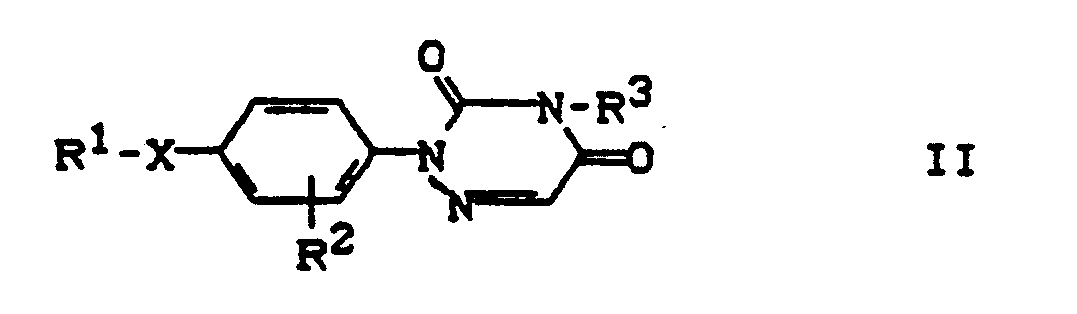
X, R¹, R² und R³ die oben angegebene Bedeutung haben,
hydriert oder - b) dadurch gekennzeichnet, daß man Verbindungen der Formel III

R¹, R², X die oben angegebene Bedeutung haben
mit Verbindungen der Formel IV
R³-B IV
in welcher
R³ für gegebenenfalls substituiertes Alkyl, Alkenyl, Alkinyl, Aralkyl steht und
B für Halogen, -O-SO₂-Alkyl, -O-SO₂-Aryl, -O-SO₂-Halogenalkyl steht
umsetzt, oder - c) dadurch gekennzeichnet, daß man Verbindungen der Formel V

R¹, R², R³ und X die oben angegebene Bedeutung haben, R³ aber nicht für Wasserstoff steht,
mit Verbindungen der Formel VI
R⁴-B VI
in welcher
R⁴ und B die oben angegebene Bedeutung haben,
umsetzt. - 3. Neue Verbindungen der Formel II

X die in 1. angegebene Bedeutung hat,
R¹, R², R³ die unter (1) angegebenen Bedeutungen besitzen, wobei R¹ nicht für Thiophen stehen darf, wenn X für -CR⁵(CN) steht und nicht für Benzthiazol, Benzoxazol, Thiazol und Oxazol stehen darf, wenn X für O, S, SO oder SO₂ steht. - 4. Verfahren zur Herstellung der neuen Verbindungen der Formel II gemäß (3) sowie bekannter Verbindungen der Formel II, dadurch gekennzeichnet,
- a) daß man Verbindungen der Formel VII

X, R¹ und R² die in (3) angegebene Bedeutung haben,
mit Verbindungen der Formel IV
R³-B IV
in welcher
R³ und B die in (2) angegebenen Bedeutungen haben,
umsetzt, oder - b) daß man Verbindungen der Formel VIII

X, R¹, R², R³, R⁵ die in (1) angegebenen Bedeutungen haben,
durch Erhitzen decarboxyliert oder - c) daß man Verbindungen der Formel IX

X für O, S, -CR⁵(CN)- steht,
R¹, R² die in (1) angegebene Bedeutung haben,
R⁶ und R⁷ für gegebenenfalls substituiertes Alkyl stehen,
mit Glyoxylsäure der Formel X
CHO-COOH X
in Gegenwart von anorganischen oder organischen Säuren umsetzt, oder - d) daß man Verbindungen der Formel XI

X für O, S oder -CR⁵(CN)- steht,
R¹, R², R³, R⁵ die in (1) angegebene Bedeutung haben, und
R⁸ für Alkyl oder gegebenenfalls substituiertes Aryl steht,
R⁹ für H steht,
in Gegenwart von Basen erhitzt, - e) daß man Verbindungen der Formel XVII

X für O oder S steht,
R², R³ die oben angegebene Bedeutung haben,
mit Verbindungen der Formel XVIII R¹-A XVIII
in welcher
R¹ die oben angegebene Bedeutung hat und
A für die Reste Halogen, O-SO₂-Alkyl, -O-SO₂-Halogenalkyl, -O-SO₂-Aryl, -S-Alkyl, -SO₂-Alkyl oder SO₂-Halogenalkyl steht, - 5. Neue Verbindungen der Formel VIII

X, R¹, R², R³ die in (1) angegebene Bedeutung haben. - 6. Verfahren zur Herstellung der neuen Verbindungen der Formel VIII gemäß (5), dadurch gekennzeichnet, daß man Verbindungen der Formel XII

X, R¹, R², R³ die in (1) angegebene Bedeutung haben,
R⁸ für Alkyl oder Aryl steht,
R⁹ für CN oder den Rest -CO-N(R³)-COOR⁸ steht,
in Gegenwart von wäßrigen Mineralsäuren erhitzt. - 7. Neue Verbindungen der Formel XII

X, R¹, R², R³, R⁸ die in (6) angegebene Bedeutung haben, und
R⁹ für CN oder den Rest -CO-N(R³)-COOR⁸ steht. - 8. Verfahren zur Herstellung der neuen Verbindungen der Formel XII gemäß (7), dadurch gekennzeichnet, daß man Verbindungen der Formel XI

X, R¹, R², R³, R⁸, R⁹ die in (7) angegebene Bedeutung haben,
in Gegenwart von Basen erhitzt. - 9. Neue Verbindungen der Formel XI

X, R¹, R², R³, R⁸, R⁹ die in (7) angegebene Bedeutung haben und R⁹ zusätzlich für Wasserstoff stehen kann. - 10. Verfahren zur Herstellung der neuen Verbindungen der Formel XI, dadurch gekennzeichnet, daß man
- a) Verbindungen der Formel XIII

X, R¹, R² die in (1) angegebene Bedeutung haben,
in an sich bekannter Weise diazotiert und anschließend mit Verbindungen der Formel XIV
R³, R⁸, R⁹ die in (7) angegebene Bedeutung haben,
umsetzt, oder - b) indem man Verbindungen der Formel XV

X, R¹, R² die in (1) angegebene Bedeutung haben,
zunächst mit Glyoxylsäure der Formel X, anschließend mit Thionylchlorid und dann mit Ethylurethan umsetzt. - 11. Neue Verbindungen der Formel IX

X, R¹, R² die in (1) angegebene Bedeutung haben,
R⁶ und R⁷ unabhängig voneinander für gegebenenfalls substituiertes Alkyl stehen. - 12. Verfahren zur Herstellung der neuen Verbindungen der Formel IX, dadurch gekennzeichnet, daß man Verbindungen der Formel XV

X, R¹, R² die in (1) angegebene Bedeutung haben,
zunächst mit Ketonen der Formel XVI
R⁶ und R⁷ die oben angegebene Bedeutung haben,
und anschließend mit Alkalicyanaten umsetzt. - Die Verbindungen der Formel I sowie ihre Salze mit Basen oder Säuren sind hervorragend zur Bekämpfung parasitärer Protozoen und insbesondere von Coccidien sowie Fischparasiten geeignet.
- Bevorzugte Verbindungen der Formel I sind Verbindungen in denen
R¹ für gegebenenfalls durch Halogen, Alkyl, Cyano, Nitro, Alkoxy, Alkylthio, Halogenalkyl, Halogenalkoxy, Halogenalkylthio, Halogenalkylsulfonyl, Halogenalkylsulfinyl, Amino, Alkylamino, Halogenalkylamino, Acylamino substituiertes Thiazolyl, Oxazolyl, Benzthiazolyl, Benzoxazolyl, Pyrimidinyl, Pyridinyl, Chinolinyl oder Chinoxalinyl steht,
X für O, S oder -CH(CN)- steht,
R² für Halogen oder C₁₋₆-Alkyl steht,
R³ für Wasserstoff oder C₁-C₄-Alkyl, insbesondere Methyl, steht,
R⁴ für Wasserstoff oder C₁₋₄-Alkyl steht. - Besonders bevorzugt sind Verbindungen der Formel I in welcher
X für O steht,
R¹ für Pyridinyl oder Benzthiazolyl, die gegebenenfalls durch C₁₋₄-Alkyl, insbesondere Methyl, C₁₋₄-Halogenalkyl insbesondere Trifluormethyl, Halogen, insbesondere Chlor, Brom, Fluor, Nitro, CN, C₁₋₄-Alkoxy insbesondere Methoxy, C₁₋₄-Halogenalkoxy insbesondere Trifluormethoxy, C₁₋₄-Alkylthio insbesondere Methylthio, C₁₋₄-Halogenalkylthio insbesondere Trifluormethylthio, C₁₁₋₄ Halogenalkylsulfonyl, insbesondere Trifluormethylsulfonyl, C₁₋₄-Halogenalkylsulfinyl, insbesondere Trifluormethylsulfinyl, Amino, C₁₋₄-Alkylamino, C₁₄-Halogenalkylamino, Acylamino insbesondere Acetylamino substituiert sind, steht,
R² für einen oder mehrere Reste der Gruppe Wasserstoff oder Halogen insbesondere Chlor, Brom, C₁₋₄-Alkyl insbesondere Methyl, 1-5-Halogen(C₁₋₄)-alkyl, insbesondere Trifluormethyl steht,
R³ für Wasserstoff oder Methyl steht,
R⁴ für Wasserstoff steht. - Ganz besonders bevorzugt sind Verbindungen der Formel I
in welcher
X für O steht,
R¹ für gegebenenfalls durch Chlor oder Methyl oder Trifluormethyl, Trifluoromethylthio oder Trifluoromethoxy oder Fluor, substituiertes Benzthiazolyl oder Pyridinyl steht,
R² für einen oder mehrere Reste der Gruppe Wasserstoff, Methyl oder Chlor steht,
R³ für Wasserstoff oder Methyl steht,
R⁴ für Wasserstoff steht. - Als Einzelverbindungen seien genannt:

- Weiterhin seien die folgenden Verbindungen genannt:


Y X R2 R³ R˝ R⁴ S S H H 6-Cl H S S H H H H O S H H H H O SO H H H H O SO₂ H H H H O S 3,5-C12 H 6-Cl H O S 3,5-C12 H H H S CHCN H H H H S CHCN Cl H H H S CHCN 3,5-Cl₂ H H H S C(CH₃)CN H H H H S C(CH₃)CN H CH₃ H H - Weiter seien folgende Verbindungen der Formel I genannt:


- Nach Verfahren 2a) lassen sich sowohl die Verbindungen der Formel I als auch die Verbindungen der Formeln III und V herstellen.
- Setzt man bei dem Verfahren 2a) als Verbindung der Formel II 2-(4-(2-Benzthiazolyloxy)-phenyl)-1,2,4-triazin-3,5-(2H,4H)dion ein, läßt sich das Verfahren durch folgendes Formelschema beschreiben:

- Die Verbindungen der Formel II sind zum Teil neu (vgl. 3 unten) und werden z.B. nach den in (4) angegebenen Verfahren erhalten.
- Bevorzugt seien Verbindungen der Formel II genannt, in denen X, R¹, R², R³ die bei den Verbindungen der Formel 1 genannten bevorzugten Bedeutungen haben.
- Im einzelnen seien folgende Verbindungen der Formel II genannt:

- Weiter seien als Verbindungen der Formel II genannt:


- Das Verfahren 2a) wird durchgeführt, indem man eine Verbindung der Formel II in Gegenwart eines Reduktionsmittels und einer Säure erwärmt. Als Reduktionsmittel können Metalle wie z.B. Zink und Metallsalze wie z.B. Zinn(II)chlorid, Metallhydride wie Lithiumaluminiumhydrid und katalytisch angeregter Wasserstoff verwendet werden.
- Als Säuren kommen verdünnte Mineralsäuren wie z.B. Salzsäure und organische Säuren wie z.B. Eisessig zum Einsatz. Die Reaktion kann gegebenenfalls in Gegenwart eines Verdünnungsmittels durchgeführt werden. Als Verdünnungsmittel können inerte organische Lösungsmittel verwendet werden. Hierzu gehören Kohlenwasserstoffe wie zB Toluol, Ether wie z.B. Dioxan, Ketone wie z.B. Aceton und Alkohole wie z.B. Ethanol. Die Reduktion erfolgt bei Temperaturen zwischen 80 und 120°C bei Normaldruck oder erhöhtem Druck.
- Nach Verfahren 2b lassen sich sowohl die Verbindungen der Formel I als auch die Verbindungen der Formel V herstellen.
- Setzt man bei dem Verfahren 2b) als Verbindung der Formel III 2-[4-[6′-Chloro)-2′-benzothiazolyloxy]-3,5-dichlorphenyl]-hexahydro-1,2,4-triazin-3,5-dion und als Verbindung der Formel IV Methyliodid ein, läßt sich das Verfahren durch folgendes Schema beschreiben:

- Die Verbindungen der Formel III werden durch Formel I umfasst und können wie bei Verfahren 2a) beschrieben hergestellt werden.
- Die Verbindungen der Formel IV sind bekannt oder lassen sich nach bekannten Methoden darstellen.
- Es werden bevorzugt Verbindungen der Formeln III und IV eingesetzt, in denen die Reste X, R¹, R², R³ die bei den Verbindungen der Formel I angegebenen bevorzugten Bedeutungen besitzen.
- Das Verfahren 2b) wird durchgeführt, indem man eine Verbindung der Formel III gegebenenfalls in Gegenwart einer Base und eines Verdünnungsmittels mit Verbindungen der Formel IV umsetzt. Als Verdünnungsmittel können alle inerten organischen Lösungsmittel eingesetzt werden.
- Als Verdünnungsmittel kommen dabei praktisch alle inerten organischen Lösungsmittel in Frage. Hierzu gehören vorzugsweise aliphatische und aromatische, gegebenenfalls halogenierte Kohlenwasserstoffe, Benzin, Ligroin, Benzol, Toluol, Xylol, Methylenchlorid, Ethylenchlorid, Chlorbenzol und o-Dichlorbenzol, Ether wie Diethyl- und Dibutylether, Glykoldimethylether und Diglykoldimethylether, Tetrahydrofuran und Dioxan, Ketone wie Aceton, Methyl-ethyl-, Methyl-isopropyl- und Methyl-isobutylketon, Ester wie Essigsäuremethylester und -ethylester, Nitrile wie z.B. Acetonitril und Propionitril, Amide wie z.B. Dimethylformamid, Dimethylacetamid und N-Methylpyrrolidon sowie Dimethylsulfoxid, Tetramethylensulfon und Hexamethylphosphorsäuretriamid.
- Das Verfahren wird in Gegenwart von Basen durchgeführt. Als bevorzugte Basen seien genannt die Alkalihydroxide wie Natriumyhdroxid, Alkalialkoholate wie Natriummethylat oder Kaliumbutanolat, Metallhydride wie Natriumhydrid oder organische Basen wie 1,8-Diazabicyclo[5,40]-undec-7-en (DBU).
- Das Verfahren wird durchgeführt bei Normaldruck und Temperaturen zwischen 20° und 140°C.
- Die Reaktion wird durchgeführt, indem man äquimolare Mengen der Verbindung der Formel Ia und Base zusammengibt, dieses Gemisch mit einer äquimolaren Menge der Verbindung der Formel IV versetzt und auf die Reaktionstemperatur erhitzt.
- Setzt man bei dem Verfahren 2c) als Verbindung der Formel V 2-[4-[6′-Chloro)-2′-benzthiazolyloxy]-3,5-dichlorophenyl]-4-methyl-hexahydro-1,2,4-triazin-3,5-dion ein und als Verbindung der Formel VI Ethyliodid, läßt sich das Verfahren durch folgendes Schema beschreiben:

- Die Verbindungen der Formel V werden von Formel I umfaßt. Sie sind neu und können wie bei Verfahren 2a) und 2b) beschrieben hergestellt werden. Bevorzugt werden Verbindungen der Formel V eingesetzt, in denen X, R¹, R², R³ die bei den Verbindungen der Formel I angegebenen bevorzugten Bedeutungen besitzen.
- Das Verfahren 2c) wird wie unter 2b) beschrieben durchgeführt.
- Die neuen Verbindungen der Formel II können nach den unter (4) angegebenen Verfahren hergestellt werden.
- Einige Verbindungen der Formel II, in der X für O, S, SO, SO₂ steht, sind Gegenstand einer älteren, nicht vorveröffentlichten Anmeldung der Anmelderin (Deutsche Patentanmeldung P 38 05 660. ). Zusätzlich zu den dort angegebenen Herstellverfahren lassen sich die Verbindungen der Formel II, in welcher X für O, S, SO, SO₂ steht, nach den im folgenden beschriebenen Verfahren 4b) - d) herstellen.
- Setzt man bei dem Verfahren 4a) zur Herstellung der Verbindungen der Formel II, in welcher R³ nicht für Wasserstoff steht, als Verbindung der Formel VIIa 2-[4-(2′-Pyridiloxy)phenyl]1,2,4-triazin-3,5-(2H,4H)-dion und als Verbindung der Formel IV Methyliodid ein, läßt sich das Verfahren durch folgendes Schema beschreiben:

- Die Verbindungen der Formel VII werden wie bei Verfahren 4b) beschrieben dargestellt.
- Die Verbindungen der Formel IV sind bekannt oder lassen sich nach bekannten Methoden darstellen Besonders genannt sei Methyliodid, Ethylbromid.
- Das Verfahren wird durchgeführt, indem man eine Verbindung der Formel VII in Gegenwart einer Base und eines Verdünnungsmittels mit Verbindungen der Formel IV umsetzt. Als Verdünnungsmittel können alle inerten organischen Lösungsmittel eingesetzt werden, die auch zur Durchführung von Verfahren Ia dienen.
- Das Verfahren wird in Gegenwart von Basen durchgeführt. Als bevorzugte Basen seien genannt die Alkalihydroxide wie Natriumyhdroxid, Alkalialkoholate wie Natriummethylat oder Kaliumbutanolat, Metallhydride wie Natriumhydrid oder organische Basen wie 1,8-Diazabicyclo[5,40]-undec-7-en (DBU).
- Das Verfahren wird durchgeführt bei Normaldruck und Temperaturen zwischen 20° und 140°C.
- Die Reaktion wird durchgeführt indem man äquimolare Mengen der Verbindung der Formel VII und Base zusammengibt, dieses Gemisch mit einer äquimolaren Menge der Verbindung der Formel IV versetzt und auf die Reaktionstemperatur erhitzt.
- Nach dem im folgenden beschriebenen Verfahren 4b) lassen sich sowohl die Verbindungen der Formel II als auch die Verbindungen der Formel VII herstellen.
- Wird bei Verfahren 4b) zur Herstellung der Verbindungen der Formel II als Verbindung der Formel VIII 2-(3-Methyl-4-pyridylphenyl)-1,2,4-triazin-2,5(2H,4H)dion-6-carbonsäure eingesetzt, läßt sich das Verfahren durch folgendes Schema beschreiben:

- Die Verbindungen der Formel VIII werden nach dem weiter unten (6) beschriebenen Verfahren hergestellt. Es werden bevorzugt Verbindungen der Formel VIII eingesetzt, in denen X, R¹, R², R³ die bei den Verbindungen der Formel I angegebenen bevorzugten Bedeutungen haben.
- Als Einzelverbindungen der Formel VIII seien genannt:


- Die Decarboxylierung wird gegebenenfalls in Gegenwart von inerten organischen Verdünnungsmitteln durchgeführt. Hierzu gehören aliphatische und aromatische, gegebenenfalls halogenierte Kohlenwasserstoffe wie Nonan, Decan, Dodecan, Xylole, Alkohole wie Diethylenglykol, Ether wie Ethylenglykolmonobutylether, Diethylenglykoldibutylether, Sulfoxide wie Dimethylsulfoxid und Sulfone wie Tetramethylensulfon.
- Darüber hinaus kann die Reaktion in Gegenwart von mercaptogruppenhaltigen Carbonsäuren wie z.B. Mercaptoessigsäure oder Thiosalicylsäure durchgeführt werden.
- Die Umsetzung erfolgt bei Temperturen zwischen 150 und 300°C, gegebenenfalls in Gegenwart von mercaptogruppenhaltigen Carbonsäuren wie z.B. Mercaptoessigsäure vorzugsweise zwischen 160 und 250°C, insbesondere zwischen 180 und 210C°.
- Es wird bei Normaldruck gearbeitet. Die Verbindungen der Formeln VIII werden in Substanz oder im jeweiligen Verdünnungsmittel, gelöst oder suspendiert, erhitzt.
- Setzt man im Verfahren 4c) zur Herstellung der Verbindungen der Formel II als Verbindung der Formel IX 1-[3,5-Dichlor-4-(2-pyridyl)-phenyl]-3,3-dimethyl-1,2,4-triazolidin-5-on ein, läßt sich das Verfahren durch folgendes Schema beschreiben:

- Die Verbindungen der Formel IX sind neu. Ihre Herstellung erfolgt nach dem unter (12) beschriebenen Verfahren.
- Bevorzugt werden Verbindungen der Formel IX eingesetzt, in der X, R¹, R² die bei den Verbindungen der Formel I angegebenen bevorzugten Bedeutungen haben und R⁶ und R⁷ unabhängig voneinander für C₁₋₄-Alkyl, insbesondere Methyl oder Ethyl stehen. Im einzelnen seien genannt:

- Das Verfahren wird durchgeführt, indem man eine Verbindung der Formel IX in einem Verdünnungsmittel in Gegenwart von Glyoxylsäure und einer katalytischen Menge konzentrierter Mineralsäure erwärmt und das Rohprodukt nach wäßriger Aufarbeitung an Kieselgel chromatographiert.
- Als Verdünnungsmittel können alle inerten organischen Lösungsmittel verwendet werden, die z.B. bei Verfahren 2b) angeführt sind. Als Mineralsäure wird vorzugsweise Schwefelsäure verwendet. Es wird bei Temperaturen zwischen 60°C und 130°C, vorzugsweise bei 100°C, gearbeitet.
- Wird im Verfahren 4d) zur Herstellung der Verbindungen der Formel II als Verbindung der Formel XI Ethyl-N-[[3-methyl-4-(5′-trifluoromethyl-2′-pyridinyloxyphenyl] hydrazinyliden-carbonyl]carbamat eingesetzt, läßtsich das Verfahren durch folgendes Schema beschreiben:

- Die Verbindungen der Formel XI sind neu. Ihre Herstellung erfolgt nach dem unter (10) beschriebenen Verfahren. Bevorzugt werden Verbindungen der Formel XI eingesetzt, in der X, R¹, R², R³ die bei den Verbindungen der Formel I angegebenen bevorzugten Bedeutungen haben, R⁸ für C₁₋₄-Alkyl, insbesondere Methyl oder Ethyl und Phenyl steht und R⁹ für Wasserstoff oder CN steht.
- Als Einzelverbindungen dar Formel XI seien genannt:

- Das Verfahren wird durchgeführt, indem man eine Verbindung der Formel XI erhitzt, gegebenenfalls in Gegenwart eines Lösungsmittels und einer Base.
- Als Lösungsmittel und Basen finden die bei der Herstellung der Verbindungen I aufgeführten Lösungsmittel und Basen Verwendung. Als weitere besonders bevorzugte organische Lösungsmittel werden Alkohole wie z.B. Ethanol oder organische Säuren wie z.B. Eisessig eingesetzt.
- Besonders bevorzugte Basen sind die Hydroxide und Acetate der Alkali- oder Erdalkalimetalle wie z.B. NaOH oder Natrium- und Kaliumacetat.
- Die Umsetzung erfolgt unter Normaldruck bei Temperaturen zwischen 70 und 150°C, vorzugsweise zwischen 70 und 100°C.
- Die verwendete Base wird in 10-80 %igem molarem Überschuß eingesetzt. Das Reaktionsgemisch wird nach abgeschlossener Cyclisierung vorzugsweise mit einer verdünnten Mineralsäure wie z.B. Salzsäure angesäuert und das als Feststoff anfallende Produkt abfiltriert.
- Die bei Verfahren 4b) eingesetzten Verbindungen der Formel VIII sind neu. Sie werden nach dem unter (6) beschriebenen Verfahren hergestellt.
- Setzt man bei dem Verfahren 4e) als Verbindung XVII 2-(3,5-Dichloro-4-hydroxyphenyl)-1,2,4-triazin-3,5(2H,4H)-dion und als Verbindung der Formel III 2-Chlorpyridin ein und läßt sich das Verfahren durch folgendes Formelschema beschreiben.

- Verbindungen der Formel XVII
in welcher
R² und R³ für Wasserstoff stehen, sind bekannt (J. Slouka, Acta Unio Palacki Olomuk. Fac. Rerum. Nat. 1984 (Chem 23), 39 - 45; C.A. 102 203946c). - Andere Verbindungen der Formel XVII sind Gegenstand einer bislang nicht veröffentlichen Ameldung der Anmelderin (Deutsche Patentanmeldung P 3 805 660). Sie lassen sich analog zu den für die Verbindungen der Formel II angegebenen Verfahren herstellen.
- Bevorzugt seien Verbindungen der Formel XVII genannt, in denen R² und R³ die bei den Verbindungen der Formel I genannten bevorzugten Bedeutungen haben.
- Die substituierten Heterocyclen der Formel XVIII sind bekannt oder lassen sich analog zu bekannten Verfahren herstellen (Beilstein Bd. 27; Katrizky und Rees, Comprehensive Het. Chem. Col. 6 1984).
- Sie besitzen die weiter oben bei den Verbindungen der Formel I angegebenen bevorzugten Bedeutungen. Im einzelnen seien die folgenden Verbindungen der Formel XVIII genannt:

- Die Reaktion wird vorzugsweise unter Verwendung von Verdünnungsmitteln durchgeführt.
- Als Verdünnungsmittel kommen dabei praktisch alle inerten organischen Lösungsmittel in Frage. Hierzu gehören vorzugsweise aliphatische und aromatische, gegebenenfalls halogenierte Kohlenwasserstoffe, Benzin, Ligroin, Benzol, Toluol, Xylol, Methylenchlorid, Ethylenchlorid, Chloroform, Tetrachlorkohlenstoff, Chlorbenzol und o-Dichlorbenzol, Ether wie Diethyl- und Dibutylether, Glykoldimethylether und Diglykoldimethylether, Tetrahydrofuran und Dioxan, Ketone wie Aceton, Methyl-ethyl-, Methyl-isopropyl- und Methyl-isobutyl-keton, Ester wie Essigsäuremethylester und -ethylester, Nitrile wie z.B. Acetonitril und Propionitril, Amide wie z.B. Dimethylformamid, Dimethylacetamid und N-Methyl-pyrrolidon sowie Dimethylsulfoxid, Tetramethylensulfon und Hexamethylphosphorsäuertriamid.
- Die Reaktion wird in Gegenwart von anorganischen oder organischen Säureakzeptoren durchgeführt.
- Als solche seien z.B. genannt:
- Alkalimetallhydroxide wie z.B. Natrium- und Kaliumhydroxid, Erdalkalihydroxide wie z.B. Calciumhydroxid, Alkalicarbonate und -alkoholate wie Natrium- und Kaliumcarbonat, Natrium- und Kaliummethylat bzw. -ethylat, ferner aliphatische, aromatische oder heterocyclische Amine, beispielsweise Triethylamin, Pyridin, 1,5-Diazabicyclo-[4,3,0]-non-5-en (DBN), 1,8-Diazabicyclo-[5,4,0]-undec-7-en (DBU) und 1,4-Diazabicyclo-[2,2,2]-octan (DABCO).
- Die Umsetzung erfolgt bei Temperaturen zwischen 50 und 200°C, vorzugsweise zwischen 80 und 160°C bei Normaldruck oder erhöhtem Druck. Es wird bevorzugt bei Normaldruck gearbeitet.
- Das Verfahren wird durchgeführt, indem äquimolare Mengen der Verbindungen der Formel XVII und XVIII in einem der angegebenen Verdünnungsmittel zusammengegeben und erhitzt werden. Nach vollendeter Umsetzung wird das Reaktionsgemisch mit verdünnter anorganischer Säure (z.B. Salzsäure) angesäuert und der entstehende Niederschlag abfiltriert, gewaschen und getrocknet.
- Wird im Verfahren 6 zur Herstellung der Verbindungen der Formel VIII als Verbindung der Formel XII 2-[3′-Methyl-4′-(2-trifluoromethyl-3-pyridinyl)phenyl]-6-cyano-1,2,4-triazin-3,5(2H,4H)dion eingesetzt, läßt sich das Verfahren durch folgendes Formelschema beschreiben:

- Die Verbindungen der Formel XII sind neu. Ihre Herstellung erfolgt nach dem unter (8) beschriebenen Verfahren. Bevorzugt werden Verbindungen der Formel XII eingesetzt, in der X, R¹, R², R³ die bei den Verbindungen der Formel I angegebenen bevorzugten Bedeutungen hat und R⁹ für CN steht.
- Als Einzelverbindungen der Formel XII seien genannt:

- Die Hydrolyse der Verbindungen der Formel XII wird unter sauren Bedingungen durchgeführt. Als Säuren kommen Mineralsäuren zum Einsatz wie z.B. Salzsäure, Bromwasserstoffsäure, Schwefelsäure und Gemische aus Mineralsäuren und organischen Säuren wie z.B. Essigsäure oder Propionsäure.
- Die Umsetzung erfolgt bei Temperaturen zwischen 80 und 120°C. Es wird unter Normaldruck gearbeitet.
- Die Verbindungen der Formel XII werden im 10-30-fachen Volumen der Säure oder des Säuregemisches gelöst und bis zur abgeschlossenen Hydrolyse erhitzt.
- Das Verfahren kann auch so geführt werden, daß ohne Isolierung der Verbindung der Formel VIII direkt Verbindungen der Formel II entstehen. Dazu wird die Hydrolyse der Verbindung der Formel XII unter Zusatz von mercaptogruppenhaltigen Carbonsäuren wie z.B. Mercaptoessigsäure oder Thiosalicylsäure durchgeführt.
- Wird im Verfahren 8 zur Herstellung der Verbindungen der Formel XII als Verbindung der Formel XI Ethyl-N-[[[Cyano(3-methyl-4-pyridyloxyphenyl)-hydrazinyliden]methyl]carbonyl]-carbamat eingesetzt, läßt sich das Verfahren durch folgendes Schema beschreiben:

- Die Verbindungen der Formel XI sind neu. Ihre Herstellung erfolgt nach dem unter (10) beschriebenen Verfahren. Bevorzugt werden Verbindungen der Formel XI eingesetzt, in der X, R¹, R², R³ die bei den Verbindungen der Formel I angegebenen bevorzugten Bedeutungen haben, R⁸ für C₁₋₄-Alkyl, insbesondere Methyl oder Ethyl und Phenyl steht, und R⁹ für CN steht.
- Als Einzelverbindungen der Formel XI seien genannt:

- Das Verfahren (8) wird wie bei Verfahren 4d) beschrieben durchgeführt.
- Die in den Verfahren 4d) und 8 eingesetzten Verbindungen der Formel XI werden nach dem unter 10 beschriebenen Verfahren hergestellt.
- Wird im Verfahren 10a) zur Herstellung der Verbindungen der Formel XI als Verbindung der Formel XIII 3-Methyl-4-benzthiazolyloxyanilin eingesetzt und als Verbindung der Formel XIV Ethyl-cyanacetylurethan läßt sich das Verfahren durch folgendes Schema beschreiben:

- Die Verbindungen der Formeln XIII und XIV sind bekannt oder lassen sich analog zu bekannten Verfahren herstellen (vgl. DE-OS 34 05 241).
- Das Verfahren wird durchgeführt, indem man ein Anilin der Formel XIII mit NaNO₂ und konz Mineralsäure wie z.B. HCl, gegebenenfalls in Gegenwart eines Verdünnungsmittels, umsetzt.
- Als Verdünnungsmittel dienen mit Wasser mischbare Verdünnungsmittel wie Alkohole, z.B. Methanol, Ethanol, organische Säuren wie z.B. Eisessig, Ameisensäure, Glycolether wie Monomethylglycolether, Nitrile wie Acetonitril, Dimethylsulfoxid.
- Das so erzeugte Diazoniumsalz wird in situ mit einer Verbindung der Formel XIV wie z.B. Malonyldiurethan oder Cyanacetylurethan in Gegenwart einer Base umgesetzt. Als Basen finden Verwendung Hydroxide und Carbonate der Alkali und Erdalkalimetalle sowie Acetate von Natrium, Kalium und Ammonium.
- Weiterhin können organische Basen wie Pyridin oder Triethylamin verwendet werden.
- Die Diazotierung wird bei Normaldruck und bei Temperaturen zwischen 0°C und 10°C durchgeführt. Die Zugabe der Verbindungen der Formel XIV erfolgt bei 5° bis 20°C. Anilin und Nitrit werden in äquimolaren Mengen in einem Überschuß Säure vorzugsweise der 2-3 fachen molaren Menge umgesetzt. Die CH-acide Verbindung wird in 0 bis 30 %igem molaren Überschuß, vorzugsweise 10 %igem Überschuß zugesetzt. Die Base wird im 1,5-2,5-fachen molaren Überschuß zugesetzt.
- Das Kupplungsprodukt aus Diazoniumsalz und CH-acider Verbindung ist im Reaktionsmedium unlöslich und kann als Feststoff isoliert werden.
- Das Verfahren kann auch so geführt werden, daß ohne Isolierung der Verbindung der Formel XI direkt Verbindungen der Formel VIII entstehen. Dazu wird die Diazotierung der Aniline der Formel XIII und die Umsetzung mit den Urethanen der Formel XIV in einem für die Cyclisierung geeigneten Verdünnungsmittel durchgeführt. Das Reaktionsgemisch wird nach erfolgter Diazotierung und Kupplung erwärmt und dann das Triazindion der Formel VIII isoliert.
- Als Verdünnungsmittel seien genannt: Alkohole wie Methanol, Ethanol.
- Zur Cyclisierung wird das Reaktionsgemisch auf ca. 80 bis 120°C, bevorzugt ca. 80 bis 100°C, erwärmt.
- Die Aufarbeitung erfolgt wie weiter oben bei Verfahren (6) zur Herstellung der Verbindungen der Formel VIII angegeben.
- Wird im Verfahren 10b) zur Herstellung der Verbindungen XI als Verbindung der Formel XV 3,5-Dichloro-4-(2-pyridyl)-phenylhydrazin eingesetzt, läßt sich das Verfahren durch folgendes Schema beschreiben:

- Die Verbindungen der Formeln XV und XIV sind bekannt oder lassen sich analog zu bekannten Verfahren herstellen. Es werden bevorzugt Verbindungen eingesetzt, in denen X, R¹, R², R³ die bei den Verbindungen der Formel I angegebenen bevorzugten Bedeutungen besitzen, R⁹ für Wasserstoff oder CN steht und R⁸ für C₁₋₄-Alkyl, insbesondere Methyl oder Ethyl steht.
- Das Verfahren wird durchgeführt, indem man eine Verbindung der Formel XV zunächst mit Glyoxylsäure umsetzt. Das Rohprodukt der Reaktion wird mit Thionylchlorid in das jeweilige Säurechlorid umgewandelt und dieses dann mit Ethylurethan umgesetzt. Die erste Stufe der Reaktion wird in Gemische aus Alkoholen, vorzugsweise Ethanol und Wasser, durchgeführt. Die zweite und dritte Stufe des Verfahrens können in Gegenwart der bei Verfahren 2a) beschriebenen inerten organischen Lösungsmittel durchgeführt werden. Bevorzugt seien für die zweite Stufe Kohlenwasserstoffe wie Toluol genannt. Die Reaktionstemperatur kann zwischen 20 und 120°C variiert werden, wobei die 1. Stufe vorzugsweise bei 20 bis 40°C, die 2. und 3. Stufe bei 80 bis 110°C durchgeführt werden.
- Die Verbindungen der Formel IX lassen sich nach Verfahren 12 herstellen.
- Wird im Verfahren 12 zur Herstellung der Verbindungen IX als Verbindung der Formel XV 3,5-Dichloro-4-(2-pyridyloxy)-phenylhydrazin eingesetzt, läßt sich das Verfahren durch folgendes Schema beschreiben:

- Es werden Verbindungen der Formel XV eingesetzt, in denen X, R¹, R² die bei den Verbindungen der Formel I angegebenen bevorzugten Bedeutungen besitzen. Es werden Ketone der Formel XVI eingesetzt, in denen R⁶ und R⁷ für C₁₋₄-Alkyl, insbesondere Methyl oder Ethyl stehen.
- Das Verfahren wird durchgeführt, indem man eine Verbindung der Formel XV mit einem Keton wie z.B. Aceton umsetzt. Das so hergestellte Hydrazon wird mit Alkalicyanat, insbesondere Kaliumcyanat, umgesetzt. Die Reaktion kann in Gegenwart von inerten organischen Lösungsmitteln durchgeführt werden, wie sie auch in Verfahren 10b) Verwendung finden. Die beiden Stufen werden bei Temperaturen zwischen 20 und 40°C durchgeführt.
- Die Wirkstoffe eignen sich bei günstiger Warmblütertoxizität zur Bekämpfung von parasitischen Protozoen die in der Tierhaltung und Tierzucht bei Nutz-, Zucht-, Zoo-, Labor-, Versuchs- und Hobbytieren vorkommen. Sie sind dabei gegen alle oder einzelne Entwicklungsstadien der Schädlinge sowie gegen resistente und normal sensible Stämme wirksam. Durch die Bekämpfung der parasitischen Protozoen sollen Krankheit, Todesfälle und Leistungsminderungen (z.B. bei der Produktion von Fleisch, Milch, Wolle, Häuten, Eiern, Honig usw.) vermindert werden, so daß durch den Einsatz der Wirkstoffe eine wirtschaftlichere und einfachere Tierhaltung möglich ist.
- Zu den parasitischen Protozoen zählen:
- Mastigophora (Flagellata) wie z.B. Trypanosomatidae z.B. Trypanosoma b. brucei, T.b. gambiense, T.b. rhodesiense, T. congolense, T. cruzi, T. evansi, T. equinum, T. lewisi, T. percae, T. simiae, T. vivax, Leishmania brasiliensis, L. donovani, L. tropica, wie z.B. Trichomonadidae z.B. Giardia lamblia, G. canis.
- Sarcomastigophora (Rhizopoda) wie Entamoebidae z.B. Entamoeba histolytica, Hartmanellidae z.B. Acanthamoeba sp., Hartmanella sp.
- Apicomplexa (Sporozoa) wie Eimeridae z.B. Eimeria acervulina, E. adenoides, E. alabahmensis, E. anatis, E. anseris, E. arloingi, E. ashata, E. auburnensis, E. bovis, E. brunetti, E. canis, E. chinchillae, E. clupearum, E. columbae, E. contorta, E. crandalis, E. dabliecki, E. dispersa, E. ellipsoidales, E. falciformis, E. faurei, E. flavescens, E. gallopavonis, E. hagani, E. intestinalis, E. iroquoina, E. irresidua, E. labbeana, E. leucarti, E. magna, E. maxima, E. media, E. meleagridis, E. meleagrimitis, E. mitis, E. necatrix, E. ninakohlyaklmovae, E. ovis, E. parva, E. pavonis, E. perforans, E. phasani, E. piriformis, E. praecox, E. residua, E. scabra, E. spec., E. stiedai, E. suis, E. tenella, E. truncata, E. truttae, E. zuernii, Globidium spec., Isospora belli, I. canis, I. felis, I. ohioensis, I.rivolta, I. spec., I. suis, Cystisospora spec., Cryptosporidium spec. wie Toxoplasmadidae z.B. Toxoplasma gondii, wie Sarcocystidae z.B. Sarcocystis bovicanis, S. bovihominis, S. ovicanis, S. ovifelis, S. spec., S. suihominis wie Leucozoidae z.B. Leucozytozoon simondi, wie Plasmodiidae z.B. Plasmodium berghei, P. falciparum, P. malariae, P. ovale, P. vivax, P. spec., wie Piroplasmea z.B. Babesia argentina, B. bovis, B. canis, B. spec., Theileria parva, Theileria spec., wie Adeleina z.B. Hepatozoon canis, H. spec.
- Ferner Myxospora und Microspora z.B. Glugea spec. Nosema spec.
- Ferner Pneumocystis carinii, sowie Ciliophora (Ciliata) wie z.B. Balantidium coli, Ichthiophthirius spec., Trichodina spec., Epistylis spec.
- Die erfindungsgemäßen Verbindungen sind auch wirksam gegen Protozoen, die als Parasiten bei Insekten auftreten. Als solche seien genannt Parasiten des Stammes Microsporida, insbesondere der Gattung Nosema. Besonders genannt sei Nosema apis bei der Honigbiene.
- Zu den Nutz- und Zuchttieren gehören Säugetiere wie z.B. Rinder, Pferde, Schafe, Schweine, Ziegen, Kamele, Wasserbüffel, Esel, Kaninchen, Damwild, Rentiere, Pelztiere wie z.B. Nerze, Chinchilla, Waschbär, Vögel wie z.B. Hühner, Gänse, Puten, Enten, Tauben, Vogelarten für Heim- und Zoohaltung. Ferner gehören dazu Nutz- und Zierfische.
- Zu Labor- und Versuchstieren gehören Mäuse, Ratten, Meerschweinchen, Goldhamster, Hunde und Katzen.
- Zu den Hobbytieren gehören Hunde und Katzen.
- Zu den Fischen gehören Nutz-, Zucht-, Aquarien- und Zierfische aller Altersstufen, die in Süß- und Salzwasser leben. Zu den Nutz- und Zuchtfischen zählen z. B. Karpfen, Aal, Forelle, Weißfisch, Lachs, Brachse, Rotauge, Rotfeder, Döbel, Seezunge, Scholle, Heilbutt, Japanese yellowtail (Seriola quinqueradiata), Japanaal (Anguilla japonica), Red seabream (Pagurus major), Seabass (Dicentrarchus labrax), Grey mullet (Mugilus cephalus), Pompano, Gilthread seabream (Sparus auratus), Tilapia spp., Chichliden-Arten wie z. B. Plagioscion, Channel catfish. Besonders geeignet sind die erfindungsgemäßen Mittel zur Behandlung von Fischbrut, z. B. Karpfen von 2 - 4 cm Körperlänge. Sehr gut geeignet sind die Mittel auch in der Aalmast.
- Die Anwendung kann sowohl prophylaktisch als auch therapeutisch erfolgen.
- Die Anwendung der Wirkstoffe erfolgt direkt oder in Form von geeigneten Zubereitungen enteral, parenteral, dermal, nasal.
- Die enterale Anwendung der Wirkstoffe geschieht z.B. oral in Form von Pulver, Zäpfchen, Tabletten, Kapseln, Pasten, Tränken, Granulaten, Drenchen, Boli, medikiertem Futter oder Trinkwasser. Die dermale Anwendung geschieht z.B. in Form des Tauchens (Dippen), Sprühens (Sprayen), Badens, Waschens, Aufgießens (pour-on and spot-on) und des Einpuderns. Die parenterale Anwendung geschieht z.B. in Form der Injektion (intramusculär, subcutan, intravenös, intraperitoneal) oder durch Implantate.
- Geeignete Zubereitungen sind:
- Lösungen wie Injektionslösungen, orale Lösungen, Konzentrate zur oralen Verabreichung nach Verdünnung, Lösungen zum Gebrauch auf der Haut oder in Körperhöhlen, Aufgußformulierungen, Gele;
- Emulsionen und Suspension zur oralen oder dermalen Anwendung sowie zur Injektion; Halbfeste Zubereitungen;
- Formulierungen bei denen der Wirkstoff in einer Salbengrundlage oder in einer Öl in Wasser oder Wasser in Öl Emulsionsgrundlage verarbeitet ist;
- Feste Zubereitungen wie Pulver, Premixe oder Konzentrate, Granulate, Pellets, Tabletten, Boli, Kapseln; Aerosole und Inhalate, wirkstoffhaltige Formkörper.
- Injektionslösungen werden intravenös, intramuskulär und subcutan verabreicht.
- Injektionslösungen werden hergestellt, indem der Wirkstoff in einem geeigneten Lösungsmittel gelöst wird und eventuell Zusätze wie Lösungsvermittler, Säuren, Basen, Puffersalze, Antioxidantien, Konservierungsmittel zugefügt werden. Die Lösungen werden steril filtriert und abgefüllt.
- Als Lösungsmittel seien genannt: Physiologisch verträgliche Lösungsmittel wie Wasser, Alkohole wie Ethanol, Butanol, Benzylakohol, Glycerin, Kohlenwasserstoffe, Propylenglykol, Polyethylenglykole, N-Methylpyrrolidon, sowie Gemische derselben.
- Die Wirkstoffe lassen sich gegebenenfalls auch in physiologisch verträglichen pflanzlichen oder synthetischen Ölen, die zur Injektion geeignet sind, lösen.
- Als Lösungsvermittler seien genannt: Lösungsmittel, die die Lösung des Wirkstoffs im Hauptlösungsmittel fördern oder sein Ausfallen verhindern Beispiele sind Polyvinylpyrrolidon, polyoxyethyliertes Rhizinusöl, polyoxyethylierte Sorbitanester.
- Konservierungsmittel sind: Benzylalkohol, Trichlorbutanol, p-Hydroxybenzoesäureester, n-Butanol.
- Orale Lösungen werden direkt angewendet. Konzentrate werden nach vorheriger Verdünnung auf die Anwendungskonzentration oral angewendet. Orale Lösungen und Konzen trate werden wie oben bei den Injektionslösungen beschrieben hergestellt, wobei auf steriles Arbeiten verzichtet werden kann.
- Lösungen zum Gebrauch auf der Haut werden aufgeträufelt, aufgestrichen, eingerieben, aufgespritzt, aufgesprüht oder durch Tauchen (Dippen), Baden oder Waschen aufgebracht. Diese Lösungen werden wie oben bei den Injektionslösungen beschrieben hergestellt.
- Es kann vorteilhaft sein, bei der Herstellung Verdikkungsmittel zuzufügen. Verdickungsmittel sind: Anorganische Verdickungsmittel wie Bentonite, kolloidale Kieselsäure, Aluminiummonostearat, organische Verdikkungsmittel wie Cellulosederivate, Polyvinylalkohole und deren Copolymere, Acrylate und Metacrylate.
- Gele werden auf die Haut aufgetragen oder aufgestrichen oder in Körperhöhlen eingebracht. Gele werden hergestellt indem Lösungen, die wie bei den Injektionslösungen beschrieben hergestellt worden sind, mit soviel Verdickungsmittel versetzt werden, daß eine klare Masse mit salbenartiger Konsistenz entsteht. Als Verdickungsmittel werden die weiter oben angegebenen Verdickungsmittel eingesetzt.
- Aufgießformulierungen werden auf begrenzte Bereiche der Haut aufgegossen oder aufgespritzt, wobei der Wirkstoff entweder die Haut durchdringt und systemisch wirkt oder sich auf der Körperoberfläche verteilt.
- Aufgießformulierungen werden hergestellt, indem der Wirkstoff in geeigneten hautverträglichen Lösungsmitteln oder Lösungsmittelgemischen gelöst, suspendiert oder emulgiert wird. Gegebenenfalls werden weitere Hilfsstoffe wie Farbstoffe, resorptionsfördernde Stoffe, Antioxidantien, Lichtschutzmittel, Haftmittel zugefügt.
- Als Lösungsmittel seien genannt: Wasser, Alkanole, Glycole, Polyethylenglycole, Polypropylenglycole, Glycerin, aromatische Alkohole wie Benzylalkohol, Phenylethanol, Phenoxyethanol, Ester wie Essigester, Butylacetat, Benzylbenzoat, Ether wie Alkylenglykolalkylether wie Dipropylenglykolmonomethylether, Diethylenglykolmono-butylether, Ketone wie Aceton, Methylethylketon, aromatische und/oder aliphatische Kohlenwasserstoffe, pflanzliche oder synthetische Öle, DMF, Dimethylacetamid, N-Methylpyrrolidon, 2-Dimethyl-4-oxy-methylen-1,3-dioxolan.
- Farbstoffe sind alle zur Anwendung am Tier zugelassenen Farbstoffe, die gelöst oder suspendiert sein können.
- Resorptionsfördernde Stoffe sind Z.B.DMSO, spreitende Öle wie Isopropylmyristat, Dipropylenglykolpelargonat, Silikonöle, Fettsäureester, Triglyceride, Fettalkohole.
- Antioxidantien sind Sulfite oder Metabisulfite wie Kaliummetabisulfit, Ascorbinsäure, Butylhydroxytoluol, Butylhydroxyanisol, Tocopherol.
- Lichtschutzmittel sind z.B. Stoffe aus der Klasse der Benzophenone oder Novantisolsäure.
- Haftmittel sind z.B. Cellulosederivate, Stärkederivate, Polyacrylate, natürliche Polymere wie Alginate, Gelatine.
- Emulsionen können oral, dermal oder als Injektionen angewendet werden.
- Emulsionen sind entweder vom Typ Wasser in Öl oder vom Typ Öl in Wasser.
- Sie werden hergestellt, indem man den Wirkstoff entweder in der hydrophoben oder in der hydrophilen Phase löst und diese unter Zuhilfenahme geeigneter Emulgatoren und gegebenenfalls weiterer Hilfsstoffe wie Farbstoffe, resorptionsfördernde Stoffe, Konservierungsstoffe, Antioxidantien, Lichtschutzmittel, viskositätserhöhende Stoffe, mit dem Lösungsmittel der anderen Phase homogenisiert.
- Als hydrophobe Phase (Öle) seien genannt: Paraffinöle, Silikonöle, natürliche Pflanzenöle wie Sesamöl, Mandelöl, Rizinusöl, synthetische Triglyceride wie Capryl/Caprinsäure-bigylcerid, Triglyceridgemisch mit Pflanzenfettsäuren der Kettenlänge C₈₋₁₂ oder anderen speziell ausgewählten natürlichen Fettsäuren, Partialglyceridgemische gesättigter oder ungesättigter eventuell auch hydroxylgruppenhaltiger Fettsäuren, Mono- und Diglyceride der C₈/C₁₀-Fettsäuren.
- Fettsäureester wie Ethylstearat, Di-n-butyryl-adipat, Laurinsäurehexylester, Dipropylen-glykolpelargonat, Ester einer verzweigten Fettsäure mittlerer Kettenlänge mit gesättigten Fettalkoholen der Kettenlänge C₁₆-C₁₈, Isopropylmyristat, Isopropylpalmitat, Capryl/Caprinsäureester von gesättigten Fettalkoholen der Kettenlänge C₁₂-C₁₈, Isopropylstearat, Ölsäureoleylester, Ölsäuredecylester Ethyloleat, Milchsäureethylester, wachsartige Fettsäureester wie Dibutylphthalat Adipinsäurediisopropylester letzterem verwandte Estergemische u.a. Fettalkohole wie Isotridecylalkohol, 2-Octyldodecanol, Cetylstearyl-alkohol, Oleylalkohol.
- Fettsäuren wie z.B. Ölsäure und ihre Gemische.
- Als hydrophile Phase seien genannt: Wasser, Alkohole wie z.B. Propylenglycol, Glycerin, Sorbitol und ihre Gemische.
- Als Emulgatoren seien genannt: nichtionogene Tenside, z.B. polyoxyethyliertes Rizinusöl, polyoxyethyliertes Sorbitan-monooleat, Sorbitanmonostearat, Glycerinmonostearat, Polyoxyethylstearat, Alkylphenolpolyglykolether;
ampholytische Tenside wie Di-Na-N-lauryl-β-iminodipropionat oder Lecithin;
anionaktive Tenside wie Na-Laurylsulfat Fettalkoholethersulfate, Mono/Dialkylpolyglykoletherorthophosphorsäureester-monoethanolaminsalz;
kationaktive Tenside wie Cetyltrlmethylammoniumchlorid. - Als weitere Hilfsstoffe seien genannt: Viskositätserhöhende und die Emulsion stabilisierende Stoffe wie Carboxymethylcellulose, Methylcellulose und andere Cellulose- und Stärke-Derivate, Polyacrylate, Alginate, Gelatine, Gummi-arabicum, Polyvinylpyrrolidon, Polyvinylalkohol, Copolymere aus Methylvinylether und Maleinsäureanhydrid, Polyethylenglykole, Wachse, kolloidale Kieselsäure oder Gemische der aufgeführten Stoffe.
- Suspensionen können oral, dermal oder als Injektion angewendet werden. Sie werden hergestellt, indem man den Wirkstoff in einer Trägerflüssigkeit gegebenenfalls unter Zusatz weiterer Hilfsstoffe wie Netzmittel, Farbstoffe, resorptionsfördernde Stoffe, Konservierungsstoffe, Antioxidantien Lichtschutzmittel suspendiert.
- Als Trägerflüssigkeiten seien alle homogenen Lösungsmittel und Lösungsmittelgemische genannt.
- Als Netzmittel (Dispergiermittel) seien die weiter oben angegebene Tenside genannt.
- Als weitere Hilfsstoffe seien die weiter oben angegebenen genannt.
- Halbfeste Zubereitungen können oral oder dermal verabreicht werden. Sie unterscheiden sich von den oben beschriebenen Suspensionen und Emulsionen nur durch ihre höhere Viskosität.
- Zur Herstellung fester Zubereitungen wird der Wirkstoff mit geeigneten Trägerstoffen gegebenenfalls unter Zusatz von Hilfsstoffen vermischt und in die gewünschte Form gebracht.
- Als Trägerstoffe seien genannt alle physiologisch verträglichen festen Inertstoffe. Alle solche dienen anorganische und organische Stoffen Anorganische Stoffe sind z.B. Kochsalz, Carbonate wie Calciumcarbonat, Hydrogencarbonate, Aluminiumoxide, Kieselsäuren, Tonerden, gefälltes oder kolloidales Siliciumdioxid, Phosphate.
- Organische Stoffe sind z.B. Zucker, Zellulose, Nahrungs- und Futtermittel wie Milchpulver, Tiermehle, Getreidemehle und -schrote, Stärken.
- Hilfsstoffe sind Konservierungsstoffe, Antioxidantien, Farbstoffe, die bereits weiter oben aufgeführt worden sind.
- Weitere geeignete Hilfsstoffe sind Schmier- und Gleitmittel wie z.B. Magnesiumstearat, Stearinsäure, Talkum, Bentonite, zerfallsfördernde Substanzen wie Stärke oder quervernetztes Polyvinylpyrrolidon, Bindemittel wie z.B. Stärke, Gelatine oder lineares Polyvinylpyrrolidon sowie Trockenbindemittel wie mikrokristalline Cellulose.
- Die Wirkstoffe können in den Zubereitungen auch in Mischung mit Synergisten oder mit anderen Wirkstoffen vorliegen.
- Anwendungsfertige Zubereitungen enthalten den Wirkstoff in Konzentrationen von 10 ppm - 20 Gewichtsprozent, bevorzugt von 0,1 - 10 Gewichtsprozent.
- Zubereitungen die vor Anwendung verdünnt werden, enthalten den Wirkstoff in Konzentrationen von 0,5 - 90 Gewichtsprozent, bevorzugt von 1 bis 50 Gewichtsprozent.
- Im allgemeinen hat es sich als vorteilhaft erwiesen, Mengen von etwa 0,5 bis etwa 50 mg, bevorzugt 1 bis 20 mg, Wirkstoff je kg Körpergewicht pro Tag zur Erzielung wirksamer Ergebnisse zu verabreichen.
- Die Wirkstoffe können auch zusammen mit dem Futter oder Trinkwasser der Tiere verabreicht werden.
- Futter- und Nahrungsmittel enthalten 0,01 bis 100 ppm, vorzugsweise 0,5 bis 50 ppm des Wirkstoffs in Kombination mit einem geeigneten eßbaren Material.
- Ein solches Futter- und Nahrungsmittel kann sowohl für Heilzwecke als auch für prophylaktische Zwecke verwendet werden.
- Die Herstellung eines solchen Futter- oder Nahrungsmittels erfolgt durch Mischen eines Konzentrats oder einer Vormischung, die 0,5 bis 30 %, vorzugsweise 1 bis 20 Gew.-% eines Wirkstoffs in Mischung mit einem eßbaren organischen oder anorganischen Täger enthält mit üblichen Futtermitteln. Eßbare Träger sind z.B. Maismehl oder Mais- und Sojabohnenmehl oder Mineralsalze, die vorzugsweise eine geringe Menge eines eßbaren Staubverhütungsöls, z.B. Maisöl oder Sojaöl, enthalten Die hierbei erhaltene Vormischung kann dann dem vollständigen Futtermittel vor seiner Verfütterung an die Tiere zugesetzt werden.
- Beispielhaft sei der Einsatz bei der Coccidiose genannt:
- Für die Heilung und Prophylaxe etwa der Coccidiose bei Geflügel, insbesondere bei Hühnern, Enten, Gänsen und Truthähnen, werden 0,1 bis 100 ppm, vorzugsweise 0,5 bis 100 ppm eines Wirkstoffs mit einem geeigneten eßbaren Material, z.B. einem nahrhaften Futtermittel, gemischt. Falls gewünscht, können diese Mengen erhöht werden, besonders wenn der Wirkstoff vom Empfänger gut vertragen wird. Entsprechend kann die Verabreichung über das Trinkwasser erfolgen.
- Für die Behandlung von Einzeltieren, z.B. im Falle der Behandlung der Coccidiose bei Säugetieren oder der Toxoplasmose, werden vorzugsweise Wirkstoffmengen von 0,5 bis 100 mg/kg Körpergewicht täglich verabreicht, um die gewünschten Ergebnisse zu erzielen. Trotzdem kann es zeitweilig notwendig sein, von den genannten Mengen abzuweichen, insbesodnere in Abhängigkeit vom Körpergewicht des Versuchstieres oder der Art der Verabreichungsmethode, aber auch wegen der Tiergattung und seiner individuellen Reaktion auf den Wirkstoff oder der Art der Formulierung und der Zeit oder dem Abstand, zu dem er verabreicht wird. So kann es in gewissen Fällen genügen, mit weniger als der vorstehend genannten Mindestmenge auszukommen, während in anderen Fällen die genannte obere Grenze überschritten werden muß. Bei der Verabreichung größerer Mengen kann es zweckmäßig sein, diese im Verlauf des Tages in mehrere Einzeldarreichungen zu unterteilen.
- Darüber hinaus sind die erfindungsgemäßen Verbindungen wirksam gegenüber verschiedenen zu den Helminthen (Würmern) zählenden Fischparasiten.
- Zu den Parasiten bei Fischen gehören aus dem Unterreich der Protozoen Spezies des Stammes der Ciliata, z.B. Ichthyophthirius multifiliis, Chilodonella cyprini, Trichodina spp., Glossatella spp., Epistylis spp. des Stammes der Myxosporidia, z.B. Myxosoma cerebralis, Myxidium spp., Myxobolus spp., Heneguya spp., Hoferellus spp., der Klasse der Mikrosporidia z.B. Glugea spp., Thelohania spp., Pleistophora spp., aus dem Stamm der Plathelminthen: Trematoden; Monogenea z.B. Dactylogyrus spp., Gyrodactylus spp., Pseudodactylogyrus spp., Diplozoon spp., Cestoden, z.B. aus den Gruppen der Caryphyllidea (z.B. Caryophyllaeus laticeps), Pseudophyllidea (z.B. Diphyllobothrium spp.), Tetraphyllidea (z.B. Phyllobothrium spp.) und Protocephalida (z.B. Arten der Gattung Proteocephalus) und aus dem Stamm der Arthropoda verschiedene parasitische Crustaceen, insbesondere aus den Unterklassen der Branchiura (Fischläuse) und Copepoda (Ruderfußkrebse) sowie den Ordnungen der Isopoda (Asseln) und Amphipoda (Flohkrebse).
- Die Behandlung der Fische erfolgt entweder oral, z. B. über das Futter oder durch Kurzzeitbehandlung, "medizinisches Bad", in das die Fische eingesetzt und in dem sie eine Zeitlang (Minuten bis mehrere Stunden) z. B. beim Umsetzen von einem Zuchtbecken zum anderen gehalten werden.
- Es kann aber auch eine vorübergehende oder dauernde Behandlung des Lebensraums der Fische (z. B. ganzer Teichanlagen, Aquarien, Tanks oder Becken), in denen die Fische gehalten werden, erfolgen.
- Der Wirkstoff wird in Zubereitungen verabreicht, die den Anwendungen angepaßt sind.
- Die Konzentration des Wirkstoffs, liegt in den Zubereitungen bei 1 ppm bis 10 Gew.-%.
- Bevorzugte Zubereitungen zur Kurzzeitbehandlung in der Anwendung als "medizinisches Bad" z.B. bei der Behandlung beim Umsetzen der Fische oder zur Behandlung des Lebensraums (Teichbehandlung) der Fische sind Lösungen des Wirkstoffs in einem oder mehreren polaren Lösungsmitteln, die bei Verdünnen mit Wasser alkalisch reagieren.
- Zur Herstellung dieser Lösungen wird der Wirkstoff in einem polaren, wasserlöslichen Lösungsmittel gelöst, welches entweder alkalisch reagiert oder dem eine alkalische wasserlösliche Substanz zugefügt wird. Letztere wird vorteilhaft ebenfalls im Lösungsmittel gelöst, kann aber auch in dem Lösungsmittel suspendiert sein und sich erst im Wasser lösen. Dabei soll das Wasser nach Zusatz der Wirkstofflösung einen pH-Wert von 7-10, vorzugsweise aber einen pH-Wert von 8-10 haben.
- Die Konzentration des Wirkstoffes kann im Bereich von 0,5-50 % liegen, vorzugsweise aber in einem Bereich von 1-25 %.
- Als Lösungsmittel kommen alle wasserlöslichen Lösungsmittel in Betracht, in denen der Wirkstoff in genügender Konzentration löslich ist und die physiologisch unbedenklich sind.
- Dies sind Ethylalkohol, Isopropylalkohol, Benzylalkohol, Glycerin, Propylenglykol, Polyethylenglykole, Poly(oxoethylen)-poly(oxypropylen)-Polymere, basische Alkohole wie Mono-, Di- und Triethanolamin, Ketone wie Aceton oder Methylethylketon, Ester wie Milchsäureethylester ferner N-Methylpyrrolidon, Dimethylacetamid, Dimethylformamid, ferner Dispergier- und Emulgiermittel wie polyoxyethyliertes Rizinusöl, Polyethylenglykol-Sorbitan-Monooleat, Polyethylenglykolstearat, oder Polyethylenglykolether, Polyethylenglykol-Alkylamine.
- Als Basen zur Einstellung des alkalischen pH-Wertes seien genannt organische Basen wie basische Aminosäuren wie L- bzw. D,L-Arginin, L- bzw. D, L-Lysin, Methylglucosamin, Glucosamin, 2-Amino-2-hydroxymethylpropandiol-(1,3) ferner wie N,N,N′,N′-tetrakis-(2-hydroxypropyl)-ethylendiamin oder Polyether-Tetrol auf der Basis Ethylendiamin (M.G. 480-420), anorganische Basen, wie Ammoniak oder Natriumcarbonat-gegebenenfalls unter Zugabe von Wasser.
- Die Zubereitungen können auch 0,1 bis 20 Gew-%, vorzugsweise 0,1-10 Gew-% anderer Formulierhilfsstoffe, wie Antioxydantien, Tenside, Suspensionsstabilisatoren und Verdickungsmittel wie z.B. Methylcellulose, Alginate, Polysaccharide, Galaktomannane und kolloidale Kieselssäure enthalten. Der Zusatz von Farbe, Aroma und Aufbaustoffen zur Tierernährung ist ebenfalls möglich. Auch Säuren, die mit der vorgelegten Base zusammen ein Puffersystem bilden oder den pH der Lösung reduzieren, sind hier zu nennen.
- Die Konzentration des Wirkstoffs bei der Anwendung hängt ab von Art und Dauer der Behandlung, sowie Alter und Zustand der behandelten Fische. Sie beträgt z.B. bei Kurzzeitbehandlung 2-50 mg Wirkstoff pro Liter Wasser bevorzugt 5-10 mg pro Liter, bei einer Behandlungsdauer von 3-4 Stunden. Bei der Behandlung von jungen Karpfen wird z.B. mit einer Konzentration von 5-10 mg/l und einer Behandlungsdauer von ca. 1-4 Stunden gearbeitet.
- Aale werden mit Konzentrationen von ca. 5 mg/l ca. 4 Stunden behandelt.
- Bei längerer Behandlungsdauer oder bei Dauerbehandlung kann die Konzentration entsprechend niedriger gewählt werden.
- Bei Teichbehandlungen können 0,1-5 mg Wirkstoff pro Liter Wasser verwendet werden.
- Zubereitungen zur Anwendung als Futterzusatz sind z.B. wie folgt zusammengesetzt:
a) Wirkstoff der Formel I 1 - 10 Gewichtsteile Sojabohnen-Protein 49 - 90 Gewichtsteile b) Wirkstoff der Formel I 0,5 - 10 Gewichtsteile Benzylalkohol 0,08 - 1,4 Gewichtsteile Hydroxypropylmethylcellulose 0 - 3,5 Gewichtsteile Wasser Rest ad 100 - Zubereitungen zur Anwendung bei "medizinischen Bädern" und zur Teichbehandlung sind z.B. wie folgt zusammengesetzt und hergestellt.
- c) 2,5 g Wirkstoff der Formel (I) werden in 100 ml Triethanolamin unter Erwärmen gelöst.
- d) 2,5 g Wirkstoff der Formel (I) 12,5 g Milchsäure werden in 100 ml Triethanol amin unter Erwärmen und Rühren gelöst.
- e) 10,0 g Wirkstoff der Formel (I) wird in 100 ml Monoethanolamin gelöst.
- Der Wirkstoff wird unter Erwärmen im Polyethylenglykol gelöst und Natriumcarbonat darin suspendiert.
- 9 bis 11 Tage alte Küken wurden mit 40000 sporulierten Oozysten von stark virulenten Stämmen von Eiveria acervulina, E. maxima und E. tenella, den Krankheiteserregern der intestinalen Coccidiose infiziert.
- 3 Tage vor der Infektion und 8 Tage nach der Infektion (Ende des Versuchs) wurde Wirkstoff in der angegebenen Konzentration im Futter der Tiere eingemischt verabreicht.
- Die Zahl der Oozysten im Kot wurde mit Hilfe der Mcmaster-Kammer bestimmt (siehe Engelbrecht und Mitarbeiter "Parasitologische Arbeitsmehoden in Medizin und Veterinärmedizin", S. 172, Akademie-Verlag, Berlin (1965)).
- Als wirksam werden diejenigen Dosen angesehen, die die Ausscheidung von Oozysten und/oder klinische Symptome der Coccidiose einschließlich der Mortalität vollständig oder in hohem Maße verhüteten. In der folgenden Tabelle werden die wirksamen Dosen angegeben:
Tabelle 1 Coccidiose bei Hühnern Beispiel Nr. Dosis ppm. Sterberate tot/eingesetzt Oocystenausscheidung in % im Vergleich zur unbehandelten infizierten Kontrolle Gewichtszunahme in % im Vergleich zur nicht infizierten unbehandelten Kon- Kontrolle Blutausscheidung mit dem Kot unbehandelte infizierte Kontrolle 2/6 100 35 stark 1 50 0/3 0 100 keine -

- 10 g (23 mmol) Benzthiazolyloxyphenylazauracil werden in 100 ml Eisessig gelöst und mit 8 g 2n-Pulver versetzt. Man rührt 2 h unter Rückfluß und filtriert von ungelöstem Feststoff ab. Der Rückstand wird mehrmals mit DMF ausgekocht und abgesaugt. Die vereinigten Filtrate werden zur Trockene eingeengt und der Rückstand aus Ethanol umkristallisiert. Man erhält so 6,5 g (64 % d. Th.) Hexahydroazauracil.
- Analog werden hergestellt:
-

- 2,5 g (6 mmol) 2-[4-[(6′-Chloro)-2′-benzothiazolyloxy]-3,5-dichlorophenyl]-hexahydro-1,2,4-triazin-3,5-dion werden in 25 ml trockenem DMF gelöst und mit 0,15 g (6 mmol) NaH versetzt. Man rührt 10 min nach und tropft dann 1 g (7 mmol) Methyliodid zu und rührt 5 h bei Raumtemperatur nach. Im Anschluß verdünnt man mit Wasser und saugt den auskristallisierten Feststoff ab. Umkristallisation aus Ethanol liefert 1,9 g (74 % d. Th.) Methylverbindung.
- Analog werden hergestellt:
-

- 2 g (7 mmol) Pyridinyloxyarylazauracil werden in 20 ml absolutem DMSO gelöst und mit 0,16 g (6 mmol) Natriumhydrid versetzt. Man rührt 20 min bei RT und gibt dann 1,5 g (9 mmol) Methyljodid in 5 ml DMSO unter Argon zu. Man erwärmt auf 50°C und hält 3 h bei dieser Temperatur. Anschließend wird das Reduktionsgemisch i. V. eingeengt und dann mit Wasser versetzt. Nach dem Absaugen des ausgefallenen Feststoffs erhält man so 1,5 g (72 % der Theorie) der N-Methylverbindung.
-

- 10 g (0,03 mol) Carbonsäure werden in 20 ml Mercaptoessigsäure auf 170°C erhitzt. Nach 1,5 h läßt man abkühlen, versetzt mit Wasser und erhält nach Abfiltration 27 (82 % der Theorie) decarboxyliertes Produkt.
-

- 3 g (8,5 mmol) 1-[3,5-Dichloro-4-(2-pyridyl)-phenyl]-3,3-dimethyl-1,2,4-triazolidin-5-on werden in 50 ml Dioxan gelöst und mit 0,78 g (8,5 mmol) Glyoxylsäuremonohydrat und 0,1 ml H₂SO₄ konz. versetzt. Man rührt zunächst bei Raumtemperatur 2 h und gibt dann weitere 0,8 g Glyoxylsäure zu. Nach 5 h Rühren unter Rückfluß gießt man das Reaktionsgemisch auf Wasser und extrahiert 3 x mit Ethylacetat. Das Lösungsmittel wird im Vakuum abgezogen und der Rückstand mit Dichlormethan/Methanol (95:5) an SiO₂ chromatographiert. Man erhält so 1,2 g (40 % d. Th.) des entsprechenden Azauracils.
-

- 12 g (0,034 mol) des Hydrazonocyanurethans, 1,8 g (0,44 mol) NaOH werden in 50 ml abs. Ethanol 2 h unter Rückfluß erhitzt. Anschließend kühlt man ab, säuert mit Salzsäure an und engt i.V. ein. Man verrührt mit Wasser und saugt den ausgefallenen Niederschlag ab. Man erhält so nach Trocknung 8,9 g (85 % der Theorie) Cyanazauracil.
-

- 29 g (0,01 mol) Hydroxyphenylazauracil, 1,5 g (0,01 mol) Dichlorthiazol und 1,4 g (0,01 mol) Kaliumcarbonat werden in 20 ml trockenem DMF unter Rückfluß 2 h gerührt. Das abgekühlte Reaktionsgemisch wird mit HCl angesäuert und ausgefallenes Produkt abgesaugt. Nach dem Umkristallisieren aus Ethanol erhält man 2,9 g (90 % der Theorie) Thiazolyloxarylazaurazil.
-

- 16,9 g (0,091 mol) Pyridyloxyanilin werden in 19,7 ml konz HCl und 200 ml Ethanol gelöst und bei 0-5°C mit einer Lösung aus 6,4 g (0,092 mol) Natriumnitrit in 30 ml Wasser tropfenweise versetzt. Man rührt bis zur klaren Lösung nach, gibt dann ein Gemisch aus 14,3 g (0,092 mol) Cyanacetylurethan und 21 g (0,25 mol) Natriumacetat zu und läßt 3 h bei 10°C nachrühren. Das Reaktionsgemisch wird i.V. eingeengt, mit Wasser verrührt und der Feststoff abgesaugt. Man erhält so 25 g (78 %) Produkt als feinkristallines gelbes Pulver.
-

- 10 g (0,033 mol) Pyridyloxyphenylhydrazinhydrochlorid werden in einem Gemisch aus 150 ml Wasser und 100 ml Ethanol gelöst. Hierzu tropft man 2,9 g (0,039 mol) Glyoxylsäure in 40 ml Wasser. Man rührt 2 h bei Raumtemperatur nach und saugt den Niederschlag ab. Nach Trocknung wird das so gebildete Hydrazon ohne weitere Reinigung in 200 ml Toluol suspendiert und mit 7,8 g (0,066 mol) Thionylchlorid versetzt. Man rührt 1 h unter Rückfluß und destilliert dann das Lösungsmittel im Vakuum ab. Der Rückstand wird in Tetrahydrofuran suspendiert und mit 4,4 g (0,05 mol) Urethan versetzt und 2 h unter Rückfluß gerührt. Nach dem Abziehen des Lösungsmittels wird der Rückstand an SiO₂ mit Essigester/Cyclohexan (1:1) chromatographiert. Man erhält so 4,7 g (42 % d. Th.) Hydrazonoverbindung.
-

- 10 g (0,037 mol) Pyridyloxyphenylhydrazin werden in 100 ml Tetrahydrofuran und 30 ml Aceton gelöst. Hierzu tropft man 0,5 ml 20 %ige Schwefelsäure. Man rührt bei Raumtemperatur 3 h nach, engt im Vakuum ein, versetzt mit Wasser und extrahiert 3 x mit Ethylacetat. Trocknen über Na₂SO₄ und Abziehen des Lösungsmittels liefern einen Rest öligen Rückstand, der in 50 ml Eisessig gelöst wird. Hierzu gibt man 2 ml Wasser und 3,2 g (0,04 mol) Kaliumcyanat. Man rührt 15 h bei Raumtemperatur, gibt mehrmals 1 g Kaliumcyanat zu und rührt weitere 8 h. Das Reaktionsgemisch wird mit Wasser verdünnt und ausgefallener Feststoff abgesaugt. Man erhält so 5,3 g (44 % d. Th.) 1-[3,5-Dichloro-4-(2-pyridyl)-phenyl]-3,3-dimethyl-1,2,4-triazolidin-5-on.
| f) Wirkstoff der Formel I | 5,0 g |
| Propylenglykol | 50,0 g |
| Natriumcarbonat | 5,0 g |
| Wasser | ad 100 ml |
| g) Wirkstoff der Formel I | 5,0 g |
| Monoethanolamin | 10 g |
| N-Methylpyrrolidon | ad 100 ml |
| h) Wirkstoff der Formel I | 2,5 g |
| Natriumcarbonat | 5,0 g |
| Polyethylenglykol200 | ad 100 ml |
Claims (17)

R¹ für über Kohlenstoff gebundene heteroaromatische Reste steht, die gegebenenfalls substituiert sind,
X für O, S, SO, SO₂ oder -CR⁵(CN)- steht,
R² für einen oder mehrere, gleiche oder verschiedene Reste der Gruppe Wasserstoff, Halogen, Nitro, Alkyl, Alkoxy, Halogenalkyl, Halogenalkoxy, Alkylthio, Halogenalkylthio,
R³ und R⁴ unabhängig voneinander für Wasserstoff, gegebenenfalls substituiertes Alkyl, Alkenyl, Alkinyl, Aralkyl stehen,
R⁵ für Wasserstoff oder Alkyl steht,
ausgenommen Verbindungen, in denen X für -CR⁵(CN)- und R¹ für Thienyl steht.
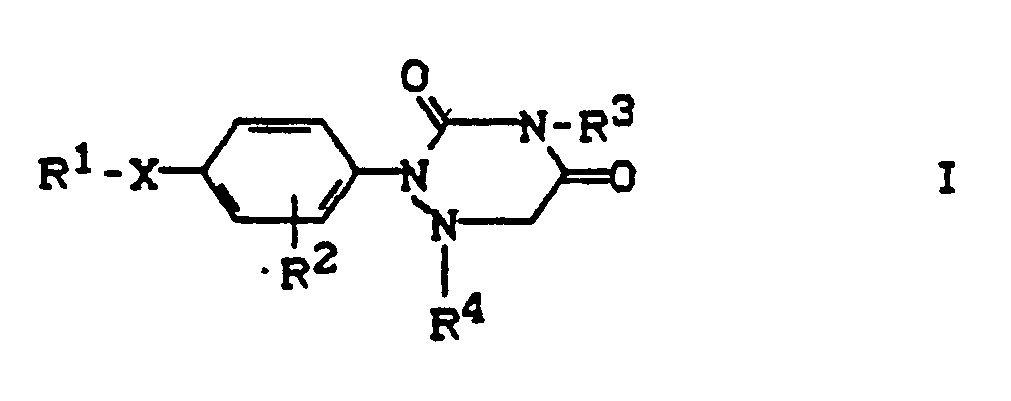
R¹ für über Kohlenstoff gebundene heteroaromatische Reste steht, die gegebenenfalls substituiert sind,
X für O, S, SO, SO₂ oder -CR⁵(CN)- steht,
R² für Wasserstoff einen oder mehrere, gleiche oder verschiedene Reste der Gruppe Wasserstoff, Halogen, Nitro, Alkyl, Alkoxy, Halogenalkyl, Halogenalkoxy, Alkylthio, Halogenalkylthio,
R³ und R⁴ unabhängig voneinander für Wasserstoff, gegebenenfalls substituiertes Alkyl, Alkenyl, Alkinyl, Aralkyl stehen,
R⁵ für Wasserstoff oder Alkyl steht,
ausgenommen Verbindungen, in denen X für -CR⁵(CN)- und R¹ für Thienyl steht,
a) dadurch gekennzeichnet, daß man Verbindungen der Formel II

X, R¹, R² und R³ die oben angegebene Bedeutung haben,
hydriert oder
b) dadurch gekennzeichnet, daß man Verbindungen der Formel III

R¹, R², X die oben angegebene Bedeutung haben mit Verbindungen der Formel IV
R³-B IV
in welcher
R³ für gegebenenfalls substituiertes Alkyl, Alkenyl, Alkinyl, Aralkyl steht und
B für Halogen, -O-SO₂-Alkyl, -O-SO₂-Aryl, -O-SO₂-Halogenalkyl steht
umsetzt, oder
c) dadurch gekennzeichnet, daß man Verbindungen der Formel V

R¹, R², R³ und X die oben angegebene Bedeutung haben, R³ aber nicht für Wasserstoff steht,
mit Verbindungen der Formel VI
R⁴-B VI
in welcher
R⁴ und B die oben angegebene Bedeutung haben,
umsetzt.

X die in Anspruch 1 angegebene Bedeutung hat,
R¹, R², R³ die in Anspruch 1 angegebenen Bedeutungen besitzen, wobei R¹ nicht für Thiophen stehen darf, wenn X für -C R⁵(CN) steht und nicht für Benzthiazol, Benzoxazol, Thiazol und Oxazol stehen darf, wenn X für O, S, SO, SO₂ steht.
a) daß man Verbindungen der Formel VII

X, R¹ und R² die in Anspruch 3 angegebene Bedeutung haben,
mit Verbindungen der Formel IV
R³-B IV
in welcher
R³ und B die in (2) angegebenen Bedeutungen haben,
umsetzt, oder
b) daß man Verbindungen der Formel VIII

X, R¹, R², R³, R⁵ die in Anspruch 1 angegebenen deutungen haben,
durch Erhitzen decarboxyliert oder
c) daß man Verbindungen der Formel IX

X für O, S, -CR⁵(CN)- steht,
R¹, R² die in Anspruch 1 angegebene Bedeutung haben,
R⁶ und R⁷ für gegebenenfalls substituiertes Alkyl stehen,
mit Glyoxylsäure der Formel X
CHO-COOH X
in Gegenwart von anorganischen oder organischen Säuren umsetzt, oder
d) daß man Verbindungen der Formel XI

X für O, S oder -CR⁵(CN)- steht,
R¹, R², R³, R⁵ die in Anspruch 1 angegebene Bedeutung haben, und
R⁸ für Alkyl oder gegebenenfalls substituiertes Aryl steht,
R⁹ für H steht,
in Gegenwart von Basen erhitzt.
e) daß man Verbindungen der Formel XVII

X, R², R³ die oben angegebene Bedeutung haben,
mit Verbindungen der Formel XVIII
R¹-A XVIII
in welcher
R¹ die oben angegebene Bedeutung hat und
A für die Reste Halogen, O-SO₂-Alkyl, -O-SO₂-Halogenalkyl, -O-SO₂-Aryl, -S-Alkyl, -SO₂-Alkyl oder SO₂-Halogenalkyl steht,
umsetzt.

X, R¹, R², R³ die in Anspruch 1 angegebene Bedeutung haben.

X, R¹, R², R³ die in Anspruch 1 angegebene Bedeutung haben,
R⁸ für Alkyl oder Aryl steht,
R⁹ für CN oder den Rest -CO-N(R³)-C00R⁸ steht,
in Gegenwart von wäßrigen Mineralsäuren erhitzt.

X, R¹, R², R³, R⁸ die in Anspruch 6 angegebene Bedeutung haben, und
R⁹ für CN oder den Rest -CO-N(R³)-COOR⁸ steht.

X, R¹, R², R³, R⁸, R⁹ die in Anspruch 7 angegebene Bedeutung haben,
in Gegenwart von Basen erhitzt.

X, R¹, R², R³, R⁸ die in Anspruch 4 angegebene Bedeutung haben
und R⁹ für H, CN oder den Rest CON(R³)-COOR⁸ steht.
a) Verbindungen der Formel XIII

X, R¹, R² die in Anspruch 1 angegebene Bedeutung haben,
in an sich bekannter Weise diazotiert und anschließend mit Verbindungen der Formel XIV

R³, R⁸, R⁹ die in Anspruch 7 angegebene Bedeutung haben,
umsetzt, oder
b) indem man Verbindungen der Formel XV
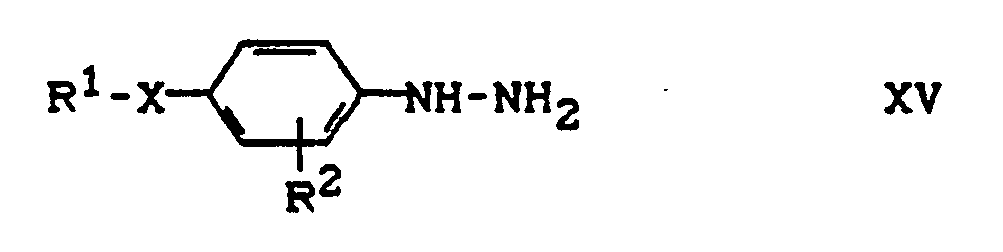
X, R¹, R² die in Anspruch 1 angegebene Bedeutung haben,
zunächst mit Glyoxylsäure der Formel X, anschließend mit Thionylchlorid und dann mit Ethylurethan umsetzt.

X, R¹, R² die in Anspruch 1 angegebene Bedeutung haben,
R⁶ und R⁷ unabhängig voneinander für gegebenenfalls substituiertes Alkyl stehen.

X, R¹, R² die in Anspruch 1 angegebene Bedeutung haben,
zunächst mit Ketonen der Formel XVI

R⁶ und R⁷ die in Anspruch 11 angegebene Bedeutung haben,
und anschließend mit Alkalicyanaten umsetzt.
Applications Claiming Priority (2)
| Application Number | Priority Date | Filing Date | Title |
|---|---|---|---|
| DE3900373 | 1989-01-09 | ||
| DE3900373 | 1989-01-09 |
Publications (2)
| Publication Number | Publication Date |
|---|---|
| EP0377903A2 true EP0377903A2 (de) | 1990-07-18 |
| EP0377903A3 EP0377903A3 (de) | 1991-07-17 |
Family
ID=6371725
Family Applications (1)
| Application Number | Title | Priority Date | Filing Date |
|---|---|---|---|
| EP19890124122 Withdrawn EP0377903A3 (de) | 1989-01-09 | 1989-12-28 | Substituierte Hexahydro-1,2,4-triazindione, Verfahren zu ihrer Herstellung, Zwischenprodukte dafür und ihre Verwendung |
Country Status (4)
| Country | Link |
|---|---|
| US (1) | US5114938A (de) |
| EP (1) | EP0377903A3 (de) |
| JP (1) | JPH02225483A (de) |
| ZA (1) | ZA90114B (de) |
Cited By (3)
| Publication number | Priority date | Publication date | Assignee | Title |
|---|---|---|---|---|
| EP0457015A3 (en) * | 1990-05-17 | 1992-07-08 | Bayer Ag | Use of substituted 1,2,4-triazinediones in combating parasitical protozoa |
| EP0576251A1 (de) * | 1992-06-25 | 1993-12-29 | Suntory Limited | Substituierte 1,2,4-Triazine-3,5-Dion Derivate und diese enthaltende Arzneimittel, insbesondere zur Behandlung von Coccidiose |
| WO1999011634A1 (en) * | 1997-08-29 | 1999-03-11 | Takeda Chemical Industries, Ltd. | Triazine derivatives, their production and use |
Families Citing this family (11)
| Publication number | Priority date | Publication date | Assignee | Title |
|---|---|---|---|---|
| US5747476A (en) | 1996-07-17 | 1998-05-05 | Mortar & Pestle Veterinary Pharmacy, Inc. | Treatment of equine protozoal myeloencephalitis |
| US5883095A (en) * | 1997-08-07 | 1999-03-16 | University Of Kentucky Research Foundation | Formulations and methods to treat and prevent equine protozoal myeloencephalitis |
| US5830893A (en) * | 1997-04-23 | 1998-11-03 | Mortar & Pestle Veterinary Pharmacy, Inc. | Treatment of equine protozoan myeloencephalitis using triazinediones |
| HK1043019B (zh) | 1998-10-08 | 2005-05-13 | 高新研究公司 | 用於预防和治疗原虫病的组合物和方法 |
| US6194408B1 (en) | 1998-12-22 | 2001-02-27 | Bayer Corporation | Triazineone compounds for treating diseases due to Sarcocystis, Neospora and Toxoplasma |
| DE19958388A1 (de) * | 1999-12-03 | 2001-06-07 | Bayer Ag | Triazinonverbindungen zur Behandlung von durch den Befall mit parasitischen Protozoen bedingten Krankheiten |
| US6429211B1 (en) | 2000-05-23 | 2002-08-06 | Bayer Corporation | Praziquantel compounds for treating diseases due to Sarcocystis Neospora Toxoplasma and Isospora |
| CN121081472A (zh) | 2018-12-13 | 2025-12-09 | 拓臻股份有限公司 | 一种THRβ受体激动剂化合物及其制备方法和用途 |
| CA3154488A1 (en) | 2019-08-23 | 2021-03-04 | Terns Pharmaceuticals, Inc. | Thyroid hormone receptor beta agonist compounds |
| CA3154391A1 (en) | 2019-09-12 | 2021-03-18 | Terns Pharmaceuticals, Inc. | Thyroid hormone receptor beta agonist compounds |
| PE20252787A1 (es) | 2023-04-07 | 2025-12-22 | Terns Pharmaceuticals Inc | Combinacion que comprende un agonista de thr-beta y un agonista de glp-1r para su uso en el tratamiento de un trastorno hepatico o una enfermedad cardiometabolica |
Family Cites Families (9)
| Publication number | Priority date | Publication date | Assignee | Title |
|---|---|---|---|---|
| US3912723A (en) * | 1971-03-29 | 1975-10-14 | Pfizer | 2-Phenyl-as-triazine-3,5(2H,4H)diones |
| US3896124A (en) * | 1971-07-07 | 1975-07-22 | Pfizer | Preparation of 2 (aryl)-as-triazine-3,5(2h,4h)-diones |
| AU6280973A (en) * | 1972-12-01 | 1975-05-22 | Pfizer | Process and intermediates for preparation of 2-arly-6- carboxy-1,2,4-triazine-3,5%2h,4h<-diones |
| DE3405241A1 (de) * | 1984-02-15 | 1985-08-29 | Bayer Ag, 5090 Leverkusen | 1-/4-(benzothia- oder -oxazol-2-ylthio- oder -2-yloxy) phenyl/-1,3,5-triazin-2,4,6-(1h,3h,5h)-trione, verfahren zu ihrer herstellung und ihre verwendung als arzneimittel |
| DE3408924A1 (de) * | 1984-03-12 | 1985-09-26 | Hoechst Ag, 6230 Frankfurt | Substituierte 2-phenyl-hexahydro-1,2,4-triazin-3,5-dione, verfahren zu ihrer herstellung, sie enthaltende mittel und ihre verwendung |
| CA1244024A (en) * | 1984-08-01 | 1988-11-01 | Gustaaf M. Boeckx | .alpha.- ARYL-4-(4,5-DIHYDRO-3,5-DIOXO-1,2,4-TRIAZIN- 2(3H)-YL)BENZENEACETONITRILES |
| GB8602342D0 (en) * | 1986-01-30 | 1986-03-05 | Janssen Pharmaceutica Nv | 5 6-dihydro-2-(substituted phenyl)-1 2 4-triazine-3 5(2h 4h)-diones |
| DE3631085A1 (de) * | 1986-09-12 | 1988-03-24 | Boehringer Mannheim Gmbh | Heterocyclisch substituierte indolinone, verfahren zu ihrer herstellung, arzneimittel sowie zwischenprodukte |
| DE3805660A1 (de) * | 1988-02-24 | 1989-09-07 | Bayer Ag | Substituierte 1,2,4-triazindione, verfahren zu ihrer herstellung und ihre verwendung |
-
1989
- 1989-12-28 EP EP19890124122 patent/EP0377903A3/de not_active Withdrawn
-
1990
- 1990-01-02 US US07/459,895 patent/US5114938A/en not_active Expired - Fee Related
- 1990-01-08 ZA ZA90114A patent/ZA90114B/xx unknown
- 1990-01-08 JP JP2000731A patent/JPH02225483A/ja active Pending
Cited By (6)
| Publication number | Priority date | Publication date | Assignee | Title |
|---|---|---|---|---|
| EP0457015A3 (en) * | 1990-05-17 | 1992-07-08 | Bayer Ag | Use of substituted 1,2,4-triazinediones in combating parasitical protozoa |
| US5141938A (en) * | 1990-05-17 | 1992-08-25 | Bayer Aktiengesellschaft | Parasiticidal substituted 1,2,4-triazinediones |
| AU634657B2 (en) * | 1990-05-17 | 1993-02-25 | Bayer Aktiengesellschaft | Use of substituted 1,2,4-triazinediones |
| EP0576251A1 (de) * | 1992-06-25 | 1993-12-29 | Suntory Limited | Substituierte 1,2,4-Triazine-3,5-Dion Derivate und diese enthaltende Arzneimittel, insbesondere zur Behandlung von Coccidiose |
| US5424310A (en) * | 1992-06-25 | 1995-06-13 | Suntory Limited | Substituted 1,2,4-triazine-3,5-dione derivative and anticoccidial drug composition containing the same as active component |
| WO1999011634A1 (en) * | 1997-08-29 | 1999-03-11 | Takeda Chemical Industries, Ltd. | Triazine derivatives, their production and use |
Also Published As
| Publication number | Publication date |
|---|---|
| ZA90114B (en) | 1990-10-31 |
| US5114938A (en) | 1992-05-19 |
| JPH02225483A (ja) | 1990-09-07 |
| EP0377903A3 (de) | 1991-07-17 |
Similar Documents
| Publication | Publication Date | Title |
|---|---|---|
| EP0457015B1 (de) | Verwendung von substituierten 1,2,4-Triazindionen zur Bekämpfung von parasitären Protozoen | |
| EP0597304B1 (de) | Verwendung von substituierten Benzimidazolen zur Bekämpfung parasitärer Protozoen | |
| EP0330041B1 (de) | Substituierte 1,2,4-Triazindione, Verfahren zu ihrer Herstellung und ihre Verwendung | |
| US5256631A (en) | Substituted 1,2,4-triazinediones, and their use | |
| US5114938A (en) | Parasiticidal substituted hexahydro-1,2,4-triazinediones and use thereas | |
| EP0353526A2 (de) | Triazindion-Derivate enthaltendes Mittel gegen Fischparasiten | |
| US4933341A (en) | Substituted 1,3,5-triazinetriones, for use against parasitic protozoa | |
| EP0476439A1 (de) | Substituierte 1,2,4-Triazindione, Verfahren zu ihrer Herstellung, Zwischenprodukte dafür und ihre Verwendung | |
| EP1177191B1 (de) | Substituierte benzimidazole, ihre herstellung und ihre verwendung als mittel gegen parasitäre protozoen | |
| EP0392298A2 (de) | Substituierte Uracile, Verfahren zu ihrer Herstellung und ihre Verwendung gegen parasitäre Protozoen | |
| US5214043A (en) | Parasiticidal substituted hexahydro-1,2,4-triazinediones | |
| US5196562A (en) | Substituted 1,3,5-triazinetriones, for use against parasitic protozoa | |
| WO2002030909A1 (de) | N-alkoxyalkyl-substituierte benzimidazole und ihre verwendung als mittel gegen parasitäre protozoen | |
| EP0364765A2 (de) | Substituierte 1,3,5-Triazintrione, Verfahren zu ihrer Herstellung und ihre Verwendung gegen parasitäre Protozoen | |
| DE19831985A1 (de) | Substituierte Benzimidazole, ihre Herstellung und ihre Verwendung als Mittel gegen parasitäre Protozoen | |
| EP0602465A1 (de) | Verwendung von CN-substituierten Benzimidazolen | |
| DE4029534A1 (de) | Substituierte 1,2,4-triazindione, verfahren zu ihrer herstellung, zwischenprodukte dafuer und ihre verwendung |
Legal Events
| Date | Code | Title | Description |
|---|---|---|---|
| PUAI | Public reference made under article 153(3) epc to a published international application that has entered the european phase |
Free format text: ORIGINAL CODE: 0009012 |
|
| 17P | Request for examination filed |
Effective date: 19891229 |
|
| AK | Designated contracting states |
Kind code of ref document: A2 Designated state(s): BE CH DE ES FR GB IT LI NL |
|
| PUAL | Search report despatched |
Free format text: ORIGINAL CODE: 0009013 |
|
| AK | Designated contracting states |
Kind code of ref document: A3 Designated state(s): BE CH DE ES FR GB IT LI NL |
|
| 17Q | First examination report despatched |
Effective date: 19930624 |
|
| STAA | Information on the status of an ep patent application or granted ep patent |
Free format text: STATUS: THE APPLICATION IS DEEMED TO BE WITHDRAWN |
|
| 18D | Application deemed to be withdrawn |
Effective date: 19931105 |