EP0378846A2 - Appareil téléphonique - Google Patents
Appareil téléphonique Download PDFInfo
- Publication number
- EP0378846A2 EP0378846A2 EP89123837A EP89123837A EP0378846A2 EP 0378846 A2 EP0378846 A2 EP 0378846A2 EP 89123837 A EP89123837 A EP 89123837A EP 89123837 A EP89123837 A EP 89123837A EP 0378846 A2 EP0378846 A2 EP 0378846A2
- Authority
- EP
- European Patent Office
- Prior art keywords
- handset
- data
- handset unit
- memory
- telephone
- Prior art date
- Legal status (The legal status is an assumption and is not a legal conclusion. Google has not performed a legal analysis and makes no representation as to the accuracy of the status listed.)
- Granted
Links
Images


Classifications
-
- H—ELECTRICITY
- H04—ELECTRIC COMMUNICATION TECHNIQUE
- H04M—TELEPHONIC COMMUNICATION
- H04M1/00—Substation equipment, e.g. for use by subscribers
- H04M1/26—Devices for calling a subscriber
- H04M1/27—Devices whereby a plurality of signals may be stored simultaneously
- H04M1/274—Devices whereby a plurality of signals may be stored simultaneously with provision for storing more than one subscriber number at a time, e.g. using toothed disc
- H04M1/2745—Devices whereby a plurality of signals may be stored simultaneously with provision for storing more than one subscriber number at a time, e.g. using toothed disc using static electronic memories, e.g. chips
- H04M1/275—Devices whereby a plurality of signals may be stored simultaneously with provision for storing more than one subscriber number at a time, e.g. using toothed disc using static electronic memories, e.g. chips implemented by means of portable electronic directories
-
- H—ELECTRICITY
- H04—ELECTRIC COMMUNICATION TECHNIQUE
- H04M—TELEPHONIC COMMUNICATION
- H04M1/00—Substation equipment, e.g. for use by subscribers
- H04M1/26—Devices for calling a subscriber
- H04M1/27—Devices whereby a plurality of signals may be stored simultaneously
- H04M1/274—Devices whereby a plurality of signals may be stored simultaneously with provision for storing more than one subscriber number at a time, e.g. using toothed disc
- H04M1/2745—Devices whereby a plurality of signals may be stored simultaneously with provision for storing more than one subscriber number at a time, e.g. using toothed disc using static electronic memories, e.g. chips
- H04M1/2753—Devices whereby a plurality of signals may be stored simultaneously with provision for storing more than one subscriber number at a time, e.g. using toothed disc using static electronic memories, e.g. chips providing data content
- H04M1/2757—Devices whereby a plurality of signals may be stored simultaneously with provision for storing more than one subscriber number at a time, e.g. using toothed disc using static electronic memories, e.g. chips providing data content by data transmission, e.g. downloading
-
- H—ELECTRICITY
- H04—ELECTRIC COMMUNICATION TECHNIQUE
- H04M—TELEPHONIC COMMUNICATION
- H04M1/00—Substation equipment, e.g. for use by subscribers
- H04M1/72—Mobile telephones; Cordless telephones, i.e. devices for establishing wireless links to base stations without route selection
- H04M1/724—User interfaces specially adapted for cordless or mobile telephones
- H04M1/72403—User interfaces specially adapted for cordless or mobile telephones with means for local support of applications that increase the functionality
- H04M1/72409—User interfaces specially adapted for cordless or mobile telephones with means for local support of applications that increase the functionality by interfacing with external accessories
-
- H—ELECTRICITY
- H04—ELECTRIC COMMUNICATION TECHNIQUE
- H04M—TELEPHONIC COMMUNICATION
- H04M1/00—Substation equipment, e.g. for use by subscribers
- H04M1/72—Mobile telephones; Cordless telephones, i.e. devices for establishing wireless links to base stations without route selection
- H04M1/724—User interfaces specially adapted for cordless or mobile telephones
Definitions
- the present invention relates generally to telephone apparatus and, more particularly, to telephone apparatus such as a cordless telephone that is capable of multiple operational modes.
- Telephone systems capable of performing multiple functions and having different operational modes such as a mobile telephone system, a cordless telephone, a so-called intelligent telephone, and the like are now widely used.
- the telephone subscriber or user When making an outgoing call, the telephone subscriber or user has to operate a number of pushbuttons or keys, for example, from 6 to 14 digits may have to be entered, which is very cumbersome for the user.
- this type of telephone is provided with an abbreviated dialing function and/or a so-called one-touch dialing function.
- the user stores predetermined telephone numbers of persons to whom the user wishes to place a call in a memory of the telephone by operating the keys of the telephone set. Following such storage, the user can make an outgoing call by simply manipulating the keys of an abbreviated number or by only depressing the so-called one-touch dial key of the telephone set.
- a further object of the present invention is to provide a telephone apparatus having such data transfer capability that is applicable for use with a mobile telephone system, a cordless telephone, or an intelligent telephone set.
- a telephone apparatus that comprises a handset unit having a keypad and a memory for storing data, such as a plurality of telephone numbers, with the handset unit being intended to make an outgoing call on the basis of the data stored in the memory.
- a data transmitting section is also provided for permitting connection of two of the handset units, so that when a predetermined key of one of the two handset units is operated in a predetermined manner, the data stored in the memory of the one handset unit is transmitted to the memory of another handset through use of the respective data transmitting sections of each handset unit.
- the present invention is advantageously applied to a so-called cordless telephone system.
- the typical cordless telephone system is comprised of a remote station formed as a so-called handset unit having transmitting and receiving sections and a master station or a so-called base unit, also having transmitting and receiving sections.
- the base unit is directly connected to the telephone network and the handset unit and the base unit are mutually connected by radio waves. Telephone subscribers or users can pick up and operate the handset unit in the same way as they operate a standard telephone set.
- FIG. 1 An example of a circuit arrangement of a handset unit of such cordless telephone is shown in Fig. 1, and Fig. 2 pictorially illustrates two of the above-mentioned handset units, as might be included in the system of Fig. 1.
- Handset unit 1A is comprised of a microphone 2 for picking up the spoken words of a user, a transmitting circuit 3 for transmitting an audio signal corresponding to the output of microphone 2 and a control signal to another telephone station over an antenna 4, a speaker or transducer 5 for producing the words of the other party in a telephone conversation, a receiving circuit 6 for receiving the audio signal and control signal transmitted from another telephone station, a dial key pad 7, a microcomputer 8 for controlling the operation of the various subsystems of handset unit 1A, and a random access memory (RAM) 9 cooperating with microcomputer 8.
- RAM random access memory
- Microcomputer 8 may advantageously be comprised of a commercially available product known as HD-647180X marketed by Hitachi Limited.
- RAM 9 is provided to store data such as different telephone numbers for outgoing calls and the like, and is backed-up by a battery (not shown) so as to become a non-volatile memory.
- Microcomputer 8 is provided with a change-over switch 13 to change-over from a communication mode to a noncommunication mode.
- change-over switch 13 When the handset unit is not being used, change-over switch 13 is set in the noncommunication mode.
- change-over switch 13 Upon determining to make an outgoing call the user operates change-over switch 13 to place handset unit 1A in the communication mode. The user then makes an outgoing call by entering the appropriate telephone number for the outgoing call by depressing the corresponding keys of dial keypad 7. At the completion of the telephone conversation, the user again operates button 13 to cause the handset unit 1A to be set back into the noncommunication mode.
- An incoming call is received as follows.
- a ringer tone is emitted by speaker 5
- the user operates change-over switch 13 to place the handset unit 1A in the communication mode, thereby making a telephone conversation possible.
- the user again operates change-over switch 13 to cause handset unit 1A to be set back into the noncommunication mode.
- Microcomputer 8 is provided with auxiliary buttons, such as a reserve switch 14, a pause switch 15, and a call switch 16.
- the reserve switch 14 places the line on hold and typically plays a tune or melody to the other party on hold.
- a power switch 12 is provided, as shown in Fig. 2, and this is the main switch for the handset unit.
- the above-mentioned circuit elements and switches 2 through 9 and 12 through 16 are substantially the same as those found in a standard cordless telephone and operate in the well-known fashion, so they need not be described in any further detail.
- Two interface units 11A and 11B are provided and are constructed to operate according to standards set down by the Federal Communications Commission (FCC), for example, standard RS-2326. This standard specifically describes interface units that are adapted to transfer data onto the telephone network.
- FCC Federal Communications Commission
- interface units 11A and 11B are connected between the respective data terminals 10 of handset units 1A and 1B.
- Each data terminal 10 is provided within the respective handset units 1A and 1B at positions corresponding to jacks 18 formed in the side of handset units 1A and 1B, as shown in Fig. 2.
- interface units 11A and 11b each have electrical contacts 20 that form a plug to make electrical contact with the respective data terminals 10 located in the respective handset units.
- contacts 20 are brought into electrical contact with the internal data terminals 10, thereby to connect interface units 11A and 11B through their respective data terminals 10.
- Interface units 11A and 11B are connected to each other for transmitting and receiving data by means of at least two electrical conductors located in a cable 21.
- a data transfer routine 100 is provided within the respective microcomputers 8 of handset units 1A and 1B.
- RAM 9 in handset unit 1A is provided to store therein predetermined phone numbers that the user of handset 1A wishes to call.
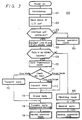
- the flow chart of Fig. 3 explains how to operate the switches and keys of handset unit 1A to transfer data, such as a plurality of phone numbers stored in RAM 9, to the corresponding RAM of handset unit 1B.
- interface units 11A and 11B are connected to the respective data terminals 10 of handset unit 1A and handset unit 1B by inserting contacts 20 into jacks 18, whereby microcomputer 8 of the handset unit 1A and the microcomputer 8 of handset unit 1B are mutually connected via these interface units 11A and 11B and the wires in cable 21.
- step 101 initialization of respective logic sections is performed in the well-known fashion, and the routine proceeds to the next step 102, in which the status of the input/output (I/O) port of microcomputer is read out.
- step 103 it is determined on the basis of the of the I/O port whether an interface unit is connected to data terminal 10.
- step 103 If it is determined that an interface unit, such as 11A or 11B, is not connected to data terminal 10, as represented by a NO at step 103, the routine proceeds from step 103 to step 104, where handset units 1A and 1B are set in the normal operation mode for making an outgoing call and for receiving an incoming call.
- step 103 determines that an interface unit 11A or 11b is indeed connected to data terminal 10
- a YES decision is made and the routine proceeds from step 103 to step 105.
- step 105 handset units 1A and 1B are both set in a standby mode for a predetermined time period while awaiting the instructional inputs from one of the respective key pads 7. If instructional data is input by operating a key pad 7 within the predetermined time period, then that handset unit, 1A or 1B, is designated at the transmitting unit, the above-mentioned input data is read out, and the routine proceeds to step 106. If no data is input by the key pad 7 of handset 1A or 1B, then, the routine directly proceeds to step 106.
- one handset unit will have data entered using its key pad within the standby period and the other handset unit will not have data entered using its key pad.
- particular data such as [#], [7], [3], [8], [6] will be input to handset unit 1A, which will be the unit to transfer data, by operating dial key pad 7 in step 105, whereas no data will be input to handset unit 1B because it will be the unit to which the data is transferred.
- the so-called particular data is an identification code (ID) that is used to transfer data from one handset to another.
- ID identification code
- the respective microcomputers 8 of handset units 1A and 1B determines whether the particular instructional data was input by operating the respective dial key pad 7 at step 105.
- step 106 If it is determined that the particular data is input to handset unit 1A, as represented by a YES at step 106, then the processing by microcomputer 8 proceeds from step 106 to step 110, and handset unit 1A is set in the data transmission mode. If it is determined that the particular data was not input to handset unit 1B, as represented by a NO at step 106, then the routine proceeds from step 106 to step 120, and handset unit 1B is placed in the data reception mode.
- the routine proceeds from step 110 to the next decision step 111 where it is determined whether the data input by keypad 7 represents the copy mode or the forget mode or the copy and forget mode. If the key [1] is pressed after the key [*] in dial key pad, this represents the copy mode. If such was the case, the routine proceeds from step 111 to step 112, wherein microcomputer 8 in handset unit 1A is operated to transmit the data, such as a plurality of telephone numbers, stored in RAM 9 to data terminal 10 of handset unit 1B through the I/O port, terminal 10, and interface units 11A and 11B.
- step 115 in which an end code indicative of the end of the data transmission operation is transmitted.
- step 116 the handset unit 1A is set in the normal operation mode.
- step 111 If it is determined in step 111 that the data input by dial keypad 7 at step 105 indicates the copy and forget mode, which is represented by pressing key [2] after key [*] in dial keypad 7, the routine proceeds from step 111 to step 113, so that the data stored in RAM 9 of handset unit 1A is transmitted to handset unit 1B, just as in the operation of step 112. At the completion of the data transmission operation, the routine proceeds from step 113 to step 114, wherein microcomputer 8 is operated to erase all data stored in RAM 9 of handset unit 1A. The routine proceeds to the next step 115, with subsequent operation as described above.
- step 111 If it is determined in step 111 that the data input by dial key pad 7 at step 105 indicates the forget mode, which is represented by key [3] being pressed after the [*] key, then the routine proceeds from step 111 directly to step 114, so that microcomputer 8 is operated to erase the data stored in RAM 9 of handset unit 1A. The routine proceeds then to the next step 115, with subsequent operations as described above.
- handset unit 1B is set in the receiving mode at step 120 because the particular data was not entered during the standby mode, and data transmitted through interface unit 11B are sequentially written in RAM 9 at step 121. Once the data transmission end code is transmitted to handset unit 1B, the routine proceeds to step 122, wherein handset unit 1B is set in the normal operation mode.
- information stored in the memory of a first handset unit is transferred to the memory of a second handset unit by operating the keys of the first handset unit.
- the data already entered in the memory of the first handset unit can be easily entered in the memory of another handset unit without manually inputting all of the data one by one.
- the cumbersome operation for manually inputting data one by one eliminated, but also mistakes that tend to occur in the manual input operation can be avoided.
- an interface unit 11A or 11B is connected to a data terminal 10 of both handset units. Only when an interface unit 11A or 11B is connected to data terminal 10, can handset unit 1A be set in the data transfer mode. Thus, even if the data is input in advertently by dial key pad 7 to set handset unit 1A in the forget mode, the data cannot be transmitted and the previously entered data can protected.
- the processing status can be announced to the user by a light emitting diode (LED) or an electronically emitted sound.
- LED light emitting diode
Landscapes
- Engineering & Computer Science (AREA)
- Signal Processing (AREA)
- Computer Networks & Wireless Communication (AREA)
- Human Computer Interaction (AREA)
- Mobile Radio Communication Systems (AREA)
- Telephone Set Structure (AREA)
- Sub-Exchange Stations And Push- Button Telephones (AREA)
Applications Claiming Priority (2)
| Application Number | Priority Date | Filing Date | Title |
|---|---|---|---|
| JP330139/88 | 1988-12-27 | ||
| JP63330139A JPH02174448A (ja) | 1988-12-27 | 1988-12-27 | 電話機 |
Publications (3)
| Publication Number | Publication Date |
|---|---|
| EP0378846A2 true EP0378846A2 (fr) | 1990-07-25 |
| EP0378846A3 EP0378846A3 (fr) | 1991-10-23 |
| EP0378846B1 EP0378846B1 (fr) | 1996-02-14 |
Family
ID=18229248
Family Applications (1)
| Application Number | Title | Priority Date | Filing Date |
|---|---|---|---|
| EP89123837A Expired - Lifetime EP0378846B1 (fr) | 1988-12-27 | 1989-12-22 | Appareil téléphonique |
Country Status (7)
| Country | Link |
|---|---|
| US (1) | US5062132A (fr) |
| EP (1) | EP0378846B1 (fr) |
| JP (1) | JPH02174448A (fr) |
| CA (1) | CA2006502C (fr) |
| DE (1) | DE68925691T2 (fr) |
| HK (1) | HK1007652A1 (fr) |
| SG (1) | SG63633A1 (fr) |
Cited By (5)
| Publication number | Priority date | Publication date | Assignee | Title |
|---|---|---|---|---|
| EP0583077A1 (fr) * | 1992-07-21 | 1994-02-16 | ORBITEL MOBILE COMMUNICATIONS LIMITED (Reg. no. 2515004) | Méthodes et appareil pour reprogrammation |
| GB2296630A (en) * | 1994-12-27 | 1996-07-03 | Nec Corp | Registering abbreviated dialing numbers |
| WO2002056620A1 (fr) * | 2001-01-10 | 2002-07-18 | Siemens Aktiengesellschaft | Procede de connexion d'un appareil terminal a un reseau |
| WO2002037879A3 (fr) * | 2000-11-06 | 2003-01-30 | Siemens Ag | Procede d'archivage flexible de donnees memorisees par voie electronique dans des terminaux de telecommunication |
| EP1215870A4 (fr) * | 2000-07-24 | 2005-11-02 | Matsushita Electric Industrial Co Ltd | Systeme de gestion d'informations personnelles |
Families Citing this family (55)
| Publication number | Priority date | Publication date | Assignee | Title |
|---|---|---|---|---|
| US5259018A (en) * | 1989-03-17 | 1993-11-02 | Technophone Limited | Radio telephone system having a handset adapted to be removably connected and containing a NAM for storing a telephone number identifying the handset |
| USD337326S (en) | 1991-04-16 | 1993-07-13 | Hyundai Electronics Industries Co., Ltd. | Portable telephone |
| AU116452S (en) | 1991-05-02 | 1993-03-04 | Nokia Mobile Phones Uk | A telephone |
| JPH0549024A (ja) * | 1991-08-09 | 1993-02-26 | Fujitsu Ltd | パソコン連携式テレビ電話装置 |
| DE69321858T2 (de) * | 1992-03-06 | 1999-05-12 | Fujitsu Ltd., Kawasaki, Kanagawa | Adapter zum Koppeln eines tragbaren Funktelefons an ein Mobiltelefon |
| JP2973723B2 (ja) * | 1992-07-30 | 1999-11-08 | 日本電気株式会社 | 携帯電話機の加入者情報設定方式 |
| US5826201A (en) * | 1992-11-25 | 1998-10-20 | Asterion, Inc. | Antenna microwave shield for cellular telephone |
| US5499295A (en) * | 1993-08-31 | 1996-03-12 | Ericsson Inc. | Method and apparatus for feature authorization and software copy protection in RF communications devices |
| TW249877B (fr) * | 1993-11-23 | 1995-06-21 | Bellsouth Int Inc | |
| US6819916B1 (en) * | 1993-11-23 | 2004-11-16 | Bellsouth Intellectual Property Corporation | Memory device for a cellular telephone |
| JP3126011B2 (ja) * | 1994-09-01 | 2001-01-22 | 株式会社日立製作所 | 電話機 |
| FR2725103B1 (fr) * | 1994-09-23 | 1996-12-27 | Alcatel Mobile Comm France | Economie d'energie dans un systeme incluant un radiotelephone portatif connecte a un dispositif peripherique |
| GB2310110B (en) * | 1996-02-09 | 2000-05-10 | Nokia Mobile Phones Ltd | Transferring information |
| FI102869B (fi) | 1996-02-26 | 1999-02-26 | Nokia Mobile Phones Ltd | Laite, menetelmä ja järjestelmä eri sovelluksiin liittyvien tietojen l ähettämiseksi ja vastaanottamiseksi |
| US7088990B1 (en) | 1996-02-26 | 2006-08-08 | Nokia Mobile Phones, Ltd. | Communication network terminal supporting a plurality of applications |
| US5930703A (en) * | 1996-03-21 | 1999-07-27 | Ericsson Inc. | Methods and systems for programming a cellular radiotelephone |
| KR0167727B1 (ko) * | 1996-05-07 | 1999-02-01 | 김광호 | 핸드폰의 마이크/헤드폰 잭을 이용한 무선 데이타 통신 시스템 |
| DE19737126A1 (de) * | 1997-08-26 | 1999-03-04 | Siemens Ag | Konfigurieren eines Mobilteils in einem Schnurlostelefonsystem |
| FI105762B (fi) * | 1997-11-21 | 2000-09-29 | Nokia Mobile Phones Ltd | Langaton viestin |
| US6408068B1 (en) | 1998-10-30 | 2002-06-18 | Kool! Technologies, Inc. | Modular telephone |
| AU1467400A (en) * | 1998-11-20 | 2000-06-13 | Ericsson Inc. | Automatic direct transfer of user data in wireless communications devices |
| US6473613B2 (en) * | 1998-12-18 | 2002-10-29 | Conexant Systems, Inc. | Method and system for generating a secure wireless link between a handset and base station |
| US7010116B1 (en) | 1998-12-21 | 2006-03-07 | Micron Technology, Inc. | Method of programming telephone numbers and identifiers in a telephone |
| US6697484B1 (en) | 1998-12-21 | 2004-02-24 | Micron Technology, Llc | Method of programming telephone numbers and identifiers in a telephone |
| US6625444B1 (en) | 1999-02-02 | 2003-09-23 | Micron Technology, Inc. | Method of programming a telephone |
| JP4350209B2 (ja) * | 1999-06-18 | 2009-10-21 | パナソニック株式会社 | 電話端末装置 |
| US6487403B2 (en) * | 1999-08-19 | 2002-11-26 | Verizon Laboratories Inc. | Wireless universal provisioning device |
| DE19949540B4 (de) * | 1999-10-14 | 2009-01-22 | Deutsche Telekom Ag | Verfahren zum Übertragen von geräte- und/oder kundenspezifischen Daten |
| FR2807272A1 (fr) * | 2000-03-28 | 2001-10-05 | Koninkl Philips Electronics Nv | Appareil comprenant un dispositif de stockage pour des informations de fonctionnement et procede pour mettre a jour ce dispositif de stockage |
| DE10030603A1 (de) * | 2000-06-21 | 2002-01-03 | Mannesmann Vdo Ag | Externe Bedieneinheit für ein Mobilfunktelefon |
| KR20020001348A (ko) * | 2000-06-28 | 2002-01-09 | 윤종용 | 근거리 이동무선시스템을 이용하여 디지탈 오디오데이타를 청취할 수 있는 헤드셋 |
| JP3639194B2 (ja) * | 2000-07-27 | 2005-04-20 | 富士通株式会社 | 機種変更装置および機種変更方法ならびに機種変更プログラムを記録した記録媒体 |
| US7039177B1 (en) | 2000-09-13 | 2006-05-02 | International Business Machines Corp. | Automatic update of a directory entry within a directory of an electronic communication device by electronic notification |
| US6608889B2 (en) * | 2001-01-25 | 2003-08-19 | Agere Systems Inc. | Telephone having convenience feature data transfer capability |
| US7406421B2 (en) | 2001-10-26 | 2008-07-29 | Intellisist Inc. | Systems and methods for reviewing informational content in a vehicle |
| USRE46109E1 (en) | 2001-03-29 | 2016-08-16 | Lg Electronics Inc. | Vehicle navigation system and method |
| US6885735B2 (en) | 2001-03-29 | 2005-04-26 | Intellisist, Llc | System and method for transmitting voice input from a remote location over a wireless data channel |
| US6748244B2 (en) * | 2001-11-21 | 2004-06-08 | Intellisist, Llc | Sharing account information and a phone number between personal mobile phone and an in-vehicle embedded phone |
| US8175886B2 (en) | 2001-03-29 | 2012-05-08 | Intellisist, Inc. | Determination of signal-processing approach based on signal destination characteristics |
| US6487494B2 (en) * | 2001-03-29 | 2002-11-26 | Wingcast, Llc | System and method for reducing the amount of repetitive data sent by a server to a client for vehicle navigation |
| US7127242B1 (en) * | 2001-06-11 | 2006-10-24 | Gateway Inc. | Inter device personal information transfer |
| JP2003060559A (ja) * | 2001-08-16 | 2003-02-28 | Nec Access Technica Ltd | データの変更/更新機能付き無線通信システム |
| US6885861B2 (en) * | 2001-08-24 | 2005-04-26 | Nokia Corporation | Service mobility and recovery in communication networks |
| US8249880B2 (en) * | 2002-02-14 | 2012-08-21 | Intellisist, Inc. | Real-time display of system instructions |
| JP2004005006A (ja) * | 2002-03-27 | 2004-01-08 | Nec Corp | 移動通信端末装置の辞書追加方法 |
| AU2003248523A1 (en) * | 2002-05-16 | 2003-12-02 | Intellisist, Llc | System and method for dynamically configuring wireless network geographic coverage or service levels |
| US7162229B2 (en) * | 2002-06-26 | 2007-01-09 | Interdigital Technology Corporation | Method and system for transmitting data between personal communication devices |
| AU2002368344A1 (en) * | 2002-11-08 | 2004-06-03 | Carl Underwood | Cellular phone cordless home base unit |
| US7236578B2 (en) * | 2003-01-08 | 2007-06-26 | Vtech Telecommunications Limited | System and method for remotely accessing caller ID information |
| US20040242216A1 (en) * | 2003-06-02 | 2004-12-02 | Nokia Corporation | Systems and methods for transferring data between mobile stations |
| TWM240769U (en) | 2003-07-04 | 2004-08-11 | High Tech Comp Corp | Shiftable pivot structure |
| US20050113079A1 (en) * | 2003-11-24 | 2005-05-26 | Sony Ericsson Mobile Communications Ab | System and method for transferring data files between mobile phones |
| US7783729B1 (en) | 2004-03-19 | 2010-08-24 | Single Touch Interactive, Inc. | Transmitting mobile device data |
| US20090011793A1 (en) * | 2005-01-13 | 2009-01-08 | Pocrass Alan L | Flash Memory Cell Phone With Integrated Male And Female Connectors |
| US8457686B2 (en) * | 2010-12-02 | 2013-06-04 | General Motors Llc | Method of communication between a vehicle telematics unit and a call center |
Family Cites Families (13)
| Publication number | Priority date | Publication date | Assignee | Title |
|---|---|---|---|---|
| US3689703A (en) * | 1970-12-21 | 1972-09-05 | Bell Telephone Labor Inc | Information recording system |
| US4125872A (en) * | 1977-03-31 | 1978-11-14 | Racal-Vadic, Inc. | Multiline automatic calling system adapter |
| US4122304A (en) * | 1977-04-01 | 1978-10-24 | Motorola, Inc. | Control circuitry for a radio telephone |
| JPS58104537A (ja) * | 1981-12-16 | 1983-06-22 | Yokogawa Hokushin Electric Corp | 再生形光デ−タ・バス |
| JPS60223340A (ja) * | 1984-04-20 | 1985-11-07 | Sony Corp | コ−ドレステレホン |
| US4680787A (en) * | 1984-11-21 | 1987-07-14 | Motorola, Inc. | Portable radiotelephone vehicular converter and remote handset |
| US4752949A (en) * | 1984-12-05 | 1988-06-21 | Jay Steinbeck | Corded/cordless telephone |
| EP0206391A3 (fr) * | 1985-05-30 | 1988-12-21 | Automatic Dialer Partners Ltd. 1983 c/o Dasa Corporation General Partner | Numéroteur à répertoire contrôlé par microprocesseur |
| JPS6253552A (ja) * | 1985-09-03 | 1987-03-09 | Nec Corp | 電話機 |
| CA1244979A (fr) * | 1986-05-06 | 1988-11-15 | Robert P. Brennan | Module de programmation pour poste d'abonne |
| US4800582A (en) * | 1986-08-08 | 1989-01-24 | Dictaphone Corporation | Method and apparatus for creating and storing telephone directory listings |
| US4811377A (en) * | 1987-07-31 | 1989-03-07 | Motorola, Inc. | Secure transfer of radio specific data |
| US5029233A (en) * | 1987-10-09 | 1991-07-02 | Motorola, Inc. | Radio arrangement having two radios sharing circuitry |
-
1988
- 1988-12-27 JP JP63330139A patent/JPH02174448A/ja active Pending
-
1989
- 1989-12-22 SG SG1996008383A patent/SG63633A1/en unknown
- 1989-12-22 DE DE68925691T patent/DE68925691T2/de not_active Expired - Fee Related
- 1989-12-22 CA CA002006502A patent/CA2006502C/fr not_active Expired - Fee Related
- 1989-12-22 EP EP89123837A patent/EP0378846B1/fr not_active Expired - Lifetime
- 1989-12-27 US US07/457,931 patent/US5062132A/en not_active Expired - Lifetime
-
1998
- 1998-06-25 HK HK98106792A patent/HK1007652A1/en not_active IP Right Cessation
Cited By (8)
| Publication number | Priority date | Publication date | Assignee | Title |
|---|---|---|---|---|
| EP0583077A1 (fr) * | 1992-07-21 | 1994-02-16 | ORBITEL MOBILE COMMUNICATIONS LIMITED (Reg. no. 2515004) | Méthodes et appareil pour reprogrammation |
| US5430877A (en) * | 1992-07-21 | 1995-07-04 | Orbitel Mobile Communications Limited | Reprogramming methods and apparatus |
| GB2296630A (en) * | 1994-12-27 | 1996-07-03 | Nec Corp | Registering abbreviated dialing numbers |
| US5875405A (en) * | 1994-12-27 | 1999-02-23 | Nec Corporation | Method and system for registering abbreviated dialing numbers |
| GB2296630B (en) * | 1994-12-27 | 1999-04-21 | Nec Corp | Method and system for registering abbreviated dialing numbers |
| EP1215870A4 (fr) * | 2000-07-24 | 2005-11-02 | Matsushita Electric Industrial Co Ltd | Systeme de gestion d'informations personnelles |
| WO2002037879A3 (fr) * | 2000-11-06 | 2003-01-30 | Siemens Ag | Procede d'archivage flexible de donnees memorisees par voie electronique dans des terminaux de telecommunication |
| WO2002056620A1 (fr) * | 2001-01-10 | 2002-07-18 | Siemens Aktiengesellschaft | Procede de connexion d'un appareil terminal a un reseau |
Also Published As
| Publication number | Publication date |
|---|---|
| EP0378846B1 (fr) | 1996-02-14 |
| CA2006502C (fr) | 1999-08-31 |
| EP0378846A3 (fr) | 1991-10-23 |
| CA2006502A1 (fr) | 1990-06-27 |
| SG63633A1 (en) | 1999-03-30 |
| US5062132A (en) | 1991-10-29 |
| DE68925691D1 (de) | 1996-03-28 |
| JPH02174448A (ja) | 1990-07-05 |
| HK1007652A1 (en) | 1999-04-16 |
| DE68925691T2 (de) | 1996-10-02 |
Similar Documents
| Publication | Publication Date | Title |
|---|---|---|
| US5062132A (en) | Telephone apparatus providing for automatic transfer of stored data between handsets | |
| HK1007652B (en) | Telephone apparatus | |
| EP0443562B1 (fr) | Téléphone sans fil | |
| CA1302600C (fr) | Telephone sans fil | |
| US4639549A (en) | Cordless telephone | |
| US4107477A (en) | Multi-subscriber telephone apparatus | |
| US4542262A (en) | Subscriber telephone station | |
| JPH04502392A (ja) | 標準電話セットを備えたセルラ電話のためのダイアリングの特徴的機能 | |
| CN1251491A (zh) | 包括收音机模块的耳机-麦克风组合及其运行方式在电话模式和收音机模式之间转换的方法 | |
| JPH0334702B2 (fr) | ||
| US6154530A (en) | Telecommunication equipment, system and method comprising management means for managing subscriber call-back lists | |
| US5826196A (en) | Multi-line remotely-accessible controller for cordless telephones | |
| JPS6182561A (ja) | 電話装置 | |
| JPH03114341A (ja) | 電話機 | |
| EP0331194B1 (fr) | Radiotéléphone | |
| US5243646A (en) | Fast redial system for a telephone | |
| US5987330A (en) | Cordless telephone set | |
| JPS62214799A (ja) | 電話装置 | |
| US4996708A (en) | Key telephone system adapted to respond to information stored in a portable outpulser | |
| KR100820793B1 (ko) | 원격지 이동 단말기의 동작 제어 방법 | |
| US5857010A (en) | Power-failure resistant communication system | |
| EP0533935A1 (fr) | Appareil telephonique | |
| JPS63272152A (ja) | ボタン電話装置 | |
| KR100372296B1 (ko) | 메모리 전화기 | |
| JPS58223994A (ja) | ボタン電話装置 |
Legal Events
| Date | Code | Title | Description |
|---|---|---|---|
| PUAI | Public reference made under article 153(3) epc to a published international application that has entered the european phase |
Free format text: ORIGINAL CODE: 0009012 |
|
| AK | Designated contracting states |
Kind code of ref document: A2 Designated state(s): DE FR GB |
|
| 17P | Request for examination filed |
Effective date: 19901220 |
|
| PUAL | Search report despatched |
Free format text: ORIGINAL CODE: 0009013 |
|
| AK | Designated contracting states |
Kind code of ref document: A3 Designated state(s): DE FR GB |
|
| 17Q | First examination report despatched |
Effective date: 19931207 |
|
| GRAA | (expected) grant |
Free format text: ORIGINAL CODE: 0009210 |
|
| AK | Designated contracting states |
Kind code of ref document: B1 Designated state(s): DE FR GB |
|
| REF | Corresponds to: |
Ref document number: 68925691 Country of ref document: DE Date of ref document: 19960328 |
|
| ET | Fr: translation filed | ||
| PLBE | No opposition filed within time limit |
Free format text: ORIGINAL CODE: 0009261 |
|
| STAA | Information on the status of an ep patent application or granted ep patent |
Free format text: STATUS: NO OPPOSITION FILED WITHIN TIME LIMIT |
|
| 26N | No opposition filed | ||
| PGFP | Annual fee paid to national office [announced via postgrant information from national office to epo] |
Ref country code: FR Payment date: 20011212 Year of fee payment: 13 |
|
| PGFP | Annual fee paid to national office [announced via postgrant information from national office to epo] |
Ref country code: GB Payment date: 20011227 Year of fee payment: 13 |
|
| REG | Reference to a national code |
Ref country code: GB Ref legal event code: IF02 |
|
| PGFP | Annual fee paid to national office [announced via postgrant information from national office to epo] |
Ref country code: DE Payment date: 20020109 Year of fee payment: 13 |
|
| PG25 | Lapsed in a contracting state [announced via postgrant information from national office to epo] |
Ref country code: GB Free format text: LAPSE BECAUSE OF NON-PAYMENT OF DUE FEES Effective date: 20021222 |
|
| PG25 | Lapsed in a contracting state [announced via postgrant information from national office to epo] |
Ref country code: DE Free format text: LAPSE BECAUSE OF NON-PAYMENT OF DUE FEES Effective date: 20030701 |
|
| GBPC | Gb: european patent ceased through non-payment of renewal fee |
Effective date: 20021222 |
|
| PG25 | Lapsed in a contracting state [announced via postgrant information from national office to epo] |
Ref country code: FR Free format text: LAPSE BECAUSE OF NON-PAYMENT OF DUE FEES Effective date: 20030901 |
|
| REG | Reference to a national code |
Ref country code: FR Ref legal event code: ST |