EP0379284A2 - Polymères à base de styrène et procédé de leur préparation - Google Patents
Polymères à base de styrène et procédé de leur préparation Download PDFInfo
- Publication number
- EP0379284A2 EP0379284A2 EP90300166A EP90300166A EP0379284A2 EP 0379284 A2 EP0379284 A2 EP 0379284A2 EP 90300166 A EP90300166 A EP 90300166A EP 90300166 A EP90300166 A EP 90300166A EP 0379284 A2 EP0379284 A2 EP 0379284A2
- Authority
- EP
- European Patent Office
- Prior art keywords
- styrene
- weight
- polymer
- based polymer
- ppm
- Prior art date
- Legal status (The legal status is an assumption and is not a legal conclusion. Google has not performed a legal analysis and makes no representation as to the accuracy of the status listed.)
- Granted
Links
- PPBRXRYQALVLMV-UHFFFAOYSA-N Styrene Chemical compound C=CC1=CC=CC=C1 PPBRXRYQALVLMV-UHFFFAOYSA-N 0.000 title claims abstract description 111
- 229920000642 polymer Polymers 0.000 title claims abstract description 102
- 238000000034 method Methods 0.000 title claims description 25
- 238000002360 preparation method Methods 0.000 title claims description 14
- MYRTYDVEIRVNKP-UHFFFAOYSA-N 1,2-Divinylbenzene Chemical compound C=CC1=CC=CC=C1C=C MYRTYDVEIRVNKP-UHFFFAOYSA-N 0.000 claims abstract description 46
- -1 vinyl compound Chemical class 0.000 claims abstract description 32
- 229920002554 vinyl polymer Polymers 0.000 claims abstract description 25
- 239000003505 polymerization initiator Substances 0.000 claims abstract description 14
- 238000006116 polymerization reaction Methods 0.000 claims description 37
- 150000001875 compounds Chemical class 0.000 claims description 32
- 125000003118 aryl group Chemical group 0.000 claims description 28
- 229920001577 copolymer Polymers 0.000 claims description 8
- 229920001971 elastomer Polymers 0.000 claims description 7
- OKKRPWIIYQTPQF-UHFFFAOYSA-N Trimethylolpropane trimethacrylate Chemical compound CC(=C)C(=O)OCC(CC)(COC(=O)C(C)=C)COC(=O)C(C)=C OKKRPWIIYQTPQF-UHFFFAOYSA-N 0.000 claims description 3
- 239000003999 initiator Substances 0.000 claims description 2
- 230000000379 polymerizing effect Effects 0.000 claims 1
- 238000010526 radical polymerization reaction Methods 0.000 abstract 1
- 239000000203 mixture Substances 0.000 description 27
- 239000000178 monomer Substances 0.000 description 20
- 229940116441 divinylbenzene Drugs 0.000 description 16
- 238000005259 measurement Methods 0.000 description 15
- 239000002245 particle Substances 0.000 description 12
- 238000002474 experimental method Methods 0.000 description 11
- 230000000052 comparative effect Effects 0.000 description 9
- 238000000465 moulding Methods 0.000 description 8
- ATUOYWHBWRKTHZ-UHFFFAOYSA-N Propane Chemical compound CCC ATUOYWHBWRKTHZ-UHFFFAOYSA-N 0.000 description 6
- 230000003247 decreasing effect Effects 0.000 description 6
- KAKZBPTYRLMSJV-UHFFFAOYSA-N Butadiene Chemical group C=CC=C KAKZBPTYRLMSJV-UHFFFAOYSA-N 0.000 description 5
- STVZJERGLQHEKB-UHFFFAOYSA-N ethylene glycol dimethacrylate Substances CC(=C)C(=O)OCCOC(=O)C(C)=C STVZJERGLQHEKB-UHFFFAOYSA-N 0.000 description 5
- 239000004793 Polystyrene Substances 0.000 description 4
- 238000007334 copolymerization reaction Methods 0.000 description 4
- 229940116336 glycol dimethacrylate Drugs 0.000 description 4
- 238000001746 injection moulding Methods 0.000 description 4
- 239000005060 rubber Substances 0.000 description 4
- NALFRYPTRXKZPN-UHFFFAOYSA-N 1,1-bis(tert-butylperoxy)-3,3,5-trimethylcyclohexane Chemical compound CC1CC(C)(C)CC(OOC(C)(C)C)(OOC(C)(C)C)C1 NALFRYPTRXKZPN-UHFFFAOYSA-N 0.000 description 3
- ZWEHNKRNPOVVGH-UHFFFAOYSA-N 2-Butanone Chemical compound CCC(C)=O ZWEHNKRNPOVVGH-UHFFFAOYSA-N 0.000 description 3
- 239000003963 antioxidant agent Substances 0.000 description 3
- 239000003795 chemical substances by application Substances 0.000 description 3
- 125000004386 diacrylate group Chemical group 0.000 description 3
- 239000012778 molding material Substances 0.000 description 3
- 239000004014 plasticizer Substances 0.000 description 3
- 229920002223 polystyrene Polymers 0.000 description 3
- 239000001294 propane Substances 0.000 description 3
- OZAIFHULBGXAKX-UHFFFAOYSA-N 2-(2-cyanopropan-2-yldiazenyl)-2-methylpropanenitrile Chemical compound N#CC(C)(C)N=NC(C)(C)C#N OZAIFHULBGXAKX-UHFFFAOYSA-N 0.000 description 2
- XFCMNSHQOZQILR-UHFFFAOYSA-N 2-[2-(2-methylprop-2-enoyloxy)ethoxy]ethyl 2-methylprop-2-enoate Chemical compound CC(=C)C(=O)OCCOCCOC(=O)C(C)=C XFCMNSHQOZQILR-UHFFFAOYSA-N 0.000 description 2
- NLHHRLWOUZZQLW-UHFFFAOYSA-N Acrylonitrile Chemical compound C=CC#N NLHHRLWOUZZQLW-UHFFFAOYSA-N 0.000 description 2
- HEDRZPFGACZZDS-UHFFFAOYSA-N Chloroform Chemical compound ClC(Cl)Cl HEDRZPFGACZZDS-UHFFFAOYSA-N 0.000 description 2
- YNQLUTRBYVCPMQ-UHFFFAOYSA-N Ethylbenzene Chemical compound CCC1=CC=CC=C1 YNQLUTRBYVCPMQ-UHFFFAOYSA-N 0.000 description 2
- RRHGJUQNOFWUDK-UHFFFAOYSA-N Isoprene Chemical compound CC(=C)C=C RRHGJUQNOFWUDK-UHFFFAOYSA-N 0.000 description 2
- BAPJBEWLBFYGME-UHFFFAOYSA-N Methyl acrylate Chemical compound COC(=O)C=C BAPJBEWLBFYGME-UHFFFAOYSA-N 0.000 description 2
- GYCMBHHDWRMZGG-UHFFFAOYSA-N Methylacrylonitrile Chemical compound CC(=C)C#N GYCMBHHDWRMZGG-UHFFFAOYSA-N 0.000 description 2
- XYLMUPLGERFSHI-UHFFFAOYSA-N alpha-Methylstyrene Chemical compound CC(=C)C1=CC=CC=C1 XYLMUPLGERFSHI-UHFFFAOYSA-N 0.000 description 2
- 230000003078 antioxidant effect Effects 0.000 description 2
- 239000002131 composite material Substances 0.000 description 2
- 150000001993 dienes Chemical class 0.000 description 2
- 238000009826 distribution Methods 0.000 description 2
- UKMSUNONTOPOIO-UHFFFAOYSA-N docosanoic acid Chemical compound CCCCCCCCCCCCCCCCCCCCCC(O)=O UKMSUNONTOPOIO-UHFFFAOYSA-N 0.000 description 2
- 230000000694 effects Effects 0.000 description 2
- LYCAIKOWRPUZTN-UHFFFAOYSA-N ethylene glycol Natural products OCCO LYCAIKOWRPUZTN-UHFFFAOYSA-N 0.000 description 2
- 229920001519 homopolymer Polymers 0.000 description 2
- WGCNASOHLSPBMP-UHFFFAOYSA-N hydroxyacetaldehyde Natural products OCC=O WGCNASOHLSPBMP-UHFFFAOYSA-N 0.000 description 2
- XMGQYMWWDOXHJM-UHFFFAOYSA-N limonene Chemical compound CC(=C)C1CCC(C)=CC1 XMGQYMWWDOXHJM-UHFFFAOYSA-N 0.000 description 2
- 239000000314 lubricant Substances 0.000 description 2
- 239000002480 mineral oil Substances 0.000 description 2
- 238000002156 mixing Methods 0.000 description 2
- SSDSCDGVMJFTEQ-UHFFFAOYSA-N octadecyl 3-(3,5-ditert-butyl-4-hydroxyphenyl)propanoate Chemical compound CCCCCCCCCCCCCCCCCCOC(=O)CCC1=CC(C(C)(C)C)=C(O)C(C(C)(C)C)=C1 SSDSCDGVMJFTEQ-UHFFFAOYSA-N 0.000 description 2
- 239000008188 pellet Substances 0.000 description 2
- OJMIONKXNSYLSR-UHFFFAOYSA-N phosphorous acid Chemical compound OP(O)O OJMIONKXNSYLSR-UHFFFAOYSA-N 0.000 description 2
- 229920002857 polybutadiene Polymers 0.000 description 2
- 229920001451 polypropylene glycol Polymers 0.000 description 2
- CIHOLLKRGTVIJN-UHFFFAOYSA-N tert‐butyl hydroperoxide Chemical compound CC(C)(C)OO CIHOLLKRGTVIJN-UHFFFAOYSA-N 0.000 description 2
- BIDIHFPLDRSAMB-AATRIKPKSA-N (E)-4,4-Dimethyl-2-pentene Chemical compound C\C=C\C(C)(C)C BIDIHFPLDRSAMB-AATRIKPKSA-N 0.000 description 1
- HSLFISVKRDQEBY-UHFFFAOYSA-N 1,1-bis(tert-butylperoxy)cyclohexane Chemical compound CC(C)(C)OOC1(OOC(C)(C)C)CCCCC1 HSLFISVKRDQEBY-UHFFFAOYSA-N 0.000 description 1
- VDYWHVQKENANGY-UHFFFAOYSA-N 1,3-Butyleneglycol dimethacrylate Chemical compound CC(=C)C(=O)OC(C)CCOC(=O)C(C)=C VDYWHVQKENANGY-UHFFFAOYSA-N 0.000 description 1
- WGGLDBIZIQMEGH-UHFFFAOYSA-N 1-bromo-4-ethenylbenzene Chemical compound BrC1=CC=C(C=C)C=C1 WGGLDBIZIQMEGH-UHFFFAOYSA-N 0.000 description 1
- KTZVZZJJVJQZHV-UHFFFAOYSA-N 1-chloro-4-ethenylbenzene Chemical compound ClC1=CC=C(C=C)C=C1 KTZVZZJJVJQZHV-UHFFFAOYSA-N 0.000 description 1
- JZHGRUMIRATHIU-UHFFFAOYSA-N 1-ethenyl-3-methylbenzene Chemical compound CC1=CC=CC(C=C)=C1 JZHGRUMIRATHIU-UHFFFAOYSA-N 0.000 description 1
- XKNLMAXAQYNOQZ-UHFFFAOYSA-N 2,2-bis(hydroxymethyl)propane-1,3-diol;2-methylprop-2-enoic acid Chemical compound CC(=C)C(O)=O.CC(=C)C(O)=O.CC(=C)C(O)=O.CC(=C)C(O)=O.OCC(CO)(CO)CO XKNLMAXAQYNOQZ-UHFFFAOYSA-N 0.000 description 1
- GZBSIABKXVPBFY-UHFFFAOYSA-N 2,2-bis(hydroxymethyl)propane-1,3-diol;prop-2-enoic acid Chemical compound OC(=O)C=C.OC(=O)C=C.OC(=O)C=C.OC(=O)C=C.OCC(CO)(CO)CO GZBSIABKXVPBFY-UHFFFAOYSA-N 0.000 description 1
- YAJYJWXEWKRTPO-UHFFFAOYSA-N 2,3,3,4,4,5-hexamethylhexane-2-thiol Chemical compound CC(C)C(C)(C)C(C)(C)C(C)(C)S YAJYJWXEWKRTPO-UHFFFAOYSA-N 0.000 description 1
- 150000003923 2,5-pyrrolediones Chemical class 0.000 description 1
- SMZOUWXMTYCWNB-UHFFFAOYSA-N 2-(2-methoxy-5-methylphenyl)ethanamine Chemical compound COC1=CC=C(C)C=C1CCN SMZOUWXMTYCWNB-UHFFFAOYSA-N 0.000 description 1
- XMNIXWIUMCBBBL-UHFFFAOYSA-N 2-(2-phenylpropan-2-ylperoxy)propan-2-ylbenzene Chemical compound C=1C=CC=CC=1C(C)(C)OOC(C)(C)C1=CC=CC=C1 XMNIXWIUMCBBBL-UHFFFAOYSA-N 0.000 description 1
- NIXOWILDQLNWCW-UHFFFAOYSA-N 2-Propenoic acid Natural products OC(=O)C=C NIXOWILDQLNWCW-UHFFFAOYSA-N 0.000 description 1
- JFZBUNLOTDDXNY-UHFFFAOYSA-N 2-[2-(2-methylprop-2-enoyloxy)propoxy]propyl 2-methylprop-2-enoate Chemical compound CC(=C)C(=O)OCC(C)OCC(C)OC(=O)C(C)=C JFZBUNLOTDDXNY-UHFFFAOYSA-N 0.000 description 1
- HWSSEYVMGDIFMH-UHFFFAOYSA-N 2-[2-[2-(2-methylprop-2-enoyloxy)ethoxy]ethoxy]ethyl 2-methylprop-2-enoate Chemical compound CC(=C)C(=O)OCCOCCOCCOC(=O)C(C)=C HWSSEYVMGDIFMH-UHFFFAOYSA-N 0.000 description 1
- DBWWINQJTZYDFK-UHFFFAOYSA-N 2-ethenyl-1,4-dimethylbenzene Chemical compound CC1=CC=C(C)C(C=C)=C1 DBWWINQJTZYDFK-UHFFFAOYSA-N 0.000 description 1
- JMWGZSWSTCGVLX-UHFFFAOYSA-N 2-ethyl-2-(hydroxymethyl)propane-1,3-diol;2-methylprop-2-enoic acid Chemical group CC(=C)C(O)=O.CC(=C)C(O)=O.CC(=C)C(O)=O.CCC(CO)(CO)CO JMWGZSWSTCGVLX-UHFFFAOYSA-N 0.000 description 1
- BTOVVHWKPVSLBI-UHFFFAOYSA-N 2-methylprop-1-enylbenzene Chemical compound CC(C)=CC1=CC=CC=C1 BTOVVHWKPVSLBI-UHFFFAOYSA-N 0.000 description 1
- FRIBMENBGGCKPD-UHFFFAOYSA-N 3-(2,3-dimethoxyphenyl)prop-2-enal Chemical compound COC1=CC=CC(C=CC=O)=C1OC FRIBMENBGGCKPD-UHFFFAOYSA-N 0.000 description 1
- POZGETMIPGBFGQ-UHFFFAOYSA-N 3-methylbut-1-en-2-ylbenzene Chemical compound CC(C)C(=C)C1=CC=CC=C1 POZGETMIPGBFGQ-UHFFFAOYSA-N 0.000 description 1
- IYMZEPRSPLASMS-UHFFFAOYSA-N 3-phenylpyrrole-2,5-dione Chemical class O=C1NC(=O)C(C=2C=CC=CC=2)=C1 IYMZEPRSPLASMS-UHFFFAOYSA-N 0.000 description 1
- FQMIAEWUVYWVNB-UHFFFAOYSA-N 3-prop-2-enoyloxybutyl prop-2-enoate Chemical compound C=CC(=O)OC(C)CCOC(=O)C=C FQMIAEWUVYWVNB-UHFFFAOYSA-N 0.000 description 1
- XOJWAAUYNWGQAU-UHFFFAOYSA-N 4-(2-methylprop-2-enoyloxy)butyl 2-methylprop-2-enoate Chemical compound CC(=C)C(=O)OCCCCOC(=O)C(C)=C XOJWAAUYNWGQAU-UHFFFAOYSA-N 0.000 description 1
- JLBJTVDPSNHSKJ-UHFFFAOYSA-N 4-Methylstyrene Chemical compound CC1=CC=C(C=C)C=C1 JLBJTVDPSNHSKJ-UHFFFAOYSA-N 0.000 description 1
- DBCAQXHNJOFNGC-UHFFFAOYSA-N 4-bromo-1,1,1-trifluorobutane Chemical compound FC(F)(F)CCCBr DBCAQXHNJOFNGC-UHFFFAOYSA-N 0.000 description 1
- 235000021357 Behenic acid Nutrition 0.000 description 1
- 239000004342 Benzoyl peroxide Substances 0.000 description 1
- OMPJBNCRMGITSC-UHFFFAOYSA-N Benzoylperoxide Chemical compound C=1C=CC=CC=1C(=O)OOC(=O)C1=CC=CC=C1 OMPJBNCRMGITSC-UHFFFAOYSA-N 0.000 description 1
- NLZUEZXRPGMBCV-UHFFFAOYSA-N Butylhydroxytoluene Chemical compound CC1=CC(C(C)(C)C)=C(O)C(C(C)(C)C)=C1 NLZUEZXRPGMBCV-UHFFFAOYSA-N 0.000 description 1
- 229920002943 EPDM rubber Polymers 0.000 description 1
- 241001435619 Lile Species 0.000 description 1
- CERQOIWHTDAKMF-UHFFFAOYSA-N Methacrylic acid Chemical compound CC(=C)C(O)=O CERQOIWHTDAKMF-UHFFFAOYSA-N 0.000 description 1
- VVQNEPGJFQJSBK-UHFFFAOYSA-N Methyl methacrylate Chemical compound COC(=O)C(C)=C VVQNEPGJFQJSBK-UHFFFAOYSA-N 0.000 description 1
- IZMILXUBYXMQBP-UHFFFAOYSA-N OC(=O)C=C.OC(=O)C=C.OC(=O)C=C.OCC(C)C(CO)(CO)CO Chemical compound OC(=O)C=C.OC(=O)C=C.OC(=O)C=C.OCC(C)C(CO)(CO)CO IZMILXUBYXMQBP-UHFFFAOYSA-N 0.000 description 1
- JKIJEFPNVSHHEI-UHFFFAOYSA-N Phenol, 2,4-bis(1,1-dimethylethyl)-, phosphite (3:1) Chemical compound CC(C)(C)C1=CC(C(C)(C)C)=CC=C1OP(OC=1C(=CC(=CC=1)C(C)(C)C)C(C)(C)C)OC1=CC=C(C(C)(C)C)C=C1C(C)(C)C JKIJEFPNVSHHEI-UHFFFAOYSA-N 0.000 description 1
- 229920003171 Poly (ethylene oxide) Polymers 0.000 description 1
- 239000005062 Polybutadiene Substances 0.000 description 1
- 239000002202 Polyethylene glycol Substances 0.000 description 1
- XBDQKXXYIPTUBI-UHFFFAOYSA-M Propionate Chemical compound CCC([O-])=O XBDQKXXYIPTUBI-UHFFFAOYSA-M 0.000 description 1
- 235000021355 Stearic acid Nutrition 0.000 description 1
- DAKWPKUUDNSNPN-UHFFFAOYSA-N Trimethylolpropane triacrylate Chemical compound C=CC(=O)OCC(CC)(COC(=O)C=C)COC(=O)C=C DAKWPKUUDNSNPN-UHFFFAOYSA-N 0.000 description 1
- SWHLOXLFJPTYTL-UHFFFAOYSA-N [2-methyl-3-(2-methylprop-2-enoyloxy)-2-(2-methylprop-2-enoyloxymethyl)propyl] 2-methylprop-2-enoate Chemical compound CC(=C)C(=O)OCC(C)(COC(=O)C(C)=C)COC(=O)C(C)=C SWHLOXLFJPTYTL-UHFFFAOYSA-N 0.000 description 1
- HSZUHSXXAOWGQY-UHFFFAOYSA-N [2-methyl-3-prop-2-enoyloxy-2-(prop-2-enoyloxymethyl)propyl] prop-2-enoate Chemical compound C=CC(=O)OCC(C)(COC(=O)C=C)COC(=O)C=C HSZUHSXXAOWGQY-UHFFFAOYSA-N 0.000 description 1
- YSKCRYMJUCLQDG-UHFFFAOYSA-N [4-[2-(2,3-diethoxy-4-prop-2-enoyloxyphenyl)propan-2-yl]-2,3-diethoxyphenyl] prop-2-enoate Chemical compound CCOC1=C(OC(=O)C=C)C=CC(C(C)(C)C=2C(=C(OCC)C(OC(=O)C=C)=CC=2)OCC)=C1OCC YSKCRYMJUCLQDG-UHFFFAOYSA-N 0.000 description 1
- SJSXBTSSSQCODU-UHFFFAOYSA-N [4-[2-[2,3-diethoxy-4-(2-methylprop-2-enoyloxy)phenyl]propan-2-yl]-2,3-diethoxyphenyl] 2-methylprop-2-enoate Chemical compound CCOC1=C(OC(=O)C(C)=C)C=CC(C(C)(C)C=2C(=C(OCC)C(OC(=O)C(C)=C)=CC=2)OCC)=C1OCC SJSXBTSSSQCODU-UHFFFAOYSA-N 0.000 description 1
- KYIKRXIYLAGAKQ-UHFFFAOYSA-N abcn Chemical compound C1CCCCC1(C#N)N=NC1(C#N)CCCCC1 KYIKRXIYLAGAKQ-UHFFFAOYSA-N 0.000 description 1
- 239000002253 acid Substances 0.000 description 1
- 239000000654 additive Substances 0.000 description 1
- 125000005250 alkyl acrylate group Chemical group 0.000 description 1
- 229940116226 behenic acid Drugs 0.000 description 1
- 235000019400 benzoyl peroxide Nutrition 0.000 description 1
- 230000015572 biosynthetic process Effects 0.000 description 1
- 238000012662 bulk polymerization Methods 0.000 description 1
- 235000010354 butylated hydroxytoluene Nutrition 0.000 description 1
- 239000012986 chain transfer agent Substances 0.000 description 1
- 238000006243 chemical reaction Methods 0.000 description 1
- 239000003086 colorant Substances 0.000 description 1
- 238000013329 compounding Methods 0.000 description 1
- LSXWFXONGKSEMY-UHFFFAOYSA-N di-tert-butyl peroxide Chemical compound CC(C)(C)OOC(C)(C)C LSXWFXONGKSEMY-UHFFFAOYSA-N 0.000 description 1
- 239000000539 dimer Substances 0.000 description 1
- WNAHIZMDSQCWRP-UHFFFAOYSA-N dodecane-1-thiol Chemical compound CCCCCCCCCCCCS WNAHIZMDSQCWRP-UHFFFAOYSA-N 0.000 description 1
- 238000007720 emulsion polymerization reaction Methods 0.000 description 1
- 239000003063 flame retardant Substances 0.000 description 1
- 238000010528 free radical solution polymerization reaction Methods 0.000 description 1
- 150000002334 glycols Chemical class 0.000 description 1
- FPYJFEHAWHCUMM-UHFFFAOYSA-N maleic anhydride Chemical compound O=C1OC(=O)C=C1 FPYJFEHAWHCUMM-UHFFFAOYSA-N 0.000 description 1
- 238000004519 manufacturing process Methods 0.000 description 1
- 125000002496 methyl group Chemical group [H]C([H])([H])* 0.000 description 1
- 235000010446 mineral oil Nutrition 0.000 description 1
- FTQWRYSLUYAIRQ-UHFFFAOYSA-N n-[(octadecanoylamino)methyl]octadecanamide Chemical compound CCCCCCCCCCCCCCCCCC(=O)NCNC(=O)CCCCCCCCCCCCCCCCC FTQWRYSLUYAIRQ-UHFFFAOYSA-N 0.000 description 1
- RKISUIUJZGSLEV-UHFFFAOYSA-N n-[2-(octadecanoylamino)ethyl]octadecanamide Chemical compound CCCCCCCCCCCCCCCCCC(=O)NCCNC(=O)CCCCCCCCCCCCCCCCC RKISUIUJZGSLEV-UHFFFAOYSA-N 0.000 description 1
- QIQXTHQIDYTFRH-UHFFFAOYSA-N octadecanoic acid Chemical compound CCCCCCCCCCCCCCCCCC(O)=O QIQXTHQIDYTFRH-UHFFFAOYSA-N 0.000 description 1
- OQCDKBAXFALNLD-UHFFFAOYSA-N octadecanoic acid Natural products CCCCCCCC(C)CCCCCCCCC(O)=O OQCDKBAXFALNLD-UHFFFAOYSA-N 0.000 description 1
- 150000002989 phenols Chemical class 0.000 description 1
- 229920001485 poly(butyl acrylate) polymer Polymers 0.000 description 1
- 229920000058 polyacrylate Polymers 0.000 description 1
- 229920001223 polyethylene glycol Polymers 0.000 description 1
- HJWLCRVIBGQPNF-UHFFFAOYSA-N prop-2-enylbenzene Chemical compound C=CCC1=CC=CC=C1 HJWLCRVIBGQPNF-UHFFFAOYSA-N 0.000 description 1
- 239000007870 radical polymerization initiator Substances 0.000 description 1
- 239000011342 resin composition Substances 0.000 description 1
- 239000007787 solid Substances 0.000 description 1
- 239000000243 solution Substances 0.000 description 1
- 239000007858 starting material Substances 0.000 description 1
- 239000008117 stearic acid Substances 0.000 description 1
- 238000003860 storage Methods 0.000 description 1
- 150000003440 styrenes Chemical class 0.000 description 1
- 125000003011 styrenyl group Chemical group [H]\C(*)=C(/[H])C1=C([H])C([H])=C([H])C([H])=C1[H] 0.000 description 1
- 239000000126 substance Substances 0.000 description 1
- 238000010557 suspension polymerization reaction Methods 0.000 description 1
- 125000000999 tert-butyl group Chemical group [H]C([H])([H])C(*)(C([H])([H])[H])C([H])([H])[H] 0.000 description 1
- 238000012360 testing method Methods 0.000 description 1
- 238000012546 transfer Methods 0.000 description 1
- 229940096522 trimethylolpropane triacrylate Drugs 0.000 description 1
- 125000000391 vinyl group Chemical group [H]C([*])=C([H])[H] 0.000 description 1
Images
Classifications
-
- C—CHEMISTRY; METALLURGY
- C08—ORGANIC MACROMOLECULAR COMPOUNDS; THEIR PREPARATION OR CHEMICAL WORKING-UP; COMPOSITIONS BASED THEREON
- C08F—MACROMOLECULAR COMPOUNDS OBTAINED BY REACTIONS ONLY INVOLVING CARBON-TO-CARBON UNSATURATED BONDS
- C08F212/00—Copolymers of compounds having one or more unsaturated aliphatic radicals, each having only one carbon-to-carbon double bond, and at least one being terminated by an aromatic carbocyclic ring
- C08F212/02—Monomers containing only one unsaturated aliphatic radical
- C08F212/04—Monomers containing only one unsaturated aliphatic radical containing one ring
- C08F212/06—Hydrocarbons
- C08F212/08—Styrene
-
- C—CHEMISTRY; METALLURGY
- C08—ORGANIC MACROMOLECULAR COMPOUNDS; THEIR PREPARATION OR CHEMICAL WORKING-UP; COMPOSITIONS BASED THEREON
- C08F—MACROMOLECULAR COMPOUNDS OBTAINED BY REACTIONS ONLY INVOLVING CARBON-TO-CARBON UNSATURATED BONDS
- C08F212/00—Copolymers of compounds having one or more unsaturated aliphatic radicals, each having only one carbon-to-carbon double bond, and at least one being terminated by an aromatic carbocyclic ring
- C08F212/02—Monomers containing only one unsaturated aliphatic radical
- C08F212/04—Monomers containing only one unsaturated aliphatic radical containing one ring
Definitions
- the present invention relates to a novel styrene-based polymer and a method for the preparation thereof. More particularly, the invention relates to a novel styrene-based polymer of a branched-chain molecular structure obtained by the copolymerization of an aromatic monovinyl compound and a polyfunctional vinyl compound and having, in addition to the excellent impact strength, rigidity and heat resistance, excellent moldability or, in particular, moldability by high-speed injection molding so as to be useful as a molding material of various kinds of household commodities and parts of electric and electronic appliances.
- styrene-based polymers are widely used hitherto as a molding material of various kinds of household commodities and parts of electric and electronic appliances. It is a trend in recent years that styrene-based polymers having upgraded properties are required so as to exhibit a good balance between mechanical properties such as impact strength and rigidity and other properties such as heat resistance along with excellent moldability.
- the latter method is not always applicable to an industrial process because the method involves complicated steps including the preparation of an ultra-high molecular-weight styrene-based polymer by the polymerization under conditions different from those in the preparation of the major portion of the styrene-based polymer and blending of a very small amount of the ultra-high molecualr-weight polymer with a major amount of the polymer having an ordinary molecualr weight.
- the improvement in the impact strength is still insufficient in the styrene-based polymer obtained by such a blending method.
- the present invention accordingly has an object to provide a novel styrene-based polymer having, in addition to the excellent impact strength, rigidity and heat resistance, excellent moldability suitable, in particular, for high-speed injection molding so as to be quite satisfactory as a molding material of various kinds of household commodities and parts of electric and electronic appliances as well as to provide a method for the preparation of such a novel styrene-based polymer.
- the styrene-based polymer of the present invention is a copolymer of an aromatic monovinyl compound and a polyfunctional vinyl compound, in which the weight proportion of the moiety derived from the polyfunctional vinyl compound is in the range from 30 to 300 ppm based on the moiety derived from the aromatic monovinyl compound, having a weight-average molecular weight in the range from 150,000 to 350,000, of which the ratio of the kinematic viscosities ⁇ ′( ⁇ ′ a / ⁇ ′ b does not exceed 0.07 where ⁇ ′ a and ⁇ ′ b are the kinematic viscosities when the shear rate in a cone-and-disc type rheometer is 1 ⁇ 102 rad/second and 1 ⁇ 10 ⁇ 2 rad/second, respectively.
- the above defined specific styrene-based polymer is prepared by the polymerization of the aromatic monovinyl compound with admixture of from 35 to 350 ppm by weight of the polyfunctional vinyl compound and from 10 to 500 ppm by weight of a polymerizaiton initiator.
- the inventive styrene-based polymer is characterized by the specified content of the moiety derived from a polyfunctional vinyl compound in the moiety derived from an aromatic monovinyl compound and a specified weight-average molecular weight as well as by the specific characteristics of the kinematic viscosity.
- the aromatic monovinyl compound which is the principal starting material for the preparation of the inventive styrene-based polymer, is exemplified by styrene; ⁇ -substituted alkyl styrenes such as ⁇ -methyl styrene, ⁇ -isopropyl styrene and the like; nucleus-substituted alkyl styrenes such as 4-methyl styrene, 3-methyl styrene, 2,5-dimethyl styrene and the like and nucleus-substituted halogenated styrenes such as 4-chlorostyrene, 4-bromostyrene and the like as well as vinyl toluene and the like.
- aromatic monovinyl compounds can be used either singly or as a combination of two kinds or more according to need.
- the polyfunctional vinyl compound to be copolymerized with the above described aromatic monovinyl compound is exemplified by non-conjugated divinyl compounds such as divinyl benzene and the like and polyacrylate compounds including diacrylate compounds such as polyethylene glycol diacrylate, 1,3-butylene glycol diacrylate, 1,6-hexene glycol diacrylate, 2,2-dimethyl pentene glycol diacrylate, polyoxypropylene glycol diacrylate, 2,2-bis(4-acryloxypropoxyphenyl) propane, 2,2-bis(4-acryloxy diethoxy phenyl) propane and the like, dimethacrylate compounds such as ethylene glycol dimethacrylate, diethylene glycol dimethacrylate, triethylene glycol dimethacrylate, polyoxyethylene glycol dimethacrylate, 1,3-butylene glycol dimethacrylate, 1,4-butylene glycol dimethacrylate, 1,6-hexene glycol dimethacrylate, 2,
- the styrene-based polymer of the invention is substantially free from a gelled fraction so that the amount of the polyfunctional vinyl compound added to the polymerization mixture of the aromatic monovinyl compound should be small enough not to form a substantial amount of a gelled matter.
- the amount of the polyfunctional vinyl compound added to the aromatic monovinyl compound should be in the range from 35 to 350 ppm by weight or, preferably, from 50 to 250 ppm by wieght based on the aromatic monovinyl compound so that the content of the moiety derived from this monomer in the resultant copolymer can be in the range from 30 to 300 ppm by weight.
- the added amount thereof When the added amount thereof is too small, the desired effect to be exhibited by the addition thereof can hardly be exhibited while, when the added amount thereof is too large, a too large number of crosslinks are formed in the polymer so that the polymer would eventually be insoluble and infusible with a developed network structure containing a significant amount of a gelled matter and the polymer can no longer be molded under ordinary molding conditions.
- the criterion for the substantial absence of any gelled matter implied here is given by the test that a 6% by weight solution of the polymer in methyl ethyl ketone is clear at room temperature without noticeable cloudiness.
- a third monomeric compound copolymerizable with the aromatic monovinyl compound and the polyfunctional vinyl compound is added to the polymerization mixture in a limited amount.
- a third monomeric compound include acrylonitrile, methacrylonitrile, methacrylic acid, methyl methacrylate, acrylic acid, methyl acrylate, maleic anhydride, maleimide compounds, nucleus-substituted phenyl maleimide compounds and the lile. It is of course optional that two kinds or more of these monomers are used in combination, if desired.
- the styrene-based polymer of the present invention should have a weight-average molecular weight in the range from 150,000 to 350,000 or, preferably, from 180,000 to 330,000.
- weight-average molecular weight of the polymer is too small, shaped articles of the polymer may have a greatly decreased impact strength.
- weight-average molecular weight of the polymer is too large, on the other hand, difficulties are encountered in the molding process of the polymer due to the extremely high viscosity of the molten polymer.
- the ratio of the kinematic viscosities ⁇ ′ ( ⁇ ′ a / ⁇ ′ b ) should not exceed 0.07 or, preferably, should not exceed 0.06 where ⁇ ′ a and ⁇ ′ b are each the kinematic viscosity at a temperature of 200 to 260 °C when the shear rate in a cone-and-disc type rheometer is 1 ⁇ 102 rad/second and 1 ⁇ 10 ⁇ 2 rad/second, respectively.
- the kinematic viscosity has a decreased frequency dependence and the polymer has an increased melt viscosity in the injection molding with poor moldability.
- the method of polymerization for the preparation of the inventive styrene-based polymer is not particularly limitative and any polymerization method conventionally undertaken for the preparation of styrene-based polymers is applicable thereto including the mehtods of emulsion polymerization, bulk polymerization, solution polymerization, suspension polymerization and the like without particular limitations.
- the polymerization temperature is also conventional and can be selected in the range, for example, 60 to 200 ° C or, preferably, from 80 to 180 ° C. It is essential that the polymerization reaction is effected in the presence of a radical polymerization initiator.
- Suitable polymerization initiators include organic peroxide compounds such as tert-butyl hydroperoxide, di-tert-butyl peroxide, cumene hydroperoxide, dicumyl peroxide, benzoyl peroxide, 1,1-bis (tert-butylperoxy) cyclohexane, 1,1-bis(tert-butylperoxy)-3,3,5-trimethyl cyclohexane, 2,2-bis(4,4-di-tert-butylperoxy cyclohexyl) propane and the like and azo compounds such as azobisisobutyronitrile, azobis-2,4-dimethyl valeronitrile, azobiscyclohexane carbonitrile, methyl azobisisobutyrate, azobiscyanovaleric acid and the like though not particularly limited thereto.
- organic peroxide compounds such as tert-butyl hydroperoxide, di-tert-butyl
- the amount of the polymerization initiator added to the polymerization mixture is usually in the range from 10 to 500 ppm by weight or, preferably, from 20 to 450 ppm by weight based on the amount of the aromatic monovinyl compound.
- the amount of the polymerization initiator is too small, the polymerization reaction cannot proceed smoothly.
- the amount of the polymerization initiator is too large, on the other hand, a highly crosslinked gelled matter having a network structure is formed in the polymer so that the polymer product is insoluble and infusible and difficulties are encountered in the molding process of the polymer.
- the polyfunctional vinyl compound and the polymerization initiator can be introduced into the polymerization mixture in several different ways. For example, firstly, they can be introduced together with the aromatic monovinyl compound into the polymerization mixture at one time or in several portions. Secondly, they can be introduced together with the aromatic monovinyl compound into the polymerization mixture at one time or portionwise concurrently under continuous introduction thereof. Thirdly, they are introduced into the polymerization mixture continuously together with the aromatic monovinyl compound. Fourthly, they are introduced into the polymerization mixture at a moment when the conversion of the aromatic monovinyl compound has reached 20% to 90%.
- a molecular weight-controlling agent or a chain transfer agent is added to the polymerization mixture at an appropriate moment.
- suitable chain transfer agents include dimer of ⁇ -methyl styrene, n-dodecyl mercaptan, tert-dodecyl mercaptan, 1-phenylbutene-2-fluorene, dipentene, chloroform and the like.
- the polymerization of the aromatic monovinyl compound and the polyfunctional vinyl compound is carried out with admixture of a rubbery polymer in such an amount that the content of the rubbery polymer in the resultant styrene-based polymer is about 3 to 10% by weight.
- a rubbery polymer examples include polybutadiene, i.e.
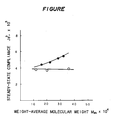
- the styrene-based polymer of the invention obtained in the above described manner contains from 30 to 300 ppm by weight of the moiety derived from the polyfunctional vinyl compound based on the moiety derived from the aromatic monovinyl compound and, as a consequence of the copolymerization with the polyfunctional vinyl compound, the polymer has a branched molecular structure as is evidenced by the graph shown in the figure of the accompanying drawing indicating that the steady-state compliance of the polymer varies depending on the weight-average molecular weight in contrast to conventional general-purpose polystyrenes.
- the curve plotted with filled circles shows the steady-state compliance of the inventive styrene-based polymer obtained by using divinyl benzene as the polyfunctional vinyl compound as a function of the weight-average molecular weight while the curve plotted with open circles indicates that the steady-state compliance of a conventional polystyrene having a linear molecular structure is almost independent on the weigt-average molecular weight.
- the inventive polymer is compounded, if desired, with various kinds of additives conventionally admixed with styrene-based polymers including lubricants, antioxidants, plasticizers, photostabilizers, flame retardants, coloring agents and the like.
- lubricants include stearic acid, behenic acid, stearoamide, methylene bisstearoamide, ethylene bisstearoamide and the like.
- antioxidants examples include 2,6-di-tert-butyl-4-methyl phenol, stearyl- ⁇ -(3,5-di-tert-butyl-4-hydroxy phenyl) propionate, triethylene glycol-bis-3-(3-tert-butyl-4-hydroxy-5-methyl phenyl) propionate and other hindered phenol compounds and tri(2,4-di-tert-butyl phenyl) phosphite, 4,4′-butylidene bis(3-methyl-6-tert-butyl phenyl-di-tridecyl) phosphite and other phosphite compounds.
- Examples of the plasticizer include mineral oils, polyoxyethylene glycols and the like.
- Inversely truncated conical cup-like forms of the polymer each having a diameter of 45 mm at the bottom, height of 55 mm and wall thickness of 0.5 mm were shaped by high-speed molding at a molding temperature of 280 °C in a cycle time of 6 seconds and records were made of the number of shots by which the continuous molding could be performed. Namely, the index of the moldability was given by the number of shots by which the continuous molding of the cup-like forms could be run without interruption due to troubles such as breaking in the runner of the molded article, clogging in the gate, crack formation in demounting from the mold and the like.
- styrene monomer admixed with 80 ppm by weight of 1,1-bis(tert-butylperoxy)-3,3,5-trimethyl cyclohexane as a polymerization initiator, 100 ppm by weight of divinyl benzene and 700 ppm by weight of an antioxidant (Irganox 1076, a product by Ciba Geigy Co.) at a rate of 6 liters per hour to effect copolymerization of styrene and divinyl benzene.
- an antioxidant Irganox 1076, a product by Ciba Geigy Co.
- the polymerization mixture coming out of the first polymerization reactor was introduced successively into a second polymerization reactor of 12 liter capacity and then into a third polymerization reactor of 10 liter capacity where the polymerization reaction was continued to completion at a temperature of 110 ° C to 180 ° C followed by removal of the volatile matter in a vented extruder machine to give a styrene-based copolymer in the form of pellets. No unreacted divinyl benzene could be detected in the pellets.
- the solid content in the polymerization mixture after completion of hte polymerization reaction but before removal of the volatile matter was 94% by weight.
- the volatile matter recovered contained 80 ppm by weight of divinyl benzene based on the styrene monomer so that the content of the divinyl benzene moiety in the pelletized polymer should be 95 ppm by weight by calculation.
- Example 2 The same experimental procedure as in Example 1 was repeated except that the amount of divinyl benzene added to the starting monomer mixture was decreased from 100 to 70 ppm by weight. The content of the divinyl benzene moiety in the resultant polymer was calculated as 66 ppm by weight.
- Table 1 also shows the results of the measurements of several parameters obtained with this polymer.
- Example 2 The same experimental procedure as in Example 1 was repeated except that the amount of divinyl benzene added to the starting monomer mixture was increased from 100 to 130 ppm by weight. The content of the divinyl benzene moiety in the resultant polymer was 123 ppm by weight.
- Table 1 also shows the results of the measurements of several parameters obtained with this polymer.
- Example 2 The same experimental procedure as in Example 1 was repeated except that the amount of divinyl benzene added to the starting monomer mixture was increased from 100 to 170 ppm by weight. The content of the divinyl benzene moiety in the resultant polymer was 161 ppm by weight.
- Table 1 also shows the results of the measurements of several parameters obtained with this polymer.
- the experimental conditions were substantially the same as in Example 1 except that the amount of the polymerization initiator added to the starting monomer mixture was 40 ppm by weight instead of 80 ppm by weight, the monomer mixture was introduced into the first polymerization reactor at a rate of 7 liters per hour instead of 6 liters per hour and the temperature of the first polymerization reactor was 123 ° C instead of 118 ° C. The content of the divinyl benzene moiety in the resultant polymer was 95 ppm by weight.
- Table 1 also shows the results of the measurements of several parameters obtained with this polymer.
- Example 5 The same experimental procedure was repeated as in Example 5 except that 1,1-bis (tert-butylperoxy)-3,3,5-trimethyl cyclohexane as the polymerization initiator was replaced with the same amount of 2,2-bis(4,4-di-tert-butylperoxy cyclohexyl) propane.
- the content of the divinyl benzene moiety in the resultant polymer was 95 ppm by weight.
- Table 1 also shows the results of the measurements of several parameters obtained with this polymer.
- Example 2 The same experimental procedure as in Example 1 was repeated except that divinyl benzene was replaced with the same amount of trimethylolpropane trimethacrylate.
- the content of the trimethylolpropane trimethacrylate moiety in the resultant polymer was 95 ppm by weight.
- Table 1 also shows the results of the measurements of several parameters obtained with this polymer.
- the experimental conditions were substantially the same as in Example 1 except that the starting monomer mixture further contained 5.0% by weight of ethyl benzene and 6.0% by weight of a polybutadiene rubber (Diene NF35A5, a product by Asahi Chemical Industry Co.) based on the styrene monomer, the temperature of the first polymerization reactor was 122 ° C instead of 118 ° C and the monomer mixture was introduced at a rate of 7 liters per hour instead of 6 liters per hour. The content of the divinyl benzene moiety in the polymer was 95 ppm by weight based on the amount of the styrene moiety.
- a polybutadiene rubber (Diene NF35A5, a product by Asahi Chemical Industry Co.)
- Table 1 also shows the results of the measurements of several parameters obtained with this polymer.
- the rubber particles dispersed in the thus prepared composite polymer had an average particle diameter of 2.1 ⁇ m.
- Example 2 The same experimental procedure as in Example 1 was repeated excepting omission of the divinyl benzene in the starting monomer mixture.
- Table 1 also shows the results of the measurements of several parameters obtained with the thus prepared polymer.
- Example 2 The same experimental procedure as in Example 1 was repeated except that the amount of divinyl benzene added to the starting monomer mixture was increased from 100 to 400 ppm by weight. The content of the divinyl benzene moiety in the thus obtained polymer was 379 ppm by weight. This polymer was insoluble and infusible so that the physical parameters could not be determined.
- Example 2 The same experimental procedure as in Example 1 was repeated except that the polymerization initiator in the starting monomer mixture was omitted and the temperature of the first polymerization reactor was 131 ° C instead of 118 ° C. The content of the divinyl benzene moiety in the thus obtained polymer was 95 ppm by weight.
- Table 1 also shows the results of the measurements of several parameters obtained with this polymer.
- the experimental conditions were substantially the same as in Example 1 except that the amount of the polymerization initiator added to the starting monomer mixture was increased from 80 ppm by weight to 600 ppm by weight, the monomer mixture was introduced into the first polymerization reactor at a rate of 10 liters per hour instead of 6 liters per hour and the temperature of the first polymerization reactor was 111 ° C instead of 118 ° C. The content of the divinyl benzene moiety in the resultant polymer was 95 ppm by weight.
- Table 1 also shows the results of the measurements of several parameters obtained with this polymer.
- Example 2 The same experimental procedure as in Example 1 was repeated except that the divinyl benzene and the polymerization initiator in the starting monomer mixture were both omitted and the temperature of the first polymerization reactor was 131 ° C instead of 118 ° C.
- Table 1 also shows the results of the measurements of several parameters obtained with the thus prepared polymer.
- Example 2 The same experimental procedure as in Example 1 was repeated except that the divinyl benzene in the monomer mixture was omitted, the amount of the polymerization initiator added to the monomer mixture was decreased from 80 to ppm by weight and the temperature of the first polymerization reactor was 120 ° C instead of 118 ° C.
- Table 1 also shows the results of the measurements of several parameters obtained with the thus prepared polymer.
- Example 8 The same experimental procedure as in Example 8 was repeated except that the divinyl benzene in the monomer mixture was omitted and the temperature of the first polymerization reactor was 125 ° C instead of 122 ° C.
- Table 1 also shows the results of the measurements of several parameters obtained with the thus prepared polymer.
- the rubber particles dispersed in the thus prepared composite polymer had an average particle diameter of 2.2 ⁇ m.
- Table 1 Weight-average molecular weight M w , ⁇ 104 Ratio of kinematic viscosities MI, g/10 minutes Thermal deformation temperature, °C Impact strength, kg ⁇ cm/cm2 High-speed moldability, number of shots
- Example 1 23 0.05 6.7 90 13.7 1) ⁇ 20 2 17 0.06 18.5 90 11.3 1) ⁇ 20 3 28 0.04 3.1 91 14.6 1) 15 4 33 0.03 2.1 91 15.2 1) 10 5 20 0.05 14.0 90 12.1 1) ⁇ 20 6 25 0.04 5.2 91 13.4 1) 17 7 23 0.06 8.3 90 12.5 1) ⁇ 20 8 21 0.05 2.7 88 12.7 2) ⁇ 20 Comparative Example 1 17 0.10 18.7 88 9.2 1) 1 3 22 0.08 7.1 88 9.6 1) 1 4 13 0.11 24.0 87 7.5 1) 1 5 40 0.09 1.4 88 10.5 1) 1 6 23 0.06 5.8
- the figure of the accompanying drawing is a graphic showing of the steady-state compliance Je0 of styrene-based polymers as a function of the weight-average molecular weight M w in which the curve plotted with filled circles is for the inventive styrene-based polymer prepared by using styrene as the aromatic monovinyl compound and divinyl benzene as the polyfunctional vinyl compound and the curve plotted with open circles is for a conventional general-purpose polystyrene available on the market.
Landscapes
- Chemical & Material Sciences (AREA)
- Health & Medical Sciences (AREA)
- Chemical Kinetics & Catalysis (AREA)
- Medicinal Chemistry (AREA)
- Polymers & Plastics (AREA)
- Organic Chemistry (AREA)
- Addition Polymer Or Copolymer, Post-Treatments, Or Chemical Modifications (AREA)
- Graft Or Block Polymers (AREA)
- Polymerisation Methods In General (AREA)
Applications Claiming Priority (2)
| Application Number | Priority Date | Filing Date | Title |
|---|---|---|---|
| JP2267/89 | 1989-01-09 | ||
| JP1002267A JP2684400B2 (ja) | 1989-01-09 | 1989-01-09 | スチレン系重合体及びその製造方法 |
Publications (4)
| Publication Number | Publication Date |
|---|---|
| EP0379284A2 true EP0379284A2 (fr) | 1990-07-25 |
| EP0379284A3 EP0379284A3 (en) | 1990-12-27 |
| EP0379284B1 EP0379284B1 (fr) | 1993-03-24 |
| EP0379284B2 EP0379284B2 (fr) | 1998-08-26 |
Family
ID=11524596
Family Applications (1)
| Application Number | Title | Priority Date | Filing Date |
|---|---|---|---|
| EP90300166A Expired - Lifetime EP0379284B2 (fr) | 1989-01-09 | 1990-01-08 | Polymères à base de styrène et procédé de leur préparation |
Country Status (7)
| Country | Link |
|---|---|
| US (1) | US5059667A (fr) |
| EP (1) | EP0379284B2 (fr) |
| JP (1) | JP2684400B2 (fr) |
| KR (1) | KR920009617B1 (fr) |
| DE (1) | DE69001136T3 (fr) |
| ES (1) | ES2055312T3 (fr) |
| MY (1) | MY104869A (fr) |
Cited By (1)
| Publication number | Priority date | Publication date | Assignee | Title |
|---|---|---|---|---|
| EP1917305A4 (fr) * | 2005-08-22 | 2010-08-11 | Fina Technology | Mesure et preparation de polymeres vinyliques reticules |
Families Citing this family (15)
| Publication number | Priority date | Publication date | Assignee | Title |
|---|---|---|---|---|
| DE69316126T2 (de) * | 1992-10-01 | 1998-08-13 | Hitachi Chemical Co Ltd | Harz für eine Kunststofflinse |
| CA2115587A1 (fr) * | 1993-02-18 | 1994-08-19 | Hayato Kihara | Copolymeres de styrene, compositions de polystyrene, procedes pour la production de copolymeres de styrene, et articles moules par injection |
| US5455321A (en) * | 1993-12-02 | 1995-10-03 | The Dow Chemical Company | Process for producing high molecular weight monovinylidene aromatic polymers |
| JP3603425B2 (ja) * | 1995-11-10 | 2004-12-22 | 住友化学株式会社 | スチレン系ランダム共重合体およびその製造方法 |
| US6638995B1 (en) * | 1998-11-30 | 2003-10-28 | Flint Ink Corporation | Printing inks |
| US6806301B2 (en) * | 1998-11-30 | 2004-10-19 | Flint Ink Corporation | Lithographic printing inks |
| US6140392A (en) | 1998-11-30 | 2000-10-31 | Flint Ink Corporation | Printing inks |
| US6353066B1 (en) * | 2001-02-09 | 2002-03-05 | Fina Technology, Inc. | Method for producing copolymers in the presence of a chain transfer agent |
| US6840175B2 (en) | 2002-11-20 | 2005-01-11 | Flint Ink Corporation | Lithographic printing method using a single fluid ink |
| EP1613672B1 (fr) * | 2003-04-14 | 2019-06-12 | Akzo Nobel Chemicals International B.V. | Dosage du peroxyde utilise dans un procede de polymerisation en suspension de styrene |
| US6972311B2 (en) * | 2003-05-27 | 2005-12-06 | Fina Technology, Inc. | Optimizing polystyrene in the presence of additives |
| BRPI0416908A (pt) * | 2003-11-26 | 2007-01-16 | Fina Technology | uso de iniciadores tetrafuncionais para aperfeiçoar o volume de fase de borracha de hips |
| US20050256216A1 (en) * | 2004-05-14 | 2005-11-17 | Berti Douglas A | Production of polystyrene for foaming applications using a combination of peroxide initiators |
| KR100749665B1 (ko) * | 2005-12-22 | 2007-08-14 | 제일모직주식회사 | 가공성이 우수한 분지형 스티렌계 열가소성 수지 및 그 제조방법 |
| WO2013069077A1 (fr) * | 2011-11-07 | 2013-05-16 | 新日鉄住金化学株式会社 | Composition de résine à base de styrène comprenant un corps de poids moléculaire très élevé de type très ramifié, et procédé de fabrication de celle-ci |
Family Cites Families (8)
| Publication number | Priority date | Publication date | Assignee | Title |
|---|---|---|---|---|
| NL81841C (fr) * | 1950-12-21 | |||
| US2921932A (en) * | 1954-01-28 | 1960-01-19 | Monsanto Chemicals | High pressure polymerization of styrene |
| US3231544A (en) * | 1962-06-22 | 1966-01-25 | Monsanto Co | Difunctional aromatic hydrocarbon resins |
| JPS4845590A (fr) * | 1971-10-13 | 1973-06-29 | ||
| US4228269A (en) * | 1978-06-08 | 1980-10-14 | Wesley-Jessen Inc. | Contact lenses of high gas permeability |
| JPS55106211A (en) * | 1979-02-09 | 1980-08-14 | Asahi Chem Ind Co Ltd | Porous crosslinked copolymer of chloromethylstyrene and its iminodiacetic acid derivative, and preparation thereof |
| EP0028394A1 (fr) * | 1979-10-31 | 1981-05-13 | The Dow Chemical Company | Polymérisation contrôlée de monomères polymérisables par addition avec de petites quantités de monomères difonctionnels non-conjugués |
| US4692472A (en) * | 1986-05-05 | 1987-09-08 | Atlantic Richfield Company | Divinylbenzene in expandable beads for cup molding |
-
1989
- 1989-01-09 JP JP1002267A patent/JP2684400B2/ja not_active Expired - Fee Related
-
1990
- 1990-01-02 US US07/460,264 patent/US5059667A/en not_active Expired - Lifetime
- 1990-01-04 MY MYPI90000008A patent/MY104869A/en unknown
- 1990-01-08 KR KR1019900000137A patent/KR920009617B1/ko not_active Expired
- 1990-01-08 ES ES90300166T patent/ES2055312T3/es not_active Expired - Lifetime
- 1990-01-08 EP EP90300166A patent/EP0379284B2/fr not_active Expired - Lifetime
- 1990-01-08 DE DE69001136T patent/DE69001136T3/de not_active Expired - Fee Related
Cited By (1)
| Publication number | Priority date | Publication date | Assignee | Title |
|---|---|---|---|---|
| EP1917305A4 (fr) * | 2005-08-22 | 2010-08-11 | Fina Technology | Mesure et preparation de polymeres vinyliques reticules |
Also Published As
| Publication number | Publication date |
|---|---|
| KR900011801A (ko) | 1990-08-02 |
| EP0379284A3 (en) | 1990-12-27 |
| KR920009617B1 (ko) | 1992-10-22 |
| DE69001136D1 (de) | 1993-04-29 |
| JPH02182711A (ja) | 1990-07-17 |
| MY104869A (en) | 1994-06-30 |
| EP0379284B1 (fr) | 1993-03-24 |
| DE69001136T2 (de) | 1993-08-19 |
| EP0379284B2 (fr) | 1998-08-26 |
| DE69001136T3 (de) | 1999-01-21 |
| ES2055312T3 (es) | 1994-08-16 |
| US5059667A (en) | 1991-10-22 |
| JP2684400B2 (ja) | 1997-12-03 |
Similar Documents
| Publication | Publication Date | Title |
|---|---|---|
| EP0716664B1 (fr) | Amelioration apportee au polystyrene modifie par le caoutchouc | |
| US5059667A (en) | Styrene-based polymer and method for the preparation thereof | |
| EP0308916B1 (fr) | Polymère à base de styrène et procédé de leur préparation | |
| HK1004068B (en) | Improved rubber modified polystyrene | |
| US5073447A (en) | Polypropylene-based resin composition | |
| EP0541797B1 (fr) | Copolymere thermoplastique, procede de production de ce copolymere, et resine thermoplastique le comprenant | |
| US6111024A (en) | Process for producing moulding compounds modified with acrylic rubber and moulding compounds thus obtainable | |
| EP0208382B1 (fr) | Polymère styrénique renforcé par du caoutchouc ayant des caractéristiques d'écoulement et de brillant | |
| EP1246857B1 (fr) | Procede pour la preparation d'un polymere abs d'extrusion a proprietes ameliorees | |
| CA1322071C (fr) | Procede de fabrication de resines resistant a la chaleur | |
| CN1160406A (zh) | 非线性苯乙烯类聚合物组合物和由其制备的制品 | |
| JP3289239B2 (ja) | 改良された熱成形及び環境による応力クラック抵抗特性を有する樹脂 | |
| EP0403902B1 (fr) | Composition de résine à base de styrène | |
| KR980009375A (ko) | 내약품성이 우수한 열가소성 수지 조성물 | |
| WO2011025695A1 (fr) | Polymères superchoc, leurs procédés de fabrication et d'utilisation | |
| EP0390508A1 (fr) | Composition de résine à base de styrène | |
| KR100368043B1 (ko) | 연신특성및성형성이우수한스티렌계수지조성물 | |
| JP4834262B2 (ja) | 透明な電子部品包装用成形体 | |
| JP3640698B2 (ja) | 発泡用耐熱スチレン系樹脂 | |
| EP1311569A1 (fr) | Polymeres aromatiques de monovinylidene de poids moleculaire eleve possedant une bonne aptitude au traitement | |
| JPS6225144A (ja) | スチレン系樹脂組成物 | |
| MXPA98008263A (en) | Preparation of molding materials modified with acrylic rubber and molding materials that can be removed from this man |
Legal Events
| Date | Code | Title | Description |
|---|---|---|---|
| PUAI | Public reference made under article 153(3) epc to a published international application that has entered the european phase |
Free format text: ORIGINAL CODE: 0009012 |
|
| AK | Designated contracting states |
Kind code of ref document: A2 Designated state(s): BE CH DE ES FR GB IT LI NL SE |
|
| PUAL | Search report despatched |
Free format text: ORIGINAL CODE: 0009013 |
|
| AK | Designated contracting states |
Kind code of ref document: A3 Designated state(s): BE CH DE ES FR GB IT LI NL SE |
|
| 17P | Request for examination filed |
Effective date: 19901217 |
|
| 17Q | First examination report despatched |
Effective date: 19920427 |
|
| GRAA | (expected) grant |
Free format text: ORIGINAL CODE: 0009210 |
|
| AK | Designated contracting states |
Kind code of ref document: B1 Designated state(s): BE CH DE ES FR GB IT LI NL SE |
|
| PG25 | Lapsed in a contracting state [announced via postgrant information from national office to epo] |
Ref country code: NL Free format text: LAPSE BECAUSE OF FAILURE TO SUBMIT A TRANSLATION OF THE DESCRIPTION OR TO PAY THE FEE WITHIN THE PRESCRIBED TIME-LIMIT Effective date: 19930324 |
|
| ITF | It: translation for a ep patent filed | ||
| REF | Corresponds to: |
Ref document number: 69001136 Country of ref document: DE Date of ref document: 19930429 |
|
| ET | Fr: translation filed | ||
| PLBI | Opposition filed |
Free format text: ORIGINAL CODE: 0009260 |
|
| 26 | Opposition filed |
Opponent name: BASF AKTIENGESELLSCHAFT, LUDWIGSHAFEN Effective date: 19931006 |
|
| NLR1 | Nl: opposition has been filed with the epo |
Opponent name: BASF AG. |
|
| REG | Reference to a national code |
Ref country code: ES Ref legal event code: FG2A Ref document number: 2055312 Country of ref document: ES Kind code of ref document: T3 |
|
| EAL | Se: european patent in force in sweden |
Ref document number: 90300166.7 |
|
| RAP2 | Party data changed (patent owner data changed or rights of a patent transferred) |
Owner name: IDEMITSU PETROCHEMICAL CO., LTD. |
|
| REG | Reference to a national code |
Ref country code: CH Ref legal event code: PFA Free format text: IDEMITSU PETROCHEMICAL COMPANY LIMITED,1-1, 3-CHOME, MARUNOUCHI,CHIYODA-KU/TOKYO (JP) TRANSFER- IDEMITSU PETROCHEMICAL CO., LTD.,6-1, SHIBA 5-CHOME,MINATO-KU, TOKYO (JP) |
|
| NLT2 | Nl: modifications (of names), taken from the european patent patent bulletin |
Owner name: IDEMITSU PETROCHEMICAL CO., LTD. |
|
| PGFP | Annual fee paid to national office [announced via postgrant information from national office to epo] |
Ref country code: SE Payment date: 19970115 Year of fee payment: 8 |
|
| PGFP | Annual fee paid to national office [announced via postgrant information from national office to epo] |
Ref country code: CH Payment date: 19970120 Year of fee payment: 8 |
|
| PGFP | Annual fee paid to national office [announced via postgrant information from national office to epo] |
Ref country code: ES Payment date: 19970124 Year of fee payment: 8 |
|
| PLAW | Interlocutory decision in opposition |
Free format text: ORIGINAL CODE: EPIDOS IDOP |
|
| PG25 | Lapsed in a contracting state [announced via postgrant information from national office to epo] |
Ref country code: SE Free format text: LAPSE BECAUSE OF NON-PAYMENT OF DUE FEES Effective date: 19980109 Ref country code: ES Free format text: LAPSE BECAUSE OF NON-PAYMENT OF DUE FEES Effective date: 19980109 |
|
| PGFP | Annual fee paid to national office [announced via postgrant information from national office to epo] |
Ref country code: NL Payment date: 19980128 Year of fee payment: 9 |
|
| PG25 | Lapsed in a contracting state [announced via postgrant information from national office to epo] |
Ref country code: LI Free format text: LAPSE BECAUSE OF NON-PAYMENT OF DUE FEES Effective date: 19980131 Ref country code: CH Free format text: LAPSE BECAUSE OF NON-PAYMENT OF DUE FEES Effective date: 19980131 |
|
| PLAW | Interlocutory decision in opposition |
Free format text: ORIGINAL CODE: EPIDOS IDOP |
|
| PUAH | Patent maintained in amended form |
Free format text: ORIGINAL CODE: 0009272 |
|
| STAA | Information on the status of an ep patent application or granted ep patent |
Free format text: STATUS: PATENT MAINTAINED AS AMENDED |
|
| 27A | Patent maintained in amended form |
Effective date: 19980826 |
|
| AK | Designated contracting states |
Kind code of ref document: B2 Designated state(s): BE CH DE ES FR GB IT LI NL SE |
|
| REG | Reference to a national code |
Ref country code: CH Ref legal event code: PL Ref country code: CH Ref legal event code: AEN Free format text: MAINTIEN DU BREVET DONT L'ETENDUE A ETE MODIFIEE |
|
| EUG | Se: european patent has lapsed |
Ref document number: 90300166.7 |
|
| NLR2 | Nl: decision of opposition | ||
| ET3 | Fr: translation filed ** decision concerning opposition | ||
| NLV1 | Nl: lapsed or annulled due to failure to fulfill the requirements of art. 29p and 29m of the patents act | ||
| REG | Reference to a national code |
Ref country code: ES Ref legal event code: FD2A Effective date: 20000503 |
|
| REG | Reference to a national code |
Ref country code: GB Ref legal event code: IF02 |
|
| PGFP | Annual fee paid to national office [announced via postgrant information from national office to epo] |
Ref country code: GB Payment date: 20030108 Year of fee payment: 14 |
|
| PGFP | Annual fee paid to national office [announced via postgrant information from national office to epo] |
Ref country code: FR Payment date: 20030110 Year of fee payment: 14 |
|
| PGFP | Annual fee paid to national office [announced via postgrant information from national office to epo] |
Ref country code: BE Payment date: 20030312 Year of fee payment: 14 |
|
| PG25 | Lapsed in a contracting state [announced via postgrant information from national office to epo] |
Ref country code: GB Free format text: LAPSE BECAUSE OF NON-PAYMENT OF DUE FEES Effective date: 20040108 |
|
| PGFP | Annual fee paid to national office [announced via postgrant information from national office to epo] |
Ref country code: DE Payment date: 20040115 Year of fee payment: 15 |
|
| PG25 | Lapsed in a contracting state [announced via postgrant information from national office to epo] |
Ref country code: BE Free format text: LAPSE BECAUSE OF NON-PAYMENT OF DUE FEES Effective date: 20040131 |
|
| BERE | Be: lapsed |
Owner name: *IDEMITSU PETROCHEMICAL CO. LTD Effective date: 20040131 |
|
| GBPC | Gb: european patent ceased through non-payment of renewal fee |
Effective date: 20040108 |
|
| PG25 | Lapsed in a contracting state [announced via postgrant information from national office to epo] |
Ref country code: FR Free format text: LAPSE BECAUSE OF NON-PAYMENT OF DUE FEES Effective date: 20040930 |
|
| REG | Reference to a national code |
Ref country code: FR Ref legal event code: ST |
|
| PG25 | Lapsed in a contracting state [announced via postgrant information from national office to epo] |
Ref country code: IT Free format text: LAPSE BECAUSE OF NON-PAYMENT OF DUE FEES;WARNING: LAPSES OF ITALIAN PATENTS WITH EFFECTIVE DATE BEFORE 2007 MAY HAVE OCCURRED AT ANY TIME BEFORE 2007. THE CORRECT EFFECTIVE DATE MAY BE DIFFERENT FROM THE ONE RECORDED. Effective date: 20050108 |
|
| REG | Reference to a national code |
Ref country code: FR Ref legal event code: TP |
|
| PG25 | Lapsed in a contracting state [announced via postgrant information from national office to epo] |
Ref country code: DE Free format text: LAPSE BECAUSE OF NON-PAYMENT OF DUE FEES Effective date: 20050802 |