EP0379323B1 - Fabrication d'isopropanol - Google Patents
Fabrication d'isopropanol Download PDFInfo
- Publication number
- EP0379323B1 EP0379323B1 EP90300403A EP90300403A EP0379323B1 EP 0379323 B1 EP0379323 B1 EP 0379323B1 EP 90300403 A EP90300403 A EP 90300403A EP 90300403 A EP90300403 A EP 90300403A EP 0379323 B1 EP0379323 B1 EP 0379323B1
- Authority
- EP
- European Patent Office
- Prior art keywords
- acetone
- liquid
- isopropanol
- gas
- reactor
- Prior art date
- Legal status (The legal status is an assumption and is not a legal conclusion. Google has not performed a legal analysis and makes no representation as to the accuracy of the status listed.)
- Expired - Lifetime
Links
Images
Classifications
-
- C—CHEMISTRY; METALLURGY
- C07—ORGANIC CHEMISTRY
- C07C—ACYCLIC OR CARBOCYCLIC COMPOUNDS
- C07C31/00—Saturated compounds having hydroxy or O-metal groups bound to acyclic carbon atoms
- C07C31/02—Monohydroxylic acyclic alcohols
- C07C31/10—Monohydroxylic acyclic alcohols containing three carbon atoms
-
- B—PERFORMING OPERATIONS; TRANSPORTING
- B01—PHYSICAL OR CHEMICAL PROCESSES OR APPARATUS IN GENERAL
- B01J—CHEMICAL OR PHYSICAL PROCESSES, e.g. CATALYSIS OR COLLOID CHEMISTRY; THEIR RELEVANT APPARATUS
- B01J8/00—Chemical or physical processes in general, conducted in the presence of fluids and solid particles; Apparatus for such processes
- B01J8/02—Chemical or physical processes in general, conducted in the presence of fluids and solid particles; Apparatus for such processes with stationary particles, e.g. in fixed beds
- B01J8/0242—Chemical or physical processes in general, conducted in the presence of fluids and solid particles; Apparatus for such processes with stationary particles, e.g. in fixed beds the fluid flow within the bed being predominantly vertical
- B01J8/025—Chemical or physical processes in general, conducted in the presence of fluids and solid particles; Apparatus for such processes with stationary particles, e.g. in fixed beds the fluid flow within the bed being predominantly vertical in a cylindrical shaped bed
-
- C—CHEMISTRY; METALLURGY
- C07—ORGANIC CHEMISTRY
- C07C—ACYCLIC OR CARBOCYCLIC COMPOUNDS
- C07C29/00—Preparation of compounds having hydroxy or O-metal groups bound to a carbon atom not belonging to a six-membered aromatic ring
- C07C29/132—Preparation of compounds having hydroxy or O-metal groups bound to a carbon atom not belonging to a six-membered aromatic ring by reduction of an oxygen containing functional group
- C07C29/136—Preparation of compounds having hydroxy or O-metal groups bound to a carbon atom not belonging to a six-membered aromatic ring by reduction of an oxygen containing functional group of >C=O containing groups, e.g. —COOH
- C07C29/143—Preparation of compounds having hydroxy or O-metal groups bound to a carbon atom not belonging to a six-membered aromatic ring by reduction of an oxygen containing functional group of >C=O containing groups, e.g. —COOH of ketones
- C07C29/145—Preparation of compounds having hydroxy or O-metal groups bound to a carbon atom not belonging to a six-membered aromatic ring by reduction of an oxygen containing functional group of >C=O containing groups, e.g. —COOH of ketones with hydrogen or hydrogen-containing gases
Definitions
- This invention relates to the preparation of isopropanol which is a very useful intermediate in organic synthesis as well as a commercially important solvent.
- JP-A-62-12729 describes a process for preparing isopropanol from acetone using a powdery Raney nickel catalyst. Powdery catalysts are most appropriate for use in batch or semi-batch reactions, and are not always suitable for continuous reactions.
- JP-A-62-77338 relates to an isopropanol production apparatus in which the hydrogenation of acetone is performed within a heat exchange reactor and the catalyst is carried by the heat transmission fin of a heat exchange tube. Acetone is supplied as a vapour and the hydrogenation reaction takes place in the vapour phase.
- Acetone is now produced in great amounts as a by-product in the manufacture of phenol by the cumene process.
- the acetone is surplus to industrial requirements and this is a drawback of the cumene process.
- acetone has found a major use as a starting material to produce methyl methacrylate, the demand for acetone is reduced by the recent changeover of the starting material to produce methyl methacrylate to another material. It has thus become necessary to ensure the economy of the cumene process to produce phenol by making efficient use of the surplus acetone by-product.
- One possible approach is to convert acetone into isopropanol which is of great industrial value. This approach will aid in establishing the economy of the cumene process to produce phenol.
- EP-A-371738 which is prior art by virtue of the provisions of Article 54(3) and (4) EPC, describes the preparation of phenol from cumene synthesized by the alkylation of benzene with isopropanol. It describes how the isopropanol can be prepared by the catalytic hydrogenation of acetone, and contemplates the use of a reaction having a fixed catalyst bed operated as a trickle bed by cocurrent gas/liquid downflows.
- the present invention seeks to provide an industrial process for preparing isopropanol from acetone.
- the present invention provides a process for preparing isopropanol by catalytic hydrogenation of acetone, characterised by feeding hydrogen gas and acetone liquid into a reactor having a fixed catalyst bed from its top to form a cocurrent gas/liquid downflow while maintaining the catalyst bed in a trickle bed state, wherein the hydrogen gas and the acetone liquid are fed (i) in a molar ratio which satisfies the equation: wherein B is moles of hydrogen, A is moles of acetone, and ⁇ is a percent conversion of acetone and (ii) at a superficial mass velocity which satisfies the equations: log( L G ⁇ ) ⁇ -1.35log( G ⁇ ) + log11.6 (4) 0.01 ⁇ ( G ⁇ ) ⁇ 2.0 (5) wherein G is the superficial mass velocity of hydrogen gas in kg/m2s, L is the superficial mass velocity of acetone liquid in kg/m2s, ⁇ G is a density of hydrogen gas in g/cm3, ⁇
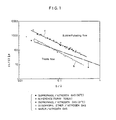
- Fig. 1 is a diagram showing gas-liquid flow regimes.
- Raney nickel catalysts are most often used.
- Other catalysts known for hydrogenation may also be used, for example, copper base catalysts such as copper-chromium, Raney copper, and copper-zinc; nickel base catalysts such as reduced nickel catalysts prepared by carrying nickel oxide on a diatomaceous earth, alumina or silica support and tailoring it through a reducing treatment; and platinum group catalysts such as platinum, palladium, ruthenium, and rhodium as well as the foregoing catalysts on activated carbon and alumina supports.
- Reaction may preferably be effected at a temperature of from room temperature to 200°C although an industrial reaction rate is achieved at a reaction temperature of from 35 to 150°C. Too high a reaction temperture will induce excess hydrogenation decomposition of acetone, resulting in reduced yields of isopropanol.
- the reaction pressure may be in the range of from atmospheric pressure to 80 kg/cm2, more preferably from 2 to 50 kg/cm2.
- hydrogen gas and acetone reactant are preferably fed in such a proportion that 1.0 to 10 mol, more preferably 1.2 to 5 mol of hydrogen is present per mole of acetone.
- the hydrogenation may be effected in the presence or absence of a reaction medium.
- the solvent if used, may be selected from alcohols such as methanol, ethanol, propanol, and butanol. Isopropanol which is a hydrogenation product of acetone is also a useful solvent. Also useful are ethylene glycol, propylene glycol, diethylene glycol and triethylene glycol.
- ethers such as diisopropyl ether, dibutyl ether, ethylene glycol dimethyl ether, diglyme and triglyme
- aprotic polar solvents such as dimethylformamide, dimethylacetamide, acetonitrile and dimethylsulfoxide
- saturated hydrocarbons such as hexane, heptane, cyclopentane and cyclohexane.
- Water is also a useful solvent for the hydrogenation of the invention.
- the direction of reactant liquid and hydrogen gas flows and the state of the catalyst are critical. It is critical to provide a cocurrent liquid/gas downflow relative to the fixed bed catalyst and to maintain the catalyst bed in a trickle bed state.
- trickle bed state it is meant that the reactant liquid trickles along the surface of the catalyst which is packed in an atmosphere full of hydrogen gas. Therefore, no significant movement will be observed in appearance in the catalyst bed, as if standing still in spite of the presence of liquid/gas flow.
- Reaction in a trickle bed state is effective for gas-liquid-solid related reaction, particularly such reaction in which gas largely participates.
- the present hydrogenation is a reaction in which hydrogen molecules adsorbed onto the catalyst react with acetone to form isopropanol, location of the catalyst in a hydrogen gas atmosphere facilitates adsorption of hydrogen molecules to the catalyst.
- hydrogen molecules are once dissolved in the reactant liquid and then adsorbed to the catalyst so that the rate of adsorption of hydrogen to the catalyst is slower than in the trickle bed state.
- the magnitude of hydrogen adsorption rate does not largely affect the overall reaction rate of a process in which hydrogenation is slow, the hydrogen adsorption rate has a critical influence on the present hydrogenation process.
- the present hydrogenation reaction must be conducted in a trickle bed state in order to achieve the objects of the invention.
- FIG. 1 shows the results of visual observation of flow for gas/liquid systems through a packed bed wherein the flow velocity of a gas/liquid downflow is varied.
- Line a in FIG. 1 is a flow map depicted as FIG. 6 in Guray Tosun "A Study of Cocurrent Downflow of Nonfoaming Gas-Liquid Systems in a Packed Bed," Ind. Eng. Chem. Process Des. Dev., Vol. 23, No. 1 (1984), pages 29-35.
- Lines b and c in FIG. 1 are the flow map to show the results obtained in the following experiments by the present invention.
- the boundary between trickle flow and bubble flow is depicted by a line marked " a .”
- the gas and liquid feeds are chosen so as to fall in the range in FIG. 1 defined by the following relationships.
- G is a superficial mass velocity of hydrogen gas in kg/m2s
- L is a superficial mass velocity of acetone liquid in kg/m2s
- ⁇ G is a density of hydrogen gas in g/cm3
- ⁇ L is a density of isopropanol liquid in g/cm3
- ⁇ w is a density of water in g/cm3
- ⁇ air is a density of air in g/cm3
- ⁇ w is a surface tension of water in dyn/cm
- ⁇ L is a surface tension of isopropanol liquid in dyn/cm
- » L is a viscosity of isopropanol liquid in centipoise
- » w is a viscosity of water in centipoise.
- the gas superficial mass velocity used herein is the amount of gas supplied into a packed bed catalyst through the upper side of a reaction column containing the catalyst, and this gas flow rate (l/hr) measured by using a gas flowmeter is then converted to a value of mass velocity per unit cross section area of the reaction column (kg/m2 ⁇ sec).
- Liquid superficial mass velocity is calculated in the same manner based on the liquid flow rate.
- line b shown in Fig. 1 is obtained as the boundary between trickle flow and bubble flow when a water/nitrogen gas system is used as the gas/liquid downflow system in the experiments.
- the line b coincides closely with the line a described by Guray Tosun.
- a stainless steel vertical reactor column having an inner diameter of 25.4 mm (1 inch) and a length of 500 mm was loaded at a mid-portion with 100 grams (50 ml) of a lumpy (beads with length 6-7 mm and breadth 4-5 mm) Raney nickel alloy (50/50 Ni/Al, R-20L manufactured by Nikko Rika K.K.).
- the reactor was filled with water.
- the Raney nickel catalyst was then developed by gradually pumping 1280 grams of an aqueous sodium hydroxide developer into the reactor from its bottom, the developer being prepared by dissolving 128 grams of sodium hydroxide in water and adjusting to a concentration of 10% by weight.
- the catalyst development was accompanied by an exothermic reaction so that the temperature of the reactor interior rose.
- the feed rate of the sodium hydroxide developer was adjusted and the reactor was temperature controlled by air cooling or the like so that the interior temperature did not exceed 50°C.
- the used developer exiting from the reactor top was fed back to the mother sodium hydroxide developer for recycle use.
- the amount of hydrogen gas given off with the progress of development was measured by a gas meter.
- Pumping of the alkaline developer was continued until a substantial cessation of hydrogen gas emission (approximately 20 hours).
- the total amount of hydrogen gas emission indicated that the rate of development of the catalyst was 50%.
- the pump feed was replaced by water to wash the reactor interior with water. Water washing was continued until the outflow from the reactor became neutral.
- the pump feed was replaced by isopropanol to purge the reactor interior with isopropanol.
- Heating of the reactor was started.
- reaction was started by feeding 39.5 gram/hour of acetone and 37.2 liter/hour of hydrogen into the reactor from the top.
- a pressure of 20 kgf/cm2 was maintained in the reactor.
- the reaction mixture exiting from the reactor bottom was separated into the reaction solution and hydrogen gas by a gas/liquid separator. There were discharged 39.8 gram/hour of reaction solution and 16.4 liter/hour of exhausted hydrogen gas.
- Example 1 The procedure of Example 1 was repeated except that the flow rates of acetone and hydrogen were changed to 78.7 gram/hour and 64.4 liter/hour, respectively.
- Example 1 The procedure of Example 1 was repeated except that acetone and hydrogen were introduced into the reactor from the bottom. The results included an acetone conversion of 88.6% and an isopropanol yield of 88.6%.
- Example 1 The procedure of Example 1 was repeated except that the reaction temperature was lowered to 80°C. The results included an acetone conversion of 99.7% and an isopropanol yield of 99.7%.
- Example 1 The procedure of Example 1 was repeated except that the reaction pressure was changed to 15 kgf/cm2. The results included an acetone conversion of 98.6% and an isopropanol yield of 98.6%.
- Example 2 The procedure of Example 1 was repeated except that the reaction pressure was changed to 10 kgf/cm2. The results included an acetone conversion of 95.2% and an isopropanol yield of 95.2%.
- a stainless steel vertical reactor column having an inner diameter of 25.4 mm (1 inch) and a length of 1,100 mm was loaded at a mid-portion with 200 ml of a lumpy Raney nickel catalyst (beads with length 6-7 mm and breadth 4-5 mm, rate of development 60%).
- the reactor was filled with isopropanol.
- the temperature of the reactor interior was raised by passing warm water at 70°C through a reactor jacket.
- acetone, isopropanol and hydrogen were introduced into the reactor from its top through respective inlet tubes connected thereto.
- the flow rates of acetone, isopropanol and hydrogen were adjusted to 400 ml/hour, 400 ml/hour and 247 liter(standard state)/hour, respectively.
- the reactor interior temperature rose to 85°C after the start of hydrogenation while the warm water through the reactor jacket was maintained at 70°C at the inlet.
- the reaction product and excess hydrogen gas exited the reactor at the bottom outlet. While the reactor interior pressure was maintained at 20 kg/cm2 by means of a pressure regulator valve at the bottom outlet, the gas/liquid mixture was taken out of the reactor and introduced into a reservoir where the excess hydrogen was separated from the reaction product. A portion of the reaction product was separated and recycled as a substitute for the isopropanol feed to the reactor.
- a stainless steel vertical reactor column having an inner diameter of 38.4 mm and a length of 4,800 mm was loaded with 2,500 ml of the same lumpy Raney nickel catalyst as used in Example 6.
- the reactor was filled with isopropanol.
- the reactor at the top had inlet ports for the reactant and hydrogen.
- a pressure gauge was provided for measuring the differential pressure between the top and the bottom of the reactor.
- the reactor at the bottom had an outlet port in flow communication with a reservoir for the reaction mixture. The reservoir was adapted to separate excess hydrogen gas from the reaction solution.
- the reaction solution was divided into two portions. The first portion was taken out of the reaction system as a product. The second portion was fed back by means of a recycle pump to the reactor top where it was combined with acetone to form a feed mixture for reaction. In a line for recycling the reaction solution second portion was provided a heat exchanger. The reactor interior temperature was then maintained at a predetermined temperature by controlling the jacket temperature of the heat exchanger.
- the isopropanol in the reactor was started to flow along with the pumped flow from the recycle line and at the same time, feeding of hydrogen gas was started. Feeding of acetone was also started through an acetone feed line connected to the inlet port of the reactor.
- reaction conditions were set: acetone feed 3 liter/hour, reaction solution recycle feed 24 liter/hour, and hydrogen feed 1850 liter(standard state)/hour.
- the reactant preheated to 77°C was fed along with hydrogen gas while maintaining a reactor interior pressure of 18 kg/cm2. There was discharged a reaction mixture at 113°C from the outlet of the reactor. After the reaction conditions became stable, the reaction product was analyzed, finding an acetone conversion of 99.8% and an isopropanol selectivity of 99.9%.
- the differential pressure between the top and the bottom of the reactor was always maintained at 120 mm in water manometer.
- Example 7 The procedure of Example 7 was repeated except that the reaction conditions were set: acetone feed 6 liter/hour, reaction solution recycle feed 48 liter/hour, and hydrogen feed 3710 N-liter/hour.
- the differential pressure between the top and the bottom of the reactor was 550 mm in water column with drastic fluctuations of ⁇ 10 mm.
- reaction product discharge from the reactor showed a drastic pulsating flow synchronous with the fluctuations of differential pressure across the reactor.
- the concentration of acetone remaining in the reaction product also varied and as a result, the acetone conversion varied between 93.4% and 94.7%.
- the process of the invention can produce isopropanol from acetone in a simplified reactor without a need for careful operation and cumbersome catalyst separation.
- the present process is of great industrial value since isopropanol can be produced at a high reaction rate in high yields.
Landscapes
- Chemical & Material Sciences (AREA)
- Organic Chemistry (AREA)
- Physics & Mathematics (AREA)
- Fluid Mechanics (AREA)
- Chemical Kinetics & Catalysis (AREA)
- Organic Low-Molecular-Weight Compounds And Preparation Thereof (AREA)
- Low-Molecular Organic Synthesis Reactions Using Catalysts (AREA)
- Catalysts (AREA)
Claims (3)
- Procédé de préparation de l'isopropanol par hydrogénation catalytique de l'acétone, caractérisé en ce que l'on introduit dans un réacteur ayant un lit de catalyseur fixe, par son sommet, de l'hydrogène gazeux et de l'acétone liquide, de façon à former un cocourant de gaz et de liquide s'écoulant vers le bas, tout en maintenant le lit de catalyseur dans un état de lit à ruissellement, l'hydrogène gazeux et l'acétone liquide étant introduits (i) suivant un rapport molaire qui satisfait à l'équation :


dans lesquelles G désigne le débit en masse par unité de surface de l'hydrogène gazeux, en kg/m².s,
L désigne le débit en masse par unité de surface de l'acétone liquide, en kg/m².s, ρG désigne la masse volumique de l'hydrogène gazeux en g/cm³,ρL désigne la masse volumique de l'isopropanol liquide en g/cm³,ρw désigne la masse volumique de l'eau en g/cm³,ρair désigne la masse volumique de l'air en g/cm³,σw désigne la tension superficielle de l'eau en dyn/cm,σL désigne la tension superficielle de l'isopropanol liquide en dyn/cm,»L désigne la viscosité de l'isopropanol liquide en centipoises, et»w désigne la viscosité de l'eau en centipoises.
 - Procédé selon la revendication 1, dans lequel ledit catalyseur est un catalyseur à base de nickel de Raney.
- Procédé selon la revendication 1 ou 2, dans lequel :

Applications Claiming Priority (4)
| Application Number | Priority Date | Filing Date | Title |
|---|---|---|---|
| JP804489 | 1989-01-17 | ||
| JP8044/89 | 1989-01-17 | ||
| JP279059/89 | 1989-10-26 | ||
| JP1279059A JP2724001B2 (ja) | 1989-01-17 | 1989-10-26 | イソプロパノールの製造方法 |
Publications (3)
| Publication Number | Publication Date |
|---|---|
| EP0379323A2 EP0379323A2 (fr) | 1990-07-25 |
| EP0379323A3 EP0379323A3 (fr) | 1991-07-17 |
| EP0379323B1 true EP0379323B1 (fr) | 1995-03-22 |
Family
ID=26342466
Family Applications (1)
| Application Number | Title | Priority Date | Filing Date |
|---|---|---|---|
| EP90300403A Expired - Lifetime EP0379323B1 (fr) | 1989-01-17 | 1990-01-15 | Fabrication d'isopropanol |
Country Status (9)
| Country | Link |
|---|---|
| US (1) | US5081321A (fr) |
| EP (1) | EP0379323B1 (fr) |
| JP (1) | JP2724001B2 (fr) |
| KR (1) | KR920001787B1 (fr) |
| AT (1) | ATE120168T1 (fr) |
| CA (1) | CA2007813C (fr) |
| DE (1) | DE69017924T2 (fr) |
| ES (1) | ES2072972T3 (fr) |
| MY (1) | MY105181A (fr) |
Cited By (1)
| Publication number | Priority date | Publication date | Assignee | Title |
|---|---|---|---|---|
| US7799958B2 (en) | 2007-10-04 | 2010-09-21 | Barclays Bank Plc | Process for the production of iso-propanol by liquid phase hydrogenation |
Families Citing this family (35)
| Publication number | Priority date | Publication date | Assignee | Title |
|---|---|---|---|---|
| JP2526404B2 (ja) * | 1993-10-15 | 1996-08-21 | 工業技術院長 | 触媒反応方法 |
| US5430198A (en) * | 1993-11-08 | 1995-07-04 | Texaco Chemical Inc. | Diisopropyl ehter/MTBE cogeneration from crude by-product acetone |
| US5449838A (en) * | 1993-12-30 | 1995-09-12 | Texaco Chemical Inc. | Isopropyl t-butyl ether (IPTBE) generation from crude acetone |
| US5583266A (en) * | 1994-05-02 | 1996-12-10 | Texaco Inc. | Integrated process for the production of isopropyl alcohol and diisopropyl ethers |
| DE19933691A1 (de) * | 1999-07-17 | 2001-01-18 | Phenolchemie Gmbh & Co Kg | Verfahren zur Hydrierung von Aceton |
| US6888035B2 (en) | 2000-09-25 | 2005-05-03 | Exxonmobil Chemical Patents Inc. | Hydrogenation of cleavage effluents in phenol production |
| JP4754058B2 (ja) * | 2000-10-16 | 2011-08-24 | 三井化学株式会社 | イソプロピルアルコールの製造方法 |
| US6774275B2 (en) * | 2001-08-21 | 2004-08-10 | Catalytic Distillation Technologies | Pulse flow reaction |
| TWI301480B (en) * | 2001-11-16 | 2008-10-01 | Shell Int Research | Process for the hydrogenation of acetone |
| RU2205818C1 (ru) * | 2002-04-26 | 2003-06-10 | Закрытое акционерное общество "Химтэк Инжиниринг" | Способ получения изопропанола |
| US7131446B2 (en) * | 2004-03-25 | 2006-11-07 | Tang Kenneth Y | Light-triggered tattoo process |
| US7208646B2 (en) * | 2004-05-14 | 2007-04-24 | Catalytic Distillation Technologies | Selective hydrogenation of butadiene |
| US7422904B2 (en) * | 2005-02-04 | 2008-09-09 | Exxonmobil Chemical Patents Inc. | Method of operating a fixed bed reactor under predetermined hydraulic conditions |
| US7041857B1 (en) * | 2005-09-07 | 2006-05-09 | Air Products And Chemicals, Inc. | Hydrogenation of acetone |
| US7619118B2 (en) | 2006-06-07 | 2009-11-17 | The Procter & Gamble Company | Process for the conversion of glycerol to propylene glycol and amino alcohols |
| US7619119B2 (en) * | 2006-06-07 | 2009-11-17 | The Procter & Gamble Company | Processes for converting glycerol to amino alcohols |
| EP2024320A1 (fr) * | 2006-06-07 | 2009-02-18 | The Procter and Gamble Company | Procédé pour la conversion alternative de glycérol en propylèneglycol ou en aminoalcools |
| JP5058265B2 (ja) | 2007-09-19 | 2012-10-24 | 三井化学株式会社 | アルコールの製造方法および酸処理ラネー触媒 |
| EP2243762B1 (fr) * | 2008-02-21 | 2017-07-19 | Mitsui Chemicals, Inc. | Procédé de fabrication de 2-propanol |
| WO2009150973A1 (fr) | 2008-06-10 | 2009-12-17 | 三井化学株式会社 | Procédé de fabrication d’un composé aromatique alkylé et procédé de fabrication de phénol |
| TWI458695B (zh) * | 2008-10-06 | 2014-11-01 | Badger Licensing Llc | 異丙苯的製造方法 |
| CN102171168A (zh) * | 2008-10-06 | 2011-08-31 | 巴杰许可有限责任公司 | 生产枯烯的方法 |
| ITMI20111143A1 (it) | 2011-06-23 | 2012-12-24 | Polimeri Europa Spa | Procedimento per l'alchilazione di idrocarburi aromatici con alcoli c1-c8 |
| US20130035517A1 (en) * | 2011-08-03 | 2013-02-07 | Celanese International Corporation | Production of alcohols |
| JP2015166315A (ja) * | 2012-06-27 | 2015-09-24 | 三井化学株式会社 | イソプロパノールの製造方法 |
| US8926718B2 (en) | 2013-03-15 | 2015-01-06 | Celanese International Corporation | Thermochemically produced ethanol compositions |
| CN104355965A (zh) * | 2014-11-19 | 2015-02-18 | 岳阳市中顺化工有限责任公司 | 一种二异丁基甲醇的制备方法 |
| CN113149883B (zh) | 2015-06-30 | 2024-04-02 | 武田药品工业株式会社 | 制备吡咯化合物的方法 |
| WO2018004992A1 (fr) | 2016-07-01 | 2018-01-04 | Res Usa, Llc | Conversion de méthane en diméthyléther |
| US9938217B2 (en) | 2016-07-01 | 2018-04-10 | Res Usa, Llc | Fluidized bed membrane reactor |
| WO2018004993A1 (fr) | 2016-07-01 | 2018-01-04 | Res Usa, Llc | Réduction des émissions de gaz à effet de serre |
| CN111215077A (zh) * | 2020-02-19 | 2020-06-02 | 山东京博石油化工有限公司 | 一种用于合成异丙醇的催化剂及其制备方法和应用 |
| FR3111916B1 (fr) | 2020-06-29 | 2022-07-15 | Ifp Energies Now | Valorisation de l’acetone par procede de fermentation ibe impliquant des microorganismes genetiquement modifies |
| FR3111914B1 (fr) | 2020-06-29 | 2022-07-15 | Ifp Energies Now | Procede de fermentation ibe optimise pour valoriser l’acetone |
| IT202200025110A1 (it) | 2022-12-06 | 2024-06-06 | Versalis Spa | Procedimento per la preparazione di isopropanolo in alte rese e con un elevato grado di purezza. |
Citations (1)
| Publication number | Priority date | Publication date | Assignee | Title |
|---|---|---|---|---|
| EP0371738A2 (fr) * | 1988-11-28 | 1990-06-06 | Mitsui Petrochemical Industries, Ltd. | Préparation de phénol en passant par le cumène |
Family Cites Families (10)
| Publication number | Priority date | Publication date | Assignee | Title |
|---|---|---|---|---|
| GB1002372A (en) * | 1961-04-25 | 1965-08-25 | Chisso Corp | Process for continuously hydrogenating higher aldehydes in liquid phase |
| GB1183637A (en) * | 1966-06-25 | 1970-03-11 | Basf Ag | Production of Saturated Alcohols by Hydrogenation of Aldehydes or Ketones. |
| GB1182797A (en) * | 1967-11-01 | 1970-03-04 | B P Chemicals U K Ltd | Hydrogenation of Carbonyl Compounds. |
| BE754868A (fr) * | 1969-08-16 | 1971-02-15 | Basf Ag | Procede pour la mise en oeuvre de reactions exothermiques entreun gaz et un liquide |
| BE756877A (fr) * | 1969-09-30 | 1971-03-30 | Basf Ag | Procede de preparation du 2-ethylhexanol |
| DE2257673B1 (de) * | 1972-11-24 | 1974-03-28 | Verfahren zur herstellung von aliphatischen alkoholen | |
| US4361705A (en) * | 1981-06-29 | 1982-11-30 | Gulf Research & Development Company | Process for hydrogenating unsaturated compounds |
| JPS6212729A (ja) * | 1985-07-11 | 1987-01-21 | Mitsui Petrochem Ind Ltd | イソプロピルアルコ−ルの製造法 |
| JPH0692334B2 (ja) * | 1985-09-30 | 1994-11-16 | 石川島播磨重工業株式会社 | イソプロパノ−ルの製造装置 |
| US4843359A (en) * | 1988-04-11 | 1989-06-27 | General Electric Company | Molded case circuit breaker handle for automated assembly |
-
1989
- 1989-10-26 JP JP1279059A patent/JP2724001B2/ja not_active Expired - Lifetime
-
1990
- 1990-01-12 US US07/464,315 patent/US5081321A/en not_active Expired - Lifetime
- 1990-01-15 MY MYPI90000058A patent/MY105181A/en unknown
- 1990-01-15 EP EP90300403A patent/EP0379323B1/fr not_active Expired - Lifetime
- 1990-01-15 AT AT90300403T patent/ATE120168T1/de not_active IP Right Cessation
- 1990-01-15 DE DE69017924T patent/DE69017924T2/de not_active Expired - Lifetime
- 1990-01-15 ES ES90300403T patent/ES2072972T3/es not_active Expired - Lifetime
- 1990-01-16 CA CA002007813A patent/CA2007813C/fr not_active Expired - Lifetime
- 1990-01-17 KR KR1019900000491A patent/KR920001787B1/ko not_active Expired
Patent Citations (1)
| Publication number | Priority date | Publication date | Assignee | Title |
|---|---|---|---|---|
| EP0371738A2 (fr) * | 1988-11-28 | 1990-06-06 | Mitsui Petrochemical Industries, Ltd. | Préparation de phénol en passant par le cumène |
Cited By (1)
| Publication number | Priority date | Publication date | Assignee | Title |
|---|---|---|---|---|
| US7799958B2 (en) | 2007-10-04 | 2010-09-21 | Barclays Bank Plc | Process for the production of iso-propanol by liquid phase hydrogenation |
Also Published As
| Publication number | Publication date |
|---|---|
| CA2007813A1 (fr) | 1990-07-17 |
| MY105181A (en) | 1994-08-30 |
| ATE120168T1 (de) | 1995-04-15 |
| JP2724001B2 (ja) | 1998-03-09 |
| EP0379323A2 (fr) | 1990-07-25 |
| US5081321A (en) | 1992-01-14 |
| CA2007813C (fr) | 1997-11-11 |
| DE69017924T2 (de) | 1995-08-03 |
| EP0379323A3 (fr) | 1991-07-17 |
| KR920001787B1 (ko) | 1992-03-02 |
| JPH02270829A (ja) | 1990-11-05 |
| KR900011695A (ko) | 1990-08-01 |
| ES2072972T3 (es) | 1995-08-01 |
| DE69017924D1 (de) | 1995-04-27 |
Similar Documents
| Publication | Publication Date | Title |
|---|---|---|
| US5081321A (en) | Preparation of isopropanol | |
| CN101298443B (zh) | 粗环氧丙烷的纯化方法 | |
| KR100339285B1 (ko) | 디니트로톨루엔을 톨루엔디아민으로 가수소화시키는데 유용한모놀리스 촉매 | |
| KR0132775B1 (ko) | 페놀제조방법 및 그 제조사의 부생아세톤으로부터 프로필렌을 얻는 방법 | |
| EP0548202B1 (fr) | Procede et appareil de production de peroxyde d'hydrogene a partir d'hydrogene et d'oxygene | |
| US5728871A (en) | Process for the preparation of acetic acid | |
| EP0310191B1 (fr) | Procédé et réacteur pour la production de nitrite d'alkyle | |
| JPH11322658A (ja) | 酢酸からのアセトアルデヒドの製造方法およびこの製造方法に用いる触媒 | |
| EP0095321B1 (fr) | Production de sels de formiates | |
| CA2370808A1 (fr) | Condensation d'aldehydes avec des cetones grace a une reaction en phase multiple | |
| JPS6120531B2 (fr) | ||
| JPH01121250A (ja) | アルキルナイトライトの生成における不純物の除去方法 | |
| JP2774607B2 (ja) | フェノールの製造方法およびその製造時の副生アセトンからプロピレンを得る方法 | |
| JPH0399041A (ja) | ジアルキルカルボネートの連続的製法 | |
| CN101012172A (zh) | 叔胺的制造方法 | |
| CA1039312A (fr) | Mode de preparation du butynediol | |
| JPH03133941A (ja) | イソプロパノールの製造方法及び装置 | |
| JPH02231442A (ja) | フェノールの製造方法 | |
| JP2006511440A (ja) | 蟻酸メチルの製造法 | |
| CN120303233A (zh) | 以高产率和高纯度制备异丙醇的方法 | |
| EP1444184B1 (fr) | Procede d'hydrogenation de l'acetone | |
| US6620965B1 (en) | Process for vinyl acetate | |
| JP2005120037A (ja) | アルキルベンズアルデヒド類の製造方法 | |
| US20090156858A1 (en) | Process For Production of 5-Phenylisophthalic Acid | |
| EP0057629A1 (fr) | Procédé de préparation de diesters de l'acide oxalique en phase de vapeur |
Legal Events
| Date | Code | Title | Description |
|---|---|---|---|
| PUAI | Public reference made under article 153(3) epc to a published international application that has entered the european phase |
Free format text: ORIGINAL CODE: 0009012 |
|
| AK | Designated contracting states |
Kind code of ref document: A2 Designated state(s): AT BE CH DE DK ES FR GB GR IT LI LU NL SE |
|
| PUAL | Search report despatched |
Free format text: ORIGINAL CODE: 0009013 |
|
| AK | Designated contracting states |
Kind code of ref document: A3 Designated state(s): AT BE CH DE DK ES FR GB GR IT LI LU NL SE |
|
| 17P | Request for examination filed |
Effective date: 19920108 |
|
| 17Q | First examination report despatched |
Effective date: 19930607 |
|
| GRAA | (expected) grant |
Free format text: ORIGINAL CODE: 0009210 |
|
| AK | Designated contracting states |
Kind code of ref document: B1 Designated state(s): AT BE CH DE DK ES FR GB GR IT LI LU NL SE |
|
| PG25 | Lapsed in a contracting state [announced via postgrant information from national office to epo] |
Ref country code: NL Free format text: LAPSE BECAUSE OF FAILURE TO SUBMIT A TRANSLATION OF THE DESCRIPTION OR TO PAY THE FEE WITHIN THE PRESCRIBED TIME-LIMIT Effective date: 19950322 Ref country code: LI Effective date: 19950322 Ref country code: AT Effective date: 19950322 Ref country code: CH Effective date: 19950322 Ref country code: DK Effective date: 19950322 Ref country code: GR Free format text: LAPSE BECAUSE OF FAILURE TO SUBMIT A TRANSLATION OF THE DESCRIPTION OR TO PAY THE FEE WITHIN THE PRESCRIBED TIME-LIMIT Effective date: 19950322 |
|
| REF | Corresponds to: |
Ref document number: 120168 Country of ref document: AT Date of ref document: 19950415 Kind code of ref document: T |
|
| ET | Fr: translation filed | ||
| ITF | It: translation for a ep patent filed | ||
| REF | Corresponds to: |
Ref document number: 69017924 Country of ref document: DE Date of ref document: 19950427 |
|
| PG25 | Lapsed in a contracting state [announced via postgrant information from national office to epo] |
Ref country code: SE Effective date: 19950622 |
|
| REG | Reference to a national code |
Ref country code: CH Ref legal event code: PL |
|
| REG | Reference to a national code |
Ref country code: ES Ref legal event code: FG2A Ref document number: 2072972 Country of ref document: ES Kind code of ref document: T3 |
|
| NLV1 | Nl: lapsed or annulled due to failure to fulfill the requirements of art. 29p and 29m of the patents act | ||
| PLBE | No opposition filed within time limit |
Free format text: ORIGINAL CODE: 0009261 |
|
| STAA | Information on the status of an ep patent application or granted ep patent |
Free format text: STATUS: NO OPPOSITION FILED WITHIN TIME LIMIT |
|
| PG25 | Lapsed in a contracting state [announced via postgrant information from national office to epo] |
Ref country code: LU Free format text: LAPSE BECAUSE OF NON-PAYMENT OF DUE FEES Effective date: 19960131 |
|
| 26N | No opposition filed | ||
| REG | Reference to a national code |
Ref country code: FR Ref legal event code: CD |
|
| REG | Reference to a national code |
Ref country code: ES Ref legal event code: PC2A |
|
| REG | Reference to a national code |
Ref country code: GB Ref legal event code: IF02 |
|
| PGFP | Annual fee paid to national office [announced via postgrant information from national office to epo] |
Ref country code: ES Payment date: 20090203 Year of fee payment: 20 |
|
| PGFP | Annual fee paid to national office [announced via postgrant information from national office to epo] |
Ref country code: DE Payment date: 20090108 Year of fee payment: 20 |
|
| PGFP | Annual fee paid to national office [announced via postgrant information from national office to epo] |
Ref country code: GB Payment date: 20090114 Year of fee payment: 20 |
|
| PGFP | Annual fee paid to national office [announced via postgrant information from national office to epo] |
Ref country code: BE Payment date: 20090119 Year of fee payment: 20 |
|
| PGFP | Annual fee paid to national office [announced via postgrant information from national office to epo] |
Ref country code: IT Payment date: 20090127 Year of fee payment: 20 |
|
| PGFP | Annual fee paid to national office [announced via postgrant information from national office to epo] |
Ref country code: FR Payment date: 20090113 Year of fee payment: 20 |
|
| BE20 | Be: patent expired |
Owner name: *MITSUI CHEMICALS INC. Effective date: 20100115 |
|
| REG | Reference to a national code |
Ref country code: GB Ref legal event code: PE20 Expiry date: 20100114 |
|
| REG | Reference to a national code |
Ref country code: ES Ref legal event code: FD2A Effective date: 20100116 |
|
| PG25 | Lapsed in a contracting state [announced via postgrant information from national office to epo] |
Ref country code: ES Free format text: LAPSE BECAUSE OF EXPIRATION OF PROTECTION Effective date: 20100116 |
|
| PG25 | Lapsed in a contracting state [announced via postgrant information from national office to epo] |
Ref country code: GB Free format text: LAPSE BECAUSE OF EXPIRATION OF PROTECTION Effective date: 20100114 |
|
| PG25 | Lapsed in a contracting state [announced via postgrant information from national office to epo] |
Ref country code: DE Free format text: LAPSE BECAUSE OF EXPIRATION OF PROTECTION Effective date: 20100115 |