EP0379905A1 - Reaktivfarbstoffe - Google Patents
Reaktivfarbstoffe Download PDFInfo
- Publication number
- EP0379905A1 EP0379905A1 EP90100559A EP90100559A EP0379905A1 EP 0379905 A1 EP0379905 A1 EP 0379905A1 EP 90100559 A EP90100559 A EP 90100559A EP 90100559 A EP90100559 A EP 90100559A EP 0379905 A1 EP0379905 A1 EP 0379905A1
- Authority
- EP
- European Patent Office
- Prior art keywords
- triazinyl
- formula
- fluoro
- dyes
- pyrimidinyl
- Prior art date
- Legal status (The legal status is an assumption and is not a legal conclusion. Google has not performed a legal analysis and makes no representation as to the accuracy of the status listed.)
- Withdrawn
Links
- 239000000985 reactive dye Substances 0.000 title claims abstract description 18
- 239000002253 acid Substances 0.000 claims abstract description 11
- 239000010949 copper Substances 0.000 claims abstract description 6
- RYGMFSIKBFXOCR-UHFFFAOYSA-N Copper Chemical compound [Cu] RYGMFSIKBFXOCR-UHFFFAOYSA-N 0.000 claims abstract description 4
- 229910052802 copper Inorganic materials 0.000 claims abstract description 4
- 239000000975 dye Substances 0.000 claims description 51
- XTHPWXDJESJLNJ-UHFFFAOYSA-N sulfurochloridic acid Chemical class OS(Cl)(=O)=O XTHPWXDJESJLNJ-UHFFFAOYSA-N 0.000 claims description 18
- UFHFLCQGNIYNRP-UHFFFAOYSA-N Hydrogen Chemical compound [H][H] UFHFLCQGNIYNRP-UHFFFAOYSA-N 0.000 claims description 6
- 125000001931 aliphatic group Chemical group 0.000 claims description 6
- 229910052739 hydrogen Inorganic materials 0.000 claims description 5
- 239000001257 hydrogen Substances 0.000 claims description 5
- 125000005842 heteroatom Chemical group 0.000 claims description 3
- 229910052757 nitrogen Inorganic materials 0.000 claims description 3
- 125000004433 nitrogen atom Chemical group N* 0.000 claims description 3
- ORLGPUVJERIKLW-UHFFFAOYSA-N 5-chlorotriazine Chemical compound ClC1=CN=NN=C1 ORLGPUVJERIKLW-UHFFFAOYSA-N 0.000 claims description 2
- XPVPPZLJRZSNTD-UHFFFAOYSA-N 5-fluorotriazine Chemical compound FC1=CN=NN=C1 XPVPPZLJRZSNTD-UHFFFAOYSA-N 0.000 claims description 2
- 150000005699 fluoropyrimidines Chemical class 0.000 claims description 2
- 125000000623 heterocyclic group Chemical group 0.000 claims description 2
- 150000002431 hydrogen Chemical group 0.000 claims description 2
- 238000004043 dyeing Methods 0.000 abstract description 8
- 239000000463 material Substances 0.000 abstract description 5
- 125000001424 substituent group Chemical group 0.000 abstract description 5
- 125000002887 hydroxy group Chemical group [H]O* 0.000 abstract description 4
- 125000003368 amide group Chemical group 0.000 abstract description 2
- -1 heterocyclic radical Chemical class 0.000 description 104
- HEMHJVSKTPXQMS-UHFFFAOYSA-M Sodium hydroxide Chemical compound [OH-].[Na+] HEMHJVSKTPXQMS-UHFFFAOYSA-M 0.000 description 30
- 150000001412 amines Chemical class 0.000 description 29
- UIIMBOGNXHQVGW-UHFFFAOYSA-M Sodium bicarbonate Chemical compound [Na+].OC([O-])=O UIIMBOGNXHQVGW-UHFFFAOYSA-M 0.000 description 20
- 238000000034 method Methods 0.000 description 17
- 239000000203 mixture Substances 0.000 description 15
- XLYOFNOQVPJJNP-UHFFFAOYSA-N water Substances O XLYOFNOQVPJJNP-UHFFFAOYSA-N 0.000 description 15
- 229920000742 Cotton Polymers 0.000 description 11
- JUJWROOIHBZHMG-UHFFFAOYSA-N Pyridine Chemical compound C1=CC=NC=C1 JUJWROOIHBZHMG-UHFFFAOYSA-N 0.000 description 11
- 229910000030 sodium bicarbonate Inorganic materials 0.000 description 10
- 235000017557 sodium bicarbonate Nutrition 0.000 description 10
- 238000009833 condensation Methods 0.000 description 9
- 230000005494 condensation Effects 0.000 description 9
- 0 C*CCN(C)C Chemical compound C*CCN(C)C 0.000 description 8
- QGZKDVFQNNGYKY-UHFFFAOYSA-N ammonia Natural products N QGZKDVFQNNGYKY-UHFFFAOYSA-N 0.000 description 8
- 238000006243 chemical reaction Methods 0.000 description 8
- 239000001046 green dye Substances 0.000 description 8
- FYSNRJHAOHDILO-UHFFFAOYSA-N thionyl chloride Chemical compound ClS(Cl)=O FYSNRJHAOHDILO-UHFFFAOYSA-N 0.000 description 8
- PVNIIMVLHYAWGP-UHFFFAOYSA-N Niacin Chemical compound OC(=O)C1=CC=CN=C1 PVNIIMVLHYAWGP-UHFFFAOYSA-N 0.000 description 7
- 125000003178 carboxy group Chemical group [H]OC(*)=O 0.000 description 7
- 239000012065 filter cake Substances 0.000 description 7
- 125000001997 phenyl group Chemical group [H]C1=C([H])C([H])=C(*)C([H])=C1[H] 0.000 description 7
- FAPWRFPIFSIZLT-UHFFFAOYSA-M sodium chloride Inorganic materials [Na+].[Cl-] FAPWRFPIFSIZLT-UHFFFAOYSA-M 0.000 description 7
- LSNNMFCWUKXFEE-UHFFFAOYSA-M Bisulfite Chemical group OS([O-])=O LSNNMFCWUKXFEE-UHFFFAOYSA-M 0.000 description 6
- DFPAKSUCGFBDDF-UHFFFAOYSA-N Nicotinamide Chemical compound NC(=O)C1=CC=CN=C1 DFPAKSUCGFBDDF-UHFFFAOYSA-N 0.000 description 6
- 125000000217 alkyl group Chemical group 0.000 description 6
- 230000007935 neutral effect Effects 0.000 description 6
- XLRVZZPXDZWHEP-UHFFFAOYSA-N 3-n-(5-chloro-2,6-difluoropyrimidin-4-yl)benzene-1,3-diamine Chemical compound NC1=CC=CC(NC=2C(=C(F)N=C(F)N=2)Cl)=C1 XLRVZZPXDZWHEP-UHFFFAOYSA-N 0.000 description 5
- 230000010933 acylation Effects 0.000 description 5
- 238000005917 acylation reaction Methods 0.000 description 5
- 125000003118 aryl group Chemical group 0.000 description 5
- 150000001875 compounds Chemical class 0.000 description 5
- 229910052736 halogen Inorganic materials 0.000 description 5
- 150000002367 halogens Chemical class 0.000 description 5
- UMJSCPRVCHMLSP-UHFFFAOYSA-N pyridine Natural products COC1=CC=CN=C1 UMJSCPRVCHMLSP-UHFFFAOYSA-N 0.000 description 5
- 150000003254 radicals Chemical class 0.000 description 5
- 125000000020 sulfo group Chemical group O=S(=O)([*])O[H] 0.000 description 5
- JYEUMXHLPRZUAT-UHFFFAOYSA-N 1,2,3-triazine Chemical group C1=CN=NN=C1 JYEUMXHLPRZUAT-UHFFFAOYSA-N 0.000 description 4
- KEQGZUUPPQEDPF-UHFFFAOYSA-N 1,3-dichloro-5,5-dimethylimidazolidine-2,4-dione Chemical compound CC1(C)N(Cl)C(=O)N(Cl)C1=O KEQGZUUPPQEDPF-UHFFFAOYSA-N 0.000 description 4
- VHUUQVKOLVNVRT-UHFFFAOYSA-N Ammonium hydroxide Chemical compound [NH4+].[OH-] VHUUQVKOLVNVRT-UHFFFAOYSA-N 0.000 description 4
- BVKZGUZCCUSVTD-UHFFFAOYSA-M Bicarbonate Chemical compound OC([O-])=O BVKZGUZCCUSVTD-UHFFFAOYSA-M 0.000 description 4
- ZMANZCXQSJIPKH-UHFFFAOYSA-N Triethylamine Chemical compound CCN(CC)CC ZMANZCXQSJIPKH-UHFFFAOYSA-N 0.000 description 4
- 125000004442 acylamino group Chemical group 0.000 description 4
- 235000011114 ammonium hydroxide Nutrition 0.000 description 4
- AFOSIXZFDONLBT-UHFFFAOYSA-N divinyl sulfone Chemical class C=CS(=O)(=O)C=C AFOSIXZFDONLBT-UHFFFAOYSA-N 0.000 description 4
- 229910052731 fluorine Inorganic materials 0.000 description 4
- 125000001624 naphthyl group Chemical group 0.000 description 4
- 238000005185 salting out Methods 0.000 description 4
- 239000011780 sodium chloride Substances 0.000 description 4
- 238000003756 stirring Methods 0.000 description 4
- 125000000472 sulfonyl group Chemical group *S(*)(=O)=O 0.000 description 4
- RHUYHJGZWVXEHW-UHFFFAOYSA-N 1,1-Dimethyhydrazine Chemical compound CN(C)N RHUYHJGZWVXEHW-UHFFFAOYSA-N 0.000 description 3
- GOYNRDSJTYLXBU-UHFFFAOYSA-N 5-chloro-2,4,6-trifluoropyrimidine Chemical compound FC1=NC(F)=C(Cl)C(F)=N1 GOYNRDSJTYLXBU-UHFFFAOYSA-N 0.000 description 3
- NLXLAEXVIDQMFP-UHFFFAOYSA-N Ammonia chloride Chemical compound [NH4+].[Cl-] NLXLAEXVIDQMFP-UHFFFAOYSA-N 0.000 description 3
- QUSNBJAOOMFDIB-UHFFFAOYSA-N Ethylamine Chemical compound CCN QUSNBJAOOMFDIB-UHFFFAOYSA-N 0.000 description 3
- WMFOQBRAJBCJND-UHFFFAOYSA-M Lithium hydroxide Chemical compound [Li+].[OH-] WMFOQBRAJBCJND-UHFFFAOYSA-M 0.000 description 3
- ZMXDDKWLCZADIW-UHFFFAOYSA-N N,N-Dimethylformamide Chemical compound CN(C)C=O ZMXDDKWLCZADIW-UHFFFAOYSA-N 0.000 description 3
- 125000003545 alkoxy group Chemical group 0.000 description 3
- 125000002490 anilino group Chemical group [H]N(*)C1=C([H])C([H])=C([H])C([H])=C1[H] 0.000 description 3
- JEHKKBHWRAXMCH-UHFFFAOYSA-N benzenesulfinic acid Chemical compound O[S@@](=O)C1=CC=CC=C1 JEHKKBHWRAXMCH-UHFFFAOYSA-N 0.000 description 3
- XSCHRSMBECNVNS-UHFFFAOYSA-N benzopyrazine Natural products N1=CC=NC2=CC=CC=C21 XSCHRSMBECNVNS-UHFFFAOYSA-N 0.000 description 3
- 239000011737 fluorine Substances 0.000 description 3
- 238000010438 heat treatment Methods 0.000 description 3
- TWBYWOBDOCUKOW-UHFFFAOYSA-N isonicotinic acid Chemical compound OC(=O)C1=CC=NC=C1 TWBYWOBDOCUKOW-UHFFFAOYSA-N 0.000 description 3
- 235000005152 nicotinamide Nutrition 0.000 description 3
- 239000011570 nicotinamide Substances 0.000 description 3
- 235000001968 nicotinic acid Nutrition 0.000 description 3
- 239000011664 nicotinic acid Substances 0.000 description 3
- 229960003512 nicotinic acid Drugs 0.000 description 3
- 125000003170 phenylsulfonyl group Chemical group C1(=CC=CC=C1)S(=O)(=O)* 0.000 description 3
- GETQZCLCWQTVFV-UHFFFAOYSA-N trimethylamine Chemical compound CN(C)C GETQZCLCWQTVFV-UHFFFAOYSA-N 0.000 description 3
- 125000004169 (C1-C6) alkyl group Chemical group 0.000 description 2
- HZAXFHJVJLSVMW-UHFFFAOYSA-N 2-Aminoethan-1-ol Chemical compound NCCO HZAXFHJVJLSVMW-UHFFFAOYSA-N 0.000 description 2
- BSKHPKMHTQYZBB-UHFFFAOYSA-N 2-methylpyridine Chemical compound CC1=CC=CC=N1 BSKHPKMHTQYZBB-UHFFFAOYSA-N 0.000 description 2
- 125000000590 4-methylphenyl group Chemical group [H]C1=C([H])C(=C([H])C([H])=C1*)C([H])([H])[H] 0.000 description 2
- RTZKZFJDLAIYFH-UHFFFAOYSA-N Diethyl ether Chemical compound CCOCC RTZKZFJDLAIYFH-UHFFFAOYSA-N 0.000 description 2
- ROSDSFDQCJNGOL-UHFFFAOYSA-N Dimethylamine Chemical compound CNC ROSDSFDQCJNGOL-UHFFFAOYSA-N 0.000 description 2
- LFQSCWFLJHTTHZ-UHFFFAOYSA-N Ethanol Chemical compound CCO LFQSCWFLJHTTHZ-UHFFFAOYSA-N 0.000 description 2
- DHMQDGOQFOQNFH-UHFFFAOYSA-N Glycine Chemical compound NCC(O)=O DHMQDGOQFOQNFH-UHFFFAOYSA-N 0.000 description 2
- VEXZGXHMUGYJMC-UHFFFAOYSA-N Hydrochloric acid Chemical compound Cl VEXZGXHMUGYJMC-UHFFFAOYSA-N 0.000 description 2
- DGAQECJNVWCQMB-PUAWFVPOSA-M Ilexoside XXIX Chemical compound C[C@@H]1CC[C@@]2(CC[C@@]3(C(=CC[C@H]4[C@]3(CC[C@@H]5[C@@]4(CC[C@@H](C5(C)C)OS(=O)(=O)[O-])C)C)[C@@H]2[C@]1(C)O)C)C(=O)O[C@H]6[C@@H]([C@H]([C@@H]([C@H](O6)CO)O)O)O.[Na+] DGAQECJNVWCQMB-PUAWFVPOSA-M 0.000 description 2
- BAVYZALUXZFZLV-UHFFFAOYSA-N Methylamine Chemical compound NC BAVYZALUXZFZLV-UHFFFAOYSA-N 0.000 description 2
- YNAVUWVOSKDBBP-UHFFFAOYSA-N Morpholine Chemical compound C1COCCN1 YNAVUWVOSKDBBP-UHFFFAOYSA-N 0.000 description 2
- SUZRRICLUFMAQD-UHFFFAOYSA-N N-Methyltaurine Chemical compound CNCCS(O)(=O)=O SUZRRICLUFMAQD-UHFFFAOYSA-N 0.000 description 2
- PCNDJXKNXGMECE-UHFFFAOYSA-N Phenazine Natural products C1=CC=CC2=NC3=CC=CC=C3N=C21 PCNDJXKNXGMECE-UHFFFAOYSA-N 0.000 description 2
- NQRYJNQNLNOLGT-UHFFFAOYSA-N Piperidine Chemical compound C1CCNCC1 NQRYJNQNLNOLGT-UHFFFAOYSA-N 0.000 description 2
- 239000004952 Polyamide Substances 0.000 description 2
- WCUXLLCKKVVCTQ-UHFFFAOYSA-M Potassium chloride Chemical compound [Cl-].[K+] WCUXLLCKKVVCTQ-UHFFFAOYSA-M 0.000 description 2
- KYQCOXFCLRTKLS-UHFFFAOYSA-N Pyrazine Chemical compound C1=CN=CC=N1 KYQCOXFCLRTKLS-UHFFFAOYSA-N 0.000 description 2
- SMWDFEZZVXVKRB-UHFFFAOYSA-N Quinoline Chemical compound N1=CC=CC2=CC=CC=C21 SMWDFEZZVXVKRB-UHFFFAOYSA-N 0.000 description 2
- CDBYLPFSWZWCQE-UHFFFAOYSA-L Sodium Carbonate Chemical compound [Na+].[Na+].[O-]C([O-])=O CDBYLPFSWZWCQE-UHFFFAOYSA-L 0.000 description 2
- GSEJCLTVZPLZKY-UHFFFAOYSA-N Triethanolamine Chemical compound OCCN(CCO)CCO GSEJCLTVZPLZKY-UHFFFAOYSA-N 0.000 description 2
- 150000007513 acids Chemical class 0.000 description 2
- DZBUGLKDJFMEHC-UHFFFAOYSA-N acridine Chemical compound C1=CC=CC2=CC3=CC=CC=C3N=C21 DZBUGLKDJFMEHC-UHFFFAOYSA-N 0.000 description 2
- 125000004414 alkyl thio group Chemical group 0.000 description 2
- 125000003277 amino group Chemical group 0.000 description 2
- 229910021529 ammonia Inorganic materials 0.000 description 2
- 125000001691 aryl alkyl amino group Chemical group 0.000 description 2
- 125000003710 aryl alkyl group Chemical group 0.000 description 2
- 125000001769 aryl amino group Chemical group 0.000 description 2
- 125000005110 aryl thio group Chemical group 0.000 description 2
- 125000004104 aryloxy group Chemical group 0.000 description 2
- 239000002585 base Substances 0.000 description 2
- 229910052794 bromium Inorganic materials 0.000 description 2
- MVPPADPHJFYWMZ-UHFFFAOYSA-N chlorobenzene Chemical compound ClC1=CC=CC=C1 MVPPADPHJFYWMZ-UHFFFAOYSA-N 0.000 description 2
- 239000007859 condensation product Substances 0.000 description 2
- 125000004663 dialkyl amino group Chemical group 0.000 description 2
- 238000006193 diazotization reaction Methods 0.000 description 2
- 238000001704 evaporation Methods 0.000 description 2
- 239000000835 fiber Substances 0.000 description 2
- 239000000706 filtrate Substances 0.000 description 2
- 239000005457 ice water Substances 0.000 description 2
- 229960003966 nicotinamide Drugs 0.000 description 2
- 125000000449 nitro group Chemical group [O-][N+](*)=O 0.000 description 2
- XHXFXVLFKHQFAL-UHFFFAOYSA-N phosphoryl trichloride Chemical compound ClP(Cl)(Cl)=O XHXFXVLFKHQFAL-UHFFFAOYSA-N 0.000 description 2
- 229920002647 polyamide Polymers 0.000 description 2
- BWHMMNNQKKPAPP-UHFFFAOYSA-L potassium carbonate Chemical compound [K+].[K+].[O-]C([O-])=O BWHMMNNQKKPAPP-UHFFFAOYSA-L 0.000 description 2
- 238000002360 preparation method Methods 0.000 description 2
- 125000002924 primary amino group Chemical group [H]N([H])* 0.000 description 2
- 125000000542 sulfonic acid group Chemical group 0.000 description 2
- XOAAWQZATWQOTB-UHFFFAOYSA-N taurine Chemical compound NCCS(O)(=O)=O XOAAWQZATWQOTB-UHFFFAOYSA-N 0.000 description 2
- VZGDMQKNWNREIO-UHFFFAOYSA-N tetrachloromethane Chemical compound ClC(Cl)(Cl)Cl VZGDMQKNWNREIO-UHFFFAOYSA-N 0.000 description 2
- 125000004178 (C1-C4) alkyl group Chemical group 0.000 description 1
- 125000000229 (C1-C4)alkoxy group Chemical group 0.000 description 1
- WZCQRUWWHSTZEM-UHFFFAOYSA-N 1,3-phenylenediamine Chemical compound NC1=CC=CC(N)=C1 WZCQRUWWHSTZEM-UHFFFAOYSA-N 0.000 description 1
- OCJBOOLMMGQPQU-UHFFFAOYSA-N 1,4-dichlorobenzene Chemical compound ClC1=CC=C(Cl)C=C1 OCJBOOLMMGQPQU-UHFFFAOYSA-N 0.000 description 1
- VEPOHXYIFQMVHW-XOZOLZJESA-N 2,3-dihydroxybutanedioic acid (2S,3S)-3,4-dimethyl-2-phenylmorpholine Chemical compound OC(C(O)C(O)=O)C(O)=O.C[C@H]1[C@@H](OCCN1C)c1ccccc1 VEPOHXYIFQMVHW-XOZOLZJESA-N 0.000 description 1
- BCHZICNRHXRCHY-UHFFFAOYSA-N 2h-oxazine Chemical compound N1OC=CC=C1 BCHZICNRHXRCHY-UHFFFAOYSA-N 0.000 description 1
- AGIJRRREJXSQJR-UHFFFAOYSA-N 2h-thiazine Chemical compound N1SC=CC=C1 AGIJRRREJXSQJR-UHFFFAOYSA-N 0.000 description 1
- UCAQHFBZQDMWCL-UHFFFAOYSA-N 3-n-(3-chloro-2,6-difluoropyridin-4-yl)benzene-1,3-diamine Chemical compound NC1=CC=CC(NC=2C(=C(F)N=C(F)C=2)Cl)=C1 UCAQHFBZQDMWCL-UHFFFAOYSA-N 0.000 description 1
- 125000004172 4-methoxyphenyl group Chemical group [H]C1=C([H])C(OC([H])([H])[H])=C([H])C([H])=C1* 0.000 description 1
- QGZKDVFQNNGYKY-UHFFFAOYSA-O Ammonium Chemical compound [NH4+] QGZKDVFQNNGYKY-UHFFFAOYSA-O 0.000 description 1
- WKBOTKDWSSQWDR-UHFFFAOYSA-N Bromine atom Chemical compound [Br] WKBOTKDWSSQWDR-UHFFFAOYSA-N 0.000 description 1
- MYMOFIZGZYHOMD-UHFFFAOYSA-N Dioxygen Chemical compound O=O MYMOFIZGZYHOMD-UHFFFAOYSA-N 0.000 description 1
- WHXSMMKQMYFTQS-UHFFFAOYSA-N Lithium Chemical compound [Li] WHXSMMKQMYFTQS-UHFFFAOYSA-N 0.000 description 1
- UEEJHVSXFDXPFK-UHFFFAOYSA-N N-dimethylaminoethanol Chemical compound CN(C)CCO UEEJHVSXFDXPFK-UHFFFAOYSA-N 0.000 description 1
- OJGMBLNIHDZDGS-UHFFFAOYSA-N N-ethyl-N-phenylamine Natural products CCNC1=CC=CC=C1 OJGMBLNIHDZDGS-UHFFFAOYSA-N 0.000 description 1
- AFBPFSWMIHJQDM-UHFFFAOYSA-N N-methyl-N-phenylamine Natural products CNC1=CC=CC=C1 AFBPFSWMIHJQDM-UHFFFAOYSA-N 0.000 description 1
- 229910004727 OSO3H Inorganic materials 0.000 description 1
- CZPWVGJYEJSRLH-UHFFFAOYSA-N Pyrimidine Chemical compound C1=CN=CN=C1 CZPWVGJYEJSRLH-UHFFFAOYSA-N 0.000 description 1
- VMHLLURERBWHNL-UHFFFAOYSA-M Sodium acetate Chemical compound [Na+].CC([O-])=O VMHLLURERBWHNL-UHFFFAOYSA-M 0.000 description 1
- UIIMBOGNXHQVGW-DEQYMQKBSA-M Sodium bicarbonate-14C Chemical compound [Na+].O[14C]([O-])=O UIIMBOGNXHQVGW-DEQYMQKBSA-M 0.000 description 1
- FZNCGRZWXLXZSZ-CIQUZCHMSA-N Voglibose Chemical compound OCC(CO)N[C@H]1C[C@](O)(CO)[C@@H](O)[C@H](O)[C@H]1O FZNCGRZWXLXZSZ-CIQUZCHMSA-N 0.000 description 1
- 125000000738 acetamido group Chemical group [H]C([H])([H])C(=O)N([H])[*] 0.000 description 1
- 230000002378 acidificating effect Effects 0.000 description 1
- 125000003647 acryloyl group Chemical group O=C([*])C([H])=C([H])[H] 0.000 description 1
- 239000003513 alkali Substances 0.000 description 1
- 229910052783 alkali metal Inorganic materials 0.000 description 1
- 235000019270 ammonium chloride Nutrition 0.000 description 1
- 150000001450 anions Chemical group 0.000 description 1
- 125000006615 aromatic heterocyclic group Chemical group 0.000 description 1
- 125000000852 azido group Chemical group *N=[N+]=[N-] 0.000 description 1
- GDTBXPJZTBHREO-UHFFFAOYSA-N bromine Substances BrBr GDTBXPJZTBHREO-UHFFFAOYSA-N 0.000 description 1
- 125000000484 butyl group Chemical group [H]C([*])([H])C([H])([H])C([H])([H])C([H])([H])[H] 0.000 description 1
- 229910052799 carbon Inorganic materials 0.000 description 1
- 125000002915 carbonyl group Chemical group [*:2]C([*:1])=O 0.000 description 1
- 229920002678 cellulose Polymers 0.000 description 1
- 239000001913 cellulose Substances 0.000 description 1
- 125000001309 chloro group Chemical group Cl* 0.000 description 1
- 125000002668 chloroacetyl group Chemical group ClCC(=O)* 0.000 description 1
- WCZVZNOTHYJIEI-UHFFFAOYSA-N cinnoline Chemical compound N1=NC=CC2=CC=CC=C21 WCZVZNOTHYJIEI-UHFFFAOYSA-N 0.000 description 1
- 125000004122 cyclic group Chemical group 0.000 description 1
- 229940117389 dichlorobenzene Drugs 0.000 description 1
- ZBCBWPMODOFKDW-UHFFFAOYSA-N diethanolamine Chemical compound OCCNCCO ZBCBWPMODOFKDW-UHFFFAOYSA-N 0.000 description 1
- HPNMFZURTQLUMO-UHFFFAOYSA-N diethylamine Chemical compound CCNCC HPNMFZURTQLUMO-UHFFFAOYSA-N 0.000 description 1
- 125000001495 ethyl group Chemical group [H]C([H])([H])C([H])([H])* 0.000 description 1
- 125000001153 fluoro group Chemical class F* 0.000 description 1
- 238000009472 formulation Methods 0.000 description 1
- 229960002449 glycine Drugs 0.000 description 1
- 235000013905 glycine and its sodium salt Nutrition 0.000 description 1
- 125000003630 glycyl group Chemical group [H]N([H])C([H])([H])C(*)=O 0.000 description 1
- 150000004820 halides Chemical class 0.000 description 1
- OAKJQQAXSVQMHS-UHFFFAOYSA-O hydrazinium(1+) Chemical compound [NH3+]N OAKJQQAXSVQMHS-UHFFFAOYSA-O 0.000 description 1
- 229940079826 hydrogen sulfite Drugs 0.000 description 1
- 229910052500 inorganic mineral Inorganic materials 0.000 description 1
- 229910052744 lithium Inorganic materials 0.000 description 1
- XGZVUEUWXADBQD-UHFFFAOYSA-L lithium carbonate Chemical compound [Li+].[Li+].[O-]C([O-])=O XGZVUEUWXADBQD-UHFFFAOYSA-L 0.000 description 1
- 229910052808 lithium carbonate Inorganic materials 0.000 description 1
- 229940018564 m-phenylenediamine Drugs 0.000 description 1
- 238000004519 manufacturing process Methods 0.000 description 1
- 125000002496 methyl group Chemical group [H]C([H])([H])* 0.000 description 1
- 125000004170 methylsulfonyl group Chemical group [H]C([H])([H])S(*)(=O)=O 0.000 description 1
- 235000010755 mineral Nutrition 0.000 description 1
- 239000011707 mineral Substances 0.000 description 1
- 125000004957 naphthylene group Chemical group 0.000 description 1
- 229910000069 nitrogen hydride Inorganic materials 0.000 description 1
- 239000003960 organic solvent Substances 0.000 description 1
- 125000003431 oxalo group Chemical group 0.000 description 1
- RDOWQLZANAYVLL-UHFFFAOYSA-N phenanthridine Chemical group C1=CC=C2C3=CC=CC=C3C=NC2=C1 RDOWQLZANAYVLL-UHFFFAOYSA-N 0.000 description 1
- 125000000843 phenylene group Chemical group C1(=C(C=CC=C1)*)* 0.000 description 1
- UHZYTMXLRWXGPK-UHFFFAOYSA-N phosphorus pentachloride Chemical compound ClP(Cl)(Cl)(Cl)Cl UHZYTMXLRWXGPK-UHFFFAOYSA-N 0.000 description 1
- FAIAAWCVCHQXDN-UHFFFAOYSA-N phosphorus trichloride Chemical compound ClP(Cl)Cl FAIAAWCVCHQXDN-UHFFFAOYSA-N 0.000 description 1
- LFSXCDWNBUNEEM-UHFFFAOYSA-N phthalazine Chemical compound C1=NN=CC2=CC=CC=C21 LFSXCDWNBUNEEM-UHFFFAOYSA-N 0.000 description 1
- IEQIEDJGQAUEQZ-UHFFFAOYSA-N phthalocyanine Chemical compound N1C(N=C2C3=CC=CC=C3C(N=C3C4=CC=CC=C4C(=N4)N3)=N2)=C(C=CC=C2)C2=C1N=C1C2=CC=CC=C2C4=N1 IEQIEDJGQAUEQZ-UHFFFAOYSA-N 0.000 description 1
- IBBMAWULFFBRKK-UHFFFAOYSA-N picolinamide Chemical compound NC(=O)C1=CC=CC=N1 IBBMAWULFFBRKK-UHFFFAOYSA-N 0.000 description 1
- SIOXPEMLGUPBBT-UHFFFAOYSA-N picolinic acid Chemical compound OC(=O)C1=CC=CC=N1 SIOXPEMLGUPBBT-UHFFFAOYSA-N 0.000 description 1
- 229920006306 polyurethane fiber Polymers 0.000 description 1
- 229910000027 potassium carbonate Inorganic materials 0.000 description 1
- 239000001103 potassium chloride Substances 0.000 description 1
- 235000011164 potassium chloride Nutrition 0.000 description 1
- 159000000001 potassium salts Chemical class 0.000 description 1
- 125000001436 propyl group Chemical group [H]C([*])([H])C([H])([H])C([H])([H])[H] 0.000 description 1
- WGYKZJWCGVVSQN-UHFFFAOYSA-N propylamine Chemical compound CCCN WGYKZJWCGVVSQN-UHFFFAOYSA-N 0.000 description 1
- PBMFSQRYOILNGV-UHFFFAOYSA-N pyridazine Chemical compound C1=CC=NN=C1 PBMFSQRYOILNGV-UHFFFAOYSA-N 0.000 description 1
- DWJMBQYORXLGAE-UHFFFAOYSA-N pyridine-2-sulfonamide Chemical compound NS(=O)(=O)C1=CC=CC=N1 DWJMBQYORXLGAE-UHFFFAOYSA-N 0.000 description 1
- KZVLNAGYSAKYMG-UHFFFAOYSA-N pyridine-2-sulfonic acid Chemical compound OS(=O)(=O)C1=CC=CC=N1 KZVLNAGYSAKYMG-UHFFFAOYSA-N 0.000 description 1
- DVECLMOWYVDJRM-UHFFFAOYSA-N pyridine-3-sulfonic acid Chemical compound OS(=O)(=O)C1=CC=CN=C1 DVECLMOWYVDJRM-UHFFFAOYSA-N 0.000 description 1
- 125000000714 pyrimidinyl group Chemical group 0.000 description 1
- 125000001453 quaternary ammonium group Chemical group 0.000 description 1
- JWVCLYRUEFBMGU-UHFFFAOYSA-N quinazoline Chemical compound N1=CN=CC2=CC=CC=C21 JWVCLYRUEFBMGU-UHFFFAOYSA-N 0.000 description 1
- 239000011541 reaction mixture Substances 0.000 description 1
- 230000035484 reaction time Effects 0.000 description 1
- 230000009257 reactivity Effects 0.000 description 1
- 239000004627 regenerated cellulose Substances 0.000 description 1
- 229910052708 sodium Inorganic materials 0.000 description 1
- 239000011734 sodium Substances 0.000 description 1
- 239000001632 sodium acetate Substances 0.000 description 1
- 235000017281 sodium acetate Nutrition 0.000 description 1
- 229910000029 sodium carbonate Inorganic materials 0.000 description 1
- 229910052979 sodium sulfide Inorganic materials 0.000 description 1
- GRVFOGOEDUUMBP-UHFFFAOYSA-N sodium sulfide (anhydrous) Chemical compound [Na+].[Na+].[S-2] GRVFOGOEDUUMBP-UHFFFAOYSA-N 0.000 description 1
- 238000001694 spray drying Methods 0.000 description 1
- 239000007858 starting material Substances 0.000 description 1
- 238000006467 substitution reaction Methods 0.000 description 1
- SEEPANYCNGTZFQ-UHFFFAOYSA-N sulfadiazine Chemical compound C1=CC(N)=CC=C1S(=O)(=O)NC1=NC=CC=N1 SEEPANYCNGTZFQ-UHFFFAOYSA-N 0.000 description 1
- 125000000446 sulfanediyl group Chemical group *S* 0.000 description 1
- 229950000244 sulfanilic acid Drugs 0.000 description 1
- BUUPQKDIAURBJP-UHFFFAOYSA-N sulfinic acid Chemical compound OS=O BUUPQKDIAURBJP-UHFFFAOYSA-N 0.000 description 1
- 125000000565 sulfonamide group Chemical group 0.000 description 1
- RWSOTUBLDIXVET-UHFFFAOYSA-O sulfonium Chemical compound [SH3+] RWSOTUBLDIXVET-UHFFFAOYSA-O 0.000 description 1
- YBBRCQOCSYXUOC-UHFFFAOYSA-N sulfuryl dichloride Chemical compound ClS(Cl)(=O)=O YBBRCQOCSYXUOC-UHFFFAOYSA-N 0.000 description 1
- 229960003080 taurine Drugs 0.000 description 1
- 239000004753 textile Substances 0.000 description 1
- 125000003396 thiol group Chemical class [H]S* 0.000 description 1
- 125000000391 vinyl group Chemical group [H]C([*])=C([H])[H] 0.000 description 1
- 210000002268 wool Anatomy 0.000 description 1
Classifications
-
- C—CHEMISTRY; METALLURGY
- C09—DYES; PAINTS; POLISHES; NATURAL RESINS; ADHESIVES; COMPOSITIONS NOT OTHERWISE PROVIDED FOR; APPLICATIONS OF MATERIALS NOT OTHERWISE PROVIDED FOR
- C09B—ORGANIC DYES OR CLOSELY-RELATED COMPOUNDS FOR PRODUCING DYES, e.g. PIGMENTS; MORDANTS; LAKES
- C09B62/00—Reactive dyes, i.e. dyes which form covalent bonds with the substrates or which polymerise with themselves
- C09B62/44—Reactive dyes, i.e. dyes which form covalent bonds with the substrates or which polymerise with themselves with the reactive group not directly attached to a heterocyclic ring
- C09B62/4401—Reactive dyes, i.e. dyes which form covalent bonds with the substrates or which polymerise with themselves with the reactive group not directly attached to a heterocyclic ring with two or more reactive groups at least one of them being directly attached to a heterocyclic system and at least one of them being directly attached to a non-heterocyclic system
- C09B62/4403—Reactive dyes, i.e. dyes which form covalent bonds with the substrates or which polymerise with themselves with the reactive group not directly attached to a heterocyclic ring with two or more reactive groups at least one of them being directly attached to a heterocyclic system and at least one of them being directly attached to a non-heterocyclic system the heterocyclic system being a triazine ring
- C09B62/4418—Porphines; Azoporphines
-
- C—CHEMISTRY; METALLURGY
- C09—DYES; PAINTS; POLISHES; NATURAL RESINS; ADHESIVES; COMPOSITIONS NOT OTHERWISE PROVIDED FOR; APPLICATIONS OF MATERIALS NOT OTHERWISE PROVIDED FOR
- C09B—ORGANIC DYES OR CLOSELY-RELATED COMPOUNDS FOR PRODUCING DYES, e.g. PIGMENTS; MORDANTS; LAKES
- C09B47/00—Porphines; Azaporphines
- C09B47/04—Phthalocyanines abbreviation: Pc
- C09B47/08—Preparation from other phthalocyanine compounds, e.g. cobaltphthalocyanineamine complex
- C09B47/24—Obtaining compounds having —COOH or —SO3H radicals, or derivatives thereof, directly bound to the phthalocyanine radical
- C09B47/26—Amide radicals
-
- C—CHEMISTRY; METALLURGY
- C09—DYES; PAINTS; POLISHES; NATURAL RESINS; ADHESIVES; COMPOSITIONS NOT OTHERWISE PROVIDED FOR; APPLICATIONS OF MATERIALS NOT OTHERWISE PROVIDED FOR
- C09B—ORGANIC DYES OR CLOSELY-RELATED COMPOUNDS FOR PRODUCING DYES, e.g. PIGMENTS; MORDANTS; LAKES
- C09B62/00—Reactive dyes, i.e. dyes which form covalent bonds with the substrates or which polymerise with themselves
- C09B62/002—Reactive dyes, i.e. dyes which form covalent bonds with the substrates or which polymerise with themselves with the linkage of the reactive group being alternatively specified
- C09B62/016—Porphines; Azaporphines
Definitions
- R, R 1 and R 2 preferably represents C 1 -C 4 alkyl optionally substituted by OCH 3 , OH, COOH, SO 3 H or phenyl, for example methyl, ethyl, propyl , Butyl, ⁇ -hydroxyethyl, ⁇ -sulfatoethyl, ⁇ -methoxyethyl.
- Examples of Y are: -CH 2 CH 2 OSO 3 H, -CH 2 CH 2 Cl, -CH 2 CH 2 S 2 O 3 H, -CH 2 CH 2 OPO 3 H 2 ,
- R 1 and R 2 form a heterocyclic radical which may contain further heteroatoms together with the nitrogen atom enclosed by them, the following groups are preferably suitable:
- the phenylene or naphthylene rings can of course contain substituents, for example C 1 -C 4 alkyl such as CH 3 , C 2 Hs, C 1 -C 4 alkoxy such as OCH 3 , OC 2 H 5 , halogen such as CI or Br, carboxy and Sulfo.
- substituents for example C 1 -C 4 alkyl such as CH 3 , C 2 Hs, C 1 -C 4 alkoxy such as OCH 3 , OC 2 H 5 , halogen such as CI or Br, carboxy and Sulfo.
- each sulfonic acid or sulfonamide group is bonded to another benzene ring of the Cu-TTP in the 3- or 4-position.
- Preferred dyes in the context of the formula (1a) are those in which those are particularly preferred in which A is and X represents a reactive group of the monofluorotriazine, monochlorotriazine or fluoropyrimidine series.
- X in the context of the formula (1a) preferably represents a reactive group bonded via SO 2 , for example 2,4-dichloropyrimidine-5-sulfonyl, 2,3-dichloroquinoxaline-6-sulfonyl, 1,4-dichlorophthalazine-6 -sulfonyl, 2-chlorobenzthiazole-5- or -6-sufonyl, 2-methylsulfonylbenzthiazole-5- or -6-sulfonyl.
- the invention further relates to processes for the preparation of dyes (1a), (1b) and (1c).
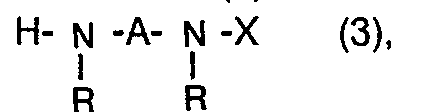
- Cu-TTP dyes of the formula (1a) with B by preparing a TTP sulfochloride of the formula wherein Cu-TTP has the meaning given, m is a number from 0 to 3 and n is a number from 1 to 4 and the sum of m and n is at most 4 with an amine of the formula and optionally in the presence of a further amine of the formula implements.
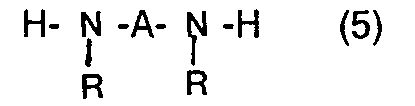
- Another process for the preparation of dyes of the formula (1 a) consists in that a Cu-TTP sulfochloride of the formula (2) with an amine of the formula selectively reacted so that only one amino group of (5) reacts with a sulfochloride group, and optionally in the presence of another amine (4) to a Cu-TTP compound of the formula where a, b and d have the meaning given for dyes of the formula (1 a), and these are then condensed by acylation with a reactive component of the formula wherein U is an anionically cleavable group, in particular F or CI, and X has the meaning given, acylated to give dyes of the formula (1a).
- Dyes of the formula (1b) can be prepared, for example, by reacting a Cu-TTP sulfochloride (2) with an amine of the formula and optionally condensed in the presence of a further amine of the formula (4).
- Dyes of the formula (1c) are prepared, for example, by reacting a Cu-TTP sulfochloride of the formula (2) with an amine of the formula an amine of formula (8) and optionally in the presence of another amine of formula (4).
- the amines (3), (5), (5a) and (8) compared to the Cu-TPP sulfochloride of the formula (2) are in a molar excess of 0 to 70% above that determined by the respective numerical value of Index c and d (cf. formula (1), (1a), (1b) and (1c)) predetermined molar amount used.
- the reaction of compounds of formula (2) with the amines (3), (5), (5a), (8) and optionally (4) is preferably carried out in the aqueous or in the aqueous-organic medium in the pH range from 3 to 8 and carried out at temperatures between 0 and 60 C, expediently the acid released by adding alkali, such as Sodium bicarbonate, sodium carbonate, sodium hydroxide solution, sodium acetate, lithium carbonate, lithium hydroxide or potassium carbonate neutralized or buffered, or if necessary the acid released binds through an excess of amine (4).
- alkali such as Sodium bicarbonate, sodium carbonate, sodium hydroxide solution, sodium acetate, lithium carbonate, lithium hydroxide or potassium carbonate neutralized or buffered, or if necessary the acid released binds through an excess of amine (4).
- Suitable organic solvents are ethanol, chlorobenzene, dichlorobenzene, dimethylformamide and the like.
- the condensation can also be carried out in the presence of a reaction accelerator such as pyridine, pyridinecarboxylic acid or pyridine sulfonic acid, pyridine carboxylic acid amide or pyridine sulfonic acid amide.
- a reaction accelerator such as pyridine, pyridinecarboxylic acid or pyridine sulfonic acid, pyridine carboxylic acid amide or pyridine sulfonic acid amide.
- a reaction accelerator is used in the production of dyes of the formula (1 b).
- Examples of such reaction accelerators are known from German Patent 2906442 and European Patent Application 231837.
- the amines (3), (5), (5a) and (8) and optionally (4) can be reacted with the sulfochlorides (2) simultaneously or in succession in any order in the individual process variants. If the Cu-TPP sulfochloride (2) contains fewer sulfonic acid groups than are desired for the compounds (1), those sulfochloride groups which are associated with the amines (3), (5), (5a), (8) and, if appropriate, (4) have not reacted, hydrolyzed to sulfonic acid groups.
- Dyes of the general formula (1) are usually obtained in the form of mixtures of the individual dyes which differ from one another by the degree of substitution a, b, c and d, which is why broken values of the indices in the formulation of the formulas covering the dyes according to the invention a, b, c and d can be specified. These fractional numbers represent average values that can be determined experimentally and analytically.
- the Cu-TTP sulfochlorides of the formula (2) can in principle be prepared by the processes known from phthalocyanine chemistry, for example in such a way that the Cu tetrabenzotriazaporphine or the corresponding Cu tetrabenzotriazaporphinsulfanic acid with chlorosulfonic acid, optionally in the presence of Carbon tetrachloride or an acid halide such as thionyl chloride, sulfonyl chloride, phosphorus pentachloride, phosphorus oxychloride or phosphorus trichloride.
- the sulfochlorides (2) are preferably obtained by heating the Cu-tetrabenzotriazaporphine with chlorosulfonic acid, it being possible to control the number m and n of the sulfochloride and sulfo groups entering in compounds of the formula (2) by the suitable choice of temperature and reaction time.
- the ratio of the indices m and n can be influenced by post-treatment with thionyl chloride.
- the copper tetrabenzotriazaporphine used as the starting material is known from the literature (US Pat. No. 2,166,240), likewise Cu-tetrabenzotriazaporphine sulfonic acid (J. Chem. Soc. 1938, 1; US Pat. No. 2166240).
- the acylation preferably takes place at the amino group marked with an asterisk *.
- Examples of amines (8) are as follows:
- Suitable fiber reactive residues i.e. those which react with the OH or NH groups of the fiber under dyeing conditions to form covalent bonds are, in particular, those which contain at least one reactive substituent bonded to a 5- or 6-membered aromatic-heterocyclic ring, for example to a monoazine , Diazine or triazine ring, in particular a pyridine, pyrimidine, pyridazine, pyrazine, thiazine, oxazine or asymmetrical or symmetrical triazine ring, or to such a ring system which has one or more fused aromatic-carbocyclic rings, for example. a quinoline, phthalazine, cinnoline, quinazoline, quinoxaline, acridine, phenazine and phenanthridine ring system.
- reactive substituents on the heterocycle are, for example, halogen (CI, Br or F), ammonium including hydrazinium, sulfonium, sulfonyl, azido (N 3 ), rhodanido, thio, thiol ether, oxyether, sulfinic acid and sulfonic acid.
- halogen CI, Br or F
- ammonium including hydrazinium, sulfonium, sulfonyl, azido (N 3 ), rhodanido, thio, thiol ether, oxyether, sulfinic acid and sulfonic acid.
- halotriazinyl radicals can also be linked to a second halotriazinyl radical or a halodiazinyl radical or one or more vinylsulfonyl or sulfatoethylsulfonyl radicals, for example via a bridge member
- halogenotriazinyl radicals can also be linked to an amine radical capable of forming a vinylsulfone radical, such as, for example, 2- (2'-, 3'- or 4 '- ( ⁇ -sulfatoethylsulfonyl) phenylamino-4-fluorotriazinyl-6, 2 - (2'-, 3'-, 4 '- ( ⁇ -thiosulfatoethylsulfonyl) phenylamino) -4-fluorotriazinyl-6, 2- (2'-, 3'-, 4' - (ß-phosphatoethyl-sulfonyl ) -phenylamino) -4-fluorotriazinyl-6, 2- (2'-, 3'-, 4'- ⁇ -acetoxyethylsulfonyl) phenylamino) -4-fluorotriazinyl-6, 2- ( 2'-, 3'-, 4
- Mono-, di- or trihalopyrimidinyl residues such as 2,4-dichloropyrimidinyl-6-, 2,3,5-trichloropyrimidinyl-6-, 2,4-dichloro-5-nitro- or -5-methyl- or -5-carboxymethyl -or -5-carboxy- or -5-cyano- or -5-vinyl- or -5-sulfo- or -5-mono-, -di or -trichloromethyl- or 5-5-carboalkoxy-pyrimidinyl-6- , 2,6-dichloropyrimidine-4-carbonyl-, 2,4-dichloropyrimidine-5-carbonyl-, 2-chloro-4-methyl-pyrimidine-5-carbonyl-, 2-methyl-4-chloropyrimidine-5-carbonyl -, 2-Methylthio-4-fluoropyrimidine-5-carbonyl-, 6-methyl-2,4-dichloropyrimidine
- Di- C -C 4 alkylamino, quaternary ammonium, especially -N ⁇ (C 1 -C 4 alkyl) 3 X ⁇ , with X anion, for example.
- the dyes obtained by the processes described above are isolated in the customary manner by salting out, for example using sodium or potassium chloride and / or by acidifying with a mineral acid or by evaporating the neutral or weakly acidic aqueous dye solution, preferably at moderately elevated temperature and reduced pressure or by spray drying.
- the new dyes give clear colorations on cellulose and natural or synthetic polyamide materials. They are characterized by high color strength.
- the new dyes find preferred interest for dyeing textile materials containing hydroxyl and amide groups, in particular materials made from native and regenerated cellulose and synthetic polyamide and polyurethane fibers, wool and silk.
- the materials mentioned are dyed or printed by the processes which are generally known and customary in industry for water-soluble reactive dyes. Light and wet fast brilliant dyeings and prints are then obtained.
- the temperature data in the examples are ° C.
- the formulas of the water-soluble reactive dyes in the description and in the examples are those of the free acids.
- the dyes are generally isolated and used in the form of their alkali metal salts, in particular the lithium, sodium or potassium salts.
- the dye formed is isolated by evaporating this solution or by salting out.
- a salty green dye is obtained, the constitution of which is roughly the same as that of the formula corresponds.
- the dye dyes cotton according to one of the dyeing processes customary for reactive dyes of the vinyl sulfone series in clear green tones.
- Color code 18
- the dye dyes cotton according to one of the dyeing processes customary for reactive dyes of the vinyl sulfone series in clear green tones.
- the result is a clear dark green solution.
- the dye is isolated by salting out.
- a green dye is obtained, the constitution of which is roughly of the formula corresponds.
- the water-moist filter cake obtained according to Example 1 is stirred in 200 ml of water and neutralized with dilute sodium hydroxide solution. Then 12.8 g of 20% strength aqueous ammonia are slowly added dropwise and the mixture is stirred at 20 ° C. until it reacts neutral again. Then a neutral solution of 56.2 g of ⁇ -sulfatoethyl- (4-aminophenyl) sulfone and of 12.3 g of nicotinic acid in 150 ml of water is added. Then stirring is continued at 20 ° C., a pH of 6 to 6.5 being maintained by sprinkling in sodium hydrogen carbonate. After the condensation has ended, the dark green solution is filtered and the dye is isolated by salting out. A salty green dye is obtained, the constitution of which roughly corresponds to the formula:
- dyes are also obtained which dye cotton in clear green tones: methylamine, dimethylamine, ethylamine, diethylamine, ethanolamine, diethanolamine, aminoacetic acid , Methalyminoacetic acid, taurine, N-methyl taurine, aniline, N-methyl aniline, N-ethyl aniline, n-sulfanilic acid, morpholine, piperidine.
- the water-moist filter cake obtained according to Example 1 is stirred in 200 ml of water and neutralized with dilute sodium hydroxide solution. Then 0.13 mol of 2,6-difluoro-5-chloro-4- (3'-aminophenylamino) pyridine (obtainable from m-phenylenediamine by acylation with 2,4,6-trifluoro-5-chloro- pyrimidine) and heated to 40 to 45 C, a pH of 6 to 6.5 being obtained by sprinkling in sodium hydrogen carbonate. When no more bicarbonate is consumed, the mixture is heated to 60 C and water is added until a blue solution is formed, which is then clarified. The unreacted condensation product in the residue is determined by the diazotization value.
- the degree of condensation c is calculated (cf. general formula 1a).
- the dye is salted out of the filtrate by adding sodium chloride. A green dye is obtained, the structure of which corresponds roughly to the formula according to the above determinations corresponds.
- the water-moist filter cake obtained according to Example 1 is stirred in 200 ml of water and neutralized with dilute sodium hydroxide solution. Then 12.8 g of 20% strength aqueous ammonia are slowly added dropwise and the mixture is stirred at room temperature until it reacts neutral again. Then 0.13 mol of 2,6-difluoro-5-chloro-4- (3'-aminophenylamino) pyrimidine is added and the mixture is heated to 40 to 45 ° C., a pH of 6 to 6.5 being obtained by sprinkling in sodium bicarbonate receives.
- the water-moist filter cake obtained according to Example 1 is stirred in 200 ml of water and neutralized with dilute sodium hydroxide solution. Then 12.8 g of 20% strength aqueous ammonia are added dropwise and the mixture is stirred at room temperature until it reacts neutral again. Therein, 0.13 mol of 3-oxalylaminoaniline is added and the mixture is heated to 40 to 45 ° C., a pH of 6 to 6.5 being obtained by the dropwise addition of dilute sodium hydroxide solution, and enough water being added to give a clear solution. If no more sodium hydroxide solution is used, add enough concentrated sodium hydroxide solution to form an approx. 2N sodium hydroxide solution and split off the oxylyl group by heating to 80 to 90 ° C. The solution is neutralized with hydrochloric acid and the dye is separated by adding sodium chloride.
- the dye which is present as a water-moist paste, corresponds approximately to the formula
- the paste is dissolved in ice water. 16.5 g of 2,4,6-trifluoro-5-chloro-pyrimidine are then added dropwise, and the pH is kept at 6 to 7 by dropwise addition of dilute sodium hydroxide solution. After the condensation has ended, the dye is salted out and dried. A green dye is obtained, the constitution of which corresponds to the dye obtained according to Example 9.
Landscapes
- Chemical & Material Sciences (AREA)
- Organic Chemistry (AREA)
- Coloring (AREA)
Abstract
Reaktivfarbstoffe, die in Form der freien Säure der Formel (1) entsprechen <IMAGE> worin [Cu-TTP] = Rest des Kupfer-Tetrabenzo-triazaporphins der Formel <IMAGE> und die restlichen Substituenten die in der Beschreibung angegebene Bedeutung haben, eignen sich zum Färben von hydroxyl- und amidgruppenhaltigen Materialien und liefern klare Färbungen mit guten Licht- und Naßechtheiten.
Description
- Die vorliegende Erfindung betrifft Reaktivfarbstoffe, die in Form der freien Säure der Formel (1) entsprechen

- [Cu-TTP] = Rest des Kupfer-Tetrabenzo-triazaporphins abgekürzt TTP) der Formel

- R' und R2 gleich oder verschieden sein können und für Wasserstoff oder ggf. substituiertes C1-C6-Alkyl stehen können oder worin R1 und R2 zusammen mit dem durch sie eingeschlossenen Stickstoffatom einen ggf. weitere Heteroatome enthaltenden heterocyclischen Rest bilden,
- B = direkte Bindung oder
- wobei

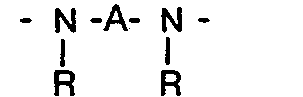
- A = zweiwertiger aliphatischer, araliphatischer oder aromatischer Rest,
- R = Wasserstoff, ggf. substituiertes C1-C6-Alkyl, wobei die Gruppierung

- auch für

- stehen kann,
- A' = zweiwertiger aliphatischer, araliphatischer oder aromatischer Rest,
- X = Reaktivgruppe,
- Y = -CH = CH2 oder -CH2-CH2-Z, wobei Z eine abspaltbare Gruppe bedeutet,
- a = 0 bis 3,
- b = 0 bis 1,
- c = 0 bis 3,
- d = 0 bis 3,
- wobei a + b + c + d = 3 bis 4
- und c + d = 1 bis 3.
- Gegebenenfalls substituiertes C1-C6-Alkyl, R, R1 und R2 steht vorzugsweise für ggf. durch OCH3, OH, COOH, SO3H oder Phenyl substituiertes C1-C4-Alkyl, z.B. Methyl, Ethyl, Propyl, Butyl, β-Hydroxyethyl, ß-Sulfatoethyl, β-Methoxyethyl.
- Beispiele für Y sind: -CH2CH2OSO3H, -CH2CH2Cl, -CH2CH2S2O3H, -CH2CH2OPO3H2,

- Bilden R1 und R2 zusammen mit dem durch sie eingeschlossenen Stickstoffatom einen ggf. weitere Heteroatome enthaltenden heterocyclischen Rest, so kommen vorzugsweise folgende Gruppierungen in Betracht:

- Beispiele für die Reste A und A1 sind folgende:
- a) aliphatisch


- b) araliphatisch

- c) aromatisch


- Die Phenylen- oder Naphthylenringe können selbstverständlich Substituenten enthalten, beispielsweise C1-C4-Alkyl wie CH3, C2Hs, C1-C4-Alkoxy wie OCH3, OC2H5, Halogen wie CI oder Br, Carboxy und Sulfo.
- In den Farbstoffen der Formel (1) ist jede Sulfonsäure-, bzw. jede Sulfonamidgruppe, an einen anderen Benzolring des Cu-TTP in 3- oder 4-Stellung gebunden.
- Im Rahmen der Formel (1) sind Farbstoffe (1 a) bevorzugt, in denen
- a = 0 bis 3,
- b = 0 bis 1,
- c = 1 bis 3 und
- d = 0, wobei a + b + c = 3 bis 4,
- weiterhin solche (1b), in denen
- a = 0 bis 3,
- b = 0 bis 1,
- c = 0,
- d = 1 bis 3, wobei a + b + d = 3 bis 4,
- weiterhin solche (1c), in denen

- a = 0 bis 2,
- b = 0 bis 1,
- c = 0,2 bis 2,
- d = 0,2 bis 2, wobei a + b + c + d 3 bis 4
- und c + d = 1 bis 3, insbesondere 1,5 bis 2,5. Weiterhin sind Farbstoffe der Formel (1), (1a), (1 b) und (1c) bevorzugt, in denen R, R1 und R2 = Wasserstoff.
- Bevorzugte Farbstoffe im Rahmen der Formel (1a) sind solche, in denen wobei besonders bevorzugt diejenigen sind, worin A für


- Für B = direkte Bindung steht X im Rahmen der Formel (1a) bevorzugt für eine über SO2 gebundene Reaktivgruppe beispielsweise 2,4-Dichlorpyrimidin-5-sulfonyl, 2,3-Dichlorchinoxalin-6-sulfonyl, 1,4-Dichlorphthalazin-6-sulfonyl, 2-Chlorbenzthiazol-5- oder -6-sufonyl, 2-Methylsulfonylbenzthiazol-5- oder -6-sulfonyl.
- Bevorzugte Farbstoffe der Formel (1b) sind solche, in denen

- Y = -CH2CH2OSO3H oder-CH=CH2
- Gegenstand der Erfindung sind weiterhin Verfahren zur Herstellung der Farbstoffe (1a), (1b) und (1c). So lassen sich beispielsweise Cu-TTP Farbstoffe der Formel (1a) mit B =


- Ein weiteres Verfahren zur Herstellung von Farbstoffen der Formel (1 a) mit



- Cu-TTP-Verbindungen der Formel (1a), in denen

- daß man ein Cu-TTP-Sulfochlorid der Formel (2) mit einem Amin der Formel


- Farbstoffe der Formel (1 b) iassen sich beispielsweise dadurch herstellen, daß man ein Cu-TTP-Sulfochlorid (2) mit einem Amin der Formel

- Farbstoffe der Formel (1c) werden beispielsweise dadurch hergestellt, daß man ein Cu-TTP-Sulfochlorid der Formel (2) mit einem Amin der Formel
- Bei den erwähnten Verfahrensvarianten werden die Amine (3), (5), (5a) und (8) gegenüber dem Cu-TPP-Sulfochlorid der Formel (2) in einem molaren Überschuß von 0 bis 70 % über die durch den jeweiligen Zahlenwert des Index c und d (vgl. Formel (1), (1a), (1b) und (1c)) vorgegebene molare Menge hinaus eingesetzt.
- Die Umsetzung von Verbindungen der Formel (2) mit den Aminen (3), (5), (5a), (8) und ggf. (4) wird vorzugsweise im wäßrigen oder im wäßrig-organischen Medium im pH-Bereich von 3 bis 8 und bei Temperaturen zwischen 0 und 60 C durchgeführt, wobei man zweckmäßigerweise die freiwerdende Säure durch Zusatz von Alkali, wie z.B. Natriumbicarbonat, Soda, Natronlauge, Natriumacetat, Lithiumcarbonat, Lithiumhydroxid oder Kaliumcarbonat neutralisiert bzw. abpuffert oder ggf. die freiwerdende Säure durch einen Überschuß an Amin (4) bindet. Als organische Lösungsmittel kommen Ethanol, Chlorbenzol, Dichlorbenzol, Dimethylformamid und ähnliche infrage. Man kann die Kondensation auch in Gegenwart eines Reaktionsbeschleunigers wie Pyridin, Pyridincarbonsäure oder Pyridinsulfonsäure, Pyridincarbonsäureamid oder Pyridinsulfonsäureamid ausführen. Insbesondere verwendet man einen solchen Reaktionsbeschleuniger bei der Herstellung von Farbstoffen der Formel (1 b). Beispiele für solche Reaktionsbeschleuniger sind aus der Deutschen Patentschrift 2906442 und der Europäischen Patentanmeldung 231837 bekannt.
- Die Amine (3), (5), (5a) und (8) und ggf. (4) können bei den einzelnen Verfahrensvarianten gleichzeitig oder nacheinander in beliebiger Reihenfolge mit den Sulfochloriden (2) umgesetzt werden. Enthält das Cu-TPP-Sulfochlorid (2) weniger Sulfonsäuregruppen als sie für die Verbindungen (1) erwünscht sind, so werden diejenigen Sulfochloridgruppen, die mit den Aminen (3), (5), (5a), (8) und ggf. (4) nicht reagiert haben, zu Sulfonsäuregruppen hydrolysiert.
- Farbstoffe der allgemeinen Formel (1) fallen bei der Synthese gewöhnlich in Form von Gemischen der Einzel farbstoffe an, die sich voneinander durch den Substitutionsgrad a, b, c und d unterscheiden, weshalb bei der Aufstellung der die erfindungsgemäßen Farbstoffe abdeckenden Formeln gebrochene Werte der Indices a, b, c und d angegeben werden. Diese gebrochenen Zahlen stellen Durchschnittswerte dar, die experimentell und analytisch ermittelt werden können.
- Die Cu-TTP-Sulfochloride der Formel (2) können prinzipiell nach den aus der Phthalocyanin-Chemie bekannten Verfahren hergestellt werden beispielsweise in der Weise, daß man das Cu-Tetrabenzotriazaporphin bzw. die entsprechende Cu-Tetrabenzotriazaporphinsulfansäure mit Chlorsulfonsäure, ggf. in Gegenwart von Tetrachlorkohlenstoff oder eines Säurehalogenids wie Thionylchlorid, Sulfonylchlorid, Phosphorpentachlorid, Phosphoroxichlorid bzw. Phosphortrichlorid umsetzt.
- Bevorzugt werden die Sulfochloride (2) durch Erhitzen des Cu-Tetrabenzotriazaporphins mit Chlorsulfonsäure erhalten, wobei man die Anzahl m und n der eintretenden Sulfochlorid- und Sulfogruppen in Verbindungen der Formel (2) durch die geeignete Wahl von Temperatur und Reaktionszeit steuern kann. Durch Nachbehandeln mit Thionylchlorid kann man das Verhältnis der Indices m und n beeinflussen.
- Das als Ausgangsmaterial eingesetzte Kupfertetrabenzotriazaporphin ist aus der Literatur bekannt (US-Patent 2166240), gleichfalls die Cu-Tetrabenzotriazaporphinsulfonsäure (J. Chem. Soc. 1938, 1; US-Patent 2166240).
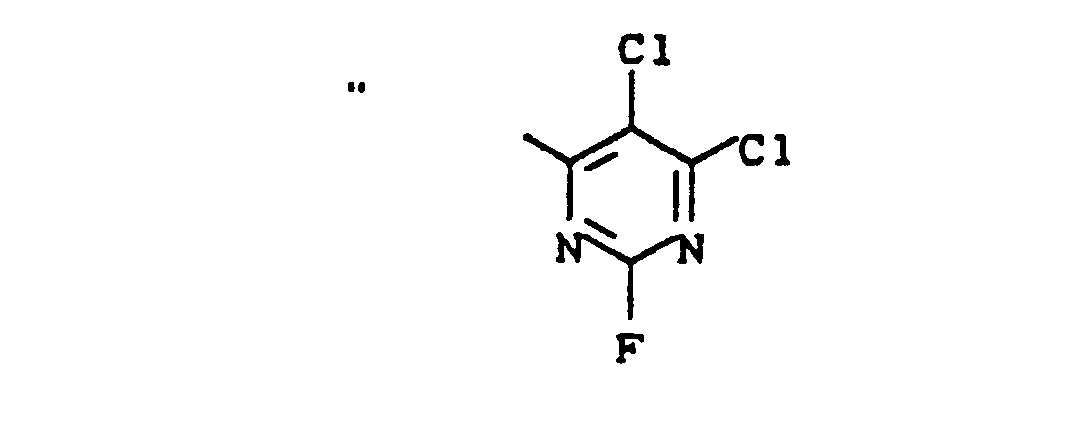
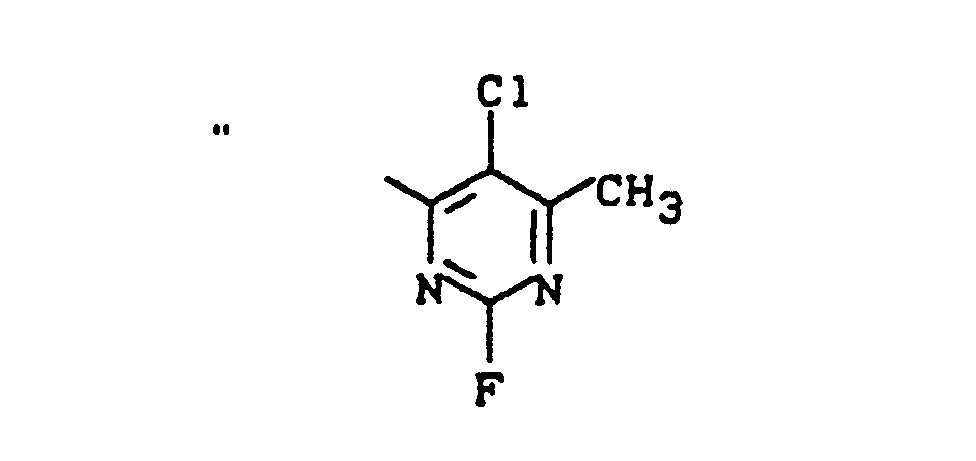
- Beispiele für Amine der Formel (3) sind folgende:
-

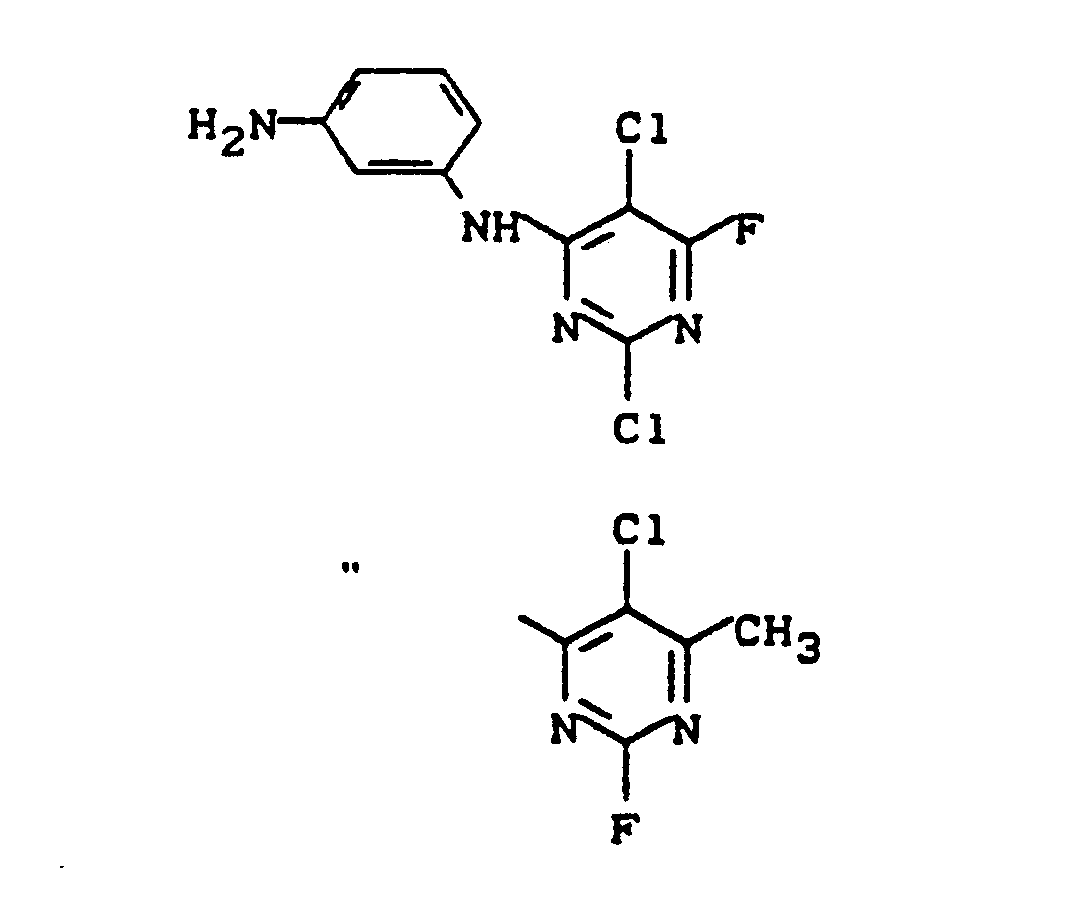



- Beispiele für Amine der Formel (5) sind folgende:


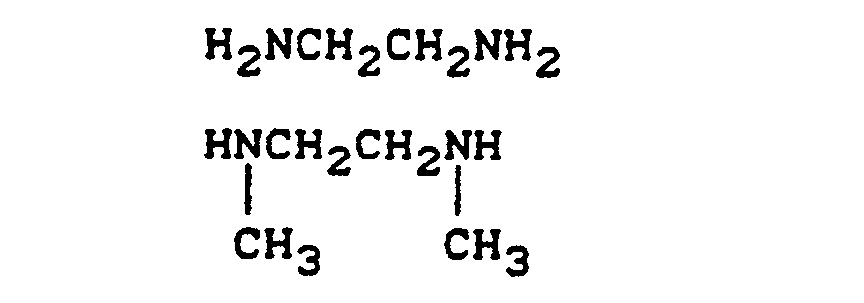


- Die Acylierung findet vorzugsweise an der mit einem Stern * gekennzeichneten Aminogruppe statt.
- Beispiele für Amine der Formel (5 a) sind folgende:
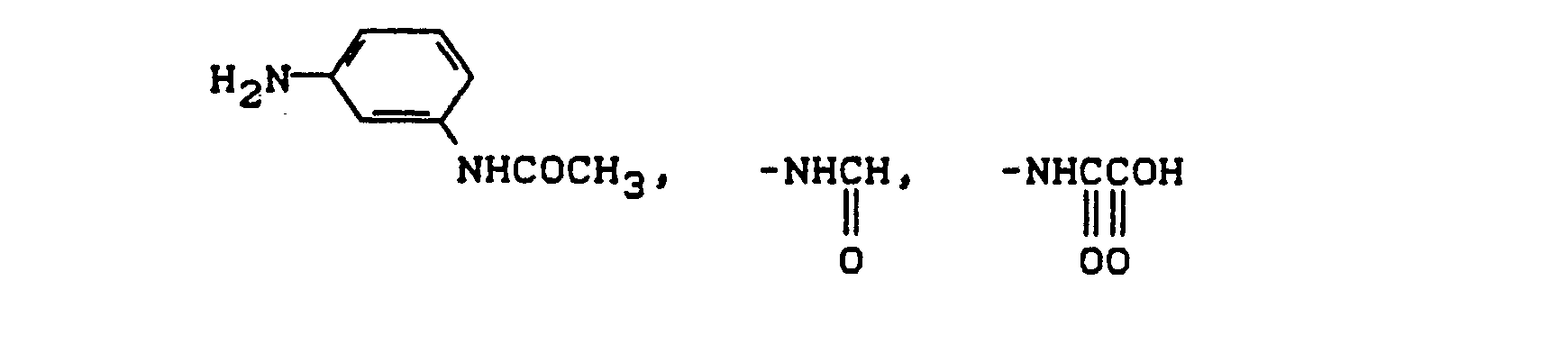
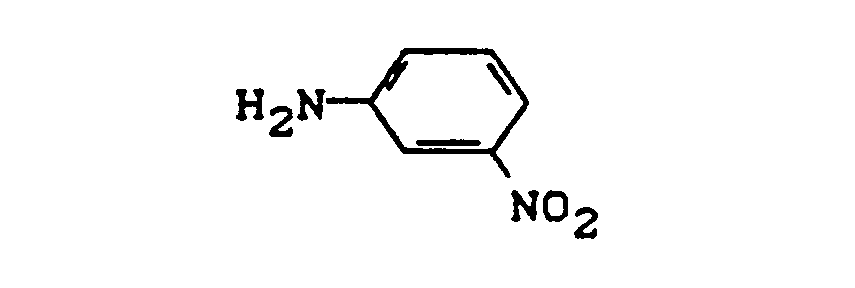


- Beispiele für Amine (8) sind folgende:





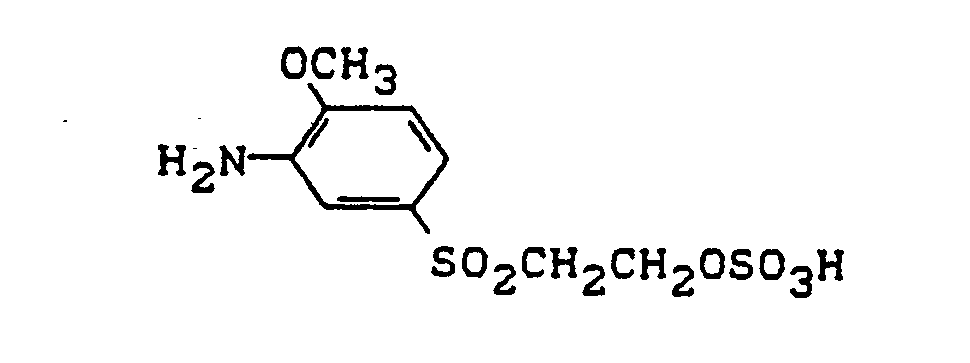


- Amine der Formel (4) sind beispielsweise:
- NH3CH3NH2, C2H5NH2, n-C3H7NH2, i-C3H7NH2, H2NCH2CH2OH, HN(CH2CH2OH)2, N2NCH2CH2OCH3, H2NCH2COOH, H2NCH2CH2S03H.

- Geeignete faserreaktive Reste, d.h. solche die mit den OH-oder NH-Gruppen der Faser unter Färbebedingungen unter Ausbildung kovalenter Bindungen reagieren, sind insbesondere solche, die mindestens einen reaktiven Substituenten an einen 5- oder 6-gliedrigen aromatisch-heterocyclischen Ring gebunden enthalten, bspw. an einen Monoazin-, Diazin- oder Triazinring, insbesondere einen Pyridin-, Pyrimidin-, Pyridazin-, Pyrazin-, Thiazin-, Oxazin- oder asymmetrischen oder symmetrischen Triazinring, oder an ein derartiges Ringsystem, welches einen oder mehrere ankondensierte aromatisch-carbocyclische Ringe aufweist, bspw. ein Chinolin-, Phthalazin-, Cinnolin-, Chinazolin-, Chinoxalin-, Acridin-, Phenazin- und Phenanthridin-Ring-System.
- Unter den reaktiven Substituenten am Heterocyclus sind beispielsweise zu erwähnen Halogen (CI, Br oder F), Ammonium einschließlich Hydrazinium, Sulfonium, Sulfonyl, Azido-(N3), Rhodanido, Thio, Thiolether, Oxiether, Sulfinsäure und Sulfonsäure.
- Im einzelnen sind beispielsweise zu nennen:
- 2,4-Difiuortriaziny!-6-, 2,4-Dichlortriazinyl-6-, Monohalogen-sym.-triazinylreste, insbesondere Monochlor- und Monofluortriazinylreste, die durch Alkyl, Aryl, Amino, Monoalkylamino, Dialkylamino, Aralkylamino, Arylamino, Alkoxy, Aryloxy, Alkylthio, Arylthio substituiert sind, wobei Alkyl vorzugsweise gegebenenfalls substituiertes C1-C4-Alkyl, Aralkyl vorzugsweise gegebenenfalls substituiertes Phenyl-C1-C4-alkyl und Aryl vorzugsweise gegebenenfalls substituiertes Phenyl oder Naphthyl bedeutet und wobei bevorzugte Substituenten für Alkyl, Hydroxy, Cyan, C1-C4-Alkoxy, Carboxy, Sulfo oder Sulfato sind und für Phenyl und Naphthyl, Sulfo, C,-C4-Alkyl, Ci-C4-Alkoxy, Carboxy, Halogen oder Acylamino.
- Im einzelnen seien folgende Reste genannt:
- 2-Amino-4-fluor-triazinyl-6, 2-Methylamino-4-fluortriazinyl-6, 2-Ethylamino-4-fluortriazinyl-6, 2-Isopropylamino-4-fluor-triazinyl-6, 2-Dimethylamino-4-fluortriazinyl-6, 2-Diethylamino-4-fluor-triazinyl-6, 2-ß-Methoxy-ethylamino-4-fluor-triazinyl-6, 2-ß-Hydroxyethylamino-4-fluor-triazinyl-6, 2-Di-(ß-hydroxyethylami- no)-4-fluor-triazinyl-6, 2-ß-Sulfoethylamino-4-fluor-triazinyl-6, 2-ß-Sulfoethyl-methylamino-4-fluor-triazinyl-6, 2-Carboxymethylamino-4-fluor-triazinyl-6, 2-Di-(carboxymethylamino)-4-6-fluor-triazinyl-6, 2-Sulfomethyl- methylamino-4-fluor-triazinyl-6, 2-ß-Cyanethylamino-4-fluor-triazinyl-6, 2-Benzylamino-4-fluor-triazinyl-6, 2-ß-Phenylethylamino-4-fluortriazinyl-6, 2-Benzyl-methylamino-4-fluor-triazinyl-6, 2-(x-Sulfobenzyl)-amino-4-fluor- triazinyl-6, 2-Cyclohexylamino-4-fluor-triazinyl-6, 2-(o-, m-, p-Methylphenyl)-amino-4-fluor-triazinyl-6, 2-(o-, m-, p-Sulfophenyl)-amino-4-fluor-triazinyl-6, 2-(2',5'-Disulfophenyl)-amino-4-fluor-triazinyl-6, 2-(o-, m-, p-Chlorphenyl)-amino-4-fluor-triazinyl-6, 2-(0-, m-, p-Methoxyphenyl)-4-fluor-triazinyl-6, 2-(2'-Methyl-4'-sulfophenyl)-amino-4-fluor-triazinyl-6, 2-(2'-Methyl-5'-sulfophenyl)-amino-4-fluor-triazinyl-6, 2-(2'-chlor-4'-sulfophenyl)-amino-4-fluor-triazinyl-6, 2-(2'-Chlor-5'-sulfophenyl)-amino-4-fluor-triazinyl-6, 2-(2'-Methoxy-4'-sulfophenyl)-amino-4-fluor-triazinyl-6, 2-(o-, m-, p-Carboxyphenyl)-amino-4-fluor-triazinyl-6, 2-(2',4'-Disulfophenyl)-amino-4-fluor-triazinyl-6, 2-(3',5'-Disulfophenyl)-amino-4-fluor-triazinyl-6, 2-(2'-Carboxy-4'-sulfophenyl)-amino-4-fluor-triazinyl-6, 2-(2'-Carboxy-5'-sulfophenyl)-amino-4-fluor-triazinyl-6, 2-(6'-Sulfonaphthyl-(2'))-amino-4-fluor-triazinyl-6, 2-(4',8'-Disulfonaphthyl-(2'))-amino-4-fluor-triazinyl-6, 2-(6',8'-Disulfonaphthyl-(2'))-amino-4-fluor-triazinyl-6, 2-(N-Methylphenyl)-amino-4-fluor-triazinyl-6, 2-(N-Ethylphenyl)-amino-4-fluor- triazinyl-6, 2-(N-ß-Hydroxyethylphenyl)-amino-4-fluor-triazinyl-6, 2-(N-iso-Propylphenyl)-amino-4-fluor- triazinyl-6, 2-Morpholino-4-fluor-triazinyl-6, 2-Piperidino-4-fluor-triazinyl-6, 2-(4' 6',8'-Trisulfonaphthyl-(2'))-4-fluor-triazinyl-6, 2-(3',6',8'-Trisulfonaphthyl-(2'))-4-fluor-triazinyl-6, 2-(3',6'-Disulfonaphthyl-(1'))-4-fluor- triazinyl-6, N-Methyl-N-(2,4-dichlortriazinyl-6)-carbamyl-, N-Methyl-N-(2-methylamino-4-chlortriazinyl-6)-carbamyl-, N-Methyl-N-(2-dimethylamino-4-chlortriazinyl-6)-carbamyl-, N-Methyl-bzw. N-Ethyl-N-(2,4-dichlortriazinyl-6)-aminoacetyl-, 2-Methoxy-4-fluor-triazinyl-6, 2-Ethoxy-4-fluor-triazinyl-6, 2-Phenoxy-4-fluor- triazinyl-6, 2-(o-, m- oder p-Sulfophenoxy)-4-fluor-triazinyl-6, 2-(o-, m- oder p-Methyl- oder -Methoxy- phenoxy)-4-fluor-triazinyl-6, 2-ß-Hydroxyethylmercapto-4-fluor-triazinyl-6, 2-Phenylmercapto-4-fluor-triazinyl-6, 2-(4'-Methylphenyl)-mercapto-4-fluortriazinyl, 2-(2',4'-Dinitrophenyl)-mercapto-4-fluor-triazinyl-6, 2-Methyl-4-fluor-triazinyl-6, 2-Phenyl-4-fluor-triazinyl-6 sowie die entsprechenden 4-Chlor- bzw. 4-Brom-Triazinyl-Reste und die entsprechenden durch Halogenaustausch mit tertiären Basen wie Trimethylamin, Triethylamin, Dimethyl-ß-hydroxyethylamin, Triethanolamin, N,N-Dimethylhydrazin, Pyridin oder Picolin, Nicotinsäure oder Isonicotinsäure, Sulfinaten insbesondere Benzolsulfinsäure oder Hydrogensulfit erhältlichen Reste.
- Die Halogentriazinylreste können auch mit einem zweiten Halogentriazinylrest oder einem Halogendiazinylrest oder einem oder merheren Vinylsulfonyl- oder Sulfatoethylsulfonylreste verknüpft sein beispielsweise über ein Brückenglied


- oder im Falle der Sulfatoethylsulfonyl- bzw. Vinylsulfonylgruppen über ein Brückenglied


- Beispiele für derartige Reste sind die folgenden:


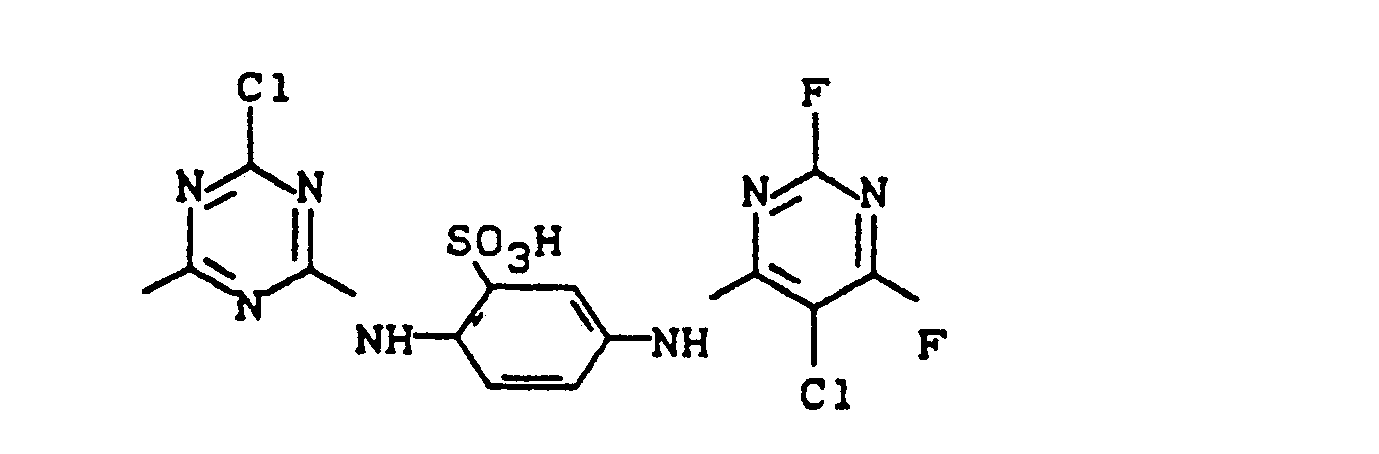


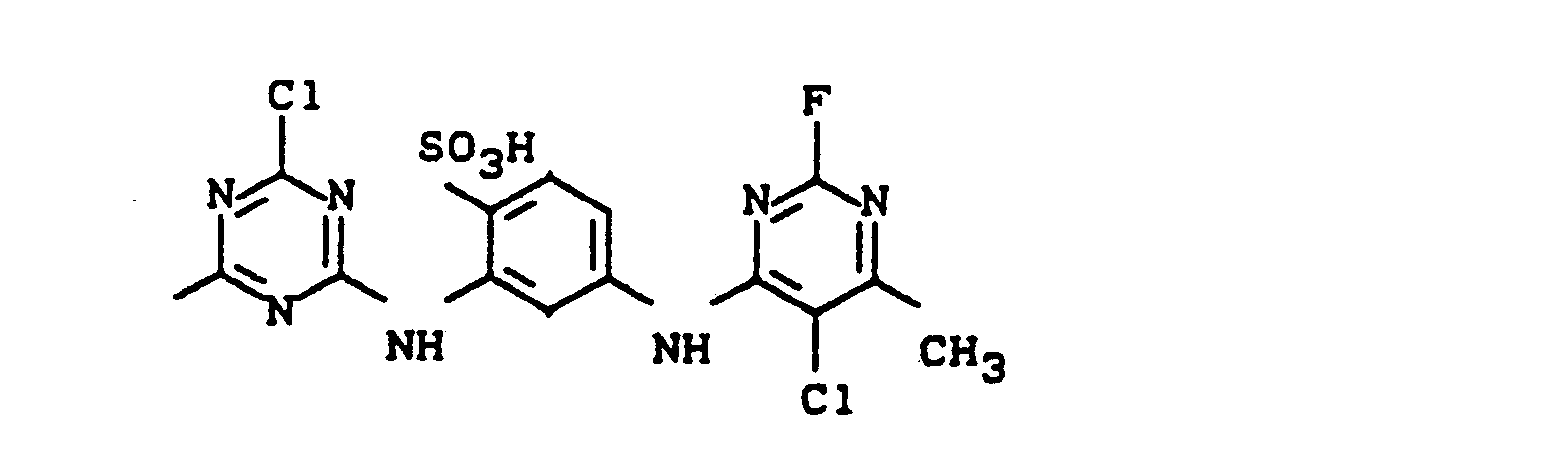


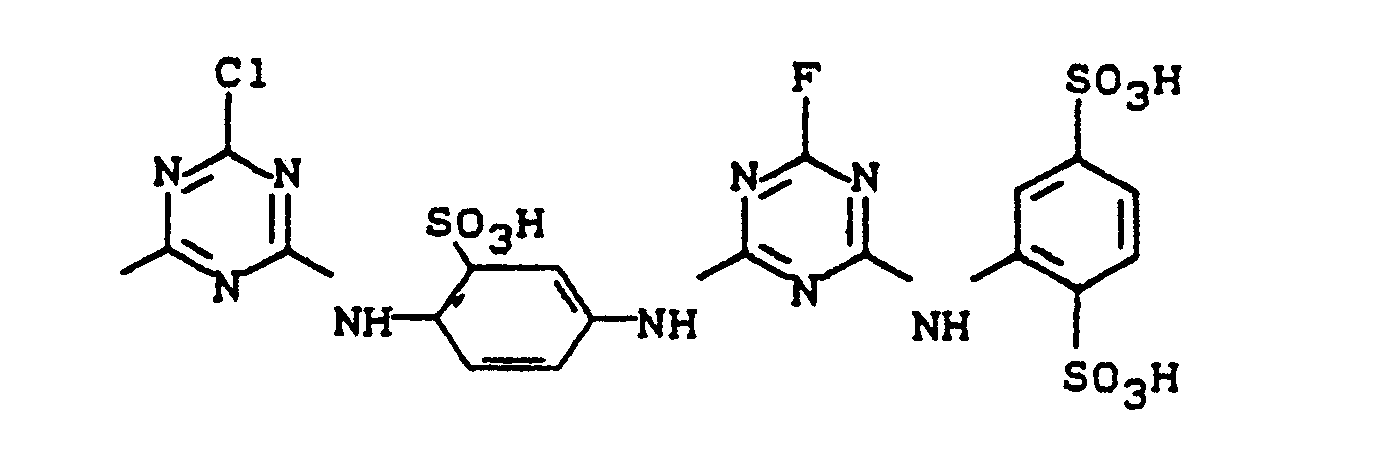
- Weiter können die Halogentriazinylreste auch mit einem zur Bildung eines Vinylsulfonrestes befähigten Aminrest verknüpft sein, wie zum Beispiel 2-(2'-, 3'- oder 4'-(ß-Sulfatoethylsulfonyl)-phenylamino-4-fluor- triazinyl-6, 2-(2'-, 3'-, 4'-(β-Thiosulfatoethylsulfonyl)-phenylamino)-4-fluor-triazinyl-6, 2-(2'-, 3'-, 4'-(ß-Phosphatoethyl-sulfonyl)-phenylamino)-4-fluor-triazinyl-6, 2-(2'-, 3'-, 4'-β-Acetoxy-ethylsulfonyl)-phenylami- no)-4-fluor-triazinyl-6, 2-(2'-, 3'-, 4' -(ß-Chlorethylsulfonyl)-phenylamino)-4-fluor-triazinyl-6, 2-(2'-, 3'-, 4'-Vinylsulfonyl-phenylamino)-4-fluor-triazinyl-6, 2-(2-(ß-Sulfatoethylsulfonyl)-ethylamino)-4-fluor-triazinyl-6 sowie die entsprechenden 2-Substituierten-4-chlor-triazinyl-6-reste.
- Mono-, Di- oder Trihalogenpyrimidinylreste, wie 2,4-Dichlorpyrimidinyl-6-, 2,3,5-Trichlorpyrimidinyl-6-, 2,4-Dichlor-5-nitro- oder -5-methyl- oder -5-carboxymethyl-oder -5-carboxy- oder -5-cyano- oder -5-vinyl-oder -5- sulfo- oder -5-mono-, -di- oder -trichlormethyl- oder 5-5-carboalkoxy-pyrimidinyl-6-, 2,6-Dichlorpyrimidin-4-carbonyl-, 2,4-Dichlorpyrimidin-5-carbonyl-, 2-Chlor-4-me thyl-pyrimidin-5-carbonyl-, 2-Methyl-4-chlorpyrimidin-5-carbonyl-, 2-Methylthio-4-fluorpyrimidin-5-carbonyl-, 6-Methyl-2,4-dichlorpyrimidin-5-carbonyl-, 2,4,6-Trichlorpyrimidin-5-carbonyl-, 2,4-Dichlorpyrimidin-5-sulfonyl-, 2-Chlor- chinoxalin-3-carbonyl-, 2-oder 3-Monochlorchinoxalin-6-carbonyl-, 2- oder 3-Monochlorchinoxalin-6-sulfonyl-, 2,3-Dichlorchinoxalin-6-carbonyl-, 2,3-Dichlorchinoxalin-6-sulfanyl-, 1,4-Dichlorphthalazin-6-sulfonyl-oder -6-carbanyl-, 2,4-Dichlorchinazolin-7-oder -6-sulfonyl-oder -carbonyl-, 2- oder 3- oder 4-(4',5'-Dichlorpyridazon-6'-yl-1 ')-phenylsulfonyl- oder -carbonyl-, β-(4',5'-Dichlorpyridazon-6'-yl-1 ')-ethylcarbonyl-, N-Methyl-N-(2,3-dichlorchinoxalin-6-sulfonyl)-aminoacetyl-, N-Methyl-N-(2,3-dichlarchinoxalin-6-carbonyl)-aminoacetyl-, sowie die entsprechenden Brom- und Fluor-Derivate der oben erwähnten chlorsubstituierten heterocyclischen Reste, unter diesen beispielsweise 2-Fluor-4-pyrimidinyl-, 2,6-Difluor-4-pyrimidinyl-, 2,6-Difluor-5-chlar-4-pyrimidinyl-, 2-Fluor-5,6-dichlor-4-pyrimidinyl-, 2,6-Difluor-5-methyl-4-pyrimidinyl-, 2-Fluor-5-methyl-6-chlor-4-pyrimidinyl-, 2-Fluor-5-nitro-6-chlor-4-pyrimidinyl-, 5-Brom-2-fluor-4-pyrimidinyl-, 2-Fluor-5-cyan-4-pyrimidinyl-, 2-Fluor-5-methyl-4-pyrimidinyl-, 2,5,6-Trif)uor-4-pyrimidi nyl-, 5-Chlor-6-chlormethyl-2-fluor-4-pyrimidinyl-, 5-Chlor-6-dichlormethyl-2-fluor-4-pyrimidinyl-, 5-Chlor-6-trichlormethyl-2-fluor-4-pyrimi dinyl-, 5-Chlor-2-chlormethyl-6-fluor-4-pyrimidinyl-, 5-Chlor-2-dichlormethyl-6-fluor-4-pyrimidinyl-, 5-Chlor2-trichlormethyl-6-fluor-4-pyrimidinyl-, 5-Chlor-2-fluordichlormethyl-6-fluor-4-pyrimidinyl-, 2,6-Difluor-5-brom-4-pyrimidinyl-, 2-Fluor-5-brom-6-methyl-4-pyrimidinyl-, 2-Fluor-5-brom-6-chlormethyl-4-pyrimidinyl-, 2,6-Difluor-5-chlormethyl-4-pyrimidinyl-, 2,6-Difluor-5-nitro-4-pyrimidinyl-, 2-Fluor-6-methyl-4-pyrimidinyl-, 2-Fluor-5-chlor-6-methyl-4-pyrimidinyl-, 2-Fluoi-5-chlor-4-pyrimidinyl-, 2-Fluor-6-chlor-4-pyrimidinyl-, 6-Trifluormethyl-5-chlor-2-fluor-4-pyrimidinyl-, 6-Trifluormethyl-2-fluor-4-pyrimidinyl-, 2-Fluor-5-nitro-4-pyrimidinyl-, 2-Fluor-5-trifluormethyl-4-pyrimidinyl-, 2-Fluor-5-phenyl-oder -5-methylsulfonyl-4-pyrimidinyl., 2-Fluor-5-carbonamido-4-pyrimidinyl-, 2-Fluor-5-carbomethoxy-4-pyrimidinyl-, 2-Fluor-5-brom-6-trifluormethyl-4-pyrimidinyl-, 2-Fluor-6-carbonamido-4-pyrimidinyl-, 2-Fluor-6-carbomethoxy-4-pyrimidinyl-, 2-Fluor-6-phenyl-4-pyrimidinyl-, 2-Fluor-6-cyan-4-pyrimidinyl-, 2-Fluor-4-dichlormethyl-5-chlorpyrimidin-6-yl, 2-Fluor-5-chlorpyrimidin-4-yl; 2-Methyl-4-fluor-5-methylsulfonylpyrimidinyl-6; 2,6-Difluor-5-methyl-sulfonyl-4-pyrimidinyl-, 2,6-Dichlor-5-methylsulfonyl-4-pyrimidinyl, 2-Fluor-5-sulfonamido-4-pyrimidinyl-, 2-Fluor-5-chlor-6-carbomethoxy-4-pyrimidinyl-, 2,6-Difluor-5-trifluormethyl-4-pyrimidinyl; sulfonylgruppenhaltige Triazinreste, wie 2,4-Bis-(phenylsulfonyl)-triazinyl-6-, 2-(3'-Carboxyphenyl)-sulfonyl-4-chlortriazinyl-6-, 2-(3'-Sulfophenyl)-sulfonyl-4-chlortriazinyl-6-, 2,4-Bis-(3'-carboxyphenylsulfonyl)-triazinyl-6; sulfonylgruppen haltige Triazinreste, wie 2,4-Bis-(phenylsulfonyl)-triazinyl-6-, 2-(3 -Carboxyphenyl)-sulfonyl-4-chlortriazinyl-6-, 2-(3 - Sulfophenyl)-sulfonyl-4-chlortriazinyl-6-, 2,4-Bis-(3'-carboxyphenylsulfonyl)-triazinyl-6; sulfonylgruppenhaltige Pyrimidinringe, wie 2-Carboxymethylsulfonyl-pyrimidinyl-4-, 2-Methylsulfonyl-6-methyl-pyrimidinyl-4-, 2-Methylsulfonyl-6-ethylpyrimidinyl-4-, 2-Phenylsulfonyl-5-chlor-6-methyl-pyrimidinyl-4-, 2,6-Bis- methylsulfonyl-pyrimidinyl-4-, 2,6-Bis-methylsulfonyl-5-chlor-pyrimidinyl-4-, 2,4-Bis-methylsulfonyl- pyrimidin-5-sulfonyl-, 2-Methylsulfonyl-pyrimidinyl-4, 2-Phenylsulfonyl-pyrimidinyl-4-, 2-Trichlormethylsulfonyl-6-methyl-pyrimidinyl-4-, 2-Methylsulfonyl-5-chlor-6-methyl-pyrimidinyl-4-, 2-Methylsulfonyl-5-brom-6-methyl-pyrimidinyl-4-, 2-Methylsulfonyl-5-chlor-6-ethyl-pyrimidinyl-4-, 2-Methylsulfonyl-5-chlor-6-chlormethyl-pyrimidinyl-4-, 2-Methylsulfonyl-4-chlor-6-methylpyrimidin-5-sulfonyl-, 2-Methylsulfonyl-5-nitro-6-methylpyrimidinyl-4-, 2,5,6-Tris-methylsulfonyl-pyrimidinyl-4-, 2-Methylsulfonyl-5,6-dimethyl- pyrimidinyl-4-, 2-Ethylsulfonyl-5-chlor-6-methyl-pyrimidinyl-4-, 2-Methylsulfonyl-6-chlor-pyrimidinyl-4-, 2,6-Bis-methylsulfonyl-5-chlor-pyrimidinyl-4-, 2-Methylsulfonyl-6-carboxypyrimidinyl-4-, 2-Methylsulfonyl-5-sulfo- pyrimidinyl-4-, 2-Methylsulfonyl-6-carbomethoxy-pyrimidinyl-4-, 2-Methylsulfonyl-5-carboxypyrimidinyl-4-, 2-Methylsulfonyl-5-cyan-6-methoxypyrimidinyl-4-, 2-Methylsulfonyl-5-chlor-pyrimidinyl-4-, 2-Sulfoethylsulfonyl-6-methyl-pyrimidinyl-4-, 2-Methylsulfonyl-5-brom-pyrimidinyl-4-, 2-Phenyl-sulfonyl-5- chlor-pyrimidinyl-4-, 2-Carboxymethylsulfonyl-5-chlor-6-methyl-pyrimidinyl-4-, 2-Methylsulfonyl-6-chlorpyrimidin-4- und -5-carbonyl-, 2,6-Bis-(methylsulfonyl)-pyrimidin-4-oder -5-carbonyl-, 2-Ethylsulfonyl-6-chlorpyrimidin-5-carbonyl-, 2,4-Bis-(methylsulfonyl)-pyrimidin-5-sulfonyl-, 2-Methylsulfonyl-4-chlor-6-methylpyrimidin-5-sulfonyl-oder -carbonyl-; 2-Chlorbenzthiazol-5- oder -6-carbonyl-oder -5- oder -6-sulfonyl-, 2-Arylsulfonyl-oder Alkylsulfonylbenzthiazol-5- oder -6-carbonyl- oder -5- oder -6-sulfonyl-, wie 2-Methylsulfonyl- oder 2-Ethylsulfonylbenzthiazol-5-oder -6-sulfonyl- oder -carbonyl-, 2-Phenyosulfonylbenzthiazol-5-oder -6-sulfonyl-oder -carbanyl- und die entsprechenden im ankondensierten Benzolring Sulfogruppen enthaltenden 2-Sulfonylbenzthiazol-5- oder -6-carbonyl- oder -sulfonyl-Derivate, 2-Chlorbenzoxazol-5-oder -6-carbonyl- oder -sulfonyl-, 2-Chlorbenzimidazol-5-oder -6-carbonyl- oder -sulfonyl-, 2-Chlor-1-methylbenzimidazol-5- oder -6-carbonyl-oder -sulfonyl-, 2-Chlor-4-methylthiazol-(1,3)-5-carbonyl-oder -4- oder -5-sulfonyl-, N-Oxid des 4-Chlor- oder 4-Nitrochinolin-5-carbonyl.
- Desweiteren sind Reaktivgruppen der aliphatischen Reihe zu nennen, wie Acryloyl-, Mono-, Di- oder Trichloracryloyl-, wie -CO-CH=CH-Cl, -CO-CCl=CH2, -CO-CCI=CH-CH3, ferner -CO-CCl=CH-COOH, - CO-CH=CCI-COOH, ß-Chlorpropionyl-, 3-Phenylsulfonylpropionyl-, 3-Methylsulfonylpropionyl-, 2-Fluor-2-chlor-3,3-difluorcyclobutan-1-carbonyf-, 2,2,3,3-Tetrafluorcyclobutan-carbonyl-1-oder -sulfonyl-1-, β-(2,2,3,3-Tetrafluorcyclobutyl-2)- aryloxy-, a- oder β-Bromacryloyl-, a- oder β-Alkyl- oder Arylsulfoacryloyl-Gruppe, wie α- oder ß-Methylsulfonylacryloyl, Chloracetyl, Vinylsulfonyl, -S02CH2CH2Z worin Z = alkalisch abspaltbare Gruppe, insbesondere -OSO3H, -OCOCH3, -SSO3H, -OPOsH2, -OCOC6H5. Di-C-C4-Alkylamino, quartäres Ammonium, insbesondere -N⊕ (C1-C4-Alkyl)3X⊖,

- Die Isolierung der nach den vorstehend beschriebenen Verfahren erhaltenen Farbstoffe erfolgt in üblicher Weise durch Aussalzen, beispielsweise mit Natrium- oder Kaliumchlorid und/oder durch Ansäuern mit einer Mineralsäure oder durch Eindampfen der neutralen oder schwach sauren wäßrigen Farbstofflösung, vorzugsweise bei mäßig erhöhter Temperatur und vermindertem Druck oder durch Sprühtrocknung.
- Die neuen Farbstoffe geben auf Cellulose- sowie natürlichen oder synthetischen Polyamidmaterialien klare Färbungen. Sie zeichnen sich durch hohe Farbstärke aus.
- Als wasserlösliche Reaktivfarbstoffe finden die neuen Farbstoffe bevorzugtes Interesse für das Färben von hydroxyl- und amidgruppenhaltigen Textilmaterialien, insbesondere von Materialien aus nativer und regenerierter Cellulose sowie synthetischen Polyamid- und Polyurethanfasern, Wolle und Seide.
- Die genannten Materialien werden nach den für wasserlösliche Reaktivfarbstoffe allgemein bekannten und in der Technik üblichen Verfahren gefärbt oder bedruckt. Man erhält dann licht- und naßechte brillante Färbungen und Drucke.
- Bei den Temperaturangaben in den Beispielen handelt es sich um °C. Die Formeln der wasserlöslichen Reaktivfarbstoffe in der Beschreibung und in den Beispielen sind die der freien Säuren. Isoliert und angewandt werden die Farbstoffe im allgemeinen in Form ihrer Alkalisalze, insbesondere der Lithium-, Natrium- oder Kaliumsalze.
- Die in den Beispielen angegebenen Farbkennzahlen beziehen sich auf Colour Index Hue Indication Chart (Indicator Numbers).
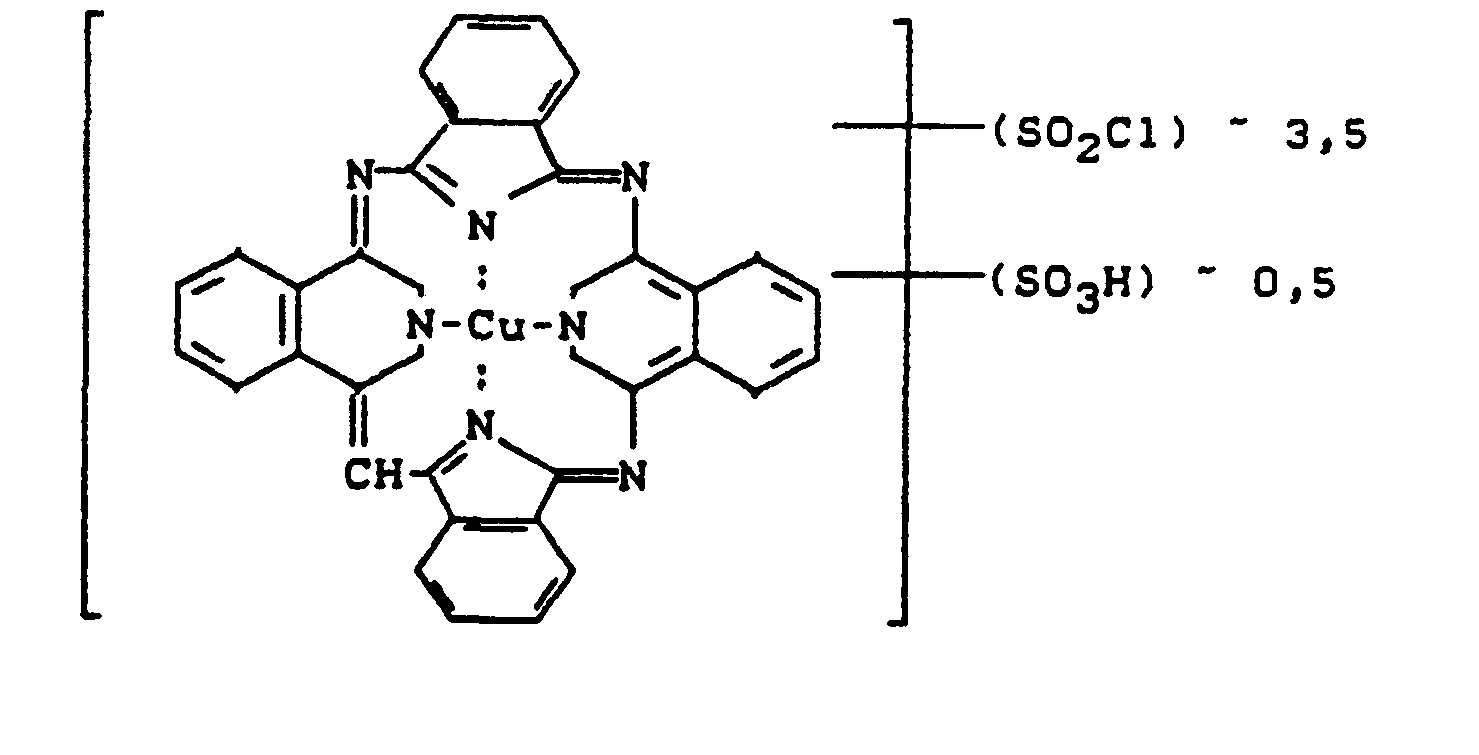
- 57,5 g (0,1 oal) Cu-Tetrabenzotriazaporphin (hergestellt nach dem Beispiel 1 der US-Patentschrift 2166240) werden in einer Stunde in 155 ml Chlorsulfonsäure eingetragen. Anschließend bringt man in einer weiteren Stunde die Temperatur auf 145° C und rührt dann vier Stunden im Temperaturbereich von 143 bis 145° C. Die dunkelgrüne Schmelze wird auf 80° C abgekühlt und dann in einer Stunde tropfenweise mit 24 ml (0,33 mol) Thionylchlorid versetzt. Man rührt dann eine weitere Stunde bei 75 bis 80 C nach und kühlt auf Raumtemperatur ab. Die dickflüssige dunkelgrüne Schmelze wird auf Eiswasser ausgetragen, abgesaugt und auf der Nutsche mit wenig Wasser ausgewaschen. Die als wasserfeuchte Paste vorliegende Verbindung entspricht folgender Zusammensetzung:
- 112 g β-Sulfatoethyl-(4-amino-phenyl)-sulfon werden in 200 ml Wasser unter Zugabe von Natriumhydrogencarbonat bei einem pH von 6,5 gelöst. Unter gutem Rühren wird die nach Beispiel 1 erhaltene Cu-Tetrabenzotriazaporphinsülfochloridsulfonsäure in Form des feuchten Preßkuchens eingetragen. Dann fügt man 5 g Pyridin (oder die äquivalente Menge Nicotinsäure, Nicotinsäureamid oder Pyridin-3-sulfonsäure) hinzu. Man hält bei einer Temperatur von 20 bis 25 C den pH bei 6 bis 6,5 durch Zugabe von Natriumhydrogencarbonat. Die Reaktion ist beendet, wenn kein Bicarbonat mehr verbraucht wird. Man erhält eine klare dunkelgrüne Lösung.
- Die Isolierung des gebildeten Farbstoffs erfolgt durch Eindampfen dieser Lösung oder durch Aussalzen. Man erhält einen salzhaltigen grünen Farbstoff, dessen Konstitution nach der Analyse etwa der Formel

- 42,1 g β-Sulfatoethyl-(3-amino-phenyl)-sulfon und 6,1 g Nicotinsäureamid werden in 750 ml Wasser unter Zugabe von Natriumbicarbonat bei einem pH von 6,5 bei Raumtemperatur gelöst. Unter gutem Rühren wird der nach Beispiel 1 erhaltene wasserfeuchte Filterkuchen eingetragen. Die Reaktion setzt langsam ein und der pH des Reaktoinsgmisches wird durch Einstreuen von Natriumbicarbonat bei 6 bis 6,5 und die Temperatur bei 20 bis 250 C gehalten. Nach etwa 24 Stunden ist die Reaktion zuende. Die entstandene klare dunkelgrüne Lösung wird geklärt und dann unter vermindertem Druck bei 60 C zur Trockne eingedampft. Man erhält einen salzhaltigen grünen Farbstoff, dessen Konstitution etwa der Formel

- Der Farbstoff färbt Baumwolle nach einem der für Reaktivfarbstoffe der Vinylsulfonreihe üblichen Färbeverfahren in klaren grünen Tönen. Farbkennzahl 18
- 42,1 g β-sulfatoethyl-(4-aminophenyl)-sulfon und 6,1 g Nicotinsäureamid werden in 200 ml Wasser unter Zugabe von Natronhydrogencarbonat bei einem pH von 6 bis 6,5 bei Raumtemperatur gelöst. Anschließend fügt man 10 g Ammoniumchlorid hinzu und trägt dann unter gutem Rühren den nach Beispiel 1 erhaltenen wasserfeuchten Filterkuchen ein. Der pH des Reaktionsgmisches wird dann fortlaufend durch Einstreuen von Natriumhydrogencarbonat bei 6,5 bis 7 und die Temperatur bei 20 bis 25 C gehalten. Die Kondensation ist beendet, wenn kein Bicarbonat mehr verbraucht wird.
- Es resultiert eine klare dunkelgrüne Lösung. Der Farbstoff wird durch Aussalzen isoliert Man erhält einen grünen Farbstoff, dessen Konstitution etwa der Formel

- Der nach Beispiel 1 erhaltene wasserfeuchte Filterkuchen wird in 200 ml Wasser angerührt und mit verdünnter Na tronlauge neutral gestellt. Dann läßt man 12,8 g 20%iges wäßriges Ammoniak langsam eintropfen und verrührt diese Mischung bei 20 C, bis sie wieder neutral reagiert. Dann fügt man eine neutral gestellte Lösung von 56,2 g β-Sulfatoethyl-(4-aminophenyl)-sulfon und von 12,3 g Nicotinsäure in 150 ml Wasser hinzu. Danach rührt man bei 20° C weiter, wobei durch Einstreuen von Natriumhydrogencarbonat ein pH von 6 bis 6,5 eingehalten wird. Nach Beendigung der Kondensation filtriert man die dunkelgrüne Lösung und isoliert den Farbstoff durch Aussalzen. Man erhält einen salzhaltigen grünen Farbstoff, dessen Konstitution etwa der Formel entspricht:

- Er färbt Baumwolle nach einem der für Reaktivfarbstoffe der Vinylsulfonreihe üblichen Färbeverfahren in klaren grünen Tönen. Farbkennzahl 18
- Arbeitet man in der in Beispiel 5a beschriebenen Weise, verwendet jedoch anstelle von Ammoniak eine äquivalente Menge der nachfolgend genannten Amine, so erhält man gleichfalls Farbstoffe, die Baumwolle in klaren grünen Tönen färben: Methylamin, Dimethylamin, Ethylamin, Diethylamin, Ethanolamin, Diethanolamin, Aminoessigsäure, Methalyminoessigsäure, Taurin, N-Methyltaurin, Anilin, N-Methylanilin, N-Ethylanilin, n-Sulfanilsäure, Morpholin, Piperidin.
- 57,5 g (0,1 mol) Cu-Tetrabenzotriazaporphin werden in einer Stunde in 155 ml Chlorsulfonsäure eingetragen. Anschließend bringt man in einer weiteren Stunde die Temperatur auf 127 bis 135° C und rührt dann eine Stunde in diesem Temperaturbereich. Die dunkelgrüne Schmelze kühlt man anschließend auf 80 C ab und tropft dann in einer Stunde 23 ml (0,3 mol) Thionylchlorid ein. Es wird dann eine weitere Stunde bei 75 bis 80 C gerührt. Die auf Raumtemperatur abgekühlte dickflüssige dunkelgrüne Schmelze wird auf Eis ausgetragen, abgesaugt und auf der Nutsche mit wenig Wasser ausgewaschen. Die als wasserfeuchte Paste vorliegende Verbindung entspricht folgender Zusammensetzung:

- 84,3 g (0,3 mol) β-Sulfatoethyl-(4-amino-phenyl)-sulfon werden in 100 ml Wasser neutral gelöst. In diese Lösung trägt man den nach Beispiel 6 erhaltenen wasserfeuchten Filterkuchen ein, fügt 5 g Pyridin hinzu und führt die Kondensation bei 10 bis 13` C durch, wobei durch Zugabe von Natriumbicarbonat ein pH von 5,5 bis 6 eingehalten wird. Solltee während der Kondensation der Ansatz eine breiige Konsistenz annehmen, so kann mit etwas Wasser verdünnt werden. Man rührt solange, bis der pH konstant bleibt. Dann erwärmt man 2 Stunden auf 40°C. Anschließend wird ein kleiner, genau abgemessener Teil der Farbstofflösung entnommen und davon der Diazotierwert bestimmt, woraus sich der Kondensationsgrad (vgl. allgemeine Formel 1b) durch Differenzbildung zur insgesamt eingesetzten Menge an ß-Sulfatoethyl-(4-aminophenyl)-sulfon errechnet. Dann wird die klare dunkelgrüne Lösung filtriert und der Farbstoff ausgesalzen und getrocknet. Man erhält einen grünen Farbstoff, dessen Konstitution nach obiger Bestimmung etwa der Formel

- Der nach Beispiel 1 erhaltene wasserfeuchte Filterkuchen wird in 200 ml Wasser angerührt und mit verdünnter Natronlauge neutral gestellt. Anschließend fügt man 0,13 mol 2,6-Difluor-5-chlor-4-(3'-aminophe- nylamino)-pyridin (erhältlich aus m-Phenylendiamin durch Acylierung mit 2,4,6-Trifluor-5-chlor-pyrimidin) hinzu und erwärmt auf 40 bis 45 C, wobei man durch Einstreuen von Natriumhydrogencarbonat einen pH von 6 bis 6,5 erhält. Wenn kein Bicarbonat mehr verbraucht wird, erwärmt man auf 60 C und fügt soviel Wasser hinzu, bis eine blaue Lösung entsteht, die dann geklärt wird. Im Rückstand wird das nicht umgesetzte Kondensationsprodukt durch den Diazotierwert bestimmt. Durch Differenzbildung zur insgesamt eingesetzten Menge an 2,6-Difluor-5-chlor-4-(3'-aminophenylamino)-pyrimidin errechnet sich der Kondensationsgrad c (vgl. allgemein Formel 1a). Aus dem Filtrat wird der Farbstoff durch Zugabe von Natriumchlorid ausgesalzen. Man erhält einen grünen Farbstoff, dessen Struktur nach den obigen Bestimmungen etwa der Formel

- Er färbt Baumwolle nach einem der für Reaktivfarbstoffe üblichen Verfahren in einem klaren Grün. Farbkennzahl 18.
- Weitere wertvolle Reaktivfarbstoffe, die Baumwolle grün färben, erhält man, wenn man anstelle von 2,6-Difluor-5-chlor-4-(3'-aminophenylamino)-pyrimidin eine äquivalente Menge der in der Tabelle 1 aufgeführten Amine verwendet und ansonsten wie angegeben verfährt.

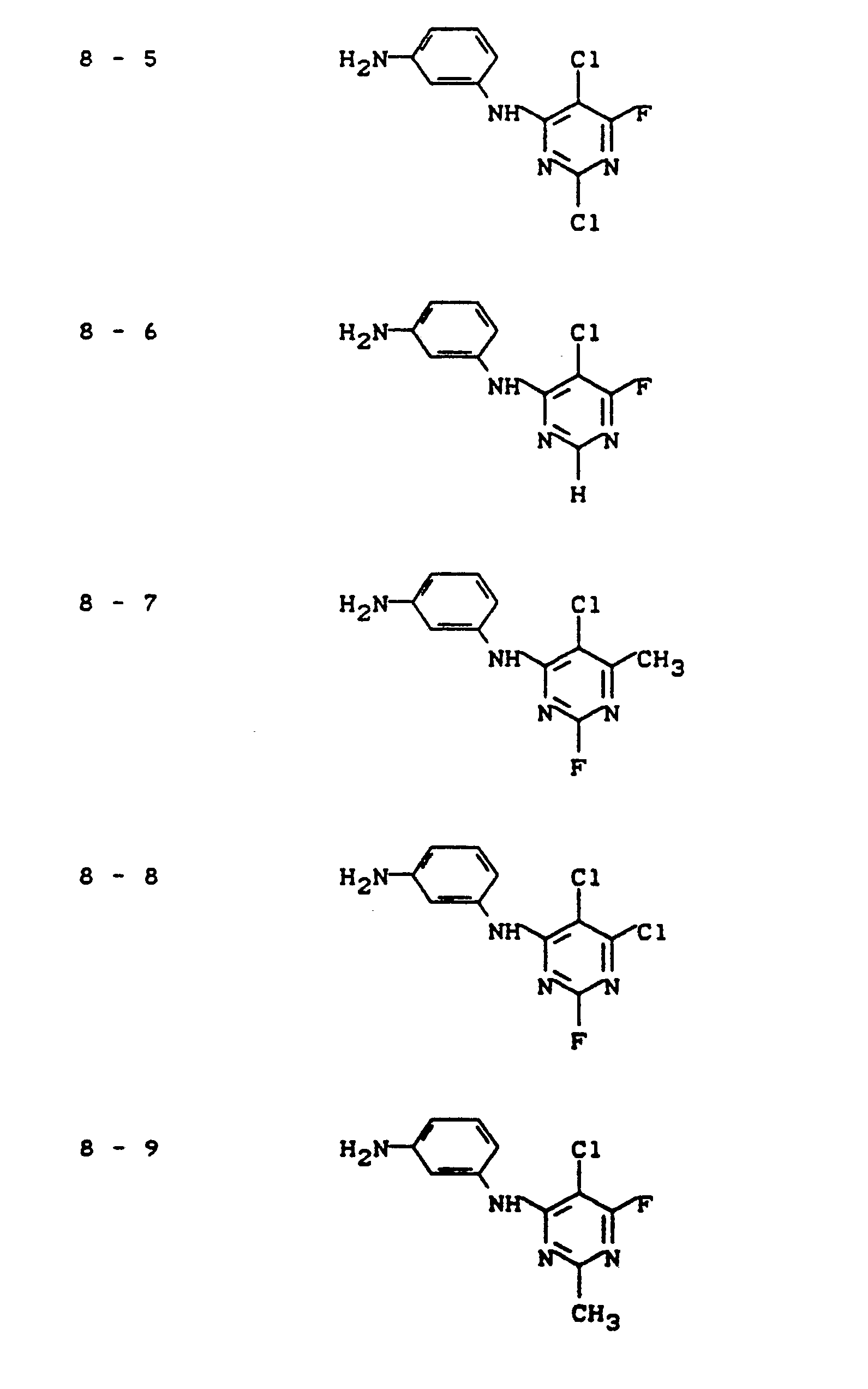

- Der nach Beispiel 1 erhaltene wasserfeuchte Filterkuchen wird in 200 ml Wasser angerührt und mit verdünnter Natronlauge neutral gestellt. Dann läßt man 12,8 g 20%iges wäßriges Ammoniak langsam eintropfen und verrührt diese Mischung bei Raumtemperatur, bis sie wieder neutral reagiert. Dann fügt man 0,13 mol 2,6-Difluor-5-chlor-4-(3'-aminophenylamino)-pyrimidin hinzu und erwärmt auf 40 bis 45 C, wobei man durch Einstreuen von Natriumbicarbonat einen pH von 6 bis 6,5 erhält.
- Wenn kein Bicarbonat mehr verbraucht wird, erwärmt man auf 60° C und fügt soviel Wasser hinzu, bis eine klare Lösung entsteht, die dann geklärt wird. Im Rückstand wird das nicht umgesetzte Kondensationsprodukt durch den Diazotiertwert bestimmt. Durch Differenzbildung zur insgesamt eingesetzten Menge an 2,6-Difluor-5-chlor-4-(3'-aminophenylamino)-pyrimidin errechnet sich der Kondensationsgrad c (vgl. allgemeine Formel 1a). Aus dem Filtrat wird der Farbstoff durch Zugabe von Natriumchlorid ausgesalzen. Man erhält einen grünen Farbstoff, dessen Struktur nach der obigen Bestimmung und Analyse etwa der Formel
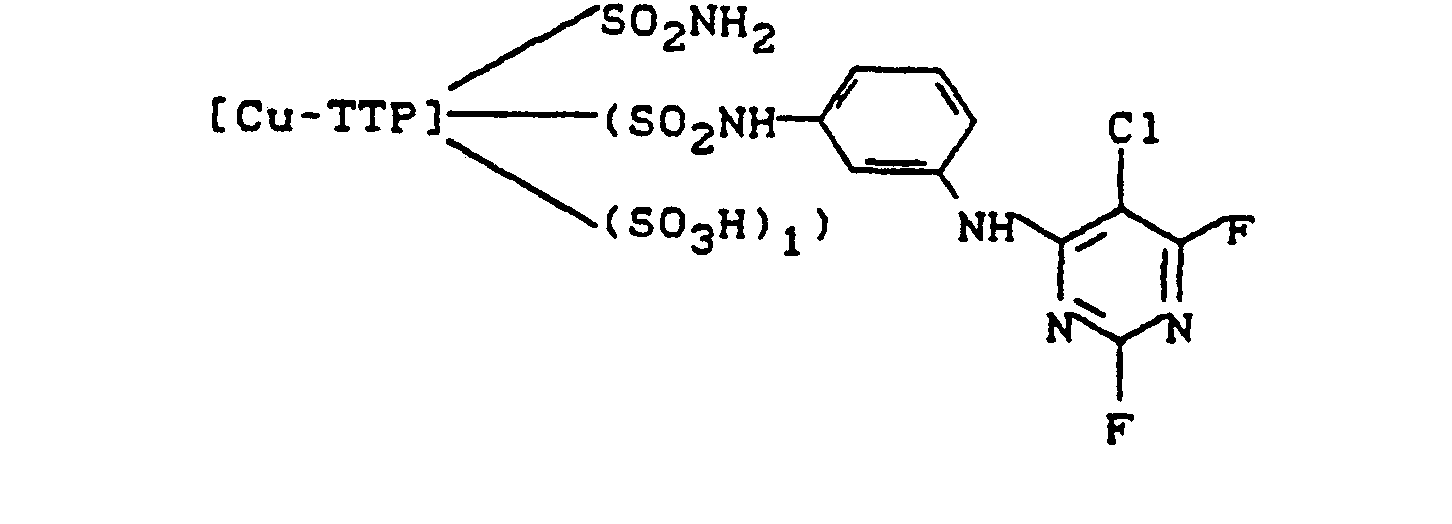
- Er färbt Baumwolle nach einem der für Reaktivfarbstoffe üblichen Verfahren in einem klaren Grün. Farbkennzahl 18.
- Weitere grüne Baumwollreaktivfarbstoffe erhält man, wenn man anstelle von 2,6-Difluor-5-chlor-4-(3'-aminophenylamino)-pyrimidin die in Tabelle 1 aufgeführten Amine verwendet und ansonsten wie angegeben verfährt.
- Gleichfalls grüne Reaktivfarbstoffe werden erhalten, wenn man anstelle von Ammoniak eine äquimolare Menge der in Beispiel 5a aufgeführten Amine und das in Beispiel 8 verwendete und die in der Tabelle 1 genannten reaktivgruppenhaltigen Amine einsetzt und nach den Angaben von Beispiel 9 verfährt
- Der nach Beispiel 1 erhaltene wasserfeuchte Filterkuchen wird in 200 ml Wasser angerührt und mit verdünnter Natronlauge neutral gestellt. Dann läßt man 12,8 g 20%igen wäßrigen Ammoniak eintropfen und verrührt diese Mischung bei Raumtemperatur, bis sie wieder neutral reagiert. Darin fügt man 0,13 mol 3-Oxalylaminoanilin hinzu und erwärmt auf 40 bis 45 C, wobei man durch Eintropfen von verdünnter Natronlauge einen pH von 6 bis 6,5 erhält und soviel Wasser zugibt, daß eine klare Lösung entsteht. Wenn keine Natronlauge mehr verbraucht wird, fügt man soviel konzentrierte Natronlauge hinzu, daß ein ca. 2n-Natronlauge entsteht, und spaltet die Oxylylgruppe durch Erwärmen auf 80 bis 90 C ab. Die Lösung wird mit Salzsäure neutral gestellt und der Farbstoff durch Zugabe von Natriumchlorid abgeschieden. Der Farbstoff, der als wasserfeuchte Paste vorliegt, entspricht etwa der Formel
-

- Die Paste wird in Eiswasser gelöst. Man tropft dann 16,5 g 2,4,6-Trifluor-5-chlor-pyrimidin ein und hält dabei den pH durch Eintropfen von verdünnter Natronlauge bei pH 6 bis 7. Nach beendeter Kondensation wird der Farbstoff ausgesalzen und getrocknet. Man erhält einen grünen Farbstoff, dessen Konstitution dem nach Beispiel 9 erhaltenen Farbstoff entspricht.
- Weitere wertvolle grüne Baumwollreaktivfarbstoffe werden erhalten, wenn man nach den Angaben von Beispiel 10 verfährt und anstelle von 2,4,6-Trifluor-5-chlor-pyrimidin eine äquimolare Menge der in Tabelle 2 aufgeführten Reaktivkomponenten verwendet und die Reaktionstemperatur so wählt, wie sie der Reaktivität der Reaktivkomponenten entspricht.


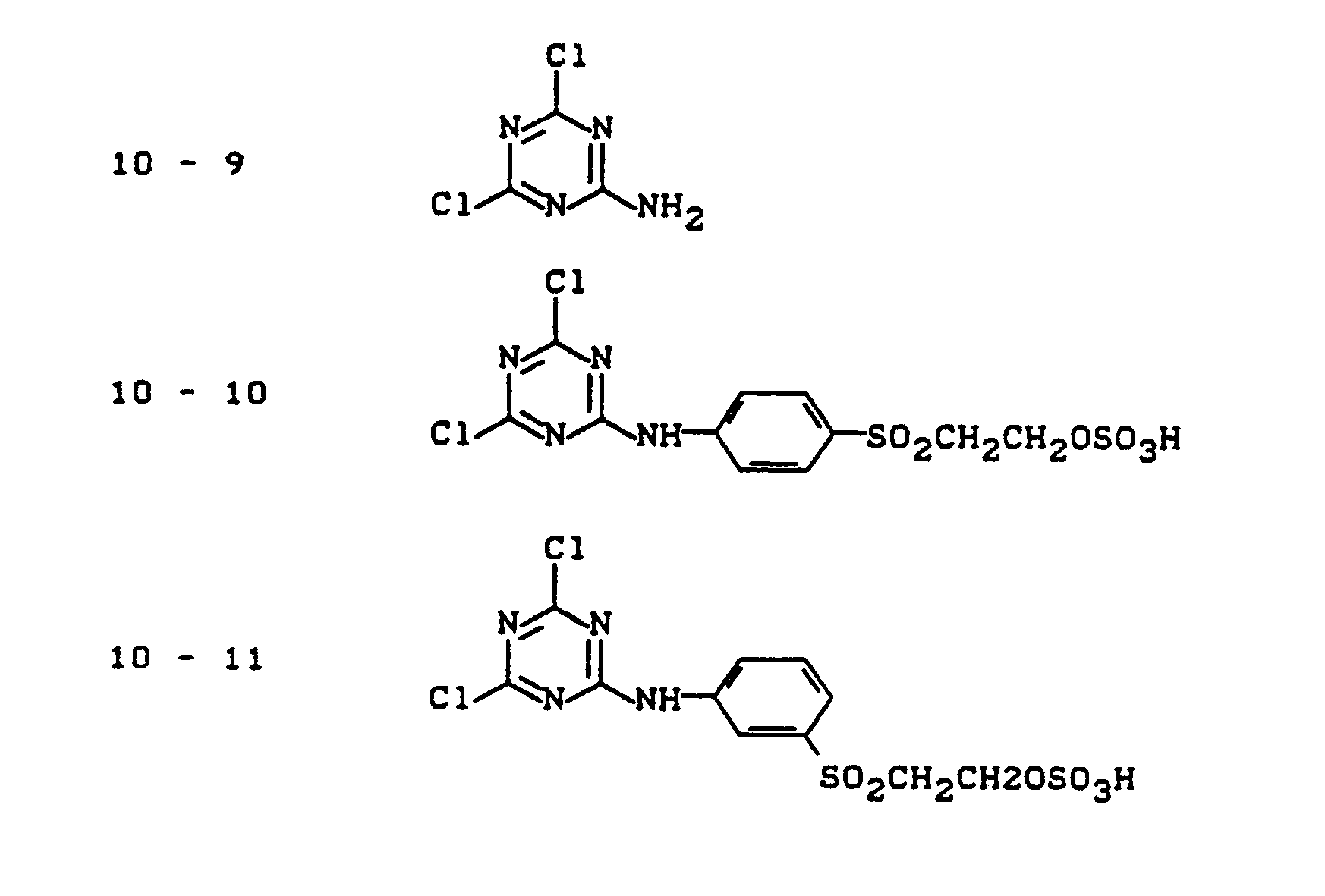
- Wenn man nach den Angaben von Beispiel 10 verfährt, jedoch die Vorbehandlung mit wäßriger Ammoniaklösung unterläßt, so erhält man ein Farbstoffamin mit etwa folgender Struktur:

- Durch Acylierung mit der in Beispiel 10 verwendeten und der in Tabelle 2 aufgeführten Reaktivkomponenten erhält man gleichfalls grüne Baumwollreaktivfarbstoffe.
Claims (7)
1. Reaktivfarbstoffe, die in Form der freien Säure der Formel (1)

entsprechen, worin
[Cu-TTP] = Rest des Kupfer-Tetrabenzotriazaporphins der Formel

R' und R2 gleich oder verschieden sein können und für Wasserstoff oder ggf. substituiertes C1-C6-Alkyl stehen oder worin R' und R2 zusammen mit dem durch sie eingeschlossenen Stickstoffatom einen ggf. weitere Heteroatome enthaltenden heterocyclischen Rest bilden,
B = direkte Bindung oder

wobei
A = zweiwertiger aliphatischer, araliphatischer oder aromatischer Rest,
R = Wasserstoff, ggf. substituiertes C1-C6-Alkyl, wobei die Gruppierung
auch für

stehen kann,
A1 = zweiwertiger aliphatischer, araliphatischer oder aromatischer Rest,
X = Reaktivgruppe,
Y = -CH = CH2 oder -CH2-CH2-Z, wobei Z eine abspaltbare Gruppe bedeutet, a = 0 bis 3,
b = 0 bis 1,
c = 0 bis 3,
d = 0 bis 3.
wobei a + b + c + d = 3 bis 4
und c + d = 1 bis 3.
2. Farbstoffe des Anspruches 1 mit
a = 0 bis 3,
b = 0 bis 1,
c = 1 bis 3 und
d = 0,
wobei a + b + c = 3 bis 4.
3. Farbstoffe des Anspruches 1 mit
a = 0 bis 3,
b = 0 bis 1,
c = 0,
d = 1 bis 3,
wobei a + b + d = 3 bis 4.
4. Farbstoffe des Anspruches 1 mit
a = 0 bis 2,
b = 0 bis 1,
c = 0,2 bis 2,
d = 0,2 bis 2,
wobei a + b + c + d = 3 bis 4
und c + d = 1 bis 3, insbesondere 1,5 bis 2,5.
5. Farbstoffe des Anspruchs 2 mit

und
X = Reaktivgruppe der Monofluortriazin-, Monochlortriazin- oder Fluorpyrimidin-Reihe.
6. Farbstoffe des Anspruches 2 mit
B = direkte Bindung und
X = über -SO2- verknüpfte heterocyclische Reaktivgruppe.
7. Farbstoffe des Anspruchs 3 mit

Y = -CH2CH2OSO3H oder -CH=CH2.
8. Kupfer-Tetrabenzo-triazaporphin-sulfochloride der Formel

worin m = 0 bis 3, n = 1 bis 4 und m + n = < 4.
Applications Claiming Priority (2)
| Application Number | Priority Date | Filing Date | Title |
|---|---|---|---|
| DE19893902053 DE3902053A1 (de) | 1989-01-25 | 1989-01-25 | Reaktivfarbstoffe |
| DE3902053 | 1989-01-25 |
Publications (1)
| Publication Number | Publication Date |
|---|---|
| EP0379905A1 true EP0379905A1 (de) | 1990-08-01 |
Family
ID=6372702
Family Applications (1)
| Application Number | Title | Priority Date | Filing Date |
|---|---|---|---|
| EP90100559A Withdrawn EP0379905A1 (de) | 1989-01-25 | 1990-01-12 | Reaktivfarbstoffe |
Country Status (3)
| Country | Link |
|---|---|
| EP (1) | EP0379905A1 (de) |
| JP (1) | JPH02233768A (de) |
| DE (1) | DE3902053A1 (de) |
Cited By (1)
| Publication number | Priority date | Publication date | Assignee | Title |
|---|---|---|---|---|
| CN119432118A (zh) * | 2024-11-12 | 2025-02-14 | 河南隆胜新材料有限公司 | 一种高性能功能型环境友好(铜/镍)酞菁四取代多活性基翠蓝染料及其制备方法 |
Citations (2)
| Publication number | Priority date | Publication date | Assignee | Title |
|---|---|---|---|---|
| US2166240A (en) * | 1937-04-30 | 1939-07-18 | Ici Ltd | Heterocyclic compounds |
| DE3503747A1 (de) * | 1985-02-05 | 1986-08-07 | Bayer Ag, 5090 Leverkusen | Phthalocyanin-reaktivfarbstoffe |
-
1989
- 1989-01-25 DE DE19893902053 patent/DE3902053A1/de not_active Withdrawn
-
1990
- 1990-01-12 EP EP90100559A patent/EP0379905A1/de not_active Withdrawn
- 1990-01-22 JP JP1076790A patent/JPH02233768A/ja active Pending
Patent Citations (2)
| Publication number | Priority date | Publication date | Assignee | Title |
|---|---|---|---|---|
| US2166240A (en) * | 1937-04-30 | 1939-07-18 | Ici Ltd | Heterocyclic compounds |
| DE3503747A1 (de) * | 1985-02-05 | 1986-08-07 | Bayer Ag, 5090 Leverkusen | Phthalocyanin-reaktivfarbstoffe |
Non-Patent Citations (1)
| Title |
|---|
| Journal of the Chemical Society, Part I, 1938, London, DENT: "Preparation of Phthalocyanine-like Pigments related to the Porphyrius", Seiten 1-6, insbesondere Seite 5, Zeilen 22-29. * |
Cited By (1)
| Publication number | Priority date | Publication date | Assignee | Title |
|---|---|---|---|---|
| CN119432118A (zh) * | 2024-11-12 | 2025-02-14 | 河南隆胜新材料有限公司 | 一种高性能功能型环境友好(铜/镍)酞菁四取代多活性基翠蓝染料及其制备方法 |
Also Published As
| Publication number | Publication date |
|---|---|
| DE3902053A1 (de) | 1990-07-26 |
| JPH02233768A (ja) | 1990-09-17 |
Similar Documents
| Publication | Publication Date | Title |
|---|---|---|
| EP0053743A2 (de) | Dioxazin-Reaktivfarbstoffe, Verfahren zu ihrer Herstellung und ihre Verwendung zum Färben und Bedrucken von hydroxyl- oder amidgruppenhaltigen Fasermaterialien | |
| EP0197418B1 (de) | Azoreaktivfarbstoffe | |
| EP0134033B1 (de) | Benzthiazinophenoxazin-Farbstoffe | |
| EP0158857A2 (de) | Reaktive Dichlorotriphendioxazinfarbstoffe | |
| EP0043561B1 (de) | Wasserlösliche Phthalocyaninverbindungen, Verfahren zu ihrer Herstellung und ihre Verwendung als Farbstoffe | |
| EP0299328B1 (de) | Reaktivfarbstoffe | |
| EP0204245B1 (de) | Reaktivfarbstoffe | |
| EP0349848B1 (de) | Triphendioxazin-Farbstoffe | |
| EP0272532A2 (de) | Farbstoffe | |
| EP0395951A1 (de) | Polyfunktionelle faserreaktive Farbstoffe | |
| EP0794234A1 (de) | Farbstoffmischungen, Verfahren zu deren Herstellung und deren Verwendung | |
| EP0582886A1 (de) | Phthalocyaninreaktivfarbstoffe | |
| EP0379905A1 (de) | Reaktivfarbstoffe | |
| EP0094020A1 (de) | Wasserlösliche Disazoverbindungen, Verfahren zu ihrer Herstellung und ihre Verwendung als Farbstoffe | |
| EP0229339B1 (de) | Wasserlösliche Triphendioxazin-Verbindungen, deren sulfonylgruppenhaltigen Vorprodukte, Verfahren zu ihrer Herstellung und Verwendung der Triphendioxazine als Farbstoffe | |
| EP0087113A2 (de) | Wasserlösliche Disazoverbindungen, Verfahren zu deren Herstellung und ihre Verwendung als Farbstoffe | |
| EP0192964B1 (de) | Phthalocyanin-Reaktivfarbstoffe | |
| EP0414068B1 (de) | Reaktivfarbstoffe | |
| EP0685532A1 (de) | Neue Reaktivfarbstoffe, deren Herstellung und Verwendung | |
| EP0158110B1 (de) | Triphendioxazinfarbstoffe | |
| EP0648815A1 (de) | Wasserlösliche, metallfreie Phthalocyaninfarbstoffe, Verfahren zu ihrer Herstellung und ihre Verwendung | |
| DE3704660A1 (de) | Wasserloesliche azoverbindungen, verfahren zu deren herstellung und ihre verwendung als farbstoffe | |
| EP0527441A2 (de) | Wasserlösliche Phthalocyaninfarbstoffe, Verfahren zu ihrer Herstellung und ihre Verwendung | |
| EP0205080B1 (de) | Triphendioxazin-disulfimid-Reaktivfarbstoffe | |
| EP0012342A1 (de) | Anthrachinon-Reaktivfarbstoffe und deren Verwendung beim Färben und Bedrucken von hydroxyl- oder amidgruppenhaltigen Materialien |
Legal Events
| Date | Code | Title | Description |
|---|---|---|---|
| PUAI | Public reference made under article 153(3) epc to a published international application that has entered the european phase |
Free format text: ORIGINAL CODE: 0009012 |
|
| 17P | Request for examination filed |
Effective date: 19900112 |
|
| AK | Designated contracting states |
Kind code of ref document: A1 Designated state(s): CH DE FR GB LI |
|
| 17Q | First examination report despatched |
Effective date: 19920803 |
|
| STAA | Information on the status of an ep patent application or granted ep patent |
Free format text: STATUS: THE APPLICATION HAS BEEN WITHDRAWN |
|
| 18W | Application withdrawn |
Withdrawal date: 19920917 |