EP0134033B1 - Benzthiazinophenoxazin-Farbstoffe - Google Patents
Benzthiazinophenoxazin-Farbstoffe Download PDFInfo
- Publication number
- EP0134033B1 EP0134033B1 EP84109630A EP84109630A EP0134033B1 EP 0134033 B1 EP0134033 B1 EP 0134033B1 EP 84109630 A EP84109630 A EP 84109630A EP 84109630 A EP84109630 A EP 84109630A EP 0134033 B1 EP0134033 B1 EP 0134033B1
- Authority
- EP
- European Patent Office
- Prior art keywords
- triazinyl
- amino
- fluoro
- pyrimidinyl
- fluor
- Prior art date
- Legal status (The legal status is an assumption and is not a legal conclusion. Google has not performed a legal analysis and makes no representation as to the accuracy of the status listed.)
- Expired
Links
- -1 R8 = H Chemical group 0.000 claims description 98
- 238000004043 dyeing Methods 0.000 claims description 17
- 229910052794 bromium Inorganic materials 0.000 claims description 11
- 229910052731 fluorine Inorganic materials 0.000 claims description 11
- 229910052801 chlorine Inorganic materials 0.000 claims description 9
- 125000004178 (C1-C4) alkyl group Chemical group 0.000 claims description 8
- 239000000463 material Substances 0.000 claims description 8
- 125000000217 alkyl group Chemical group 0.000 claims description 7
- 125000000229 (C1-C4)alkoxy group Chemical group 0.000 claims description 5
- 125000002887 hydroxy group Chemical group [H]O* 0.000 claims description 5
- 125000003368 amide group Chemical group 0.000 claims description 4
- 125000003830 C1- C4 alkylcarbonylamino group Chemical group 0.000 claims description 3
- ZMXDDKWLCZADIW-UHFFFAOYSA-N N,N-Dimethylformamide Chemical compound CN(C)C=O ZMXDDKWLCZADIW-UHFFFAOYSA-N 0.000 description 79
- 239000000243 solution Substances 0.000 description 64
- 239000000975 dye Substances 0.000 description 58
- XLYOFNOQVPJJNP-UHFFFAOYSA-N water Substances O XLYOFNOQVPJJNP-UHFFFAOYSA-N 0.000 description 46
- FAPWRFPIFSIZLT-UHFFFAOYSA-M Sodium chloride Chemical compound [Na+].[Cl-] FAPWRFPIFSIZLT-UHFFFAOYSA-M 0.000 description 44
- WCUXLLCKKVVCTQ-UHFFFAOYSA-M Potassium chloride Chemical compound [Cl-].[K+] WCUXLLCKKVVCTQ-UHFFFAOYSA-M 0.000 description 28
- HEMHJVSKTPXQMS-UHFFFAOYSA-M Sodium hydroxide Chemical compound [OH-].[Na+] HEMHJVSKTPXQMS-UHFFFAOYSA-M 0.000 description 24
- 239000000203 mixture Substances 0.000 description 23
- 239000011780 sodium chloride Substances 0.000 description 22
- 239000000047 product Substances 0.000 description 21
- 150000001875 compounds Chemical class 0.000 description 17
- 238000009833 condensation Methods 0.000 description 14
- 230000005494 condensation Effects 0.000 description 14
- 239000001103 potassium chloride Substances 0.000 description 14
- 235000011164 potassium chloride Nutrition 0.000 description 14
- 239000011541 reaction mixture Substances 0.000 description 14
- 239000012065 filter cake Substances 0.000 description 13
- 239000000985 reactive dye Substances 0.000 description 13
- 125000000542 sulfonic acid group Chemical group 0.000 description 13
- JUJWROOIHBZHMG-UHFFFAOYSA-N Pyridine Chemical compound C1=CC=NC=C1 JUJWROOIHBZHMG-UHFFFAOYSA-N 0.000 description 12
- 229920003043 Cellulose fiber Polymers 0.000 description 11
- 239000007859 condensation product Substances 0.000 description 11
- 239000002244 precipitate Substances 0.000 description 10
- 238000006277 sulfonation reaction Methods 0.000 description 10
- CDBYLPFSWZWCQE-UHFFFAOYSA-L Sodium Carbonate Chemical compound [Na+].[Na+].[O-]C([O-])=O CDBYLPFSWZWCQE-UHFFFAOYSA-L 0.000 description 9
- 239000002253 acid Substances 0.000 description 9
- CSCPPACGZOOCGX-UHFFFAOYSA-N Acetone Chemical compound CC(C)=O CSCPPACGZOOCGX-UHFFFAOYSA-N 0.000 description 8
- 229920000742 Cotton Polymers 0.000 description 8
- 239000000460 chlorine Substances 0.000 description 8
- 235000011121 sodium hydroxide Nutrition 0.000 description 8
- 238000003756 stirring Methods 0.000 description 8
- RMVRSNDYEFQCLF-UHFFFAOYSA-N thiophenol Chemical compound SC1=CC=CC=C1 RMVRSNDYEFQCLF-UHFFFAOYSA-N 0.000 description 8
- 239000002585 base Substances 0.000 description 7
- VMKJWLXVLHBJNK-UHFFFAOYSA-N cyanuric fluoride Chemical compound FC1=NC(F)=NC(F)=N1 VMKJWLXVLHBJNK-UHFFFAOYSA-N 0.000 description 7
- 125000002924 primary amino group Chemical group [H]N([H])* 0.000 description 7
- 239000000725 suspension Substances 0.000 description 7
- OKKJLVBELUTLKV-UHFFFAOYSA-N Methanol Chemical compound OC OKKJLVBELUTLKV-UHFFFAOYSA-N 0.000 description 6
- 238000006243 chemical reaction Methods 0.000 description 6
- UMJSCPRVCHMLSP-UHFFFAOYSA-N pyridine Natural products COC1=CC=CN=C1 UMJSCPRVCHMLSP-UHFFFAOYSA-N 0.000 description 6
- JYEUMXHLPRZUAT-UHFFFAOYSA-N 1,2,3-triazine Chemical compound C1=CN=NN=C1 JYEUMXHLPRZUAT-UHFFFAOYSA-N 0.000 description 5
- YZZBHDPNIDGABH-UHFFFAOYSA-N 1,2,4-trichloro-6-nitrophenoxazin-3-one Chemical compound N1=C2C(Cl)=C(Cl)C(=O)C(Cl)=C2OC2=C1C=CC=C2[N+](=O)[O-] YZZBHDPNIDGABH-UHFFFAOYSA-N 0.000 description 5
- LDCCBULMAFILCT-UHFFFAOYSA-N 2-aminobenzene-1,4-disulfonic acid Chemical compound NC1=CC(S(O)(=O)=O)=CC=C1S(O)(=O)=O LDCCBULMAFILCT-UHFFFAOYSA-N 0.000 description 5
- QAOWNCQODCNURD-UHFFFAOYSA-N Sulfuric acid Chemical compound OS(O)(=O)=O QAOWNCQODCNURD-UHFFFAOYSA-N 0.000 description 5
- 229910052736 halogen Inorganic materials 0.000 description 5
- 150000002367 halogens Chemical class 0.000 description 5
- 239000000126 substance Substances 0.000 description 5
- 125000001424 substituent group Chemical group 0.000 description 5
- GOYNRDSJTYLXBU-UHFFFAOYSA-N 5-chloro-2,4,6-trifluoropyrimidine Chemical compound FC1=NC(F)=C(Cl)C(F)=N1 GOYNRDSJTYLXBU-UHFFFAOYSA-N 0.000 description 4
- 0 CC1C=*(**)C=CC1N[C@](CC=C1*)C(C)=C(C)C1=C Chemical compound CC1C=*(**)C=CC1N[C@](CC=C1*)C(C)=C(C)C1=C 0.000 description 4
- 239000004952 Polyamide Substances 0.000 description 4
- SMWDFEZZVXVKRB-UHFFFAOYSA-N Quinoline Chemical compound N1=CC=CC2=CC=CC=C21 SMWDFEZZVXVKRB-UHFFFAOYSA-N 0.000 description 4
- 238000004458 analytical method Methods 0.000 description 4
- 125000003118 aryl group Chemical group 0.000 description 4
- 238000009826 distribution Methods 0.000 description 4
- 238000004519 manufacturing process Methods 0.000 description 4
- 238000001819 mass spectrum Methods 0.000 description 4
- 238000000034 method Methods 0.000 description 4
- 125000000449 nitro group Chemical group [O-][N+](*)=O 0.000 description 4
- 229920002647 polyamide Polymers 0.000 description 4
- 125000000020 sulfo group Chemical group O=S(=O)([*])O[H] 0.000 description 4
- 125000000472 sulfonyl group Chemical group *S(*)(=O)=O 0.000 description 4
- ZWEHNKRNPOVVGH-UHFFFAOYSA-N 2-Butanone Chemical compound CCC(C)=O ZWEHNKRNPOVVGH-UHFFFAOYSA-N 0.000 description 3
- VRVRGVPWCUEOGV-UHFFFAOYSA-N 2-aminothiophenol Chemical class NC1=CC=CC=C1S VRVRGVPWCUEOGV-UHFFFAOYSA-N 0.000 description 3
- LHYQAEFVHIZFLR-UHFFFAOYSA-L 4-(4-diazonio-3-methoxyphenyl)-2-methoxybenzenediazonium;dichloride Chemical compound [Cl-].[Cl-].C1=C([N+]#N)C(OC)=CC(C=2C=C(OC)C([N+]#N)=CC=2)=C1 LHYQAEFVHIZFLR-UHFFFAOYSA-L 0.000 description 3
- QGZKDVFQNNGYKY-UHFFFAOYSA-O Ammonium Chemical compound [NH4+] QGZKDVFQNNGYKY-UHFFFAOYSA-O 0.000 description 3
- IJGRMHOSHXDMSA-UHFFFAOYSA-N Atomic nitrogen Chemical compound N#N IJGRMHOSHXDMSA-UHFFFAOYSA-N 0.000 description 3
- WKBOTKDWSSQWDR-UHFFFAOYSA-N Bromine atom Chemical compound [Br] WKBOTKDWSSQWDR-UHFFFAOYSA-N 0.000 description 3
- 229920002292 Nylon 6 Polymers 0.000 description 3
- 229920002302 Nylon 6,6 Polymers 0.000 description 3
- YXFVVABEGXRONW-UHFFFAOYSA-N Toluene Chemical compound CC1=CC=CC=C1 YXFVVABEGXRONW-UHFFFAOYSA-N 0.000 description 3
- ZMANZCXQSJIPKH-UHFFFAOYSA-N Triethylamine Chemical compound CCN(CC)CC ZMANZCXQSJIPKH-UHFFFAOYSA-N 0.000 description 3
- 125000003545 alkoxy group Chemical group 0.000 description 3
- 125000003282 alkyl amino group Chemical group 0.000 description 3
- 125000003277 amino group Chemical group 0.000 description 3
- 125000004429 atom Chemical group 0.000 description 3
- XSCHRSMBECNVNS-UHFFFAOYSA-N benzopyrazine Natural products N1=CC=NC2=CC=CC=C21 XSCHRSMBECNVNS-UHFFFAOYSA-N 0.000 description 3
- 239000000835 fiber Substances 0.000 description 3
- 125000005843 halogen group Chemical group 0.000 description 3
- 150000002828 nitro derivatives Chemical class 0.000 description 3
- 229910052757 nitrogen Inorganic materials 0.000 description 3
- 125000001997 phenyl group Chemical group [H]C1=C([H])C([H])=C(*)C([H])=C1[H] 0.000 description 3
- 229920006395 saturated elastomer Polymers 0.000 description 3
- 229910000029 sodium carbonate Inorganic materials 0.000 description 3
- CDAWCLOXVUBKRW-UHFFFAOYSA-N 2-aminophenol Chemical class NC1=CC=CC=C1O CDAWCLOXVUBKRW-UHFFFAOYSA-N 0.000 description 2
- TXNSZCSYBXHETP-UHFFFAOYSA-N 2-chloro-n-(hydroxymethyl)acetamide Chemical compound OCNC(=O)CCl TXNSZCSYBXHETP-UHFFFAOYSA-N 0.000 description 2
- 125000000590 4-methylphenyl group Chemical group [H]C1=C([H])C(=C([H])C([H])=C1*)C([H])([H])[H] 0.000 description 2
- 125000002373 5 membered heterocyclic group Chemical group 0.000 description 2
- DTHVZNIHFRRDTI-UHFFFAOYSA-N 5-amino-1,5-difluoro-3-(triazin-4-yl)cyclohex-2-ene-1,4-disulfonic acid Chemical compound OS(=O)(=O)C1C(N)(F)CC(F)(S(O)(=O)=O)C=C1C1=CC=NN=N1 DTHVZNIHFRRDTI-UHFFFAOYSA-N 0.000 description 2
- 125000004070 6 membered heterocyclic group Chemical group 0.000 description 2
- QTBSBXVTEAMEQO-UHFFFAOYSA-N Acetic acid Chemical compound CC(O)=O QTBSBXVTEAMEQO-UHFFFAOYSA-N 0.000 description 2
- LSNNMFCWUKXFEE-UHFFFAOYSA-M Bisulfite Chemical compound OS([O-])=O LSNNMFCWUKXFEE-UHFFFAOYSA-M 0.000 description 2
- ZAMOUSCENKQFHK-UHFFFAOYSA-N Chlorine atom Chemical compound [Cl] ZAMOUSCENKQFHK-UHFFFAOYSA-N 0.000 description 2
- RTZKZFJDLAIYFH-UHFFFAOYSA-N Diethyl ether Chemical compound CCOCC RTZKZFJDLAIYFH-UHFFFAOYSA-N 0.000 description 2
- IAZDPXIOMUYVGZ-UHFFFAOYSA-N Dimethylsulphoxide Chemical compound CS(C)=O IAZDPXIOMUYVGZ-UHFFFAOYSA-N 0.000 description 2
- MYMOFIZGZYHOMD-UHFFFAOYSA-N Dioxygen Chemical compound O=O MYMOFIZGZYHOMD-UHFFFAOYSA-N 0.000 description 2
- QXNVGIXVLWOKEQ-UHFFFAOYSA-N Disodium Chemical class [Na][Na] QXNVGIXVLWOKEQ-UHFFFAOYSA-N 0.000 description 2
- LFQSCWFLJHTTHZ-UHFFFAOYSA-N Ethanol Chemical compound CCO LFQSCWFLJHTTHZ-UHFFFAOYSA-N 0.000 description 2
- PXGOKWXKJXAPGV-UHFFFAOYSA-N Fluorine Chemical compound FF PXGOKWXKJXAPGV-UHFFFAOYSA-N 0.000 description 2
- VEXZGXHMUGYJMC-UHFFFAOYSA-N Hydrochloric acid Chemical compound Cl VEXZGXHMUGYJMC-UHFFFAOYSA-N 0.000 description 2
- 241001536374 Indicator indicator Species 0.000 description 2
- KFZMGEQAYNKOFK-UHFFFAOYSA-N Isopropanol Chemical compound CC(C)O KFZMGEQAYNKOFK-UHFFFAOYSA-N 0.000 description 2
- PVNIIMVLHYAWGP-UHFFFAOYSA-N Niacin Chemical compound OC(=O)C1=CC=CN=C1 PVNIIMVLHYAWGP-UHFFFAOYSA-N 0.000 description 2
- PCNDJXKNXGMECE-UHFFFAOYSA-N Phenazine Natural products C1=CC=CC2=NC3=CC=CC=C3N=C21 PCNDJXKNXGMECE-UHFFFAOYSA-N 0.000 description 2
- NBIIXXVUZAFLBC-UHFFFAOYSA-L Phosphate ion(2-) Chemical compound OP([O-])([O-])=O NBIIXXVUZAFLBC-UHFFFAOYSA-L 0.000 description 2
- KYQCOXFCLRTKLS-UHFFFAOYSA-N Pyrazine Chemical compound C1=CN=CC=N1 KYQCOXFCLRTKLS-UHFFFAOYSA-N 0.000 description 2
- QAOWNCQODCNURD-UHFFFAOYSA-L Sulfate Chemical compound [O-]S([O-])(=O)=O QAOWNCQODCNURD-UHFFFAOYSA-L 0.000 description 2
- HCHKCACWOHOZIP-UHFFFAOYSA-N Zinc Chemical class [Zn] HCHKCACWOHOZIP-UHFFFAOYSA-N 0.000 description 2
- 230000002378 acidificating effect Effects 0.000 description 2
- DZBUGLKDJFMEHC-UHFFFAOYSA-N acridine Chemical compound C1=CC=CC2=CC3=CC=CC=C3N=C21 DZBUGLKDJFMEHC-UHFFFAOYSA-N 0.000 description 2
- 229910052783 alkali metal Inorganic materials 0.000 description 2
- 125000001691 aryl alkyl amino group Chemical group 0.000 description 2
- 125000003710 aryl alkyl group Chemical group 0.000 description 2
- GDTBXPJZTBHREO-UHFFFAOYSA-N bromine Substances BrBr GDTBXPJZTBHREO-UHFFFAOYSA-N 0.000 description 2
- 125000003178 carboxy group Chemical group [H]OC(*)=O 0.000 description 2
- 239000011737 fluorine Substances 0.000 description 2
- 125000000623 heterocyclic group Chemical group 0.000 description 2
- OAKJQQAXSVQMHS-UHFFFAOYSA-O hydrazinium(1+) Chemical compound [NH3+]N OAKJQQAXSVQMHS-UHFFFAOYSA-O 0.000 description 2
- 229910052739 hydrogen Inorganic materials 0.000 description 2
- 239000005457 ice water Substances 0.000 description 2
- 239000013067 intermediate product Substances 0.000 description 2
- TWBYWOBDOCUKOW-UHFFFAOYSA-N isonicotinic acid Chemical compound OC(=O)C1=CC=NC=C1 TWBYWOBDOCUKOW-UHFFFAOYSA-N 0.000 description 2
- 125000001624 naphthyl group Chemical group 0.000 description 2
- LQNUZADURLCDLV-UHFFFAOYSA-N nitrobenzene Chemical compound [O-][N+](=O)C1=CC=CC=C1 LQNUZADURLCDLV-UHFFFAOYSA-N 0.000 description 2
- TVMXDCGIABBOFY-UHFFFAOYSA-N octane Chemical compound CCCCCCCC TVMXDCGIABBOFY-UHFFFAOYSA-N 0.000 description 2
- 239000003973 paint Substances 0.000 description 2
- FIZIRKROSLGMPL-UHFFFAOYSA-N phenoxazin-1-one Chemical class C1=CC=C2N=C3C(=O)C=CC=C3OC2=C1 FIZIRKROSLGMPL-UHFFFAOYSA-N 0.000 description 2
- 238000001556 precipitation Methods 0.000 description 2
- HYHCSLBZRBJJCH-UHFFFAOYSA-M sodium hydrosulfide Chemical compound [Na+].[SH-] HYHCSLBZRBJJCH-UHFFFAOYSA-M 0.000 description 2
- 239000007858 starting material Substances 0.000 description 2
- RWSOTUBLDIXVET-UHFFFAOYSA-O sulfonium Chemical compound [SH3+] RWSOTUBLDIXVET-UHFFFAOYSA-O 0.000 description 2
- 239000004753 textile Substances 0.000 description 2
- GETQZCLCWQTVFV-UHFFFAOYSA-N trimethylamine Chemical compound CN(C)C GETQZCLCWQTVFV-UHFFFAOYSA-N 0.000 description 2
- 210000002268 wool Anatomy 0.000 description 2
- RHUYHJGZWVXEHW-UHFFFAOYSA-N 1,1-Dimethyhydrazine Chemical compound CN(C)N RHUYHJGZWVXEHW-UHFFFAOYSA-N 0.000 description 1
- LJRBOQLUSYCVQA-UHFFFAOYSA-N 1,2,4-trichloro-7-nitrophenoxazin-3-one Chemical compound ClC1=C(Cl)C(=O)C(Cl)=C2OC3=CC([N+](=O)[O-])=CC=C3N=C21 LJRBOQLUSYCVQA-UHFFFAOYSA-N 0.000 description 1
- CAEMVPPQDUQAIU-UHFFFAOYSA-N 1-aminocyclohexa-3,5-diene-1,2-disulfonic acid Chemical compound OS(=O)(=O)C1(N)C=CC=CC1S(O)(=O)=O CAEMVPPQDUQAIU-UHFFFAOYSA-N 0.000 description 1
- VEPOHXYIFQMVHW-XOZOLZJESA-N 2,3-dihydroxybutanedioic acid (2S,3S)-3,4-dimethyl-2-phenylmorpholine Chemical compound OC(C(O)C(O)=O)C(O)=O.C[C@H]1[C@@H](OCCN1C)c1ccccc1 VEPOHXYIFQMVHW-XOZOLZJESA-N 0.000 description 1
- NKVOWMXMEDIMOX-UHFFFAOYSA-N 2-amino-3-methyl-4-(2,4,6-trimethylanilino)benzenethiol Chemical compound CC1=CC(C)=CC(C)=C1NC1=CC=C(S)C(N)=C1C NKVOWMXMEDIMOX-UHFFFAOYSA-N 0.000 description 1
- MYYODQWJSSZERA-UHFFFAOYSA-N 2-amino-3-methyl-4-(3-methylanilino)benzenethiol Chemical compound CC1=CC=CC(NC=2C(=C(N)C(S)=CC=2)C)=C1 MYYODQWJSSZERA-UHFFFAOYSA-N 0.000 description 1
- SCVJRXQHFJXZFZ-KVQBGUIXSA-N 2-amino-9-[(2r,4s,5r)-4-hydroxy-5-(hydroxymethyl)oxolan-2-yl]-3h-purine-6-thione Chemical compound C1=2NC(N)=NC(=S)C=2N=CN1[C@H]1C[C@H](O)[C@@H](CO)O1 SCVJRXQHFJXZFZ-KVQBGUIXSA-N 0.000 description 1
- ZNQVEEAIQZEUHB-UHFFFAOYSA-N 2-ethoxyethanol Chemical compound CCOCCO ZNQVEEAIQZEUHB-UHFFFAOYSA-N 0.000 description 1
- BCHZICNRHXRCHY-UHFFFAOYSA-N 2h-oxazine Chemical compound N1OC=CC=C1 BCHZICNRHXRCHY-UHFFFAOYSA-N 0.000 description 1
- AGIJRRREJXSQJR-UHFFFAOYSA-N 2h-thiazine Chemical compound N1SC=CC=C1 AGIJRRREJXSQJR-UHFFFAOYSA-N 0.000 description 1
- ZAJAQTYSTDTMCU-UHFFFAOYSA-N 3-aminobenzenesulfonic acid Chemical compound NC1=CC=CC(S(O)(=O)=O)=C1 ZAJAQTYSTDTMCU-UHFFFAOYSA-N 0.000 description 1
- 125000004172 4-methoxyphenyl group Chemical group [H]C1=C([H])C(OC([H])([H])[H])=C([H])C([H])=C1* 0.000 description 1
- 125000004008 6 membered carbocyclic group Chemical group 0.000 description 1
- MBFDVNLAJVWQAR-HWKANZROSA-N CC/C=C/c1cc(N)ccc1 Chemical compound CC/C=C/c1cc(N)ccc1 MBFDVNLAJVWQAR-HWKANZROSA-N 0.000 description 1
- DGAQECJNVWCQMB-PUAWFVPOSA-M Ilexoside XXIX Chemical compound C[C@@H]1CC[C@@]2(CC[C@@]3(C(=CC[C@H]4[C@]3(CC[C@@H]5[C@@]4(CC[C@@H](C5(C)C)OS(=O)(=O)[O-])C)C)[C@@H]2[C@]1(C)O)C)C(=O)O[C@H]6[C@@H]([C@H]([C@@H]([C@H](O6)CO)O)O)O.[Na+] DGAQECJNVWCQMB-PUAWFVPOSA-M 0.000 description 1
- SECXISVLQFMRJM-UHFFFAOYSA-N N-Methylpyrrolidone Chemical compound CN1CCCC1=O SECXISVLQFMRJM-UHFFFAOYSA-N 0.000 description 1
- UEEJHVSXFDXPFK-UHFFFAOYSA-N N-dimethylaminoethanol Chemical compound CN(C)CCO UEEJHVSXFDXPFK-UHFFFAOYSA-N 0.000 description 1
- 150000001204 N-oxides Chemical class 0.000 description 1
- CZPWVGJYEJSRLH-UHFFFAOYSA-N Pyrimidine Chemical compound C1=CN=CN=C1 CZPWVGJYEJSRLH-UHFFFAOYSA-N 0.000 description 1
- GSEJCLTVZPLZKY-UHFFFAOYSA-N Triethanolamine Chemical compound OCCN(CCO)CCO GSEJCLTVZPLZKY-UHFFFAOYSA-N 0.000 description 1
- 229960000583 acetic acid Drugs 0.000 description 1
- 150000007513 acids Chemical class 0.000 description 1
- 125000003647 acryloyl group Chemical group O=C([*])C([H])=C([H])[H] 0.000 description 1
- 125000004442 acylamino group Chemical group 0.000 description 1
- 125000001931 aliphatic group Chemical group 0.000 description 1
- 239000003513 alkali Substances 0.000 description 1
- 229910000288 alkali metal carbonate Inorganic materials 0.000 description 1
- 150000008041 alkali metal carbonates Chemical class 0.000 description 1
- 150000008044 alkali metal hydroxides Chemical class 0.000 description 1
- 239000007864 aqueous solution Substances 0.000 description 1
- 150000004982 aromatic amines Chemical class 0.000 description 1
- 125000001769 aryl amino group Chemical group 0.000 description 1
- 125000004104 aryloxy group Chemical group 0.000 description 1
- 125000000852 azido group Chemical group *N=[N+]=[N-] 0.000 description 1
- 230000015572 biosynthetic process Effects 0.000 description 1
- 239000001045 blue dye Substances 0.000 description 1
- 150000001732 carboxylic acid derivatives Chemical class 0.000 description 1
- 230000000747 cardiac effect Effects 0.000 description 1
- 229920002678 cellulose Polymers 0.000 description 1
- 239000001913 cellulose Substances 0.000 description 1
- 239000003795 chemical substances by application Substances 0.000 description 1
- 150000001805 chlorine compounds Chemical class 0.000 description 1
- 125000001309 chloro group Chemical group Cl* 0.000 description 1
- 238000004587 chromatography analysis Methods 0.000 description 1
- 239000003086 colorant Substances 0.000 description 1
- 125000004122 cyclic group Chemical group 0.000 description 1
- 238000000921 elemental analysis Methods 0.000 description 1
- 125000001301 ethoxy group Chemical group [H]C([H])([H])C([H])([H])O* 0.000 description 1
- 125000001495 ethyl group Chemical group [H]C([H])([H])C([H])([H])* 0.000 description 1
- 125000000031 ethylamino group Chemical group [H]C([H])([H])C([H])([H])N([H])[*] 0.000 description 1
- 238000001914 filtration Methods 0.000 description 1
- 125000001153 fluoro group Chemical class F* 0.000 description 1
- 239000012362 glacial acetic acid Substances 0.000 description 1
- 150000005171 halobenzenes Chemical class 0.000 description 1
- 230000007062 hydrolysis Effects 0.000 description 1
- 238000006460 hydrolysis reaction Methods 0.000 description 1
- 125000000956 methoxy group Chemical group [H]C([H])([H])O* 0.000 description 1
- 125000002496 methyl group Chemical group [H]C([H])([H])* 0.000 description 1
- 125000004170 methylsulfonyl group Chemical group [H]C([H])([H])S(*)(=O)=O 0.000 description 1
- WHQSYGRFZMUQGQ-UHFFFAOYSA-N n,n-dimethylformamide;hydrate Chemical compound O.CN(C)C=O WHQSYGRFZMUQGQ-UHFFFAOYSA-N 0.000 description 1
- HWJHZLJIIWOTGZ-UHFFFAOYSA-N n-(hydroxymethyl)acetamide Chemical compound CC(=O)NCO HWJHZLJIIWOTGZ-UHFFFAOYSA-N 0.000 description 1
- MNQOPPDTVHYCEZ-UHFFFAOYSA-N n-(hydroxymethyl)formamide Chemical compound OCNC=O MNQOPPDTVHYCEZ-UHFFFAOYSA-N 0.000 description 1
- 230000007935 neutral effect Effects 0.000 description 1
- 229960003512 nicotinic acid Drugs 0.000 description 1
- 235000001968 nicotinic acid Nutrition 0.000 description 1
- 239000011664 nicotinic acid Substances 0.000 description 1
- 239000012299 nitrogen atmosphere Substances 0.000 description 1
- 125000004433 nitrogen atom Chemical group N* 0.000 description 1
- 239000003960 organic solvent Substances 0.000 description 1
- 125000003854 p-chlorophenyl group Chemical group [H]C1=C([H])C(*)=C([H])C([H])=C1Cl 0.000 description 1
- RDOWQLZANAYVLL-UHFFFAOYSA-N phenanthridine Chemical group C1=CC=C2C3=CC=CC=C3C=NC2=C1 RDOWQLZANAYVLL-UHFFFAOYSA-N 0.000 description 1
- 125000000951 phenoxy group Chemical group [H]C1=C([H])C([H])=C(O*)C([H])=C1[H] 0.000 description 1
- 125000003170 phenylsulfonyl group Chemical group C1(=CC=CC=C1)S(=O)(=O)* 0.000 description 1
- LFSXCDWNBUNEEM-UHFFFAOYSA-N phthalazine Chemical compound C1=NN=CC2=CC=CC=C21 LFSXCDWNBUNEEM-UHFFFAOYSA-N 0.000 description 1
- 229920006306 polyurethane fiber Polymers 0.000 description 1
- 159000000001 potassium salts Chemical class 0.000 description 1
- 238000002360 preparation method Methods 0.000 description 1
- PBMFSQRYOILNGV-UHFFFAOYSA-N pyridazine Chemical compound C1=CC=NN=C1 PBMFSQRYOILNGV-UHFFFAOYSA-N 0.000 description 1
- 125000000714 pyrimidinyl group Chemical group 0.000 description 1
- JWVCLYRUEFBMGU-UHFFFAOYSA-N quinazoline Chemical compound N1=CN=CC2=CC=CC=C21 JWVCLYRUEFBMGU-UHFFFAOYSA-N 0.000 description 1
- 238000010992 reflux Methods 0.000 description 1
- 239000004627 regenerated cellulose Substances 0.000 description 1
- 230000001105 regulatory effect Effects 0.000 description 1
- 230000036633 rest Effects 0.000 description 1
- 150000003839 salts Chemical group 0.000 description 1
- 238000007127 saponification reaction Methods 0.000 description 1
- 238000009738 saturating Methods 0.000 description 1
- XGVXKJKTISMIOW-ZDUSSCGKSA-N simurosertib Chemical compound N1N=CC(C=2SC=3C(=O)NC(=NC=3C=2)[C@H]2N3CCC(CC3)C2)=C1C XGVXKJKTISMIOW-ZDUSSCGKSA-N 0.000 description 1
- 229910052708 sodium Inorganic materials 0.000 description 1
- 239000011734 sodium Substances 0.000 description 1
- 229910052979 sodium sulfide Inorganic materials 0.000 description 1
- GRVFOGOEDUUMBP-UHFFFAOYSA-N sodium sulfide (anhydrous) Chemical compound [Na+].[Na+].[S-2] GRVFOGOEDUUMBP-UHFFFAOYSA-N 0.000 description 1
- 125000003107 substituted aryl group Chemical group 0.000 description 1
- SEEPANYCNGTZFQ-UHFFFAOYSA-N sulfadiazine Chemical compound C1=CC(N)=CC=C1S(=O)(=O)NC1=NC=CC=N1 SEEPANYCNGTZFQ-UHFFFAOYSA-N 0.000 description 1
- 125000000446 sulfanediyl group Chemical group *S* 0.000 description 1
- 238000005670 sulfation reaction Methods 0.000 description 1
- BUUPQKDIAURBJP-UHFFFAOYSA-N sulfinic acid Chemical compound OS=O BUUPQKDIAURBJP-UHFFFAOYSA-N 0.000 description 1
- HXJUTPCZVOIRIF-UHFFFAOYSA-N sulfolane Chemical compound O=S1(=O)CCCC1 HXJUTPCZVOIRIF-UHFFFAOYSA-N 0.000 description 1
- 229920002994 synthetic fiber Polymers 0.000 description 1
- 230000008719 thickening Effects 0.000 description 1
- 150000003573 thiols Chemical class 0.000 description 1
- 125000005270 trialkylamine group Chemical group 0.000 description 1
- 238000005406 washing Methods 0.000 description 1
- 150000003751 zinc Chemical class 0.000 description 1
Classifications
-
- C—CHEMISTRY; METALLURGY
- C09—DYES; PAINTS; POLISHES; NATURAL RESINS; ADHESIVES; COMPOSITIONS NOT OTHERWISE PROVIDED FOR; APPLICATIONS OF MATERIALS NOT OTHERWISE PROVIDED FOR
- C09B—ORGANIC DYES OR CLOSELY-RELATED COMPOUNDS FOR PRODUCING DYES, e.g. PIGMENTS; MORDANTS; LAKES
- C09B62/00—Reactive dyes, i.e. dyes which form covalent bonds with the substrates or which polymerise with themselves
- C09B62/44—Reactive dyes, i.e. dyes which form covalent bonds with the substrates or which polymerise with themselves with the reactive group not directly attached to a heterocyclic ring
- C09B62/4401—Reactive dyes, i.e. dyes which form covalent bonds with the substrates or which polymerise with themselves with the reactive group not directly attached to a heterocyclic ring with two or more reactive groups at least one of them being directly attached to a heterocyclic system and at least one of them being directly attached to a non-heterocyclic system
- C09B62/4403—Reactive dyes, i.e. dyes which form covalent bonds with the substrates or which polymerise with themselves with the reactive group not directly attached to a heterocyclic ring with two or more reactive groups at least one of them being directly attached to a heterocyclic system and at least one of them being directly attached to a non-heterocyclic system the heterocyclic system being a triazine ring
- C09B62/4405—Dioxazine dyes
-
- C—CHEMISTRY; METALLURGY
- C09—DYES; PAINTS; POLISHES; NATURAL RESINS; ADHESIVES; COMPOSITIONS NOT OTHERWISE PROVIDED FOR; APPLICATIONS OF MATERIALS NOT OTHERWISE PROVIDED FOR
- C09B—ORGANIC DYES OR CLOSELY-RELATED COMPOUNDS FOR PRODUCING DYES, e.g. PIGMENTS; MORDANTS; LAKES
- C09B21/00—Thiazine dyes
-
- C—CHEMISTRY; METALLURGY
- C09—DYES; PAINTS; POLISHES; NATURAL RESINS; ADHESIVES; COMPOSITIONS NOT OTHERWISE PROVIDED FOR; APPLICATIONS OF MATERIALS NOT OTHERWISE PROVIDED FOR
- C09B—ORGANIC DYES OR CLOSELY-RELATED COMPOUNDS FOR PRODUCING DYES, e.g. PIGMENTS; MORDANTS; LAKES
- C09B62/00—Reactive dyes, i.e. dyes which form covalent bonds with the substrates or which polymerise with themselves
- C09B62/002—Reactive dyes, i.e. dyes which form covalent bonds with the substrates or which polymerise with themselves with the linkage of the reactive group being alternatively specified
- C09B62/0025—Specific dyes not provided for in groups C09B62/004 - C09B62/018
Definitions
- DE-A-2 503 611 discloses 6,13-dichloro-triphendioxazine reactive dyes which have a fiber-reactive group bonded via nitrogen and which are suitable for dyeing cellulose textile materials in reddish-blue shades.
- the alkyl radicals are preferably C 1 -C 4 alkyl radicals and can be substituted, for example by OH, OSO 3 H, SO 3 H.
- the alkoxy radicals can optionally be substituted, for example by hydroxyl.
- Fiber-reactive residues residues which, under dyeing conditions, react with materials containing hydroxyl groups or amide groups to form a covalent bond.
- Fiber-reactive radicals are, for example, those which contain at least one removable substituent bonded to a heterocyclic or to an aliphatic radical, in particular those which contain at least one reactive substituent bonded to a 5- or 6-membered heterocyclic ring, such as to a monazine or diazine -, triazine, e.g. B.
- pyridine pyrimidine, pyridazine, pyrazine, thiazine, oxazine or asymmetrical or symmetrical triazine ring, or to such a ring system which has one or more fused aromatic rings, such as a quinoline, phthalazine, quinoline , Quinazoline, quinoxaline, acridine, phenazine and phenanthridine ring system; the 5- or 6-membered heterocyclic rings which have at least one reactive substituent are accordingly preferably those which contain one or more nitrogen atoms and may contain 5 or preferably 6-membered carbocyclic rings fused on.
- halotriazinyl radicals can also be linked to a second halotriazinyl radical.
- residues are the following:
- the reactive halogen atoms in the above-mentioned 2-halo-4-substituted-triazinyl radicals can form quaternary salts against tertiary bases such as trimethylamine, triethylamine, dimethyl- ⁇ -hydroxyethylamine, triethanolamine, NN-dimethylhydrazine, pyridine, a-, y-picoline, nicotinic acid or isonicotinic acid can be exchanged.
- Mono-, di- or trihalopyrimidinyl residues such as 2,4-dichloropyrimidinyl-6, 2,4,5-trichloropyrimidinyl-6-, 2,4-dichloro-5-nitro- or -5-methyl- or -5-carboxymethyl - or -5-carboxy- or -5-cyano- or -5-vinyl- or -5-sulfo- or -5-mono-, -di or -trichloromethyl- or -5-carboalkoxypyrimidinyl-6-, 2,6-dichloropyrimidine-4-carbonyl-, 2,4-dichloropyrimidine-5-carbonyl-, 2-chloro-4-methylpyrimidine-5-carbonyl-, 2-methyl-4-chloropyrimidine-5-carbonyl-, 2- Methylthio-4-fluoropyrimidine-5-carbonyl-, 6-methyl-2,4-dichloropyrimidine-5-carbonyl-
- the condensation with the reactive components IV is carried out either in aqueous or aqueous-organic medium, depending on the reactive component used, at temperatures of 0-80 ° C. and pH values of 3-9 in the presence of alkaline condensing agents, such as aqueous alkali metal bicarbonate, alkali metal carbonate, alkali metal hydroxide.
- alkaline condensing agents such as aqueous alkali metal bicarbonate, alkali metal carbonate, alkali metal hydroxide.
- the introduction of water-solubilizing sulfonic acid groups can be done by sulfonation and / or after the introduction of the fiber-reactive radicals Z and / or by condensation with already sulfonic acid groups or other water-solubilizing groups, such as reactive components containing sulfato or carboxyl.
- Z dihalotriazinyl
- a further halogen atom can be exchanged in the resulting dihalotriazinyl dyes of the formula I-III per triazine system, preferably for those radicals which contain water-solubilizing groups such as SO 3 H, OSO 3 H, COOH.
- the conversion can be carried out, for example, by reducing nitro groups or condensing VII with N-methylolacylamides and, if appropriate, subsequent saponification.
- a variant is phenothiazinones of the formula with optionally substituted 2-aminophenols of the formula to condense to compounds of formula VII and convert them as described above.
- Phenoxazinones of the formula V can be prepared, for example, by condensation of appropriately substituted 1,4-berizoquinones, preferably of substituted 2,5-dihalo-1,4-benzoquinones, with appropriately substituted 2-aminophenols by methods known per se (compare DE- PS 620 346; Friedlaender, Progress of Tar Paint Manufacture Volume 22, pages 754 f., 1935; Mital, Jain, Journal of the Chemical Society (London), 1971, page 1876).
- the sulfo groups indicated in brackets in the dyes of the formulas I-III are preferably introduced by post-sulfation.
- the numerical values given are average values.
- the new dyes in the range from purple to blue are valuable products that are characterized by high color strengths. They are suitable in dispersed or dissolved form for a wide variety of applications.
- water-soluble compounds find preferred interest for dyeing textile materials containing hydroxyl and amide groups, in particular materials made from native and regenerated cellulose as well as synthetic polyamide and polyurethane fibers, wool and silk.
- the temperature information in the examples is ° C.
- the formulas of the water-soluble dyes in the description and in the examples are those of the free acids. If reactive dyes are involved, these are generally isolated and used in the form of their alkali metal salts, in particular the sodium or potassium salts.
- the color indicators given in the examples refer to the Color Index Hue Indication Chart (Indicator Numbers).
- cyanuric fluoride 4.4 ml of cyanuric fluoride are added dropwise to a neutralized solution of 12.6 g of 2-aminobenzene-1,4-disulfonic acid in 50 ml of water at 0-5 ° C. in 5 minutes and the pH is maintained using 1N sodium carbonate solution 4.5-5.0 (reactive component). 24 g dye component of the formula are dissolved in 900 ml of water at pH 11-12.
- the solutions of the dye component and the reactive component in 100 ml of water initially introduced are added dropwise at about 0-5 ° C. in about 30 minutes, so that equal fractions of both components get into the reaction mixture per unit of time, and the pH is kept dropwise at 1 n Sodium hydroxide solution to 7.5. After the reaction has subsided, the temperature is allowed to rise to 20 °, the mixture is stirred for a further 2 hours and the solution is saturated with potassium chloride.
- the dye component used above can be prepared, for example, as follows.
- the dye sulfonic acid used for the condensation with the reactive component is obtained by entering 21 g of the amino color base in 84 ml of 13% oleum at 20 °, stirring for 1 hour, pouring the solution onto ice, suction filtering and washing with 10% sodium chloride solution until sulfate-free.
- 19 g of the intermediate product obtained in this way are introduced into 90 ml of 20% oleum at 15-20 ° and dissolved.
- the mixture is stirred for a few hours at 20 ° until a sample no longer shows any change in the chromatographic behavior.
- the dye is isolated by pouring the reaction mixture into 700 g of ice, adding 120 g of sodium chloride, raising the temperature to 20 °, suctioning off and covering the filter cake twice with 15% sodium chloride solution.
- the acidic filter cake is suspended in 300 ml of water and the solution is carefully adjusted to pH 6.5 with 2N sodium hydroxide solution.
- the dye dyes cotton in strong reddish shades of blue with good fastness properties (C. 1. Indicator Number 14).
- 13.0 g of the intermediate obtained are introduced into 65 ml of 20% oleum.
- the oleum is left to act for several hours until a sample shows no change in the chromatogram.
- the mixture is poured onto 500 g of ice, 60 g of sodium chloride are added to the suspension, the precipitate is filtered off with suction and the filter cake is washed sulfate-free with 25% sodium chloride solution.
- CI Indicator Number 14 Other blue dyes of this type of CI Indicator Number 14 are available if the benzothiazinophenoxazine components listed in column 2 of Table III are condensed with the reactive components of column 3 in a molar ratio of 1: 1 and sulfonic acid groups are introduced by subsequent sulfonation.
- n represents the number of sulfonic acid groups introduced.
- 15.0 g of the condensation product obtained are introduced uniformly into 60 ml of 20% oleum at 18-20 ° in 3 hours.
- the mixture is left to react at 20 ° for 2 hours, the reaction mixture is added to 500 g of ice, 125 g of potassium chloride are added to the suspension, the mixture is warmed to 15 °, the precipitate is filtered off with suction and washed free of sulfate with 25% potassium chloride solution.
- the filter cake is dissolved in 100 ml of water, the solution is adjusted to pH 6.5 with 1N sodium hydroxide solution and evaporated in vacuo in a rotary evaporator.
- the dye gives strong blue dyeings with good fastness properties on cotton from a long liquor at 40 ° (C.I. Indicator Number 14).
- n is the number of sulfonic acid groups introduced.
- the reaction mixture is now poured onto 400 g of ice and 40 g of sodium chloride.
- the suspension is heated to 20 °.
- the precipitate is filtered off and washed with 10% sodium chloride solution sulfate-free and dried.
- the solution of a reactive component which was prepared according to Example 1 from 11.3 g of 2-aminobenzene-1,4-disulfonic acid and 4.0 ml of cyanuric fluoride, is then added dropwise at 0-5 ° in 30 minutes and the pH is maintained -Value to 5.8-6.3. The temperature is then increased to 20 ° and the pH is maintained for a few hours until the consumption of soda solution comes to a complete standstill.
- the mixture is stirred for a further 4 hours at this temperature, the mixture is poured onto 400 g of ice, the precipitate is filtered off with suction and the filter cake is washed free of sulfate with 10% sodium chloride solution.
- the dye is suitable for dyeing synthetic and natural polyamide fibers, such as Perlon, Nylon 66, wool and silk, and gives clear, reddish blue dyeings on these materials.
- the filter cake is suspended in 100 ml of water.
- the dye is brought into solution by adjusting the pH of the mixture to 6.5 using dilute sodium hydroxide solution, and the solution is evaporated in vacuo.
- the dye dye s cellulose fibers in neutral wet-fast blue tones (CI Indicator Number 14).
- Similar dyes which are suitable for achieving light and wet fast blue dyeings (CI Indicator Number 14) on cellulose fibers, are obtained if the following benzothiazinophenoxazine components and reactive components are condensed and n sulfonic acid groups are introduced by subsequent sulfonation.
- n is the number of sulfonic acid groups introduced.
- 17.2 g of the product obtained are suspended in 300 ml of water.
- the pH is adjusted to 10 and 100 ml of acetone are added and the pH is regulated again.
- the solution of the reactive component which was prepared from 8.4 g of 2-aminobenzene-1,4-disulfonic acid and 3.0 ml of cyanuric fluoride as described in Example 1 is added dropwise in 30 minutes at 0-5 ° to dissolve the dye component and the pH in the reaction mixture was kept at 7.5-8.0 with 1N sodium hydroxide solution. The mixture is left for 5 hours under these conditions and the temperature is then allowed to rise to 20 ° overnight under pH control.
- the temperature is first kept at 0-5 ° for 6 hours, then the batch is allowed to gradually warm to 20 ° in 12-15 hours. After complete implementation, a total solution has been reached. 15% sodium chloride is then added to the solution, the precipitate formed is suction filtered, the filter cake is washed with sodium chloride solution and dried at 40 ° in vacuo.
- a similar dye is obtained if, instead of the amino-m-toluidinobenzothiazino-phenoxazine disulfonic acid used above, the disulfonic acid of Example 66 isomeric with respect to the amino group is used in an equivalent amount.
- dye component of the formula are dissolved in 400 ml of water at pH 11-12.
- a solution of: difluoro-6-triazinyl-2-aminobenzene-1 is made from 6.3 g of 2-aminobenzenedisulfonic acid in 50 ml of water and 2.2 ml of cyanuric fluoride at 0-5 ° and pH 4.5-5.0 , 4-disulfonic acid.
- the solutions of the dye and reactive component in 50 ml of water initially introduced are then added dropwise at 0-5 ° in about 30 minutes so that equal fractions of both components enter the reaction mixture per unit of time, and the pH-W is maintained by dropwise addition of 1 n Caustic soda to 7.5. Stir for 1 hour.
Landscapes
- Chemical & Material Sciences (AREA)
- Organic Chemistry (AREA)
- Coloring (AREA)
- Plural Heterocyclic Compounds (AREA)
Description
- Aus der DE-A-2 503 611 sind 6,13-Dichlor-triphendioxazin-Reaktivfarbstoffe bekannt, die eine über Stickstoff gebundene faserreaktive Gruppe aufweisen und die sich zum Färben von Cellulosetextilmaterialien in rötlich-blauen Farbtönen eignen.
- Gegenstand der vorliegenden Erfindung sind nun Farbstoffe der Formeln


- Z = faserreaktiver Rest
- R3 = H, Alkyl
- R8 = H, C1-C4-Alkyl, C1-C4-Alkoxy, F, Cl, Br
- R'9 = H, CH3
- R10 = C1-C4-Alkyl, C1-C4-Alkoxy, C1-C4-Alkylcarbonylamino, F, Cl, Br
- R11 = H, C1-C4-Alkyl, gegebenenfalls substituiert durch OH oder OS03H
- Die Alkylreste sind vorzugsweise C1-C4-Alkylreste und können substituiert sein, beispielsweise durch OH, OSO3H, SO3H. Die Alkoxyreste können gegebenenfalls substituiert sein, beispielsweise durch Hydroxy.
- Faserreaktive Reste = Reste, die unter Färbebedingungen mit hydroxylgruppen- oder amidgruppenhaltigen Materialien unter Ausbildung einer kovalenten Bindung reagieren.
- Faserreaktive Reste sind beispielsweise solche, die mindestens einen abspaltbaren Substituenten an einen heterocyclischen oder an einen aliphatischen Rest gebunden enthalten, insbesondere solche, die mindestens einen reaktiven Substituenten an einen 5- oder 6-gliedrigen heterocylischen Ring gebunden enthalten, wie an einen Monazin-, Diazin-, Triazin-, z. B. Pyridin-, Pyrimidin-, Pyridazin-, Pyrazin-, Thiazin-, Oxazin- oder asymmetrischen oder symmetrischen Triazinring, oder an ein derartiges Ringsystem, welches einen oder mehrere ankondensierte aromatische Ringe aufweist, wie ein Chinolin-, Phthalazin-, Chinolin-, Chinazolin-, Chinoxalin-, Acridin-, Phenazin- und Phenanthridin-Ringsystem ; die 5- oder 6- gliedrigen heterocyclischen Ringe, welche mindestens einen reaktiven Substituenten aufweisen, sind demnach bevorzugt solche, die ein oder mehrere Stickstoffatome enthalten und 5- oder bevorzugt 6- gliedrige carbocyclische Ringe ankondensiert enthalten können.
- Unter den reaktiven Substituenten am Heterocyclus sind beispielsweise zu erwähnen :
- Halogen (CI, Br oder F), Ammonium, einschließlich Hydrazinium, Sulfonium, Sulfonyl, Azido-(N3), Rhodanido, Thio, Thiolether, Oxyether, Sulfinsäure und Sulfonsäure. Im einzelnen sind beispielsweise zu nennen :
- Mono- oder Dihalogen-symmetrische-triazinylreste, z. B. 2,4-Dichlortriazinyl-6-, 2-Amino-4-chlor- triazinyl-6-, 2-Alkylamino-4-chlortriazinyl-6-, wie 2-Methylamino-4-chlortriazinyl-6-, 2-Ethylamino- oder 2-Propylamino-4-chlortriazinyl-6-, 2-β-Oxethylamino-4-chlortriazinyl-6-, 2-Di-β-oxethylamino-4-chlortriazinyl-6- und die entsprechenden Schwefelsäurehalbester, 2-Diethylamino-4-chlortriazinyl-6-, 2-Morpholino-oder 2-Piperidino-4-chlortriazinyl-6-, 2-Cyclohexylamino-4-chlortriazinyl-6-, 2-Arylamino- und substituiertes Arylamino-4-chlortriazinyl-6-, wie 2-Phenylamino-4-chlortriazinyl-6-, 2-(o-, m- oder p-Carboxy- oder Sulfophenyl)-amino-4-chlortriazinyl-6-, 2-(2',4'-,2',5'- oder 3',4'-Disulfophenyl)-amino-4-chlor-triazinyl-6, 2-Alkoxy-4-chlortriazinyl-6-, wie 2-Methoxy- oder Ethoxy-4-chlortriazinyl-6-, 2-(Phenyl-sulfonylmethoxy)-4- chlortriazinyl-6-, 2-Aryloxy und substituiertes Aryloxy-4-chlortriazinyl-6-, wie 2-Phenoxy-4-chlortriazinyl-6-, 2-(p-Sulfophenyl)-oxy-4-chlortriazinyl-6-, 2-(o-, m- oder p-Methyl- oder Methoxyphenyl)-oxy-4-chlor- triazinyl-6-, 2-Alkylmercapto- oder 2-Arylmercapto- oder 2-(substituiertes Aryl)-mercapto-4-chlortriazinyl-6-, wie 2-β-Hydroxyethylmercapto-4-chlortriazinyl-6-, 2-Phenylmercapto-4-chlortriazinyl-6-, 3-(4'-Methylphenyl)-mercapto-4-chlortriazinyl-6-, 2-(2',4'-Dinitro)-phenyl-mercapto-4-chlortriazinyl-6-, 2-Methyl-4- chlortriazinyl-6-, 2-Phenyl-4-chlor-triazinyl-6, 2,4-Difluortriazinyl-6, Monofluortriazinylreste, die durch Amino-, Alkylamino-, Aralkylamino, Arylaminogruppen substituiert sind, wobei Alkyl, insbesondere gegebenenfalls substituiertes C1-C4-Alkyl, Aralkyl, insbesondere gegebenenfalls substituiertes Phenyl-C1-C4-Alkyl und Aryl, insbesondere gegebenenfalls durch Sulfo-, Alkyl-, insbesondere C1-C4-Alkyl, Alkoxy-, insbesondere C1-C4-Alkoxy-, Carbonsäure-, Acylaminogruppen und Halogenatome wie Fluor, Chlor oder Brom substituiertes Phenyl oder Naphthyl bedeutet, beispielsweise 2-Amino-4-fluor-triazinyl-6, 2-Methyfamino-4-fluor-triazinyl-6, 2-Ethylamino-4-fluor-triazinyl-6, 2-iso-Propylamino-4-fluor-triazinyl-6, 2-Dimethylamino-4-fluor-triazinyl-6, 2-Diethylamino-4-fluor-triazinyl-6, 2-ß-Methoxy-ethylamino-4-fluor- triazinyl-6, 2-ß-Hydroxy-ethylamino-4-fluor-triazinyl-6, 2-Di-(ß-hydroxyethylamino)-4-fluor-triazinyl-6, 2-ß-Sulfoethylamino-4-fluor-triazinyl-6,
- 2-ß-Sulfoethyl-methylamino-4-fluor-triazinyl-6,
- 2-Carboxymethylamino-4-fluor-triazinyl-6,
- 2-ß-Cyanethylamino-4-fluor-triazinyl-6,
- 2-Benzylamino-4-fluor-triazinyl-6,
- 2-ß-Phenylethylamino-4-fluor-triazinyl-6,
- 2-Benzyl-methylamino-4-fluor-triazinyl-6,
- 2-(x-Sulfo-benzyl)-amino-4-fluor-triazinyl-6,
- 2-Cyclohexylamino-4-fluor-triazinyl-6,
- 2-(o-,m-,p-Methylphenyl)-amino-4-fluor-triazinyl-6,
- 2-(o-,m-,p-Sulfophenyl)-amino-4-fluor-triazinyl-6,
- 2-(2',5'-Disulfophenyl)-amino-4-fluor-triazinyl-6,
- 2-(o-,m-,p-Chlorphenyl)-amino-4-fluor-triazinyl-6,
- 2-(o-,m-,p-Methoxyphenyl)-4-fluor-triazinyl-6,
- 2-(2'-Methyl-4'-sulfophenyl)-amino-4-fluor-triazinyl-6,
- 2-(2'-Methyl-5'-sulfophenyl)-amino-4-fluor-triazinyl-6,
- 2-(2'-Chlor-4'-sulfophenyl)-amino-4-fluor-triazinyl-6,
- 2-(2'-Chlor-5'-sulfophenyl)-amino-4-fluor-triazinyl-6,
- 2-(2'-Methoxy-4'-sulfophenyl)-amino-4-fluor-triazinyl-6,
- 2-(o-,m-,p-Carboxyphenyl)-amino-4-fluor-triazinyl-6,
- 2-(2',4'-Disulfophenyl)-amino-4-fluor-triazinyl-6,
- 2-(3',5'-Disulfophenyl)-amino-4-fluor-triazinyl-6,
- 2-(2'-Carboxy-4-sulfophenyl)-amino-4-fluor-triazinyl-6,
- 2-(6'-Sulfonaphthyl-(2'))-amino-4-fluor-triazinyl-6,
- 2-(4',8'-Disulfonaphthyl-(2'))-amino-4-fluor-triazinyl-6,
- 2-(6',8'-Disulfonaphthyl-(2'))-amino-4-fluor-triazinyl-6,
- 2-(N-Methylphenyl)-amino-4-fluor-triazinyl-6,
- 2-(N-ethylphenyl)-amino-4-fluor-triazinyl-6,
- 2-(N-ß-Hydroxyethylphenyl)-amino-4-fluor-triazinyl-6,
- 2-(N-iso-Propylphenyl)-amino-4-fluor-triazinyl-6,
- 2-Morpholino-4-fluor-triazinyl-6,
- 2-Piperidino-4-fluor-triazinyl-6,
- 2-(4',6',8'-Trisulfonaphthyl-(2'))-4-fluor-triazinyl-6,
- 2-(3',6',8'-Trisulfonaphthyl-(2'))-4-fluor-triazinyl-6,
- 2-(3',6'-Disulfanaphthyl-(1'))-4-fluor-triazinyl-6,
- 2-Chlor- oder 2-Fluor-4-(4'-β-sulfatoethylsulfonyl-phenyl-amino)-6-triazinyl ; 2-Chlor- oder 2-Fluor-4-(3'-β-sulfatoethylsulfonyl-phenylamino)-6-triazinyl ; 2-Chlor- und 2-Fluor-4-(β-(β'-sulfatoethylsulfonyl)-ethylamino)-6-triazinyl ; 2-Fluor-4-bis-(β-(β'-chlorethylsulfonyl)-ethyt)-amino-6-triazinyl.
- Die Halogentriazinylreste können auch mit einem zweiten Halogentriazinylrest verknüpft sein. Beispiele für derartige Reste sind die folgenden :


- Weiterhin können die reaktiven Halogenatome in den oben genannten 2-Halogen-4-substituierten- triazinyl-Resten unter Bildung quartärer Salze noch gegen tertiäre Basen wie Trimethylamin, Triethylamin, Dimethyl-ß-hydroxyethylamin, Triethanolamin, N-N-Dimethylhydrazin, Pyridin, a-,y-Picolin, Nicotinsäure oder Isonicotinsäure ausgetauscht werden.
- Mono-, Di- oder Trihalogenpyrimidinylreste, wie 2,4-Dichlorpyrimidinyl-6-, 2,4,5-Trichlorpyrimidinyl-6-, 2,4-Dichlor-5-nitro- oder -5-methyl- oder -5-carboxymethyl- oder -5-carboxy- oder -5-cyano- oder -5-vinyl- oder -5-sulfo- oder -5-mono-, -di- oder -trichlormethyl- oder -5-carboalkoxy-pyrimidinyl-6-, 2,6-Dichlorpyrimidin-4-carbonyl-, 2,4-Dichlorpyrimidin-5-carbonyl-, 2-Chlor-4-methylpyrimidin-5-carbonyl-, 2-Methyl-4-chlorpyrimidin-5-carbonyl-, 2-Methylthio-4-fluorpyrimidin-5-carbonyl-, 6-Methyl-2,4-dichlorpyrimidin-5-carbonyl-, 2,4,6-Trichlorpyrimidin-5-carbonyl-, 2,4-Dichlorpyrimidin-5-sulfonyl-, 2-Chlorchinoxa-Iin-3-carbonyl-, 2- oder 3-Monochlorchinoxalin-6-carbonyl-, 2- oder 3-Monochlorchinoxalin-6-sulfonyl-, 2,3-Dichlorchinoxalin-6-carbonyl-, 2,3-Dichlorchinoxalin-6-sulfonyl-, 1,4-Dichlorphthalazin-6-sulfonyl-oder -6-carbonyl-, 2,4-Dichlorchinazolin-7- oder -6-sulfonyl- oder -carbonyl-, 2- oder 3- oder 4-(4',5'-Dichlorpyridazon-6'-yl-1')-phenylsulfonyl- oder carbonyl-, β-(4',5'-Dichlorpyridazon-6'-yl-1')-ethylcarbonyl-, N-Methyl-N-(2,4-dichlortriazinyl-6-)-carbamyl-, N-Methyl-N-(2-methylamino-4-chlortriazinyl-6)-carbamyl-, N-Methyl-N-2-dimethylamino-4-chlortriazinyl-6)-carbamyl-, N-Methyl- oder N-Ethyl-N-(2,4-dichlortriazinyl-6)-aminoacetyl-, N-Methyl-N-(2,3-dichlorchinoxalin-6-sulfonyl)-aminoacetyl-, N-Methyl-N-(2,3-dichlorchi- noxalin-6-carbonyl)-aminoacetyl-, sowie die entsprechenden Brom- und Fluor-Derivate der oben erwähnten chlorsubstituierten heterocyclischen Reste, unter diesen beispielsweise 2-Fluor-4-pyrimidinyl-, 2,6-Difluor-4-pyrimidinyl-, 2,6-Difluor-5-chlor-4-pyrimidinyl, 2-Fluor-5,6-dichlor-4-pyrimidinyl-, 2,6-Difluor-5-methyl-4-pyrimidinyl-, 2-Fluor-5-methyl-6-chlor-4-pyrimidinyl-, 2-Fluor-5-nitro-6-chlor-4-pyrimidinyl-, 5-Brom-2-fluor-4-pyrimidinyl-, 2-Fluor-5-cyan-4-pyrimidinyl-, 2-Fluor-5-methyl-4-pyrimidinyl-, 2,5,6-Trifluor-4-pyrimidinyl-, 5-Chlor-6-chlormethyl-2-fluor-4-pyrimidinyl-, 2,6-Difluor-5-brom-4-pyrimidinyl-, 2-Fluor-5-brom-6-methyl-4-pyrimidinyl-, 2-Fluor-5-brom-6-chlormethyl-4-pyrimidinyl-, 2,6-Difluor-5-chlormethyl-4-pyrimidinyl-, 2,6-Difluor-5-nitro-4-pyrimidinyl-, 2-Fluor-6-methyl-4-pyrimidinyl-, 2-Fluor-5-chlor-6-methyl-4-pyrimidinyl-, 2-Fluor-5-chlor-4-pyrimidinyl-, 2-Fluor-6-chlor-4-pyrirnidinyl-, 6-Trifluormethyl-5-chlor-2-fluor-4-pyrimidinyl-, 6-Trifluormethyl-2-fluor-4-pyrimidinyl-, 2-Fluor-5-nitro-4-pyrimidinyl-, 2-Fluor-5-trifluormethyl-4-pyrimidinyl-, 2-Fluor-5-phenyl- oder -S-methylsulfonyl-4-pyrimidinyl-, 2-Fluor-5-carbonamido-4-pyrimidinyl-, 2-Fluor-5-carbomethoxy-4-pyrimidinyl-, 2-Fluor-5-brom-6-trifluormethyl-4-pyrimidinyl-, 2-Fluor-6-carbonamido-4-pyrimidinyl-, 2-Fluor-6-carbomethoxy-4-pyrimidinyl-, 2-Fluor-6-phenyl-4-pyrimidinyl-, 2-Fluor-6-cyan-4-pyrimidinyl-, 2-Fluor-4-dichlormethyl-5-chlorpyrimidin-6-yl, 2-Fluor-5-chlor-pyrimidin-4-yl ; 2-Methyl-4-fluor-5-methylsulfonylpyrimidinyl-6 ; 2,6-Difluor-5-methylsulfonyl-4-pyrimidinyl-, 2,6-Dichlor-5-methylsulfonyl-4-pyrimidinyl, 2-Fluor-5-sulfonamido-4-pyrimidinyl-, 2-Fluor-5-chlor-6- carbo- methoxy-4-pyrimidinyl-, 2,6-Difluor-5-trifluormethyl-4-pyrimidinyl ; sulfonylgruppenhaltige Triazinreste, wie 2,4-Bis-(phenylsulfonyl)-triazinyl-6-, 2-(3'-Carboxyphenyl)- sulfonyl-4-chlortriazinyl-6-, 2-(3'-Sulfophenyl)-sulfonyl-4-chlortriazinyl-6-, 2,4-Bis-(3'-carboxyphenylsulfonyl-)- triazinyl-6 ; sulfonylgruppenhaltige Pyrimidinringe, wie 2-Carboxymethylsulfonyl-pyrimidinyl-4-, 2-Methylsulfonyl-6-methyl-pyrimidinyl-4-, 2-Methylsulfonyl-6-ethylpyrimidinyl-4-, 2-Phenylsulfonyl-5-chlor-6-methyl-pyrimidinyl-4-, 2.6-Bis- methylsulfonyl-pyrimidinyl-4-, 2,6-Bis-methylsulfonyl-5-chlor-pyrimidinyl-4-, 2,4-Bis-methylsulfonyl-pyrimidin-5-sulfonyl-, 2-Methylsulfonyl-pyrimidinyl-4, 2-Phenylsulfonyl-pyrimidinyl-4-, 2-Trichlormethylsulfo- nyl-6-methyl-pyrimidinyl-4-, 2-Methylsulfonyl-5-chlor-6-methyl-pyrimidinyl-4-, 2-Methylsulfonyl-5-brom-6-methyl-pyrimidinyl-4-, 2-Methylsulfonyl-5-chlor-6-ethyl-pyrimidinyl-4-, 2-Methylsulfonyl-5-chlor-6- chlormethyl-pyrimidinyl-4-, 2-Methylsulfonyl-4-chlor-6-methyl-pyrimidin-5-sulfonyl-, 2-Methylsulfonyl-5-nitro-6-methyl-pyrimidinyl-4-, 2,5,6-Tris-methylsulfonyl-pyrimidinyl-4-, 2-Methylsulfonyl-5,6-dimethyl-pyrimidinyl-4-, 2-Ethylsulfonyl-5-chlor-6-methyl-pyrimidinyl-4-, 2-Methylsulfonyl-6-chlor-pyrimidinyl-4-, 2,6-Bis-methylsulfonyl-5-chlor-pyrimidinyl-4-, 2-Methylsulfonyl-6-carboxy-pyrimidinyl-4-, 2-Methylsulfonyl-5-sulfo-pyrimidinyl-4-, 2-Methylsulfonyl-6-carbomethoxy-pyrimidinyl-4-, 2-Methylsulfonyl-5-carboxy-pyrimidinyl-4-, 2-Methylsulfonyl-5-cyan-6-methoxy-pyrimidinyl-4-, 2-Methylsulfonyl-5-chlor-pyrimidinyl-4-, 2-Sulfoethylsulfonyl-6-methyl-pyrimidinyl-4-, 2-Methylsulfonyl-5-brom-pyrimidinyl-4-, 2-Phenylsulfonyl-5-chlor-pyrimidinyi-4-, 2-Carboxymethylsulfonyl-5-chlor-6-methyl-pyrimidinyl-4-, 2-Methylsulfonyl-6- chlorpyrimidin-4- und -5-carbonyl-, 2,6-Bis-(methylsulfonyl)-pyrimidin-4- oder -5-carbonyl-, 2-Ethylsulfonyl-6-chlorpyrimidin-5-carbonyl-, 2,4-Bis-(methylsulfonyl)-pyrimidin-5-sulfonyl-, 2-Methylsulfonyl-4-chlor-6-methyl-pyrimidin-5-sulfonyl- oder -carbonyl- ; ammoniumgruppenhaltige Triazinringe, wie 2-Trimethylammonium-4-phenylamino- oder -4-(o-, m- oder p-sulfophenyl)-aminotriazinyl-6-, 2-(1,1-Dimethylhydrazi- nium)-4-phenylamino- oder -4-(o-, m- oder p-sulfophenyl)-aminotriazinyl-6-, 2-(2-Isopropyliden-1,1-dimethyl)-hydrazinium-4-phenylamino- oder -4-(o-, m- oder p-sulfophenyl)-aminotriazinyl-6-, 2-N-Aminopyrrolidinium- oder 2-N-Aminopiperidinium-4-phenylamino- oder -4-(o-, m- oder p-sulfophenyl)-ami- notriazinyl-6-, ferner 4-Phenylamino- oder 4-(sulfophenylamino)-triazinyl-S-Reste, die in 2-Stellung über eine Stickstoffbindung das 1,4-Bisazabicyclo-[2,2,2]-octan oder das 1,2-Bis-aza-bicyclo-[0,3,3]-octan quartär gebunden enthalten, 2-Pyridinium-4-phenylamino- oder -4-(o-, m- oder p-sulfophenyl)-ami- notriazinyl-6- sowie entsprechende 2-Oniumtriazinyl-6-Reste, die in 4-Stellung durch Alkylamino-, wie Methylamino-, Ethylamino- oder β-Hydroxyethylamino-, oder Alkoxy-, wie Methoxy- oder Ethoxy-, oder Aroxy-, wie Phenoxy- oder Sulfophenoxy-Gruppen substituiert sind ; 2-Chlorbenzthiazol-5- oder -6-carbonyl- oder -5- oder -6-sulfonyl-, 2-Arylsulfonyl- oder -Alkylsulfonylbenzthiazol-5- oder -6-carbonyl-oder -5- oder -6-sulfonyl-, wie 2-Methylsulfonyl- oder 2-Ethyisulfonylbenzthiazol-5- oder -6-sulfonyl- oder - carbonyl-, 2-Phenylsulfonyl- benzthiazol-5- oder -6-sulfonyl- oder carbonyl- und die entsprechenden im ankondensierten Benzolring Sulfogruppen enthaltenden 2-Sulfonylbenzthiazol-5- oder -6-carbonyl- oder -sulfonyl-Derivate, 2-Chlorbenzoxazol-5- oder -6-carbonyl- oder -sulfonyl-, 2-Chlorbenzimidazol-5- oder - 6-carbonyl- oder -sulfonyl-, 2-Chlor-1-methylbenzimidazol-S- oder -6-carbonyl- oder-sulfonyl-, 2-Chlor-4-methyl-thiazol-(1,3)-5-carbonyl- oder -4- oder -5-sulfonyl-, N-Oxid des 4-Chlor- oder 4-Nitrochinolin-5-carbonyl.
- Desweiteren sind Reaktivgruppen der aliphatischen Reihe zu nennen, wie Acryloyl-, Mono-, Di- oder Trichlor-acryloyl-, wie ―CO―CH=CH―Cl, ―CO―CCl=CH2, ―CO―CCl=CH―CH3, ferner ―CO―CCl=CH―COOH, ―CO―CH=CCl―COOH. β-Chlorpropionyl-, 3-Phenylsulfonylpropionyl-, 3-Methylsulfonylpropionyl-, β-Sulfato-ethylaminosulfonyl-, Vinylsulfonyl-, β-Chlorethylsulfonyl-, β-Sulfatoethylsulfonyl-, β-Methylsulfonylethylsulfonyl-, β-Phenylsulfonylethylsulfonyl-, 2-Fluor-2=chlor-3,3-diflu- orcyclobutan-1-carbonyl-, 2,2,3,3-Tetrafluorcyclobutan-carbonyl-1- oder sulfonyl-l-, β-(2,2,3,3-Tetrafluorcyclobutyl-1)-acryloyl-, α- oder β-Bromacryloyl-, α- oder β-Alkyl- oder Arylsulfonyl-acryloyl-Gruppe, wie α- oder β-Methylsulfonylacryloyl, α, β-Dichlor- und Dibrompropionyl.
- Die Farbstoffe der Formeln I-III erhält man beispielsweise durch Umsetzung der entsprechenden Farbstoffe mit Z = H mit Reaktivkomponenten der Formel

- Die Kondensation mit den Reaktivkomponenten IV wird entweder in wäßrigem oder wäßrigorganischem Medium in Abhängigkeit von der eingesetzten Reaktivkomponente bei Temperaturen von 0-80 °C und pH-Werten von 3-9 in Gegenwart alkalischer Kondensationsmittel, wie wässriger Alkalihydrogencarbonat-, Alkalicarbonat-, Alkalihydroxid-, Alkalihydrogenphosphat-, Dialkalihydrogen-phosphat-oder Trialkaliphosphat-Lösung durchgeführt, oder aber die Kondensation wird in aprotischen organischen Lösungsmitteln, wie Toluol, Halogenbenzolen, Nitrobenzol, Dimethylformamid, N-Methylpyrrolidon, Tetramethylensulfon, Dimethylsulfoxid, Aceton, Methylethylketon, gegebenenfalls in Gegenwart aprotischer organischer Basen, wie Trialkylamin, N,N-Dialkylanilin, Pyridin oder Alkylpyridinen, bei Temperaturen von 0-80 °C vollzogen.
- Die Einführung von wasserlöslichmachenden Sulfonsäuregruppen kann durch Sulfonierung vor und/oder nach der Einführung der faserreaktiven Reste Z und/oder durch Kondensation mit bereits Sulfonsäuregruppen oder andere wasserlöslichmachende Gruppen, wie Sulfato oder Carboxyl enthaltende Reaktivkomponenten erfolgen. Ist Z = Dihalogentriazinyl, so kann in den entstehenden Dihalogentriazinylfarbstoffen der Formel I-III je Triazinsystem ein weiteres Halogenatom ausgetauscht werden, bevorzugt gegen solche Reste, die wasserlöslichmachende Gruppen, wie SO3H, OSO3H, COOH, enthalten.
- Die Ausgangsverbindungen mit Z = H lassen sich nach bekannten Verfahren herstellen (vergleiche beispielsweise Deutsche Patentschrift 639 207 ; Friedlaender, Fortschritte der Teerfarbenfabrikation Band 23, S. 717, 1936) und zwar durch Kondensation von gegebenenfalls substituierten Phenoxazinonen der Formel

- R12 = H, N02, Amino,
- Halogen = F, Cl, Br,
- Die Umwandlung kann beispielsweise durch die Reduktion von Nitrogruppen oder Kondensation von VII mit N-Methylolacylamiden und gegebenenfalls nachfolgende Verseifung erfolgen.
- Eine Variante besteht darin, Phenothiazinone der Formel


- Phenoxazinone der Formel V können beispielsweise hergestellt werden durch Kondensation von entsprechend substituierten 1,4-Berizochinonen, bevorzugt von substituierten 2,5-Dihalogen-1,4-benzochinonen, mit entsprechend substituierten 2-Aminophenolen nach an sich bekannten Methoden, (vergleiche DE-PS 620 346 ; Friedlaender, Fortschritte der Teerfarbenfabrikation Band 22, Seite 754 f., 1935 ; Mital, Jain, Journal of the Chemical Society (London), 1971, Seite 1876).
- Die Herstellung einer großen Zahl substituierter 2-Aminothiophenole der Formel VI ist ebenfalls aus der Literatur bekannt.
- Als spezielle Methode zur Herstellung arylaminosubstituierter 2-Aminothiophenole sei insbesondere die in den Deutschen Patentschriften 445 270, 487849 und 491 224 ; Friedlaender, Fortschritte der Teerfarbenfabrikation Band 15, Seite 611, 1925-1927 ; Band 16, Seite 465 und 470, 1927-1929 beschriebene Kondensation von Arylen-1,2-thiazthioniumchloriden (« Herz-Verbindungen") mit aromatischen Aminen und anschließender Aufspaltung der Thiazthioniumfunktion unter Bildung der NH2- und SH-Gruppe erwähnt.
- Die in den Farbstoffen der Formeln I-III in der Klammer angegebenen Sulfogruppen werden vorzugsweise durch Nachsulfierung eingeführt. Die angegebenen Zahlenwerte sind Durchschnittswerte.
- Die neuen Farbstoffe im Nuancenbereich violett bis blau sind wertvolle Produkte, die sich durch hohe Farbstärken auszeichnen. Sie eignen sich in dispergierter oder gelöster Form für die verschiedensten Anwendungszwecke.
- In Form wasserlöslicher Verbindungen finden sie bevorzugtes Interesse für das Färben hydroxyl- und amidgruppenhaltiger Textilmaterialien, insbesondere von Materialien aus nativer und regenerierter Cellulose sowie synthetischen Polyamid- und Polyurethanfasern, Wolle und Seide.
- Handelt es sich um wasserlösliche Reaktivfarbstoffe, so werden die genannten Materialien nach den für Reaktivfarbstoffe allgemein bekannten und üblichen Verfahren gefärbt oder bedruckt. Man erhält dann licht- und naßechte blaue bis violette Färbungen und Drucke.
- Bei Temperaturangaben in den Beispielen handelt es sich um °C. Die Formeln der wasserlöslichen Farbstoffe in der Beschreibung und in den Beispielen sind die der freien Säuren. Handelt es sich um Reaktivfarbstoffe, dann werden diese in der Regel in Form ihrer Alkalisalze, insbesondere der Natrium-oder Kaliumsalze, isoliert und angewandt. Die in den Beispielen angegebenen Farbkennzahlen beziehen sich auf Color Index Hue Indication Chart (Indicator Numbers).
- Zu einer neutralisierten Lösung von 12,6 g 2-Aminobenzol-1,4-disulfonsäure in 50 ml Wasser tropft man bei 0-5 °C 4,4 ml Cyanurfluorid in 5 Minuten zu und hält den pH-Wert mittels 1 n Sodalösung auf 4,5-5,0 (Reaktiv komponente). 24 g Farbstoffkomponente der Formel

- Man läßt die Lösungen der Farbstoffkomponente und der Reaktivkomponente in 100 ml vorgelegtes Wasser bei 0-5 °C gleichmäßig in etwa 30 Minuten so eintropfen, daß gleiche Bruchteile beider Komponenten pro Zeiteinheit in das Reaktionsgemisch gelangen, und hält den pH-Wert durch Zutropfen von 1 n Natronlauge auf 7,5. Nach Abklingen der Reaktion läßt man die Temperatur auf 20° steigen, rührt noch 2 Stunden nach und sättigt die Lösung mit Kaliumchlorid. Der ausgefallene Farbstoff, der im wesentlichen der Formel

entspricht, wird abgesaugt, mit 25%iger Kaliumchloridlösung gewaschen und bei 40° im Vakuum getrocknet. - Er färbt Baumwolle aus langer Flotte nach den für Reaktivfarbstoffe bekannten Färbetechniken in kräftigen Blautönen, die gute Licht- und Naßechtheiten aufweisen. (C. I. Indicator Number 14)
- Die oben eingesetzte Farbstoffkomponente läßt sich beispielsweise folgendermaßen herstellen.
- 28 g 6-Nitro-1,2,4-trichlor-3H-phenoxazin-3-on (A) und

- 25 g 2-Amino-3-methyl-5-(4'-N-methylaminomethyl-phenylamino)-thiophenol (B), in Form des Zinksalzes werden homogen vermischt und unter Stickstoffatmosphäre in 150 ml Pyridin eingetragen. Man läßt dabei die Temperatur auf 30-35° ansteigen und rührt noch 1 Stunde nach. Das ausgefallene Produkt wird abgesaugt und mit Pyridin bis zum klar blauen Ablauf, danach mit Wasser gewaschen und getrocknet. Es wird eine grünstichig blaue Nitroverbindung erhalten (Amax = 664 nm in Dimethylformamid). 25 g der erhaltenen Nitroverbindung werden in 150 ml Ethanol oder Glykolmonoethylether auf 70° erwärmt. Zu der Suspension läßt man 6,2 g Natriumhydrogensulfid als 25 %ige wässrige Lösung in 30 Min. zutropfen. Nach 2-stündigem Nachrühren ist die Reaktion beendet. Man kühlt das Reaktionsgemisch auf Raumtemperatur ab und leitet nun mehrere Stunden Luft ein, bis die anfangs grüne Farbe nach rein blau umgeschlagen ist. Nach Zutropfen von 240 ml Wasser wird die ausgefallene Aminofarbbase abgesaugt, mit Wasser gewaschen und getrocknet. Das erhaltene Reduktionsprodukt der Formel

ist in Lösung deutlich rotstichiger blau als die Nitroverbindung. - Die für die Kondensation mit der Reaktivkomponente eingesetzte Farbstoffsulfonsäure wird erhalten, indem man 21 g der Aminofarbbase in 84 ml 13 %iges Oleum bei 20° einträgt, 1 Stunde nachrührt, die Lösung auf Eis gießt, absaugt und mit 10 %iger Natriumchloridlösung sulfatfrei wäscht.
- Weitere Reaktivfarbstoffe, die für das Färben und Bedrucken von Cellulosefasern in blauen Tönen geeignen sind (C. I. Indicator Number 14), werden erhalten, wenn man die Reaktivkomponenten der Tabelle mit der Farbstoffkomponente des Beispiels 1 im Molverhältnis 1 : 1 kondensiert:

- 21,6 g Benzothiazinophenoxazin-Komponente der Formel


und färbt Cellulosefasern aus langer Flotte in kräftigen Blautönen mit gutem Echtheitsniveau (C. I. Indicator Number 14). - Die oben eingesetzte Farbstoffkomponente kann analog den Angaben des Beispiels 1 durch Kondensation von 6-Nitro-1,2,4-trichlor-3H-phenoxazin-3-on mit 2-Amino-3-methyl-5-(4'-nitro-phenylam!- no)-thiophenol, Reduktion der erhaltenen Dinitroverbindung zur Diaminoverbindung (λmax = 646 nm in Dimethylformamid, Massenspektrum : Molmassen 505 und 507 mit der für 2 CI-Atome typischen Intensitätsverteilung) und Sulfonierung in 16 %igem Oleum erhalten werden. Das erhaltene Produkt weist nach Ausweis der Elementaranalyse zwei Sulfonsäuregruppen auf. Die grünstichig blaue Lösung des Dinatriumsalzes in Wasser-Dimethylformamid 1 : 1 zeigt hmax = 650 nm.
- Setzt man die in Spalte 2 der Tabelle II aufgezeigten Benzothiazinophenoxazin-Komponenten mit den Reaktivkomponenten der Spalte 3 im Molverhältnis 1 : 1 um, so erhält man analog zu den Beispielen 1 und 2 weitere für das Färben und Bedrucken von Cellulosefasern geeignete blaue Reaktivfarbstoffe, (C. I. Indicator Number 14) in denen die Reaktivgruppe mit der Aminogruppe des Brückengliedes verknüpft ist.


- 15,5 g der Benzothiazinophenoxazin-Verbindung der Formel

werden in 75 ml Dimethylformamid gelöst bzw. suspendiert. Man läßt bei 20-25° innerhalb 5 Minuten 3,5 ml 2,4,6-Trifluor-5-chlorpyrimidin = 5,7 g zutropfen und hält dabei obige Temperatur ein. Nach 1-2 Stunden ist die Umsetzung beendet, das entstandene Kondensationsprodukt ausgefallen. Es liegt fast ausschließlich die Verbindung
vor, daneben nur Spuren des Bis-Kondensationproduktes. Man rührt das Reaktionsgemisch langsam in 1 I 10 %ige Natriumchloridlösung ein, rührt 15 Min. nach, saugt ab und wäscht den Filterkuchen mit Wasser chloridfrei und trocknet bei 50° im Umluftschrank. - 19 g des auf diese Weise erhaltenen Zwischenproduktes werden in 90 ml 20 %iges Oleum bei 15-20° eingetragen und gelöst. Man rührt einige Stunden bei 20° nach, bis eine Probe keine Änderung im chromatographischen Verhalten mehr zeigt. Der Farbstoff wird durch Eingießen des Reaktionsgemisches in 700 g Eis, Zusatz von 120 g Natriumchlorid, Steigerung der Temperatur auf 20°, Absaugen und zweimaliges Abdecken des Nutschkuchens mit 15 %iger Natriumchloridlösung isoliert. Der saure Filterkuchen wird in 300 ml Wasser suspendiert, die Lösung mit 2 n Natronlauge vorsichtig auf pH 6,5 gestellt. Aus der neutralisierten Lösung wird der Farbstoff ausgesalzen, abgesaugt und mit 25 %iger Natriumchloridlösung sulfatfrei gewaschen. Er enthält nach Ausweis der Elementaranalyse 3 Sulfonsäuregruppen und entspricht der Formel

- Der Farbstoff färbt Baumwolle in kräftigen rotstichigen Blautönen mit guten Echtheiten (C. 1. Indicator Number 14).
- Zur Herstellung der am Beginn dieses Beispiels eingesetzten Benzothiazinophenoxazin-Farbbase kann man beispielsweise 45 g 6-Nitro-1,2,4-trichlor-3H-phenoxazin-3-on und 41 g 2 Amino-3-methyl-4-(3'-nitrophenylamino)-thiophenol analog Beispiel 1 in Pyridin oder bei 80-110° in Eisessig kondensieren und die erhaltene Dinitroverbindung mit Natriumhydrogensulfid oder Natriumsulfid in einem Lösungsmittel-Wasser-Gemisch oder in Wasser zur Diamino- verbindung reduzieren. Das Produkt zeigt im Massenspektrum die Molmassen 505 und 507 mit der für 2 CI-Atome charakteristischen Intensitätsverteilung.
- 13,2 g Benzothiazinophenoxazin-Komponente der Formel

werden in 100 ml Dimethylformamid gelöst. Man läßt innerhalb von 10 Minuten bei 20-25° 3,4 ml 2,4,6-Trifluor-5-chlorpyrimidin zutropfen und rührt die allmählich dicker werdende Mischung 5 Stunden weiter, bis eine Probe im Chromatogramm kein Ausgangsprodukt mehr zeigt. Die Fällung wird abgesaugt, der Filterkuchen mit Isopropanol gewaschen und das Produkt im Umluftschrank getrocknet. Es entspricht der Formel
- 13,0 g des erhaltenen Zwischenprodukts werden in 65 ml 20 %iges Oleum eingetragen. Man läßt das Oleum mehrere Stunden einwirken, bis eine Probe im Chromatogramm keine Veränderung mehr erkennen läßt. Der Ansatz wird auf 500 g Eis gegeben, die Suspension mit 60 g Natriumchlorid versetzt, die Fällung abgesaugt und der Filterkuchen mit 25 %iger Natriumchloridlösung sulfatfrei gewaschen.
- Der saure Filterkuchen wird in 200 ml Wasser gelöst, die Lösung vorsichtig mit verdünnter Natronlauge auf pH 6,5 gestellt, der Farbstoff durch Natriumchlorid abgeschieden, abgesaugt und der Filterkuchen mit 20 %iger Natriumchloridlösung gewaschen. Er entspricht der Formel

und färbt Cellulosefasern in licht- und naßechten Blautönen (C. 1. Indicator Number 14). - Weitere blaue Farbstoffe dieses Typs der C. I. Indicator Number 14 sind erhältlich, wenn man die in der Spalte 2 der Tabelle III aufgeführten Benzothiazinophenoxazin-Komponenten mit den Reaktivkomponenten der Spalte 3 im Molverhältnis 1 : 1 kondensiert und durch anschließende Sulfonierung Sulfonsäuregruppen einführt. In der folgenden Tabelle 111 bedeutet n die Zahl der eingeführten Sulfonsäuregruppen.


- 13,5 g Benzothiazinophenoxazin-Verbindung der Formel


wird abgesaugt, mit Methanol gewaschen und getrocknet. - 15,0 g des erhaltenen Kondensationsproduktes werden in 60 ml Oleum 20 %ig bei 18-20° in 3 Stunden gleichmäßig eingetragen. Man läßt 2 Stunden bei 20° reagieren, gibt das Reaktionsgemisch auf 500 g Eis, setzt 125 g Kaliumchlorid zu der Suspension, erwärmt auf 15°, saugt den Niederschlag ab und wäscht ihn mit 25 %iger Kaliumchloridlösung sulfatfrei. Der Filterkuchen wird in 100 ml Wasser gelöst, die Lösung mit 1 n Natronlauge auf pH 6,5 gestellt und im Rotationsverdampfer im Vakuum eingedampft. Man erhält den Farbstoff in Form eines blauen Pulvers. Er enthält laut Analyse 3,7 Sulfonsäuregruppen und läßt sich durch die folgende Formel

beschreiben. - Der Farbstoff gibt auf Baumwolle aus langer Flotte bei 40° kräftige blaue Färbungen mit guten Echtheitseigenschaften (C. I. Indicator Number 14).
- Weitere ähnliche blaue Reaktivfarbstoffe werden erhalten, wenn man die in Spalte 2 der Tabelle IV aufgeführten Benzothiazino-phenoxazin-Komponenten mit den Reaktivkomponenten der Spalte 3 im Molverhältnis 1 : 2 kondensiert und anschließend durch Sulfonierung mit mindestens 20 %igem Oleum n Sulfonsäuregruppen einführt.
- In Tabelle IV bedeutet n die Zahl der eingeführten Sulfonsäuregruppen.


- 11 g Benzothiazinophenoxazin-Verbindung der Formel,

hergestellt durch Kondensation von 6-Nitro-1,2,4-trichlor-3H-phenoxazin-3-on mit 2-Amino-3-methyl-4-(3'-methylphenylamino)-thiophenol und anschließende Reduktion der Nitrogruppe, werden bei 18-20° in eine Mischung aus 24 ml 20 %igem Oleum und 24 ml konzentrierte Schwefelsäure eingetragen. 30 Minuten nach dem Eintragen ist das Produkt gelöst. Man setzt noch 12 ml 20 %iges Oleum nach und läßt etwa eine Stunde weiter reagieren, bis intermediär aufgetretene Monosulfonsäure chromatographisch, nicht mehr nachweisbar ist. Das Reaktionsgemisch wird nun auf 400 g Eis und 40 g Natriumchlorid gegeben. Man wärmt die Suspension auf 20°. Die Fällung wird abgesaugt und mit 10 %iger Natriumchloridlösung sulfatfrei gewaschen und getrocknet. Das Produkt entspricht der Formel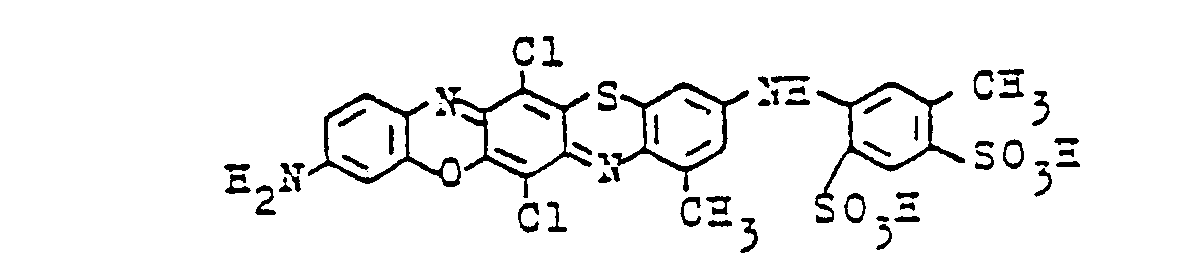
und kann zum Färben von synthetischen Polyamidfasern wie Perlon und Nylon 66 eingesetzt werden. Man erhält dann licht- und sehr naßechte klare Blautöne (C. I. Indicator Number 14). - 15,2 g der erhaltenen Disulfonsäure (berechnet auf salzfreie Substanz) werden in 300 ml Wasser bei 50° auf pH 8 gestellt. Man setzt 60 ml Dimethylformamid zu und kühlt auf 0-5° ab.
- Darauf läßt man die Lösung einer Reaktivkomponente, die nach Angaben des Beispiels 1 aus 11,3 g 2-Aminobenzol-1,4-disulfonsäure und 4,0 ml Cyanurfluorid hergestellt war, in 30 Minuten bei 0-5° zutropfen und hält den pH-Wert auf 5,8-6,3. Man steigert anschließend die Temperatur auf 20° und hält noch einige Stunden den pH-Wert, bis der Verbrauch an Sodalösung völlig zum Stillstand kommt. Der erhaltene Farbstoff wird mit Natriumchlorid ausgesalzen, abgesaugt und mit 10 %iger Natriumchloridlösung gewaschen. Er entspricht der Formel

und färbt Baumwolle aus langer Flotte in kräftigen, naßechten, rotstichigen Blautönen (C. I. Indicator Number 13). - 8,0 g Benzothiazinophenoxazin-Verbindung der Formel,

hergestellt durch Kondensation von 6-Nitro-1,2,4-trichlor-3H-phenoxazin-3-on mit 2-Amino-3-methyl-4-(2', 4', 6'-trimethyl-phenylamino)-thiophenol und nachfolgende Reduktion der Nitrogruppe des Kondensationsproduktes, werden in 40 ml 20 %iges Oleum bei 15-20° eingetragen. Man rührt etwa 4 Stunden bei dieser Temperatur weiter, gibt das Gemisch auf 400 g Eis, saugt die Fällung ab und wäscht den Filterkuchen mit 10 %iger Natriumchloridlösung sulfatfrei. Das Produkt wird bei 50° im Umluftschrank getrocknet. Es enthält gemäß Analyse zwei Sulfonsäuregruppen und entspricht damit der Formel
- Der Farbstoff ist geeignet zum Färben von synthetischen und natürlichen Polyamidfasern, wie Perlon, Nylon 66, Wolle und Seide, und gibt auf diesen Materialien klare, rotstichig blaue Färbungen.
- 9,2 g der erhaltenen Disulfonsäure (berechnet auf salzfreie Substanz) werden in 150 ml Wasser bei 50° bei pH 7-8 gelöst. Man kühlt auf 0-5° ab, läßt dann die Lösung einer Reaktivkomponente, die nach den Angaben des Beispiels 1 aus 5,8 g 2-Aminobenzol-1,4-disulfonsäure und 2,1 ml Cyanurfluorid hergestellt war, in 30 Minuten bei 0-5° zutropfen und hält den pH-Wert im Reaktionsgemisch mit 1 n Sodalösung auf 6,0-6,3. Nach 24 Stunden läßt man die Temperatur aud 20° ansteigen und hält weiterhin den pH-Wert bis kein weiterer Verbrauch an Sodalösung erfolgt. Die erhaltene Farbstofflösung wird dann mit 22% Kaliumchlorid allmählich versetzt, der ausgefällte Farbstoff abgesaugt, mit 25 %iger Kaliumchloridlösung gewaschen und im Vakuum bei 40° getrocknet. Er entspricht der Formel

und färbt Cellulosefasern in naßechten Blautönen (C. I. Indicator Number 14). - Setzt man im Beispiel 64 an Stelle der dort genannten Benzothiazinophenoxazin-Verbindung die äquivalente Menge eines Produktes der Formel

ein (hergestellt durch Kondensation von 7-Nitro-1,2,4-trichlor-3H-phenoxazin-3-on mit 2-Amino-3-methyl-4-(3'-methylphenylamino)-thiophenol und anschließende Reduktion der Nitrogruppe des Kondensationsproduktes) und führt die Sulfonierung nach den dortigen Angaben durch, so erhält man ein Produkt der Formel,
das synthetische Polyamidfasern wie Perlon und Nylon 66 in licht- und sehr naßechten Blautönen färbt. - Kondensiert man die erhaltene Disulfonsäure mit 2,4-Difluor-6-triazinyl-2-aminobenzol-1,4-disulfonsäure, wie im Beispiel 64 beschrieben, so erhält man einen Reaktivfarbstoff der Formel,

der Baumwolle ebenfalls in naßechten, rotstichigen Blautönen färbt (C. I. lndicator Number 13). - Weitere ähnliche Farbstoffe, die zum Färben von Cellulosefasern in rotstichig blauen Tönen angewandt werden können, lassen sich durch Kondensation der in Tabelle V, Spalte 2, angegebenen Benzothiazinophenoxazin-Komponenten mit den Reaktivkomponenten der Spalte 3 erhalten.


- 12,0 g Benzothiazinophenoxazin-Verbindung der Formel

werden in 60 ml Dimethylformamid gelöst und die Mischung bei 20° in 5 Minuten tropfenweise mit 3,0 ml 2,4,6-Trifluor-5-chlorpyrimidin versetzt. Man rührt den Ansatz 2 Stunden weiter, gibt ihn dann auf 500 ml Eis-Wasser, saugt das ausgefallene Kondensationsprodukt ab, wäscht es mit Wasser frei von Dimethylformamid und trocknet es im Umluftschrank bei 50°. Man erhält ein mit blauer Farbe in Dimethylformamid lösliches Zwischenprodukt (λmax = 624 nm). - 13,5 g dieses Zwischenproduktes werden bei Raumtemperatur in 60 ml 20 %iges Oleum eingetragen. Man läßt das Oleum, nachdem die Substanz völlig gelöst ist, noch 2 Stunden einwirken und gibt dann das Reaktionsgemisch auf 500 g Eis. Nach Zusatz von 50 g Natriumchlorid wird der Niederschlag abgesaugt und mit 25 %iger Natriumchloridlösung gewaschen. Man löst den Filterkuchen bei pH 6,5-7 in 400 ml Wasser und salzt den Farbstoff mit 120 g Natriumchlorid aus, saugt ihn ab und wäscht ihn mit 25 %iger Natriumchloridlösung. Der Farbstoff läßt sich durch die Formel

beschreiben und gibt blaue Färbungen mit guten Echtheitseigenschaften (C. I. lndicator Number 14). - 12,0 g Benzothiazinophenoxazin-Verbindung der Formel

werden in 80 ml Dimethylformamid gelöst. Zur Lösung werden bei 25° 3,0 ml 2,4,6-Trifluor-5-chlorpyrimi- din zugetropft. Man rührt den Ansatz 24 Stunden weiter, saugt das ausgefallene Kondensationsprodukt ab und wäscht es mit Methanol. Das erhaltene Produkt (λmax = 623 nm in DMF) wird bei 50-60° im Umluftschrank getrocknet und anschließend in 50 ml 20 %iges Oleum bei 15-20° eintragen. Ist die Sulfonierung nach einigen Stunden beendet, gibt man den Ansatz auf 400 g Eis, fügt 60 g Natriumchlorid hinzu, erwärmt unter Rühren auf 20° und saugt den ausgefällten Farbstoff scharf ab. - Der Filterkuchen wird in 100 ml Wasser suspendiert. Man bringt den Farbstoff durch Einstellen des pH-Wertes der Mischung auf 6,5 mittels verdünnter Natronlauge in Lösung und dampft die Lösung im Vakuum ein. Der als blaues Pulver so erhaltene Farbstoff enthält auf Grund analytischer Untersuchungen zwei Sulfonsäuregruppen und entspricht der Formel

(λmax = 610 nm in Wasser) Der Farbstoff färbt Cellulosefasern in neutralen naßechten Blautönen (C. I. Indicator Number 14). - Setzt man im Beispiel 85 an Stelle der dort angegebenen Benzothiazinophenoxazin-Verbindung 12 g der Komponente der Formel

ein und verfährt im übrigen wie dort beschrieben, so erhält man ein Kondensationsprodukt, das in Dimethylformamid ebenfalls mit blauer Farbe löslich ist (λmex = 631 nm in Dimethylformamid). - 12,3 g dieses Kondensationsproduktes werden in 60 ml 14 %iges Oleum bei 20° eingetragen. Nach vierstündiger Oleumeinwirkung gibt man das Reaktionsgemisch auf 500 g Eis, saugt die Fällung ab und wäscht den Filterkuchen mit 25%iger Natriumchloridlösung sulfatfrei. Der Farbstoff wird in 300 ml Wasser gelöst, durch Einstellen auf pH = 6,5 neutralisiert und aus der Lösung mit Kaliumchlorid ausgesalzen. Man saugt ihn ab, wäscht ihn mit 20 %iger Kaliumchloridlösung und trocknet. Der Farbstoff weist statistisch einen etwas geringeren Sulfonierungsgrad als der des Beispiels 85 auf und kann durch die Formel

wiedergegeben werden. Er färbt Baumwolle aus langer Flotte in naßechten Blautönen (C. I. Indicator Number 14). - Ähnliche Farbstoffe, die geeignet sind, auf Cellulosefasern licht- und naßechte blaue Färbungen (C. I. Indicator Number 14) zu erzielen, werden erhalten, wenn man folgende Benzothiazinophenoxazin-Komponenten und Reaktivkomponenten kondensiert und durch anschließende Sulfonierung n Sulfonsäuregruppen einführt. In der Tabelle VI bedeutet n die Zahl der eingeführten Sulfonsäuregruppen.


- 15,0 g Benzothiazinophenoxazin-Base der Formel

- 17 g des erhaltenen Kondensationsproduktes werden in 75 ml 20 %iges Oleum bei 15-20° eingetragen. Nach 8 Stunden gibt man die Lösung unter gleichmäßigem Rühren in 600 ml Wasser und erhitzt anschließend die entstandene Suspension am Rückflußkühler, bis eine chromatographische Probe vollständige Hydrolyse der Chloracetylaminogruppe anzeigt. Man kühlt die grünliche Suspension ab, saugt den Niederschlag ab, wäscht ihn mit verdünnter Salzsäure sulfatfrei und trocknet das Produkt, das der Formel

entspricht, bei 60° im Umluftschrank. - 17,2 g des erhaltenen Produktes werden in 300 ml Wasser suspendiert. Man stellt den pH-Wert auf 10 und setzt 100 ml Aceton zu und reguliert erneut den pH-Wert. Die Lösung der Reaktivkomponente, die entsprechend den Angaben des Beispiels 1 aus 8,4 g 2-Aminobenzol-1,4-disulfonsäure und 3,0 ml Cyanurfluorid bereitet wurde, wird in 30 Minuten bei 0-5° zur Lösung der Farbstoffkomponente zugetropft und der pH-Wert im Reaktionsgemisch mit 1 n-Natronlauge auf 7,5-8,0 gehalten. Man beläßt 5 Stunden weiter unter diesen Bedingungen und läßt die Temperatur dann unter pH-Kontrolle über Nacht auf 20° ansteigen. Die Farbstofflösung wird im Vakuum auf ca. 60 % ihres Volumens eingeengt und der Farbstoff durch Sättigen der verbleibenden Lösung mit Kaliumchlorid ausgefällt. Man saugt die Fällung ab und wäscht das Produkt mit 25 %iger Kaliumchloridlösung. Der Farbstoff wird bei 40° im Vakuum getrocknet. Er entspricht der Formel,

und ergibt auf Cellulosefasern klare, blaue Färbungen und Drucke, die durch gute Licht- und Naßechtheiten gekennzeichnet sind (C. I. Indicator Number 14). - Weitere blaue Reaktivfarbstoffe lassen sich herstellen, wenn man analog entsprechend substituierte Benzothiazinophenoxazin-Farbbasen mit N-Methylolchloracetamid, N-Methylolacetamid oder N-Methylolformamid kondensiert, anschließend sulfoniert oder diese beiden Schritte in umgekehrter Reihenfolge durchführt, schließlich verseift und die so gewonnenen aminomethylierten Benzothiazinophenoxazinsulfonsäuren der Spalte 2 in Tabelle VII mit den Reaktivkomponenten der Spalte 3 umsetzt.


- 11,7 g Disulfonsäure aus Beispiel 64 der Formel


und färbt Baumwolle in licht- und naßechten Blautönen (C. I. Indicator Number 13). - Ein ähnlicher Farbstoff wird erhalten, wenn man anstelle der oben eingesetzten Amino-m-toluidinobenzothiazino-phenoxazindisulfonsäure die bezüglich der Aminogruppe isomere Disulfonsäure des Beispiels 66 in äquivalenter Menge einsetzt.
- Ein dem Farbstoff des Beispiels 1 ähnlicher Reaktivfarbstoff läßt sich erhalten, wenn man an Stelle der dort eingesetzten Amino-arylamino-benzothiazinophenoxazin-Verbindung die bezüglich der Aminogruppe isomere Verbindung

zur Sulfonierung einsetzt und die erhaltene sulfonierte Verbindung mit 2,4-Difluor-6-triazinyl-2-aminobenzol-1,4-disulfonsäure im Molverhältnis 1 : 1 kondensiert. Man erhält dann einen Farbstoff der ungefähren Zusammensetzung
der Baumwolle in ähnlich blauen Tönen licht- und naßecht färbt wie der Farbstoff des Beispiels 1 (C. I. Indicator Number 14). - 12,0 g Farbstoffkomponente der Formel


ergibt auf Cellulosefasern licht- und naßechte blaue Färbungen und Drucke (C. I. Indicator Number 14). - Analog erhält man weitere, für das Färben und Bedrucken von Cellulosefasern geeignete blaue Reaktivfarbstoffe, wenn man die Benzothiazinophenoxazin-Verbindungen in Spalte 2 der Tabelle VIII mit den Reaktivkomponenten der Spalte 3 im Molverhältnis 1 : 2 kondensiert.
-

sowie deren Verwendung zum Färben und Bedrucken von hydroxylgruppenhaltigen und amidgruppenhaltigen natürlichen und synthetischen Materialien.
mit gegebenenfalls substituierten 2-Aminothiophenolen der Formel


und erforderlichenfalls anschließende Umwandlung des Restes R12 und/oder R,3 in den Rest NH2 bzw.

Claims (2)


Applications Claiming Priority (2)
| Application Number | Priority Date | Filing Date | Title |
|---|---|---|---|
| DE3330547 | 1983-08-24 | ||
| DE3330547A DE3330547A1 (de) | 1983-08-24 | 1983-08-24 | Benzthiazinophenoxazin-farbstoffe |
Publications (2)
| Publication Number | Publication Date |
|---|---|
| EP0134033A1 EP0134033A1 (de) | 1985-03-13 |
| EP0134033B1 true EP0134033B1 (de) | 1987-07-08 |
Family
ID=6207335
Family Applications (1)
| Application Number | Title | Priority Date | Filing Date |
|---|---|---|---|
| EP84109630A Expired EP0134033B1 (de) | 1983-08-24 | 1984-08-13 | Benzthiazinophenoxazin-Farbstoffe |
Country Status (3)
| Country | Link |
|---|---|
| EP (1) | EP0134033B1 (de) |
| JP (1) | JPS6065067A (de) |
| DE (2) | DE3330547A1 (de) |
Families Citing this family (10)
| Publication number | Priority date | Publication date | Assignee | Title |
|---|---|---|---|---|
| GB2166148B (en) * | 1984-10-25 | 1988-08-10 | Sandoz Ltd | Oxazine dyestuffs containing basic groups |
| DE3723459A1 (de) * | 1987-07-16 | 1989-02-02 | Bayer Ag | Reaktivfarbstoffe |
| EP0356014B1 (de) * | 1988-08-17 | 1994-11-30 | Zeneca Limited | Reaktivfarbstoffe |
| DE3832531A1 (de) * | 1988-09-24 | 1990-03-29 | Bayer Ag | Direktfarbstoffe |
| GB9022540D0 (en) * | 1989-11-16 | 1990-11-28 | Ici Plc | Compound |
| GB8925900D0 (en) * | 1989-11-16 | 1990-01-04 | Ici Plc | Reactive dyes |
| EP0655061B2 (de) * | 1992-08-12 | 2006-07-26 | Clariant Finance (BVI) Limited | Verfahren zur erhöhung des sonnenschutzfaktors und verbindungen gerignet zur erhöhung des sonnenschutzfaktors von fasern und geweben |
| AU742388B2 (en) * | 1996-12-24 | 2002-01-03 | Chugai Seiyaku Kabushiki Kaisha | Aromatic amine derivatives having nos inhibiting action |
| TW506993B (en) | 1999-03-15 | 2002-10-21 | Ciba Sc Holding Ag | Reactive dyes, processes for their preparation and process for dyeing or printing a fibre material |
| EP1036825B1 (de) * | 1999-03-15 | 2004-05-06 | Ciba SC Holding AG | Reaktivfarbstoffe, Verfahren zu deren Herstellung und deren Verwendung |
Family Cites Families (2)
| Publication number | Priority date | Publication date | Assignee | Title |
|---|---|---|---|---|
| DE639207C (de) * | 1933-07-14 | 1936-12-01 | I G Farbenindustrie Akt Ges | Verfahren zur Herstellung von Verbindungen der Oxazinreihe |
| GB1450746A (en) * | 1974-01-31 | 1976-09-29 | Ici Ltd | Tripendioxazine dyestuffs |
-
1983
- 1983-08-24 DE DE3330547A patent/DE3330547A1/de not_active Withdrawn
-
1984
- 1984-08-13 DE DE8484109630T patent/DE3464622D1/de not_active Expired
- 1984-08-13 EP EP84109630A patent/EP0134033B1/de not_active Expired
- 1984-08-21 JP JP59172540A patent/JPS6065067A/ja active Pending
Also Published As
| Publication number | Publication date |
|---|---|
| EP0134033A1 (de) | 1985-03-13 |
| JPS6065067A (ja) | 1985-04-13 |
| DE3464622D1 (de) | 1987-08-13 |
| DE3330547A1 (de) | 1985-03-21 |
Similar Documents
| Publication | Publication Date | Title |
|---|---|---|
| EP0053743B1 (de) | Dioxazin-Reaktivfarbstoffe, Verfahren zu ihrer Herstellung und ihre Verwendung zum Färben und Bedrucken von hydroxyl- oder amidgruppenhaltigen Fasermaterialien | |
| EP0199036B1 (de) | Triphendioxazin-Farbstoffe | |
| EP0144580B1 (de) | Triphendioxazin-Farbstoffe | |
| EP0197418B1 (de) | Azoreaktivfarbstoffe | |
| EP0134033A1 (de) | Benzthiazinophenoxazin-Farbstoffe | |
| EP0158857B1 (de) | Reaktive Dichlorotriphendioxazinfarbstoffe | |
| EP0120255A1 (de) | Reaktivfarbstoffe | |
| EP0299328B1 (de) | Reaktivfarbstoffe | |
| DE2132963C3 (de) | Wasserlösliche, reaktive Xanthenfarbstoffe, ihre Herstellung und ihre Verwendung | |
| EP0204245B1 (de) | Reaktivfarbstoffe | |
| DE2455615A1 (de) | Reaktivfarbstoffe | |
| EP0272532B1 (de) | Farbstoffe | |
| EP0349848B1 (de) | Triphendioxazin-Farbstoffe | |
| EP0153480A2 (de) | Reaktivfarbstoffe der Diarylaminoxanthen-Reihe, ihre Herstellung und Verwendung | |
| EP0043561A2 (de) | Wasserlösliche Phthalocyaninverbindungen, Verfahren zu ihrer Herstellung und ihre Verwendung als Farbstoffe | |
| EP0158110B1 (de) | Triphendioxazinfarbstoffe | |
| EP0201026B1 (de) | Metallkomplex-Farbstoffe | |
| EP0190603B1 (de) | Aminoalkylensulfon-triphendioxazin-Farbstoffe | |
| DE4418992A1 (de) | Neue Reaktivfarbstoffe, deren Herstellung und Verwendung | |
| EP0379905A1 (de) | Reaktivfarbstoffe | |
| EP0012342A1 (de) | Anthrachinon-Reaktivfarbstoffe und deren Verwendung beim Färben und Bedrucken von hydroxyl- oder amidgruppenhaltigen Materialien | |
| EP0205080B1 (de) | Triphendioxazin-disulfimid-Reaktivfarbstoffe | |
| EP0338310B1 (de) | Reaktivfarbstoffe | |
| EP0190615A2 (de) | Reaktivfarbstoffe | |
| EP0128316A1 (de) | Disazoreaktivfarbstoffe |
Legal Events
| Date | Code | Title | Description |
|---|---|---|---|
| PUAI | Public reference made under article 153(3) epc to a published international application that has entered the european phase |
Free format text: ORIGINAL CODE: 0009012 |
|
| 17P | Request for examination filed |
Effective date: 19840813 |
|
| AK | Designated contracting states |
Designated state(s): CH DE FR GB LI |
|
| GRAA | (expected) grant |
Free format text: ORIGINAL CODE: 0009210 |
|
| AK | Designated contracting states |
Kind code of ref document: B1 Designated state(s): CH DE FR GB LI |
|
| ET | Fr: translation filed | ||
| REF | Corresponds to: |
Ref document number: 3464622 Country of ref document: DE Date of ref document: 19870813 |
|
| PLBE | No opposition filed within time limit |
Free format text: ORIGINAL CODE: 0009261 |
|
| STAA | Information on the status of an ep patent application or granted ep patent |
Free format text: STATUS: NO OPPOSITION FILED WITHIN TIME LIMIT |
|
| 26N | No opposition filed | ||
| PGFP | Annual fee paid to national office [announced via postgrant information from national office to epo] |
Ref country code: DE Payment date: 19940714 Year of fee payment: 11 |
|
| PGFP | Annual fee paid to national office [announced via postgrant information from national office to epo] |
Ref country code: GB Payment date: 19940804 Year of fee payment: 11 |
|
| PGFP | Annual fee paid to national office [announced via postgrant information from national office to epo] |
Ref country code: CH Payment date: 19940812 Year of fee payment: 11 |
|
| PGFP | Annual fee paid to national office [announced via postgrant information from national office to epo] |
Ref country code: FR Payment date: 19940824 Year of fee payment: 11 |
|
| PG25 | Lapsed in a contracting state [announced via postgrant information from national office to epo] |
Ref country code: GB Effective date: 19950813 |
|
| PG25 | Lapsed in a contracting state [announced via postgrant information from national office to epo] |
Ref country code: LI Effective date: 19950831 Ref country code: CH Effective date: 19950831 |
|
| GBPC | Gb: european patent ceased through non-payment of renewal fee |
Effective date: 19950813 |
|
| REG | Reference to a national code |
Ref country code: CH Ref legal event code: PL |
|
| PG25 | Lapsed in a contracting state [announced via postgrant information from national office to epo] |
Ref country code: FR Effective date: 19960430 |
|
| PG25 | Lapsed in a contracting state [announced via postgrant information from national office to epo] |
Ref country code: DE Effective date: 19960501 |
|
| REG | Reference to a national code |
Ref country code: FR Ref legal event code: ST |