EP0379931A2 - Fabrikationsleisten für die Schuhfertigung auf einer computergesteuerten Transferstrasse - Google Patents
Fabrikationsleisten für die Schuhfertigung auf einer computergesteuerten Transferstrasse Download PDFInfo
- Publication number
- EP0379931A2 EP0379931A2 EP90100804A EP90100804A EP0379931A2 EP 0379931 A2 EP0379931 A2 EP 0379931A2 EP 90100804 A EP90100804 A EP 90100804A EP 90100804 A EP90100804 A EP 90100804A EP 0379931 A2 EP0379931 A2 EP 0379931A2
- Authority
- EP
- European Patent Office
- Prior art keywords
- fork
- last
- strips according
- strip
- metal part
- Prior art date
- Legal status (The legal status is an assumption and is not a legal conclusion. Google has not performed a legal analysis and makes no representation as to the accuracy of the status listed.)
- Granted
Links
Images

Classifications
-
- A—HUMAN NECESSITIES
- A43—FOOTWEAR
- A43D—MACHINES, TOOLS, EQUIPMENT OR METHODS FOR MANUFACTURING OR REPAIRING FOOTWEAR
- A43D23/00—Single parts for pulling-over or lasting machines
- A43D23/02—Wipers; Sole-pressers; Last-supports; Pincers
- A43D23/025—Last-supports
-
- A—HUMAN NECESSITIES
- A43—FOOTWEAR
- A43D—MACHINES, TOOLS, EQUIPMENT OR METHODS FOR MANUFACTURING OR REPAIRING FOOTWEAR
- A43D3/00—Lasts
- A43D3/02—Lasts for making or repairing shoes
- A43D3/024—Lasts with a fore part and heel section relatively slideable to one another along an inclined line of cut
-
- A—HUMAN NECESSITIES
- A43—FOOTWEAR
- A43D—MACHINES, TOOLS, EQUIPMENT OR METHODS FOR MANUFACTURING OR REPAIRING FOOTWEAR
- A43D3/00—Lasts
- A43D3/02—Lasts for making or repairing shoes
- A43D3/027—Lasts with exchangeable parts, e.g. for changing the form or for remodelling
Definitions
- the invention relates to a production last for shoe manufacture on a computer-controlled transfer line which is equipped with robots and automatic processing machines, according to the preamble of claim 1.
- the sliding strips and the folding strips are currently used in shoe manufacturing: the sliding strips and the folding strips. These each have a toe part and a heel part, which are movably coupled to one another by means of a hinge.
- a spring built into the hinge ensures that the heel and toe parts are in a fixed position with respect to one another in the closed position of the last.
- the purpose of the hinge is to shorten the effective last length by the relative movement of the last parts so that the finished shoe can be finished.
- the strips In order to ensure a smooth process in such production lines, the strips must also be precisely positioned and adjustable. However, this is not possible with strips made of plastic, as they are often used, because these plastics tend to creep.
- the present invention is therefore based on the object of specifying a production strip suitable for use in computer-controlled transfer lines, which, with lower actuation forces, permits a greater shortening of the effective last length without overstretching the shoe, permits exact adjustment of the releasable connecting members and is adapted to a boot production without problems can be.
- the length of the elongated hole or the long groove which can be set as desired, in conjunction with the inclination of the cutting surface between the two strip parts, which can also be selected in principle, can result in a practically arbitrary reduction in the effective length of the strip, but that Actuating force itself can be chosen independently and adjusted solely by the strength of the spring and that the closure structure is simple, inexpensive and reliable.
- Lasts made of plastic are often used in the manufacture of shoes. If you screw the connecting elements, which are responsible for the detachable positioning of the last at the individual processing stations of the transfer line, to the plastic, they change their position uncontrollably due to the plastic properties. Malfunctions occur. However, this can be prevented if the last is further developed according to the features of claims 9 and 10, respectively.
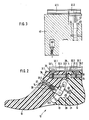
- a fabrication last 10 consisting of a tip part 11, a heel part 12 and a closure 20.
- the intersection between the two strip parts 11, 12 is identified by reference number 13.
- the tip part 11 of the last 10 has a vertical, recessed groove 15 in the area of the cut surface 13.
- a flat metal part 21 is fastened in this by means of screws 29.
- the flat metal part 21 has an elongated hole 22 which extends essentially parallel to the cutting surface 13.
- the elongated hole 22 has a latching groove 26 at its upper end, which effects the later closed position of the last 10.
- a stepped bore 14 is provided in the heel part 12 of the last 10. A fork 23 is guided in this.
- the fork 23 has a fork head 23.1, the two legs of which overlap the flat metal part 21.
- a cross pin 24 is mounted in the fork head 23.1, on which a roller 25 is rotatably fastened.
- the cross pin 24 with roller 25 extends through the elongated hole 22 and in this way holds the two strip parts 11, 12 together.
- the roller 25 runs along the wall of the elongated hole 22 when the two strip parts 11, 12 are moved against each other.
- the elongated hole 22 and the transverse pin 24 can be replaced by two elongated grooves, in each of which a transverse pin engages.
- the shaft 23.2 of the fork 23 carries a spiral spring 27 which is supported against a metal sleeve 28 screwed into the stepped bore 14.
- the spring 27 is designed as a compression spring.
- the locking groove 26 would have to be formed in the elongated hole 22 on the other side.
- the flat metal part 21 can also be spring-mounted.
- Elongated hole 22 and fork 23 are approximately perpendicular to each other. In this way, the force required to move the last parts 11, 12 is minimal after overcoming the locking position, but the holding force of the last parts 11, 12 against one another is maximal.
- FIG. 2 shows an embodiment in which the flat metal part 21 is mounted in the heel part 12, the fork 23 in the tip part 11 of the last 10.
- the advantage of this embodiment is that the shaft 23.2 of the fork 23 is accessible even when a shoe shaft is attached.
- a two-part mounting plate 30.1, 30.2 is fastened on the tip part 11 and the heel part 12 of the last 10.
- This receiving plate 30 is used for the detachable connection of the last 10 with the respective processing station of the transfer line.
- the receiving plate 30 In order to ensure that the transfer line runs smoothly, the receiving plate 30 must be positioned exactly. If, as is often the case, the last 10 is made of plastic, the required accuracy of the adjustment of the mounting plate 30 cannot be guaranteed in the long run, since the plastics used to produce the last 10 tend to creep. For this reason, a bore 31.1, 31.2 is made in the toe part 11 and the heel part 12 under the receiving plate 30 and parallel thereto.
- a metal part 32.1, 32.2 here in the form of a fine-thread rod, is inserted into each of these bores 31.
- the metal part 32.1, 32.2 has transverse threaded holes 34. Below the receiving plate 30 are in the area of the threaded holes 34 Connecting holes 35 are introduced with a relatively large cross section. The fastening screws 33.1, 33.2 are inserted through these and screwed into the threaded bores 34 of the metal parts 32.1, 32.2.
- Fig. 3 shows a boot construction as it is used when boots are to be produced on the transfer line instead of low shoes.
- the boot structure 40 consists of a metal body, preferably of aluminum. It is screwed to the last 10 instead of the mounting plate 30. A comparable mounting plate 41.1 is screwed onto its top. Since the boot structure 40 is made of metal, the adjustment of the mounting plate 41.1 to the boot structure 40 which has been set once remains unchanged.
- the rear part 41.2 of the mounting plate 41 is screwed to a connecting bolt 42.
- This is mounted so that it can move longitudinally in a bore in the boot structure 40.
- the connecting bolt 42 has a longitudinal slot 43 through which a cross pin 44 is inserted.
- a pivot bearing 45 can be seen, on which a connecting screw 46.2 then engages, which is screwed to the heel part 12 of the last 10.
- the strip 10 can be opened and closed via the rear part 41.2 of the mounting plate 41.
- the boot structure 40 is screwed to the tip part 11 of the last 10 by means of connecting screws 46.1.
Landscapes
- Footwear And Its Accessory, Manufacturing Method And Apparatuses (AREA)
- Control Of Conveyors (AREA)
- Multi-Process Working Machines And Systems (AREA)
- Electric Cable Installation (AREA)
- Injection Moulding Of Plastics Or The Like (AREA)
Abstract
Description
- Die Erfindung betrifft einen Fabrikationsleisten für die Schuhfertigung auf einer computergesteuerten Transferstraße, die mit Robotern und automatischen Bearbeitungsmaschinen bestückt ist, gemäß dem Oberbegriff des Anspruchs 1.
- Zur Zeit sind zwei Arten von Fabrikationsleisten in der Schuhfertigung gebräuchlich: der Schiebeleisten und der Klappleisten. Diese besitzen je ein Spitzenteil und ein Fersenteil, die mittels eines Scharniers beweglich miteinander gekoppelt sind. Eine in das Scharnier eingebaute Feder sorgt dafür, daß Fersen- und Spitzenteil in der Schließstellung des Leistens eine fixe Position zueinander einnehmen.
- Der Sinn des Scharniers besteht darin, durch die Relativbewegung der Leistenteile die effektive Leistenlänge zu verkürzen, um den fertigen Schuh ausleisten zu können.
- Um die beiden Leistenteile mit Hilfe des Scharniers gegeneinander bewegen zu können, werden erhebliche Kräfte benötigt, um die Kraft der eingebauten Feder zu überwinden. Die hohe Federkraft ist jedoch erforderlich, um einen ausreichend stabilen Halt der beiden Leistenteile in der Schließstellung des Leistens zu erreichen.
- Hinzu kommt als weiterer Nachteil, daß bei den handelsüblichen Scharnierkonstruktionen nur eine relativ kleine Verkürzung der effektiven Leistenlänge erreichbar ist. Diese reicht zwar aus, um den fertigen Schuh von Hand ausleisten zu können. Sie reicht jedoch nicht aus, um diese Arbeit von einfachen mechanischen Vorrichtungen oder auch von Handhabungsautomaten ausführen zu lassen, wie sie in modernen computergesteuerten Fertigungsstraßen verwendet werden (DE-A- 38 04 538).
- Um einen reibungslosen Ablauf in solchen Fertigungsstraßen zu gewährleisten, müssen auch die Leisten exakt positionierbar und justierbar sein. Dies ist jedoch bei Leisten aus Kunststoff, wie sie gern verwendet werden, nicht möglich, weil diese Kunststoffe zum Kriechen neigen.
- Schließlich wäre noch darauf hinzuweisen, daß zur Herstellung von Halbschuhen einerseits und Stiefeln andererseits unterschiedlich hohe Leisten verwendet werden, was eine doppelte Lagerhaltung zur Folge hat.
- Der vorliegenden Erfindung liegt deshalb die Aufgabe zugrunde, einen für den Einsatz in computergesteuerten Transferstraßen geeigneten Fabrikationsleisten anzugeben, der bei geringeren Betätigungskräften eine stärkere Verkürzung der effektiven Leistenlänge ohne Überdehnung des Schuhs zuläßt, eine exakte Justierung der lösbaren Verbindungsorgane gestattet und ohne Probleme an eine Stiefelfertigung angepaßt werden kann.
- Gelöst wird diese Aufgabe durch einen gattungsgemäßen Leisten mit den kennzeichnenden Merkmalen des Anspruchs 1.
- Die wesentlichen Vorteile dieser Konstruktion bestehen darin, daß durch die beliebig einzustellende Länge des Langlochs bzw. der Langnut in Verbindung mit der ebenfalls prinzipiell beliebig wählbaren Neigung der Schnittfläche zwischen den beiden Leistenteilen eine praktisch beliebig starke Verkürzung der effektiven Leistenlänge erreicht werden kann, daß jedoch die Betätigungskraft selbst hiervon unabhängig gewählt und allein durch die Stärke der Feder eingestellt werden können und daß die Verschlußkonstruktion einfach, preiswert und betriebssicher ist.
- Bei der Fertigung von Schuhen werden gerne Leisten aus Kunststoff eingesetzt. Verschraubt man die Verbindungsorgane, die für die lösbare Positionierung des Leistens an den einzelnen Bearbeitungsstationen der Transferstraße verantwortlich sind, mit dem Kunststoff, verändern sie aufgrund der Kunststoffeigenschaften unkontrollierbar ihre Position. Es kommt zu Betriebsstörungen. Dem kann jedoch vorgebeugt werden, wenn der Leisten gemäß den Merkmalen der Ansprüche 9 bzw. 10 weitergebildet wird.
- Um die zunächst für die Fabrikation von Halbschuhen bestimmten Leisten auch bei einer Produktion von Stiefeln einsetzen zu können, empfiehlt sich die Verwendung eines gesonderten Stiefelaufbaus, wie er in den Ansprüchen 11 bis 13 definiert ist.
- Weitere Ausgestaltungen der Erfindung ergeben sich aus den Unteransprüchen in Verbindung mit der nachfolgenden Beschreibung von Ausführungsbeispielen. Es zeigen
- Fig. 1 eine teilweise aufgebrochene, perspektivische Darstellung eines Leistens nach der Erfindung als Sprengbild,
- Fig. 2 eine schematische Seitenansicht einer weiteren Ausführungsform eines Leistens und
- Fig. 3 eine schematische Seitenansicht eines bei Bedarf einzusetzenden Stiefelaufbaus.
- In Fig. 1 erkennt man einen Fabrikationsleisten 10, bestehend aus einem Spitzenteil 11, einem Fersenteil 12 und einem Verschluß 20. Die Schnittfläche zwischen den beiden Leistenteilen 11, 12 ist mit dem Bezugszeichen 13 gekennzeichnet. Das Spitzenteil 11 des Leistens 10 weist im Bereich der Schnittfläche 13 eine senkrechte, vertiefte Nut 15 auf. In dieser ist ein flaches Metallteil 21 mit Hilfe von Schrauben 29 befestigt. Das flache Metallteil 21 besitzt ein Langloch 22, das sich im wesentlichen parallel zur Schnittfläche 13 erstreckt. Das Langloch 22 weist an seinem oberen Ende eine Rastnut 26 auf, die die spätere Schließstellung des Leistens 10 bewirkt.
- Im Fersenteil 12 des Leistens 10 ist eine Stufenbohrung 14 vorgesehen. In dieser ist eine Gabel 23 geführt.
- Die Gabel 23 besitzt einen Gabelkopf 23.1, dessen beiden Schenkel das flache Metallteil 21 übergreifen. Im Gabelkopf 23.1 ist ein Querstift 24 gelagert, auf dem eine Rolle 25 drehbar befestigt ist. Der Querstift 24 mit Rolle 25 greift durch das Langloch 22 hindurch und hält auf diese Weise die beiden Leistenteile 11, 12 zusammen. Die Rolle 25 läuft dabei auf der Wand des Langlochs 22 entlang, wenn die beiden Leistenteile 11, 12 gegeneinander bewegt werden.
- Es versteht sich, daß Langloch 22 und Querstift 24 ersetzt werden können durch zwei Langnuten, in die je ein Querzapfen eingreift.
- Der Schaft 23.2 der Gabel 23 trägt eine Spiralfeder 27, die sich gegen eine in die Stufenbohrung 14 eingeschraubte Metallhülse 28 abstützt.
- Im vorliegenden Ausführungsbeispiel ist die Feder 27 als Druckfeder ausgebildet. Bei Verwendung einer Zugfeder müßte die Rastnut 26 im Langloch 22 nach der anderen Seite ausgebildet sein.
- Es versteht sich, daß alternativ auch das flache Metallteil 21 federnd gelagert sein kann.
- Langloch 22 und Gabel 23 stehen etwa senkrecht zueinander. Auf diese Weise ist die zum Verschieben der Leistenteile 11, 12 benötigte Kraft nach Überwinden der Raststellung minimal, die Haltekraft der Leistenteile 11, 12 gegeneinander jedoch maximal.
- Die Fig. 2 zeigt eine Ausführungsform, bei der das flache Metallteil 21 im Fersenteil 12, die Gabel 23 im Spitzenteil 11 des Leistens 10 gelagert sind. Der Vorteil dieser Ausführungsform liegt darin, daß der Schaft 23.2 der Gabel 23 auch dann zugänglich ist, wenn ein Schuhschaft aufgeleistet ist.
- Auf dem Spitzenteil 11 und dem Fersenteil 12 des Leistens 10 ist eine zweigeteilte Aufnahmeplatte 30.1, 30.2 befestigt. Diese Aufnahmeplatte 30 dient zur lösbaren Verbindung des Leistens 10 mit der jeweiligen Bearbeitungsstation der Transferstraße. Um einen einwandfreien Betriebsablauf der Transferstraße zu gewährleisten, muß die Aufnahmeplatte 30 exakt positioniert sein. Besteht der Leisten 10 wie vielfach üblich aus Kunststoff, ist die erforderliche Exaktheit der Justierung der Aufnahmeplatte 30 auf Dauer nicht zu gewährleisten, da die zur Herstellung der Leisten 10 verwendeten Kunstsstoffe zum Kriechen neigen. Aus diesem Grunde ist unter der Aufnahmeplatte 30 und parallel zu dieser je eine Bohrung 31.1, 31.2 in das Spitzenteil 11 bzw. das Fersenteil 12 eingebracht. In diese Bohrungen 31 ist je ein Metallteil 32.1, 32.2, hier in Form einer Feingewindestange, eingesetzt. Das Metallteil 32.1, 32.2 besitzt querlaufende Gewindebohrungen 34. Unterhalb der Aufnahmeplatte 30 sind im Bereich der Gewindebohrungen 34 Verbindungsbohrungen 35 mit relativ großem Querschnitt eingebracht. Durch diese werden die Befestigungsschrauben 33.1, 33.2 hindurchgesteckt und in den Gewindebohrungen 34 der Metallteile 32.1, 32.2 verschraubt.
- Fig. 3 zeigt einen Stiefelaufbau, wie er verwendet wird, wenn auf der Transferstraße statt Halbschuhen Stiefel produziert werden sollen.
- Der Stiefelaufbau 40 besteht aus einem Metallkörper, vorzugsweise aus Aluminium. Er wird anstelle der Aufnahmeplatte 30 mit dem Leisten 10 verschraubt. An seiner Oberseite ist eine vergleichbare Aufnahmeplatte 41.1 angeschraubt. Da der Stiefelaufbau 40 aus Metall besteht, bleibt die einmal eingestellte Justierung der Aufnahmeplatte 41.1 zum Stiefelaufbau 40 unveränderlich erhalten.
- Das Rückteil 41.2 der Aufnahmeplatte 41 ist mit einem Verbindungsbolzen 42 verschraubt. Dieser ist in einer Bohrung des Stiefelaufbaus 40 längsbeweglich gelagert. Um eine Verdrehsicherung zu erreichen, besitzt der Verbindungsbolzen 42 einen Längsschlitz 43, durch den ein Querstift 44 hindurchgesteckt ist.
- Am unteren Ende des Verbindungsbolzens 42 erkennt man ein Schwenklager 45, an dem dann eine Verbindungsschraube 46.2 angreift, die mit dem Fersenteil 12 des Leistens 10 verschraubt wird. Dadurch kann der Leisten 10 über den rückwärtigen Teil 41.2 der Aufnahmeplatte 41 geöffnet und geschlossen werden. Der Stiefelaufbau 40 wird im übrigen mittels Verbindungsschrauben 46.1 mit dem Spitzenteil 11 des Leistens 10 verschraubt.
- Abschließend soll noch darauf hingewiesen werden, daß die Schnittfläche 13 zwischen den beiden Leistenteilen 11, 12 praktisch jede beliebige Winkelstellung und Kurvenform erhalten kann. In allen Fällen muß lediglich dafür gesorgt werden, daß das Langloch 22 sich im wesentlichen parallel zur Schnittfläche 13 erstreckt.
Claims (13)
Applications Claiming Priority (2)
| Application Number | Priority Date | Filing Date | Title |
|---|---|---|---|
| DE8900722U | 1989-01-24 | ||
| DE8900722U DE8900722U1 (de) | 1989-01-24 | 1989-01-24 | Fabrikationsleisten für die Schuhfertigung |
Publications (3)
| Publication Number | Publication Date |
|---|---|
| EP0379931A2 true EP0379931A2 (de) | 1990-08-01 |
| EP0379931A3 EP0379931A3 (de) | 1992-01-15 |
| EP0379931B1 EP0379931B1 (de) | 1994-12-21 |
Family
ID=6835309
Family Applications (1)
| Application Number | Title | Priority Date | Filing Date |
|---|---|---|---|
| EP90100804A Expired - Lifetime EP0379931B1 (de) | 1989-01-24 | 1990-01-16 | Fabrikationsleisten für die Schuhfertigung auf einer computergesteuerten Transferstrasse |
Country Status (8)
| Country | Link |
|---|---|
| US (1) | US5054147A (de) |
| EP (1) | EP0379931B1 (de) |
| AT (1) | ATE115837T1 (de) |
| DD (1) | DD291690A5 (de) |
| DE (2) | DE8900722U1 (de) |
| DK (1) | DK0379931T3 (de) |
| ES (1) | ES2067571T3 (de) |
| PT (1) | PT92927A (de) |
Families Citing this family (9)
| Publication number | Priority date | Publication date | Assignee | Title |
|---|---|---|---|---|
| TW249196B (de) * | 1993-07-23 | 1995-06-11 | James L Throneburg | |
| US5335517A (en) * | 1993-07-23 | 1994-08-09 | James L. Throneburg | Anatomical isotonic sock and method of knitting the same |
| USD374553S (en) | 1995-02-28 | 1996-10-15 | James L. Throneburg | Shoe last |
| US5881413A (en) * | 1995-02-28 | 1999-03-16 | James L. Throneburg | Shoe last and method of constructing a shoe |
| US5714098A (en) * | 1995-12-20 | 1998-02-03 | Nike, Inc. | Footwear fitting method |
| FR2832909B1 (fr) * | 2001-12-03 | 2004-04-02 | Actis Ets | Forme avec dispositif de prehension, pour la fabrication de chaussures |
| AUPS207602A0 (en) * | 2002-05-02 | 2002-06-06 | Blundstone Pty Limited | A last locking device |
| FR2854032B1 (fr) * | 2003-04-25 | 2005-05-27 | Actis Ets | Forme en plusieurs parties pour la fabrication de chaussures |
| CN108652133A (zh) * | 2017-03-27 | 2018-10-16 | 涂火龙鞋楦股份有限公司 | 运用于自动化工艺的鞋楦制作方法 |
Family Cites Families (16)
| Publication number | Priority date | Publication date | Assignee | Title |
|---|---|---|---|---|
| DE1068156B (de) * | 1959-10-29 | |||
| US851968A (en) * | 1902-01-06 | 1907-04-30 | Walter E Trufant | Last. |
| US909388A (en) * | 1907-11-02 | 1909-01-12 | Fitz Double Pivot Las Company | Last. |
| US1192257A (en) * | 1916-02-11 | 1916-07-25 | United Shoe Machinery Ab | Last. |
| US1500106A (en) * | 1919-04-17 | 1924-07-08 | United Shoe Machinery Corp | Last |
| US1664293A (en) * | 1927-03-23 | 1928-03-27 | Gubitosi Sabino | Sectional last |
| US1828640A (en) * | 1929-04-04 | 1931-10-20 | Albert W Bennett | Collapsible shoe last |
| US2037915A (en) * | 1935-02-18 | 1936-04-21 | St Louis Cutting Die Company I | Instep increaser |
| US2062557A (en) * | 1935-03-26 | 1936-12-01 | George C Clark | Shoe last |
| US2111512A (en) * | 1936-02-01 | 1938-03-15 | J F Mcelwain Co | Last |
| US2684493A (en) * | 1952-07-23 | 1954-07-27 | Vulcan Corp | Shoe last |
| US2806233A (en) * | 1955-09-26 | 1957-09-17 | United Shoe Machinery Corp | Lasts |
| GB889838A (en) * | 1958-05-21 | 1962-02-21 | Strode Components Ltd | Improvements relating to lasts |
| US3076213A (en) * | 1961-06-20 | 1963-02-05 | United Shoe Machinery Corp | Lasts |
| US4286348A (en) * | 1979-09-05 | 1981-09-01 | White Sr Thomas P | Shoe last conversion assembly for lasting boots |
| DE3804583C2 (de) * | 1988-02-13 | 1994-02-10 | Psb Foerderanlagen | Transferstraße für die Schuhfabrikation |
-
1989
- 1989-01-24 DE DE8900722U patent/DE8900722U1/de not_active Expired
-
1990
- 1990-01-16 AT AT90100804T patent/ATE115837T1/de not_active IP Right Cessation
- 1990-01-16 ES ES90100804T patent/ES2067571T3/es not_active Expired - Fee Related
- 1990-01-16 DK DK90100804.5T patent/DK0379931T3/da active
- 1990-01-16 DE DE59008043T patent/DE59008043D1/de not_active Expired - Fee Related
- 1990-01-16 EP EP90100804A patent/EP0379931B1/de not_active Expired - Lifetime
- 1990-01-23 PT PT92927A patent/PT92927A/pt not_active Application Discontinuation
- 1990-01-23 DD DD90337277A patent/DD291690A5/de not_active IP Right Cessation
- 1990-01-23 US US07/468,562 patent/US5054147A/en not_active Expired - Fee Related
Also Published As
| Publication number | Publication date |
|---|---|
| ES2067571T3 (es) | 1995-04-01 |
| EP0379931B1 (de) | 1994-12-21 |
| DE8900722U1 (de) | 1989-03-09 |
| EP0379931A3 (de) | 1992-01-15 |
| PT92927A (pt) | 1991-09-30 |
| DD291690A5 (de) | 1991-07-11 |
| US5054147A (en) | 1991-10-08 |
| DK0379931T3 (da) | 1995-05-22 |
| ATE115837T1 (de) | 1995-01-15 |
| DE59008043D1 (de) | 1995-02-02 |
Similar Documents
| Publication | Publication Date | Title |
|---|---|---|
| DE3690023C1 (de) | Vorrichtung zum Eindrehen von Schrauben mit Unterlegscheiben | |
| DE4106401C2 (de) | Snowboard-Bindung | |
| DE8625910U1 (de) | Werktisch | |
| DE2834342C2 (de) | Lager für Wendeflügelfenster | |
| EP0339235B1 (de) | Tisch mit höhenverstellbarer und kippbarer Tischplatte | |
| DE2426030C2 (de) | Ausstellvorrichtung für ein Drehkippfenster | |
| EP0379931B1 (de) | Fabrikationsleisten für die Schuhfertigung auf einer computergesteuerten Transferstrasse | |
| DE8803519U1 (de) | Untersatz für ein Gerät | |
| DE2900240A1 (de) | Sicherheitsskibindung | |
| DE3141158C2 (de) | Führungsvorrichtung für einen ein- und ausfahrbaren Einsatz im Korpus eines Schrankes | |
| EP0098515A1 (de) | Vorrichtung zur Längsverstellung von Skibindungsteilen | |
| DE3040766C2 (de) | ||
| DE29615166U1 (de) | Fassadenunterkonstruktion | |
| DE2821101C3 (de) | Auszugführung für in einem Gestell gehaltene Schubladen o.dgl | |
| DE19511176C2 (de) | Vorrichtung zur Verstellung der Höhe und/oder Neigung der Tischplatte eines Tisches | |
| DE19501567C2 (de) | Tisch | |
| DE2916640A1 (de) | Eingriff-drehkippbeschlag fuer fenster und fenstertueren, insbesondere fuer bogenfenster | |
| DE2443036A1 (de) | Ausstellvorrichtung | |
| DE2505511C3 (de) | Aufliegender Oberlichtöffner | |
| DE2929405C2 (de) | Verstellbare Aufhängevorrichtung für ein an einer Wand befestigbares Möbelstück, beispielsweise Wandhängeschrank | |
| AT225449B (de) | Mikroskop | |
| DE19506971C1 (de) | Notenpult | |
| DE3913956A1 (de) | Sicherheitsskibindung | |
| DE1163704B (de) | Bodentuerschliesser, insbesondere fuer die Fluegel von Pendeltueren | |
| DE679449C (de) | Ausziehtisch |
Legal Events
| Date | Code | Title | Description |
|---|---|---|---|
| PUAI | Public reference made under article 153(3) epc to a published international application that has entered the european phase |
Free format text: ORIGINAL CODE: 0009012 |
|
| AK | Designated contracting states |
Kind code of ref document: A2 Designated state(s): AT CH DE DK ES FR GB IT LI |
|
| PUAL | Search report despatched |
Free format text: ORIGINAL CODE: 0009013 |
|
| AK | Designated contracting states |
Kind code of ref document: A3 Designated state(s): AT CH DE DK ES FR GB IT LI |
|
| 17P | Request for examination filed |
Effective date: 19920208 |
|
| 17Q | First examination report despatched |
Effective date: 19930629 |
|
| GRAA | (expected) grant |
Free format text: ORIGINAL CODE: 0009210 |
|
| AK | Designated contracting states |
Kind code of ref document: B1 Designated state(s): AT CH DE DK ES FR GB IT LI |
|
| PG25 | Lapsed in a contracting state [announced via postgrant information from national office to epo] |
Ref country code: GB Effective date: 19941221 Ref country code: FR Effective date: 19941221 |
|
| REF | Corresponds to: |
Ref document number: 115837 Country of ref document: AT Date of ref document: 19950115 Kind code of ref document: T |
|
| PG25 | Lapsed in a contracting state [announced via postgrant information from national office to epo] |
Ref country code: AT Effective date: 19950116 |
|
| PG25 | Lapsed in a contracting state [announced via postgrant information from national office to epo] |
Ref country code: LI Effective date: 19950131 Ref country code: CH Effective date: 19950131 |
|
| REF | Corresponds to: |
Ref document number: 59008043 Country of ref document: DE Date of ref document: 19950202 |
|
| ITF | It: translation for a ep patent filed | ||
| REG | Reference to a national code |
Ref country code: ES Ref legal event code: FG2A Ref document number: 2067571 Country of ref document: ES Kind code of ref document: T3 |
|
| EN | Fr: translation not filed | ||
| REG | Reference to a national code |
Ref country code: DK Ref legal event code: T3 |
|
| GBV | Gb: ep patent (uk) treated as always having been void in accordance with gb section 77(7)/1977 [no translation filed] |
Effective date: 19941221 |
|
| REG | Reference to a national code |
Ref country code: CH Ref legal event code: PL |
|
| PLBE | No opposition filed within time limit |
Free format text: ORIGINAL CODE: 0009261 |
|
| STAA | Information on the status of an ep patent application or granted ep patent |
Free format text: STATUS: NO OPPOSITION FILED WITHIN TIME LIMIT |
|
| 26N | No opposition filed | ||
| PGFP | Annual fee paid to national office [announced via postgrant information from national office to epo] |
Ref country code: DK Payment date: 19970124 Year of fee payment: 8 |
|
| PGFP | Annual fee paid to national office [announced via postgrant information from national office to epo] |
Ref country code: ES Payment date: 19970131 Year of fee payment: 8 |
|
| PG25 | Lapsed in a contracting state [announced via postgrant information from national office to epo] |
Ref country code: ES Free format text: LAPSE BECAUSE OF NON-PAYMENT OF DUE FEES Effective date: 19980117 |
|
| PG25 | Lapsed in a contracting state [announced via postgrant information from national office to epo] |
Ref country code: DK Free format text: LAPSE BECAUSE OF NON-PAYMENT OF DUE FEES Effective date: 19980202 |
|
| PGFP | Annual fee paid to national office [announced via postgrant information from national office to epo] |
Ref country code: DE Payment date: 19990126 Year of fee payment: 10 |
|
| REG | Reference to a national code |
Ref country code: ES Ref legal event code: FD2A Effective date: 20000403 Ref country code: DK Ref legal event code: EBP |
|
| PG25 | Lapsed in a contracting state [announced via postgrant information from national office to epo] |
Ref country code: DE Free format text: LAPSE BECAUSE OF NON-PAYMENT OF DUE FEES Effective date: 20001101 |
|
| PG25 | Lapsed in a contracting state [announced via postgrant information from national office to epo] |
Ref country code: IT Free format text: LAPSE BECAUSE OF NON-PAYMENT OF DUE FEES;WARNING: LAPSES OF ITALIAN PATENTS WITH EFFECTIVE DATE BEFORE 2007 MAY HAVE OCCURRED AT ANY TIME BEFORE 2007. THE CORRECT EFFECTIVE DATE MAY BE DIFFERENT FROM THE ONE RECORDED. Effective date: 20050116 |