EP0381179A2 - Procédé de dépôt par électrophorèse d'une couche protectrice sur des métaux précieux - Google Patents
Procédé de dépôt par électrophorèse d'une couche protectrice sur des métaux précieux Download PDFInfo
- Publication number
- EP0381179A2 EP0381179A2 EP90101883A EP90101883A EP0381179A2 EP 0381179 A2 EP0381179 A2 EP 0381179A2 EP 90101883 A EP90101883 A EP 90101883A EP 90101883 A EP90101883 A EP 90101883A EP 0381179 A2 EP0381179 A2 EP 0381179A2
- Authority
- EP
- European Patent Office
- Prior art keywords
- ceramic
- precious metal
- platinum
- aluminum oxide
- barrier layer
- Prior art date
- Legal status (The legal status is an assumption and is not a legal conclusion. Google has not performed a legal analysis and makes no representation as to the accuracy of the status listed.)
- Withdrawn
Links
Images

Classifications
-
- C—CHEMISTRY; METALLURGY
- C25—ELECTROLYTIC OR ELECTROPHORETIC PROCESSES; APPARATUS THEREFOR
- C25D—PROCESSES FOR THE ELECTROLYTIC OR ELECTROPHORETIC PRODUCTION OF COATINGS; ELECTROFORMING; APPARATUS THEREFOR
- C25D13/00—Electrophoretic coating characterised by the process
- C25D13/02—Electrophoretic coating characterised by the process with inorganic material
-
- C—CHEMISTRY; METALLURGY
- C25—ELECTROLYTIC OR ELECTROPHORETIC PROCESSES; APPARATUS THEREFOR
- C25D—PROCESSES FOR THE ELECTROLYTIC OR ELECTROPHORETIC PRODUCTION OF COATINGS; ELECTROFORMING; APPARATUS THEREFOR
- C25D13/00—Electrophoretic coating characterised by the process
-
- C—CHEMISTRY; METALLURGY
- C03—GLASS; MINERAL OR SLAG WOOL
- C03B—MANUFACTURE, SHAPING, OR SUPPLEMENTARY PROCESSES
- C03B37/00—Manufacture or treatment of flakes, fibres, or filaments from softened glass, minerals, or slags
- C03B37/08—Bushings, e.g. construction, bushing reinforcement means; Spinnerettes; Nozzles; Nozzle plates
- C03B37/0805—Manufacturing, repairing, or other treatment of bushings, nozzles or bushing nozzle plates
-
- C—CHEMISTRY; METALLURGY
- C03—GLASS; MINERAL OR SLAG WOOL
- C03B—MANUFACTURE, SHAPING, OR SUPPLEMENTARY PROCESSES
- C03B37/00—Manufacture or treatment of flakes, fibres, or filaments from softened glass, minerals, or slags
- C03B37/08—Bushings, e.g. construction, bushing reinforcement means; Spinnerettes; Nozzles; Nozzle plates
- C03B37/095—Use of materials therefor
Definitions
- This invention relates to electrophoretic processes for coating precious metals, and in one particular aspect relates to a process for the electrophoretic deposition of a ceramic coating, such as alumina or an alumina-containing composition, onto a precious metal surface which is to be subjected to high temperature.
- a ceramic coating such as alumina or an alumina-containing composition
- the ceramic coating acts as a barrier layer which prevents the loss of precious metal.
- a particular problem which this invention addresses is the loss of precious metal from bushings used in the manufacture of fiberglass.
- These bushings are essentially blocks of platinum or platinum/rhodium alloy which weigh two (2) or more kilograms and which are maintained at temperatures of, for example, 1200°C. Even though platinum and its alloys are quite to both heat and oxidation, long term exposure to such severe conditions results in a small percentage weight loss, which loss can be very expensive.
- the invention contemplates reducing this weight loss by coating those surfaces of platinum or platinum alloy bushings, which do not contact molten glass, with a thin layer of ceramic.
- the present invention is directed to a particular method for placing a protective ceramic coating on precious metal parts such as the described platinum bushings, as well as depositing such coatings on other precious metal surfaces, such as exposed portions of thermocouples.
- the invention uses an electrophoretic coating process, which yields a smooth, substantially pore-free, ceramic layer of a protective ceramic composition, such as alumina or an alumina-zirconium oxide.
- a protective ceramic composition such as alumina or an alumina-zirconium oxide.
- the electrophoretic process deposits ceramic onto precious metal surfaces rapidly and efficiently, without employment of expensive, difficult to control apparatus, such is required in alternative coating procedures.
- Electrophoretic deposition of various non-metals onto metals for the purpose of providing electrical insulation is known.
- Kraner U.S. Patent 1,907,984 discloses the electrophoretic deposition of porcelain onto metallic elements used in thermionic tubes.
- the Kraner process involves the suspension of clay or other ceramic materials in water and the use of an electric current to deposit the ceramic powders onto the object to be coated.
- Verwey, U.S. Patent 2,321,439 and Schneider, U.S. 2,442,863 disclose a similar process.
- Electrophoretic deposition of alumina on metals such as tinplate is also known. See Sumner, U.S. Patent U.S. 2,215,167. Sumner disclosed electrophoretically deposited alumina on tinplate to prevent discoloration caused by sulfur-bearing foodstuffs within tin-plated cans.
- Glass fibers are made by the rapid attenuation of drops of molten glass exuding through nozzles under gravity and suspended from them.
- a description of the process for making glass fibers may be found, for example, in K.L. Lowenstein "The Manufacturing Technology Of Continuous Glass Fibers", Glass Science & Technology 6, pages 122-53, Oxford (1983).
- the function of a bushing is to provide a plate containing several hundred nozzles at a uniform temperature and to condition the glass to this uniform temperature so that the fibers drawn are of uniform diameter.
- bushings are commonly made from pure platinum as well as from platinum alloys, both 10% rhodium - 90% platinum and 20% rhodium - 80% platinum being used,the latter being somewhat more resistant to distortion at elevated temperatures.
- a 400 nozzle bushing weighs approximately 2000 or 4000 gm. Since the production from such a bushing may lead to not more than about 50-150 tons of saleable product per year, a substantial proportion of the total investment in a glass fiber plant resides in its platinum alloy. Some of this precious metal is lost, and only between about 97 and 99% of the original metal weight is recovered when the bushings are scrapped. One object of the present invention is to reduce this loss.
- rhodium is presently more expensive than platinum, it has a lower density. As a result, the cost of rhodium-platinum alloys is not significantly different from pure platinum. However, the operating losses of plainum-rhodium alloys are higher than those of platinum. This may be a result of slow oxidation of rhodium in air and evaporation of this oxide from the exposed surfaces of the metal. Areas of metal which are not exposed, i.e. those encased in refractory, also suffer losses, but the oxide apparently dissociates as it cools and some metal condenses in the interior of the refractory from which it can be recovered.
- the actual mechanism of precious metal loss from fiberglass bushings may vary with location on the bushing.
- the inside of the bushings and the nozzles are exposed to molten glass and gases released by it.
- the sides are typically in contact with castable refractories, primarily Al2O3 plus SiO2, and in some instances some ZrO2. Loss at those locations will proceed by other mechanisms.
- an electrophoretically deposited barrier layer of ceramic on a precious metal surface will greatly retard weight loss which attends long term exposure to high temperatures.
- the ceramic coating may be selected from such refractory oxides as silica, ceria, titania or alumina or mixtures thereof. Electrophoretic deposition of such ceramics in an acidified low polarity organic solvent having a dielectic constant of from about 12 to 25, for example isopropyl alcohol, proceeds rapidly and gives adherent substantially pore-free coatings which when sintered form a crack-free adherent barrier layer.
- the present invention is directed to smooth, crack-free, dense and adherent oxide coatings for precious metals deposited using an electrophoretic deposition process.
- High deposition rates up to, for example, 5 microns/sec, are easily achieved using this electrophoretic process.
- this offers a major deposition rate advantage over such alternative coating technologies as, e.g. sputtering or chemical vapor deposition.
- complex and expensive equipment is not needed to prepare electrophoretic oxide coatings, and this offers another important advantage over other conventional coating methods.
- Electrophoresis is an electrokinetic phenomenon in which charged particles, suspended in a liquid, are transported and deposited in an electric field. The particles travel to the electrode independently of one another, just as they do when settling from a suspension under gravity.
- the deposition rate is proportional to the time, the concentration of solid, the coated area and the electric field perpendicular to the surface.
- Ceramic powders useful for the precious metal coating process here described include, among others, alumina, mullite, magnesia, ceria, silica, titania, zirconia, and mixtures thereof. The selection of the proper ceramic powder is a matter of choice.
- Nitric acid was the acid of choice in the following examples, but any acid which will impart a charge to the dispersed ceramic specie can be employed.
- sulfuric, hydrochloric, phosphoric or acetic acid can be used as activators.
- Acid concentration is also a factor which influences flocculation.
- a concentration of 1 oz. of nitric acid per 100 oz. of isopropyl alcohol was employed.
- the acid acts to provide a stable suspension, as well as to act as a charge donator to the suspended ceramic, and a nitric acid concentration varying from less than 1/2 that used in the present examples to more than 3 times that amount can be utilized with no discernable difference in dispersion stability.
- adherent ceramic layer may be sintered by firing in air. The result is a crack-free adherent coating.
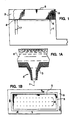
- Fig. 1 is a schematic representation of a precious metal bushing, 5, which is open at the top to receive molten glass.
- the sides of the bushing are coated with a ceramic barrier layer, 3, and the bushing itself is encased in ceramic, 9.
- Fig. 1A depicts molten glass, 6, flowing through a nozzle 8, to form a fiber, 7.
- the barrier layer, 3, is on the outside of the nozzle.
- Fig. 1B the barrier layer, 3, is shown surrounding the bushing, 5, and is in turn encased in the conventional ceramic layer, 9.
- a 250 ml stainless steel beaker was used as both container and electrode.
- the positive electrode was a 3/4" x 3/4" precious metal coupon.
- the ceramic suspension was stirred continuously with a magnetic stirrer to prevent settling.
- the deposition voltage was controlled with a variable d.c. power supply. After deposition the samples were dried at room temperature for 30 minutes, and then at 120° for 30 minutes. The deposit was then densified (sintered) at 1500°C in air for two hours. The total porosity and pore size distribution of green compacts were determined by mercury porosimetry. Microstructures of green and sintered compacts were observed by scanning electron microscopy (SEM), and the compositions were determined by EDX.
- SEM scanning electron microscopy
- the substrate onto which the ceramic powder was deposited was platinum or platinum-rhodium alloy. It should be understood, however, the deposition onto any platinum group metal could be accomplished, as iridium, palladium and osmium exhibit similar behavior toward ceramic coatings.
- a 250 ml stainless steel beaker was used as container and electrode.
- a coating of the Al2O3 was deposited directly onto a 0.03"x3/4"x3/4" precious metal coupon of Pt.
- the deposition voltage which could range from of 0 to 400 V was controlled with a variable dc power supply.
- a deposition rate of 10 micron/sec was used to prepare the oxide coating and was obtained at a deposition voltage of 50 V.
- the deposition rate could be increased by increasing the deposition voltage.
- the green density of the coatings was slightly higher with lower deposition voltages.
- the thickness of coating was easily controlled in the range of 30 to 2000 micron through the change of deposition period or deposition voltage.
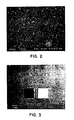
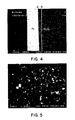
- the microstructure of the coating was characterized by scanning electron microscopy and the chemical compositions were determined by EDX.
- the coating process was repeated using 85% Al2O3 - 15% ZrO2 as the ceramic powder, and was also repeated using a coupon of Pt-10% Rh.
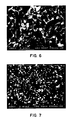
- Figure 5 is an SEM micrograph which depicts the microstructures of Al2O3 coatings on Pt fired at 1500°C in air for two hours while Figure 6 depicts the fracture surface of this coating. A high sintered density, >98%, was obtained.
- Figures 7 and 8 show the typical microstructures for the system of 85% Al2O3 > 15% ZrO2 on Pt fired at 1500°C for two hours and are indicative of high sintered density, >98%, small Al2O3 grains, and uniform distribution of ZrO2 particles in the Al2O3 matrix.
- FIG. 9 The microstructure of the interface for the system of 85% Al2O3 - 15% ZrO2 on Pt is depicted in Figure 9.
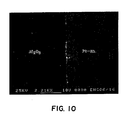
- Figure 10 depicts the interface of an Al2O3 coating on Pt-Rh. No cracks or porosities are observed.
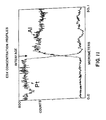
- the composition profiles of Pt and Al across the interfaces were analyzed by EDX and the results are given in Figure 11 for Al2O3/Pt system. No interdiffusion or interfacial reaction products is observed, suggesting that the adherent oxide coatings on precious metals is due to mechanical interlocking rather than chemical bonding.
- a Pt-Rh substrate was coated with Al2O3-MgO and the coating was maintained after firing at 1300°C in air for 150 hours, i.e., the coating remained crack-free, and adherent.
- the adverse effect of water on the electrophoretic deposition was shown by preparing 0.24 gm/cm3 of a solid ceramic powder (85wt% Al2O3-15wt% SIC), 0.008 gm/cm3 HNO3 and various concentrations of water.
- the viscosity of the suspensions increased from 46 cp for a suspension without water to 140 cp for a suspension with 0.016 gm/cm3 water. This demonstrates that the suspension became more flocculated with the addition of water. This was also observed visually.
- Maximum sediment density was achieved when the suspension contained less than 0.004 gm/cm3 water.
- An increase in water concentration from 0.004 to 0.03 gm/ml resulted in a reduction in sediment density from 22% to 14% of theoretical. This confirmed that the suspension became less stable with the addition of water.
Landscapes
- Chemical & Material Sciences (AREA)
- Engineering & Computer Science (AREA)
- Materials Engineering (AREA)
- Organic Chemistry (AREA)
- Metallurgy (AREA)
- General Life Sciences & Earth Sciences (AREA)
- Geochemistry & Mineralogy (AREA)
- Manufacturing & Machinery (AREA)
- Life Sciences & Earth Sciences (AREA)
- Chemical Kinetics & Catalysis (AREA)
- Electrochemistry (AREA)
- Inorganic Chemistry (AREA)
- Inorganic Insulating Materials (AREA)
- Glass Compositions (AREA)
- Colloid Chemistry (AREA)
- Other Surface Treatments For Metallic Materials (AREA)
- Compositions Of Oxide Ceramics (AREA)
Applications Claiming Priority (2)
| Application Number | Priority Date | Filing Date | Title |
|---|---|---|---|
| US30535189A | 1989-02-01 | 1989-02-01 | |
| US305351 | 2005-12-19 |
Publications (2)
| Publication Number | Publication Date |
|---|---|
| EP0381179A2 true EP0381179A2 (fr) | 1990-08-08 |
| EP0381179A3 EP0381179A3 (fr) | 1990-08-22 |
Family
ID=23180442
Family Applications (1)
| Application Number | Title | Priority Date | Filing Date |
|---|---|---|---|
| EP90101883A Withdrawn EP0381179A3 (fr) | 1989-02-01 | 1990-01-31 | Procédé de dépôt par électrophorèse d'une couche protectrice sur des métaux précieux |
Country Status (5)
| Country | Link |
|---|---|
| EP (1) | EP0381179A3 (fr) |
| JP (1) | JPH0317295A (fr) |
| KR (1) | KR900013111A (fr) |
| BR (1) | BR9000425A (fr) |
| CA (1) | CA2007501A1 (fr) |
Cited By (10)
| Publication number | Priority date | Publication date | Assignee | Title |
|---|---|---|---|---|
| US5879427A (en) * | 1997-10-16 | 1999-03-09 | Ppg Industries, Inc. | Bushing assemblies for fiber forming |
| WO2005019505A1 (fr) * | 2003-08-16 | 2005-03-03 | Forschungszentrum Karlsruhe Gmbh | Procede de production electrophoretique de structures ceramiques |
| EP1447381A3 (fr) * | 1999-05-14 | 2008-04-23 | Fraunhofer-Gesellschaft zur Förderung der angewandten Forschung e.V. | Produits d alumine nanoporeux et procédé de leur préparation |
| EP2000557A1 (fr) * | 2007-06-04 | 2008-12-10 | United Technologies Corporation | Barrière contre l'érosion pour revêtements de barrière thermique |
| US8470458B1 (en) | 2006-05-30 | 2013-06-25 | United Technologies Corporation | Erosion barrier for thermal barrier coatings |
| EP2724994A1 (fr) * | 2012-10-24 | 2014-04-30 | K-Protech GmbH | Élément de défibrage pour la fabrication de laine minérale |
| CN107555967A (zh) * | 2017-08-02 | 2018-01-09 | 山东玻纤集团股份有限公司 | 一种玻璃纤维拉丝漏板陶瓷喷涂工艺 |
| WO2019239117A1 (fr) | 2018-06-11 | 2019-12-19 | Johnson Matthey Public Limited Company | Composition de revêtement, procédé de revêtement, produit revêtu, système et utilisation |
| US11384007B2 (en) | 2018-09-07 | 2022-07-12 | Tanaka Kikinzoku Kogyo K.K. | Bushing for producing glass fibers |
| US12054417B2 (en) | 2021-04-23 | 2024-08-06 | Tanaka Kikinzoku Kogyo K.K. | Bushing for producing glass fibers and method for producing glass fibers |
Families Citing this family (1)
| Publication number | Priority date | Publication date | Assignee | Title |
|---|---|---|---|---|
| WO2015016931A1 (fr) * | 2013-08-01 | 2015-02-05 | Empire Technology Development Llc | Surfaces résistantes à la corrosion destinées à des réacteurs |
Family Cites Families (3)
| Publication number | Priority date | Publication date | Assignee | Title |
|---|---|---|---|---|
| US1897902A (en) * | 1927-03-14 | 1933-02-14 | Harsanyi Eugene | Method of coating radiant bodies |
| GB691859A (en) * | 1950-01-24 | 1953-05-20 | Bristol Aeroplane Co Ltd | Improvements in or relating to coatings |
| US4532184A (en) * | 1983-11-23 | 1985-07-30 | Owens-Corning Fiberglas Corporation | Precious metal vaporization reduction |
-
1990
- 1990-01-10 CA CA002007501A patent/CA2007501A1/fr not_active Abandoned
- 1990-01-31 JP JP2019352A patent/JPH0317295A/ja active Pending
- 1990-01-31 KR KR1019900001072A patent/KR900013111A/ko not_active Withdrawn
- 1990-01-31 EP EP90101883A patent/EP0381179A3/fr not_active Withdrawn
- 1990-01-31 BR BR909000425A patent/BR9000425A/pt unknown
Cited By (14)
| Publication number | Priority date | Publication date | Assignee | Title |
|---|---|---|---|---|
| US5879427A (en) * | 1997-10-16 | 1999-03-09 | Ppg Industries, Inc. | Bushing assemblies for fiber forming |
| EP1447381A3 (fr) * | 1999-05-14 | 2008-04-23 | Fraunhofer-Gesellschaft zur Förderung der angewandten Forschung e.V. | Produits d alumine nanoporeux et procédé de leur préparation |
| WO2005019505A1 (fr) * | 2003-08-16 | 2005-03-03 | Forschungszentrum Karlsruhe Gmbh | Procede de production electrophoretique de structures ceramiques |
| US8470458B1 (en) | 2006-05-30 | 2013-06-25 | United Technologies Corporation | Erosion barrier for thermal barrier coatings |
| US8512871B2 (en) | 2006-05-30 | 2013-08-20 | United Technologies Corporation | Erosion barrier for thermal barrier coatings |
| EP2000557A1 (fr) * | 2007-06-04 | 2008-12-10 | United Technologies Corporation | Barrière contre l'érosion pour revêtements de barrière thermique |
| EP2724994A1 (fr) * | 2012-10-24 | 2014-04-30 | K-Protech GmbH | Élément de défibrage pour la fabrication de laine minérale |
| WO2014063805A1 (fr) * | 2012-10-24 | 2014-05-01 | K-Protech Gmbh | Élément défibreur pour la fabrication de laine minérale |
| CN107555967A (zh) * | 2017-08-02 | 2018-01-09 | 山东玻纤集团股份有限公司 | 一种玻璃纤维拉丝漏板陶瓷喷涂工艺 |
| CN107555967B (zh) * | 2017-08-02 | 2023-04-14 | 山东玻纤集团股份有限公司 | 一种玻璃纤维拉丝漏板陶瓷喷涂工艺 |
| WO2019239117A1 (fr) | 2018-06-11 | 2019-12-19 | Johnson Matthey Public Limited Company | Composition de revêtement, procédé de revêtement, produit revêtu, système et utilisation |
| US11384007B2 (en) | 2018-09-07 | 2022-07-12 | Tanaka Kikinzoku Kogyo K.K. | Bushing for producing glass fibers |
| US12054417B2 (en) | 2021-04-23 | 2024-08-06 | Tanaka Kikinzoku Kogyo K.K. | Bushing for producing glass fibers and method for producing glass fibers |
| EP4328199A4 (fr) * | 2021-04-23 | 2024-10-30 | Tanaka Kikinzoku Kogyo K.K. | Douille permettant de produire des fibres de verre et procédé permettant de produire des fibres de verre |
Also Published As
| Publication number | Publication date |
|---|---|
| CA2007501A1 (fr) | 1990-08-01 |
| EP0381179A3 (fr) | 1990-08-22 |
| KR900013111A (ko) | 1990-09-03 |
| BR9000425A (pt) | 1991-01-15 |
| JPH0317295A (ja) | 1991-01-25 |
Similar Documents
| Publication | Publication Date | Title |
|---|---|---|
| CA1306147C (fr) | Materiau composite ceramique-metal | |
| Zhitomirsky et al. | Electrophoretic deposition of hydroxyapatite | |
| CA2007501A1 (fr) | Procede d'electrodeposition de revetements protecteurs de metaux precieux pour electrophorese | |
| WO2004031445A1 (fr) | Revetement protecteur ceramique | |
| EP1896379A1 (fr) | Procede permettant de produire des materiaux poreux frittes | |
| DE3446286A1 (de) | Verfahren zum beschichten von kohlenstoff- und graphitkoerpern | |
| Pei et al. | Laser cladding of ZrO2-(Ni alloy) composite coating | |
| CN1217881C (zh) | 耐火构件涂层的制备方法 | |
| Bae et al. | Fabrication and microstructure of Al2O3 TiO2 composite membranes with ultrafine pores | |
| SE461662B (sv) | Saett att anbringa emaljbelaeggning innehaallande pulveriserad metall paa ett metallsubstrat | |
| JP5554934B2 (ja) | スピネル前駆体ゾルの製造方法、及びスピネルがコーティングされたチタン酸アルミニウム焼結体の製造方法 | |
| US11352699B2 (en) | Tungsten bronze thin films and method of making the same | |
| US5472583A (en) | Manufacture of conical pore ceramics by electrophoretic deposition | |
| EP0678597A1 (fr) | Préparation de fibres céramiques par électrophorése | |
| EP0767845B1 (fr) | Procede d'electrophorese pour deposition de rev tements multiples sur des fibres | |
| US4720419A (en) | Substrates for electronic devices | |
| DE19941610C1 (de) | Bauteil zur Verwendung in Kontakt zu einer Glasschmelze | |
| US5340779A (en) | Manufacture of conical pore ceramics by electrophoretic deposition | |
| Hong et al. | Preparation and property of a modified micro-arc oxidation coating using Al2O3 particles on Ti6Al4V | |
| CN116445842B (zh) | 钛及钛合金表面含MgAl2O4尖晶石涂层及其制备方法 | |
| Ren et al. | Al2O3/YSZ composite coatings prepared by a novel sol–gel process and their high-temperature oxidation resistance | |
| JPS6048550B2 (ja) | 高温溶融金属用耐蝕性塗料 | |
| JP2588276B2 (ja) | 炭化珪素多孔質焼結体及びその製造方法 | |
| Sainz et al. | Novel Technique for Zirconia‐Coated Mullite | |
| Marquordt et al. | Fabrication of micromechanical structures of titania and titanium with electrophoretic deposition |
Legal Events
| Date | Code | Title | Description |
|---|---|---|---|
| PUAI | Public reference made under article 153(3) epc to a published international application that has entered the european phase |
Free format text: ORIGINAL CODE: 0009012 |
|
| PUAL | Search report despatched |
Free format text: ORIGINAL CODE: 0009013 |
|
| AK | Designated contracting states |
Kind code of ref document: A2 Designated state(s): AT BE CH DE DK ES FR GB GR IT LI LU NL SE |
|
| AK | Designated contracting states |
Kind code of ref document: A3 Designated state(s): AT BE CH DE DK ES FR GB GR IT LI LU NL |
|
| STAA | Information on the status of an ep patent application or granted ep patent |
Free format text: STATUS: THE APPLICATION IS DEEMED TO BE WITHDRAWN |
|
| 18D | Application deemed to be withdrawn |
Effective date: 19910223 |