EP0382497B1 - Machine postale pourvue de moyens d'alimentation en feuilles - Google Patents
Machine postale pourvue de moyens d'alimentation en feuilles Download PDFInfo
- Publication number
- EP0382497B1 EP0382497B1 EP90301279A EP90301279A EP0382497B1 EP 0382497 B1 EP0382497 B1 EP 0382497B1 EP 90301279 A EP90301279 A EP 90301279A EP 90301279 A EP90301279 A EP 90301279A EP 0382497 B1 EP0382497 B1 EP 0382497B1
- Authority
- EP
- European Patent Office
- Prior art keywords
- ejection roller
- roller
- shaft
- sheet
- rotary printing
- Prior art date
- Legal status (The legal status is an assumption and is not a legal conclusion. Google has not performed a legal analysis and makes no representation as to the accuracy of the status listed.)
- Expired - Lifetime
Links
- 230000002093 peripheral effect Effects 0.000 description 3
- 239000003990 capacitor Substances 0.000 description 2
- 230000007257 malfunction Effects 0.000 description 2
- 238000011144 upstream manufacturing Methods 0.000 description 2
- 230000006835 compression Effects 0.000 description 1
- 238000007906 compression Methods 0.000 description 1
- 230000007423 decrease Effects 0.000 description 1
- 239000000463 material Substances 0.000 description 1
- 230000000717 retained effect Effects 0.000 description 1
Images




Classifications
-
- G—PHYSICS
- G07—CHECKING-DEVICES
- G07B—TICKET-ISSUING APPARATUS; FARE-REGISTERING APPARATUS; FRANKING APPARATUS
- G07B17/00—Franking apparatus
- G07B17/00459—Details relating to mailpieces in a franking system
- G07B17/00467—Transporting mailpieces
-
- B—PERFORMING OPERATIONS; TRANSPORTING
- B41—PRINTING; LINING MACHINES; TYPEWRITERS; STAMPS
- B41K—STAMPS; STAMPING OR NUMBERING APPARATUS OR DEVICES
- B41K3/00—Apparatus for stamping articles having integral means for supporting the articles to be stamped
- B41K3/44—Means for handling copy matter
- B41K3/48—Means for handling copy matter for conveying intermittently to or from stamping station
-
- G—PHYSICS
- G07—CHECKING-DEVICES
- G07B—TICKET-ISSUING APPARATUS; FARE-REGISTERING APPARATUS; FRANKING APPARATUS
- G07B17/00—Franking apparatus
- G07B17/00459—Details relating to mailpieces in a franking system
- G07B17/00467—Transporting mailpieces
- G07B2017/00491—Mail/envelope/insert handling system
Definitions
- the present invention is generally concerned with mailing machines, including means for feeding sheets therethrough, and more particularly with an improved means for feeding mixed thickness sheets in a mailing machine.
- the drive mechanism includes a single revolution clutch, having a helical spring, for rotating the output gear and thus the drum drive gear, which, in turn, rotates the drum into engagement with a sheet fed to the drum.
- Each revolution of the clutch, and thus of the drum is initiated by a sheet engaging a trip lever to release the helical spring for causing the drum to rotate into engagement with the sheet and print a postage value thereon.
- the mailing machine includes structure for feeding the sheet downstream beneath the drum as the drum returns to its home position.
- the drive mechanism intermittently operates the rotary printing drum in response to a sheet fed thereto engaging the trip lever.
- the mailing machine additionally includes sheets feeding apparatus mounted in the base for feeding sheets downstream in the path of travel.
- the sheet feeding apparatus includes an impression roller resiliently mounted beneath the postage meter drum to accommodate urging letters of different thickness into printing engagement with the rotating drum.
- the impression roller is rotatably mounted on a bracket which is pivotably connected to the frame of the mailing machine at a point remote from the mail handling assembly of which the impression roller forms a part.
- a compression spring connected between the bracket and a lower portion of the mailing machine frame, biases the bracket upwardly so that the impression roller is resiliently urged towards the print drum to accommodate letters of different thicknesses.
- a mailing machine including a postage meter, the mailing machine comprising a housing for supporting the postage meter, and sheet feeding means for individually feeding sheets in a path of travel through the machine, the sheet feeding means comprising an impression roller, an ejection roller and a shaft on which the ejection roller is mounted for rotation therewith, and rotating means for rotating the ejection roller shaft and the impression roller, wherein the postage meter includes rotary printing means for printing indicia on the sheets, and a roller spaced downstream in the path of travel from the rotary printing means, characterised in that: the sheet feeding means includes: an elongate carriage including a pair of side walls spaced apart from each other, one end of each of the side walls including an arcuately-shaped portion pivotally attaching the carriage to the housing and forming a generally C-shaped bearing bushing, the ejection roller shaft being rotatably mounted within the bearing bushings for supporting the ejection roller beneath the postage meter roller, and the impression roller being rotat
- the apparatus in which the invention may be incorporated generally includes a mailing machine 10 which includes a base 12, having a housing 14, and a postage meter 16 which is removably mounted on the base 12.
- the postage meter 16 forms therewith a slot 18 through which sheets 20, including mailpieces such as letters, envelopes, cards or other sheet-like materials, may be fed in a downstream path of travel 22.
- the postage meter 16 (Fig. 1) includes rotary printing structure including a postage printing drum 24 and a drive gear 26 therefor.
- the drum 24 and drive gear 26 are spaced apart from one another and mounted on a common drum drive shaft 28.
- the drum 24 is conventionally constructed and arranged for feeding the respective sheets 20 in the path of travel 22, which extends beneath the drum 24, and for printing postage data, registration data or other selected indicia on the upwardly disposed surface of each sheet 20.
- the drum drive gear 26 has a key slot 30 formed therein, which is located vertically beneath the drum drive shaft 28 when the postage meter drum 24 and drive gear 26 are located in their respective home positions.
- the base 12 additionally includes a registration fence 50, aligned with the path of travel 22, against which an edge 52 of a given sheet 20 may be urged when fed to the mailing machine 10.
- the base 12 includes drive system trip structure for sensing sheets 20 fed to the machine 10, including a trip lever 54 which extends upwardly through another housing aperture 58 and into the path of travel 22 of each sheet 20 fed to the mailing machine 10.
- the base 12 includes a conventional input feed roller 60, known in the art as an impression roller.
- the impression roller 60 which has an inner end 60A and an outer end 60B, respectively facing inwardly and outwardly of the machine 10, is suitably secured to or integrally formed with a driven shaft 61.
- the shaft 61 is resiliently connected to the housing 14, as hereinafter set forth in greater detail, for causing the roller 60 to extend upwardly through the housing aperture 58 and into the path of travel 22 for urging each sheet 20 into printing engagement with the drum 24 and cooperating therewith for feeding the sheets 20 through the machine 10.
- the base 12 For feeding sheets 20 (Fig. 1) from the mailing machine 10, the base 12 includes a conventional output feed roller 62, known in the art as an ejection roller.
- the roller 62 includes a cylindrically-shaped rim 62A which is suitably rotatably connected to a hubbed shaft 63 by means of a coil spring 62B.
- the shaft 63 is rotatably connected to the housing 14, as hereinafter set forth in greater detail, for causing the roller 62 to extend upwardly through a further housing aperture 64 and into the path of travel 22.
- the rim 62A is driven by the shaft 63 via the coil spring 62B.
- the postage meter 16 includes a suitable idler roller 66 which is conventionally yieldably mounted, to accommodate mixed thickness batches of sheets 20, with its axis disposed parallel with the axis of the ejection roller 62, when the meter 16 is mounted on the base 14. As thus mounted, the idler roller 66 extends downwardly into the path of travel 22.
- the idler roller 66 is also conventionally movably mounted for adjusting vertical spacing thereof from the ejection roller 62, to accommodate feeding a given batch of relatively thick sheets 20, such as a batch of envelopes which are each stuffed with a letter and inserts.
- the base 12 (Fig. 1), and thus the mailing machine 10, includes an elongate impression roller carriage 67 which includes a pair of parallel-spaced side walls 67A, one of which is shown, and a lower wall 67B which extends between and is suitably secured to or integrally formed with the side walls 67A.
- the carriage 67 generally horizontally extends from the ejection roller shaft 63, and beneath and in supporting relationship with the impression roller shaft 61. More particularly, one end of each of the carriage side walls 67A is pivotably attached to the housing 14 so as to define parallel-spaced arcuately-shaped bearing surfaces 67C within which the ejection roller shaft 63 is rotatably mounted.
- the side walls 67A are conventionally constructed and arranges for rotatably supporting the opposed ends of the impression roller shaft 61.
- the carriage lower wall 67B is preferably connected to the housing 14 by means of a depending spring 68.
- the base 12 includes a driven gear 61A which is suitably fixedly connected to or integrally formed with the impression roller shaft 61.
- the impression roller shaft 61 and drive gear 61A are both conventionally rotatably connected to the carriage 67.
- the base 12 includes a driven gear 63A which is suitably fixedly connected to or integrally formed with the ejection roller shaft 63.
- the base 12 includes an endless gear belt 69 which is looped about the gears 61A and 63A for transmitting rotational movement of the gear 61A to the gear 63A, whereby the ejection roller shaft 63 and the impression roller 60 are driven in timed relationship with one another.
- the gears 61A and 63A, and the impression roller 60 and ejection roller 62 are relatively dimensioned for ensuring that the peripheral velocity of the ejection roller 62 is greater than the peripheral velocity of the impression roller 60, when neither of the respective rollers 60 and 62 are in engagement with a sheet 20 fed thereto.
- the base 12 includes a drive system 70 (Fig. 2) for driving the shutter bar lever arm 40, and for driving the drive system output gear 46 and thus the postage meter drum 24 (Fig. 1), the ejection roller shaft 63 and impression roller 60 preferably in timed relationship with one another.
- the drive system 70 (Fig. 2) is conventionally supported by the housing 14 and generally includes a control mechanism 74, relevant portions of which are shown in greater detail, and drive system operating apparatus 76.
- the operating apparatus 76 generally includes trip lever structure 80 and, in addition, a plurality of components, including the trip switch 72, a motor switch 82, a d.c. motor drive system 84, and a control circuit 86 to which the components 72, 82 and 84 are electrically connected.
- the control mechanism 74 (Fig. 2) preferably includes any conventional structure for normally holding the shutter bar lever arm 40, against the force of suitable resilient structure in which energy is stored for actuating the lever arm 40, to hold the shutter bar's key portion 34 in the drum drive gear's key slot 30, thereby holding the shutter bar 32 in locking engagement with the drum drive gear 26, for preventing rotation of the drum drive gear 26 and thus the drum 24.
- the resilient structure actuates the lever arm 40, in response to actuation of the trip switch 70 by a sheet 20 fed to the machine 10, for urging the shutter bar lever arm 40 to move the shutter bar 32 out of locking engagement with the drum drive gear 26, thereby permitting rotation of the drum 24, and into engagement with the motor switch 82 for actuating the motor switch 82 to start operation of the drive mechanism 70.
- the drive mechanism 74 preferably includes additional conventional structure for restoring the energy in the resilient structure during a single revolution of the drum drive gear 26 and then causing the shutter bar lever arm 40 to actuate the motor switch 82, to stop operation of the drive mechanism 74 and to move the shutter bar 30 into locking engagement with the drum drive gear 24.
- the control mechanism includes a generally annularly-shaped rotary cam 88, which is suitably secured to or integrally formed with a drive shaft 89.
- the drive shaft 89 is conventionally connected to the housing 14, to permit rotation of the cam 88 in a generally vertically-extending plane.
- the cam 88 has an outer, peripherally-extending, D-shaped cam surface 88A.
- the trip lever structure 80 further includes a spring 106 having one end located in the depending leg's slot 94 and the other end conventionally connected to the housing 14 above the lower end of the depending leg 94 but below the level of the axis of the trip lever pivot shaft 90.
- the spring constant of the spring 106 is chosen to be small enough to permit any sheet 20 which is of sufficient weight to be fed through the machine 10 and marked with indicia, without being torn or creating a jam condition, to also be capable of pivoting the trip lever 54 against the force of the spring 106 when the sheet 20 is normally fed to the machine 10.
- the trip switch 72 (Fig. 2) is preferably a single pole double throw switch having two modes of operation.
- the switch 72 is conventionally connected to the housing 14 for suitable location of the switch 72 relative to the trip lever's switch actuating shoulder 102, to allow the shoulder 102 to operate the switch 72 in response to movement of the trip lever 54.
- the switch 72 includes an operating lead 110 and two switch position leads, 110A and 110B. When the switch 86 is in one of its modes of operation, the leads 110 and 110A are electrically connected, whereas when the switch 72 is in its other mode of operation, the leads 110 and 110B are electrically connected.
- the motor switch 82 (Fig. 2) is preferably a single pole double throw switch having two modes of operation.
- the switch 82 is conventionally connected to the housing 14 for suitable location of the switch 82 relative to the shutter bar lever arm 40 to operate the switch 82 in response to movement of the lever arm 40.
- the switch 82 includes an operating lead 120 and two switch position leads 120A and 120B. When the switch 82 is in one of its modes of operation, the leads 120 and 120A are electrically connected, whereas when the switch 82 in its other mode of operation, the leads 120 and 120B are electrically connected.
- the d.c. motor drive system 84 (Fig. 2) preferably includes a conventional d.c. motor, 140 having an output shaft 142.
- the motor 84 is conventionally physically connected to the housing 14 via a gear box 144.
- the motor output shaft 142 is preferably connected, via a reduction gear train 146 within the gear box 144, to an output drive gear 148, which is suitably journalled to the gear box 144 for rotation.
- the drive system 84 additionally includes a control mechanism drive gear 150 and gear belt 152.
- the control mechanism drive gear 150 is suitably fixedly connected to or integrally formed with the cam drive shaft 89.
- the cam 88 is mounted for rotation with the drive gear 150.
- the gear belt 152 is endlessly looped about and disposed in meshing engagement with the drive gear 148 and cam drive gear 150.
- the drive system 84 further includes an ejection roller drive gear 154 and a drive shaft 156 on which the gear 154 is conventionally fixedly mounted.
- the drive shaft 156 is suitably rotatably connected to the housing 14 for conventionally connecting one end thereof to the ejection roller shaft 63A (Fig. 1) and disposing the ejection roller drive gear 154 (Fig. 2) in meshing engagement with the gear belt 152, between the motor output drive gear 148 and timing control mechanism drive gear 150.
- the drive system 84 additionally includes the drive system output gear 46 (Fig.
- the control circuit 86 (Fig. 2) preferably includes a conventional D.C. power supply 170.
- the control circuit 86 (Fig. 7) includes suitable trip control circuitry for interconnecting the trip switch 72, a solenoid 171, a capacitor 171A and power supply 170 for energization and deenergization of the solenoid 171 and thus the driving system 70 (Fig. 2) in response to operation of the switch 72.
- the trip control circuitry is conventionally constructed and arranged such that in one mode of operation the switch 170 (Fig. 7) is operated to electrically connect the switch leads 110 and 110B for energizing the solenoid 171, through the capacitor 171A, for causing the shutter bar lever arm 40 to actuate the motor switch 82.
- control circuit 86 includes suitable motor control circuitry for interconnecting the D.C. motor 140 and power supply 170 for energization and deenergization of the D.C. motor 140 in response to actuation of the switch 82 by the shutter bar lever arm 40.
- the motor control circuitry is conventionally constructed and arranged such that in one mode of operation the switch 82 is operated to electrically disconnect the leads 120 and 120A, for opening a shunt circuit, such as a short circuit, across the D.C.motor 140, and to electrically connect the switch leads 120 and 120B, for energizing the D.C. motor 140 from the power supply 170. And, in the other mode of operation the switch 82 is operated to electrically disconnect the switch leads 120 and 120B, for deenergizing the D.C. motor 140, and to electrically connect the switch leads 120 and 120A, for closing the shunt circuit across the D.C. motor 140 for dynamically braking the D.C. motor 140.
- a shunt circuit such as a short circuit
- control mechanism 74 and control circuit 86 may be found in U.S. Patent No. 4881461 of John Nobile et al for a Mailing Machine Including Improved Driving Means or in U.S. Patent Application Serial No. 307559 of John Nobile et al for a Mailing Machine Including Driving Means Circuit.
- the base 12 and thus the mailing machine 10, additionally includes sheet aligning structure 180 (Fig. 2) for aligning a sheet 20 fed to the machine 10 with the path of travel 22.
- the aligning structure 180 includes the registration fence 50 (Fig. 1), and an elongate stop lever 182.
- the stop lever 182 is conventionally mounted for rotation, in a generally vertically-extending plane in the path of travel 22, on the outboard end of a pivot shaft 184.
- the pivot shaft 184 is suitably rotatably connected to the housing 14.
- the stop lever 182 has an upper end portion 186 which extends upwardly into the path of travel 22 of sheets 20 fed through the machine 10. As thus mounted, the stop lever's upper end portion 186 extends into the path of travel 22 (Fig.
- the aligning structure 180 includes a cam follower 192 which is suitably secured to the other end of the pivot shaft 184 so as to extend therefrom and into engagement with the driving system's D-shaped cam 88, and, more particularly, with the D-shaped cam surface 88A thereof.
- the aligning structure 180 For holding the cam follower 192 in engagement with the cam 88, the aligning structure 180 includes a depending spring 194, having one end suitably connected to the stop lever 182, preferably beneath the pivot shaft 184, and the other end, suitably connected to the housing 14. As thus constructed and arranged, the stop lever 182 is driven by the cam 88 in a path of travel determined by the geometry of cam surface 88A, cam follower 182 and stop lever 182, for timely lowering the stop lever 182 out of and beneath the path of travel 22 of sheets 20 fed through the machine 10.
- the aligning structure 180 additionally includes an elongate cam 196, which is suitably secured to the pivot shaft 184 for movement therewith and is disposed in engagement with the trip lever's cam follower 104.
- the trip lever structure 80 may be viewed as including the cam 196, pivot shaft 184, cam 88 and spring 194.
- the drum 24 (Fig. 1) is locked in its home position.
- the motor switch 82 (Fig. 2) is maintained in its mode of operation wherein the leads 120 and 120B are disconnected for preventing the D.C. motor 140 from being energized from the power supply 170, and wherein the leads 120 and 120A are connected for maintaining the shunt circuit across the D.C. motor 140, with the result that the D.C. motor 140 is maintained deenergized.
- the leading edge of the sheet 20 will engage the stop lever's upper end 186, either before or after engaging the trip lever 92, and tend to be pivoted thereby towards the registration fence 50 until its sheet edge 52 is disposed in engagement with the registration fence 50 for aligning the sheet 20 in the direction of the path of travel 22.
- the stop lever's upper end 186 either before or after engaging the trip lever 92, and tend to be pivoted thereby towards the registration fence 50 until its sheet edge 52 is disposed in engagement with the registration fence 50 for aligning the sheet 20 in the direction of the path of travel 22.
- the upper end of the trip lever 54 is preferably located more distantly upstream in the path of travel 22 than the upper end of the stop lever 182, to permit a sheet 20 which is aligned with the registration fence 50 by the operator to commence moving the trip lever 92 before engaging the stop lever's upper end 186.
- the trip switch 72 is not operated by the trip lever 54 until the sheet 20 has moved the trip lever's upper leg 92 downstream sufficiently to almost permit the sheet 20 to also be urged into engagement with the stop lever's upper end 186.
- the trip structure 80 and sheet aligning structure 180 are constructed and arranged such that the distance "d" (Fig.
- the trip lever's curvedly-extending upper edge 100 upwardly supports the leading edge of the sheet 20 between and drum 24 and impression roller 60, and, preferably guides the sheet over the impression roller 60, to prevent the leading edges of the lightweight sheets from engaging and being folded against the impression roller 60.
- the trip lever 54 continues to rotate, the trip lever's shoulder 102 operates the trip switch 72, thereby interconnecting the switch leads 110 and 110B for energizing the solenoid 171 from the power supply 170.
- the solenoid 171 causes the control mechanism 82 to move the lever arm 40, for moving the shutter bar key portion 34 (Fig. 1) out of the drum drive gear slot 30 to permit rotation of the drum drive gear 26 and thus the drum 24, and to move the lever arm 40 into engagement with the motor switch 82 to actuate the motor switch 82 for energizing the d.c. motor 140.
- the cam 88 commences rotation substantially at the same time as the sheet 20 fed to the machine 10 is urged into engagement with the stop lever 182.
- the cam follower 192 follows the cam surface 88A, against the force exerted by the spring 194.
- the cam 88 is preferably dimensioned such that the cam follower 192, and thus the cam shaft 184, are not initially moved by the rotating cam 88, as a result of which the stop lever 182 initially prevents a given sheet 20 from being fed into the path of travel 22 although the impression roller 60 and drum 24 have commenced rotation.
- the trip lever's upper leg 92 may be dimensioned to extend beyond the path of travel 22 to permit the rotating printing drum 24 to engage and lower the trip lever 54 into the path of travel 22. In which instance, as the drum 24 engages the sheet 20, the sheet 20 will move the upper end of the trip lever 54 out of engagement with the drum 24, against the force of the spring 106, and lower the trip lever 54 beneath the sheet 20 and thus out of the path of travel 22.
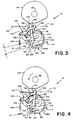
- the spring 106 is connected to the trip lever 54 as hereinbefore described to ensure that the moment arm due to the spring force acting through the distance "L2" (Fig. 6) is less than the moment arm due to the spring force acting through the distance "L1” (Fig. 3).
- the force exerted by the trip lever 54 on a sheet 20 fed through the machine 10 decreases when the sheet 20 is fed between the drum 24 and impression roller 60, thereby reducing the likelihood of marking or scoring the underside of a lightweight sheet 20.
- the trip lever's upper leg 92 (Fig. 5) is dimensioned as shown by the dashed line, to extend into but not beyond the path of travel 22. And, as thus constructed and arranged, the drum 24 does not engage and move the trip lever 54. Rather, the moving sheet 20 lowers the trip lever 54 out of the path of travel 22.
- the cam follower 104 (Fig. 5)
- the ejection roller 62 also commences rotating for feeding sheets 22 engaged thereby from beneath the idler roller 66 and thus from the machine 10. Since the angular velocity of the ejection roller rim 62A is normally greater than the angular velocity of the impression roller 60, the peripheral velocity of the ejection roller 62 is greater than that of the impression roller 60, as a result of which the ejection roller 62 tends to pull respective sheets 20 which are fed thereto from beneath drum 24 while the drum 24 and impression roller 60 are still rotating in engagement with the sheets 20.
- the ejection roller shaft 63 continues rotation and stores energy in the coil spring 62B as the ejection roller rim 62A slips relative to the shaft 63, until the drum 24 is no longer in engagement with the sheet 20.
- the coil spring 62B releases the energy stored therein by driving the ejection roller rim 62A for feeding the sheet 20 from the machine 10.
- the trip lever 54 is rotated about the pivot shaft 90 by the spring 106, causing the trip lever's shoulder 102 to operate the trip switch 72 for disconnecting the switch leads 110 and 110B and connecting the switch leads 110 and 110A for returning the trip switch 72 to its at-ready mode of operation.
- the drive mechanism 74 completes driving the drive system output gear 46, and thus drum drive gear 26 and drum 24, a single revolution.
- the drive mechanism 74 moves the shutter bar lever arm 40 to actuate the motor switch 82 for deenergizing the motor 140 and to move the shutter bar's key portion 34 (Fig. 1) into the drum drive gear slot 30 to prevent further rotation of the drum drive gear 26 and thus the drum 24.
- the switch leads 120 and 120B are electrically disconnected for deenergizing the D.C. motor 140, followed by the switch leads 120 and 120A being electrically connected to close the shunt circuit across the D.C.
- the D.C. motor 140 for dynamically braking the D.C. motor 140.
- the D.C. motor 140 is both deenergized and braked as the shutter bar key portion 24 (Fig. 1) enters the drum drive gear slot 30.
- the control mechanism 74 has returned the drive system 70 (Fig. 2) to its normal or at-ready mode of operation.
Landscapes
- Physics & Mathematics (AREA)
- General Physics & Mathematics (AREA)
- Delivering By Means Of Belts And Rollers (AREA)
Claims (10)
- Machine postale incluant une affranchisseuse (16), la machine postale comprenant un boîtier (14) pour supporter l'affranchisseuse (16) et un moyen d'alimentation en feuilles pour alimenter individuellement des feuilles (20) dans une voie de déplacement (22) au travers de la machine, le moyen d'alimentation en feuilles comprenant un rouleau d'impression (60), un rouleau d'éjection (62) et un arbre (63) sur lequel le rouleau d'éjection (62) est monté de manière à tourner avec, et un moyen de rotation (61A, 63A) pour faire tourner l'arbre de rouleau d'éjection (63) et le rouleau d'impression (60), dans laquelle l'affranchisseuse (16) inclut un moyen d'impression tournant (24) pour imprimer des indices sur les feuilles (20) et un rouleau (66) espacé vers l'aval dans la voie de déplacement par rapport au moyen d'impression tournant (24),
caractérisée en ce que :
le moyen d'alimentation en feuilles inclut :
un chariot allongé (67) incluant une paire de parois latérales (67A) espacées l'une de l'autre, une extrémité de chacune des parois latérales (67A) incluant une partie en forme d'arc qui fixe de façon pivotante le chariot (67) au boîtier (14) et formant un coussinet ayant la form générale d'un C (67C), l'arbre de rouleau d'éjection (63) étant monté à rotation dans les coussinets (67C) pour supporter le rouleau d'éjection (62) au-dessous du rouleau d'affranchisseuse (66) et le rouleau d'impression (60) étant connecté de façon tournante aux parois latérales de chariot (67A) pour supporter le rouleau d'impression (60) au-dessous du moyen d'impression tournant (24) ; et un ressort (68) qui connecte l'autre extrémité du chariot (67) au boîtier (14) pour permettre au chariot (67) de pivoter vers le bas autour de l'arbre de rouleau d'éjection (63) en s'opposant à la force exercée par le ressort (68) lorsque l'arbre de rouleau d'éjection (63) tourne dans les coussinets (67C), ce qui permet à des feuilles d'épaisseurs mixtes d'être alimentées individuellement entre le moyen d'impression tournant (24) et le rouleau d'impression (60). - Machine postale selon la revendication 1, incluant un arbre (61) sur lequel le rouleau d'impression (60) est monté pour tourner avec, le moyen de rotation (61A, 63A) incluant deux pignons espacés l'un de l'autre et fixés l'un à l'arbre de rouleau d'impression (61) et l'autre à l'arbre de rouleau d'éjection (63) et une courroie crantée de synchronisation (69) formée en boucle autour des pignons (61A, 63A) et disposée de manière à s'engrener avec.
- Machine postale selon la revendication 1, incluant un moyen d'entraînement (70) pour entraîner le moyen d'impression tournant (24) selon une relation cadencée par rapport à la rotation de l'arbre de rouleau d'éjection (63), le moyen d'entraînement (70) incluant un moyen pour faire tourner le moyen d'impression tournant (24) et un moyen pour faire tourner le rouleau d'impression (60) selon une relation cadencée par rapport à l'arbre de rouleau d'éjection (63) et ainsi, l'arbre de rouleau d'éjection (63) et le moyen d'impression tournant (24) tournent selon une relation cadencée l'un par rapport à l'autre.
- Machine postale selon la revendication 1, dans laquelle le rouleau d'éjection (62) est de forme cylindrique, l'arbre de rouleau d'éjection (63) est un arbre de transmission et le moyen tournant inclut un ressort hélicoïdal (62B) qui connecte le rouleau d'éjection (62) et l'arbre de rouleau d'éjection (63) pour permettre un glissement relatif entre eux lorsqu'une feuille (20) en coopération d'alimentation avec le rouleau d'éjection (62) est également en coopération avec le moyen d'impression tournant (24).
- Machine postale selon la revendication 1, dans laquelle le chariot (67) inclut une paroi inférieure (67B) s'étendant entre les parois latérales (67A) et formée d'un seul tenant avec elles et dans laquelle le ressort (68) est un ressort d'interconnexion comportant une première extrémité connectée à la paroi inférieure (67B) et une autre extrémité connectée au boîtier (14) pour pousser de façon élastique le chariot (67) et par conséquent le rouleau d'impression (60) vers le haut en direction du moyen d'impression tournant (24) et ainsi, des feuilles respectives (20) alimentées entre le moyen d'impression tournant (24) et le rouleau d'impression (60) sont poussées selon une coopération d'impression avec le moyen d'impression tournant (24).
- Machine postale selon la revendication 3, dans laquelle le moyen d'entraînement (70) inclut un pignon de sortie (46) et un moteur courant continu (140) connecté pour entraîner le pignon de sortie (46) et dans laquelle le moyen de rotation inclut un pignon d'entraînement (154) fixé à l'arbre d'entraînement de rouleau d'éjection (63) pour sa rotation et une courroie crantée de synchronisation (152) formée en boucle autour du pignon de sortie (46) et disposée de manière à s'engrener avec le pignon d'entraînement de rouleau d'éjection (154) pour entraîner l'arbre de rouleau d'éjection (63) selon une relation cadencée par rapport au pignon de sortie de moteur.
- Machine postale selon la revendication 2, incluant un moyen pour entraîner l'arbre de rouleau d'éjection (63) selon une relation cadencée par rapport au moyen d'impression tournant (24), le rouleau d'impression (60) présentant le même diamètre que le moyen d'impression tournant (24) et le rouleau d'éjection (62) présentant un diamètre inférieur à celui du rouleau d'impression (60) et ainsi, le rouleau d'impression (60) alimente les feuilles (20) qui lui sont appliquées selon une vitesse linéaire plus importante que celle selon laquelle le rouleau d'impression (60) alimente des feuilles (20) qui lui sont appliquées, et le rouleau d'éjection (62) étant connecté à l'arbre de rouleau d'éjection (63) pour permettre un glissement relatif entre lorsque le moyen d'impression (24) et le rouleau d'éjection (62) sont tous deux en coopération avec une feuille (20) qui est en train d'être alimentée au travers de la machine.
- Machine postale selon la revendication 1, incluant un moyen (70) pour entraîner par intermittence l'arbre de rouleau d'éjection (63), le rouleau d'impression (60) et le moyen d'impression tournant (24) selon une relation cadencée les uns par rapport aux autres.
- Machine postale selon la revendication 6, dans laquelle le moyen d'entraînement (70) inclut un moyen (74) pour entraîner le pignon de sortie (46) selon un unique tour en réponse à l'alimentation d'une feuille (20) dans la machine et un moyen pour entraîner l'arbre de rouleau d'éjection (63) et le rouleau d'impression (60) et le moyen d'impression tournant (24) selon une relation cadencée par rapport au pignon de sortie (46) et ainsi, le rouleau d'impression (60) et le moyen d'impression tournant (24) et l'arbre de rouleau d'éjection (63) sont entraînés par intermittence selon une relation cadencée les uns par rapport aux autres pour alimenter des feuilles respectives (20) au travers de la machine.
- Machine postale selon la revendication 7, dans laquelle le moyen d'entraînement (70) inclut un ressort hélicoïdal (62B) qui interconnecte le rouleau d'éjection (62) et l'arbre (63) pour permettre le stockage d'énergie dedans lorsque l'arbre de rouleau d'éjection (63) tourne et que le rouleau d'éjection (62) glisse par rapport à l'arbre de rouleau d'éjection (63), le ressort hélicoïdal (62B) libérant l'énergie stockée pour entraîner le rouleau d'éjection (62) lorsque le rouleau d'éjection (62) est en coopération avec la feuille (20) qui lui est appliquée et que le moyen d'impression (24) tourne de façon à se désengager de la feuille (20).
Applications Claiming Priority (2)
| Application Number | Priority Date | Filing Date | Title |
|---|---|---|---|
| US07/307,808 US4884503A (en) | 1989-02-08 | 1989-02-08 | Mailing machine including improved sheet feeding means |
| US307808 | 1989-02-08 |
Publications (3)
| Publication Number | Publication Date |
|---|---|
| EP0382497A2 EP0382497A2 (fr) | 1990-08-16 |
| EP0382497A3 EP0382497A3 (fr) | 1991-04-03 |
| EP0382497B1 true EP0382497B1 (fr) | 1995-01-18 |
Family
ID=23191240
Family Applications (1)
| Application Number | Title | Priority Date | Filing Date |
|---|---|---|---|
| EP90301279A Expired - Lifetime EP0382497B1 (fr) | 1989-02-08 | 1990-02-07 | Machine postale pourvue de moyens d'alimentation en feuilles |
Country Status (5)
| Country | Link |
|---|---|
| US (1) | US4884503A (fr) |
| EP (1) | EP0382497B1 (fr) |
| AU (1) | AU617034B2 (fr) |
| CA (1) | CA2009227A1 (fr) |
| DE (1) | DE69016053T2 (fr) |
Families Citing this family (6)
| Publication number | Priority date | Publication date | Assignee | Title |
|---|---|---|---|---|
| US4882989A (en) * | 1989-02-08 | 1989-11-28 | Pitney Bowes Inc. | Mailing machine including improved sheet aligning means |
| JPH05503048A (ja) * | 1990-03-14 | 1993-05-27 | アスコム アウテルカ エージー ポストベアルベイツング ウンド メステクニック | 郵便料金メーター機の起動装置 |
| FR2685799B1 (fr) * | 1991-12-31 | 1997-07-18 | Alcatel Satmam | Machine a affranchir electronique integree. |
| DE69310871T2 (de) * | 1992-11-18 | 1997-09-04 | Pitney Bowes | Maschine mit Vorrichtung zur Buchführung der Fehlerbedingungen |
| US5706727A (en) * | 1995-03-14 | 1998-01-13 | Ascom Hasler Mailing Systems Ag | Postage meter with improved paper path |
| FR2744062B1 (fr) * | 1996-01-31 | 1998-04-30 | Neopost Ind | Dispositif d'entrainement optimise d'articles de courrier |
Family Cites Families (16)
| Publication number | Priority date | Publication date | Assignee | Title |
|---|---|---|---|---|
| US2152204A (en) * | 1939-03-28 | Postage meter | ||
| GB576267A (en) * | 1943-03-12 | 1946-03-26 | Pitney Bowes Postage Meter Co | Improvements in letter controlled mechanism |
| US2934009A (en) * | 1956-10-22 | 1960-04-26 | Pitney Bowes Inc | Sheet feeding and treating |
| US2871781A (en) * | 1957-05-06 | 1959-02-03 | Pitney Bowes Inc | Piece printing and ejecting device |
| US4013159A (en) * | 1974-05-30 | 1977-03-22 | Copal Company Limited | Printer having a limited movement platen and/or printing head and independent supports therefor |
| NL7607249A (nl) * | 1976-06-30 | 1978-01-03 | Ibm Nederland | Mechanisme voor het uitvoeren van een omwen- teling. |
| US4358103A (en) * | 1977-02-04 | 1982-11-09 | Canon Kabushiki Kaisha | Magnetic card transporting apparatus |
| US4170350A (en) * | 1977-12-23 | 1979-10-09 | Pitney-Bowes, Inc. | Mail handling apparatus |
| IT1122891B (it) * | 1979-08-30 | 1986-04-30 | Honeywell Inf Systems Italia | Dispositivo di trascinamento per supporto di stampa |
| FR2519583A1 (fr) * | 1982-01-12 | 1983-07-18 | Smh Alcatel | Mecanisme d'entrainement et d'impression pour machine a affranchir |
| US4627607A (en) * | 1982-10-15 | 1986-12-09 | Ricoh Company, Ltd. | Sheet feeding system |
| US4579054A (en) * | 1982-12-08 | 1986-04-01 | Pitney Bowes Inc. | Stand-alone electronic mailing machine |
| JPS59149839U (ja) * | 1982-12-28 | 1984-10-06 | 武蔵エンジニアリング株式会社 | 紙葉計数機のガイド部開閉装置 |
| US4705413A (en) * | 1986-07-18 | 1987-11-10 | Pitney Bowes Inc. | Thickness compensating means for mailing machine |
| US4763575A (en) * | 1987-04-06 | 1988-08-16 | Pitney Bowes Inc. | Envelope pressure plate for mailing machine |
| US4882989A (en) * | 1989-02-08 | 1989-11-28 | Pitney Bowes Inc. | Mailing machine including improved sheet aligning means |
-
1989
- 1989-02-08 US US07/307,808 patent/US4884503A/en not_active Expired - Lifetime
-
1990
- 1990-02-02 CA CA002009227A patent/CA2009227A1/fr not_active Abandoned
- 1990-02-07 EP EP90301279A patent/EP0382497B1/fr not_active Expired - Lifetime
- 1990-02-07 DE DE69016053T patent/DE69016053T2/de not_active Expired - Fee Related
- 1990-02-08 AU AU49241/90A patent/AU617034B2/en not_active Ceased
Also Published As
| Publication number | Publication date |
|---|---|
| US4884503A (en) | 1989-12-05 |
| AU617034B2 (en) | 1991-11-14 |
| AU4924190A (en) | 1990-08-16 |
| CA2009227A1 (fr) | 1990-08-08 |
| DE69016053D1 (de) | 1995-03-02 |
| DE69016053T2 (de) | 1995-05-18 |
| EP0382497A3 (fr) | 1991-04-03 |
| EP0382497A2 (fr) | 1990-08-16 |
Similar Documents
| Publication | Publication Date | Title |
|---|---|---|
| AU782076B2 (en) | Franking machine | |
| EP0382498B1 (fr) | Machine postale pourvue de moyens d'alignement de feuilles | |
| EP0382497B1 (fr) | Machine postale pourvue de moyens d'alimentation en feuilles | |
| US4903591A (en) | Mailing machine including improved trip means | |
| CA2254856C (fr) | Mecanisme d'impression | |
| US4905590A (en) | Mailing machine including driving means circuit | |
| EP0382501B1 (fr) | Machine postale pourvue d'un circuit de moyens d'entraînement | |
| US4905600A (en) | Single revolution drive system including a rotary timing cam | |
| US4936568A (en) | Control circuit for single revolution means | |
| US4876959A (en) | Drive system for rotary printing apparatus including improved means for locking and unlocking the apparatus | |
| EP0382500B1 (fr) | Machine comprenant une came tournante activée par des feuilles transportées | |
| GB2262480A (en) | A drive system for rotary printing apparatus. | |
| JPH06199026A (ja) | 用紙の消印装置 |
Legal Events
| Date | Code | Title | Description |
|---|---|---|---|
| PUAI | Public reference made under article 153(3) epc to a published international application that has entered the european phase |
Free format text: ORIGINAL CODE: 0009012 |
|
| AK | Designated contracting states |
Kind code of ref document: A2 Designated state(s): CH DE FR GB LI |
|
| PUAL | Search report despatched |
Free format text: ORIGINAL CODE: 0009013 |
|
| AK | Designated contracting states |
Kind code of ref document: A3 Designated state(s): CH DE FR GB LI |
|
| 17P | Request for examination filed |
Effective date: 19910912 |
|
| 17Q | First examination report despatched |
Effective date: 19930429 |
|
| GRAA | (expected) grant |
Free format text: ORIGINAL CODE: 0009210 |
|
| AK | Designated contracting states |
Kind code of ref document: B1 Designated state(s): CH DE FR GB LI |
|
| REF | Corresponds to: |
Ref document number: 69016053 Country of ref document: DE Date of ref document: 19950302 |
|
| ET | Fr: translation filed | ||
| PLBE | No opposition filed within time limit |
Free format text: ORIGINAL CODE: 0009261 |
|
| STAA | Information on the status of an ep patent application or granted ep patent |
Free format text: STATUS: NO OPPOSITION FILED WITHIN TIME LIMIT |
|
| 26N | No opposition filed | ||
| PGFP | Annual fee paid to national office [announced via postgrant information from national office to epo] |
Ref country code: CH Payment date: 19960202 Year of fee payment: 7 |
|
| PG25 | Lapsed in a contracting state [announced via postgrant information from national office to epo] |
Ref country code: LI Effective date: 19970228 Ref country code: CH Effective date: 19970228 |
|
| REG | Reference to a national code |
Ref country code: CH Ref legal event code: PL |
|
| REG | Reference to a national code |
Ref country code: GB Ref legal event code: IF02 |
|
| PGFP | Annual fee paid to national office [announced via postgrant information from national office to epo] |
Ref country code: FR Payment date: 20030117 Year of fee payment: 14 |
|
| PGFP | Annual fee paid to national office [announced via postgrant information from national office to epo] |
Ref country code: GB Payment date: 20030129 Year of fee payment: 14 |
|
| PGFP | Annual fee paid to national office [announced via postgrant information from national office to epo] |
Ref country code: DE Payment date: 20030228 Year of fee payment: 14 |
|
| PG25 | Lapsed in a contracting state [announced via postgrant information from national office to epo] |
Ref country code: GB Free format text: LAPSE BECAUSE OF NON-PAYMENT OF DUE FEES Effective date: 20040207 |
|
| PG25 | Lapsed in a contracting state [announced via postgrant information from national office to epo] |
Ref country code: DE Free format text: LAPSE BECAUSE OF NON-PAYMENT OF DUE FEES Effective date: 20040901 |
|
| GBPC | Gb: european patent ceased through non-payment of renewal fee |
Effective date: 20040207 |
|
| PG25 | Lapsed in a contracting state [announced via postgrant information from national office to epo] |
Ref country code: FR Free format text: LAPSE BECAUSE OF NON-PAYMENT OF DUE FEES Effective date: 20041029 |
|
| REG | Reference to a national code |
Ref country code: FR Ref legal event code: ST |