EP0383060A1 - Electrode pour soudage par résistance de tôles d'acier à surfaces modifiées par traitement et procédé pour sa fabrication - Google Patents
Electrode pour soudage par résistance de tôles d'acier à surfaces modifiées par traitement et procédé pour sa fabrication Download PDFInfo
- Publication number
- EP0383060A1 EP0383060A1 EP90101344A EP90101344A EP0383060A1 EP 0383060 A1 EP0383060 A1 EP 0383060A1 EP 90101344 A EP90101344 A EP 90101344A EP 90101344 A EP90101344 A EP 90101344A EP 0383060 A1 EP0383060 A1 EP 0383060A1
- Authority
- EP
- European Patent Office
- Prior art keywords
- electrode
- copper
- plate
- electrode according
- tungsten
- Prior art date
- Legal status (The legal status is an assumption and is not a legal conclusion. Google has not performed a legal analysis and makes no representation as to the accuracy of the status listed.)
- Granted
Links
- 238000003466 welding Methods 0.000 title claims abstract description 27
- 229910000831 Steel Inorganic materials 0.000 title claims abstract description 11
- 239000010959 steel Substances 0.000 title claims abstract description 11
- 238000000034 method Methods 0.000 title description 7
- 238000004519 manufacturing process Methods 0.000 title description 6
- 229910052751 metal Inorganic materials 0.000 claims abstract description 28
- 239000002184 metal Substances 0.000 claims abstract description 28
- 239000000463 material Substances 0.000 claims abstract description 10
- RYGMFSIKBFXOCR-UHFFFAOYSA-N Copper Chemical compound [Cu] RYGMFSIKBFXOCR-UHFFFAOYSA-N 0.000 claims description 32
- 239000010949 copper Substances 0.000 claims description 29
- 229910052802 copper Inorganic materials 0.000 claims description 27
- 238000002844 melting Methods 0.000 claims description 24
- WFKWXMTUELFFGS-UHFFFAOYSA-N tungsten Chemical compound [W] WFKWXMTUELFFGS-UHFFFAOYSA-N 0.000 claims description 16
- 239000010937 tungsten Substances 0.000 claims description 16
- 229910052721 tungsten Inorganic materials 0.000 claims description 15
- 239000002131 composite material Substances 0.000 claims description 12
- ZOKXTWBITQBERF-UHFFFAOYSA-N Molybdenum Chemical compound [Mo] ZOKXTWBITQBERF-UHFFFAOYSA-N 0.000 claims description 7
- 239000011733 molybdenum Substances 0.000 claims description 7
- 238000005476 soldering Methods 0.000 claims description 7
- 229910052750 molybdenum Inorganic materials 0.000 claims description 6
- VYZAMTAEIAYCRO-UHFFFAOYSA-N Chromium Chemical compound [Cr] VYZAMTAEIAYCRO-UHFFFAOYSA-N 0.000 claims description 4
- 239000011651 chromium Substances 0.000 claims description 4
- 239000002360 explosive Substances 0.000 claims description 4
- 239000000654 additive Substances 0.000 claims description 3
- 238000005266 casting Methods 0.000 claims description 3
- 229910052804 chromium Inorganic materials 0.000 claims description 3
- 238000007747 plating Methods 0.000 claims description 3
- 238000003825 pressing Methods 0.000 claims description 3
- 229910052782 aluminium Inorganic materials 0.000 claims description 2
- 238000010009 beating Methods 0.000 claims description 2
- 229910052700 potassium Inorganic materials 0.000 claims description 2
- 229910052702 rhenium Inorganic materials 0.000 claims description 2
- WUAPFZMCVAUBPE-UHFFFAOYSA-N rhenium atom Chemical compound [Re] WUAPFZMCVAUBPE-UHFFFAOYSA-N 0.000 claims description 2
- 229910052710 silicon Inorganic materials 0.000 claims description 2
- 229910052726 zirconium Inorganic materials 0.000 claims description 2
- 229910000881 Cu alloy Inorganic materials 0.000 claims 2
- 229910001182 Mo alloy Inorganic materials 0.000 claims 2
- 229910001080 W alloy Inorganic materials 0.000 claims 2
- 229910000599 Cr alloy Inorganic materials 0.000 claims 1
- QCWXUUIWCKQGHC-UHFFFAOYSA-N Zirconium Chemical compound [Zr] QCWXUUIWCKQGHC-UHFFFAOYSA-N 0.000 claims 1
- 229910001093 Zr alloy Inorganic materials 0.000 claims 1
- 230000002093 peripheral effect Effects 0.000 claims 1
- 229910052761 rare earth metal Inorganic materials 0.000 claims 1
- 229910045601 alloy Inorganic materials 0.000 description 8
- 239000000956 alloy Substances 0.000 description 8
- HCHKCACWOHOZIP-UHFFFAOYSA-N Zinc Chemical compound [Zn] HCHKCACWOHOZIP-UHFFFAOYSA-N 0.000 description 7
- 150000002739 metals Chemical class 0.000 description 6
- 239000011701 zinc Substances 0.000 description 6
- 229910052725 zinc Inorganic materials 0.000 description 6
- 230000017525 heat dissipation Effects 0.000 description 5
- 238000001816 cooling Methods 0.000 description 4
- 239000007772 electrode material Substances 0.000 description 4
- 238000011835 investigation Methods 0.000 description 4
- 238000005275 alloying Methods 0.000 description 3
- 239000000498 cooling water Substances 0.000 description 3
- 230000006698 induction Effects 0.000 description 3
- 230000008018 melting Effects 0.000 description 3
- 239000007858 starting material Substances 0.000 description 3
- 238000012360 testing method Methods 0.000 description 3
- XLYOFNOQVPJJNP-UHFFFAOYSA-N water Substances O XLYOFNOQVPJJNP-UHFFFAOYSA-N 0.000 description 3
- MCMNRKCIXSYSNV-UHFFFAOYSA-N Zirconium dioxide Chemical compound O=[Zr]=O MCMNRKCIXSYSNV-UHFFFAOYSA-N 0.000 description 2
- 238000005219 brazing Methods 0.000 description 2
- 238000005260 corrosion Methods 0.000 description 2
- 230000007797 corrosion Effects 0.000 description 2
- 239000003792 electrolyte Substances 0.000 description 2
- 238000010438 heat treatment Methods 0.000 description 2
- 229910052574 oxide ceramic Inorganic materials 0.000 description 2
- 239000011224 oxide ceramic Substances 0.000 description 2
- 238000012545 processing Methods 0.000 description 2
- 229910000679 solder Inorganic materials 0.000 description 2
- 229910001335 Galvanized steel Inorganic materials 0.000 description 1
- 244000089486 Phragmites australis subsp australis Species 0.000 description 1
- ZLMJMSJWJFRBEC-UHFFFAOYSA-N Potassium Chemical compound [K] ZLMJMSJWJFRBEC-UHFFFAOYSA-N 0.000 description 1
- XUIMIQQOPSSXEZ-UHFFFAOYSA-N Silicon Chemical compound [Si] XUIMIQQOPSSXEZ-UHFFFAOYSA-N 0.000 description 1
- 229910002065 alloy metal Inorganic materials 0.000 description 1
- XAGFODPZIPBFFR-UHFFFAOYSA-N aluminium Chemical compound [Al] XAGFODPZIPBFFR-UHFFFAOYSA-N 0.000 description 1
- 238000004873 anchoring Methods 0.000 description 1
- 239000011230 binding agent Substances 0.000 description 1
- 230000033228 biological regulation Effects 0.000 description 1
- 230000015572 biosynthetic process Effects 0.000 description 1
- CETPSERCERDGAM-UHFFFAOYSA-N ceric oxide Chemical compound O=[Ce]=O CETPSERCERDGAM-UHFFFAOYSA-N 0.000 description 1
- 229910000422 cerium(IV) oxide Inorganic materials 0.000 description 1
- 239000011248 coating agent Substances 0.000 description 1
- 238000000576 coating method Methods 0.000 description 1
- 239000004020 conductor Substances 0.000 description 1
- 239000002826 coolant Substances 0.000 description 1
- 238000005336 cracking Methods 0.000 description 1
- 239000013078 crystal Substances 0.000 description 1
- 230000007423 decrease Effects 0.000 description 1
- 238000011161 development Methods 0.000 description 1
- 230000000694 effects Effects 0.000 description 1
- 238000009713 electroplating Methods 0.000 description 1
- 238000005516 engineering process Methods 0.000 description 1
- 238000002474 experimental method Methods 0.000 description 1
- 239000000835 fiber Substances 0.000 description 1
- 238000007730 finishing process Methods 0.000 description 1
- 239000008397 galvanized steel Substances 0.000 description 1
- 238000005246 galvanizing Methods 0.000 description 1
- 239000003779 heat-resistant material Substances 0.000 description 1
- MRELNEQAGSRDBK-UHFFFAOYSA-N lanthanum oxide Inorganic materials [O-2].[O-2].[O-2].[La+3].[La+3] MRELNEQAGSRDBK-UHFFFAOYSA-N 0.000 description 1
- KTUFCUMIWABKDW-UHFFFAOYSA-N oxo(oxolanthaniooxy)lanthanum Chemical compound O=[La]O[La]=O KTUFCUMIWABKDW-UHFFFAOYSA-N 0.000 description 1
- 239000002245 particle Substances 0.000 description 1
- 230000000704 physical effect Effects 0.000 description 1
- 239000011591 potassium Substances 0.000 description 1
- 238000004080 punching Methods 0.000 description 1
- 239000003870 refractory metal Substances 0.000 description 1
- 230000000717 retained effect Effects 0.000 description 1
- 238000007788 roughening Methods 0.000 description 1
- 239000010703 silicon Substances 0.000 description 1
- 238000012916 structural analysis Methods 0.000 description 1
- 239000000126 substance Substances 0.000 description 1
- 238000010998 test method Methods 0.000 description 1
- 238000012546 transfer Methods 0.000 description 1
Images

Classifications
-
- B—PERFORMING OPERATIONS; TRANSPORTING
- B23—MACHINE TOOLS; METAL-WORKING NOT OTHERWISE PROVIDED FOR
- B23K—SOLDERING OR UNSOLDERING; WELDING; CLADDING OR PLATING BY SOLDERING OR WELDING; CUTTING BY APPLYING HEAT LOCALLY, e.g. FLAME CUTTING; WORKING BY LASER BEAM
- B23K35/00—Rods, electrodes, materials, or media, for use in soldering, welding, or cutting
- B23K35/02—Rods, electrodes, materials, or media, for use in soldering, welding, or cutting characterised by mechanical features, e.g. shape
- B23K35/0205—Non-consumable electrodes; C-electrodes
-
- B—PERFORMING OPERATIONS; TRANSPORTING
- B23—MACHINE TOOLS; METAL-WORKING NOT OTHERWISE PROVIDED FOR
- B23K—SOLDERING OR UNSOLDERING; WELDING; CLADDING OR PLATING BY SOLDERING OR WELDING; CUTTING BY APPLYING HEAT LOCALLY, e.g. FLAME CUTTING; WORKING BY LASER BEAM
- B23K11/00—Resistance welding; Severing by resistance heating
- B23K11/30—Features relating to electrodes
- B23K11/3009—Pressure electrodes
Definitions
- the small electrode life lies in the alloy tendency of the zinc to the copper of the electrode.
- the build-up of an alloy layer on the electrode work surface changes the electrical resistance in the spot welding circuit.
- the contact resistance between the electrode and the steel sheet is increased. This creates a greater amount of heat in the weld, which in turn accelerates the application of the electrode.
- the weld spot quality decreases rapidly with an increasing number of spots.
- An electrode material must therefore be used that does not allow alloying with zinc. Tungsten can be used as a high-melting metal in a copper electrode.
- D-OS 25 54 990 and D-PS 19 14 106 are also based on the task of creating an electrode with a long service life, which was achieved by using a heat-resistant material as a pin in the contact area.
- D-PS 625 201 has also made known an electrode whose inserts consist of a heavy-melting metal, the heavy-melting metal preferably being embedded as a sheet metal layer in the easier-melting metal and whose fiber direction is approximately parallel to the direction of the electric current.
- D-AS 22 03 776 discloses electrodes whose contact surfaces consist of alloys, whose metal crystals have directed, elongated, separated phases.
- the requirements for an electrode material for spot welding galvanized sheets can be specified as follows: - little or no alloying with zinc - high hardness - low electrical resistance and sufficient thermal conductivity
- the invention is therefore based on the object to find an electrode for electrical resistance welding, the life of which is reproducible, is substantially higher than that of known electrodes, without complex regulation of the welding current and over its life cycle provides a constant, high-quality spot weld connection without soldering cracks in the spot weld connection.
- This requirement is particularly posed by the rapidly increasing consumption of galvanized steel sheets in the automotive industry, which increasingly uses surface-protected sheets and has to take increasing account of product liability.
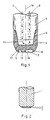
- an electrode or electrode cap with good electrical conductivity, is permanently connected to the working surface with a thin plate of a high-melting metal, preferably tungsten or an alloy of various suitable metals, the microstructure of which is very flat and with the grain orientation is transverse to the longitudinal axis of the electrode.
- a high-melting metal preferably tungsten or an alloy of various suitable metals, the microstructure of which is very flat and with the grain orientation is transverse to the longitudinal axis of the electrode.
- the object according to the invention can avoid soldering cracks and thus produce a high quality welded joint.
- the plate (2) which is permanently attached to the work surface, has a thickness of less than 4 mm.
- the thinner the plate (2) the better the cooling of the electrode.
- the electrical resistance is also lower with extremely thin platelets. Limits in the thickness of the platelets are indicated by the mechanical strength. The better cooling of thin platelets reduces the tendency of the electrodes to stick to the surface-coated steel sheets to be welded.
- the plate (2) is made of a pure high-melting metal, preferably tungsten or molybdenum. However, since these pure metals are very brittle, they can also be added with other high-melting metals, such as. B. rhenium can be alloyed. Even chromium can be used as a binder with a small proportion as an alloying element. But not only the pure elements, also their oxides can be used.
- All suitable high-melting metals can be alloyed with each other. These alloys can also be modified with 0.1 - 15% HF and / or 0.1 - 15% Zr and / or 0.15 - 15% Ti and 0.01 - 3% C. Pure oxide additives are also quite possible.
- Molybdenum can also be doped with aluminum, potassium and silicon or oxide-dispersed.
- oxide additives of 0.05 - 25% can be added in the form of oxide ceramics with a melting point of the oxide that is above 1,500 ° C. Suitable oxide ceramics would be e.g. B. Mo 15 ZrO2, Mo 15 CeO2 and Mo 15 La2O3.
- the grain orientation (13) must lie transversely to the electrode axis (18). This is the only way to ensure that the physical properties of the plate (2) are retained.
- the starting material is rolled out. This automatically gives you the correct grain orientation.
- the structural grain is also elongated.
- the large flat elongated grain is better for this application than a small flat elongated grain. With the large flat grain, there are inevitably fewer grain boundaries that are perpendicular to the surface, and the tendency to edge breakouts is also avoided.
- the punched-out plate (2) which has a certain ductility, is connected to the electrode shaft (1) by means of a suitable solder to form a permanent connection (3).
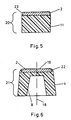
- the plates (2), which have a truncated cone (5) on their circumference, can be very well, for. B. with electrode caps, shed with the same during manufacture. Because the smaller diameter of the plate (2) represents the working surface (19), the plate (2) cannot fall out, it is surely covered by the electrode material (16).
- Another economical type of fastening would be achieved by pressing or hitting. Since the electrode material of the caps (4) is relatively soft, the plate (2) can be used at the same time in a manufacturing process and the cap (4) is also given a circumferential curve (17). By hitting all voids around the plate (2) are filled. The copper flows, so to speak. Since the electrode caps (4) represent a disposable item and z. B. be changed per shift in the automotive industry, the above-described mounting option represents a cost-effective alternative to other electrodes. Reworking the caps is not economical.
- cap (4) Another advantage of the cap (4) is that electrolyte copper can be used as the starting material, which has both better electrical conductivity and thermal conductivity than other alloys or metals.
- a very economical manufacturing method is the beating of electrode caps (4).
- a composite material made of high-melting metal and copper is used for this.
- the electrolytic copper layer (1) must be considerably thicker than the plate (2).
- Discs are also punched out of the flat material. Punching gives the high-melting material a slight rounding (23).
- the discs made of composite material are further processed in a device not described in detail.
- the soft electrolyte copper (11) is deformed into the desired shape of an electrode cap (4) by hitting it. Because of the tool geometry, it is achieved that the copper is driven around the rounding (23) of the plate (2). This creates a backfill (22) which gives the plate (2) an even better hold. So that the work surface (19) is free of copper, the electrode cap (4) may need to be reworked slightly.
- An electrolytic copper core (11) can also be used as the starting material for the electrode caps (4).
- a plate (2) is attached by friction welding, explosive plating or induction soldering and then, as already described, the electrode cap (4) is struck.
- Rings for a roller electrode can also be produced with the same composite material. These rings are also permanently attached to a raw electrode (15) by induction soldering (14).
- the thin plates (2) used make it possible to change the structure of the electrode and thus enable much better cooling.
- the copper of the cap electrode (4) immediately behind the plate (2) has better heat dissipation than z. B. Tungsten. So sits z. B. the electrode cap (4) on a mounting cone (9) of the electrode holder (6).
- the cooling water flows through a channel (7) into the electrode holder (6.). Between the electrode holder (6) and the electrode cap (4) there is a cavity (10) into which the cooling water flows.
- the (19) heat generated on the work surface is drawn to the cavity (10) of the cap electrode (4) due to the temperature gradient.
- the heating cooling water is discharged again via the channel (8). This means that the system cannot heat up due to the large copper content.
- the heat is dissipated directly from the point of origin. The thinner the plate (2), the better this heat dissipation.
- the subject of the invention offers a previously unattainable reproducibility of the weld quality of spot weld connections. With constant quality z. B. sufficient welding points are produced on fully automatic welding lines without having to change the electrode caps. Welding security increases with the subject of the invention.
Landscapes
- Engineering & Computer Science (AREA)
- Mechanical Engineering (AREA)
- Resistance Welding (AREA)
- Heat Treatment Of Sheet Steel (AREA)
- Electrodes For Compound Or Non-Metal Manufacture (AREA)
- Arc Welding In General (AREA)
Priority Applications (1)
| Application Number | Priority Date | Filing Date | Title |
|---|---|---|---|
| AT90101344T ATE94107T1 (de) | 1989-02-13 | 1990-01-24 | Elektrode zum widerstandsschweissen von oberflaechenveredelten stahlblechen und verfahren zu deren herstellung. |
Applications Claiming Priority (2)
| Application Number | Priority Date | Filing Date | Title |
|---|---|---|---|
| DE3904213 | 1989-02-13 | ||
| DE3904213A DE3904213C1 (fr) | 1989-02-13 | 1989-02-13 |
Publications (2)
| Publication Number | Publication Date |
|---|---|
| EP0383060A1 true EP0383060A1 (fr) | 1990-08-22 |
| EP0383060B1 EP0383060B1 (fr) | 1993-09-08 |
Family
ID=6373944
Family Applications (1)
| Application Number | Title | Priority Date | Filing Date |
|---|---|---|---|
| EP90101344A Expired - Lifetime EP0383060B1 (fr) | 1989-02-13 | 1990-01-24 | Electrode pour soudage par résistance de tôles d'acier à surfaces modifiées par traitement et procédé pour sa fabrication |
Country Status (6)
| Country | Link |
|---|---|
| US (1) | US5021627A (fr) |
| EP (1) | EP0383060B1 (fr) |
| JP (1) | JPH03481A (fr) |
| AT (1) | ATE94107T1 (fr) |
| DE (2) | DE3904213C1 (fr) |
| ES (1) | ES2017068T3 (fr) |
Cited By (4)
| Publication number | Priority date | Publication date | Assignee | Title |
|---|---|---|---|---|
| FR2670700A1 (fr) * | 1990-12-21 | 1992-06-26 | Lorraine Laminage | Electrode de soudage par points. |
| DE202014000408U1 (de) | 2014-01-16 | 2014-02-06 | Bayerische Metallwerke Gmbh | Elektrode zum Widerstandsschweißen |
| DE102014203160A1 (de) | 2014-02-21 | 2015-08-27 | Volkswagen Aktiengesellschaft | Schweißelektrode |
| WO2016113019A1 (fr) * | 2015-01-14 | 2016-07-21 | Thyssenkrupp Steel Europe Ag | Électrode de soudage, procédé et dispositif de soudage de tôles sandwich |
Families Citing this family (26)
| Publication number | Priority date | Publication date | Assignee | Title |
|---|---|---|---|---|
| DE19520514A1 (de) * | 1995-06-03 | 1996-12-05 | Bayerische Motoren Werke Ag | Elektrode zum Widerstands-Punktschweißen von Aluminium-Blechen |
| SE511962C2 (sv) * | 1997-03-12 | 1999-12-20 | Volvo Ab | Förfarande för att framställa en elektrod för motståndssvetsning |
| DE19828798A1 (de) * | 1998-06-27 | 1999-12-30 | Opel Adam Ag | Schweißelektrode |
| US6657153B2 (en) | 2001-01-31 | 2003-12-02 | The Esab Group, Inc. | Electrode diffusion bonding |
| US6420673B1 (en) | 2001-02-20 | 2002-07-16 | The Esab Group, Inc. | Powdered metal emissive elements |
| JP2004527878A (ja) | 2001-03-09 | 2004-09-09 | ハイパーサーム インコーポレイテッド | プラズマアークトーチ用複合電極 |
| US6528753B2 (en) | 2001-05-31 | 2003-03-04 | The Esab Group, Inc. | Method of coating an emissive element |
| US6423922B1 (en) | 2001-05-31 | 2002-07-23 | The Esab Group, Inc. | Process of forming an electrode |
| US6563075B1 (en) | 2001-12-20 | 2003-05-13 | The Esab Group, Inc. | Method of forming an electrode |
| US20030183602A1 (en) * | 2002-03-28 | 2003-10-02 | Hughes Russell Vernon | Method of resistance spot welding |
| US7032800B2 (en) * | 2003-05-30 | 2006-04-25 | General Electric Company | Apparatus and method for friction stir welding of high strength materials, and articles made therefrom |
| US7022934B1 (en) * | 2003-06-10 | 2006-04-04 | Honda Giken Kogyo Kabushiki Kaisha | Connecting adapter for weld electrode |
| US20050029234A1 (en) * | 2003-08-04 | 2005-02-10 | Feng Lu | Resistance spot welding electrode |
| DE102004010723A1 (de) * | 2004-03-05 | 2005-09-22 | Minebea Co., Ltd. | Verfahren zur Herstellung einer elektrischen Verbindung zwischen mehreren lackisolierten Leitern |
| US7355142B2 (en) * | 2005-04-22 | 2008-04-08 | Lincoln Global, Inc. | Resistance welding electrode, welded copper flex lead, and method for making same |
| RU2341360C2 (ru) * | 2007-01-30 | 2008-12-20 | Башкирский государственный аграрный университет (БГАУ) | Роликовый электрод для электроконтактной приварки |
| US8299388B2 (en) * | 2007-10-25 | 2012-10-30 | Cmw International, Inc. | Finned resistance spot welding electrode |
| US8785807B2 (en) * | 2011-03-17 | 2014-07-22 | GM Global Technology Operations LLC | Welding electrode and method of forming a resistance spot weld joint |
| US8895887B2 (en) * | 2011-08-05 | 2014-11-25 | General Electric Company | Resistance weld repairing of casing flange holes |
| US9649717B2 (en) * | 2013-12-24 | 2017-05-16 | Innovative Weld Solutions, Ltd. | Welding assembly and method |
| DE102014008623A1 (de) | 2014-06-17 | 2015-12-17 | Thyssenkrupp Ag | Verfahren zum Widerstandspunktschweißen eines Sandwichmaterials und Vorrichtung hierfür |
| US10259071B2 (en) * | 2015-03-27 | 2019-04-16 | GM Global Technology Operations LLC | Resistive welding electrode and method for spot welding steel and aluminum alloy workpieces with the resistive welding electrode |
| DE102015220970A1 (de) * | 2015-10-27 | 2017-04-27 | Volkswagen Aktiengesellschaft | Schweißelektrode, Widerstandsschweißnietanlage, Widerstandsschweißnietsystem und Widerstandsschweißnietverfahren |
| US20170157697A1 (en) * | 2015-12-08 | 2017-06-08 | GM Global Technology Operations LLC | Welding electrode for use in resistance spot welding workpiece stack-ups that include an aluminum workpiece and a steel workpiece |
| USD908150S1 (en) | 2020-05-08 | 2021-01-19 | Luvata Ohio, Inc. | Welding cap |
| CN115196636B (zh) * | 2022-09-15 | 2022-11-22 | 溧阳天目先导电池材料科技有限公司 | 一种金属掺杂的硅基负极材料及其制备方法和应用 |
Citations (4)
| Publication number | Priority date | Publication date | Assignee | Title |
|---|---|---|---|---|
| GB191508543A (en) * | 1915-06-09 | 1916-03-23 | Britsh Thomson Houston Company | Improvements in and relating to Electric Welding and Brazing Apparatus. |
| GB1252062A (fr) * | 1968-03-21 | 1971-11-03 | ||
| DE1914106C3 (de) * | 1969-03-20 | 1973-06-20 | Licentia Gmbh | Elektrode zum widerstandsschweissen von blech |
| DE2804816A1 (de) * | 1978-02-04 | 1979-08-09 | Kabel Metallwerke Ghh | Elektrode fuer die elektrische widerstandsschweissung |
Family Cites Families (13)
| Publication number | Priority date | Publication date | Assignee | Title |
|---|---|---|---|---|
| DE625201C (de) * | 1933-08-12 | 1936-02-06 | Molybdenum Company Nv | Mindestens ein schwerer und mindestens ein leichter schmelzendes Metall enthaltende Elektrode, insbesondere fuer elektrische Widerstandsschweissung |
| US2257566A (en) * | 1939-05-29 | 1941-09-30 | Bert L Quarnstrom | Welding electrode and method of forming the same |
| US3109087A (en) * | 1960-10-14 | 1963-10-29 | Sciaky Electric Welding Machin | Welding electrodes |
| FR1410358A (fr) * | 1964-07-29 | 1965-09-10 | Le Bronze Ind Rene Loiseau & C | électrode de soudure par résistance |
| US3665145A (en) * | 1970-04-10 | 1972-05-23 | Harold J Engel | Resistance welding electrode |
| DE2203776B2 (de) * | 1972-01-27 | 1976-12-16 | Battelle-Institut E.V., 6000 Frankfurt | Hochbelastbare elektrische kontakte oder elektroden sowie verfahren zu deren herstellung |
| GB1465535A (en) * | 1974-05-09 | 1977-02-23 | Standard Telephones Cables Ltd | Spot welding electrodes |
| JPS5143340A (ja) * | 1974-10-12 | 1976-04-14 | Yutaka Suetomi | Suhotsutoyosetsuyodenkyokuzai |
| DE2554990A1 (de) * | 1975-12-06 | 1977-06-16 | Kabel Metallwerke Ghh | Elektrode fuer die elektrische widerstandsschweissung |
| FR2424093A1 (fr) * | 1978-04-25 | 1979-11-23 | Renault | Electrode composite de soudage par resistance |
| JPS5736073A (ja) * | 1980-07-15 | 1982-02-26 | Hitachi Ltd | Yosetsurobotsutonoanzensochi |
| JPS5941838A (ja) * | 1982-08-31 | 1984-03-08 | Fujitsu Ltd | マイクロ波プラズマ装置 |
| JPS60227997A (ja) * | 1984-04-26 | 1985-11-13 | Sumitomo Electric Ind Ltd | 溶接用電極材料 |
-
1989
- 1989-02-13 DE DE3904213A patent/DE3904213C1/de not_active Expired - Fee Related
-
1990
- 1990-01-24 AT AT90101344T patent/ATE94107T1/de not_active IP Right Cessation
- 1990-01-24 DE DE90101344T patent/DE59002591D1/de not_active Expired - Fee Related
- 1990-01-24 EP EP90101344A patent/EP0383060B1/fr not_active Expired - Lifetime
- 1990-01-24 ES ES90101344T patent/ES2017068T3/es not_active Expired - Lifetime
- 1990-02-12 US US07/478,622 patent/US5021627A/en not_active Expired - Fee Related
- 1990-02-13 JP JP2029787A patent/JPH03481A/ja active Pending
Patent Citations (4)
| Publication number | Priority date | Publication date | Assignee | Title |
|---|---|---|---|---|
| GB191508543A (en) * | 1915-06-09 | 1916-03-23 | Britsh Thomson Houston Company | Improvements in and relating to Electric Welding and Brazing Apparatus. |
| GB1252062A (fr) * | 1968-03-21 | 1971-11-03 | ||
| DE1914106C3 (de) * | 1969-03-20 | 1973-06-20 | Licentia Gmbh | Elektrode zum widerstandsschweissen von blech |
| DE2804816A1 (de) * | 1978-02-04 | 1979-08-09 | Kabel Metallwerke Ghh | Elektrode fuer die elektrische widerstandsschweissung |
Cited By (6)
| Publication number | Priority date | Publication date | Assignee | Title |
|---|---|---|---|---|
| FR2670700A1 (fr) * | 1990-12-21 | 1992-06-26 | Lorraine Laminage | Electrode de soudage par points. |
| EP0493194A1 (fr) * | 1990-12-21 | 1992-07-01 | Sollac | Electrode de soudage par points |
| DE202014000408U1 (de) | 2014-01-16 | 2014-02-06 | Bayerische Metallwerke Gmbh | Elektrode zum Widerstandsschweißen |
| DE102014203160A1 (de) | 2014-02-21 | 2015-08-27 | Volkswagen Aktiengesellschaft | Schweißelektrode |
| WO2016113019A1 (fr) * | 2015-01-14 | 2016-07-21 | Thyssenkrupp Steel Europe Ag | Électrode de soudage, procédé et dispositif de soudage de tôles sandwich |
| US10875119B2 (en) | 2015-01-14 | 2020-12-29 | Thyssenkrupp Steel Europe Ag | Welding electrode, method, and device for welding sandwich panels |
Also Published As
| Publication number | Publication date |
|---|---|
| JPH03481A (ja) | 1991-01-07 |
| EP0383060B1 (fr) | 1993-09-08 |
| US5021627A (en) | 1991-06-04 |
| ES2017068T3 (es) | 1994-02-16 |
| ES2017068A4 (es) | 1991-01-01 |
| DE59002591D1 (de) | 1993-10-14 |
| DE3904213C1 (fr) | 1990-04-05 |
| ATE94107T1 (de) | 1993-09-15 |
Similar Documents
| Publication | Publication Date | Title |
|---|---|---|
| EP0383060B1 (fr) | Electrode pour soudage par résistance de tôles d'acier à surfaces modifiées par traitement et procédé pour sa fabrication | |
| EP2193867B1 (fr) | Electrode en fil d'acier destinée à la coupe par étincelage et méthode de fabrication d'une telle électrode. | |
| DE2906245C3 (de) | Drahtelektrode für das funkenerosive Schneiden | |
| DE2323242C3 (de) | Verfahren und Vorrichtung zur Herstellung einer verschleißfesten Hartmetalischicht auf einem Metallgegenstand | |
| DE60206413T2 (de) | Draht für hochgeschwindigkeitsfunkenerosion | |
| DE202013008126U1 (de) | Legierung | |
| DE102017107477A1 (de) | Widerstandspunktschweissen von stahl- und aluminiumwerkstücken mit elektrode, die einen einsatz aufweisen | |
| EP3247530B1 (fr) | Alliage pour soudure épaisse | |
| EP0196447A1 (fr) | Procédé pour l'amélioration de la résistance à l'oxydation et à la corrosion par un traitement de surface d'un article en un superalliage renforcé par dispersion | |
| DE2112427A1 (de) | Verfahren zur Herstellung eines mit hoher Geschwindigkeit arbeitenden bimetallischen Schneidblattes | |
| EP2999101A2 (fr) | Rotor en court-circuit | |
| DE69904237T2 (de) | Elektrogewinnungs-Anoden mit einer sich schnell bildenden Oxid-Schutzschicht | |
| CH663922A5 (de) | Elektrode fuer drahtschneide-funkenerosion. | |
| DE3424958C2 (fr) | ||
| DE2754188A1 (de) | Bimetall-widerstandsschweisselektrode und verfahren zu deren herstellung | |
| DE102020206853A1 (de) | Wärmeübertrager und Verfahren zum Herstellen eines Wärmeübertragers | |
| EP0090887A1 (fr) | Procédé pour la jonction par diffusion de matériaux résistant au fluage à température élevée | |
| EP1640108B1 (fr) | Procédé de fabrication d'un contact | |
| DE10392662T5 (de) | Kupfer-Nickel-Silizium Zwei-Phasen Abschrecksubstrat | |
| DE4344714A1 (de) | Verfahren zum Punktschweißen von Aluminiumlegierungen | |
| DE3504861A1 (de) | Widerstandsverbindungsverfahren zum loeten oder schweissen metastabiler metalle | |
| EP0166149A1 (fr) | Molette électrode pour le soudage en ligne par résistance électrique | |
| DE2907323A1 (de) | Elektrode zum elektrischen widerstandsschweissen | |
| DE1914424A1 (de) | Elektroden zum Widerstandsschweissen von beschichteten Stahlblechen | |
| DE2250810B2 (de) | Kontaktstueck, insbesondere kontaktniet, und herstellungsverfahren hierzu |
Legal Events
| Date | Code | Title | Description |
|---|---|---|---|
| PUAI | Public reference made under article 153(3) epc to a published international application that has entered the european phase |
Free format text: ORIGINAL CODE: 0009012 |
|
| AK | Designated contracting states |
Kind code of ref document: A1 Designated state(s): AT BE CH DE ES FR GB IT LI NL SE |
|
| ITCL | It: translation for ep claims filed |
Representative=s name: RICCARDI SERGIO & CO. |
|
| TCNL | Nl: translation of patent claims filed | ||
| 17P | Request for examination filed |
Effective date: 19900823 |
|
| GBC | Gb: translation of claims filed (gb section 78(7)/1977) | ||
| EL | Fr: translation of claims filed | ||
| 17Q | First examination report despatched |
Effective date: 19920204 |
|
| GRAA | (expected) grant |
Free format text: ORIGINAL CODE: 0009210 |
|
| AK | Designated contracting states |
Kind code of ref document: B1 Designated state(s): AT BE CH DE ES FR GB IT LI NL SE |
|
| REF | Corresponds to: |
Ref document number: 94107 Country of ref document: AT Date of ref document: 19930915 Kind code of ref document: T |
|
| REF | Corresponds to: |
Ref document number: 59002591 Country of ref document: DE Date of ref document: 19931014 |
|
| RAP2 | Party data changed (patent owner data changed or rights of a patent transferred) |
Owner name: METALLWERK PLANSEE GESELLSCHAFT M.B.H. Owner name: KRUPP HOESCH STAHL AG |
|
| GBT | Gb: translation of ep patent filed (gb section 77(6)(a)/1977) |
Effective date: 19931103 |
|
| ITF | It: translation for a ep patent filed | ||
| ET | Fr: translation filed | ||
| REG | Reference to a national code |
Ref country code: ES Ref legal event code: FG2A Ref document number: 2017068 Country of ref document: ES Kind code of ref document: T3 |
|
| NLT2 | Nl: modifications (of names), taken from the european patent patent bulletin |
Owner name: KRUPP HOESCH STAHL AG TE DORTMUND, BONDSREPUBLIEK |
|
| PLBE | No opposition filed within time limit |
Free format text: ORIGINAL CODE: 0009261 |
|
| STAA | Information on the status of an ep patent application or granted ep patent |
Free format text: STATUS: NO OPPOSITION FILED WITHIN TIME LIMIT |
|
| 26N | No opposition filed | ||
| PGFP | Annual fee paid to national office [announced via postgrant information from national office to epo] |
Ref country code: FR Payment date: 19941222 Year of fee payment: 6 |
|
| PGFP | Annual fee paid to national office [announced via postgrant information from national office to epo] |
Ref country code: DE Payment date: 19941224 Year of fee payment: 6 |
|
| PGFP | Annual fee paid to national office [announced via postgrant information from national office to epo] |
Ref country code: CH Payment date: 19941227 Year of fee payment: 6 |
|
| PGFP | Annual fee paid to national office [announced via postgrant information from national office to epo] |
Ref country code: BE Payment date: 19941229 Year of fee payment: 6 Ref country code: AT Payment date: 19941229 Year of fee payment: 6 |
|
| PGFP | Annual fee paid to national office [announced via postgrant information from national office to epo] |
Ref country code: SE Payment date: 19941230 Year of fee payment: 6 Ref country code: GB Payment date: 19941230 Year of fee payment: 6 |
|
| PGFP | Annual fee paid to national office [announced via postgrant information from national office to epo] |
Ref country code: ES Payment date: 19950118 Year of fee payment: 6 |
|
| EAL | Se: european patent in force in sweden |
Ref document number: 90101344.1 |
|
| PGFP | Annual fee paid to national office [announced via postgrant information from national office to epo] |
Ref country code: NL Payment date: 19950131 Year of fee payment: 6 |
|
| PG25 | Lapsed in a contracting state [announced via postgrant information from national office to epo] |
Ref country code: GB Effective date: 19960124 Ref country code: AT Effective date: 19960124 |
|
| PG25 | Lapsed in a contracting state [announced via postgrant information from national office to epo] |
Ref country code: SE Effective date: 19960125 Ref country code: ES Free format text: LAPSE BECAUSE OF NON-PAYMENT OF DUE FEES Effective date: 19960125 |
|
| PG25 | Lapsed in a contracting state [announced via postgrant information from national office to epo] |
Ref country code: LI Effective date: 19960131 Ref country code: CH Effective date: 19960131 Ref country code: BE Effective date: 19960131 |
|
| BERE | Be: lapsed |
Owner name: METALLWERK PLANSEE G.M.B.H. Effective date: 19960131 Owner name: HOESCH STAHL A.G. Effective date: 19960131 |
|
| PG25 | Lapsed in a contracting state [announced via postgrant information from national office to epo] |
Ref country code: NL Effective date: 19960801 |
|
| GBPC | Gb: european patent ceased through non-payment of renewal fee |
Effective date: 19960124 |
|
| REG | Reference to a national code |
Ref country code: CH Ref legal event code: PL |
|
| PG25 | Lapsed in a contracting state [announced via postgrant information from national office to epo] |
Ref country code: FR Effective date: 19960930 |
|
| NLV4 | Nl: lapsed or anulled due to non-payment of the annual fee |
Effective date: 19960801 |
|
| PG25 | Lapsed in a contracting state [announced via postgrant information from national office to epo] |
Ref country code: DE Effective date: 19961001 |
|
| EUG | Se: european patent has lapsed |
Ref document number: 90101344.1 |
|
| REG | Reference to a national code |
Ref country code: FR Ref legal event code: ST |
|
| REG | Reference to a national code |
Ref country code: ES Ref legal event code: FD2A Effective date: 19990301 |
|
| PG25 | Lapsed in a contracting state [announced via postgrant information from national office to epo] |
Ref country code: IT Free format text: LAPSE BECAUSE OF NON-PAYMENT OF DUE FEES Effective date: 20050124 |