EP0383313A2 - Réactif d'essai immunologique et kit le contenant - Google Patents
Réactif d'essai immunologique et kit le contenant Download PDFInfo
- Publication number
- EP0383313A2 EP0383313A2 EP90102909A EP90102909A EP0383313A2 EP 0383313 A2 EP0383313 A2 EP 0383313A2 EP 90102909 A EP90102909 A EP 90102909A EP 90102909 A EP90102909 A EP 90102909A EP 0383313 A2 EP0383313 A2 EP 0383313A2
- Authority
- EP
- European Patent Office
- Prior art keywords
- antibody
- hapten
- labelled
- antigen
- reagent
- Prior art date
- Legal status (The legal status is an assumption and is not a legal conclusion. Google has not performed a legal analysis and makes no representation as to the accuracy of the status listed.)
- Ceased
Links
- 238000003018 immunoassay Methods 0.000 title claims abstract description 85
- 239000003153 chemical reaction reagent Substances 0.000 title claims abstract description 83
- 239000000427 antigen Substances 0.000 claims abstract description 133
- 102000036639 antigens Human genes 0.000 claims abstract description 133
- 108091007433 antigens Proteins 0.000 claims abstract description 133
- 238000009739 binding Methods 0.000 claims abstract description 41
- 230000027455 binding Effects 0.000 claims abstract description 40
- 230000002441 reversible effect Effects 0.000 claims abstract description 38
- 230000002163 immunogen Effects 0.000 claims description 73
- 239000000126 substance Substances 0.000 claims description 73
- 150000003431 steroids Chemical class 0.000 claims description 55
- 229940011871 estrogen Drugs 0.000 claims description 44
- 239000000262 estrogen Substances 0.000 claims description 44
- 239000001257 hydrogen Substances 0.000 claims description 39
- 229910052739 hydrogen Inorganic materials 0.000 claims description 39
- 238000002360 preparation method Methods 0.000 claims description 39
- 239000003795 chemical substances by application Substances 0.000 claims description 25
- 238000002372 labelling Methods 0.000 claims description 24
- 125000004432 carbon atom Chemical group C* 0.000 claims description 16
- 150000001875 compounds Chemical class 0.000 claims description 16
- 125000005842 heteroatom Chemical group 0.000 claims description 16
- UFHFLCQGNIYNRP-UHFFFAOYSA-N Hydrogen Chemical compound [H][H] UFHFLCQGNIYNRP-UHFFFAOYSA-N 0.000 claims description 15
- 150000002431 hydrogen Chemical class 0.000 claims description 15
- QVGXLLKOCUKJST-UHFFFAOYSA-N atomic oxygen Chemical group [O] QVGXLLKOCUKJST-UHFFFAOYSA-N 0.000 claims description 12
- 239000001301 oxygen Substances 0.000 claims description 12
- 229910052760 oxygen Inorganic materials 0.000 claims description 12
- 102000004190 Enzymes Human genes 0.000 claims description 11
- 108090000790 Enzymes Proteins 0.000 claims description 11
- 125000004435 hydrogen atom Chemical group [H]* 0.000 claims description 9
- 125000003178 carboxy group Chemical group [H]OC(*)=O 0.000 claims description 7
- 125000002887 hydroxy group Chemical group [H]O* 0.000 claims description 6
- 239000002207 metabolite Substances 0.000 claims description 6
- HZVOZRGWRWCICA-UHFFFAOYSA-N methanediyl Chemical group [CH2] HZVOZRGWRWCICA-UHFFFAOYSA-N 0.000 claims description 4
- 239000000583 progesterone congener Substances 0.000 claims description 3
- 125000002345 steroid group Chemical class 0.000 claims 7
- 238000000034 method Methods 0.000 abstract description 62
- 230000009137 competitive binding Effects 0.000 abstract description 22
- RJKFOVLPORLFTN-LEKSSAKUSA-N Progesterone Chemical compound C1CC2=CC(=O)CC[C@]2(C)[C@@H]2[C@@H]1[C@@H]1CC[C@H](C(=O)C)[C@@]1(C)CC2 RJKFOVLPORLFTN-LEKSSAKUSA-N 0.000 description 66
- 239000000243 solution Substances 0.000 description 61
- 238000005259 measurement Methods 0.000 description 52
- 108091003079 Bovine Serum Albumin Proteins 0.000 description 42
- 229940098773 bovine serum albumin Drugs 0.000 description 42
- 229960005309 estradiol Drugs 0.000 description 41
- 230000008105 immune reaction Effects 0.000 description 37
- XEKOWRVHYACXOJ-UHFFFAOYSA-N Ethyl acetate Chemical compound CCOC(C)=O XEKOWRVHYACXOJ-UHFFFAOYSA-N 0.000 description 36
- 102000013415 peroxidase activity proteins Human genes 0.000 description 35
- 108040007629 peroxidase activity proteins Proteins 0.000 description 35
- VOXZDWNPVJITMN-ZBRFXRBCSA-N 17β-estradiol Chemical compound OC1=CC=C2[C@H]3CC[C@](C)([C@H](CC4)O)[C@@H]4[C@@H]3CCC2=C1 VOXZDWNPVJITMN-ZBRFXRBCSA-N 0.000 description 34
- 229930182833 estradiol Natural products 0.000 description 34
- 238000006243 chemical reaction Methods 0.000 description 33
- 239000000186 progesterone Substances 0.000 description 33
- 229960003387 progesterone Drugs 0.000 description 33
- 210000004369 blood Anatomy 0.000 description 30
- 239000008280 blood Substances 0.000 description 30
- 230000002485 urinary effect Effects 0.000 description 16
- 210000004408 hybridoma Anatomy 0.000 description 15
- 238000012360 testing method Methods 0.000 description 14
- MHAJPDPJQMAIIY-UHFFFAOYSA-N Hydrogen peroxide Chemical compound OO MHAJPDPJQMAIIY-UHFFFAOYSA-N 0.000 description 12
- 230000007910 cell fusion Effects 0.000 description 12
- JBBNFGYRYNBDIH-DBGGZKJISA-N 11alpha-hydroxyprogesterone hemisuccinate Chemical compound C1CC2=CC(=O)CC[C@]2(C)[C@@H]2[C@@H]1[C@@H]1CC[C@H](C(=O)C)[C@@]1(C)C[C@H]2OC(=O)CCC(O)=O JBBNFGYRYNBDIH-DBGGZKJISA-N 0.000 description 11
- 108010001336 Horseradish Peroxidase Proteins 0.000 description 11
- 238000003127 radioimmunoassay Methods 0.000 description 11
- PROQIPRRNZUXQM-UHFFFAOYSA-N (16alpha,17betaOH)-Estra-1,3,5(10)-triene-3,16,17-triol Natural products OC1=CC=C2C3CCC(C)(C(C(O)C4)O)C4C3CCC2=C1 PROQIPRRNZUXQM-UHFFFAOYSA-N 0.000 description 10
- PROQIPRRNZUXQM-ZXXIGWHRSA-N estriol Chemical compound OC1=CC=C2[C@H]3CC[C@](C)([C@H]([C@H](O)C4)O)[C@@H]4[C@@H]3CCC2=C1 PROQIPRRNZUXQM-ZXXIGWHRSA-N 0.000 description 10
- FQYGGFDZJFIDPU-JRSYHJKYSA-N estriol 16-O-(beta-D-glucuronide) Chemical compound O([C@@H]1C[C@H]2[C@H]3[C@@H](C4=CC=C(O)C=C4CC3)CC[C@@]2([C@H]1O)C)[C@@H]1O[C@H](C(O)=O)[C@@H](O)[C@H](O)[C@H]1O FQYGGFDZJFIDPU-JRSYHJKYSA-N 0.000 description 10
- FQYGGFDZJFIDPU-UHFFFAOYSA-N estriol 16alpha-beta-D-glucuronide Natural products OC1C2(C)CCC(C3=CC=C(O)C=C3CC3)C3C2CC1OC1OC(C(O)=O)C(O)C(O)C1O FQYGGFDZJFIDPU-UHFFFAOYSA-N 0.000 description 10
- 239000011521 glass Substances 0.000 description 10
- VEXZGXHMUGYJMC-UHFFFAOYSA-N Hydrochloric acid Chemical compound Cl VEXZGXHMUGYJMC-UHFFFAOYSA-N 0.000 description 9
- 150000008065 acid anhydrides Chemical class 0.000 description 9
- 238000003149 assay kit Methods 0.000 description 9
- 230000009260 cross reactivity Effects 0.000 description 9
- 229960001348 estriol Drugs 0.000 description 9
- 239000000758 substrate Substances 0.000 description 9
- YJPIDPAGJSWWBE-FNIAAEIWSA-N 4-{[(14β,17α)-3-hydroxyestra-1,3,5(10)-trien-17-yl]oxy}-4-oxobutanoic acid Chemical compound OC1=CC=C2[C@H]3CC[C@](C)([C@H](CC4)OC(=O)CCC(O)=O)[C@@H]4[C@@H]3CCC2=C1 YJPIDPAGJSWWBE-FNIAAEIWSA-N 0.000 description 8
- 241000699670 Mus sp. Species 0.000 description 8
- 150000002159 estradiols Chemical class 0.000 description 8
- 230000008569 process Effects 0.000 description 8
- 239000003418 antiprogestin Substances 0.000 description 7
- 239000000463 material Substances 0.000 description 7
- 239000000047 product Substances 0.000 description 7
- 230000003623 progesteronic effect Effects 0.000 description 7
- XLYOFNOQVPJJNP-UHFFFAOYSA-N water Substances O XLYOFNOQVPJJNP-UHFFFAOYSA-N 0.000 description 7
- GEYOCULIXLDCMW-UHFFFAOYSA-N 1,2-phenylenediamine Chemical compound NC1=CC=CC=C1N GEYOCULIXLDCMW-UHFFFAOYSA-N 0.000 description 6
- RYHBNJHYFVUHQT-UHFFFAOYSA-N 1,4-Dioxane Chemical compound C1COCCO1 RYHBNJHYFVUHQT-UHFFFAOYSA-N 0.000 description 6
- PPELYUTTZHLIAZ-CDUDAXDSSA-N 2-[(e)-[(8s,9s,10r,13s,14s,17s)-17-acetyl-10,13-dimethyl-1,2,6,7,8,9,11,12,14,15,16,17-dodecahydrocyclopenta[a]phenanthren-3-ylidene]amino]oxyacetic acid Chemical compound C1CC2=C\C(=N\OCC(O)=O)CC[C@]2(C)[C@@H]2[C@@H]1[C@@H]1CC[C@H](C(=O)C)[C@@]1(C)CC2 PPELYUTTZHLIAZ-CDUDAXDSSA-N 0.000 description 6
- QAOWNCQODCNURD-UHFFFAOYSA-N Sulfuric acid Chemical compound OS(O)(=O)=O QAOWNCQODCNURD-UHFFFAOYSA-N 0.000 description 6
- 238000002835 absorbance Methods 0.000 description 6
- 229940046836 anti-estrogen Drugs 0.000 description 6
- 230000001833 anti-estrogenic effect Effects 0.000 description 6
- 238000006911 enzymatic reaction Methods 0.000 description 6
- 239000000328 estrogen antagonist Substances 0.000 description 6
- 150000003145 progesterone derivatives Chemical class 0.000 description 6
- 238000005406 washing Methods 0.000 description 6
- 238000004108 freeze drying Methods 0.000 description 5
- 241001465754 Metazoa Species 0.000 description 4
- 241000699666 Mus <mouse, genus> Species 0.000 description 4
- 238000001042 affinity chromatography Methods 0.000 description 4
- 239000007864 aqueous solution Substances 0.000 description 4
- 238000001816 cooling Methods 0.000 description 4
- 230000037029 cross reaction Effects 0.000 description 4
- 150000002166 estriols Chemical class 0.000 description 4
- 102000004169 proteins and genes Human genes 0.000 description 4
- 108090000623 proteins and genes Proteins 0.000 description 4
- 238000000926 separation method Methods 0.000 description 4
- DNXHEGUUPJUMQT-UHFFFAOYSA-N (+)-estrone Natural products OC1=CC=C2C3CCC(C)(C(CC4)=O)C4C3CCC2=C1 DNXHEGUUPJUMQT-UHFFFAOYSA-N 0.000 description 3
- 102000009027 Albumins Human genes 0.000 description 3
- 108010088751 Albumins Proteins 0.000 description 3
- DNXHEGUUPJUMQT-CBZIJGRNSA-N Estrone Chemical compound OC1=CC=C2[C@H]3CC[C@](C)(C(CC4)=O)[C@@H]4[C@@H]3CCC2=C1 DNXHEGUUPJUMQT-CBZIJGRNSA-N 0.000 description 3
- UEZVMMHDMIWARA-UHFFFAOYSA-N Metaphosphoric acid Chemical compound OP(=O)=O UEZVMMHDMIWARA-UHFFFAOYSA-N 0.000 description 3
- 229920005654 Sephadex Polymers 0.000 description 3
- 239000012507 Sephadex™ Substances 0.000 description 3
- FAPWRFPIFSIZLT-UHFFFAOYSA-M Sodium chloride Chemical class [Na+].[Cl-] FAPWRFPIFSIZLT-UHFFFAOYSA-M 0.000 description 3
- 230000015572 biosynthetic process Effects 0.000 description 3
- 238000004440 column chromatography Methods 0.000 description 3
- 238000000502 dialysis Methods 0.000 description 3
- 229960003399 estrone Drugs 0.000 description 3
- 150000002167 estrones Chemical class 0.000 description 3
- 238000007499 fusion processing Methods 0.000 description 3
- 230000003053 immunization Effects 0.000 description 3
- 230000000670 limiting effect Effects 0.000 description 3
- 239000012528 membrane Substances 0.000 description 3
- 239000000203 mixture Substances 0.000 description 3
- 102000004196 processed proteins & peptides Human genes 0.000 description 3
- 108090000765 processed proteins & peptides Proteins 0.000 description 3
- 230000035484 reaction time Effects 0.000 description 3
- 210000004989 spleen cell Anatomy 0.000 description 3
- FCYRILLHKIZCQM-UHFFFAOYSA-N (1-chloro-2-methylpropyl) formate Chemical compound CC(C)C(Cl)OC=O FCYRILLHKIZCQM-UHFFFAOYSA-N 0.000 description 2
- FALRKNHUBBKYCC-UHFFFAOYSA-N 2-(chloromethyl)pyridine-3-carbonitrile Chemical compound ClCC1=NC=CC=C1C#N FALRKNHUBBKYCC-UHFFFAOYSA-N 0.000 description 2
- 102000012406 Carcinoembryonic Antigen Human genes 0.000 description 2
- 108010022366 Carcinoembryonic Antigen Proteins 0.000 description 2
- 241000581652 Hagenia abyssinica Species 0.000 description 2
- 102000009151 Luteinizing Hormone Human genes 0.000 description 2
- 108010073521 Luteinizing Hormone Proteins 0.000 description 2
- JUJWROOIHBZHMG-UHFFFAOYSA-N Pyridine Chemical compound C1=CC=NC=C1 JUJWROOIHBZHMG-UHFFFAOYSA-N 0.000 description 2
- PMZURENOXWZQFD-UHFFFAOYSA-L Sodium Sulfate Chemical compound [Na+].[Na+].[O-]S([O-])(=O)=O PMZURENOXWZQFD-UHFFFAOYSA-L 0.000 description 2
- MUMGGOZAMZWBJJ-DYKIIFRCSA-N Testostosterone Chemical compound O=C1CC[C@]2(C)[C@H]3CC[C@](C)([C@H](CC4)O)[C@@H]4[C@@H]3CCC2=C1 MUMGGOZAMZWBJJ-DYKIIFRCSA-N 0.000 description 2
- 102000011923 Thyrotropin Human genes 0.000 description 2
- 108010061174 Thyrotropin Proteins 0.000 description 2
- 239000000061 acid fraction Substances 0.000 description 2
- 230000004913 activation Effects 0.000 description 2
- 150000001412 amines Chemical class 0.000 description 2
- 150000001413 amino acids Chemical class 0.000 description 2
- 150000008064 anhydrides Chemical class 0.000 description 2
- 230000000890 antigenic effect Effects 0.000 description 2
- 239000000969 carrier Substances 0.000 description 2
- 238000011161 development Methods 0.000 description 2
- 239000012502 diagnostic product Substances 0.000 description 2
- LOKCTEFSRHRXRJ-UHFFFAOYSA-I dipotassium trisodium dihydrogen phosphate hydrogen phosphate dichloride Chemical compound P(=O)(O)(O)[O-].[K+].P(=O)(O)([O-])[O-].[Na+].[Na+].[Cl-].[K+].[Cl-].[Na+] LOKCTEFSRHRXRJ-UHFFFAOYSA-I 0.000 description 2
- 238000001035 drying Methods 0.000 description 2
- GNBHRKFJIUUOQI-UHFFFAOYSA-N fluorescein Chemical compound O1C(=O)C2=CC=CC=C2C21C1=CC=C(O)C=C1OC1=CC(O)=CC=C21 GNBHRKFJIUUOQI-UHFFFAOYSA-N 0.000 description 2
- 238000002875 fluorescence polarization Methods 0.000 description 2
- 230000002710 gonadal effect Effects 0.000 description 2
- 229940088597 hormone Drugs 0.000 description 2
- 239000005556 hormone Substances 0.000 description 2
- 230000002427 irreversible effect Effects 0.000 description 2
- 229940040129 luteinizing hormone Drugs 0.000 description 2
- 238000012986 modification Methods 0.000 description 2
- 230000004048 modification Effects 0.000 description 2
- NMHMNPHRMNGLLB-UHFFFAOYSA-N phloretic acid Chemical compound OC(=O)CCC1=CC=C(O)C=C1 NMHMNPHRMNGLLB-UHFFFAOYSA-N 0.000 description 2
- 239000002953 phosphate buffered saline Substances 0.000 description 2
- 238000004321 preservation Methods 0.000 description 2
- 230000002829 reductive effect Effects 0.000 description 2
- 238000010992 reflux Methods 0.000 description 2
- 239000007858 starting material Substances 0.000 description 2
- 229940014800 succinic anhydride Drugs 0.000 description 2
- 238000003786 synthesis reaction Methods 0.000 description 2
- 238000004809 thin layer chromatography Methods 0.000 description 2
- IMFACGCPASFAPR-UHFFFAOYSA-N tributylamine Chemical compound CCCCN(CCCC)CCCC IMFACGCPASFAPR-UHFFFAOYSA-N 0.000 description 2
- QFNCSEWPJSDMED-OFELHODLSA-N (8r,9s,10r,13r,14s,17s)-17-acetyl-13-(hydroxymethyl)-10-methyl-1,2,6,7,8,9,11,12,14,15,16,17-dodecahydrocyclopenta[a]phenanthren-3-one Chemical compound C1CC2=CC(=O)CC[C@]2(C)[C@@H]2[C@@H]1[C@@H]1CC[C@H](C(=O)C)[C@@]1(CO)CC2 QFNCSEWPJSDMED-OFELHODLSA-N 0.000 description 1
- FIHWBGCIKMXLBI-NXMWLWCLSA-N (8s,9s,10s,13s,14s,17s)-17-acetyl-10-(hydroxymethyl)-13-methyl-1,2,6,7,8,9,11,12,14,15,16,17-dodecahydrocyclopenta[a]phenanthren-3-one Chemical compound C1CC2=CC(=O)CC[C@]2(CO)[C@@H]2[C@@H]1[C@@H]1CC[C@H](C(=O)C)[C@@]1(C)CC2 FIHWBGCIKMXLBI-NXMWLWCLSA-N 0.000 description 1
- 0 **(C1=CC(CCC(C2CCC3=*)C4CCC23O)C4C=*1)=C Chemical compound **(C1=CC(CCC(C2CCC3=*)C4CCC23O)C4C=*1)=C 0.000 description 1
- CZGFLAQOJPXVRV-FLVROIOLSA-N 16alpha,17beta-Estriol 17-(beta-D-glucuronide) Chemical compound O([C@H]1[C@H](O)C[C@H]2[C@H]3[C@@H](C4=CC=C(O)C=C4CC3)CC[C@@]21C)[C@@H]1O[C@H](C(O)=O)[C@@H](O)[C@H](O)[C@H]1O CZGFLAQOJPXVRV-FLVROIOLSA-N 0.000 description 1
- LOVNYFVWYTXDRE-RMWFXKKMSA-N 16alpha-hydroxyprogesterone Chemical compound C1CC2=CC(=O)CC[C@]2(C)[C@@H]2[C@@H]1[C@@H]1C[C@@H](O)[C@H](C(=O)C)[C@@]1(C)CC2 LOVNYFVWYTXDRE-RMWFXKKMSA-N 0.000 description 1
- DBPWSSGDRRHUNT-UHFFFAOYSA-N 17alpha-hydroxy progesterone Natural products C1CC2=CC(=O)CCC2(C)C2C1C1CCC(C(=O)C)(O)C1(C)CC2 DBPWSSGDRRHUNT-UHFFFAOYSA-N 0.000 description 1
- VOXZDWNPVJITMN-SFFUCWETSA-N 17α-estradiol Chemical compound OC1=CC=C2[C@H]3CC[C@](C)([C@@H](CC4)O)[C@@H]4[C@@H]3CCC2=C1 VOXZDWNPVJITMN-SFFUCWETSA-N 0.000 description 1
- SZBWYTRVLQFZGU-UQZPWQSVSA-N 2-[[(8r,9s,13s,14s,16r,17r)-16,17-dihydroxy-13-methyl-6,7,8,9,11,12,14,15,16,17-decahydrocyclopenta[a]phenanthren-3-yl]oxy]acetic acid Chemical compound OC(=O)COC1=CC=C2[C@H]3CC[C@](C)([C@H]([C@H](O)C4)O)[C@@H]4[C@@H]3CCC2=C1 SZBWYTRVLQFZGU-UQZPWQSVSA-N 0.000 description 1
- FPQQSJJWHUJYPU-UHFFFAOYSA-N 3-(dimethylamino)propyliminomethylidene-ethylazanium;chloride Chemical compound Cl.CCN=C=NCCCN(C)C FPQQSJJWHUJYPU-UHFFFAOYSA-N 0.000 description 1
- PQSUYGKTWSAVDQ-ZVIOFETBSA-N Aldosterone Chemical compound C([C@@]1([C@@H](C(=O)CO)CC[C@H]1[C@@H]1CC2)C=O)[C@H](O)[C@@H]1[C@]1(C)C2=CC(=O)CC1 PQSUYGKTWSAVDQ-ZVIOFETBSA-N 0.000 description 1
- PQSUYGKTWSAVDQ-UHFFFAOYSA-N Aldosterone Natural products C1CC2C3CCC(C(=O)CO)C3(C=O)CC(O)C2C2(C)C1=CC(=O)CC2 PQSUYGKTWSAVDQ-UHFFFAOYSA-N 0.000 description 1
- 102000002260 Alkaline Phosphatase Human genes 0.000 description 1
- 108020004774 Alkaline Phosphatase Proteins 0.000 description 1
- 102000015427 Angiotensins Human genes 0.000 description 1
- 108010064733 Angiotensins Proteins 0.000 description 1
- 101800001890 Atrial natriuretic peptide Proteins 0.000 description 1
- 102400001282 Atrial natriuretic peptide Human genes 0.000 description 1
- ZJNISSYJJUZVDY-ARJAWSKDSA-N C/C=C\C(N(C)C=O)=O Chemical compound C/C=C\C(N(C)C=O)=O ZJNISSYJJUZVDY-ARJAWSKDSA-N 0.000 description 1
- OMFXVFTZEKFJBZ-UHFFFAOYSA-N Corticosterone Natural products O=C1CCC2(C)C3C(O)CC(C)(C(CC4)C(=O)CO)C4C3CCC2=C1 OMFXVFTZEKFJBZ-UHFFFAOYSA-N 0.000 description 1
- XUIIKFGFIJCVMT-GFCCVEGCSA-N D-thyroxine Chemical compound IC1=CC(C[C@@H](N)C(O)=O)=CC(I)=C1OC1=CC(I)=C(O)C(I)=C1 XUIIKFGFIJCVMT-GFCCVEGCSA-N 0.000 description 1
- LTMHDMANZUZIPE-AMTYYWEZSA-N Digoxin Natural products O([C@H]1[C@H](C)O[C@H](O[C@@H]2C[C@@H]3[C@@](C)([C@@H]4[C@H]([C@]5(O)[C@](C)([C@H](O)C4)[C@H](C4=CC(=O)OC4)CC5)CC3)CC2)C[C@@H]1O)[C@H]1O[C@H](C)[C@@H](O[C@H]2O[C@@H](C)[C@H](O)[C@@H](O)C2)[C@@H](O)C1 LTMHDMANZUZIPE-AMTYYWEZSA-N 0.000 description 1
- XSDCLHQDGODZPZ-WWNBULGVSA-N Estra-1,3,5-(10)-trien-17-one-3-oxyacetic acid Chemical compound OC(=O)COC1=CC=C2[C@H]3CC[C@](C)(C(CC4)=O)[C@@H]4[C@@H]3CCC2=C1 XSDCLHQDGODZPZ-WWNBULGVSA-N 0.000 description 1
- 229920013685 Estron Polymers 0.000 description 1
- 229910052693 Europium Inorganic materials 0.000 description 1
- 102000006771 Gonadotropins Human genes 0.000 description 1
- 108010086677 Gonadotropins Proteins 0.000 description 1
- 241000700721 Hepatitis B virus Species 0.000 description 1
- DOMWKUIIPQCAJU-LJHIYBGHSA-N Hydroxyprogesterone caproate Chemical compound C1CC2=CC(=O)CC[C@]2(C)[C@@H]2[C@@H]1[C@@H]1CC[C@@](C(C)=O)(OC(=O)CCCCC)[C@@]1(C)CC2 DOMWKUIIPQCAJU-LJHIYBGHSA-N 0.000 description 1
- NQTADLQHYWFPDB-UHFFFAOYSA-N N-Hydroxysuccinimide Chemical compound ON1C(=O)CCC1=O NQTADLQHYWFPDB-UHFFFAOYSA-N 0.000 description 1
- 241000710799 Rubella virus Species 0.000 description 1
- CDBYLPFSWZWCQE-UHFFFAOYSA-L Sodium Carbonate Chemical class [Na+].[Na+].[O-]C([O-])=O CDBYLPFSWZWCQE-UHFFFAOYSA-L 0.000 description 1
- 102000009843 Thyroglobulin Human genes 0.000 description 1
- 108010034949 Thyroglobulin Proteins 0.000 description 1
- DZBUGLKDJFMEHC-UHFFFAOYSA-N acridine Chemical class C1=CC=CC2=CC3=CC=CC=C3N=C21 DZBUGLKDJFMEHC-UHFFFAOYSA-N 0.000 description 1
- 229960002478 aldosterone Drugs 0.000 description 1
- 239000013566 allergen Substances 0.000 description 1
- 239000003098 androgen Substances 0.000 description 1
- 229940030486 androgens Drugs 0.000 description 1
- 239000007853 buffer solution Substances 0.000 description 1
- 150000001720 carbohydrates Chemical class 0.000 description 1
- 230000001684 chronic effect Effects 0.000 description 1
- 238000011109 contamination Methods 0.000 description 1
- OMFXVFTZEKFJBZ-HJTSIMOOSA-N corticosterone Chemical compound O=C1CC[C@]2(C)[C@H]3[C@@H](O)C[C@](C)([C@H](CC4)C(=O)CO)[C@@H]4[C@@H]3CCC2=C1 OMFXVFTZEKFJBZ-HJTSIMOOSA-N 0.000 description 1
- 238000003745 diagnosis Methods 0.000 description 1
- LTMHDMANZUZIPE-PUGKRICDSA-N digoxin Chemical compound C1[C@H](O)[C@H](O)[C@@H](C)O[C@H]1O[C@@H]1[C@@H](C)O[C@@H](O[C@@H]2[C@H](O[C@@H](O[C@@H]3C[C@@H]4[C@]([C@@H]5[C@H]([C@]6(CC[C@@H]([C@@]6(C)[C@H](O)C5)C=5COC(=O)C=5)O)CC4)(C)CC3)C[C@@H]2O)C)C[C@@H]1O LTMHDMANZUZIPE-PUGKRICDSA-N 0.000 description 1
- 229960005156 digoxin Drugs 0.000 description 1
- LTMHDMANZUZIPE-UHFFFAOYSA-N digoxine Natural products C1C(O)C(O)C(C)OC1OC1C(C)OC(OC2C(OC(OC3CC4C(C5C(C6(CCC(C6(C)C(O)C5)C=5COC(=O)C=5)O)CC4)(C)CC3)CC2O)C)CC1O LTMHDMANZUZIPE-UHFFFAOYSA-N 0.000 description 1
- 229940079593 drug Drugs 0.000 description 1
- 239000003814 drug Substances 0.000 description 1
- 230000000694 effects Effects 0.000 description 1
- OGPBJKLSAFTDLK-UHFFFAOYSA-N europium atom Chemical compound [Eu] OGPBJKLSAFTDLK-UHFFFAOYSA-N 0.000 description 1
- 239000000706 filtrate Substances 0.000 description 1
- 238000007710 freezing Methods 0.000 description 1
- 230000008014 freezing Effects 0.000 description 1
- 238000010353 genetic engineering Methods 0.000 description 1
- 239000003862 glucocorticoid Substances 0.000 description 1
- 239000002622 gonadotropin Substances 0.000 description 1
- -1 haptens Substances 0.000 description 1
- 238000010438 heat treatment Methods 0.000 description 1
- 229950000801 hydroxyprogesterone caproate Drugs 0.000 description 1
- 238000011534 incubation Methods 0.000 description 1
- 230000005764 inhibitory process Effects 0.000 description 1
- 239000007924 injection Substances 0.000 description 1
- 238000002347 injection Methods 0.000 description 1
- 229910052500 inorganic mineral Inorganic materials 0.000 description 1
- 238000002955 isolation Methods 0.000 description 1
- 108010045069 keyhole-limpet hemocyanin Proteins 0.000 description 1
- 150000002632 lipids Chemical class 0.000 description 1
- 230000000938 luteal effect Effects 0.000 description 1
- 230000035800 maturation Effects 0.000 description 1
- 239000011707 mineral Substances 0.000 description 1
- 239000012299 nitrogen atmosphere Substances 0.000 description 1
- 210000002394 ovarian follicle Anatomy 0.000 description 1
- 230000016087 ovulation Effects 0.000 description 1
- 239000008055 phosphate buffer solution Substances 0.000 description 1
- 239000002504 physiological saline solution Substances 0.000 description 1
- 229920001184 polypeptide Polymers 0.000 description 1
- UMJSCPRVCHMLSP-UHFFFAOYSA-N pyridine Natural products COC1=CC=CN=C1 UMJSCPRVCHMLSP-UHFFFAOYSA-N 0.000 description 1
- 239000011541 reaction mixture Substances 0.000 description 1
- 238000009877 rendering Methods 0.000 description 1
- 238000010898 silica gel chromatography Methods 0.000 description 1
- 238000001179 sorption measurement Methods 0.000 description 1
- 229940037128 systemic glucocorticoids Drugs 0.000 description 1
- 229960003604 testosterone Drugs 0.000 description 1
- 229960002175 thyroglobulin Drugs 0.000 description 1
- 239000005495 thyroid hormone Substances 0.000 description 1
- 229940036555 thyroid hormone Drugs 0.000 description 1
- 229940034208 thyroxine Drugs 0.000 description 1
- XUIIKFGFIJCVMT-UHFFFAOYSA-N thyroxine-binding globulin Natural products IC1=CC(CC([NH3+])C([O-])=O)=CC(I)=C1OC1=CC(I)=C(O)C(I)=C1 XUIIKFGFIJCVMT-UHFFFAOYSA-N 0.000 description 1
- 210000002700 urine Anatomy 0.000 description 1
Images





Classifications
-
- G—PHYSICS
- G01—MEASURING; TESTING
- G01N—INVESTIGATING OR ANALYSING MATERIALS BY DETERMINING THEIR CHEMICAL OR PHYSICAL PROPERTIES
- G01N33/00—Investigating or analysing materials by specific methods not covered by groups G01N1/00 - G01N31/00
- G01N33/48—Biological material, e.g. blood, urine; Haemocytometers
- G01N33/50—Chemical analysis of biological material, e.g. blood, urine; Testing involving biospecific ligand binding methods; Immunological testing
- G01N33/74—Chemical analysis of biological material, e.g. blood, urine; Testing involving biospecific ligand binding methods; Immunological testing involving hormones or other non-cytokine intercellular protein regulatory factors such as growth factors, including receptors to hormones and growth factors
- G01N33/743—Steroid hormones
-
- G—PHYSICS
- G01—MEASURING; TESTING
- G01N—INVESTIGATING OR ANALYSING MATERIALS BY DETERMINING THEIR CHEMICAL OR PHYSICAL PROPERTIES
- G01N33/00—Investigating or analysing materials by specific methods not covered by groups G01N1/00 - G01N31/00
- G01N33/48—Biological material, e.g. blood, urine; Haemocytometers
- G01N33/50—Chemical analysis of biological material, e.g. blood, urine; Testing involving biospecific ligand binding methods; Immunological testing
- G01N33/53—Immunoassay; Biospecific binding assay; Materials therefor
- G01N33/531—Production of immunochemical test materials
- G01N33/532—Production of labelled immunochemicals
-
- G—PHYSICS
- G01—MEASURING; TESTING
- G01N—INVESTIGATING OR ANALYSING MATERIALS BY DETERMINING THEIR CHEMICAL OR PHYSICAL PROPERTIES
- G01N33/00—Investigating or analysing materials by specific methods not covered by groups G01N1/00 - G01N31/00
- G01N33/48—Biological material, e.g. blood, urine; Haemocytometers
- G01N33/50—Chemical analysis of biological material, e.g. blood, urine; Testing involving biospecific ligand binding methods; Immunological testing
- G01N33/53—Immunoassay; Biospecific binding assay; Materials therefor
- G01N33/557—Immunoassay; Biospecific binding assay; Materials therefor using kinetic measurement, i.e. time rate of progress of an antigen-antibody interaction
-
- G—PHYSICS
- G01—MEASURING; TESTING
- G01N—INVESTIGATING OR ANALYSING MATERIALS BY DETERMINING THEIR CHEMICAL OR PHYSICAL PROPERTIES
- G01N33/00—Investigating or analysing materials by specific methods not covered by groups G01N1/00 - G01N31/00
- G01N33/48—Biological material, e.g. blood, urine; Haemocytometers
- G01N33/50—Chemical analysis of biological material, e.g. blood, urine; Testing involving biospecific ligand binding methods; Immunological testing
- G01N33/58—Chemical analysis of biological material, e.g. blood, urine; Testing involving biospecific ligand binding methods; Immunological testing involving labelled substances
-
- Y—GENERAL TAGGING OF NEW TECHNOLOGICAL DEVELOPMENTS; GENERAL TAGGING OF CROSS-SECTIONAL TECHNOLOGIES SPANNING OVER SEVERAL SECTIONS OF THE IPC; TECHNICAL SUBJECTS COVERED BY FORMER USPC CROSS-REFERENCE ART COLLECTIONS [XRACs] AND DIGESTS
- Y10—TECHNICAL SUBJECTS COVERED BY FORMER USPC
- Y10S—TECHNICAL SUBJECTS COVERED BY FORMER USPC CROSS-REFERENCE ART COLLECTIONS [XRACs] AND DIGESTS
- Y10S436/00—Chemistry: analytical and immunological testing
- Y10S436/815—Test for named compound or class of compounds
- Y10S436/817—Steroids or hormones
Definitions
- This invention relates to a reagent for use in an immunoassay and an immunoassay device in which the reagent is included in a container, for measuring haptens, antigens or antibodies by means of a competitive binding method.
- Such an immune reaction-aided measurement is divided chiefly into a sandwich method and a competitive binding method on the basis of the measuring principles.
- a principle of the sandwich method in the case of an antigen as a substance to be detected for example, is to capture the antigen by holding (sandwiching) it between an antibody (insoluble antibody) which has a specific affinity for one of the antigenicity-active sites (determinant group) of the antigen molecule and another antibody (labelled antibody) which also has a specific affinity but for another determinant group of the antigen molecule and then to measure the quantity of the antigen in the sample based on the signals originated from the labelled antibody.
- the test substance has to be an antigen which has at least two specific determinant groups.
- the antigen in a sample and a labelled antigen are competitively bound to an antibody and the quantity of the antigen in the sample is then measured based on the signals originated from the labelled antigen.
- the substance to be tested may be either of an antigenic substance having only one determinant group and an antibody prepared from such an antigenic substance, and also either of a hapten and an antibody which is prepared by using an immunogenic compound composed of a hapten and an immunoactive carrier.
- the competitive binding method is generally used for the measurement of substances which are difficult to be analyzed by the sandwich technique, for example, substances having relatively low molecular weights, such as steroids, amines, amino acids and peptides.
- the antigen-antibody reaction is irreversible. Therefore, in the case of an antigen as a substance to be detected for example, accurate measurement can be achieved when a labelled antigen is added into a container, in which an insoluble antibody is previously included, only after, or at the same time of, the addition of a sample into the container. In consequence, it has been considered generally that an insoluble antibody and a labelled antigen for use in an immune reaction could not be included together in one container prior to the addition of a sample.
- the competitive binding method is a useful technique for the measurement of trace substances having relatively low molecular weights.
- complex operations are required in the case of manual measurement, because an insoluble antibody and a labelled antigen for use in an immune reaction have to be included in separate containers and the labelled antigen held in the separate container has to be injected only after, or at the same time of, the addition of a sample into the container in which the insoluble antibody is previously included.
- a system for keeping and injecting a labelled antigen for every measuring item is required in the case of an automatic measuring device, which has been an obstacle to the development of an automatic device for the measurement of multiple items.
- an immunoassay reagent making use of the principle of the competitive binding method, which comprises a combination of reversibly bindable insoluble antibody and labelled hapten, a combination of reversibly bindable insoluble antibody and labelled antigen, a combination of reversibly bindable insoluble hapten and labelled antibody, or a combination of reversibly bindable insoluble antigen and labelled antibody.
- Another object of the present invention is to provide a device for use in an immunoassay wherein any one of the above-described immunoassay reagents is included in a single container.
- a reagent for use in an immunoassay for measuring a hapten comprising
- a reagent for use in an immunoassay for measuring an antigen comprising
- a reagent for use in an immunoassay for measuring an antibody comprising
- a reagent for use in an immunoassay for measuring an antibody comprising
- a device for use in an immunoassay wherein any one of the above-described immunoassay reagents is included in a single container.
- hapten refers to any commonly called “incomplete antigen” which is inactive itself as an immunogen regardless of the presence of a determinant group, but becomes active when it is linked to an immunoactive carrier.
- antigen refers to any commonly called “complete antigen” which is active as an immunogen as it is.
- a new competitive binding method could be established making use of the principle of the commonly used competitive binding method.
- a combination of an insoluble antibody and a labelled hapten or a combination of an insoluble hapten and a labelled antibody, for use in an intended immune reaction for the immunoassay of haptens may be included previously in a single container.
- Such a new competitive binding method may also be usable even when an immune reaction occurs between the antibody and the hapten during the preservation period, because, due to the reversible nature of the reaction, the labelled hapten molecules once bound to the insoluble antibody molecules or the labelled antibody molecules once bound to the insoluble hapten molecules will be unbound again in proportion to the amount of hapten molecules in a sample newly injected into the container and, instead, the hapten molecules in the sample will bind to the antibody molecules.
- a new competitive binding method could be established making use of the principle of the commonly used competitive binding method.
- a combination of an insoluble hapten or an insoluble antigen and a labelled antibody or another combination of an insoluble antibody and a labelled hapten or a labelled antigen, for use in an intended immune reaction for the immunoassay of antigens or antibodies may be included previously in a single container.
- Such a new competitive binding method may also be usable even when an immune reaction occurs between the insoluble antibody and the labelled hapten or the labelled antigen or between the insoluble hapten or insoluble antigen and the labelled antibody during the preservation period, because, due to the reversible nature of the reaction, the labelled antigen molecules once bound to the insoluble antibody molecules or the labelled antibody molecules once bound to the insoluble antigen molecules will be unbound again in proportion to the amount of antigen molecules in a sample newly injected into the container and, instead, the antigen molecules in the sample will bind to the antibody molecules, or the labelled antibody molecules once bound to the insoluble hapten molecules or the antigen molecules (or the labelled hapten molecules or the labelled antigen molecules once bound to the insoluble antibody molecules) will be unbound again in proportion to the amount of antibody molecules in a sample newly injected into the container and, instead, the antibody molecules in the sample will bind to the hapten molecules or the antigen molecules.
- the present invention has been accomplished by finding such combinations of antibodies and haptens or antibodies and antigens in which the immune reaction proceeds reversibly and reaches its equilibrium state quickly.
- the immunoassay reagent of the present invention is useful for the measurement of specific substances, such as haptens, antigens and antibodies, in a sample by means of a competitive binding method.
- the measuring principle is described below, firstly taking the case of a hapten as an example of the substance to be measured.
- case 1 being a combination of a labelled hapten (a) comprising a first hapten and a labelling agent bound to said first hapten and an antibody (b) prepared by using an immunogen comprising a second hapten and an immunoactive carrier bound to said second hapten; and "case 2" being a combination of a first hapten (c) and a labelled antibody (d) comprising an antibody (b) prepared by using an immunogen comprising a second hapten and an an immunoactive carrier bound to said second hapten and a labelling agent bound to said antibody.
- the amount of a hapten in a sample is measured by detecting signals originated from a labelled insoluble substance after B/F separation (B, bound form; F, free form).
- the measuring principle is the same as in the case of a hapten as described above, except that immunoactive carrier is not necessary, and also provided that the term "hapten" in the description is replaced by another term "antigen".
- the principle in the case of the measurement of a compound comprising a hapten and an immunoactive carrier or an antibody prepared by using an antigen as the immunogen can be explained in the same manner.
- the measuring device of the present invention is divided into two cases: a case in which a hapten (or an antigen) is included in a container in an insolubilized form, and an antibody in a sample and a labelled antibody bind competitively to the insoluble hapten (or antigen); and the other case in which an antibody is included in a container in an insolubilized form, and the insoluble antibody and an antibody in a sample bind competitively to a labelled hapten (or a labelled antigen comprising an antigen and a labelling agent).
- the amount of an antibody in a sample is measured by detecting signals originated from a labelled insoluble substance after B/F separation.
- a first hapten of the labelled hapten (a) and a second hapten (which is used after binding it to an immunoactive carrier) used as the immunogen for the preparation of the antibody (b) are analogous but different from each other having different chemical structures, respectively. Since the binding ability between the labelled hapten (a) and the antibody (b) varies widely by the use of such analogous substances, a combination of a member of the group of the labelled hapten (a) and a member of the group of the antibody (b), which are capable of undergoing reversible binding, can be selected.
- the reaction between the labelled hapten (a) and the antibody (b) becomes reversible, if a hapten, whose chemical structure is analogous to but different from the second hapten used as the immunogen for the preparation of the antibody (b) and whose cross-reaction ability with the antibody is relatively small, is labelled and used as the labelled hapten (a).
- a first hapten for use in the labelled hapten (a) and a second hapten to be used as the immunogen for the preparation of the antibody (b) have the same chemical structure, these haptens may also be applicable, because the labelled hapten (a) and the antibody (b) prepared by using these first and second haptens having the same chemical structure are sometimes capable of undergoing reversible binding.
- a substance to be measured becomes a third factor of the chemical structures.
- the second hapten used as the immunogen for the preparation of the antibody (b) may have the same chemical structure as that of the hapten to be measured or have a slightly modified chemical structure of the hapten to be measured but having the same antigenicity, and an immunoactive carrier is linked to a site of the second hapten where the antigenicity of the second hapten may not be changed.
- a labelled hapten may be obtained by labelling a substance (hapten) having a certain chemical structure which has the affinity to a prepared antibody (b) and is capable of undergoing reversible binding to the antibody (b).
- the substance to be measured is an antibody which is made against an immunogen comprising a hapten and an immunoactive carrier
- a first hapten having the same chemical structure as that of the hapten which is used in the immunogen for the preparation of the antibody to be measured or having a slightly modified chemical structure of the hapten in the immunogen but having the same antigenicity is used for the preparation of the labelled hapten (a)
- a second hapten having a slightly different chemical structure from that of the hapten used in the immunogen for the preparation of the antibody to be measured is bound to an immunoactive carrier and used as the immunogen for use in the preparation of the antibody (b).
- the substance to be measured is an antigen or an antibody which is made against an antigen
- conditions for the selection of the chemical structure of the first and second haptens are the same as those in the case of the above-described substances to be measured (a hapten and an antibody which is made against an immunogen comprising a hapten and an immunoactive carrier), except that immunoactive carriers are not required.
- a first hapten (c) for use in the immunoassay reagent of the present invention and a second hapten (which is used after binding it to an immunoactive carrier) used as the immunogen for the preparation of the labelled antibody (d) are analogous but different from each other having different chemical structures, respectively. Since the binding ability between the hapten (c) and the labelled antibody (d) varies widely by the use of such analogous substances, a combination of a member of the group of the hapten (c) and a member of the group of the labelled antibody (d), which are capable of undergoing reversible binding, can be selected.
- first hapten (c) for use in the immunoassay reagent of the present invention and a second hapten to be used as the immunogen for the preparation of the labelled antibody (d) have the same chemical structure
- these haptens may also be applicable, because the hapten (c) and the labelled antibody (d) prepared by using these first and second haptens having the same chemical structure are sometimes capable of undergoing reversible binding.
- the substance to be measured is an antibody which is made against an immunogen comprising a hapten and an immunoactive carrier
- a first hapten having the same chemical structure as that of the hapten which is used in the immunogen for the preparation of the antibody to be measured or having a slightly modified chemical structure of the hapten in the immunogen but having the same antigenicity is used for the preparation of the hapten (c)
- a second hapten having a slightly modified chemical structure from that of the hapten used in the immunogen for the preparation of the antibody to be measured is bound to an immunoactive carrier and used as the immunogen for use in the preparation of the labelled antibody (d)
- chemical structures of the first and second haptens being such kinds that the hapten (c) for use in the immunoassay reagent of the present invention and the labelled antibody (d) become capable of undergoing reversible binding.
- the second hapten used as the immunogen for the preparation of the labelled antibody (d) may have the same chemical structure as that of the hapten to be measured or have a slightly modified chemical structure of the hapten to be measured but having the same antigenicity, and an immunoactive carrier is linked to a site of the second hapten where the antigenicity of the second hapten may not be changed.
- the hapten (c) for use in the immunoassay reagent of the present invention may be obtained by selecting a certain chemical structure which has the affinity to a labelled antibody (d) and is capable of undergoing reversible binding to the labelled antibody (d).
- the substance to be measured is an antigen, or the immunogen for use in the preparation of an antibody to be measured is not a hapten but an antigen
- conditions for the selection of the chemical structure of the first and second haptens are the same as those in the above description wherein a substance to be measured or an immunogen for use in the preparation of an antibody to be measured is a hapten, except that immunoactive carriers are not required.
- modified chemical structure or the like as used hereinabove is intended to include any derivative which can be prepared by using commonly used techniques.
- the immunoassay reagent or the immunoassay device of the present invention can be used for the measurement of substances having relatively low molecular weights, which are called haptens, such as: steroids which comprises estrogens including estrone, estradiol and estriol, gestagens including progesterone, androgens including testosterone, mineral corticoids including aldosterone, and glucocorticoids including corticosterone; thyroid hormones including thyroxine; amino acids and amines; drugs including digoxin; and peptides including angiotensin and ⁇ -hANP; as well as metabolites of these substances.
- steroids which comprises estrogens including estrone, estradiol and estriol, gestagens including progesterone, androgens including testosterone, mineral corticoids including aldosterone, and glucocorticoids including corticosterone
- thyroid hormones including thyroxine
- amino acids and amines drugs including digoxin
- peptides including angioten
- the immunoassay reagent or the immunoassay device of the present invention can also be used for the measurement of antigens, such as a luteinizing hormone (LH), a thyroid-stimulating hormone (TSH), a human chronic gonadotropin (hCG) and a carcinoembryonic antigen (CEA), as well as metabolites thereof.
- antigens such as a luteinizing hormone (LH), a thyroid-stimulating hormone (TSH), a human chronic gonadotropin (hCG) and a carcinoembryonic antigen (CEA), as well as metabolites thereof.
- the immunoassay reagent or the immunoassay device of the present invention can be used for the measurement of antibodies which are made in the body against immunogens, such as hepatitis B virus, rubella virus and various allergens.
- the immunoassay reagent or the immunoassay device of the present invention is useful especially for the measurement of haptens, more especially for the measurement of estrogens and their metabolites and gestagens and their metabolites.
- the following exemplifies the combination of antibodies and labelled haptens for use in the immunoassay reagent and the immunoassay device of the present invention for the measurement of urinary estrogen, blood estradiol or blood progesterone.
- a labelled hapten in which a first hapten for the preparation of the labelled hapten (a) is selected from the group consisting of compounds represented by the following formulae I to IV and an antibody (b) which is prepared by using an immunogen comprising a second hapten selected from the group consisting of compounds represented by the following formulae I to IV and an immunoactive carrier bound to the second hapten: wherein R1 is hydrogen, and R2 is Y1-Z; or R1 is Y2-Z and R2 is oxygen; wherein Y1 is a straight chain, branched, or cyclic radical intervening Z and the steroid nucleus comprising a backbone having 1 to 10 carbon atoms and/or hetero atoms, bonded to the steroid nucleus by a double bond; Y2 is a straight-chain, branched, or
- the compound corresponding to the formula I includes estrone, estrone-17-carboxymethyl oxime and estrone-3-carboxymethyl ether.
- the compound corresponding to the formula II includes estradiol, estradiol-3-carboxymethyl ether, estradiol-6 ⁇ -hemisuccinate, estradiol-6-carboxymethyl oxime, estradiol-17 ⁇ -hemisuccinate and estradiol-17 ⁇ -hemisuccinate.
- the compound corresponding to the formula III includes estriol, estriol-3-carboxymethyl ether, estriol-16 ⁇ , 17 ⁇ -dihemisuccinate, estriol-16 ⁇ ,17 ⁇ -dihemisuccinate, estriol-16 ⁇ -glucuronide and estriol-17 ⁇ -glucuronide.
- the compound corresponding to the formula IV comprises estradiol-7- hemisuccinate, estradiol-7-carboxyethyl thioether, estradiol-11-hemisuccinate and estradiol-16 ⁇ -hemisuccinate.
- the following describes preparation methods and combinations of antibodies and labelled haptens for use in the immunoassay reagent and the immunoassay device of the present invention for measuring urinary estrogen.
- Measurement of urinary estrogen is usually being applied to a monitor system of the fetoplacental unit function in pregnant women, because conditions of the fetoplacental unit in a pregnant woman can be evaluated by measuring the amount of estriol which is produced in the fetoplacental unit and excreted into urine of the pregnant woman.
- the major component of urinary estrogen comprises estriol derivatives, and estriol-16 ⁇ -glucuronide is the most important derivative among them.
- estriol-16 ⁇ -glucuronide is the most important derivative among them.
- an antibody to estriol-16 ⁇ -glucuronide as the main substance to be measured, which is cross-reactive to other coexisting conjugated estriols, conjugated estradiols and conjugated estrones in the sample.
- Such an antibody may be obtained by immunizing an animal with an immunogen which comprises an immunoactive carrier and an estriol derivative, an estradiol derivative or an estrone derivative and then preparing a hybridoma which produces an anti-estrogen antibody by means of a cell fusion technique.
- the use of an estriol derivative, rather than an estrone derivative, is effective as a hapten of the immunogen which is used for the preparation of an antibody for use in the measurement of urinary estrogen.
- Antibodies thus prepared are then checked for their cross-reactivities and measurable ranges of estrogen, in order to select an antibody which shows about 100 ng/ml of the 50%- inhibition concentration of estriol-16 ⁇ -glucuronide, estimated from a standard curve, and has cross-reactivities to estriol, estradiol, estrone, conjugated estriol at the 17-position, conjugated estriol at the 16-position, conjugated estriol at the 16- and 17- positions, conjugated estradiol at the 17-position, and the like.
- Preparation of a labelled estrogen is performed by selecting an estrogen derivative whose binding ability to the antibody is slightly lower than or similar to that of the estrogen to be measured (estriol-16 ⁇ -glucuronide). For this purpose, results of the cross-reactivity test of antibodies are used as a reference.
- a labelled estrogen corresponding to the antibody may preferably be prepared using an estrone-17-derivative.
- this combination of the antibody and the labelled estrogen is in no way to be taken as limiting.
- Measurement of blood estradiol is being applied to a monitor system of the female gonadal functions, especially maturation of ovarian follicles and ovulation.
- the antibody for use in the measurement of estradiol may be obtained by immunizing an animal with an immunogen which comprises an estradiol-3, 6, 7, 11 or 16-derivative and an immunoactive carrier bound to the derivative and then preparing a hybridoma which produces an anti-estradiol antibody by means of a cell fusion technique.
- An antibody prepared by using an immunogen which comprises an estradiol-3 or 6-derivative and an immunoactive carrier bound to the derivative is advantageous in view of the cross-reactivity.
- Antibodies thus prepared are then checked for their measurable ranges of estradiol and cross-reactivities to each of the steroids and their derivatives, in order to select an antibody which shows about 200 pg/ml of the 50%-inhibition concentration of estradiol, estimated from a standard curve, and has small cross-reactivities to other steroids than estradiol.
- estradiol When an antibody for use in the measurement of blood estradiol is prepared by using an immunogen comprising an estradiol-6-derivative and an immunoactive carrier bound to the derivative, a labelled estradiol corresponding to the antibody may preferably be prepared using an estradiol-3-derivative or even the same estradiol-6-derivative provided that the derivatives has a different bridge structure. Naturally, this combination of the antibody and the labelled estradiol is in no way to be taken as limiting.
- the following describes preparation and combination of antibodies and labelled haptens wherein the substance to be measured is blood progesterone.
- the immunoassay reagent or the immunoassay device of the present invention comprises (a) a labelled hapten comprising a first hapten and a labelling agent bound to the first hapten and (b) an antibody prepared by using an immunogen comprising a second hapten and an immunoactive carrier bound to the second hapten, wherein the first and second haptens are individually selected from the group consisting of compounds represented by the formula V: wherein R18 is oxygen, one of R19, R20, R21, R22 and R23 is Y5-Z, and others are hydrogen; or R18 is Y1-Z, and R19, R20, R21, R22 and R23 are hydrogen; wherein Y1 is a straight-chain, branched, or cyclic radical intervening Z and the steroid nucleus comprising a backbone having 1 to 10 carbon atoms and/or hetero atoms, bonded to the steroid nucleus by a
- the compound represented by the formula V includes progesterone, progesterone-3-carboxymethyl oxime, progesterone-11 ⁇ -hemisuccinate, progesterone-16 ⁇ -hemisuccinate, progesterone-17 ⁇ -hemisuccinate, progesterone-18-hemisuccinate and progesterone-19-hemisuccinate.
- the following describes preparation methods and combinations of antibodies and labelled haptens for use in the immunoassay reagent and the immunoassay device of the present invention for measuring blood progesterone.
- Measurement of blood progesterone is being applied to a diagnosis of women's gonadal functions, especially luteal function.
- the antibody for use in the measurement of progesterone may be obtained by immunizing an animal with an immunogen which comprises a progesterone-3, 11, 16, 17, 18 or 19-derivative and an immunoactive carrier bound to the derivative and then preparing a hybridoma which produces an anti-progesterone antibody by means of a cell fusion technique.
- An antibody prepared by using an immunogen which comprises an progesterone-11-derivative and an immunoactive carrier bound to the derivative is advantageous in view of the cross-reactivity.
- Antibodies thus prepared are then checked for their measurable ranges of progesterone and cross-reactivities to each of the steroids and their derivatives, in order to select an antibody which shows about 3 ng/ml of the 50%-inhibition concentration of progesterone, estimated from a standard curve, and has small cross-reactivities to other steroids than progesterone.
- a labelled progesterone corresponding to the antibody may preferably be prepared using a progesterone-19-derivative.
- this combination of the antibody and the labelled progesterone is in no way to be taken as limiting.
- any one of bovine serum albumin, keyhole limpet hemocyanin, Thyroglobulin and the like may be used as an immunoactive carrier in an immunogen for use in the preparation of an antibody which is prepared by using the immunogen comprising a second hapten and the immunoactive carrier bound to the second hapten. Binding of an immunoactive carrier to a hapten may be performed in accordance with any known method described in textbooks and the like, such as Koso Men-eki Sokuteiho [(Enzyme Immunoassay, written in Japanese); published by Igaku Shoin Co., Ltd.; p.
- Either of monoclonal and polyclonal antibodies may be useful as the antibody of the present invention, but, if a polyclonal antibody is used, it is preferable that the polyclonal antibody be purified into a fraction suitable for the measuring purpose by means of an affinity chromatography and the like. Therefore, monoclonal antibodies are preferable as the antibody of the present invention from a workability point of view. Animals for the preparation of antibodies are not limited, but a mouse is generally used.
- any of the commonly used agents such as enzymes including a horseradish peroxidase and an alkaline phosphatase, radioisotopes including 125I, fluorescent materials including a fluorescein, a fluorescein derivative and europium and chemiluminescent materials including an acridinium derivative, may be used, preferably an enzyme from a viewpoint of easy handling.
- Binding of the labelling agent to a hapten, an antigen or an antibody may be performed in accordance with any known method described in textbooks and the like, such as Koso Men-eki Sokuteiho [(Enzyme Immunoassay, written in Japanese); published by Igaku Shoin Co., Ltd.; p. 46 - 60].
- the immunoassay device of the present invention wherein the immunoassay reagent of the present invention (a combination of a labelled hapten and an antibody, a labelled antigen and an antibody, a hapten and a labelled antibody or an antigen and a labelled antibody) is included in a container made of a plastic material, a glass material or the like, is produced as follows.
- an antibody, a hapten or an antigen to be insolubilized is included in a container and insolubilized by means of a chemical covalent bonding or a physical adsorption.
- a portion of a buffer solution containing a corresponding labelled hapten, labelled antigen or labelled antibody is then incubated for a certain period, a time which is enough for the completion or near-completion of the equilibrium state of the immune reaction. Thereafter, the contents in the container are subjected to freezing or freeze-drying.
- Measuring process is started by the injection of a sample into the container thus prepared. After a certain period of incubation of the sample-added container (a time which is enough for the completion or near-completion of the equilibrium state of the immune reaction), a B/F separation is performed, and the amount of a substance to be measured in the sample is calculated on the basis of a signal (activity or physical value) originated from the remained labelled material after the B/F separation. Presence of a substance to be detected can be judged by the same manner.
- a labelled hapten or a labelled antigen (or a labelled antibody) and a corresponding antibody (or hapten or antigen) in the reagent of the present invention are capable of undergoing reversible binding.
- a part of the labelled hapten or labelled antigen (or labelled antibody) once bound to its corresponding antibody (or hapten or antigen) is unbound again in proportion to the amount of a substance to be measured in the sample and, instead, the substance to be measured in the sample is bound to its corresponding antibody, hapten or antigen.
- the equilibrium state of an immune reaction can be obtained quickly within about 30 minutes.
- estradiol-17epi-hemisuccinate Preparation of estradiol-17epi-hemisuccinate, estriol-16,17-dihemisuccinate, estriol-16epi,17-dihemisuccinate, progesterone-19-hemisuccinate, progesterone-16 ⁇ -hemisuccinate, progesterone-17 ⁇ -hemisuccinate and progesterone-18-hemisuccinate.
- an acid fraction was extracted and separated from the ethyl acetate phase by saturated sodium carbonate solution.
- dilute hydrochloric acid was added to the acid fraction cooled in an ice bath to acidify the aqueous solution, and the product was extracted by ethyl acetate.
- the ethyl acetate phase was washed with water and saturated sodium chloride solution in that order.
- Table 1 Succinic anhydride Reflux time Yield (molar ratio) (hr) (%) Estradiol-17epi-hemisuccinate 20 18 3 Estriol-16,17-dihemisuccinate 30 20 30 Estriol-16epi,17-dihemisuccinate 30 15 5 Progesterone-19-hemisuccinate 10 3 80 Progesterone-16 ⁇ -hemisuccinate 10 5 60 Progesterone-17 ⁇ -hemisuccinate 10 3 55 Progesterone-18-hemisuccinate 10 3 60
- estrone-17-carboxymethyl oxime ⁇ bovine serum albumin estradiol-17-hemisuccinate ⁇ bovine serum albumin, estriol-16,17-dihemisuccinate ⁇ bovine serum albumin, estriol-16 ⁇ -glucuronide ⁇ bovine serum albumin, estradiol-3-carboxymethyl ether ⁇ bovine serum albumin, estradiol-6-carboxymethyl oxime ⁇ bovine serum albumin, estradiol-6 ⁇ -hemisuccinate ⁇ bovine serum albumin, progesterone-11 ⁇ -hemisuccinate ⁇ bovine serum albumin, progesterone-19-hemisuccinate ⁇ bovine serum albumin, progesterone-16 ⁇ -hemisuccinate ⁇ bovine serum albumin, progesterone-17 ⁇ -hemisuccinate ⁇ bovine serum albumin, progesterone-18-hemisuccinate ⁇ bovine serum albumin, and progesterone-3-carboxymethyl oxime
- Bovine serum albumin was bound to each of the steroid derivatives listed below by means of a mixed acid anhydride method: Steroid derivatives prepared in Example 1 consisting of estriol-16,17-dihemisuccinate, progesterone-19-hemisuccinate, progesterone-16 ⁇ -hemisuccinate, progesterone-17 ⁇ -hemisuccinate and progesterone-18-hemisuccinate; steroid derivatives purchased from Sigma Chemical Co.
- estrone-17-carboxymethyl oxime consisting of estrone-17-carboxymethyl oxime, estradiol-17-hemisuccinate, estriol-16 ⁇ -glucuronide, estradiol-6-carboxymethyl oxime, progesterone-11 ⁇ -hemisuccinate and progesterone-3-carboxymethyl oxime; and steroid derivatives purchased from Mitani Sangyo Co., Ltd. consisting of estradiol-3-carboxymethyl ether and estradiol-6 ⁇ -hemisuccinate.
- Bovine serum albumin was dissolved into 50% aqueous solution of dioxane to its final concentration of 10 mg/ml, and the albumin solution was adjusted to pH 8. After cooling down the albumin solution to 10 ⁇ 2°C, the mixed acid anhydride of each steroid derivative previously prepared was dripped into the albumin solution, with a molar ratio of the anhydride to the bovine serum albumin being 5 to 100. After completion of the dripping, resulting solution was adjusted to pH 8 and stirred for another 2 hours at 10 ⁇ 2°C.
- reaction solution was transferred into a semi-permeable membrane tube and dialyzed against 100 volumes of physiological saline.
- the dialysis process was repeated three times and then the product was purified by means of a Sephadex G-50 column chromatography.
- estrone-17-carboxymethyl oxime ⁇ peroxidase Preparation of estrone-17-carboxymethyl oxime ⁇ peroxidase, estradiol-17-hemisuccinate ⁇ peroxidase, estriol-16,17-dihemisuccinate ⁇ peroxidase, estriol-16 ⁇ -glucuronide ⁇ peroxidase, estradiol-17epi hemisuccinate ⁇ peroxidase, estriol-16epi,17-dihemisuccinate ⁇ peroxidase, estradiol-3-carboxymethyl ether ⁇ peroxidase, estradiol-6-carboxymethyl oxime ⁇ peroxidase, estradiol-6 ⁇ -hemisuccinate ⁇ peroxidase, progesterone-11 ⁇ -hemisuccinate ⁇ peroxidase, progesterone-19-hemisuccinate ⁇ peroxidase, progesterone-16 ⁇ -hemisuccinate ⁇ peroxidase and progesterone
- Horseradish peroxidase was purchased from Toyobo Co., Ltd. and bound to each of the steroid derivatives listed below by means of a mixed acid anhydride method or an N-hydroxysuccinimide ester activation method: Steroid derivatives purchased from Sigma Chemical Co. consisting of estrone-17-carboxymethyl oxime, estradiol-17-hemisuccinate, estriol-16 ⁇ -glucuronide, estradiol-6-carboxymethyl oxime, progesterone-11 ⁇ -hemisuccinate and progesterone-3-carboxymethyl oxime; steroid derivatives purchased from Mitani Sangyo Co., Ltd.
- estradiol-3-carboxymethyl ether and estradiol-6 ⁇ -hemisuccinate consisting of estradiol-3-carboxymethyl ether and estradiol-6 ⁇ -hemisuccinate; and steroid derivatives prepared in Example 1 consisting of estriol-16,17-dihemisuccinate, estradiol-17epi-hemisuccinate, estriol-16epi,17-dihemisuccinate, progesterone-19-hemisuccinate and progesterone-16 ⁇ -hemisuccinate.
- reaction solution was transferred into a semi-permeable membrane tube and dialyzed against 100 volumes of 0.076 M phosphate buffered saline (pH 7.0). The dialysis process was repeated three times and then the product was purified by means of a Sephadex G-50 column chromatography.
- Each steroid derivative was dissolved into 95% dioxane aqueous solution, and the resulting solution was mixed with N-hydroxysuccinimide (molar ratio to the steroid derivative, 1.5) and water-soluble carbodiimide (molar ratio, 2) and stirred for 1 to 6 hours.
- Ethyl acetate was added to the resulting reaction solution and the product was extracted from the water phase by an ethyl acetate phase. The ethyl acetate phase was washed with water and saturated sodium chloride solution in that order.
- Horseradish peroxidase was dissolved into 50 mM phosphate buffer solution (pH 7.6) to its final concentration of 10 mg/ml. After cooling down the peroxidase solution to 4 ⁇ 2°C, the activated steroid derivative previously prepared was dripped into the peroxidase solution, with a molar ratio of the activated steroid derivative to the horseradish peroxidase being 1 to 50. After completion of the dripping, resulting solution was stirred for another 4 hours at 4 ⁇ 2°C. Thereafter, the reaction solution was transferred into a semi-permeable membrane tube and dialyzed against 100 volumes of 0.076 M phosphate buffered saline (pH 7.0). The dialysis process was repeated three times and then the product was purified by means of a Sephadex G-50 column chromatography.
- Balb/c mice were immunized with an immunogen prepared by binding an estrogen derivative to bovine serum albumin. Changes in the blood antibody titer was monitored while booster is performed, and spleen cells of a mouse in which the antibody titer was increased were used for a cell fusion process. The cell fusion was performed in accordance with a method described in Methods in Enzymology (vol. 73, p. 3 to 46). Culture supernate of hybridomas thus obtained were screened for the anti estrogen-antibody, and positive hybridomas were cloned. Antibodies thus selected were further checked for their cross-reactions and measurable ranges of estrogen, in order to eliminate any antibody which was found to be inappropriate for the measuring of urinary estrogen. An appropriate antibody produced in a culture supernate of a hybridoma thus selected was purified by means of an affinity column chromatography using protein A.
- Table 3 Immunogen No. of immunized mice No. of cell fusions No. of antibodies selected Estrone-17-carboxymethyl oxime ⁇ bovine serum albumin 10 2 0 Estradiol-17-hemisuccinate ⁇ bovine serum albumin 10 8 30 Estriol-16,17-dihemisuccinate ⁇ bovine serum albumin 10 9 65 Estriol-16 ⁇ -glucuronide ⁇ bovine serum albumin 10 1 0
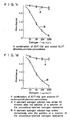
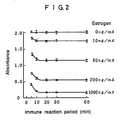
- One of the purified monoclonal anti-estrogen antibodies was immobilized in a glass test tube. A portion of a solution containing one of the estrogen derivatives labelled with horseradish peroxidase was added to the test tube, and the labelled antigen was allowed to react with the insoluble antibody for 60 minutes. A portion of a standard estrogen solution (10, 50, 200 or 1000 ng/ml) was then added to the reaction system and the immune reaction was performed for 20 minutes, followed by a washing process. Thereafter, the enzyme (peroxidase) reaction was performed for 10 minutes in the presence of hydrogen peroxide as the substrate and orthophenylenediamine as the color reagent and then the absorbance of the colored solution was measured.
- a standard estrogen solution (10, 50, 200 or 1000 ng/ml) was then added to the reaction system and the immune reaction was performed for 20 minutes, followed by a washing process. Thereafter, the enzyme (peroxidase) reaction was performed for 10 minutes in the presence of hydrogen peroxide as the substrate and orthopheny
- the solution containing the peroxidase-labelled estrogen derivative was added to another glass tube in which the purified monoclonal anti-estrogen antibody was immobilized.
- a standard estrogen solution was added immediately after the addition of the solution of the peroxidase-labelled estrogen derivative. After performing 20 minutes of the immune reaction, the enzyme reaction was performed in the same manner as described above, and the result was compared to that of the above result.
- Fig. 2 shows changes in the immune reaction during the reaction period after the addition of a standard estrogen solution, in the case of a combination of the antibody E15-008 and the peroxidase-labelled estrone-17-carboxymethyl oxime.
- mice were immunized with an immunogen prepared by binding an estradiol derivative to bovine serum albumin. Changes in the blood antibody titer was monitored while booster is performed, and spleen cells of a mouse in which the antibody titer was increased were used for a cell fusion process. The cell fusion was performed in accordance with a method described in Methods in Enzymology (vol. 73, p. 3 to 46). Culture supernate of hybridomas thus obtained were screened for the anti-estradiol antibody, and positive hybridomas were cloned. Antibodies thus selected were further checked for their cross-reactions and measurable ranges of estradiol, in order to eliminate any antibody which was found to be inappropriate for the measuring of blood estradiol. An appropriate antibody produced in a culture supernate of a hybridoma thus selected was purified by means of an affinity column chromatography using protein A.
- Table 4 Immunogens Immunized mice No. of immunized mice No. of cell fusions No. of antibodies selected Estradiol-3-carboxymethyl ether ⁇ bovine serum albumin Balb/c 10 4 0 ddY 10 3 1 Estradiol-6-carboxymethyl oxime ⁇ bovine serum albumin Balb/c 30 14 11 ddY 20 11 12 Estradiol-6 ⁇ -hemisuccinate ⁇ bovine serum albumin Balb/c 30 9 3 ddY 30 14 4
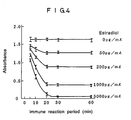
- One of the purified monoclonal anti-estradiol antibodies was immobilized in a glass test tube. To this was added a portion of a solution containing one of the estradiol derivatives labelled with horseradish peroxidase, and the labelled antigen was allowed to react with the insoluble antibody for 60 minutes. A portion of a standard estradiol solution (10, 50, 200, 1000 or 5000 pg/ml) was then added to the reaction system and the immune reaction was performed for 20 minutes, followed by a washing process. Thereafter, the enzyme (peroxidase) reaction was performed for 10 minutes in the presence of hydrogen peroxide as the substrate and orthophenylenediamine as the color reagent and then the absorbance of the colored substance was measured.
- a standard estradiol solution (10, 50, 200, 1000 or 5000 pg/ml) was then added to the reaction system and the immune reaction was performed for 20 minutes, followed by a washing process. Thereafter, the enzyme (peroxidase) reaction was performed for
- Fig. 4 shows changes in the immune reaction during the reaction period after the addition of a standard estradiol solution, in the case of a combination of the antibody E213-074 and the peroxidase-labelled estradiol-6 ⁇ -hemisuccinate.
- mice were immunized with an immunogen prepared by binding an progesterone derivative to bovine serum albumin. Changes in the blood antibody titer was monitored while booster is performed, and spleen cells of a mouse in which the antibody titer was increased were used for a cell fusion process. The cell fusion was performed in accordance with a method described in Methods in Enzymology (vol. 73, p. 3 to 46). Culture supernate of hybridomas thus obtained were screened for the anti-progesterone antibody, and positive hybridomas were cloned. Antibodies thus selected were further checked for their cross-reactions and measurable ranges of progesterone, in order to eliminate any antibody which was found to be inappropriate for the measuring of blood progesterone. An appropriate antibody produced in a culture filtrate of a hybridoma thus selected was purified by means of an affinity column chromatography using protein A.
- Table 5 Immunogens Immunized mice No. of immunized mice No. of cell fusions No. of antibodies selected Progesterone-11 ⁇ -hemisuccinate ⁇ bovine serum albumin Balb/c 10 8 9 ddY 10 3 11 Progesterone-19-hemisuccinate ⁇ bovine serum albumin Balb/c 10 4 4 ddY 10 3 2 Progesterone-16 ⁇ -hemisuccinate ⁇ bovine serum albumin Balb/c 10 3 0 ddY 5 2 0 Progesterone-3-carboxymethyl oxime ⁇ bovine serum albumin Balb/c 5 1 0
- One of the purified monoclonal anti-progesterone antibodies was immobilized in a glass test tube. To this was added a portion of a solution containing one of the progesterone derivatives labelled with horseradish peroxidase, and the labelled antigen was allowed to react with the insoluble antibody for 60 minutes. A portion of a standard progesterone solution (0.2, 1, 10, 30 or 100 ng/ml) was then added to the reaction system and the immune reaction was performed for 20 minutes, followed by a washing process. Thereafter, the enzyme (peroxidase) reaction was performed for 10 minutes in the presence of hydrogen peroxide as the substrate and orthophenylenediamine as the color reagent and then the absorbance of the colored substance was measured.
- a standard progesterone solution 0.2, 1, 10, 30 or 100 ng/ml
- Figs. 5a, 5b, 5c and 5d Examples of the results are shown in Figs. 5a, 5b, 5c and 5d, wherein P7-006 (immunogen, progesterone-11 ⁇ -hemisuccinate ⁇ bovine serum albumin) or P15-037 (immunogen, progesterone-11 ⁇ -hemisuccinate ⁇ bovine serum albumin) was used as the antibody and progesterone-11 ⁇ -hemisuccinate ⁇ peroxidase or progesterone-19-hemisuccinate ⁇ peroxidase was used as the labelled progesterone derivative.
- Fig. 6 shows changes in the immune reaction during the reaction period after the addition of a standard progesterone solution, in the case of a combination of the antibody P7-006 and the peroxidase-labelled progesterone-19-hemisuccinate.
- Antibody E15-008 was immobilized in a glass tube (diameter, 10 mm; length, 65 mm). A 200 ⁇ l portion of estrone-17-carboxymethyl oxime ⁇ peroxidase solution, with its concentration being 50 ng/ml calculated in terms of peroxidase in the compound, was transferred into the tube and allowed to react with the insoluble antibody. After 60 minutes of the reaction, resulting solution in the tube was subjected to freeze-drying, the dried body was sealed in the tube against access of air and the sealed tube was stored as a device for use in the measurement of urinary estrogen.
- Measurement of urinary estrogen was performed as follows. A portion (250 ⁇ l in normal conditions) of a sample, which is diluted in advance if necessary, or a standard estrogen solution was transferred into the above-described device (test tube) for the measurement of urinary estrogen. After 20 minutes of the immune reaction and subsequent washing process, the enzyme (peroxidase) reaction was performed for 10 minutes by adding into the test tube a 500 ⁇ l portion of a substrate solution which consisted of orthophenylenediamine (0.3%) as a color reagent and hydrogen peroxide (0.027%) as the substrate.
- a substrate solution which consisted of orthophenylenediamine (0.3%) as a color reagent and hydrogen peroxide (0.027%) as the substrate.
- the enzyme reaction was stopped by adding 1000 ⁇ l of 3 M phosphoric acid solution (sulfuric acid, hydrochloric acid and the like can be used as well), and the absorbance of the colored agent was measured at 492 nm. Concentration of estrogen in the sample was calculated from a standard curve.
- the concentration of estrogen in the same sample was separately measured by using commercially available assay kits, and correlation coefficients between the measuring method of the present invention and these commercial kits were calculated.
- the assay kits used were Radioimmunoassay kit (from Amersham Ltd.), Fluorescence Polarization Immunoassay (from Abbott Lab.) and E3 Kit (a color reaction system produced by Teikoku Hormone Mfg. Co., Ltd.). A total of 54 samples were checked.
- Antibody E213-074 was immobilized in a glass tube (diameter, 10 mm; length, 65 mm). A 200 ⁇ l portion of estradiol-6 ⁇ -hemisuccinate ⁇ peroxidase solution, with its concentration being 10 ng/ml calculated in terms of peroxidase in the compound, was transferred into the tube and allowed to react with the insoluble antibody. After 60 minutes of the reaction, resulting solution in the tube was subjected to freeze-drying, the dried body was sealed in the tube against access of air and the sealed tube was stored as a device for use in the measurement of blood estradiol.
- Measurement of blood estradiol was performed as follows. A portion (250 ⁇ l in normal conditions) of a sample, which is diluted in advance if necessary, or a standard estradiol solution was transferred into the above-described device (test tube) for the measurement of blood estradiol. After 20 minutes of the immune reaction and subsequent washing process, the enzyme (peroxidase) reaction was performed for 10 minutes by adding into the test tube a 500 ⁇ l portion of a substrate solution which consisted of orthophenylenediamine (0.3%) as a color reagent and hydrogen peroxide (0.027%) as the substrate.
- a substrate solution which consisted of orthophenylenediamine (0.3%) as a color reagent and hydrogen peroxide (0.027%) as the substrate.
- the enzyme reaction was stopped by adding 1000 ⁇ l of 3 M phosphoric acid solution (sulfuric acid, hydrochloric acid and the like can be used as well), and the absorbance of the colored solution was measured at 492 nm. Concentration of estradiol in the sample was calculated from a standard curve.
- the concentration of estradiol in the same sample was separately measured by using commercially available assay kits, and correlation coefficients between the measuring method of the present invention and these commercial kits were calculated.
- the assay kits used were Radioimmunoassay (produced by Diagnostic Products Corporation) and Radioimmunoassay (I-125 Kit, produced by Commissariant A Lénegiè Atomique). A total of 34 samples were checked.
- Antibody P7-006 was immobilized in a glass tube (diameter, 10 mm; length, 65 mm). A 200 ⁇ l portion of progesterone-19-hemisuccinate ⁇ peroxidase solution, with its concentration being 20 ng/ml calculated in terms of peroxidase in the compound, was transferred into the tube and allowed to react with the insoluble antibody. After 60 minutes of the reaction, resulting solution in the tube was subjected to freeze-drying, the dried body was sealed in the tube against access of air and the sealed tube was stored as a device for use in the measurement of blood progesterone.
- Measurement of blood progesterone was performed as follows. A portion (250 ⁇ l in normal conditions) of a sample, which is diluted in advance if necessary, or a standard progesterone solution was transferred into the above-described device (test tube) for the measurement of blood progesterone. After 20 minutes of the immune reaction and subsequent washing process, the enzyme (peroxidase) reaction was performed for 10 minutes by adding into the test tube a 500 ⁇ l portion of a substrate solution which consisted of orthophenylenediamine (0.3%) as a color reagent and hydrogen peroxide (0.027%) as the substrate.
- a substrate solution which consisted of orthophenylenediamine (0.3%) as a color reagent and hydrogen peroxide (0.027%) as the substrate.
- the enzyme reaction was stopped by adding 1000 ⁇ l of 3 M phosphoric acid solution (sulfuric acid, hydrochloric acid and the like can be used as well), and the absorbance of the colored solution was measured at 492 nm. Concentration of progesterone in the sample was calculated from a standard curve.
- the concentration of progesterone in the same sample was separately measured by using commercially available assay kits, and correlation coefficients between the measuring method of the present invention and these commercial kits were calculated.
- the assay kits used were Radioimmunoassay (produced by Diagnostic Products Corporation) and Radioimmunoassay (produced by Daiichi Radioisotope Labs., LTD.). A total of 54 samples were checked.
- the immunoassay device of the present invention renders possible easy and simple manual operation and simplification of mechanical structure of an automatic measuring apparatus, because a process for the supply of a labelled substance is not necessary.
- the measuring principle according to the present invention is based on the competitive binding method
- the reaction steps are similar to those steps for the sandwich method-based immunoassay. Consequently, by the use of the immunoassay device of the present invention, acquirement of immunoassay techniques may be achieved more easily, and both competitive binding method and sandwich method could be applied to a single automatic measuring apparatus.
Landscapes
- Health & Medical Sciences (AREA)
- Life Sciences & Earth Sciences (AREA)
- Immunology (AREA)
- Engineering & Computer Science (AREA)
- Molecular Biology (AREA)
- Chemical & Material Sciences (AREA)
- Biomedical Technology (AREA)
- Hematology (AREA)
- Urology & Nephrology (AREA)
- Food Science & Technology (AREA)
- Biochemistry (AREA)
- Cell Biology (AREA)
- Biotechnology (AREA)
- Medicinal Chemistry (AREA)
- Physics & Mathematics (AREA)
- Analytical Chemistry (AREA)
- Microbiology (AREA)
- General Health & Medical Sciences (AREA)
- General Physics & Mathematics (AREA)
- Pathology (AREA)
- Chemical Kinetics & Catalysis (AREA)
- Endocrinology (AREA)
- Peptides Or Proteins (AREA)
- Medicines Containing Antibodies Or Antigens For Use As Internal Diagnostic Agents (AREA)
- Preparation Of Compounds By Using Micro-Organisms (AREA)
Applications Claiming Priority (2)
| Application Number | Priority Date | Filing Date | Title |
|---|---|---|---|
| JP35815/89 | 1989-02-15 | ||
| JP1035815A JPH02213766A (ja) | 1989-02-15 | 1989-02-15 | 免疫測定用試薬および免疫測定器具 |
Publications (2)
| Publication Number | Publication Date |
|---|---|
| EP0383313A2 true EP0383313A2 (fr) | 1990-08-22 |
| EP0383313A3 EP0383313A3 (fr) | 1992-11-25 |
Family
ID=12452430
Family Applications (1)
| Application Number | Title | Priority Date | Filing Date |
|---|---|---|---|
| EP19900102909 Ceased EP0383313A3 (fr) | 1989-02-15 | 1990-02-14 | Réactif d'essai immunologique et kit le contenant |
Country Status (5)
| Country | Link |
|---|---|
| US (2) | US5283176A (fr) |
| EP (1) | EP0383313A3 (fr) |
| JP (1) | JPH02213766A (fr) |
| AU (1) | AU627548B2 (fr) |
| CA (1) | CA2009985A1 (fr) |
Cited By (9)
| Publication number | Priority date | Publication date | Assignee | Title |
|---|---|---|---|---|
| FR2666657A1 (fr) * | 1990-09-10 | 1992-03-13 | Elan Corp Plc | Methode pour determiner le risque d'evolution d'une infection provoquee par hiv et sa mise en óoeuvre. |
| WO1993003367A1 (fr) * | 1991-07-29 | 1993-02-18 | Serex, Inc. | Affinites de liaison differentielles et methodes de detection de dissociation basees sur ces affinites |
| WO1993020448A1 (fr) * | 1992-04-01 | 1993-10-14 | The Regents Of The University Of California | Immuno-titrage par enzymes sans instrument d'analyse: procede general recourant a des effets de liaison cinetiques |
| WO1993025672A1 (fr) * | 1992-06-10 | 1993-12-23 | Abbott Laboratories | Dosage de l'estradiol par essai immunologique competitif |
| WO1996016332A1 (fr) * | 1994-11-24 | 1996-05-30 | Unipath Limited | Recuperation d'agents de liaison specifiques et utilisations de ceux-ci |
| WO1996027800A1 (fr) * | 1995-03-03 | 1996-09-12 | Abbott Laboratories | Determination de steroides par dosage immunologique par competition |
| WO2002012270A1 (fr) * | 2000-08-03 | 2002-02-14 | Inverness Medical Switzerland Gmbh | Peptides capables de fonctionner en tant que mimotopes pour des analytes d'estradiol |
| CN103134715A (zh) * | 2011-11-30 | 2013-06-05 | 内蒙古蒙牛乳业(集团)股份有限公司 | 检测乳酸菌饮料中催乳素含量的前处理方法及检测方法 |
| CN103134716A (zh) * | 2011-11-30 | 2013-06-05 | 内蒙古蒙牛乳业(集团)股份有限公司 | 检测乳酸菌饮料中孕酮含量的前处理方法及检测方法 |
Families Citing this family (10)
| Publication number | Priority date | Publication date | Assignee | Title |
|---|---|---|---|---|
| US5804452A (en) * | 1995-04-27 | 1998-09-08 | Quidel Corporation | One step urine creatinine assays |
| US6429026B1 (en) * | 1996-04-08 | 2002-08-06 | Innotrac Diagnostics Oy | One-step all-in-one dry reagent immunoassay |
| US6548491B2 (en) * | 1997-12-24 | 2003-04-15 | Sri International | Anti-estrogenic steroids, and associated pharmaceutical compositions and methods of use |
| US7572639B2 (en) * | 2004-06-03 | 2009-08-11 | Stc.Unm | Method and apparatus for predicting pregnancy outcome |
| US20080286812A1 (en) * | 2007-03-23 | 2008-11-20 | Joseph Thomas Ippoliti | Alcohol oxidase-based enzyme-linked immunosorbent assay |
| CN103134717B (zh) * | 2011-11-30 | 2015-04-08 | 内蒙古蒙牛乳业(集团)股份有限公司 | 检测乳酸菌饮料中雌二醇含量的前处理方法及检测方法 |
| CN103134709A (zh) * | 2011-11-30 | 2013-06-05 | 内蒙古蒙牛乳业(集团)股份有限公司 | 检测原料奶中孕酮含量的前处理方法及检测方法 |
| CN104059119A (zh) * | 2014-06-10 | 2014-09-24 | 高海岗 | 雌二醇半抗原、抗原、抗体及其制备方法与应用 |
| CN109111494A (zh) * | 2018-08-30 | 2019-01-01 | 苏州博源医疗科技有限公司 | 雌二醇衍生物、免疫原、抗体、酶标偶联物、检测试剂及其制备方法 |
| CN109180768B (zh) * | 2018-09-06 | 2020-04-17 | 苏州博源医疗科技有限公司 | 雌酮衍生物、免疫原、抗体、酶标偶联物、检测试剂及其制备方法 |
Family Cites Families (9)
| Publication number | Priority date | Publication date | Assignee | Title |
|---|---|---|---|---|
| JPS57136165A (en) * | 1981-02-18 | 1982-08-23 | Mochida Pharmaceut Co Ltd | Immunological measuring reagent |
| IL67289A (en) * | 1982-03-18 | 1985-12-31 | Miles Lab | Homogeneous immunoassay with labeled monoclonal anti-analyte |
| US4585741A (en) * | 1983-08-25 | 1986-04-29 | Clevinger Brian L | Method of assay for vitamin D metabolites |
| US4895809A (en) * | 1984-01-09 | 1990-01-23 | Varian Associates, Inc. | Immobilized antigen-antibody displacement process |
| US4720455A (en) * | 1985-09-06 | 1988-01-19 | Pitman-Moore, Inc. | Progesterone assay method for mammals and monoclonal antibody therefor |
| JPS62148857A (ja) * | 1985-12-24 | 1987-07-02 | Toyo Soda Mfg Co Ltd | 免疫測定用材料の製造方法 |
| JPS62151758A (ja) * | 1985-12-26 | 1987-07-06 | Toyo Soda Mfg Co Ltd | 免疫測定用材料の製造方法 |
| GB9122180D0 (en) * | 1991-10-18 | 1991-11-27 | Marconi Gec Ltd | Separation and analysis |
| US5342760A (en) * | 1992-06-10 | 1994-08-30 | Abbott Laboratories | Determination of estradiol by competitive immunoassay |
-
1989
- 1989-02-15 JP JP1035815A patent/JPH02213766A/ja active Pending
-
1990
- 1990-02-14 EP EP19900102909 patent/EP0383313A3/fr not_active Ceased
- 1990-02-14 CA CA002009985A patent/CA2009985A1/fr not_active Abandoned
- 1990-02-14 AU AU49792/90A patent/AU627548B2/en not_active Ceased
- 1990-02-14 US US07/480,165 patent/US5283176A/en not_active Expired - Fee Related
-
1993
- 1993-11-10 US US08/149,917 patent/US5459045A/en not_active Expired - Fee Related
Cited By (14)
| Publication number | Priority date | Publication date | Assignee | Title |
|---|---|---|---|---|
| FR2666657A1 (fr) * | 1990-09-10 | 1992-03-13 | Elan Corp Plc | Methode pour determiner le risque d'evolution d'une infection provoquee par hiv et sa mise en óoeuvre. |
| WO1993003367A1 (fr) * | 1991-07-29 | 1993-02-18 | Serex, Inc. | Affinites de liaison differentielles et methodes de detection de dissociation basees sur ces affinites |
| WO1993020448A1 (fr) * | 1992-04-01 | 1993-10-14 | The Regents Of The University Of California | Immuno-titrage par enzymes sans instrument d'analyse: procede general recourant a des effets de liaison cinetiques |
| WO1993025672A1 (fr) * | 1992-06-10 | 1993-12-23 | Abbott Laboratories | Dosage de l'estradiol par essai immunologique competitif |
| US5342760A (en) * | 1992-06-10 | 1994-08-30 | Abbott Laboratories | Determination of estradiol by competitive immunoassay |
| US5989926A (en) * | 1994-11-24 | 1999-11-23 | Unipath Limited | Recovery of and uses of specific binding agents |
| WO1996016332A1 (fr) * | 1994-11-24 | 1996-05-30 | Unipath Limited | Recuperation d'agents de liaison specifiques et utilisations de ceux-ci |
| WO1996027800A1 (fr) * | 1995-03-03 | 1996-09-12 | Abbott Laboratories | Determination de steroides par dosage immunologique par competition |
| US5663054A (en) * | 1995-03-03 | 1997-09-02 | Abbott Laboratories | Determination of steroids by competitive immunoassay |
| US5932431A (en) * | 1995-03-03 | 1999-08-03 | Abbott Laboratories | Determination of steroids by competitive immunoassay |
| US6201141B1 (en) | 1995-03-03 | 2001-03-13 | Abbott Laboratories | Determination of steroids by competitive immunoassay |
| WO2002012270A1 (fr) * | 2000-08-03 | 2002-02-14 | Inverness Medical Switzerland Gmbh | Peptides capables de fonctionner en tant que mimotopes pour des analytes d'estradiol |
| CN103134715A (zh) * | 2011-11-30 | 2013-06-05 | 内蒙古蒙牛乳业(集团)股份有限公司 | 检测乳酸菌饮料中催乳素含量的前处理方法及检测方法 |
| CN103134716A (zh) * | 2011-11-30 | 2013-06-05 | 内蒙古蒙牛乳业(集团)股份有限公司 | 检测乳酸菌饮料中孕酮含量的前处理方法及检测方法 |
Also Published As
| Publication number | Publication date |
|---|---|
| JPH02213766A (ja) | 1990-08-24 |
| US5283176A (en) | 1994-02-01 |
| CA2009985A1 (fr) | 1990-08-15 |
| EP0383313A3 (fr) | 1992-11-25 |
| AU627548B2 (en) | 1992-08-27 |
| AU4979290A (en) | 1990-11-22 |
| US5459045A (en) | 1995-10-17 |
Similar Documents
| Publication | Publication Date | Title |
|---|---|---|
| US5459045A (en) | Reagent for immunoassay, and device using the same | |
| US4185084A (en) | Immunochemical measuring method using second antigenic substance | |
| EP0177531B1 (fr) | Anticorps, fabrication et utilisation | |
| US4828985A (en) | Antibodies against the complex of a small molecule and its binding protein, their preparation and their use in diagnostic methods | |
| US3839153A (en) | Process for the detection and determination of specific binding proteins and their corresponding bindable substances | |
| EP0702233B1 (fr) | Procede et appareil de dosage semi-quantitatif immunochimique simple | |
| CA1040082B (fr) | Methode de demonstration et de determination des composantes reactives ayant des affinites de liaisonnement specifique reciproques | |
| US4248965A (en) | Immunochemical process of measuring physiologically active substances | |
| USRE29169E (en) | Process for the demonstration and determination of reaction components having specific binding affinity for each other | |
| JPH0340341B2 (fr) | ||
| EP0010405B1 (fr) | Réactif immunochimique stable pour la détermination des haptènes et un procédé de titrage utilisant ce réactif | |
| Haning et al. | The evolution of titer and specificity of aldosterone binding antibodies in hyperimmunized sheep | |
| Samarajeewa et al. | The radioimmunoassay of pregnanediol-3α-glucuronide | |
| Nishina et al. | Site of conjugation of bovine serum albumin to corticosteroid hormones and specificity of antibodies | |
| EP0088974A2 (fr) | Essai immunologique homogène avec un anti-réactif marqué monoclonal | |
| EP0104926A2 (fr) | Méthode d'essai et composants utilisés pour cette méthode | |
| US5559210A (en) | Reagents and methods for the detection and quantification of testosterone in fluid samples | |
| CN100445746C (zh) | 一种检测19-去甲睾酮的方法及其专用酶联免疫试剂盒 | |
| Mitsuma et al. | A sensitive bridge heterologous enzyme immunoassay of progesterone using geometrical isomers | |
| Pratt et al. | Specificity of immunoassays: II. Heterogeneity of specificity of antibodies in antisera used for steroid immunoassay and the selective blocking of less specific antibodies, including a new method for the measurement of immunoassay specificity | |
| JPS62272156A (ja) | ウシ脱脂乳中のプロゲステロンの定量方法 | |
| CA1071535A (fr) | Methode de dosage immunologique de la progesterone recourant a une enzyme | |
| Samanta et al. | Enzyme immunoassay of testosterone using nitrocellulose discs as the solid phase | |
| EP0131096A2 (fr) | Procédé d'essai immunologique homogène pour la détermination des substances agglutinantes et système de réactifs pour sa mise en oeuvre | |
| Podestà et al. | Highly specific polyclonal antisera against estriol: cross-reactivity restriction following affinity chromatography |
Legal Events
| Date | Code | Title | Description |
|---|---|---|---|
| PUAI | Public reference made under article 153(3) epc to a published international application that has entered the european phase |
Free format text: ORIGINAL CODE: 0009012 |
|
| AK | Designated contracting states |
Kind code of ref document: A2 Designated state(s): AT BE CH DE DK ES FR GB GR IT LI LU NL SE |
|
| PGFP | Annual fee paid to national office [announced via postgrant information from national office to epo] |
Ref country code: LU Payment date: 19930510 Year of fee payment: 4 |
|
| PUAL | Search report despatched |
Free format text: ORIGINAL CODE: 0009013 |
|
| AK | Designated contracting states |
Kind code of ref document: A3 Designated state(s): AT BE CH DE DK ES FR GB GR IT LI LU NL SE |
|
| EPTA | Lu: last paid annual fee | ||
| 17P | Request for examination filed |
Effective date: 19930121 |
|
| 17Q | First examination report despatched |
Effective date: 19940610 |
|
| STAA | Information on the status of an ep patent application or granted ep patent |
Free format text: STATUS: THE APPLICATION HAS BEEN REFUSED |
|
| 18R | Application refused |
Effective date: 19960513 |