EP0383348A1 - Kohlefaserverstärktes hydraulisches Verbundmaterial - Google Patents
Kohlefaserverstärktes hydraulisches Verbundmaterial Download PDFInfo
- Publication number
- EP0383348A1 EP0383348A1 EP90103051A EP90103051A EP0383348A1 EP 0383348 A1 EP0383348 A1 EP 0383348A1 EP 90103051 A EP90103051 A EP 90103051A EP 90103051 A EP90103051 A EP 90103051A EP 0383348 A1 EP0383348 A1 EP 0383348A1
- Authority
- EP
- European Patent Office
- Prior art keywords
- composite material
- carbon fibers
- carbon fiber
- cement
- weight
- Prior art date
- Legal status (The legal status is an assumption and is not a legal conclusion. Google has not performed a legal analysis and makes no representation as to the accuracy of the status listed.)
- Granted
Links
- OKTJSMMVPCPJKN-UHFFFAOYSA-N Carbon Chemical compound [C] OKTJSMMVPCPJKN-UHFFFAOYSA-N 0.000 title claims abstract description 43
- 229910052799 carbon Inorganic materials 0.000 title claims abstract description 42
- 239000002131 composite material Substances 0.000 title claims abstract description 31
- 229920000049 Carbon (fiber) Polymers 0.000 claims abstract description 73
- 239000004917 carbon fiber Substances 0.000 claims abstract description 73
- 239000004568 cement Substances 0.000 claims description 41
- 238000002156 mixing Methods 0.000 claims description 33
- 239000000463 material Substances 0.000 claims description 22
- 239000004094 surface-active agent Substances 0.000 claims description 13
- XLYOFNOQVPJJNP-UHFFFAOYSA-N water Substances O XLYOFNOQVPJJNP-UHFFFAOYSA-N 0.000 claims description 10
- 125000000129 anionic group Chemical group 0.000 claims description 7
- 150000003918 triazines Chemical class 0.000 claims description 6
- 210000000988 bone and bone Anatomy 0.000 claims description 4
- 230000005484 gravity Effects 0.000 claims description 4
- 238000010257 thawing Methods 0.000 abstract description 29
- 238000012360 testing method Methods 0.000 description 40
- 239000000835 fiber Substances 0.000 description 20
- 238000005452 bending Methods 0.000 description 14
- 239000011083 cement mortar Substances 0.000 description 12
- 239000000203 mixture Substances 0.000 description 12
- 239000003638 chemical reducing agent Substances 0.000 description 10
- -1 fatty acid sorbitan esters Chemical class 0.000 description 10
- 230000003014 reinforcing effect Effects 0.000 description 10
- VYPSYNLAJGMNEJ-UHFFFAOYSA-N Silicium dioxide Chemical compound O=[Si]=O VYPSYNLAJGMNEJ-UHFFFAOYSA-N 0.000 description 9
- 239000003795 chemical substances by application Substances 0.000 description 9
- 239000004567 concrete Substances 0.000 description 9
- 230000000052 comparative effect Effects 0.000 description 8
- 238000000034 method Methods 0.000 description 8
- QAOWNCQODCNURD-UHFFFAOYSA-N sulfuric acid Substances OS(O)(=O)=O QAOWNCQODCNURD-UHFFFAOYSA-N 0.000 description 7
- LFQSCWFLJHTTHZ-UHFFFAOYSA-N Ethanol Chemical compound CCO LFQSCWFLJHTTHZ-UHFFFAOYSA-N 0.000 description 6
- 239000004615 ingredient Substances 0.000 description 6
- VNWKTOKETHGBQD-UHFFFAOYSA-N methane Chemical compound C VNWKTOKETHGBQD-UHFFFAOYSA-N 0.000 description 6
- 235000014113 dietary fatty acids Nutrition 0.000 description 5
- 239000000194 fatty acid Substances 0.000 description 5
- 229930195729 fatty acid Natural products 0.000 description 5
- 239000011208 reinforced composite material Substances 0.000 description 5
- RTZKZFJDLAIYFH-UHFFFAOYSA-N Diethyl ether Chemical compound CCOCC RTZKZFJDLAIYFH-UHFFFAOYSA-N 0.000 description 4
- 239000007864 aqueous solution Substances 0.000 description 4
- 230000000694 effects Effects 0.000 description 4
- 239000002657 fibrous material Substances 0.000 description 4
- 238000007710 freezing Methods 0.000 description 4
- 239000011159 matrix material Substances 0.000 description 4
- 239000004570 mortar (masonry) Substances 0.000 description 4
- 238000000465 moulding Methods 0.000 description 4
- 230000002787 reinforcement Effects 0.000 description 4
- 238000007493 shaping process Methods 0.000 description 4
- 238000003756 stirring Methods 0.000 description 4
- DGAQECJNVWCQMB-PUAWFVPOSA-M Ilexoside XXIX Chemical compound C[C@@H]1CC[C@@]2(CC[C@@]3(C(=CC[C@H]4[C@]3(CC[C@@H]5[C@@]4(CC[C@@H](C5(C)C)OS(=O)(=O)[O-])C)C)[C@@H]2[C@]1(C)O)C)C(=O)O[C@H]6[C@@H]([C@H]([C@@H]([C@H](O6)CO)O)O)O.[Na+] DGAQECJNVWCQMB-PUAWFVPOSA-M 0.000 description 3
- 239000004640 Melamine resin Substances 0.000 description 3
- 229920000877 Melamine resin Polymers 0.000 description 3
- 239000011398 Portland cement Substances 0.000 description 3
- 230000007423 decrease Effects 0.000 description 3
- 239000006185 dispersion Substances 0.000 description 3
- 239000000839 emulsion Substances 0.000 description 3
- 150000004665 fatty acids Chemical class 0.000 description 3
- 238000004519 manufacturing process Methods 0.000 description 3
- 239000004576 sand Substances 0.000 description 3
- 239000000377 silicon dioxide Substances 0.000 description 3
- 238000004513 sizing Methods 0.000 description 3
- 239000002002 slurry Substances 0.000 description 3
- 239000011734 sodium Substances 0.000 description 3
- 229910052708 sodium Inorganic materials 0.000 description 3
- BDHFUVZGWQCTTF-UHFFFAOYSA-M sulfonate Chemical compound [O-]S(=O)=O BDHFUVZGWQCTTF-UHFFFAOYSA-M 0.000 description 3
- 239000004372 Polyvinyl alcohol Substances 0.000 description 2
- XLOMVQKBTHCTTD-UHFFFAOYSA-N Zinc monoxide Chemical compound [Zn]=O XLOMVQKBTHCTTD-UHFFFAOYSA-N 0.000 description 2
- PNEYBMLMFCGWSK-UHFFFAOYSA-N aluminium oxide Inorganic materials [O-2].[O-2].[O-2].[Al+3].[Al+3] PNEYBMLMFCGWSK-UHFFFAOYSA-N 0.000 description 2
- 239000011400 blast furnace cement Substances 0.000 description 2
- 239000011300 coal pitch Substances 0.000 description 2
- 239000011294 coal tar pitch Substances 0.000 description 2
- 238000001035 drying Methods 0.000 description 2
- 239000003733 fiber-reinforced composite Substances 0.000 description 2
- 230000008014 freezing Effects 0.000 description 2
- 229910052602 gypsum Inorganic materials 0.000 description 2
- 239000010440 gypsum Substances 0.000 description 2
- 230000006872 improvement Effects 0.000 description 2
- 229920000609 methyl cellulose Polymers 0.000 description 2
- 239000001923 methylcellulose Substances 0.000 description 2
- 235000010981 methylcellulose Nutrition 0.000 description 2
- 230000000704 physical effect Effects 0.000 description 2
- 229920002451 polyvinyl alcohol Polymers 0.000 description 2
- 238000010998 test method Methods 0.000 description 2
- WZFUQSJFWNHZHM-UHFFFAOYSA-N 2-[4-[2-(2,3-dihydro-1H-inden-2-ylamino)pyrimidin-5-yl]piperazin-1-yl]-1-(2,4,6,7-tetrahydrotriazolo[4,5-c]pyridin-5-yl)ethanone Chemical compound C1C(CC2=CC=CC=C12)NC1=NC=C(C=N1)N1CCN(CC1)CC(=O)N1CC2=C(CC1)NN=N2 WZFUQSJFWNHZHM-UHFFFAOYSA-N 0.000 description 1
- NLHHRLWOUZZQLW-UHFFFAOYSA-N Acrylonitrile Chemical compound C=CC#N NLHHRLWOUZZQLW-UHFFFAOYSA-N 0.000 description 1
- 239000002202 Polyethylene glycol Substances 0.000 description 1
- 229930006000 Sucrose Natural products 0.000 description 1
- 230000003213 activating effect Effects 0.000 description 1
- 239000000654 additive Substances 0.000 description 1
- 238000013019 agitation Methods 0.000 description 1
- 150000001408 amides Chemical class 0.000 description 1
- 238000004458 analytical method Methods 0.000 description 1
- 239000012300 argon atmosphere Substances 0.000 description 1
- 239000004566 building material Substances 0.000 description 1
- 239000000378 calcium silicate Substances 0.000 description 1
- 229910052918 calcium silicate Inorganic materials 0.000 description 1
- OYACROKNLOSFPA-UHFFFAOYSA-N calcium;dioxido(oxo)silane Chemical compound [Ca+2].[O-][Si]([O-])=O OYACROKNLOSFPA-UHFFFAOYSA-N 0.000 description 1
- 150000001721 carbon Chemical class 0.000 description 1
- 238000003763 carbonization Methods 0.000 description 1
- 150000001734 carboxylic acid salts Chemical class 0.000 description 1
- 239000001913 cellulose Substances 0.000 description 1
- 229920002678 cellulose Polymers 0.000 description 1
- 239000003245 coal Substances 0.000 description 1
- 238000010276 construction Methods 0.000 description 1
- 230000003111 delayed effect Effects 0.000 description 1
- 230000006866 deterioration Effects 0.000 description 1
- 235000013681 dietary sucrose Nutrition 0.000 description 1
- 239000004205 dimethyl polysiloxane Substances 0.000 description 1
- 235000013870 dimethyl polysiloxane Nutrition 0.000 description 1
- 239000002270 dispersing agent Substances 0.000 description 1
- 230000003028 elevating effect Effects 0.000 description 1
- 150000002148 esters Chemical class 0.000 description 1
- 238000011156 evaluation Methods 0.000 description 1
- 230000001747 exhibiting effect Effects 0.000 description 1
- 230000002349 favourable effect Effects 0.000 description 1
- 239000010881 fly ash Substances 0.000 description 1
- 238000005259 measurement Methods 0.000 description 1
- 238000002074 melt spinning Methods 0.000 description 1
- 239000011302 mesophase pitch Substances 0.000 description 1
- 238000012986 modification Methods 0.000 description 1
- 230000004048 modification Effects 0.000 description 1
- 230000010355 oscillation Effects 0.000 description 1
- 239000002245 particle Substances 0.000 description 1
- 239000003208 petroleum Substances 0.000 description 1
- 150000003009 phosphonic acids Chemical class 0.000 description 1
- 239000011295 pitch Substances 0.000 description 1
- 229920000435 poly(dimethylsiloxane) Polymers 0.000 description 1
- 229920001223 polyethylene glycol Polymers 0.000 description 1
- 229920001522 polyglycol ester Polymers 0.000 description 1
- 239000000843 powder Substances 0.000 description 1
- 238000002360 preparation method Methods 0.000 description 1
- 230000008569 process Effects 0.000 description 1
- 230000009467 reduction Effects 0.000 description 1
- 239000012783 reinforcing fiber Substances 0.000 description 1
- 239000012779 reinforcing material Substances 0.000 description 1
- 230000000979 retarding effect Effects 0.000 description 1
- 238000007127 saponification reaction Methods 0.000 description 1
- 238000010008 shearing Methods 0.000 description 1
- 239000007787 solid Substances 0.000 description 1
- 239000007858 starting material Substances 0.000 description 1
- 239000004575 stone Substances 0.000 description 1
- 229960004793 sucrose Drugs 0.000 description 1
- 150000003460 sulfonic acids Chemical class 0.000 description 1
Images

Classifications
-
- C—CHEMISTRY; METALLURGY
- C04—CEMENTS; CONCRETE; ARTIFICIAL STONE; CERAMICS; REFRACTORIES
- C04B—LIME, MAGNESIA; SLAG; CEMENTS; COMPOSITIONS THEREOF, e.g. MORTARS, CONCRETE OR LIKE BUILDING MATERIALS; ARTIFICIAL STONE; CERAMICS; REFRACTORIES; TREATMENT OF NATURAL STONE
- C04B14/00—Use of inorganic materials as fillers, e.g. pigments, for mortars, concrete or artificial stone; Treatment of inorganic materials specially adapted to enhance their filling properties in mortars, concrete or artificial stone
- C04B14/38—Fibrous materials; Whiskers
- C04B14/386—Carbon
-
- C—CHEMISTRY; METALLURGY
- C04—CEMENTS; CONCRETE; ARTIFICIAL STONE; CERAMICS; REFRACTORIES
- C04B—LIME, MAGNESIA; SLAG; CEMENTS; COMPOSITIONS THEREOF, e.g. MORTARS, CONCRETE OR LIKE BUILDING MATERIALS; ARTIFICIAL STONE; CERAMICS; REFRACTORIES; TREATMENT OF NATURAL STONE
- C04B24/00—Use of organic materials as active ingredients for mortars, concrete or artificial stone, e.g. plasticisers
- C04B24/24—Macromolecular compounds
- C04B24/28—Macromolecular compounds obtained otherwise than by reactions only involving carbon-to-carbon unsaturated bonds
-
- C—CHEMISTRY; METALLURGY
- C04—CEMENTS; CONCRETE; ARTIFICIAL STONE; CERAMICS; REFRACTORIES
- C04B—LIME, MAGNESIA; SLAG; CEMENTS; COMPOSITIONS THEREOF, e.g. MORTARS, CONCRETE OR LIKE BUILDING MATERIALS; ARTIFICIAL STONE; CERAMICS; REFRACTORIES; TREATMENT OF NATURAL STONE
- C04B28/00—Compositions of mortars, concrete or artificial stone, containing inorganic binders or the reaction product of an inorganic and an organic binder, e.g. polycarboxylate cements
- C04B28/02—Compositions of mortars, concrete or artificial stone, containing inorganic binders or the reaction product of an inorganic and an organic binder, e.g. polycarboxylate cements containing hydraulic cements other than calcium sulfates
-
- C—CHEMISTRY; METALLURGY
- C04—CEMENTS; CONCRETE; ARTIFICIAL STONE; CERAMICS; REFRACTORIES
- C04B—LIME, MAGNESIA; SLAG; CEMENTS; COMPOSITIONS THEREOF, e.g. MORTARS, CONCRETE OR LIKE BUILDING MATERIALS; ARTIFICIAL STONE; CERAMICS; REFRACTORIES; TREATMENT OF NATURAL STONE
- C04B2111/00—Mortars, concrete or artificial stone or mixtures to prepare them, characterised by specific function, property or use
- C04B2111/76—Use at unusual temperatures, e.g. sub-zero
Definitions
- This invention relates to a carbon fiber-reinforced hydraulic composite material obtained by mixing carbon fibers into a base material (or a matrix) and shaping the mixture into a homogeneous composite.
- carbon fiber-reinforced cement mortar prepared by incorporating carbon fibers to various kinds of cement such as Portland cement, blast furnace cement and alumina cement, has been widely used in buildings, civil engineering, etc., as a material having the characteristics of light weight, high mechanical strength and high toughness sufficient to prevent cracks.
- the carbon fibers which have been used, up to this date, as the reinforcing material have various problems such that, when the mechanical strength of the monofilament becomes higher, the monofilament diameter becomes thinner, on account of which, while the reinforcing effect of the composite material after it mixing to the cement mortar is large, the fluidity of the fibers becomes very small with the consequence that reinforced cement is practically difficult to be shaped in the production of articles, even though the cement and the carbon fibers can be mixed.
- the monofilament diameter When the monofilament diameter is large, the fluidity becomes high, and the shaping will be easy. However, at the same time, the monofilament strength of the carbon fibers becomes low, whereby there still remains an inconvenience such that the reinforcing effect to the cement mortar becomes low.
- its freezing-and-thawing resistance is obtained by inclusion, in its interior, of air of 4 to 6% by volume, by use of an "AE” agent which is the air-entraining agent, or by mixing such "AE” agent with an "AE-water-reducing” agent capable of reducing a unit quantity of water by improvement in the surface activating effect and fluidity due to the air-entrainment.
- air bubbles having a very small diameter in a range of from 100 to 200 ⁇ m are generally said to be more effective than air bubbles of a larger diameter.
- the above-mentioned object of the present invention can be attained by a carbon fiber-reinforced hydraulic composite material obtained by mixing and dispersing carbon fibers in a hydraulic material, wherein chopped carbon fibers having a monofilament tensile strength of from 140 to 270 kg/mm2 and a monofilament diameter of from 15 ⁇ m to 30 ⁇ m are blended as the carbon fibers by volume of composite material from 1 to 4% to bring a flow index of the composite material before hardening to 120 mm or above.
- the above-mentioned carbon fiber-reinforced hydraulic composite material comprises: (a) 50 to 60% by weight of water to cement; (b) 60 to 100% by weight of aggregate to cement; (c) 20 to 50% by weight of light weight aggregate having a bone dry specific gravity of 2.0g/cm3 or below in the aggregate; (d) a quantity of highly condensed triazine type compound; and (e) 0.001 to 0.009% by weight of a nonionic surface active agent or an anionic surface active agent with respect to cement.
- the above-mentioned highly condensed triazine type compound in the carbon fiber-reinforced hydraulic composite material is preferably in a range of from 0.5 to 1% by weight with respect to cement.
- the above-mentioned carbon fibers in the carbon fiber-reinforced hydraulic composite material are preferably from 1 to 100 mm long.
- the above-mentioned carbon fibers preferably have a bulk density of 0.05 g/ml or above.
- hydraulic material to be used in the present invention there may usually be used various inorganic hydraulic materials for the purpose of the architectural and civil engineering construction.
- Such materials include, for example, Portland cement, blast furnace cement, alumina cement, calcium silicate, natural gypsum and synthetic gypsum.
- Any known carbon fibers may be used for the purpose of the present invention, without any particular restriction.
- These carbon fibers are used in the form of chopped fibers, usually having a length of from about 1 to 100 mm. With the length of the fibers shorter than 1 mm, it is difficult to obtain a sufficient reinforcing effect, although dispersibility thereof at the time of mixing with the hydraulic material is satisfactory. On the other hand, when the fiber length exceeds 100 mm, the dispersibility of the fibers at the time of mixing with the hydraulic material becomes lowered with the consequent difficulty in obtaining a homogeneous product.
- These carbon fibers are not particularly limited. They may be carbon fibers in the form of bundled short fibers produced, for instance, by the process disclosed in Japanese Unexamined Patent Publication No. 162559/1988 and having a bulk density of at least 0.05 g/ml. Otherwise, the carbon fibers may be downy short fibers or loosely bundled to have a low bulk density.
- the mixing device may be a general purpose mixing device of the following types, having a rotatable outer shell and/or stirring blades: that is, an inclined barrel type concrete mixer, a rotatable drum mixer, etc. having its rotatable outer shell in the form of cylinder, double cone, and regular hexahedron. Also, there may be used those mixing devices provided with stirring blades in the form of paddle, propeller, anchor, turbine, pan, ribbon, screw, wasner, kneader, or others. Further, there may be used a pan-rotating type compulsory mixer, an Eirich type mixer, etc. having both rotatable outer shell and stirring blades. From their mechanical structures, these mixers carry out mixing, mainly by agitation and/or shearing.
- a process steps for mixing both carbon fiber bundles and hydraulic materials are such that they are at first dry-mixed together without water, and thereafter water is added to the mixture.
- the chopped carbon fibers are in the form of tuft, they are dispersed in advance in an aqueous type dispersant such as aqueous solution of methyl cellulose by means of a special mixer such as "omni-mixer" (having no stirring blades, but having a flexible rubber drum placed on an oscillating plate to mainly perform mixing by dispersion, from its mechanical structure).
- an aqueous type dispersant such as aqueous solution of methyl cellulose
- omni-mixer having no stirring blades, but having a flexible rubber drum placed on an oscillating plate to mainly perform mixing by dispersion, from its mechanical structure.
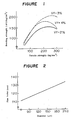
- the monofilament diameter ( ⁇ ) and the quantity of the carbon fibers are remarkably influential in the increase and the decrease in the flow index. Further studies on this point revealed that preferred is the use of the chopped carbon fibers having a tensile strength of the monofilament being in a range of from 140 to 270 kg/mm2, preferably from 180 to 250 kg/mm2, and the diameter of the monofilament being in a range of from 15 ⁇ m to 30 ⁇ m, preferably from 15 ⁇ m to 25 ⁇ m.
- the tensile strength of the monofilament is below 140 kg/mm2, the reinforcing effect of the carbon fibers to the cement mortar is not sufficient, since the tensile strength is low.
- Figure 1 is a graphical representation showing a relationship between the tensile strength and the reinforcing effect of the bending strength, at the mixing quantity (Vf) of the carbon fibers of 2%, 3% and 4%, respectively.
- the abscissa represents the tensile strength (TS) of the carbon fiber monofilament
- the ordinate denotes a value ( ⁇ b′) obtained by subtracting the bending strength of a shaped body not containing the carbon fibers from the bending strength of a shaped body containing the carbon fibers.
- the plotted values in the graph indicate averages resulted from the load test which was carried on three test specimens, each having a dimension of 4 cm wide, 2 cm thick, and 32 cm long, at their bisected point with a span of 26 cm.
- the carbon fibers having the monofilament diameter of from 12 ⁇ m to 30 ⁇ m use is made of the carbon fibers having the monofilament diameter of from 12 ⁇ m to 30 ⁇ m. If a monofilament diameter is shorter than 15 ⁇ m, the flow index falls too short to carry out the favolable molding operation. On the contrary, when the diameter exceeds 30 ⁇ m, the carbon fibers suffer breakage in the course of mixing with the consequent inability to obtain sufficient tensile strength.
- the abscissa denotes the monofilament diameter of the carbon fibers, and the ordinate represents the flow index after the mixing.
- the carbon fibers are mixed with the mortar from 1 to 4% by volume with respect to the entire composite material to make its flow index before hardening (apparent viscosity measured in accordance with Japanese Industrial Standard JIS-R 5201-1987) to be 120 mm or above.
- the quantity of the carbon fibers is under 1%, the required tensile flexural cannot be obtained.
- the mixing quantity exceeds 4%, the fluidity of the carbon fiber-reinforced composite material after the mixing, i.e. the flow index falls short of 120 mm with the consequence that satisfactory molding operation becomes difficult.
- such specific carbon fibers are mixed from 1 to 4% by volume.
- the relation between the tensile strength (kg/mm2) of the carbon fibers and the reinforcing effect [the difference between the bending strength (kg/cm2) of the shaped product containing the carbon fibers and the bending strength (kg/cm2) of the shaped product containing no carbon fibers] of the carbon fibers is obtained as shown in Figure 1, and the reinforcement is effected by using carbon fibers having a monofilament tensile strength of at least 90% of the maximum fiber-reinforcing effect and a monofilament diameter such that the flow index of the slurry of the hydraulic composite material after incorporating the carbon fibers becomes at least 120 mm.
- the carbon fibers in the form of chopped strands are used at a ratio of from 1 to 4% by volume with respect to the entire reinforced composite material. If the content of the carbon fibers is below 1%, the required tensile strength cannot be obtained. On the other hand, if it exceeds 4%, the carbon fibers cannot be uniformly dispersed in cement by the ordinary mortar mixer or the concrete mixer bringing about decrease in the tensile strength.
- a preferred water cement ratio is selected within a range of from 50 to 60%. If the W/C is below 50%, the carbon fiber-reinforced cement becomes highly viscous at the mixing stage with the consequent difficulty in the molding. On the other hand, if the W/C exceeds 60%, the tensile strength and the freezing-and-thawing resistance of the reinforced composite material tend to be low.
- the aggregate to be used for the purpose of the present invention may be selected from sand, silica sand, gravel, crushed stone, etc. and various light weight aggregates having a bone dry specific gravity of 2.0 g/cm3 or below, as represented by fly ash, ultra-fine silica powder, and shirasu balloon.
- the term "light weight aggregate” as used throughout the description is meant for an aggregate having a bone dry specific gravity of 2.0 g/cm3 or below, unless otherwise specified.
- a preferred ratio of the aggregate to cement is in a range of from 60 to 100% by weight. If its mixing quantity is below 60% or exceeds 100%, the carbon fibers will not be uniformly dispersed, and the tensile strength of the resulting reinforced composite material tends to be low.
- the addition of the light weight aggregate to the aggregate is for reducing the weight of the carbon fiber-reinforced cement.
- the particle size of the light weight aggregate is below 70 ⁇ m in average.
- the mixing quantity of the light weight aggregate in the aggregate is in a range of from 20 to 50% by weight. If the mixing quantity does not reach 20% by weight, the carbon fibers will not be dispersed uniformly, the tensile strength of the reinforced composite material will be low, and the reduction in weight of the carbon fiber-reinforced cement cannot be achieved. On the other hand, if it exceeds 50% by weight, the resulting carbon fiber-reinforced cement becomes highly viscous at the mixing stage due to water-retaining property of the light weight aggregate with the consequent difficulty in the molding.
- highly condensed triazine type compounds are used as the water-reducing agent, and nonionic or anionic surface active agents are used as the AE-water-reducing agents.
- melamine resin sodium sulfonate may be an example.
- the ratio of the water-reducing agent is selected within a range of from 0.5 to 1% by weight to the cement matrix. If the ratio of the water-reducing agent is under 0.5%, no adequate water-reducing effect can be obtained, whereby the tensile strength and the freezing-and-thawing resistance tend to be low. On the other hand, if the ratio of the water-reducing agent exceeds 1% by weight, the hardening time of the carbon fiber-reinforced cement is delayed due to the retarding effect of the water-reducing agent.
- the amount of the AE-water-reducing agent is selected within a range of 0.002% to 0.009% by weight with respect to the entire cement matrix. If the AE-water-reducing agent is less than 0.002%, no appropriate amount of air can be secured in the carbon fiber-reinforced cement, on account of which the freezing-and-thawing resistance of the reinforced cement decreases. On the other hand, if the AE-water reducing agent exceeds 0.009%, excessive amount of air is introduced into the carbon fiber-reinforced cement, whereby the tensile strength and the freezing-and-thawing resistance of the reinforced cement tend to be low.
- nonionic surface active agent there is no particular limitation to the nonionic surface active agent or the anionic surface active agent.
- the nonionic surface active agent there may be mentioned such as fatty acid monoglycerine esters, fatty acid polyglycol esters, fatty acid sorbitan esters, fatty acid saccharose ethers, fatty acid alkanole amides, and polyethylene glycol condensation-type nonionic surface active agent.
- the anionic surface active agent there may be mentioned such as carboxylic acid salts, and sulfonic acid salts, sulfuric acid ester salts, phosphoric acid ester salts, and phosphonic acid salts.
- the thus infusibilized fiber material was treated for carbonization in an argon atmosphere by raising temperature from a room temperature to about 1,100°C in a time period of 4.3 hours, and then holding the same for one hour at the temperature level of about 1,100°C so as to be carbonized.
- the properties of the carbon fibers thus obtained are indicated in Table 1 below.
- the carbon fibers were then immersed continuously, in their form of long fibers, into aqueous solution of polyvinyl alcohol, as the sizing agent, having a degree of saponification of 80% (in a concentration of 0.8%), followed by drying the same at a temperature of 180°C, thereby obtaining the carbon fibers in a collected bundle, on which 1.8% by weight of the sizing agent had been adhered. Thereafter, the carbon fiber bundle was chopped into short fibers having a length of 18 mm by means of a Guillotin cutter.
- the chopped fiber bundles 100 parts by weight of rapid hardening Portland cement, 50 parts by weight of silica sand, and 0.5 part by weight of methyl cellulose were charged into a cement mixer (a mortar mixer, "Model C-138A", manufactured by Marutoh Seisakusho Co. Ltd., Japan in accordance with the Japanese Industrial Standard JIS R-5201), and the ingredients were mixed in a dry condition for 30 seconds to thereby obtain a mixture with the chopped fibers having been sufficiently dispersed. Subsequently, 45 parts by weight of water was added to this dry mixture and mixed for 2 minutes, after which the mixture was shaped into test pieces in planar form, each having 32 cm in length, 4cm in width, and 2 cm in thickness.
- a cement mixer a mortar mixer, "Model C-138A", manufactured by Marutoh Seisakusho Co. Ltd., Japan in accordance with the Japanese Industrial Standard JIS R-5201
- test pieces were then cured in the air at a temperature of 20°C and 65% of relative humidity, to thereby obtain the carbon fiber-reinforced cement material with the carbon fiber content of 2% by volume.
- their bending strength was measured by the three-point load test (with a span of 26 cm). Average value and its fluctuation of the bending strength of these three test pieces are shown in Table 1 below.
- the flow index of the reinforced composite material after mixing is also shown in Table 1.
- coal pitch type carbon fibers having the properties as shown in Table 1 below and not being collected into bundle, were charged into an "omni-mixer" ("Model OM-10E", a product of Chiyoda Giken Kogyo K.K., Japan) with the same ingredients as in Example 1 above, and the carbon fiber-reinforced cement material was obtained by the same mixing and shaping recipe as in Example 1 above. Then, this carbon fiber-reinforced cement material was subjected to the same load test as done in Example 1 above, with the result as shown in Table 1 below.
- omni-mixer Model OM-10E
- the carbon fiber-reinforced cement material obtained by use of the coal pitch type carbon fibers having the properties as shown in Table 1 below, and by the same mixing and shaping recipe as in Example 1 above was subjected to the same load test as done in Example 1 above, with the result as shown in Table 1 below.
- the ingredients were mixed in a mortar mixer, at the mix proportion as shown in Table 2.
- the mixture thus obtained was shaped into a rectangular test piece of 10 cm in width, 20 cm in thickness, and 40 cm in length, and then it was subjected to water-curing for 14 days.
- the freezing-and-thawing resistance test was done in the manner as prescribed by ASTM C-666-B (air-freezing and water-thawing method).
- test specimen was mounted on a freezing-and-thawing tester ("Model: MIT-1682-A3", manufactured by Marui Ltd., Japan), and the air-freezing and water-thawing were repeated alternately for 300 cycles (one cycle being that the test specimen was subjected alternately to a freezing temperature of -18°C( ⁇ 2°C) and a thawing temperature of +5°C( ⁇ 2°C), as measured at the center of the specimen, in a time period of from three to four hours).
- test results were evaluated in accordance with JIS A-1127 (a test method for modulus of dynamic elasticity, modulus of dynamic rigidity, and dynamic Poisson's ratio of concrete by resonant frequency) by use of a primary resonant frequency measuring device of flexural oscillation (Model: "MIN-001-1-03", a product of Marui, Ltd., Japan), with which the primary resonant frequency (fz) of the test specimen was measured at every 30 cycles of the freezing and thawing, and the results of the measurement were evaluated by the following equation: modulus of relative dynamic elasticity (fz/fo)2 x 100 where: "fo" represents the primary resonant frequency before the freezing-and-thawing test.
- the evaluation of the results is indicated by an average value of three test specimens used.
- the bending strength of the test specimen was 140 kg/cm2, the test having been done in accordance with JIS R-5201 (a physical test method of cement) by use of a Michaelis type bending tester.
- the carbon fibers used had a monofilament diameter of 17 ⁇ m, a length of 18 mm, a tensile strength of 160 kg/mm2, and a modulus of tensile elasticity of 18 ton/mm2.
- test specimens were produced in the same manner as in Example 4 with the exception that the mix proportion were changed as shown in Table 3 below, and then they were subjected to the same test for the freezing-and-thawing resistance in the same manner as in Example 4 above. The results obtained are shown in Figure 3. As is apparent from the graphical representation of Figure 3, the test specimens degraded before 300 cycles. Table 3 Comp. Ex.
- the carbon fiber-reinforced cement mortar according to the present invention shows its modulus of relative dynamic elasticity of 100% even after 300 cycles of the freezing-and-thawing test, without indicating any deterioration whatsoever of the test specimens owing to the repeated freezing-and-thawing actions, hence it possesses highly excellent freezing-and-thawing resistance.
- the test specimen was produced in the same manner as in Example 4 above with the exception that, in place of the nonionic surface active agent (Pelletex N), sulfuric acid ester salt of higher alcohol ("EMAR D-3-D", a product of Kao K.K., Japan) was used as the anionic surface active agent, and the mix proportion of the ingredients were changed as shown in Table 3.
- the modulus of relative dynamic elasticity of the test specimen after 300 cycles of the freezing-and-thawing test was 98.5% with respect to that before the test.
- the test specimen was produced in the same manner as in Example 4 with the exception that, as the anionic surface active agent, sulfuric acid ester salt of higher alcohol ether ("ALSCOPE W 181A", a product of Toho-Chiba Chemical Co. Ltd., Japan) was used, and that the mix proportion of the ingredients were changed as shown in Table 4.
- the moduli of relative dynamic elasticity of the test specimens after 300 cycles of the freezing-and-thawing test were 93.4% and 92.5%, respectively, with respect to those before the test.
- Table 6 below indicates the flow index and the bending strength (by the three-point load bending test (with a span of 26 cm)) of the test specimens obtained in Examples 4 through 7.
- Table 6 Example 4 Example 5
- Example 6 Example 7 Flow index (mm) 129 126 133 131 Bending strength (kg/cm2) 110 120 140 140 Note: The lower values of the bending strength than Examples 1 to 3 are considered to be due to the addition of "shirasu balloon".
- the present invention is capable of producing the carbon fiber-reinforced hydraulic composite material which is excellent in its workability, is capable of exhibiting the reinforcing effect of the carbon fibers to the maximum extent, and is superior in its freezing-and-thawing resistance.
Landscapes
- Chemical & Material Sciences (AREA)
- Engineering & Computer Science (AREA)
- Ceramic Engineering (AREA)
- Materials Engineering (AREA)
- Structural Engineering (AREA)
- Organic Chemistry (AREA)
- Chemical Kinetics & Catalysis (AREA)
- Nanotechnology (AREA)
- Civil Engineering (AREA)
- Inorganic Chemistry (AREA)
- Curing Cements, Concrete, And Artificial Stone (AREA)
Applications Claiming Priority (4)
| Application Number | Priority Date | Filing Date | Title |
|---|---|---|---|
| JP38085/89 | 1989-02-17 | ||
| JP3808589A JPH02217344A (ja) | 1989-02-17 | 1989-02-17 | 炭素繊維強化水硬性複合材料 |
| JP8767989A JPH02267145A (ja) | 1989-04-06 | 1989-04-06 | 炭素繊維補強セメントモルタル |
| JP87679/89 | 1989-04-06 |
Publications (2)
| Publication Number | Publication Date |
|---|---|
| EP0383348A1 true EP0383348A1 (de) | 1990-08-22 |
| EP0383348B1 EP0383348B1 (de) | 1993-02-24 |
Family
ID=26377273
Family Applications (1)
| Application Number | Title | Priority Date | Filing Date |
|---|---|---|---|
| EP90103051A Expired - Lifetime EP0383348B1 (de) | 1989-02-17 | 1990-02-16 | Kohlefaserverstärktes hydraulisches Verbundmaterial |
Country Status (3)
| Country | Link |
|---|---|
| US (1) | US5062897A (de) |
| EP (1) | EP0383348B1 (de) |
| DE (1) | DE69000939T2 (de) |
Cited By (10)
| Publication number | Priority date | Publication date | Assignee | Title |
|---|---|---|---|---|
| WO1993024426A1 (en) * | 1992-05-22 | 1993-12-09 | Schneider John F | Homogeneous compositions of cementitious/particulates/tar componets |
| CN111718180A (zh) * | 2020-07-01 | 2020-09-29 | 北京玻钢院复合材料有限公司 | 一种短切碳纤维增强硅酸铝类陶瓷基复合材料及其制备方法 |
| WO2020223243A1 (en) * | 2019-04-29 | 2020-11-05 | Saudi Arabian Oil Company | Method for improving cement toughness |
| US11858039B2 (en) | 2022-01-13 | 2024-01-02 | Saudi Arabian Oil Company | Direct ink printing of multi-material composite structures |
| US12071589B2 (en) | 2021-10-07 | 2024-08-27 | Saudi Arabian Oil Company | Water-soluble graphene oxide nanosheet assisted high temperature fracturing fluid |
| US12234356B2 (en) | 2021-12-14 | 2025-02-25 | William Marsh Rice University | Epoxy compositions containing polyrotaxane additives having improved impact strength |
| US12269944B2 (en) | 2021-12-14 | 2025-04-08 | Saudi Arabian Oil Company | Shape memory behavior of epoxy/sliding-ring polymer composites |
| US12286499B2 (en) | 2021-03-09 | 2025-04-29 | Saudi Arabian Oil Company | Polyrotaxane-reinforced settable fluids with entrapped gas phase under high pressure |
| US12338383B2 (en) | 2021-12-14 | 2025-06-24 | Saudi Arabian Oil Company | 3D-printed polyrotaxane additives and compositions |
| US12540269B2 (en) | 2021-12-14 | 2026-02-03 | William Marsh Rice University | Cementing a wellbore using a direct ink printing |
Families Citing this family (13)
| Publication number | Priority date | Publication date | Assignee | Title |
|---|---|---|---|---|
| US5803964A (en) * | 1992-07-13 | 1998-09-08 | Sequoyah Exo Systems, Inc. | Composite building material and system for creating structures from such building material |
| ES2116437T3 (es) * | 1992-08-24 | 1998-07-16 | Vontech Int Corp | Cementos con fibras intertrituradas. |
| DE69313410T2 (de) * | 1992-11-27 | 1998-02-19 | Petoca Ltd | Kohlenstoffasern für die Bewehrung von Zement und zementhaltiges Verbundmaterial |
| DE69410050T2 (de) * | 1993-10-13 | 1998-11-12 | Mitsubishi Chem Corp | Geschnittene Stränge aus Kohlenstoffasern und damit verstärkte hydraulische Verbundmaterialien |
| US5685902A (en) * | 1994-12-19 | 1997-11-11 | Mitsubishi Chemical Corporation | Carbon fiber-reinforced concrete and method for preparing the same |
| US5766686A (en) * | 1996-03-01 | 1998-06-16 | North American Refractories Co. | Spray insulating coating for refractory articles |
| LU90627B1 (de) * | 2000-08-09 | 2002-02-12 | Heribert Hoehn | Verfahren zum Herstellen von Beton oder Moertel mit einem pflanzlichen Zuschlag |
| US6962201B2 (en) * | 2003-02-25 | 2005-11-08 | Halliburton Energy Services, Inc. | Cement compositions with improved mechanical properties and methods of cementing in subterranean formations |
| US6821336B1 (en) * | 2003-08-15 | 2004-11-23 | Wisconsin Electric Power Co. | Electrically conductive concrete and controlled low strength materials having carbon fibers |
| US7578881B2 (en) * | 2006-04-12 | 2009-08-25 | Wisconsin Electric Power Company | Electrically conductive concrete and controlled low strength materials having spent carbon sorbent |
| US8915997B2 (en) | 2013-05-16 | 2014-12-23 | Navs, Llc | Durable concrete and method for producing the same |
| WO2019023698A1 (en) * | 2017-07-28 | 2019-01-31 | Texas A&M University | CEMENT REINFORCED BY FIBERS |
| DE102020205287A1 (de) | 2020-04-27 | 2021-10-28 | Siemens Aktiengesellschaft | Elektrische rotierende Maschine, Elektromotor oder Flüssigkeitspumpe mit Spaltrohr |
Citations (2)
| Publication number | Priority date | Publication date | Assignee | Title |
|---|---|---|---|---|
| DE2756695B2 (de) * | 1976-12-23 | 1979-03-01 | Union Carbide Corp., New York, N.Y. (V.St.A.) | Verfahren zum Einarbeiten von Kohlenstoffasern in eine Zementmatrix |
| EP0251544A1 (de) * | 1986-06-14 | 1988-01-07 | Toho Rayon Co., Ltd. | Mit Kohlenstoffasern bewehrtes Zementverbundmaterial und Verfahren zu seiner Herstellung |
-
1990
- 1990-02-16 EP EP90103051A patent/EP0383348B1/de not_active Expired - Lifetime
- 1990-02-16 DE DE90103051T patent/DE69000939T2/de not_active Expired - Fee Related
- 1990-02-16 US US07/480,768 patent/US5062897A/en not_active Expired - Fee Related
Patent Citations (2)
| Publication number | Priority date | Publication date | Assignee | Title |
|---|---|---|---|---|
| DE2756695B2 (de) * | 1976-12-23 | 1979-03-01 | Union Carbide Corp., New York, N.Y. (V.St.A.) | Verfahren zum Einarbeiten von Kohlenstoffasern in eine Zementmatrix |
| EP0251544A1 (de) * | 1986-06-14 | 1988-01-07 | Toho Rayon Co., Ltd. | Mit Kohlenstoffasern bewehrtes Zementverbundmaterial und Verfahren zu seiner Herstellung |
Cited By (12)
| Publication number | Priority date | Publication date | Assignee | Title |
|---|---|---|---|---|
| WO1993024426A1 (en) * | 1992-05-22 | 1993-12-09 | Schneider John F | Homogeneous compositions of cementitious/particulates/tar componets |
| WO2020223243A1 (en) * | 2019-04-29 | 2020-11-05 | Saudi Arabian Oil Company | Method for improving cement toughness |
| US10836950B1 (en) | 2019-04-29 | 2020-11-17 | Saudi Arabian Oil Company | Method for improving cement toughness |
| US11130900B2 (en) | 2019-04-29 | 2021-09-28 | Saudi Arabian Oil Company | Method for improving cement toughness |
| CN111718180A (zh) * | 2020-07-01 | 2020-09-29 | 北京玻钢院复合材料有限公司 | 一种短切碳纤维增强硅酸铝类陶瓷基复合材料及其制备方法 |
| US12286499B2 (en) | 2021-03-09 | 2025-04-29 | Saudi Arabian Oil Company | Polyrotaxane-reinforced settable fluids with entrapped gas phase under high pressure |
| US12071589B2 (en) | 2021-10-07 | 2024-08-27 | Saudi Arabian Oil Company | Water-soluble graphene oxide nanosheet assisted high temperature fracturing fluid |
| US12234356B2 (en) | 2021-12-14 | 2025-02-25 | William Marsh Rice University | Epoxy compositions containing polyrotaxane additives having improved impact strength |
| US12269944B2 (en) | 2021-12-14 | 2025-04-08 | Saudi Arabian Oil Company | Shape memory behavior of epoxy/sliding-ring polymer composites |
| US12338383B2 (en) | 2021-12-14 | 2025-06-24 | Saudi Arabian Oil Company | 3D-printed polyrotaxane additives and compositions |
| US12540269B2 (en) | 2021-12-14 | 2026-02-03 | William Marsh Rice University | Cementing a wellbore using a direct ink printing |
| US11858039B2 (en) | 2022-01-13 | 2024-01-02 | Saudi Arabian Oil Company | Direct ink printing of multi-material composite structures |
Also Published As
| Publication number | Publication date |
|---|---|
| DE69000939T2 (de) | 1993-09-30 |
| EP0383348B1 (de) | 1993-02-24 |
| DE69000939D1 (de) | 1993-04-01 |
| US5062897A (en) | 1991-11-05 |
Similar Documents
| Publication | Publication Date | Title |
|---|---|---|
| EP0383348B1 (de) | Kohlefaserverstärktes hydraulisches Verbundmaterial | |
| RU2036886C1 (ru) | Способ приготовления смеси для получения композиционного материала и изделия из композиционного материала | |
| KR100244102B1 (ko) | 공동분쇄된 섬유 시멘트 | |
| CN1934052B (zh) | 超高性能、自密实的混凝土,其制备方法和用途 | |
| US5032181A (en) | Carbon fiber reinforced cement concrete composites improved by using chemical agents | |
| EP0261971B1 (de) | Faserverstärktes Zementmaterial und geformter Artikel, enthaltend das gehärtete Zementmaterial | |
| Fu et al. | Improving the tensile properties of carbon fiber reinforced cement by ozone treatment of the fiber | |
| Zheng et al. | Carbon fiber reinforced cement composites improved by using chemical agents | |
| JPH09295877A (ja) | 短繊維補強コンクリート | |
| CA2132439C (en) | Interground fiber cement | |
| JP2881256B2 (ja) | 炭素繊維補強コンクリート又はその類似組成物の製造方法 | |
| EP0170495A2 (de) | Zementzusammensetzungen | |
| JPH0772097B2 (ja) | 炭素繊維強化水硬性複合材料の製造方法 | |
| JP7756793B2 (ja) | 炭素繊維含有コンクリート若しくはモルタル組成物、並びに炭素繊維強化コンクリート若しくはモルタル構造物、及びその製造方法 | |
| JPS6096554A (ja) | セメント系複合体の製造方法 | |
| JPH06144911A (ja) | 繊維補強無機質製品の押出成形方法 | |
| JPH06127987A (ja) | コンクリート組成物 | |
| JPH06263494A (ja) | 炭素短繊維分散組成物及びそれを用いたcfrcの製造方法 | |
| JPS6317244A (ja) | 炭素繊維強化セメント硬化体の製造用材料 | |
| JP3936014B2 (ja) | セメント補強用炭素繊維束 | |
| JP3107656B2 (ja) | コンクリート組成物 | |
| JP2545177B2 (ja) | 太径炭素繊維強化セメント系材料の製造方法 | |
| JPH06329454A (ja) | 炭素繊維により補強された人工岩 | |
| JPH02267145A (ja) | 炭素繊維補強セメントモルタル | |
| JPH02217344A (ja) | 炭素繊維強化水硬性複合材料 |
Legal Events
| Date | Code | Title | Description |
|---|---|---|---|
| PUAI | Public reference made under article 153(3) epc to a published international application that has entered the european phase |
Free format text: ORIGINAL CODE: 0009012 |
|
| AK | Designated contracting states |
Kind code of ref document: A1 Designated state(s): BE DE FR GB |
|
| 17P | Request for examination filed |
Effective date: 19901211 |
|
| 17Q | First examination report despatched |
Effective date: 19920518 |
|
| GRAA | (expected) grant |
Free format text: ORIGINAL CODE: 0009210 |
|
| AK | Designated contracting states |
Kind code of ref document: B1 Designated state(s): BE DE FR GB |
|
| REF | Corresponds to: |
Ref document number: 69000939 Country of ref document: DE Date of ref document: 19930401 |
|
| ET | Fr: translation filed | ||
| PLBE | No opposition filed within time limit |
Free format text: ORIGINAL CODE: 0009261 |
|
| STAA | Information on the status of an ep patent application or granted ep patent |
Free format text: STATUS: NO OPPOSITION FILED WITHIN TIME LIMIT |
|
| 26N | No opposition filed | ||
| PGFP | Annual fee paid to national office [announced via postgrant information from national office to epo] |
Ref country code: FR Payment date: 19971217 Year of fee payment: 9 |
|
| PGFP | Annual fee paid to national office [announced via postgrant information from national office to epo] |
Ref country code: GB Payment date: 19971222 Year of fee payment: 9 |
|
| PGFP | Annual fee paid to national office [announced via postgrant information from national office to epo] |
Ref country code: BE Payment date: 19971230 Year of fee payment: 9 |
|
| PGFP | Annual fee paid to national office [announced via postgrant information from national office to epo] |
Ref country code: DE Payment date: 19980331 Year of fee payment: 9 |
|
| PG25 | Lapsed in a contracting state [announced via postgrant information from national office to epo] |
Ref country code: GB Free format text: LAPSE BECAUSE OF NON-PAYMENT OF DUE FEES Effective date: 19990216 |
|
| PG25 | Lapsed in a contracting state [announced via postgrant information from national office to epo] |
Ref country code: BE Free format text: LAPSE BECAUSE OF NON-PAYMENT OF DUE FEES Effective date: 19990228 |
|
| BERE | Be: lapsed |
Owner name: MITSUBISHI CHEMICAL CORP. Effective date: 19990228 |
|
| GBPC | Gb: european patent ceased through non-payment of renewal fee |
Effective date: 19990216 |
|
| PG25 | Lapsed in a contracting state [announced via postgrant information from national office to epo] |
Ref country code: FR Free format text: LAPSE BECAUSE OF NON-PAYMENT OF DUE FEES Effective date: 19991029 |
|
| PG25 | Lapsed in a contracting state [announced via postgrant information from national office to epo] |
Ref country code: DE Free format text: LAPSE BECAUSE OF NON-PAYMENT OF DUE FEES Effective date: 19991201 |
|
| REG | Reference to a national code |
Ref country code: FR Ref legal event code: ST |