EP0383692A2 - Schaltung und Methode zur Steuerung der Lichtstärke von Entladungslampen - Google Patents
Schaltung und Methode zur Steuerung der Lichtstärke von Entladungslampen Download PDFInfo
- Publication number
- EP0383692A2 EP0383692A2 EP90400423A EP90400423A EP0383692A2 EP 0383692 A2 EP0383692 A2 EP 0383692A2 EP 90400423 A EP90400423 A EP 90400423A EP 90400423 A EP90400423 A EP 90400423A EP 0383692 A2 EP0383692 A2 EP 0383692A2
- Authority
- EP
- European Patent Office
- Prior art keywords
- discharge lamp
- circuit
- discharge
- set forth
- lamp
- Prior art date
- Legal status (The legal status is an assumption and is not a legal conclusion. Google has not performed a legal analysis and makes no representation as to the accuracy of the status listed.)
- Ceased
Links
- 238000000034 method Methods 0.000 title claims abstract description 9
- 238000005286 illumination Methods 0.000 claims abstract description 38
- 238000010891 electric arc Methods 0.000 claims abstract description 27
- 238000010248 power generation Methods 0.000 claims abstract description 6
- 230000010355 oscillation Effects 0.000 claims description 16
- 239000003990 capacitor Substances 0.000 claims description 14
- 238000001514 detection method Methods 0.000 claims description 7
- 230000004044 response Effects 0.000 claims description 7
- 230000015556 catabolic process Effects 0.000 claims description 6
- 230000008878 coupling Effects 0.000 claims description 5
- 238000010168 coupling process Methods 0.000 claims description 5
- 238000005859 coupling reaction Methods 0.000 claims description 5
- 238000007599 discharging Methods 0.000 claims description 3
- 238000011144 upstream manufacturing Methods 0.000 claims description 3
- 239000002184 metal Substances 0.000 description 6
- 238000006243 chemical reaction Methods 0.000 description 3
- 238000010276 construction Methods 0.000 description 3
- 230000005284 excitation Effects 0.000 description 3
- 229910052736 halogen Inorganic materials 0.000 description 3
- 150000002367 halogens Chemical class 0.000 description 3
- 230000008016 vaporization Effects 0.000 description 3
- 238000009834 vaporization Methods 0.000 description 3
- 230000001419 dependent effect Effects 0.000 description 2
- 230000006866 deterioration Effects 0.000 description 2
- 230000007774 longterm Effects 0.000 description 2
- 230000009467 reduction Effects 0.000 description 2
- 239000000126 substance Substances 0.000 description 2
- 238000010792 warming Methods 0.000 description 2
- 230000009471 action Effects 0.000 description 1
- 230000003247 decreasing effect Effects 0.000 description 1
- 230000003111 delayed effect Effects 0.000 description 1
- 238000010586 diagram Methods 0.000 description 1
- 239000002784 hot electron Substances 0.000 description 1
- 238000012986 modification Methods 0.000 description 1
- 230000004048 modification Effects 0.000 description 1
- 230000003287 optical effect Effects 0.000 description 1
- 239000007858 starting material Substances 0.000 description 1
- 230000001052 transient effect Effects 0.000 description 1
Images




Classifications
-
- H—ELECTRICITY
- H05—ELECTRIC TECHNIQUES NOT OTHERWISE PROVIDED FOR
- H05B—ELECTRIC HEATING; ELECTRIC LIGHT SOURCES NOT OTHERWISE PROVIDED FOR; CIRCUIT ARRANGEMENTS FOR ELECTRIC LIGHT SOURCES, IN GENERAL
- H05B41/00—Circuit arrangements or apparatus for igniting or operating discharge lamps
- H05B41/14—Circuit arrangements
- H05B41/36—Controlling
- H05B41/38—Controlling the intensity of light
- H05B41/382—Controlling the intensity of light during the transitional start-up phase
- H05B41/386—Controlling the intensity of light during the transitional start-up phase for speeding-up the lighting-up
-
- H—ELECTRICITY
- H05—ELECTRIC TECHNIQUES NOT OTHERWISE PROVIDED FOR
- H05B—ELECTRIC HEATING; ELECTRIC LIGHT SOURCES NOT OTHERWISE PROVIDED FOR; CIRCUIT ARRANGEMENTS FOR ELECTRIC LIGHT SOURCES, IN GENERAL
- H05B41/00—Circuit arrangements or apparatus for igniting or operating discharge lamps
- H05B41/14—Circuit arrangements
- H05B41/26—Circuit arrangements in which the lamp is fed by power derived from DC by means of a converter, e.g. by high-voltage DC
- H05B41/28—Circuit arrangements in which the lamp is fed by power derived from DC by means of a converter, e.g. by high-voltage DC using static converters
- H05B41/288—Circuit arrangements in which the lamp is fed by power derived from DC by means of a converter, e.g. by high-voltage DC using static converters with semiconductor devices and specially adapted for lamps without preheating electrodes, e.g. for high-intensity discharge lamps, high-pressure mercury or sodium lamps or low-pressure sodium lamps
- H05B41/2881—Load circuits; Control thereof
- H05B41/2882—Load circuits; Control thereof the control resulting from an action on the static converter
-
- H—ELECTRICITY
- H05—ELECTRIC TECHNIQUES NOT OTHERWISE PROVIDED FOR
- H05B—ELECTRIC HEATING; ELECTRIC LIGHT SOURCES NOT OTHERWISE PROVIDED FOR; CIRCUIT ARRANGEMENTS FOR ELECTRIC LIGHT SOURCES, IN GENERAL
- H05B41/00—Circuit arrangements or apparatus for igniting or operating discharge lamps
- H05B41/14—Circuit arrangements
- H05B41/36—Controlling
Definitions
- the present invention relates generally to a control circuit and method for controlling a luminous intensity of a discharge lamp such as utilized as head lamps in automotive vehicles.
- the automotive head lamp includes a pair of dischargeable electrodes and a discharge lamp having a substance which vaporizes and emits the light during its discharge.
- The, the discharge lamp is installed within a lamp housing.
- An optical lens is installed on a front face of the lamp housing and a reflector is installed on a rear inner surface thereof, respectively.
- the discharge lamp is charged when the metallic vapor of the light emitting substance is excited at a high energy state, and, when it is again returned into a low energy state the lamp is caused to illuminate.
- the prescribed intensity value cannot speedily be obtained at the moment a lighting operation is required.
- an object of the present invention to provide a control apparatus and method for a discharge lamp which carries out speedy illumination without the necessity of installing an auxiliary lamp and which does not incurr a temporary insufficiency of luminous intensity when switching is carried out.
- a circuit for controlling a discharge lamp comprising: a) a first circuit responsive to a first input signal for charging and illuminating the discharge lamp; and b) a second circuit responsive to a second input signal for outputting the first signal to the first circuit to cause the first circuit to control the discharge lamp at least between a warmed-up arc discharge state via a minute current flowing through the discharge lamp and an illuminating arc discharge state via a stationary current flowing through the discharge lamp.
- a circuit for controlling a discharge lamp comprising: a) first means for variably setting an oscillation frequency of a DC/AC converter so as to control a discharge state of the discharge lamp; and b) second means for detecting a tube temperature within the discharge lamp, and for causing the first means to variably set the oscillation frequency of the DC/AC converter according to the inner temperature of the discharge lamp so that speedy illumination of the discharge lamp can be achieved.
- the above-described object can also be achieved by providing a method for controlling a discharge lamp, comprising the steps of: a) receiving a first signal and discharging and illuminating the discharge lamp; and b) receiving a second signal and, responsive to the second signal, controlling the discharge lamp at least between a warmed-up arc discharge state via a minute current of the first signal, and, an illuminating arc discharge state due to a stationary current of the first signal.
- the above-described object can also be achieved by providing a method for controlling a discharge lamp, comprising the steps of: a) variably setting an oscillation frequency of a DC/AC converter connected to a discharge lamp so as to control a discharge state of the discharge lamp; and b) detecting a tube temperature within the discharge lamp and producing a first signal to variably set the oscillation frequency of the DC/AC converter according to the inner temperature of the discharge lamp so that speedy illumination of the discharge lamp can be achieved.
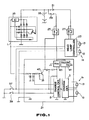
- Fig. 1 shows circuit construction of a control circuit controlling discharge lamps in a preferred embodiment according to the present invention.
- the control circuit for the discharge lamps are applicable to head lamps for an automotive vehicle.
- Discharge lamp 1 is constituted by a left discharge lamp 1a and a right discharge lamp 1b, each discharge lamp 1 including a main discharge lamp 13 and a dimmer discharge lamp 15.
- the main discharge lamp may be said to correspond substantially to an automobile's high-beam head lamp
- the dimmer discharge lamp corresponding substantially to an automobile's low-beam head lamp.
- the left discharge lamp 1a is controlled by means of a left head lamp controlling circuit 21.
- the right discharge lamp 1b is controlled by means of a right head lamp control circuit 23.
- head lamp relays 25, 27 are respectively installed upstream of the left head lamp control circuit 21 and the right head lamp control circuit 23 for carrying out connection and disconnection of the power supply. These head lamp relays 25, 27 are connected to a battery 33 and an alternator 25 which serve as a power supply via power supply fuses 29, 31. A light switch 37 and beam change-over switch 39 are connected to the head lamp controlling circuits 21, and 23.
- the left head lamp control circuit 21 and right head lamp control circuit 23 constitute a control circuit 17 which can charge and illuminate the main discharge lamp(s) 13 or the dimmer discharge lamp(s) 15.
- left head lamp control circuit 21 and right head lamp control circuit 23 have mutually the same structures, further detailed explanation will be limited to the left (side) head lamp control circuit 21.
- the left (side) head lamp control circuit 21 is provided with a charge circuit 3 and charge control circuit 5.
- the charge circuit 3 serves to charge and illuminate the main and dimmer discharge lamps 13 and 15.
- the charge control circuit 5 serves to control the charge circuit 3 so that the discharge lamps 13 and 15 are controlled at least between a warmed-up arc discharge state via a small current and a lighting arc discharge state via a stationary current. It is noted that both charge circuit 3 and charge control circuit 5 are connected to a relay contact of the left head lamp relay 25 via the power supply portions 41 and 43, respectively.
- the left (side) head lamp control circuit 21 receives command signals derived from the light switch 37 and beam change-over switch 39.
- the light switch 37 is connected to an excitation coil of the left head lamp relay 25.
- the left head lamp control circuit 21 is provided with a relay control transistor 45, its collector terminal being connected to the energization coil of the left head lamp relay 25.
- a base terminal of the relay control transistor 45 is connected to an L terminal of an alternator 35.
- the L terminal of the alternator 35 provides a generation of the vehicle power supply voltage when the engine of the vehicle is rotated and the alternator 35 starts power supply generation.
- the transistor 45 is in the conduction state so that the relay 25 is turned to ON.
- An output of the L terminal of the alternator 35 is serially input to the charge control circuit 5.
- the charge control circuit 5 since the charge control circuit 5 can detect the output of the alternator 35, the charge control circuit 5 also constitutes a start detecting means for detecting engine start.
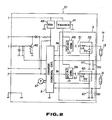
- Fig. 2 shows detailed circuit construction of the left head lamp control circuit 21.
- the charge control circuit 5 receives the input signal of a timer 47. When lighting is changed between one discharge lamp and another, the timer 47 sets a time and the charge control circuit 5 controls the turn-off timing of the illuminated discharge lamp which has just been turned off, according to the temperature within the discharge lamp which has just been turned on.
- the tube temperature in the discharge lamp selected to be illuminated can delay the turn-off timing of the discharge lamp previously selected thus the temporary overlap of both beams prevent a temporary reduction of luminous intensity during beam switching.
- timer 47 and charge control circuit 5 constitute switching control means in the preferred embodiment.
- FIG. 2 A detailed circuit structure of the charge circuit 3 is shown in Fig. 2.
- the main discharge lamp 13 includes a main beam DC/AC converter 49, a main beam coupling capacitor 51, a main beam L-C resonance circuit 53, a main beam current detecting resistor 55, and a main beam voltage detection capacitor 57.
- the dimmer discharge lamp 15 includes a dimmer beam DC/AC converter 59, dimmer beam coupling capacitor 61, dimmer beam L-C resonance circuit 63, a dimmer beam current detecting resistor 65, and dimmer beam voltage detecting capacitor 63.
- Both main beam DC/AC converter 49 and dimmer beam DC/AC converter 59 receive a signal having a set frequency from the charge control circuit 5.
- the L-C resonance circuits 53, 63 include an inductor Lo, electrostatic capacitor Co, the voltage detecting capacitor 67 having its capacitance sufficiently larger than that of Co (for example, 100 through 1000 times).
- the detection voltage and detection current of the discharge lamps 13, 15 are input to the charge control circuit 5.
- the detection current has a constant relationship to the tube temperature of the discharge lamps 13, 15.
- the current detection resistors 55, 65 and charge control circuit 5 constitute temperature detecting means in the preferred embodiment.
- the power supply to the left head lamp control circuit 21 is carried out by the start of power generation in the alternator 35 or operation of the light switch 37.
- the L terminal provides the vehicular power supply voltage and a relay control transistor 45 incorporated in the left head lamp control circuit 21 is operated. Consequently, the current flows through an excitation coil of the left head lamp relay 25 so that the vehicle power supply voltage is supplied to the power supply portions 41, 43 of the left head lamp control circuit 21.
- the discharge lamps 13, 15 are put in a stand-by state so that speedy illumination control can be carried out.
- the head lamp relays 25, 27 are turned OFF. With the fact that no operation of the light switch 37 commonly takes place when the engine is not operated taken into consideration, voltage is not applied to the circuit.
- the charge control circuit 5 serves to set a conversion frequency f M of the main beam DC/AC converter 49. In this way, a voltage Vsource having a frequency of F M is supplied to the main beam L-C resonance circuit 53 via a main beam coupling capacitor 51.
- the L-C resonance circuit 53 has a resonance frequency as shown in Fig. 3.
- both ends of a capacitor Co of the L-C resonance circuit 53 generate a very high voltage Vo determined with internal resistances of the Lo and Co (for example, 5 kV through 20kV).
- both terminal voltages of the discharge lamp 13 are substantially equal to the terminal voltage across a capacitor Co of the resonance circuit 53.
- the charge control circuit 5 controls the inter-terminal voltage and charge current by controlling f M .
- the current value is settled at a predetermined value Ic.
- the light emitting quantity of the discharge lamp 13 is dependent on the current value. As the current is reduced, the luminous intensity value of the discharge lamp 13 becomes reduced.
- the alternator 35 starts power generation so that the L terminal provides the vehicular power supply voltage.
- the relay control transistor 45 is turned to ON and the relay 25 is operated.
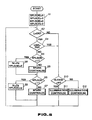
- the power is supplied to the charge control circuit 5 and the control is started in accordance with a previously determined program.
- the control circuit determines that spark discharge is not completed and a spark control (M) is executed in a step S5.
- step S5 The main spark control of step S5 is executed as shown in Fig. 8 in steps S51-S53.
- SFLG (D) 1 in steps S6 and S7 of Fig. 5, i.e., steps S71, S72 and step S73 of Fig. 9.
- the main beam L-C resonance circuit 53 is used to control the terminal voltage across the main discharge lamp 13 to maintain same at a relatively high voltage level (for example, 500 V through 1 kV). Therefore, the arc current provides a very small value (for example, 0. 1 A or less). Then, since this minute arc current gradually warms up the inside of the tube of the main discharge lamp 13, the luminous metal is vaporized. After several minutes have passed, the arc current and arc voltage are settled at the terminal voltage Vs and current Is as shown in Fig. 4.
- the dimmer discharge lamp 15 is warmed up and in the stand-by state in a step S9 via a step S6 so that the warm up using a minute current is carried out in a step S9 via the step S6.
- the dimmer discharge lamp is held in the stand-by state.
- step S3 of Fig. 5 when the light (illumination) switch 37 is operated in the stand-by state, LSW is turned to ON and the routine goes to a step S10.
- step S11 an illumination control for the main discharge lamp 13 is executed in the routine shown in Fig. 6.
- the routine goes from the step S113 to the step S114.
- the light switch 37 is operated immediately after the engine has started.
- an initial current I o ( ⁇ I c ) has a relatively large magnitude.
- This current I o is very large (for example, 2 A to 3 A) and therefore the tube temperature is abruptly increased so that the vaporization of the luminous metal is promoted.
- a speedy warm-up control is caused to provide a stably current focused value I C as shown in Fig. 4.
- HFLG (M) 1
- I M for example, 0. 3 A through 0. 6 A
- V M for example, 50 V through 100 V
- the control circuit determines whether the temperature of the main discharge lamp 13 becomes a predetermined temperature according to a current value flowing through the main discharge lamp 13 in a step S115.
- the illumination control is immediately carried out. Therefore, response is extremely fast.
- the tube temperature is determined according to the current value, no special temperature sensor is needed and the structure of the system is simplified.
- the control circuit determines whether the time exceeds the set time ö in a step S118.
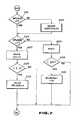
- the routine goes from the step S10 to the step S12 in which the illumination control routine of the dimmer discharge lamp 15 shown in Fig. 7 is executed in the same way as the illumination control routine of the main discharge lamp 13 shown in Fig. 6 (steps S121 through S129).
- the flag HFLG (D) 1.
- the dimmer discharge lamp 15 can also be speedily illuminated.
- the light quantity of the dimmer discharge lamp 15 already reaches 0. 3 X L D . In the same way, while the beam is exchanged, no temporary loss of light intensity occurs.
- the present invention can be applied to lightings of a two-wheeled cycle or a marine vessel.
- the present invention can control the discharge lamps in the warm up arc discharge state at the same time as the engine is started, the discharge lamps are speedily illuminated with good response characteristics in the illumination arc discharge state.
- the spark control is not repeated whenever the lamp is turned on. Therefore, deterioration can be prevented and the long term use can be achieved.
- the control circuit can make the discharge lamps stand by without failure when the engine is started.
- the transfer from the warm-up of the arc discharge state to the illumination arc discharge is controlled according to the tube temperature within the discharge lamps. If the tube temperature in the discharge lamp is warm, the control is immediately transferred to the arc discharge state. Thus, no wasted time is present after warm up and response characteristics are maintained extremely high.
- the control for warm up can speedily be carried out. Wasted time until warm up is achieved is descreased and response characteristics are considerably increased.
- the head lamp relay In a case where the head lamp relay is installed upstream of the discharge circuit and discharge control circuit, the head lamp relay is turned to ON at the same time as engine start and the lamp soon achieves the stand-by state. In addition, when the engine is stopped, no voltage is applied to the circuitry, thus no errosion can occur.
- the time at which one of the discharge lamps is to be turned off is controlled according to the tube temperature in the other discharge lamp to be turned on, the turning-off of the discharge lamp to be turned off can be carried out after the tube temperature of the discharge lamp to be turned on is sufficiently warmed up. Thus, temporary loss of light quantity can be prevented.
Landscapes
- Lighting Device Outwards From Vehicle And Optical Signal (AREA)
Applications Claiming Priority (2)
| Application Number | Priority Date | Filing Date | Title |
|---|---|---|---|
| JP34925/89 | 1989-02-16 | ||
| JP1034925A JPH0784154B2 (ja) | 1989-02-16 | 1989-02-16 | 放電灯の制御装置 |
Publications (2)
| Publication Number | Publication Date |
|---|---|
| EP0383692A2 true EP0383692A2 (de) | 1990-08-22 |
| EP0383692A3 EP0383692A3 (de) | 1991-05-02 |
Family
ID=12427780
Family Applications (1)
| Application Number | Title | Priority Date | Filing Date |
|---|---|---|---|
| EP19900400423 Ceased EP0383692A3 (de) | 1989-02-16 | 1990-02-15 | Schaltung und Methode zur Steuerung der Lichtstärke von Entladungslampen |
Country Status (3)
| Country | Link |
|---|---|
| US (1) | US5191266A (de) |
| EP (1) | EP0383692A3 (de) |
| JP (1) | JPH0784154B2 (de) |
Cited By (6)
| Publication number | Priority date | Publication date | Assignee | Title |
|---|---|---|---|---|
| NL9101649A (nl) * | 1990-10-01 | 1992-05-06 | Koito Mfg Co Ltd | Ontsteekketen voor een ontladingslamp van een voertuig. |
| EP0483082A3 (en) * | 1990-10-22 | 1992-11-19 | Marelli Autronica S.P.A. | Device for controlling a gas-discharge lamp for use in a motor vehicle |
| FR2798336A1 (fr) * | 1999-09-10 | 2001-03-16 | Koito Mfg Co Ltd | Appareil d'eclairage a lampes a decharge pour vehicule |
| WO2002085078A1 (de) * | 2001-04-14 | 2002-10-24 | Bayerische Motoren Werke Aktiengesellschaft | Scheinwerfervorrichtung für kraftfahrzeuge |
| GB2466515A (en) * | 2008-12-24 | 2010-06-30 | Greenlighting Ltd | Security light with a fluorescent lamp |
| WO2011136785A1 (en) * | 2010-04-30 | 2011-11-03 | Lumetric, Inc. | Modular programmable lighting ballast |
Families Citing this family (3)
| Publication number | Priority date | Publication date | Assignee | Title |
|---|---|---|---|---|
| SE503989C2 (sv) * | 1995-01-16 | 1996-10-14 | Ultralux Ab | Förfarande och anordning för att reglera strålkastare för fordon |
| JP3878793B2 (ja) * | 1999-09-10 | 2007-02-07 | 株式会社小糸製作所 | 車輌用放電灯装置 |
| CN108534089A (zh) * | 2018-04-12 | 2018-09-14 | 上海小糸车灯有限公司 | 日间行车灯联动控制策略和日间行车灯 |
Family Cites Families (15)
| Publication number | Priority date | Publication date | Assignee | Title |
|---|---|---|---|---|
| US3931544A (en) * | 1974-12-05 | 1976-01-06 | Gte Sylvania Incorporated | Fast warm up electronic ballast circuit for a high pressure discharge lamp |
| US4362971A (en) * | 1977-12-30 | 1982-12-07 | Sloan Jr Hiram C | Power supply for arc discharge devices |
| US4276497A (en) * | 1978-04-28 | 1981-06-30 | J. K. Lasers Limited | Laser flashtube power supply |
| FR2506554A1 (fr) * | 1981-05-20 | 1982-11-26 | Signaux Entr Electriques | Dispositif d'alimentation electronique pour lampes a decharge |
| NL8201631A (nl) * | 1982-04-20 | 1983-11-16 | Philips Nv | Gelijkstroom-wisselstroomomzetter voor het ontsteken en met wisselstroom voeden van een gas- en/of dampontladingslamp. |
| US4585974A (en) * | 1983-01-03 | 1986-04-29 | North American Philips Corporation | Varible frequency current control device for discharge lamps |
| US4559478A (en) * | 1983-06-28 | 1985-12-17 | U-Lite, Inc. | Fluorescent lamp circuit |
| US4777409A (en) * | 1984-03-23 | 1988-10-11 | Tracy Stanley J | Fluorescent lamp energizing circuit |
| US4642525A (en) * | 1985-04-15 | 1987-02-10 | Widmayer Don F | Transient control circuit for fluorescent lamp systems |
| SE447623B (sv) * | 1985-11-05 | 1986-11-24 | Lumalampan Ab | Fattning for kompaktlysror |
| JPS62198046A (ja) * | 1986-02-25 | 1987-09-01 | Nissan Motor Co Ltd | 車両用前照灯 |
| ZA862614B (en) * | 1986-04-08 | 1986-12-30 | David John Cockram | Controller for gas discharge lamps |
| US4713584A (en) * | 1987-03-19 | 1987-12-15 | Jean Pierre Paul | Vehicle light control system for automotive vehicles |
| DE3715162A1 (de) * | 1987-05-07 | 1988-11-17 | Bosch Gmbh Robert | Schaltungsanordnung zum betrieb einer gasentladungslampe an einer gleichstromquelle |
| US4949012A (en) * | 1988-01-21 | 1990-08-14 | Navistar International Transportation Corp. | Automotive vehicle daytime running light circuit |
-
1989
- 1989-02-16 JP JP1034925A patent/JPH0784154B2/ja not_active Expired - Lifetime
-
1990
- 1990-02-15 US US07/480,637 patent/US5191266A/en not_active Expired - Fee Related
- 1990-02-15 EP EP19900400423 patent/EP0383692A3/de not_active Ceased
Cited By (6)
| Publication number | Priority date | Publication date | Assignee | Title |
|---|---|---|---|---|
| NL9101649A (nl) * | 1990-10-01 | 1992-05-06 | Koito Mfg Co Ltd | Ontsteekketen voor een ontladingslamp van een voertuig. |
| EP0483082A3 (en) * | 1990-10-22 | 1992-11-19 | Marelli Autronica S.P.A. | Device for controlling a gas-discharge lamp for use in a motor vehicle |
| FR2798336A1 (fr) * | 1999-09-10 | 2001-03-16 | Koito Mfg Co Ltd | Appareil d'eclairage a lampes a decharge pour vehicule |
| WO2002085078A1 (de) * | 2001-04-14 | 2002-10-24 | Bayerische Motoren Werke Aktiengesellschaft | Scheinwerfervorrichtung für kraftfahrzeuge |
| GB2466515A (en) * | 2008-12-24 | 2010-06-30 | Greenlighting Ltd | Security light with a fluorescent lamp |
| WO2011136785A1 (en) * | 2010-04-30 | 2011-11-03 | Lumetric, Inc. | Modular programmable lighting ballast |
Also Published As
| Publication number | Publication date |
|---|---|
| US5191266A (en) | 1993-03-02 |
| JPH0784154B2 (ja) | 1995-09-13 |
| JPH02215079A (ja) | 1990-08-28 |
| EP0383692A3 (de) | 1991-05-02 |
Similar Documents
| Publication | Publication Date | Title |
|---|---|---|
| US5142203A (en) | Lighting circuit for high-pressure discharge lamp for vehicles | |
| JP4252117B2 (ja) | 放電灯装置 | |
| US5081565A (en) | Daytime running light system | |
| US6417624B1 (en) | Lighting system for vehicle | |
| US5191266A (en) | Circuit and method for controlling luminous intensity of discharge lamps | |
| US5050545A (en) | Engine preheating system | |
| KR20000048605A (ko) | 고압 가스 방출 램프의 상태 판정 장치 | |
| CN100567050C (zh) | 放电灯点灯装置 | |
| JPH0721804A (ja) | 自動車前照燈用の回路装置 | |
| US7239089B2 (en) | Power supply apparatus for high pressure discharge lamp | |
| EP0220675B1 (de) | Zünd- und Betriebsvorrichtung mit Batteriespannungskompensation für eine Hochdruckentladungslampe | |
| US4105927A (en) | Device for adjusting the level of brightness emitted by a lamp | |
| JP2715644B2 (ja) | 車輌用前照灯 | |
| JP2705292B2 (ja) | 車両用前照灯 | |
| JP3091325B2 (ja) | 車輛用照明装置 | |
| JP4350810B2 (ja) | 放電灯装置 | |
| JP4120022B2 (ja) | 放電灯装置 | |
| JPH05213109A (ja) | 照明制御装置 | |
| JP4319705B2 (ja) | 放電灯装置 | |
| KR0184545B1 (ko) | 보조 배터리를 이용한 전원 공급방법 | |
| JP4330668B2 (ja) | 放電灯装置 | |
| Bacon | Electronic Equipment in Cars | |
| JP4339418B2 (ja) | 放電灯装置 | |
| JP2658167B2 (ja) | 車両用照明具 | |
| KR0124539Y1 (ko) | 자동차의 배터리 전원차단 회로 |
Legal Events
| Date | Code | Title | Description |
|---|---|---|---|
| PUAI | Public reference made under article 153(3) epc to a published international application that has entered the european phase |
Free format text: ORIGINAL CODE: 0009012 |
|
| 17P | Request for examination filed |
Effective date: 19900312 |
|
| AK | Designated contracting states |
Kind code of ref document: A2 Designated state(s): DE FR GB |
|
| PUAL | Search report despatched |
Free format text: ORIGINAL CODE: 0009013 |
|
| AK | Designated contracting states |
Kind code of ref document: A3 Designated state(s): DE FR GB |
|
| 17Q | First examination report despatched |
Effective date: 19930519 |
|
| GRAG | Despatch of communication of intention to grant |
Free format text: ORIGINAL CODE: EPIDOS AGRA |
|
| STAA | Information on the status of an ep patent application or granted ep patent |
Free format text: STATUS: THE APPLICATION HAS BEEN REFUSED |
|
| 18R | Application refused |
Effective date: 19990813 |