EP0383991B2 - Alkalische Sammlerbatterie mit einer wasserstoffabsorbierenden Legierung - Google Patents
Alkalische Sammlerbatterie mit einer wasserstoffabsorbierenden Legierung Download PDFInfo
- Publication number
- EP0383991B2 EP0383991B2 EP89109751A EP89109751A EP0383991B2 EP 0383991 B2 EP0383991 B2 EP 0383991B2 EP 89109751 A EP89109751 A EP 89109751A EP 89109751 A EP89109751 A EP 89109751A EP 0383991 B2 EP0383991 B2 EP 0383991B2
- Authority
- EP
- European Patent Office
- Prior art keywords
- atomic ratio
- range
- absorbing alloy
- hydrogen absorbing
- hydrogen
- Prior art date
- Legal status (The legal status is an assumption and is not a legal conclusion. Google has not performed a legal analysis and makes no representation as to the accuracy of the status listed.)
- Expired - Lifetime
Links
Images

Classifications
-
- H—ELECTRICITY
- H01—ELECTRIC ELEMENTS
- H01M—PROCESSES OR MEANS, e.g. BATTERIES, FOR THE DIRECT CONVERSION OF CHEMICAL ENERGY INTO ELECTRICAL ENERGY
- H01M10/00—Secondary cells; Manufacture thereof
- H01M10/34—Gastight accumulators
- H01M10/345—Gastight metal hydride accumulators
-
- H—ELECTRICITY
- H01—ELECTRIC ELEMENTS
- H01M—PROCESSES OR MEANS, e.g. BATTERIES, FOR THE DIRECT CONVERSION OF CHEMICAL ENERGY INTO ELECTRICAL ENERGY
- H01M4/00—Electrodes
- H01M4/02—Electrodes composed of, or comprising, active material
- H01M4/36—Selection of substances as active materials, active masses, active liquids
- H01M4/38—Selection of substances as active materials, active masses, active liquids of elements or alloys
- H01M4/383—Hydrogen absorbing alloys
-
- Y—GENERAL TAGGING OF NEW TECHNOLOGICAL DEVELOPMENTS; GENERAL TAGGING OF CROSS-SECTIONAL TECHNOLOGIES SPANNING OVER SEVERAL SECTIONS OF THE IPC; TECHNICAL SUBJECTS COVERED BY FORMER USPC CROSS-REFERENCE ART COLLECTIONS [XRACs] AND DIGESTS
- Y02—TECHNOLOGIES OR APPLICATIONS FOR MITIGATION OR ADAPTATION AGAINST CLIMATE CHANGE
- Y02E—REDUCTION OF GREENHOUSE GAS [GHG] EMISSIONS, RELATED TO ENERGY GENERATION, TRANSMISSION OR DISTRIBUTION
- Y02E60/00—Enabling technologies; Technologies with a potential or indirect contribution to GHG emissions mitigation
- Y02E60/10—Energy storage using batteries
Definitions
- the present invention relates to an alkaline storage battery using a negative electrode including, as a main constituent material, a hydrogen absorbing alloy capable of electrochemically absorbing/desorbing hydrogen and, more particularly, relates to an improvement in this type hydrogen absorbing alloy.
- A is selected one from the group consisting of misch metal, Y, Ti, Hf, Zr, Ca, Th, La and other rare-earth elements;
- B is at least one element selected from the group consisting of Ni,Co,Cu,Fe and Mn;
- m is an atomic ratio within the range made up as follows, m ⁇ 3.5 for Ni, m ⁇ 3.5 for Co, m ⁇ 3.5 for Cu, m ⁇ 2.0 for Fe, and m ⁇ 1.0 for Mn;
- C is at least one element selected from the group of Al, Cr and Si; and
- n is an atomic ratio within the range made up as follows, 0.05 ⁇ n 0.6 for Al, 0.05 ⁇ n ⁇ 0.5 for Cr, and 0.05 ⁇ n ⁇ 0.6 for Si.
- an alloy for example, an LaNi 5 alloy
- other elements to prepare a multicomponent alloy so as to prevent the alloy from becoming fine power by repetition of charging/discharging cycles and prevent the generated alloy powder from being oxidized to thereby prolong the cycle life of the battery.
- a multicomponent alloy represented by the general formula LnNi x Mn y M z is proposed, in which formula Ln is a selected one of or a mixture of rare-earth elements; M is at least one element selected from the group consisting of Co, Cu, Fe, Al, Cr, Zn, Ti, Zr, Mo, Si and Mg; z is an atomic ratio within the range made up as follows, 0 ⁇ z ⁇ 0.2 for Co, 0 ⁇ z ⁇ 2 for Cu, 0 ⁇ z ⁇ 2 for Fe, 0 ⁇ z ⁇ 0.9 for Al, 0 ⁇ z ⁇ 1 for Cr, 0 ⁇ z ⁇ 0.5 for Zn, 0 ⁇ z ⁇ 0.3 for Ti, 0 ⁇ z ⁇ 0.3 for Zr, 0 ⁇ z ⁇ 0.3 for Mo, 0 ⁇ z ⁇ 0.5 for Si, and 0 ⁇ z ⁇ 0.5 for Si, and 0
- JP-A-63 304 570 a hydrogen adsorbing alloy is disclosed, which provides improved discharge characteristics and is represented by the general formula Ln(Ni 5-x-y-z Mn x Al y Co z ) M w , wherein Ln is Lanthanium or a mixture of rare earth elements, M is selected from the group consisting of Ti, Fe, V, Cr, Ni, Cu, Co and x, y, z and w satisfy the relations 0 ⁇ x ⁇ 0.6, 0 ⁇ y ⁇ 0.3, 0 ⁇ z ⁇ 1.0 and 0.05 ⁇ w ⁇ 0.35.
- the principle of the sealed cell design is the same as the oxygen extinguishing mechanism in a nickel-cadmium battery which has been proposed by Neumann, and the chargeable capacity of the negative electrode is established to be larger than that of the positive electrode.
- the negative electrode is made so as not to be perfectly charged to have a not-charged portion remained even after the positive electrode has been perfectly charged, so that a hydrogen gas is prevented from being generated from the negative electrode in an overcharging period and at the same time, an oxygen gas generated from the positive electrode is absorbed to the negative electrode by the reaction represented by the following formula (1) to keep the sealing state of the battery, MH x + O 2 ⁇ MH x-4 + 2H 2 O in which M is a hydrogen absorbing alloy.
- the hydrogen generation reacticn which is a competitive reaction, is carried out in an earlier stage of the negative electrode charging period, as the negative electrode is charged more rapidly. Accordingly, even though the sealed nickel-hydrogen battery is constructed so that the chargeable capacity of the negative electrode is established to be larger than that of the positive electrode, a hydrogen gas is generated from the negative electrode in the rapid charging period and cannot be removed, thereby the internal gas pressure of the battery is increased remarkably. As the result, a gas as well as an alkaline electrolytic solution are leaked from a safety vent (in general, which is operated by pressure of 10 to 15 kg/cm 2 ). There arises therefore a new problem in that deterioration of cycle life and lowering of safety are caused by the leakage of the electrolytic solution.
- a rechargeable electrochemical cell having a positive electrode, an alkaline electrolyte and a negative electrode made mainly of a hydrogen absorbing alloy is disclosed in EP-A-0 206 776.
- the alloy of the negative electrode comprises, as a first component, a rare-earth component consisting of a mixture of rare-earth elements, and.
- the elements Ni and Co in an atomic quantity of 2.2 ⁇ x ⁇ 4.8 per 1 gramme atom of the rare-earth component
- the elements Cu, Fe and Mn in an atomic quantity of 0.01 ⁇ y ⁇ 2.0 per 1 gramme atom of the rare-earth component
- the fourth component at least one element selected from the group consisting of Al, Cr, Si, Ti, V and Sn in an atomic quantity of 0.01 ⁇ z ⁇ 0.6 per 1 gramme atom of the rare-earth component, wherein the total atomic quantity of the second to fourth components is 4.8 ⁇ x + y + z ⁇ 5.4 per 1 gramme atom of the rare-earth component.
- JP-A-62-271 349 is known a hydrogen occlusion alloy electrode for a rechargeable electrochemical cell, which is represented as La 1-x A x Ni a CO b M c , wherein A denotes at least one element selected from a group comprising rare-earth elements, Ca, Mg, Ti, Zr, Th and Hf, except La, wherein M denotes at least one element selected from another group comprising V, Nb, Ta, Mn, Fe, Cu, Zn, Mo, Ga, Sn, W, Ag. In, Ge, Tl, Pb, Bi and Sb, and wherein a, b, c and x are conditioned as 4.5 ⁇ a + b + c ⁇ 5.5. 0 ⁇ c ⁇ 1.0 and 0 ⁇ x ⁇ 0.5.
- the object of the present invention is to provide an excellent sealed alkaline storage battery in which generation of hydrogen from a hydrogen absorbing alloy constituting a negative electrode is suppressed in a rapid charging period to thereby prevent remarkable increase in internal gas pressure of the the battery.
- an alkaline storage battery using a hydrogen absorbing alloy comprising: a positive electrode including a metal oxide as a main constituent material; a negative electrode including, as a main constituent material, a hydrogen absorbing alloy capable of electrochemically absorbing/desorbing hydrogen serving as an active material; an alkaline electrolytic solution; and a separator;
- the alloy composition is represented by the general formula of MmNi a Co b Mn c Al d ln e , in which formula:
- said metal oxide included in said positive electrode as its main constituent material is a nickel oxide, said metal oxide included in said positive electrode as its main constituent material is a manganese oxide or at least a part of said negative electrode has hydrophobic property.
- the positive electrode may be a nickel electrode having nickel oxide as as active material or may be another metal oxide electrode having a metal oxide such as manganese dioxide as an active material. Further alternatively, the positive electrode may be a composite electrode containing nickel oxide and manganese oxide combined in a suitable ratio by weight.
- misch metal Mm a mixture of rare-earth elements, such as for example La by about 25 wt%, Ce by about 52 wt%, Nd by about 18 wt%, and Pr by about 5 wt%
- the furnace was evacuated to obtain a vacuum state of 10 -4 to 10 -5 torr. Then, the samples were heated so as to be melted by arc discharge under the reduced pressure in an atmosphere of an argon gas. The samples were inverted several times to thereby obtain homogeneous alloys. To make the alloys more homogeneous, the alloys were heated in a vacuum at 1050°C for 6 hours. Then, the alloys were ground roughly and then pulverized by a ball mill to prepare various kinds of fine powder having a particle diameter of not larger than 38 ⁇ m.
- each of the various kinds of fine powder was dipped in a 7.2 N potassium hydroxide aqueous solution at 80°C for one hour to dissolve a part of the alloy surface. Then, the fine powder was washed with water and dried to prepare various kinds of fine powder having a rough alloy surface. The fine powder was mixed into an aqueous solution containing 1.5 wt% polyvinyl alcohol to prepare paste. Then, a foamed nickel porous matrix was filled with the paste, dried and pressed to prepare negative electrodes formed of various alloy compositions.
- the alloy content in each of the negative electrodes was selected to be 7.2 g.
- Table shows the compositions of the hydrogen absorbing alloys contained in the negative electrodes used in this example.
- Each of those negative electrodes 1 and a nickel positive electrode 2 prepared by filling a known foamed metal with nickel hydroxide were inserted into a case 4 serving as a negative electrode terminal in the state that the negative electrode 1 and the positive electrode 2 were wound spirally through a separator 3 formed of sulfonated polypropylene non-woven fabric.
- a safety vent 6 provided in the inner side of a positive electrode cap 5 is established to be operated by pressure of not lower than 30 kg/cm 2 for the purpose of measuring the internal gas pressure of the battery, though in general such a safety vent is established so as to be operated by pressure of 11 to 12 kg/cm 2 .
- the reference numeral 7 designates a sealing plate
- 8 designates an insulating gasket
- 9 designates a positive electrode collector for electrically connecting the positive electrode 2 and the sealing plate 7.
- the battery was then fixed to a apparatus having a pressure sensor attached thereto and the internal gas pressure of the battery was measured when the battery was subject to 150% charging with 1 CmA.
- the results of measurement, together with the ratios of the alloy components, are shown in Table.
- the symbol "CmA” indicates the charging rate or discharging rate in proportion to the battery capacity. For example, in the case of measuring a characteristic AA-type battery, having a capacity of 1000 mAh, discharging of 1 CmA means that the discharging is at 1000 mA.
- electrodes D to I are examples prepared according to the present invention, whereas electrode W is a comparative example.
- the Sf value of the alloy used in each of the electrodes A to R is not larger than 2.5.
- the theoretical capacity in each of the electrodes D to I is in a range of from 220 to 250 mAh/g.
- the internal gas pressure in each of the batteries using the electrodes D to I according to the present invention was excellent and not higher than 7.8 kg/cm 2 though the battery was rapidly charged with 1 CmA.
- the internal gas pressure of the battery using the electrode W formed of an alloy not containing In, Tl or Ga was remarkably increased to 18 kg/cm 2 when the battery was charged with 1 CmA.
- the internal gas pressure of a battery using an alloy containing Fe by an atomic ratio of 0.4, Cu by an atomic ratio of 1.0, and Cr by an atomic ratio of 0.4 became not lower than 10 kg/cm 2 .
- the amount of substitution of elements, such as Ti, Zr, Ca, Y and Hf, represented by B in the general formula, for elements represented by A is limited within a suitable range. If the atomic ratio x of substitution of these elements is not smaller than 0.2, the quantity of alloy phase effective for hydrogen absorption (CaCu 5 type crystal structure) is reduced so that the quantity of absorbed hydrogen is reduced. Consequently, in the case where the atomic ratio x was not smaller than 0.2, a large amount of hydrogen gas was generated to increase the internal gas pressure of the battery to 15 kg/cm 2 though the battery was assembled in the same condition.
- the atomic ratio x of substitution of elements Ti, Zr, Ca, Y and Hf for the element A is not larger than 0.2 even in the case where the alloy contains at least one element selected from the group consisting of In, Tl and Ga.
- a hydrophobic resin such as polytetrafluoroethylene may be used as a binding agent to be disposed in a part of the electrode.
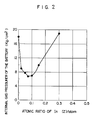
- Hydrogen absorbing alloys represented by the general formula MmNi 3.8-z Co 0.5 Mn 0.4 Al 0.3 ln z were used for electrodes. While the atomic ratio z was changed within a range of from 0 to 0.4, the relation between the amount of substitution of In and the internal gas pressure of the battery charged with 1 CmA was examined. The results of examination are shwon in Fig. 2. The condition of production of alloys and electrodes, the condition of construction of batteries and the condition of measurement of internal gas pressure of the battery were the same as in the Example 1. Fig. 2 shows the results of examination in the case where In is substituted for Ni.
- the internal gas pressure of the battery charged with 1 CmA was not higher than 10 kg/cm 2 . Accordingly, it is preferable to select the atomic ratio of substitution of In to be within a range of from 0.02 to 0.1.
- a hydrogen absorbing alloy represented by the general formula of Al 1-x B x C y D z is used as the negative electrode, in which formula; A is selected from the group consisting of La, mixture of rare-earth elements, and misch metal; B is selected from the group consisting of Ti, Zr, Ca, Y, Hf and mixtures thereof; C is selected from the group consisting of Ni, Co, Mn, Al, Fe, Cu, Cr and mixtures thereof; D is selected from the group consisting of In, Tl, Ga and mixtures thereof; x has a value within a range of from 0 to 0.2; y has
Landscapes
- Chemical & Material Sciences (AREA)
- Chemical Kinetics & Catalysis (AREA)
- Electrochemistry (AREA)
- General Chemical & Material Sciences (AREA)
- Engineering & Computer Science (AREA)
- Manufacturing & Machinery (AREA)
- Battery Electrode And Active Subsutance (AREA)
- Secondary Cells (AREA)
Claims (5)
- Alkalische Speicherbatterie, in der eine Wasserstoff absorbierende Legierung eingesetzt wird, wobei die Batterie aufweist: eine ein Metalloxid als Hauptbestandteilsmaterial enthaltende positive Elektrode, eine negative Elektrode, die als Hauptbestandteilsmaterial eine Wasserstoff absorbierende Legierung enthält, mit der als aktives Material dienender Wasserstoff elektrochemisch absorbiert/desorbiert werden kann, eine alkalische Elektrolytlösung und einen Separator,wobei die Wasserstoff absorbierende Legierungeine Kristallstruktur von CaCu5-Typ aufweist,durch die allgemeine Formel A1-xBxCyDz, dargestellt wird,
wobei gilt:A ist aus der aus Mischungen von Elementen der seltenen Erden, Mischmetall und La bestehenden Gruppe ausgewählt,B ist aus der aus Ti, Zr, Ca, Y, Hf und Mischungen davon bestehende Gruppe ausgewählt,C besteht aus Ni in einem Atomverhältnis von mehr als 3,5, Co in einem Atomverhältnis von 1,0 oder
weniger, Mn in einem Atomverhältnis von 0,6 oder
weniger, Al in einem Atomverhältnis von 0,5 oder
weniger, Fe in einem Atomverhältnis von 0,3 oder
weniger, Cu in einem Atomverhältnis von 1,0 oder
weniger und Cr in einem Atomverhältnis von 0,3 oder
weniger, vorausgesetzt, daß die Atomverhältnisseauf die Summe von A und B normiert sind,D besteht aus In in einem Atomverhältnis innerhalb des Bereichs von 0,02 bis 0,1, Tl in einem Atomverhältnis innerhalb des Bereichs von 0,02 bis 0,1 und/oder Ga in einem Atomverhältnis innerhalb des Bereichs von 0,02 bis 0,1, vorausgesetzt, daß die Atomverhältnisse auf die Summe von A + B normiert sind,und x, y und z genügen den Beziehungen 0 ≤ x ≤ 0,2 und 4,7 ≤ (y+z) ≤ 0,3,eine rauhe Oberfläche aufweist undeinen Sf-Wert [= In (PH/M = 0,75/PH/M = 0,25)]
von nicht mehr als 2,5 aufweist, wobei der Sf-Wert die Flachheit des Plateaudrucks für den Fall darstellt, daß von der Wasserstoff absorbierenden Legierung Wasserstoff desorbiert wird, wenn als Testbedingungen 1000 mAh, AA-Größe, 150%-Ladung mit 1 CmA gewählt werden. - Alkalische Speicherbatterie in der eine Wasserstoff absorbierenden Legierung eingesetzt wird, gemäß Anspruch 1, bei der das in der positiven Elektrode als deren Hauptbestandteilsmaterial enthaltene Metalloxid ein Nickeloxid ist.
- Alkalische Speicherbatterie, in der eine Wasserstoff absorbierende Legierung eingesetzt wird, gemäß Ansprüchen 1 oder 2, bei der das in der positiven Elektrode als deren Hauptbestandteilsmaterial enthaltene Metalloxid ein Manganoxid ist.
- Alkalische Speicherbatterie, in der eine Wasserstoff absorbierende Legierung eingesetzt wird, gemäß einem der Ansprüche 1 bis 3, bei der zumindest ein Teil der negativen Elektrode hydrophobe Eigenschaften aufweist.
- Alkalische Speicherbatterie, in der eine Wasserstoff absorbierende Legierung eingesetzt wird, gemäß einem der Ansprüche 1 bis 4, bei der die Legierungszusammensetzung durch die allgemeine Formel MmNiaCobMncAldIne dargestellt ist, in welcher Formel:Mm ein Mischmetall darstellt;a ein Atomverhältnis im Bereich a > 3,5 ist;b ein Atomverhältnis im Bereich 0,25 < b < 1,0 ist;c ein Atomverhältnis im Bereich 0,2 < c < 0,6 ist;d ein Atomverhältnis im Bereich 0,1 < d < 0,3 ist;e ein Atomverhältnis im Bereich 0,02 < e < 0,1 ist;die Werte von a, b, c, d und e relative Zahlen bezogen auf die Gesamtmenge vom Mm sind.
Applications Claiming Priority (2)
| Application Number | Priority Date | Filing Date | Title |
|---|---|---|---|
| JP1043710A JP2926734B2 (ja) | 1989-02-23 | 1989-02-23 | 水素吸蔵合金を用いたアルカリ蓄電池 |
| JP43710/89 | 1989-02-23 |
Publications (4)
| Publication Number | Publication Date |
|---|---|
| EP0383991A2 EP0383991A2 (de) | 1990-08-29 |
| EP0383991A3 EP0383991A3 (en) | 1990-09-12 |
| EP0383991B1 EP0383991B1 (de) | 1994-01-19 |
| EP0383991B2 true EP0383991B2 (de) | 1997-04-09 |
Family
ID=12671365
Family Applications (1)
| Application Number | Title | Priority Date | Filing Date |
|---|---|---|---|
| EP89109751A Expired - Lifetime EP0383991B2 (de) | 1989-02-23 | 1989-05-30 | Alkalische Sammlerbatterie mit einer wasserstoffabsorbierenden Legierung |
Country Status (4)
| Country | Link |
|---|---|
| US (1) | US4925748A (de) |
| EP (1) | EP0383991B2 (de) |
| JP (1) | JP2926734B2 (de) |
| DE (1) | DE68912566T3 (de) |
Families Citing this family (25)
| Publication number | Priority date | Publication date | Assignee | Title |
|---|---|---|---|---|
| US5346781A (en) * | 1989-02-23 | 1994-09-13 | Matsushita Electric Industrial Co., Ltd. | Alkaline storage battery |
| NL8901776A (nl) * | 1989-07-11 | 1991-02-01 | Philips Nv | Elektrochemische cel. |
| US5032475A (en) * | 1989-09-18 | 1991-07-16 | Toshiba Battery Co. | Nickel-metal hydride secondary cell |
| JP2980328B2 (ja) * | 1989-09-29 | 1999-11-22 | 株式会社東芝 | 電池用水素吸蔵合金、その製造方法及びニッケル水素二次電池 |
| US6001810A (en) * | 1989-11-20 | 1999-12-14 | Eli Lilly And Company | Methods for treating retroviral infection |
| JP3005247B2 (ja) * | 1990-05-31 | 2000-01-31 | 三洋電機株式会社 | 水素吸蔵合金 |
| NL9001677A (nl) * | 1990-07-24 | 1992-02-17 | Koninkl Philips Electronics Nv | Elektrochemische cel met hydride vormende intermetallische verbinding. |
| JPH04137368A (ja) * | 1990-09-26 | 1992-05-12 | Matsushita Electric Ind Co Ltd | ニッケル/水素蓄電池とその製造法 |
| US5264301A (en) * | 1992-04-14 | 1993-11-23 | Globe-Union Inc. | Metal oxide-hydrogen battery incorporating a mechanism for maintaining a constant pressure in the battery |
| JP3438142B2 (ja) * | 1992-09-18 | 2003-08-18 | 松下電器産業株式会社 | 中・大容量密閉式金属酸化物・水素蓄電池 |
| JP2903913B2 (ja) * | 1992-11-10 | 1999-06-14 | 松下電器産業株式会社 | 蓄電池システム |
| US5547784A (en) * | 1993-01-18 | 1996-08-20 | Matsushita Electric Industrial Co., Ltd. | Alkaline storage battery and method for producing the same |
| US5376474A (en) * | 1993-02-05 | 1994-12-27 | Sanyo Electric Co., Ltd. | Hydrogen-absorbing alloy for a negative electrode and manufacturing method therefor |
| EP0614236B1 (de) * | 1993-03-01 | 2001-01-24 | Matsushita Electric Industrial Co., Ltd. | Verfahren und Herstellung von einer Wasserstoffspeicherlegierung |
| JPH06338344A (ja) * | 1993-05-31 | 1994-12-06 | Sanyo Electric Co Ltd | 密閉形ニッケル・金属水素化物アルカリ蓄電池 |
| US5389333A (en) * | 1993-08-31 | 1995-02-14 | Central Iron & Steel Research Institute Of Ministry Of Metallurgical Industry | Hydrogen storage alloys |
| US5525435A (en) * | 1994-07-11 | 1996-06-11 | Eveready Battery Company, Inc. | Hydrogen storage materials |
| DE19512841A1 (de) * | 1995-04-06 | 1996-10-10 | Varta Batterie | Alkalische Metalloxid-Metallhydrid-Batterie |
| US6048644A (en) * | 1997-03-24 | 2000-04-11 | Matsushita Electric Industrial Co., Ltd. | Hydrogen storage alloy electrode |
| SG78302A1 (en) * | 1998-06-22 | 2001-02-20 | Yao Li Ho | A hydrogen absorbing alloy for battery application |
| WO2000001023A1 (fr) * | 1998-06-26 | 2000-01-06 | Sanyo Electric Co., Ltd. | Alliage absorbeur d'hydrogene pour batteries alcalines et procede de preparation associe |
| US6492057B1 (en) * | 1999-04-14 | 2002-12-10 | Ovonic Battery Company, Inc. | Electrochemical cell having reduced cell pressure |
| JP2001015142A (ja) | 1999-06-30 | 2001-01-19 | Mitsubishi Heavy Ind Ltd | 燃料電池車両の走行方法及び燃料電池車両 |
| US10193154B2 (en) | 2013-01-31 | 2019-01-29 | Medtronic, Inc. | Cathode composition for primary battery |
| JP2018147626A (ja) * | 2017-03-02 | 2018-09-20 | トヨタ自動車株式会社 | アルカリ二次電池 |
Family Cites Families (15)
| Publication number | Priority date | Publication date | Assignee | Title |
|---|---|---|---|---|
| US3850694A (en) * | 1972-11-27 | 1974-11-26 | Communications Satellite Corp | Low pressure nickel hydrogen cell |
| FR2311858A1 (fr) * | 1975-05-23 | 1976-12-17 | Anvar | Alliages a base de lanthane et de nickel et leurs applications electrochimiques |
| FR2382774A2 (fr) * | 1977-03-02 | 1978-09-29 | Anvar | Alliages a base de lanthane et de nickel et leurs applications electrochimiques |
| FR2399484A1 (fr) * | 1977-08-02 | 1979-03-02 | Anvar | Nouveaux alliages a base de lanthane et de nickel, leur fabrication et leurs applications electrochimiques |
| US4214043A (en) * | 1978-02-03 | 1980-07-22 | U.S. Philips Corporation | Rechargeable electrochemical cell |
| US4312928A (en) * | 1978-05-04 | 1982-01-26 | U.S. Philips Corporation | Rechargeable electrochemical cell |
| NL8303630A (nl) * | 1983-10-21 | 1985-05-17 | Philips Nv | Elektrochemische cel met stabiele hydridevormende materialen. |
| FR2569059B1 (fr) * | 1984-08-10 | 1992-08-07 | Sanyo Electric Co | Accumulateur alcalin metal/hydrogene |
| US4696873A (en) * | 1985-06-21 | 1987-09-29 | Kabushiki Kaisha Toshiba | Rechargeable electrochemical cell with a negative electrode comprising a hydrogen absorbing alloy including rare earth component |
| NL8601674A (nl) * | 1986-06-26 | 1988-01-18 | Philips Nv | Elektrochemische cel. |
| NL8601675A (nl) * | 1986-06-26 | 1988-01-18 | Philips Nv | Elektrochemische cel. |
| DE3776300D1 (de) * | 1986-12-08 | 1992-03-05 | Matsushita Electric Industrial Co Ltd | Gasdichter akkumulator und verfahren zur herstellung seiner elektrode. |
| KR920007380B1 (ko) * | 1987-02-17 | 1992-08-31 | 산요 덴끼 가부시끼가이샤 | 알칼리 축전지 및 그 제조방법 |
| JP2752970B2 (ja) * | 1987-06-03 | 1998-05-18 | 松下電器産業株式会社 | 水素吸蔵電極 |
| JPS63314764A (ja) * | 1987-06-17 | 1988-12-22 | Matsushita Electric Ind Co Ltd | 水素吸蔵電極 |
-
1989
- 1989-02-23 JP JP1043710A patent/JP2926734B2/ja not_active Expired - Lifetime
- 1989-05-24 US US07/356,229 patent/US4925748A/en not_active Expired - Lifetime
- 1989-05-30 DE DE68912566T patent/DE68912566T3/de not_active Expired - Lifetime
- 1989-05-30 EP EP89109751A patent/EP0383991B2/de not_active Expired - Lifetime
Also Published As
| Publication number | Publication date |
|---|---|
| EP0383991A3 (en) | 1990-09-12 |
| JPH02223150A (ja) | 1990-09-05 |
| DE68912566T3 (de) | 1997-11-13 |
| EP0383991B1 (de) | 1994-01-19 |
| JP2926734B2 (ja) | 1999-07-28 |
| US4925748A (en) | 1990-05-15 |
| DE68912566D1 (de) | 1994-03-03 |
| DE68912566T2 (de) | 1994-06-30 |
| EP0383991A2 (de) | 1990-08-29 |
Similar Documents
| Publication | Publication Date | Title |
|---|---|---|
| EP0383991B1 (de) | Alkalische Sammlerbatterie mit einer wasserstoffabsorbierenden Legierung | |
| EP0522297B1 (de) | Wasserstoffspeichernde Elektrode | |
| US4487817A (en) | Electrochemical cell comprising stable hydride-forming material | |
| JP2771592B2 (ja) | アルカリ蓄電池用水素吸蔵合金電極 | |
| EP0284333B1 (de) | Gasdichte Nickel-Hydridbatterie und Verfahren zur Herstellung | |
| EP1026764B1 (de) | Wasserstoffabsorbierende Legierung, Verfahren zur Herstellung und alkalischer Akkumulator | |
| EP0386305B1 (de) | Alkalische Sammlerbatterie und Verfahren zur Herstellung ihrer negativen Elektrode | |
| EP0554617B1 (de) | Aktives Material von einer Elektrode aus Wasserstoffspeicherlegierung | |
| US4702978A (en) | Electrochemical cell | |
| US7198868B2 (en) | Alkaline storage battery | |
| US6071644A (en) | Metal hydride storage cell and method of producing hydrogen absorbing alloy electrode | |
| JPH0677451B2 (ja) | 水素吸蔵電極の製造法 | |
| US20050100789A1 (en) | Nickel metal hydride storage battery | |
| EP0845823B1 (de) | Elektrode aus Wasserstoffspeicherlegierung, Verfahren zur Herstellung und alkalische Sekundärbatterie | |
| US6197448B1 (en) | Hydrogen storage alloy | |
| JP2680623B2 (ja) | 水素吸蔵合金電極 | |
| EP0550153B1 (de) | Elektrode aus einer wasserstoffabsorbierenden Legierung und Verfahren zu ihrer Herstellung | |
| EP0627779B1 (de) | Gasdichter alkalischer Nickel/Metallhydrid-Speicherzelle und dessen Herstellungsverfahren | |
| US6395424B1 (en) | Hydrogen absorbing alloy for alkali storage battery, hydrogen absorbing alloy electrode for alkali storage battery, and alkali storage battery | |
| US6238823B1 (en) | Non-stoichiometric AB5 alloys for metal hydride electrodes | |
| JPH0690924B2 (ja) | 蓄電池用電極 | |
| JP3101622B2 (ja) | ニッケル・水素アルカリ蓄電池 | |
| JP2679441B2 (ja) | ニッケル・水素蓄電池 | |
| JPH06145849A (ja) | 水素吸蔵合金電極 | |
| JP3146063B2 (ja) | 金属酸化物・水素二次電池 |
Legal Events
| Date | Code | Title | Description |
|---|---|---|---|
| PUAI | Public reference made under article 153(3) epc to a published international application that has entered the european phase |
Free format text: ORIGINAL CODE: 0009012 |
|
| PUAL | Search report despatched |
Free format text: ORIGINAL CODE: 0009013 |
|
| AK | Designated contracting states |
Kind code of ref document: A2 Designated state(s): BE DE FR GB IT NL |
|
| AK | Designated contracting states |
Kind code of ref document: A3 Designated state(s): BE DE FR GB IT NL |
|
| 17P | Request for examination filed |
Effective date: 19901015 |
|
| 17Q | First examination report despatched |
Effective date: 19911018 |
|
| GRAA | (expected) grant |
Free format text: ORIGINAL CODE: 0009210 |
|
| ITF | It: translation for a ep patent filed | ||
| AK | Designated contracting states |
Kind code of ref document: B1 Designated state(s): BE DE FR GB IT NL |
|
| REF | Corresponds to: |
Ref document number: 68912566 Country of ref document: DE Date of ref document: 19940303 |
|
| ET | Fr: translation filed | ||
| ITTA | It: last paid annual fee | ||
| PLBI | Opposition filed |
Free format text: ORIGINAL CODE: 0009260 |
|
| 26 | Opposition filed |
Opponent name: ALCATEL ALSTHOM CIE. GEN. D'ELECTRICITE Effective date: 19941012 |
|
| NLR1 | Nl: opposition has been filed with the epo |
Opponent name: ALCATEL ALSTHOM CIE. GEN. D'ELECTRICITE |
|
| PLAW | Interlocutory decision in opposition |
Free format text: ORIGINAL CODE: EPIDOS IDOP |
|
| PLAW | Interlocutory decision in opposition |
Free format text: ORIGINAL CODE: EPIDOS IDOP |
|
| PUAH | Patent maintained in amended form |
Free format text: ORIGINAL CODE: 0009272 |
|
| STAA | Information on the status of an ep patent application or granted ep patent |
Free format text: STATUS: PATENT MAINTAINED AS AMENDED |
|
| ITF | It: translation for a ep patent filed | ||
| 27A | Patent maintained in amended form |
Effective date: 19970409 |
|
| AK | Designated contracting states |
Kind code of ref document: B2 Designated state(s): BE DE FR GB IT NL |
|
| NLR2 | Nl: decision of opposition | ||
| NLR3 | Nl: receipt of modified translations in the netherlands language after an opposition procedure | ||
| ET3 | Fr: translation filed ** decision concerning opposition | ||
| REG | Reference to a national code |
Ref country code: GB Ref legal event code: IF02 |
|
| PGFP | Annual fee paid to national office [announced via postgrant information from national office to epo] |
Ref country code: DE Payment date: 20080605 Year of fee payment: 20 |
|
| PGFP | Annual fee paid to national office [announced via postgrant information from national office to epo] |
Ref country code: IT Payment date: 20080527 Year of fee payment: 20 |
|
| PGFP | Annual fee paid to national office [announced via postgrant information from national office to epo] |
Ref country code: NL Payment date: 20080501 Year of fee payment: 20 |
|
| PGFP | Annual fee paid to national office [announced via postgrant information from national office to epo] |
Ref country code: GB Payment date: 20080604 Year of fee payment: 20 |
|
| PGFP | Annual fee paid to national office [announced via postgrant information from national office to epo] |
Ref country code: BE Payment date: 20080709 Year of fee payment: 20 |
|
| BE20 | Be: patent expired |
Owner name: *MATSUSHITA ELECTRIC INDUSTRIAL CO. LTD Effective date: 20090530 |
|
| REG | Reference to a national code |
Ref country code: GB Ref legal event code: PE20 Expiry date: 20090529 |
|
| PG25 | Lapsed in a contracting state [announced via postgrant information from national office to epo] |
Ref country code: NL Free format text: LAPSE BECAUSE OF EXPIRATION OF PROTECTION Effective date: 20090530 |
|
| NLV7 | Nl: ceased due to reaching the maximum lifetime of a patent |
Effective date: 20090530 |
|
| PG25 | Lapsed in a contracting state [announced via postgrant information from national office to epo] |
Ref country code: GB Free format text: LAPSE BECAUSE OF EXPIRATION OF PROTECTION Effective date: 20090529 |
|
| PGFP | Annual fee paid to national office [announced via postgrant information from national office to epo] |
Ref country code: FR Payment date: 20080514 Year of fee payment: 20 |