EP0384313A1 - Chinolin-4-carbonsäurederivate und deren Verwendung - Google Patents
Chinolin-4-carbonsäurederivate und deren Verwendung Download PDFInfo
- Publication number
- EP0384313A1 EP0384313A1 EP90103019A EP90103019A EP0384313A1 EP 0384313 A1 EP0384313 A1 EP 0384313A1 EP 90103019 A EP90103019 A EP 90103019A EP 90103019 A EP90103019 A EP 90103019A EP 0384313 A1 EP0384313 A1 EP 0384313A1
- Authority
- EP
- European Patent Office
- Prior art keywords
- alkyl
- hydrogen
- alkoxy
- quinoline
- methyl
- Prior art date
- Legal status (The legal status is an assumption and is not a legal conclusion. Google has not performed a legal analysis and makes no representation as to the accuracy of the status listed.)
- Withdrawn
Links
- VQMSRUREDGBWKT-UHFFFAOYSA-N quinoline-4-carboxylic acid Chemical class C1=CC=C2C(C(=O)O)=CC=NC2=C1 VQMSRUREDGBWKT-UHFFFAOYSA-N 0.000 title claims abstract description 19
- -1 methylenedioxy Chemical class 0.000 claims abstract description 64
- 239000001257 hydrogen Substances 0.000 claims abstract description 31
- 229910052739 hydrogen Inorganic materials 0.000 claims abstract description 31
- 125000002496 methyl group Chemical group [H]C([H])([H])* 0.000 claims abstract description 24
- 125000002887 hydroxy group Chemical group [H]O* 0.000 claims abstract description 17
- 125000001495 ethyl group Chemical group [H]C([H])([H])C([H])([H])* 0.000 claims abstract description 16
- 125000001997 phenyl group Chemical group [H]C1=C([H])C([H])=C(*)C([H])=C1[H] 0.000 claims abstract description 15
- 125000000027 (C1-C10) alkoxy group Chemical group 0.000 claims abstract description 14
- 125000000217 alkyl group Chemical group 0.000 claims abstract description 14
- 125000004430 oxygen atom Chemical group O* 0.000 claims abstract description 13
- 239000000460 chlorine Substances 0.000 claims abstract description 12
- 229910052801 chlorine Inorganic materials 0.000 claims abstract description 12
- 230000009021 linear effect Effects 0.000 claims abstract description 12
- PXGOKWXKJXAPGV-UHFFFAOYSA-N Fluorine Chemical compound FF PXGOKWXKJXAPGV-UHFFFAOYSA-N 0.000 claims abstract description 9
- ZAMOUSCENKQFHK-UHFFFAOYSA-N Chlorine atom Chemical compound [Cl] ZAMOUSCENKQFHK-UHFFFAOYSA-N 0.000 claims abstract description 8
- 229910052731 fluorine Inorganic materials 0.000 claims abstract description 8
- 239000011737 fluorine Substances 0.000 claims abstract description 8
- WKBOTKDWSSQWDR-UHFFFAOYSA-N Bromine atom Chemical compound [Br] WKBOTKDWSSQWDR-UHFFFAOYSA-N 0.000 claims abstract description 5
- 125000003860 C1-C20 alkoxy group Chemical group 0.000 claims abstract description 5
- GDTBXPJZTBHREO-UHFFFAOYSA-N bromine Substances BrBr GDTBXPJZTBHREO-UHFFFAOYSA-N 0.000 claims abstract description 5
- 229910052794 bromium Inorganic materials 0.000 claims abstract description 5
- 125000001309 chloro group Chemical group Cl* 0.000 claims abstract description 5
- 125000002933 cyclohexyloxy group Chemical group C1(CCCCC1)O* 0.000 claims abstract description 5
- 239000000463 material Substances 0.000 claims abstract description 5
- 125000000956 methoxy group Chemical group [H]C([H])([H])O* 0.000 claims abstract description 5
- 239000001301 oxygen Substances 0.000 claims abstract description 5
- 229910052760 oxygen Inorganic materials 0.000 claims abstract description 5
- 125000002861 (C1-C4) alkanoyl group Chemical group 0.000 claims abstract description 4
- QVGXLLKOCUKJST-UHFFFAOYSA-N atomic oxygen Chemical compound [O] QVGXLLKOCUKJST-UHFFFAOYSA-N 0.000 claims abstract description 4
- 125000003236 benzoyl group Chemical group [H]C1=C([H])C([H])=C(C([H])=C1[H])C(*)=O 0.000 claims abstract description 4
- 125000001797 benzyl group Chemical group [H]C1=C([H])C([H])=C(C([H])=C1[H])C([H])([H])* 0.000 claims abstract description 4
- 125000000242 4-chlorobenzoyl group Chemical group ClC1=CC=C(C(=O)*)C=C1 0.000 claims abstract description 3
- 125000006283 4-chlorobenzyl group Chemical group [H]C1=C([H])C(=C([H])C([H])=C1Cl)C([H])([H])* 0.000 claims abstract description 3
- 150000002431 hydrogen Chemical class 0.000 claims description 19
- UFHFLCQGNIYNRP-UHFFFAOYSA-N Hydrogen Chemical compound [H][H] UFHFLCQGNIYNRP-UHFFFAOYSA-N 0.000 claims description 13
- 125000003545 alkoxy group Chemical group 0.000 claims description 8
- XEEYBQQBJWHFJM-UHFFFAOYSA-N Iron Chemical compound [Fe] XEEYBQQBJWHFJM-UHFFFAOYSA-N 0.000 claims description 5
- 125000002947 alkylene group Chemical group 0.000 claims description 2
- LNQUWGZAZIOHMM-UHFFFAOYSA-N ethoxy-hydroxy-methoxy-lambda3-chlorane Chemical compound CCOCl(O)OC LNQUWGZAZIOHMM-UHFFFAOYSA-N 0.000 claims description 2
- 125000000325 methylidene group Chemical group [H]C([H])=* 0.000 claims description 2
- UUEVFMOUBSLVJW-UHFFFAOYSA-N oxo-[[1-[2-[2-[2-[4-(oxoazaniumylmethylidene)pyridin-1-yl]ethoxy]ethoxy]ethyl]pyridin-4-ylidene]methyl]azanium;dibromide Chemical compound [Br-].[Br-].C1=CC(=C[NH+]=O)C=CN1CCOCCOCCN1C=CC(=C[NH+]=O)C=C1 UUEVFMOUBSLVJW-UHFFFAOYSA-N 0.000 claims 1
- 125000003837 (C1-C20) alkyl group Chemical group 0.000 abstract description 2
- 125000004178 (C1-C4) alkyl group Chemical group 0.000 abstract description 2
- 125000006527 (C1-C5) alkyl group Chemical group 0.000 abstract description 2
- 125000004169 (C1-C6) alkyl group Chemical group 0.000 abstract description 2
- 125000004435 hydrogen atom Chemical class [H]* 0.000 abstract 6
- RJSYPKWVIJGNLO-UHFFFAOYSA-N CCOClOC Chemical compound CCOClOC RJSYPKWVIJGNLO-UHFFFAOYSA-N 0.000 abstract 1
- YXFVVABEGXRONW-UHFFFAOYSA-N Toluene Chemical compound CC1=CC=CC=C1 YXFVVABEGXRONW-UHFFFAOYSA-N 0.000 description 30
- OKKJLVBELUTLKV-UHFFFAOYSA-N Methanol Chemical compound OC OKKJLVBELUTLKV-UHFFFAOYSA-N 0.000 description 24
- FYSNRJHAOHDILO-UHFFFAOYSA-N thionyl chloride Chemical compound ClS(Cl)=O FYSNRJHAOHDILO-UHFFFAOYSA-N 0.000 description 16
- LFQSCWFLJHTTHZ-UHFFFAOYSA-N Ethanol Chemical compound CCO LFQSCWFLJHTTHZ-UHFFFAOYSA-N 0.000 description 12
- VEXZGXHMUGYJMC-UHFFFAOYSA-N Hydrochloric acid Chemical compound Cl VEXZGXHMUGYJMC-UHFFFAOYSA-N 0.000 description 12
- 150000001875 compounds Chemical class 0.000 description 12
- 125000000484 butyl group Chemical group [H]C([*])([H])C([H])([H])C([H])([H])C([H])([H])[H] 0.000 description 11
- PAYRUJLWNCNPSJ-UHFFFAOYSA-N Aniline Chemical compound NC1=CC=CC=C1 PAYRUJLWNCNPSJ-UHFFFAOYSA-N 0.000 description 10
- 238000001816 cooling Methods 0.000 description 9
- 239000000203 mixture Substances 0.000 description 9
- VHUUQVKOLVNVRT-UHFFFAOYSA-N Ammonium hydroxide Chemical compound [NH4+].[OH-] VHUUQVKOLVNVRT-UHFFFAOYSA-N 0.000 description 6
- LCTONWCANYUPML-UHFFFAOYSA-N Pyruvic acid Chemical compound CC(=O)C(O)=O LCTONWCANYUPML-UHFFFAOYSA-N 0.000 description 6
- ZMANZCXQSJIPKH-UHFFFAOYSA-N Triethylamine Chemical compound CCN(CC)CC ZMANZCXQSJIPKH-UHFFFAOYSA-N 0.000 description 6
- 239000002253 acid Substances 0.000 description 6
- 235000011114 ammonium hydroxide Nutrition 0.000 description 6
- 238000000034 method Methods 0.000 description 6
- 238000010992 reflux Methods 0.000 description 6
- NLXLAEXVIDQMFP-UHFFFAOYSA-N Ammonium chloride Substances [NH4+].[Cl-] NLXLAEXVIDQMFP-UHFFFAOYSA-N 0.000 description 5
- 239000000370 acceptor Substances 0.000 description 5
- 125000000959 isobutyl group Chemical group [H]C([H])([H])C([H])(C([H])([H])[H])C([H])([H])* 0.000 description 5
- 125000001449 isopropyl group Chemical group [H]C([H])([H])C([H])(*)C([H])([H])[H] 0.000 description 5
- 125000001436 propyl group Chemical group [H]C([*])([H])C([H])([H])C([H])([H])[H] 0.000 description 5
- XLYOFNOQVPJJNP-UHFFFAOYSA-N water Substances O XLYOFNOQVPJJNP-UHFFFAOYSA-N 0.000 description 5
- XJSXKUVHNQWOPH-UHFFFAOYSA-N 2-(3,4-dimethoxyphenyl)quinoline-4-carboxylic acid Chemical compound C1=C(OC)C(OC)=CC=C1C1=CC(C(O)=O)=C(C=CC=C2)C2=N1 XJSXKUVHNQWOPH-UHFFFAOYSA-N 0.000 description 4
- LYCAIKOWRPUZTN-UHFFFAOYSA-N Ethylene glycol Chemical compound OCCO LYCAIKOWRPUZTN-UHFFFAOYSA-N 0.000 description 4
- KWYUFKZDYYNOTN-UHFFFAOYSA-M Potassium hydroxide Chemical compound [OH-].[K+] KWYUFKZDYYNOTN-UHFFFAOYSA-M 0.000 description 4
- CTSLXHKWHWQRSH-UHFFFAOYSA-N oxalyl chloride Chemical compound ClC(=O)C(Cl)=O CTSLXHKWHWQRSH-UHFFFAOYSA-N 0.000 description 4
- WSFSSNUMVMOOMR-UHFFFAOYSA-N Formaldehyde Chemical compound O=C WSFSSNUMVMOOMR-UHFFFAOYSA-N 0.000 description 3
- 150000001298 alcohols Chemical class 0.000 description 3
- 230000015572 biosynthetic process Effects 0.000 description 3
- 239000013078 crystal Substances 0.000 description 3
- 230000032050 esterification Effects 0.000 description 3
- 238000005886 esterification reaction Methods 0.000 description 3
- 238000002844 melting Methods 0.000 description 3
- 230000008018 melting Effects 0.000 description 3
- 229940107700 pyruvic acid Drugs 0.000 description 3
- LOAUVZALPPNFOQ-UHFFFAOYSA-N quinaldic acid Chemical class C1=CC=CC2=NC(C(=O)O)=CC=C21 LOAUVZALPPNFOQ-UHFFFAOYSA-N 0.000 description 3
- 239000011541 reaction mixture Substances 0.000 description 3
- XLPXCPQGEXXQCQ-UHFFFAOYSA-N 2-(4-butoxy-3-methoxyphenyl)quinoline-4-carboxylic acid Chemical compound C(CCC)OC1=C(C=C(C=C1)C1=NC2=CC=CC=C2C(=C1)C(=O)O)OC XLPXCPQGEXXQCQ-UHFFFAOYSA-N 0.000 description 2
- NGNBDVOYPDDBFK-UHFFFAOYSA-N 2-[2,4-di(pentan-2-yl)phenoxy]acetyl chloride Chemical compound CCCC(C)C1=CC=C(OCC(Cl)=O)C(C(C)CCC)=C1 NGNBDVOYPDDBFK-UHFFFAOYSA-N 0.000 description 2
- 125000004172 4-methoxyphenyl group Chemical group [H]C1=C([H])C(OC([H])([H])[H])=C([H])C([H])=C1* 0.000 description 2
- KWOLFJPFCHCOCG-UHFFFAOYSA-N Acetophenone Chemical compound CC(=O)C1=CC=CC=C1 KWOLFJPFCHCOCG-UHFFFAOYSA-N 0.000 description 2
- 0 Cc(cc1)c(*)c(*)c1N Chemical compound Cc(cc1)c(*)c(*)c1N 0.000 description 2
- SNRUBQQJIBEYMU-UHFFFAOYSA-N Dodecane Natural products CCCCCCCCCCCC SNRUBQQJIBEYMU-UHFFFAOYSA-N 0.000 description 2
- UFWIBTONFRDIAS-UHFFFAOYSA-N Naphthalene Chemical compound C1=CC=CC2=CC=CC=C21 UFWIBTONFRDIAS-UHFFFAOYSA-N 0.000 description 2
- JUJWROOIHBZHMG-UHFFFAOYSA-N Pyridine Chemical compound C1=CC=NC=C1 JUJWROOIHBZHMG-UHFFFAOYSA-N 0.000 description 2
- IQZLUWLMQNGTIW-UHFFFAOYSA-N acetoveratrone Chemical compound COC1=CC=C(C(C)=O)C=C1OC IQZLUWLMQNGTIW-UHFFFAOYSA-N 0.000 description 2
- 150000007513 acids Chemical class 0.000 description 2
- 150000001299 aldehydes Chemical class 0.000 description 2
- 238000006243 chemical reaction Methods 0.000 description 2
- 125000003438 dodecyl group Chemical group [H]C([H])([H])C([H])([H])C([H])([H])C([H])([H])C([H])([H])C([H])([H])C([H])([H])C([H])([H])C([H])([H])C([H])([H])C([H])([H])C([H])([H])* 0.000 description 2
- 238000001035 drying Methods 0.000 description 2
- 239000000975 dye Substances 0.000 description 2
- 239000007789 gas Substances 0.000 description 2
- 125000004051 hexyl group Chemical group [H]C([H])([H])C([H])([H])C([H])([H])C([H])([H])C([H])([H])C([H])([H])* 0.000 description 2
- IXCSERBJSXMMFS-UHFFFAOYSA-N hydrogen chloride Substances Cl.Cl IXCSERBJSXMMFS-UHFFFAOYSA-N 0.000 description 2
- 229910000041 hydrogen chloride Inorganic materials 0.000 description 2
- SHFJWMWCIHQNCP-UHFFFAOYSA-M hydron;tetrabutylazanium;sulfate Chemical compound OS([O-])(=O)=O.CCCC[N+](CCCC)(CCCC)CCCC SHFJWMWCIHQNCP-UHFFFAOYSA-M 0.000 description 2
- 239000005457 ice water Substances 0.000 description 2
- JXDYKVIHCLTXOP-UHFFFAOYSA-N isatin Chemical compound C1=CC=C2C(=O)C(=O)NC2=C1 JXDYKVIHCLTXOP-UHFFFAOYSA-N 0.000 description 2
- 125000001972 isopentyl group Chemical group [H]C([H])([H])C([H])(C([H])([H])[H])C([H])([H])C([H])([H])* 0.000 description 2
- 125000000040 m-tolyl group Chemical group [H]C1=C([H])C(*)=C([H])C(=C1[H])C([H])([H])[H] 0.000 description 2
- 239000003094 microcapsule Substances 0.000 description 2
- 125000003261 o-tolyl group Chemical group [H]C1=C([H])C(*)=C(C([H])=C1[H])C([H])([H])[H] 0.000 description 2
- 125000002347 octyl group Chemical group [H]C([*])([H])C([H])([H])C([H])([H])C([H])([H])C([H])([H])C([H])([H])C([H])([H])C([H])([H])[H] 0.000 description 2
- 239000012074 organic phase Substances 0.000 description 2
- 125000001037 p-tolyl group Chemical group [H]C1=C([H])C(=C([H])C([H])=C1*)C([H])([H])[H] 0.000 description 2
- 125000001147 pentyl group Chemical group C(CCCC)* 0.000 description 2
- 150000003839 salts Chemical class 0.000 description 2
- 238000003756 stirring Methods 0.000 description 2
- 238000005406 washing Methods 0.000 description 2
- 239000001993 wax Substances 0.000 description 2
- JQCVPZXMGXKNOD-UHFFFAOYSA-N 1,2-dibenzylbenzene Chemical class C=1C=CC=C(CC=2C=CC=CC=2)C=1CC1=CC=CC=C1 JQCVPZXMGXKNOD-UHFFFAOYSA-N 0.000 description 1
- YJTKZCDBKVTVBY-UHFFFAOYSA-N 1,3-Diphenylbenzene Chemical group C1=CC=CC=C1C1=CC=CC(C=2C=CC=CC=2)=C1 YJTKZCDBKVTVBY-UHFFFAOYSA-N 0.000 description 1
- XIMNLCORTSZNND-UHFFFAOYSA-N 2-(2,4-dimethoxyphenyl)-7-methoxyquinoline-4-carboxylic acid Chemical compound COC1=CC(OC)=CC=C1C1=CC(C(O)=O)=C(C=CC(OC)=C2)C2=N1 XIMNLCORTSZNND-UHFFFAOYSA-N 0.000 description 1
- WYTXUCQXBWXPPG-UHFFFAOYSA-N 2-(3,4-dimethoxyphenyl)-1H-quinoline-2-carboxylic acid Chemical compound C1=C(OC)C(OC)=CC=C1C1(C(O)=O)C=CC2=CC=CC=C2N1 WYTXUCQXBWXPPG-UHFFFAOYSA-N 0.000 description 1
- VVYJHDAXNLGUHV-UHFFFAOYSA-N 2-(3,4-dimethoxyphenyl)-n-phenylquinoline-4-carboxamide Chemical compound C1=C(OC)C(OC)=CC=C1C1=CC(C(=O)NC=2C=CC=CC=2)=C(C=CC=C2)C2=N1 VVYJHDAXNLGUHV-UHFFFAOYSA-N 0.000 description 1
- YDQQULBSEAGHCV-UHFFFAOYSA-N 2-(4-hydroxy-3-methoxyphenyl)quinoline-4-carboxylic acid Chemical compound OC1=C(C=C(C=C1)C1=NC2=CC=CC=C2C(=C1)C(=O)O)OC YDQQULBSEAGHCV-UHFFFAOYSA-N 0.000 description 1
- LTHNHFOGQMKPOV-UHFFFAOYSA-N 2-ethylhexan-1-amine Chemical compound CCCCC(CC)CN LTHNHFOGQMKPOV-UHFFFAOYSA-N 0.000 description 1
- MBVCESWADCIXJN-UHFFFAOYSA-N 5-Bromoisatin Chemical compound BrC1=CC=C2NC(=O)C(=O)C2=C1 MBVCESWADCIXJN-UHFFFAOYSA-N 0.000 description 1
- FELCZJPVKOMVNP-UHFFFAOYSA-N 6-bromo-2-(3,4-dimethoxyphenyl)quinoline-4-carboxylic acid Chemical compound C1=C(OC)C(OC)=CC=C1C1=CC(C(O)=O)=C(C=C(Br)C=C2)C2=N1 FELCZJPVKOMVNP-UHFFFAOYSA-N 0.000 description 1
- DJUKESLNSGEZQB-UHFFFAOYSA-N 7-acetamido-2-(3,4-dimethoxyphenyl)-6-methylquinoline-4-carboxylic acid Chemical compound C1=C(OC)C(OC)=CC=C1C1=CC(C(O)=O)=C(C=C(C)C(NC(C)=O)=C2)C2=N1 DJUKESLNSGEZQB-UHFFFAOYSA-N 0.000 description 1
- 239000005995 Aluminium silicate Substances 0.000 description 1
- MYMOFIZGZYHOMD-UHFFFAOYSA-N Dioxygen Chemical compound O=O MYMOFIZGZYHOMD-UHFFFAOYSA-N 0.000 description 1
- AAEAJGSXTMMNNS-UHFFFAOYSA-N OC1=C(O)C2=CC=CC=C2N=C1C=CC1=CC=CC=C1 Chemical compound OC1=C(O)C2=CC=CC=C2N=C1C=CC1=CC=CC=C1 AAEAJGSXTMMNNS-UHFFFAOYSA-N 0.000 description 1
- BPQQTUXANYXVAA-UHFFFAOYSA-N Orthosilicate Chemical compound [O-][Si]([O-])([O-])[O-] BPQQTUXANYXVAA-UHFFFAOYSA-N 0.000 description 1
- 239000005662 Paraffin oil Substances 0.000 description 1
- 230000002378 acidificating effect Effects 0.000 description 1
- 230000001476 alcoholic effect Effects 0.000 description 1
- 239000003513 alkali Substances 0.000 description 1
- 150000004996 alkyl benzenes Chemical class 0.000 description 1
- XAGFODPZIPBFFR-UHFFFAOYSA-N aluminium Chemical compound [Al] XAGFODPZIPBFFR-UHFFFAOYSA-N 0.000 description 1
- 229910052782 aluminium Inorganic materials 0.000 description 1
- 235000012211 aluminium silicate Nutrition 0.000 description 1
- 230000009435 amidation Effects 0.000 description 1
- 238000007112 amidation reaction Methods 0.000 description 1
- 239000000440 bentonite Substances 0.000 description 1
- 229910000278 bentonite Inorganic materials 0.000 description 1
- SVPXDRXYRYOSEX-UHFFFAOYSA-N bentoquatam Chemical compound O.O=[Si]=O.O=[Al]O[Al]=O SVPXDRXYRYOSEX-UHFFFAOYSA-N 0.000 description 1
- CODNYICXDISAEA-UHFFFAOYSA-N bromine monochloride Chemical compound BrCl CODNYICXDISAEA-UHFFFAOYSA-N 0.000 description 1
- 125000004106 butoxy group Chemical group [*]OC([H])([H])C([H])([H])C(C([H])([H])[H])([H])[H] 0.000 description 1
- 150000001732 carboxylic acid derivatives Chemical class 0.000 description 1
- 150000001805 chlorine compounds Chemical class 0.000 description 1
- 239000004927 clay Substances 0.000 description 1
- 239000003086 colorant Substances 0.000 description 1
- 238000004040 coloring Methods 0.000 description 1
- 239000007859 condensation product Substances 0.000 description 1
- 150000005690 diesters Chemical class 0.000 description 1
- 150000002148 esters Chemical class 0.000 description 1
- BPDXUSPKHYXBTN-UHFFFAOYSA-N ethyl 2-(3,4-dimethoxyphenyl)quinoline-4-carboxylate Chemical class N=1C2=CC=CC=C2C(C(=O)OCC)=CC=1C1=CC=C(OC)C(OC)=C1 BPDXUSPKHYXBTN-UHFFFAOYSA-N 0.000 description 1
- 125000004494 ethyl ester group Chemical group 0.000 description 1
- FJWYVZDPWAPMGN-UHFFFAOYSA-N ethyl quinoline-4-carboxylate Chemical class C1=CC=C2C(C(=O)OCC)=CC=NC2=C1 FJWYVZDPWAPMGN-UHFFFAOYSA-N 0.000 description 1
- 238000001914 filtration Methods 0.000 description 1
- 150000003840 hydrochlorides Chemical class 0.000 description 1
- FUKUFMFMCZIRNT-UHFFFAOYSA-N hydron;methanol;chloride Chemical compound Cl.OC FUKUFMFMCZIRNT-UHFFFAOYSA-N 0.000 description 1
- WGCNASOHLSPBMP-UHFFFAOYSA-N hydroxyacetaldehyde Natural products OCC=O WGCNASOHLSPBMP-UHFFFAOYSA-N 0.000 description 1
- 229910052500 inorganic mineral Inorganic materials 0.000 description 1
- NLYAJNPCOHFWQQ-UHFFFAOYSA-N kaolin Chemical compound O.O.O=[Al]O[Si](=O)O[Si](=O)O[Al]=O NLYAJNPCOHFWQQ-UHFFFAOYSA-N 0.000 description 1
- 238000004519 manufacturing process Methods 0.000 description 1
- 239000000155 melt Substances 0.000 description 1
- KPZUGRPXEZGEGE-UHFFFAOYSA-N methyl quinoline-4-carboxylate Chemical class C1=CC=C2C(C(=O)OC)=CC=NC2=C1 KPZUGRPXEZGEGE-UHFFFAOYSA-N 0.000 description 1
- 239000011707 mineral Substances 0.000 description 1
- 239000002480 mineral oil Substances 0.000 description 1
- 235000010446 mineral oil Nutrition 0.000 description 1
- 230000007935 neutral effect Effects 0.000 description 1
- 238000006386 neutralization reaction Methods 0.000 description 1
- 239000012299 nitrogen atmosphere Substances 0.000 description 1
- 125000005447 octyloxy group Chemical group [H]C([H])([H])C([H])([H])C([H])([H])C([H])([H])C([H])([H])C([H])([H])C([H])([H])C([H])([H])O* 0.000 description 1
- 239000003921 oil Substances 0.000 description 1
- 229920000620 organic polymer Polymers 0.000 description 1
- 239000003960 organic solvent Substances 0.000 description 1
- 125000003854 p-chlorophenyl group Chemical group [H]C1=C([H])C(*)=C([H])C([H])=C1Cl 0.000 description 1
- 238000003408 phase transfer catalysis Methods 0.000 description 1
- 150000002989 phenols Chemical class 0.000 description 1
- 125000000109 phenylethoxy group Chemical group [H]C1=C([H])C([H])=C(C([H])=C1[H])C([H])([H])C([H])([H])O* 0.000 description 1
- 239000000049 pigment Substances 0.000 description 1
- XAEFZNCEHLXOMS-UHFFFAOYSA-M potassium benzoate Chemical compound [K+].[O-]C(=O)C1=CC=CC=C1 XAEFZNCEHLXOMS-UHFFFAOYSA-M 0.000 description 1
- 239000000047 product Substances 0.000 description 1
- UMJSCPRVCHMLSP-UHFFFAOYSA-N pyridine Natural products COC1=CC=CN=C1 UMJSCPRVCHMLSP-UHFFFAOYSA-N 0.000 description 1
- 150000003222 pyridines Chemical class 0.000 description 1
- 150000003248 quinolines Chemical class 0.000 description 1
- 238000001953 recrystallisation Methods 0.000 description 1
- 239000007787 solid Substances 0.000 description 1
- 239000007858 starting material Substances 0.000 description 1
- 239000000126 substance Substances 0.000 description 1
- 125000001424 substituent group Chemical group 0.000 description 1
- 239000000725 suspension Substances 0.000 description 1
- 238000003786 synthesis reaction Methods 0.000 description 1
- CMQCNTNASCDNGR-UHFFFAOYSA-N toluene;hydrate Chemical compound O.CC1=CC=CC=C1 CMQCNTNASCDNGR-UHFFFAOYSA-N 0.000 description 1
- MWOOGOJBHIARFG-UHFFFAOYSA-N vanillin Chemical compound COC1=CC(C=O)=CC=C1O MWOOGOJBHIARFG-UHFFFAOYSA-N 0.000 description 1
- FGQOOHJZONJGDT-UHFFFAOYSA-N vanillin Natural products COC1=CC(O)=CC(C=O)=C1 FGQOOHJZONJGDT-UHFFFAOYSA-N 0.000 description 1
- 235000012141 vanillin Nutrition 0.000 description 1
- WJUFSDZVCOTFON-UHFFFAOYSA-N veratraldehyde Chemical compound COC1=CC=C(C=O)C=C1OC WJUFSDZVCOTFON-UHFFFAOYSA-N 0.000 description 1
- 238000010626 work up procedure Methods 0.000 description 1
Classifications
-
- B—PERFORMING OPERATIONS; TRANSPORTING
- B41—PRINTING; LINING MACHINES; TYPEWRITERS; STAMPS
- B41M—PRINTING, DUPLICATING, MARKING, OR COPYING PROCESSES; COLOUR PRINTING
- B41M5/00—Duplicating or marking methods; Sheet materials for use therein
- B41M5/26—Thermography ; Marking by high energetic means, e.g. laser otherwise than by burning, and characterised by the material used
- B41M5/30—Thermography ; Marking by high energetic means, e.g. laser otherwise than by burning, and characterised by the material used using chemical colour formers
- B41M5/323—Organic colour formers, e.g. leuco dyes
-
- B—PERFORMING OPERATIONS; TRANSPORTING
- B41—PRINTING; LINING MACHINES; TYPEWRITERS; STAMPS
- B41M—PRINTING, DUPLICATING, MARKING, OR COPYING PROCESSES; COLOUR PRINTING
- B41M5/00—Duplicating or marking methods; Sheet materials for use therein
- B41M5/124—Duplicating or marking methods; Sheet materials for use therein using pressure to make a masked colour visible, e.g. to make a coloured support visible, to create an opaque or transparent pattern, or to form colour by uniting colour-forming components
- B41M5/132—Chemical colour-forming components; Additives or binders therefor
- B41M5/136—Organic colour formers, e.g. leuco dyes
-
- C—CHEMISTRY; METALLURGY
- C07—ORGANIC CHEMISTRY
- C07D—HETEROCYCLIC COMPOUNDS
- C07D215/00—Heterocyclic compounds containing quinoline or hydrogenated quinoline ring systems
- C07D215/02—Heterocyclic compounds containing quinoline or hydrogenated quinoline ring systems having no bond between the ring nitrogen atom and a non-ring member or having only hydrogen atoms or carbon atoms directly attached to the ring nitrogen atom
- C07D215/16—Heterocyclic compounds containing quinoline or hydrogenated quinoline ring systems having no bond between the ring nitrogen atom and a non-ring member or having only hydrogen atoms or carbon atoms directly attached to the ring nitrogen atom with hetero atoms or with carbon atoms having three bonds to hetero atoms with at the most one bond to halogen, e.g. ester or nitrile radicals, directly attached to ring carbon atoms
- C07D215/48—Carbon atoms having three bonds to hetero atoms with at the most one bond to halogen
- C07D215/50—Carbon atoms having three bonds to hetero atoms with at the most one bond to halogen attached in position 4
- C07D215/52—Carbon atoms having three bonds to hetero atoms with at the most one bond to halogen attached in position 4 with aryl radicals attached in position 2
-
- C—CHEMISTRY; METALLURGY
- C07—ORGANIC CHEMISTRY
- C07D—HETEROCYCLIC COMPOUNDS
- C07D405/00—Heterocyclic compounds containing both one or more hetero rings having oxygen atoms as the only ring hetero atoms, and one or more rings having nitrogen as the only ring hetero atom
- C07D405/02—Heterocyclic compounds containing both one or more hetero rings having oxygen atoms as the only ring hetero atoms, and one or more rings having nitrogen as the only ring hetero atom containing two hetero rings
- C07D405/04—Heterocyclic compounds containing both one or more hetero rings having oxygen atoms as the only ring hetero atoms, and one or more rings having nitrogen as the only ring hetero atom containing two hetero rings directly linked by a ring-member-to-ring-member bond
-
- C—CHEMISTRY; METALLURGY
- C07—ORGANIC CHEMISTRY
- C07D—HETEROCYCLIC COMPOUNDS
- C07D491/00—Heterocyclic compounds containing in the condensed ring system both one or more rings having oxygen atoms as the only ring hetero atoms and one or more rings having nitrogen atoms as the only ring hetero atoms, not provided for by groups C07D451/00 - C07D459/00, C07D463/00, C07D477/00 or C07D489/00
- C07D491/02—Heterocyclic compounds containing in the condensed ring system both one or more rings having oxygen atoms as the only ring hetero atoms and one or more rings having nitrogen atoms as the only ring hetero atoms, not provided for by groups C07D451/00 - C07D459/00, C07D463/00, C07D477/00 or C07D489/00 in which the condensed system contains two hetero rings
- C07D491/04—Ortho-condensed systems
Definitions
- the color formers of the prior art have the disadvantage that they have only a low light fastness both in the neutral and in the protonated state.
- the object of the present application was to provide color formers which are improved in terms of light fastness and which give yellow to orange colorations.
- the quinoline-4-carboxylic acid derivatives of the invention give intense yellow to orange colorations with electron acceptors, such as are used in ordinary CF layers, in comparison to the colorations described in EP-A-109 930, GB-A-2 136 823 and DE-OS-22 27 597 described color formers can be obtained in which light fastness is superior.
- R 1 and R 3 are preferably hydrogen and R 2 is hydrogen, methyl or methoxy.
- methylene or ethylene dioxy optionally substituted by methyl are preferred for R 2 and R 3 together.
- R 4 stands for C 1 -C 10 alkoxy which can be interrupted by 1, 2, 3 or 4 oxygen atoms or for phenyl-C 1 -C 2 alkoxy optionally substituted by chlorine.
- the following may be mentioned in detail, for example: methoxy, ethoxy, propoxy, isopropoxy, butoxy, isobutoxy, tert.
- R 5 stands for hydroxy for C 1 -C 10 alkoxy such as methoxy, ethoxy, propoxy, isopropoxy, butoxy, isobutoxy, tert. Butoxy, pentoxy, hexoxy, 2-ethylhexoxy and octyloxy.
- R 6 in addition to those specified, methyl, ethyl, propyl, isopropyl, butyl and isobutyl are to be mentioned.
- R 4 together with R 5 is a methylenedioxy or 1,2-ethylenedioxy group, the residues are to emphasize.
- Color formers I in which R 5 is in the 2 'or 3' position and R 6 is hydrogen are particularly preferred.
- X is a radical of the formula II
- Z can be oxygen or> NR 9 .
- linear or branched C 2 -C 10 -alkylene, which can be interrupted by up to 4 oxygen atoms, are suitable as the bridge member R 13 . The following are to be mentioned in detail, for example:
- the quinoline compounds (I) according to the invention are colorless to slightly yellowish compounds whose solutions in inert organic solvents such as partially hydrogenated di- or terphenyl, alkylbenzenes, alkylnaphthalenes, alkylated dibenzylbenzenes, paraffin oil or mineral oil in contact with electron acceptors, such as carboxylic, sulfonic or mineral acids , Kaolin, bentonite, activated acid clay, aluminum sili Kat, attapulkite or acidic organic polymers, for example condensation products of formaldehyde and phenols or phenolsulfonic acids, yellow to orange colors. Because of these properties, these compounds can be enclosed in microcapsules. When printing occurs in contact with electron acceptors, color formation occurs at the printing point.
- inert organic solvents such as partially hydrogenated di- or terphenyl, alkylbenzenes, alkylnaphthalenes, alkylated dibenzylbenzenes, paraffin oil
- Suitable methods for producing microcapsules are e.g. known from US-A-2 800 457, US-A-2 800 458, DE-A-21 19 933 and EP-A-26 914.
- the compounds according to the invention can also be finely distributed in wax or oil / wax mixtures by the process described in US Pat. No. 3,103,404. Paper coated with it releases the dye on printing and color formation occurs on paper coated on the front with electron acceptors.
- the quinoline-4-carboxylic acid derivatives e.g. according to DE-A-2 228 581 or DE-A-21 10 854 as color formers in heat-sensitive recording materials or e.g. can be used in copying systems of GB-A-2 029 591 or GB-A-2 162 652.
- the lightfastness of the colorings developed is better for the quinoline-4-carboxylic acid compounds (I) than that of the colorations obtained with the compounds of the above-mentioned prior art.
- Quinoline-4-carboxylic acids which are required for the synthesis of compounds of the formula I, can be prepared by the method of W. Pfitzinger (J. Prakt. Chem. 38, 582 (1888)), according to which an isatin of the general formula ( 111) eg in a strong alcoholic alkali, preferably potassium hydroxide in ethanol, with an acetophenone of the formula (IV) is implemented.
- This reaction can also be carried out, for example, by phase transfer catalysis, analogously to Dyes and Pigments 8 (1987), pages 281-290.
- Example 9 The compounds of Examples 9 to 12 were prepared analogously to Example 8. In the case of Examples 11 and 12, the corresponding alcohols were used. In this case, after the esterification had ended, the mixture was made slightly alkaline with concentrated ammonia solution.
- the 2- (3 ', 4'-dimethoxyphenyl) -quinoline-4-carboxylic acids required as the starting compound were prepared analogously to Example 7.
- the ethyl esters were made from the acid chlorides.
- the respective acid was reacted with excess thionyl chloride.
- the excess thionyl chloride was distilled off in vacuo and ethanol was added dropwise to the residue with cooling.
- the hydrochlorides of the respective quinoline-4-carboxylic acid ethyl esters were made slightly alkaline with concentrated ammonia solution and the 2- (3 ', 4'-dimethoxyphenyl) -quinoline-4-carboxylic acid ethyl esters were isolated.
- the 7-methoxy-2 (2 ', 4'-dimethoxyphenyl) -quinoline-4-carboxylic acid was prepared analogously to Example 7.
- the acid was esterified with the corresponding alcohols, as indicated for Examples 32 to 37.
- the amidations were carried out according to Example 38.
- the color former of Example 2 is dissolved in a 0.5% strength solution in a diisopropylated naphthalene and applied to a CF paper from Wiggins Teape using a 6 ⁇ m doctor blade. A yellow hue develops. After exposure to the Hanau Suntest device for one hour, the AE value is determined in accordance with the CIELAB system. The same applies to the prior art color formers.
Landscapes
- Chemical & Material Sciences (AREA)
- Organic Chemistry (AREA)
- Chemical Kinetics & Catalysis (AREA)
- General Chemical & Material Sciences (AREA)
- Physics & Mathematics (AREA)
- Optics & Photonics (AREA)
- Plural Heterocyclic Compounds (AREA)
- Color Printing (AREA)
- Heat Sensitive Colour Forming Recording (AREA)
- Nitrogen Condensed Heterocyclic Rings (AREA)
Abstract
Es werden Chinolin-4-carbonsäurederivate der allgemeinen Formel I <IMAGE> in der einer der Reste R¹, R² und R³ für Wasserstoff, die beiden anderen unabhängig voneinander für Wasserstoff, Fluor, Chlor, Brom, lineares und verzweigtes C1-C5 Alkyl, Hydroxy, C1-C10 Alkoxy, das im Alkyl durch 1 oder 2 Sauerstoffatome unterbrochen sein kann oder für <IMAGE> stehen, wobei R<7> Wasserstoff, Methyl oder Ethyl und R<8> C1-C4 Alkanoyl, Benzoyl, p-Chlorbenzoyl, C1-C6 Alkyl, Benzyl oder p-Chlorbenzyl ist, oder R¹ und R² zusammen einen ankondensierten Benzolring, R² und R³ zusammen gegebenenfalls durch C1- bis C4-Alkyl substituierte Methylendioxy oder Ethylendioxy, R<4> Hydroxy, C1-C10 Alkoxy, das durch 1 bis 4 Sauerstoffatome unterbrochen sein kann, oder gegebenenfalls durch Chlor substituiertes Phenyl-C1-C2-alkoxy, R<5> Hydroxy oder C1-C10 Alkoxy, wobei orthoständiges R<4> und R<5> zusammen auch Methylendioxy oder 1,2-Ethylendioxy sein können, R<6> Wasserstoff, Hydroxy, Methoxy, Ethoxy, Chlor, Fluor oder C1-C4 Alkyl und X C1-C20 Alkoxy, Benzyloxy, p-Chlorbenzyloxy, Phenylethyloxy, Cyclopentoxy oder Cyclohexoxy oder <IMAGE> bedeuten, wobei R<9> Wasserstoff, Methyl oder Ethyl und R¹° Wasserstoff, C1-C20 Alkyl, gegebenenfalls ein- oder zweimal durch Chlor, Methoxy oder Methyl substituiertes Phenyl oder ein Rest der Formel <IMAGE> sind, in dem R¹ bis R<6> die oben angegebene Bedeutung haben und Z Sauerstoff oder >N-R<9> und R¹³ lineares oder verzweigtes C2-C10-Alkylen, das durch bis zu 4 Sauerstoffatome unterbrochen sein kann, oder 1,2-, 1,3- oder 1,4-Xylylen bedeuten. Die Verbindungen I sind Farbbildner für druck- und thermoempfindliche Aufzeichnungsmaterialien.
Description
- Aus dem Stand der Technik sind Aufzeichnungsmaterialien mit Farbbildnern, die gelbe bis orange Färbungen liefern, bekannt. So werden in der DE-OS 2 227 597 Pyridinverbindungen beschrieben, die auf mit Elektronenacceptoren beschichtetem Papier gelbe bis orange Färbungen geben. Aus den EP-A-109 930 und EP-A-159 295 sind Bischinazolinverbindungen bekannt, die als Farbbildner für druck- oder wärmeempfindliche Aufzeichnungsmaterialien geeignet sind. Weiterhin sind aus der EP-A-256 180 und GB-A-2136823 Farbbildner auf Basis Dihydroxystyrylchinolin bekannt.
- Die Farbbildner des Standes der Technik haben den Nachteil, daß sie sowohl im neutralen als auch im protonierten Zustand nur eine geringe Lichtechtheit haben.
- Aufgabe der vorliegenden Anmeldung war es, hinsichtlich der Lichtechtheit verbesserte Farbbildner bereitzustellen, die gelbe bis orange Färbungen liefern.
- Diese Aufgabe wird mit Hilfe der erfindungsgemäßen Chinolin-4-carbonsäurederivate gelöst.
- Die Erfindung betrifft Chinolincarbonsäurederivate der Formel I

- R1, R2 und R3 für Wasserstoff, die beiden anderen unabhängig voneinander für Wasserstoff, Fluor, Chlor, Brom, lineares und verzweigtes Ci-Cs Alkyl, Hydroxy, C1-C10 Alkoxy, das im Alkyl durch 1 oder 2 Sauerstoffatome unterbrochen sein kann oder für

- R7 Wasserstoff, Methyl oder Ethyl und
- R8 C1-C4 Alkanoyl, Benzoyl, p-Chlorbenzoyl, C1-C6 Alkyl, Benzyl oder p-Chlorbenzyl ist, oder
- R1 und R2 zusammen einen ankondensierten Benzolring,
- R2 und R3 zusammen gegebenenfalls durch C1- bis C4-Alkyl substituierte Methylendioxy oder Ethylendioxy,
- R4 Hydroxy, C1-C10 Alkoxy, das durch 1 bis 4 Sauerstoffatome unterbrochen sein kann, oder gegebenenfalls durch Chlor substituiertes Phenyl-C1-C2-alkoxy,
- R5 Hydroxy oder C1-C10 Alkoxy, wobei orthoständiges R4 und R5 zusammen auch Methylendioxy oder 1,2-Ethylendioxy sein können,
- R6 Wasserstoff, Hydroxy, Methoxy, Ethoxy, Chlor, Fluor oder C1-C4 Alkyl und
- X C1-C20 Alkoxy, Benzyloxy, p-Chlorbenzyloxy, Phenylethyloxy, Cyclopentoxy oder Cyclohexoxy oder

- R9 Wasserstoff, Methyl oder Ethyl und
- R10 Wasserstoff, C1-C20 Alkyl, gegebenenfalls ein- oder zweimal durch Chlor, Methoxy oder Methyl substituiertes Phenyl oder ein Rest der Formel

- R1 bis R6 die oben angegebene Bedeutung haben und
- Z Sauerstoff oder >N-R9 und
- R13 lineares oder verzweigtes C2-C10-Alkylen, das durch bis zu 4 Sauerstoffatome unterbrochen sein kann, oder 1,2-, 1,3- oder 1,4-Xylylen bedeuten.
- Die Chinolin-4-carbonsäurederivate der Erfindung geben mit Elektronenacceptoren, wie sie in gewöhnlichen CF-Schichten verwendet werden, intensive gelbe bis orange Färbungen, die im Vergleich zu Färbungen, die mit den in EP-A-109 930, GB-A-2 136 823 und DE-OS-22 27 597 beschriebenen Farbbildnern erhalten werden, in der Lichtechtheit überlegen sind.
- Neben Wasserstoff, Fluor, Chlor, Brom und Hydroxy sind für R1, R2 und R3 zu nennen:
- a) lineares oder verzweigtes C1-C5 Alkyl, z.B. Methyl, Ethyl, Propyl, Isopropyl, Butyl, Isobutyl, tert. Butyl, Pentyl und Isoamyl;
- b) Ci-Cio Alkoxy, das im Alkyl durch 1 oder 2 Sauerstoffatome unterbrochen sein kann, wie Methoxy, Ethoxy, Propoxy, Isopropoxy, Butoxy, Isobutoxy, tert. Butoxy, Pentoxy, Hexoxy, 2-Ethylhexoxy und 2-(Ethoxy)ethoxy;
- c) ein Rest der Formel

R1 und R2 können auch zusammen für einen ankondensierten Benzolring stehen. - Vorzugsweise stehen R1 und R3 für Wasserstoff und R2 für Wasserstoff, Methyl oder Methoxy.
- Ferner sind für R2 und R3 zusammen gegebenenfalls durch Methyl substituiertes Methylen- oder Ethylendioxy bevorzugt.
- Neben Hydroxy steht R4 für C1-C10 Alkoxy, das durch 1, 2, 3 oder 4 Sauerstoffatome unterbrochen sein kann oder für gegebenenfalls durch Chlor substituiertes Phenyl-C1-C2-alkoxy. Im einzelnen sind z.B. zu nennen: Methoxy, Ethoxy, Propoxy, Isopropoxy, Butoxy, Isobutoxy, tert. Butoxy, Pentoxy, Hexoxy, 2-Ethylhexoxy, Octyloxy, Decyloxy, 2-(Ethoxy)ethoxy, 2-(Propoxy)ethoxy und 2'-(Ethoxy-2-ethoxyethylenoxy; Benzyloxy, p-Chlorbenzyloxy und Phenylethyloxy.
- R5 steht außer für Hydroxy für C1-C10-Alkoxy wie Methoxy, Ethoxy, Propoxy, Isopropoxy, Butoxy, Isobutoxy, tert. Butoxy, Pentoxy, Hexoxy, 2-Ethylhexoxy und Octyloxy.
- Für R6 sind neben den bestimmt genannten, z.B. Methyl, Ethyl, Propyl, Isopropyl, Butyl und Isobutyl zu nennen.
- Ist R4 zusammen mit R5 eine Methylendioxy- oder 1,2-Ethylendioxy-Gruppe, sind die Reste

- Beispiele bevorzugter Kombinationen, die Substituenten R4, R5 und R6 enthalten, sind in der Tabelle 1 zusammengestellt.


- Besonders bevorzugt sind Farbbildner I, bei denen R5 in 2'- oder 3'-Stellung steht und R6 Wasserstoff ist.
- Neben den bestimmt genannten Resten steht
X für C1-C20 Alkoxy wie Methoxy, Ethoxy, Propoxy, Isopropoxy, Butoxy, Isobutoxy, sec. Butoxy, tert. Butoxy, Pentoxy, Isoamyloxy, tert. Amyloxy, Neopentyloxy, Hexyloxy, 2-Ethylhexyloxy, Heptoxy, Octyloxy, Nonyloxy, Decyloxy, Dodecyloxy, Cetyloxy und Octandecyloxy oder für einen Rest der Formel
- i) Ci-C2o-Alkyl wie Methyl, Ethyl, Propyl, Isopropyl, Butyl, Isobutyl, sec. Butyl, tert. Butyl, Hexyl, 2-Ethylhexyl, Octyl und Dodecyl;
- ii) gegebenenfalls substituiertes Phenyl wie Phenyl, 4-Chlorphenyl, 4-Methoxyphenyl, 4-Methylphenyl, 2-Methylphenyl, 3-Methylphenyl, 3,4-Dimethylphenyl und
- iii) ein Rest der Formel II.
- Ist X ein Rest der Formel II, so kann Z Sauerstoff oder >N-R9 sein. Als Brückenglied R13 kommen neben den bestimmt genannten Resten lineares oder verzweigtes C2-C10-Alkylen in Betracht, das durch bis zu 4 Sauerstoffatome unterbrochen sein kann. Im einzelnen sind z.B. zu nennen:

- Die erfindungsgemäßen Chinolinverbindungen (I) sind farblose bis schwach gelbliche Verbindungen, deren Lösungen in inerten organischen Lösungsmitteln wie partiell hydrierten Di- oder Terphenyl, Alkylbenzole, Alkylnaphthalinen, alkylierte Dibenzylbenzolen, Paraffinöl oder Mineralöl in Kontakt mit Elektronenacceptoren, wie Carbon-, Sulfon- oder Mineralsäuren, Kaolin, Bentonit, aktivierten sauren Ton, Aluminiumsilikat, Attapulkit oder sauer reagierenden organischen Polymeren, beispielsweise Kondensationsprodukten aus Formaldehyd und Phenolen oder Phenolsulfonsäuren, gelbe bis orange Färbungen liefern. Wegen dieser Eigenschaften können diese Verbindungen in Mikrokapseln eingeschlossen werden. Bei Druck tritt im Kontakt mit Elektronenacceptoren an der Druckstelle Farbbildung ein.
- Geeignete Verfahren zur Herstellung von Mikrokapseln sind z.B. aus der US-A-2 800 457, US-A-2 800 458, DE-A-21 19 933 und EP-A-26 914 bekannt. Die erfindungsgemäßen Verbindungen können auch nach dem in der US-A-3 103 404 beschriebenen Verfahren in Wachs- oder Öl-Wachsmischungen fein verteilt werden. Damit beschichtetes Papier gibt auf Druck den Farbstoff frei und auf einem vorderseitig mit Elektronenacceptoren beschichtetem Papier tritt die Farbbildung ein.
- Ebenso können die Chinolin-4-carbonsäurederivate z.B. nach DE-A-2 228 581 oder DE-A-21 10 854 als Farbbildner in wärmeempfindlichen Aufzeichnungsmaterialien oder z.B. in Kopiersystemen der GB-A-2 029 591 oder GB-A-2 162 652 verwendet werden.
- Die Lichtechtheit der entwickelten Färbungen ist bei den Chinolin-4-carbonsäureverbindungen (I) besser als die, der mit den Verbindungen des oben angegebenen Standes der Technik erhaltenen Färbungen.
- Chinolin-4-carbonsäuren, die zur Synthese von Verbindungen der Formel I benötigt werden, können nach der Methode von W. Pfitzinger (J. Prakt. Chem. 38, 582 (1888)) hergestellt werden, nach der ein Isatin der allgemeinen Formel (111)


- Die erhaltenen Chinolin-4-carbonsäuren werden anschließend nach bekannten Methoden zu (I) verestert oder amidiert.
- Eine weitere Methode zur Herstellung von Chinolin-4-carbonsäuren ist in Chem. Ber. 20, S. 277 (1887) beschrieben. Danach wird ein Anilin der Formel (V)


- Die folgenden Beispiele sollen die Erfindung näher erläutern. Die Prozentangaben beziehen sich auf das Gewicht.
-

- Zu 75,5 g Vanillin und 46 g Anilin wurden in 500 ml Ethanol zwischen 0 bis 5 °C 44 g Brenztraubensäure getropft. Nach zweistündigem Rühren bei Raumtemperatur wurde noch weitere 2 Stunden unter Rückfluß erhitzt. Beim Abkühlen auf Raumtemperatur schieden sich 42,2 g 2-(4 -Hydroxy-3'-methoxyphenyl)-chinolin-4-carbonsäure ab.
- 14,7 g dieser Carbonsäure wurden in 64 g Methanol aufgenommen. Bei Rückflußtemperatur wurde während 1 1/2 Stunden Chlorwasserstoffgas eingeleitet. Nach dem Abkühlen wurde mit konzentrierter Ammoniaklösung ein pH-Wert von 8,5 eingestellt, die abgeschiedenen Kristalle abgesaugt und aus Methanol umkristallisiert. Es wurden 9,8 g 2-(4'-Hydroxy-3'-methoxyphenyl)-chinolin-4-carbonsäuremethylester mit einem Schmelzpunkt von 144 °C erhalten. In Toluol hat die Verbindung ein λmax bei 363 nm und in 2 %iger salzsaurer Methanollösung ein λmax bei 420 nm.
- Analog Beispiel 1 wurden die in der folgenden Tabelle angegebenen Verbindungen hergestellt.

- Zu 82,5 g Veratrumaldehyd und 46 g Anilin in 500 ml Ethanol wurden unter Eiskühlung 44 g Brenztraubensäure getropft. Danach wurde 2 Stunden bei Raumtemperatur und anschließend 4 Stunden unter Rückfluß erhitzt. Nach dem Erkalten wurden 48,7 g 2-(3',4'-Dimethoxyphenyl)-chinolin-4-carbonsäure isoliert.
-

- 7,72 g, der nach Beispiel 7 hergestellten 2-(3',4'-Dimethoxyphenyl)-chinolin-4-carbonsäure, wurden bei Raumtemperatur in 40 g Thionylchlorid eingetragen. Es wurde solange gerührt bis sich eine dunkelrote Lösung gebildet hatte. Danach wurde das überschüssige Thionylchlorid im Vakuum bei 40 °C Badtemperatur abdestilliert. Der verbleibende Rückstand wurde bei 25 bis 30 °C in 60 g Anilin eingetragen und kurz auf 80 °C erwärmt. Nach dem Erkalten wurde mit 250 ml Methanol verdünnt, die Kristalle abfiltriert, mit Wasser gewaschen und getrocknet. Ausbeute: 8,72 g 2-(3',4'-Dimethoxyphenyl)-chinolin-4-carbonsäureanilid, Schmelzpunkt: 235 bis 237 C, λmax in Toluol 354 nm und in 2 %iger methanolischer Salzsäure 398 nm.
- Analog Beispiel 8 wurden die Verbindungen der Beispiele 9 bis 12 hergestellt. Wobei im Fall der Beispiele 11 und 12 die entsprechenden Alkohole verwendet wurden. In diesem Falle wurde nach Beendigung der Veresterung das Gemisch mit konzentrierter Ammoniaklösung leicht alkalisch gestellt.


-
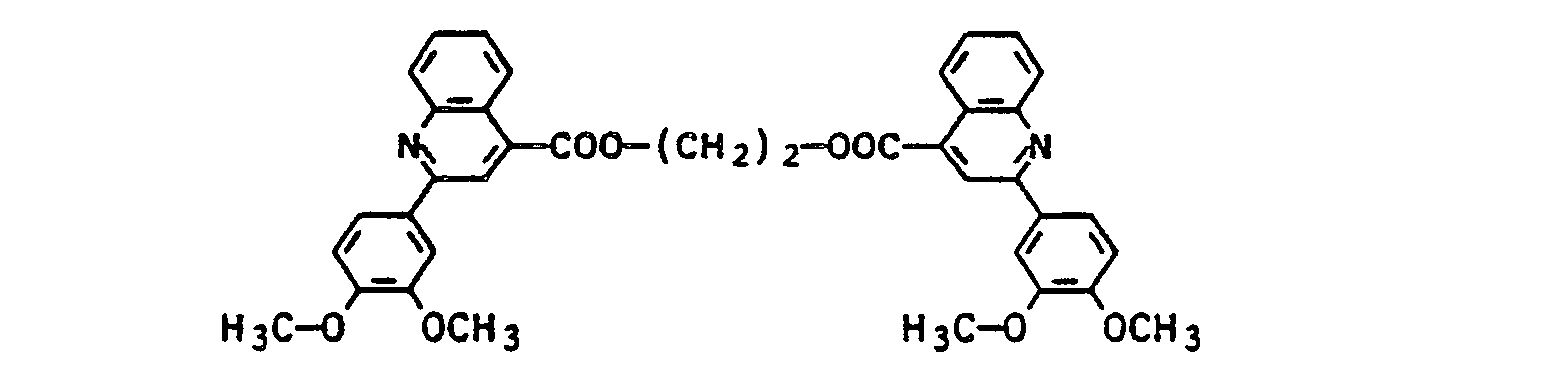
- 15,44 g der 2-(3',4'-Dimethoxyphenyl)-chinolincarbonsäure aus Beispiel 7 wurden in 80 g Thionylchlorid gegeben. Nach Beendigung der Reaktion wurde das überschüssige Thionylchlorid im Vakuum bei 40 °C Badtemperatur abdestilliert. Die Hälfte des Säurechlorids wurde portionsweise in 40 g Ethylenglykol eingetragen. Es wurde 1 Stunde auf 70 °C erwärmt. Das Reaktionsgemisch wurde auf 200 ml Wasser gegeben und die Suspension mit Ammoniakwasser leicht alkalisch gestellt. Der entstandene Ester wurde mit Toluol extrahiert. Die abgetrennte organische Phase wurde durch Abdestillieren des Toluol-Wasser-Azeotrops getrocknet. Zu der getrockneten organischen Phase wurden 4 g Pyridin und die andere Hälfte des Säurechlorids hinzugefügt und das Gemisch 1 Stunde auf 75 °C erwärmt. Das entstandene Salz des Diesters wurde abgesaugt, mit Toluol gewaschen und getrocknet. Das Salz wurde in verdünnte Ammoniaklösung eingetragen und gerührt. Nach dem Filtrieren, Waschen und Trocknen wurden 8,8 g Bis(2-(3',4'-Dimethoxyphenyl)-chinolin-4-carbonsäure)-glykolester erhalten. Schmp. 182 bis 184°C, λmax in Toluol 368 nm; λmax in 2 %iger methanolischer Salzsäure: 416 nm.
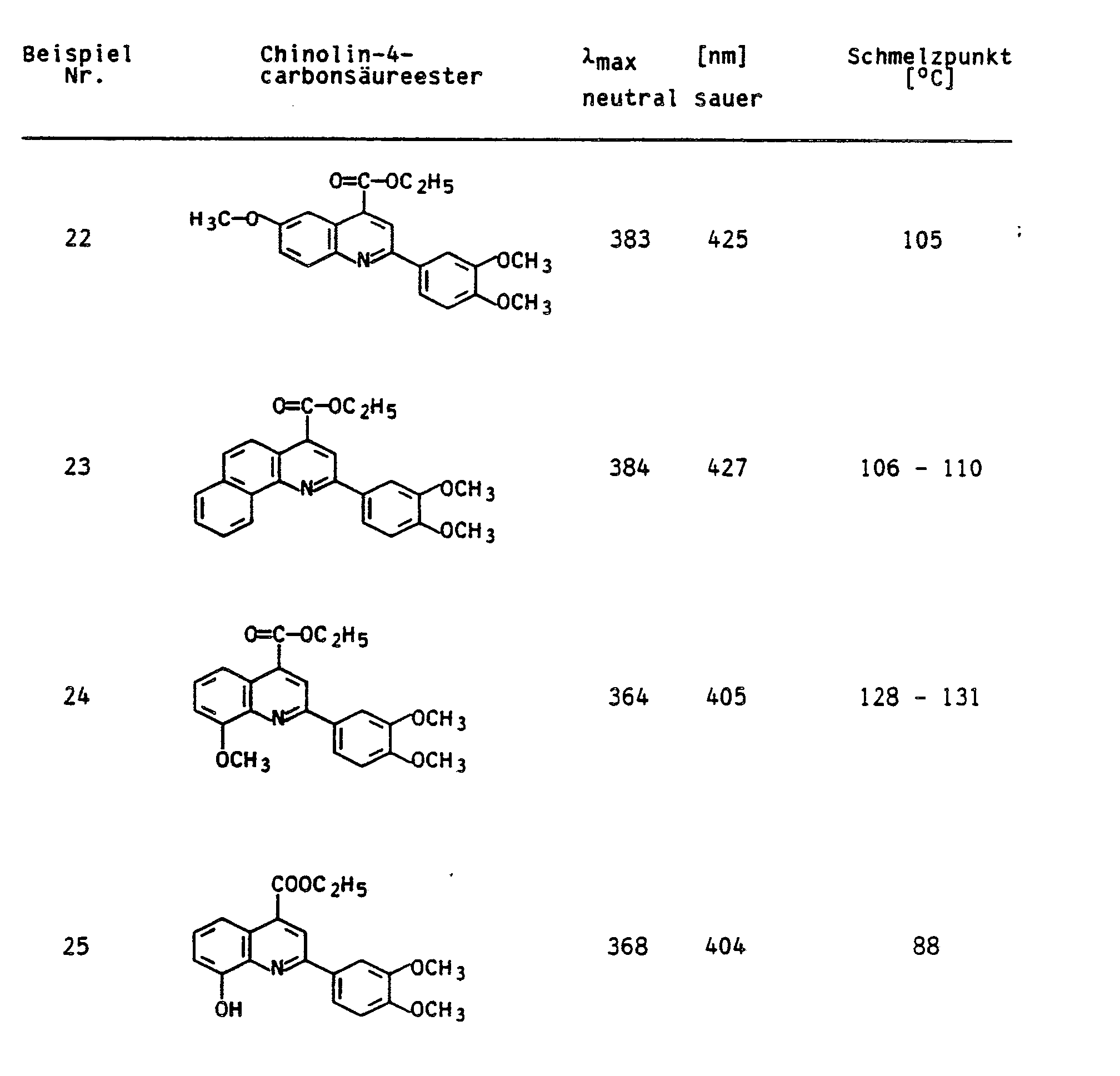
- Die Verbindungen der Beispiele 14 bis 21 wurden analog Beispiel 13 hergestellt.


- Die als Ausgangsverbindung benötigten 2-(3',4'-Dimethoxyphenyl)-chinolin-4-carbonsäuren wurden analog Beispiel 7 hergestellt. Die Ethylester wurden aus den Säurechloriden hergestellt. Hierzu wurde die jeweilige Säure mit überschüssigem Thionylchlorid umgesetzt. Das überschüssige Thionylchlorid wurde im Vakuum abdestilliert und der Rückstand unter Kühlung tropfenweise mit Ethanol versetzt. Die Hydrochloride der jeweiligen Chinolin-4-carbonsäureethylester wurden mit konzentrierter Ammoniaklösung leicht alkalisch gestellt und die 2-(3',4'-Dimethoxyphenyl)-chinolin-4-carbonsäureethylester isoliert.

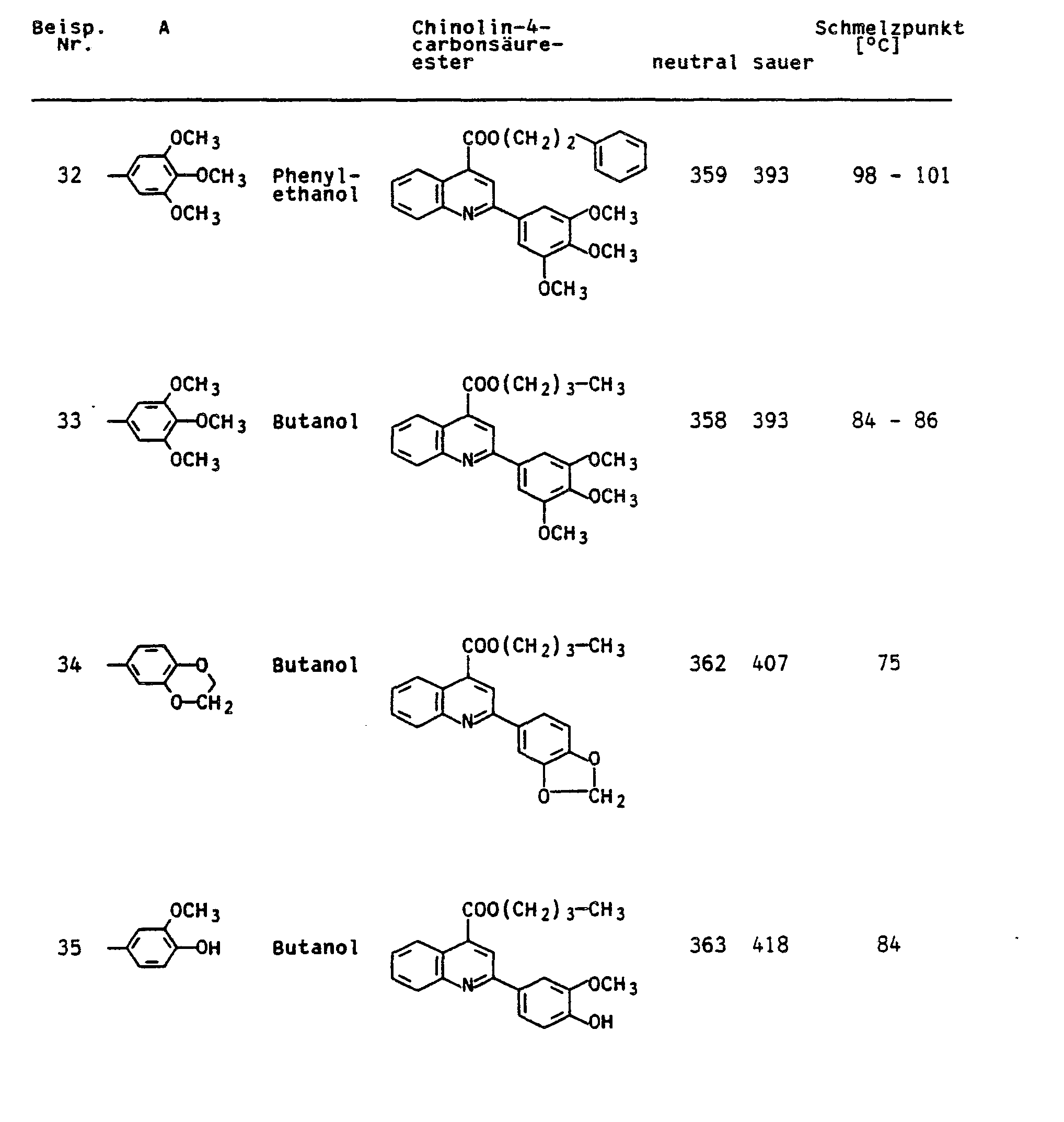
- Anilin wurde mit den Aldehyden ACHO in Ethanol gelöst und in der in Beispiel 7 angegebenen Weise zu den entsprechenden Chinolin-4-carbonsäuren umgesetzt. Die Veresterung erfolgte in den in der Tabelle angegebenen Alkoholen H-X bei 80 °C unter Einleiten von Chlorwasserstoffgas. Nach der Neutralisation mit konzentrierter Ammoniaklösung und der üblichen Aufarbeitung wurden die in den der folgenden Tabelle angegebenen Chinolin-4-carbsonäureester erhalten. Die Bedeutung von A und H-X ist in der Tabelle angegeben.

-

- 10,5 g 2-(4'-Butoxy-3'-methoxyphenyl)-chinolin-4-carbonsäure (hergestellt analog Beispiel 7) wurde in 50 g Thionylchlorid aufgelöst und das Reaktionsgemisch eine halbe Stunde unter Rückfluß erhitzt. Das überschüssige Thionylchlorid wurde unter Vakuum abdestilliert und der verbleibende Rückstand in 50 g 2-Ethylhexylamin unter Eiswasserkühlung eingetragen. Es wurde 1 Stunde bei 25 °C und eine weitere halbe Stunde bei 80 °C gerührt. Nach dem Abkühlen wurde mit 200 ml Methanol verdünnt und das ausgefallene Produkt mit Methanol und Wasser gewaschen und im Trockenschrank bei 60 °C getrocknet. Es wurden 6,5 g 2-(4'-Butoxy-3'-methoxyphenyl)-chinolin-4-carbonsäure-(2'-ethyl)-hexylamid erhalten. Die farblosen Kristalle schmelzen bei 118 °C und absorbieren in Toluol bei λmax 352 nm. In 2 %iger methanolischer Salzsäure absorbiert die Verbindung bei 403 nm.
-

- 7,68 g 5-Bromisatin, 5,41 g 3,4-Dimethoxyacetophenon, 2 g Tetrabutylammoniumhydrogensulfat und 45 g 33 %ige Kalilauge wurden 10 Stunden unter Rückfluß gerührt. Das ausgefallene Kalisalz wurde abfiltriert, in Wasser suspendiert und mit 10 %iger Salzsäure auf pH 4,5 gestellt. Ausbeute: 9,22 g 6-Brom-2(3',4'-dimethoxyphenyl)-chinolin-4-carbonsäure. Die Veresterung erfolgte wie in Beispiel 1. Es wurden 6,8 g 6-Brom-2(3',4'-dimethoxyphenyi)-chinolin-4-carbonsäuremethylester erhalten. Die Substanz schmilzt bei 154 °C und absorbiert in Toluol bei λmax 377 nm. In 2 %iger methanolischer Salzsäure absorbiert sie bei λmax 425 nm.
- Analog Beispiel 39 wurden die in der folgenden Tabelle angegebenen Chinolin-4-carbonsäuremethylester hergestellt.

- Die 7-Methoxy-2(2',4'-dimethoxyphenyl)-chinolin-4-carbonsäure wurde analog Beispiel 7 hergestellt. Die Säure wurde, so wie es für die Beispiele 32 bis 37 angegeben ist, mit den entsprechenden Alkoholen verestert. Die Amidierungen erfolgten nach Beispiel 38.

- Analog zu Beispiel 7 können auch die Verbindungen der Beispiele 48 - 52...

-

- 11,4 g (0,03 mol) der analog Beispiel 7 hergestellten 2-(3',4'-Dimethoxyphenyl)-6-methyl-7-acetamino- chinolin-4-carbonsäure wurde bei Raumtemperatur unter Stickstoffatmosphäre in eine Lösung von 3,8 g (0,03 mol) Oxalylchlorid in 60 ml Toluol eingetragen und unter Eiswasserkühlung mit 6,1 g (0,06 mol) Triethylamin in -30 ml Toluol versetzt. Nach 1,5 Std. bei 65-70°C wurden 3,86 g (0,03 mol) und nach weiteren 3 Std. 2 g (0,02 mol) Oxalylchlorid hinzugefügt. Das Reaktionsgemisch wurde anschließend 2,5 Std. auf 75-80°C erhitzt, abgekühlt und mit 30 g Methanol und 10,1 g (0,01 mol) Triethylamin versetzt. Die Aufarbeitung des ausgefallenen Feststoffs erfolgte nach 12-stündigem Rühren bei Raumtemperatur durch Absaugen, Waschen mit Methanol und Wasser und Umkristallisation aus Toluol. Ausbeute: 6,8 g (57 %), Schmelzpunkt: 234-236 C.
- Wie in Beispiel 53 beschrieben, werden die Chinolincarbonsäureester der Beispiele 54 und 55 hergestellt.

- Der Farbbildner des Beispiels 2 wird 0,5 %ig in einem diisopropylierten Naphthalin gelöst und mit einem 6 um Rakel auf ein CF-Papier der Fa. Wiggins Teape aufgetragen. Es entwickelt sich ein gelber Farbton. Nach einstündigem Belichten im Suntest-Gerät der Fa. Hanau wird der AE-Wert gemäß CIELAB-System ermittelt. Ebenso wird mit den Farbbildnern des Standes der Technik verfahren.

- AE-Werte von 1 sind deutlich visuell erkennbar.
Claims (7)
1. Chinolin-4-carbonsäurederivate der allgemeinen Formel I

in der einer der Reste
R1, R2 und R3 für Wasserstoff, die beiden anderen unabhängig voneinander für Wasserstoff, Fluor, Chlor, Brom, lineares und verzweigtes C1-C5 Alkyl, Hydroxy, Ci-Cio Alkoxy, das im Alkyl durch 1 oder 2 Sauerstoffatome unterbrochen sein kann oder für

stehen, wobei
R7 Wasserstoff, Methyl oder Ethyl und
R8 C1-C4 Alkanoyl, Benzoyl, p-Chlorbenzoyl, C1-C6 Alkyl, Benzyl oder p-Chlorbenzyl ist, oder
R1 und R2 zusammen einen ankondensierten Benzolring,
R2 und R3 zusammen gegebenenfalls durch C1- bis C4-Alkyl substituierte Methylendioxy oder Ethylendioxy, R4 Hydroxy, C1-C10 Alkoxy, das durch 1 bis 4 Sauerstoffatome unterbrochen sein kann, oder gegebenenfalls durch Chlor substituiertes Phenyl-C1-C2-alkoxy,
R5 Hydroxy oder C1-C10 Alkoxy, wobei orthoständiges R4 und R5 zusammen auch Methylendioxy oder 1,2-Ethylendioxy sein können,
R6 Wasserstoff, Hydroxy, Methoxy, Ethoxy, Chlor, Fluor oder C1-C4 Alkyl und
X C1-C20 Alkoxy, Benzyloxy, p-Chlorbenzyloxy, Phenylethyloxy, Cyclopentoxy oder Cyclohexoxy oder

bedeuten, wobei
R9 Wasserstoff, Methyl oder Ethyl und
R10 Wasserstoff, C1-C20 Alkyl, gegebenenfalls ein- oder zweimal durch Chlor, Methoxy oder Methyl substituiertes Phenyl oder ein Rest der Formel

sind, in dem
R1 bis R6 die oben angegebene Bedeutung haben und
Z Sauerstoff oder > N-R9 und
R13 lineares oder verzweigtes C2-C10-Alkylen, das durch bis zu 4 Sauerstoffatome unterbrochen sein kann, oder 1,2-, 1,3- oder 1,4-Xylylen bedeuten.
2. Chinolin-4-carbonsäurederivate gemäß Anspruch 1, dadurch gekennzeichnet, daß einer der Reste R1, R2 und R3 Wasserstoff, Fluor, Chlor, Brom, lineares oder verzweigtes C1-C5 Alkyl, Hydroxy oder C1-C10 Alkoxy, das im Alkyl durch 1 bis 2 Sauerstoffatome unterbrochen sein kann, ist und die restlichen Reste für Wasserstoff stehen.
3. Chinolin-4-carbonsäurederivate gemäß Anspruch 1, bei denen
R1 Wasserstoff und
R2 und R3 gegebenenfalls durch Methyl substituiertes Methylen- oder Ethylendioxy sind.
4. Chinolin-4-carbonsäurederivate gemäß Anspruch 1 oder 2, dadurch gekennzeichnet, daß X für C1-C20 Alkoxy, Benzyloxy, Phenylethyloxy, Cyclopentoxy oder Cyclohexoxy oder für

steht, worin
R9 Wasserstoff, Methyl oder Ethyl und
R10 C1-C20 Alkyl oder gegebenenfalls ein oder zweifach durch Chlor, Methoxy und/oder Methyl substituiertes Phenyl bedeutet.
5. Chinolin-4-carbonsäurederivate gemäß Anspr. 1, gekennzeichnet durch die Formel

in der
R2, R3, R4 und R5 die im Anspruch 1 angegebene Bedeutung haben und
X für C1-C20 Alkoxy oder für

steht, worin
R9 Wasserstoff, Methyl oder Ethyl und
R10 C1-C10 Alkyl oder Phenyl ist.
6. Chinolin-4-carbonsäurederivate gemäß Anspruch 5, dadurch gekennzeichnet, daß R2 Wasserstoff oder C1-C5 Alkoxy ist.
7. Verwendung der Chinolin-4-carbonsäurederivate gemäß den Ansprüchen 1 bis 6 als Farbbildner in druck- und thermoempfindlichen Aufzeichnungsmaterialien.
Applications Claiming Priority (2)
| Application Number | Priority Date | Filing Date | Title |
|---|---|---|---|
| DE3905339 | 1989-02-22 | ||
| DE3905339A DE3905339A1 (de) | 1989-02-22 | 1989-02-22 | Chinolin-4-carbonsaeurederivate und deren verwendung |
Publications (1)
| Publication Number | Publication Date |
|---|---|
| EP0384313A1 true EP0384313A1 (de) | 1990-08-29 |
Family
ID=6374612
Family Applications (1)
| Application Number | Title | Priority Date | Filing Date |
|---|---|---|---|
| EP90103019A Withdrawn EP0384313A1 (de) | 1989-02-22 | 1990-02-16 | Chinolin-4-carbonsäurederivate und deren Verwendung |
Country Status (4)
| Country | Link |
|---|---|
| US (1) | US5071987A (de) |
| EP (1) | EP0384313A1 (de) |
| JP (1) | JPH02255659A (de) |
| DE (1) | DE3905339A1 (de) |
Cited By (4)
| Publication number | Priority date | Publication date | Assignee | Title |
|---|---|---|---|---|
| EP0490200A1 (de) * | 1990-12-10 | 1992-06-17 | BASF Aktiengesellschaft | Derivate von Chinolincarbonsäuren |
| US5811553A (en) * | 1994-05-27 | 1998-09-22 | Smithkline Beecham Farmaceutici S.P.A. | Quinoline derivatives(2) |
| CN104629702A (zh) * | 2013-11-08 | 2015-05-20 | 中国石油天然气股份有限公司 | 一种用于酸性气田具有缓蚀功能的起泡剂及其制备和应用 |
| CN109336811A (zh) * | 2018-12-15 | 2019-02-15 | 浙江工业大学 | 一种喹啉-4-甲酸酯类化合物的制备方法 |
Families Citing this family (5)
| Publication number | Priority date | Publication date | Assignee | Title |
|---|---|---|---|---|
| US5627193A (en) * | 1995-02-09 | 1997-05-06 | Mitsui Toatsu Chemicals, Inc. | Quinoline-4-carbonylguanidine derivatives, process for producing the same and pharmaceutical preparations containing the compounds |
| US6143480A (en) * | 1998-09-03 | 2000-11-07 | Fuji Photo Film Co., Ltd. | Leuco dye and image recording medium containing the same |
| US20040152727A1 (en) * | 2001-05-18 | 2004-08-05 | Hay Douglas William Pierre | Novel use |
| WO2005047258A2 (en) * | 2003-11-10 | 2005-05-26 | Wyeth | Methods and compositions for selectin inhibition |
| CN118791466B (zh) * | 2023-04-14 | 2025-09-19 | 苏州缘聚医药科技有限公司 | 一种放射性探针前体的制备方法 |
Citations (4)
| Publication number | Priority date | Publication date | Assignee | Title |
|---|---|---|---|---|
| DE244788C (de) * | ||||
| EP0133244A2 (de) * | 1983-07-22 | 1985-02-20 | E.I. Du Pont De Nemours And Company | Phenylchinolinsäure und Derivate als Antitumormittel |
| EP0159295A2 (de) * | 1984-04-18 | 1985-10-23 | Ciba-Geigy Ag | Chromogene Bis-Chinazolinverbindungen, Verfahren zu ihrer Herstellung und ihre Verwendung als Farbbildner in druckempfindlichen oder wärmeempfindlichen Aufzeichnungsmaterialien |
| EP0256180A1 (de) * | 1986-08-11 | 1988-02-24 | Yamada Chemical Co., Ltd. | Chromogene Verbindungen für druck- oder wärmeempfindliche Aufzeichnungsblätter |
Family Cites Families (7)
| Publication number | Priority date | Publication date | Assignee | Title |
|---|---|---|---|---|
| DE462136C (de) * | 1920-12-16 | 1928-07-09 | Chemische Ind Ges | Verfahren zur Darstellung von sekundaeren und tertiaeren Aminoalkoholen der Chinolinreihe |
| US3985376A (en) * | 1973-06-04 | 1976-10-12 | Basf Aktiengesellschaft | Dye precursors for pressure-sensitive recording material |
| JPS5518647A (en) * | 1978-07-26 | 1980-02-08 | Matsushita Electric Ind Co Ltd | Light transmittable particle for forming color images |
| US4625027A (en) * | 1982-10-25 | 1986-11-25 | Ciba-Geigy Corporation | Bisquinazolines useful in color former systems |
| JPS59152891A (ja) * | 1983-02-18 | 1984-08-31 | Yamada Kagaku Kogyo Kk | 発色性記録材料 |
| US4680299A (en) * | 1984-04-30 | 1987-07-14 | E.I. Du Pont De Nemours And Company | 2-phenyl-4-quinolinecarboxylic acids and pharmaceutical compositions thereof |
| US4600678A (en) * | 1984-08-03 | 1986-07-15 | The Mead Corporation | Imaging systems employing photosensitive microcapsules containing 4-(4'-aminophenyl)-pyridine compounds |
-
1989
- 1989-02-22 DE DE3905339A patent/DE3905339A1/de not_active Withdrawn
-
1990
- 1990-02-02 US US07/474,327 patent/US5071987A/en not_active Expired - Fee Related
- 1990-02-16 EP EP90103019A patent/EP0384313A1/de not_active Withdrawn
- 1990-02-21 JP JP2038549A patent/JPH02255659A/ja active Pending
Patent Citations (4)
| Publication number | Priority date | Publication date | Assignee | Title |
|---|---|---|---|---|
| DE244788C (de) * | ||||
| EP0133244A2 (de) * | 1983-07-22 | 1985-02-20 | E.I. Du Pont De Nemours And Company | Phenylchinolinsäure und Derivate als Antitumormittel |
| EP0159295A2 (de) * | 1984-04-18 | 1985-10-23 | Ciba-Geigy Ag | Chromogene Bis-Chinazolinverbindungen, Verfahren zu ihrer Herstellung und ihre Verwendung als Farbbildner in druckempfindlichen oder wärmeempfindlichen Aufzeichnungsmaterialien |
| EP0256180A1 (de) * | 1986-08-11 | 1988-02-24 | Yamada Chemical Co., Ltd. | Chromogene Verbindungen für druck- oder wärmeempfindliche Aufzeichnungsblätter |
Cited By (8)
| Publication number | Priority date | Publication date | Assignee | Title |
|---|---|---|---|---|
| EP0490200A1 (de) * | 1990-12-10 | 1992-06-17 | BASF Aktiengesellschaft | Derivate von Chinolincarbonsäuren |
| US5214146A (en) * | 1990-12-10 | 1993-05-25 | Basf Aktiengesellschaft | Derivatives of quinolinecarboxylic acids |
| US5811553A (en) * | 1994-05-27 | 1998-09-22 | Smithkline Beecham Farmaceutici S.P.A. | Quinoline derivatives(2) |
| US6608083B1 (en) | 1994-05-27 | 2003-08-19 | Smithkline Beecham Farmaceutici S.P.A | Quinoline derivatives(2) |
| US7482458B2 (en) | 1994-05-27 | 2009-01-27 | Smithkline Beecham Farmaceutica S.P.A. | Quinoline derivatives |
| CN104629702A (zh) * | 2013-11-08 | 2015-05-20 | 中国石油天然气股份有限公司 | 一种用于酸性气田具有缓蚀功能的起泡剂及其制备和应用 |
| CN104629702B (zh) * | 2013-11-08 | 2017-11-10 | 中国石油天然气股份有限公司 | 一种用于酸性气田具有缓蚀功能的起泡剂及其制备和应用 |
| CN109336811A (zh) * | 2018-12-15 | 2019-02-15 | 浙江工业大学 | 一种喹啉-4-甲酸酯类化合物的制备方法 |
Also Published As
| Publication number | Publication date |
|---|---|
| DE3905339A1 (de) | 1990-09-06 |
| JPH02255659A (ja) | 1990-10-16 |
| US5071987A (en) | 1991-12-10 |
Similar Documents
| Publication | Publication Date | Title |
|---|---|---|
| EP0252406B1 (de) | Verfahren zur Herstellung polycyclischer Verbindungen | |
| DE1795737A1 (de) | Chromogene verbindungen und ihre verwendung in druckempfindlichem aufzeichnungsmaterial | |
| DE2747526A1 (de) | Druck- oder waermeempfindliches aufzeichnungsmaterial | |
| DE2265233A1 (de) | Neue farbstoffbildner und ihre verwendung | |
| DE2130845B2 (de) | Dibenzylaminofluorane, ihre Her stellung und Verwendung | |
| DE3612618A1 (de) | Fluoranverbindungen und sie enthaltende chromogene materialien | |
| EP0138177B1 (de) | Fluorane und deren Verwendung | |
| DE2412640B2 (de) | Druckempfindliches Kopierpapier | |
| DE2163658B2 (de) | 3-(2-Alkoxy-4-amino-phenyl)-3-(3-indolyl)-phthalide sowie druckempfindliche Kopierpapiere, die diese enthalten | |
| DE2423533A1 (de) | 3-indolyl-3-phenylphthalid-verbindungen, verfahren zu ihrer herstellung und ihre verwendung in einem druckempfindlichen kopiermaterial | |
| DE2405243A1 (de) | Chromogene dilacton-verbindungen, verfahren zu ihrer herstellung und ihre verwendung | |
| CH628290A5 (de) | Druck- oder waermeempfindliches aufzeichnungsmaterial. | |
| DE2842263C2 (de) | ||
| DE3905339A1 (de) | Chinolin-4-carbonsaeurederivate und deren verwendung | |
| DE3116815C2 (de) | ||
| DE2724682C2 (de) | Chromeno[4,3-b]indolverbindungen | |
| EP0003726B1 (de) | Substituierte Diaminophthalide, Verfahren zu ihrer Herstellung und ihre Verwendung als Farbbildner in druckempfindlichen oder wärmeempfindlichen Aufzeichnungsmaterialien | |
| CH656138A5 (de) | Chromogenes lacton. | |
| DE2413986B2 (de) | Druckempfindliches Kopierpapier | |
| DE2435408C2 (de) | 2(3)-[&alpha;-Aminophenyl-&alpha;-tetrahydrochinolin-&alpha;-hydroxy]-methylpyridincarbonsäuren-3(2)-lactone | |
| DE2446313A1 (de) | Fluoranverbindungen und diese enthaltende aufzeichnungsmaterialien | |
| DE2537776A1 (de) | Phthalidverbindungen | |
| DE2509793C2 (de) | Diazarhodaminlactone und deren Verwendung als Farbbildner für Kopieverfahren | |
| DE2243483C2 (de) | Neue Diazaxanthenlactone, deren Herstellung und deren Verwendung als Farbbildner für Kopierverfahren | |
| EP0490200B1 (de) | Derivate von Chinolincarbonsäuren |
Legal Events
| Date | Code | Title | Description |
|---|---|---|---|
| PUAI | Public reference made under article 153(3) epc to a published international application that has entered the european phase |
Free format text: ORIGINAL CODE: 0009012 |
|
| AK | Designated contracting states |
Kind code of ref document: A1 Designated state(s): CH DE FR GB IT LI |
|
| 17P | Request for examination filed |
Effective date: 19900711 |
|
| 17Q | First examination report despatched |
Effective date: 19910604 |
|
| STAA | Information on the status of an ep patent application or granted ep patent |
Free format text: STATUS: THE APPLICATION HAS BEEN WITHDRAWN |
|
| 18W | Application withdrawn |
Withdrawal date: 19920111 |