EP0384403A2 - Méthode de contrôle d'un affichage à gradations multiples et dispositif d'affichage à gradations multiples - Google Patents
Méthode de contrôle d'un affichage à gradations multiples et dispositif d'affichage à gradations multiples Download PDFInfo
- Publication number
- EP0384403A2 EP0384403A2 EP90103253A EP90103253A EP0384403A2 EP 0384403 A2 EP0384403 A2 EP 0384403A2 EP 90103253 A EP90103253 A EP 90103253A EP 90103253 A EP90103253 A EP 90103253A EP 0384403 A2 EP0384403 A2 EP 0384403A2
- Authority
- EP
- European Patent Office
- Prior art keywords
- dots
- effective
- gradation
- display
- image
- Prior art date
- Legal status (The legal status is an assumption and is not a legal conclusion. Google has not performed a legal analysis and makes no representation as to the accuracy of the status listed.)
- Granted
Links
Images





Classifications
-
- G—PHYSICS
- G09—EDUCATION; CRYPTOGRAPHY; DISPLAY; ADVERTISING; SEALS
- G09G—ARRANGEMENTS OR CIRCUITS FOR CONTROL OF INDICATING DEVICES USING STATIC MEANS TO PRESENT VARIABLE INFORMATION
- G09G3/00—Control arrangements or circuits, of interest only in connection with visual indicators other than cathode-ray tubes
- G09G3/20—Control arrangements or circuits, of interest only in connection with visual indicators other than cathode-ray tubes for presentation of an assembly of a number of characters, e.g. a page, by composing the assembly by combination of individual elements arranged in a matrix no fixed position being assigned to or needed to be assigned to the individual characters or partial characters
- G09G3/34—Control arrangements or circuits, of interest only in connection with visual indicators other than cathode-ray tubes for presentation of an assembly of a number of characters, e.g. a page, by composing the assembly by combination of individual elements arranged in a matrix no fixed position being assigned to or needed to be assigned to the individual characters or partial characters by control of light from an independent source
- G09G3/36—Control arrangements or circuits, of interest only in connection with visual indicators other than cathode-ray tubes for presentation of an assembly of a number of characters, e.g. a page, by composing the assembly by combination of individual elements arranged in a matrix no fixed position being assigned to or needed to be assigned to the individual characters or partial characters by control of light from an independent source using liquid crystals
-
- G—PHYSICS
- G09—EDUCATION; CRYPTOGRAPHY; DISPLAY; ADVERTISING; SEALS
- G09G—ARRANGEMENTS OR CIRCUITS FOR CONTROL OF INDICATING DEVICES USING STATIC MEANS TO PRESENT VARIABLE INFORMATION
- G09G3/00—Control arrangements or circuits, of interest only in connection with visual indicators other than cathode-ray tubes
- G09G3/20—Control arrangements or circuits, of interest only in connection with visual indicators other than cathode-ray tubes for presentation of an assembly of a number of characters, e.g. a page, by composing the assembly by combination of individual elements arranged in a matrix no fixed position being assigned to or needed to be assigned to the individual characters or partial characters
- G09G3/34—Control arrangements or circuits, of interest only in connection with visual indicators other than cathode-ray tubes for presentation of an assembly of a number of characters, e.g. a page, by composing the assembly by combination of individual elements arranged in a matrix no fixed position being assigned to or needed to be assigned to the individual characters or partial characters by control of light from an independent source
- G09G3/36—Control arrangements or circuits, of interest only in connection with visual indicators other than cathode-ray tubes for presentation of an assembly of a number of characters, e.g. a page, by composing the assembly by combination of individual elements arranged in a matrix no fixed position being assigned to or needed to be assigned to the individual characters or partial characters by control of light from an independent source using liquid crystals
- G09G3/3611—Control of matrices with row and column drivers
-
- G—PHYSICS
- G02—OPTICS
- G02F—OPTICAL DEVICES OR ARRANGEMENTS FOR THE CONTROL OF LIGHT BY MODIFICATION OF THE OPTICAL PROPERTIES OF THE MEDIA OF THE ELEMENTS INVOLVED THEREIN; NON-LINEAR OPTICS; FREQUENCY-CHANGING OF LIGHT; OPTICAL LOGIC ELEMENTS; OPTICAL ANALOGUE/DIGITAL CONVERTERS
- G02F1/00—Devices or arrangements for the control of the intensity, colour, phase, polarisation or direction of light arriving from an independent light source, e.g. switching, gating or modulating; Non-linear optics
- G02F1/01—Devices or arrangements for the control of the intensity, colour, phase, polarisation or direction of light arriving from an independent light source, e.g. switching, gating or modulating; Non-linear optics for the control of the intensity, phase, polarisation or colour
- G02F1/13—Devices or arrangements for the control of the intensity, colour, phase, polarisation or direction of light arriving from an independent light source, e.g. switching, gating or modulating; Non-linear optics for the control of the intensity, phase, polarisation or colour based on liquid crystals, e.g. single liquid crystal display cells
- G02F1/133—Constructional arrangements; Operation of liquid crystal cells; Circuit arrangements
- G02F1/1333—Constructional arrangements; Manufacturing methods
- G02F1/1343—Electrodes
- G02F1/134309—Electrodes characterised by their geometrical arrangement
- G02F1/134345—Subdivided pixels, e.g. for grey scale or redundancy
-
- G—PHYSICS
- G09—EDUCATION; CRYPTOGRAPHY; DISPLAY; ADVERTISING; SEALS
- G09G—ARRANGEMENTS OR CIRCUITS FOR CONTROL OF INDICATING DEVICES USING STATIC MEANS TO PRESENT VARIABLE INFORMATION
- G09G3/00—Control arrangements or circuits, of interest only in connection with visual indicators other than cathode-ray tubes
- G09G3/20—Control arrangements or circuits, of interest only in connection with visual indicators other than cathode-ray tubes for presentation of an assembly of a number of characters, e.g. a page, by composing the assembly by combination of individual elements arranged in a matrix no fixed position being assigned to or needed to be assigned to the individual characters or partial characters
- G09G3/2007—Display of intermediate tones
- G09G3/2018—Display of intermediate tones by time modulation using two or more time intervals
- G09G3/2022—Display of intermediate tones by time modulation using two or more time intervals using sub-frames
- G09G3/2025—Display of intermediate tones by time modulation using two or more time intervals using sub-frames the sub-frames having all the same time duration
-
- G—PHYSICS
- G09—EDUCATION; CRYPTOGRAPHY; DISPLAY; ADVERTISING; SEALS
- G09G—ARRANGEMENTS OR CIRCUITS FOR CONTROL OF INDICATING DEVICES USING STATIC MEANS TO PRESENT VARIABLE INFORMATION
- G09G3/00—Control arrangements or circuits, of interest only in connection with visual indicators other than cathode-ray tubes
- G09G3/20—Control arrangements or circuits, of interest only in connection with visual indicators other than cathode-ray tubes for presentation of an assembly of a number of characters, e.g. a page, by composing the assembly by combination of individual elements arranged in a matrix no fixed position being assigned to or needed to be assigned to the individual characters or partial characters
- G09G3/2007—Display of intermediate tones
- G09G3/2044—Display of intermediate tones using dithering
- G09G3/2051—Display of intermediate tones using dithering with use of a spatial dither pattern
Definitions
- This invention relates to a multi-gradation display for displaying images, as of letters, patterns, etc., and to a method for controlling the display of images in multi-gradations by selectively turning on or not turning on a number of dots.
- liquid crystal displays As one example of devices which can display images in multi-gradations liquid crystal displays (LCD) are known which are practically used as displays for televisions, personal computers, etc. In these LCDs, gradations are realized as described below.
- n dots a natural number
- the positions of these effective dots which are turned on or off depending on the data they receive , on the display panel are repeatedly changed from frame to frame with a period of a certain number of frames. Conventionally this period or the cycle of repetition is the same for every gradation.
- n dots x n dots effective dot matrix effective dots are shifted vertically up or down, and horizontally right or left to thereby enable multi-gradation displays. This will be explained below with reference to Fig. 1.
- an 8 dots x 8 dots effective matrix as shown in Figs. 1A and 1B is set on an LCD panel.
- the respective 8 x 8 64 dots become effective once from the first to the eighth frame, and the display can be in 1/8 gradation.
- the distributions of the effective dots in the respective frames are respective single oblique rows. In this example as well as the example of Fig. 1A, the display can be in 1/8 gradation.
- a first object of this invention is to provide a display control method which can realize a multi-gradation image display which is free from the above-described fringes.
- a second object of this invention is to provide a multi-gradation display which can display easily perceivable images.
- Figs. 2A - 2F are views explaining the LCD driving method according to an embodiment of this invention and show the sizes of respective effective dot matrices from Gradation 1, i.e., 1/8-gradation display to Gradation 6, i.e., 7/8-gradation display.
- the respective effective dot matrices have 8 dots in the horizontal direction.
- Gradations 1 and 6 have 8 dots
- Gradations 2 and 5 have 5 dots
- Gradations 3 and 4 have 3 dots. Letters and patterns can be gradation-displayed by making dots indicated by circles in the drawing effective in one frame, and making other dots effective in the next frame.
- the eight dots of the first horizontal row indicated by the circles in Fig. 2A are set as effective dots in a first frame
- the eight dots of the bottom row are set as effective dots
- the dots of a row of dots immediately next above the bottom row are set as effective dots.
- the dots of the sixth to the second row are sequentially made effective.
- the dots of the first row are made effective as in the first frame. This occurrence is repeated.
- the respective 8 x 8 64 dots become effective once in 8 frames. Accordingly a 1/8 gradation display can be made.
- Fig. 3 shows a modification of the embodiment.
- effective dot matrices of different sizes are set for different gradations as in the first embodiment of Fig. 2.
- this modification is different from the first embodiment in that in the former the effective dots in the respective frames are scattered in the effective dot matrices. That is, the effective dots of the respective frames are scattered substantially homogeneously both in the horizontal and the vertical directions of the effective dot matrices, and the positions of the effective dots are shifted vertically in the respective frames. Accordingly, control is conducted so that the respective dots become effective once within 8 frames for Gradation 1, once within 5 frames for Gradation 2, and once within 3 frames for Gradation 3. Control is conducted so that the respective dots become effective twice within 3 frames for Gradation 4, four times within 5 frames for Gradation 5, and 7 times within 8 frames for Gradation 6.
- a characteristic of the method according to this invention is that at least either of the horizontal and the vertical sizes of an effective dot matrix is changed in accordance with a gradation of an image to be displayed. That is, when an effective dot matrix is n dots x m dots (m and n: natural numbers), at least either of m and n is a variable value in accordance with a gradation.
- an effective dot matrix is n dots x m dots (m and n: natural numbers)
- K K: a natural number
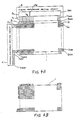
- Figs. 4A and 4B contain diagrammatic views of an LCD and Fig. 4A is a diagrammatic view of the LCD, and Fig. 4B is a diagrammatic view of a dot matrix of the display body or liquid crystal panel.
- a display portion 1 of the liquid crystal panel is formed at a position where 200 horizontal scanning electrodes 21 - 2200, and 640 signal electrodes 31 - 3640 are crossed and consequently contains 200 x 640 dots.
- a scanning electrodes driving circuit 4 supplies horizontal scanning signals X1 - X200 to the scanning electrodes 21 - 2200.
- a signal electrodes driving circuit 5 supplies data signals Y1 - Y640 to the signal electrodes 31 - 3640.
- the signal electrodes driving circuit 5 comprises 80 element circuits 51 - 580. Each element circuit is in charge of outputting the data signals Y for a respective group of 8 dots, i.e., a first element circuit 5 outputs data signals Y1 - Y8, a second element circuit 52 outputs data signals Y9 - Y16 and so on.
- the signal electrodes driving circuit 5 having 80 element circuits 51 - 580 outputs a total of 640 data signals Y1 - Y640.
- the scanning electrodes driving circuit 4 repeatedly outputs horizontal scanning signals sequentially from X1 to X209. There are no scanning electrodes 2201 - 2209 corresponding to the scanning signals X201 - X209. Accordingly the effective area of the panel, i.e., the area of the panel where an image can be displayed comprises 200 dots in the vertical direction of the panel.
- the display portion 1 provided by the LCD of Fig. 4A can thus be represented as in a dot matrix shown in Fig. 4B. That is, the display portion 1 has a size of 640 dots, i.e., 80 times 8-dot elements in the horizontal direction, and 200 dots in the vertical direction.
- Fig. 5 shows the detailed structure of the element circuits 5 of Fig. 4A.
- the element circuit comprises a gradation data decoder 6, an effective dot matrices generating circuit 7, and an output gate circuit having eight gate units GT1 - GT8.
- the gradation decoder 6 decodes a color signal of 3 bits, R and G (most significant bits) and B (least significant bit) to supply an effective signal to one of output terminals 0 - 7 for outputting gradation signals, i.e., to place the output terminal in the state "1".
- the output terminal for Gradation 0 is open, and when the gradation is 0, the data signals Y1 - Y8 are always 0.
- the output terminal for Gradation 7 is directly connected to an OR gate of the output gate circuit, and when the gradation is 7, the data signals Y1 - Y8 are always "1", i.e., effective. For Gradations 1 - 6, lighting control for the respective dots is required. The effective dot matrices generating circuit 7 conducts this control.
- the effective dot matrices generating circuit 7 has effective dot matrix generating circuit units 71 - 76 for the respective gradations which generate effective dot matrices for Gradations 1 - 6, and output signals from the terminals indicated by A - H, A - H are supplied to the output gate circuit.
- the eight gate units GT1 - GT8 of the output gate circuit correspond to the data signals Y1 - Y8.
- the respective gate units GT1 - GT8 are supplied with gradation outputs from the gradation data decoder 6 and output signals from the A - H output terminals and the A - H output terminals of the effective dot matrices generating circuit 7. When the output signals of the output terminals A - H and A - H are "1", effective dot signals are obtained.
- An output for Gradation 1 of the gradation data decoder 6 is supplied to an AND gate gt1 of the respective gate units GT1 - GT8, an output for Gradation 2 to an AND gate gt2, an output for Gradation 3 to an AND gate gt3,...., and an output for Gradation 6 to an AND gate gt6 of the respective gate units GT1 - GT8.
- the outputs A - H of the effective dot matrix generating unit 71 for Gradation 1 are supplied to the AND gates gt1 of the respective gate units GT1 - GT8 in the sequential order of 1, 4, 6, 3, 5, 8, 2, 7 from the top as indicated in Fig. 5.
- the outputs for Gradation 4 are supplied in the same combinations as for Gradation 3.
- Those for Gradation 5 are supplied in the same combinations as for Gradation 2.
- Those for Gradation 6 are supplied in the same combinations as for Gradation 1.
- the outputs of the output terminals A - H are supplied to the gate units GT1 - GT8.
- the outputs of the output terminals A - H are supplied to the AND gates gt6 of the respective gate units GT1 - GT8 in the sequential order of 1, 4, 6, 3, 5, 8, 2, 7 from the top.
- These input combinations determine distributions of effective dots in the horizontal and the vertical directions as shown in Fig. 3.
- Fig. 6 shows in more detail the effective dot matrices generating circuit 7.
- the effective dot matrices generating circuit 7 comprises a D-flip-flop 71, three OR gates 721 - 723 for receiving an output Q of the D-flip-flop 71, three shift registers 731 - 733 each having an input terminal IN and eight output terminals corresponding to the output terminals A - H, and totally sixteen inverters 741 - 743.
- the effective dot matrices generating circuit 7 is characteri zed in that the output terminal H of the shift register 731 is connected to the OR gate 721 so that eight signal outputs of the output terminals A - H are repeated many times.
- the output terminal E of the shift register 732 is connected to the OR gate 722 so that 5 signal outputs of the output terminals A - E are repeated many times.
- the output terminal C of the shift register 733 is connected to the OR gate 723 so that 3 output signals of the output terminal A - C are repeated many times.
- the circuit 7 is also characterized in that the inverters 741 - 743 are provided on the output side of the shift registers 731 - 733, which are respectively used commonly by circuits for Gradations 1 and 6, commonly by those for Gradations 2 and 5, and commonly by those for Gradations 3 and 4.
- the output terminals of the shift register 731 supply 8 effective signals of the output terminals A - H for Gradation 1, and by passing the 8 effective signals A - H through the inverter 741, 8 effective signals A - H for Gradation 6 are obtained.
- 8 effective signals A - H for Gradation 6 are obtained.
- 5 effective signals A - E for Gradation 2 are obtained, from the output terminals of the shift register 733, effective signal A - C are obtained, and by passing the 5 effective signals through the inverters 742, 743, effective signals A - E for Gradations 5 and effective signals A - C for Gradation 4 are obtained.
- a 640 dots x 200 dots liquid crystal panel is used.
- Effective dot matrices are repeated 80 times in the horizontal direction.
- a repetition cycle on turning of the dots in the vertical direction i.e., a repetition cycle of a horizontal scanning line
- a repetition cycle of a horizontal scanning line is a multiple of 8, 5 and 3 which are vertical sizes of the effective dot matrices
- positions of the effective dots are fixed in every frame. Therefore, the scanning line has to be repeated in a cycle other than the above-descri bed multiples and larger than 200. That is, it is necessary that a vertical scanning signal is outputted every certain number of horizontal scanning signals, such as 202, 203, 206, 209, 211, 213, etc. But since more than 201 horizontal scannings are wasteful in the image display, it is prefer strictlyable that the repetition cycle number is as small as possible.
- the horizontal scanning signal when the horizontal scanning signal has been outputted 209 times, that is, the horizontal scanning signal X209 is outputted, the vertical scanning signal is outputted, and then the horizontal scanning signal returns to the horizontal scanning signal X1.
- 8 x 5 x 3 frames 120 frames for an effective dot distribution pattern to return to its initial pattern.
- 8 dots x 8 dots effective dot matrices are set for respective gradations, and accordingly effective dots interfere with one another in every frame. But in this invention, the interferences are lessened to once 120 frames, with a result that gradation display is made more effective.
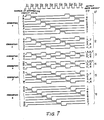
- Fig. 7 is a timing chart of the operation of the above-described LCD.
- a - H and A - H represent output terminals of the effective dot matrix generating units 71 - 76 of Fig. 5 for generating effective dot matrices, and correspond to the output terminals of the shift registers 731 - 733, and to the output terminals of the inverters 741 - 743.
- X1 - X12 represent horizontal scanning signals.
- This timing chart shows that the shift registers 731 - 733 are reset to shift the outputs of the effective signals sequentially from A -> B -> C -> .. every time a horizontal scanning signal is supplied to their respective terminals CK.
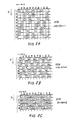
- Fig. 8 shows effective dots obtained when the circuits of Fig. 4 - 6 are operated based on the signals of Fig. 7.
- Fig. 8A is for Gradation 1
- Fig. 8B is for Gradation 2
- Fig. 8C is for Gradation 3.
- the circles indicate effective dots in a first frame
- the triangles indicate effective dots in a following second frame
- the crosses indicate effective dots in a third frame following the second one.
- the scanning electrodes driving circuit 4 has output terminals for the horizontal scanning signals X1 - X209, but the display body 1 has only 200 scanning electrodes 21 - 2200.
- Fig. 9 shows another example explaining the same effect of Fig. 8A.
- the outputs of the output terminals A - H of the shift registers 721 - 723 are distributed in the horizontally sequential order of 1, 4, 7, 2, 5, 8, 3, 6. In this case as well, effective dots are not adjacent to one another in one frame, and in a next frame they do not become adjacent to one another.
- the driving circuits are in positive logic but can attain the same advantageous effect in negative logic.
Landscapes
- Engineering & Computer Science (AREA)
- Chemical & Material Sciences (AREA)
- Crystallography & Structural Chemistry (AREA)
- Physics & Mathematics (AREA)
- Computer Hardware Design (AREA)
- General Physics & Mathematics (AREA)
- Theoretical Computer Science (AREA)
- Liquid Crystal Display Device Control (AREA)
- Liquid Crystal (AREA)
- Control Of Indicators Other Than Cathode Ray Tubes (AREA)
Applications Claiming Priority (6)
| Application Number | Priority Date | Filing Date | Title |
|---|---|---|---|
| JP3972589 | 1989-02-20 | ||
| JP39725/89 | 1989-02-20 | ||
| JP9911489 | 1989-04-19 | ||
| JP99114/89 | 1989-04-19 | ||
| JP1298842A JPH0361924A (ja) | 1989-02-20 | 1989-11-17 | 多階調表示体の制御方法 |
| JP298842/89 | 1989-11-17 |
Publications (3)
| Publication Number | Publication Date |
|---|---|
| EP0384403A2 true EP0384403A2 (fr) | 1990-08-29 |
| EP0384403A3 EP0384403A3 (fr) | 1991-03-20 |
| EP0384403B1 EP0384403B1 (fr) | 1994-09-21 |
Family
ID=27290246
Family Applications (1)
| Application Number | Title | Priority Date | Filing Date |
|---|---|---|---|
| EP90103253A Expired - Lifetime EP0384403B1 (fr) | 1989-02-20 | 1990-02-20 | Méthode de contrôle d'un affichage à gradations multiples et dispositif d'affichage à gradations multiples |
Country Status (3)
| Country | Link |
|---|---|
| EP (1) | EP0384403B1 (fr) |
| KR (1) | KR940001358B1 (fr) |
| DE (1) | DE69012607T2 (fr) |
Cited By (6)
| Publication number | Priority date | Publication date | Assignee | Title |
|---|---|---|---|---|
| EP0494826A1 (fr) * | 1991-01-11 | 1992-07-15 | Commissariat A L'energie Atomique | Procédé d'affichage sur un écran matriciel d'images comportant Q niveaux de gris |
| EP0623912A1 (fr) * | 1993-05-05 | 1994-11-09 | Philips Electronique Grand Public | Procédé et dispositif pour engendrer des niveaux de gris dans un écran à cristaux liquides à matrice passive |
| US5400044A (en) * | 1990-06-29 | 1995-03-21 | Acorn Computers Limited | Method and apparatus for producing grey levels on a raster scan video display device |
| US5489918A (en) * | 1991-06-14 | 1996-02-06 | Rockwell International Corporation | Method and apparatus for dynamically and adjustably generating active matrix liquid crystal display gray level voltages |
| WO1997008678A1 (fr) * | 1995-08-25 | 1997-03-06 | S3, Incorporated | Degrade d'echelle des gris par regulation de frequence de trame des afficheurs a cristaux liquides |
| EP1434195A4 (fr) * | 2001-09-14 | 2009-01-21 | Nec Corp | Appareils de traitement, emission, reception d'images et procede de traitement d'images |
Family Cites Families (3)
| Publication number | Priority date | Publication date | Assignee | Title |
|---|---|---|---|---|
| CH666560A5 (de) * | 1983-03-01 | 1988-07-29 | Tadeusz Bobak | Anzeigevorrichtung. |
| EP0193728B1 (fr) * | 1985-03-08 | 1992-08-19 | Ascii Corporation | Système de commande d'affichage |
| CA1322257C (fr) * | 1987-11-13 | 1993-09-14 | Kalluri R. Sarma | Dispositif et methode pour etablir une echelle de gris dans les afficheurs plats a cristaux liquides |
-
1990
- 1990-02-16 KR KR1019900001878A patent/KR940001358B1/ko not_active Expired - Lifetime
- 1990-02-20 DE DE69012607T patent/DE69012607T2/de not_active Expired - Lifetime
- 1990-02-20 EP EP90103253A patent/EP0384403B1/fr not_active Expired - Lifetime
Cited By (8)
| Publication number | Priority date | Publication date | Assignee | Title |
|---|---|---|---|---|
| US5400044A (en) * | 1990-06-29 | 1995-03-21 | Acorn Computers Limited | Method and apparatus for producing grey levels on a raster scan video display device |
| EP0494826A1 (fr) * | 1991-01-11 | 1992-07-15 | Commissariat A L'energie Atomique | Procédé d'affichage sur un écran matriciel d'images comportant Q niveaux de gris |
| FR2671656A1 (fr) * | 1991-01-11 | 1992-07-17 | Commissariat Energie Atomique | Procede d'affichage sur un ecran matriciel d'images comportant q niveaux de gris. |
| US5321418A (en) * | 1991-01-11 | 1994-06-14 | Commissariat A L'energie Atomique | Method for displaying images comprising Q levels of grey on a matrix screen |
| US5489918A (en) * | 1991-06-14 | 1996-02-06 | Rockwell International Corporation | Method and apparatus for dynamically and adjustably generating active matrix liquid crystal display gray level voltages |
| EP0623912A1 (fr) * | 1993-05-05 | 1994-11-09 | Philips Electronique Grand Public | Procédé et dispositif pour engendrer des niveaux de gris dans un écran à cristaux liquides à matrice passive |
| WO1997008678A1 (fr) * | 1995-08-25 | 1997-03-06 | S3, Incorporated | Degrade d'echelle des gris par regulation de frequence de trame des afficheurs a cristaux liquides |
| EP1434195A4 (fr) * | 2001-09-14 | 2009-01-21 | Nec Corp | Appareils de traitement, emission, reception d'images et procede de traitement d'images |
Also Published As
| Publication number | Publication date |
|---|---|
| EP0384403B1 (fr) | 1994-09-21 |
| EP0384403A3 (fr) | 1991-03-20 |
| DE69012607T2 (de) | 1995-03-23 |
| KR940001358B1 (ko) | 1994-02-19 |
| KR900013441A (ko) | 1990-09-05 |
| DE69012607D1 (de) | 1994-10-27 |
Similar Documents
| Publication | Publication Date | Title |
|---|---|---|
| US5196839A (en) | Gray scales method and circuitry for flat panel graphics display | |
| US8199102B2 (en) | Liquid crystal display and method of driving the same utilizing data line blocks | |
| US5436747A (en) | Reduced flicker liquid crystal display | |
| US5172108A (en) | Multilevel image display method and system | |
| EP0193728B1 (fr) | Système de commande d'affichage | |
| EP0585466A1 (fr) | Procede et circuit pour exciter des elements a cristaux liquides et dispositif d'affichage | |
| US5252959A (en) | Method and apparatus for controlling a multigradation display | |
| JPH11338438A5 (ja) | 表示装置 | |
| JPH11327518A5 (ja) | 表示装置 | |
| WO1992021122A1 (fr) | Affichage a cristaux liquides | |
| JP3181295B2 (ja) | 液晶ディスプレイパネル用フレームレート制御グレイ・スケールシェーディング | |
| JPS6019196A (ja) | 液晶表示装置の駆動方法及びその装置 | |
| EP1410374B1 (fr) | Dispositif de commande d'affichage et procede de commande | |
| KR100538782B1 (ko) | 디스플레이장치와 그 구동방법 | |
| US6972779B2 (en) | Flat-panel display device | |
| EP0384403B1 (fr) | Méthode de contrôle d'un affichage à gradations multiples et dispositif d'affichage à gradations multiples | |
| JP2823614B2 (ja) | 階調表示方式および液晶表示装置 | |
| JP3426723B2 (ja) | 液晶表示装置及びその駆動方式 | |
| JPH10325946A (ja) | 光変調装置 | |
| EP0260146A2 (fr) | Système d'affichage à plusieurs couleurs | |
| KR100982083B1 (ko) | 액정 디스플레이 장치 | |
| JP3526471B2 (ja) | 多階調表示装置 | |
| US20030085861A1 (en) | Gray scale driving method of liquid crystal display panel | |
| CN111341235B (zh) | 一种显示面板的驱动装置及显示装置 | |
| JPH03130797A (ja) | 表示制御装置 |
Legal Events
| Date | Code | Title | Description |
|---|---|---|---|
| PUAI | Public reference made under article 153(3) epc to a published international application that has entered the european phase |
Free format text: ORIGINAL CODE: 0009012 |
|
| AK | Designated contracting states |
Kind code of ref document: A2 Designated state(s): DE FR GB |
|
| PUAL | Search report despatched |
Free format text: ORIGINAL CODE: 0009013 |
|
| AK | Designated contracting states |
Kind code of ref document: A3 Designated state(s): DE FR GB |
|
| 17P | Request for examination filed |
Effective date: 19910315 |
|
| 17Q | First examination report despatched |
Effective date: 19930423 |
|
| GRAA | (expected) grant |
Free format text: ORIGINAL CODE: 0009210 |
|
| AK | Designated contracting states |
Kind code of ref document: B1 Designated state(s): DE FR GB |
|
| REF | Corresponds to: |
Ref document number: 69012607 Country of ref document: DE Date of ref document: 19941027 |
|
| ET | Fr: translation filed | ||
| PLBE | No opposition filed within time limit |
Free format text: ORIGINAL CODE: 0009261 |
|
| STAA | Information on the status of an ep patent application or granted ep patent |
Free format text: STATUS: NO OPPOSITION FILED WITHIN TIME LIMIT |
|
| 26N | No opposition filed | ||
| REG | Reference to a national code |
Ref country code: GB Ref legal event code: IF02 |
|
| PGFP | Annual fee paid to national office [announced via postgrant information from national office to epo] |
Ref country code: DE Payment date: 20090213 Year of fee payment: 20 |
|
| PGFP | Annual fee paid to national office [announced via postgrant information from national office to epo] |
Ref country code: GB Payment date: 20090217 Year of fee payment: 20 |
|
| PGFP | Annual fee paid to national office [announced via postgrant information from national office to epo] |
Ref country code: FR Payment date: 20090213 Year of fee payment: 20 |
|
| REG | Reference to a national code |
Ref country code: GB Ref legal event code: PE20 Expiry date: 20100219 |
|
| PG25 | Lapsed in a contracting state [announced via postgrant information from national office to epo] |
Ref country code: GB Free format text: LAPSE BECAUSE OF EXPIRATION OF PROTECTION Effective date: 20100219 |
|
| PG25 | Lapsed in a contracting state [announced via postgrant information from national office to epo] |
Ref country code: DE Free format text: LAPSE BECAUSE OF EXPIRATION OF PROTECTION Effective date: 20100220 |