EP0384812A1 - Trifluorométhoxy-5 benzimidazolamine-2, procédé pour sa préparation et médicaments la contenant - Google Patents
Trifluorométhoxy-5 benzimidazolamine-2, procédé pour sa préparation et médicaments la contenant Download PDFInfo
- Publication number
- EP0384812A1 EP0384812A1 EP90400429A EP90400429A EP0384812A1 EP 0384812 A1 EP0384812 A1 EP 0384812A1 EP 90400429 A EP90400429 A EP 90400429A EP 90400429 A EP90400429 A EP 90400429A EP 0384812 A1 EP0384812 A1 EP 0384812A1
- Authority
- EP
- European Patent Office
- Prior art keywords
- trifluoromethoxy
- preparation
- compound
- aminobenzimidazole
- compositions
- Prior art date
- Legal status (The legal status is an assumption and is not a legal conclusion. Google has not performed a legal analysis and makes no representation as to the accuracy of the status listed.)
- Withdrawn
Links
- 238000002360 preparation method Methods 0.000 title claims abstract description 5
- 238000000034 method Methods 0.000 title claims description 12
- PKVNYLKKHHYCHH-UHFFFAOYSA-N 6-(trifluoromethoxy)-1h-benzimidazol-2-amine Chemical compound C1=C(OC(F)(F)F)C=C2NC(N)=NC2=C1 PKVNYLKKHHYCHH-UHFFFAOYSA-N 0.000 title claims 2
- 239000003814 drug Substances 0.000 title abstract description 5
- 150000003839 salts Chemical class 0.000 claims abstract description 12
- 229910052500 inorganic mineral Inorganic materials 0.000 claims abstract description 6
- 239000011707 mineral Substances 0.000 claims abstract description 6
- 150000007524 organic acids Chemical class 0.000 claims abstract description 6
- 150000007522 mineralic acids Chemical class 0.000 claims abstract description 5
- ATDGTVJJHBUTRL-UHFFFAOYSA-N cyanogen bromide Chemical compound BrC#N ATDGTVJJHBUTRL-UHFFFAOYSA-N 0.000 claims description 4
- 229940079593 drug Drugs 0.000 abstract 1
- 239000000203 mixture Substances 0.000 description 18
- 150000001875 compounds Chemical class 0.000 description 14
- LFQSCWFLJHTTHZ-UHFFFAOYSA-N Ethanol Chemical compound CCO LFQSCWFLJHTTHZ-UHFFFAOYSA-N 0.000 description 10
- YMWUJEATGCHHMB-UHFFFAOYSA-N Dichloromethane Chemical compound ClCCl YMWUJEATGCHHMB-UHFFFAOYSA-N 0.000 description 6
- CKLJMWTZIZZHCS-REOHCLBHSA-N L-aspartic acid Chemical compound OC(=O)[C@@H](N)CC(O)=O CKLJMWTZIZZHCS-REOHCLBHSA-N 0.000 description 6
- 235000003704 aspartic acid Nutrition 0.000 description 6
- OQFSQFPPLPISGP-UHFFFAOYSA-N beta-carboxyaspartic acid Natural products OC(=O)C(N)C(C(O)=O)C(O)=O OQFSQFPPLPISGP-UHFFFAOYSA-N 0.000 description 6
- XLYOFNOQVPJJNP-UHFFFAOYSA-N water Substances O XLYOFNOQVPJJNP-UHFFFAOYSA-N 0.000 description 6
- PEDCQBHIVMGVHV-UHFFFAOYSA-N Glycerine Chemical compound OCC(O)CO PEDCQBHIVMGVHV-UHFFFAOYSA-N 0.000 description 5
- DNIAPMSPPWPWGF-UHFFFAOYSA-N Propylene glycol Chemical compound CC(O)CO DNIAPMSPPWPWGF-UHFFFAOYSA-N 0.000 description 5
- QPFMBZIOSGYJDE-UHFFFAOYSA-N 1,1,2,2-tetrachloroethane Chemical compound ClC(Cl)C(Cl)Cl QPFMBZIOSGYJDE-UHFFFAOYSA-N 0.000 description 4
- RTZKZFJDLAIYFH-UHFFFAOYSA-N Diethyl ether Chemical compound CCOCC RTZKZFJDLAIYFH-UHFFFAOYSA-N 0.000 description 4
- CSNNHWWHGAXBCP-UHFFFAOYSA-L Magnesium sulfate Chemical compound [Mg+2].[O-][S+2]([O-])([O-])[O-] CSNNHWWHGAXBCP-UHFFFAOYSA-L 0.000 description 4
- 235000019441 ethanol Nutrition 0.000 description 4
- HQKMJHAJHXVSDF-UHFFFAOYSA-L magnesium stearate Chemical compound [Mg+2].CCCCCCCCCCCCCCCCCC([O-])=O.CCCCCCCCCCCCCCCCCC([O-])=O HQKMJHAJHXVSDF-UHFFFAOYSA-L 0.000 description 4
- ZOOGRGPOEVQQDX-UUOKFMHZSA-N 3',5'-cyclic GMP Chemical compound C([C@H]1O2)OP(O)(=O)O[C@H]1[C@@H](O)[C@@H]2N1C(N=C(NC2=O)N)=C2N=C1 ZOOGRGPOEVQQDX-UUOKFMHZSA-N 0.000 description 3
- PIOKGAUSPFWRMD-UHFFFAOYSA-N 4-(trifluoromethoxy)benzene-1,2-diamine Chemical compound NC1=CC=C(OC(F)(F)F)C=C1N PIOKGAUSPFWRMD-UHFFFAOYSA-N 0.000 description 3
- XEKOWRVHYACXOJ-UHFFFAOYSA-N Ethyl acetate Chemical compound CCOC(C)=O XEKOWRVHYACXOJ-UHFFFAOYSA-N 0.000 description 3
- VEXZGXHMUGYJMC-UHFFFAOYSA-N Hydrochloric acid Chemical compound Cl VEXZGXHMUGYJMC-UHFFFAOYSA-N 0.000 description 3
- 241000700159 Rattus Species 0.000 description 3
- 229920002472 Starch Polymers 0.000 description 3
- 239000002253 acid Substances 0.000 description 3
- 239000002585 base Substances 0.000 description 3
- 235000019359 magnesium stearate Nutrition 0.000 description 3
- 235000010755 mineral Nutrition 0.000 description 3
- 239000003960 organic solvent Substances 0.000 description 3
- 239000000546 pharmaceutical excipient Substances 0.000 description 3
- 239000000243 solution Substances 0.000 description 3
- 239000008107 starch Substances 0.000 description 3
- 235000019698 starch Nutrition 0.000 description 3
- 239000000126 substance Substances 0.000 description 3
- 239000000454 talc Substances 0.000 description 3
- 229910052623 talc Inorganic materials 0.000 description 3
- 208000024827 Alzheimer disease Diseases 0.000 description 2
- 201000006474 Brain Ischemia Diseases 0.000 description 2
- WKBOTKDWSSQWDR-UHFFFAOYSA-N Bromine atom Chemical compound [Br] WKBOTKDWSSQWDR-UHFFFAOYSA-N 0.000 description 2
- 206010008120 Cerebral ischaemia Diseases 0.000 description 2
- 208000023105 Huntington disease Diseases 0.000 description 2
- 229930195725 Mannitol Natural products 0.000 description 2
- 229920000168 Microcrystalline cellulose Polymers 0.000 description 2
- 208000012902 Nervous system disease Diseases 0.000 description 2
- 208000025966 Neurological disease Diseases 0.000 description 2
- 229910019142 PO4 Inorganic materials 0.000 description 2
- 208000028017 Psychotic disease Diseases 0.000 description 2
- VYPSYNLAJGMNEJ-UHFFFAOYSA-N Silicium dioxide Chemical compound O=[Si]=O VYPSYNLAJGMNEJ-UHFFFAOYSA-N 0.000 description 2
- CDBYLPFSWZWCQE-UHFFFAOYSA-L Sodium Carbonate Chemical compound [Na+].[Na+].[O-]C([O-])=O CDBYLPFSWZWCQE-UHFFFAOYSA-L 0.000 description 2
- FAPWRFPIFSIZLT-UHFFFAOYSA-M Sodium chloride Chemical compound [Na+].[Cl-] FAPWRFPIFSIZLT-UHFFFAOYSA-M 0.000 description 2
- WPYMKLBDIGXBTP-UHFFFAOYSA-N benzoic acid Chemical compound OC(=O)C1=CC=CC=C1 WPYMKLBDIGXBTP-UHFFFAOYSA-N 0.000 description 2
- GDTBXPJZTBHREO-UHFFFAOYSA-N bromine Substances BrBr GDTBXPJZTBHREO-UHFFFAOYSA-N 0.000 description 2
- 229910052794 bromium Inorganic materials 0.000 description 2
- 239000002775 capsule Substances 0.000 description 2
- 206010008118 cerebral infarction Diseases 0.000 description 2
- KXZJHVJKXJLBKO-UHFFFAOYSA-N chembl1408157 Chemical compound N=1C2=CC=CC=C2C(C(=O)O)=CC=1C1=CC=C(O)C=C1 KXZJHVJKXJLBKO-UHFFFAOYSA-N 0.000 description 2
- 239000008119 colloidal silica Substances 0.000 description 2
- ZOOGRGPOEVQQDX-UHFFFAOYSA-N cyclic GMP Natural products O1C2COP(O)(=O)OC2C(O)C1N1C=NC2=C1NC(N)=NC2=O ZOOGRGPOEVQQDX-UHFFFAOYSA-N 0.000 description 2
- 239000003085 diluting agent Substances 0.000 description 2
- 230000000694 effects Effects 0.000 description 2
- 239000000839 emulsion Substances 0.000 description 2
- 206010015037 epilepsy Diseases 0.000 description 2
- 239000003257 excitatory amino acid Substances 0.000 description 2
- 235000011187 glycerol Nutrition 0.000 description 2
- WVDDGKGOMKODPV-UHFFFAOYSA-N hydroxymethyl benzene Natural products OCC1=CC=CC=C1 WVDDGKGOMKODPV-UHFFFAOYSA-N 0.000 description 2
- 239000003701 inert diluent Substances 0.000 description 2
- 229910052943 magnesium sulfate Inorganic materials 0.000 description 2
- 235000019341 magnesium sulphate Nutrition 0.000 description 2
- 239000000594 mannitol Substances 0.000 description 2
- 235000010355 mannitol Nutrition 0.000 description 2
- 229940016286 microcrystalline cellulose Drugs 0.000 description 2
- 235000019813 microcrystalline cellulose Nutrition 0.000 description 2
- 239000008108 microcrystalline cellulose Substances 0.000 description 2
- 230000004770 neurodegeneration Effects 0.000 description 2
- 208000015122 neurodegenerative disease Diseases 0.000 description 2
- 230000000926 neurological effect Effects 0.000 description 2
- 239000003921 oil Substances 0.000 description 2
- 235000019198 oils Nutrition 0.000 description 2
- 229920001223 polyethylene glycol Polymers 0.000 description 2
- 229920000036 polyvinylpyrrolidone Polymers 0.000 description 2
- 235000013855 polyvinylpyrrolidone Nutrition 0.000 description 2
- 208000020016 psychiatric disease Diseases 0.000 description 2
- 239000011541 reaction mixture Substances 0.000 description 2
- 201000000980 schizophrenia Diseases 0.000 description 2
- HEMHJVSKTPXQMS-UHFFFAOYSA-M sodium hydroxide Inorganic materials [OH-].[Na+] HEMHJVSKTPXQMS-UHFFFAOYSA-M 0.000 description 2
- 239000008247 solid mixture Substances 0.000 description 2
- 239000002904 solvent Substances 0.000 description 2
- 239000000725 suspension Substances 0.000 description 2
- 239000003826 tablet Substances 0.000 description 2
- 235000015112 vegetable and seed oil Nutrition 0.000 description 2
- 239000008158 vegetable oil Substances 0.000 description 2
- 238000009736 wetting Methods 0.000 description 2
- KGRVJHAUYBGFFP-UHFFFAOYSA-N 2,2'-Methylenebis(4-methyl-6-tert-butylphenol) Chemical compound CC(C)(C)C1=CC(C)=CC(CC=2C(=C(C=C(C)C=2)C(C)(C)C)O)=C1O KGRVJHAUYBGFFP-UHFFFAOYSA-N 0.000 description 1
- QTBSBXVTEAMEQO-UHFFFAOYSA-M Acetate Chemical compound CC([O-])=O QTBSBXVTEAMEQO-UHFFFAOYSA-M 0.000 description 1
- GUBGYTABKSRVRQ-XLOQQCSPSA-N Alpha-Lactose Chemical compound O[C@@H]1[C@@H](O)[C@@H](O)[C@@H](CO)O[C@H]1O[C@@H]1[C@@H](CO)O[C@H](O)[C@H](O)[C@H]1O GUBGYTABKSRVRQ-XLOQQCSPSA-N 0.000 description 1
- 239000005711 Benzoic acid Substances 0.000 description 1
- UXVMQQNJUSDDNG-UHFFFAOYSA-L Calcium chloride Chemical compound [Cl-].[Cl-].[Ca+2] UXVMQQNJUSDDNG-UHFFFAOYSA-L 0.000 description 1
- NTRXCJPZQCEWJI-UHFFFAOYSA-N Cc(cc(cc1)OC(F)(F)F)c1NC(N)N Chemical compound Cc(cc(cc1)OC(F)(F)F)c1NC(N)N NTRXCJPZQCEWJI-UHFFFAOYSA-N 0.000 description 1
- LVGKNOAMLMIIKO-UHFFFAOYSA-N Elaidinsaeure-aethylester Natural products CCCCCCCCC=CCCCCCCCC(=O)OCC LVGKNOAMLMIIKO-UHFFFAOYSA-N 0.000 description 1
- VZCYOOQTPOCHFL-OWOJBTEDSA-N Fumaric acid Chemical compound OC(=O)\C=C\C(O)=O VZCYOOQTPOCHFL-OWOJBTEDSA-N 0.000 description 1
- WQZGKKKJIJFFOK-GASJEMHNSA-N Glucose Natural products OC[C@H]1OC(O)[C@H](O)[C@@H](O)[C@@H]1O WQZGKKKJIJFFOK-GASJEMHNSA-N 0.000 description 1
- VLSMHEGGTFMBBZ-OOZYFLPDSA-M Kainate Chemical compound CC(=C)[C@H]1C[NH2+][C@H](C([O-])=O)[C@H]1CC([O-])=O VLSMHEGGTFMBBZ-OOZYFLPDSA-M 0.000 description 1
- GUBGYTABKSRVRQ-QKKXKWKRSA-N Lactose Natural products OC[C@H]1O[C@@H](O[C@H]2[C@H](O)[C@@H](O)C(O)O[C@@H]2CO)[C@H](O)[C@@H](O)[C@H]1O GUBGYTABKSRVRQ-QKKXKWKRSA-N 0.000 description 1
- 229910002651 NO3 Inorganic materials 0.000 description 1
- NHNBFGGVMKEFGY-UHFFFAOYSA-N Nitrate Chemical compound [O-][N+]([O-])=O NHNBFGGVMKEFGY-UHFFFAOYSA-N 0.000 description 1
- 235000014676 Phragmites communis Nutrition 0.000 description 1
- 239000002202 Polyethylene glycol Substances 0.000 description 1
- XBDQKXXYIPTUBI-UHFFFAOYSA-M Propionate Chemical compound CCC([O-])=O XBDQKXXYIPTUBI-UHFFFAOYSA-M 0.000 description 1
- 229930006000 Sucrose Natural products 0.000 description 1
- CZMRCDWAGMRECN-UGDNZRGBSA-N Sucrose Chemical compound O[C@H]1[C@H](O)[C@@H](CO)O[C@@]1(CO)O[C@@H]1[C@H](O)[C@@H](O)[C@H](O)[C@@H](CO)O1 CZMRCDWAGMRECN-UGDNZRGBSA-N 0.000 description 1
- QAOWNCQODCNURD-UHFFFAOYSA-L Sulfate Chemical compound [O-]S([O-])(=O)=O QAOWNCQODCNURD-UHFFFAOYSA-L 0.000 description 1
- GWEVSGVZZGPLCZ-UHFFFAOYSA-N Titan oxide Chemical compound O=[Ti]=O GWEVSGVZZGPLCZ-UHFFFAOYSA-N 0.000 description 1
- 239000013543 active substance Substances 0.000 description 1
- 230000006978 adaptation Effects 0.000 description 1
- 239000002671 adjuvant Substances 0.000 description 1
- 239000000443 aerosol Substances 0.000 description 1
- VLSMHEGGTFMBBZ-UHFFFAOYSA-N alpha-Kainic acid Natural products CC(=C)C1CNC(C(O)=O)C1CC(O)=O VLSMHEGGTFMBBZ-UHFFFAOYSA-N 0.000 description 1
- 230000003042 antagnostic effect Effects 0.000 description 1
- 239000005557 antagonist Substances 0.000 description 1
- 239000008346 aqueous phase Substances 0.000 description 1
- 239000007864 aqueous solution Substances 0.000 description 1
- 239000012298 atmosphere Substances 0.000 description 1
- 235000010233 benzoic acid Nutrition 0.000 description 1
- 235000019445 benzyl alcohol Nutrition 0.000 description 1
- 230000015572 biosynthetic process Effects 0.000 description 1
- 239000001110 calcium chloride Substances 0.000 description 1
- 235000011148 calcium chloride Nutrition 0.000 description 1
- 229910001628 calcium chloride Inorganic materials 0.000 description 1
- 239000001913 cellulose Substances 0.000 description 1
- 235000010980 cellulose Nutrition 0.000 description 1
- 229920002678 cellulose Polymers 0.000 description 1
- 210000001638 cerebellum Anatomy 0.000 description 1
- 230000002490 cerebral effect Effects 0.000 description 1
- 238000006243 chemical reaction Methods 0.000 description 1
- 238000004587 chromatography analysis Methods 0.000 description 1
- 239000011248 coating agent Substances 0.000 description 1
- 238000000576 coating method Methods 0.000 description 1
- 229940110456 cocoa butter Drugs 0.000 description 1
- 235000019868 cocoa butter Nutrition 0.000 description 1
- 239000003086 colorant Substances 0.000 description 1
- 239000006071 cream Substances 0.000 description 1
- 238000002425 crystallisation Methods 0.000 description 1
- 230000008025 crystallization Effects 0.000 description 1
- 230000001186 cumulative effect Effects 0.000 description 1
- 125000004122 cyclic group Chemical group 0.000 description 1
- FHHZOYXKOICLGH-UHFFFAOYSA-N dichloromethane;ethanol Chemical compound CCO.ClCCl FHHZOYXKOICLGH-UHFFFAOYSA-N 0.000 description 1
- 239000002270 dispersing agent Substances 0.000 description 1
- 239000008298 dragée Substances 0.000 description 1
- 239000003480 eluent Substances 0.000 description 1
- 239000003995 emulsifying agent Substances 0.000 description 1
- 230000001804 emulsifying effect Effects 0.000 description 1
- 230000007515 enzymatic degradation Effects 0.000 description 1
- LVGKNOAMLMIIKO-QXMHVHEDSA-N ethyl oleate Chemical compound CCCCCCCC\C=C/CCCCCCCC(=O)OCC LVGKNOAMLMIIKO-QXMHVHEDSA-N 0.000 description 1
- 229940093471 ethyl oleate Drugs 0.000 description 1
- 238000002474 experimental method Methods 0.000 description 1
- 238000000605 extraction Methods 0.000 description 1
- 239000003889 eye drop Substances 0.000 description 1
- 229940012356 eye drops Drugs 0.000 description 1
- 239000007941 film coated tablet Substances 0.000 description 1
- 238000001914 filtration Methods 0.000 description 1
- 239000012458 free base Substances 0.000 description 1
- 239000007903 gelatin capsule Substances 0.000 description 1
- 239000008103 glucose Substances 0.000 description 1
- 125000005456 glyceride group Chemical group 0.000 description 1
- 239000008187 granular material Substances 0.000 description 1
- RQFCJASXJCIDSX-UUOKFMHZSA-N guanosine 5'-monophosphate Chemical compound C1=2NC(N)=NC(=O)C=2N=CN1[C@@H]1O[C@H](COP(O)(O)=O)[C@@H](O)[C@H]1O RQFCJASXJCIDSX-UUOKFMHZSA-N 0.000 description 1
- 235000013928 guanylic acid Nutrition 0.000 description 1
- 238000010438 heat treatment Methods 0.000 description 1
- 150000002391 heterocyclic compounds Chemical class 0.000 description 1
- 229920003063 hydroxymethyl cellulose Polymers 0.000 description 1
- 229940031574 hydroxymethyl cellulose Drugs 0.000 description 1
- 238000011065 in-situ storage Methods 0.000 description 1
- 230000002401 inhibitory effect Effects 0.000 description 1
- 230000005764 inhibitory process Effects 0.000 description 1
- 238000002347 injection Methods 0.000 description 1
- 239000007924 injection Substances 0.000 description 1
- VLSMHEGGTFMBBZ-OOZYFLPDSA-N kainic acid Chemical compound CC(=C)[C@H]1CN[C@H](C(O)=O)[C@H]1CC(O)=O VLSMHEGGTFMBBZ-OOZYFLPDSA-N 0.000 description 1
- 229950006874 kainic acid Drugs 0.000 description 1
- 150000002576 ketones Chemical class 0.000 description 1
- 239000008101 lactose Substances 0.000 description 1
- 239000007788 liquid Substances 0.000 description 1
- 239000006210 lotion Substances 0.000 description 1
- 231100000053 low toxicity Toxicity 0.000 description 1
- 239000000314 lubricant Substances 0.000 description 1
- 238000002844 melting Methods 0.000 description 1
- 230000008018 melting Effects 0.000 description 1
- 239000002324 mouth wash Substances 0.000 description 1
- 239000007923 nasal drop Substances 0.000 description 1
- 229940100662 nasal drops Drugs 0.000 description 1
- 239000012457 nonaqueous media Substances 0.000 description 1
- 239000002674 ointment Substances 0.000 description 1
- 235000008390 olive oil Nutrition 0.000 description 1
- 239000004006 olive oil Substances 0.000 description 1
- 235000005985 organic acids Nutrition 0.000 description 1
- 150000002895 organic esters Chemical class 0.000 description 1
- 239000012074 organic phase Substances 0.000 description 1
- 239000012188 paraffin wax Substances 0.000 description 1
- 238000007911 parenteral administration Methods 0.000 description 1
- 230000000144 pharmacologic effect Effects 0.000 description 1
- NBIIXXVUZAFLBC-UHFFFAOYSA-K phosphate Chemical compound [O-]P([O-])([O-])=O NBIIXXVUZAFLBC-UHFFFAOYSA-K 0.000 description 1
- 239000010452 phosphate Substances 0.000 description 1
- 239000006187 pill Substances 0.000 description 1
- 239000000843 powder Substances 0.000 description 1
- 238000002953 preparative HPLC Methods 0.000 description 1
- 238000003127 radioimmunoassay Methods 0.000 description 1
- 230000008929 regeneration Effects 0.000 description 1
- 238000011069 regeneration method Methods 0.000 description 1
- YGSDEFSMJLZEOE-UHFFFAOYSA-M salicylate Chemical compound OC1=CC=CC=C1C([O-])=O YGSDEFSMJLZEOE-UHFFFAOYSA-M 0.000 description 1
- 229960001860 salicylate Drugs 0.000 description 1
- 239000000377 silicon dioxide Substances 0.000 description 1
- 239000011734 sodium Substances 0.000 description 1
- 229910052708 sodium Inorganic materials 0.000 description 1
- 235000010234 sodium benzoate Nutrition 0.000 description 1
- 239000004299 sodium benzoate Substances 0.000 description 1
- 229910000029 sodium carbonate Inorganic materials 0.000 description 1
- 239000011780 sodium chloride Substances 0.000 description 1
- 239000003381 stabilizer Substances 0.000 description 1
- 230000000087 stabilizing effect Effects 0.000 description 1
- 230000001954 sterilising effect Effects 0.000 description 1
- 238000004659 sterilization and disinfection Methods 0.000 description 1
- 239000003206 sterilizing agent Substances 0.000 description 1
- 238000006467 substitution reaction Methods 0.000 description 1
- KDYFGRWQOYBRFD-UHFFFAOYSA-L succinate(2-) Chemical compound [O-]C(=O)CCC([O-])=O KDYFGRWQOYBRFD-UHFFFAOYSA-L 0.000 description 1
- 239000005720 sucrose Substances 0.000 description 1
- 229910021653 sulphate ion Inorganic materials 0.000 description 1
- 239000000829 suppository Substances 0.000 description 1
- 238000003786 synthesis reaction Methods 0.000 description 1
- 239000006188 syrup Substances 0.000 description 1
- 235000020357 syrup Nutrition 0.000 description 1
- -1 theophillineacetate Chemical compound 0.000 description 1
- ZFXYFBGIUFBOJW-UHFFFAOYSA-N theophylline Chemical compound O=C1N(C)C(=O)N(C)C2=C1NC=N2 ZFXYFBGIUFBOJW-UHFFFAOYSA-N 0.000 description 1
- 238000002560 therapeutic procedure Methods 0.000 description 1
- 230000008719 thickening Effects 0.000 description 1
- OGIDPMRJRNCKJF-UHFFFAOYSA-N titanium oxide Inorganic materials [Ti]=O OGIDPMRJRNCKJF-UHFFFAOYSA-N 0.000 description 1
- 238000011200 topical administration Methods 0.000 description 1
- VZCYOOQTPOCHFL-UHFFFAOYSA-N trans-butenedioic acid Natural products OC(=O)C=CC(O)=O VZCYOOQTPOCHFL-UHFFFAOYSA-N 0.000 description 1
- 239000002966 varnish Substances 0.000 description 1
- 239000003981 vehicle Substances 0.000 description 1
Classifications
-
- C—CHEMISTRY; METALLURGY
- C07—ORGANIC CHEMISTRY
- C07D—HETEROCYCLIC COMPOUNDS
- C07D235/00—Heterocyclic compounds containing 1,3-diazole or hydrogenated 1,3-diazole rings, condensed with other rings
- C07D235/02—Heterocyclic compounds containing 1,3-diazole or hydrogenated 1,3-diazole rings, condensed with other rings condensed with carbocyclic rings or ring systems
- C07D235/04—Benzimidazoles; Hydrogenated benzimidazoles
- C07D235/24—Benzimidazoles; Hydrogenated benzimidazoles with hetero atoms or with carbon atoms having three bonds to hetero atoms with at the most one bond to halogen, e.g. ester or nitrile radicals, directly attached in position 2
- C07D235/30—Nitrogen atoms not forming part of a nitro radical
-
- A—HUMAN NECESSITIES
- A61—MEDICAL OR VETERINARY SCIENCE; HYGIENE
- A61P—SPECIFIC THERAPEUTIC ACTIVITY OF CHEMICAL COMPOUNDS OR MEDICINAL PREPARATIONS
- A61P25/00—Drugs for disorders of the nervous system
- A61P25/08—Antiepileptics; Anticonvulsants
-
- A—HUMAN NECESSITIES
- A61—MEDICAL OR VETERINARY SCIENCE; HYGIENE
- A61P—SPECIFIC THERAPEUTIC ACTIVITY OF CHEMICAL COMPOUNDS OR MEDICINAL PREPARATIONS
- A61P25/00—Drugs for disorders of the nervous system
- A61P25/18—Antipsychotics, i.e. neuroleptics; Drugs for mania or schizophrenia
-
- A—HUMAN NECESSITIES
- A61—MEDICAL OR VETERINARY SCIENCE; HYGIENE
- A61P—SPECIFIC THERAPEUTIC ACTIVITY OF CHEMICAL COMPOUNDS OR MEDICINAL PREPARATIONS
- A61P25/00—Drugs for disorders of the nervous system
- A61P25/28—Drugs for disorders of the nervous system for treating neurodegenerative disorders of the central nervous system, e.g. nootropic agents, cognition enhancers, drugs for treating Alzheimer's disease or other forms of dementia
Definitions
- the present invention relates to trifluoromethoxy-5-benzimidazolamine-2, its preparation and the medicaments containing it.
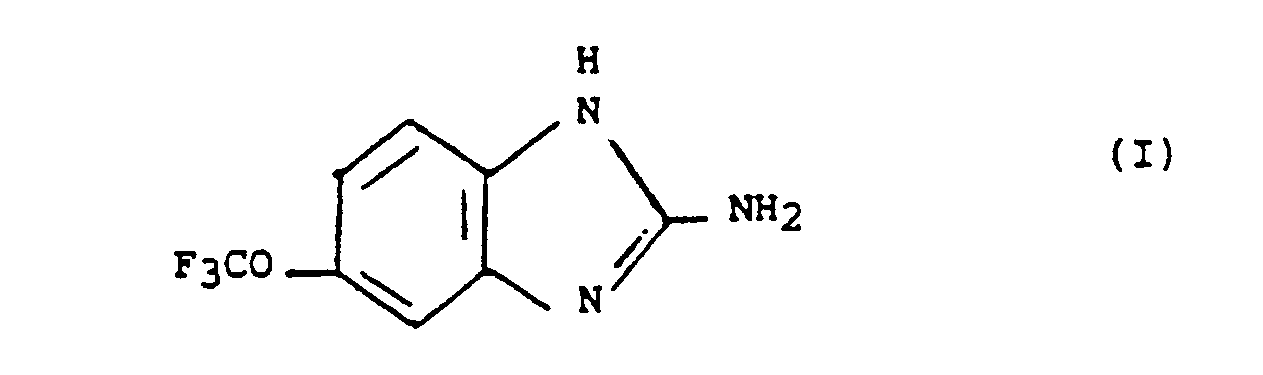
- Trifluoromethoxy-5 benzimidazolamine-2 is represented by the formula:
- the compound of formula (I) can be prepared by the action of cyanogen bromide on 4-trifluoromethoxy-1,2-benzenediamine.
- This process consists of an adaptation of the method described by R.C. EDERFIELD, Heterocyclic Compounds, 1957, 5, 285 for the preparation of benzimidazolamine-2.
- the reaction of cyanogen bromide on 4-trifluoromethoxy-1,2-benzenediamine can be carried out at around 0 ° C. in an inert hydroorganic medium.
- organic solvent tetrachloroethane can be used.
- Cyanogen bromide can be generated in situ by the action of bromine on sodium cyanide according to the method described in Organic Synthesis, 1983, 61,35.
- reaction mixture obtained is treated according to conventional physical (extraction, crystallization, chromatography) or chemical (salt formation and base regeneration) methods in order to isolate the compound of formula (I) in the pure state.
- the compound of formula (I) in the form of the free base can optionally be converted into an addition salt with a mineral or organic acid by the action of such an acid within an inert organic solvent such as an alcohol, a ketone , an ether or a chlorinated solvent.
- an inert organic solvent such as an alcohol, a ketone , an ether or a chlorinated solvent.
- the compound of formula (I) and its salts have interesting pharmacological properties.
- This compound is an antagonist with regard to aspartic acid and is active with respect to the electrophysiological responses provoked in the rat by iontophoretic application of neuroexcitatory amino acids, in particular kainic acid.
- This compound is therefore useful for the treatment of neurological and psychiatric disorders, in particular psychotic states (schizophrenia), epilepsy, neurodegenerative diseases such as Alzheimer's disease or Huntington's disease and cerebral ischemia.
- the antagonistic properties with regard to aspartic acid were determined by measuring the inhibition of the increase in the level of cyclic guanosine monophosphate (GMP) induced by aspartic acid according to the method of J. GARTHWAITE, Neuroscience, 1982 , 7, 2491-2497.
- GMP cyclic guanosine monophosphate
- the sections are again washed and transferred to 15 cm3 of buffer containing the products to be studied. After 18 min. the tissues are incubated in 2 cm3 of ethanol and the level of cyclic GMP is determined by radioimmunoassay according to a method described by ALSTEINER, CW PARKER and DM KIPNIS, J. Biol. Chem. 1972, 247 , 1106.
- Aspartic acid is used at a concentration of 100 ⁇ M and the product to be studied is added 3 minutes. before aspartic acid at a concentration of 25.30 or 100 ⁇ M.
- the results used are the average of 5 to 10 experiments for each concentration and an IC50 is determined which is the concentration inhibiting by 50% the increase in the cyclic rate induced by aspartic acid.
- the compound of formula (2) has in this test an IC50 of 30 ⁇ M.
- NMDA N-methyl D-aspartic acids
- IQ quisqualic
- the compound of formula (I) causes, 30 minutes after its administration, a 90% decrease in the electrophysiological responses to kainate and a 20% decrease in the responses to NMDA and to IQ.
- the compound according to the invention and its salts have low toxicity.
- the oral DL50 in the mouse of the compound of Example 1 is 620 mg / kg. This DL50 was calculated, after 3 days of observation by the cumulative method of J.J. REED and H. MUENCH, Amer. J. Hyg., 1938, 27, 493.
- salts As pharmaceutically acceptable salts, mention may be made of addition salts with a mineral acid such as the hydrochloride, sulphate, nitrate or phosphate or with an organic acid such as acetate, propionate, succinate, benzoate, fumarate, theophillineacetate, salicylate, methylene bis (z-hydroxynaphtoate) or substitution derivatives of these products.
- a mineral acid such as the hydrochloride, sulphate, nitrate or phosphate
- organic acid such as acetate, propionate, succinate, benzoate, fumarate, theophillineacetate, salicylate, methylene bis (z-hydroxynaphtoate) or substitution derivatives of these products.
- Trifluoromethoxy-4-benzenediamine-1,2 is prepared according to Zhur. Obshchei. Khim., 1961, 31, 915.
- the medicaments according to the invention consist of the compound of formula (I) or a salt of this compound, in the pure state or in the form of a composition in which it is associated with any other pharmaceutically compatible product, which may be inert. or physiologically active.
- the medicaments according to the invention can be used orally, parenterally, rectally or topically.
- compositions for oral administration tablets, pills, powders (gelatin capsules, cachets) or granules can be used.
- the active principle according to the invention is mixed with one or more inert diluents, such as starch, cellulose, sucrose, lactose or silica.
- these compositions can also include substances other than diluents, for example one or more lubricants such as magnesium stearate or talc, a colorant, a coating (dragees) or a varnish.
- compositions for oral administration there may be used pharmaceutically acceptable solutions, suspensions, emulsions, syrups and elixirs containing inert diluents such as water, ethanol, glycerol, vegetable oils or oil paraffin.
- inert diluents such as water, ethanol, glycerol, vegetable oils or oil paraffin.
- These compositions can include substances other than diluents, for example wetting, sweetening, thickening, flavoring or stabilizing products.
- the sterile compositions for parenteral administration may preferably be aqueous or non-aqueous solutions, suspensions or emulsions.
- solvent or vehicle water, propylene glycol, a polyethylene glycol, vegetable oils, in particular olive oil, injectable organic esters, for example ethyl oleate or other suitable organic solvents.
- These compositions can also contain adjuvants, in particular wetting, isotonizing, emulsifying, dispersing and stabilizing agents. Sterilization can be done in several ways, for example by aseptic filtration, by incorporating sterilizing agents into the composition, by irradiation or by heating. They can also be prepared in the form of sterile solid compositions which can be dissolved at the time of use in a sterile injectable medium.
- compositions for rectal administration are suppositories or rectal capsules, which contain, in addition to the active product, excipients such as cocoa butter, semi-synthetic glycerides or polyethylene glycols.
- compositions for topical administration can be, for example, creams, ointments, lotions, eye drops, mouthwashes, nasal drops or aerosols.
- the compound according to the invention is particularly useful for the treatment of neurological and psychiatric disorders, in particular psychotic states (schizophrenia), epilepsy, neurodegenerative diseases such as Alzheimer's disease or Huntington's disease and cerebral ischemia.
- neurological and psychiatric disorders in particular psychotic states (schizophrenia), epilepsy, neurodegenerative diseases such as Alzheimer's disease or Huntington's disease and cerebral ischemia.
- the doses depend on the desired effect, on the duration of the treatment and on the route of administration used; they are generally between 50 and 500 mg per day orally for an adult with unit doses ranging from 10 to 50 mg of active substance.
- the doctor will determine the appropriate dosage based on age, weight and all other factors specific to the subject to be treated.
- capsules containing 25 mg of active product having the following composition are prepared: - Trifluoromethoxy-5 benzimidazolamine-2 ; 25 mg - Microcrystalline cellulose ; 75 mg - Mannitol ; 41 mg - Colloidal silica ; 4 mg - Sodium carboxymethyl starch ; 25 mg - Talc ; 18 mg - Magnesium stearate ; 2 mg - Polyvidone excipient ; 10 mg
- Tablets containing 50 mg of active product having the following composition are prepared according to the usual technique - Trifluoromethoxy-5 benzimidazolamine-2 ; 50 mg - Microcrystalline cellulose owing 75 mg - Mannitol owing 41 mg - Polyvidone excipient ; 10 mg - Carboxymethyl starch owing 25 mg - Colloidal silica ?? 4 mg - Talc ; 18 mg - Magnesium stearate across 2 mg - Mixture of hydroxymethylcellulose, glycerin, titanium oxide (72-3,5-24,5) bibture of hydroxymethylcellulose, glycerin, titanium oxide (72-3,5-24,5) bibture of hydroxymethylcellulose, glycerin, titanium oxide (72-3,5-24,5) apt qs 1 film-coated tablet finished at 245 mg
- a solution for injection containing 10 mg of active product having the following composition is prepared: - Trifluoromethoxy-5 benzimidazolamine-2 ; 10 mg - Benzoic acid ?? 80 mg - Benzyl alcohol ?? 0.06 cm3 - Sodium benzoate ; 80 mg - 95% ethanol whereas 0.4 cm3 - Sodium hydroxide ; 24 mg - Propylene glycol ; 1.6 cc - Water owing qs 4 cm3
Landscapes
- Health & Medical Sciences (AREA)
- Organic Chemistry (AREA)
- Chemical & Material Sciences (AREA)
- Engineering & Computer Science (AREA)
- Bioinformatics & Cheminformatics (AREA)
- Biomedical Technology (AREA)
- Neurology (AREA)
- Neurosurgery (AREA)
- Medicinal Chemistry (AREA)
- Veterinary Medicine (AREA)
- Chemical Kinetics & Catalysis (AREA)
- Nuclear Medicine, Radiotherapy & Molecular Imaging (AREA)
- General Chemical & Material Sciences (AREA)
- Pharmacology & Pharmacy (AREA)
- Life Sciences & Earth Sciences (AREA)
- Animal Behavior & Ethology (AREA)
- General Health & Medical Sciences (AREA)
- Public Health (AREA)
- Psychiatry (AREA)
- Pain & Pain Management (AREA)
- Hospice & Palliative Care (AREA)
- Pharmaceuticals Containing Other Organic And Inorganic Compounds (AREA)
Abstract
La trifluorométhoxy-5 benzimidazolamine-2 et ses sels avec un acide minéral ou organique, sa préparation et les médicaments la contenant.
Description
- La présente invention concerne la trifluorométhoxy-5 benzimidazolamine-2, sa préparation et les médicaments la contenant.
- La trifluorométhoxy-5 benzimidazolamine-2 est représentée par la formule :
- Les sels du composé de formule (I) avec des acides minéraux ou organiques font également partie de l'invention.
- Le composé de formule (I) peut être préparé par action du bromure de cyanogène sur la trifluorométhoxy-4 benzènediamine-1,2.
- Ce procédé consiste en une adaptation de la méthode décrite par R.C. EDERFIELD, Heterocyclic Compounds, 1957, 5, 285 pour la préparation de la benzimidazolamine-2.
- La réaction du bromure de cyanogène sur la trifluorométhoxy-4 benzènediamine-1,2 peut être effectuée vers 0°C dans un milieu inerte hydroorganique. Comme solvant organique, on peut utiliser le tétrachloroéthane.
- Le bromure de cyanogène peut être généré in situ par action de brome sur le cyanure de sodium selon la méthode décrite dans Organic Synthesis, 1983, 61,35.
- Le mélange réactionnel obtenu est traité suivant des méthodes classiques physiques (extraction, cristallisation, chromatographie) ou chimiques (formation de sel et régénération de la base) afin d'isoler le composé de formule (I) à l'état pur.
- Le composé de formule (I) sous forme de base libre peut être éventuellement transformé en sel d'addition avec un acide minéral ou organique par action d'un tel acide au sein d'un solvant organique inerte tel qu'un alcool, une cétone, un éther ou un solvant chloré.
- Le composé de formule (I) et ses sels présentent des propriétés pharmacologiques intéressantes. Ce composé est un antagoniste à l'égard de l'acide aspartique et est actif vis-à-vis des réponses électrophysiologiques provoquées chez le rat par applicastion iontophorétique d'acides aminés neuroexcitateurs, notamment l'acide kainique. Ce composé est donc utile pour le traitement de troubles neurologiques et psychiatriques, en particulier les états psychotiques (schizophrénie), l'épilepsie, les maladies neurodégénératives telles que la maladie d'Alzheimer ou la maladie du Huntington et l'ischémie cérébrale.
- Les propriétés antagonistes à l'égard de l'acide aspartique ont été déterminées en mesurant l'inhibition de l'augmentation du taux de guanosine monophosphate (GMP) cyclique induit par l'acide aspartique selon la méthode de J. GARTHWAITE, Neuroscience, 1982, 7, 2491-2497.
- Des rats jeunes et mâles (8-12 jours) sont décapités et le cervelet est rapidement prélevé et placé dans un tampon à 0 °C (122 NaCl, 3 mM KCl, 1,2 mM MgSO₄, 1,3 mM CaCl₂, 0,4 mM kH₂ PO₄, 25 mM NaH CO₃ et 10 mM glucose, contenant 0,5 mM de théophyline pour éviter la dégradation enzymatique du GMP cyclique). Des coupes du cervelet (0,6-0,8 mm) sont incubées pendant 40 mn. à 37°C sous atmosphère de 95 % 0₂, 5 % CO₂ dans 20 cm³ du même tampon, puis lavées et placées à nouveau dans 15 cm³ de tampon dans les même conditions pendant 60 mn.
- Les coupes sont à nouveau lavées et transférées dans 15 cm³ de tampon contenant les produits à étudier. Après 18 mn. d'incubation les tissus sont broyés dans 2 cm³ d'éthanol et le taux de GMP cyclique est déterminé par dosage radioimmunologique selon une méthode décrite par A. L.STEINER, C.W. PARKER et D.M. KIPNIS, J. Biol. Chem. 1972, 247, 1106.
- L'acide aspartique est utilisé à la concentration de 100 µM et le produit à étudier est ajouté 3 mn. avant l'acide aspartique à une concentration de 25,30 ou 100 µM. Les résultats utilisés sont la moyenne de 5 à 10 expériences pour chaque concentration et on détermine une IC₅₀ qui est la concentration inhibant de 50 % l'augmentation du taux de cyclique induit par l'acide aspartique.
- Le composé de formule (2) présente dans ce test une IC₅₀ de 30 µM.
- L'activité vis-à-vis des réponses électrophysiologiques provoquées chez le rat par application iontophorétique d'acides aminés neuroexcitateurs tels que les acides N-méthyl D-aspartique (NMDA), kainique et quisqualique (QI) est déterminée selon la méthode de M. A. MARTIN et al., European Journal of Pharmacology, 1977, VOL.42, 291-298.
- A la dose de 1 mg/kg, le composé de formule (I) provoque, 30 minutes après son administration, une diminution de 90 % des réponses électrophysiologiques au kainate et de 20 % des réponses au NMDA et au QI.
- Le composé selon l'invention et ses sels présentent une faible toxicité. La DL₅₀ par voie orale chez la souris du composé de l'exemple 1 est de 620 mg/kg. Cette DL₅₀a été calculée, après 3 jours d'observation par la méthode cumulative de J.J. REED et H. MUENCH, Amer. J. Hyg., 1938, 27, 493.
- Pour l'emploi médicinal, il peut être fait usage du produit de formule (I) tel quel ou à l'état de sel avec un acide pharmaceutiquement acceptable.
- Comme sels pharmaceutiquement acceptables, on peut citer les sels d'addition avec un acide minéral tels que le chlorohydrate, le sulfate, le nitrate ou le phosphate ou avec un acide organique tels que l'acétate, le propionate, le succinate, le benzoate, le fumarate, le théophillineacétate, le salicylate, le méthylène bis (z-hydroxynaphtoate) ou des dérivés de substitution de ces produits.
- A un mélange refroidi à 0°C de 5,8 g de brome et de 5,6 cm³ d'eau, on ajoute goutte à goutte 1,79 g de cyanure de sodium en solution dans 5,6 cm³ d'eau. Après 1 heure de contact à 0°C, on ajoute goutte à goutte une solution de 7 g de trifluorométhoxy-4 benzènediamine-1,2 dans 7 cm³ de tétrachloroéthane. Après 2 heures à 0°C, on verse le mélange réactionnel dans 500 cm³ d'eau. On ajoute 500 cm³ de dichlorométhane et on agite 20 minutes. On décante la phase aqueuse, la lave avec 2 fois 150 cm³ de dichlorométhane et l'alcalinise à pH 8 avec du carbonate de sodium. On extrait la base avec 3 fois 300 cm³ d'acétate d'éthyle, sèche la phase organique sur sulfate de magnésium et évapore sous pression réduite. On obtient 9,5 g de base brute que l'on purifie par HPLC préparative en utilisant un mélange dichlorométhane-éthanol (95-5 en volumes) comme éluant. On récupère une huile que l'on transforme en chlorhydrate au sein d'éther éthylique. On obtient 4,8 g de chlorhydrate de trifluorométhoxy-5 benzimidazolamine-2 fondant à 180°C.
- La trifluorométhoxy- 4 benzènediamine- 1,2 est préparée selon Zhur. Obshchei. Khim., 1961, 31, 915.
- Les médicaments selon l'invention sont constitués par le composé de formule (I) ou un sel de ce composé, à l'état pur ou sous forme d'une composition dans laquelle il est associé à tout autre produit pharmaceutiquement compatible, pouvant être inerte ou physiologiquement actif. Les médicaments selon l'invention peuvent être utilisés par voie orale, parentérale, rectale ou topique.
- Comme compositions solides pour administration orale peuvent être utilisés des comprimés, pilules, poudres (capsules de gélatine, cachets) ou granulés. Dans ces compositions, le principe actif selon l'invention est mélangé à un ou plusieurs diluants inertes, tels que amidon, cellulose, saccharose, lactose ou silice. Ces compositions peuvent également comprendre des substances autres que les diluants, par exemple un ou plusieurs lubrifiants tels que le stéarate de magnésium ou le talc, un colorant, un enrobage (dragées) ou un vernis.
- Comme compositions liquides pour administration orale, on peut utiliser des solutions, des suspensions, des émulsions, des sirops et des élixirs pharmaceutiquement acceptables contenant des diluants inertes tels que l'eau, l'éthanol, le glycérol, les huiles végétales ou l'huile de paraffine. Ces compositions peuvent comprendre des substances autres que les diluants, par exemple des produits mouillants, édulcorants, épaississants, aromatisants ou stabilisants.
- Les compositions stériles pour administration parentérale peuvent être de préférence des solutions aqueuses ou non aqueuses, des suspensions ou des émulsions. Comme solvant ou véhicule, on peut employer l'eau, le propylèneglycol, un polyéthylèneglycol, des huiles végétales, en particulier l'huile d'olive, des esters organiques injectables, par exemple l'oléate d'éthyle ou autres solvants organiques convenables. Ces compositions peuvent également contenir des adjuvants, en particulier des agents mouillants, isotonisants, émulsifiants, dispersants et stabilisants. La stérilisation peut se faire de plusieurs façons, par exemple par filtration aseptisante, en incorporant à la composition des agents stérilisants, par irradiation ou par chauffage. Elles peuvent également être préparées sous forme de compositions solides stériles qui peuvent être dissoutes au moment de l'emploi dans un milieu stérile injectable.
- Les compositions pour administration rectale sont les suppositoires ou les capsules rectales, qui contiennnent outre le produit actif des excipients tels que le beurre de cacao, des glycérides semi-synthétiques ou des polyéthylèneglycols.
- Les compositions pour administration topique peuvent être par exemple des crèmes, pommades, lotions, collyres, collutoires, gouttes nasales ou aérosols.
- En thérapeutique humaine, le composé selon l'invention est particulièrement utile pour le traitement des troubles neurologiques et psychiatriques, en particulier les états psychotiques (schizophrénie), l'épilepsie, les maladies neurodégénératives telles que la maladie d'Alzheimer ou la maladie de Huntington et l'ischémie cérébrale.
- Les doses dépendent de l'effet recherché, de la durée du traitement et de la voie d'administration utilisée ; elles sont généralement comprises entre 50 et 500 mg par jour par voie orale pour un adulte avec des doses unitaires allant de 10 à 50 mg de substance active.
- D'une façon générale, le médecin déterminera la posologie appropriée en fonction de l'âge, du poids et de tous les autres facteurs propres au sujet à traiter.
- Les exemples suivants illustrent des compositions selon l'invention :
- On prépare, selon la technique habituelle, des gélules dosées à 25 mg de produit actif ayant la composition suivante :
- Trifluorométhoxy-5 benzimidazolamine-2 ..... 25 mg - Cellulose microcristalline ..... 75 mg - Mannitol ..... 41 mg - Silice colloïdale ..... 4 mg - Carboxyméthylamidon sodique ..... 25 mg - Talc ..... 18 mg - Stéarate de magnésium ..... 2 mg - Polyvidone excipient ..... 10 mg - On prépare selon la technique habituelle, des comprimés dosés à 50 mg de produit actif ayant la composition suivante
- Trifluorométhoxy-5 benzimidazolamine-2 ..... 50 mg - Cellulose microcristalline ..... 75 mg - Mannitol ..... 41 mg - Polyvidone excipient ..... 10 mg - Carboxyméthylamidon ..... 25 mg - Silice colloïdale ..... 4 mg - Talc ..... 18 mg - Stéarate de magnésium ..... 2 mg - Mélange d'hydroxyméthylcellulose, glycérine, oxyde de titane (72-3,5-24,5) .....q.s.p. 1 comprimé pelliculé terminé à 245 mg - On prépare une solution injectable contenant 10 mg de produit actif ayant la compositon suivante :
- Trifluorométhoxy-5 benzimidazolamine-2 ..... 10 mg - Acide benzoïque ..... 80 mg - Alcool benzylique ..... 0,06 cm³ - Benzoate de sodium ..... 80 mg - Ethanol à 95 % ..... 0,4 cm³ - Hydroxyde de sodium ..... 24 mg - Propylèneglycol ..... 1,6 cm³ - Eau .....q.s.p. 4 cm³
Claims (3)
- Procédé de préparation de la trifluorométhoxy-5 benzimidazolamine-2 ou ses sels avec un acide minéral ou organique caractérisé en ce que l'on fait réagir le bromure de cyanogène sur la trifluométhoxy-4 benzénediamine-1,2, isole le produit et le transforme éventuellement en sel avec un acide minéral ou organique.
Applications Claiming Priority (2)
| Application Number | Priority Date | Filing Date | Title |
|---|---|---|---|
| FR8902168A FR2643264B1 (fr) | 1989-02-20 | 1989-02-20 | Trifluoromethoxy-5 benzimidazolamine-2, procede pour sa preparation et medicaments la contenant |
| FR8902168 | 1989-02-20 |
Publications (1)
| Publication Number | Publication Date |
|---|---|
| EP0384812A1 true EP0384812A1 (fr) | 1990-08-29 |
Family
ID=9378934
Family Applications (1)
| Application Number | Title | Priority Date | Filing Date |
|---|---|---|---|
| EP90400429A Withdrawn EP0384812A1 (fr) | 1989-02-20 | 1990-02-16 | Trifluorométhoxy-5 benzimidazolamine-2, procédé pour sa préparation et médicaments la contenant |
Country Status (5)
| Country | Link |
|---|---|
| US (1) | US5049574A (fr) |
| EP (1) | EP0384812A1 (fr) |
| JP (1) | JPH02264762A (fr) |
| CA (1) | CA2010349A1 (fr) |
| FR (1) | FR2643264B1 (fr) |
Families Citing this family (2)
| Publication number | Priority date | Publication date | Assignee | Title |
|---|---|---|---|---|
| US5981168A (en) * | 1998-05-15 | 1999-11-09 | The University Of British Columbia | Method and composition for modulating amyloidosis |
| WO2006050148A2 (fr) * | 2004-10-29 | 2006-05-11 | Teva Pharmaceutical Industries, Ltd. | Derives de propargyl-trifluoromethoxy-aminobenzimidazole |
Citations (3)
| Publication number | Priority date | Publication date | Assignee | Title |
|---|---|---|---|---|
| US3455948A (en) * | 1966-11-09 | 1969-07-15 | Smithkline Corp | 2-aminobenzimidazole and a process for preparing 2-aminobenzimidazoles |
| EP0091796A1 (fr) * | 1982-04-08 | 1983-10-19 | Eli Lilly And Company | Procédé pour l'enlèvement des groupes sulfonyles-1 de benzimidazoles |
| CH667649A5 (en) * | 1986-09-10 | 1988-10-31 | Lonza Ag | 2-Substd. amino-benzoxazole and -benzimidazole derivs. prodn. - by reacting prim. amino cpd. with amine in presence of acid catalyst, useful as intermediates e.g. for pharmaceuticals |
Family Cites Families (6)
| Publication number | Priority date | Publication date | Assignee | Title |
|---|---|---|---|---|
| US3309987A (en) * | 1965-12-22 | 1967-03-21 | Ibm | Imprinting apparatus |
| JPS5116669A (en) * | 1974-07-29 | 1976-02-10 | Yoshitomi Pharmaceutical | 22 aminobenzuimidazoorujudotaino seizoho |
| HU182794B (en) * | 1980-03-19 | 1984-03-28 | Chinoin Gyogyszer Es Vegyeszet | Process for producing 5-bracket-6-bracket closed-thiocyanato-benzimidazolyl-alkyl-carbamates and salts |
| DE3013277A1 (de) * | 1980-04-05 | 1981-10-15 | Bayer Ag, 5090 Leverkusen | Verfahren zur herstellung von 2-amino-benzimidazol |
| US4593105A (en) * | 1981-05-01 | 1986-06-03 | Uniroyal Chemical Company, Inc. | Process for making 2-mercapto benzimidazoles in the presence of a water-insoluble alkanol |
| FR2521141A1 (fr) * | 1982-02-09 | 1983-08-12 | Rhone Poulenc Agrochimie | Nouveaux derives du cyano-2 benzimidazole, leur preparation et leur utilisation comme fongicides |
-
1989
- 1989-02-20 FR FR8902168A patent/FR2643264B1/fr not_active Expired - Lifetime
-
1990
- 1990-02-16 EP EP90400429A patent/EP0384812A1/fr not_active Withdrawn
- 1990-02-16 US US07/481,063 patent/US5049574A/en not_active Expired - Fee Related
- 1990-02-19 CA CA002010349A patent/CA2010349A1/fr not_active Abandoned
- 1990-02-19 JP JP2036402A patent/JPH02264762A/ja active Pending
Patent Citations (3)
| Publication number | Priority date | Publication date | Assignee | Title |
|---|---|---|---|---|
| US3455948A (en) * | 1966-11-09 | 1969-07-15 | Smithkline Corp | 2-aminobenzimidazole and a process for preparing 2-aminobenzimidazoles |
| EP0091796A1 (fr) * | 1982-04-08 | 1983-10-19 | Eli Lilly And Company | Procédé pour l'enlèvement des groupes sulfonyles-1 de benzimidazoles |
| CH667649A5 (en) * | 1986-09-10 | 1988-10-31 | Lonza Ag | 2-Substd. amino-benzoxazole and -benzimidazole derivs. prodn. - by reacting prim. amino cpd. with amine in presence of acid catalyst, useful as intermediates e.g. for pharmaceuticals |
Non-Patent Citations (1)
| Title |
|---|
| CHEMICAL ABSTRACTS, vol. 85, no. 9, 30 août 1976, page 566, résumé no. 63069e, Columbus, Ohio, US; K. SAWATARI et al. (Yoshitomi Pharmaceutical Industries, Ltd): "2-Aminobenzimidazoles" * |
Also Published As
| Publication number | Publication date |
|---|---|
| CA2010349A1 (fr) | 1990-08-20 |
| FR2643264B1 (fr) | 1991-04-26 |
| JPH02264762A (ja) | 1990-10-29 |
| FR2643264A1 (fr) | 1990-08-24 |
| US5049574A (en) | 1991-09-17 |
Similar Documents
| Publication | Publication Date | Title |
|---|---|---|
| BE851310A (fr) | Nouveaux derives de la tetrahydro-equinocandine b | |
| EP0497659A1 (fr) | Dérivés d'aryl (ou hétéroaryl)-piperaz inyl-alkyl-azoles, leur préparation et leur application en tant que médicaments | |
| EP0370901A1 (fr) | Nouveaux dérivés du chromanne actifs sur le système nerveux central, leur procédé de préparation et les compositions pharmaceutiques en contenant | |
| EP0073161B1 (fr) | Nouveaux dérivés de la pyrazine actifs sur le système nerveux central | |
| FR2601015A1 (fr) | Nouveaux derives du 1h,3h-pyrrolo (1,2-c) thiazole, leur preparation et les compositions pharmaceutiques qui les contiennent | |
| FR2885364A1 (fr) | Derives d'alkyl-, alkenyl-et alkynylcarbamates, leur preparation et leur application en therapeutique | |
| EP0479631B1 (fr) | Dérivés du spiro [4.5]décane leur procédé de préparation et les compositions pharmaceutiques les renfermant | |
| FR2662695A1 (fr) | Amino-2 polyfluoroalcoxy-6 benzoselenazoles, leur preparation et les medicaments les contenant. | |
| EP0003445A1 (fr) | Dérivés d'aza-1 bicyclo(2,2,2)octane, leur procédé de préparation et produits intermédiaires, et médicaments les contenant | |
| EP0418933A1 (fr) | Dérivés d'alcadiènes, leurs préparations, les médicaments les contenant et produits intermédiaires | |
| FR2623808A1 (fr) | Nouveaux derives flavonoides (benzyl-4 piperazinyl-1)-2 oxo-2 ethylene substitues, leurs procedes de preparation et les compositions pharmaceutiques qui les contiennent | |
| EP0286515A1 (fr) | Nouvelles amines tricycliques dérivées du tétrahydro-5,6,7,8 naphto [2,3b] dihydro-2,3 furanne, et du tétrahydro-6,7,8,9 5H-benzocyclohepta [2,3b] dihydro-2,3 furanne, leurs procédés de préparation et les compositions pharmaceutiques qui les contiennent | |
| EP0004494A1 (fr) | Nouveaux dérivés de 1,3-dihydro 3-(1-(2-(2,3-dihydro 1,4-benzo-dioxin-2-yl)2-hydroxy éthyl)pipéridin-4-yl)2H-indol 2-one, leur procédé de préparation, leur application comme médicaments et les compositions pharmaceutiques les renfermant | |
| EP0788491B1 (fr) | Derives de 6-polyfluoroalcoxy et 6-polyfluoroalkyle-2-aminobenzothiazole | |
| EP0638568B1 (fr) | Pipérazines substituées, leur procédé de préparation et les compositions pharmaceutiques les contenant | |
| EP0008259A1 (fr) | Nouveaux dérivés de la pipéridylbenzimidazolinone, leurs procédés de préparation et les compositions pharmaceutiques les renfermant | |
| CH639075A5 (fr) | Ethers dibenzyliques substitues actifs sur le plan therapeutique. | |
| EP0528968B1 (fr) | Derives d'(alkylthio-3 propyl)-3 benzothiazoline, leur preparation et les medicaments les contenant | |
| FR2643264A1 (fr) | Trifluoromethoxy-5 benzimidazolamine-2, procede pour sa preparation et medicaments la contenant | |
| FR2531433A1 (fr) | Nouveaux alcaloides de l'ergot de seigle, leur preparation et leur utilisation comme medicaments | |
| CH620211A5 (fr) | ||
| LU87945A1 (fr) | Derive de la dichloroaniline | |
| WO1993001194A1 (fr) | DERIVES DE 1,2,4-THIADIAZINO[3,4-b]BENZOTHIAZOLE, LEUR PREPARATION ET LES MEDICAMENTS LES CONTENANT | |
| EP0125975B1 (fr) | Diphénylazométhines portant une chaîne esterifiée, leur préparation et leur application en thérapeutique | |
| EP0408437A2 (fr) | Dérivés d'alkylimino-2 benzothiazoline, leurs procédés de préparation et les médicaments les contenant |
Legal Events
| Date | Code | Title | Description |
|---|---|---|---|
| PUAI | Public reference made under article 153(3) epc to a published international application that has entered the european phase |
Free format text: ORIGINAL CODE: 0009012 |
|
| AK | Designated contracting states |
Kind code of ref document: A1 Designated state(s): AT BE CH DE DK ES FR GB GR IT LI LU NL SE |
|
| 17P | Request for examination filed |
Effective date: 19900918 |
|
| 17Q | First examination report despatched |
Effective date: 19910712 |
|
| STAA | Information on the status of an ep patent application or granted ep patent |
Free format text: STATUS: THE APPLICATION IS DEEMED TO BE WITHDRAWN |
|
| 18D | Application deemed to be withdrawn |
Effective date: 19911203 |