EP0384896A1 - Zähe Epoxidgiessharze - Google Patents
Zähe Epoxidgiessharze Download PDFInfo
- Publication number
- EP0384896A1 EP0384896A1 EP90810111A EP90810111A EP0384896A1 EP 0384896 A1 EP0384896 A1 EP 0384896A1 EP 90810111 A EP90810111 A EP 90810111A EP 90810111 A EP90810111 A EP 90810111A EP 0384896 A1 EP0384896 A1 EP 0384896A1
- Authority
- EP
- European Patent Office
- Prior art keywords
- component
- hydroxyl
- carboxyl
- groups
- curable compositions
- Prior art date
- Legal status (The legal status is an assumption and is not a legal conclusion. Google has not performed a legal analysis and makes no representation as to the accuracy of the status listed.)
- Withdrawn
Links
- 238000005266 casting Methods 0.000 title claims description 6
- 239000004593 Epoxy Substances 0.000 title description 15
- 229920005989 resin Polymers 0.000 title description 15
- 239000011347 resin Substances 0.000 title description 15
- -1 polybutylene Polymers 0.000 claims abstract description 75
- 239000000203 mixture Substances 0.000 claims abstract description 69
- KAKZBPTYRLMSJV-UHFFFAOYSA-N Butadiene Chemical compound C=CC=C KAKZBPTYRLMSJV-UHFFFAOYSA-N 0.000 claims abstract description 43
- 229920001577 copolymer Polymers 0.000 claims abstract description 39
- 125000002887 hydroxy group Chemical group [H]O* 0.000 claims abstract description 29
- 125000003178 carboxy group Chemical group [H]OC(*)=O 0.000 claims abstract description 26
- LYCAIKOWRPUZTN-UHFFFAOYSA-N Ethylene glycol Chemical compound OCCO LYCAIKOWRPUZTN-UHFFFAOYSA-N 0.000 claims abstract description 25
- 239000007788 liquid Substances 0.000 claims abstract description 25
- 150000001244 carboxylic acid anhydrides Chemical class 0.000 claims abstract description 22
- 239000003822 epoxy resin Substances 0.000 claims abstract description 20
- 229920000647 polyepoxide Polymers 0.000 claims abstract description 20
- 229920001748 polybutylene Polymers 0.000 claims abstract description 19
- 229920001451 polypropylene glycol Polymers 0.000 claims abstract description 18
- 229920001515 polyalkylene glycol Polymers 0.000 claims abstract description 17
- 125000003055 glycidyl group Chemical group C(C1CO1)* 0.000 claims abstract description 16
- GYZLOYUZLJXAJU-UHFFFAOYSA-N diglycidyl ether Chemical compound C1OC1COCC1CO1 GYZLOYUZLJXAJU-UHFFFAOYSA-N 0.000 claims abstract description 12
- WGCNASOHLSPBMP-UHFFFAOYSA-N hydroxyacetaldehyde Natural products OCC=O WGCNASOHLSPBMP-UHFFFAOYSA-N 0.000 claims abstract description 10
- 150000008064 anhydrides Chemical class 0.000 claims description 18
- IISBACLAFKSPIT-UHFFFAOYSA-N bisphenol A Chemical compound C=1C=C(O)C=CC=1C(C)(C)C1=CC=C(O)C=C1 IISBACLAFKSPIT-UHFFFAOYSA-N 0.000 claims description 18
- NLHHRLWOUZZQLW-UHFFFAOYSA-N Acrylonitrile Chemical compound C=CC#N NLHHRLWOUZZQLW-UHFFFAOYSA-N 0.000 claims description 16
- 150000001875 compounds Chemical class 0.000 claims description 15
- 150000002334 glycols Chemical class 0.000 claims description 12
- 239000004848 polyfunctional curative Substances 0.000 claims description 12
- 125000003118 aryl group Chemical group 0.000 claims description 11
- 238000004519 manufacturing process Methods 0.000 claims description 11
- RTZKZFJDLAIYFH-UHFFFAOYSA-N Diethyl ether Chemical compound CCOCC RTZKZFJDLAIYFH-UHFFFAOYSA-N 0.000 claims description 9
- 125000001931 aliphatic group Chemical group 0.000 claims description 9
- 229920001198 elastomeric copolymer Polymers 0.000 claims description 9
- OFOBLEOULBTSOW-UHFFFAOYSA-N Malonic acid Chemical compound OC(=O)CC(O)=O OFOBLEOULBTSOW-UHFFFAOYSA-N 0.000 claims description 7
- 229920000459 Nitrile rubber Polymers 0.000 claims description 7
- NTXGQCSETZTARF-UHFFFAOYSA-N buta-1,3-diene;prop-2-enenitrile Chemical compound C=CC=C.C=CC#N NTXGQCSETZTARF-UHFFFAOYSA-N 0.000 claims description 7
- 125000000524 functional group Chemical group 0.000 claims description 7
- 239000004743 Polypropylene Substances 0.000 claims description 6
- 239000011353 cycloaliphatic epoxy resin Substances 0.000 claims description 6
- 125000003700 epoxy group Chemical group 0.000 claims description 6
- ISWSIDIOOBJBQZ-UHFFFAOYSA-N phenol group Chemical group C1(=CC=CC=C1)O ISWSIDIOOBJBQZ-UHFFFAOYSA-N 0.000 claims description 6
- 229920001155 polypropylene Polymers 0.000 claims description 6
- 229930185605 Bisphenol Natural products 0.000 claims description 5
- 239000001257 hydrogen Substances 0.000 claims description 5
- 229910052739 hydrogen Inorganic materials 0.000 claims description 5
- 125000004435 hydrogen atom Chemical group [H]* 0.000 claims description 5
- XSTXAVWGXDQKEL-UHFFFAOYSA-N Trichloroethylene Chemical compound ClC=C(Cl)Cl XSTXAVWGXDQKEL-UHFFFAOYSA-N 0.000 claims description 4
- 125000000217 alkyl group Chemical group 0.000 claims description 4
- 125000003710 aryl alkyl group Chemical group 0.000 claims description 4
- 125000000753 cycloalkyl group Chemical group 0.000 claims description 4
- 238000010438 heat treatment Methods 0.000 claims description 4
- 150000001991 dicarboxylic acids Chemical class 0.000 claims description 3
- PXQLVRUNWNTZOS-UHFFFAOYSA-N sulfanyl Chemical class [SH] PXQLVRUNWNTZOS-UHFFFAOYSA-N 0.000 claims description 3
- PUPZLCDOIYMWBV-UHFFFAOYSA-N (+/-)-1,3-Butanediol Chemical compound CC(O)CCO PUPZLCDOIYMWBV-UHFFFAOYSA-N 0.000 claims description 2
- BVKZGUZCCUSVTD-UHFFFAOYSA-N carbonic acid Chemical compound OC(O)=O BVKZGUZCCUSVTD-UHFFFAOYSA-N 0.000 claims description 2
- 150000001732 carboxylic acid derivatives Chemical class 0.000 claims description 2
- 239000002131 composite material Substances 0.000 claims description 2
- 229920001971 elastomer Polymers 0.000 abstract description 8
- 239000003795 chemical substances by application Substances 0.000 abstract description 6
- 239000000806 elastomer Substances 0.000 abstract description 3
- 150000002118 epoxides Chemical group 0.000 abstract description 2
- HOSGXJWQVBHGLT-UHFFFAOYSA-N 6-hydroxy-3,4-dihydro-1h-quinolin-2-one Chemical group N1C(=O)CCC2=CC(O)=CC=C21 HOSGXJWQVBHGLT-UHFFFAOYSA-N 0.000 abstract 1
- 125000003396 thiol group Chemical class [H]S* 0.000 abstract 1
- WYURNTSHIVDZCO-UHFFFAOYSA-N Tetrahydrofuran Chemical compound C1CCOC1 WYURNTSHIVDZCO-UHFFFAOYSA-N 0.000 description 23
- 239000000047 product Substances 0.000 description 18
- 239000002253 acid Substances 0.000 description 16
- 229910052757 nitrogen Inorganic materials 0.000 description 14
- IJGRMHOSHXDMSA-UHFFFAOYSA-N Atomic nitrogen Chemical compound N#N IJGRMHOSHXDMSA-UHFFFAOYSA-N 0.000 description 12
- RIOQSEWOXXDEQQ-UHFFFAOYSA-N triphenylphosphine Chemical compound C1=CC=CC=C1P(C=1C=CC=CC=1)C1=CC=CC=C1 RIOQSEWOXXDEQQ-UHFFFAOYSA-N 0.000 description 10
- 150000002148 esters Chemical class 0.000 description 8
- LNEPOXFFQSENCJ-UHFFFAOYSA-N haloperidol Chemical compound C1CC(O)(C=2C=CC(Cl)=CC=2)CCN1CCCC(=O)C1=CC=C(F)C=C1 LNEPOXFFQSENCJ-UHFFFAOYSA-N 0.000 description 7
- 229920000909 polytetrahydrofuran Polymers 0.000 description 7
- 150000007513 acids Chemical class 0.000 description 6
- 230000015572 biosynthetic process Effects 0.000 description 6
- WERYXYBDKMZEQL-UHFFFAOYSA-N butane-1,4-diol Chemical compound OCCCCO WERYXYBDKMZEQL-UHFFFAOYSA-N 0.000 description 6
- BRLQWZUYTZBJKN-UHFFFAOYSA-N Epichlorohydrin Chemical compound ClCC1CO1 BRLQWZUYTZBJKN-UHFFFAOYSA-N 0.000 description 5
- PEDCQBHIVMGVHV-UHFFFAOYSA-N Glycerine Chemical compound OCC(O)CO PEDCQBHIVMGVHV-UHFFFAOYSA-N 0.000 description 5
- 150000001412 amines Chemical class 0.000 description 5
- 239000003054 catalyst Substances 0.000 description 5
- 239000000835 fiber Substances 0.000 description 5
- 238000000034 method Methods 0.000 description 5
- 125000002496 methyl group Chemical group [H]C([H])([H])* 0.000 description 5
- 229920000642 polymer Polymers 0.000 description 5
- 239000005060 rubber Substances 0.000 description 5
- VVHFXJOCUKBZFS-UHFFFAOYSA-N 2-(chloromethyl)-2-methyloxirane Chemical compound ClCC1(C)CO1 VVHFXJOCUKBZFS-UHFFFAOYSA-N 0.000 description 4
- IAYPIBMASNFSPL-UHFFFAOYSA-N Ethylene oxide Chemical compound C1CO1 IAYPIBMASNFSPL-UHFFFAOYSA-N 0.000 description 4
- CERQOIWHTDAKMF-UHFFFAOYSA-N Methacrylic acid Chemical compound CC(=C)C(O)=O CERQOIWHTDAKMF-UHFFFAOYSA-N 0.000 description 4
- PPBRXRYQALVLMV-UHFFFAOYSA-N Styrene Chemical compound C=CC1=CC=CC=C1 PPBRXRYQALVLMV-UHFFFAOYSA-N 0.000 description 4
- QMKYBPDZANOJGF-UHFFFAOYSA-N benzene-1,3,5-tricarboxylic acid Chemical compound OC(=O)C1=CC(C(O)=O)=CC(C(O)=O)=C1 QMKYBPDZANOJGF-UHFFFAOYSA-N 0.000 description 4
- PXKLMJQFEQBVLD-UHFFFAOYSA-N bisphenol F Chemical compound C1=CC(O)=CC=C1CC1=CC=C(O)C=C1 PXKLMJQFEQBVLD-UHFFFAOYSA-N 0.000 description 4
- 230000009477 glass transition Effects 0.000 description 4
- NAQMVNRVTILPCV-UHFFFAOYSA-N hexane-1,6-diamine Chemical compound NCCCCCCN NAQMVNRVTILPCV-UHFFFAOYSA-N 0.000 description 4
- 229920002857 polybutadiene Polymers 0.000 description 4
- 235000013824 polyphenols Nutrition 0.000 description 4
- 238000002360 preparation method Methods 0.000 description 4
- ARCGXLSVLAOJQL-UHFFFAOYSA-N trimellitic acid Chemical compound OC(=O)C1=CC=C(C(O)=O)C(C(O)=O)=C1 ARCGXLSVLAOJQL-UHFFFAOYSA-N 0.000 description 4
- LTVUCOSIZFEASK-MPXCPUAZSA-N (3ar,4s,7r,7as)-3a-methyl-3a,4,7,7a-tetrahydro-4,7-methano-2-benzofuran-1,3-dione Chemical compound C([C@H]1C=C2)[C@H]2[C@H]2[C@]1(C)C(=O)OC2=O LTVUCOSIZFEASK-MPXCPUAZSA-N 0.000 description 3
- SMZOUWXMTYCWNB-UHFFFAOYSA-N 2-(2-methoxy-5-methylphenyl)ethanamine Chemical compound COC1=CC=C(C)C=C1CCN SMZOUWXMTYCWNB-UHFFFAOYSA-N 0.000 description 3
- 229920013646 Hycar Polymers 0.000 description 3
- MUBZPKHOEPUJKR-UHFFFAOYSA-N Oxalic acid Chemical compound OC(=O)C(O)=O MUBZPKHOEPUJKR-UHFFFAOYSA-N 0.000 description 3
- GOOHAUXETOMSMM-UHFFFAOYSA-N Propylene oxide Chemical compound CC1CO1 GOOHAUXETOMSMM-UHFFFAOYSA-N 0.000 description 3
- KKEYFWRCBNTPAC-UHFFFAOYSA-N Terephthalic acid Chemical compound OC(=O)C1=CC=C(C(O)=O)C=C1 KKEYFWRCBNTPAC-UHFFFAOYSA-N 0.000 description 3
- 230000002378 acidificating effect Effects 0.000 description 3
- 239000000654 additive Substances 0.000 description 3
- 150000001298 alcohols Chemical class 0.000 description 3
- 238000006243 chemical reaction Methods 0.000 description 3
- MTHSVFCYNBDYFN-UHFFFAOYSA-N diethylene glycol Chemical compound OCCOCCO MTHSVFCYNBDYFN-UHFFFAOYSA-N 0.000 description 3
- XXBDWLFCJWSEKW-UHFFFAOYSA-N dimethylbenzylamine Chemical compound CN(C)CC1=CC=CC=C1 XXBDWLFCJWSEKW-UHFFFAOYSA-N 0.000 description 3
- 229920000570 polyether Polymers 0.000 description 3
- 239000000843 powder Substances 0.000 description 3
- YPFDHNVEDLHUCE-UHFFFAOYSA-N propane-1,3-diol Chemical compound OCCCO YPFDHNVEDLHUCE-UHFFFAOYSA-N 0.000 description 3
- 150000003254 radicals Chemical class 0.000 description 3
- VYPSYNLAJGMNEJ-UHFFFAOYSA-N silicon dioxide Inorganic materials O=[Si]=O VYPSYNLAJGMNEJ-UHFFFAOYSA-N 0.000 description 3
- 150000003440 styrenes Chemical class 0.000 description 3
- VZCYOOQTPOCHFL-UHFFFAOYSA-N trans-butenedioic acid Natural products OC(=O)C=CC(O)=O VZCYOOQTPOCHFL-UHFFFAOYSA-N 0.000 description 3
- KMOUUZVZFBCRAM-OLQVQODUSA-N (3as,7ar)-3a,4,7,7a-tetrahydro-2-benzofuran-1,3-dione Chemical compound C1C=CC[C@@H]2C(=O)OC(=O)[C@@H]21 KMOUUZVZFBCRAM-OLQVQODUSA-N 0.000 description 2
- DEWLEGDTCGBNGU-UHFFFAOYSA-N 1,3-dichloropropan-2-ol Chemical compound ClCC(O)CCl DEWLEGDTCGBNGU-UHFFFAOYSA-N 0.000 description 2
- NOGFHTGYPKWWRX-UHFFFAOYSA-N 2,2,6,6-tetramethyloxan-4-one Chemical compound CC1(C)CC(=O)CC(C)(C)O1 NOGFHTGYPKWWRX-UHFFFAOYSA-N 0.000 description 2
- JAHNSTQSQJOJLO-UHFFFAOYSA-N 2-(3-fluorophenyl)-1h-imidazole Chemical compound FC1=CC=CC(C=2NC=CN=2)=C1 JAHNSTQSQJOJLO-UHFFFAOYSA-N 0.000 description 2
- VPWNQTHUCYMVMZ-UHFFFAOYSA-N 4,4'-sulfonyldiphenol Chemical compound C1=CC(O)=CC=C1S(=O)(=O)C1=CC=C(O)C=C1 VPWNQTHUCYMVMZ-UHFFFAOYSA-N 0.000 description 2
- QGZKDVFQNNGYKY-UHFFFAOYSA-N Ammonia Chemical compound N QGZKDVFQNNGYKY-UHFFFAOYSA-N 0.000 description 2
- PAYRUJLWNCNPSJ-UHFFFAOYSA-N Aniline Chemical compound NC1=CC=CC=C1 PAYRUJLWNCNPSJ-UHFFFAOYSA-N 0.000 description 2
- FBPFZTCFMRRESA-FSIIMWSLSA-N D-Glucitol Natural products OC[C@H](O)[C@H](O)[C@@H](O)[C@H](O)CO FBPFZTCFMRRESA-FSIIMWSLSA-N 0.000 description 2
- FBPFZTCFMRRESA-JGWLITMVSA-N D-glucitol Chemical compound OC[C@H](O)[C@@H](O)[C@H](O)[C@H](O)CO FBPFZTCFMRRESA-JGWLITMVSA-N 0.000 description 2
- VZCYOOQTPOCHFL-OWOJBTEDSA-N Fumaric acid Chemical compound OC(=O)\C=C\C(O)=O VZCYOOQTPOCHFL-OWOJBTEDSA-N 0.000 description 2
- QIGBRXMKCJKVMJ-UHFFFAOYSA-N Hydroquinone Chemical compound OC1=CC=C(O)C=C1 QIGBRXMKCJKVMJ-UHFFFAOYSA-N 0.000 description 2
- BAVYZALUXZFZLV-UHFFFAOYSA-N Methylamine Chemical compound NC BAVYZALUXZFZLV-UHFFFAOYSA-N 0.000 description 2
- NBIIXXVUZAFLBC-UHFFFAOYSA-N Phosphoric acid Chemical compound OP(O)(O)=O NBIIXXVUZAFLBC-UHFFFAOYSA-N 0.000 description 2
- 229920002164 Polyalkylene glycol copolymer Polymers 0.000 description 2
- DNIAPMSPPWPWGF-UHFFFAOYSA-N Propylene glycol Chemical compound CC(O)CO DNIAPMSPPWPWGF-UHFFFAOYSA-N 0.000 description 2
- GWEVSGVZZGPLCZ-UHFFFAOYSA-N Titan oxide Chemical compound O=[Ti]=O GWEVSGVZZGPLCZ-UHFFFAOYSA-N 0.000 description 2
- ZJCCRDAZUWHFQH-UHFFFAOYSA-N Trimethylolpropane Chemical compound CCC(CO)(CO)CO ZJCCRDAZUWHFQH-UHFFFAOYSA-N 0.000 description 2
- WNLRTRBMVRJNCN-UHFFFAOYSA-N adipic acid Chemical compound OC(=O)CCCCC(O)=O WNLRTRBMVRJNCN-UHFFFAOYSA-N 0.000 description 2
- 230000001476 alcoholic effect Effects 0.000 description 2
- XAGFODPZIPBFFR-UHFFFAOYSA-N aluminium Chemical compound [Al] XAGFODPZIPBFFR-UHFFFAOYSA-N 0.000 description 2
- 238000005452 bending Methods 0.000 description 2
- 229920001400 block copolymer Polymers 0.000 description 2
- 235000013877 carbamide Nutrition 0.000 description 2
- 239000007795 chemical reaction product Substances 0.000 description 2
- 238000007334 copolymerization reaction Methods 0.000 description 2
- 238000006735 epoxidation reaction Methods 0.000 description 2
- 150000002170 ethers Chemical class 0.000 description 2
- 238000009472 formulation Methods 0.000 description 2
- 235000011187 glycerol Nutrition 0.000 description 2
- QQVIHTHCMHWDBS-UHFFFAOYSA-N isophthalic acid Chemical compound OC(=O)C1=CC=CC(C(O)=O)=C1 QQVIHTHCMHWDBS-UHFFFAOYSA-N 0.000 description 2
- VZCYOOQTPOCHFL-UPHRSURJSA-N maleic acid Chemical compound OC(=O)\C=C/C(O)=O VZCYOOQTPOCHFL-UPHRSURJSA-N 0.000 description 2
- 239000011976 maleic acid Substances 0.000 description 2
- FPYJFEHAWHCUMM-UHFFFAOYSA-N maleic anhydride Chemical compound O=C1OC(=O)C=C1 FPYJFEHAWHCUMM-UHFFFAOYSA-N 0.000 description 2
- 239000000463 material Substances 0.000 description 2
- LVHBHZANLOWSRM-UHFFFAOYSA-N methylenebutanedioic acid Natural products OC(=O)CC(=C)C(O)=O LVHBHZANLOWSRM-UHFFFAOYSA-N 0.000 description 2
- 239000000178 monomer Substances 0.000 description 2
- WXUAQHNMJWJLTG-UHFFFAOYSA-N monomethylpersuccinic acid Natural products OC(=O)C(C)CC(O)=O WXUAQHNMJWJLTG-UHFFFAOYSA-N 0.000 description 2
- BDJRBEYXGGNYIS-UHFFFAOYSA-N nonanedioic acid Chemical compound OC(=O)CCCCCCCC(O)=O BDJRBEYXGGNYIS-UHFFFAOYSA-N 0.000 description 2
- 229920003986 novolac Polymers 0.000 description 2
- IWDCLRJOBJJRNH-UHFFFAOYSA-N p-cresol Chemical compound CC1=CC=C(O)C=C1 IWDCLRJOBJJRNH-UHFFFAOYSA-N 0.000 description 2
- RZXMPPFPUUCRFN-UHFFFAOYSA-N p-toluidine Chemical compound CC1=CC=C(N)C=C1 RZXMPPFPUUCRFN-UHFFFAOYSA-N 0.000 description 2
- FJKROLUGYXJWQN-UHFFFAOYSA-N papa-hydroxy-benzoic acid Natural products OC(=O)C1=CC=C(O)C=C1 FJKROLUGYXJWQN-UHFFFAOYSA-N 0.000 description 2
- WXZMFSXDPGVJKK-UHFFFAOYSA-N pentaerythritol Chemical compound OCC(CO)(CO)CO WXZMFSXDPGVJKK-UHFFFAOYSA-N 0.000 description 2
- 150000002989 phenols Chemical class 0.000 description 2
- WLJVNTCWHIRURA-UHFFFAOYSA-N pimelic acid Chemical compound OC(=O)CCCCCC(O)=O WLJVNTCWHIRURA-UHFFFAOYSA-N 0.000 description 2
- CYIDZMCFTVVTJO-UHFFFAOYSA-N pyromellitic acid Chemical compound OC(=O)C1=CC(C(O)=O)=C(C(O)=O)C=C1C(O)=O CYIDZMCFTVVTJO-UHFFFAOYSA-N 0.000 description 2
- GHMLBKRAJCXXBS-UHFFFAOYSA-N resorcinol Chemical compound OC1=CC=CC(O)=C1 GHMLBKRAJCXXBS-UHFFFAOYSA-N 0.000 description 2
- YGSDEFSMJLZEOE-UHFFFAOYSA-N salicylic acid Chemical compound OC(=O)C1=CC=CC=C1O YGSDEFSMJLZEOE-UHFFFAOYSA-N 0.000 description 2
- CXMXRPHRNRROMY-UHFFFAOYSA-N sebacic acid Chemical compound OC(=O)CCCCCCCCC(O)=O CXMXRPHRNRROMY-UHFFFAOYSA-N 0.000 description 2
- 239000000600 sorbitol Substances 0.000 description 2
- 150000003512 tertiary amines Chemical class 0.000 description 2
- YLQBMQCUIZJEEH-UHFFFAOYSA-N tetrahydrofuran Natural products C=1C=COC=1 YLQBMQCUIZJEEH-UHFFFAOYSA-N 0.000 description 2
- CWERGRDVMFNCDR-UHFFFAOYSA-N thioglycolic acid Chemical compound OC(=O)CS CWERGRDVMFNCDR-UHFFFAOYSA-N 0.000 description 2
- JOXIMZWYDAKGHI-UHFFFAOYSA-N toluene-4-sulfonic acid Chemical compound CC1=CC=C(S(O)(=O)=O)C=C1 JOXIMZWYDAKGHI-UHFFFAOYSA-N 0.000 description 2
- QXJQHYBHAIHNGG-UHFFFAOYSA-N trimethylolethane Chemical compound OCC(C)(CO)CO QXJQHYBHAIHNGG-UHFFFAOYSA-N 0.000 description 2
- 125000000391 vinyl group Chemical group [H]C([*])=C([H])[H] 0.000 description 2
- XLYOFNOQVPJJNP-UHFFFAOYSA-N water Substances O XLYOFNOQVPJJNP-UHFFFAOYSA-N 0.000 description 2
- DNIAPMSPPWPWGF-VKHMYHEASA-N (+)-propylene glycol Chemical compound C[C@H](O)CO DNIAPMSPPWPWGF-VKHMYHEASA-N 0.000 description 1
- KNDQHSIWLOJIGP-UMRXKNAASA-N (3ar,4s,7r,7as)-rel-3a,4,7,7a-tetrahydro-4,7-methanoisobenzofuran-1,3-dione Chemical compound O=C1OC(=O)[C@@H]2[C@H]1[C@]1([H])C=C[C@@]2([H])C1 KNDQHSIWLOJIGP-UMRXKNAASA-N 0.000 description 1
- MUTGBJKUEZFXGO-OLQVQODUSA-N (3as,7ar)-3a,4,5,6,7,7a-hexahydro-2-benzofuran-1,3-dione Chemical compound C1CCC[C@@H]2C(=O)OC(=O)[C@@H]21 MUTGBJKUEZFXGO-OLQVQODUSA-N 0.000 description 1
- 125000004169 (C1-C6) alkyl group Chemical group 0.000 description 1
- XVOUMQNXTGKGMA-OWOJBTEDSA-N (E)-glutaconic acid Chemical compound OC(=O)C\C=C\C(O)=O XVOUMQNXTGKGMA-OWOJBTEDSA-N 0.000 description 1
- ZWVMLYRJXORSEP-UHFFFAOYSA-N 1,2,6-Hexanetriol Chemical compound OCCCCC(O)CO ZWVMLYRJXORSEP-UHFFFAOYSA-N 0.000 description 1
- VYMPLPIFKRHAAC-UHFFFAOYSA-N 1,2-ethanedithiol Chemical compound SCCS VYMPLPIFKRHAAC-UHFFFAOYSA-N 0.000 description 1
- APXNRLPBXNJAGG-UHFFFAOYSA-N 1,2:3,4-diepoxycyclohexane Chemical compound C1CC2OC2C2OC12 APXNRLPBXNJAGG-UHFFFAOYSA-N 0.000 description 1
- OUPZKGBUJRBPGC-UHFFFAOYSA-N 1,3,5-tris(oxiran-2-ylmethyl)-1,3,5-triazinane-2,4,6-trione Chemical compound O=C1N(CC2OC2)C(=O)N(CC2OC2)C(=O)N1CC1CO1 OUPZKGBUJRBPGC-UHFFFAOYSA-N 0.000 description 1
- OWRCNXZUPFZXOS-UHFFFAOYSA-N 1,3-diphenylguanidine Chemical compound C=1C=CC=CC=1NC(=N)NC1=CC=CC=C1 OWRCNXZUPFZXOS-UHFFFAOYSA-N 0.000 description 1
- PXGZQGDTEZPERC-UHFFFAOYSA-N 1,4-cyclohexanedicarboxylic acid Chemical compound OC(=O)C1CCC(C(O)=O)CC1 PXGZQGDTEZPERC-UHFFFAOYSA-N 0.000 description 1
- RTBFRGCFXZNCOE-UHFFFAOYSA-N 1-methylsulfonylpiperidin-4-one Chemical compound CS(=O)(=O)N1CCC(=O)CC1 RTBFRGCFXZNCOE-UHFFFAOYSA-N 0.000 description 1
- JWVWYFAPZYEQQQ-UHFFFAOYSA-N 2,2-dimethylpropane-1,1-diol;2,2-dimethylpropane-1,3-diol Chemical compound CC(C)(C)C(O)O.OCC(C)(C)CO JWVWYFAPZYEQQQ-UHFFFAOYSA-N 0.000 description 1
- RIAIKPXVFURCBS-UHFFFAOYSA-N 2-(2,2,4-trimethylpentoxymethyl)oxirane Chemical compound CC(C)CC(C)(C)COCC1CO1 RIAIKPXVFURCBS-UHFFFAOYSA-N 0.000 description 1
- DAXRGSDCXVUHEW-UHFFFAOYSA-N 2-(benzhydrylamino)ethanol Chemical compound C=1C=CC=CC=1C(NCCO)C1=CC=CC=C1 DAXRGSDCXVUHEW-UHFFFAOYSA-N 0.000 description 1
- YSUQLAYJZDEMOT-UHFFFAOYSA-N 2-(butoxymethyl)oxirane Chemical compound CCCCOCC1CO1 YSUQLAYJZDEMOT-UHFFFAOYSA-N 0.000 description 1
- FALRKNHUBBKYCC-UHFFFAOYSA-N 2-(chloromethyl)pyridine-3-carbonitrile Chemical compound ClCC1=NC=CC=C1C#N FALRKNHUBBKYCC-UHFFFAOYSA-N 0.000 description 1
- NIXOWILDQLNWCW-UHFFFAOYSA-N 2-Propenoic acid Natural products OC(=O)C=C NIXOWILDQLNWCW-UHFFFAOYSA-N 0.000 description 1
- CUFXMPWHOWYNSO-UHFFFAOYSA-N 2-[(4-methylphenoxy)methyl]oxirane Chemical compound C1=CC(C)=CC=C1OCC1OC1 CUFXMPWHOWYNSO-UHFFFAOYSA-N 0.000 description 1
- AOBIOSPNXBMOAT-UHFFFAOYSA-N 2-[2-(oxiran-2-ylmethoxy)ethoxymethyl]oxirane Chemical compound C1OC1COCCOCC1CO1 AOBIOSPNXBMOAT-UHFFFAOYSA-N 0.000 description 1
- OJPDDQSCZGTACX-UHFFFAOYSA-N 2-[n-(2-hydroxyethyl)anilino]ethanol Chemical compound OCCN(CCO)C1=CC=CC=C1 OJPDDQSCZGTACX-UHFFFAOYSA-N 0.000 description 1
- XDRAKJQFCQVBMP-UHFFFAOYSA-N 2-but-2-enyl-3-methylbutanedioic acid Chemical compound CC=CCC(C(O)=O)C(C)C(O)=O XDRAKJQFCQVBMP-UHFFFAOYSA-N 0.000 description 1
- RMAINTGPKFNBDP-UHFFFAOYSA-N 2-methylphenol Chemical compound [CH2]C1=CC=CC=C1O RMAINTGPKFNBDP-UHFFFAOYSA-N 0.000 description 1
- GRWFFFOEIHGUBG-UHFFFAOYSA-N 3,4-Epoxy-6-methylcyclohexylmethyl-3,4-epoxy-6-methylcyclo-hexanecarboxylate Chemical compound C1C2OC2CC(C)C1C(=O)OCC1CC2OC2CC1C GRWFFFOEIHGUBG-UHFFFAOYSA-N 0.000 description 1
- NDXGRHCEHPFUSU-UHFFFAOYSA-N 3-(3-aminophenyl)aniline Chemical group NC1=CC=CC(C=2C=C(N)C=CC=2)=C1 NDXGRHCEHPFUSU-UHFFFAOYSA-N 0.000 description 1
- RXBBSTXUVVVWRC-UHFFFAOYSA-N 3-[3-[4,4-dimethyl-3-(oxiran-2-ylmethyl)-2,5-dioxoimidazolidin-1-yl]-2-(oxiran-2-ylmethoxy)propyl]-5,5-dimethyl-1-(oxiran-2-ylmethyl)imidazolidine-2,4-dione Chemical compound O=C1N(CC(CN2C(C(C)(C)N(CC3OC3)C2=O)=O)OCC2OC2)C(=O)C(C)(C)N1CC1CO1 RXBBSTXUVVVWRC-UHFFFAOYSA-N 0.000 description 1
- CWLKGDAVCFYWJK-UHFFFAOYSA-N 3-aminophenol Chemical class NC1=CC=CC(O)=C1 CWLKGDAVCFYWJK-UHFFFAOYSA-N 0.000 description 1
- YAXXOCZAXKLLCV-UHFFFAOYSA-N 3-dodecyloxolane-2,5-dione Chemical compound CCCCCCCCCCCCC1CC(=O)OC1=O YAXXOCZAXKLLCV-UHFFFAOYSA-N 0.000 description 1
- OFNISBHGPNMTMS-UHFFFAOYSA-N 3-methylideneoxolane-2,5-dione Chemical compound C=C1CC(=O)OC1=O OFNISBHGPNMTMS-UHFFFAOYSA-N 0.000 description 1
- YBRVSVVVWCFQMG-UHFFFAOYSA-N 4,4'-diaminodiphenylmethane Chemical compound C1=CC(N)=CC=C1CC1=CC=C(N)C=C1 YBRVSVVVWCFQMG-UHFFFAOYSA-N 0.000 description 1
- UITKHKNFVCYWNG-UHFFFAOYSA-N 4-(3,4-dicarboxybenzoyl)phthalic acid Chemical compound C1=C(C(O)=O)C(C(=O)O)=CC=C1C(=O)C1=CC=C(C(O)=O)C(C(O)=O)=C1 UITKHKNFVCYWNG-UHFFFAOYSA-N 0.000 description 1
- NZGQHKSLKRFZFL-UHFFFAOYSA-N 4-(4-hydroxyphenoxy)phenol Chemical compound C1=CC(O)=CC=C1OC1=CC=C(O)C=C1 NZGQHKSLKRFZFL-UHFFFAOYSA-N 0.000 description 1
- HLBLWEWZXPIGSM-UHFFFAOYSA-N 4-Aminophenyl ether Chemical compound C1=CC(N)=CC=C1OC1=CC=C(N)C=C1 HLBLWEWZXPIGSM-UHFFFAOYSA-N 0.000 description 1
- WXQZLPFNTPKVJM-UHFFFAOYSA-N 4-[(4-hydroxycyclohexyl)methyl]cyclohexan-1-ol Chemical compound C1CC(O)CCC1CC1CCC(O)CC1 WXQZLPFNTPKVJM-UHFFFAOYSA-N 0.000 description 1
- HDPBBNNDDQOWPJ-UHFFFAOYSA-N 4-[1,2,2-tris(4-hydroxyphenyl)ethyl]phenol Chemical compound C1=CC(O)=CC=C1C(C=1C=CC(O)=CC=1)C(C=1C=CC(O)=CC=1)C1=CC=C(O)C=C1 HDPBBNNDDQOWPJ-UHFFFAOYSA-N 0.000 description 1
- CDBAMNGURPMUTG-UHFFFAOYSA-N 4-[2-(4-hydroxycyclohexyl)propan-2-yl]cyclohexan-1-ol Chemical compound C1CC(O)CCC1C(C)(C)C1CCC(O)CC1 CDBAMNGURPMUTG-UHFFFAOYSA-N 0.000 description 1
- PLIKAWJENQZMHA-UHFFFAOYSA-N 4-aminophenol Chemical class NC1=CC=C(O)C=C1 PLIKAWJENQZMHA-UHFFFAOYSA-N 0.000 description 1
- WXNZTHHGJRFXKQ-UHFFFAOYSA-N 4-chlorophenol Chemical compound OC1=CC=C(Cl)C=C1 WXNZTHHGJRFXKQ-UHFFFAOYSA-N 0.000 description 1
- YWVFNWVZBAWOOY-UHFFFAOYSA-N 4-methylcyclohexane-1,2-dicarboxylic acid Chemical compound CC1CCC(C(O)=O)C(C(O)=O)C1 YWVFNWVZBAWOOY-UHFFFAOYSA-N 0.000 description 1
- IGFHQQFPSIBGKE-UHFFFAOYSA-N 4-nonylphenol Chemical compound CCCCCCCCCC1=CC=C(O)C=C1 IGFHQQFPSIBGKE-UHFFFAOYSA-N 0.000 description 1
- QHPQWRBYOIRBIT-UHFFFAOYSA-N 4-tert-butylphenol Chemical compound CC(C)(C)C1=CC=C(O)C=C1 QHPQWRBYOIRBIT-UHFFFAOYSA-N 0.000 description 1
- YIROYDNZEPTFOL-UHFFFAOYSA-N 5,5-Dimethylhydantoin Chemical compound CC1(C)NC(=O)NC1=O YIROYDNZEPTFOL-UHFFFAOYSA-N 0.000 description 1
- SVLTVRFYVWMEQN-UHFFFAOYSA-N 5-methylcyclohex-3-ene-1,2-dicarboxylic acid Chemical compound CC1CC(C(O)=O)C(C(O)=O)C=C1 SVLTVRFYVWMEQN-UHFFFAOYSA-N 0.000 description 1
- YXALYBMHAYZKAP-UHFFFAOYSA-N 7-oxabicyclo[4.1.0]heptan-4-ylmethyl 7-oxabicyclo[4.1.0]heptane-4-carboxylate Chemical compound C1CC2OC2CC1C(=O)OCC1CC2OC2CC1 YXALYBMHAYZKAP-UHFFFAOYSA-N 0.000 description 1
- 239000005995 Aluminium silicate Substances 0.000 description 1
- LCFVJGUPQDGYKZ-UHFFFAOYSA-N Bisphenol A diglycidyl ether Chemical compound C=1C=C(OCC2OC2)C=CC=1C(C)(C)C(C=C1)=CC=C1OCC1CO1 LCFVJGUPQDGYKZ-UHFFFAOYSA-N 0.000 description 1
- ZOXJGFHDIHLPTG-UHFFFAOYSA-N Boron Chemical compound [B] ZOXJGFHDIHLPTG-UHFFFAOYSA-N 0.000 description 1
- CNWSNAOJLLXJDS-UHFFFAOYSA-N C(C1CO1)C12C(CC(CC1)C2)C2CO2 Chemical compound C(C1CO1)C12C(CC(CC1)C2)C2CO2 CNWSNAOJLLXJDS-UHFFFAOYSA-N 0.000 description 1
- 229920000049 Carbon (fiber) Polymers 0.000 description 1
- MQJKPEGWNLWLTK-UHFFFAOYSA-N Dapsone Chemical compound C1=CC(N)=CC=C1S(=O)(=O)C1=CC=C(N)C=C1 MQJKPEGWNLWLTK-UHFFFAOYSA-N 0.000 description 1
- OTMSDBZUPAUEDD-UHFFFAOYSA-N Ethane Chemical compound CC OTMSDBZUPAUEDD-UHFFFAOYSA-N 0.000 description 1
- PIICEJLVQHRZGT-UHFFFAOYSA-N Ethylenediamine Chemical compound NCCN PIICEJLVQHRZGT-UHFFFAOYSA-N 0.000 description 1
- 239000004606 Fillers/Extenders Substances 0.000 description 1
- UFHFLCQGNIYNRP-UHFFFAOYSA-N Hydrogen Chemical compound [H][H] UFHFLCQGNIYNRP-UHFFFAOYSA-N 0.000 description 1
- XEEYBQQBJWHFJM-UHFFFAOYSA-N Iron Chemical compound [Fe] XEEYBQQBJWHFJM-UHFFFAOYSA-N 0.000 description 1
- OYHQOLUKZRVURQ-HZJYTTRNSA-N Linoleic acid Chemical compound CCCCC\C=C/C\C=C/CCCCCCCC(O)=O OYHQOLUKZRVURQ-HZJYTTRNSA-N 0.000 description 1
- VVQNEPGJFQJSBK-UHFFFAOYSA-N Methyl methacrylate Chemical compound COC(=O)C(C)=C VVQNEPGJFQJSBK-UHFFFAOYSA-N 0.000 description 1
- GYCMBHHDWRMZGG-UHFFFAOYSA-N Methylacrylonitrile Chemical compound CC(=C)C#N GYCMBHHDWRMZGG-UHFFFAOYSA-N 0.000 description 1
- AFBPFSWMIHJQDM-UHFFFAOYSA-N N-methyl-N-phenylamine Natural products CNC1=CC=CC=C1 AFBPFSWMIHJQDM-UHFFFAOYSA-N 0.000 description 1
- ALQSHHUCVQOPAS-UHFFFAOYSA-N Pentane-1,5-diol Chemical compound OCCCCCO ALQSHHUCVQOPAS-UHFFFAOYSA-N 0.000 description 1
- FQYUMYWMJTYZTK-UHFFFAOYSA-N Phenyl glycidyl ether Chemical compound C1OC1COC1=CC=CC=C1 FQYUMYWMJTYZTK-UHFFFAOYSA-N 0.000 description 1
- 239000005062 Polybutadiene Substances 0.000 description 1
- 239000004721 Polyphenylene oxide Substances 0.000 description 1
- 239000004146 Propane-1,2-diol Substances 0.000 description 1
- AWMVMTVKBNGEAK-UHFFFAOYSA-N Styrene oxide Chemical compound C1OC1C1=CC=CC=C1 AWMVMTVKBNGEAK-UHFFFAOYSA-N 0.000 description 1
- KDYFGRWQOYBRFD-UHFFFAOYSA-N Succinic acid Natural products OC(=O)CCC(O)=O KDYFGRWQOYBRFD-UHFFFAOYSA-N 0.000 description 1
- FEWJPZIEWOKRBE-UHFFFAOYSA-N Tartaric Acid Chemical compound [H+].[H+].[O-]C(=O)C(O)C(O)C([O-])=O FEWJPZIEWOKRBE-UHFFFAOYSA-N 0.000 description 1
- XTXRWKRVRITETP-UHFFFAOYSA-N Vinyl acetate Chemical compound CC(=O)OC=C XTXRWKRVRITETP-UHFFFAOYSA-N 0.000 description 1
- YXEBFFWTZWGHEY-UHFFFAOYSA-N [1-(hydroxymethyl)cyclohex-3-en-1-yl]methanol Chemical compound OCC1(CO)CCC=CC1 YXEBFFWTZWGHEY-UHFFFAOYSA-N 0.000 description 1
- FDLQZKYLHJJBHD-UHFFFAOYSA-N [3-(aminomethyl)phenyl]methanamine Chemical compound NCC1=CC=CC(CN)=C1 FDLQZKYLHJJBHD-UHFFFAOYSA-N 0.000 description 1
- YIMQCDZDWXUDCA-UHFFFAOYSA-N [4-(hydroxymethyl)cyclohexyl]methanol Chemical compound OCC1CCC(CO)CC1 YIMQCDZDWXUDCA-UHFFFAOYSA-N 0.000 description 1
- MSILJOYZYPRFDK-UHFFFAOYSA-N [4-[4-(sulfanylmethyl)phenoxy]phenyl]methanethiol Chemical compound C1=CC(CS)=CC=C1OC1=CC=C(CS)C=C1 MSILJOYZYPRFDK-UHFFFAOYSA-N 0.000 description 1
- IKHGUXGNUITLKF-XPULMUKRSA-N acetaldehyde Chemical compound [14CH]([14CH3])=O IKHGUXGNUITLKF-XPULMUKRSA-N 0.000 description 1
- 239000002318 adhesion promoter Substances 0.000 description 1
- 239000000853 adhesive Substances 0.000 description 1
- 230000001070 adhesive effect Effects 0.000 description 1
- 239000001361 adipic acid Substances 0.000 description 1
- 235000011037 adipic acid Nutrition 0.000 description 1
- 150000001299 aldehydes Chemical class 0.000 description 1
- 239000003513 alkali Substances 0.000 description 1
- 125000002947 alkylene group Chemical group 0.000 description 1
- 229910052782 aluminium Inorganic materials 0.000 description 1
- 229910000147 aluminium phosphate Inorganic materials 0.000 description 1
- 235000012211 aluminium silicate Nutrition 0.000 description 1
- 150000001408 amides Chemical class 0.000 description 1
- 229910021529 ammonia Inorganic materials 0.000 description 1
- JFCQEDHGNNZCLN-UHFFFAOYSA-N anhydrous glutaric acid Natural products OC(=O)CCCC(O)=O JFCQEDHGNNZCLN-UHFFFAOYSA-N 0.000 description 1
- 238000010539 anionic addition polymerization reaction Methods 0.000 description 1
- 239000003945 anionic surfactant Substances 0.000 description 1
- 239000003963 antioxidant agent Substances 0.000 description 1
- 150000004982 aromatic amines Chemical class 0.000 description 1
- 125000000732 arylene group Chemical group 0.000 description 1
- 239000010425 asbestos Substances 0.000 description 1
- 239000010426 asphalt Substances 0.000 description 1
- 239000002585 base Substances 0.000 description 1
- 235000012216 bentonite Nutrition 0.000 description 1
- HFACYLZERDEVSX-UHFFFAOYSA-N benzidine Chemical group C1=CC(N)=CC=C1C1=CC=C(N)C=C1 HFACYLZERDEVSX-UHFFFAOYSA-N 0.000 description 1
- 125000001797 benzyl group Chemical group [H]C1=C([H])C([H])=C(C([H])=C1[H])C([H])([H])* 0.000 description 1
- XFUOBHWPTSIEOV-UHFFFAOYSA-N bis(oxiran-2-ylmethyl) cyclohexane-1,2-dicarboxylate Chemical compound C1CCCC(C(=O)OCC2OC2)C1C(=O)OCC1CO1 XFUOBHWPTSIEOV-UHFFFAOYSA-N 0.000 description 1
- 238000012661 block copolymerization Methods 0.000 description 1
- 229910052796 boron Inorganic materials 0.000 description 1
- HQABUPZFAYXKJW-UHFFFAOYSA-N butan-1-amine Chemical compound CCCCN HQABUPZFAYXKJW-UHFFFAOYSA-N 0.000 description 1
- KDYFGRWQOYBRFD-NUQCWPJISA-N butanedioic acid Chemical compound O[14C](=O)CC[14C](O)=O KDYFGRWQOYBRFD-NUQCWPJISA-N 0.000 description 1
- DHZBEENLJMYSHQ-XCVPVQRUSA-N cantharidin Chemical compound C([C@@H]1O2)C[C@@H]2[C@]2(C)[C@@]1(C)C(=O)OC2=O DHZBEENLJMYSHQ-XCVPVQRUSA-N 0.000 description 1
- 239000004202 carbamide Substances 0.000 description 1
- 125000004432 carbon atom Chemical group C* 0.000 description 1
- 239000006229 carbon black Substances 0.000 description 1
- 239000004917 carbon fiber Substances 0.000 description 1
- HDFRDWFLWVCOGP-UHFFFAOYSA-N carbonothioic O,S-acid Chemical class OC(S)=O HDFRDWFLWVCOGP-UHFFFAOYSA-N 0.000 description 1
- 150000001735 carboxylic acids Chemical class 0.000 description 1
- 230000003197 catalytic effect Effects 0.000 description 1
- 238000010538 cationic polymerization reaction Methods 0.000 description 1
- XEHUIDSUOAGHBW-UHFFFAOYSA-N chromium;pentane-2,4-dione Chemical compound [Cr].CC(=O)CC(C)=O.CC(=O)CC(C)=O.CC(=O)CC(C)=O XEHUIDSUOAGHBW-UHFFFAOYSA-N 0.000 description 1
- HNEGQIOMVPPMNR-IHWYPQMZSA-N citraconic acid Chemical compound OC(=O)C(/C)=C\C(O)=O HNEGQIOMVPPMNR-IHWYPQMZSA-N 0.000 description 1
- 229940018557 citraconic acid Drugs 0.000 description 1
- 239000011280 coal tar Substances 0.000 description 1
- 239000011248 coating agent Substances 0.000 description 1
- 238000009833 condensation Methods 0.000 description 1
- 230000005494 condensation Effects 0.000 description 1
- 238000004132 cross linking Methods 0.000 description 1
- 239000003431 cross linking reagent Substances 0.000 description 1
- 150000004292 cyclic ethers Chemical class 0.000 description 1
- IHLIVAHFDOAPFC-UHFFFAOYSA-N cyclohex-2-ene-1,4-dicarboxylic acid Chemical compound OC(=O)C1CCC(C(O)=O)C=C1 IHLIVAHFDOAPFC-UHFFFAOYSA-N 0.000 description 1
- VKIRRGRTJUUZHS-UHFFFAOYSA-N cyclohexane-1,4-diamine Chemical compound NC1CCC(N)CC1 VKIRRGRTJUUZHS-UHFFFAOYSA-N 0.000 description 1
- VKONPUDBRVKQLM-UHFFFAOYSA-N cyclohexane-1,4-diol Chemical compound OC1CCC(O)CC1 VKONPUDBRVKQLM-UHFFFAOYSA-N 0.000 description 1
- 125000000113 cyclohexyl group Chemical group [H]C1([H])C([H])([H])C([H])([H])C([H])(*)C([H])([H])C1([H])[H] 0.000 description 1
- FOTKYAAJKYLFFN-UHFFFAOYSA-N decane-1,10-diol Chemical compound OCCCCCCCCCCO FOTKYAAJKYLFFN-UHFFFAOYSA-N 0.000 description 1
- 238000007033 dehydrochlorination reaction Methods 0.000 description 1
- 230000001419 dependent effect Effects 0.000 description 1
- WMWXXXSCZVGQAR-UHFFFAOYSA-N dialuminum;oxygen(2-);hydrate Chemical compound O.[O-2].[O-2].[O-2].[Al+3].[Al+3] WMWXXXSCZVGQAR-UHFFFAOYSA-N 0.000 description 1
- BQQUFAMSJAKLNB-UHFFFAOYSA-N dicyclopentadiene diepoxide Chemical compound C12C(C3OC33)CC3C2CC2C1O2 BQQUFAMSJAKLNB-UHFFFAOYSA-N 0.000 description 1
- 150000001993 dienes Chemical class 0.000 description 1
- 235000014113 dietary fatty acids Nutrition 0.000 description 1
- 239000003085 diluting agent Substances 0.000 description 1
- 239000012153 distilled water Substances 0.000 description 1
- 150000004662 dithiols Chemical class 0.000 description 1
- GHLKSLMMWAKNBM-UHFFFAOYSA-N dodecane-1,12-diol Chemical compound OCCCCCCCCCCCCO GHLKSLMMWAKNBM-UHFFFAOYSA-N 0.000 description 1
- 239000000975 dye Substances 0.000 description 1
- 238000006266 etherification reaction Methods 0.000 description 1
- 125000004494 ethyl ester group Chemical group 0.000 description 1
- 239000000194 fatty acid Substances 0.000 description 1
- 229930195729 fatty acid Natural products 0.000 description 1
- 150000004665 fatty acids Chemical class 0.000 description 1
- 239000000945 filler Substances 0.000 description 1
- 239000003063 flame retardant Substances 0.000 description 1
- 239000001530 fumaric acid Substances 0.000 description 1
- HYBBIBNJHNGZAN-UHFFFAOYSA-N furfural Chemical compound O=CC1=CC=CO1 HYBBIBNJHNGZAN-UHFFFAOYSA-N 0.000 description 1
- 239000000499 gel Substances 0.000 description 1
- 239000003365 glass fiber Substances 0.000 description 1
- 125000003827 glycol group Chemical group 0.000 description 1
- 229920000578 graft copolymer Polymers 0.000 description 1
- 125000005842 heteroatom Chemical group 0.000 description 1
- WJSATVJYSKVUGV-UHFFFAOYSA-N hexane-1,3,5-triol Chemical compound CC(O)CC(O)CCO WJSATVJYSKVUGV-UHFFFAOYSA-N 0.000 description 1
- XXMIOPMDWAUFGU-UHFFFAOYSA-N hexane-1,6-diol Chemical compound OCCCCCCO XXMIOPMDWAUFGU-UHFFFAOYSA-N 0.000 description 1
- 150000001469 hydantoins Chemical class 0.000 description 1
- 230000007062 hydrolysis Effects 0.000 description 1
- 238000006460 hydrolysis reaction Methods 0.000 description 1
- YAMHXTCMCPHKLN-UHFFFAOYSA-N imidazolidin-2-one Chemical compound O=C1NCCN1 YAMHXTCMCPHKLN-UHFFFAOYSA-N 0.000 description 1
- 238000010348 incorporation Methods 0.000 description 1
- 239000012442 inert solvent Substances 0.000 description 1
- 229910052500 inorganic mineral Inorganic materials 0.000 description 1
- NLYAJNPCOHFWQQ-UHFFFAOYSA-N kaolin Chemical compound O.O.O=[Al]O[Si](=O)O[Si](=O)O[Al]=O NLYAJNPCOHFWQQ-UHFFFAOYSA-N 0.000 description 1
- 239000004611 light stabiliser Substances 0.000 description 1
- 235000020778 linoleic acid Nutrition 0.000 description 1
- OYHQOLUKZRVURQ-IXWMQOLASA-N linoleic acid Natural products CCCCC\C=C/C\C=C\CCCCCCCC(O)=O OYHQOLUKZRVURQ-IXWMQOLASA-N 0.000 description 1
- 239000011159 matrix material Substances 0.000 description 1
- HNEGQIOMVPPMNR-NSCUHMNNSA-N mesaconic acid Chemical compound OC(=O)C(/C)=C/C(O)=O HNEGQIOMVPPMNR-NSCUHMNNSA-N 0.000 description 1
- 229910052751 metal Inorganic materials 0.000 description 1
- 239000002184 metal Substances 0.000 description 1
- 229920003145 methacrylic acid copolymer Polymers 0.000 description 1
- WSFSSNUMVMOOMR-NJFSPNSNSA-N methanone Chemical compound O=[14CH2] WSFSSNUMVMOOMR-NJFSPNSNSA-N 0.000 description 1
- KNRCVAANTQNTPT-UHFFFAOYSA-N methyl-5-norbornene-2,3-dicarboxylic anhydride Chemical compound O=C1OC(=O)C2C1C1(C)C=CC2C1 KNRCVAANTQNTPT-UHFFFAOYSA-N 0.000 description 1
- HNEGQIOMVPPMNR-UHFFFAOYSA-N methylfumaric acid Natural products OC(=O)C(C)=CC(O)=O HNEGQIOMVPPMNR-UHFFFAOYSA-N 0.000 description 1
- 239000010445 mica Substances 0.000 description 1
- 229910052618 mica group Inorganic materials 0.000 description 1
- 239000011707 mineral Substances 0.000 description 1
- 238000002156 mixing Methods 0.000 description 1
- 239000006082 mold release agent Substances 0.000 description 1
- 238000000465 moulding Methods 0.000 description 1
- 239000002736 nonionic surfactant Substances 0.000 description 1
- XNGIFLGASWRNHJ-UHFFFAOYSA-N o-dicarboxybenzene Natural products OC(=O)C1=CC=CC=C1C(O)=O XNGIFLGASWRNHJ-UHFFFAOYSA-N 0.000 description 1
- QWVGKYWNOKOFNN-UHFFFAOYSA-N o-methyl phenol Natural products CC1=CC=CC=C1O QWVGKYWNOKOFNN-UHFFFAOYSA-N 0.000 description 1
- OEIJHBUUFURJLI-UHFFFAOYSA-N octane-1,8-diol Chemical compound OCCCCCCCCO OEIJHBUUFURJLI-UHFFFAOYSA-N 0.000 description 1
- 235000006408 oxalic acid Nutrition 0.000 description 1
- 239000003973 paint Substances 0.000 description 1
- 238000005191 phase separation Methods 0.000 description 1
- 125000001997 phenyl group Chemical group [H]C1=C([H])C([H])=C(*)C([H])=C1[H] 0.000 description 1
- 150000004714 phosphonium salts Chemical class 0.000 description 1
- ZFACJPAPCXRZMQ-UHFFFAOYSA-N phthalic acid Chemical compound OC(=O)C1=CC=CC=C1C(O)=O.OC(=O)C1=CC=CC=C1C(O)=O ZFACJPAPCXRZMQ-UHFFFAOYSA-N 0.000 description 1
- 239000000049 pigment Substances 0.000 description 1
- 239000004033 plastic Substances 0.000 description 1
- 229920003023 plastic Polymers 0.000 description 1
- 239000004014 plasticizer Substances 0.000 description 1
- 238000006068 polycondensation reaction Methods 0.000 description 1
- 150000004291 polyenes Chemical class 0.000 description 1
- 229920002959 polymer blend Polymers 0.000 description 1
- 238000006116 polymerization reaction Methods 0.000 description 1
- 229920005862 polyol Polymers 0.000 description 1
- 150000003077 polyols Chemical class 0.000 description 1
- 150000008442 polyphenolic compounds Chemical class 0.000 description 1
- 229920001296 polysiloxane Polymers 0.000 description 1
- 229920000166 polytrimethylene carbonate Polymers 0.000 description 1
- HJWLCRVIBGQPNF-UHFFFAOYSA-N prop-2-enylbenzene Chemical compound C=CCC1=CC=CC=C1 HJWLCRVIBGQPNF-UHFFFAOYSA-N 0.000 description 1
- 229960004063 propylene glycol Drugs 0.000 description 1
- 235000013772 propylene glycol Nutrition 0.000 description 1
- 239000010453 quartz Substances 0.000 description 1
- 239000000376 reactant Substances 0.000 description 1
- 239000012744 reinforcing agent Substances 0.000 description 1
- 229910052895 riebeckite Inorganic materials 0.000 description 1
- 229960004889 salicylic acid Drugs 0.000 description 1
- 150000004760 silicates Chemical class 0.000 description 1
- 239000000377 silicon dioxide Substances 0.000 description 1
- RYYKJJJTJZKILX-UHFFFAOYSA-M sodium octadecanoate Chemical class [Na+].CCCCCCCCCCCCCCCCCC([O-])=O RYYKJJJTJZKILX-UHFFFAOYSA-M 0.000 description 1
- 239000007787 solid Substances 0.000 description 1
- 239000007858 starting material Substances 0.000 description 1
- 229920006301 statistical copolymer Polymers 0.000 description 1
- 229940014800 succinic anhydride Drugs 0.000 description 1
- 229920003051 synthetic elastomer Polymers 0.000 description 1
- 239000005061 synthetic rubber Substances 0.000 description 1
- 238000009864 tensile test Methods 0.000 description 1
- ISIJQEHRDSCQIU-UHFFFAOYSA-N tert-butyl 2,7-diazaspiro[4.5]decane-7-carboxylate Chemical compound C1N(C(=O)OC(C)(C)C)CCCC11CNCC1 ISIJQEHRDSCQIU-UHFFFAOYSA-N 0.000 description 1
- 150000003866 tertiary ammonium salts Chemical class 0.000 description 1
- 150000000000 tetracarboxylic acids Chemical class 0.000 description 1
- 239000004753 textile Substances 0.000 description 1
- 230000000930 thermomechanical effect Effects 0.000 description 1
- 229920001169 thermoplastic Polymers 0.000 description 1
- 229920002725 thermoplastic elastomer Polymers 0.000 description 1
- 239000004416 thermosoftening plastic Substances 0.000 description 1
- 150000003553 thiiranes Chemical class 0.000 description 1
- 239000013008 thixotropic agent Substances 0.000 description 1
- 239000004408 titanium dioxide Substances 0.000 description 1
- 239000012745 toughening agent Substances 0.000 description 1
- HFFLGKNGCAIQMO-UHFFFAOYSA-N trichloroacetaldehyde Chemical compound ClC(Cl)(Cl)C=O HFFLGKNGCAIQMO-UHFFFAOYSA-N 0.000 description 1
- 229920001567 vinyl ester resin Polymers 0.000 description 1
- 229920002554 vinyl polymer Polymers 0.000 description 1
- 239000001993 wax Substances 0.000 description 1
- 239000010456 wollastonite Substances 0.000 description 1
- 229910052882 wollastonite Inorganic materials 0.000 description 1
Classifications
-
- C—CHEMISTRY; METALLURGY
- C08—ORGANIC MACROMOLECULAR COMPOUNDS; THEIR PREPARATION OR CHEMICAL WORKING-UP; COMPOSITIONS BASED THEREON
- C08L—COMPOSITIONS OF MACROMOLECULAR COMPOUNDS
- C08L63/00—Compositions of epoxy resins; Compositions of derivatives of epoxy resins
Definitions
- the present invention relates to new castable epoxy resin compositions and the cured products obtainable therefrom.
- DE-A-2,631,108 describes curable and pourable polymer compositions containing a non-cycloaliphatic epoxy resin and a selected liquid amine-terminated polymer such as a butadiene-acrylonitrile rubber. These compositions are resistant to hydrolysis and generally do not require an additional crosslinking agent.
- DE-A-2,706,693 describes mixtures comprising a cycloaliphatic epoxy resin, a selected liquid amine-terminated polymer, such as a butadiene-acrylonitrile rubber, and an anhydride. These mixtures are curable to a thermoplastic, elastomeric intermediate state and can then be converted into a heat-hardened, elastomeric, tack-free end product via a molten state.
- DE-A-2,447,036 describes the production of rubber-elastic molded parts.
- the process disclosed therein is characterized by the casting and curing of compositions comprising a polyether with an average molecular weight of 1,000 and 20,000, a 1,2-dicarboxylic acid anhydride, a bisepoxide and optionally a polar, high-molecular rubber.
- DE-A-3,740,183 proposes to improve the incorporation of synthetic rubber into epoxy resins by using a nonionic or anionic surfactant.
- the rubber can thus be dispersed evenly and continuously in the epoxy resin, which leads to improved processability and products with a small fluctuation in the peel strength can be obtained.
- combinations of glycidyl ethers and amino-terminated aliphatic polyethers can be modified by adding a combination of a polymeric toughener and a curing catalyst, so that quickly curable compositions are obtained which are converted into cured products with high tensile shear strength and high peel strength can.
- the invention provides castable and heat-curable epoxy compositions with increased toughness, which can be processed into hardened products with high strength and high glass transition temperatures.
- the compositions according to the invention are distinguished in particular by surprisingly high impact and fracture toughness and by high elongation at break.
- Polyalkylene glycol and elastomeric copolymer can also occur together in a segmented copolymer. This embodiment is preferred because it can generally achieve even higher toughness of the hardened product without significant losses in strength.
- R1 as alkyl can be straight-chain or branched. Straight-chain C1-C6alkyl, in particular methyl, is preferred.
- R1 as cycloalkyl preferably has 5 or 6 ring carbon atoms. It is preferably cyclohexyl.
- R1 as aryl is preferably a mono- or dinuclear carbocyclic aromatic radical, especially phenyl.
- R1 as aralkyl is preferably a radical with a mononuclear carbocyclic aromatic radical, in particular benzyl.
- epoxy resins with an average of at least two 1,2-epoxy groups per molecule are suitable as component A) of the compositions according to the invention.
- examples include: I) Polyglycidyl and poly ( ⁇ -methylglycidyl) esters, which can be obtained, for example, by reacting a compound containing at least two carboxyl groups in the molecule with epichlorohydrin, glycerol dichlorohydrin or with ⁇ -methylepichlorohydrin in the presence of bases.
- Examples of compounds with at least two carboxyl groups in the molecule are saturated aliphatic dicarboxylic acids, such as oxalic acid, malonic acid, succinic acid, ⁇ -methylsuccinic acid, glutaric acid, adipic acid, pimelic acid, azelaic acid, sebacic acid or dimerized linoleic acid; or unsaturated aliphatic dicarboxylic acids, such as maleic acid, mesaconic acid, citraconic acid, glutaconic acid or itaconic acid; or cycloaliphatic dicarboxylic acids, such as hexahydrophthalic, hexahydroisophthalic or hexahydroterephthalic acid, or tetrahydrophthalic, tetrahydroisophthalic or tetrahydroterephthalic acid, or 4-methyltetrahydrophthalic acid, 4-methylhexahydrophthalic acid or endomethylene tetrahydric
- tri- and higher carboxylic acids are, in particular, aromatic tri- or tetracarboxylic acids, such as trimellitic acid, trimesic acid, pyromellitic acid or benzophenonetetracarboxylic acid, and also dimerized or trimerized fatty acids, as are commercially available, for example, under the name Pripol®.
- Polyglycidyl and poly ( ⁇ -methylglycidyl) ethers for example by reacting a compound containing at least two alcoholic hydroxyl groups and / or phenolic hydroxyl groups in the molecule with epichlorohydrin, glycerol dichlorohydrin or with ⁇ -methylepichlorohydrin under alkaline conditions or in the presence of an acidic one Catalyst and subsequent alkali treatment can be obtained.
- Examples of compounds with at least two alcoholic hydroxyl groups and / or phenolic hydroxyl groups in the molecule are aliphatic alcohols, such as ethylene glycol, diethylene glycol and higher poly (oxyethylene) glycols, propane-1,2-diol, propane-1,3-diol or higher Poly (oxypropylene) glycols, butane-1,4-diol or higher poly- (oxybutylene) glycols, pentane-1,5-diol, neopentyl glycol (2,2-dimethylpropane diol), hexane-1,6-diol, Octane-1,8-diol, decane-1,10-diol or dodecane-1,12-diol; Hexane-2,4,6-triol, glycerin, 1,1,1-trimethylolethane, 1,1,1-trimethylolpropane, pentaerythritol, sorbi
- Poly (N-glycidyl) compounds for example, by dehydrochlorination of Reaction products of epichlorohydrin with amines containing at least two amino hydrogen atoms can be prepared.
- amines on which such epoxy resins are based are aliphatic amines, such as hexamethylene diamine or n-butylamine; cycloaliphatic amines such as 1,4-diaminocyclohexane, bis-aminomethylene-1,4-cyclohexane; aromatic amines, such as aniline, p-toluidine, bis (4-aminophenyl) methane, bis (4-aminophenyl) ether, bis (4-aminophenyl) sulfone, 4,4'-diaminobiphenyl or 3,3 'Diaminobiphenyl; or araliphatic amines such as m-xylylenediamine.
- poly (N-glycidyl) compounds also include triglycidyl isocyanurate, N, N'-diglycidyl derivatives of cycloalkylene ureas, such as of ethylene urea or of 1,3-propylene urea, and N, N'-diglycidyl derivatives of hydantoins, such as of 5, 5-dimethylhydantoin.
- Poly (S-glycidyl) compounds such as, for example, di-S-glycidyl derivatives, which are derived from dithiols, such as ethane-1,2-dithiol or from bis (4-mercaptomethylphenyl) ether.
- Cycloaliphatic epoxy resins or epoxidation products of dienes or polyenes such as cycloaliphatic epoxy resins, which can be prepared, for example, by epoxidation of ethylenically unsaturated cycloaliphatic compounds.
- Examples include 1,2-bis (2,3-epoxicyclopentyloxy) ethane, 2,3-epoxicyclopentyl glycidyl ether, cyclohexane-1,2-dicarboxylic acid diglycidyl ester, 3,4-epoxicyclohexyl glycidyl ether, bis (2,3-epoxicyclopentyl) - ether, bis (3,4-epoxicyclohexyl) ether, 5 (6) glycidyl-2- (1,2-epoxyethyl) bicyclo [2.2.1] heptane, dicyclopentadiene dioxide, cyclohexa-1,3-diene dioxide, 3 , 4-epoxy-6-methylcyclohexylmethyl-3 ', 4'-epoxy-6'-methylcyclohexane carboxylate or 3,4-epoxy cyclohexylmethyl-3', 4'-epoxy cyclohexan
- epoxy resins can also be used in which the 1,2-epoxy groups are bonded to different heteroatoms or functional groups;
- Such compounds include, for example, the N, N, O-triglycidyl derivative of 4-aminophenol, the N, N, O-triglycidyl derivative of 3-aminophenol, the glycidyl ether glycidyl ester of salicylic acid, N-glycidyl-N ′ - (2-glycidyloxipropyl) -5 , 5-dimethylhydantoin or 2-glycidyloxy-1,3-bis (5,5-dimethyl-1-glycidylhydantoin-3-yl) propane.
- Preferred components A) and cycloaliphatic epoxy resins such as the compounds listed above, and polyglycidyl ethers, in particular diglycidyl ethers based on bisphenol, such as based on bisphenol F or in particular based on bisphenol A.
- Very particularly preferred components A) are liquid diglycidyl ethers based on bisphenol A.
- anhydride hardeners for epoxy resins are generally suitable as component B) of the compositions according to the invention.
- These include anhydrides of aliphatic, cycloaliphatic, aromatic or araliphatic polycarboxylic acids, such as, for example, anhydrides of the polycarboxylic acids listed above as formation components for polyglycidyl esters.
- Preferred components B) are anhydrides of aliphatic, cycloaliphatic or aromatic dicarboxylic acids.
- Anhydrides of dicarboxylic acids or mixtures of these anhydrides which are liquid at temperatures below 40 ° C. are very particularly preferred.
- Such anhydride hardeners are known per se to the person skilled in the field of epoxy curing and are described, for example, in the "Epoxy Handbook” by Lee and Neville (Mc Graw Hill, 1967).
- preferred anhydride hardeners B) are maleic anhydride, succinic anhydride, dodecylsuccinic anhydride, tetrahydrophthalic anhydride, hexahydrophthalic anhydride, hexachlorodomethylene tetrahydrophthalic anhydride, 4,4'-phthalic anhydride, 3,3-tianhydonic anhydride, pyromellitic benzoic anhydride, pyromellitic benzoic anhydride, pyromellitanoic anhydride, 5-ene-5,7 2,3-dicarboxylic anhydride (nadic anhydride) or methyl bicyclo [2.2.1] hept-5-en-2,3-dicarboxylic anhydride (methyl nadic anhydride).
- Component C) of the compositions according to the invention is either a combination of components C1) and C2) defined above or a segmented copolymer comprising blocks based on these components C1) and C2).
- Component C1) is a selected polyalkylene glycol based on polypropylene glycol or polybutylene glycol with two to about six hydroxyl, carboxyl, carboxylic anhydride or glycidyl end groups. These polymers generally have an average molecular weight (number average) of about 500 to 10,000, in particular between 1,000 and 5,000.
- the polyalkylene glycol segments generally have a minimum length of about five recurring structural units in order to give the composition according to the invention sufficient flexibility.
- Mixtures of different polypropylene glycols or polybutylene glycols can also be present within the compositions according to the invention or within a segmented copolymer C); Components C1) or copolyether segments made of polypropylene glycol and polybutylene glycol units can also be used. In this embodiment, up to 30% by weight of ethylene glycol units can also be condensed into the copolyether residue.
- Hydroxyl-terminated polyalkylene glycols can be, for example, by anionic polymerization, copolymerization or block copolymerization of propylene oxide or butylene oxide, if appropriate in combination with ethylene oxide with di- or polyfunctional alcohols, such as 1,2-ethanediol, 1,4-butanediol, 1,1,1-trimethylolethane , 1,1,1-trimethylolpropane, 1,2,6-hexanetriol, glycerol, pentaerythritol or sorbitol, or with di- or polyfunctional phenols, such as bisphenol A or novolaks, or with amines, such as methylamine, ethylenediamine or 1,6- Hexamethylenediamine, as starter components or by cationic polymerization or copolymerization of cyclic ethers, such as tetrahydrofuran or propylene oxide, optionally together with ethylene oxide with acidic catalysts, such as
- oxyalkylation products of phosphoric acid or phosphorous acid with tetrahydrofuran or propylene oxide if appropriate together with ethylene oxide.
- Polypropylene oxide oligomers can be terminated with ethylene oxide.
- Other hydroxyl-terminated polyalkylene glycols can be e.g. by capping hydroxyl- or amino-terminated polypropylene or polybutylene glycols with aromatic hydroxycarboxylic acids, e.g. with hydroxybenzoic acid.
- Components C1) terminated by carboxyl or carboxylic anhydride can be obtained, for example, by capping hydroxyl-terminated polypropylene or polybutylene glycols with polycarboxylic acids, their anhydrides or other ester-forming derivatives.
- Examples of possible capping components are the polycarboxylic acids listed above as formation components for polyglycidyl esters.
- Glycidyl-terminated components C1) can be, for example, by reacting Prepare hydroxyl-terminated polypropylene or polybutylene glycols with epichlorohydrin or with ⁇ -methylepichlorohydrin in the manner described above in the preparation of glycidyl ethers.
- polypropylene or polybutylene glycols terminated with aromatic hydroxycarboxylic acids can be glycidylated in the manner described above.
- Preferred components C1) are trihydric and in particular dibasic carboxylic, carboxylic anhydride, glycidyl and in particular hydroxyl-terminated polypropylene or polybutylene glycols.
- the average molecular weights (number average) of these preferred components C1) are between 500 and 5,000, in particular between 1,000 and 2,500.
- Very particularly preferred components C1) are compounds of the formulas I to V wherein y is 5 to 90, in particular 10 to 90, z is 10 to 40, R2 is a residue of an aliphatic diol or a bisphenol after removal of the two OH groups, R3 is a residue of an aliphatic triol or a trisphenol after removal which means three OH groups and Z is a radical which is selected from the group be aliphatic, cycloaliphatic or aromatic dicarboxylic acid after removal of the two carboxyl groups, R5 is the residue of an aromatic tricarboxylic acid after removal of the three carboxyl groups, R6 is the residue of an aromatic hydroxycarboxylic acid after removal of the carboxyl and phenolic hydroxyl groups and R7 is hydrogen or a group of the formula means.
- R4 as aliphatic, cycloaliphatic or aromatic dicarboxylic acid are listed above as formation components for glycidyl ester A).
- R4 is preferably an unbranched C2-C12alkylene radical, an unsubstituted or methyl-substituted phenylene radical or an unsubstituted naphthylene radical.
- R5 is preferably a residue of trimesic acid or in particular a residue of trimellitic acid.
- R6 is preferably an unsubstituted or methyl-substituted phenylene radical or an unsubstituted naphthylene radical.
- Any elastomeric carboxyl-, hydroxyl-, mercapto- or glycidyl ether-terminated copolymers based on butadiene, a polar, ethylenically unsaturated comonomer and optionally further ethylenically unsaturated comonomers can be used as component C2) of the compositions according to the invention.
- polar, ethylenically unsaturated comonomers for the production of component C2) are acrylic acid, methacrylic acid, esters of acrylic or methacrylic acid, for example the methyl or ethyl esters, amides of acrylic or methacrylic acid, and fumaric acid, itaconic acid, maleic acid or their esters and half-esters, or maleic or itaconic anhydride; Vinyl esters, for example vinyl acetate; polar styrenes, such as chlorinated or brominated styrenes; or methacrylonitrile or in particular acrylonitrile.
- non-polar, ethylenically unsaturated comonomers can also be used to produce component C2).
- examples include ethylene, propylene, or in particular styrene or substituted styrenes, such as vinyl toluene.
- Component C2) can be statistical copolymers, block copolymers or graft copolymers. This component can be solid, in particular powdery, or liquid, as long as it can be used to produce a liquid mixture in combination with component C1).
- Component C2) is generally an elastomer or a thermoplastic elastomer.
- Component C2) is very particularly preferably a liquid elastomer.
- the average molecular weights (number average) of the preferred liquid butadiene copolymers are generally 500-10,000, in particular 1,000-5,000.
- Preferred components C2) are carboxyl-, hydroxyl-, mercapto- or glycidyl ether-terminated, liquid, elastomeric copolymers based on butadiene and acrylonitrile.
- Examples of such compounds are rubbers of the Hycar® type from B.F. Goodrich.
- Components C2) which are terminated with carboxyl or carboxylic anhydride can also be obtained by capping hydroxyl-terminated butadiene copolymers C2) with polycarboxylic acids, their anhydrides or other ester-forming derivatives.
- Examples of possible capping components are the polycarboxylic acids listed above as formation components for polyglycidyl esters.
- Glycidyl-terminated components C2) can also be prepared by reacting hydroxyl-terminated butadiene copolymers C2) with epichlorohydrin or with ⁇ -methylepichlorohydrin in the manner described above in the preparation of glycidyl ethers.
- Preferred types of liquid butadiene elastomers C2) contain the structural elements of the formulas VIa to VId and the end groups Q.
- R8 is hydrogen or methyl
- R9 is -COOH, -COOR10 or -CONH2
- R10 is an aliphatic radical, preferably methyl
- Q is selected from the group consisting of -R11-COOH and -R11-OH, wherein R11 is a Is alkylene or arylene
- the proportion of the residues VIa and VIb is preferably 5-50% by weight
- the proportion of the residues VIc is preferably 5-50% by weight
- the proportion of the residues VId is preferably 0-10% by weight, the quantities being based on the total amount the residues VIa to VId are related.
- the acrylonitrile content of the preferred liquid butadiene copolymers is generally less than 50% by weight, in particular 8 to 30% by weight, based on the total monomer content.
- Component C2) can also be used in the form of an adduct of a butadiene-acrylonitrile copolymer with the functional groups described above which are reactive towards epoxy groups on an epoxy resin.
- Such adducts are prepared in a manner known per se by heating the reactive butadiene elastomer and the epoxy resin, optionally with a catalyst such as triphenylphosphine, a tertiary amine, a tertiary ammonium or phosphonium salt or chromium acetylacetonate, so that a meltable but still curable Pre-condensate is formed.
- a catalyst such as triphenylphosphine, a tertiary amine, a tertiary ammonium or phosphonium salt or chromium acetylacetonate
- the proportion of the comonomers to one another in component C2) can vary within wide ranges.
- This component is selected so that it is compatible with epoxy resin A) and hardener B).
- Solubility parameter of the mixture components is less than 1.0, in particular less than 0.6.
- solubility parameters can be calculated, for example, using Small's method [J.Appl.Chem., 3 , 71 (1953)]. The use of solubility parameters in the determination of tolerances of polymer mixtures was described, for example, by CB Bucknall in "Toughened Plastics". Chapter 2, Applied Science Publishers Ltd., London 1977.
- Very particularly preferred components C) are segmented copolymers with hydroxyl, carboxyl, carboxylic anhydride or glycidyl end groups containing blocks based on components C1) and C2) which are linked to one another via the functional groups defined above.
- copolymers generally have an average molecular weight (number average) of 1,000 to 20,000, preferably 3,000 to 10,000.
- Segmented copolymers C) linked to one another via —CO — X groups can be reacted with components C1) terminated with carboxyl or carboxylic anhydride with components C2) hydroxyl-, mercapto- or amino-terminated, or by reacting hydroxyl-, mercapto- or amino-terminated components C1) with carboxyl- or carboxylic anhydride-terminated components C2).
- About -Y-CH2-CH (OH) -CH2-O- linked segmented copolymers C) can by reacting carboxyl, carboxylic anhydride, hydroxyl, mercapto or amino-terminated components C1) with glycidyl ether-terminated components C2) or by reacting glycidyl ether-terminated components C1) with carboxyl-, carboxylic anhydride, hydroxyl-, mercapto- or amino-terminated components C2).
- the amounts of the reactants are generally chosen such that the reactive groups of one of the components are essentially consumed by the reaction, while the reactive groups of the other component are partially preserved and form the end groups of component C) or by capping be transferred into the end groups according to the definition using a capping agent.
- the reactions are generally carried out by heating the formation components of the segmented copolymers in the presence or in the absence of an inert solvent.
- the components C1) and C2) to be reacted with one another are selected, depending on the functionality of these components, in such a way that a segmented copolymer which is liquid at temperatures up to about 40 ° C. is obtained.
- a segmented copolymer which is liquid at temperatures up to about 40 ° C. is obtained.
- a difunctional component is present, a further more highly functional component can be used, while combinations of several more highly functional components generally lead to excessive crosslinking and the formation of gels.
- the selection criteria for the production of component C) with the specification given above are known per se to the person skilled in the field of polymerization.
- the carboxyl, carboxylic anhydride, hydroxyl, mercapto, glycidyl ether or amino-terminated starting products for the preparation of the segmented copolymers C) are known per se or can be obtained by processes known per se.
- Amino-terminated polyalkylene glycols are derived, for example, from the hydroxyl-terminated polyalkylene glycols described above by reacting such compounds containing primary hydroxyl groups, for example polybutylene glycol, with acrylonitrile and then hydrogenating the products, or by reacting such compounds containing secondary hydroxyl groups with ammonia.
- Suitable amino-terminated polypropylene glycols are the compounds commercially available from Texaco under the name "Jeffamine®".
- Mercapto-terminated polyalkylene glycols can be obtained, for example, by reacting the corresponding hydroxyl- or amino-terminated polyalkylene glycols with mercaptocarboxylic acids or their esters, such as mercaptoacetic acid (esters), or by adding episulfides to hydroxyl- or amino-terminated polyalkylene glycols.
- carboxyl, carboxylic anhydride, hydroxyl or glycidyl ether-terminated butadiene copolymers is further above in the production of components C2).
- Mercapto- and amino-terminated butadiene copolymers are partly commercially available and can be prepared analogously to the polyalkylene glycol derivatives by capping hydroxyl-terminated derivatives.
- Preferred segmented copolymers C) are derived from essentially difunctional components C1) and C2).
- Very particularly preferred segmented copolymers C) are compounds containing blocks derived from liquid butadiene-acrylonitrile copolymers and containing blocks derived from difunctional polybutylene glycols or from trifunctional or, in particular, difunctional polypropylene glycols.
- Segmented copolymers C) of the formula VI are very particularly preferably used Z ⁇ PAG-X1-BDC ⁇ X1-PAG-Z (VI), where n is an integer from 1 to 10, in particular 1, PAG is the residue of a difunctional polypropylene glycol or polybutylene glycol after the removal of the functional groups, BDC is the residue of a difunctional liquid butadiene-acrylonitrile copolymer after removal of the functional groups, X 1 is a Bridging group of the formulas -CO-X- or -X-CO- or -Y-CH2-CH (OH) -CH2-O- or -O-CH2-CH (OH) -CH2-Y-, in which X , Y and the end groups Z have the meaning defined above.
- Components A), B) and C) of the compositions according to the invention should be compatible with one another. These components are generally selected so that there is no visible phase separation in the hardenable mixture. Components B) and C) should dissolve in epoxy resin A) at least at elevated temperature. Components A), B) and C) are preferably selected so that a multi-phase system is formed when the composition is cured.
- component C In order to achieve products with high strength, glass transition temperature, peel strength, impact resistance and crack propagation resistance (crack resistance), the proportion of component C), based on the amount of A), B) and C), will generally not exceed 40% by weight. The lower limit depends on the desired properties, for example the peel strength. As a rule, component C) should make up more than 5% by weight, preferably more than 10% by weight. Prefers are compositions with a proportion of component C) of about 10 to about 30 wt.%, Based on the amount of A), B) and C).
- the weight ratio of C1) to C2) or the weight ratio of the polyalkylene glycol and elastomeric copolymer segments in the copolymer C) can be varied within a wide range.
- the preferred range from C1) to C2) or the polyalkylene glycol to the elastomeric copolymer segments is 50: 1 to 1:50, in particular 5: 1 to 1: 5.
- the amount of hardener B), based on the epoxy resin A), is generally dependent on the type of hardener used and is known per se to the person skilled in the art. As a rule, such amounts of component B) are used so that about 0.7 to 0.8 anhydride groups of the hardener are accounted for by one epoxy group.
- compositions according to the invention optionally also contain a curing accelerator D).
- a curing accelerator D generally depend on the type of hardener used and are known per se to the person skilled in the art in the field of epoxy curing. Details can be found in the "Epoxy Handbook" by Lee and Neville (Mc Graw Hill, New York 1967).
- Preferred curing accelerators are tertiary amines, such as benzyldimethylamine.
- compositions according to the invention can be prepared by mixing their components in the facilities customary for this.
- the curing temperatures of the compositions according to the invention are preferably between 80 and 280 ° C., particularly preferably between 100 and 200 ° C.
- curing can also be carried out in two stages, e.g. interrupts the hardening process or partially allows the hardenable mixture to harden at lower temperatures.
- the products obtained are still meltable and soluble precondensates (so-called "B-stage resins") and are suitable, for example, as molding compounds, sinter powder or for the production of prepregs.
- the curable mixtures for reducing the viscosity can be reactive diluents, such as, for example, styrene oxide, butyl glycidyl ether, 2,2,4-trimethylpentyl glycidyl ether, phenyl glycidyl ether, cresyl glycidyl ether or glycidyl ester synthetic, highly branched, mainly tertiary aliphatic monocarboxylic acids.
- reactive diluents such as, for example, styrene oxide, butyl glycidyl ether, 2,2,4-trimethylpentyl glycidyl ether, phenyl glycidyl ether, cresyl glycidyl ether or glycidyl ester synthetic, highly branched, mainly tertiary aliphatic monocarboxylic acids.
- the mixtures according to the invention can also contain plasticizers, extenders, fillers and reinforcing agents, such as, for example, coal tar, bitumen, textile fibers, glass fibers, asbestos fibers, boron fibers, carbon fibers, mineral silicates, mica, quartz powder, aluminum oxide hydrate, bentonites, wollastonite, Kaolin, silica airgel or metal powder, for example aluminum powder or iron powder, also pigments and dyes, such as carbon black, oxide paints and titanium dioxide, as well as flame retardants, thixotropic agents, leveling agents (which are also used as mold release agents), such as silicones, waxes and stearates, or adhesion promoters, Contain antioxidants and light stabilizers.
- plasticizers such as, for example, coal tar, bitumen, textile fibers, glass fibers, asbestos fibers, boron fibers, carbon fibers, mineral silicates, mica, quartz powder, aluminum oxide hydrate, bentonites, wollastonite, Ka
- compositions according to the invention can be used quite generally as casting resins for the production of hardened products, and can be used in the formulation adapted to the particular field of application, for example as an adhesive, as a matrix resin, as an electrostatic casting resin or as a surface coating agent.
- the curable compositions according to the invention are generally liquid at room temperature. In any case, they can be cast at temperatures of 40 ° C.
- curable compositions according to the invention are particularly suitable for casting and encapsulating electrical and electronic components, or for the production of composite materials.
- the invention also relates to the use of the curable mixtures for the purposes mentioned above.
- the hardened products are characterized by the advantageous and surprising properties described at the outset.
- the invention therefore also relates to the products which can be obtained by heating the compositions according to the invention.
- a mixture of 450 g of polypropylene glycol triol with the molecular weight M n 4,500 (Baygal® K390 from Bayer AG) and 180 g of a carboxyl-terminated butadiene / acrylonitrile copolymer (26% acrylonitrile content, acid number 32 mg KOH / g) is used for 8 hours Heated at 220 ° C under a gentle stream of nitrogen, water distilling off.
- a mixture of 867 g carboxyl-terminated butadiene / acrylonitrile copolymer (26% acrylonitrile content, 35 mg KOH / g acid content) and 667 g dihydroxyl-terminated polytetrahydrofuran with the molecular weight M n 1,000 is heated for 8 hours at 220 ° C under a gentle stream of nitrogen, whereby Distilled water.
- the carboxyl-terminated butadiene / acrylonitrile copolymer with 26% acrylonitrile and an acid number of 35 mg KOH / g is sold as Hycar® CTBN 1300X13 by B.F. Goodrich related.
- a mixture of 160 g butadiene / acrylonitrile copolymer (26% acrylonitrile, acid number 32 mg KOH / g) and 100 g dihydroxyl-terminated polytetrahydrofuran with a molecular weight of 1,000 is heated to 220 ° C. under a gentle stream of nitrogen for 8 hours.
- Viscosity of the uncured mixture according to the Epprecht method (mPas at 25 ° C); Glass transition temperature of the hardened product measured by thermomechanical analysis (TMA) using DuPont 9000 thermal analyzer; Tensile shear strength on degreased aluminum according to DIN 53285; Tensile strength according to DIN 53455; Elongation at break according to DIN 53455; Bending strength according to DIN 53452; Edge fiber elongation according to DIN 53452; Impact strength (Charpy) according to DIN 53453; Fracture toughness G Ic in the bend notch test, the crack being initiated using a razor blade; Elastic modulus from tensile test according to DIN 53455; Elastic modulus from bending test according to DIN 53452;
- Table I Proven formulations Example No. II.1. II.2. II.3. II.4. II.5. II.6. II.7. II.8. II.9. Bisphenol A diglycidyl ether (epoxy content: 5.4 eq.
Landscapes
- Chemical & Material Sciences (AREA)
- Health & Medical Sciences (AREA)
- Chemical Kinetics & Catalysis (AREA)
- Medicinal Chemistry (AREA)
- Polymers & Plastics (AREA)
- Organic Chemistry (AREA)
- Epoxy Resins (AREA)
- Compositions Of Macromolecular Compounds (AREA)
Abstract
Beschrieben werden härtbare Zusammensetzungen enthaltend A) ein Epoxidharz mit durchschnittlich mehr als einer Epoxidgruppe pro Molekül, B) einen Carbonsäureanhydridhärter für Komponente A), und C) etwa 5 bis 40 Gew.%, bezogen auf die Menge der Komponenten A), B) und C), einer flüssigen Mischung aus C1) einem Polyalkylenglykol auf Basis von Polypropylenglykol oder Polybutylenglykol mit zwei bis etwa sechs Hydroxyl-, Carboxyl-, Carbonsäureanhydrid- oder Glycidylendgruppen und aus C2) einem elastomeren Copolymeren auf Basis von Butadien, einem polaren, ethylenisch ungesättigten Comonomeren und gegebenenfalls weiteren ethylenisch ungesättigten Comonomeren mit Carbonsäure-, Hydroxyl-, Mercapto- oder Glycidyletherendgruppen. Komponenten C1) und C2) können auch in einem segmentierten Copolymeren gemeinsam auftreten.
Description
- Die vorliegende Erfindung betrifft neue giessfähige Epoxidharzzusammensetzungen und die daraus erhältlichen gehärteten Produkte.
- Zusätze zum Modifizieren von Epoxidharzen sind bereits bekannt. So werden beispielsweise in der DE-A-2,631,108 bei Raumtemperatur härtbare und giessbare Polymermassen enthaltend ein nicht cycloaliphatisches Epoxidharz und ein ausgewähltes flüssiges amin-terminiertes Polymerisat, wie einen Butadien-Acrylnitril Kautschuk, beschrieben. Diese Massen sind gegen Hydrolyse beständig und erfordern im allgemeinen kein zusätzliches Vernetzungsmittel.
- In der DE-A-2,706,693 werden Stoffgemische enthaltend ein cycloaliphatisches Epoxidharz, ein ausgewähltes flüssiges amin-terminiertes Polymerisat, wie einen Butadien-Acrylnitril Kautschuk, und ein Anhydrid beschrieben. Diese Gemische sind zu einem thermoplastischen, elastomeren Zwischenzustand härtbar und können anschliessend über einen geschmolzenen Zustand in ein hitzegehärtetes, elastomeres klebfreies Endprodukt übergeführt werden.
- In der DE-A-2,447,036 wird die Herstellung von gummielastischen Formteilen beschrieben. Das dort offenbarte Verfahren ist gekennzeichnet durch das Giessen und Härten von Zusammensetzungen enthaltend einen Polyether mit einem mittleren Molekulargewicht von 1'000 und 20'000, ein 1,2-Dicarbonsäureanhydrid, ein Bisepoxid und gegebenenfalls einen polaren hochmolekularen Kautschuk.
- In der DE-A-3,740,183 wird vorgeschlagen, die Einarbeitung von synthetischem Kautschuk in Epoxidharze durch Verwendung eines nichtionischen oder anionischen grenzflächenaktiven Mittels zu verbessern. Damit lässt sich der Kautschuk gleichmässig und beständig im Epoxidharz dispergieren, was zu einer verbesserten Verarbeitbarkeit führt und es lassen sich Produkte mit einer geringen Schwankung der Schälfestigkeit erhalten.
- Gemäss der EP-A-169,066 lassen sich Kombinationen von Gylcidylethern und amino-terminierten aliphatischen Polyethern durch Zugabe einer Kombination eines polymeren Zähigkeitsvermittlers und eines Härtungskatalysators modifizieren, so dass rasch härtbare Zusammensetzungen erhalten werden, die zu gehärteten Produkten mit hoher Zugscherfestigkeit und hoher Schälfestigkeit umgesetzt werden können.
- Es hat sich gezeigt, dass die Verwendung von Polyethern in Epoxidharzen häufig zu verringerten Festigkeiten, wie Zug-, Zugscher- und Biegefestigkeit, bei den gehärteten Produkten führt. Ferner werden in der Regel der Elastizitätsmodul und die Glasübergangstemperatur der gehärteten Produkte herabgesetzt. Durch Zugabe von Butadien-Elastomeren können Festigkeitsverluste in der Regel vermieden werden. Allerdings führen solche Zusätze häufig zu einer unerwünschten Erhöhung der Viskosität der härtbaren Mischung und die Schlagzähigkeit und Bruchzähigkeit der gehärteten Produkte lassen in der Regel zu wünschen übrig.
- Durch die Erfindung werden giessbare und heisshärtbare Epoxidzusammensetzungen mit erhöhter Zähigkeit bereitgestellt, die zu gehärteten Produkten mit hoher Festigkeit und hohen Glasübergangstemperaturen verarbeitet werden können.Die erfindungsgemässen Zusammensetzungen zeichnen sich insbesondere durch überraschend hohe Schlag- und Bruchzähigkeiten und durch hohe Bruchdehnungen aus.
- Die Erfindung betrifft härtbare Zusammensetzungen enthaltend
- A) ein Epoxidharz mit durchschnittlich mehr als einer Epoxidgruppe pro Molekül,
- B) einen Carbonsäureanhydridhärter für Komponente A), und
- C) etwa 5 bis 40 Gew.%, bezogen auf die Menge der Komponenten A), B) und C), einer flüssigen Mischung aus C1) einem Polyalkylenglykol auf Basis von Polypropylenglykol oder Polybutylenglykol mit zwei bis etwa sechs Hydroxyl-, Carboxyl-, Carbonsäureanhydrid- oder Glycidylendgruppen und aus C2) einem elastomeren Copolymeren auf Basis von Butadien, einem polaren, ethylenisch ungesättigten Comonomeren und gegebenenfalls weiteren ethylenisch ungesättigten Comonomeren mit Carbonsäure-, Hydroxyl-, Mercapto- oder Glycidyletherendgruppen.
- Polyalkylenglycol und elastomeres Copolymeres können auch in einem segmentierten Copolymeren gemeinsam auftreten. Diese Ausführungsform ist bevorzugt, da sich damit in der Regel noch höhere Zähigkeiten des gehärteten Produktes ohne signifikante Festigkeitsverluste erzielen lassen.
- Die Erfindung betrifft daher auch härtbare Zusammensetzungen enthaltend
- A) ein Epoxidharz mit durchschnittlich mehr als einer Epoxidgruppe pro Molekül,
- B) einen Carbonsäureanhydridhärter für Komponente A), und
- C) etwa 5 bis 40 Gew.%, bezogen auf die Menge der Komponenten A), B) und C), eines flüssigen segmentierten Copolymeren mit Hydroxyl-, Carboxyl-, Carbonsäureanhydrid- oder Glycidylendgruppen enthaltend mindestens einen Block, der sich von einem Polyalkylenglykol auf Basis von Polypropylenglykol oder Polybutylenglykol ableitet und mindestens einen Block, der sich von einem elastomeren Copolymeren auf Basis von Butadien, einem polaren, ethylenisch ungesättigten Comonomeren und gegebenenfalls weiteren ethylenisch ungesättigten Comonomeren ableitet, wobei besagte Blöcke über gleiche oder verschiedene funktionelle Gruppen -CO-X- oder -Y-CH₂-CH(OH)-CH₂-O- verbunden sind, worin X -O-, -S- oder -NR₁- bedeutet, Y -O-, -S-, -NR₁- oder -CO-O- ist und R₁ Wasserstoff, Alkyl, Cycloalkyl, Aryl oder Aralkyl ist.
- R₁ als Alkyl kann geradkettig oder verzweigt sein. Bevorzugt wird geradkettiges C₁-C₆Alkyl, insbesondere Methyl.
R₁ als Cycloalkyl besitzt vorzugsweise 5 oder 6 Ringkohlenstoffatome. Vorzugsweise handelt es sich dabei um Cyclohexyl.
R₁ als Aryl ist vorzugsweise ein ein- oder zweikerniger carbocyclisch-aromatischer Rest, insbesondere Phenyl.
R₁ als Aralkyl ist vorzugsweise ein Rest mit einem einkernigen carbocyclischen-aromatischen Rest, insbesondere Benzyl. - Als Komponente A) der erfindungsgemässen Zusammensetzungen eignen sich praktisch alle Epoxidharze mit durchschnittlich wenigstens zwei 1,2-Epoxidgruppen pro Molekül. Beispiele dafür sind:
I) Polyglycidyl- und Poly-(β-methylglycidyl)-ester, die beispielsweise durch Umsetzung von einer Verbindung enthaltend mindestens zwei Carboxylgruppen im Molekül mit Epichlorhydrin, Glycerindichlorhydrin oder mit β-Methylepichlorhydrin in Gegenwart von Basen erhalten werden können.
Beispiele für Verbindungen mit mindestens zwei Carboxylgruppen im Molekül sind gesättigte aliphatische Dicarbonsäuren, wie Oxalsäure, Malonsäure, Bernsteinsäure, α-Methylbernsteinsäure, Glutarsäure, Adipinsäure, Pimelinsäure, Azelainsäure, Sebazinsäure oder dimerisierte Linolsäure; oder ungesättigte aliphatische Dicarbonsäuren, wie Maleinsäure, Mesaconsäure, Citraconsäure, Glutaconsäure oder Itaconsäure; oder cycloaliphatische Dicarbonsäuren, wie Hexahydrophthal-, Hexahydroisophthal- oder Hexahydroterephthalsäure, oder Tetrahydrophthal-, Tetrahydroisophthal- oder Tetrahydroterephthalsäure, oder 4- Methyltetrahydrophthalsäure, 4-Methylhexahydrophthalsäure oder Endomethylentetrahydrophthalsäure; oder aromatische Dicarbonsäuren, wie Phthal-, Isophthal- oder Terephthalsäure; oder Copolymere von (Meth)acrylsäure mit copolymerisierbaren Vinylmonomeren, wie beispielsweise die 1 : 1 Copolymeren von Methacyrylsäure mit Styrol oder mit Methacrylsäuremethylester. Beispiele für Tri- und höhere Carbonsäuren sind insbesondere aromatische Tri- oder Tetracarbonsäuren, wie Trimellitsäure, Trimesinsäure, Pyromellitsäure oder Benzophenontetracarbonsäure, sowie dimerisierte oder trimerisierte Fettsäuren, wie sie beispielsweise under der Bezeichnung Pripol® im Handel sind.
II) Polyglycidyl- und Poly-(β-methylglycidyl)-ether, die beispielsweise durch Umsetzung einer Verbindung enthaltend mindestens zwei alkoholische Hydroxylgruppen und/oder phenolische Hydroxylgruppen im Molekül mit Epichlorhydrin, Glycerindichlorhydrin oder mit β-Methylepichlorhydrin unter alkalischen Bedingungen oder in Anwesenheit eines sauren Katalysators und anschliessende Alkalibehandlung erhalten werden können. Beispiele für Verbindungen mit mindestens zwei alkoholischen Hydroxylgruppen und/oder phenolischen Hydroxylgruppen im Molekül sind aliphatische Alkohole, wie Ethylenglykol, Diethylenglykol und höhere Poly-(oxyethylen)-glykole, Propan-1,2-diol, Propan-1,3-diol oder höhere Poly-(oxypropylen)-glykole, Butan-1,4-diol oder höhere Poly-(oxybutylen)-glykole, Pentan-1,5-diol, Neopentylglykol (2,2- Dimethylpropandiol), Hexan-1,6-diol, Octan-1,8-diol, Decan-1,10-diol oder Dodecan-1,12-diol; Hexan-2,4,6-triol, Glycerin, 1,1,1- Trimethylolethan, 1,1,1-Trimethylolpropan, Pentaerythrit, Sorbit oder Polyepichlorhydrine; oder cycloaliphatische Alkohole, wie 1,3- oder 1,4-Dihydroxycyclohexan, 1,4-Cyclohexandimethanol, Bis-(4-hydroxycyclohexyl)-methan, 2,2- Bis-(4-hydroxycyclohexyl)-propan oder 1,1-Bis-(hydroxy-methyl)-cyclohex-3-en; oder Alkohole enthaltend aromatische Gruppen, wie N,N-Bis-(2-hydroxyethyl)-anilin oder p,p′-Bis-(2-hydroxyethylamino)-diphenylmethan; oder ein- oder mehrkernige Polyphenole, wie Resorcin, Hydrochinon, Bis-(4-hydroxyphenyl)-methan, 2,2,-Bis-(4-hydroxyphenyl)-propan, bromiertes 2,2,-Bis-(4-hydroxyphenyl)-propan, Bis-(4-hydroxyphenyl)-ether, Bis-(4-hydroxyphenyl)-sulfon, 1,1,2,2-Tetrakis-(4-hydroxyphenyl)-ethan oder Novolake, die durch Kondensation von Aldehyden, wie Formaldehyd, Acetaldehyd, Chloral oder Furfuraldehyd mit gegebenenfalls alkyl- oder halogen-substituierten Phenolen, wie Phenol, den oben beschriebenen Bisphenolen, 2- oder 4-Methylphenol, 4-tert.Butylphenol, p-Nonylphenol oder 4- Chlorphenol erhältlich sind.
III) Poly-(N-glycidyl)-verbindungen, die beispielsweise durch Dehydrochlorierung von Reaktionsprodukten von Epichlorhydrin mit Aminen, die mindestens zwei Aminowasserstoffatome enthalten, hergestellt werden können.
Beispiele für Amine, die solchen Epoxidharzen zugrunde liegen, sind aliphatische Amine, wie Hexamethylendiamin oder n-Butylamin; cycloaliphatische Amine, wie 1,4-Diaminocyclohexan, Bis-aminomethylen-1,4-cyclohexan; aromatische Amine, wie Anilin, p-Toluidin, Bis-(4-aminophenyl)-methan, Bis-(4-aminophenyl)-ether, Bis-(4-aminophenyl)-sulfon, 4,4′-Diaminobiphenyl oder 3,3′-Diaminobiphenyl; oder araliphatische Amine, wie m-Xylylendiamin.
Zu den Poly-(N-glycidyl)-verbindungen zählen aber auch Triglycidylisocyanurat, N,N′-Diglycidylderivate von Cycloalkylenharnstoffen, wie von Ethylenharnstoff oder von 1,3-Propylenharnstoff, und N,N′-Diglycidylderiatve von Hydantoinen, wie von 5,5-Dimethylhydantoin.
IV) Poly-(S-glycidyl)-verbindungen, wie beispielsweise Di-S-glycidylderivate, die sich von Dithiolen, wie Ethan-1,2-dithiol oder von Bis-(4-mercaptomethylphenyl)-ether, ableiten.
V) Cycloaliphatische Epoxidharze oder Epoxidierungsprodukte von Dienen oder Polyenen, wie cycloaliphatische Epoxidharze, die beispielsweise durch Epoxidierung ethylenisch ungesättigter cycloaliphatischer Verbindungen hergestellt werden können. Beispiele dafür sind 1,2-Bis-(2,3-epoxicyclopentyloxi)-ethan, 2,3-Epoxicyclopentylglycidylether, Cyclohexan-1,2-dicarbonsäure Diglycidylester, 3,4-Epoxicyclohexylglycidylether, Bis-(2,3-epoxicyclopentyl)-ether, Bis-(3,4-epoxicyclohexyl)-ether, 5(6)-Glycidyl-2-(1,2-epoxiethyl)-bicyclo[2.2.1]heptan, Dicyclopentadiendioxid, Cyclohexa-1,3-diendioxid, 3,4-Epoxi-6-methylcyclohexylmethyl-3′,4′-epoxi-6′-methylcyclohexancarboxylat oder 3,4-Epoxicyclohexylmethyl-3′,4′-epoxicyclohexancarboxylat.
Es lassen sich aber auch Epoxidharze verwenden, bei denen die 1,2-Epoxidgruppen an unterschiedliche Heteroatome bzw. funktionelle Gruppen gebunden sind; zu solchen Verbindungen zählen beispielsweise das N,N,O-Triglycidylderivat des 4-Aminophenols, das N,N,O-Triglycidylderivat des 3-Aminophenols, der Glycidyletherglycidylester der Salicylsäure, N-Glycidyl-N′-(2-glycidyloxipropyl)-5,5-dimethylhydantoin oder 2-Glycidyloxy-1,3-bis-(5,5-dimethyl-1-glycidylhydantoin-3-yl)-propan. - Bevorzugte Komponenten A) und cycloaliphatische Epoxidharze, wie z.B. die weiter oben aufgezählten Verbindungen, und Polyglycidylether, insbesondere Diglycidylether auf Bisphenol Basis, wie auf Basis von Bisphenol F oder insbesondere auf Basis von Bisphenol A.
- Ganz besonders bevorzugte Komponenten A) sind flüssige Diglycidylether auf Basis von Bisphenol A.
- Als Komponente B) der erfindungsgemässen Zusammensetzungen eignen sich im allgemeinen alle Anhydridhärter für Epoxidharze. Dazu zählen Anhydride von aliphatischen, cycloaliphatischen, aromatischen oder araliphatischen Polycarbonsäuren, wie beispielsweise Anhydride von den weiter oben als Bildungskomponenten für Polyglycidylester aufgezählten Polycarbonsäuren.
- Bevorzugte Komponenten B) sind Anhydride von aliphatischen, cycloaliphatischen oder aromatischen Dicarbonsäuren.
- Ganz besonders bevorzugt sind Anhydride von Dicarbonsäuren oder Gemische dieser Anhydride, die bei Temperaturen unterhalb von 40°C flüssig sind. Solche Anhydridhärter sind dem Fachmann auf dem Gebiet der Epoxidhärtung an sich bekannt und beispielsweise im "Epoxy Handbook" von Lee und Neville (Mc Graw Hill, 1967) beschrieben.
- Spezifische Beispiele für bevorzugte Anhydridhärter B) sind Maleinsäureanhydrid, Bernsteinsäureanhydrid, Dodecylbernsteinsäureanhydrid, Tetrahydrophthalsäureanhydrid, Hexahydrophthalsäureanhydrid, Hexachlorendomethylentetrahydrophthalsäureanhydrid, Phthalsäureanhydrid, Pyromellitsäuredianhydrid, Benzophenon-3,3′,4,4′-tetracarbonsäuredianhydrid, Bicyclo[2.2.1]hept-5-en-2,3-dicarbonsäureanhydrid (Nadic-Anhydrid) oder Methyl-bicyclo[2.2.1]hept-5-en-2,3-dicarbonsäureanhydrid (Methylnadic-Anhydrid).
- Komponente C) der erfindungsgemässen Zusammensetzungen ist entweder eine Kombination der oben definierten Komponenten C1) und C2) oder ein segmentiertes Copolymeres enthaltend Blöcke auf Basis dieser Komponenten C1) und C2).
- Komponente C1) ist ein ausgewähltes Polyalkylenglykol auf Basis von Polypropylenglykol oder Polybutylenglykol mit zwei bis etwa sechs Hydroxyl-, Carboxyl-, Carbonsäureanhydrid- oder Glycidylendgruppen. Diese Polymeren besitzen im allgemeinen ein durchschnittliches Molekulargewicht (Zahlenmittel) von etwa 500 bis 10'000, insbesondere zwischen 1'000 und 5'000.
- Die Polyalkylenglykolsegmente besitzen in der Regel eine Mindestlänge von etwa fünf wiederkehrenden Struktureinheiten, um der erfindungsgemässen Zusammensetzung eine ausreichende Flexibilität zu verleihen. Es können auch Mischungen verschiedener Polypropylenglykole oder Polybutylenglykole innerhalb der erfindungsgemässen Zusammensetzungen oder innerhalb eines segmentierten Copolymeren C) vorliegen; ferner können Komponenten C1) oder Copolyethersegmente aus Polypropylenglykol- und Polybutylenglykoleinheiten verwendet werden. Bei dieser Ausführungsform können auch bis zu 30 Gew.% an Ethylenglykoleinheiten in den Copolyetherrest einkondensiert sein.
- Hydroxyl-terminierte Polyalkylenglykole lassen sich beispielsweise durch anionische Polymerisation, Copolymerisation oder Blockcopolymerisation von Propylenoxid oder Butylenoxid gegebenenfalls in Kombination mit Ethylenoxid mit di- oder polyfunktionellen Alkoholen, wie 1,2-Ethandiol, 1,4-Butandiol, 1,1,1-Trimethylolethan, 1,1,1-Trimethylolpropan, 1,2,6-Hexantriol, Glycerin, Pentaerythrit oder Sorbit, oder mit di- oder polyfunktionellen Phenolen, wie Bisphenol A oder Novolaken, oder mit Aminen, wie Methylamin, Ethylendiamin oder 1,6-Hexamethylendiamin, als Starterkomponenten oder durch kationische Polymerisation oder Copolymerisation cyclischer Ether, wie Tetrahydrofuran oder Propylenoxid gegebenenfalls zusammen mit Ethylenoxid mit sauren Katalysatoren, wie BF₃-Etherat, oder durch Polykondensation von unter Wasserabspaltung polykondensierbaren Glykolen, wie 1,3-Propandiol oder 1,4-Butandiol in Gegenwart saurer Veretherungskatalysatoren, wie p-Toluolsulfonsäure, erhalten. Ferner kann man auch Oxalkylierungsprodukte von Phosphorsäure oder phosphoriger Säure mit Tetrahydrofuran oder Propylenoxid gegebenenfalls zusammen mit Ethylenoxid verwenden. Polypropylenoxidoligomere können mit Ethylenoxid terminiert sein. Weitere hydroxyl-terminierte Polyalkylenglykole lassen sich z.B. durch Verkappen von hydroxyl- oder amino-terminierten Polypropylen- oder Polybutylenglykolen mit aromatischen Hydroxycarbonsäuren, wie z.B. mit Hydroxybenzoesäure, erhalten.
- Carboxyl- oder carbonsäureanhydrid-terminierte Komponenten C1) lassen sich beispielsweise durch Verkappen von hydroxyl-terminierten Polypropylen- oder Polybutylenglykolen mit Polycarbonsäuren, deren Anhydriden oder anderen esterbildenden Derivaten erhalten. Beispiele für mögliche Verkappungskomponenten sind die weiter oben als Bildungskomponenten für Polyglycidylester aufgezählten Polycarbonsäuren.
- Glycidyl-terminierte Komponenten C1) lassen sich beispielsweise durch Umsetzung von hydroxyl-terminierten Polypropylen- oder Polybutylenglykolen mit Epichlorhydrin oder mit β-Methylepichlorhydrin in der weiter oben bei der Herstellung von Glycidylethern beschriebenen Weise herstellen. Ausserdem können mit aromatischen Hydroxycarbonsäuren terminierte Polypropylen- oder Polybutylenglykole in der oben beschriebenen Weise glycidylisiert werden.
- Bevorzugte Komponenten C1) sind drei- und insbesondere zweiwertige carboxyl-, carbonsäureanhydrid-, glycidyl- und insbesondere hydroxyl-terminierte Polypropylen- oder Polybutylenglykole. Die durchschnittlichen Molekulargewichte (Zahlenmittel) dieser bevorzugten Komponenten C1) liegen zwischen 500 und 5'000, insbesondere zwischen 1'000 und 2'500.
- Ganz besonders bevorzugte Komponenten C1) sind Verbindungen der Formeln I bis V

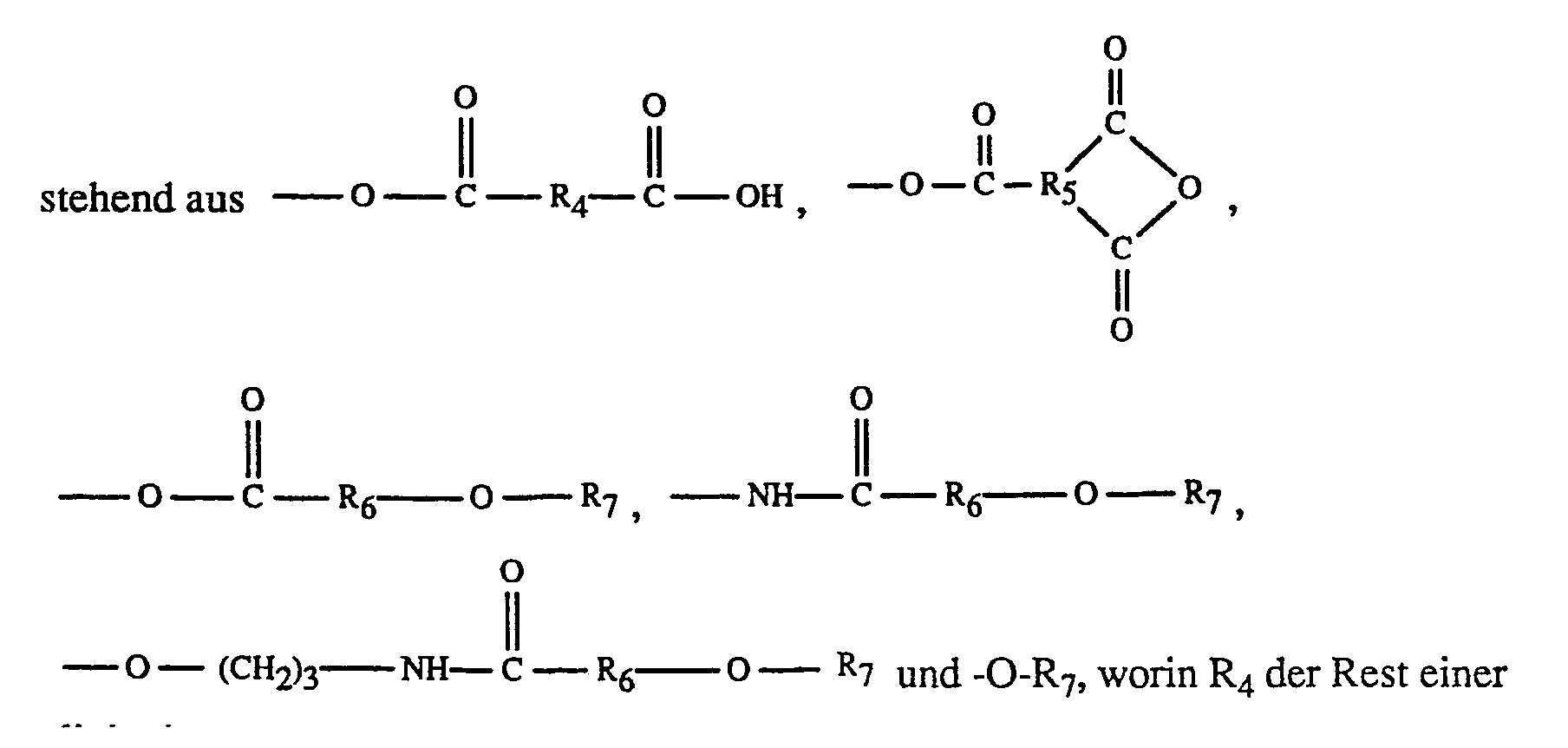
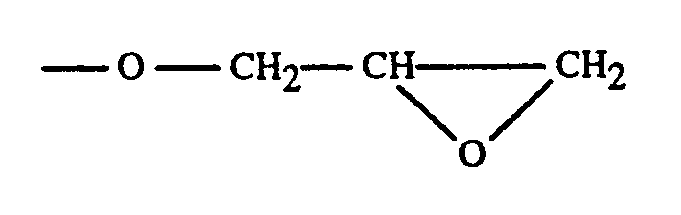
- Beispiele für R₄ als aliphatische, cycloaliphatische oder aromatische Dicarbonsäure sind weiter oben als Bildungskomponenten für Glycidylester A) aufgeführt.
- R₄ ist vorzugsweise ein unverzweigter C₂-C₁₂Alkylenrest, ein unsubstituierter oder methylsubstituierter Phenylenrest oder ein unsubstituierter Naphthylenrest.
- R₅ ist vorzugsweise ein Rest der Trimesinsäure oder insbesondere ein Rest der Trimellitsäure.
- R₆ ist vorzugsweise ein unsubstituierter oder methylsubstituierter Phenylenrest oder ein unsubstituierter Naphthylenrest.
- Als Komponente C2) der erfindungsgemässen Zusammensetzungen lassen sich beliebige elastomere carboxyl-, hydroxyl-, mercapto- oder glycidylether-terminierte Copolymere auf Basis von Butadien, einem polaren, ethylenisch ungesättigten Comonomeren und gegebenenfalls weiteren ethylenisch ungesättigten Comonomeren verwenden.
- Beispiele für polare, ethylenisch ungesättigte Comonomere zur Herstellung von Komponente C2) sind Acrylsäure, Methacrylsäure, Ester der Acryl- oder Methacrylsäure, beispielsweise die Methyl- oder Ethylester, Amide der Acryl- oder Methacrylsäure, sowie Fumarsäure, Itaconsäure, Maleinsäure oder deren Ester und Halbester, oder Maleinsäure- oder Itaconsäureanhydrid; Vinylester, beispielswiese Vinylacetat; polare Styrole, wie kernchlorierte oder kernbromierte Styrole; oder Methacrylnitril oder insbesondere Acrylnitril.
- Neben polaren, ethylenisch ungesättigten Comonomeren können zur Herstellung von Komponente C2) noch weitere unpolare, ethylenisch ungesättigte Comonomere eingesetzt werden. Beispiele dafür sind Ethylen, Propylen, oder insbesondere Styrol oder substituierte Styrole, wie Vinyltoluol.
- Bei Komponente C2) kann es sich um statistische Copolymere, Block-Copolymere oder Pfropf-Copolymere handeln. Diese Komponente kann fest, insbesondere pulverförmig, oder flüssig sein, solange sich in Kombination mit Komponente C1) eine flüssige Mischung damit herstellen lässt. Komponente C2) ist im allgemeinen ein Elastomeres oder ein thermoplastisches Elastomeres. Komponente C2) ist ganz besonders bevorzugt ein flüssiges Elastomeres.
- Die durchschnittlichen Molekulargewichte (Zahlenmittel) der bevorzugten flüssigen Butadien-Copolymeren betragen im allgemeinen 500-10'000, insbesondere 1'000-5'000.
- Bevorzugte Komponenten C2) sind carboxyl-, hydroxyl-, mercapto- oder glycidyletherterminierte, flüssige, elastomere Copolymere auf Basis von Butadien und Acrylnitril. Beispiele für solche Verbindungen sind Kautschuke vom Typ Hycar® der Fa. B.F.Goodrich.
- Carboxyl- oder carbonsäureanhydrid-terminierte Komponenten C2) lassen sich auch durch Verkappen von hydroxyl-terminierten Butadien-Copolymeren C2) mit Polycarbonsäuren, deren Anhydriden oder anderen esterbildenden Derivaten erhalten. Beispiele für mögliche Verkappungskomponenten sind die weiter oben als Bildungskomponenten für Polyglycidylester aufgezählten Polycarbonsäuren.
- Glycidyl-terminierte Komponenten C2) lassen sich auch durch Umsetzung von hydroxylterminierten Butadien-Copolymeren C2) mit Epichlorhydrin oder mit β-Methylepichlorhydrin in der weiter oben bei der Herstellung von Glycidylethern beschriebenen Weise herstellen.
- Bevorzugte Typen flüssiger Butadienelastomerer C2) enthalten die Strukturelemente der Formeln VIa bis VId und die Endgruppen Q

- Der Acrylnitrilgehalt der bevorzugten flüssigen Butadien-Copolymeren beträgt im allgemeinen weniger als 50 Gew.%, insbesondere 8 bis 30 Gew.%, bezogen auf den Gesamtmonomergehalt.
- Komponente C2) kann auch in Form eines Adduktes eines Butadien-Acrylnitril Copolymeren mit den oben beschriebenen gegenüber Epoxidgruppen reaktiven funktionellen Gruppen an ein Epoxidharz eingesetzt werden.
- Die Herstellung solcher Addukte erfolgt in an sich bekannter Weise durch Erhitzen des reaktiven Butadien-Elastomeren und des Epoxidharzes mit gegebenenfalls einem Katalysator, wie Triphenylphosphin, einem tertiären Amin, einem tertiären Ammonium- oder Phosphoniumsalz oder Chrom-Acetylacetonat, so dass ein schmelzbares aber noch härtbares Vorkondensat entsteht.
- Der Anteil der Comonomeren zueinander in Komponente C2) kann in weiten Bereichen schwanken. Diese Komponente wird so gewählt, dass sie mit dem Epoxidharz A) und dem Härter B) verträglich ist. Dazu ist es im allgemeinen erforderlich, dass die Differenz der Löslichkeitsparameter der Mischungsbestandteile kleiner als 1,0, insbesondere kleiner als 0,6 ist. Solche Löslichkeitsparamter lassen sich beispielsweise nach Small's Methode [J.Appl.Chem., 3, 71 (1953)] berechnen. Die Anwendung von Löslichkeitsparametern bei der Ermittlung von Verträglichkeiten von Polymergemischen wurde beispielsweise von C.B. Bucknall in "Toughened Plastics". Kapitel 2, Applied Science Publishers Ltd., London 1977, beschrieben.
- Ganz besonders bevorzugte Komponenten C) sind segmentierte Copolymere mit Hydroxyl-, Carboxyl-, Carbonsäureanhydrid- oder Glycidylendgruppen enthaltend Blöcke auf Basis der Komponenten C1) und C2), die über die weiter oben definierten funktionellen Gruppen miteinander verknüpft sind.
- Diese Copolymeren weisen im allgemeinen ein mittleres Molekulargewicht (Zahlenmittel) von 1'000 bis 20'000, bevorzugt von 3'000 bis 10'000, auf.
- Ueber -CO-X- Gruppen miteinander verknüpfte segmentierte Copolymere C) lassen sich durch Umsetzung von carboxyl- oder carbonsäureanhydrid-terminierten Komponenten C1) mit hydroxyl-, mercapto- oder amino-terminierten Komponenten C2) oder durch Umsetzung von hydroxyl-, mercapto- oder amino-terminierten Komponenten C1) mit carboxyl- oder carbonsäureanhydrid-terminierten Komponenten C2) erhalten.
- Ueber -Y-CH₂-CH(OH)-CH₂-O- Gruppen miteinander verknüpfte segmentierte Copolymere C) lassen sich durch Umsetzung von carboxyl-, carbonsäureanhydrid-, hydroxyl-, mercapto- oder amino-terminierten Komponenten C1) mit glycidylether-terminierten Komponenten C2) oder durch Umsetzung von glycidylether-terminierten Komponenten C1) mit carboxyl-, carbonsäureanhydrid-, hydroxyl-, mercapto- oder amino-terminierten Komponenten C2) erhalten.
- Bei diesen Umsetzungen werden die Mengen der Reaktionspartner im allgemeinen so gewählt, dass die reaktiven Gruppen einer der Komponenten im wesentlichen durch die Reaktion verbraucht werden, während die reaktiven Gruppen der anderen Komponente zum Teil erhalten bleiben und die Endgruppen der Komponente C) bilden oder durch Verkappung mit einem Verkappungsmittel in die definitionsgemässen Endgruppen übergeführt werden.
- Die Umsetzungen erfolgen im allgemeinen durch Erhitzen der Bildungskomponenten der segmentierten Copolymeren in Gegenwart oder in Abwesenheit eines inerten Lösungsmittels.
- Die miteinander zu reagierenden Komponenten C1) und C2) werden, je nach Funktionaliät dieser Komponenten, so ausgewählt, dass ein bei Temperaturen bis zu etwa 40°C flüssiges segmentiertes Copolymeres erhalten wird. So wird beim Vorliegen einer difunktionellen Komponente eine weitere höher funktionelle Komponente verwendet werden können, während Kombinationen mehrerer höherfunktioneller Komponenten in der Regel zu übermässiger Vernetzung und zur Ausbildung von Gelen führen. Die Auswahlkriterien zur Herstellung der Komponente C) mit der oben angegebenen Spezifikation sind dem Fachmann auf dem Gebiet der Polymerisation an sich bekannt.
- Die carboxyl-, carbonsäureanhydrid-, hydroxyl-, mercapto-, glycidylether- oder amino-terminierten Ausgangsprodukte zur Herstellung der segmentierten Copolymeren C) sind an sich bekannt oder können durch an sich bekannte Verfahren erhalten werden.
- Die Herstellung von carboxyl-, carbonsäureanhydrid-, hydroxyl- oder glycidylether-terminierten Polyalkylenglykolen ist weiter oben bei der Herstellung von Komponente C1) beschrieben.
- Amino-terminierte Polyalkylenglykole leiten sich beispielsweise von den oben beschriebenen hydroxyl-terminierten Polyalkylenglykolen ab, indem man solche Verbindungen enthaltend primäre Hydroxylgruppen, beispielsweise Polybutylenglykol, mit Acrylnitril umsetzt und die Produkte anschliessend hydriert, oder indem man solche Verbindungen enthaltend sekundäre Hydroxylgruppen mit Ammoniak umsetzt. Geeignete amino-terminierte Polypropylenglykole sind die kommerziell unter der Bezeichnung "Jeffamine®" von der Firma Texaco erhältlichen Verbindungen.
- Mercapto-terminierte Polyalkylenglykole lassen sich beispielsweise durch Umsetzung der entsprechenden hydroxyl- oder amino-terminierten Polyalkylenglykole mit Mercaptocarbonsäuren oder deren Estern, wie Mercaptoessigsäure(estern), oder durch Anlagerung von Episulfiden an hydroxyl- oder amino-terminierte Polyalkylenglykole erhalten.
- Die Herstellung von carboxyl-, carbonsäureanhydrid-, hydroxyl- oder glycidylether-terminierten Butadien-Copolymeren ist weiter oben bei der Herstellung von Komponente C2) beschrieben. Mercapto- und amino-terminierte Butadien-Copolymere sind teilweise im Handel erhältlich und können in Analogie zu den Polyalkylenglykolderivaten durch Verkappen von hydroxyl-terminierten Derivaten hergestellt werden.
- Bevorzugte segmentierte Copolymere C) leiten sich von im wesentlichen difunktionellen Komponenten C1) und C2) ab.
- Ganz besonders bevorzugte segmentierte Copolymere C) sind Verbindungen enthaltend Blöcke, die sich von flüssigen Butadien-Acrylnitril Copolymeren ableiten und enthaltend Blöcke, die sich von difunktionellen Polybutylenglykolen oder von tri- oder insbesondere von difunktionellen Polypropylenglykolen ableiten.
- Ganz besonders bevorzugt verwendet man segmentierte Copolymere C) der Formel VI
Z⁅PAG-X₁-BDC⁆X₁-PAG-Z (VI),
worin n eine ganze Zahl von 1 bis 10, insbesondere 1 ist, PAG der Rest eines difunktionellen Polypropylenglykols oder Polybutylenglykols nach dem Entfernen der funktionellen Gruppen ist, BDC der Rest eines difunktionellen flüssigen Butadien-Acrylnitril Copolymeren nach dem Entfernen der funktionellen Gruppen ist, X₁ eine Brückengruppe der Formeln -CO-X- bzw. -X-CO- oder -Y-CH₂-CH(OH)-CH₂-O- bzw. -O-CH₂-CH(OH)-CH₂-Y- ist, worin X, Y und die Endgruppen Z die oben definierte Bedeutung besitzen. - Komponenten A), B) und C) der erfindungsgemässen Zusammensetzungen sollten miteinander verträglich sein. Die Auswahl dieser Komponenten erfolgt im allgemeinen so, dass im härtbaren Gemisch keine sichtbare Phasentrennung erfolgt. Komponenten B) und C) sollten sich zumindest bei erhöhter Temperatur im Epoxidharz A) lösen. Komponenten A), B) und C) werden vorzugsweise so ausgewählt, dass bei der Härtung der Zusammensetzung ein Mehrphasensystem entsteht.
- Zum Erzielen von Produkten mit hoher Festigkeit, Glasübergangstemperatur, Schälfestigkeit, Schlagzähigkeit und Rissfortpflanzungsbeständigkeit (Risszähigkeit), wird der Anteil der Komponente C), bezogen auf die Menge an A), B) und C), im allgemeinen 40 Gew.% nicht überschreiten. Die untere Grenze richtet sich nach den gewünschten Eigenschaften, beispielsweise der Schälfestigkeit. In der Regel sollte Komponente C) mehr als 5 Gew.%, bevorzugt mehr als 10 Gew.%, ausmachen. Bevorzugt werden Zusammensetzungen mit einem Anteil der Komponente C) von etwa 10 bis etwa 30 Gew.%, bezogen auf die Menge von A), B) und C).
- Das Gewichtsverhältnis von C1) zu C2) bzw. das Gewichtsverhältnis der Polyalkylenglykol- und elastomeren Copolymersegmente im Copolymeren C) kann in weiten Bereichen variiert werden. Bevorzugter Bereich von C1) zu C2) bzw. der Polyalkylenglykol- zu den elastomeren Copolymersegmenten ist 50:1 bis 1:50, insbesondere 5:1 bis 1:5.
- Die Menge an Härter B), bezogen auf das Epoxidharz A), ist im allgemeinen vom verwendeten Härtertyp abhängig und dem Fachmann an sich bekannt. In der Regel setzt man solche Mengen an Komponente B) ein, so dass auf eine Epoxidgruppe etwa 0,7 bis 0,8 Anhydridgruppen des Härters entfallen.
- Die erfindungsgemässen Zusammensetzungen enthalten gegebenenfalls noch einen Härtungsbeschleuniger D). Art und Menge von Komponente D) hängen in der Regel vom verwendeten Härtertyp ab und sind dem Fachmann auf der Gebiet der Epoxidhärtung an sich bekannt. Einzelheiten findet man im "Epoxy-Handbook" von Lee and Neville (Mc Graw Hill, New York 1967). Bevorzugte Härtungsbeschleuniger sind tertiäre Amine, wie Benzyldimethylamin.
- Die erfindungsgemässen Zusammensetzungen können durch Vermischen ihrer Komponenten in den dafür üblichen Einrichtungen hergestellt werden.
- Die Härtungstemperaturen der erfindungsgemässen Zusammensetzungen liegen vorzugsweise zwischen 80 und 280°C, besonders bevorzugt zwischen 100 und 200°C.
- Die Härtung kann gewünschtenfalls auch in zwei Stufen vorgenommen werden, indem man z.B. den Härtungsvorgang unterbricht oder die härtbare Mischung bei tieferen Temperaturen teilweise härten lässt. Die dabei erhaltenen Produkte sind noch schmelzbare und lösliche Präkondensate (sogenannte "B-Stufenharze") und eignen sich beispielsweise als Pressmassen, Sinterpulver oder zur Herstellung von Prepregs.
- Gewünschtenfalls kann man den härtbaren Gemischen zur Herabsetzung der Viskosität reaktive Verdünner, wie z.B. Styroloxid, Butylglycidylether, 2,2,4-Trimethylpentylglycidylether, Phenylglycidylether, Kresylglycidylether oder Glycidylester von synthetischen, hochverzweigten, in der Hauptsache tertiären aliphatischen Monocarbonsäuren, zusetzen.
Als weitere übliche Zusätze können die erfindungsgemässen Gemische ferner Weichmacher, Streck-, Füll- und Verstärkungsmittel, wie beispielsweise Steinkohlenteer, Bitumen, Textilfasern, Glasfasern, Asbestfasern, Borfasern, Kohlenstoff-Fasern, mineralische Silikate, Glimmer, Quarzmehl, Aluminiumoxidhydrat, Bentonite, Wollastonit, Kaolin, Kieselsäureaerogel oder Metallpulver, z.B. Aluminiumpolver oder Eisenpulver, ferner Pigmente und Farbstoffe, wie Russ, Oxidfarben und Titandioxid, sowie Flammschutzmittel, Thixotropiemittel, Verlaufmittel (die zum Teil auch als Formtrennmittel Anwendung finden), wie Silicone, Wachse und Stearate, oder Haftvermittler, Antioxidantien und Lichtschutzmittel enthalten. - Die erfindungsgemässen Zusammensetzungen lassen sich ganz allgemein als Giessharze zur Herstellung von gehärteten Produkten einsetzen, und können in der dem jeweils speziellen Anwendungsgebiet angepassten Formulierung, beispielsweise als Klebmittel, als Matrixharze, als Elektrogiessharze oder als Oberflächenbeschichtungsmittel verwendet werden.
- Die erfindungsgemässen härtbaren Zusammensetzungen sind in der Regel bei Raumtemperatur flüssig. Sie lassen sich auf jeden Fall bei Temperaturen von 40°C vergiessen.
- Die erfindungsgemässen härtbaren Zusammensetzungen eignen sich insbesondere zum Vergiessen und Umhüllen von Elektro- und Elektronik-Komponenten, oder zur Herstellung von Verbundwerkstoffen.
- Die Erfindung betrifft auch die Verwendung der härtbaren Gemische für die oben erwähnten Zwecke.
- Die gehärteten Produkte zeichnen sich durch die eingangs geschilderten vorteilhaften und überraschenden Eigenschaften aus. Die Erfindung betrifft daher auch die Produkte, die durch Erhitzen der erfindungsgemässen Zusammensetzungen erhältlich sind.
- Die folgenden Beispiele erläutern die Erfindung.
- Eine Mischung aus 730 g Bisphenol A-diglycidether (Epoxidgehalt 5,4 Äqu./kg), 200 g carboxylterminiertem Acrylnitril/Butadien Copolymeren (26% Acrylnitrilgehalt, Säurezahl 32 mg KOH/g), 64 g Bisphenol A und 5 g Triphenylphosphin wird 3 Stunden bei 130°C erhitzt bis sich ein viskoses Harz mit einem Epoxidgehalt von 3,3 Äqu./kg mit einer Viskosität nach Epprecht von 130'000 mPas (40°C) bildet.
- Eine Mischung aus 450 g Polypropylenglykoltriol mit dem Molekulargewicht Mn = 4'500 (Baygal® K390 der Firma Bayer AG) und 180 g eines carboxylterminierten Butadien/Acrylnitril-Copolymers (26% Acrylnitrilgehalt, Säurezahl 32 mg KOH/g) wird 8 Stunden bei 220°C unter leichtem Stickstoffstrom erhitzt, wobei Wasser abdestilliert. Man erhält ein Harz mit den folgenden Analysedaten:
Viskosität (nach Epprecht): 6'400 mPas (25°C);
Molekulargewicht (GPC, in THF): Mn = 7700, Mw/Mn = 1,4. - Eine Mischung aus 867 g carboxylterminiertem Butadien/Acrylnitril-Copolymer (26% Acrylnitrilgehalt, 35 mg KOH/g Säuregehalt) und 667 g dihydroxylterminiertem Polytetrahydrofuran mit dem Molekulargewicht Mn = 1'000 wird 8 Stunden bei 220°C unter leichtem Stickstoffstrom erhitzt, wobei Wasser abdestilliert. Man erhält ein Harz mit den folgenden Analysedaten:
Viskosität (nach Epprecht): 66'560 mPas (25°C);
Hydroxylgruppengehalt: 1,65 Gew.-%;
Molekulargewicht (GPC, in THF): Mn = 4750, Mw/Mn = 3,7. - Eine Mischung aus 350 g eines Polypropylenglykoldiglycidethers (Epoxidgehalt: 2,5 Äqu./kg), 936 g eines carboxylterminierten Butadien/Acrylnitril-Copolymers (26% Acrylnitrilgehalt, 35 mg KOH/g Säuregehalt) und 0,5 g Triphenylphosphin wird 7 Stunden auf 140°C erhitzt, und man erhält ein Harz mit den folgenden Analysedaten:
Viskosität (nach Epprecht): 327'680 mPas (25°C);
Molekulargewicht (GPC, in THF): Mn = 5'390, Mw/Mn = 4,9;
Epoxidgehalt: 0,34 Äqu./kg. - Dihydroxylterminiertes Polytetrahydrofuran (Mn = 1'000) wird von BASF AG bezogen.
- Polypropylenglykoltriol (Mn = 4'500) wird unter dem Handelsnamen Baygal® K390 von Bayer AG bezogen.
- Das carboxylterminierte Butadien/Acrylnitril-Copolymer mit 26 % Acrylnitril und einer Säurezahl von 35 mg KOH/g wird als Hycar® CTBN 1300X13 von der Firma B.F. Goodrich bezogen.
- Eine Mischung aus 433 g Butadien/Acrylnitril-Copolymer (26 % Acrylnitril, Säurezahl 32 mg KOH/g), 500 g Diglycidylether des Polytetrahydrofurans (790 mPas bei 25°C, Epoxidgehalt 1,2 Eq/kg, Zahlenmittel des Molekulargewichtes Mn = 1'280) und 0,5 g Triphenylphosphin werden 2 Stunden auf 150°C und 6 Stunden auf 180°C erhitzt bis sich ein viskoses Harz mit den folgenden Analysedaten bildet:
Viskosität nach Epprecht: 76'800 mPas (25°C);
Molekulargewicht (GPC in THF): Mn = 4'950, Mw/Mn = 6,3;
Epoxidgehalt: 0,39 Äqu./kg. - Eine Mischung aus 160 g Butadien/Acrylnitril-Copolymer (26 % Acrylnitril, Säurezahl 32 mg KOH/g) und 100 g dihydroxylterminiertes Polytetrahydrofuran mit einem Molekulargewicht von 1'000 wird 8 Stunden auf 220°C unter einem leichten Stickstoffstrom erhitzt. Man erhält ein viskoses Harz mit den folgenden Analysedaten:
Hydroxylgruppengehalt: 0,67 Äqu./kg;
Viskosität nach Epprecht: 261'120 mPas (25°C);
Molekulargewicht (GPC in THF): Mn = 5'770, Mw/Mn = 6,0. - Eine Mischung aus 100 g Butadien/Acrylnitril-Copolymer (26 % Acrylnitril, Säurezahl 32 mg KOH/g) und 125 g dihydroxylterminiertes Polytetrahydrofuran mit einem Molekulargewicht von 2'000 wird 8 Stunden unter leichtem Stickstoffstrom auf 220°C erhitzt bis sich ein viskoses Harz mit den folgenden Analysedaten bildet:
Hydroxylgruppengehalt: 0,53 Äqu./kg;
Viskosität nach Epprecht: 87'040 mPas (40°C);
Molekulargewicht (GPC in THF): Mn = 6'470, Mw/Mn = 5,7. - Eine Mischung aus 106,7 g Butadien/Acrylnitril-Copolymer (26 % Acrylnitril, Säurezahl 32 mg KOH/g) und 133,3 g dihydroxylterminiertes Polypropylenglykol mit einem Molekulargewicht von Mn = 2'000 wird 8 Stunden unter leichtem Stickstoffstrom auf 220°C erhitzt bis sich ein viskoses Harz mit den folgenden Analysedaten bildet:
Viskosität nach Epprecht: 22'400 mPas (25°C);
Molekulargewicht (GPC in THF): Mn = 6'800, Mw/Mn = 5,5. - Eine Mischung aus 144,3 g Butadien/Acrylnitril-Copolymer (18 % Acrylnitril) und 111 g dihydroxylterminiertes Polytetrahydrofuran des Molekulargewichts 1'000 wird unter leichtem Stickstoffstrom auf 220°C erhitzt bis sich ein viskoses Harz mit den folgenden Analysedaten bildet:
Hydroxylgruppengehalt: 0,71 Äqu./kg;
Viskosität nach Epprecht: 110'080 mPas (25°C);
Molekulargewicht (GPC in THF): Mn = 5'650, Mw/Mn = 5,9. - Eine Mischung aus carboxylterminiertem Polybutadien (kommerziell von B.F. Goodrich als Hycar® CTB 2000x162 erhältlich) und 111 g eines glycidylierten Polytetrahydrofurans (Viskosität nach Epprecht 790 mPas bei 25°C, 1,2 Äqu. Epoxid/kg, Mn = 1'280) wird in Gegenwart von 0,2 g Triphenylphosphin 8 Stunden auf 165°C erhitzt bis ein viskoses Harz mit den folgenden Analysedaten erhalten wird:
Epoxidgehalt: 0,42 Äqu./kg;
Viskosität nach Epprecht: 29'440 mPas (25°C);
Molekulargewicht (GPC in THF): 2'670, Mw/Mn = 10,1. - Wie in Tabelle I beschrieben werden 4 mm-dicke Platten hergestellt, wobei man ein Bisphenol A-diglycidether (Epoxidgehalt 5,4 Äqu./kg) mit dem Anhydrid der Methyl-bicyclo[2.2.1.]hept-5-en-2,3-dicarbonsäure (Methylnadicanhydrid) in Gegenwart von katalytischen Mengen Benzyldimethylamin und verschiedenen Mengen von Präpolymeren I.1 bis I.7 härtet. Die Härtung erfolgt 6 Stunden bei 150°C. Es werden härtbare Mischungen enthaltend als Komponente C Blockcopolymere (Beispiele II.1-II.5) oder Präpolymerblends (Beispiele II.6-II.9) geprüft.
- Die folgenden Materialprüfungen werden durchgeführt:
Viskosität der ungehärteten Mischung nach der Methode Epprecht (mPas bei 25°C);
Glasübergangstemperatur des gehärteten Produkts gemessen mittels thermomechanischer Analyse (TMA) mittels DuPont 9000 Thermoanalysegerät;
Zugscherfestigkeit auf entfettetem Aluminium gemäss DIN 53285;
Zugfestigkeit gemäss DIN 53455;
Reissdehnung gemäss DIN 53455;
Biegefestigkeit gemäss DIN 53452;
Randfaserdehnung gemäss DIN 53452;
Schlagzähigkeit (Charpy) gemäss DIN 53453;
Bruchzähigkeit GIc im Bend Notch Test, wobei der Riss mittels Rasierklinge initiiert wird;
Elastizitätsmodul aus Zugversuch gemäss DIN 53455;
Elastizitätsmodul aus Biegeversuch gemäss DIN 53452; - Die Mengenangaben in der folgenden Tabelle I sind Gewichtsteile.
Tabelle I Geprüfte Formulierungen Beispiel Nr. II.1. II.2. II.3. II.4. II.5. II.6. II.7. II.8. II.9. Bisphenol A-diglycidylether (Epoxidgehalt: 5,4 Äqu./kg) 100 100 100 100 100 100 100 100 100 Methylnadicanhydrid 81,7 81,7 81,7 81,7 81,7 102,3 81,7 81,7 102,3 Benzyldimethylamin 3,6 3,6 3,6 3,6 3,6 4,0 3,6 3,6 4,0 Präpolymer 1 40 40 Präpolymer 2 24 48 80 Präpolymer 3 48 Präpolymer 4 48 Präpolymer 5 40 Präpolymer 6 40 40 40 Präpolymer 7 8 40 Viscosität bei 25°C(mPas) 15'360 12'800 9'280 26'560 35'840 22'400 11'520 23'360 26'880 Tg(TMA) (°C) 119 117 92 84-108 107 83 100 23+83 111 Zugscherfestigkeit (N/mm²) 18,5 18,2 15,2 24,7 23,5 19,0 20,3 18,0 19,7 Zugfestigkeit (N/mm) 67,4 47,5 24,2 49,3 43,9 59,5 44,8 29,3 51,5 Reissdehnung (%) 4,3 7,7 21,1 9,8 8,2 7,3 10,9 45,0 7,7 Biegefestigkeit (MPa) 111,4 80,7 37,0 78,9 13,0 103,4 74,4 44,0 86,2 Randfaserdehnung (%) 6,6 12,4 - 12,6 - 12,8 - 12,6 10,6 Schlagzähigkeit (kJ/m²) 28,4 35,3 40,7 52,8 36,9 41,7 41,0 62,8 28,6 Bruchzähigkeit (kJ/m²) 0,91 1,14 1,09 1,93 1,78 0,66 0,55 0,9 0,82 E-Modul (Zug) (N/mm²) 2444 1874 903 1833 1729 2407 1642 1002 1925 E-Modul (Biegung) (N/mm²) 2427 1837 894 1814 1799 2420 1711 1039 1946
Claims (12)
1. Härtbare Zusammensetzungen enthaltend
A) ein Epoxidharz mit durchschnittlich mehr als einer Epoxidgruppe pro Molekül,
B) einen Carbonsäureanhydridhärter für Komponente A), und
C) etwa 5 bis 40 Gew.%, bezogen auf die Menge der Komponenten A), B) und C), einer flüssigen Mischung aus C1) einem Polyalkylenglykol auf Basis von Polypropylenglykol oder Polybutylenglykol mit zwei bis etwa sechs Hydroxyl-, Carboxyl-, Carbonsäureanhydrid- oder Glycidylendgruppen und aus C2) einem elastomeren Copolymeren auf Basis von Butadien, einem polaren, ethylenisch ungesättigten Comonomeren und gegebenenfalls weiteren ethylenisch ungesättigten Comonomeren mit Carbonsäure-, Hydroxyl-, Mercapto- oder Glycidyletherendgruppen.
2. Härtbare Zusammensetzungen enthaltend
A) ein Epoxidharz mit durchschnittlich mehr als einer Epoxidgruppe pro Molekül,
B) einen Carbonsäureanhydridhärter für Komponente A), und
C) etwa 5 bis 40 Gew.%, bezogen auf die Menge der Komponenten A), B) und C), eines flüssigen segmentierten Copolymeren mit Hydroxyl-, Carboxyl-, Carbonsäureanhydrid- oder Glycidylendgruppen enthaltend mindestens einen Block, der sich von einem Polyalkylenglykol auf Basis von Polypropylenglykol oder Polybutylenglykol ableitet und mindestens einen Block, der sich von einem elastomeren Copolymeren auf Basis von Butadien, einem polaren, ethylenisch ungesättigten Comonomeren und gegebenenfalls weiteren ethylenisch ungesättigten Comonomeren ableitet, wobei besagte Blöcke über gleiche oder verschiedene funktionelle Gruppen -CO-X- oder -Y-CH₂-CH(OH)-CH₂-O- verbunden sind, worin X -O-, -S- oder -NR₁- bedeutet, Y -O-, -S-, -NR₁- oder -CO-O- ist und R₁ Wasserstoff, Alkyl, Cycloalkyl, Aryl oder Aralkyl ist.
3. Härtbare Zusammensetzungen gemäss Ansprüchen 1 oder 2, dadurch gekennzeichnet, dass Komponente A) ein cycloaliphatisches Epoxidharz oder ein Polyglycidylether ist, insbesondere ein Diglycidylether auf Bisphenol Basis.
4. Härtbare Zusammensetzung gemäss Anspruch 3, dadurch gekennzeichnet, dass Komponente A) ein flüssiger Digylcidylether auf Basis von Bisphenol A ist.
5. Härtbare Zusammensetzungen gemäss Ansprüchen 1 oder 2, dadurch gekennzeichnet, dass Komponente B) ein Anhydrid von aliphatischen, cycloaliphatischen oder aromatischen Dicarbonsäuren ist, insbesondere ein Anhydrid von Dicarbonsäuren oder ein Gemisch dieser Anhydride, das bei Temperaturen unterhalb von 40°C flüssig ist.
6. Härtbare Zusammensetzungen gemäss Anspruch 1, dadurch gekennzeichnet, dass Komponente C1) ein drei- und insbesondere ein zweiwertiges carboxyl-, carbonsäureanhydrid-, glycidyl- und insbesondere hydroxyl-terminiertes Polypropylen- oder Polybutylenglykol mit einem durchschnittlichen Molekulargewicht (Zahlenmittel) zwischen 500 und 5'000 ist.
7. Härtbare Zusammensetzungen gemäss Anspruch 6, dadurch gekennzeichnet, dass Komponente C1) eine Verbindung der Formeln I bis V ist

worin y 5 bis 90, insbesondere 10 bis 90, bedeutet, z 10 bis 40 ist, R₂ ein Rest eines aliphatischen Diols oder eines Bisphenols nach dem Entfernen der beiden OH-Gruppen ist, R₃ einen Rest eines aliphatischen Triols oder eines Trisphenols nach dem Entfernen der drei OH-Gruppen bedeutet und Z ein Rest ist, der ausgewählt wird aus der Gruppe

aliphatischen, cycloaliphatischen oder aromatischen Dicarbonsäure nach dem Entfernen der beiden Carboxylgruppen ist, R₅ der Rest einer aromatischen Tricarbonsäure nach dem Entfernen der drei Carboxylgruppen ist, R₆ der Rest einer aromatischen Hydroxycarbonsäure nach dem Entfernen der Carboxyl- und der phenolischen Hydroxylgruppe ist und R₇ Wasserstoff ist oder eine Gruppe der Formel

bedeutet.
8. Härtbare Zusammensetzungen gemäss Anspruch 1, dadurch gekennzeichnet, dass Komponente C2) ein carboxyl-, hydroxyl-, mercapto- oder glycidylether-terminiertes, flüssiges, elastomeres Copolymeres auf Basis von Butadien und Acrylnitril ist oder ein Addukt dieses Copolymeren an ein Epoxidharz ist.
9. Härtbare Zusammensetzungen gemäss Anspruch 2, dadurch gekennzeichnet, dass Komponente C) Blöcke enthält, die sich von flüssigen Butadien-Acrylnitril Copolymeren und von difunktionellen Polybutylenglykolen oder von tri- oder insbesondere von difunktionellen Polypropylenglykolen ableiten.
10. Härtbare Zusammensetzungen gemäss Anspruch 9 dadurch gekennzeichnet, dass Komponente C) ein segmentiertes Copolymeres der Formel VI ist
Z⁅PAG-X₁-BDC⁆ X₁-PAG-Z (VI),
worin n eine ganze Zahl von 1 bis 10 ist, PAG der Rest eines difunktionellen Polypropylenglykols oder Polybutylenglykols nach dem Entfernen der funktionellen Gruppen ist, BDC der Rest eines difunktionellen flüssigen Butadien-Acrylnitril Copolymeren nach dem Entfernen der funktionellen Gruppen ist, X₁ eine Brückengruppe der Formeln -CO-X- bzw. -X-CO- oder -Y-CH₂-CH(OH)-CH₂-O- bzw. -O-CH₂-CH(OH)-CH₂-Y- ist, worin X und Y eine der in Anspruch 2 definierten Bedeutungen besitzen und die Endgruppen Z eine der in Anspruch 7 definierten Bedeutungen besitzen.
Z⁅PAG-X₁-BDC⁆
worin n eine ganze Zahl von 1 bis 10 ist, PAG der Rest eines difunktionellen Polypropylenglykols oder Polybutylenglykols nach dem Entfernen der funktionellen Gruppen ist, BDC der Rest eines difunktionellen flüssigen Butadien-Acrylnitril Copolymeren nach dem Entfernen der funktionellen Gruppen ist, X₁ eine Brückengruppe der Formeln -CO-X- bzw. -X-CO- oder -Y-CH₂-CH(OH)-CH₂-O- bzw. -O-CH₂-CH(OH)-CH₂-Y- ist, worin X und Y eine der in Anspruch 2 definierten Bedeutungen besitzen und die Endgruppen Z eine der in Anspruch 7 definierten Bedeutungen besitzen.
11. Verwendung der härtbaren Zusammensetzungen gemäss Anspruch 1 oder 2 zum Vergiessen und Umhüllen von Elektro- und Elektronik-Komponenten oder zur Herstellung von Verbundwerkstoffen.
12. Gehärtete Produkte erhältlich durch Erhitzen der härbaren Zusammensetzungen gemäss Anspruch 1 oder 2.
Applications Claiming Priority (2)
| Application Number | Priority Date | Filing Date | Title |
|---|---|---|---|
| CH67489 | 1989-02-24 | ||
| CH674/89 | 1989-02-24 |
Publications (1)
| Publication Number | Publication Date |
|---|---|
| EP0384896A1 true EP0384896A1 (de) | 1990-08-29 |
Family
ID=4192515
Family Applications (1)
| Application Number | Title | Priority Date | Filing Date |
|---|---|---|---|
| EP90810111A Withdrawn EP0384896A1 (de) | 1989-02-24 | 1990-02-15 | Zähe Epoxidgiessharze |
Country Status (4)
| Country | Link |
|---|---|
| US (1) | US5140069A (de) |
| EP (1) | EP0384896A1 (de) |
| JP (1) | JPH02248423A (de) |
| CA (1) | CA2010649A1 (de) |
Cited By (2)
| Publication number | Priority date | Publication date | Assignee | Title |
|---|---|---|---|---|
| EP1935904A1 (de) * | 2006-12-22 | 2008-06-25 | Sika Technology AG | Ester-vorverlängerte Epoxidgruppen terminierte Zähigkeitsverbesserer und Verfahren zu deren Herstellung |
| CN101056934B (zh) * | 2004-11-10 | 2010-09-29 | 陶氏环球技术公司 | 两性嵌段共聚物改性的环氧树脂以及由此制造的粘合剂 |
Families Citing this family (17)
| Publication number | Priority date | Publication date | Assignee | Title |
|---|---|---|---|---|
| US5260130A (en) * | 1989-09-29 | 1993-11-09 | Shin-Etsu Chemical Co., Ltd. | Adhesive composition and coverlay film therewith |
| US5602193A (en) * | 1995-10-31 | 1997-02-11 | Shell Oil Company | Aqueous dispersions of epoxy resins |
| US5741835A (en) * | 1995-10-31 | 1998-04-21 | Shell Oil Company | Aqueous dispersions of epoxy resins |
| US5698631A (en) * | 1996-05-30 | 1997-12-16 | Uniroyal Chemical Company, Inc. | Epoxy resin compositions for encapsulating signal transmission devices |
| SG97811A1 (en) * | 1999-09-24 | 2003-08-20 | Advanpack Solutions Pte Ltd | Fluxing adhesive |
| JP4099761B2 (ja) * | 2003-01-30 | 2008-06-11 | 太陽誘電株式会社 | 電子材料用組成物、電子用品及び電子材料用組成物の使用方法 |
| DE602005019190D1 (de) * | 2004-11-10 | 2010-03-18 | Dow Global Technologies Inc | Mit amphiphilem blockcoplymer gehärtete epoxidharze und daraus hergestellte, bei umgebungstemperatur ausgehärtete hochfeste beschichtungen |
| DE602005018680D1 (de) * | 2004-11-10 | 2010-02-11 | Dow Global Technologies Inc | Mit amphiphilem blockcopolymer schlagzäh modifizierte epoxidharze und daraus hergestellte elektrische laminate |
| EP1814947B1 (de) * | 2004-11-10 | 2009-12-30 | Dow Global Technologies Inc. | Mit amphiphilem blockcoplymer gehärtete epoxidharze |
| ES2338680T3 (es) * | 2004-11-10 | 2010-05-11 | Dow Global Technologies Inc. | Resinas epoxidicas endurecidas con copolimeros anfifilicos de bloques y recubrimientos en polvo obtenidos a partir de ellas. |
| KR20150063590A (ko) * | 2007-08-02 | 2015-06-09 | 다우 글로벌 테크놀로지스 엘엘씨 | 열경화성 중합체의 성능을 개선시키기 위한 양친매성 블록 공중합체 및 무기 나노충진제 |
| US20100041814A1 (en) * | 2008-08-15 | 2010-02-18 | Cvc Specialty Chemicals, Inc | Methods for preparing toughened epoxy polymer composite systems |
| CN103881301B (zh) * | 2012-12-24 | 2015-12-09 | 江苏绿材谷新材料科技发展有限公司 | 一种可用于拉挤成型的耐高温环氧树脂组合物及制备方法 |
| WO2016099878A1 (en) | 2014-12-15 | 2016-06-23 | Zephyros, Inc. | Epoxy composition containing copolyamide and block copolymer with polyamide and polyether blocks |
| JP6657385B2 (ja) * | 2015-09-22 | 2020-03-04 | エメラルド・スペシャルティ・ポリマーズ・エルエルシーEmerald Specialty Polymers,Llc | エポキシ末端ブタジエン及びブタジエンアクリロニトリルコポリマー |
| DE102018110180A1 (de) | 2018-04-27 | 2019-10-31 | Schill + Seilacher "Struktol" Gmbh | Kettenverlängerte Polyester und Polyester-Blockcopolymere, präpolymerisierte Derivate davon sowie deren Verwendung |
| CN110628181B (zh) * | 2019-09-27 | 2022-03-29 | 大连理工大学 | 一种基于哑铃型共聚物的增韧型环氧树脂及其制备方法 |
Citations (3)
| Publication number | Priority date | Publication date | Assignee | Title |
|---|---|---|---|---|
| US3280077A (en) * | 1962-12-10 | 1966-10-18 | Leslie C Case | Resinous compositions comprising epoxy resins and polyester-ether copolymers having acidic end groups |
| DE2447036A1 (de) * | 1974-10-02 | 1976-04-08 | Phoenix Gummiwerke Ag | Verfahren zum herstellen von gummielastischen formteilen |
| DE3740183A1 (de) * | 1986-11-27 | 1988-06-09 | Sunstar Engineering Inc | Epoxyharzmasse |
Family Cites Families (6)
| Publication number | Priority date | Publication date | Assignee | Title |
|---|---|---|---|---|
| US4055541A (en) * | 1975-06-13 | 1977-10-25 | The B. F. Goodrich Company | Reaction products of non-cycloaliphatic epoxy resins and amine-terminated liquid polymers and process for preparation thereof |
| US4088708A (en) * | 1975-06-13 | 1978-05-09 | The B. F. Goodrich Company | Thermoplastic, thermosetting elastomeric compositions and methods for making the same |
| CA1104287A (en) * | 1975-07-14 | 1981-06-30 | Goodrich (B.F.) Company (The) | Reaction products of non-cycloaliphatic epoxy resins and amine-terminated liquid polymers and process for preparation thereof |
| JPS5224287A (en) * | 1975-08-20 | 1977-02-23 | Yokohama Rubber Co Ltd:The | Composite boards having damped oscillating intermediate layers |
| CA1249691A (en) * | 1984-07-18 | 1989-01-31 | Janis Robins | Fast curing epoxy resin compositions |
| ES2068911T3 (es) * | 1988-07-28 | 1995-05-01 | Ciba Geigy Ag | Combinaciones de flexibilizadores para resinas epoxi. |
-
1990
- 1990-02-15 EP EP90810111A patent/EP0384896A1/de not_active Withdrawn
- 1990-02-16 US US07/481,424 patent/US5140069A/en not_active Expired - Fee Related
- 1990-02-22 CA CA002010649A patent/CA2010649A1/en not_active Abandoned
- 1990-02-23 JP JP2044283A patent/JPH02248423A/ja active Pending
Patent Citations (3)
| Publication number | Priority date | Publication date | Assignee | Title |
|---|---|---|---|---|
| US3280077A (en) * | 1962-12-10 | 1966-10-18 | Leslie C Case | Resinous compositions comprising epoxy resins and polyester-ether copolymers having acidic end groups |
| DE2447036A1 (de) * | 1974-10-02 | 1976-04-08 | Phoenix Gummiwerke Ag | Verfahren zum herstellen von gummielastischen formteilen |
| DE3740183A1 (de) * | 1986-11-27 | 1988-06-09 | Sunstar Engineering Inc | Epoxyharzmasse |
Cited By (5)
| Publication number | Priority date | Publication date | Assignee | Title |
|---|---|---|---|---|
| CN101056934B (zh) * | 2004-11-10 | 2010-09-29 | 陶氏环球技术公司 | 两性嵌段共聚物改性的环氧树脂以及由此制造的粘合剂 |
| CN101864261B (zh) * | 2004-11-10 | 2012-09-05 | 陶氏环球技术有限责任公司 | 两性嵌段共聚物改性的环氧树脂以及由此制造的粘合剂 |
| EP1935904A1 (de) * | 2006-12-22 | 2008-06-25 | Sika Technology AG | Ester-vorverlängerte Epoxidgruppen terminierte Zähigkeitsverbesserer und Verfahren zu deren Herstellung |
| WO2008077933A1 (de) * | 2006-12-22 | 2008-07-03 | Sika Technology Ag | Ester-vorverlängerte epoxidgruppen terminierte zähigkeitsverbesserer und verfahren zu deren herstellung |
| US7915344B2 (en) | 2006-12-22 | 2011-03-29 | Sika Technology Ag | Ester pre-extended epoxy-terminated viscosifiers and method for producing the same |
Also Published As
| Publication number | Publication date |
|---|---|
| JPH02248423A (ja) | 1990-10-04 |
| CA2010649A1 (en) | 1990-08-24 |
| US5140069A (en) | 1992-08-18 |
Similar Documents
| Publication | Publication Date | Title |
|---|---|---|
| EP0353190B1 (de) | Flexibilisatorkombinationen für Epoxidharze | |
| EP0381625B1 (de) | Zähe Epoxidharze | |
| KR101323831B1 (ko) | 강화된 조성물 | |
| EP0776917B1 (de) | Core/Shell-Partikel und diese enthaltende härtbare Epoxidharzzusammensetzungen | |
| US5140069A (en) | Tough epoxy casting resins based on polybutadiene-polyoxyalkleneglycol copolymers | |
| DE19627469A1 (de) | Epoxidharzvernetzungsmittel und Ein-Komponenten-Epoxidharzzusammensetzung | |
| JPH05506879A (ja) | 低粘性統計的―官能性反応性ポリマーにより改質されたエポキシ樹脂システム | |
| DE60304651T2 (de) | Epoxidharzzusammensetzung und Verfahren zur Herstellung von Epoxidharzen | |
| EP2145924A1 (de) | Auf amphiphilen Block-Copolymer basierende Reaktionsprodukte und deren Verwendung als Schlagzähigkeitsmodifikator | |
| DE60301926T2 (de) | Epoxyharzzusammensetzung | |
| EP0717073A2 (de) | Core/Shell-Zähigkeitsvermittler enthaltende härtbare Epoxidharz-Giessmassen | |
| CN116987271A (zh) | 环氧树脂增韧剂、环氧树脂组合物及其制备方法和应用 | |
| DE19628409A1 (de) | Amin-modifizierte Epoxidharz-Zusammensetzung | |
| KR102766518B1 (ko) | 비스페놀-z기반 폴리우레탄을 포함하는 일액형 에폭시 접착제 조성물 | |
| DE3624314A1 (de) | Verwendung von epoxidharz/haerter-mischungen zur herstellung von beschichtungen mit erhoehter zwischenschichthaftung | |
| EP0215740B1 (de) | Verzweigte Polyester | |
| EP2805982A1 (de) | Polybutadien mit Epoxygruppen | |
| CN114854089A (zh) | 芳基醇胺类作为环氧树脂稀释剂的应用以及环氧树脂组合物 | |
| WO2002100951A1 (en) | Thermosetting resin composition | |
| DE2147899A1 (de) | Neue Polyglycidylverbindungen, Verfahren zu ihrer Herstellung und Anwendung | |
| US2944996A (en) | Resinous condensation product of a polyepoxypolyether resin and a hydroxyl-terminated polyester and method of making same | |
| CN115011074B (zh) | 一种环氧树脂组合物、制备方法及其应用 | |
| JPS61179224A (ja) | エポキシ樹脂組成物 | |
| JP4608709B2 (ja) | エポキシ樹脂組成物 | |
| CN1329446C (zh) | 环氧树脂组合物 |
Legal Events
| Date | Code | Title | Description |
|---|---|---|---|
| PUAI | Public reference made under article 153(3) epc to a published international application that has entered the european phase |
Free format text: ORIGINAL CODE: 0009012 |
|
| 17P | Request for examination filed |
Effective date: 19900217 |
|
| AK | Designated contracting states |
Kind code of ref document: A1 Designated state(s): AT CH DE FR GB IT LI NL SE |
|
| 17Q | First examination report despatched |
Effective date: 19930519 |
|
| STAA | Information on the status of an ep patent application or granted ep patent |
Free format text: STATUS: THE APPLICATION IS DEEMED TO BE WITHDRAWN |
|
| 18D | Application deemed to be withdrawn |
Effective date: 19940614 |