EP0385109A2 - Formteil für optische Zwecke - Google Patents
Formteil für optische ZweckeInfo
- Publication number
- EP0385109A2 EP0385109A2 EP90101544A EP90101544A EP0385109A2 EP 0385109 A2 EP0385109 A2 EP 0385109A2 EP 90101544 A EP90101544 A EP 90101544A EP 90101544 A EP90101544 A EP 90101544A EP 0385109 A2 EP0385109 A2 EP 0385109A2
- Authority
- EP
- European Patent Office
- Prior art keywords
- radicals
- molded part
- optical
- groups
- mixture
- Prior art date
- Legal status (The legal status is an assumption and is not a legal conclusion. Google has not performed a legal analysis and makes no representation as to the accuracy of the status listed.)
- Withdrawn
Links
- 230000003287 optical effect Effects 0.000 title claims abstract description 40
- 239000000654 additive Substances 0.000 claims abstract description 89
- 239000000758 substrate Substances 0.000 claims abstract description 82
- 239000000203 mixture Substances 0.000 claims abstract description 74
- 229920000642 polymer Polymers 0.000 claims abstract description 53
- 229920001955 polyphenylene ether Polymers 0.000 claims abstract description 42
- 229920002554 vinyl polymer Polymers 0.000 claims abstract description 41
- QAOWNCQODCNURD-UHFFFAOYSA-N Sulfuric acid Chemical class OS(O)(=O)=O QAOWNCQODCNURD-UHFFFAOYSA-N 0.000 claims abstract 4
- RTZKZFJDLAIYFH-UHFFFAOYSA-N Diethyl ether Chemical compound CCOCC RTZKZFJDLAIYFH-UHFFFAOYSA-N 0.000 claims description 44
- 230000000996 additive effect Effects 0.000 claims description 33
- 125000002496 methyl group Chemical group [H]C([H])([H])* 0.000 claims description 22
- 238000000465 moulding Methods 0.000 claims description 22
- HEDRZPFGACZZDS-UHFFFAOYSA-N Chloroform Chemical compound ClC(Cl)Cl HEDRZPFGACZZDS-UHFFFAOYSA-N 0.000 claims description 14
- 125000004435 hydrogen atom Chemical class [H]* 0.000 claims description 14
- 125000006850 spacer group Chemical group 0.000 claims description 9
- ZAMOUSCENKQFHK-UHFFFAOYSA-N Chlorine atom Chemical compound [Cl] ZAMOUSCENKQFHK-UHFFFAOYSA-N 0.000 claims description 6
- 125000001246 bromo group Chemical group Br* 0.000 claims description 6
- 239000000460 chlorine Substances 0.000 claims description 6
- 229910052801 chlorine Inorganic materials 0.000 claims description 6
- 125000002887 hydroxy group Chemical group [H]O* 0.000 claims description 6
- 229910052757 nitrogen Inorganic materials 0.000 claims description 6
- 125000001449 isopropyl group Chemical group [H]C([H])([H])C([H])(*)C([H])([H])[H] 0.000 claims description 5
- 125000004108 n-butyl group Chemical group [H]C([H])([H])C([H])([H])C([H])([H])C([H])([H])* 0.000 claims description 5
- 125000004433 nitrogen atom Chemical group N* 0.000 claims description 5
- OMIHGPLIXGGMJB-UHFFFAOYSA-N 7-oxabicyclo[4.1.0]hepta-1,3,5-triene Chemical class C1=CC=C2OC2=C1 OMIHGPLIXGGMJB-UHFFFAOYSA-N 0.000 claims description 4
- 125000000999 tert-butyl group Chemical group [H]C([H])([H])C(*)(C([H])([H])[H])C([H])([H])[H] 0.000 claims description 4
- 125000003118 aryl group Chemical group 0.000 claims description 3
- 125000006165 cyclic alkyl group Chemical group 0.000 claims description 3
- 239000001257 hydrogen Substances 0.000 claims description 3
- 229910052739 hydrogen Inorganic materials 0.000 claims description 3
- 125000004191 (C1-C6) alkoxy group Chemical group 0.000 claims description 2
- 125000004169 (C1-C6) alkyl group Chemical group 0.000 claims description 2
- 125000003342 alkenyl group Chemical group 0.000 claims description 2
- 150000005208 1,4-dihydroxybenzenes Chemical class 0.000 claims 1
- 230000001464 adherent effect Effects 0.000 claims 1
- 238000001746 injection moulding Methods 0.000 abstract description 13
- DDTHMESPCBONDT-UHFFFAOYSA-N 4-(4-oxocyclohexa-2,5-dien-1-ylidene)cyclohexa-2,5-dien-1-one Chemical compound C1=CC(=O)C=CC1=C1C=CC(=O)C=C1 DDTHMESPCBONDT-UHFFFAOYSA-N 0.000 abstract description 6
- 150000003863 ammonium salts Chemical class 0.000 abstract 1
- 239000000969 carrier Substances 0.000 abstract 1
- -1 3-chloropropyl groups Chemical group 0.000 description 56
- 239000010410 layer Substances 0.000 description 40
- 238000000034 method Methods 0.000 description 25
- PPBRXRYQALVLMV-UHFFFAOYSA-N Styrene Chemical compound C=CC1=CC=CC=C1 PPBRXRYQALVLMV-UHFFFAOYSA-N 0.000 description 20
- 230000000052 comparative effect Effects 0.000 description 19
- 239000004793 Polystyrene Substances 0.000 description 18
- 229920002223 polystyrene Polymers 0.000 description 18
- 239000000243 solution Substances 0.000 description 18
- YXFVVABEGXRONW-UHFFFAOYSA-N Toluene Chemical compound CC1=CC=CC=C1 YXFVVABEGXRONW-UHFFFAOYSA-N 0.000 description 15
- 238000002474 experimental method Methods 0.000 description 15
- 230000008901 benefit Effects 0.000 description 10
- 229920001577 copolymer Polymers 0.000 description 10
- 239000000975 dye Substances 0.000 description 10
- XYLMUPLGERFSHI-UHFFFAOYSA-N alpha-Methylstyrene Chemical compound CC(=C)C1=CC=CC=C1 XYLMUPLGERFSHI-UHFFFAOYSA-N 0.000 description 9
- 238000004519 manufacturing process Methods 0.000 description 9
- JLBJTVDPSNHSKJ-UHFFFAOYSA-N 4-Methylstyrene Chemical compound CC1=CC=C(C=C)C=C1 JLBJTVDPSNHSKJ-UHFFFAOYSA-N 0.000 description 8
- 239000000463 material Substances 0.000 description 8
- 239000000178 monomer Substances 0.000 description 8
- 239000007787 solid Substances 0.000 description 8
- CSCPPACGZOOCGX-UHFFFAOYSA-N Acetone Chemical compound CC(C)=O CSCPPACGZOOCGX-UHFFFAOYSA-N 0.000 description 6
- NLHHRLWOUZZQLW-UHFFFAOYSA-N Acrylonitrile Chemical compound C=CC#N NLHHRLWOUZZQLW-UHFFFAOYSA-N 0.000 description 6
- OKKJLVBELUTLKV-UHFFFAOYSA-N Methanol Chemical compound OC OKKJLVBELUTLKV-UHFFFAOYSA-N 0.000 description 6
- 238000006243 chemical reaction Methods 0.000 description 6
- 239000000470 constituent Substances 0.000 description 6
- 230000008569 process Effects 0.000 description 6
- GEHJYWRUCIMESM-UHFFFAOYSA-L sodium sulfite Chemical compound [Na+].[Na+].[O-]S([O-])=O GEHJYWRUCIMESM-UHFFFAOYSA-L 0.000 description 6
- 238000005481 NMR spectroscopy Methods 0.000 description 5
- 229920001400 block copolymer Polymers 0.000 description 5
- 238000012812 general test Methods 0.000 description 5
- 238000002347 injection Methods 0.000 description 5
- 239000007924 injection Substances 0.000 description 5
- 239000000155 melt Substances 0.000 description 5
- 239000012071 phase Substances 0.000 description 5
- 150000003335 secondary amines Chemical class 0.000 description 5
- 0 C*C(C(C(CC1C)CC(C)=C1O)C=C1C)C(C)=C1O Chemical compound C*C(C(C(CC1C)CC(C)=C1O)C=C1C)C(C)=C1O 0.000 description 4
- VEXZGXHMUGYJMC-UHFFFAOYSA-N Hydrochloric acid Chemical compound Cl VEXZGXHMUGYJMC-UHFFFAOYSA-N 0.000 description 4
- 230000015572 biosynthetic process Effects 0.000 description 4
- 230000008859 change Effects 0.000 description 4
- 239000007795 chemical reaction product Substances 0.000 description 4
- 229930003836 cresol Natural products 0.000 description 4
- 230000000694 effects Effects 0.000 description 4
- 125000001495 ethyl group Chemical group [H]C([H])([H])C([H])([H])* 0.000 description 4
- 230000005291 magnetic effect Effects 0.000 description 4
- 125000001436 propyl group Chemical group [H]C([*])([H])C([H])([H])C([H])([H])[H] 0.000 description 4
- 238000012360 testing method Methods 0.000 description 4
- XLYOFNOQVPJJNP-UHFFFAOYSA-N water Substances O XLYOFNOQVPJJNP-UHFFFAOYSA-N 0.000 description 4
- WEVYAHXRMPXWCK-UHFFFAOYSA-N Acetonitrile Chemical compound CC#N WEVYAHXRMPXWCK-UHFFFAOYSA-N 0.000 description 3
- 239000000853 adhesive Substances 0.000 description 3
- 230000001070 adhesive effect Effects 0.000 description 3
- 239000012043 crude product Substances 0.000 description 3
- 238000007872 degassing Methods 0.000 description 3
- 238000001514 detection method Methods 0.000 description 3
- 239000007789 gas Substances 0.000 description 3
- 238000004128 high performance liquid chromatography Methods 0.000 description 3
- 238000004949 mass spectrometry Methods 0.000 description 3
- 238000005259 measurement Methods 0.000 description 3
- 125000001280 n-hexyl group Chemical group C(CCCCC)* 0.000 description 3
- 125000000740 n-pentyl group Chemical group [H]C([H])([H])C([H])([H])C([H])([H])C([H])([H])C([H])([H])* 0.000 description 3
- 150000002989 phenols Chemical class 0.000 description 3
- 230000010287 polarization Effects 0.000 description 3
- 238000012545 processing Methods 0.000 description 3
- 239000011541 reaction mixture Substances 0.000 description 3
- 125000002914 sec-butyl group Chemical group [H]C([H])([H])C([H])([H])C([H])(*)C([H])([H])[H] 0.000 description 3
- 230000035945 sensitivity Effects 0.000 description 3
- 235000010265 sodium sulphite Nutrition 0.000 description 3
- 125000000391 vinyl group Chemical group [H]C([*])=C([H])[H] 0.000 description 3
- KTZVZZJJVJQZHV-UHFFFAOYSA-N 1-chloro-4-ethenylbenzene Chemical compound ClC1=CC=C(C=C)C=C1 KTZVZZJJVJQZHV-UHFFFAOYSA-N 0.000 description 2
- JZHGRUMIRATHIU-UHFFFAOYSA-N 1-ethenyl-3-methylbenzene Chemical compound CC1=CC=CC(C=C)=C1 JZHGRUMIRATHIU-UHFFFAOYSA-N 0.000 description 2
- ISRGONDNXBCDBM-UHFFFAOYSA-N 2-chlorostyrene Chemical compound ClC1=CC=CC=C1C=C ISRGONDNXBCDBM-UHFFFAOYSA-N 0.000 description 2
- QGZKDVFQNNGYKY-UHFFFAOYSA-N Ammonia Chemical compound N QGZKDVFQNNGYKY-UHFFFAOYSA-N 0.000 description 2
- IJGRMHOSHXDMSA-UHFFFAOYSA-N Atomic nitrogen Chemical compound N#N IJGRMHOSHXDMSA-UHFFFAOYSA-N 0.000 description 2
- SOGAXMICEFXMKE-UHFFFAOYSA-N Butylmethacrylate Chemical compound CCCCOC(=O)C(C)=C SOGAXMICEFXMKE-UHFFFAOYSA-N 0.000 description 2
- CERQOIWHTDAKMF-UHFFFAOYSA-N Methacrylic acid Chemical compound CC(=C)C(O)=O CERQOIWHTDAKMF-UHFFFAOYSA-N 0.000 description 2
- PXHVJJICTQNCMI-UHFFFAOYSA-N Nickel Chemical compound [Ni] PXHVJJICTQNCMI-UHFFFAOYSA-N 0.000 description 2
- HEDRZPFGACZZDS-MICDWDOJSA-N Trichloro(2H)methane Chemical compound [2H]C(Cl)(Cl)Cl HEDRZPFGACZZDS-MICDWDOJSA-N 0.000 description 2
- 150000001242 acetic acid derivatives Chemical class 0.000 description 2
- NIXOWILDQLNWCW-UHFFFAOYSA-N acrylic acid group Chemical group C(C=C)(=O)O NIXOWILDQLNWCW-UHFFFAOYSA-N 0.000 description 2
- 150000001412 amines Chemical class 0.000 description 2
- 239000003638 chemical reducing agent Substances 0.000 description 2
- 238000001816 cooling Methods 0.000 description 2
- 230000007797 corrosion Effects 0.000 description 2
- 238000005260 corrosion Methods 0.000 description 2
- 238000000354 decomposition reaction Methods 0.000 description 2
- JQVDAXLFBXTEQA-UHFFFAOYSA-N dibutylamine Chemical compound CCCCNCCCC JQVDAXLFBXTEQA-UHFFFAOYSA-N 0.000 description 2
- KPUWHANPEXNPJT-UHFFFAOYSA-N disiloxane Chemical class [SiH3]O[SiH3] KPUWHANPEXNPJT-UHFFFAOYSA-N 0.000 description 2
- 125000001033 ether group Chemical group 0.000 description 2
- 239000002902 ferrimagnetic material Substances 0.000 description 2
- 239000007863 gel particle Substances 0.000 description 2
- 229920000578 graft copolymer Polymers 0.000 description 2
- 239000008187 granular material Substances 0.000 description 2
- 229920001519 homopolymer Polymers 0.000 description 2
- 230000006872 improvement Effects 0.000 description 2
- 230000003993 interaction Effects 0.000 description 2
- 230000014759 maintenance of location Effects 0.000 description 2
- FPYJFEHAWHCUMM-UHFFFAOYSA-N maleic anhydride Chemical compound O=C1OC(=O)C=C1 FPYJFEHAWHCUMM-UHFFFAOYSA-N 0.000 description 2
- 229910052751 metal Inorganic materials 0.000 description 2
- 239000002184 metal Substances 0.000 description 2
- 125000005322 morpholin-1-yl group Chemical group 0.000 description 2
- 125000003136 n-heptyl group Chemical group [H]C([H])([H])C([H])([H])C([H])([H])C([H])([H])C([H])([H])C([H])([H])C([H])([H])* 0.000 description 2
- 239000012074 organic phase Substances 0.000 description 2
- 239000002245 particle Substances 0.000 description 2
- 125000001997 phenyl group Chemical group [H]C1=C([H])C([H])=C(*)C([H])=C1[H] 0.000 description 2
- 125000001844 prenyl group Chemical group [H]C([*])([H])C([H])=C(C([H])([H])[H])C([H])([H])[H] 0.000 description 2
- 238000002360 preparation method Methods 0.000 description 2
- 239000011241 protective layer Substances 0.000 description 2
- 150000004053 quinones Chemical class 0.000 description 2
- 229920005604 random copolymer Polymers 0.000 description 2
- 230000009467 reduction Effects 0.000 description 2
- 238000002310 reflectometry Methods 0.000 description 2
- 238000007493 shaping process Methods 0.000 description 2
- NDVLTYZPCACLMA-UHFFFAOYSA-N silver oxide Chemical compound [O-2].[Ag+].[Ag+] NDVLTYZPCACLMA-UHFFFAOYSA-N 0.000 description 2
- 238000003860 storage Methods 0.000 description 2
- 125000000008 (C1-C10) alkyl group Chemical group 0.000 description 1
- NVZWEEGUWXZOKI-UHFFFAOYSA-N 1-ethenyl-2-methylbenzene Chemical compound CC1=CC=CC=C1C=C NVZWEEGUWXZOKI-UHFFFAOYSA-N 0.000 description 1
- 125000001637 1-naphthyl group Chemical group [H]C1=C([H])C([H])=C2C(*)=C([H])C([H])=C([H])C2=C1[H] 0.000 description 1
- HIDBROSJWZYGSZ-UHFFFAOYSA-N 1-phenylpyrrole-2,5-dione Chemical compound O=C1C=CC(=O)N1C1=CC=CC=C1 HIDBROSJWZYGSZ-UHFFFAOYSA-N 0.000 description 1
- SMZOUWXMTYCWNB-UHFFFAOYSA-N 2-(2-methoxy-5-methylphenyl)ethanamine Chemical compound COC1=CC=C(C)C=C1CCN SMZOUWXMTYCWNB-UHFFFAOYSA-N 0.000 description 1
- 125000001340 2-chloroethyl group Chemical group [H]C([H])(Cl)C([H])([H])* 0.000 description 1
- 125000001622 2-naphthyl group Chemical group [H]C1=C([H])C([H])=C2C([H])=C(*)C([H])=C([H])C2=C1[H] 0.000 description 1
- 125000003903 2-propenyl group Chemical group [H]C([*])([H])C([H])=C([H])[H] 0.000 description 1
- OFNISBHGPNMTMS-UHFFFAOYSA-N 3-methylideneoxolane-2,5-dione Chemical compound C=C1CC(=O)OC1=O OFNISBHGPNMTMS-UHFFFAOYSA-N 0.000 description 1
- QDRFIDSUGRGGAY-UHFFFAOYSA-N 4-(3,5-dimethyl-4-oxocyclohexa-2,5-dien-1-ylidene)-2,6-dimethylcyclohexa-2,5-dien-1-one Chemical compound C1=C(C)C(=O)C(C)=CC1=C1C=C(C)C(=O)C(C)=C1 QDRFIDSUGRGGAY-UHFFFAOYSA-N 0.000 description 1
- 125000004195 4-methylpiperazin-1-yl group Chemical group [H]C([H])([H])N1C([H])([H])C([H])([H])N(*)C([H])([H])C1([H])[H] 0.000 description 1
- NIXOWILDQLNWCW-UHFFFAOYSA-M Acrylate Chemical compound [O-]C(=O)C=C NIXOWILDQLNWCW-UHFFFAOYSA-M 0.000 description 1
- SSVGIXCOUCMOTA-UHFFFAOYSA-N CC(CC(C(C=C(C)C(C1C)O)=C1O)=CC1C)C1O Chemical compound CC(CC(C(C=C(C)C(C1C)O)=C1O)=CC1C)C1O SSVGIXCOUCMOTA-UHFFFAOYSA-N 0.000 description 1
- 239000005749 Copper compound Substances 0.000 description 1
- 229910021589 Copper(I) bromide Inorganic materials 0.000 description 1
- JPVYNHNXODAKFH-UHFFFAOYSA-N Cu2+ Chemical compound [Cu+2] JPVYNHNXODAKFH-UHFFFAOYSA-N 0.000 description 1
- QXNVGIXVLWOKEQ-UHFFFAOYSA-N Disodium Chemical class [Na][Na] QXNVGIXVLWOKEQ-UHFFFAOYSA-N 0.000 description 1
- KCXVZYZYPLLWCC-UHFFFAOYSA-N EDTA Chemical compound OC(=O)CN(CC(O)=O)CCN(CC(O)=O)CC(O)=O KCXVZYZYPLLWCC-UHFFFAOYSA-N 0.000 description 1
- 206010073306 Exposure to radiation Diseases 0.000 description 1
- 238000004566 IR spectroscopy Methods 0.000 description 1
- 230000005374 Kerr effect Effects 0.000 description 1
- VVQNEPGJFQJSBK-UHFFFAOYSA-N Methyl methacrylate Chemical compound COC(=O)C(C)=C VVQNEPGJFQJSBK-UHFFFAOYSA-N 0.000 description 1
- GYCMBHHDWRMZGG-UHFFFAOYSA-N Methylacrylonitrile Chemical compound CC(=C)C#N GYCMBHHDWRMZGG-UHFFFAOYSA-N 0.000 description 1
- PMZURENOXWZQFD-UHFFFAOYSA-L Sodium Sulfate Chemical compound [Na+].[Na+].[O-]S([O-])(=O)=O PMZURENOXWZQFD-UHFFFAOYSA-L 0.000 description 1
- 229920007962 Styrene Methyl Methacrylate Polymers 0.000 description 1
- 229910021626 Tin(II) chloride Inorganic materials 0.000 description 1
- 238000006887 Ullmann reaction Methods 0.000 description 1
- 230000002378 acidificating effect Effects 0.000 description 1
- 150000001252 acrylic acid derivatives Chemical class 0.000 description 1
- 229910045601 alloy Inorganic materials 0.000 description 1
- 239000000956 alloy Substances 0.000 description 1
- 229910021529 ammonia Inorganic materials 0.000 description 1
- 238000004458 analytical method Methods 0.000 description 1
- 238000010539 anionic addition polymerization reaction Methods 0.000 description 1
- 239000003963 antioxidant agent Substances 0.000 description 1
- 239000008346 aqueous phase Substances 0.000 description 1
- 239000007864 aqueous solution Substances 0.000 description 1
- 238000000149 argon plasma sintering Methods 0.000 description 1
- 125000004467 aryl imino group Chemical group 0.000 description 1
- QVGXLLKOCUKJST-UHFFFAOYSA-N atomic oxygen Chemical compound [O] QVGXLLKOCUKJST-UHFFFAOYSA-N 0.000 description 1
- 230000033228 biological regulation Effects 0.000 description 1
- 230000005540 biological transmission Effects 0.000 description 1
- 125000000484 butyl group Chemical group [H]C([*])([H])C([H])([H])C([H])([H])C([H])([H])[H] 0.000 description 1
- 125000004218 chloromethyl group Chemical group [H]C([H])(Cl)* 0.000 description 1
- 238000004587 chromatography analysis Methods 0.000 description 1
- 150000001875 compounds Chemical class 0.000 description 1
- 238000010276 construction Methods 0.000 description 1
- 238000007334 copolymerization reaction Methods 0.000 description 1
- 150000001880 copper compounds Chemical class 0.000 description 1
- 125000000753 cycloalkyl group Chemical group 0.000 description 1
- 125000000113 cyclohexyl group Chemical group [H]C1([H])C([H])([H])C([H])([H])C([H])(*)C([H])([H])C1([H])[H] 0.000 description 1
- 125000001511 cyclopentyl group Chemical group [H]C1([H])C([H])([H])C([H])([H])C([H])(*)C1([H])[H] 0.000 description 1
- 230000003226 decolorizating effect Effects 0.000 description 1
- 125000002704 decyl group Chemical group [H]C([H])([H])C([H])([H])C([H])([H])C([H])([H])C([H])([H])C([H])([H])C([H])([H])C([H])([H])C([H])([H])C([H])([H])* 0.000 description 1
- 230000007547 defect Effects 0.000 description 1
- 230000001419 dependent effect Effects 0.000 description 1
- 230000001627 detrimental effect Effects 0.000 description 1
- 238000011161 development Methods 0.000 description 1
- 230000004069 differentiation Effects 0.000 description 1
- 238000001035 drying Methods 0.000 description 1
- 238000000921 elemental analysis Methods 0.000 description 1
- 239000003480 eluent Substances 0.000 description 1
- 238000010828 elution Methods 0.000 description 1
- 206010016256 fatigue Diseases 0.000 description 1
- 230000005293 ferrimagnetic effect Effects 0.000 description 1
- 238000001914 filtration Methods 0.000 description 1
- PCHJSUWPFVWCPO-UHFFFAOYSA-N gold Chemical compound [Au] PCHJSUWPFVWCPO-UHFFFAOYSA-N 0.000 description 1
- 229910052737 gold Inorganic materials 0.000 description 1
- 239000010931 gold Substances 0.000 description 1
- 238000010438 heat treatment Methods 0.000 description 1
- XLYOFNOQVPJJNP-ZSJDYOACSA-N heavy water Substances [2H]O[2H] XLYOFNOQVPJJNP-ZSJDYOACSA-N 0.000 description 1
- 125000000623 heterocyclic group Chemical group 0.000 description 1
- 239000008240 homogeneous mixture Substances 0.000 description 1
- 230000001771 impaired effect Effects 0.000 description 1
- 229910052747 lanthanoid Inorganic materials 0.000 description 1
- 239000000314 lubricant Substances 0.000 description 1
- 230000005415 magnetization Effects 0.000 description 1
- 238000001819 mass spectrum Methods 0.000 description 1
- 238000000691 measurement method Methods 0.000 description 1
- 230000007246 mechanism Effects 0.000 description 1
- 238000002844 melting Methods 0.000 description 1
- 230000008018 melting Effects 0.000 description 1
- 125000005397 methacrylic acid ester group Chemical group 0.000 description 1
- GBMDVOWEEQVZKZ-UHFFFAOYSA-N methanol;hydrate Chemical compound O.OC GBMDVOWEEQVZKZ-UHFFFAOYSA-N 0.000 description 1
- 125000000956 methoxy group Chemical group [H]C([H])([H])O* 0.000 description 1
- ADFPJHOAARPYLP-UHFFFAOYSA-N methyl 2-methylprop-2-enoate;styrene Chemical compound COC(=O)C(C)=C.C=CC1=CC=CC=C1 ADFPJHOAARPYLP-UHFFFAOYSA-N 0.000 description 1
- 238000002156 mixing Methods 0.000 description 1
- 230000004048 modification Effects 0.000 description 1
- 238000012986 modification Methods 0.000 description 1
- 239000012452 mother liquor Substances 0.000 description 1
- 125000001624 naphthyl group Chemical group 0.000 description 1
- 125000001971 neopentyl group Chemical group [H]C([*])([H])C(C([H])([H])[H])(C([H])([H])[H])C([H])([H])[H] 0.000 description 1
- 229910052759 nickel Inorganic materials 0.000 description 1
- 125000001400 nonyl group Chemical group [H]C([*])([H])C([H])([H])C([H])([H])C([H])([H])C([H])([H])C([H])([H])C([H])([H])C([H])([H])C([H])([H])[H] 0.000 description 1
- 239000002777 nucleoside Substances 0.000 description 1
- 150000003833 nucleoside derivatives Chemical class 0.000 description 1
- 238000006384 oligomerization reaction Methods 0.000 description 1
- 150000002903 organophosphorus compounds Chemical class 0.000 description 1
- 230000003647 oxidation Effects 0.000 description 1
- 238000007254 oxidation reaction Methods 0.000 description 1
- 239000001301 oxygen Substances 0.000 description 1
- 229910052760 oxygen Inorganic materials 0.000 description 1
- 125000004430 oxygen atom Chemical group O* 0.000 description 1
- 125000001037 p-tolyl group Chemical group [H]C1=C([H])C(=C([H])C([H])=C1*)C([H])([H])[H] 0.000 description 1
- 230000000704 physical effect Effects 0.000 description 1
- 125000004194 piperazin-1-yl group Chemical group [H]N1C([H])([H])C([H])([H])N(*)C([H])([H])C1([H])[H] 0.000 description 1
- 239000004014 plasticizer Substances 0.000 description 1
- 229920000314 poly p-methyl styrene Polymers 0.000 description 1
- 229920003251 poly(α-methylstyrene) Polymers 0.000 description 1
- 238000006116 polymerization reaction Methods 0.000 description 1
- 238000000039 preparative column chromatography Methods 0.000 description 1
- 239000000047 product Substances 0.000 description 1
- NHARPDSAXCBDDR-UHFFFAOYSA-N propyl 2-methylprop-2-enoate Chemical compound CCCOC(=O)C(C)=C NHARPDSAXCBDDR-UHFFFAOYSA-N 0.000 description 1
- 230000005855 radiation Effects 0.000 description 1
- 230000035484 reaction time Effects 0.000 description 1
- 238000007127 saponification reaction Methods 0.000 description 1
- 238000001878 scanning electron micrograph Methods 0.000 description 1
- 238000000926 separation method Methods 0.000 description 1
- 229910001923 silver oxide Inorganic materials 0.000 description 1
- 229910052938 sodium sulfate Inorganic materials 0.000 description 1
- 235000011152 sodium sulphate Nutrition 0.000 description 1
- 238000004528 spin coating Methods 0.000 description 1
- 239000003381 stabilizer Substances 0.000 description 1
- 235000011150 stannous chloride Nutrition 0.000 description 1
- 238000003756 stirring Methods 0.000 description 1
- 239000000126 substance Substances 0.000 description 1
- 238000003786 synthesis reaction Methods 0.000 description 1
- 229910052714 tellurium Inorganic materials 0.000 description 1
- PORWMNRCUJJQNO-UHFFFAOYSA-N tellurium atom Chemical compound [Te] PORWMNRCUJJQNO-UHFFFAOYSA-N 0.000 description 1
- 125000001973 tert-pentyl group Chemical group [H]C([H])([H])C([H])([H])C(*)(C([H])([H])[H])C([H])([H])[H] 0.000 description 1
- CZDYPVPMEAXLPK-UHFFFAOYSA-N tetramethylsilane Chemical compound C[Si](C)(C)C CZDYPVPMEAXLPK-UHFFFAOYSA-N 0.000 description 1
- 230000003685 thermal hair damage Effects 0.000 description 1
- AXZWODMDQAVCJE-UHFFFAOYSA-L tin(II) chloride (anhydrous) Chemical compound [Cl-].[Cl-].[Sn+2] AXZWODMDQAVCJE-UHFFFAOYSA-L 0.000 description 1
- 229910052723 transition metal Inorganic materials 0.000 description 1
- 238000003466 welding Methods 0.000 description 1
- XOOUIPVCVHRTMJ-UHFFFAOYSA-L zinc stearate Chemical compound [Zn+2].CCCCCCCCCCCCCCCCCC([O-])=O.CCCCCCCCCCCCCCCCCC([O-])=O XOOUIPVCVHRTMJ-UHFFFAOYSA-L 0.000 description 1
Classifications
-
- C—CHEMISTRY; METALLURGY
- C07—ORGANIC CHEMISTRY
- C07D—HETEROCYCLIC COMPOUNDS
- C07D295/00—Heterocyclic compounds containing polymethylene-imine rings with at least five ring members, 3-azabicyclo [3.2.2] nonane, piperazine, morpholine or thiomorpholine rings, having only hydrogen atoms directly attached to the ring carbon atoms
- C07D295/02—Heterocyclic compounds containing polymethylene-imine rings with at least five ring members, 3-azabicyclo [3.2.2] nonane, piperazine, morpholine or thiomorpholine rings, having only hydrogen atoms directly attached to the ring carbon atoms containing only hydrogen and carbon atoms in addition to the ring hetero elements
- C07D295/027—Heterocyclic compounds containing polymethylene-imine rings with at least five ring members, 3-azabicyclo [3.2.2] nonane, piperazine, morpholine or thiomorpholine rings, having only hydrogen atoms directly attached to the ring carbon atoms containing only hydrogen and carbon atoms in addition to the ring hetero elements containing only one hetero ring
-
- C—CHEMISTRY; METALLURGY
- C07—ORGANIC CHEMISTRY
- C07C—ACYCLIC OR CARBOCYCLIC COMPOUNDS
- C07C211/00—Compounds containing amino groups bound to a carbon skeleton
- C07C211/01—Compounds containing amino groups bound to a carbon skeleton having amino groups bound to acyclic carbon atoms
- C07C211/02—Compounds containing amino groups bound to a carbon skeleton having amino groups bound to acyclic carbon atoms of an acyclic saturated carbon skeleton
- C07C211/03—Monoamines
-
- C—CHEMISTRY; METALLURGY
- C07—ORGANIC CHEMISTRY
- C07C—ACYCLIC OR CARBOCYCLIC COMPOUNDS
- C07C215/00—Compounds containing amino and hydroxy groups bound to the same carbon skeleton
- C07C215/74—Compounds containing amino and hydroxy groups bound to the same carbon skeleton having hydroxy groups and amino groups bound to carbon atoms of six-membered aromatic rings of the same carbon skeleton
- C07C215/76—Compounds containing amino and hydroxy groups bound to the same carbon skeleton having hydroxy groups and amino groups bound to carbon atoms of six-membered aromatic rings of the same carbon skeleton of the same non-condensed six-membered aromatic ring
- C07C215/78—Compounds containing amino and hydroxy groups bound to the same carbon skeleton having hydroxy groups and amino groups bound to carbon atoms of six-membered aromatic rings of the same carbon skeleton of the same non-condensed six-membered aromatic ring containing at least two hydroxy groups bound to the carbon skeleton
-
- C—CHEMISTRY; METALLURGY
- C07—ORGANIC CHEMISTRY
- C07C—ACYCLIC OR CARBOCYCLIC COMPOUNDS
- C07C215/00—Compounds containing amino and hydroxy groups bound to the same carbon skeleton
- C07C215/74—Compounds containing amino and hydroxy groups bound to the same carbon skeleton having hydroxy groups and amino groups bound to carbon atoms of six-membered aromatic rings of the same carbon skeleton
- C07C215/76—Compounds containing amino and hydroxy groups bound to the same carbon skeleton having hydroxy groups and amino groups bound to carbon atoms of six-membered aromatic rings of the same carbon skeleton of the same non-condensed six-membered aromatic ring
- C07C215/80—Compounds containing amino and hydroxy groups bound to the same carbon skeleton having hydroxy groups and amino groups bound to carbon atoms of six-membered aromatic rings of the same carbon skeleton of the same non-condensed six-membered aromatic ring containing at least two amino groups bound to the carbon skeleton
-
- C—CHEMISTRY; METALLURGY
- C07—ORGANIC CHEMISTRY
- C07C—ACYCLIC OR CARBOCYCLIC COMPOUNDS
- C07C225/00—Compounds containing amino groups and doubly—bound oxygen atoms bound to the same carbon skeleton, at least one of the doubly—bound oxygen atoms not being part of a —CHO group, e.g. amino ketones
- C07C225/24—Compounds containing amino groups and doubly—bound oxygen atoms bound to the same carbon skeleton, at least one of the doubly—bound oxygen atoms not being part of a —CHO group, e.g. amino ketones the carbon skeleton containing carbon atoms of quinone rings
- C07C225/26—Compounds containing amino groups and doubly—bound oxygen atoms bound to the same carbon skeleton, at least one of the doubly—bound oxygen atoms not being part of a —CHO group, e.g. amino ketones the carbon skeleton containing carbon atoms of quinone rings having amino groups bound to carbon atoms of quinone rings or of condensed ring systems containing quinone rings
- C07C225/28—Compounds containing amino groups and doubly—bound oxygen atoms bound to the same carbon skeleton, at least one of the doubly—bound oxygen atoms not being part of a —CHO group, e.g. amino ketones the carbon skeleton containing carbon atoms of quinone rings having amino groups bound to carbon atoms of quinone rings or of condensed ring systems containing quinone rings of non-condensed quinone rings
-
- C—CHEMISTRY; METALLURGY
- C07—ORGANIC CHEMISTRY
- C07C—ACYCLIC OR CARBOCYCLIC COMPOUNDS
- C07C305/00—Esters of sulfuric acids
- C07C305/22—Esters of sulfuric acids having oxygen atoms of sulfate groups bound to carbon atoms of six-membered aromatic rings
- C07C305/24—Esters of sulfuric acids having oxygen atoms of sulfate groups bound to carbon atoms of six-membered aromatic rings of non-condensed six-membered aromatic rings
-
- C—CHEMISTRY; METALLURGY
- C07—ORGANIC CHEMISTRY
- C07C—ACYCLIC OR CARBOCYCLIC COMPOUNDS
- C07C39/00—Compounds having at least one hydroxy or O-metal group bound to a carbon atom of a six-membered aromatic ring
- C07C39/12—Compounds having at least one hydroxy or O-metal group bound to a carbon atom of a six-membered aromatic ring polycyclic with no unsaturation outside the aromatic rings
- C07C39/15—Compounds having at least one hydroxy or O-metal group bound to a carbon atom of a six-membered aromatic ring polycyclic with no unsaturation outside the aromatic rings with all hydroxy groups on non-condensed rings, e.g. phenylphenol
-
- C—CHEMISTRY; METALLURGY
- C07—ORGANIC CHEMISTRY
- C07C—ACYCLIC OR CARBOCYCLIC COMPOUNDS
- C07C50/00—Quinones
- C07C50/08—Quinones with polycyclic non-condensed quinoid structure
-
- C—CHEMISTRY; METALLURGY
- C07—ORGANIC CHEMISTRY
- C07C—ACYCLIC OR CARBOCYCLIC COMPOUNDS
- C07C50/00—Quinones
- C07C50/24—Quinones containing halogen
-
- C—CHEMISTRY; METALLURGY
- C07—ORGANIC CHEMISTRY
- C07C—ACYCLIC OR CARBOCYCLIC COMPOUNDS
- C07C50/00—Quinones
- C07C50/26—Quinones containing groups having oxygen atoms singly bound to carbon atoms
- C07C50/30—Quinones containing groups having oxygen atoms singly bound to carbon atoms with polycyclic non-condensed quinoid structure
-
- C—CHEMISTRY; METALLURGY
- C07—ORGANIC CHEMISTRY
- C07D—HETEROCYCLIC COMPOUNDS
- C07D295/00—Heterocyclic compounds containing polymethylene-imine rings with at least five ring members, 3-azabicyclo [3.2.2] nonane, piperazine, morpholine or thiomorpholine rings, having only hydrogen atoms directly attached to the ring carbon atoms
- C07D295/04—Heterocyclic compounds containing polymethylene-imine rings with at least five ring members, 3-azabicyclo [3.2.2] nonane, piperazine, morpholine or thiomorpholine rings, having only hydrogen atoms directly attached to the ring carbon atoms with substituted hydrocarbon radicals attached to ring nitrogen atoms
- C07D295/08—Heterocyclic compounds containing polymethylene-imine rings with at least five ring members, 3-azabicyclo [3.2.2] nonane, piperazine, morpholine or thiomorpholine rings, having only hydrogen atoms directly attached to the ring carbon atoms with substituted hydrocarbon radicals attached to ring nitrogen atoms substituted by singly bound oxygen or sulfur atoms
- C07D295/096—Heterocyclic compounds containing polymethylene-imine rings with at least five ring members, 3-azabicyclo [3.2.2] nonane, piperazine, morpholine or thiomorpholine rings, having only hydrogen atoms directly attached to the ring carbon atoms with substituted hydrocarbon radicals attached to ring nitrogen atoms substituted by singly bound oxygen or sulfur atoms with the ring nitrogen atoms and the oxygen or sulfur atoms separated by carbocyclic rings or by carbon chains interrupted by carbocyclic rings
-
- C—CHEMISTRY; METALLURGY
- C07—ORGANIC CHEMISTRY
- C07D—HETEROCYCLIC COMPOUNDS
- C07D295/00—Heterocyclic compounds containing polymethylene-imine rings with at least five ring members, 3-azabicyclo [3.2.2] nonane, piperazine, morpholine or thiomorpholine rings, having only hydrogen atoms directly attached to the ring carbon atoms
- C07D295/04—Heterocyclic compounds containing polymethylene-imine rings with at least five ring members, 3-azabicyclo [3.2.2] nonane, piperazine, morpholine or thiomorpholine rings, having only hydrogen atoms directly attached to the ring carbon atoms with substituted hydrocarbon radicals attached to ring nitrogen atoms
- C07D295/10—Heterocyclic compounds containing polymethylene-imine rings with at least five ring members, 3-azabicyclo [3.2.2] nonane, piperazine, morpholine or thiomorpholine rings, having only hydrogen atoms directly attached to the ring carbon atoms with substituted hydrocarbon radicals attached to ring nitrogen atoms substituted by doubly bound oxygen or sulphur atoms
- C07D295/112—Heterocyclic compounds containing polymethylene-imine rings with at least five ring members, 3-azabicyclo [3.2.2] nonane, piperazine, morpholine or thiomorpholine rings, having only hydrogen atoms directly attached to the ring carbon atoms with substituted hydrocarbon radicals attached to ring nitrogen atoms substituted by doubly bound oxygen or sulphur atoms with the ring nitrogen atoms and the doubly bound oxygen or sulfur atoms separated by carbocyclic rings or by carbon chains interrupted by carbocyclic rings
-
- C—CHEMISTRY; METALLURGY
- C07—ORGANIC CHEMISTRY
- C07D—HETEROCYCLIC COMPOUNDS
- C07D295/00—Heterocyclic compounds containing polymethylene-imine rings with at least five ring members, 3-azabicyclo [3.2.2] nonane, piperazine, morpholine or thiomorpholine rings, having only hydrogen atoms directly attached to the ring carbon atoms
- C07D295/04—Heterocyclic compounds containing polymethylene-imine rings with at least five ring members, 3-azabicyclo [3.2.2] nonane, piperazine, morpholine or thiomorpholine rings, having only hydrogen atoms directly attached to the ring carbon atoms with substituted hydrocarbon radicals attached to ring nitrogen atoms
- C07D295/10—Heterocyclic compounds containing polymethylene-imine rings with at least five ring members, 3-azabicyclo [3.2.2] nonane, piperazine, morpholine or thiomorpholine rings, having only hydrogen atoms directly attached to the ring carbon atoms with substituted hydrocarbon radicals attached to ring nitrogen atoms substituted by doubly bound oxygen or sulphur atoms
- C07D295/112—Heterocyclic compounds containing polymethylene-imine rings with at least five ring members, 3-azabicyclo [3.2.2] nonane, piperazine, morpholine or thiomorpholine rings, having only hydrogen atoms directly attached to the ring carbon atoms with substituted hydrocarbon radicals attached to ring nitrogen atoms substituted by doubly bound oxygen or sulphur atoms with the ring nitrogen atoms and the doubly bound oxygen or sulfur atoms separated by carbocyclic rings or by carbon chains interrupted by carbocyclic rings
- C07D295/116—Heterocyclic compounds containing polymethylene-imine rings with at least five ring members, 3-azabicyclo [3.2.2] nonane, piperazine, morpholine or thiomorpholine rings, having only hydrogen atoms directly attached to the ring carbon atoms with substituted hydrocarbon radicals attached to ring nitrogen atoms substituted by doubly bound oxygen or sulphur atoms with the ring nitrogen atoms and the doubly bound oxygen or sulfur atoms separated by carbocyclic rings or by carbon chains interrupted by carbocyclic rings with the doubly bound oxygen or sulfur atoms directly attached to a carbocyclic ring
-
- C—CHEMISTRY; METALLURGY
- C08—ORGANIC MACROMOLECULAR COMPOUNDS; THEIR PREPARATION OR CHEMICAL WORKING-UP; COMPOSITIONS BASED THEREON
- C08K—Use of inorganic or non-macromolecular organic substances as compounding ingredients
- C08K5/00—Use of organic ingredients
- C08K5/04—Oxygen-containing compounds
- C08K5/07—Aldehydes; Ketones
- C08K5/08—Quinones
-
- C—CHEMISTRY; METALLURGY
- C08—ORGANIC MACROMOLECULAR COMPOUNDS; THEIR PREPARATION OR CHEMICAL WORKING-UP; COMPOSITIONS BASED THEREON
- C08K—Use of inorganic or non-macromolecular organic substances as compounding ingredients
- C08K5/00—Use of organic ingredients
- C08K5/04—Oxygen-containing compounds
- C08K5/13—Phenols; Phenolates
-
- C—CHEMISTRY; METALLURGY
- C08—ORGANIC MACROMOLECULAR COMPOUNDS; THEIR PREPARATION OR CHEMICAL WORKING-UP; COMPOSITIONS BASED THEREON
- C08K—Use of inorganic or non-macromolecular organic substances as compounding ingredients
- C08K5/00—Use of organic ingredients
- C08K5/36—Sulfur-, selenium-, or tellurium-containing compounds
- C08K5/41—Compounds containing sulfur bound to oxygen
- C08K5/42—Sulfonic acids; Derivatives thereof
-
- C—CHEMISTRY; METALLURGY
- C08—ORGANIC MACROMOLECULAR COMPOUNDS; THEIR PREPARATION OR CHEMICAL WORKING-UP; COMPOSITIONS BASED THEREON
- C08L—COMPOSITIONS OF MACROMOLECULAR COMPOUNDS
- C08L25/00—Compositions of, homopolymers or copolymers of compounds having one or more unsaturated aliphatic radicals, each having only one carbon-to-carbon double bond, and at least one being terminated by an aromatic carbocyclic ring; Compositions of derivatives of such polymers
- C08L25/02—Homopolymers or copolymers of hydrocarbons
- C08L25/04—Homopolymers or copolymers of styrene
- C08L25/06—Polystyrene
-
- C—CHEMISTRY; METALLURGY
- C08—ORGANIC MACROMOLECULAR COMPOUNDS; THEIR PREPARATION OR CHEMICAL WORKING-UP; COMPOSITIONS BASED THEREON
- C08L—COMPOSITIONS OF MACROMOLECULAR COMPOUNDS
- C08L71/00—Compositions of polyethers obtained by reactions forming an ether link in the main chain; Compositions of derivatives of such polymers
- C08L71/08—Polyethers derived from hydroxy compounds or from their metallic derivatives
- C08L71/10—Polyethers derived from hydroxy compounds or from their metallic derivatives from phenols
- C08L71/12—Polyphenylene oxides
- C08L71/123—Polyphenylene oxides not modified by chemical after-treatment
-
- G—PHYSICS
- G11—INFORMATION STORAGE
- G11B—INFORMATION STORAGE BASED ON RELATIVE MOVEMENT BETWEEN RECORD CARRIER AND TRANSDUCER
- G11B11/00—Recording on or reproducing from the same record carrier wherein for these two operations the methods are covered by different main groups of groups G11B3/00 - G11B7/00 or by different subgroups of group G11B9/00; Record carriers therefor
- G11B11/10—Recording on or reproducing from the same record carrier wherein for these two operations the methods are covered by different main groups of groups G11B3/00 - G11B7/00 or by different subgroups of group G11B9/00; Record carriers therefor using recording by magnetic means or other means for magnetisation or demagnetisation of a record carrier, e.g. light induced spin magnetisation; Demagnetisation by thermal or stress means in the presence or not of an orienting magnetic field
- G11B11/105—Recording on or reproducing from the same record carrier wherein for these two operations the methods are covered by different main groups of groups G11B3/00 - G11B7/00 or by different subgroups of group G11B9/00; Record carriers therefor using recording by magnetic means or other means for magnetisation or demagnetisation of a record carrier, e.g. light induced spin magnetisation; Demagnetisation by thermal or stress means in the presence or not of an orienting magnetic field using a beam of light or a magnetic field for recording by change of magnetisation and a beam of light for reproducing, i.e. magneto-optical, e.g. light-induced thermomagnetic recording, spin magnetisation recording, Kerr or Faraday effect reproducing
- G11B11/10582—Record carriers characterised by the selection of the material or by the structure or form
-
- G—PHYSICS
- G11—INFORMATION STORAGE
- G11B—INFORMATION STORAGE BASED ON RELATIVE MOVEMENT BETWEEN RECORD CARRIER AND TRANSDUCER
- G11B11/00—Recording on or reproducing from the same record carrier wherein for these two operations the methods are covered by different main groups of groups G11B3/00 - G11B7/00 or by different subgroups of group G11B9/00; Record carriers therefor
- G11B11/10—Recording on or reproducing from the same record carrier wherein for these two operations the methods are covered by different main groups of groups G11B3/00 - G11B7/00 or by different subgroups of group G11B9/00; Record carriers therefor using recording by magnetic means or other means for magnetisation or demagnetisation of a record carrier, e.g. light induced spin magnetisation; Demagnetisation by thermal or stress means in the presence or not of an orienting magnetic field
- G11B11/105—Recording on or reproducing from the same record carrier wherein for these two operations the methods are covered by different main groups of groups G11B3/00 - G11B7/00 or by different subgroups of group G11B9/00; Record carriers therefor using recording by magnetic means or other means for magnetisation or demagnetisation of a record carrier, e.g. light induced spin magnetisation; Demagnetisation by thermal or stress means in the presence or not of an orienting magnetic field using a beam of light or a magnetic field for recording by change of magnetisation and a beam of light for reproducing, i.e. magneto-optical, e.g. light-induced thermomagnetic recording, spin magnetisation recording, Kerr or Faraday effect reproducing
- G11B11/10582—Record carriers characterised by the selection of the material or by the structure or form
- G11B11/10584—Record carriers characterised by the selection of the material or by the structure or form characterised by the form, e.g. comprising mechanical protection elements
-
- G—PHYSICS
- G11—INFORMATION STORAGE
- G11B—INFORMATION STORAGE BASED ON RELATIVE MOVEMENT BETWEEN RECORD CARRIER AND TRANSDUCER
- G11B11/00—Recording on or reproducing from the same record carrier wherein for these two operations the methods are covered by different main groups of groups G11B3/00 - G11B7/00 or by different subgroups of group G11B9/00; Record carriers therefor
- G11B11/10—Recording on or reproducing from the same record carrier wherein for these two operations the methods are covered by different main groups of groups G11B3/00 - G11B7/00 or by different subgroups of group G11B9/00; Record carriers therefor using recording by magnetic means or other means for magnetisation or demagnetisation of a record carrier, e.g. light induced spin magnetisation; Demagnetisation by thermal or stress means in the presence or not of an orienting magnetic field
- G11B11/105—Recording on or reproducing from the same record carrier wherein for these two operations the methods are covered by different main groups of groups G11B3/00 - G11B7/00 or by different subgroups of group G11B9/00; Record carriers therefor using recording by magnetic means or other means for magnetisation or demagnetisation of a record carrier, e.g. light induced spin magnetisation; Demagnetisation by thermal or stress means in the presence or not of an orienting magnetic field using a beam of light or a magnetic field for recording by change of magnetisation and a beam of light for reproducing, i.e. magneto-optical, e.g. light-induced thermomagnetic recording, spin magnetisation recording, Kerr or Faraday effect reproducing
- G11B11/10582—Record carriers characterised by the selection of the material or by the structure or form
- G11B11/10586—Record carriers characterised by the selection of the material or by the structure or form characterised by the selection of the material
-
- G—PHYSICS
- G11—INFORMATION STORAGE
- G11B—INFORMATION STORAGE BASED ON RELATIVE MOVEMENT BETWEEN RECORD CARRIER AND TRANSDUCER
- G11B7/00—Recording or reproducing by optical means, e.g. recording using a thermal beam of optical radiation by modifying optical properties or the physical structure, reproducing using an optical beam at lower power by sensing optical properties; Record carriers therefor
- G11B7/24—Record carriers characterised by shape, structure or physical properties, or by the selection of the material
-
- G—PHYSICS
- G11—INFORMATION STORAGE
- G11B—INFORMATION STORAGE BASED ON RELATIVE MOVEMENT BETWEEN RECORD CARRIER AND TRANSDUCER
- G11B7/00—Recording or reproducing by optical means, e.g. recording using a thermal beam of optical radiation by modifying optical properties or the physical structure, reproducing using an optical beam at lower power by sensing optical properties; Record carriers therefor
- G11B7/24—Record carriers characterised by shape, structure or physical properties, or by the selection of the material
- G11B7/241—Record carriers characterised by shape, structure or physical properties, or by the selection of the material characterised by the selection of the material
- G11B7/252—Record carriers characterised by shape, structure or physical properties, or by the selection of the material characterised by the selection of the material of layers other than recording layers
- G11B7/253—Record carriers characterised by shape, structure or physical properties, or by the selection of the material characterised by the selection of the material of layers other than recording layers of substrates
-
- C—CHEMISTRY; METALLURGY
- C07—ORGANIC CHEMISTRY
- C07C—ACYCLIC OR CARBOCYCLIC COMPOUNDS
- C07C2601/00—Systems containing only non-condensed rings
- C07C2601/12—Systems containing only non-condensed rings with a six-membered ring
- C07C2601/14—The ring being saturated
-
- C—CHEMISTRY; METALLURGY
- C08—ORGANIC MACROMOLECULAR COMPOUNDS; THEIR PREPARATION OR CHEMICAL WORKING-UP; COMPOSITIONS BASED THEREON
- C08L—COMPOSITIONS OF MACROMOLECULAR COMPOUNDS
- C08L25/00—Compositions of, homopolymers or copolymers of compounds having one or more unsaturated aliphatic radicals, each having only one carbon-to-carbon double bond, and at least one being terminated by an aromatic carbocyclic ring; Compositions of derivatives of such polymers
- C08L25/02—Homopolymers or copolymers of hydrocarbons
- C08L25/16—Homopolymers or copolymers of alkyl-substituted styrenes
-
- C—CHEMISTRY; METALLURGY
- C08—ORGANIC MACROMOLECULAR COMPOUNDS; THEIR PREPARATION OR CHEMICAL WORKING-UP; COMPOSITIONS BASED THEREON
- C08L—COMPOSITIONS OF MACROMOLECULAR COMPOUNDS
- C08L71/00—Compositions of polyethers obtained by reactions forming an ether link in the main chain; Compositions of derivatives of such polymers
- C08L71/08—Polyethers derived from hydroxy compounds or from their metallic derivatives
- C08L71/10—Polyethers derived from hydroxy compounds or from their metallic derivatives from phenols
- C08L71/12—Polyphenylene oxides
-
- G—PHYSICS
- G11—INFORMATION STORAGE
- G11B—INFORMATION STORAGE BASED ON RELATIVE MOVEMENT BETWEEN RECORD CARRIER AND TRANSDUCER
- G11B7/00—Recording or reproducing by optical means, e.g. recording using a thermal beam of optical radiation by modifying optical properties or the physical structure, reproducing using an optical beam at lower power by sensing optical properties; Record carriers therefor
- G11B7/24—Record carriers characterised by shape, structure or physical properties, or by the selection of the material
- G11B7/2403—Layers; Shape, structure or physical properties thereof
- G11B7/24035—Recording layers
- G11B7/24038—Multiple laminated recording layers
-
- Y—GENERAL TAGGING OF NEW TECHNOLOGICAL DEVELOPMENTS; GENERAL TAGGING OF CROSS-SECTIONAL TECHNOLOGIES SPANNING OVER SEVERAL SECTIONS OF THE IPC; TECHNICAL SUBJECTS COVERED BY FORMER USPC CROSS-REFERENCE ART COLLECTIONS [XRACs] AND DIGESTS
- Y10—TECHNICAL SUBJECTS COVERED BY FORMER USPC
- Y10S—TECHNICAL SUBJECTS COVERED BY FORMER USPC CROSS-REFERENCE ART COLLECTIONS [XRACs] AND DIGESTS
- Y10S525/00—Synthetic resins or natural rubbers -- part of the class 520 series
- Y10S525/905—Polyphenylene oxide
Definitions
- the present invention relates to an optically clear, isotropic, free from orientation birefringence molded part for optical purposes, which consists of a new mixture of polyphenylene ethers, vinyl aromatic polymers and additives.
- polystyrene with an average molecular weight of about 6.7 x 10⁵ about 38 to 40% by weight for polystyrene with an average molecular weight of 105 to 3 x 10⁵ in about 36 to 40% by weight in the case of polystyrene with a number average molecular weight of 105 to 1.1 x 10⁵ in about 37 to 39% by weight and with polystyrene with an average molecular weight of 104 in about 31 to 33% by weight of poly (2,6-dimethyl-phen- 1,4-ylene ether) is required.
- the 2,6-diethyl, 2-methyl-6-ethyl, 2-methyl-6-propyl, 2,6-dipropyl or the 2-ethyl-6-propyl-substituted polyphenylene ethers can also be used will.
- polystyrene poly ( ⁇ -methylstyrene) or copolymers of p-chlorostyrene and o-chlorostyrene can also be used.
- EP-A 0 225 801 shows a molded part for optical purposes, which essentially consists of vinyl aromatic polymers and polyphenylene ethers, the polyphenylene ethers having an intrinsic viscosity [ ⁇ ] of 0.3 to 0.7, measured in chloroform at 25 ° C. .
- 30 to 70% by weight, preferably 40 to 55% by weight, of the vinyl aromatic polymer are mixed with 70 to 30% by weight, in particular 60 to 45% by weight, of polyphenylene ethers. Leave the optically clear, isotropic mixtures produced in this way free of orientation birefringence process themselves by injection molding to form molded parts for optical purposes, in particular to dimensionally stable substrates of laser-optical data disks.
- JP-A-63-089335 discloses a process for producing an optically clear, isotropic molded part free of orientation birefringence for optical purposes, in which organic phosphorus compounds and / or sterically hindered phenols are mixed with the mixture of polyphenylene ethers and vinyl aromatic polymers to be processed added as stabilizers.
- organic phosphorus compounds and / or sterically hindered phenols are mixed with the mixture of polyphenylene ethers and vinyl aromatic polymers to be processed added as stabilizers.
- JP-A-63-056832 shows a magneto-optical data disc, the substrate of which consists of a mixture of vinyl aromatic polymers and polyphenylene ethers.
- Suitable vinyl aromatics for building up these polymers are styrene, m-methylstyrene, p-methylstyrene, o-chlorostyrene or p-chlorostyrene.
- the vinyl aromatic polymers can also contain other monomers such as methacrylonitrile, n-propyl methacrylate, n-butyl methacrylate, maleic anhydride or N-phenyl maleimide in copolymerized form.
- JP-A-63-013722 discloses an injection molding process for the production of a dimensionally stable substrate from vinyl aromatic polymers and polyphenylene ethers.
- the mixture of vinyl aromatic polymers and polyphenylene ethers is injection molded at a melt temperature of 300 to 340 ° C.
- German patent application P 37 27 093.1 describes a laser-optical data plate whose dimensionally stable substrate consists of an optically clear, isotropic, homogeneous mixture of poly (2,6-dimethyl-phen-1,4-ylene ether) and free of orientation birefringence Styrene polymers exist.
- the styrene polymers used here contain, based on the styrene polymers, 0.1 to 8% by weight of copolymerized acrylonitrile, 1 to 60% by weight of polymerized ⁇ -methylstyrene, 1 to 60% by weight of polymerized p-methylstyrene and / or 0.1 to 10% by weight of polymerized (meth) acrylates.
- additional monomer units can be statistically distributed in the polymer main chains of the polystyrene. But they can also be in the form of uniform oligomeric or polymeric blocks, which either in the Polymer main chains of polystyrene are incorporated and / or are linked to these polymer main chains as pendant residues. Furthermore, the additional monomer units can form oligomeric or polymeric homopolymers or copolymers or block or graft copolymers which are prepared separately and then added to the polystyrene. In addition, both the ⁇ -methylstyrene and the p-methylstyrene can form the monomer units of oligomeric random copolymers, which are prepared separately and then added to the polystyrene.
- the mixture free of orientation birefringence always contains not less than 40% by weight of copolymerized styrene.
- These mixtures can be processed with the aid of injection molding processes to form dimensionally stable substrates for laser-optical data plates, and dimensionally stable substrates which have been produced from these mixtures have good track groove molding, good flatness and a particularly low orientation birefringence.
- the previously known dimensionally stable substrates made from mixtures of vinyl aromatic polymers and polyphenylene ethers often result in a signal-to-noise ratio which does not meet practical requirements.
- the production of dimensionally stable substrates by injection molding often leads to the formation of specks or gel particles; in some cases, charring particles even form.
- the laser-optical and magneto-optical data disks which contain these known dimensionally stable substrates, show a comparatively high reading error rate (bit error rate).
- laser-optical data disks which have amorphous, thermally changeable, dye-containing recording layers can destroy the recording layer by UV radiation, which is detrimental to the signal-to-noise ratio and the reading error rate of the laser-optical data disks in question.
- a dye must still be added to the previously known dimensionally stable substrates for identification purposes, which always leads to processing problems and / or compatibility problems.
- This new molded part for optical purposes is said to be particularly advantageous as a dimensionally stable substrate for audio compact disks (CD), audio-visual compact disks (CDV), laser-optical data disks and magneto-optical data disks.
- this object is achieved by a new, optically clear, isotropic molded part free of orientation birefringence for optical purposes, which consists of a mixture of polyphenylene ethers, vinylaromatic polymers and additives, small amounts of new diphenoquinone and / or diphenohydroquinone derivatives being used as additives will.
- molded part according to the invention optically clear, isotropic molded part free of orientation birefringence for optical purposes from a mixture of polyphenylene ethers, vinyl aromatic polymers and additives is referred to as "molded part according to the invention" for the sake of brevity.
- the constituents of the molded parts according to the invention which are essential to the invention are the new additives of the general formula I and / or II.
- the moldings according to the invention can each contain one of these new additives I or II. However, they can also contain several new additives I or II. Furthermore, the moldings according to the invention can contain a mixture of at least one new additive I and at least one new additive II.
- the new additives I and / or II are contained in traces in the moldings according to the invention. A lot of 1 to 1000 ppm, based on the total amount of the mixture which forms the molding according to the invention, understood. Of course, the new additives I and / or II can be present in larger quantities in the moldings according to the invention. In the meantime, the new additives I and / or II develop their advantageous technical effect in full at a content of 1 to 1000 ppm, so that a further increase in the amount of the additive in and of itself is unnecessary.
- radicals R and R 1 in the general formulas I and II are hydrogen, chlorine or bromine atoms, methyl, ethyl, propyl, isopropyl, n-butyl, sec-butyl, n-pentyl or n-hexyl groups, chloromethyl, 2-chloroethyl or 3-chloropropyl groups, prop-2-en-1-yl, but-3-en-1-yl, pent-4-en-1-yl, 3- Methyl-but-2-en-1-yl or hex-5-en-1-yl groups, phenyl, naphth-1-yl, naphth-2-yl, 2'-methyl-phen-1 -yl-, 4'-methyl-phen-1-yl-, 2'-phenyl-phen-1-yl-, 3'-phenyl-phen-1-yl-, 4'-tert-butyl-phen- 1-yl or terphenylyl groups or methoxy
- Preferred radicals R and R1 in the general formulas I and / or II are methyl or methoxy groups, of which the methyl groups are very particularly preferred.
- the two radicals R4, which are linked to one and the same nitrogen atom, can be the same or different.
- R Res are branched, unbranched or cyclic alkyl groups or branched, unbranched or cyclic aza or oxaalkanyl groups.
- the two radicals R4 can be cyclically linked to one another via a divalent group, so that they form a heterocycle together with the nitrogen atom.
- radicals R4 are methyl, ethyl, propyl, n-butyl, sec-butyl, tert-butyl, n-pentyl, tert-pentyl, neopentyl, n-hexyl, n-heptyl, n-octyl, 2-ethylhexyl, isooctyl, tert-octyl, n-nonyl, n-decyl, 5,5-dimethylhexyl, 6,6-dimethylheptyl, 7, 7-dimethyloctyl-, 8,8-dimethylheptyl-, 2,4,4-trimethylpentyl-, 3,5,5-trimethylhexyl-, 4,6,6-trimethyl-2- (1,3,3-trimethylbutyl) - heptyl-, 4,5,7,7-tetramethyl-2- (1,3,3-trimethyl
- the two radicals R4 on one and the same nitrogen atom can, however, also be cyclically linked to one another via a divalent group, so that overall the N (R2) 2 group represents a heterocyclic radical.
- heterocyclic radicals which result from such a linkage of the two radicals R4 to one another are morpholin-1-yl-, imidazol-1-yl-, ⁇ 2-imidazolin-1-yl-, pyrrolidin-1-yl-, piperide -1-yl-, Piperazin-1-yl, 4-methyl-piperazin-1-yl, indolin-1-yl or isoindolin-1-yl groups, of which piperid-1-yl and the morpholin-1-yl group in particular are preferred.
- radicals R4 are methyl, ethyl, propyl, n-, butyl or 3-aza-4,4-dimethyl-pent-1-yl groups, of which the n-butyl groups are outstandingly technical Effect.
- additives I are additives I - 1 to I - 18:
- additives II - 1 to II - 18 are additives II - 1 to II - 18
- the additive II-2 is very particularly preferred.
- diphenoquinones of the general formula IV are used. wherein the radicals R and R1 have the meaning given above.
- the preparation of these diphenoquinones IV is known per se and is carried out, for example, by the copper (II) -catalyzed oxidation of disubstituted phenols of the general formula VII in acetonitrile.
- the diphenoquinones IV obtained in this way are then, for example, according to the methods used by Wanzlick, Lehmann-Horchler, Mohrmann, Gritzki, Heidepriem and Pankow in the article "Newer Methods in Preparative Organic Chemistry IV, Syntheses with Nascent Quinones", Applied Chemistry , Volume 76, pages 313 to 356, in particular page 315, 1964, for mononuclear quinones are described to the new additives I.
- the new additives II are obtained from the new additives I by reduction with a mild reducing agent in the presence of water.
- the molding according to the invention or the mixture from which the molding according to the invention consists can contain 1 to 1000 ppm of at least one further new additive of the general formula III, wherein the radicals R, R1 and R4 have the meaning given above.
- the molding according to the invention or the mixture of which it consists may contain more than 1000 ppm of at least one new additive III, these additives develop their advantageous technical effect even after the addition of small amounts, so that a higher content is unnecessary.
- suitable new additives III are the new additives III - 1 to III - 10
- the additive III-1 is very particularly preferred.
- the new additives III are prepared by reacting the diphenoquinones IV in toluene with a concentrated, aqueous, acidic sodium sulfite solution in the presence of an amine of the general formula VIII, NH (R4) 2 (VIII) wherein the two radicals R4 have the meaning given above.
- the new additives III are then isolated from the reaction mixture using customary and known preparative methods and then identified.
- the molded part according to the invention or the mixture from which it consists may also contain further additives.
- the additives IV and V can be present in the moldings according to the invention or in the mixtures from which they consist in a total amount of 1 to 10,000 ppm. It is advantageous here if the content of additives IV, if they are used, is from 1 to 100 ppm, whereas the content of additives V can be up to 10,000 ppm.
- the molding according to the invention or the mixture from which it consists can contain 10 to 10,000 ppm of oligomeric phenylene ethers of the general formula VI, wherein the radicals R and R1 have the meaning given above and n is an integer from 3 to 15.
- Oligomeric phenylene ethers VI are known compounds which, for example, via the known redistribution reaction of disubstituted phenols VII with polyphenylene ethers, the reaction of the reaction products formed in this way to silyl ethers or acetates and subsequent separation and saponification of the silyl ethers or acetates in question or by the targeted structure according to the Ullmann Reaction can be established.
- the moldings according to the invention or the mixtures from which they are made are opaque to light of a wavelength ⁇ ⁇ 400 nm and transmissive to light of a wavelength ⁇ > 400 nm. They have a yellowness index YI (Yellowness Index) according to DIN 6167 of 40 to 90, preferably 50 to 80 and in particular 55 to 70.
- YI Yellowness Index
- the mixture from which the molded part according to the invention is made has a 0.5% chloroform solution at 25 ° C measured intrinsic viscosity [ ⁇ ] from 0.5 to 0.8, preferably 0.55 to 0.75 and in particular 0.6 to 0.75.
- the molding according to the invention consists predominantly of vinyl aromatic polymers and polyphenylene ethers. Both the vinyl aromatic polymers and the polyphenylene ethers can be present as polymers which are produced separately and subsequently mixed with one another in a mixture or in the molding according to the invention. However, some or all of the vinyl aromatic polymers and polyphenylene ethers can also be linked to one another in the form of block copolymers or comb polymers.
- the weight ratio of polyphenylene ethers to vinyl aromatic polymers is 30:70 to 50:50, in particular 35:65 to 40 : 60.
- Advantageous polyphenylene ethers have an intrinsic viscosity of 0.5 to 0.6 measured in 0.5% chloroform solution at 25 ° C. They have a non-uniformity in the molecular weight of M w / M n from 4 to 11, in particular 5 to 10.
- Particularly advantageous polyphenylene ethers have a number average molecular weight M n from 3500 to 7000, in particular 4000 to 6000.
- Other particularly advantageous Polyphenylene ethers are those that have a weight average molecular weight M w have from 30,000 to 50,000, in particular 35,000 to 45,000.
- Very particularly advantageous polyphenylene ethers have both the number average molecular weight mentioned above M n and the aforementioned mass average molecular weight M w on.
- polyphenylene ethers which meet the conditions mentioned above are polyphenylene ethers of the general formula IX, wherein the radicals R and R1 have the meaning given above, such as poly (2,6-dimethyl-phen-1,4-ylene ether), Poly (2,6-diethyl-phen-1,4-ylene ether), Poly (2,6-diphenyl-phen-1,4-ylene ether), Poly (2,6-diethoxy-phen-1,4-ylene ether), Poly (2-methyl-6-chlorophen-1,4-ylene ether), Poly (2-methyl-6-bromophen-1,4-ylene ether), Poly (2-methyl-6-isopropyl-phen-1,4-ylene ether), Poly (2,6-dimethoxy-phen-1,4-ylene ether), Poly (2-methyl-6-methoxy-phen-1,4-ylene ether), Poly (2-methyl-6-ethoxy-phen-1,4-ylene ether) or Poly [2,6-bis (3-(-
- polyphenylene ethers can be used in minor amounts, i.e. Contain 0.001 to 5 mol%, copolymerized in phen-1,4-ylene ether units trisubstituted in the 2,3,6-position, such as 2,3,6-trimethyl-phen-1,4-ylene ether units Units.
- vinyl aromatic polymers are also essential constituents of the molding according to the invention or of the mixture from which it consists.
- These can be vinyl aromatic homo- or copolymers which have been prepared by the known radical-initiated polymerization.
- vinyl aromatic homo-, co- and block copolymers which have been prepared by the customary and known anionic polymerization methods.
- the monomers used for the production of such vinyl aromatic polymers are customary and known. Styrene, ⁇ -methylstyrene, o-, m- or p-methylstyrene are particularly suitable. It is particularly advantageous to use high molecular weight vinyl aromatic polymers with a weight average molecular weight M w from 8 x 10⁴ to 2 x 10⁶ together with low molecular weight vinyl aromatic polymers of a mass average molecular weight M w to use from 5 x 10³ to 3 x 10 litigation.
- the vinyl aromatic polymers can contain 0.1 to 8% by weight of cyanoethylene groups and / or 0.01 to 10% by weight of groups of the general formula X wherein the radical R5 denotes a hydrogen atom or a methyl group and the radical R6 is a substituted or an unsubstituted C1 to C10 alkyl, C5 to C8 cycloalkyl or C6 to C10 aryl group.
- Groups of this type are derived from the customary and known acrylic or methacrylic acid esters, which can be copolymerized particularly well with vinyl aromatics, such as, for example, methyl, ethyl, propyl, isopropyl, n-butyl, sec-butyl, , tert-butyl, n-pentyl, n-hexyl, n-heptyl, n-octyl, 2-ethylhexyl, nonyl, decyl, cyclopentyl, cyclohexyl, 2-methylcyclohexyl, 2 , 4-dimethylcyclohexyl, phenyl, 4-methylphenyl or the naphthyl esters of acrylic acid or methacrylic acid.
- vinyl aromatics such as, for example, methyl, ethyl, propyl, isopropyl, n-butyl, sec-butyl, , tert
- the vinyl aromatic polymers can contain, in addition to the cyanoethylene groups and / or the groups x or instead of these, based on their total amount, from 0.01 to 10% by weight of groups of the general formula XI, wherein R7 denotes a hydrogen atom or a methyl group and Y represents an oxygen atom or an N-C1 to N-C6-alkyl or an N-C6 to N-C10 arylimino group.
- These groups XI are derived from monomers such as maleic or itaconic anhydride or N-methyl, N-ethyl, N-propyl, N-butyl, N-pentyl, N-hexyl, N-phenyl or N -Naphtylmalein- or -itaconimide, which are known to be excellent for copolymerization with vinyl aromatics.
- the cyanoethylene groups, the groups X and / or the groups XI can be present as randomly distributed monomer units in the vinyl aromatic polymer main chains. However, they can also form uniform oligomeric or polymeric blocks which can be incorporated into the vinyl aromatic polymer main chains and / or linked to these main chains as pendant residues. However, the groups mentioned can also form the monomer units of oligomeric or polymeric homopolymers or copolymers or of block or graft copolymers which have been prepared separately and then added to the vinylaromatic polymers. In addition, the groups mentioned can form polymer chains which carry pendant vinyl aromatic polymer chains.
- the weight ranges mentioned above apply to these groups.
- particularly suitable vinyl aromatic polymers are polystyrene, poly- ⁇ -methylstyrene, poly-p-methylstyrene, copolymers of styrene and ⁇ -methylstyrene, copolymers of styrene and p-methylstyrene and copolymers of styrene, ⁇ -methylstyrene and p-methystyrene or styrene Methyl methacrylate copolymers.
- Vinylaromatic polymers of the type mentioned above, which optionally contain the cyanoethylene groups, the groups X and / or the groups XI, are customary and known.
- the molded part according to the invention or the mixture of which it consists can contain, based on its total amount, 0.05 to 10% by weight of additives such as antioxidants, plasticizers, lubricants and dyes.
- additives such as antioxidants, plasticizers, lubricants and dyes.
- Additives of this type are common and known. Particularly suitable are those which can be molecularly dispersed in the mixture and absorb light of the wavelength ⁇ from 720 to 1000 nm only weakly or not at all.
- additives of this type are tert-butyl cresol, white oil and zinc stearate.
- the particularly advantageous molded part according to the invention mainly contains 30 to 50, in particular 35 to 40 parts by weight of poly (2,6-dimethyl-phen-1,4-ylene ether) to 50 to 70, in particular 60 to 65, parts by weight.
- the particularly advantageous molded part according to the invention always contains at least one of the new additives I-1, I-3 and II-2 in an amount of 1 to 1000 ppm.
- the molding according to the invention can contain the new additives III, but in particular the new additive III-1 in an amount of 1 to 1000 ppm.
- the molded part according to the invention has numerous special advantages. In particular, it is suitable for optical purposes, in which optical clarity, isotropy and freedom from orientation birefringence are particularly important for molded parts.
- the molded part according to the invention can have any external shape that results directly from its intended use. Because of its particularly advantageous properties, the molded part according to the invention can serve above all as a carrier for digital or analog data. It has the shape of a round perforated disc with a diameter of 50 to 300 mm.
- the molded part according to the invention can have two planar surfaces in the form of a round perforated disc. However, at least one of these two surfaces can have a relief structure in the micrometer and / or in the submicrometer range. Molded parts or round perforated disks of this type according to the invention are used above all as dimensionally stable substrates for audio compact disks (CD), audiovisual compact disks (CDV), laser-optical data disks and magneto-optical data disks.
- the molded parts according to the invention in the form of such round perforated disks are referred to below as "dimensionally stable substrates according to the invention".
- Very particularly advantageous dimensionally stable substrates according to the invention have a surface with a relief structure in the micrometer and / or submicron range.
- relief structures are used for the exact guidance of laser beams with which the digital data contained in the relevant audio compact disks (CD), the audiovisual compact disks (CDV), the laser-optical data disks and the magneto-optical data disks are read.
- the relief structures ensure that the tracking servo and autofocusing devices in the laser-optical read and write heads of the disk drives such as for example in CD record players.
- the relief structures therefore enable or improve the so-called "tracking".
- the relief structures themselves can be data, as is the case, for example, with the audio compact disks (CD) and the audiovisual compact disks (CDV).
- the relief structures can also be used to encode data which are written into the recording layers of the laser-optical and magneto-optical data disks with the aid of writing laser beams.
- the relief structures consist of raised parts and / or recesses. Both can be in the form of continuous, concentric or spiral ruts or as isolated hills and / or holes. In addition, the relief structure can have a more or less smooth wave shape.
- the ruts are preferred. In their transverse direction they have a rectangular sawtooth, a V-shaped or a trapezoidal contour.
- Their depressions are generally referred to as "grooves” and their raised parts as "land”. Of particular advantage here are track grooves with 50 to 200 nm deep and 0.4 to 0.8 ⁇ m wide "grooves", between each of which there is a 1 to 3 ⁇ m wide "land”.
- the dimensionally stable substrates according to the invention each with a surface having relief structures, have the further particular advantage that they are excellent for the construction of audio compact disks (CD), audiovisual compact disks (CDV), laser-optical data disks and magneto-optical data disks with so-called Sandwich structure are suitable.
- two dimensionally stable substrates according to the invention are placed in pairs, exactly centered one above the other, and are connected to one another in such a way that their surfaces with relief structures, which either already contain the digital data or which carry laser-optical or magneto-optical recording layers, face each other in parallel with a certain distance between these two surfaces.
- This distance can be set in the usual and known manner with the aid of spacers such as rings, webs or small columns. These spacers can also seal off the space between the two surfaces having relief structures, provided that they have the form of rings.
- the two dimensionally stable substrates can be connected in the middle by a hub.
- Both the spacers and the hub can be suitable molded parts of any material composition. However, it is whole Particularly advantageous if both the spacers and, if used, the molded parts according to the invention are with the suitable external shape. Here, a bond between the individual molded parts according to the invention can be established with the aid of suitable adhesives. However, it is advantageous to connect the molded parts according to the invention using the known technique of ultrasonic welding.
- two of these dimensionally stable substrates according to the invention can be placed exactly one above the other in pairs, centered and bonded to one another over the full area, so that their surfaces with the relief structures face outwards.
- the dimensionally stable substrates according to the invention are produced by the customary shaping methods known from the prior art.
- the shaping processing of the new mixtures, from which the dimensionally stable substrates according to the invention consist, by means of injection molding is advantageous here.
- the new mixtures are produced on extruders and transported therein as a melt to an injection molding chamber of the appropriate shape, in which they are injection molded into the dimensionally stable substrates of the desired spatial shape.
- the relief structure is pressed into the surface of the relevant dimensionally stable substrate according to the invention to be produced by a suitable shape in the injection molding chamber. This process is usually carried out under clean room conditions.
- the dimensionally stable substrates according to the invention are further processed in different ways, showing further particular advantages:
- the dimensionally stable supports are used as audio compact disks (CD) and as audiovisual compact disks (CDV), their surface with relief structures is generally provided with a metal mirror for better reflection of the laser beams. Further layers such as protective layers can then be applied to this metal mirror in a customary and known manner.
- the compact disks obtained in this way have a particularly well-shaped relief structure, which corresponds exactly to the original on the die.
- the compact disks therefore have a particularly low bit error rate and a particularly high signal-to-noise ratio. Therefore, they show an extremely high reproduction quality.
- These compact disks can be identified visually in a simple manner on account of the color of the dimensionally stable substrates according to the invention.
- the dimensionally stable substrates according to the invention are used as supports for recording layers of laser-optical data disks, their surface having relief structures is provided with a customary and known, generally amorphous, thermally changeable recording layer, optionally over conventional and known intermediate layers.
- This amorphous, thermally changeable recording layer can be constructed from any material. Dyes, tellurium or gold may be mentioned as examples.
- the digital data are written into this amorphous, thermally changeable recording layer with the aid of a pulse-modulated write laser beam with a beam diameter of 300 to 2000 nm, a beam power of 1 to 20 mW, a pulse duration of 10 to 1000 ns and a write wavelength ⁇ of 400 to 1000 nm .
- the writing laser beam is guided over the recording layer during the writing process. Therefore, the thermally changed areas of the recording layers generally have a round or elliptical basic shape.
- the thermally changed areas can be holes (ablative data recording); it can be craters (pits), which may have a clean crater rim (wall) (deformative data recording); there may be areas in which a phase change of the material into another substance modification has taken place due to the irradiation (data recording by phase change).
- the recording layer can be underlaid with layers which expand upon exposure to radiation or develop gases, as a result of which the recording layers are locally expanded, and wherein relief structures are formed in the surface of the recording layer which contain the written-in digital data.
- the gases can also be released in the recording layer itself, with the formation of small light-scattering bubbles (vesicular data recording).
- a chemical reaction of one constituent or a chemical reaction between several constituents of the recording layer may have taken place in the thermally changed regions, or the thermally altered regions may have been formed by the enlargement or the melting together of small particles.
- the thermally changed areas have a different reflectivity to reading laser beams than the thermally unchanged areas, which is used for the detection of the written data.
- a reading laser beam with a beam power of 0.1 to 2 mW and a wavelength ⁇ of 400 to 1000 nm is guided over the recording layer, where it strikes it perpendicularly or obliquely. When striking vertically, it must be focused on the recording layer when striking obliquely. If the reading laser beam strikes a thermally altered area during the scanning of the recording layer, the properties of the light reflected or transmitted by the recording layer change, which can be detected with the aid of suitable detectors.
- Suitable devices by means of which laser-optical data disks can be written and read are the customary and known laser-optical disk drives.
- the particular advantageous properties of the dimensionally stable substrates according to the invention are particularly noticeable here: They enable the irradiation of thermally changeable recording layers with laser beams of the most varied wavelengths, whereby the intensity of which is either not affected at all or is hardly noticeably impaired. In addition, they protect UV-light-sensitive, thermally changeable recording layers from decomposition by UV light, which can occur in the daylight if the laser-optical data disks are stored for a long time.
- the laser-optical data plates which contain the dimensionally stable substrates according to the invention accordingly have a longer service life, better corrosion resistance, higher reproduction quality, a lower reading error rate and a higher signal-to-noise ratio than laser-optical data plates which contain customary and known dimensionally stable substrates.
- a customary and known magneto-optical recording layer This can be an amorphous ferrimagnetic lanthanide transition metal alloy layer magnetized perpendicular to its surface.
- the in these recording layers Inscribed thermally changed areas have the shape of spots which have a magnetization direction opposite to the original direction. They arise when the amorphous ferrimagnetic material of these layers is heated by the writing laser beam under the influence of an applied magnetic auxiliary field. The heating causes the coercive field strength H c of the amorphous ferrimagnetic material to decrease.
- the area in question is remagnetized.
- linearly polarized light from a continuously emitting continuous wave laser is used, the light output of which is not sufficient to heat the material above the critical temperature.
- This laser beam is reflected either by the recording layer itself or by a reflection layer arranged behind it, with an interaction between the magnetic moments in the recording layer and the magnetic vector of the laser light wave. This interaction makes the plane of polarization of the reflected laser light is rotated by a small angle with respect to the original plane, which is also known as the Kerr effect or the Faraday effect.
- the reflected laser light can be measured with the help of suitable optical and electronic devices and converted into signals. Since in these recording methods the magneto-optical recording layer is usually irradiated through the dimensionally stable support, the physical effect which is decisive for reading the data, ie the rotation of the plane of polarization of the laser light, being small, the particular advantages of the dimensionally stable substrates according to the invention take advantage of this particularly noticeable.
- the magneto-optical data plates which contain the dimensionally stable substrates according to the invention have a longer service life, a lower corrosion rate, a lower reading error rate and a higher signal-to-noise ratio than magneto-optical data plates which contain the customary and known dimensionally stable substrates.
- the thickness of the individual recording layers was determined on scanning electron micrographs.
- the signal-to-noise ratio in dB was determined in a known manner on laser-optical data plates, which were written through the dimensionally stable substrate using a pulse-modulated laser (wavelength ⁇ of the emitted light: 830 nm; pulse duration: 500 ns; light output: 6 mW) were.
- the laser-optical data plates were read through the dimensionally stable substrate using a continuous wave laser (wavelength ⁇ of the emitted light: 780 nm; light output: 0.5 mW).
- the emitted reading laser beam was always guided over the laser-optical data disks at a relative speed of 4 m / sec.
- the light reflected from the laser-optical data plates was always recorded and analyzed.
- the write sensitivity i.e. The lowest light output of the writing laser beam, from which perfectly readable thermally changed areas (bits) result in a recording layer, was determined with the aid of customary and known measuring methods.
- the yellowness index YI yellowness index
- dimensionally stable substrates which contained conventional, known, concentric ruts on one surface. Their depressions are generally referred to as “grooves” and their raised parts are generally referred to as “land”.
- the track grooves are known to serve for the exact guidance of the write and read laser beams which are emitted by the laser-optical write and read head of the disk drive. For this it is necessary that the tracking servo devices in the laser-optical head receive sharp optical signals. These signals are generated by diffraction of the laser light generally reflected from data disks towards the laser-optical head at the border between "groove” and "land", the photodiode arrangements customary and known for this purpose being used for the detection and analysis of these light signals.
- the uncorrected bit error rate was determined in a customary and known manner by writing standard information and reading the data to the laser-optical data plate, using a time interval analyzer (TIA).
- TIA time interval analyzer
- the laser-optical data disks were first read immediately after writing (1st reading).
- the laser-optical data disks were stored in daylight for several weeks and then read again (2nd reading) to determine whether the storage had deteriorated in properties.
- the crude product thus obtained was analyzed using high pressure liquid chromatography (HPLC) in combination with mass spectrometry.
- HPLC high pressure liquid chromatography
- "Reverse Phase Nucleoside 120-5 C18" from Machery and Nagel was used as the HPLC column.
- a methanol-water mixture served as the eluent, whose water content increased steadily during the elution of the raw products applied to the column.
- the wavelength ⁇ of the UV light used for the detection was 420 nm.
- Method C is largely the same as method B, the only difference being that 5 ml of aqueous concentrated ammonia were used in method C instead of the secondary amine of the general formula HN (R4) 2 (VIII).
- the new additives II could be obtained in a very simple manner by reducing the additives I (cf. Example 1) with mild reducing agents.
- the new additives II - 1 and II - 3 obtained almost quantitatively from the new additives I - 1 and I - 3 (cf. Example 1) were investigated by IR spectroscopy, mass spectrometry, mass spectrometry, chromatography and elemental analysis. The results of the physical examinations obtained confirm the presumed structure of the new additives II - 1 and II - 3, and the results of the elementary analyzes agreed very well with the theoretically calculated values.
- the white solid was separated from both the aqueous and the organic phase.
- the organic phase was then separated from the aqueous and evaporated, resulting in a further solid fraction.
- the two solid fractions were then combined.
- the crude product obtained in this way was dissolved in 60 ml of hot methanol, leaving small amounts of methanol-insoluble solids, which were separated off.
- the diphenohydroquinone of the general formula V initially crystallized out of the methanolic solution and was separated off.
- the methanolic mother liquor was evaporated to dryness in a water jet vacuum, as a result of which a large part of the amine of the general formula HN (R4) 2 (VIII) was removed.
- the remaining residue was recrystallized twice from methanol to further deplete diphenohydroquinone V.
- the new additive III was isolated from the crude product obtained in this way using preparative column chromatography.
- the resulting mixtures were homogenized on the twin-screw degassing extruder with a dwell time of one minute with degassing at 280 ° C., discharged from the extruder and processed into granules.
- the pre-dried granules at 100 ° C were sprayed under clean room conditions on a 90 ton injection molding machine and a special tool for molding dimensionally stable substrates from laser-optical data plates to form dimensionally stable substrates.
- Concentric track grooves were stamped on one side of the dimensionally stable substrates by means of a nickel die inserted into the injection molding tool.
- the dimensionally stable substrates were 1.2 mm thick and 130 mm in diameter;
- the embossed track grooves were 70 nm deep and 0.6 ⁇ m wide ("groove") with a distance of 1.6 ⁇ m ("land").
- the optimal injection molding parameters were set for each of the three mixtures, with the main focus being on the planarity of the dimensionally stable substrates and minimal birefringence between crossed polarizing filters.
- Table 2 gives an overview of the injection molding parameters of the mixtures and the property profile of the dimensionally stable substrates produced from them.
- the dimensionally stable substrates of Examples 4 and 5 according to the invention have many improvements over those of Comparative Experiment V1: the lowering of the melt viscosity leads to a lowering of the injection temperature and to lower thermal damage to the mixtures. Furthermore, the impression in the tool is significantly improved without the maximum continuous use temperature being reduced. Particularly noteworthy is the reduction in the orientation birefringence to almost no longer measurable values.
- the substrates according to the invention also have advantages with regard to the yellowness index (YI) of the substrates.
- the weight ratio of dye to polymer was 70:30.
- a customary and known trichinocyclopropane dye was used as the dye.
- After drying, laser-optical data plates with c.a. 100 nm thick, amorphous, thermally changeable recording layers were obtained, the reflectivity for light of the wavelength ⁇ 780 nm was determined in a known manner to 19% (measurement through the dimensionally stable substrates).
- the spacer rings used themselves were produced by injection molding the mixtures from which the dimensionally stable substrates used consisted. Accordingly, the mixture according to Example 4 was used in Example 6, the mixture according to Example 5 in Example 7 and the mixture according to Comparative Experiment V1 in Comparative Experiment V2.
- Read signal (d) Good Good Good Good Signal to noise ratio (dB) 46 45 46 Read error rate (uncorrected) ⁇ 10 ⁇ 5 ⁇ 10 ⁇ 5 10 ⁇ 5 "tracking" behavior very well Good unsatisfactory 2.
- Read Read signal (d) Good good to satisfactory satisfying Signal to noise ratio (dB) 45 43 32 Read error rate (uncorrected) ⁇ 10 ⁇ 5 ⁇ 10 ⁇ 5 > 10 ⁇ 5 "tracking" behavior very well Good unsatisfactory a) dimensionally stable substrate from Example 4; b) dimensionally stable substrate from Example 5; c) dimensionally stable substrate from comparative experiment V1; d) Criterion is both the height (strength) and the width of the reading signal caused by a thermally changed area (bit); Determination with an oscilloscope; Grading: “Good” (sharp strong signals); “Satisfactory” (somewhat broadened strong signals); "Unsatisfactory” (very broad and / or weak signals);
- the laser-optical data plates with the substrates according to the invention were able to significantly improve the signal during the first reading.
- Noise ratio, the uncorrected reading error rate and in particular the tracking can be observed compared to the prior art: the parts of the laser-optical data disks with the known substrates described could hardly be read, whereas the tracking with the laser-optical data disks with the substrates according to the invention was easy to keep, which is why the inscribed information could be recovered here almost without errors.
- the results obtained on the second reading of the laser-optical data plates clearly show how strongly the material composition of the dimensionally stable substrates used determines their application properties: For example, the laser-optical data plates with substrates according to the invention still had good to very good application properties after long storage in daylight , whereas the laser-optical data plates with the known substrates had considerable defects, which further underpins the particular advantage of the dimensionally stable substrates according to the invention.
Landscapes
- Chemical & Material Sciences (AREA)
- Organic Chemistry (AREA)
- Health & Medical Sciences (AREA)
- Chemical Kinetics & Catalysis (AREA)
- Medicinal Chemistry (AREA)
- Polymers & Plastics (AREA)
- Compositions Of Macromolecular Compounds (AREA)
- Manufacture Of Macromolecular Shaped Articles (AREA)
- Optical Record Carriers And Manufacture Thereof (AREA)
- Thermal Transfer Or Thermal Recording In General (AREA)
- Organic Low-Molecular-Weight Compounds And Preparation Thereof (AREA)
Abstract
Description
- Die vorliegende Erfindung betrifft ein optisch klares, isotropes, von Orientierungsdoppelbrechung freies Formteil für optische Zwecke, welches aus einem neuen Gemisch aus Polyphenylenethern, Vinylaromatpolymerisaten und Zusatzstoffen besteht.
- Optisch klare, isotrope, von Orientierungsdoppelbrechung freie Formteile für optische Zwecke aus einem Gemisch aus Polyphenylenethern und Vinylaromatpolymerisaten sind vom Stand der Technik her bekannt. So geht aus der US-A-4 373 065 eine laseroptische Datenplatte hervor, welche mindestens eine Schicht aus einem Gemisch aus Poly(2,6-dimethyl-phen-1,4-ylen-ether) und Polystyrol enthält. Dieses von Orientierungsdoppelbrechung freie Gemisch besteht aus 36 bis 40 Gew.-% an Poly(2,6-dimethyl-phen-1,4-ylen-ether) und aus 60 bis 64 Gew.-% an Polystyrol, wobei das jeweils verwendete Mischungsverhältnis vom mittleren Molekulargewicht des Polystyrols abhängig ist:
- Um die Orientierungsdoppelbrechung des Polystyrols zu kompensieren, werden bei Polystyrol des mittleren Molekulargewichts von etwa 6,7 x 10⁵ in etwa 38 bis 40 Gew.-% bei Polystyrol des mittleren Molewkulargewichts von 10⁵ bis 3 x 10⁵ in etwa 36 bis 40 Gew.-% bei Polystyrol des zahlenmittleren Molekulargewichts von 10⁵ bis 1,1 x 10⁵ in etwa 37 bis 39 Gew.-% und bei Polystyrol des mittleren Molekulargewichts von 10⁴ in etwa 31 bis 33 Gew.-% an Poly(2,6-dimethyl-phen-1,4-ylen-ether) benötigt. Anstelle dieses Phenylenethers können auch die 2,6-Diethyl-, 2-Methyl-6-ethyl-, 2-Methyl-6-propyl-, 2,6-Dipropyl- oder die 2-Ethyl-6-propyl-substituierten Polyphenylenether verwendet werden. Des weiteren kommen anstelle von Polystyrol auch Poly(α-methylstyrol) oder Copolymerisate aus p-Chlorstyrol und o-Chlorstyrol in Betracht.
- Aus der EP-A 0 225 801 geht ein Formteil für optische Zwecke hervor, welches im wesentlichen aus Vinylaromatpolymerisaten und Polyphenylenethern besteht, wobei die Polyphenylenether eine in Chloroform bei 25°C gemessene intrinsische Viskosität [η] von 0,3 bis 0,7 haben. Um von Orientierungsdoppelbrechung freie Gemische zu erzeugen, werden hierbei 30 bis 70 Gew.-%, vorzugsweise 40 bis 55 Gew.-%, des Vinylaromatpolymerisats mit 70 bis 30 Gew.-% insbesondere 60 bis 45 Gew.-% an Polyphenylenethern abgemischt. Die in dieser Weise hergestellten, optisch klaren, isotropen, von Orientierungsdoppelbrechung freien Gemische lassen sich durch Spritzgußverfahren zu Formteilen für optische Zwecke, insbesondere zu dimensionsstabilen Substraten von laseroptischen Datenplatten verarbeiten.
- Des weiteren geht aus der JP-A-63-089335 ein Verfahren zur Herstellung eines optisch klaren, isotropen, von Orientierungsdoppelbrechung freien Formteils für optische Zwecke hervor, bei welchem man dem zu verarbeitenden Gemisch aus Polyphenylenethern und Vinylaromatpolymerisaten organische Phosphorverbindungen und/oder sterisch gehinderte Phenole als Stabilisatoren zusetzt. Hierdurch werden die innere Spannung und die Orientierungsdoppelbrechung verringert, Zersetzungserscheinungen bei der Verarbeitung werden unterdrückt, und die optische Transmission wird verbessert.
- Aus der JP-A-63-056832 geht eine magneto-optische Datenplatte hervor, deren Substrat aus einer Mischung aus Vinylaromatpolymerisaten und Polyphenylenethern besteht. Geeignete Vinylaromaten zum Aufbau dieser Polymerisate sind Styrol, m-Methylstyrol, p-Methylstyrol, o-Chlorstyrol oder p-Chlorstyrol. Die Vinylaromatpolymerisate können noch andere Monomere wie Methacrylnitril, n-Propylmethacrylat, n-Butylmethacrylat, Maleinsäureanhydrid oder N-Phenylmaleinimid einpolymerisiert enthalten. Diese dimensionsstabilen Substrate weisen eine gute Adhäsionskraft gegenüber den ihnen aufliegenden Schutzschichten auf.
- Aus der JP-A-63-013722 geht ein Spritzgußverfahren für die Herstellung eines dimensionsstabilen Substrates aus Vinylaromatpolymerisaten und Polyphenylenethern hervor. Bei diesem Verfahren wird das Gemisch aus Vinylaromatpolymerisaten und Polyphenylenethern bei einer Massetemperatur von 300 bis 340°C spritzgegossen.
- In der deutschen Patentanmeldung P 37 27 093.1 wird eine laseroptische Datenplatte beschrieben, deren dimensionsstabiles Substrat aus einem optisch klaren, isotropen, homogenen, von Orientierungsdoppelbrechung freien Gemisch aus Poly(2,6-dimethyl-phen-1,4-ylen-ether) und Styrolpolymerisaten besteht. Die hierbei verwendeten Styrolpolymerisate enthalten, bezogen auf die Styrolpolymerisate, 0,1 bis 8 Gew.-% an einpolymerisiertem Acrylnitril, 1 bis 60 Gew.-% an einpolymerisiertem α-Methylstyrol, 1 bis 60 Gew.-% an einpolymerisiertem p-Methylstyrol und/oder 0,1 bis 10 Gew.-% an einpolymerisierten (Meth)Acrylaten. Diese zusätzlich vorhandenen Monomereinheiten können statistisch verteilt in den Polymerhauptketten des Polystyrols vorliegen. Sie können aber auch in der Form von einheitlichen oligomeren oder polymeren Blöcken vorliegen, welche entweder in die Polymerhauptketten des Polystyrols eingebaut und/oder als seitenständige Reste mit diesen Polymerhauptketten verknüpft sind. Des weiteren können die zusätzlichen Monomereinheiten oligomere oder polymere Homo- oder Copolymerisate oder Block- oder Propfmischpolymerisate bilden, die separat hergestellt und dann dem Polystyrol hinzugefügt werden. Darüber hinaus können sowohl das α-Methylstyrol als auch das p-Methylstyrol die Monomereinheiten von oligomeren statistischen Copolymerisaten bilden, welche separat hergestellt und dann dem Polystyrol hinzugefügt werden. Unabhängig davon, in welcher Weise das Styrolpolymerisat modifiziert ist, enthält das von Orientierungsdoppelbrechung freie Gemisch stets nicht weniger als 40 Gew.-% an einpolymerisiertem Styrol. Diese Gemische lassen sich mit Hilfe von Spritzgußverfahren gut zu dimensionsstabilen Substraten für laseroptische Datenplatten verarbeiten, und dimensionsstabile Substrate, welche man aus diesen Gemischen hergestellt hat, weisen eine gute Spurrillenabformung, eine gute Planlage und eine besonders niedrige Orientierungsdoppelbrechung auf.
- Trotz der bisher erzielten Fortschritte weisen die optisch klaren, isotropen, von Orientierungsdoppelbrechung freien Formteile für optische Zwecke aus Gemischen aus Polyphenylenethern, Vinylaromatpolymerisaten und gegebenenfalls Zusatzstoffen, insbesondere aber die aus diesen Gemischen hergestellten dimensionsstabilen Substrate laseroptischer Datenplatten, noch immer Nachteile auf, welche eine stetige Weiterentwicklung und Verbesserung notwendig machen. So haben die bisher bekannten dimensionsstabilen Substrate aus Gemischen aus Vinylaromatpolymerisaten und Polyphenylenethern oftmals ein Signal-Rausch-Verhältnis zur Folge, das den Anforderungen der Praxis nicht gerecht wird. Darüber hinaus kommt es bei der Herstellung der dimensionsstabilen Substrate durch den Spritzguß häufig zur Bildung von Stippen oder Gelteilchen; in manchen Fällen bilden sich sogar Verkohlungsteilchen. Des weiteren zeigen die laseroptischen und magneto-optischen Datenplatten, welche diese bekannten dimensionsstabilen Substrate enthalten, eine vergleichweise hohe Lesefehlerrate (bit error rate). Außerdem kann es bei laseroptischen Datenplatten, welche amorphe, thermisch veränderbare, Farbstoffe enthaltende Aufzeichnungsschichten aufweisen, zu einer Zerstörung der Aufzeichnungsschicht durch UV-Strahlung kommen, was dem Signal-Rausch-Verhältnis und der Lesefehlerrate der betreffenden laseroptischen Datenplatten abträglich ist. Darüber hinaus muß den bislang bekannten dimensionsstabilen Substraten zu Zwecken der Identifikation noch immer ein Farbstoff beigemengt werden, was stets zu Verarbeitungsproblemen und/oder zu Problemen der Verträglichkeit führt.
- Aufgabe der vorliegenden Erfindung ist es, ein neues, optisch klares, isotropes, von Orientierungsdoppelbrechung freies Formteil für optische Zwecke aus einem Gemisch aus Polyphenylenethern, Vinylaromatpolymerisaten und Zusatzstoffen zu finden, welches die Nachteile des Standes der Technik nicht mehr länger aufweist. Dieses neue Formteile für optische Zwecke soll sich insbesondere mit Vorteil als dimensionsstabiles Substrat von Audio-Compact-Disks (CD), von audio-visuellen Compact-Disks (CDV), von laseroptischen Datenplatten und von magneto-optischen Datenplatten eignen.
- Überraschenderweise wird diese Aufgabe durch ein neues, optisch klares, isotropes, von Orientierungsdoppelbrechung freies Formteil für optische Zwecke gelöst, welches aus einem Gemisch aus Polyphenylenethern, Vinylaromatpolymerisaten und Zusatzstoffen besteht, wobei als Zusatzstoffe geringe Mengen an neuen Diphenochinon- und/oder Diphenohydrochinon-Derivaten verwendet werden.
- Gegenstand der vorliegenden Erfindung ist demnach ein optisches klares, isotropes, von Orientierungsdoppelbrechung freies Formteil für optische Zwecke aus einem Gemisch aus Polyphenylenethern, Vinylaromatpolymerisaten und Zusatzstoffen, welches dadurch gekennzeichnet ist, daß das Gemisch, bezogen auf seine Gesamtmenge, 1 bis 1000 ppm mindestens eines Zusatzstoffes der allgemeinen Formel I,


- a) die Reste R für Wasserstoffatome oder Methylgruppen stehen, sofern die Reste R¹ Chlor- oder Bromatome bezeichnen,
- b) die Reste R für Methylgruppen stehen, sofern die Reste R¹ Isopropylgruppen bezeichnen, und wobei
- c) die tert.-Butylgruppe ausgenommen ist;
- d) der Rest R³ nur dann für ein Wasserstoffatom steht, wenn der Rest R² eine Hydroxygruppe oder eine N(R⁴)₂-Gruppe bezeichnet,
- e) der Rest R³ nur dann für eine N(R⁴)₂-Gruppe steht, wenn der Rest R² die selbe Bedeutung hat, und
- f) die beiden Reste R⁴ an einem Stickstoffatom gleich oder voneinander verschieden sein können und verzweigte, unverzweigte oder cyclische Alkylgruppen oder verzweigte, unverzweigte oder cyclische Aza- oder Oxaalkanylgruppen bezeichnen oder wobei die beiden Reste R⁴ über eine zweiwertige Gruppe cyclisch miteinander verknüpft sind.
- Außerdem wurden neue Derivate des Diphenochinons und Diphenohydrochinons gefunden, welche sich hervorragend als Zusatzstoffe für Gemische aus Vinylaromatpolymerisaten und Polyphenylenethern eignen.
- Im folgenden wird das optisch klare, isotrope, von Orientierungsdoppelbrechung freie Formteil für optische Zwecke aus einem Gemisch aus Polyphenylenethern, Vinylaromatpolymerisaten und Zusatzstoffen der Kürze halber als "erfindungsgemäßes Formteil" bezeichnet.
- Die erfindungswesentlichen Bestandteile der erfindungsgemäßen Formteile sind die neuen Zusatzstoffe der allgemeinen Formel I und/oder II.
- Die erfindungsgemäßen Formteile können jeweils einen dieser neuen Zusatzstoffe I oder II enthalten. Sie können aber auch jeweils mehrere neue Zusatzstoffe I oder II enthalten. Des weiteren können die erfindungsgemäßen Formteile eine Mischung aus mindestens einem neuen Zusatzstoff I und mindestens einem neuen Zusatzstoff II enthalten.
- Die neuen Zusatzstoffe I und/oder II sind in den erfindungsgmäßen Formteilen in Spuren enthalten. Unter Spuren wird hierbei eine Menge von 1 bis 1000 ppm, bezogen auf die Gesamtmenge des Gemischs, welches das erfindungsgemäße Formteil aufbaut, verstanden. Selbstverständlich können die neuen Zusatzstoffe I und/oder II in den erfindungsgemäßen Formteilen in größeren Mengen vorhanden sein. Indessen entfalten die neuen Zusatzstoffe I und/oder II ihre vorteilhafte technische Wirkung bereits in vollem Umfang bei einem Gehalt von 1 bis 1000 ppm, so daß sich eine weitere Erhöhung der Zuschlagsmenge an und für sich erübrigt.
- Beispiele geeigneter Reste R und R¹ in den allgemeinen Formeln I und II sind Wasserstoff-, Chlor- oder Bromatome, Methyl-, Ethyl-, Propyl-, Isopropyl-, n-Butyl-, sek.-Butyl-, n-Pentyl- oder n-Hexylgruppen, Chlormethyl-, 2-Chlorethyl- oder 3-Chlorpropylgruppen, Prop-2-en-1-yl-, But-3-en-1-yl, Pent-4-en-1-yl-, 3-Methyl-but-2-en-1-yl- oder Hex-5-en-1-yl-gruppen, Phenyl-, Napht-1-yl-, Napht-2-yl-, 2′-Methyl-phen-1-yl-, 4′-Methyl-phen-1-yl-, 2′-Phenyl-phen-1-yl-, 3′-Phenyl-phen-1-yl-, 4′-tert.-Butyl-phen-1-yl- oder Terphenylyl-gruppen oder Methoxy-, Ethan-1-oxy-, Propan-1-oxy-, n-Butan-1-oxy-, n-Pentan-1-oxy- oder n-Hexan-1-oxy-gruppen.
- Hierbei können die Reste R und R¹ in den neuen Zusatzstoffen I und/oder II gleich oder voneinander verschieden sein, wobei indes die folgenden beiden Einschränkungen gelten:
- (a) stehen die Reste R¹ für Chlor- oder Bromatome, sind die Reste R Wasserstoffatome oder Methylgruppen, und
- (b) stehen die Reste R¹ für Isopropylgruppen, so sind die Reste R Methylgruppen;
- (c) tert. -Butylgruppen als Reste R und R¹ ausgenommen sind.
- Bevorzugte Reste R und R¹ in den allgemeinen Formeln I und/oder II sind Methyl- oder Methoxygruppen, von denen die Methylgruppen ganz besonders bevorzugt sind.
- Beispiele geeigneter Reste R² und R³ in den allgemeinen Formeln I und II sind Wasserstoffatome, Hydroxygruppen oder N(R⁴)₂-Gruppen. Hierbei können die Reste R² und R³ gleich oder voneinander verschieden sein, wobei allerdings die folgenden Randbedingungen einzuhalten sind:
- (d) steht der Rest R² für eine Hydroxygruppe oder eine N(R⁴)₂-Gruppe, ist der Rest R³ ein Wasserstoffatom, und
- (e) für den Fall, daß der Rest R³ für eine N(R⁴)₂Gruppe steht, kann der Rest R² gleichfalls eine N(R⁴)₂-Gruppe sein.
- Die beiden Reste R⁴, welche mit ein und demselben Stickstoffatom verknüpft sind, können gleich oder voneinander verschieden sein. Als Reste R⁴ kommen verzweigte, unverzweigte oder cyclische Alkylgruppen oder verzweigte, unverzweigte oder cyclische Aza- oder Oxaalkanylgruppen in Betracht. Außerdem können die beiden Reste R⁴ über eine zweiwertige Gruppe cyclisch miteinder verknüpft sein, so daß sie zusammen mit dem Stickstoffatom einen Heterocyclus bilden.
- Beispiele geeigneter Reste R⁴ sind Methyl-, Ethyl-, Propyl-, n-Butyl-, sek.-Butyl-, tert.-Butyl-, n-Pentyl-, tert.-Pentyl-, Neopentyl-, n-Hexyl-, n-Heptyl-, n-Octyl-, 2-Ethylhexyl-, Isooctyl-, tert.-Octyl-, n-Nonyl-, n-Decyl-, 5,5-Dimethylhexyl-, 6,6-Dimethylheptyl-, 7,7-Dimethyloctyl-, 8,8-Dimethylheptyl-, 2,4,4-Trimethylpentyl-, 3,5,5-Trimethylhexyl-, 4,6,6-Trimethyl-2-(1,3,3-trimethylbutyl)-heptyl-, 4,5,7,7-Tetramethyl-2-(1,3,3-trimethylbutyl)-heptyl-, 8,8-Dimethyl-4,5-bis(3,3-dimethylbutyl)-nonyl-, 5-Hydroxyheptyl-, 3-Aza-but-1-yl, 3-Aza-pent-1-yl-, 3-Aza-hex-1-yl-, 3-Aza-4,4-dimethyl-pent-1-yl-, 3-Aza-5,5-dimethyl-hex-1-yl, 3-tert.-Butyloxypropyl-, 4-tert.-Butyloxypentyl-, 6-tert.-Butyloxyhexyl-, 7-tert.-Butyloxyheptyl-, 3-tert.-Butyloxy-2-methylpropyl-, 3-tert.-Butyloxy-2,3-dimethylpropyl, 3-tert.-Butyloxy-2-methyloctyl-, 5,5-Bis(tert.-butyloxy)-3,4-dimethylpentyl-, 2-(2-Oxa-3,3-dimethylbutyl)-octyl-, 2-Ethyl-4-(3-oxa-4,4-dimethylpentyl)-8-oxa-9,9-dimethyldecyl-, 4-(1,3-Dioxan-2-yl)-butyl-, 4-(1,3-Dioxan-2-yl)-3-methylbutyl-, 4-(1,3-Dioxan-2-yl)-4-methylbutyl-, 4-(1,3-Dioxan-2-yl)-2,3-trimethylbutyl-, 5-(1,3-Dioxan-2-yl)-pentyl-, 6-(1,3-Dioxolan-2-yl)-hexyl-, 4-(4,4-Dimethyl-1,3-dioxacyclooctan-2-yl)-butyl, 4-(1,3-Dioxolan-2-yl)-3-methylbutyl- oder 6-(5,5-Dimethyl-1,3-dioxan-2-yl-)-3-ethyl-4,5-dimethylhexyl-Gruppen.
- Die beiden Reste R⁴ an ein und demselben Stickstoffatom können aber auch über eine zweiwertige Gruppe cyclisch miteinander verknüpft sein, so daß insgesamt die N(R⁴)₂-Gruppe einen heterocyclischen Rest darstellt.
- Beispiele geeigneter heterocyclischer Reste, welche sich aus einer solchen Verknüpfung der beiden Reste R⁴ miteinander ergeben, sind Morpholin-1-yl-, Imidazol-1-yl-, Δ²-Imidazolin-1-yl-, Pyrrolidin-1-yl-, Piperid-1-yl-, Piperazin-1-yl-, 4-Methyl-piperazin-1-yl, Indolin-1-yl- oder Isoindolin-1-yl-Gruppen, von denen Piperid-1-yl- und die Morpholin-1-yl-Gruppe besonders bevorzugt sind.
- Ganz besonders bevorzugte Reste R⁴ sind Methyl-, Ethyl-, Propyl-, n-, Butyl- oder 3-Aza-4,4-dimethyl-pent-1-yl-Gruppen, von denen die n-Butyl-Gruppen einen herausragenden technischen Effekt bewirken.
- Beispiele geeigneter Zusatzstoffe I sind die Zusatzstoffe I - 1 bis I - 18:


- Von diesen sind die neuen Zusatzstoffe I - 1 und I - 3 ganz besonders bevorzugt.
- Beispiele geeigneter neuer Zusatzstoffe II sind die Zusatzstoffe II - 1 bis II - 18


- Von diesen ist der Zusatzstoff II - 2 ganz besonders bevorzugt.
- Bei der Herstellung der neuen Zusatzstoffe I wird von Diphenochinonen der allgemeinen Formel IV ausgegangen,


- Die neuen Zusatzstoffe II werden aus den neuen Zusatzstoffen I durch Reduktion mit einem milden Reduktionsmittel in der Gegenwart von Wasser erhalten.
- Außer den neuen Zusatzstoffen I und/oder II kann das erfindungsgemäße Formteil bzw. das Gemisch, aus dem das erfindungsgemäße Formteil besteht, bezogen auf seine Gesamtmenge, 1 bis 1000 ppm mindestens eines weiteren neuen Zusatzstoffs der allgemeinen Formel III enthalten,

- Beispiele geeigneter neuer Zusatzstoffe III sind die neuen Zusatzstoffe III - 1 bis III - 10


- Von diesen ist der Zusatzstoff III - 1 ganz besonders bevorzugt.
- Die Herstellung der neuen Zusatzstoffe III erfolgt durch Umsetzung der Diphenochinone IV in Toluol mit einer konzentrierten, wäßrigen, sauren Natriumsulfitlösung in der Gegenwart eines Amins der allgemeinen Formel VIII,
NH(R⁴)₂ (VIII)
worin die beiden Reste R⁴ die vorstehend angegebene Bedeutung haben. Hiernach werden die neuen Zusatzstoffe III aus dem Reaktionsgemisch mit Hilfe üblicher und bekannter präparativer Methoden isoliert und anschließend identifiziert. - Neben den neuen Zusatzstoffen I und/oder II sowie gegebenenfalls III kann das erfindungsgemäße Formteil bzw. das Gemisch aus dem es besteht, noch weitere Zusatzstoffe enthalten.
- Beispiele für weitere geeignete Zusatzstoffe sind Zusatzstoffe der allgemeinen Formel IV


- Des weiteren kann das erfindungsgemäße Formteil bzw. das Gemisch, aus dem es besteht, 10 bis 10.000 ppm an oligomeren Phenylenethern der allgemeinen Formel VI enthalten,

- Oligomere Phenylenether VI sind bekannte Verbindungen, welche beispielsweise über die bekannte Umverteilungsreaktion von disubstituierten Phenolen VII mit Polyphenylenethern, die Umsetzung der hierbei entstandenen Reaktionsprodukte zu Silylethern oder Acetaten und anschließender destillativer Auftrennung und Verseifung der betreffenden Silylether oder Acetate oder durch den gezielten Aufbau nach der Ullmann-Reaktion hergestellt werden können.
- Die erfindungsgemäßen Formteile bzw. die Gemische, aus denen sie bestehen, sind für Licht einer Wellenlänge λ <400 nm undurchlässig und für Licht einer Wellenlänge λ >400 nm durchlässig. Sie haben einen Gelbwert YI (Yellowness Index) nach DIN 6167 von 40 bis 90, vorzugsweise 50 bis 80 und insbesondere 55 bis 70. Das Gemisch, aus welchem das erfindungsgemäße Formteil besteht, hat eine in 0,5 %iger Chloroformlösung bei 25°C gemessene intrinsische Viskosität [η] von 0,5 bis 0,8, vorzugsweise 0,55 bis 0,75 und insbesondere 0,6 bis 0,75.
- Das erfindungsgemäße Formteil besteht überwiegend aus Vinylaromatpolymerisaten und Polyphenylenethern. Dabei können sowohl die Vinylaromatpolymerisate als auch die Polyphenylenether als separat voneinander hergestellte und nachträglich miteinander vermischte Polymere im Gemisch bzw. im erfindungsgemäßen Formteil vorliegen. Indes kann auch ein Teil oder die Gesamtmenge der Vinylaromatpolymerisate und Polyphenylenether in der Form von Blockmischpolymeren oder Kammpolymeren miteinander verknüpft sein.
- Unabhängig davon, ob die Vinylaromatpolymerisate und die Polyphenylenether als separat hergestellte und nachträglich miteinander vermischte Polymere oder als Blockmischpolymere oder Kammpolymere in dem erfindungsgemäßen Formteil vorliegen, liegt das Gewichtsverhältnis von Polyphenylenethern zu Vinylaromatpolymerisaten bei 30 : 70 bis 50 : 50, insbesondere 35 : 65 bis 40 : 60.
- Vorteilhafte Polyphenylenether haben eine in 0,5 %iger Chloroformlösung bei 25°C gemessene intrinsische Viskosität von 0,5 bis 0,6. Sie weisen eine Uneinheitlichkeit bezüglich des Molekulargewichts von
M w/M n von 4 bis 11, insbesondere 5 bis 10 auf. Besonders vorteilhafte Polyphenylenether haben ein zahlenmittleres MolekulargewichtM n von 3500 bis 7000, insbesondere 4000 bis 6000. Weitere besonders vorteilhafte Polyphenylenether sind solche, welche ein massenmittleres MolekulargewichtM w von 30.000 bis 50.000, insbesondere 35.000 bis 45.000 aufweisen. Ganz besonders vorteilhafte Polyphenylenether weisen sowohl das vorstehend genannte zahlenmittlere MolekulargewichtM n und das vorstehend genannte massenmittlere MolekulargewichtM w auf. - Beispiele geeigneter Polyphenylenether, welche die vorstehend genannten Bedingungen erfüllen, sind Polyphenylenether der allgemeinen Formel IX,

Poly(2,6-diethyl-phen-1,4-ylen-ether),
Poly(2,6-diphenyl-phen-1,4-ylen-ether),
Poly(2,6-diethoxy-phen-1,4-ylen-ether),
Poly(2-methyl-6-chlor-phen-1,4-ylen-ether),
Poly(2-methyl-6-brom-phen-1,4-ylen-ether),
Poly(2-methyl-6-isopropyl-phen-1,4-ylen-ether),
Poly(2,6-dimethoxy-phen-1,4-ylen-ether),
Poly(2-methyl-6-methoxy-phen-1,4-ylen-ether),
Poly(2-methyl-6-ethoxy-phen-1,4-ylen-ether) oder
Poly[2,6-bis(3-methyl-but-2-en-1-yl)-phen-1,4-ylen-ether], von denen Poly(2,6-dimethyl-phen-1,4-ylen-ether) besonders gut geeignet ist. - Die vorstehend genannten Polyphenylenether können untergeordneten Mengen, d.i. 0,001 bis 5 mol%, an in 2,3,6-Stellung trisubstituierten Phen-1,4-ylen-ether-Einheiten einpolymerisiert enthalten, wie etwa 2,3,6-Trimethyl-phen-1,4-ylen-ether-Einheiten.
- Weitere wesentliche Bestandteile des erfindungsgemäßen Formteils bzw. des Gemischs, aus dem es besteht, sind Vinylaromatpolymerisate. Dabei kann es sich um Vinylaromathomo- oder -copolymerisate handeln, welche durch die bekannte radikalisch initiierte Polymerisation hergestellt worden sind. Es können aber auch Vinylaromathomo-, -co- und -Blockmischpolymerisate verwendet werden, welche nach den üblichen und bekannten anionischen Polymerisationsmethoden hergestellt worden sind.
- Die für die Herstellung solcher Vinylaromatpolymerisate verwendeten Monomere sind üblich und bekannt. Besonders gut geeignet sind Styrol, α-Methylstyrol, o-, m-, oder p-Methylstyrol. Besonders vorteilhaft ist es, hochmolekulare Vinylaromatpolymerisate mit einem massemittleren Molekulargewicht
M w von 8 x 10⁴ bis 2 x 10⁶ gemeinsam mit niedermolekularen Vinylaromatpolymerisaten eines massenmittleren MolekulargewichtsM w von 5 x 10³ bis 3 x 10⁴ zu verwenden. - Die Vinylaromatpolymerisate können, bezogen auf ihre Gesamtmenge, 0,1 bis 8 Gew.% an Cyanoethylengruppen und/oder 0,01 bis 10 Gew.% an Gruppen der allgemeinen Formel X enthalten,

- Darüber hinaus können die Vinylaromatpolymerisate zusätzlich zu den Cyanoethylengruppen und/oder den Gruppen x oder anstelle von diesen, bezogen auf ihre Gesamtmenge, 0,01 bis 10 Gew.% an Gruppen der allgemeinen Formel XI enthalten,

- Die Cyanoethylengruppen, die Gruppen X und/oder die Gruppen XI können als statistisch verteilte Monomereinheiten in den Vinylaromatpolymerisat-Hauptketten vorliegen. Sie können aber auch einheitliche oligomere oder polymere Blöcke bilden, welche in die Vinylaromatpolymerisat-Hauptketten eingebaut und/oder als seitenständige Reste mit diesen Hauptketten verknüpft sein können. Die genannten Gruppen können aber auch die Monomereinheiten von oligomeren oder polymeren Homo- oder Copolymerisaten oder von Block- oder Pfropfmischpolymerisaten bilden, welche separat hergestellt und dann den Vinylaromatpolymerisaten hinzugefügt wurden. Außerdem können die genannten Gruppen Polymerketten bilden, welche seitenständige Vinylaromatpolymerisatketten tragen.
- Unabhängig davon, in welcher Form die Cyanoethylengruppen, die Gruppen X und/oder die Gruppen XI in dem erfindungsgemäßen Formteil enthalten sind, gelten die oben genannten Gewichtsbereiche für diese Gruppen. Beispiele besonders gut geeigneter Vinylaromatpolymerisate sind Polystyrol, Poly-α-methylstyrol, Poly-p-methylstyrol, Copolymerisate aus Styrol und α-Methylstyrol, Copolymerisate aus Styrol und p-Methylstyrol und Copolymerisate aus Styrol, α-Methylstyrol und p-Methystyrol oder Styrol-Methylmethacrylat-Copolymerisate.
- Vinylaromatpolymerisate der vorstehend genannten Art, welche gegebenenfalls die Cyanoethylen-Gruppen, die Gruppen X und/oder die Gruppen XI enthalten, sind üblich und bekannt.
- Das erfindungsgemäße Formteil bzw. das Gemisch, aus dem es besteht, kann, bezogen auf seine Gesamtmenge, 0,05 bis 10 Gew.% an Zusatzstoffen wie Antioxidantien, Weichmacher, Schmiermittel und Farbstoffe enthalten. Zusatzstoffe dieser Art sind üblich und bekannt. Geeignet sind vor allem diejenigen, welche sich in dem Gemisch molekulardispers verteilen lassen und Licht der Wellenlänge λ von 720 bis 1000 nm nur schwach oder gar nicht absorbieren.
- Beispiele besonders gut geeigneter Zusatzstoffe dieser Art sind tert.-Butylkresol, Weißöl und Zinkstearat.
- Das besonders vorteilhafte erfindungsgemäße Formteil enthält in der Hauptsache 30 bis 50, insbesondere 35 bis 40 Gew.-Teile Poly(2,6-dimethyl-phen-1,4-ylen-ether) auf 50 bis 70, insbesondere 60 bis 65 Gew.-Teile einer Mischung aus, bezogen auf die Mischung, 68 bis 97 Gew.% Polystyrol einem massenmittleren Molekulargewichts
M w von 8 x 10⁴ bis 10⁶; 3 bis 25 Gew.% eines statistischen Copolymerisat, bestehend aus 2 bis 98 Gew.% an einpolymerisiertem α-Methylstyrol und 98 bis 2 Gew.% an einpolymerisiertem p-Methylstyrol eines massenmittleren MolekulargewichtsM w von 7 x 10³ bis 2 x 10⁴. Außerdem enthält das besonders vorteilhafte erfindungsgemäße Formteil stets mindestens einen der neuen Zusatzstoffe I - 1, I - 3 und II - 2 in einer Menge von 1 bis 1000 ppm. - Außerdem kann das erfindungsgemäße Formteil die neuen Zusatzstoffe III, insbesondere aber den neuen Zusatzstoff III - 1 in einer Menge von 1 bis 1000 ppm enthalten.
- Das erfindungsgemäße Formteil weist zahlreiche besondere Vorteile auf. Insbesondere eignet es sich für optische Zwecke, bei denen es vor allem auf optische Klarheit, Isotropie, und Orientierungsdoppelbrechungsfreiheit von Formteilen ankommt. Hierbei kann das erfindungsgemäße Formteil eine beliebige äußere Form aufweisen, welche sich unmittelbar aus seinem Verwendungszweck ergibt. Aufgrund seiner besonderen vorteilhaften Eigenschaften kann das erfindungsgemäße Formteil vor allem als Träger digitaler oder analoger Daten dienen. Hierbei hat es die Form einer runden gelochten Scheibe eines Durchmessers von 50 bis 300 mm.
- Hierbei kann das erfindungsgemäße Formteil in der Form einer runden gelochten Scheibe zwei planare Oberflächen aufweisen. Indes kann mindestens eine dieser beiden Oberflächen eine Reliefstruktur im Mikrometer- und/oder im Submikrometerbereich haben. Erfindungsgemäße Formteile bzw. runde gelochte Scheiben dieser Art werden vor allem als dimensionstabile Substrate von Audio-Compact-Disks (CD), audiovisuellen Compact-Disks (CDV), laseroptischen Datenplatten und magneto-optischen Datenplatten verwendet. Die erfindungsgemäßen Formteile in der Form solcher runder gelochter Scheiben werden im folgenden als "erfindungsgemäße dimensionstabile Substrate" bezeichnet.
- Ganz besonders vorteilhafte erfindungsgemäße dimensionstabile Substrate haben eine Oberfläche mit einer Reliefstruktur im Mikrometer- und/oder Submikrometerbereich.
- Diese Reliefstrukturen dienen der exakten Führung von Laserstrahlen, mit welchen die in den betreffenden Audio-Compact-Disks (CD), den audiovisuellen Compact-Disks (CDV), den laseroptischen Datenplatten und den magneto-optischen Datenplatten enthaltenen digitalen Daten gelesen werden. Die Reliefstrukturen gewährleisten ein rasches und genaues Ansprechen der Spurlagenservo- und Autofokussiereinrichtungen in den laseroptischen Schreib- und Leseköpfen der Plattenlaufwerke wie beispielsweise in CD-Plattenspielern. Die Reliefstrukturen ermöglichen oder verbessern deshalb das sogenannte "tracking". Außerdem können die Reliefstrukturen selbst Daten sein, wie dies beispielsweise bei den Audio-Compact-Disks (CD) und den audiovisuellen Compakt-Disks (CDV) der Fall ist. Die Reliefstrukturen können aber auch der Codierung von Daten dienen, welche mit Hilfe von Schreiblaserstrahlen in die Aufzeichnungsschichten der laseroptischen und magneto-optischen Datenplatten eingeschrieben werden.
- Grundsätzlich bestehen die Reliefstrukturen aus erhabenen Teilen und/oder aus Vertiefungen. Beide können in der Form von durchgehenden, konzentrischen oder spiralförmigen Spurrillen oder als isolierte Hügel und/oder Löcher vorliegen. Außerdem kann die Reliefstruktur eine mehr oder weniger glatte Wellenform haben. Den Spurrillen wird hierbei der Vorzug gegeben. Sie weisen in ihrer Querrichtung eine rechteckig sägezahnartige, eine V-förmige oder eine trapezartige Kontur auf. Ihre Vertiefungen werden im allgemeinen als "grooves" und ihre erhabenen Teile als "land" bezeichnet. Von besonderem Vorteil sind hierbei Spurrillen mit 50 bis 200 nm tiefen und 0,4 bis 0,8 µm breiten "grooves", zwischen denen jeweils ein 1 bis 3 µm breites "land" liegt.
- Die erfindungsgemäßen dimensionsstabilen Substrate mit jeweils einer Reliefstrukturen aufweisenden Oberfläche haben weiterhin den besonderen Vorteil, daß sie sich vorzüglich für den Aufbau von Audio-Compact-Disks (CD), audiovisuellen Compact-Disks (CDV), laseroptischen Datenplatten und magneto-optischen Datenplatten mit sogenannter Sandwich-Struktur eignen. Zur Herstellung dieser Sandwich-Struktur werden zwei erfindungsgemäße dimensionstabile Substrate paarweise, exakt zentriert übereinander gelegt und so miteinander verbunden, daß ihre Reliefstrukturen aufweisenden Oberflächen, welche entweder bereits die digitalen Daten beinhalten oder welche laseroptische oder magneto-optische Aufzeichnungsschichten tragen, einander parallel zugekehrt sind, wobei ein gewisser Abstand zwischen diesen beiden Oberflächen herrscht. Dieser Abstand kann in üblicher und bekannter Weise mit Hilfe von Abstandshaltern wie Ringen, Stegen oder kleinen Säulen eingestellt werden. Dabei können diese Abstandshalter auch den Raum zwischen den beiden Reliefstrukturen aufweisenden Oberflächen gasdicht abschließen, sofern sie die Form von Ringen haben. Außerdem können die beiden dimensionsstabilen Substrate in ihrer Mitte durch eine Nabe verbunden sein.
- Sowohl die Abstandshalter als auch die Nabe können geeignete Formteile beliebiger stofflicher Zusammensetzung sein. Indes ist es von ganz besonderem Vorteil, wenn sowohl die Abstandshalter und, falls verwendet, die Habe erfindungsgemäße Formteile mit der geeigneten äußeren Form sind. Hierbei kann eine haftfeste Verbindung zwischen den einzelnen erfindungsgemäßen Formteilen mit Hilfe geeigneter Klebstoffe erfolgen. Es ist indes von Vorteil, die erfindungsgemäßen Formteile mit Hilfe der bekannten Technik des Ultraschallschweißens zu verbinden.
- Außerdem können zwei dieser erfindungsgemäßen dimensionsstabilen Substrate, welche jeweils eine Reliefstrukturen aufweisende Oberfläche haben, paarweise exakt übereinandergelegt, zentriert und vollflächig haftfest miteinander verbunden werden, so daß ihre Oberflächen mit den Reliefstrukturen nach außen gekehrt sind.
- Die Herstellung der erfindungsgemäßen dimensionsstabilen Substrate erfolgt nach den üblichen, vom Stand der Technik her bekannten formgebenenden Methoden. Von Vorteil ist hierbei die formgebende Verarbeitung der neuen Gemische, aus denen die erfindungsgemäßen dimensionsstabilen Substrate bestehen, durch den Spritzguß. Hierzu werden die neuen Gemische auf Extrudern hergestellt und darin als Schmelze zu einer Spritzgußkammer der geeigneten Form transportiert, worin sie zu den dimensionsstabilen Substraten der gewünschten räumlichen Form spritzgegossen werden. Bei diesem Vorgang wird die Reliefstruktur durch eine in der Spritzgußkammer befindlichen Matrize geeigneter Form in die Oberfläche des betreffenden herzustellenden erfindungsgemäßen dimensionsstabilen Substrats eingepreßt. Üblicherweise wird dieses Verfahren unter Reinraumbedingungen durchgeführt.
- Je nach Verwendungszweck werden die erfindungsgemäßen dimensionsstabilen Substrate in unterschiedlicher Weise weiterverarbeitet, wobei sie weitere besondere Vorteile zeigen:
- Werden die dimensionsstabilen Träger als Audio-Compact-Disks (CD) und als audiovisuelle Compact-Disks (CDV) verwendet, wird ihre Reliefstrukturen aufweisende Oberfläche im allgemeinen zur besseren Reflektierung der Laserstrahlen mit einem Metallspiegel versehen. Auf diesen Metallspiegel können dann in üblicher und bekannter Weise weitere Schichten wie beispielsweise Schutzschichten aufgebracht werden. Die in dieser Weise erhaltenen Compact-Disks weisen eine besonders hervorragend abgeformte Reliefstruktur auf, welche exakt dem Original auf der Matritze entspricht. Die Compact-Disks weisen deshalb eine besonders niedrige Lesefehlerrate (bit error rate) und ein besonders hohes Signal-Rausch-Verhältnis auf. Sie zeigen daher eine ausgesprochen hohe Wiedergabequalität. Darüber hinaus können diese Compact-Disks aufgrund der Färbung der erfindungsgemäßen dimensionsstabilen Substrate in einfacher Weise visuell identifiziert werden.
- Werden die erfindungsgemäßen dimensionsstabilen Substrate als Träger von Aufzeichnungsschichten laseroptischer Datenplatten verwendet, wird ihre Reliefstrukturen aufweisende Oberfläche, gegebenenfalls über übliche und bekannte Zwischenschichten, mit einer üblichen und bekannten, im allgemeinen amorphen, thermisch veränderbaren Aufzeichnungsschicht versehen. Diese amorphe, thermisch veränderbare Aufzeichnungsschicht kann aus beliebigen Stoffen aufgebaut sein. Beispielhaft genannt seien Farbstoffe, Tellur oder Gold.
- Bekanntermaßen werden die digitalen Daten in diese amorphe, thermisch veränderbare Aufzeichnungsschicht mit Hilfe eines impulsmodulierten Schreiblaserstrahls eines Strahldurchmessers von 300 bis 2000 nm, einer Strahlleistung von 1 bis 20 mW, einer Impulsdauer von 10 bis 1000 ns und einer Schreibwellenlänge λ von 400 bis 1000 nm eingeschrieben. Beim Schreibvorgang wird bekanntermaßen der Schreiblaserstrahl über die Aufzeichnungsschicht hinwegeführt. Daher haben die thermisch veränderten Bereiche der Aufzeichnungsschichten im allgemeinen eine runde oder elliptische Grundform. Je nach stofflicher Zusammensetzung der Aufzeichnungsschicht können die thermisch veränderten Bereiche Löcher sein (ablative Datenaufzeichnung); es können Krater (pits) sein, welche gegebenenfalls einen sauber ausgebildeten Kraterrand (wall) aufweisen (deformative Datenaufzeichnung); es können Bereiche sein, in denen durch die Bestrahlung eine Phasenumwandlung des Materials in eine andere Stoffmodifikation stattgefunden hat (Datenaufzeichnung durch Phasenumwandlung). Oder aber, die Aufzeichnungsschicht kann mit Schichten unterlegt sein, welche sich beim Bestrahlen ausdehnen oder Gase entwickeln, wodurch die Aufzeichnungsschichten lokal gedehnt wird, und wobei sich in der Oberfläche der Aufzeichnungsschicht Reliefstrukturen ausbilden, welche die eingeschriebenen digitalen Daten beinhalten. Die Gase können aber auch in der Aufzeichnungsschicht selbst unter Bildung kleiner lichtstreuender Bläschen freigesetzt werden (vesikulare Datenaufzeichnung). Des weiteren kann in den thermisch veränderten Bereichen eine chemische Reaktion eines Bestandteils oder eine chemische Reaktion zwischen mehreren Bestandteilen der Aufzeichnungsschicht stattgefunden haben, oder die thermisch veränderten Bereiche haben sich über die Vergrößerung oder das Zusammenschmelzen von kleinen Partikeln gebildet.
- Unabhängig davon, welche Mechanismen im einzelnen der Bildung von thermisch veränderten Bereichen bei der Bestrahlung mit Schreiblaserstrahlen zugrundeliegen, weisen die thermisch veränderten Bereiche eine andere Reflektivität gegenüber Leselaserstrahlen auf als die thermisch unveränderten Bereiche, was zur Detektion der eingeschriebenen Daten ausgenutzt wird. Zu diesem Zweck wird ein Leselaserstrahl einer Strahlleistung von 0,1 bis 2 mW und einer Wellenlänge λ von 400 bis 1000 nm über die Aufzeichnungsschicht hinweggeführt, wobei er senkrecht oder schräg auf diese auftrifft. Beim senkrechten Auftreffen kann er, beim schrägen Auftreffen muß er auf die Aufzeichnungsschicht fokussiert sein. Trifft der Leselaserstrahl beim Überstreichen der Aufzeichnungsschicht auf einen thermisch veränderten Bereich, ändern sich die Eigenschaften des von der Aufzeichnungsschicht reflektierten oder transmittierten Lichts, was mit Hilfe geeigneter Detektoren nachgewiesen werden kann. Geeignete Geräte, mit deren Hilfe laseroptische Datenplatten beschrieben und gelesen werden können, sind die üblichen und bekannten laseroptischen Plattenlaufwerke.
- Da man bei dem laseroptischen Schreiben und Lesen von Daten die Aufzeichnungsschichten vorteilhafterweise durch den dimensionsstabilen Träger hindurch bestrahlt, machen sich hierbei die besonderen vorteilhaften Eigenschaften der erfindungsgemäßen dimensionsstabilen Substrate besonders deutlich bemerkbar: Sie ermöglichen das Bestrahlen von thermisch veränderbaren Aufzeichnungsschichten mit Laserstrahlen der unterschiedlichsten Wellenlänge, wobei deren Intensität entweder gar nicht oder in kaum merklicher Weise beeinträchtigt wird. Darüber hinaus schützen sie UV-lichtempfindliche thermisch veränderbare Aufzeichnungsschichten vor der Zersetzung durch UV-Licht, welche bei längerer Lagerung der laseroptischen Datenplatten am Tageslicht eintreten kann. Die laseroptischen Datenplatten, welche die erfindungsgemäßen dimensionsstabilen Substrate enthalten, weisen demnach eine höhere Lebensdauer, eine bessere Korrosionsbeständigkeit, eine höhere Wiedergabequalität, eine niedrigere Lesefehlerrate und ein höheres Signal-Rausch-Verhältnis auf als laseroptische Datenplatten, welche übliche und bekannte dimensionsstabile Substrate enthalten.
- Bei der Verwendung der erfindungsgemäßen dimensionsstabilen Substrate als Träger in magneto-optischen Datenplatten, wird ihre Reliefstrukturen aufweisende Oberfläche mit einer üblichen und bekannten magneto-optischen Aufzeichnungsschicht bedeckt. Hierbei kann es sich um eine senkrecht zu ihrer Oberfläche magnetisierte, amorphe ferrimagnetische Lanthanid-Übergangsmetall-Legierungsschicht handeln. Die in diese Aufzeichnungsschichten eingeschriebenen thermisch veränderten Bereiche haben die Form von Flecken, welche eine der ursprünglichen Richtung entgegengesetzte Magnetisierungsrichtung aufweisen. Sie entstehen beim Erwärmen des amorphen ferrimagnetischen Materials dieser Schichten durch den Schreiblaserstrahl unter dem Einfluß eines anliegenden magnetischen Hilfsfeldes. Durch die Erwärmung nimmt die Koerzitivfeldstärke Hc des amorphen ferrimagnetischen Materials ab. Unterschreitet dabei die Koerzitivfeldstärke Hc bei einer vor dem jeweils verwendeten Material abhängigen kritischen Temperatur die Feldstärke des anliegenden magnetischen Hilfsfeldes, so wird der betreffende Bereich ummagnetisiert. Für das Lesen dieser Bereiche verwendet man linear polarisiertes Licht eines kontinuierlich emittierenden Dauerstrichlasers dessen Lichtleistung nicht dazu ausreicht, das Material über die kritische Temperatur hinaus zu erwärmen. Dieser Laserstrahl wird entweder von der Aufzeichnungsschicht selbst oder von einer hinter ihr angeordneten Reflektionsschicht reflektiert, wobei es zu einer Wechselwirkung zwischen den magnetischen Momenten in der Aufzeichnungsschicht und dem magnetischen Vektor der Laserlichtwelle kommt. Durch diese Wechselwirkung wird die Ebene der Polarisationdes reflektierten Laserlichts gegenüber der ursprünglichen Ebene um einen kleinen Winkel gedreht, was man auch als Kerr-Effekt oder als Faraday-Effekt bezeichnet. Diese Drehung der Ebene der Polarisation
 des reflektierten Laserlichts kann mit Hilfe geeigneter optischer und elektronischer Geräte gemessen und in Signale umgesetzt werden. Da man bei diesen Aufzeichnungsverfahren die magneto-optische Aufzeichnungsschicht üblicherweise durch den dimensionsstabilen Träger hindurch bestrahlt, wobei der für das Lesen der Daten maßgebliche physikalische Effekt, d.i. die Drehung der Polarisationsebene des Laserlichts, klein ist, machen sich hier die besonderen Vorteile der erfindungsgemäßen dimensionsstabilen Substrate in ganz besonders hohem Maße bemerkbar. So haben die magneto-optischen Datenplatten, welche die erfindungsgemäßen dimensionsstabilen Substrate enthalten, eine längere Lebensdauer, eine geringere Korrosionsrate, eine geringere Lesefehlerrate und ein höheres Signal-Rausch-Verhältnis als magneto-optische Datenplatten, welche die üblichen und bekannten dimensionsstabilen Substrate enthalten.
- Im folgenden werden die besonderen Vorteile der erfindungsgemäßen Formteile anhand von dimensionsstabilen Substraten für laseroptische Datenplatten exemplarisch dargestellt.
- Bei den folgenden Beispielen und Vergleichsversuchen wurde die Dicke der einzelnen Aufzeichnungsschichten an rasterelektronenmikroskopischen Aufnahmen bestimmt.
- Das Signal-Rausch-Verhältnis in dB wurde in bekannter Weise an laseroptischen Datenplatten ermittelt, welche mit Hilfe eines impulsmodulierten Lasers (Wellenlänge λ des emittierten Lichts: 830 nm; Pulsdauer: 500 ns; Lichtleistung: 6 mW) durch das dimensionstabile Substrat hindurch beschrieben worden waren. Hierzu wurden die laseroptischen Datenplatten mit Hilfe eines Dauerstrichlasers (Wellenlänge λ des emittierten Lichts: 780 nm; Lichtleistung: 0,5 mW) durch das dimensionsstabile Substrat hindurch gelesen. Der emittierte Leselaserstrahl wurde dabei stets mit der relativen Geschwindigkeit von 4 m/sec über die laseroptischen Datenplatten hinweggeführt. Dabei wurde stets das von den laseroptischen Datenplatten reflektierte Licht erfaßt und analysiert.
- Die Schreibempfindlichkeit (nJ), d.h. die geringste Lichtleistung des Schreiblaserstrahls, ab der einwandfrei lesbare thermisch veränderte Bereiche (bits) in einer Aufzeichnungsschicht resultieren, wurde mit Hilfe üblicher und bekannter Meßmethoden ermittelt.
- Der Gelbwert YI (Yellowness Index) der dimensionsstabilen Substrate wurde nach DIN 6167 bestimmt und nach DIN 6174 ausgewertet.
- In den folgenden Beispielen und Vergleichsversuchen wurden dimensionsstabile Substrate verwendet, welche auf einer Oberfläche übliche und bekannte, konzentrische Spurrillen enthielten. Deren Vertiefungen werden im allgemeinen als "grooves" und ihre erhabenen Teile im allgemeinen als "land" bezeichnet. Die Spurrillen dienen bekanntermaßen der exakten Führung der Schreib- und Leselaserstrahlen, welche vom laseroptischen Schreib- und Lesekopf des Plattenlaufwerks emittiert werden. Hierzu ist es notwendig, daß die im laseroptischen Kopf vorhandenen Spurlagenservoeinrichtungen scharfe optische Signale erhalten. Diese Signale entstehen durch Beugung des von Datenplatten allgemein zu dem laseroptischen Kopf reflektierten Laserlichts an der Grenze zwischen "groove" und "land", wobei man zur Erfassung und Analyse dieser Lichtsignale die hierfür üblichen und bekannten Photodioden-Anordnungen verwendet. Für das "tracking"-Verhalten d.h. die exakte Führung, insbesondere der Leselaserstrahlen, ist es wesentlich, daß ein hoher optischer Kontrast zwischen "land" und "groove" besteht, weil ansonsten nur schwache und verbreiterte oder gar keine Signale mehr erhalten werden. Letzteres ist oftmals bei beschriebenen laseroptischen Datenplatten der Fall. Dies führt aber zu einem geringen Signal-Rausch-Verhältnis und erschwert generell das Wiederauffinden eingeschriebener Daten. Als Maß für die Güte des "trackings" wird daher im allgemeinen die Breite der Signale sowie der Unterschied in der Intensität des von einem "groove" und von einem "land" zurückreflektierten Laserlichts angenommen. Ein zusätzliches Qualitätskriterium ist, ob dieser Intensitätsunterschied über den gesamten Durchmesser einer laseroptischen Datenplatte hinweg konstant und hoch ist.
- Demnach wurde im folgenden das "tracking"-Verhalten der laseroptischen Datenplatten über das Lesen der Materialien mit einem Leselaserstrahl (λ = 780 nm; Lichtleistung: 0,5 mW) quer zu den Spurrillen ermittelt. Hierbei wurde über den gesamten Durchmesser der laseroptischen Datenplatten hinweggemessen. Das dabei zurückreflektierte Laserlicht wurde mit Hilfe üblicher und bekannter optischer Anordnungen erfaßt, Photodioden zugeleitet und durch geeignete elektronische Bauelemente in elektrische Signale umgewandelt, deren Höhe als Funktion des Datenplattendurchmessers aufgezeichnet wurde. Es wurde beurteilt, ob die Unterschiede zwischen der Höhe der von den "lands" erhaltenen und der von den "grooves" erhaltenen Signale über den gesamten Durchmesser der laseroptischen Datenplatten hinweg konstant, scharf und hoch waren, wonach das "tracking"-Verhaltens wie folgt benotet wurde:
"Sehr gut"
scharfe Signale; großer Unterschied zwischen den Höhen der "land"- und der "groove"-Signale, welcher über den gesamten Durchmesser hinweg konstant ist;
"Gut"
scharfe Signale; großer Unterschied zwischen den betreffenden Signalhöhen, welche aber über den gesamten Durchmesser hinweg mehr oder weniger stark variiert;
"Unbefriedigend"
breite, verwaschene Signale; geringer Unterschied zwischen den betreffenden Signalhöhen; gegebenenfalls variiert dieser Unterschied auch noch über den gesamten Durchmesser hinweg mehr oder weniger stark; oder
"Schlecht"
kein Unterschied mehr zwischen den betreffenden Signalhöhen. - Um zu prüfen, ob das Beschreiben der laseroptischen Datenplatten eine Veränderung in deren "tracking"-Verhalten zur Folge hatte, wurden sowohl die unbeschriebenen als auch die beschriebenen laseroptischen Datenplatten in der oben erläuterten Weise vermessen und benotet. Ergaben sich hierbei gravierende Unterschiede in der "tracking"-Note einer laseroptischen Datenplatte im unbeschriebenen Zustand einerseits und im beschriebenen Zustand andererseits, so stellte dies einen schwerwiegenden Nachteil dar. War der Notenunterschied von einem sehr guten oder guten Niveau aus ausgehend gering, so belegte dies die besondere Vorteilhaftigkeit der betreffenden laseroptischen Datenplatte.
- Die unkorrigierte Lesefehlerrate (bit error rate) wurde in üblicher und bekannter Weise über das Beschreiben der laseroptischen Datenplatte mit einer Standardinformation und dem Lesen der Daten ermittelt, wobei ein Zeitintervall-Analysator ("time interval analyzer", TIA) verwendet wurde. Die laseroptischen Datenplatten wurden zunächst unmittelbar nach dem Beschreiben gelesen (1. Lesen).
- Die laseroptischen Datenplatten wurden mehrere Wochen lang am Tageslicht gelagert und hiernach erneut gelesen (2. Lesen), um zu ermitteln, ob durch die Lagerung eine Verschlechterung der Eigenschaften eingetreten war.
- 10 g eines Diphenohydrochinons der allgemeinen Formel V wurden in 100 ml Aceton gelöst. Zur resultierenden Lösung gab man 7 g Silberoxid und 10 g geglühtes Natriumsulfat. Nach dem Abkühlen auf 0°C wurde die resultierende Mischung mit 2 ml eines sekundären Amins der allgemeinen Formel HN(R⁴)₂ (VIII) oder mit 10 ml einer konzentrierten Lösung eines festen sekundären Amins dieser allgemeinen Formel in Aceton versetzt. Hiernach wurde das resultierende Reaktionsgemisch durchmischt. Nach zehnminütiger bis zweistündiger Standzeit wurde die Lösung der Reaktionsprodukte von den darin enthaltenen, festen anorganischen Bestandteilen abgetrennt und eingedampft. Das so erhaltene Rohprodukt wurde mit Hilfe der Hochdruckflüssigchromatographie (high pressure liquid chromatography, HPLC) in Kombination mit der Massenspektrometrie analysiert. Als HPLC-Säule wurde "Reverse Phase Nucleoside 120-5 C18" von Machery und Nagel verwendet. Als Elutionsmittel diente ein Methanol-Wassergemisch, dessen Wassergehalt während der Elution der auf die Säule aufgebrachten Rohprodukte stetig zunahm. Die Wellenlänge λ des für die Detektion verwendeten UV-Lichts war 420 nm.
- Für den neuen Zusatzstoff I-3

- 15 g eines Diphenochinons der allgemeine Formel IV wurden in 500 ml Toluol suspendiert und mit einer Mischung aus 39 g eines sekundären Amins der allgemeinen Formel HN(R⁴)₂ (VIII) und 0,72 g CuBr versetzt. Hiernach wurde die Mischung während 3 Stunden unter intensivem Rühren mit einem Sauerstoffstrom von 50 l/h begast, wobei zugleich der Gasraum über der Mischung mit Stickstoff gespült wurde. Nach beendeter Reaktion wurde die so erhaltene Lösung der Reaktionsprodukte von den darin enthaltenen festen Bestandteilen durch Filtration abgetrennt. Hiernach wurde zur Entfernung gelöster Kupferverbindung die Lösung mit einer wäßrigen Lösung des Dinatriumsalzes der Ethylendiamintetraessigsäure extrahiert. Die gereinigte Lösung der Reaktionsprodukte wurde, wie bei Methode A beschrieben, weiterverarbeitet.
- Für den neuen Zusatzstoff I - 3, welcher nach der Methode B hergestellt worden war, wurden die gleichen Meßergebnisse erhalten, wie sie bei der Methode A angegeben sind.
- Die Methode C gleicht weitgehend der Methode B, wobei der einzige Unterschied darin besteht, daß bei der Methode C anstelle des sekundären Amins der allgemeinen Formel HN(R⁴)₂ (VIII) 5 ml wäßrigen konzentrierten Ammoniaks verwendet wurden.
- Für den hierbei resultierenden neuen Zusatzstoff I - 1

- Die neuen Zusatzstoffe II konnten in sehr einfacher Weise durch Reduktion der Zusatzstoffe I (vgl. das Beispiel 1) mit milden Reduktionsmitteln erhalten werden.
- Dazu wurden 20 g eines neuen Zusatzstoffs I mit 20 g SnCl₂ 2H₂O in 200 ml Aceton vorgelegt. Zu dieser Mischung wurden innerhalb von 5 Minuten 17 ml konzentrierter Salzsäure zugetropft. Nach weiteren 10 Minuten Reaktionszeit wurde die Mischung auf Raumtemperatur abkühlen lassen, und der jeweils resultierende neue Zusatzstoff II wurde durch Zugabe von 1 l Wasser ausgefällt, filtriert, gewaschen und getrocknet.
- Die in dieser Weise aus den neuen Zusatzstoffen I - 1 und I - 3 (vgl. Beispiel 1) nahezu quantitativ erhaltenen neuen Zusatzstoff II - 1 und II - 3 wurden IR-spektroskopisch, massenspektroskopisch, massenspektrometrisch, chromatographisch und elementaranalytisch untersucht. Die hierbei erhaltenen Ergebnisse der physikalischen Untersuchungen bestätigten die vorab vermutete Struktur der neuen Zusatzstoffe II - 1 und II - 3, und die Ergebnisse der Elementaranalysen stimmten sehr gut mit den theoretisch berechneten Werten überein.
- Zu 100 g einer 21,7 %igen wäßrigen Natriumsulfitlösung, welche durch Zugabe von 60,1 g 10 %iger Salzsäure (1,65 mmol) auf pH 6 gebracht worden war, wurden unter Stickstoff 10 g eines sekundären Amins der allgemeinen Formel HN(R⁴)₂ (VIII) und 10 g eines Diphenochinons der allgemeinen Formel IV gegeben. Die resultierende Mischung wurde mit 200 ml Toluol überschichtet. Anschließend wurde das zweiphasige Reaktionsgemisch während 4 Stunden auf 80°C erhitzt, wobei sich das Diphenochinon IV unter Bildung eines weißen, an der Phasengrenze sich abscheidenden Feststoffs entfärbte. Nach Beendigung der Reaktion hatte die wäßrige Phase einen pH-Wert von 5,7.
- Zunächst wurde der weiße Feststoff sowohl von der wäßrigen als auch der organischen Phase abgetrennt. Hiernach wurde die organische Phase von der wäßrigen abgetrennt und eingedampft, wobei eine weitere Feststoff-Fraktion resultierte. Danach wurden die beiden Feststoff-Fraktionen vereinigt. Das in dieser Weise erhaltene Rohprodukt wurde in 60 ml heißem Methanol aufgelöst, wobei geringe Mengen methanolunlöslicher Feststoffe zurückblieben, welche abgetrennt wurden. Aus der methanolischen Lösung kristallisierte beim Abkühlen auf Raumtemperatur zunächst das Diphenohydrochinon der allgemeinen Formel V aus, welches abgetrennt wurde. Die methanolische Mutterlauge wurde im Wasserstrahlvakuum bis zur Trocknung eingeengt, wodurch ein Großteil des Amins der allgemeinen Formel HN(R⁴)₂ (VIII) entfernt wurde. Der verbleibende Rückstand wurde zur weiteren Abreicherung des Diphenohydrochinons V noch zweimal aus Methanol umkristallisiert. Der neue Zusatzstoff III wurde aus dem in dieser Weise erhaltenen Rohprodukt mit Hilfe der präparativen Säulenchromatographie isoliert.
- Nach dieser allgemeinen Vorschrift wurde 3,3′,5,5′-Tetramethyldiphenochinon mit Natriumsulfit in der Gegenwart von Di(n-butyl)amin umgesetzt, wobei 1,6 g des neuen Zusatzstoffs III - 1

Tabelle 1 Kernresonanzspektroskopische Daten des neuen Zusatzstoffs III - 1 (24°C, Tetramethylsilan, in CDCl₃) ¹³ C-kernresonanzspektroskopische Daten Verschiebung Intensität Zuordnung 16,2 ppm 2 -CH₃ 17,6 ppm 2 -CH₃ 123,8 ppm 2 >C= 126,9 ppm 2 -CH= 127,0 ppm 2 -CH= 132,5 ppm 1 >C= 132,7 ppm 2 >C= 138,2 ppm 1 >C= 148,4 ppm 1 >C= 152,1 ppm 1 >C= ¹H-kernresonanzspektroskopische Daten Verschiebung Intensität Zuordnung 2,27 ppm 6 -CH₃ 2,45 ppm 6 -CH₃ 7,11 ppm 2 -CH= 7,16 ppm 2 -CH= - Für die Beispiele 4 und 5 und den Vergleichsversuch V1 wurden unter exakt vergleichbaren Bedingungen Gemische aus Vinylaromatpolymerisaten und Polyphenylenethern hergestellt. Hierzu wurden in allen Fällen die Vinylaromatpolymerisate auf einem Zweiwellenentgasungsextruder aufgeschmolzen, und der Polyphenylenether wurde zu der jeweiligen Schmelze als 60 %ige Lösung in Toluol hinzudosiert, wobei die Zusatzstoffe zusammen mit den toluolischen Polyphenylenetherlösungen in die Schmelzen eingebracht wurden.
- Die resultierenden Gemische wurden auf dem Zweiwellenentgasungsextruder bei einer Verweilzeit von einer Minute unter Entgasung bei 280°C homogenisiert, aus dem Extruder ausgetragen und zu Granulat verarbeitet.
- Die bei 100°C vorgetrockneten Granulate wurden unter Reinraumbedingungen auf einer 90 to-Spritzgußmaschine und einem Spezialwerkzeug für die Abformung dimensionsstabiler Substrate laseroptischer Datenplatten zu dimensionsstabilen Substraten verspritzt. Hierbei wurden auf einer Seite der dimensionsstabilen Substrate konzentrische Spurrillen mittels einer in das Spritzgußwerkzeug eingelegten Nickelmatrize eingeprägt. Die dimensionsstabilen Substrate waren 1,2 mm dick und hatten einen Durchmesser von 130 mm; Die eingeprägten Spurrillen waren 70 nm tief und 0,6 µm breit ("groove") mit einem Abstand von 1,6 µm ("land").
- Für jedes der drei Gemische wurden die optimalen Spritzgußparameter eingestellt, wobei hauptsächlich auf Planarität der dimensionsstabilen Substrate und minimale Doppelbrechung zwischen gekreuzten Polfiltern optimiert wurde. Die Tabelle 2 gibt einen Überblick über die Spritzgußparameter der Gemische und das Eigenschaftsprofil der daraus hergestellten dimensionsstabilen Substrate.
- Für die Beispiele 4 und 5 und den Vergleichsversuch V1 wurden die folgenden Gemische verwendet:
- 30,0 kg radikalisch polymerisiertes Polystyrol mit einem massenmittleren Molekulargewicht
M w von 1,65 x 10⁵,
1,5 kg eines Copolymerisats aus α-Methylstyrol (10 Gew.%) und para-Methylstyrol (90 Gew.%) mit einem massenmittleren MolekulargewichtM w von 9 x 10³,
18,5 kg Poly(2,6-dimethyl-phen-1,4-ylen-ether) der folgenden Spezifikation: Intrinsische Viskosität [η] = 0,545 (gemessen in 0,5 %iger Lösung in Chloroform bei 25°C); zahlenmittleres MolekulargewichtM n von 5,5 x 10³; massenmittleres MolekulargewichtM w von 4,1 x 10⁴; Uneinheitlichkeit bezüglich des Molekulargewichts (M w/M n) = 7,4;
1,1 g 3,3′,5,5′-Tetramethyldiphenochinon (Zusatzstoff IV);
120 g 3,3′,5,5′-Tetramethyldiphenohydrochinon (Zusatzstoff V);
0,3 g Oligo(2,6-dimethyl-phen-1,4-ylen-ether) eines Oligomerisationsgrades von 3 bis 10 (Zusatzstoffe VI);
4 g Zusatzstoff I - 3

- 30,0 kg Polystyrol wie bei Beispiel 4;
1,5 kg eines Copolymerisats aus α-Methylstyrol und p-Methylstyrol wie bei Beispiel 4;
18,5 kg Poly(2,6-dimethyl-10-1,4-ylen-ether) der folgenden Spezifikation: Intrinsische Viskosität [η] = 0,5 (gemessen in 0,5 %iger Lösung in Chloroform bei 25°C); zahlenmittleres MolekulargewichtM n von 1,65 x 10⁴; massenmittleres MolekulargewichtM w von 3,25 x 10⁴; Uneinheitlichkeit bezüglich des Molekulargewichts (M w/M n) = 2,0;
0,3 g Zusatzstoff IV gemäß Beispiel 4;
11 g Zusatzstoff V gemäß Beispiel 4;
4,5 g Zusatzstoff I - 3;
25 g Zusatzstoff I - 1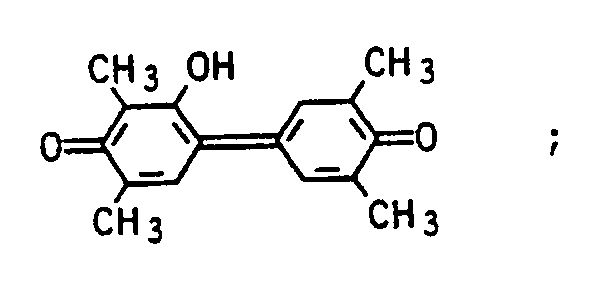
60 g p-tert.-Butylkresol. - 31,5 kg Polystyrol wie bei Beispiel 4;
18,5 kg Poly(2,6-dimethyl-phen-1,4-ylen-ether) der Spezifikation des Beispiels 5;
0,3 g Zusatzstoff IV gemäß Beispiel 4;
11,5 g Zusatzstoff V gemäß Beispiel 4; und
60 g p-tert.-Butylkresol.

- Wie der Vergleich zeigt, sind bei den erfindungsgemäßen dimensionsstabilen Substraten der Beispiele 4 und 5 viele Verbesserung gegenüber denjenigen des Vergleichsversuchs V1 eingetreten: die Erniedrigung der Schmelzviskosität führt zur Senkung der Einspritztemperatur und zu verringerter thermischer Schädigung der Gemische. Weiterhin wird die Abformung im Werkzeug deutlich verbessert, ohne daß die maximale Dauergebrauchstemperatur abgesenkt wird. Hervorzuheben ist besonders die Verringerung der Orientierungsdoppelbrechung auf fast nicht mehr meßbare Werte. Auch hinsichtlich des Gelbwertes (YI) der Substrate ergeben sich Vorteile für die erfindungsgemäßen Substrate. Darüber hinaus sind die erfindungsgemäßen Substrate bereits für Licht der Wellenlänge λ = 400 nm nicht mehr durchlässig, wogegen das bekannte dimensionsstabile Substrat das schädigende kurzwellige Licht erst ab λ = 370 nm ausfiltert. Innerhalb der Beispiele 4 und 5 selbst ergibt sich noch einmal eine Differenzierung hinsichtlich des Schmelzflußindices MFI, der Einspritzgeschwindigkeit und der optimalen Einspritztemperatur der Gemische sowie des Gelbwertes (YI) der erfindungsgemäßen dimensionsstabilen Substrate, woraus sich ableiten läßt, daß das erfindungsgemäße Gemisch und Substrat des Beispiels 4 ein Optimum und damit noch weiter vom Stand der Technik entfernt ist als das ohnehin schon vorteilhafte erfindungsgemäße Gemisch und Substrat des Beispiels 5. Daneben wurden bei den Substraten des Vergleichsversuchs V1 die Bildung von vernetzten Gelteilchen beobachtet. Außerdem wiesen die Substrate des Vergleichsversuchs V1 in ihrer Oberfläche bei schräg einfallendem Licht einen perlmuttartigen Schimmer auf, welcher im Hinblick auf die Verwendung dieser Substrate in laseroptischen und noch mehr in magneto-optischen Datenplatten von Nachteil ist.
- Bei 3000 Umdrehungen/Minute wurden auf einer Schleuderbeschichtungsanlage jeweils zwei der dimensionsstabilen Substrate aus den Beispielen 4 und 5 (für die Beispiele 6 und 7) sowie zwei bekannte dimensionsstabile Substrate aus dem Vergleichsversuch V1 (für den Vergleichsversuch V2) mit propanolischen Lösungen beschichtet, welche jeweils, bezogen auf die Lösung, 4 Gew.% einer Mischung aus einem bei den Wellenlängen λ von 700 bis 850 nm absorbierenden Farbstoff und einem Lösungspolymerisat aus Methylmethacrylat und Methacrylsäure enthielten.
- Das Gewichtsverhältnis von Farbstoff zu Polymerisat war 70 : 30. Als Farbstoff wurde ein üblicher und bekannter Trichinocyclopropanfarbstoff verwendet. Nach dem Trocknen wurden laseroptische Datenplatten mit c.a. 100 nm dicken, amorphen, thermisch veränderbaren Aufzeichnungsschichten erhalten, deren Reflektivität für Licht der Wellenlänge λ = 780 nm in bekannter Weise zu 19 % bestimmt wurde (Messung durch die dimensionsstabilen Substrate hindurch).
- Jeweils zwei gleiche laseroptische Datenplatten wurden mit den Farbstoffschichten nach innen sandwichartig über einen Abstandsring von 300 µm Dicke als Abstandshalter mittels eines Acrylatklebers haftfest miteinander verbunden.
- Die hierbei verwendeten Abstandsringe selbst wurden durch Spritzgießen derjenigen Gemische hergestellt, aus denen die jeweils verwendeten dimensionsstabilen Substrate bestanden. Demgemäß wurde bei Beispiel 6 das Gemisch gemäß dem Beispiel 4, bei Beispiel 7 das Gemisch gemäß dem Beispiel 5 und bei dem Vergleichsversuch V2 das Gemisch gemäß dem Vergleichsversuch V1 angewendet.
- Auf einem Plattenlaufwerk wurden in die "grooves" der laseroptischen Datenplatten digitale Daten eingeschrieben. Anschließend wurden die Daten gelesen (1. Lesen). Die hierbei erhaltenen-Ergebnisse finden sich in Tabelle 3.
- Hiernach wurden die laseroptischen Datenplatten während dreieinhalb Wochen bei Tageslicht gelagert und danach erneut gelesen (2. Lesen). Die hierbei erhaltenen Ergebnisse finden sich gleichfalls in Tabelle 3.
Tabelle 3 Anwendungstechnische Eigenschaften laseroptischer Datenplatten mit erfindungsgemäßen (Beispiele 6 und 7) und nicht erfindungsgemäßen (Vergleichsversuch V2) dimensionsstabilen Substraten Parameter Bsp. 6a) Bsp. 7b) Vergl.Vers. V2c) "tracking"-Verhalten der unbeschriebenen Datenplatten sehr gut sehr gut gut Schreibempfindlichkeit 1-2 nJ 1-2 nJ 1-2 nJ 1. Lesen: Lesesignal (d) gut gut gut Signal-Rausch-Verhältnis (dB) 46 45 46 Lesefehlerrate (unkorrigiert) <10⁻⁵ <10⁻⁵ 10⁻⁵ "tracking"-Verhalten sehr gut gut unbefriedigend 2. Lesen Lesesignal (d) gut gut bis befriedigend befriedigend Signal-Rausch-Verhältnis (dB) 45 43 32 Lesefehlerrate (unkorrigiert) <10⁻⁵ <10⁻⁵ >10⁻⁵ "tracking"-Verhalten sehr gut gut unbefriedigend a) dimensionsstabiles Substrat aus Beispiel 4; b) dimensionsstabiles Substrat aus Beispiel 5; c) dimensionsstabiles Substrat aus Vergleichsversuch V1; d) Kriterium ist sowohl die Höhe (Stärke) als auch die Breite des durch einen thermisch veränderten Bereich (bit) hervorgerufenen Lesesignals; Bestimmung mit einem Oszilloskop; Benotung: "Gut" (scharfe starke Signale); "Befriedigend" (etwas verbreiterte starke Signale); "Unbefriedigend" (sehr breite und/oder schwache Signale); - Die Ergebnisse lassen sich wie folgt zusammenfassen:
- Während die weitgehend durch die Farbstoffschicht selbst bedingten anwendungstechnischen Eigenschaften wie Schreibempfindlichkeit und Lesesignal von den unterschiedlichen dimensionsstabilen Substraten nicht oder nur wenig beeinflußt wurden, konnte bei den laseroptischen Datenplatten mit den erfindungsgemäßen Substraten (Beispiele 6 und 7) beim ersten Lesen eine deutliche Verbesserung des Signal-Rausch-Verhältnisses, der unkorrigierten Lesefehlerrate und insbesondere der Spurführung gegenüber dem Stand der Technik beobachtet werden: Die beschriebenen Teile der laseroptischen Datenplatten mit den bekannten Substraten konnten kaum gelesen werden, wogegen bei den laseroptischen Datenplatten mit den erfindungsgemäßen Substraten die Spurführung mühelos einzuhalten war, weswegen sich denn auch hier die eingeschriebene Information so gut wie fehlerfrei wiedergewinnen ließ.
- Die beim 2. Lesen der laseroptischen Datenplatten erhaltenen Ergebnisse machen deutlich, wie stark die stoffliche Zusammensetzung der jeweils verwendeten dimensionsstabilen Substrate deren anwendungstechnischen Eigenschaften bestimmt: So wiesen die laseroptischen Datenplatten mit erfindungsgemäßen Substraten nach längerer Lagerung am Tageslicht noch immer gute bis sehr gute anwendungstechnische Eigenschaften auf, wogegen die laseroptischen Datenplatten mit den bekannten Substraten erhebliche Mängel aufwiesen, was die besondere Vorteilhaftigkeit der erfindungsgemäßen dimensionsstabilen Substrate weiter untermauert.
Claims (26)


a) die Reste R für Wasserstoffatome oder Methylgruppen stehen, sofern die Reste R¹ Chlor- oder Bromatome bezeichnen,
b) die Reste R für Methylgruppen stehen, sofern die Reste R¹ Isopropylgruppen bezeichnen und wobei
c) tert.-Butylgruppe ausgenommen ist;
und worin die Reste R² und R³ Wasserstoffatome, Hydroxygruppen oder N(R⁴)₂-Gruppen bezeichnen, wobei


Applications Claiming Priority (2)
| Application Number | Priority Date | Filing Date | Title |
|---|---|---|---|
| DE3902939A DE3902939A1 (de) | 1989-02-01 | 1989-02-01 | Diphenochinon- und diphenohydrochinonderivate und deren verwendung in optischen formteilen |
| DE3902939 | 1989-02-01 |
Publications (2)
| Publication Number | Publication Date |
|---|---|
| EP0385109A2 true EP0385109A2 (de) | 1990-09-05 |
| EP0385109A3 EP0385109A3 (de) | 1990-12-05 |
Family
ID=6373211
Family Applications (1)
| Application Number | Title | Priority Date | Filing Date |
|---|---|---|---|
| EP19900101544 Withdrawn EP0385109A3 (de) | 1989-02-01 | 1990-01-26 | Formteil für optische Zwecke |
Country Status (4)
| Country | Link |
|---|---|
| US (1) | US5130356A (de) |
| EP (1) | EP0385109A3 (de) |
| JP (1) | JPH02264737A (de) |
| DE (1) | DE3902939A1 (de) |
Families Citing this family (24)
| Publication number | Priority date | Publication date | Assignee | Title |
|---|---|---|---|---|
| JP2872800B2 (ja) * | 1990-10-29 | 1999-03-24 | ダイセル化学工業株式会社 | 光学活性ビフェニル誘導体及び光学分割方法 |
| US7179551B2 (en) | 1999-02-12 | 2007-02-20 | General Electric Company | Poly(arylene ether) data storage media |
| WO2000048172A2 (en) | 1999-02-12 | 2000-08-17 | General Electric Company | Data storage media |
| FR2827498B1 (fr) * | 2001-07-18 | 2004-05-14 | Frederic Fortin | Dispositif de liaison vertebrale souple constitue d'elements palliant une deficience du rachis |
| US6716505B2 (en) * | 2001-08-31 | 2004-04-06 | General Electric Company | Storage medium for data with improved dimensional stability |
| US7132736B2 (en) * | 2001-10-31 | 2006-11-07 | Georgia Tech Research Corporation | Devices having compliant wafer-level packages with pillars and methods of fabrication |
| US7518737B2 (en) * | 2002-03-29 | 2009-04-14 | Georgia Tech Research Corp. | Displacement-measuring optical device with orifice |
| US7440117B2 (en) * | 2002-03-29 | 2008-10-21 | Georgia Tech Research Corp. | Highly-sensitive displacement-measuring optical device |
| US7135777B2 (en) * | 2002-05-03 | 2006-11-14 | Georgia Tech Research Corporation | Devices having compliant wafer-level input/output interconnections and packages using pillars and methods of fabrication thereof |
| FR2843538B1 (fr) * | 2002-08-13 | 2005-08-12 | Frederic Fortin | Dispositif de distraction et d'amortissement ajustable a la croissance du rachis |
| US7099525B2 (en) * | 2002-08-26 | 2006-08-29 | Georgia Tech Research Corporation | Dual-mode/function optical and electrical interconnects, methods of fabrication thereof, and methods of use thereof |
| US20040184704A1 (en) * | 2003-03-17 | 2004-09-23 | Bakir Muhannad S. | Curved metal-polymer dual-mode/function optical and electrical interconnects, methods of fabrication thereof, and uses thereof |
| US7244813B2 (en) * | 2003-08-26 | 2007-07-17 | General Electric Company | Methods of purifying polymeric material |
| US20050046056A1 (en) * | 2003-08-26 | 2005-03-03 | Jiawen Dong | Method of molding articles |
| US7041780B2 (en) * | 2003-08-26 | 2006-05-09 | General Electric | Methods of preparing a polymeric material composite |
| US20050048252A1 (en) * | 2003-08-26 | 2005-03-03 | Irene Dris | Substrate and storage media for data prepared therefrom |
| US7256225B2 (en) * | 2003-08-26 | 2007-08-14 | General Electric Company | Methods of preparing a polymeric material |
| US7354990B2 (en) * | 2003-08-26 | 2008-04-08 | General Electric Company | Purified polymeric materials and methods of purifying polymeric materials |
| US20050257709A1 (en) * | 2003-08-28 | 2005-11-24 | Tony Mule | Systems and methods for three-dimensional lithography and nano-indentation |
| US7283695B2 (en) * | 2004-08-31 | 2007-10-16 | Georgia Tech Research Corporation | Optical interconnects in microelectronics based on azimuthally asymmetric long-period fiber grating couplers |
| US7266267B2 (en) * | 2004-11-16 | 2007-09-04 | Georgia Tech Research Corp. | Microfluidic, optical, and electrical input output interconnects, methods of fabrication thereof, and methods of use thereof |
| FR2891727B1 (fr) * | 2005-10-06 | 2008-09-26 | Frederic Fortin | Dispositif d'autoblocage perfectionne pour dispositif de distraction costal |
| WO2013136975A1 (ja) * | 2012-03-15 | 2013-09-19 | 日本ゼオン株式会社 | 位相差フィルム積層体、位相差フィルム積層体の製造方法、並びに位相差フィルムの製造方法 |
| JP6303275B2 (ja) * | 2013-03-25 | 2018-04-04 | 日本ゼオン株式会社 | 位相差フィルム積層体、位相差フィルム積層体の製造方法、位相差フィルム、製造方法、及び用途 |
Family Cites Families (8)
| Publication number | Priority date | Publication date | Assignee | Title |
|---|---|---|---|---|
| US3383395A (en) * | 1965-03-03 | 1968-05-14 | Gen Electric | Stabilization of organic materials with biphenyltriols |
| US4234706A (en) * | 1977-05-26 | 1980-11-18 | General Electric Company | Quinone-coupled polyphenylene oxides |
| US4373065A (en) * | 1981-02-17 | 1983-02-08 | Xerox Corporation | Optically isotropic devices |
| DE3507379A1 (de) * | 1985-03-02 | 1986-11-06 | Basf Ag, 6700 Ludwigshafen | Optisches aufzeichnungsmedium |
| EP0225801B2 (de) * | 1985-12-06 | 1994-10-26 | Sumitomo Chemical Company, Limited | Optische Apparate |
| JPS6313722A (ja) * | 1986-07-04 | 1988-01-21 | Sumitomo Chem Co Ltd | 光デイスク基板の製造方法 |
| JPS6356832A (ja) * | 1986-08-27 | 1988-03-11 | Sumitomo Chem Co Ltd | 耐環境性の改良された光磁気デイスク |
| JPS6389335A (ja) * | 1986-10-01 | 1988-04-20 | Sumitomo Chem Co Ltd | 光学素子の製造法 |
-
1989
- 1989-02-01 DE DE3902939A patent/DE3902939A1/de not_active Withdrawn
-
1990
- 1990-01-26 EP EP19900101544 patent/EP0385109A3/de not_active Withdrawn
- 1990-01-31 JP JP2019399A patent/JPH02264737A/ja active Pending
- 1990-02-01 US US07/473,453 patent/US5130356A/en not_active Expired - Fee Related
Also Published As
| Publication number | Publication date |
|---|---|
| EP0385109A3 (de) | 1990-12-05 |
| DE3902939A1 (de) | 1990-08-02 |
| US5130356A (en) | 1992-07-14 |
| JPH02264737A (ja) | 1990-10-29 |
Similar Documents
| Publication | Publication Date | Title |
|---|---|---|
| EP0385109A2 (de) | Formteil für optische Zwecke | |
| DE60027325T2 (de) | Optisches Aufzeichnungsmedium und neue Azaporphyrinverbindung | |
| EP0303209A2 (de) | Flächenförmiges, mehrschichtiges, laseroptisches Aufzeichnungsmaterial | |
| DE3643770A1 (de) | Mono- und disubstituierte phthalocyanine | |
| DE69916944T2 (de) | Optisches Aufzeichnungsmedium | |
| DE4304311A1 (de) | Material aus einem Cycloolefin-Copolymer und Verfahren zu seiner Herstellung | |
| DE3924554A1 (de) | Anisotrope fluessigkristalline polymer-filme | |
| EP0264543A2 (de) | Perylenverbindungen | |
| EP0540468B1 (de) | NIR-Farbstoffe, Verfahren zu ihrer Herstellung und ihre Verwendung | |
| DE69922130T2 (de) | Ultraviolett härtbare zusammensetzung, optische platte und verfahren zu deren herstellung | |
| EP0285965A2 (de) | Gemischte Phthalo-naphthalocyanine sowie dünne strahlungsempfindliche Beschichtungsfilme, die diese Verbindungen enthalten | |
| EP0301405A2 (de) | Flächenförmiges, mehrschichtiges, laseroptisches Aufzeichnungsmaterial | |
| EP0291848B1 (de) | Optisches Aufzeichnungsmedium, das eine Reflektorschicht aufweist, die ein Silicium-Phthalocyaninderivat enthält | |
| DE3885181T2 (de) | Harz-Zusammensetzung für eine optische Platte. | |
| DE3810642A1 (de) | Methinfarbstoffe sowie optisches aufzeichnungsmedium, enthaltend die neuen farbstoffe | |
| EP0358080B1 (de) | Siliciumnaphthalocyanine mit ungesättigten Liganden sowie optisches Aufzeichnungsmedium | |
| DE3779476T2 (de) | Loeschbare optische platte mit optisch transparentem substrat. | |
| EP0336213B1 (de) | Siliciumnaphthalocyanine sowie dünne strahlungsempfindliche Beschichtungsfilme, die diese Verbindungen enthalten | |
| DE19744162A1 (de) | Optisches Speichermedium | |
| EP0356971B1 (de) | Tetraazaporphyrine sowie optisches Aufzeichnungsmedium | |
| EP0254184B1 (de) | Verwendung von härtbaren Reaktionsmassen zur Herstellung von Datenträgern | |
| DE69814741T2 (de) | Optische Aufzeichnungselemente mit Mischungen aus metallisierten Carbamoylazo- und Cyaninfarbstoffen | |
| DE4027173A1 (de) | Optisches aufzeichnungsmedium | |
| DE3636959C2 (de) | ||
| DE4027172A1 (de) | Optisches aufzeichnungsmedium |
Legal Events
| Date | Code | Title | Description |
|---|---|---|---|
| PUAI | Public reference made under article 153(3) epc to a published international application that has entered the european phase |
Free format text: ORIGINAL CODE: 0009012 |
|
| AK | Designated contracting states |
Kind code of ref document: A2 Designated state(s): BE DE FR GB NL |
|
| 17P | Request for examination filed |
Effective date: 19900730 |
|
| PUAL | Search report despatched |
Free format text: ORIGINAL CODE: 0009013 |
|
| AK | Designated contracting states |
Kind code of ref document: A3 Designated state(s): BE DE FR GB NL |
|
| PUAF | Information related to the publication of a search report (a3 document) modified or deleted |
Free format text: ORIGINAL CODE: 0009199SEPU |
|
| D17D | Deferred search report published (deleted) | ||
| PUAL | Search report despatched |
Free format text: ORIGINAL CODE: 0009013 |
|
| AK | Designated contracting states |
Kind code of ref document: A3 Designated state(s): BE DE FR GB NL |
|
| 17Q | First examination report despatched |
Effective date: 19930728 |
|
| STAA | Information on the status of an ep patent application or granted ep patent |
Free format text: STATUS: THE APPLICATION HAS BEEN WITHDRAWN |
|
| 18W | Application withdrawn |
Withdrawal date: 19940528 |