EP0385227A2 - Streifen aus mittels Schaumklebstoff miteinander verbundenen Befestigungsmitteln und Verfahren zur Herstellung dafür - Google Patents
Streifen aus mittels Schaumklebstoff miteinander verbundenen Befestigungsmitteln und Verfahren zur Herstellung dafür Download PDFInfo
- Publication number
- EP0385227A2 EP0385227A2 EP90103191A EP90103191A EP0385227A2 EP 0385227 A2 EP0385227 A2 EP 0385227A2 EP 90103191 A EP90103191 A EP 90103191A EP 90103191 A EP90103191 A EP 90103191A EP 0385227 A2 EP0385227 A2 EP 0385227A2
- Authority
- EP
- European Patent Office
- Prior art keywords
- adhesive layer
- strip
- foamed
- shank
- fastener
- Prior art date
- Legal status (The legal status is an assumption and is not a legal conclusion. Google has not performed a legal analysis and makes no representation as to the accuracy of the status listed.)
- Withdrawn
Links
Images

Classifications
-
- C—CHEMISTRY; METALLURGY
- C09—DYES; PAINTS; POLISHES; NATURAL RESINS; ADHESIVES; COMPOSITIONS NOT OTHERWISE PROVIDED FOR; APPLICATIONS OF MATERIALS NOT OTHERWISE PROVIDED FOR
- C09J—ADHESIVES; NON-MECHANICAL ASPECTS OF ADHESIVE PROCESSES IN GENERAL; ADHESIVE PROCESSES NOT PROVIDED FOR ELSEWHERE; USE OF MATERIALS AS ADHESIVES
- C09J5/00—Adhesive processes in general; Adhesive processes not provided for elsewhere, e.g. relating to primers
- C09J5/08—Adhesive processes in general; Adhesive processes not provided for elsewhere, e.g. relating to primers using foamed adhesives
-
- C—CHEMISTRY; METALLURGY
- C09—DYES; PAINTS; POLISHES; NATURAL RESINS; ADHESIVES; COMPOSITIONS NOT OTHERWISE PROVIDED FOR; APPLICATIONS OF MATERIALS NOT OTHERWISE PROVIDED FOR
- C09J—ADHESIVES; NON-MECHANICAL ASPECTS OF ADHESIVE PROCESSES IN GENERAL; ADHESIVE PROCESSES NOT PROVIDED FOR ELSEWHERE; USE OF MATERIALS AS ADHESIVES
- C09J151/00—Adhesives based on graft polymers in which the grafted component is obtained by reactions only involving carbon-to-carbon unsaturated bonds; Adhesives based on derivatives of such polymers
- C09J151/06—Adhesives based on graft polymers in which the grafted component is obtained by reactions only involving carbon-to-carbon unsaturated bonds; Adhesives based on derivatives of such polymers grafted on to homopolymers or copolymers of aliphatic hydrocarbons containing only one carbon-to-carbon double bond
-
- F—MECHANICAL ENGINEERING; LIGHTING; HEATING; WEAPONS; BLASTING
- F16—ENGINEERING ELEMENTS AND UNITS; GENERAL MEASURES FOR PRODUCING AND MAINTAINING EFFECTIVE FUNCTIONING OF MACHINES OR INSTALLATIONS; THERMAL INSULATION IN GENERAL
- F16B—DEVICES FOR FASTENING OR SECURING CONSTRUCTIONAL ELEMENTS OR MACHINE PARTS TOGETHER, e.g. NAILS, BOLTS, CIRCLIPS, CLAMPS, CLIPS OR WEDGES; JOINTS OR JOINTING
- F16B15/00—Nails; Staples
- F16B15/08—Nails; Staples formed in integral series but easily separable
Definitions
- This invention lies in the field of fastener strips and methods for making the same.
- Fastener strips of nails or the like for use in rapid-acting fastener-driving apparatus are widely used in construction and are exemplified in such U.S. patents as Langas et al. 3,276,576, Shelton et al. 3,966,042, and Shelton et al. 4,343,579.
- the adhesive that is employed to bond shank portions of an aligned row of such fasteners together relative to a backing web, or to a pair of such webs (where one adhesive coated web is located on each opposite side of the fastener row).
- the adhesive needs to fulfill many requirements. Aside from fastener mechanical holding and positioning capability, and structural strength properties required for maintaining strip integrity during storage and use, the adhesive needs to have acceptable fracturing characteristics. Thus, the adhesive associated with the lead fastener member in a strip needs to fracture completely and in a predictable manner when such lead fastener member is struck with predetermined shear force upon its head end by the actuated striking head of the fastener-driving apparatus.
- This fracture should occur either in the adhesive material that is adjacent to the shank of such lead fastener member, or generally along the bond between the shank of such member and the adhesive.
- the material of the backing web itself to which the adhesive is itself bonded needs to tear and/or shear transversely at the time when the adhesive is so fractured without interfering with the fastener separation from the strip or the adhesive fracturing.
- the fastener member moves downwardly (away from the striking head) and is driven into a workpiece. Bonded to, and carried along with, the driven fastener as it moves into the workpiece is adhesive material which is adhered to the fastener and, also, typically, small portions of the backing web.
- Typical strip adhesives heretofore known in this art are believed to be of the thermoplastic hot melt type permitting hot application of a layer of such adhesive upon a backing web followed by cooling and the subsequent impressing of heated fasteners into the resulting adhesive layer.
- Adhesives which have a desirable combination of such properties and which are suitable tend to constitute a significant expense item in the cost of manufacturing fastener strips.
- the present invention relates to a new and improved fastener strip structure adapted for use in rapid acting fastener-driving apparatus.
- Such fastener strip employs a foamed adhesive layer.
- fastener strip performance characteristics can be achieved which are approximately equal to those associated with fastener strips employing a solid (unfoamed) adhesive layer as in the prior art, yet the total quantity of adhesive employed in the foamed adhesive layer can be substantially reduced compared to the amount of adhesive utilized in such prior art solid adhesive layer.
- One result is that the costs of fastener strips manufacture are significantly reduced.
- the foamed adhesive layer provides increased resistance of a product fastener strip to so-called "strip corrugation" by virtue of thicker cross section and distribution of the compressive loads on the strip.
- Strip corrugation is a phenomenon sometimes observed in automatic fastener-driving apparatus involving the longitudinal compressing together of adjacent fastener shanks in a strip, causing undesirable driving apparatus malfunctioning and strip jamming.
- the present invention provides an improved process for the preparation of fastener strips.
- a backing web is precoated with a foamed thermoplastic hot melt adhesive and thereafter heated fastener members are impressed into the adhesive layer.
- the foamed structure associated with the adhesive layer is not destroyed during the heated nail impressing.
- the height of the adhesive material which resultingly upstands along opposing sides of nail shanks after impressing hot nails into the foamed adhesive layer is increased compared to corresponding such heights achieved under comparable impressing conditions employed in the prior art with solid adhesive layers. The result is better bonding efficiency between nails and adhesive.
- the hot nail adhesive impressing techniques hereto used in the prior art for the preparation of fastener strips can be employed, if desired, when making the fastener strips of the present invention which employ a foamed adhesive layer.
- costly capital improvements or changes in manufacturing procedures are not necessary in order to utilize a foamed adhesive layer, and thereby realize the features and advantages of the present invention, in a fastener strip structure.
- FIGS. 1 and 2 there is shown an embodiment of an adhered strip of common nails 10 having flat heads 11 and cylindrical shanks 12.
- Nails 10 are substantially identical to one another and all shanks 12 are disposed in aligned, closely spaced, parallel relationship to one another.
- Nails 10 are adhered in strip form to the foamed adhesive layer 13 which is deposited upon and bonded to a backing web member 14.
- Web 14 and foamed adhesive layer 13 comprise a nail connecting tape structure 15 (see, for example, FIG. 2).
- the nail heads 11 are full heads which are coplanar, and are disposed in abutting relationship relative to one another.
- the strip of this embodiment can be, if desired, convolutedly coiled into a spiral arrangement (not shown) for insertion into the magazine of a fastener-driving apparatus (not shown).
- the strip advances, and successively the entire area of each head 11 is exposed to the striking head of the driving apparatus.
- the foamed adhesive layer 13 contacts a portion 17 of each shank 12 and is bonded thereto, and as such positively retains each nail 10 in place relative to the tape 15. Relative to the axis 18 of a nail 10, an angle 19 is subtended by the adhesive/nail interface portion 17.
- FIG. 3 For comparative purposes, there is shown in FIG. 3 (as indicated above), the relationship between a nail shank 21 and an adhesive layer 22 is shown.
- the shank 21 corresponds to a shank 12 of a nail 10, but shank 21 is mounted in a solid (unfoamed) adhesive layer 22 that is associated with, and bonded to, a backing web member 23, all as known to the prior art.
- the contacting portion 24 between shank 21 and adhesive layer 22 is shown for example in FIG. 3.
- the axis 26 of shank 21 defines an angle 27 between the edge portions of the adhesive/nail interface portion 24 (which corresponds to the contacting portion 17 in the foamed adhesive layer structure shown in FIG. 2).
- the density of the foamed adhesive layer 13 should be such that the layer 13 density is from about 0.85g/cc to about 0.75g/cc, for a resin having a density of about 0.94g/cc when unfoamed, although greater and lesser densities of the foamed adhesive layer can be employed without departing from the spirit and scope of the present invention.
- the thickness 29 of the foamed adhesive layer 13 is greater than the thickness 28 of the adhesive layer 22.
- the total amount of adhesive material employed in the layer 22 approximately corresponds to the total amount of adhesive material employed in the layer 13, and it is further assumed that the chemical composition of the adhesive layer 22 is substantially the same as the composition of the adhesive layer 13 (except for possible minor differences caused by the addition of a blowing agent to the adhesive composition) at the time when the layer 13 upon the web 14 is produced, as hereinafter described.
- a vertical height 38 and 39, respectively, of each portion 36 and 37 relative to the surface 41 of the foamed adhesive layer 13 is substantially greater than the respective heights 42 and 43 of portions 32 and 33 relative to the surface 44 of solid adhesive layer 22.
- Such differences in the thickness of foamed adhesive layer 13 (compared to the thickness of solid adhesive layer 22) added to the height differences of the respective portions 36 and 37 (compared to the heights of the portions 32 and 33 of layer 22) result in a larger circumferential portion of the surface of the shank 12 being coated with and bonded to the adhesive of the foamed adhesive layer 13 compared to the area of the shank 21 which is bonded to the layer 22 of unfoamed adhesive. Consequently, the area of contacting portion 17 is surprisingly substantially greater than the area of contacting portion 24, and also the angle 19 is substantially greater than the angle 27.
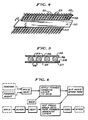
- FIGS. 4 and 5 A preferred fastener strip embodiment of this invention is illustrated in FIGS. 4 and 5 wherein a pair of taped strips 46 and 47 are employed with one such strip being positioned in opposed relationship to the other thereof on each side of the shanks 48 of a plurality of nails 49 arranged so that all shanks 48 are disposed in aligned, closely spaced, parallel relationship relative to one another.
- the nails 49 are here illustratively angularly disposed with the head 51 of each nail being located beneath the corresponding head 51 of the nail located adjacent thereto, and each head 51 being in contact with the shank 48 of the adjacent nail 49.
- the space 52 between the overlapped heads 51 can be varied depending on the configuration that the product strip is to take.
- the shanks 48 are spaced apart by an amount equal to the width of the overlapping head portion as indicated by the space 53 between adjacent nails 49 as illustrated, for example, in FIGS. 4 and 5.
- a typical configuration for a strip of the type illustrated in FIGS. 4 and 5 is one wherein the nails 49 form an angle of about 30 degrees with the horizontal when they are mounted for firing (driving) in the magazine of a fastener-driving tool (not shown).
- the head portion of the lowermost (or leading) nail in the strip which nail is not covered by the adjacent nail is exposed to the nail driver, whereby the nail may be driven into a workpiece to be joined, such as a board or the like.
- tape strips 46 and 47 Each of the tape strips 46 and 47 preferably has a structure similar to that shown and above described in reference to the tape 15.
- tape strip 46 has a backing web member 54 and a foamed adhesive layer 56
- tape strip 47 has a backing web member 57 and a foamed adhesive layer 58.
- only one of the strips 46 and 47 has a foamed adhesive layer (with the adhesive layer in the other such tape being unfoamed).
- the tape strips 46 and 47 are each mounted on an opposing side of the shanks 48 with each tape engaging a medial portion of each shank 48 and extending in a direction parallel to a line joining the heads 51 of the nails 49.
- a fastener strip structure of the type illustrated, for example, in FIGS. 4 and 5 will have a limited amount of resiliency to prevent fracture in the event that such a strip is dropped, but will retain a strip in its assembled form so that it may be readily inserted into the magazine of an automatic fastening apparatus adapted to receive same in a proper position for firing (driving).
- the fastener strip structures of this invention there needs to be no material, such as a plastic or the like, located between adjacent shanks such as would tend to bring about jamming when the nails are driven.
- the fastener strips of the present invention can be easily manufactured and require a minimum amount of adhesive.
- the amount of shear force which is applied by the actuated striking head of fastener-driving apparatus, and which is needed to release a nail 10 from a fastener strip is greater than the amount of applied shear force (identically exerted) which is required to release the shank 21 of an identical nail from an unfoamed adhesive layer 22 in a corresponding fastener strip structure, such as shown in FIG. 3.
- the amount of adhesive material needed in a fastener strip structure such as shown in FIGS. 1 and 2, or in FIGS.
- Fastener strips of this invention may be prepared by any convenient means, but it is presently preferred to assemble these fastener strips by pressure-applying heated nails to a tape strip carrying a foamed adhesive layer or by pressure-applying such a strip to heated nails.
- foaming which, when foaming is completed and the resulting layer on the product web structure has been cooled, results in a foamed adhesive layer that is bonded to the backing web.
- the fastener shank is longer than the transverse width of the backing web and the tape strip used.
- each such so heated fastener member transversely and uniformly into the adhesive layer of such a tape strip.
- Each so adhered shank is in spaced, parallel, aligned relationship with the shanks of adjacent fastener members, as described above particularly in reference to FIG. 2.
- the impressing procedure characteristically produces a raised region of adhesive on either side of the shank of each nail or fastener member with the adhesive being bonded to each fastener member in regions of contact therebetween, such as above described.
- a present preference is to prepare preliminarily a group of nails which are all held in a spaced, parallel, aligned relationship to one another and which are all uniformly heated prior to the time when such nails as a group have such tape impressed thereagainst, so as to produce a product strip which corresponds either to a structure such as is illustrated, for example, in FIGS. 4 and 5, or as is illustrated, for example, in FIGS. 1 and 2, or otherwise as described.
- Mounting pressures applied between a tape strip and heated nails vary depending upon many variables such as nail size, adhesive layer foam characteristics, extent of bonding desired between individual fasteners and the adhesive layer, natures of the fasteners, the foamed adhesives, the backing web members, and the like, so that it is not possible to give exact heating and pressing conditions applicable to all possible fastener strip structures of the present invention.
- hot melt adhesives of the chemically modified polyolefin type such as have been heretofore employed in the manufacture of prior art fastener strips, can be used to make a fastener strip of the present invention which incorporates a foamed adhesive layer.
- Such prior art adhesives appear to be foamable (blowable) by means of the conventional foaming (blowing) agents heretofore known to the prior art without substantially altering the desirable adhesive properties achievable in a product fastener strip.
- Hot melt adhesives having melt temperatures in a range of about 375°F to about 525°F.
- Hot melt, chemically modified and/or rubber-modified polyolefin are preferred, as exemplified by such materials as Bynel tm E200 rubber-modified high density polyethylene, Bynel tm E331 rubber-modified low density polyethylene, and Bynel tm E205 chemically modified linear low density polyethylene, such Bynel tm resins being available commercially from E. I.
- Admer tm NF500 and Admer tm NF550 high density polyethylene-based resins available commercially from Mitsui Petrochemical Industries, Ltd., Tokyo, Japan
- Plexar tm 6 chemically modified, rubber-modified high density polyethylene available commercially from Quantam Chemical Corporation, Cincinnati, Ohio
- Igetabond tm E and Igetabond tm G modified polyolefins available commercially from Sumitomo Chemical Co., Ltd., Osaka, Japan, Primacor tm resins discussed below, and the like.
- the chemical modification can be accomplished by various means.
- acrylic acid can be grafted on gamma irradiated low-density polyethylenes to produce adhesives for aluminum.
- acrylic acid can be copolymerized with ethylene to produce an adhesive resin (such as the low modulus, low-density resins available commercially from the Dow Chemical Company, Midland, Michigan, under the trademark "Primacor.”
- Polyolefins for example, can be modified with unsaturated acids or acid anhydrides by various grafting processes, such as grafting high-density polyethylene with unsaturated bridged dicarboxylic acid anhydrides (as taught for example, by U.S. Patents Nos.
- graft-modified polyolefin resins can be blended with a hydrocarbon elastomer to further improve adherability and physical properties of the resin (see, e.g., U.S. Patent No. 4,198,327).
- a presently preferred composition is a blend of graft-modified polyolefin and an elastomer.
- the foaming agents utilized in the practice of the present invention are added to hot melt adhesive systems during the processing thereof to produce a foamed adhesive layer upon a backing web member.
- the chemicals used as foaming agents form minute gas cells throughout the adhesive layer.
- the foaming agent is added directly to an extruder barrel at the time when the hot melt adhesive is being processed therethrough for coating upon a backing web member.
- Foaming agents useful in the practice of this invention can be physical or chemical in their operation. Chemical foaming agents (generally solids) undergo a chemical transformation when producing the gas used for foaming while physical foaming agents (generally gases or liquids initially) undergo a reversible physical change-of-state through vaporization. It is presently preferred to employ chemical foaming agents in the present invention to make starting tape strips.
- Liquid physical foaming agents can be used. Suitable such agents are short-chain aliphatic hydrocarbons and their chlorinated and fluorinated analogs. Liquid physical foaming agents are usable over a wide temperature range in low-pressure atmospheric extrusion coating processes.
- Chemical foaming agents are presently preferred and are selected based upon their decomposition temperature. It is desirable to match the decomposition temperature with the processing temperature of the polymer to be foamed. Suitable low-, medium-, and high-temperature foaming agents are well known to the art; see for example the article entitled “Foaming Agents” by Raymond Shute appearing in Modern Plastics Encyclopedia '88 at pages 152-158, which is incorporated herein by reference.
- a continuous film of foaming molten thermoplastic adhesive is extruded from a slot die.
- the extruded film is applied to a moving web of substrate, preferably paper.
- Extrusion laminating rolls aid in spreading and bonding the molten polymer film to the web substrate.
- Such application to a web substrate is accomplished in the nip region between a pair of rollers, such as a rubber roll and a chill roll, or two chill rolls.
- a preformed film of foamed thermoplastic adhesive, an intermediate bonding layer of a suitable adhesive, and a substrate, such as paper, are laminated so as to form a laminated structure.
- the coated or laminated structure normally is edge-trimmed at the laminator and the product coated tape is conveniently slit prior to winding at a turret or single drum winder into tapes.
- the preformed tapes used in the practice of this invention preferably have a foamed adhesive layer which is less than about one-third the diameter of the shanks of the fasteners used to make a given strip product, and more preferably such layer is less than about one-fifth the diameter of the shanks.
- extrudable, modified polyolefin based adhesive resin e.g. Igetabond tm E resin discussed above
- a blowing agent which is available commercially from Rite Systems, West Chicago, Illinois, under its trade designation LQC-A113-2, and which is understood to contain azodicarbonamide as the active agent.
- the heated extrudate at a melt temperature in the range of about 425°F to about 535°F is charged through a slot die to produce a continuous film of foaming molten thermoplastic. This is then applied to a moving substrate web.
- the substrate web comprises kraft paper.
- the relationship between quantity of resin and quantity of foaming agent is adjusted to produce in the coated adhesive layer of the product coated web a void volume of about 10%.
- the slot die orifice setting is such that the thickness of the coated foamed adhesive layer in the product coated web is about 8 mils.
- strips are withdrawn and placed against the mid-region of the heated nail row commencing at one end thereof and progressing to the other end thereof to produce a strip configuration as shown in FIGS. 4 and 5 wherein each individual tape is on a different side of the nail row with the individual tapes being in such opposed relationship to one another.
- the tape strips are contacted with nail shanks, opposing outside faces of the strips are compressed together with a uniformly applied force which impresses the hot shanks of the individual nails into the adhesive layer of each strip.
- the resulting nail strip is cooled and then removed from the rack.
- a nail strip is prepared using the procedure of EXAMPLE 6 using a tape pair formed from such product web.
Landscapes
- Engineering & Computer Science (AREA)
- General Engineering & Computer Science (AREA)
- Chemical & Material Sciences (AREA)
- Organic Chemistry (AREA)
- Mechanical Engineering (AREA)
- Chemical Kinetics & Catalysis (AREA)
- Adhesive Tapes (AREA)
- Laminated Bodies (AREA)
- Adhesives Or Adhesive Processes (AREA)
Applications Claiming Priority (2)
| Application Number | Priority Date | Filing Date | Title |
|---|---|---|---|
| US31326889A | 1989-02-21 | 1989-02-21 | |
| US313268 | 1989-02-21 |
Publications (2)
| Publication Number | Publication Date |
|---|---|
| EP0385227A2 true EP0385227A2 (de) | 1990-09-05 |
| EP0385227A3 EP0385227A3 (de) | 1992-02-26 |
Family
ID=23215038
Family Applications (1)
| Application Number | Title | Priority Date | Filing Date |
|---|---|---|---|
| EP19900103191 Withdrawn EP0385227A3 (de) | 1989-02-21 | 1990-02-20 | Streifen aus mittels Schaumklebstoff miteinander verbundenen Befestigungsmitteln und Verfahren zur Herstellung dafür |
Country Status (3)
| Country | Link |
|---|---|
| EP (1) | EP0385227A3 (de) |
| JP (1) | JPH037789A (de) |
| KR (1) | KR900013216A (de) |
Cited By (7)
| Publication number | Priority date | Publication date | Assignee | Title |
|---|---|---|---|---|
| EP0823563A1 (de) * | 1996-08-06 | 1998-02-11 | Illinois Tool Works Inc. | Befestigungsmittelstreifen und Klebstoffzusammensetzung |
| EP0845608A3 (de) * | 1996-11-27 | 1999-06-30 | Max Co., Ltd. | Halteklemme- Einheit |
| AU2002338113B2 (en) * | 2001-09-28 | 2007-10-25 | Max Kabushiki Kaisha | Connecting fastener |
| WO2007100446A3 (en) * | 2006-02-22 | 2007-12-13 | Illinois Tool Works | Embossed tape collating strip for nails |
| EP2327887A1 (de) * | 2009-11-23 | 2011-06-01 | Konishi Co., Ltd. | Streifen von metallischen, aneinander haftenden Befestigungen |
| US8393842B2 (en) | 2009-11-19 | 2013-03-12 | Konishi Co., Ltd. | Strip of metallic fasteners adhered to each other |
| EP3617532A1 (de) * | 2018-08-29 | 2020-03-04 | Baussmann Collated Fasteners GmbH | Befestigungselement aus holz und/oder holzwerkstoffen sowie haltegurt mit befestigungselementen für ein energiebetriebenes setzgerät |
Families Citing this family (2)
| Publication number | Priority date | Publication date | Assignee | Title |
|---|---|---|---|---|
| JPS6381087A (ja) * | 1986-09-24 | 1988-04-11 | Canon Inc | 感熱転写材 |
| KR20010074052A (ko) * | 2001-01-16 | 2001-08-04 | 고한기 | 콘크리트 연결못 및 그 제조 방법 |
Family Cites Families (3)
| Publication number | Priority date | Publication date | Assignee | Title |
|---|---|---|---|---|
| GB1451819A (en) * | 1973-03-12 | 1976-10-06 | Exxon Research Engineering Co | Composition for adhesion to copper and laminates made therefrom |
| US4298712A (en) * | 1977-08-01 | 1981-11-03 | Chemplex Company | Adhesive blends of elastomer, polyolefin, and graft of polyethylene with unsaturated fused ring anhydrides |
| US4343579A (en) * | 1979-09-07 | 1982-08-10 | Signode Corporation | Nail stack |
-
1990
- 1990-02-16 JP JP2034025A patent/JPH037789A/ja active Pending
- 1990-02-20 EP EP19900103191 patent/EP0385227A3/de not_active Withdrawn
- 1990-02-21 KR KR1019900002103A patent/KR900013216A/ko not_active Withdrawn
Cited By (9)
| Publication number | Priority date | Publication date | Assignee | Title |
|---|---|---|---|---|
| EP0823563A1 (de) * | 1996-08-06 | 1998-02-11 | Illinois Tool Works Inc. | Befestigungsmittelstreifen und Klebstoffzusammensetzung |
| EP0845608A3 (de) * | 1996-11-27 | 1999-06-30 | Max Co., Ltd. | Halteklemme- Einheit |
| US6088883A (en) * | 1996-11-27 | 2000-07-18 | Max Co., Ltd. | Clip connected unit |
| AU2002338113B2 (en) * | 2001-09-28 | 2007-10-25 | Max Kabushiki Kaisha | Connecting fastener |
| AU2002338113C1 (en) * | 2001-09-28 | 2008-07-10 | Max Kabushiki Kaisha | Connecting fastener |
| WO2007100446A3 (en) * | 2006-02-22 | 2007-12-13 | Illinois Tool Works | Embossed tape collating strip for nails |
| US8393842B2 (en) | 2009-11-19 | 2013-03-12 | Konishi Co., Ltd. | Strip of metallic fasteners adhered to each other |
| EP2327887A1 (de) * | 2009-11-23 | 2011-06-01 | Konishi Co., Ltd. | Streifen von metallischen, aneinander haftenden Befestigungen |
| EP3617532A1 (de) * | 2018-08-29 | 2020-03-04 | Baussmann Collated Fasteners GmbH | Befestigungselement aus holz und/oder holzwerkstoffen sowie haltegurt mit befestigungselementen für ein energiebetriebenes setzgerät |
Also Published As
| Publication number | Publication date |
|---|---|
| EP0385227A3 (de) | 1992-02-26 |
| KR900013216A (ko) | 1990-09-05 |
| JPH037789A (ja) | 1991-01-14 |
Similar Documents
| Publication | Publication Date | Title |
|---|---|---|
| US6418610B2 (en) | Methods for using a support backer board system for siding | |
| US4297154A (en) | Method of manufacturing expanded reinforcing sheet material | |
| US20080006367A1 (en) | Process for manufacturing a honeycomb composite material | |
| CA1135167A (en) | Expanded reinforcing sheet material, its method of manufacture, and sheet material reinforced therewith | |
| EP0385227A2 (de) | Streifen aus mittels Schaumklebstoff miteinander verbundenen Befestigungsmitteln und Verfahren zur Herstellung dafür | |
| EP2021637B1 (de) | Rückstandfreies kunststoffmagazinband für nägel | |
| US3070475A (en) | Laminated structures | |
| US4707401A (en) | Refrigerator cabinet construction | |
| JPH0686062B2 (ja) | 冷蔵庫の断熱キャビネットのためのライナーを製造する方法及び冷蔵庫のキャビネットのための断熱壁構造体 | |
| MXPA01009968A (es) | Tablon de espuma polimerica con pelicula densificada, metodo y aparato para producir el mismo. | |
| EP0456890B1 (de) | Hitzeschrumpfbarer geschäumter Mehrschichtfilm und Verfahren zur Herstellung | |
| WO2007123605A1 (en) | Scalloped tape collating strip for nails | |
| US7189296B2 (en) | Insulation material and method for manufacturing the insulation | |
| JP2001150616A (ja) | 積層複合体及びその製造方法 | |
| JP3352553B2 (ja) | 内装材の製造方法 | |
| CA2472684C (en) | Process and apparatus for manufacturing a honeycomb composite material | |
| AU2007221451B2 (en) | Embossed tape collating strip for nails | |
| WO1993014923A1 (en) | A flexible polymeric foam for use as an insulator and a moisture retardant and a process for producing it | |
| JPS5948147A (ja) | 積層材とその製造方法及び装置 | |
| JP2928444B2 (ja) | ポリスチレン系樹脂発泡板断熱材を用いた構築物への断熱施工方法 | |
| JPH10119160A (ja) | 軽量積層板 | |
| JPH0132064B2 (de) | ||
| KR20240123326A (ko) | 스페이서를 포함하는 물품, 및 슬릿 필름을 포함하는 물품, 및 물품의 제조 및 사용 방법 | |
| JPS58153631A (ja) | 中芯がプラスチツク製の段ボ−ルおよびその製造方法 | |
| US20030095852A1 (en) | Ribbed dowel |
Legal Events
| Date | Code | Title | Description |
|---|---|---|---|
| PUAI | Public reference made under article 153(3) epc to a published international application that has entered the european phase |
Free format text: ORIGINAL CODE: 0009012 |
|
| AK | Designated contracting states |
Kind code of ref document: A2 Designated state(s): AT BE CH DE DK ES FR GB GR IT LI LU NL SE |
|
| PUAL | Search report despatched |
Free format text: ORIGINAL CODE: 0009013 |
|
| AK | Designated contracting states |
Kind code of ref document: A3 Designated state(s): AT BE CH DE DK ES FR GB GR IT LI LU NL SE |
|
| 17P | Request for examination filed |
Effective date: 19920504 |
|
| 17Q | First examination report despatched |
Effective date: 19930524 |
|
| STAA | Information on the status of an ep patent application or granted ep patent |
Free format text: STATUS: THE APPLICATION IS DEEMED TO BE WITHDRAWN |
|
| 18D | Application deemed to be withdrawn |
Effective date: 19931005 |