EP0385514A1 - Verfahren zum Erzeugen von geröstetem Holz, auf diese Weise hergestelltes Produkt und dessen Verwendung zum Erzeugen von Energie - Google Patents
Verfahren zum Erzeugen von geröstetem Holz, auf diese Weise hergestelltes Produkt und dessen Verwendung zum Erzeugen von Energie Download PDFInfo
- Publication number
- EP0385514A1 EP0385514A1 EP90106484A EP90106484A EP0385514A1 EP 0385514 A1 EP0385514 A1 EP 0385514A1 EP 90106484 A EP90106484 A EP 90106484A EP 90106484 A EP90106484 A EP 90106484A EP 0385514 A1 EP0385514 A1 EP 0385514A1
- Authority
- EP
- European Patent Office
- Prior art keywords
- gas
- roasting
- roasted
- mass
- product
- Prior art date
- Legal status (The legal status is an assumption and is not a legal conclusion. Google has not performed a legal analysis and makes no representation as to the accuracy of the status listed.)
- Granted
Links
Images


Classifications
-
- C—CHEMISTRY; METALLURGY
- C10—PETROLEUM, GAS OR COKE INDUSTRIES; TECHNICAL GASES CONTAINING CARBON MONOXIDE; FUELS; LUBRICANTS; PEAT
- C10L—FUELS NOT OTHERWISE PROVIDED FOR; NATURAL GAS; SYNTHETIC NATURAL GAS OBTAINED BY PROCESSES NOT COVERED BY SUBCLASSES C10G OR C10K; LIQUIFIED PETROLEUM GAS; USE OF ADDITIVES TO FUELS OR FIRES; FIRE-LIGHTERS
- C10L9/00—Treating solid fuels to improve their combustion
- C10L9/08—Treating solid fuels to improve their combustion by heat treatments, e.g. calcining
- C10L9/083—Torrefaction
-
- A—HUMAN NECESSITIES
- A01—AGRICULTURE; FORESTRY; ANIMAL HUSBANDRY; HUNTING; TRAPPING; FISHING
- A01G—HORTICULTURE; CULTIVATION OF VEGETABLES, FLOWERS, RICE, FRUIT, VINES, HOPS OR SEAWEED; FORESTRY; WATERING
- A01G23/00—Forestry
- A01G23/02—Transplanting, uprooting, felling or delimbing trees
- A01G23/08—Felling trees
- A01G23/093—Combinations of shearing, sawing or milling apparatus specially adapted for felling trees
-
- C—CHEMISTRY; METALLURGY
- C10—PETROLEUM, GAS OR COKE INDUSTRIES; TECHNICAL GASES CONTAINING CARBON MONOXIDE; FUELS; LUBRICANTS; PEAT
- C10B—DESTRUCTIVE DISTILLATION OF CARBONACEOUS MATERIALS FOR PRODUCTION OF GAS, COKE, TAR, OR SIMILAR MATERIALS
- C10B53/00—Destructive distillation, specially adapted for particular solid raw materials or solid raw materials in special form
- C10B53/02—Destructive distillation, specially adapted for particular solid raw materials or solid raw materials in special form of cellulose-containing material
-
- C—CHEMISTRY; METALLURGY
- C10—PETROLEUM, GAS OR COKE INDUSTRIES; TECHNICAL GASES CONTAINING CARBON MONOXIDE; FUELS; LUBRICANTS; PEAT
- C10L—FUELS NOT OTHERWISE PROVIDED FOR; NATURAL GAS; SYNTHETIC NATURAL GAS OBTAINED BY PROCESSES NOT COVERED BY SUBCLASSES C10G OR C10K; LIQUIFIED PETROLEUM GAS; USE OF ADDITIVES TO FUELS OR FIRES; FIRE-LIGHTERS
- C10L5/00—Solid fuels
- C10L5/40—Solid fuels essentially based on materials of non-mineral origin
- C10L5/44—Solid fuels essentially based on materials of non-mineral origin on vegetable substances
-
- Y—GENERAL TAGGING OF NEW TECHNOLOGICAL DEVELOPMENTS; GENERAL TAGGING OF CROSS-SECTIONAL TECHNOLOGIES SPANNING OVER SEVERAL SECTIONS OF THE IPC; TECHNICAL SUBJECTS COVERED BY FORMER USPC CROSS-REFERENCE ART COLLECTIONS [XRACs] AND DIGESTS
- Y02—TECHNOLOGIES OR APPLICATIONS FOR MITIGATION OR ADAPTATION AGAINST CLIMATE CHANGE
- Y02E—REDUCTION OF GREENHOUSE GAS [GHG] EMISSIONS, RELATED TO ENERGY GENERATION, TRANSMISSION OR DISTRIBUTION
- Y02E50/00—Technologies for the production of fuel of non-fossil origin
- Y02E50/10—Biofuels, e.g. bio-diesel
-
- Y—GENERAL TAGGING OF NEW TECHNOLOGICAL DEVELOPMENTS; GENERAL TAGGING OF CROSS-SECTIONAL TECHNOLOGIES SPANNING OVER SEVERAL SECTIONS OF THE IPC; TECHNICAL SUBJECTS COVERED BY FORMER USPC CROSS-REFERENCE ART COLLECTIONS [XRACs] AND DIGESTS
- Y02—TECHNOLOGIES OR APPLICATIONS FOR MITIGATION OR ADAPTATION AGAINST CLIMATE CHANGE
- Y02E—REDUCTION OF GREENHOUSE GAS [GHG] EMISSIONS, RELATED TO ENERGY GENERATION, TRANSMISSION OR DISTRIBUTION
- Y02E50/00—Technologies for the production of fuel of non-fossil origin
- Y02E50/30—Fuel from waste, e.g. synthetic alcohol or diesel
Definitions
- the present invention relates to a product from the roasting of pieces of wood, to a process for obtaining this material and to a particular application of this product.
- roast wood that is to say a product with high fixed carbon content, with calorific value high, with very low water content, around 3%, non-hygroscopic and rot-proof, having kept practically all the pyroligneous compounds.
- EP-A-007 374 to use roasted wood under a neutral atmosphere without subsequent agglomeration, in particular as fuel.
- a disadvantage of roasted wood is that it is made from waste from forestry or the wood industry, that is to say elements of very irregular shape and composition. This results in a product which is itself irregular, and which has a non-constant particle size and above all very spread out. As a result, we have a product which lends itself poorly to automatic treatments, because it is subject, when it moves, to blockages or vault formations, and its permeability, in mass, is very irregular. . These defects can be remedied, for example, by cutting pieces of wood to uniform dimensions, or by agglomerating fine particles, in particular sawdust, but these operations are costly, and then reduce the economic advantage of roasted wood.
- the object of the invention is to provide a process for obtaining thermal energy from roasted wood which is more advantageous from the point of view of its regularity and its cost price than the analogous processes currently known.
- Another object of the invention is to provide, as a new product, the roasted wood obtained as an intermediate in the above process, with its own process of obtaining which comprises the first steps of this process of obtaining energy. thermal. It is clear that the fact of being able to supply the product for other uses is an additional cause of lowering the cost price of energy, thanks to a better use of investment.
- the invention also provides a new product of roasting between 250 and 280 ° C of woody fragments, characterized in that it is essentially in the form of sticks of diameter between 5 and 20 mm, unpeeled and of uniform length. between approximately 10 and 25 mm.
- the cutting operations provide green rods of uniform length and roughly equal to their average diameter, which is the most favorable configuration for subsequent treatments by automatic means, in fact, this configuration leads to the most regular mass flows. , with very constant loss slopes, and a very high and also uniform mass permeability.
- said culture comprises obtaining rooted strains of said plants and periodic cuts of suckers made above the level of the collar of each plant, the successive cuts being made at increasing heights, at least until the density of releases per unit area reaches the va their desired.
- the cut is made when the suckers have a height of 1.5 to 2 meters, and preferably after the leaves have fallen.
- a greater regularity of shape of the sections is thus obtained, since the diameter of the long rejects varies slowly from the nozzle to the terminal bud, and the absence of leaves eliminates the need for subsequent sorting, at the same time as '' it facilitates installation on an automatic cutting-off machine.
- the cutting is done immediately after cutting. This avoids all transport and handling problems.
- the cutting is carried out by aligning the cut rejects parallel to each other, and by passing them in front of a series of rotary knives. We thus obtain, with simple machines, sections of equal length.
- a roasting method is used, characterized in that, in a reactor, a mass of sections to be roasted is placed, and circulates in this mass a non-oxidizing gas, this gas penetrating into the mass at a temperature higher than that of roasting, passing through the mass by first passing over undried or partially dried sections, and leaving the mass by passing on the sections at the end of roasting and in that the gas circulation speed is only slightly lower than that which would cause the sections roasted by the gas stream to be entrained.
- the mode of circulation of the co-current gases firstly results in an abrupt heating of the green sections, with rapid departure of the water which causes a large opening of the pores, and then a slight difference in temperature between the sections at the end. roasting and the gas surrounding them, which makes it easier to control the reaction, in particular to prevent its runaway.
- the gases however, circulate at high speed, which facilitates obtaining uniform temperatures. This speed is facilitated by the permeability of the mass.
- said non-oxidizing gas partly circulates in a closed circuit, and consists essentially of water vapor coming from the sections and combustion gases coming from a burner intended to raise the temperature of said gas.
- the high calorific capacity of water vapor facilitates trade, on the other hand this vapor has the advantage here of being free, we will add that it is neither toxic nor polluting.
- part of said gas is cooled and freed from part of its water, then sent to the mass which has just been roasted, so as to cool it and prevent the appearance of exothermic reactions.
- a particularly interesting system is thus formed, since the heat capacity of the water vapor is once again used to control the smooth running of the process.
- roasting time from the time the product reaches 100 ° C does not exceed 10 minutes. This makes walking even easier to control, since exothermic reactions have only a short time to appear.
- the roasting and cooling are carried out in a single enclosure extending vertically and provided with sealed devices for admission to the upper part and for evacuation to the lower part, non-oxidizing gas at high temperature being sent to the upper part under a pressure higher than atmospheric pressure, non-oxidizing gas at low temperature being sent to the lower part under a pressure higher than atmospheric pressure, an extraction means being provided for passing the product which has been roasted in the upper area of the enclosure to the lower area, where it cools.
- control of walking is facilitated: if, for example, following an exaggerated heating one reduces the sending of hot gas, it results from it, in the central part, an influx of cold gas which amplifies l 'effect and thermal inertia is reduced.
- a portion of the non-oxidizing gas which has been discharged from the central zone of the enclosure is returned to the upper part of the enclosure.
- drying precedes roasting without intermediate cooling and preferably this drying is carried out using hot gases from the roasting. This is drying at a temperature below 100 ° C.
- the measures which have just been mentioned further limit the energy losses.
- the product of the invention is suitable for numerous applications.
- substantially all the pyroligneous materials contained in the roasted product are extracted by distillation, the remaining carbon is transformed into carbon monoxide, the heat produced by this reaction being used to carry out said distillation, and the whole is sent together.
- the distillation of pyroligneous materials and the transformation of carbon into carbon monoxide take place in the same hearth, which is provided on the one hand with one or more gas passages for sweeping pyroligneous materials and on the other hand or several air passages for the transformation of carbon into carbon monoxide, the hearth having a common outlet for distilled pyroligneous materials and for carbon monoxide.
- the gas intended to sweep pyroligneous materials crosses, in the direction of increasing temperatures, a mass of roasted product of sufficient thickness to ensure a substantially constant flow.
- the hearth is of the vertical type, the roasted product progressing downwards in this hearth, the gas from sweeping passing through the mass of roasted product on the way down, the air inlet (s) for the transformation of carbon being situated above a layer of ash maintained at a substantially constant level, and the common outlet of the pyroligneous materials and the monoxide of carbon being situated between the level of the ash and that of the base of the distillation zone.
- a pilot air induction type burner capable of generating sufficient vacuum in the hearth to suck in the sweeping gas and the carbon transformation air.
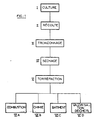
- FIG. 1 indicates the successive stages of the process: - culture I - harvest II - cut III - drying of the green sections IV - roasting V - application to VIA energy production or to VIB chemistry or to VIC building or to VID combustible waste treatment.
- the process implemented for intensive cultivation and production in the annual cycle, with mechanized harvesting of roasting woody material in the form of stems or vertical shoots of small diameters, while aiming to increase the vegetative duration of the trees cultivated at this effect, involves the implementation of a harvesting size which on the one hand, respects the collar of the tree and on the other hand, conditions the establishment of a low branched structure allowing the prolonged life of the trees and mechanized harvesting of said waste.
- the collar of the tree is the area (or section) of the tree which separates on the ground surface, the root bundle of the aerial part comprising trunk and antlers.
- the annual destruction of this collar by a clean cut causes the subject to decline in the short term.
- the method is also characterized in that at the end of the year of establishment, the first cut on cuttings or transplanted subjects is carried out according to an equidistant plane of the ground located some 10 centimeters above its surface, the stems remaining in soil being intended to form the short trunks of future trees.
- clear cuts occur when the branches have reached 1.5 to 2 centimeters in diameter at the base and 150 to 200 centimeters in height, their density possibly exceeding 100 stems per square meter.
- the harvest period in Europe is from November to February, in fact at that time the leaves have fallen; the shoots of the year are "augured", that is to say transformed into wood; the bark adheres to the wood of the stems, the sap has become scarce and the energy intended for drying will be less.
- the process according to the invention is further characterized in that the annual harvests of the shoots from the branches are carried out by mechanized cuts according to equidistant planes from the ground, but enhanced by some 2 cm per year, so that the bases of the regrowth remained on the branches , having the form of sticks and carrying the buds which should give rise to the suckers of the following year contribute to the expansion of the branched and low structure of the tree.
- Another characteristic of the invention relates to the distance between subjects of the same line of trees. It must be such that their expansion, which conditions the survival of each tree, is sufficient. While the distance to be established between the lines will be increased by the space necessary for the free passage of the machine wheels which must rest on the ground in the line space, space maintained by possible corrective sizes.
- the open passage is used to carry out the operations relating to the amendments, treatments or to loosen the soil and weed it.
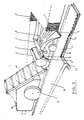
- the invention also includes a harvesting device shown schematically in action on the single board attached.
- a harvesting device shown schematically in action on the single board attached.
- In 1 we can see the high density of suckers to harvest.
- the front cutter bar 2 of the machine is of the same type as those used for harvesting cereals.
- the cut rejects 3 are conveyed to the feed rollers 4 which regulate their speed of advance towards the chopper drum 6 comprising the radial blades 7 running past the counter-iron 8. This shearing action slices the rejects and divides them in short, short sections 9. These are taken up by an elevator 10 and led to the bucket 11.
- the surface 12 represents those left after the intervention of the harvesting machine.
- In 14 is shown a section along a vertical plane located in the axis of a line of trees after harvesting. There are short trunks 15 and branched structure 16 of 2 trees.
- the harvesting device is characterized in that it successively spans the lines of trees and includes a front cutter bar 2 whose adjustable height determines that, heightened each year, of the cutting plane above the ground , said bar allowing by its action the harvest of rejections of the year and likewise the reopening of passage 13 intended for the wheels of the device, passage previously occupied by said discharges, opposite and belonging to 2 lines of trees consecutive, said device simultaneously effecting the slicing 6 of said discharges into short sections 9 gathered in the bucket 11.
- the height adjustment of the cutter bar 2 of the harvesting device should be made to 48 centimeters. Indeed to the 10 centimeters (height of the first cut) it will be necessary to add 19 times 2 centimeters (value of the annual enhancement) operation whose result is indeed 48 centimeters.
- the woody roasted product obtained consists exclusively of small sections, coming from the slicing of the branches, approximately cylindrical, wrapped in their bark, this entering an important part in the quality and presentation of the final fuel to be obtained and being a character clean.
- the method according to the invention proposes the brutal extraction of the water still contained in the sections, the channels of which were opened at both ends during slicing, using a rapid flow of gas at high temperature sweeping their surfaces.
- the process of roasting and roasting in a neutral atmosphere, fragments of still moist wood brought in continuously and gathered in mass of height kept constant in a vertically placed frustoconical reactor is characterized in that, set in motion by means of the vacuum established through said mass, the neutral heat-carrying gas is raised to a temperature higher than that required to obtain the roasting of the wood and sufficient to carry out, by grilling, the brutal drying of said fragments as soon as deposited in the reactor, drying having the effect to lower the temperature of said gases which, mixed with the vapor released, constitute the neutral gas flow and brought back to the temperature capable of ensuring, while it passes through it, the roasting of said mass.
- the device essentially comprises a member called a reactor 101 in which are carried out the toasting operations producing the initial drying, followed by the roasting of the fragments of wood brought continuously by the distributor 102.
- the fragments pass through baffles 103, of which we will see further on the object, before being placed on the wire bed 104.
- This bed is kept at constant height thanks to the action of a rotary plate extractor 105 which continuously removes the wood once roasted.
- the speeds of the distributor and the extractor are adjusted in the appropriate ratio which takes account of the shrinkage which accompanies drying and roasting.
- the residence time in the reactor is determined by the speed of the transfer.
- the roasted wood, extracted from the reactor, is deposited at the top 106 of the mass assembled in the receptacle 107.
- the latter of a certain capacity is equipped at its base with an appropriate system and not shown, with double airlock allowing removal by successive bowls of the roasted wood, without allowing the penetration of air into the device.
- An HP 108 fan lowers the device comprising the receptacle, the extractor and the reactor.
- This vacuum is transmitted to the device via the exchanger-condenser 109, the pipe terie 110, the annular nozzle 111 and the opening 112. It is applied to the mass 115 during treatment by passing through the rotary and perforated plate 105 from the base of the reactor skirt 113 which is also perforated and of the annular space 114 occupied by fragments of roasted wood being transferred.
- This depression sets in motion the flow of heat transfer gas and circulating at high speed between the fragments of wood deposited on the bed 104, a flow called upon to carry out the successive treatments of roasting and roasting of the wood.
- the method according to the invention is further characterized in that the heat transfer gas consists of the mixture of a large part of the recycled neutral gases taken off at the outlet of the reactor 101, and therefore at the roasting temperature, and of the burnt gases from combustion in the chamber 118 of a combustible gas supplied to the burner 116, a mixture whose temperature, two to three times higher than that applied during the roasting which will follow, is capable of producing on the fixed bed 104 of the reactor 101 the initial toasting of wet wood.
- the recycled gas is taken up in the circuit at 120 using the booster 121.
- the combustible gas is brought to the annular burner 116 by the line 117.
- the booster 121 brings the withdrawn gas out of the reactor to a pressure sufficient to supply said reactor 101 and to create through the baffle 103 a slight overpressure opposing the entry of air at this level, but allowing the entry of wood fragments brought in by the distributor 102.
- the combustible gas will advantageously be that obtained from a portion of roasted wood itself, taken from production and carbonated.
- the order of magnitude of the quantity consumed is approximately 10% to 12%.
- the time necessary for the successive toasting operations causing the brutal drying of the wood and its roasting is established between 3 and 6 minutes depending on the temperatures used and the average size of the fragments (less than or equal to cm3). These times which are given by way of example are not limiting. They correspond to the average residence time of the fragments in the reactor.
- This exchanger is also a condenser, it makes it possible to extract the water collected at 127 and discharged using a pump not shown, and to recover the calories contained in said gases. These calories are transferred to ambient air brought to the exchanger 109 by the fan 125 and leads, passing through the line 126 to a wood dryer, not shown, installed upstream of the reactor.
- the purpose of this dryer is to lower the water content of wood, raw material, by about 50% and to preheat it to a temperature close to 90 ° C.
- the method according to the invention is also characterized by the fact that part of the neutral gases, cooled after passing through the exchanger 109 and introduced by the annular nozzle 124 at the base of the receptacle 107 is set in motion by the prevailing depression in the device and passes through the mass 129 of roasted wood in order to extract the recoverable calories therefrom and lower the temperature so as to avoid the possible spontaneous ignition when setting said wood to the atmosphere at roasting temperature.
- the entire device is coated with a heat insulator 128.
- the combustion chamber 118 is capped with a refractory lining 130 the purpose of this chamber is to ensure complete combustion of the combustible mixture which is established without excess air. Indeed the gas flow must be neutral.
- the upper portion of the reactor is part of the combustion chamber. By its internal radiation, it contributes to temperature uniformity over the entire section of the heat transfer flow.
- the neutral gases, cooled by the exchanger 109 and extracted by the fan 108 contain a certain proportion of fumes consisting of tars formed in particular at the time of the roasting produced in the reactor 101.
- the process is finally characterized by the fact that said gases are filtered by passage through a large mass of already roasted wood and collected in a transfer silo operating continuously before the storage of said fuel.
- roasting carried out at 250-280 ° C in an apparatus as just described has the effect of fixing its water content at 3% and making it a product with stable characteristics.
- roasting does not remove pyroligneous products from wood, which represent around 50% of the energy potential to tal.
- Roasted wood has a calorific value of around 5,200 Kcal / Kg. It is suitable for mechanized handling without forming dust. It keeps well even in damp rooms. It lights up easily. It is between 250 and 350 ° C that the pyroligneous vapors can be extracted, around 350 to 500 ° C the tars, beyond there remains charcoal.
- nozzles are used with axial (Venturi) or annular nozzle, supplied with said fluid inductor under pressure while upstream of the nozzle the resulting depression puts in movement the so-called induced fluid.
- the pilot and inducing fluid may be the fuel gas or the air which can be preheated.
- the initial fuel represented by the roasted wood is transformed into a mixture of pyroligneous vapors and carbon monoxide intended to supply a burner capable of providing a continuous flame capable of being used in existing thermal appliances to replace oil or gas burners.
- the combustion device which comprises on the one hand, the hearth whose main object is to allow the extraction of pyroligneous vapors, this operation being carried out thanks to the calories coming from the partial combustion of charcoal, residue of said extraction , partial combustion which additionally provides a certain amount of carbon monoxide, and on the other hand the burner whose object is to ensure the complete combustion of the combustible mixture coming from the hearth, this device is characterized in that said hearth and burner are associated in the same assembly so that the temperature of said vapors as well as of the conduit responsible for the transfer cannot drop below the condensation temperature of the heaviest distilled element.
- the combustion device can take two embodiments: in the first, the hearth and the burner are placed side by side, and the diverging part of the nozzle itself constitutes the zone brought to high temperature where the flame front is fixed; in the second, the hearth and the burner are separated by a pipe, thermally insulated and comprising the nozzle, crossed by the flammable mixture at a speed greater than that of the propagation of the flame, the latter fixing and developing in the frustoconical combustion located at the end of the pipe.
- the ignition of the burner can be electric as known per se.
- the device is supplied with roasted wood mechanically and is intended to keep a full tubular column open at the top located above the hearth so that the height occupied therein by the roasted wood is constant as well as the pressure drop of an air flow passing through it from top to bottom.
- the supply of pilot air ensuring the combustion of vapors and combustible gases in the nozzle creates upstream a depression allowing on the one hand the admission of combustion air at the level of the hearth and on the other hand the sweeping towards bottom and through the torrefied wood supply column, pyroligneous vapors.
- the hearth constituted by the embers resulting from the partial combustion of charcoal rests according to the invention, on a hearth materialized by the bed of ashes itself.
- the stable position of the bed in the device is obtained by using a mechanical extractor.
- FIG. 4 represents the device resting on a console 201 next to the opening of a thermal enclosure to be heated 202.
- the wall of the body of the apparatus is pierced with holes 208 through which the air for combustion of charcoal is admitted.
- the interior chamber of the device then develops towards the nozzle 209, at the base of the connection conduit 210 inclined upward, the slope of slope 215 formed by the embers in ignition can be seen.
- the annular nozzle 211 in communication with the chamber 212 and the pilot air supply duct 213 and combustion of vapors and gases in the burner.
- the diverging point 214 of the nozzle has a large opening because it constitutes the combustion chamber itself where the flame front in the burner stabilizes.
- a vacuum resulting from the very principle of operation of the nozzle is installed upstream of the burner, that is to say in the hearth itself.
- the start-up and operation of the device can be obtained as follows: a batch of ashes is used to constitute the initial sole. On this one deposits charcoal up to the slope of the landslide 215. The pilot air pressure is established in the chamber 212. The flow of air in the nozzle 211 puts the fireplace in depression. The removable pipe 207 having been removed, using a flame, light the charcoal placed on the ash bed, then replace the pipe 207 which is filled with roasted wood. Almost immediately the device emits intense white smoke coming out of the nozzle 214. These are pyroligneous vapors which can therefore be ignited. Electrical equipment not shown can be used for this purpose.
- FIG. 5 represents a variant of the device in which the diverging portion of the nozzle 217 of the Venturi type is much more elongated. This results in the establishment in line 218 of a speed of movement of the flammable mixture greater than that of propagation of the flame which will then be established in a second diverging valve with a wider opening 219 located at the end of line 218. This arrangement makes it possible to supply an oven near which it is impossible to place the device of FIG. 4 properly.
- the duct 218 must be suitably insulated so as not to allow the temperature of the pyroligneous vapors to be lowered, for the same reason the combustion air admitted to the axial injector 220 must be sufficiently preheated.
Landscapes
- Chemical & Material Sciences (AREA)
- Oil, Petroleum & Natural Gas (AREA)
- Engineering & Computer Science (AREA)
- Organic Chemistry (AREA)
- Life Sciences & Earth Sciences (AREA)
- Forests & Forestry (AREA)
- Biodiversity & Conservation Biology (AREA)
- Ecology (AREA)
- Materials Engineering (AREA)
- Environmental Sciences (AREA)
- Physics & Mathematics (AREA)
- Thermal Sciences (AREA)
- Combustion & Propulsion (AREA)
- Solid Fuels And Fuel-Associated Substances (AREA)
- Non-Alcoholic Beverages (AREA)
- Micro-Organisms Or Cultivation Processes Thereof (AREA)
- Solid-Fuel Combustion (AREA)
- Drying Of Solid Materials (AREA)
Priority Applications (1)
| Application Number | Priority Date | Filing Date | Title |
|---|---|---|---|
| AT90106484T ATE80415T1 (de) | 1985-05-24 | 1986-05-26 | Verfahren zum erzeugen von geroestetem holz, auf diese weise hergestelltes produkt und dessen verwendung zum erzeugen von energie. |
Applications Claiming Priority (8)
| Application Number | Priority Date | Filing Date | Title |
|---|---|---|---|
| FR8507839A FR2582189B1 (fr) | 1985-05-24 | 1985-05-24 | Procede de production et de recolte d'un produit ligneux torrefiable |
| FR8507839 | 1985-05-24 | ||
| FR8514792 | 1985-10-07 | ||
| FR8514792A FR2588356B1 (fr) | 1985-10-07 | 1985-10-07 | Dispositif de combustion complete de bois torrefie |
| FR8600307 | 1986-01-10 | ||
| FR8600307A FR2592758B1 (fr) | 1986-01-10 | 1986-01-10 | Procede de production et dispositif pour la recolte d'un produit ligneux torrefiable |
| FR8601969 | 1986-02-13 | ||
| FR8601969A FR2594134B1 (fr) | 1986-02-13 | 1986-02-13 | Procede et dispositif pour le grillage suivi de la torrefaction de fragments de bois humides |
Related Parent Applications (1)
| Application Number | Title | Priority Date | Filing Date |
|---|---|---|---|
| EP86903408.2 Division | 1986-12-11 |
Publications (2)
| Publication Number | Publication Date |
|---|---|
| EP0385514A1 true EP0385514A1 (de) | 1990-09-05 |
| EP0385514B1 EP0385514B1 (de) | 1992-09-09 |
Family
ID=27446496
Family Applications (2)
| Application Number | Title | Priority Date | Filing Date |
|---|---|---|---|
| EP90106484A Expired - Lifetime EP0385514B1 (de) | 1985-05-24 | 1986-05-26 | Verfahren zum Erzeugen von geröstetem Holz, auf diese Weise hergestelltes Produkt und dessen Verwendung zum Erzeugen von Energie |
| EP86903408A Expired - Lifetime EP0223807B1 (de) | 1985-05-24 | 1986-05-26 | Verfahren zum erzeugen von geröstetem holz, auf diese weise hergestelltes produkt und dessen verwendung zum erzeugen von energie |
Family Applications After (1)
| Application Number | Title | Priority Date | Filing Date |
|---|---|---|---|
| EP86903408A Expired - Lifetime EP0223807B1 (de) | 1985-05-24 | 1986-05-26 | Verfahren zum erzeugen von geröstetem holz, auf diese weise hergestelltes produkt und dessen verwendung zum erzeugen von energie |
Country Status (5)
| Country | Link |
|---|---|
| US (1) | US4787917A (de) |
| EP (2) | EP0385514B1 (de) |
| AT (2) | ATE58045T1 (de) |
| DE (2) | DE3675502D1 (de) |
| WO (1) | WO1986006930A1 (de) |
Cited By (8)
| Publication number | Priority date | Publication date | Assignee | Title |
|---|---|---|---|---|
| WO1992021735A1 (en) * | 1991-06-01 | 1992-12-10 | Fi-Pro Limited | Treating biomass material |
| US8105400B2 (en) * | 2006-01-06 | 2012-01-31 | Stichting Energieonderzoek Centrum Nederland | Process and device for treating biomass |
| US8266821B2 (en) | 2008-10-03 | 2012-09-18 | Wyssmont Company Inc. | Method for drying and torrefaction |
| US8276289B2 (en) | 2009-03-27 | 2012-10-02 | Terra Green Energy, Llc | System and method for preparation of solid biomass by torrefaction |
| US8449724B2 (en) | 2009-08-19 | 2013-05-28 | Andritz Technology And Asset Management Gmbh | Method and system for the torrefaction of lignocellulosic material |
| DE202023103787U1 (de) | 2023-07-07 | 2023-09-01 | All4Labels Smart + Secure GmbH | Diebstahlsicherung |
| DE202023104234U1 (de) | 2023-07-27 | 2023-09-05 | All4Labels Smart + Secure GmbH | Preisanzeigevorrichtung |
| WO2025012126A1 (de) | 2023-07-07 | 2025-01-16 | Integritag Gmbh | Preisanzeigevorrichtung |
Families Citing this family (41)
| Publication number | Priority date | Publication date | Assignee | Title |
|---|---|---|---|---|
| DE60107122T2 (de) * | 2001-07-17 | 2006-01-19 | Liang, Zhi-Wei | Veränderung der Wasserfreundlichkeit und-feindlichkeit der natürlichen organischen Stoffe durch den Vorgang des oxydativen thermochemischen Dörrens |
| US8197561B2 (en) | 2001-10-10 | 2012-06-12 | River Basin Energy, Inc. | Process for drying coal |
| WO2006077652A1 (ja) * | 2005-01-24 | 2006-07-27 | Osaka Industrial Promotion Organization | 木質バイオマス固形燃料及びその製法 |
| US7942942B2 (en) * | 2006-05-21 | 2011-05-17 | Paoluccio John A | Method and apparatus for biomass torrefaction, manufacturing a storable fuel from biomass and producing offsets for the combustion products of fossil fuels and a combustible article of manufacture |
| ES2557993T3 (es) * | 2006-06-14 | 2016-02-01 | Torr-Coal Technology B.V. | Procedimiento de preparación de combustibles sólidos mediante torrefacción, así como los combustibles sólidos obtenidos de este modo y el uso de los mismos |
| NL1032001C2 (nl) * | 2006-06-14 | 2007-12-17 | Torr Coal Technology B V | Werkwijze voor het door torreficeren bereiden van een vaste brandstof en de daardoor verkregen vaste brandstof, werkwijze voor het verwijderen van een of meer metalen uit een vaste brandstof en de daardoor verkregen gereinigde vaste brandstof evenals toepassing van deze brandstoffen. |
| FR2904405B1 (fr) | 2006-07-31 | 2008-10-31 | Inst Francais Du Petrole | Procede de preparation d'une charge contenant de la biomasse en vue d'une gazeification ulterieure |
| US8449631B2 (en) * | 2007-03-18 | 2013-05-28 | John A. Paoluccio | Method and apparatus for biomass torrefaction using conduction heating |
| GR20070100416A (el) * | 2007-06-29 | 2009-01-20 | Μεθοδολογια απομακρυνσης ανοργανων συστατικων (καλιου, νατριου, χλωριου και θειου) απο βιομαζα αγροτικης, δασικης και αστικης προελευσης | |
| FR2924435B1 (fr) | 2007-11-30 | 2010-12-31 | Inst Francais Du Petrole | Procede et dispositif de torrefaction et de broyage en lit fluidise d'une charge de biomasse en vue d'une gazeification ou d'une combustion ulterieure |
| MX2010010859A (es) * | 2008-04-03 | 2010-11-01 | Univ North Carolina State | Dispositivos autotermicos y moviles de torrefaccion. |
| SE532746C2 (sv) * | 2008-06-11 | 2010-03-30 | Bio Energy Dev North Ab | Förfarande och apparatur för framställning av torrefierat lignocellulosamaterial |
| US8444721B2 (en) | 2008-06-26 | 2013-05-21 | Re Community Energy, Llc | Engineered fuel feed stock |
| CN104498098A (zh) * | 2008-06-26 | 2015-04-08 | 谐和能源有限责任公司 | 用于取代烧煤工厂中的煤的工程燃料原料 |
| WO2009158540A1 (en) | 2008-06-26 | 2009-12-30 | Casella Waste Systems, Inc. | Engineered fuel feed stock |
| US8669404B2 (en) * | 2008-10-15 | 2014-03-11 | Renewable Fuel Technologies, Inc. | Method for conversion of biomass to biofuel |
| DE102009010233B4 (de) * | 2009-02-24 | 2020-06-10 | Revatec Gmbh | Verfahren zum Erzeugen von Kohle aus Biomasse |
| HRP20170938T1 (hr) | 2009-12-22 | 2017-09-22 | Accordant Energy, Llc | Modificirana zamjenska goriva koja sadržavaju sorbens |
| US8795399B2 (en) * | 2010-01-15 | 2014-08-05 | Syngas Technology, Llc | Pretreatment of biomass feed for gasification |
| US20110179701A1 (en) * | 2010-01-27 | 2011-07-28 | G-Energy Technologies, Llc | Torrefaction of ligno-cellulosic biomasses and mixtures |
| US8647586B2 (en) * | 2010-03-08 | 2014-02-11 | Renewable Fuel Technologies, Inc. | Device for conversion of biomass to biofuel |
| WO2011119470A1 (en) * | 2010-03-22 | 2011-09-29 | Ber Technology Company Llc | System and method for torrefaction and processing of biomass |
| US20110179700A1 (en) * | 2010-03-22 | 2011-07-28 | James Russell Monroe | System and Method for Torrefaction and Processing of Biomass |
| US9057037B2 (en) | 2010-04-20 | 2015-06-16 | River Basin Energy, Inc. | Post torrefaction biomass pelletization |
| US8956426B2 (en) | 2010-04-20 | 2015-02-17 | River Basin Energy, Inc. | Method of drying biomass |
| US8246788B2 (en) | 2010-10-08 | 2012-08-21 | Teal Sales Incorporated | Biomass torrefaction system and method |
| WO2012101518A1 (en) | 2011-01-25 | 2012-08-02 | Giuliano Grassi | Apparatus and process for torrefaction of ligno-cellulosic biomasses and mixtures with liquids |
| EP2686404A4 (de) | 2011-03-17 | 2014-08-13 | Solazyme Inc | Pyrolyseöl und andere brennbare zusammensetzungen aus mikrobieller biomasse |
| US9487721B2 (en) | 2011-03-25 | 2016-11-08 | Hm3 Energy, Inc. | Refined torrefied biomass |
| US20130098751A1 (en) * | 2011-06-28 | 2013-04-25 | Andritz Inc. | Method for the torrefaction of lignocellulosic material |
| US8203024B2 (en) | 2011-08-23 | 2012-06-19 | Advanced Toffefaction Systems, LLC | Torrefaction systems and methods including catalytic oxidation and/or reuse of combustion gases directly in a torrefaction reactor, cooler, and/or dryer/preheater |
| US8198493B1 (en) * | 2012-01-11 | 2012-06-12 | Earth Care Products, Inc. | High energy efficiency biomass conversion process |
| US8388813B1 (en) * | 2012-01-11 | 2013-03-05 | Earth Care Products, Inc. | High energy efficiency biomass conversion process |
| ES2688361T3 (es) | 2012-01-26 | 2018-11-02 | Accordant Energy, Llc | Mitigación de emisiones de combustión dañinas usando materias primas combustibles que contienen sorbente |
| US20140283439A1 (en) * | 2013-03-21 | 2014-09-25 | Syngas Technology, Llc | Pretreatment of Biomass Feed for Gasification |
| US10066179B2 (en) | 2015-02-20 | 2018-09-04 | Integro Earth Fuels, Inc. | High energy content densified lignocellulose biomass |
| US10167428B2 (en) * | 2015-06-01 | 2019-01-01 | Central Michigan University | Methods for biomass torrefaction with carbon dioxide capture |
| CN108865196B (zh) * | 2018-06-30 | 2021-11-02 | 邢献军 | 一种生物炭制备方法 |
| US11124724B2 (en) | 2018-12-05 | 2021-09-21 | Hm3 Energy, Inc. | Method for producing a water-resistant, compressed biomass product |
| RU2707227C1 (ru) * | 2019-03-13 | 2019-11-25 | Федеральное государственное бюджетное образовательное учреждение высшего образования "Казанский государственный энергетический университет" (ФГБОУ ВО "КГЭУ") | Пиролизная установка |
| CN112521966A (zh) * | 2020-12-15 | 2021-03-19 | 广西贵港市誉诚农业科技有限公司 | 高效环保多釜移动式植物炭化炉 |
Citations (8)
| Publication number | Priority date | Publication date | Assignee | Title |
|---|---|---|---|---|
| WO1979000610A1 (fr) * | 1978-02-10 | 1979-08-23 | Lambiotte Usines | Procede non polluant de carbonisation du bois |
| US4231302A (en) * | 1979-05-14 | 1980-11-04 | Albert Neuhaus-Schwermann | Apparatus and process for burning of fuels of relatively young geological age and of any resulting gases |
| US4295822A (en) * | 1979-10-01 | 1981-10-20 | Campbell Crom B | Producer gas fueled burner system and drying apparatus |
| DE3018039A1 (de) * | 1980-05-10 | 1981-11-26 | Karl Otto Paul Chilliwack British Columbia Fischer | Verfahren zur aufbereitung von koniferen, insbesondere holzarmer koniferen zur gewinnung von energietraegern und rostoffen |
| FR2489356A1 (fr) * | 1980-08-29 | 1982-03-05 | Lambiotte Usines | Procede continu de carbonisation de matieres carbonees |
| DE3041627A1 (de) * | 1980-11-05 | 1982-06-09 | Artur Richard 6000 Frankfurt Greul | Verfahren zum aufarbeiten von zellulosehaltigen biomassen bzw. braunkohle und lignit zu einem einheitlichenk stark reaktionsfaehigen, staubfoermigen brennstoff |
| US4338985A (en) * | 1979-10-19 | 1982-07-13 | Georgia-Pacific Corporation | Tree and brushwood harvester |
| FR2512636A1 (fr) * | 1981-01-14 | 1983-03-18 | Baroni Michel | Ensemble recuperateur de remanents, abatteur de taillis, broyeur, auto- |
Family Cites Families (1)
| Publication number | Priority date | Publication date | Assignee | Title |
|---|---|---|---|---|
| FR2512053B1 (fr) * | 1981-08-28 | 1985-08-02 | Armines | Procede de transformation de matiere ligneuse d'origine vegetale et matiere d'origine vegetale ligneuse transformee par torrefaction |
-
1986
- 1986-05-26 EP EP90106484A patent/EP0385514B1/de not_active Expired - Lifetime
- 1986-05-26 US US07/010,975 patent/US4787917A/en not_active Expired - Fee Related
- 1986-05-26 DE DE8686903408T patent/DE3675502D1/de not_active Expired - Fee Related
- 1986-05-26 WO PCT/FR1986/000177 patent/WO1986006930A1/fr not_active Ceased
- 1986-05-26 AT AT86903408T patent/ATE58045T1/de not_active IP Right Cessation
- 1986-05-26 DE DE9090106484T patent/DE3686727T2/de not_active Expired - Fee Related
- 1986-05-26 AT AT90106484T patent/ATE80415T1/de not_active IP Right Cessation
- 1986-05-26 EP EP86903408A patent/EP0223807B1/de not_active Expired - Lifetime
Patent Citations (8)
| Publication number | Priority date | Publication date | Assignee | Title |
|---|---|---|---|---|
| WO1979000610A1 (fr) * | 1978-02-10 | 1979-08-23 | Lambiotte Usines | Procede non polluant de carbonisation du bois |
| US4231302A (en) * | 1979-05-14 | 1980-11-04 | Albert Neuhaus-Schwermann | Apparatus and process for burning of fuels of relatively young geological age and of any resulting gases |
| US4295822A (en) * | 1979-10-01 | 1981-10-20 | Campbell Crom B | Producer gas fueled burner system and drying apparatus |
| US4338985A (en) * | 1979-10-19 | 1982-07-13 | Georgia-Pacific Corporation | Tree and brushwood harvester |
| DE3018039A1 (de) * | 1980-05-10 | 1981-11-26 | Karl Otto Paul Chilliwack British Columbia Fischer | Verfahren zur aufbereitung von koniferen, insbesondere holzarmer koniferen zur gewinnung von energietraegern und rostoffen |
| FR2489356A1 (fr) * | 1980-08-29 | 1982-03-05 | Lambiotte Usines | Procede continu de carbonisation de matieres carbonees |
| DE3041627A1 (de) * | 1980-11-05 | 1982-06-09 | Artur Richard 6000 Frankfurt Greul | Verfahren zum aufarbeiten von zellulosehaltigen biomassen bzw. braunkohle und lignit zu einem einheitlichenk stark reaktionsfaehigen, staubfoermigen brennstoff |
| FR2512636A1 (fr) * | 1981-01-14 | 1983-03-18 | Baroni Michel | Ensemble recuperateur de remanents, abatteur de taillis, broyeur, auto- |
Cited By (13)
| Publication number | Priority date | Publication date | Assignee | Title |
|---|---|---|---|---|
| WO1992021735A1 (en) * | 1991-06-01 | 1992-12-10 | Fi-Pro Limited | Treating biomass material |
| GB2271349A (en) * | 1991-06-01 | 1994-04-13 | Fi Pro Ltd | Treating biomass material |
| GB2271349B (en) * | 1991-06-01 | 1995-07-12 | Fi Pro Ltd | Treating biomass material |
| US8105400B2 (en) * | 2006-01-06 | 2012-01-31 | Stichting Energieonderzoek Centrum Nederland | Process and device for treating biomass |
| US8549769B2 (en) | 2008-10-03 | 2013-10-08 | Wyssmont Company Inc. | System for drying and torrefaction |
| US8266812B2 (en) | 2008-10-03 | 2012-09-18 | Wyssmont Company Inc. | System for drying and torrefaction |
| US8266821B2 (en) | 2008-10-03 | 2012-09-18 | Wyssmont Company Inc. | Method for drying and torrefaction |
| US8276289B2 (en) | 2009-03-27 | 2012-10-02 | Terra Green Energy, Llc | System and method for preparation of solid biomass by torrefaction |
| US8322056B2 (en) | 2009-03-27 | 2012-12-04 | Terra Green Energy, Llc | System and method for preparation of solid biomass by torrefaction |
| US8449724B2 (en) | 2009-08-19 | 2013-05-28 | Andritz Technology And Asset Management Gmbh | Method and system for the torrefaction of lignocellulosic material |
| DE202023103787U1 (de) | 2023-07-07 | 2023-09-01 | All4Labels Smart + Secure GmbH | Diebstahlsicherung |
| WO2025012126A1 (de) | 2023-07-07 | 2025-01-16 | Integritag Gmbh | Preisanzeigevorrichtung |
| DE202023104234U1 (de) | 2023-07-27 | 2023-09-05 | All4Labels Smart + Secure GmbH | Preisanzeigevorrichtung |
Also Published As
| Publication number | Publication date |
|---|---|
| DE3686727T2 (de) | 1993-04-22 |
| ATE58045T1 (de) | 1990-11-15 |
| US4787917A (en) | 1988-11-29 |
| EP0385514B1 (de) | 1992-09-09 |
| ATE80415T1 (de) | 1992-09-15 |
| DE3686727D1 (de) | 1992-10-15 |
| WO1986006930A1 (fr) | 1986-12-04 |
| DE3675502D1 (de) | 1990-12-13 |
| EP0223807B1 (de) | 1990-11-07 |
| EP0223807A1 (de) | 1987-06-03 |
Similar Documents
| Publication | Publication Date | Title |
|---|---|---|
| EP0223807B1 (de) | Verfahren zum erzeugen von geröstetem holz, auf diese weise hergestelltes produkt und dessen verwendung zum erzeugen von energie | |
| RU2573014C2 (ru) | Способ производства угля из соломы и устройство для обугливания соломы | |
| US20160304800A1 (en) | Torrefaction Process | |
| EP2189512A1 (de) | Röstverfahren der Biomasse und Kontrolle dieses Verfahrens | |
| EP0772663B1 (de) | Verfahren und vorrichtung zum recyclen von behandeltem holz | |
| WO2012156769A1 (en) | Reactor for continuous production of wood vinegar and charcoal | |
| EP0045256A2 (de) | Verfahren und Vorrichtung zum Vergasen von Pflanzenmaterialien | |
| WO1979000610A1 (fr) | Procede non polluant de carbonisation du bois | |
| EP0345336A1 (de) | Verfahren und vorrichtung zur bertinisierung von holzartigen pflanzlichen materialien | |
| CA2609383C (fr) | Procede et installation de traitement de materiaux solides organiques | |
| EP0011037A1 (de) | Vergasungsverfahren und Vergasungsvorrichtung | |
| EP3173459B1 (de) | Schnellpyrolyseverfahren von organischen biomasseteilchen mit injektion von heissen gasen gegen den strom | |
| WO2009098418A2 (fr) | Procede et systeme de production d'hydrogene integre a partir de matiere organique. | |
| FR2583427A1 (fr) | Procede de fabrication de charbon de bois, dispositif pour sa mise en oeuvre et produits obtenus par ce procede | |
| JPS62502880A (ja) | 焙焼木材を得る方法、得られた製品、およびエネルギ発生への応用 | |
| CA2430158A1 (fr) | Procede de recolte et de preparation de la tourbe de sphaigne et sechoir pour mener a bien ce procede | |
| FR2594134A1 (fr) | Procede et dispositif pour le grillage suivi de la torrefaction de fragments de bois humides | |
| EP4610333A1 (de) | Verkohlungsanlage und verfahren zur herstellung von holzkohle | |
| CH203908A (fr) | Procédé de distillation, en continu, de matières combustibles carbonées, en particulier de matières cellulosiques, et appareil pour l'exécution de ce procédé. | |
| FR2469655A1 (fr) | Procede et appareil de combustion de melanges d'excrements et litieres provenant d'installations d'elevage intensif d'animaux | |
| FR2710399A1 (fr) | Procédés pour la combustion en continu de bois fragmenté et application à un calorifère. | |
| FR2492800A1 (fr) | Procede de production de matieres carbonees fortement activees | |
| CH363009A (fr) | Procédé de fabrication de charbon et appareil pour la mise en oeuvre de ce procédé | |
| BE884953A (fr) | Dispositif et procede de traitement de matieres organiques | |
| FR2836685A1 (fr) | Procede de craquage de dechets de polyethylene ou autres polyolefines en vue de la production d'hydrocarbures |
Legal Events
| Date | Code | Title | Description |
|---|---|---|---|
| PUAI | Public reference made under article 153(3) epc to a published international application that has entered the european phase |
Free format text: ORIGINAL CODE: 0009012 |
|
| 17P | Request for examination filed |
Effective date: 19900405 |
|
| AC | Divisional application: reference to earlier application |
Ref document number: 223807 Country of ref document: EP |
|
| AK | Designated contracting states |
Kind code of ref document: A1 Designated state(s): AT BE CH DE GB IT LI LU NL SE |
|
| 17Q | First examination report despatched |
Effective date: 19910618 |
|
| GRAA | (expected) grant |
Free format text: ORIGINAL CODE: 0009210 |
|
| AC | Divisional application: reference to earlier application |
Ref document number: 223807 Country of ref document: EP |
|
| AK | Designated contracting states |
Kind code of ref document: B1 Designated state(s): AT BE CH DE GB IT LI LU NL SE |
|
| PG25 | Lapsed in a contracting state [announced via postgrant information from national office to epo] |
Ref country code: IT Free format text: LAPSE BECAUSE OF FAILURE TO SUBMIT A TRANSLATION OF THE DESCRIPTION OR TO PAY THE FEE WITHIN THE PRE;WARNING: LAPSES OF ITALIAN PATENTS WITH EFFECTIVE DATE BEFORE 2007 MAY HAVE OCCURRED AT ANY TIME BEFORE 2007. THE CORRECT EFFECTIVE DATE MAY BE DIFFERENT FROM THE ONE RECORDED.SCRIBED TIME-LIMIT Effective date: 19920909 Ref country code: GB Effective date: 19920909 Ref country code: AT Effective date: 19920909 Ref country code: SE Effective date: 19920909 Ref country code: NL Effective date: 19920909 |
|
| REF | Corresponds to: |
Ref document number: 80415 Country of ref document: AT Date of ref document: 19920915 Kind code of ref document: T |
|
| REF | Corresponds to: |
Ref document number: 3686727 Country of ref document: DE Date of ref document: 19921015 |
|
| NLV1 | Nl: lapsed or annulled due to failure to fulfill the requirements of art. 29p and 29m of the patents act | ||
| GBV | Gb: ep patent (uk) treated as always having been void in accordance with gb section 77(7)/1977 [no translation filed] |
Effective date: 19920909 |
|
| PG25 | Lapsed in a contracting state [announced via postgrant information from national office to epo] |
Ref country code: LU Free format text: LAPSE BECAUSE OF NON-PAYMENT OF DUE FEES Effective date: 19930531 Ref country code: CH Effective date: 19930531 Ref country code: BE Effective date: 19930531 Ref country code: LI Effective date: 19930531 |
|
| PLBE | No opposition filed within time limit |
Free format text: ORIGINAL CODE: 0009261 |
|
| STAA | Information on the status of an ep patent application or granted ep patent |
Free format text: STATUS: NO OPPOSITION FILED WITHIN TIME LIMIT |
|
| 26N | No opposition filed | ||
| BERE | Be: lapsed |
Owner name: LE CLERC DE BUSSY JACQUES Effective date: 19930531 |
|
| REG | Reference to a national code |
Ref country code: CH Ref legal event code: PL |
|
| PG25 | Lapsed in a contracting state [announced via postgrant information from national office to epo] |
Ref country code: DE Effective date: 19940201 |