EP0385656B1 - Verfahren zur Herstellung eines hoch orientierten ultralangen konjugierten Polymers - Google Patents
Verfahren zur Herstellung eines hoch orientierten ultralangen konjugierten Polymers Download PDFInfo
- Publication number
- EP0385656B1 EP0385656B1 EP90301893A EP90301893A EP0385656B1 EP 0385656 B1 EP0385656 B1 EP 0385656B1 EP 90301893 A EP90301893 A EP 90301893A EP 90301893 A EP90301893 A EP 90301893A EP 0385656 B1 EP0385656 B1 EP 0385656B1
- Authority
- EP
- European Patent Office
- Prior art keywords
- monomolecular film
- group
- exposure
- orientated
- highly
- Prior art date
- Legal status (The legal status is an assumption and is not a legal conclusion. Google has not performed a legal analysis and makes no representation as to the accuracy of the status listed.)
- Expired - Lifetime
Links
Images











Classifications
-
- B—PERFORMING OPERATIONS; TRANSPORTING
- B82—NANOTECHNOLOGY
- B82Y—SPECIFIC USES OR APPLICATIONS OF NANOSTRUCTURES; MEASUREMENT OR ANALYSIS OF NANOSTRUCTURES; MANUFACTURE OR TREATMENT OF NANOSTRUCTURES
- B82Y30/00—Nanotechnology for materials or surface science, e.g. nanocomposites
-
- B—PERFORMING OPERATIONS; TRANSPORTING
- B05—SPRAYING OR ATOMISING IN GENERAL; APPLYING FLUENT MATERIALS TO SURFACES, IN GENERAL
- B05D—PROCESSES FOR APPLYING FLUENT MATERIALS TO SURFACES, IN GENERAL
- B05D1/00—Processes for applying liquids or other fluent materials
- B05D1/18—Processes for applying liquids or other fluent materials performed by dipping
- B05D1/185—Processes for applying liquids or other fluent materials performed by dipping applying monomolecular layers
-
- B—PERFORMING OPERATIONS; TRANSPORTING
- B82—NANOTECHNOLOGY
- B82Y—SPECIFIC USES OR APPLICATIONS OF NANOSTRUCTURES; MEASUREMENT OR ANALYSIS OF NANOSTRUCTURES; MANUFACTURE OR TREATMENT OF NANOSTRUCTURES
- B82Y15/00—Nanotechnology for interacting, sensing or actuating, e.g. quantum dots as markers in protein assays or molecular motors
-
- B—PERFORMING OPERATIONS; TRANSPORTING
- B82—NANOTECHNOLOGY
- B82Y—SPECIFIC USES OR APPLICATIONS OF NANOSTRUCTURES; MEASUREMENT OR ANALYSIS OF NANOSTRUCTURES; MANUFACTURE OR TREATMENT OF NANOSTRUCTURES
- B82Y20/00—Nanooptics, e.g. quantum optics or photonic crystals
-
- B—PERFORMING OPERATIONS; TRANSPORTING
- B82—NANOTECHNOLOGY
- B82Y—SPECIFIC USES OR APPLICATIONS OF NANOSTRUCTURES; MEASUREMENT OR ANALYSIS OF NANOSTRUCTURES; MANUFACTURE OR TREATMENT OF NANOSTRUCTURES
- B82Y40/00—Manufacture or treatment of nanostructures
-
- C—CHEMISTRY; METALLURGY
- C08—ORGANIC MACROMOLECULAR COMPOUNDS; THEIR PREPARATION OR CHEMICAL WORKING-UP; COMPOSITIONS BASED THEREON
- C08F—MACROMOLECULAR COMPOUNDS OBTAINED BY REACTIONS ONLY INVOLVING CARBON-TO-CARBON UNSATURATED BONDS
- C08F38/00—Homopolymers and copolymers of compounds having one or more carbon-to-carbon triple bonds
-
- G—PHYSICS
- G02—OPTICS
- G02F—OPTICAL DEVICES OR ARRANGEMENTS FOR THE CONTROL OF LIGHT BY MODIFICATION OF THE OPTICAL PROPERTIES OF THE MEDIA OF THE ELEMENTS INVOLVED THEREIN; NON-LINEAR OPTICS; FREQUENCY-CHANGING OF LIGHT; OPTICAL LOGIC ELEMENTS; OPTICAL ANALOGUE/DIGITAL CONVERTERS
- G02F1/00—Devices or arrangements for the control of the intensity, colour, phase, polarisation or direction of light arriving from an independent light source, e.g. switching, gating or modulating; Non-linear optics
- G02F1/35—Non-linear optics
- G02F1/355—Non-linear optics characterised by the materials used
- G02F1/361—Organic materials
- G02F1/3618—Langmuir Blodgett Films
Definitions
- This invention relates to an electric material and more specifically, it relates to a process for the production of a highly-orientated ultralong conjugated polymer having conjugated bounds, such as polyacetylenic bonds, which exhibits electrical conductivity and nonlinear optical effects.
- Polymers of acetylene, a derivative thereof, etc. have, in the molecule, a linear main chain having a ⁇ -electron conjugated bond system and therefore have electrical conductivity and nonlinear optical effects. For this reason, they are widely studied as an optical and electronic function materials.
- a process for the production of a highly-orientated ultralong conjugated polymer comprises:
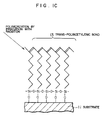
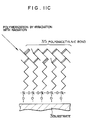
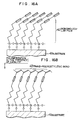
- Figs. 1A and C are process illustrations showing a process for the production of a highly-orientated ultralong conjugated polymer comprised of an NCS monomolecular film and having a trans-polyacetylenic bond.
- Fig. 1B is a schematic view showing a step of selectively and linearly inactivating unsaturated groups of the monomolecular film by means of electron beam exposure (EB irradiation).
- EB irradiation electron beam exposure
- Figs. 2A and B are process illustrations showing a process for the production of a highly-orientated ultralong conjugated polymer comprised of a TMS-NCS monomolecular film and having a trans-polyacetylenic bond.
- Figs. 3A and B are process illustrations showing a process for the production of a highly-orientated ultralong conjugated polymer having a polydiacetylenic bond.
- Fig. 3C is a process illustration showing a process for the production of a highly-orientated ultralong conjugated polymer having a polyacetylenic bond.
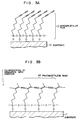
- Figs. 4A and C are process illustrations showing a process for the production of a highly-orientated ultralong conjugated polymer comprised of an NCS monomolecular film and having a trans-polyacetylenic bond.
- Fig. 4B is a schematic view showing a step of selectively and linearly inactivating unsaturated groups of the monomolecular film by means of electron beam exposure (EB irradiation).
- EB irradiation electron beam exposure
- Figs. 5A and B are process illustrations showing a process for the production of a highly-orientated ultralong conjugated polymer comprised of a TMS-NCS monomolecular film and having a trans-polyacetylenic bond.
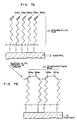
- Figs. 6A and B are process illustrations showing a process for the production of a highly-orientated ultralong conjugated polymer comprised of an NCS monomolecular film and having a cis-polyacetylenic bond.
- Figs. 7A and B are process illustrations showing a process for the production of a highly-orientated ultralong conjugated polymer comprised of a TMS-NCS monomolecular film and having a cis-polyacetylenic bond.
- Figs. 8A - E are process illustrations showing a process for the production of a highly-orientated ultralong conjugated polymer produced as other Example.
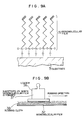
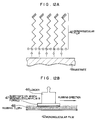
- Figs. 9A, C and D are process illustrations showing a process for the production of a highly-orientated ultralong conjugated polymer comprised of an NCS monomolecular film and having a trans-polyacetylenic bond.
- Fig. 9B is a schematic view showing a step of rubbing a monomolecular film.
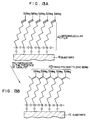
- Figs. 10A and B are process illustrations showing a process for the production of a highly-orientated ultralong conjugated polymer comprised of a TMS-NCS monomolecular film and having a trans-polyacetylenic bond.
- Figs. 11A and B are process illustrations showing a process for the production of a highly-orientated ultralong conjugated polymer having a polydiacetylenic bond.
- Figs. 12A, C and D are process illustrations showing a process for the production of a highly-orientated ultralong conjugated polymer comprised of an NCS monomolecular film and having a trans-polyacetylenic bond.
- Fig. 12B is a schematic view showing a step of rubbing a monomolecular film.
- Figs. 13A and B are process illustrations showing a process for the production of a highly-orientated ultralong conjugated polymer comprised of a TMS-NCS monomolecular film and having a trans-polyacetylenic bond.
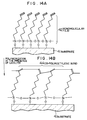
- Figs. 14A and B are process illustrations showing a process for the production of a highly-orientated ultralong conjugated polymer comprised of an NCS monomolecular film and having a cis-polyacetylenic bond.
- Figs. 15A and B are process illustrations showing a process for the production of a highly-orientated ultralong conjugated polymer comprised of a TMS-NCS monomolecular film and having a cis-polyacetylenic bond.
- Figs. 16A, B and C are process illustrations showing a process for the production of a highly-orientated ultralong conjugated polymer having a polyacetylenic bond.
- the first aspect of this invention is directed to a process for the production of a highly-orientated ultralong conjugated polymer, which comprises: a step of immersing a substrate having a hydrophilic surface in a nonaqueous organic solvent having, dissolved, a compound containing, in the molecule, at least an unsaturated group such as an acetylenic group, etc., and a (mono, di or tri) chloro- or alkylsilyl group (-SiA x H 3-x in which A denotes a chloro group and x denotes an integer of from 1 to 3), whereby forming a monomolecular film of the above compound on the substrate by chemisorption, a step of selectively and linearly inactivating unsaturated groups of the monomolecular film by means of writing with STM (scanning tunneling microscope), exposure to an electron beam, or exposure to X-ray, and a step of irradiating the entire surface of the substrate with radiation in an inert gas atmosphere to
- the second aspect of this invention is directed to a process for the production of a highly-orientated ultralong conjugated polymer, which comprises: a step of immersing a substrate having a hydrophilic surface in a first nonaqueous organic solvent having, dissolved, a compound containing at least an unsaturated group such as acetylenic group (-C ⁇ C-), etc., and a (mono, di or tri) chloro- or alkylsilyl group (-SiA x H 3-x in which A denotes a chloro or lower alkyl group and x denotes an integer of from 1 to 3) whereby forming a monomolecular film of the above compound on the substrate by chemisorption, a step of selectively and linearly inactivating unsaturated groups of the monomolecular film by means of writing with STM (scanning tunneling microscope), exposure to an electron beam or exposure to X-ray, and a step of immersing the substrate on which the monomolecular film is formed in
- one of the two acetylenic groups in the diacetylenic group may be first polymerized in the second organic solvent, and then high-energy radiation may be used to form a polyacenic bond.
- the third aspect of this invention is directed to a process for the production of a highly-orientated ultralong conjugated polymer, which comprises: a step of immersing a substrate having a hydrophilic surface in a nonaqueous organic solvent having, dissolved, a compound containing, in the molecule, at least an unsaturated group such as an acetylenic group (-C ⁇ C-), etc., and a (mono, di or tri) chlorosilyl group, whereby forming a monomolecular film of the above compound on the substrate by chemisorption, a step of orientating the monomolecular film by rubbing, and a step of irradiating the substrate with radiation in an inert gas atmosphere to polymerize the unsaturated group portion of the monomolecular film.
- the fourth aspect of this invention is directed to a process for the production of a highly-orientated ultralong conjugated polymer retaining orientation, which comprises: a step of immersing a substrate having a hydrophilic surface in a nonaqueous organic solvent having, dissolved, a compound containing, in the molecule, at least an unsaturated group such as an acetylenic group (-C ⁇ C-) and a chlorosilyl or group (SiA x H 3-x in which A and x are as defined above), whereby forming a monomolecular film of the above compound on the substrate by chemisorption, a step of orientating the monomolecular film by rubbing, whereby forming the monomolecular film of the above compound on the substrate in such a state that the molecules of the above compound are orderly orientated, and a step of polymerizing the monomolecular film formed on the substrate by using a catalyst as specified in the first aspect.
- a monomolecular film of the derivative can be formed on a hydrophilic surface of a substrate in an organic solvent by chemisorption, and further that a built-up film of the above above monomolecular film can be formed by irradiating the above monomolecular film with high-energy radiation in an oxygen-containing atmosphere to turn the surface thereof to hydrophilic property.
- a compound such as a linear hydrocarbon derivative having a chlorosilyl group on one end thereof and containing an acetylenic group or diacetylenic group in part thereof is used to carry out chemisorption, it is possible to form a monomolecular film of an acetylene derivative or diacetylene derivative in an order of dozens of angstroms, and further, a multi-layer film can be also obtained.
- unsaturated groups of the monomolecular film are selectively and linearly inactivated in a specific direction, and then the remaining acetylenic group or diacetylenic group portion of the monomolecular film is polymerized by irradiating the entirety of the monomolecular film with energy rays such as high-energy radiation or UV ray in an inert gas atmosphere, whereby there is obtained a polyacetylene-type or polydiacetylene-type polymer which has high orientation, a high molecular weight and a very long conjugated bond system, and which is also stable even in an oxygen-containing atmosphere.
- energy rays such as high-energy radiation or UV ray
- a ultrahigh-molecular-weight polymer having a continuous conjugated bond system (ultralong conjugated polymer, the polymerization degree being more several hundreds) can be obtained by polymerizing molecules of an acetylene derivative or diacetylene derivative by means of irradiation with energy ray while the monomolecular film retains a constant directional property.
- a substrate having a hydrophilic surface is immersed in a nonaqueous organic solvent having, dissolved, a compound containing, in the molecule, at least an unsaturated group such as an acetylenic group (-C ⁇ C-), a diacetylenic group (-C ⁇ C-C ⁇ C-) or the like and a chlorosilyl group (-SiCl x H 3-x ) to form a monomolecular film of the above compound on the substrate, and then, unsaturated groups of the monomolecular film are selectively and linearly inactivated and then polymerized, whereby the monomolecular film of the above compound can be linearly held on the substrate in such a state that the polymerization direction of molecules of the monomolecular film is orderly orientated.
- unsaturated group such as an acetylenic group (-C ⁇ C-), a diacetylenic group (-C ⁇ C-C ⁇ C-) or the like and a chlorosilyl
- portion of the monomolecular film which has not been inactivated is polymerized in the linear direction by means of radiation or UV ray, whereby a highly-orientated ultralong conjugated polymer can be produced which is in a state that its polymerization direction is controlled.
- the monomolecular film may naturally be rubbed instead of being inactivated for the orientation. In this case, the entirety of the monomolecular film is polymerized after the orientation.
- the polymerization reaction of unsaturated groups such as acetylenic groups, etc. in the first and third aspects may use radiation such as X-ray, electron beam or gamma ray, and when the monomolecular film contains a diacetylenic group, the polymerization may use UV ray in addition to radiation such as X-ray, electron beam and gamma ray.
- Examples of the metal catalyst preferably usable in the second and fourth aspects include MoCl5, WCl6, NbCl5 and TaCl5 as a metal halide catalyst and Mo(CO)5, W(CO)6, Nb(CO)5 and Ta(CO)5 as a metal carbonyl catalyst.
- Example of the second solvent dissolving these include toluene, dioxane, anisole, etc.
- the substrate having a hydrophilic surface is not critical, and any substrate is usable which can form an -Si-O- bond by reacting with a chloro- or alkylsilyl group.
- acetylene derivative having one terminal acetylenic group represented by the following formula HC ⁇ C- (CH2) n -SiA x H 3-x wherein n is an integer of from 14 to 24, x is an integer of from 1 to 3 and A is an defined above.
- acetylene derivatives of the above formula wherein n is 17 are suitably usable.
- the present specification sometimes refers thereto simply as NCS.
- diacetylene derivatives having one terminal diacetylenic group represented by the following formula HC ⁇ C-C ⁇ C- (CH2) n -SiA x H 3-x wherein n is an integer of from 14 to 24, x is an integer of from 1 to 3, and A denotes a chloro group.
- tricosadiynoic chlorosilane is suitably usable which is represented by the above formula in which n is 19.
- nonaqueous organic solvent to dissolve the above compounds examples include a mixture of chloroform, carbon tetrachloride and n-hexadecane.
- any nonaqueous solvents are usable if they can dissolve the above compounds and do not prevent the formation of the monomolecular film of this invention.
- a silane-based surfactant, NCS, HC ⁇ C-(CH2)17-SiCl3 is chemisorbed on an Si substrate 11 having a diameter of 3 inches and having an SiO2 film formed on the surface, whereby a monomolecular film is formed on the surface of the substrate 11.
- a chlorosilyl group (-SiCl3) of the silane-based surfactant, NCS, and an -OH group present on the SiO2 film surface of the substrate 11 react with each other to form, on the surface of the substrate 11, a monomolecular film 12 having the following structure:
- an Si substrate having an SiO2 film formed on the surface was immersed in a solution of 1.0 x 10 ⁇ 3 to 4.0 x 10 ⁇ 3 mol/l of the above silane-based surfactant, NCS, in 85% n-hexadecane, 8% carbon tetrachloride and 7% chloroform at room temperature for 8 minutes, whereby an -Si-O- bond was formed on the SiO2 film surface (Fig. 1A).
- the formation of the monomolecular film 12 having a structure of on the substrate 11 was found by FT-IR.
- unsaturated groups of the above monomolecular film were linearly inactivated by writing with STM (scanning tunneling microscope), exposure to an electron ray or exposure to X-ray (the exposure amount may be about 5 mJ/cm2 in each case) to allow the unsaturated groups to remain linearly in a certain direction, and thereafter, the entire surface of the monomolecular film was irradiated with radiation (e.g. X-ray, electron beam or gamma ray) at 5 to 10 mJ/cm2 in an atmosphere of an inert gas such as helium to cause a reaction as shown in Fig.
- radiation e.g. X-ray, electron beam or gamma ray
- highly-orientated ultralong conjugated polymers produced as above were remarkably stable to heat and pressure or UV ray even in an oxygen-containing atmosphere as compared with conventional polymers produced by using a Ziegler-Natta catalyst.
- a monomolecular film 12 is formed (Fig. 3A), and then, the diacetylenic groups are selectively and linearly inactivated and polymerized in an inert gas by using UV ray (5 to 10 mJ/cm2), whereby a highly-orientated ultralong conjugated polymer having a linear polydiacetylenic bond 14 is obtained (Fig. 5B).
- a silane-based surfactant, NCS, HC ⁇ C-(CH2)17-SiCl3 is chemisorbed on an Si substrate 21 having a diameter of 3 inches and having an SiO2 film formed on the surface, whereby a monomolecular film 21 is formed on the surface of the substrate 21.
- a chlorosilyl group (-SiCl x H 3-x ) of the silane-based surfactant, NCS, and an -OH group present on the SiO2 film surface of the substrate 21 react with each other to form, on the surface of the substrate 21, a monomolecular film 22 having the following structure:
- an Si substrate having an SiO2 film formed on the surface was immersed in a solution of 3.0 x 10 ⁇ 3 to 4.0 x 10 ⁇ 3 mol/l of the above silane-based surfactant, NCS, in 80% n-hexadecane, 12% carbon tetrachloride and 8% chloroform at room temperature for 10 minutes, whereby an -Si-O- bond was formed on the SiO2 film surface (Fig. 4A).
- the formation of the monomolecular film 22 having a structure of on the surface of the substrate 21 was found by FT-IR.
- the formation of the monomolecular film 22 was carried out in a nitrogen atmosphere containing no moisture.
- unsaturated groups of the above monomolecular film were linearly inactivated by means of writing with STM (scanning tunneling microscope), exposure to electron ray or exposure to X-ray (the exposure amount may be about 5 mJ/cm2 in each case) to allow the unsaturated groups to remain in a certain direction and linearly.
- the substrate 21 on which one layer of the above monomolecular film 22 was formed was immersed in a solution of molybdenum pentachloride (MoCl5) as a catalyst in toluene, and the solution was heated to about 30 to 70°C, whereby the remaining acetylene groups which were not inactivated were polymerized by a reaction shown in Fig.
- MoCl5 molybdenum pentachloride
- a monomolecular film of TMS-NCS was formed on the above Si substrate 21 (Fig. 5A), and acetylenic groups of the monomolecular film were selectively inactivated. Thereafter, the substrate was immersed in a solution of tungsten hexachloride (WCl6) as a catalyst and tetrabutyl tin (Bu4Sn) as a cocatalyst in an amount ratio of 1:1 in toluene, and the solution was heated to about 30 to 70°C, whereby a linear highly-orientated trans-polyacetylenic bond 23 containing trimethylsilyl groups (-SiMe3) was formed.
- WCl6 tungsten hexachloride
- Bu4Sn tetrabutyl tin
- a substrate prepared by forming one layer of a monomolecular film 22 of NCS (Fig. 6A) on an Si substrate was immersed in a solution of molybdenum pentachloride (MoCl5) as a catalyst in anisole, which is an organic solvent having an oxygen atom in the molecule, and the solution was heated to 30 to 70°C, whereby a linear highly-orientated cis-polyacetylenic bond 24 was formed by a reaction shown in Fig. 6B.
- MoCl5 molybdenum pentachloride
- a substrate prepared by forming one layer of a monomolecular film 22 of TMS-NCS (Fig. 7A) was immersed in a solution of molybdenum pentachloride (MoCl5) as a catalyst and triphenylbismuth in an amount ratio of 1:1 in anisole, which is an organic solvent having an oxygen atom in the molecule, and the solution was heated to 30 to 70°C, whereby a highly-orientated cis-polyacetylenic bond 24 containing trimethylsilyl groups (-SiMe3) was formed by a reaction shown in Fig. 7B.
- MoCl5 molybdenum pentachloride
- anisole an organic solvent having an oxygen atom in the molecule
- highly-orientated ultralong conjugated polymers produced as above were remarkably stable to heat and pressure or UV ray even in an oxygen-containing atmosphere as compared with conventional polymers produced by using a Ziegler-Natta catalyst.
- Example 2 has been explained by using only NCS and TMS-NCS as compounds to form monomolecular films.
- compounds having, in the molecule, an unsaturated group such as an acetylenic group, etc., and capable of forming a monomolecular film by an LB method, etc. can be similary used for the above process even if the depositing conditions differ.
- a monomolecular film 22 is formed (Fig. 8C), and then, the diacetylenic groups are selectively and linearly inactivated, and polymerized by using a catalyst to give a trans-polydiacetylenic bond 23 (Fig. 8D).
- Example 2 has explained a process for forming only one layer of a monomolecular film and polymerizing it.
- a process which comprises building up a multi-layer monomolecular film, inactivating the unsaturated groups selectively and linearly, and then carrying out the polymerization Further, a multi-layer built-up film of highly-orientated ultralong conjugated polymers can be also produced by repeating the monomolecular film formation-linear inactivation-polymerization procedure.
- a silane surfactant, NCS, HC ⁇ C-(CH2)17-SiCl3 is chemisorbed on an Si substrate 31 having a diameter of 3 inches and having an SiO2 film on the surface, whereby, a monomolecular film is formed on the surface of the substrate 31.
- a chlorosilyl group (-SiCl3) of NCS and an -OH group present on the SiO2 surface of the substrate 31 react with each other to form, on the surface of the substrate 31, a monomolecular film 32 having the following structure:
- an Si substrate having an SiO2 surface formed on the surface was immersed in a solution of 1.0 x 10 ⁇ 3 to 1.0 x 10 ⁇ 2 mol/l of the above silane-based surfactant, NCS, in 75% n-hexadecane, 17% carbon tetrachloride and 8% chloroform at room temperature for several minutes, whereby an -Si-O- bond was formed on the SiO2 surface (Fig. 9A).
- Fig. 9B the rubbing was carried out as shown in Fig. 9B to orientate the monomolecular film 32 in a specific direction (Fig. 9C).
- the monomolecular film was irradiated with radiation (e.g. X-ray at 50 mJ/cm2) to form a trans-polyacetylenic bond 33 orientated in a like direction by a reaction shown in Fig. 9D, which formation was found by FT-IR.
- radiation e.g. X-ray at 50 mJ/cm2
- Fig. 9D which formation was found by FT-IR.
- similarly polymerized monomolecular films were obtained by using electron beam or gamma ray as radiation other than X-ray.
- UV ray having a wavelength of 365 nm
- an Si substrate 31 having one layer of a monomolecular film 32 of TMS-NCS formed thereon was rubbed (Fig. 10A), and then the Si substrate was irradiated with radiation (e.g. X-ray at 50 mJ/cm2) in an inert gas atmosphere (e.g. helium) to form a highly-orientated trans-polyacetylenic bond 33 having trimethylsilyl groups (-SiMe3) by a reaction shown in Fig. 10B.
- radiation e.g. X-ray at 50 mJ/cm2
- an inert gas atmosphere e.g. helium
- the highly-orientated ultralong conjugated polymers produced as above were remarkably stable to heat and pressure or UV rays even in an oxygen-containing atmosphere as compared with conventional polymers produced in the presence of Ziegler-Natta catalyst.
- Example 3 has been explained by using only NCS and TMS-NCS as a compound to form monomolecular films.
- compounds having, in the molecule, an unsaturated group such as an acetylenic group (-C ⁇ C-), etc., and capable of forming a monomolecular film by an LB method, etc. can be similarly used for the above process even if the depositing conditions differ.
- a monomolecular film 32 is formed and rubbed (Fig. 11A), and thereafter the diacetylenic groups are polymerized by using UV ray, whereby a highly-orientated ultralong conjugated polymer having a polydiacetylenic bond 34 can be obtained (Fig. 11B).
- a polydiacetylene-type highly-orientated ultralong conjugated polymer having a polydiacetylenic bond 35 can be obtained (Fig. 11C).
- a silane-based surfactant, NCS, HC ⁇ C-(CH2)17-SiCl3 is chemisorbed on an Si substrate 41 having a diameter of 3 inches and having an SiO2 film formed on the surface, whereby a monomolecular film 2 is formed on the surface of the substrate 41.
- a chlorosilyl group (-SiCl3) of NCS and an -OH group present on the SiO2 surface of the substrate 41 react with each other to form, on the surface of the substrate 41, a monomolecular film 42 having the following structure:
- an Si substrate having an SiO2 surface formed on the surface was immersed in a solution of 1.0 x 10 ⁇ 3 to 1.0 x 10 ⁇ 2 mol/l of the above silane-based surfactant, NCS, in 75% n-hexadecane, 17% carbon tetrachloride and 8% chloroform at room temperature for several minutes, whereby an -Si-O- bond was formed on the SiO2 surface (Fig. 12A).
- Fig. 12B the rubbing was carried out as shown in Fig. 12B to orientate the monomolecular film 42 in a specific direction (Fig. 12C).
- the substrate 41 on which one layer of the above monomolecular film 42 was formed was immersed in a solution of molybdenum pentachloride (MoCl5) as a catalyst in toluene, and the solution was heated to 30 to 70°C, whereby a trans-polyacetylenic bond 43 orientated in a like direction was formed by a reaction shown in Fig. 12D, which formation was found by FT-IR.
- MoCl5 molybdenum pentachloride
- a monomolecular film 42 of 1-(trimethylsilyl)- ⁇ -nonadecynyltrichlorosilane Me3Si-C ⁇ C-(CH2) n -SiCl3 was formed on the above Si substrate 41, and the substrate 41 was rubbed (Fig. 13A).
- the Si substrate was immersed in a solution of tungsten hexachloride (WCl6) as a catalyst and tetrabutyl tin (Bu4) as a cocatalyst in an amount ratio of 1:1 in toluene, and the solution was heated to about 30 to 70°C, whereby a highly-orientated trans-polyacetylenic bond 43 having trimethylsilyl groups (-SiMe3) was formed by a reaction shown in Fig. 13B.
- WCl6 tungsten hexachloride
- Bu4 tetrabutyl tin
- a monomolecular film 42 of NCS was formed on an Si substrate 41 (Fig. 14A), and then the substrate was rubbed and immersed in a solution of molybdenum pentachloride (MoCl5) in anisole, which is an organic solvent having an oxygen atom in the molecule.
- MoCl5 molybdenum pentachloride
- anisole an organic solvent having an oxygen atom in the molecule.
- the solution was heated to about 30 to 70°C to form a cis-polyacetylenic bond 44 by a reaction shown in Fig. 14B.
- a monomolecular film 42 of TMS-NCS was formed on an Si substrate 41, and then the substrate was rubbed and immersed in a solution of molybdenum pentachloride (MoCl5) as a catalyst and triphenylbismuth (Ph3Bi) as a cocatalyst in an amount ratio of 1:1 in anisole, which is an organic solvent having an oxygen atom in the molecule. Then, the solution was heated to about 30 to 70°C, whereby a cis-polyacetylenic bond 44 having trimethylsilyl groups (-SiMe3) was formed by a reaction shown in Fig. 15B.
- MoCl5 molybdenum pentachloride
- Ph3Bi triphenylbismuth
- the highly-orientated ultralong conjugated polymers produced as above were remarkably stable to heat and pressure or UV rays even in an oxygen-containing atmosphere as compared with conventional polymers produced in the presence of Ziegler-Natta catalyst.
- Example 4 has been explained by using only NCS and TMS-NCS as a compound to form monomolecular films.
- compounds having, in the molecule, an unsaturated group such as an acetylenic group (-C ⁇ C-), etc., and capable of forming a monomolecular film by an LB method, etc. can be similarly used for the above process even if the depositing conditions differ.
- HC ⁇ C-C ⁇ (CH2)19SiCl3 the monomolecular film 42 is formed and rubbed (Fig. 16A), and thereafter the diacetylenic groups are polymerized by using a ctalyst, whereby a high-orientation monomolecular film having a polyacetylenic bond 43 can be obtained (Fig. 16B).
- a highly-orientated ultralong conjugated polymer having a polyacenic bond 45 can be obtained (Fig. 16C).
- the production process of this invention it is possible to produce, at high efficiency, stable highly-orientated ultralong conjugated polymers having a molecular weight of more than several hundreds and having excellent electric conductivity and excellent nonlinear optical effects.
Landscapes
- Chemical & Material Sciences (AREA)
- Engineering & Computer Science (AREA)
- Nanotechnology (AREA)
- Physics & Mathematics (AREA)
- Crystallography & Structural Chemistry (AREA)
- Nonlinear Science (AREA)
- General Physics & Mathematics (AREA)
- Optics & Photonics (AREA)
- Health & Medical Sciences (AREA)
- Condensed Matter Physics & Semiconductors (AREA)
- Life Sciences & Earth Sciences (AREA)
- Polymers & Plastics (AREA)
- Chemical Kinetics & Catalysis (AREA)
- Medicinal Chemistry (AREA)
- Materials Engineering (AREA)
- Organic Chemistry (AREA)
- Composite Materials (AREA)
- General Health & Medical Sciences (AREA)
- Molecular Biology (AREA)
- Biophysics (AREA)
- Manufacturing & Machinery (AREA)
- Manufacture Of Macromolecular Shaped Articles (AREA)
- Addition Polymer Or Copolymer, Post-Treatments, Or Chemical Modifications (AREA)
Claims (11)
- Verfahren zur Herstellung eines hoch orientierten, ultralangen konjugierten Polymeren, welches umfaßt:(a) zur Bildung eines monomolekularen Films eine Stufe des Eintauchens eines eine hydrophile Oberfläche aufweisenden Substrates in ein nichtwässriges organisches Lösungsmittel, das eine Verbindung enthält, die wenigstens eine ungesättigte Gruppe, wie eine Acetylengruppe (-C≡C-), und eine durch die Formel (-SiAxH3-x) wiedergegebene Gruppe, worin A eine Chlorgruppe bedeutet und x eine ganze Zahl von 1 bis 3 ist, besitzt, unter Bildung eines monomolekularen Films der oben genannten Verbindung auf dem Subtrat durch Chemisorption,(b) eine erste Polymerisationsstufe des selektiven und linearen Inaktivierens von ungesättigten Gruppen des monomolekularen Films durch Beschreiben mittels STM (Scanner-Tunnelmikroskop), Exposition gegenüber Elektronenstrahl oder Exposition gegenüber Röntgenstrahlen, oder, falls die ungesättigte Gruppe eine Diacetylengruppe (-C≡C-C≡C-) ist, Exposition gegenüber UV-Strahlung,(c) eine zweite Polymerisationsstufe, umfassend entweder(i) eine Stufe der Bestrahlung der gesamten Oberfläche des Substrates in einer Inertgasatmosphäre durch Beschreiben mittels STM (Scanner-Tunnelmikroskop), Exposition gegenüber Elektronenstrahl, Exposition gegenüber Röntgenstrahlen oder Exposition gegenüber Gammastrahlen, oder, falls die ungesättigte Gruppe eine Diacetylengruppe (-C≡C-C≡C-) ist, Exposition gegenüber UV-Strahlung, Exposition gegenüber Gammastrahlen, Exposition gegenüber Röntgenstrahlen oder Exposition gegenüber Elektronenstrahl zur Polymerisation des restlichen Anteiles des monomolekularen Films, der nicht während dieser ersten Polymerisationsstufe inaktiviert worden ist, oder(ii) eine Stufe des Eintauchens des Substrates, auf welchem der monomolekulare Film ausgebildet ist, in ein zweites organisches Lösungsmittel, das einen Metallhalogenidkatalysator oder Metallcarbonylkatalysator enthält, zur Polymerisation des restlichen Anteiles von ungesättigten Gruppen des monomolekularen Films, der nicht während dieser ersten Polymerisationsstufe inaktiviert worden ist.
- Verfahren zur Herstellung eines hoch orientierten ultralangen konjugierten Polymeren nach Anspruch 1, worin diese erste Polymerisationsstufe (b) durch eine Stufe der Orientierung des monomolekularen Films durch Reiben ersetzt wird.
- Verfahren nach Anspruch 1 oder Anspruch 2, worin die ungesättigte Gruppe eine Acetylengruppe oder eine Diacetylengrupe ist.
- Verfahren zur Herstellung eines hoch orientierten ultralangen konjugierten Polymeren nach Anspruch 1 oder Anspruch 2, worin die ungesättigte Gruppe eine Diacetylengruppe (-C≡C-C≡C-) ist.
- Verfahren zur Herstellung eines hoch orientierten ultralangen konjugierten Polymeren nach Anspruch 4, worin im Anschluß an diese zweite Polymerisationsstufe (ii) eine Bestrahlungsstufe in einer Inertgasatmosphäre durch Beschreiben mittels STM (Scanner-Tunnelmikroskop), Exposition gegenüber Elektronenstrahl, Exposition gegenüber Röntgenstrahlen oder Exposition gegenüber Gammastrahlen, zur Bildung einer Polyacenbindung durchgeführt wird.
- Verfahren nach einem der Ansprüche 1 bis 5, worin die Verbindung eine Trimethylsilylgruppe (-SiMe₃) aufweist.
- Verfahren nach einem der Ansprüche 1 bis 6, worin die Verbindung ω-Nonadecinyltrichlorsilan ist.
- Verfahren nach einem der Ansprüche 1 bis 6, worin die Verbindung 1-(Trimethylsilyl)-ω-nonadecinyltrichlorsilan ist.
- Verfahren nach einem der Ansprüche 1 bis 8, worin der Metallhalogenidkatalysator oder der Metallcarbonylkatalysator Mo, W, Nb oder Ta umfaßt.
- Verfahren nach einem der Ansprüche 1 bis 9, worin das zweite organische Lösungsmittels weiter einen organischen Zinnkatalysator oder organischen Wismutkatalysator als Cokatalysator zusätzlich zu dem Metallhalogenidkatalysator oder Metallcarbonylkatalysator enthält.
- Verfahren nach Anspruch 10, worin das zweite organische Lösungsmittel ein organisches Lösungsmittel ist, das ein Sauerstoffatom im Molekül enthält, der Metallhalogenidkatalysator Molybdänpetachlorid (MoCl₅) ist, und weiterhin das hoch orientierte ultralange konjugierte Polymere eine cis-Form besitzt.
Applications Claiming Priority (8)
| Application Number | Priority Date | Filing Date | Title |
|---|---|---|---|
| JP4599489 | 1989-02-27 | ||
| JP45994/89 | 1989-02-27 | ||
| JP4599689 | 1989-02-27 | ||
| JP45995/89 | 1989-02-27 | ||
| JP4599589 | 1989-02-27 | ||
| JP45996/89 | 1989-02-27 | ||
| JP45993/89 | 1989-02-27 | ||
| JP4599389 | 1989-02-27 |
Publications (3)
| Publication Number | Publication Date |
|---|---|
| EP0385656A2 EP0385656A2 (de) | 1990-09-05 |
| EP0385656A3 EP0385656A3 (de) | 1991-11-06 |
| EP0385656B1 true EP0385656B1 (de) | 1995-05-10 |
Family
ID=27461809
Family Applications (1)
| Application Number | Title | Priority Date | Filing Date |
|---|---|---|---|
| EP90301893A Expired - Lifetime EP0385656B1 (de) | 1989-02-27 | 1990-02-21 | Verfahren zur Herstellung eines hoch orientierten ultralangen konjugierten Polymers |
Country Status (3)
| Country | Link |
|---|---|
| US (1) | US5008127A (de) |
| EP (1) | EP0385656B1 (de) |
| DE (1) | DE69019202T2 (de) |
Cited By (1)
| Publication number | Priority date | Publication date | Assignee | Title |
|---|---|---|---|---|
| DE19945935B4 (de) * | 1999-09-24 | 2008-01-03 | Universität Heidelberg | Verfahren zur Herstellung eines oberflächenmodifizierten Schichtsystems |
Families Citing this family (22)
| Publication number | Priority date | Publication date | Assignee | Title |
|---|---|---|---|---|
| US5304583A (en) * | 1988-04-28 | 1994-04-19 | Matsushita Electric Industrial Co., Ltd. | Process for producing polyacetylene or polyacene type long conjugated polymers |
| US5304582A (en) * | 1988-04-28 | 1994-04-19 | Matsushita Electric Industrial Co., Ltd. | Process for producing polyacetylene or polyacene type long conjugated polymers |
| US5302416A (en) * | 1988-04-28 | 1994-04-12 | Matsushita Electric Industrial Co., Ltd. | Process for producing polyacetylene or polyacene type long conjugated polymers |
| JPH0626706B2 (ja) * | 1988-09-05 | 1994-04-13 | 日本原子力研究所 | 単分子累積膜の製造方法 |
| JPH07103190B2 (ja) * | 1989-02-15 | 1995-11-08 | 松下電器産業株式会社 | 有機導電性薄膜とその製造方法 |
| US5260115A (en) * | 1989-02-15 | 1993-11-09 | Matsushita Electric Industrial Co., Ltd. | Organic electro-conductive thin films and process for production thereof |
| US5246740A (en) * | 1990-01-12 | 1993-09-21 | Matsushita Electric Industrial Co., Ltd. | Process for preparing a lamination of organic monomolecular films, and a chemical adsorbent used for the process |
| US5204126A (en) * | 1990-02-06 | 1993-04-20 | Nanofilm Corporation | Mold surfaces with ultra thin release films |
| US5219613A (en) * | 1990-06-13 | 1993-06-15 | Wacker-Chemitronic Gesellschaft Fur Elektronik-Grundstoffe Mbh | Process for producing storage-stable surfaces of polished silicon wafers |
| JP2637869B2 (ja) * | 1990-12-10 | 1997-08-06 | 松下電器産業株式会社 | 吸着単分子膜及びその製造方法 |
| EP0511590B1 (de) * | 1991-04-30 | 1997-10-15 | Matsushita Electric Industrial Co., Ltd. | Funktionell laminierte, chemisch adsorbierte Schicht und Verfahren zu deren Herstellung |
| US5658728A (en) * | 1991-06-19 | 1997-08-19 | Gosney, Jr.; William Milton | Templates for nucleic acid molecules |
| JPH0517595A (ja) * | 1991-07-15 | 1993-01-26 | Matsushita Electric Ind Co Ltd | 高分子超薄膜エレクトレツト及びその製造方法 |
| DE4139205A1 (de) * | 1991-11-28 | 1993-06-03 | Wacker Chemitronic | Verfahren zur herstellung lagerstabiler oberflaechen von siliciumscheiben mit vorteilhaften oxidationseigenschaften |
| JPH08846B2 (ja) * | 1992-01-14 | 1996-01-10 | 松下電器産業株式会社 | ポリアセチレン型共役ポリマーの製造方法 |
| DE69310279T2 (de) * | 1992-07-29 | 1998-01-02 | Matsushita Electric Ind Co Ltd | Gleitfilm und Verfahren zu seiner Herstellung |
| US5465680A (en) * | 1993-07-01 | 1995-11-14 | Dow Corning Corporation | Method of forming crystalline silicon carbide coatings |
| JP2002069111A (ja) * | 2000-06-13 | 2002-03-08 | Japan Science & Technology Corp | 重合分子鎖の作成方法 |
| TW555790B (en) | 2000-12-26 | 2003-10-01 | Matsushita Electric Industrial Co Ltd | Conductive organic thin film, process for producing the same, and organic photoelectronic device, electric wire, and electrode aech employing the same |
| TWI298732B (en) * | 2001-04-17 | 2008-07-11 | Matsushita Electric Industrial Co Ltd | Conductive organic thin film and production method therefor, electrode and electric cable using it |
| WO2003067675A1 (en) | 2002-02-08 | 2003-08-14 | Matsushita Electric Industrial Co., Ltd. | Organic electronic device and its manufacturing method |
| DE102008046707A1 (de) * | 2008-09-11 | 2010-03-18 | Universität Bielefeld | Vollständig vernetzte chemisch strukturierte Monoschichten |
Family Cites Families (5)
| Publication number | Priority date | Publication date | Assignee | Title |
|---|---|---|---|---|
| JPH08845B2 (ja) * | 1987-07-15 | 1996-01-10 | 松下電器産業株式会社 | ポリジアセチレン高分子の製造方法 |
| JPH01236207A (ja) * | 1987-07-24 | 1989-09-21 | Nippon Steel Corp | ポリジアセチレン薄膜の製造法 |
| DE68903420T2 (de) * | 1988-04-28 | 1993-04-15 | Matsushita Electric Ind Co Ltd | Verfahren zur erzeugung von polyazetylen oder polyazen konjugierten polymeren mit sehr langer kette. |
| US4835229A (en) * | 1988-04-29 | 1989-05-30 | Air Products And Chemicals, Inc. | Catalyst and process for the preparation of tri-substituted silylalkynes |
| US5019303A (en) * | 1988-05-11 | 1991-05-28 | Matsushita Electric Industrial Co., Ltd. | Process for producing polyacetylene |
-
1990
- 1990-02-21 EP EP90301893A patent/EP0385656B1/de not_active Expired - Lifetime
- 1990-02-21 DE DE69019202T patent/DE69019202T2/de not_active Expired - Fee Related
- 1990-02-22 US US07/482,965 patent/US5008127A/en not_active Expired - Lifetime
Cited By (1)
| Publication number | Priority date | Publication date | Assignee | Title |
|---|---|---|---|---|
| DE19945935B4 (de) * | 1999-09-24 | 2008-01-03 | Universität Heidelberg | Verfahren zur Herstellung eines oberflächenmodifizierten Schichtsystems |
Also Published As
| Publication number | Publication date |
|---|---|
| US5008127A (en) | 1991-04-16 |
| EP0385656A3 (de) | 1991-11-06 |
| DE69019202T2 (de) | 1996-01-04 |
| DE69019202D1 (de) | 1995-06-14 |
| EP0385656A2 (de) | 1990-09-05 |
Similar Documents
| Publication | Publication Date | Title |
|---|---|---|
| US5008127A (en) | Process for the production of a highly-orientated ultralong conjugated polymer | |
| EP0552637B1 (de) | Verfahren zur Herstellung eines konjugierten Acetylenpolymers | |
| EP0386784A2 (de) | Selektiv durchlässige Membran und Verfahren zu ihrer Herstellung | |
| JPH0667981B2 (ja) | ポリアセチレン又はポリアセン型超長共役ポリマーの製造方法 | |
| EP0351092B1 (de) | Verfahren zur Herstellung von monomolekularen Adsorptionsfilmen oder aus monomolekularen Schichten aufgebauten Filmen unter Anwendung von Silanen, die Acetylen- oder Diacetylenbindungen enthalten | |
| JPH0227766A (ja) | 有機デバイスおよびその製造方法 | |
| EP0339677B1 (de) | Verfahren zur Erzeugung von Polyazetylen oder Polyazen konjugierten Polymeren mit sehr langer Kette | |
| Persson et al. | Patterning of poly (3‐octylthiophene) conducting polymer films by electron beam exposure | |
| EP0312100A2 (de) | Verfahren zur Herstellung eines Polyacetylen- oder Polydiacetylenfilms | |
| JP2506973B2 (ja) | 光記録媒体の製造方法 | |
| WO2002048219A1 (fr) | Polymere lamellaire organique/inorganique du type perovskite | |
| EP0341697B1 (de) | Verfahren zur Herstellung von Polyacetylen | |
| EP0299678B1 (de) | Verfahren zur Herstellung eines superlangen konjugierten Polymers | |
| Tieke et al. | Polymerization of diacetylenes in mixed multilayers | |
| Hodge et al. | Preformed polymers for Langmuir-Blodgett films | |
| EP0441326B1 (de) | Verfahren zur Erzeugung eines optischen Aufzeichnungsträgers | |
| US5248526A (en) | Process for producing polyacetylene or polyacene type long conjugated polymers | |
| JPH0627139B2 (ja) | ポリアセチレンの製造方法 | |
| EP0344799A2 (de) | Selektiv-Permeabler Film und Verfahren zu seiner Herstellung | |
| JPH0667982B2 (ja) | 高配向性共役ポリマーの製造方法 | |
| CA1327296C (en) | Coated substrates having an ultrathin, single-layer or multilayer coating, a process for their production and polyesters as intermediate products for the coated substrates | |
| Decker | An original method for producing polymer micro‐circuits by laser irradiation | |
| JPH0678394B2 (ja) | ポリアセチレンの製造方法 | |
| JPH0247108A (ja) | ポリアセチレンの製造方法 | |
| JPH02182708A (ja) | 金属化ポリアセチレン又は金属化ポリアセン型超長共役ポリマーの製造方法 |
Legal Events
| Date | Code | Title | Description |
|---|---|---|---|
| PUAI | Public reference made under article 153(3) epc to a published international application that has entered the european phase |
Free format text: ORIGINAL CODE: 0009012 |
|
| AK | Designated contracting states |
Kind code of ref document: A2 Designated state(s): DE FR GB |
|
| 17P | Request for examination filed |
Effective date: 19901228 |
|
| PUAL | Search report despatched |
Free format text: ORIGINAL CODE: 0009013 |
|
| AK | Designated contracting states |
Kind code of ref document: A3 Designated state(s): DE FR GB |
|
| 17Q | First examination report despatched |
Effective date: 19930211 |
|
| GRAA | (expected) grant |
Free format text: ORIGINAL CODE: 0009210 |
|
| AK | Designated contracting states |
Kind code of ref document: B1 Designated state(s): DE FR GB |
|
| REF | Corresponds to: |
Ref document number: 69019202 Country of ref document: DE Date of ref document: 19950614 |
|
| ET | Fr: translation filed | ||
| PLBE | No opposition filed within time limit |
Free format text: ORIGINAL CODE: 0009261 |
|
| STAA | Information on the status of an ep patent application or granted ep patent |
Free format text: STATUS: NO OPPOSITION FILED WITHIN TIME LIMIT |
|
| 26N | No opposition filed | ||
| REG | Reference to a national code |
Ref country code: GB Ref legal event code: 746 Effective date: 19970901 |
|
| REG | Reference to a national code |
Ref country code: GB Ref legal event code: IF02 |
|
| REG | Reference to a national code |
Ref country code: FR Ref legal event code: D6 |
|
| PGFP | Annual fee paid to national office [announced via postgrant information from national office to epo] |
Ref country code: GB Payment date: 20060215 Year of fee payment: 17 |
|
| PGFP | Annual fee paid to national office [announced via postgrant information from national office to epo] |
Ref country code: DE Payment date: 20060216 Year of fee payment: 17 |
|
| PGFP | Annual fee paid to national office [announced via postgrant information from national office to epo] |
Ref country code: FR Payment date: 20060220 Year of fee payment: 17 |
|
| GBPC | Gb: european patent ceased through non-payment of renewal fee |
Effective date: 20070221 |
|
| REG | Reference to a national code |
Ref country code: FR Ref legal event code: ST Effective date: 20071030 |
|
| PG25 | Lapsed in a contracting state [announced via postgrant information from national office to epo] |
Ref country code: DE Free format text: LAPSE BECAUSE OF NON-PAYMENT OF DUE FEES Effective date: 20070901 |
|
| PG25 | Lapsed in a contracting state [announced via postgrant information from national office to epo] |
Ref country code: GB Free format text: LAPSE BECAUSE OF NON-PAYMENT OF DUE FEES Effective date: 20070221 Ref country code: FR Free format text: LAPSE BECAUSE OF NON-PAYMENT OF DUE FEES Effective date: 20070228 |