EP0385849B1 - Dispositif à arbre traversant pour convoyeur à rouleaux à friction - Google Patents
Dispositif à arbre traversant pour convoyeur à rouleaux à friction Download PDFInfo
- Publication number
- EP0385849B1 EP0385849B1 EP19900400536 EP90400536A EP0385849B1 EP 0385849 B1 EP0385849 B1 EP 0385849B1 EP 19900400536 EP19900400536 EP 19900400536 EP 90400536 A EP90400536 A EP 90400536A EP 0385849 B1 EP0385849 B1 EP 0385849B1
- Authority
- EP
- European Patent Office
- Prior art keywords
- shaft
- bearing
- shaped member
- groove
- arrangement according
- Prior art date
- Legal status (The legal status is an assumption and is not a legal conclusion. Google has not performed a legal analysis and makes no representation as to the accuracy of the status listed.)
- Expired - Lifetime
Links
- 229910052782 aluminium Inorganic materials 0.000 claims description 5
- XAGFODPZIPBFFR-UHFFFAOYSA-N aluminium Chemical compound [Al] XAGFODPZIPBFFR-UHFFFAOYSA-N 0.000 claims description 5
- 230000000712 assembly Effects 0.000 claims 2
- 238000000429 assembly Methods 0.000 claims 2
- 239000004411 aluminium Substances 0.000 claims 1
- 230000000284 resting effect Effects 0.000 claims 1
- 238000003754 machining Methods 0.000 description 3
- 229910052751 metal Inorganic materials 0.000 description 2
- 239000002184 metal Substances 0.000 description 2
- 239000004952 Polyamide Substances 0.000 description 1
- 229910000831 Steel Inorganic materials 0.000 description 1
- 239000004033 plastic Substances 0.000 description 1
- 229920002647 polyamide Polymers 0.000 description 1
- 238000009987 spinning Methods 0.000 description 1
- 239000010959 steel Substances 0.000 description 1
- 238000003466 welding Methods 0.000 description 1
- 238000004804 winding Methods 0.000 description 1
Images


Classifications
-
- B—PERFORMING OPERATIONS; TRANSPORTING
- B65—CONVEYING; PACKING; STORING; HANDLING THIN OR FILAMENTARY MATERIAL
- B65G—TRANSPORT OR STORAGE DEVICES, e.g. CONVEYORS FOR LOADING OR TIPPING, SHOP CONVEYOR SYSTEMS OR PNEUMATIC TUBE CONVEYORS
- B65G47/00—Article or material-handling devices associated with conveyors; Methods employing such devices
- B65G47/22—Devices influencing the relative position or the attitude of articles during transit by conveyors
- B65G47/26—Devices influencing the relative position or the attitude of articles during transit by conveyors arranging the articles, e.g. varying spacing between individual articles
- B65G47/261—Accumulating articles
- B65G47/263—Accumulating articles the conveyor drive is taken from a longitudinally extending shaft
-
- B—PERFORMING OPERATIONS; TRANSPORTING
- B65—CONVEYING; PACKING; STORING; HANDLING THIN OR FILAMENTARY MATERIAL
- B65G—TRANSPORT OR STORAGE DEVICES, e.g. CONVEYORS FOR LOADING OR TIPPING, SHOP CONVEYOR SYSTEMS OR PNEUMATIC TUBE CONVEYORS
- B65G39/00—Rollers, e.g. drive rollers, or arrangements thereof incorporated in roller-ways or other types of mechanical conveyors
- B65G39/10—Arrangements of rollers
- B65G39/12—Arrangements of rollers mounted on framework
-
- B—PERFORMING OPERATIONS; TRANSPORTING
- B65—CONVEYING; PACKING; STORING; HANDLING THIN OR FILAMENTARY MATERIAL
- B65G—TRANSPORT OR STORAGE DEVICES, e.g. CONVEYORS FOR LOADING OR TIPPING, SHOP CONVEYOR SYSTEMS OR PNEUMATIC TUBE CONVEYORS
- B65G47/00—Article or material-handling devices associated with conveyors; Methods employing such devices
- B65G47/22—Devices influencing the relative position or the attitude of articles during transit by conveyors
- B65G47/26—Devices influencing the relative position or the attitude of articles during transit by conveyors arranging the articles, e.g. varying spacing between individual articles
- B65G47/261—Accumulating articles
Definitions
- the present invention relates to the field of handling during assembly or machining operations. It relates more particularly to a through-shaft device intended for a friction roller conveyor.
- Devices with through shafts generally include shafts mounted on two ball bearings. These ball bearings are either overmolded with a plastic part which fits into two sheet metal cheeks provided with notches, or mounted in two aluminum profiles bored to the outside diameter of the bearings
- the shafts are easily removable, but the sheet metal cheeks do not allow accessories to be mounted without machining or welding.
- the invention aims to remedy these drawbacks by combining the advantages of the two aforementioned solutions: easy disassembly of the shafts and the use of aluminum profiles for the cheeks.
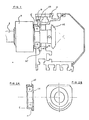
- Figure 1 is shown a section of a conveyor according to the invention, on the motor side.
- a through shaft 2 carries a friction roller 4, a bearing 6 and a conical drive pinion 12.
- the bearing 6 is fitted into an aluminum profile 10 in which a circular cylindrical bore 14 has been produced.
- a key 8 ensures the locking of the bearing 6 by taking support in a groove 18 of the profile 10.
- FIGS. 2A and 2B illustrate the bearing 6 which is overmolded on a bearing 24.
- a groove 20 comes opposite the groove 18 to receive the key 8 which locks the bearing 6.
- the heel 22 fits into the groove 16 of the profile 10.
- the other end of the shaft 2 is mounted in the same way without the pinion 12 and is free in translation in its bearing.
- FIG. 3 corresponds to another embodiment where the drive of the shafts is obtained by means of a pinion 33 which meshes with a chain 34.
- the double chain 34 rests on two drawn steel 36 themselves held in position by two grooves formed in the profile 30.
- the return strand 38 of the chain 34 rests on a polyamide profile 40 itself held in position by a groove made in the profile 30.
- the outer diameter of the pinion 33 is less than the diameter of the bore 14 in the profile 30.
- the disassembly of the shaft 2 is thus possible as described above; in addition, a free space is provided in the section 30 above the pinion 33 to allow it to be released without having to remove the chain 34.
- FIG. 4 represents a third variant where the drive of the shafts is obtained by means of a helical toothed pinion 54 which meshes on a worm screw 56.
- This endless screw 56 is common to several pinions 54.
- each pinion 54 In line with each pinion 54, it rests on a molded bearing 58.
- This bearing 58 is immobilized by means of a screw 62 and a rectangular plate 60.
- the axial component of the screw 56 is received by a stop ring secured to this screw which bears on a bearing 58.
- the outside diameter of the pinion 54 is less than the diameter of the bore 14 executed in the profile 50. This arrangement preserves the dismantling of the shaft 2 without having to pin the pinion 54.
- the endless screw 56 is rotated by a toothed belt which meshes on a pulley integral with this screw.
- the external radius of winding of the belt is smaller than the external radius of the bearing 58.
Landscapes
- Engineering & Computer Science (AREA)
- Mechanical Engineering (AREA)
- Rollers For Roller Conveyors For Transfer (AREA)
Description
- La présente invention se rapporte au domaine de la manutention au cours des opérations d'assemblage ou d'usinage. Elle vise plus particulièrement un dispositif à arbre traversant destiné à un convoyeur à rouleaux à friction.
- De nombreux convoyeurs à rouleaux exitent sur le marché. Les dispositifs à arbres traversants comportent généralement des arbres montés sur deux roulements à billes. Ces roulements à billes sont soit surmoulés d'une pièce en matière plastique qui s'emboîte dans deux joues en tôle munies d'encoches, soit montés dans deux profilés d'aluminium alésés au diamètre extérieur des roulements
- Dans la première solution, les arbres sont facilement démontables, mais les joues en tôle ne permettent pas de monter des accessoires sans usinage ou soudure.
- Dans la seconde solution, les arbres ne sont pas facilement démontables.
- L'invention a pour but de remédier à ces inconvénients en alliant les avantages des deux solutions précitées : un démontage aisé des arbres et une utilisation de profilés d'aluminium pour les joues.
- A cet effet, elle a pour objet un dispositif à arbre traversant du type comprenant un arbre monté sur deux roulements à billes, deux galetsà friction, et des moyens d'entraînement de cet arbre disposés à une extrémité de ce dernier. Suivant une particularité essentielle, cet arbre traverse à chacune de ses extrémités, un palier emboîté et claveté dans un profilé d'aluminium, et surmoulé sur un des deux roulements à billes. Cette disposition permet d'atteindre le but précédemment cité. D'autres particularités et avantages ressortiront plus clairement de la description qui suit de trois modes de réalisation préférés, donnés à titre d'exemples non limitatifs, en référence aux dessins annexés dans lesquels :
- la figure 1 représente une section d'un convoyeur d'un dispositif à arbre traversant selon une première variante;
- la figure 2A représente une vue de face d'un palier utilisé dans toutes les versions de ce dispositif;
- la figure 2B représente une vue de profil en coupe axiale de ce palier;
- la figure 3 représente une section d'un convoyeur pourvu d'un dispositif à arbre traversant selon une deuxième variante; et
- la figure 4 représente une section d'un convoyeur pourvu d'un dispositif à arbre traversant selon une troisième variante.
- Sur la figure 1 est représentée une section d'un convoyeur conforme à l'invention, du côté moteur.
- Un arbre traversant 2 porte un galet à friction 4, un palier 6 et un pignon conique d'entraînement 12.
- Le palier 6 est emboîté dans un profilé d'aluminium 10 dans lequel un alésage cylindrique circulaire 14 a été réalisé.
- Une rainure 16, obtenue de filage, reçoit le talon 22 du palier 6. Ce palier repose sur la surface de l'alésage 14.
- Une clavette 8 assure le verrouillage du palier 6 en prenant appui dans une rainure 18 du profilé 10.
- Les figures 2A et 2B illustrent le palier 6 qui est surmoulé sur un roulement 24.
- Une rainure 20 vient en vis-à-vis de la rainure 18 pour recevoir la clavette 8 qui assure le verrouillage du palier 6.
- Le talon 22 s'emboîte dans la rainure 16 du profilé 10.
- L'autre extrémité de l'arbre 2 est monté de la même manière sans le pignon 12 et est libre en translation dans son palier.
- Pour démonter l'arbre 2, il suffit de retirer les deux clavettes 8, de translater l'arbre verticalement vers le haut pour amener les paliers 6 en contact avec le profil 10, libérer les galets 4 en translation, glisser les paliers 6 vers le centre du convoyeur puis glisser l'arbre 2 vers la gauche pour extraire le pignon 12 du profilé 10 et enfin basculer l'arbre vers le haut pour l'extraire de l'autre profilé 10.
- La figure 3 correspond à une autre réalisation où l'entraînement des arbres est obtenu au moyen d'un pignon 33 qui engrène sur une chaîne 34.
- La chaîne double 34 repose sur deux étirés acier 36 eux-mêmes maintenus en position par deux rainures ménagées dans le profilé 30.
- Le brin de retour 38 de la chaîne 34 repose sur un profilé en polyamide 40 lui-même maintenu en position par une rainure ménagée dans le profilé 30.
- Le diamètre extérieur du pignon 33 est inférieur au diamètre de l'alésage 14 dans le profilé 30. Le démontage de l'arbre 2 est ainsi possible comme décrit ci-dessus; de plus, un espace libre est ménagé dans le profilé 30 au-dessus du pignon 33 pour permettre de dégager celui-ci sans avoir à retirer la chaîne 34.
- La figure 4 représente une troisième variante où l'entraînement des arbres est obtenu au moyen d'un pignon à denture hélicoïdale 54 qui engrène sur une vis sans fin 56.
- Cette vis sans fin 56, modulaire comme les profilés 50 et 52, est commune à plusieurs pignons 54.
- Au droit de chaque pignon 54, elle repose sur un palier moulé 58.
- Ce palier 58 est immobilisé au moyen d'une vis 62 et d'une plaquette rectangulaire 60.
- La composante axiale de la vis 56 est encaissée par une bague d'arrêt solidaire de cette vis qui prend appui sur un palier 58.
- Comme pour les autres versions, le diamètre extérieur du pignon 54 est inférieur au diamètre de l'alésage 14 exécuté dans le profilé 50. Cette disposition conserve la démontabilité de l'arbre 2 sans avoir à dégoupiller le pignon 54.
- La vis sans fin 56 est entraînée en rotation par une courroie crantée qui engrène sur une poulie solidaire de cette vis. Le rayon extérieur d'enroulement de la courroie est inférieur au rayon extérieur du palier 58. Ainsi, l'entraînement est possible n'importe où, entre deux paliers 58, sans nécessiter d'usinage du profilé 50.
Claims (6)
- Dispositif à arbre traversant pour convoyeur à rouleaux à friction, du type comprenant un arbre (2) monté sur deux roulements à billes (24), deux galets à friction (4) montés sur cet arbre, et des moyens d'entraînement de cet arbre prévus à une extrémité de ce dernier, caractérisé en ce que cet arbre (2) traverse, à chacune de ses extrémités, un palier (6) emboîté et claveté dans un profilé d'aluminium (10) et surmoulé sur un des deux roulements (24).
- Dispositif suivant la revendication 1, caractérisé en ce que ce palier (6) repose sur la surface d'un alésage (14) du profilé (10) avec un talon (22) logé dans une rainure (16) de ce profilé.
- Dispositif suivant la revendication 1 ou 2, caractérisé en ce qu'une clavette (8) est logée dans une rainure (18) du profilé (10) et dans une rainure (20) du palier (6).
- Dispositif suivant l'une quelconque des revendications 1, 2 et 3, caractérisé en ce que ces moyens d'entraînement sont constitués par un pignon conique (12).
- Dispositif suivant l'une quelconque des revendications 1, 2 et 3, caractérisé en ce que ces moyens d'entraînement sont constitués par un pignon (33) engrénant avec une chaîne double (34) qui repose sur deux étirés (36) eux-mêmes maintenus en position dans deux rainures ménagées dans un profilé (30), et dont le brin de retour (38) repose sur un profilé (40) également maintenu en position dans une rainure de ce profilé.
- Dispositif suivant l'une quelconque des revendications 1, 2 et 3, caractérisé en ce que ces moyens d'entraînement sont constitués par un pignon à denture hélicoïdale (54) qui engrène sur une vis sans fin (56).
Applications Claiming Priority (2)
| Application Number | Priority Date | Filing Date | Title |
|---|---|---|---|
| FR8902552A FR2643619B1 (fr) | 1989-02-28 | 1989-02-28 | Dispositif a arbre traversant pour convoyeur a rouleaux a friction |
| FR8902552 | 1989-02-28 |
Publications (2)
| Publication Number | Publication Date |
|---|---|
| EP0385849A1 EP0385849A1 (fr) | 1990-09-05 |
| EP0385849B1 true EP0385849B1 (fr) | 1992-12-02 |
Family
ID=9379183
Family Applications (1)
| Application Number | Title | Priority Date | Filing Date |
|---|---|---|---|
| EP19900400536 Expired - Lifetime EP0385849B1 (fr) | 1989-02-28 | 1990-02-27 | Dispositif à arbre traversant pour convoyeur à rouleaux à friction |
Country Status (4)
| Country | Link |
|---|---|
| EP (1) | EP0385849B1 (fr) |
| DE (1) | DE69000505T2 (fr) |
| ES (1) | ES2036092T3 (fr) |
| FR (1) | FR2643619B1 (fr) |
Families Citing this family (1)
| Publication number | Priority date | Publication date | Assignee | Title |
|---|---|---|---|---|
| DE19940672A1 (de) * | 1999-08-27 | 2001-04-05 | Bosch Gmbh Robert | Förderbahn und Tragprofil für eine Förderbahn |
Family Cites Families (4)
| Publication number | Priority date | Publication date | Assignee | Title |
|---|---|---|---|---|
| NL7107537A (fr) * | 1970-06-16 | 1971-12-20 | ||
| DE3017942C2 (de) * | 1980-05-10 | 1986-01-30 | Johann A. Krause Maschinenfabrik, 2820 Bremen | Friktionsrollenbahn |
| FR2508422B1 (fr) * | 1981-06-26 | 1990-07-27 | Thomann Charles | Element de convoyeur a rouleaux |
| IT8553173U1 (it) * | 1985-03-26 | 1986-09-26 | O C I Spa | Trasportatore a rulli motorizzati con frizionamento magnetico |
-
1989
- 1989-02-28 FR FR8902552A patent/FR2643619B1/fr not_active Expired - Lifetime
-
1990
- 1990-02-27 ES ES90400536T patent/ES2036092T3/es not_active Expired - Lifetime
- 1990-02-27 DE DE1990600505 patent/DE69000505T2/de not_active Expired - Fee Related
- 1990-02-27 EP EP19900400536 patent/EP0385849B1/fr not_active Expired - Lifetime
Also Published As
| Publication number | Publication date |
|---|---|
| DE69000505D1 (de) | 1993-01-14 |
| FR2643619A1 (fr) | 1990-08-31 |
| EP0385849A1 (fr) | 1990-09-05 |
| FR2643619B1 (fr) | 1991-05-24 |
| ES2036092T3 (es) | 1993-05-01 |
| DE69000505T2 (de) | 1993-06-03 |
Similar Documents
| Publication | Publication Date | Title |
|---|---|---|
| EP0022045B1 (fr) | Galet d'enroulement de chaîne, notamment pour les changements de vitesse de bicyclettes et véhicules analogues | |
| FR2612592A1 (fr) | Unite de guidage de mouvements complexes et appareil de guidage de mouvements complexes l'incorporant | |
| EP3298299A1 (fr) | Boitier de transmission, son procede de fermeture, et engin roulant equipe d'un tel boitier | |
| EP1370388B1 (fr) | Dispositif d'entrainement et outil de serrage equipe d'un tel dispositif | |
| FR2521666A1 (fr) | Accouplement cannele a coulissement illimite | |
| EP0385849B1 (fr) | Dispositif à arbre traversant pour convoyeur à rouleaux à friction | |
| EP0368807A1 (fr) | installation de transfert comportant un circuit fermé de rails | |
| FR2702696A1 (fr) | Dispositif antivibratile. | |
| FR2575690A1 (fr) | Mecanisme d'entrainement pour couteau electrique | |
| FR2724430A1 (fr) | Dispositif de transmission a limitation de couple | |
| EP0482268A1 (fr) | Module de guidage linéaire et de translation | |
| FR2486609A1 (fr) | Engrenage pour transmission par courroie | |
| FR2629380A1 (fr) | Dispositif d'indexation pour tours revolver et analogues | |
| FR2534335A1 (fr) | Dispositif d'entrainement a roue a rochet et a cliquets, en particulier pour moyeu a roue libre de bicyclette | |
| FR2839125A1 (fr) | Mecanisme d'embrayage a cones | |
| FR2855491A1 (fr) | Dispositif de fixation en porte-a-faux d'une roue de velo sur un cadre | |
| EP1441155B1 (fr) | Dispositif de commande de boîte de vitesses permettant un changement de rapport accéléré, et méthode de changement de rapport associé | |
| EP0677404B1 (fr) | Essieu d'entraînement et de réglage en hauteur des roues motrices d'une machine autotractée à paliers démontables et machine équipée de cet essieu | |
| FR2527725A1 (fr) | Dispositif d'entrainement synchronise de deux organes rotatifs, notamment des rotors d'un compresseur roots | |
| EP0281847A1 (fr) | Pièce à main dentaire | |
| FR2709795A1 (fr) | Dispositif d'entraînement non permanent pour mécanisme réducteur de transmission. | |
| FR2707322A1 (fr) | Serrure à cylindre et à engrenages de transmission du mouvement au pêne de celle-ci. | |
| BE898313A (fr) | Dispositif de transmission de couples de rotation. | |
| FR2743743A1 (fr) | Instrument a main pour l'usinage de pieces, notamment de pieces mecaniques | |
| WO2001071213A1 (fr) | Dispositif de reduction planetaire |
Legal Events
| Date | Code | Title | Description |
|---|---|---|---|
| PUAI | Public reference made under article 153(3) epc to a published international application that has entered the european phase |
Free format text: ORIGINAL CODE: 0009012 |
|
| 17P | Request for examination filed |
Effective date: 19900303 |
|
| AK | Designated contracting states |
Kind code of ref document: A1 Designated state(s): BE DE ES GB IT |
|
| 17Q | First examination report despatched |
Effective date: 19920402 |
|
| GRAA | (expected) grant |
Free format text: ORIGINAL CODE: 0009210 |
|
| AK | Designated contracting states |
Kind code of ref document: B1 Designated state(s): BE DE ES GB IT |
|
| PG25 | Lapsed in a contracting state [announced via postgrant information from national office to epo] |
Ref country code: GB Effective date: 19921202 |
|
| ITF | It: translation for a ep patent filed | ||
| REF | Corresponds to: |
Ref document number: 69000505 Country of ref document: DE Date of ref document: 19930114 |
|
| PG25 | Lapsed in a contracting state [announced via postgrant information from national office to epo] |
Ref country code: BE Effective date: 19930228 |
|
| REG | Reference to a national code |
Ref country code: ES Ref legal event code: FG2A Ref document number: 2036092 Country of ref document: ES Kind code of ref document: T3 |
|
| GBV | Gb: ep patent (uk) treated as always having been void in accordance with gb section 77(7)/1977 [no translation filed] |
Effective date: 19921202 |
|
| BERE | Be: lapsed |
Owner name: RENAULT AUTOMATION Effective date: 19930228 |
|
| PLBE | No opposition filed within time limit |
Free format text: ORIGINAL CODE: 0009261 |
|
| STAA | Information on the status of an ep patent application or granted ep patent |
Free format text: STATUS: NO OPPOSITION FILED WITHIN TIME LIMIT |
|
| 26N | No opposition filed | ||
| PGFP | Annual fee paid to national office [announced via postgrant information from national office to epo] |
Ref country code: DE Payment date: 19970124 Year of fee payment: 8 |
|
| PGFP | Annual fee paid to national office [announced via postgrant information from national office to epo] |
Ref country code: ES Payment date: 19970218 Year of fee payment: 8 |
|
| PG25 | Lapsed in a contracting state [announced via postgrant information from national office to epo] |
Ref country code: ES Free format text: LAPSE BECAUSE OF EXPIRATION OF PROTECTION Effective date: 19980228 |
|
| PG25 | Lapsed in a contracting state [announced via postgrant information from national office to epo] |
Ref country code: DE Free format text: LAPSE BECAUSE OF NON-PAYMENT OF DUE FEES Effective date: 19981103 |
|
| REG | Reference to a national code |
Ref country code: ES Ref legal event code: FD2A Effective date: 20000201 |
|
| PG25 | Lapsed in a contracting state [announced via postgrant information from national office to epo] |
Ref country code: IT Free format text: LAPSE BECAUSE OF NON-PAYMENT OF DUE FEES;WARNING: LAPSES OF ITALIAN PATENTS WITH EFFECTIVE DATE BEFORE 2007 MAY HAVE OCCURRED AT ANY TIME BEFORE 2007. THE CORRECT EFFECTIVE DATE MAY BE DIFFERENT FROM THE ONE RECORDED. Effective date: 20050227 |