EP0386869A2 - Doppelmodulus-orientierte Elastomerfilamente - Google Patents
Doppelmodulus-orientierte Elastomerfilamente Download PDFInfo
- Publication number
- EP0386869A2 EP0386869A2 EP90300483A EP90300483A EP0386869A2 EP 0386869 A2 EP0386869 A2 EP 0386869A2 EP 90300483 A EP90300483 A EP 90300483A EP 90300483 A EP90300483 A EP 90300483A EP 0386869 A2 EP0386869 A2 EP 0386869A2
- Authority
- EP
- European Patent Office
- Prior art keywords
- filament
- oriented
- block copolymer
- elastomeric filament
- polybutylene terephthalate
- Prior art date
- Legal status (The legal status is an assumption and is not a legal conclusion. Google has not performed a legal analysis and makes no representation as to the accuracy of the status listed.)
- Granted
Links
Images
Classifications
-
- B—PERFORMING OPERATIONS; TRANSPORTING
- B60—VEHICLES IN GENERAL
- B60N—SEATS SPECIALLY ADAPTED FOR VEHICLES; VEHICLE PASSENGER ACCOMMODATION NOT OTHERWISE PROVIDED FOR
- B60N2/00—Seats specially adapted for vehicles; Arrangement or mounting of seats in vehicles
- B60N2/70—Upholstery springs ; Upholstery
- B60N2/7094—Upholstery springs
-
- D—TEXTILES; PAPER
- D01—NATURAL OR MAN-MADE THREADS OR FIBRES; SPINNING
- D01F—CHEMICAL FEATURES IN THE MANUFACTURE OF ARTIFICIAL FILAMENTS, THREADS, FIBRES, BRISTLES OR RIBBONS; APPARATUS SPECIALLY ADAPTED FOR THE MANUFACTURE OF CARBON FILAMENTS
- D01F6/00—Monocomponent artificial filaments or the like of synthetic polymers; Manufacture thereof
- D01F6/78—Monocomponent artificial filaments or the like of synthetic polymers; Manufacture thereof from copolycondensation products
- D01F6/84—Monocomponent artificial filaments or the like of synthetic polymers; Manufacture thereof from copolycondensation products from copolyesters
-
- Y—GENERAL TAGGING OF NEW TECHNOLOGICAL DEVELOPMENTS; GENERAL TAGGING OF CROSS-SECTIONAL TECHNOLOGIES SPANNING OVER SEVERAL SECTIONS OF THE IPC; TECHNICAL SUBJECTS COVERED BY FORMER USPC CROSS-REFERENCE ART COLLECTIONS [XRACs] AND DIGESTS
- Y10—TECHNICAL SUBJECTS COVERED BY FORMER USPC
- Y10T—TECHNICAL SUBJECTS COVERED BY FORMER US CLASSIFICATION
- Y10T428/00—Stock material or miscellaneous articles
- Y10T428/29—Coated or structually defined flake, particle, cell, strand, strand portion, rod, filament, macroscopic fiber or mass thereof
- Y10T428/2913—Rod, strand, filament or fiber
-
- Y—GENERAL TAGGING OF NEW TECHNOLOGICAL DEVELOPMENTS; GENERAL TAGGING OF CROSS-SECTIONAL TECHNOLOGIES SPANNING OVER SEVERAL SECTIONS OF THE IPC; TECHNICAL SUBJECTS COVERED BY FORMER USPC CROSS-REFERENCE ART COLLECTIONS [XRACs] AND DIGESTS
- Y10—TECHNICAL SUBJECTS COVERED BY FORMER USPC
- Y10T—TECHNICAL SUBJECTS COVERED BY FORMER US CLASSIFICATION
- Y10T428/00—Stock material or miscellaneous articles
- Y10T428/29—Coated or structually defined flake, particle, cell, strand, strand portion, rod, filament, macroscopic fiber or mass thereof
- Y10T428/2913—Rod, strand, filament or fiber
- Y10T428/298—Physical dimension
Definitions
- This invention generally relates to an oriented elastomeric filament as specified in the preamble of claim 1, for example as disclosed in U.S. patent 4,545,614. More particularly, this invention concerns oriented elastomeric filaments which exhibit a dual modulus or a two-stage low tensile modulus and high tensile modulus type of mechanical behavior when tested in a standard ASTM D-638 tensile test.
- a feature of the present invention is to provide dual modulus-oriented elastomeric filaments to be used in a seat suspension element in a vehicle seat assembly formed from a block copolymer material capable of being oriented to provide a two-stage modulus in the direction of the suspension span for providing a high comfort index under static load-support conditions and an increasing load-support characteristic for absorbing road impacts.
- moulded foam cushioning elements of the type set forth in U.S. patent 3,161,436 have been used in automobile and vehicular applications to provide a vehicle seating assembly with both static and dynamic load-supporting characteristics for passenger comfort.
- the element is supported by a rigid backing member forming part of the seat assembly frame for attachment to the vehicle body.
- the modulus of elasticity of the foam cushioning element and the thickness of the element is selected to provide a static deformation which conforms to and comfortably supports the weight and shape of the different passengers.
- the cushioning elements have an elastic modulus and are dimensioned to absorb dynamic impacts which are transferred through the vehicle suspension system into the seat assembly.
- the elastic modulus and dimensions of the seating element are selected to absorb the impact loading without causing the foam element to fully compress and "bottom-out" (i.e., flatten against the rigid backing member.
- Such objectives can only be combined by use of foam elements having a thickness that will produce impact load absorption in a material of an elastic modulus that has a comfortable feel under static load conditions. Such a thickness of the foam element increases the weight of the vehicle seat assembly.
- U.S. patents 2,251,318 and 4,545,614 disclose vehicle seat assemblies in which elastomeric webbing strips are stretched between vehicle seat frame components to form a suspension for a seat cover.
- the strips are covered by a layer of foam material like sponge material which will impart static comfort to the assembly.
- the strap components are configured to yield to accommodate impact loads.
- the straps are reinforced by fabric to control against excessive deflection of natural rubber material of the straps.
- the U.S. patent 4,545,614 uses strips or fibres of a material having a tensile modulus at high deformation which is a multiple of the tensile modulus of natural rubber to control " bottoming-out" of the suspension system.
- the use of strips, filaments or straps requires a cover to impart a smooth seating surface. Such covers can set or distort into the shape of the underlying strip array following periods of use.
- Orientation of various polymeric materials is performed to achieve improved properties, such as tensile strength, creep resistance, abrasion, and permeability resistance.
- These various polymers include crystalline thermoplastics, non-crystalline thermoplastics, thermoplastic elastomers, and conventional cross-linkable elastomers.
- crystalline thermoplastics non-crystalline thermoplastics
- thermoplastic elastomers thermoplastic elastomers
- conventional cross-linkable elastomers elastomers
- none of these commercially available materials in a filament form can be used in a seat suspension application. Some commercial filaments are highly elastic and are excellent for comfort but provide poor support due to their low tensile modulus values. Other filaments have very high tensile modulus values and provide excellent support but are poor on comfort.
- An oriented elastomeric filament according to the present invention is characterised by the features specified in the characterising portion of claim 1.
- the present invention can be carried out by first selecting a suitable material that after orientation possesses a two-stage modulus behavior such that it can be suitably used in a seat suspension application.
- a suitable material can be selected from thermoplastic elastomers such as a block copolymer of polybutylene terephthalate and polytetramethylene glycol or a block copolymer of polybutylene terephthalate and polyethylene glycol/polypropylene glycol.
- the filament is first spun by using a small diameter extruder equipped with a suitable metering screw. After the extruder, the filament is predrawn to a ratio of 1.4 at a temperature of 27°C. In a second stage of drawing, the filament is drawn to a ratio greater than 5.0 at a temperature of 50°C and then annealed in a hot air oven at 120° to 140°C. The filament is allowed to shrink to a ratio of 0.84 during the annealing process. The overall draw ratio of the filament is in the range of 5 to 7.
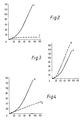
- the novel orientation process of the present invention produces a tensile strength of the oriented filament at least five times greater than that for the unoriented filament. Most significantly, whereas the oriented filament and the unoriented filament have a similar stress/strain behavior at low strain values, i.e., up to ten percent strain, the stress levels off at higher strain values in the case of the unoriented filament but climbs very fast in the case of the oriented filament. This is what the applicants have called a two-stage modulus behavior.
- the two filaments both feel soft and comfortable when used in a seat suspension application at low elongation, but in the case of an increase in load, the unoriented filament provides little support whereas the oriented filament provides the needed support to prevent the passenger from contacting the seat frame due to the "bottoming-out" of the seat suspension.
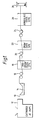
- the filament 10 is first spun using a 25.4 mm diameter extruder 12 equipped with a 20 to 1 length/diameter metering screw.
- a block copolymer of polybutylene terephthalate and polytetramethylene glycol For a block copolymer of polybutylene terephthalate and polytetramethylene glycol, the extrusion is conducted at 260°C.
- the die capillary diameter (not shown) is 2 mm.
- the spun filament 10 first enters a water cooling bath 14 with cooling water at 20°C for sufficient cooling before it enters a first set of calendar rolls 16. After leaving the calendar rolls 16, the elastomeric filament enters a predraw oven 18 set at 27°C before being drawn into a second set of calendar rolls 20.
- the predrawing of the filament is accomplished at an L/Lo ratio of 1.14 where L is the final length of the filament after predrawing and Lo is the starting length.
- the final drawing of the filament to an L/Lo ratio of greater than 5.0 is carried out at 50°C through draw oven 22 and a third set of calendar rolls 24.
- the applicants have tried other drawing temperatures up to 120°C, which produce equally satisfactory results.
- the oriented elastomeric filament is annealed in a hot air oven 26 at 120° to 140°C before being picked up by a pickup spool 28. During the annealing process, the elastomeric filament is allowed to shrink to an L/Lo ratio of 0.84.
- the overall draw ratio of the filament is greater than 5.0.
- thermoplastic elastomers One of the thermoplastic elastomers the applicants have used is a block copolymer consisting of 0.31 mole fraction of crystalline polybutylene terephthalate and 0.69 mole fraction of amorphous polytetramethylene glycol.
- This thermoplastic elastomer is commercially available as Hytrel (R.T.M.) 4056 from the E.I. Dupont Company U.S.A..
- Hytrel R.T.M. 4056 from the E.I. Dupont Company U.S.A.
- Table I The physical properties of this thermoplastic elastomer are shown in Table I.
- the tensile properties shown in Table 1 were determined in a standard ASTM D-638 tensile test procedure, using a 1.6 mm thick extruded sheet tested using an Instron machine at room temperature and at a cross-head speed of 508 mm/min.
- the stress/strain curve of this unoriented material is shown in Figure 2 as curve C.
- the elastomeric material is highly elastic and has a very high value of ultimate elongation and a tensile strength of 23 MPa.
- the material is not suitable as a seat suspension material because it does not provide sufficient support. Even assuming that enough of this material may be used to provide good support under static conditions, the seat suspension will highly elongate and "bottom-out" when a sudden load is applied to it, such as happens when a car goes over a pot-hole in the road.
- the applicants have also studied the effect of the annealing temperature on the orientation of this block copolymer. For instance, by raising the annealing temperature after the orientation process from 120°C to 140°C, the uniformity of the physical properties is greatly improved. This is shown in Table II.
- the diameter of the filament has been reduced after spinning and orientation from 0.51 mm to 0.33 mm.
- thermoplastic elastomeric materials One such material is a block copolymer consisting of 0.25 mole fraction of crystalline polybutylene terephthalate/polybutylene isophthalate and 0.75 mole fraction of amorphous polyethylene glycol/polypropylene glycol.
- This block copolymer is commercially available as Hytrel (R.T.M.) 4074 from the E.I. DuPont Company, U.S.A..
- the hardness of this material is similar to that of the block copolymer of polybutylene terephthalate and polytetramethylene glycol.
- polyesters include block copolymers of polybutylene terephthalate/polyhexene terephthalate crystalline portion and polytetramethylene glycol amorphous portion.
- the amorphous portion in these polymers is present at concentration greater than 0.5 mole fraction.
- block copolymers including polyurethane thermoplastic elastomers consisting of a polyurethane crystalline portion and polytetramethylene glycol amorphous portion (more than 0.5 mole fraction) work equally well in the present invention.
- the amorphous portion of the block copolymer must not be smaller than 0.5 mole fraction of the total copolymer. This is an important requirement in the making of elastomeric filaments from thermoplastic elastomeric materials.
Landscapes
- Engineering & Computer Science (AREA)
- Chemical & Material Sciences (AREA)
- Chemical Kinetics & Catalysis (AREA)
- General Chemical & Material Sciences (AREA)
- Textile Engineering (AREA)
- Aviation & Aerospace Engineering (AREA)
- Transportation (AREA)
- Mechanical Engineering (AREA)
- Artificial Filaments (AREA)
- Woven Fabrics (AREA)
- Yarns And Mechanical Finishing Of Yarns Or Ropes (AREA)
Applications Claiming Priority (2)
| Application Number | Priority Date | Filing Date | Title |
|---|---|---|---|
| US318998 | 1989-03-06 | ||
| US07/318,998 US5009955A (en) | 1989-03-06 | 1989-03-06 | Dual modulus oriented elastomeric filaments |
Publications (3)
| Publication Number | Publication Date |
|---|---|
| EP0386869A2 true EP0386869A2 (de) | 1990-09-12 |
| EP0386869A3 EP0386869A3 (de) | 1991-03-27 |
| EP0386869B1 EP0386869B1 (de) | 2001-12-05 |
Family
ID=23240458
Family Applications (1)
| Application Number | Title | Priority Date | Filing Date |
|---|---|---|---|
| EP90300483A Expired - Lifetime EP0386869B1 (de) | 1989-03-06 | 1990-01-17 | Arbeitsweise zur Herstellung doppelmodulus-orientierten Elastomerfilamente |
Country Status (5)
| Country | Link |
|---|---|
| US (2) | US5009955A (de) |
| EP (1) | EP0386869B1 (de) |
| JP (1) | JPH02277816A (de) |
| CA (1) | CA2002490C (de) |
| DE (1) | DE69033871T2 (de) |
Cited By (2)
| Publication number | Priority date | Publication date | Assignee | Title |
|---|---|---|---|---|
| DE4329310A1 (de) * | 1993-08-31 | 1995-03-02 | Brueggemann L Kg | Verfahren zur Herstellung modifizierter Polyester-Formmassen |
| EP0867332A3 (de) * | 1997-03-27 | 2000-11-08 | General Motors Corporation | Thermoplastische Polyurethanelastomermembrane für Sitzaufhängung |
Families Citing this family (14)
| Publication number | Priority date | Publication date | Assignee | Title |
|---|---|---|---|---|
| KR100334316B1 (ko) | 1992-06-15 | 2002-10-11 | 헤르만밀러인코퍼레이티드 | 사무용의자의지지장치및제조방법 |
| US5457968A (en) * | 1993-10-06 | 1995-10-17 | Shakespeare | Seating support |
| US20050042412A1 (en) * | 1996-12-31 | 2005-02-24 | Bruner Jeffrey W. | Composite elastomeric yarns and fabric |
| US6221279B1 (en) | 1999-06-24 | 2001-04-24 | Isotag Technology, Inc. | Pigment particles for invisible marking applications |
| AU2001294554A1 (en) | 2000-09-15 | 2002-03-26 | First Quality Fibers, Inc. | Apparatus for manufacturing optical fiber made of semi-crystalline polymer |
| US6562457B1 (en) | 2001-10-31 | 2003-05-13 | E. I. Du Pont De Nemours And Company | Polyether ester elastomer comprising polytrimethylene ether ester soft segment and tetramethylene ester hard segment |
| US6599625B2 (en) | 2001-10-31 | 2003-07-29 | E. I. Du Pont De Nemours And Company | Polyether ester elastomer comprising polytrimethylene ether ester soft segment and trimethylene ester hard segment |
| US7396082B2 (en) | 2002-03-29 | 2008-07-08 | Garrex Llc | Task chair |
| US20050046258A1 (en) * | 2003-07-09 | 2005-03-03 | Sanchez Gary L. | Task chair |
| US7040703B2 (en) * | 2002-03-29 | 2006-05-09 | Garrex Llc | Health chair a dynamically balanced task chair |
| US7625046B2 (en) * | 2002-03-29 | 2009-12-01 | Garrex Llc | Task chair |
| US20040137811A1 (en) * | 2003-01-09 | 2004-07-15 | L & P Property Management Company | Elastomeric seating composite |
| WO2016035889A1 (ja) | 2014-09-05 | 2016-03-10 | Mcppイノベーション合同会社 | 3次元プリンター成形用フィラメント及び結晶性軟質樹脂成形体の製造方法 |
| FR3158520A1 (fr) * | 2024-01-18 | 2025-07-25 | Decathlon | Méthode pour augmenter les propriétés élastiques d’un fil |
Family Cites Families (13)
| Publication number | Priority date | Publication date | Assignee | Title |
|---|---|---|---|---|
| US2251318A (en) * | 1937-12-17 | 1941-08-05 | Mishawaka Rubber & Woolen Mfg | Cushioning facility for seats and the like |
| US3161436A (en) * | 1962-03-27 | 1964-12-15 | Davidson Rubber Company Inc | Pre-stressed molded foam cushioning element |
| US3701755A (en) * | 1968-12-04 | 1972-10-31 | Toyo Boseki | Production of elastomers |
| US3651014A (en) * | 1969-07-18 | 1972-03-21 | Du Pont | Segmented thermoplastic copolyester elastomers |
| US3766146A (en) * | 1971-03-18 | 1973-10-16 | Du Pont | Segmented thermoplastic copolyester elastomers |
| JPS558023B2 (de) * | 1975-02-27 | 1980-03-01 | ||
| JPS5225898A (en) * | 1975-08-22 | 1977-02-26 | Toray Ind Inc | Process for producing copolyesters |
| US4211689A (en) * | 1978-12-06 | 1980-07-08 | General Electric Company | Copolyesters of polybutylene terephthalate |
| IN151798B (de) * | 1978-12-08 | 1983-07-30 | Ethicon Inc | |
| JPS5891820A (ja) * | 1981-11-26 | 1983-05-31 | Teijin Ltd | ポリエステル弾性糸の製造法 |
| JPS5898422A (ja) * | 1981-11-30 | 1983-06-11 | Teijin Ltd | 弾性糸の製造法 |
| US4545614A (en) * | 1984-02-09 | 1985-10-08 | General Motors Corporation | Thin elastomeric seat |
| DE3641703A1 (de) * | 1986-12-06 | 1988-06-16 | Bayer Ag | Hochdehnbare elasthanfasern mit verbesserten eigenschaften |
-
1989
- 1989-03-06 US US07/318,998 patent/US5009955A/en not_active Expired - Fee Related
- 1989-11-08 CA CA002002490A patent/CA2002490C/en not_active Expired - Fee Related
-
1990
- 1990-01-17 DE DE69033871T patent/DE69033871T2/de not_active Expired - Fee Related
- 1990-01-17 EP EP90300483A patent/EP0386869B1/de not_active Expired - Lifetime
- 1990-03-06 JP JP2054810A patent/JPH02277816A/ja active Pending
- 1990-12-19 US US07/629,889 patent/US5153065A/en not_active Expired - Fee Related
Cited By (2)
| Publication number | Priority date | Publication date | Assignee | Title |
|---|---|---|---|---|
| DE4329310A1 (de) * | 1993-08-31 | 1995-03-02 | Brueggemann L Kg | Verfahren zur Herstellung modifizierter Polyester-Formmassen |
| EP0867332A3 (de) * | 1997-03-27 | 2000-11-08 | General Motors Corporation | Thermoplastische Polyurethanelastomermembrane für Sitzaufhängung |
Also Published As
| Publication number | Publication date |
|---|---|
| DE69033871D1 (de) | 2002-01-17 |
| EP0386869B1 (de) | 2001-12-05 |
| JPH02277816A (ja) | 1990-11-14 |
| DE69033871T2 (de) | 2002-07-18 |
| US5153065A (en) | 1992-10-06 |
| CA2002490C (en) | 1995-11-21 |
| US5009955A (en) | 1991-04-23 |
| CA2002490A1 (en) | 1990-09-06 |
| EP0386869A3 (de) | 1991-03-27 |
Similar Documents
| Publication | Publication Date | Title |
|---|---|---|
| US5106678A (en) | Elastomeric filament and its woven fabric | |
| EP0386869B1 (de) | Arbeitsweise zur Herstellung doppelmodulus-orientierten Elastomerfilamente | |
| US5009827A (en) | Process for forming an elastomeric membrane | |
| US5775779A (en) | Polyurethane thermoplastic elastomer membrane for seat suspension | |
| US4939183A (en) | Elastomeric membrane and its method of manufacture | |
| US4869554A (en) | Elastomeric woven mat seat suspension | |
| CN105705695B (zh) | 安静性和轻量性优异的弹性网状结构体 | |
| DE69605605T2 (de) | Radialreifen | |
| US6632756B1 (en) | Automotive fabric composite | |
| EP4317567B1 (de) | Biologisch abbaubare dreidimensionale netzwerkstruktur | |
| EP0622332A1 (de) | Feuerfestes und hitzebeständiges polstermaterial und sitze für transportmittel | |
| CA2052594C (en) | Dual modulus oriented elastomeric filaments | |
| JP3686689B2 (ja) | 繊維系クッション体の製造方法 | |
| JPH0723834A (ja) | 積層体 | |
| KR102483365B1 (ko) | 낮은 압축 변형률을 가진 댐핑 패드 | |
| WO2016175294A1 (ja) | 網状構造体 | |
| JP7218499B2 (ja) | 網状構造体の製造方法 | |
| JP3092679B2 (ja) | クッション材 | |
| JP3035692B2 (ja) | 摺動部材の抑え具 | |
| KR20240062770A (ko) | 시트 성형품 및 이의 제조 방법 | |
| JPH0716975A (ja) | 積層構造体 | |
| US20210331443A1 (en) | Laminated sheet for vehicle interior material and method for manufacturing the same | |
| JPH08188944A (ja) | 繊維混合物および繊維成形体並びに繊維成形体の製造方法 | |
| TWM633919U (zh) | 低永久壓縮形變的減震墊 | |
| WO2026079185A1 (ja) | 立体網状構造体および立体網状構造体を有する車両用シート |
Legal Events
| Date | Code | Title | Description |
|---|---|---|---|
| PUAI | Public reference made under article 153(3) epc to a published international application that has entered the european phase |
Free format text: ORIGINAL CODE: 0009012 |
|
| AK | Designated contracting states |
Kind code of ref document: A2 Designated state(s): DE FR GB |
|
| PUAL | Search report despatched |
Free format text: ORIGINAL CODE: 0009013 |
|
| AK | Designated contracting states |
Kind code of ref document: A3 Designated state(s): DE FR GB |
|
| 17P | Request for examination filed |
Effective date: 19910415 |
|
| 17Q | First examination report despatched |
Effective date: 19931115 |
|
| APAB | Appeal dossier modified |
Free format text: ORIGINAL CODE: EPIDOS NOAPE |
|
| APAA | Appeal reference recorded |
Free format text: ORIGINAL CODE: EPIDOS REFN |
|
| APAD | Appeal reference recorded |
Free format text: ORIGINAL CODE: EPIDOS REFNE |
|
| APAB | Appeal dossier modified |
Free format text: ORIGINAL CODE: EPIDOS NOAPE |
|
| GRAG | Despatch of communication of intention to grant |
Free format text: ORIGINAL CODE: EPIDOS AGRA |
|
| RTI1 | Title (correction) |
Free format text: A METHOD OF MAKING DUAL MODULUS ORIENTED ELASTOMERIC FILAMENTS |
|
| RAP1 | Party data changed (applicant data changed or rights of an application transferred) |
Owner name: DELPHI TECHNOLOGIES, INC. |
|
| GRAG | Despatch of communication of intention to grant |
Free format text: ORIGINAL CODE: EPIDOS AGRA |
|
| GRAH | Despatch of communication of intention to grant a patent |
Free format text: ORIGINAL CODE: EPIDOS IGRA |
|
| RAP1 | Party data changed (applicant data changed or rights of an application transferred) |
Owner name: HERMAN MILLER, INC. |
|
| GRAH | Despatch of communication of intention to grant a patent |
Free format text: ORIGINAL CODE: EPIDOS IGRA |
|
| GRAA | (expected) grant |
Free format text: ORIGINAL CODE: 0009210 |
|
| AK | Designated contracting states |
Kind code of ref document: B1 Designated state(s): DE FR GB |
|
| REG | Reference to a national code |
Ref country code: GB Ref legal event code: IF02 |
|
| REF | Corresponds to: |
Ref document number: 69033871 Country of ref document: DE Date of ref document: 20020117 |
|
| ET | Fr: translation filed | ||
| PLBE | No opposition filed within time limit |
Free format text: ORIGINAL CODE: 0009261 |
|
| STAA | Information on the status of an ep patent application or granted ep patent |
Free format text: STATUS: NO OPPOSITION FILED WITHIN TIME LIMIT |
|
| 26N | No opposition filed | ||
| PGFP | Annual fee paid to national office [announced via postgrant information from national office to epo] |
Ref country code: GB Payment date: 20031211 Year of fee payment: 15 |
|
| PGFP | Annual fee paid to national office [announced via postgrant information from national office to epo] |
Ref country code: FR Payment date: 20040102 Year of fee payment: 15 |
|
| PGFP | Annual fee paid to national office [announced via postgrant information from national office to epo] |
Ref country code: DE Payment date: 20040130 Year of fee payment: 15 |
|
| PG25 | Lapsed in a contracting state [announced via postgrant information from national office to epo] |
Ref country code: GB Free format text: LAPSE BECAUSE OF NON-PAYMENT OF DUE FEES Effective date: 20050117 |
|
| PG25 | Lapsed in a contracting state [announced via postgrant information from national office to epo] |
Ref country code: DE Free format text: LAPSE BECAUSE OF NON-PAYMENT OF DUE FEES Effective date: 20050802 |
|
| GBPC | Gb: european patent ceased through non-payment of renewal fee |
Effective date: 20050117 |
|
| PG25 | Lapsed in a contracting state [announced via postgrant information from national office to epo] |
Ref country code: FR Free format text: LAPSE BECAUSE OF NON-PAYMENT OF DUE FEES Effective date: 20050930 |
|
| APAH | Appeal reference modified |
Free format text: ORIGINAL CODE: EPIDOSCREFNO |
|
| REG | Reference to a national code |
Ref country code: FR Ref legal event code: ST |