EP0387196A1 - Komplexe mit optisch aktiven Liganden, Verfahren zu deren Herstellung und deren Verwendung - Google Patents
Komplexe mit optisch aktiven Liganden, Verfahren zu deren Herstellung und deren Verwendung Download PDFInfo
- Publication number
- EP0387196A1 EP0387196A1 EP90810152A EP90810152A EP0387196A1 EP 0387196 A1 EP0387196 A1 EP 0387196A1 EP 90810152 A EP90810152 A EP 90810152A EP 90810152 A EP90810152 A EP 90810152A EP 0387196 A1 EP0387196 A1 EP 0387196A1
- Authority
- EP
- European Patent Office
- Prior art keywords
- alkyl
- phenyl
- substituted
- alkoxy
- compounds according
- Prior art date
- Legal status (The legal status is an assumption and is not a legal conclusion. Google has not performed a legal analysis and makes no representation as to the accuracy of the status listed.)
- Granted
Links
- 238000002360 preparation method Methods 0.000 title claims abstract description 22
- 238000000034 method Methods 0.000 title claims description 7
- 239000003446 ligand Substances 0.000 title description 8
- 125000001997 phenyl group Chemical group [H]C1=C([H])C([H])=C(*)C([H])=C1[H] 0.000 claims abstract description 55
- 150000001875 compounds Chemical class 0.000 claims abstract description 42
- 125000002496 methyl group Chemical group [H]C([H])([H])* 0.000 claims abstract description 25
- ZSWFCLXCOIISFI-UHFFFAOYSA-N endo-cyclopentadiene Natural products C1C=CC=C1 ZSWFCLXCOIISFI-UHFFFAOYSA-N 0.000 claims abstract description 21
- 125000000058 cyclopentadienyl group Chemical group C1(=CC=CC1)* 0.000 claims abstract description 20
- 150000002085 enols Chemical class 0.000 claims abstract description 20
- 125000000217 alkyl group Chemical group 0.000 claims abstract description 18
- 150000002081 enamines Chemical class 0.000 claims abstract description 15
- 125000003903 2-propenyl group Chemical group [H]C([*])([H])C([H])=C([H])[H] 0.000 claims abstract description 11
- 229910052719 titanium Inorganic materials 0.000 claims abstract description 10
- 229910052735 hafnium Inorganic materials 0.000 claims abstract description 8
- 229910052726 zirconium Inorganic materials 0.000 claims abstract description 8
- 150000002576 ketones Chemical class 0.000 claims abstract description 7
- 150000003333 secondary alcohols Chemical class 0.000 claims abstract description 7
- 229920002554 vinyl polymer Polymers 0.000 claims abstract description 7
- 125000000391 vinyl group Chemical group [H]C([*])=C([H])[H] 0.000 claims abstract description 6
- 229930194542 Keto Natural products 0.000 claims abstract description 5
- 125000000879 imine group Chemical group 0.000 claims abstract description 5
- 125000000468 ketone group Chemical group 0.000 claims abstract description 5
- HBAQYPYDRFILMT-UHFFFAOYSA-N 8-[3-(1-cyclopropylpyrazol-4-yl)-1H-pyrazolo[4,3-d]pyrimidin-5-yl]-3-methyl-3,8-diazabicyclo[3.2.1]octan-2-one Chemical class C1(CC1)N1N=CC(=C1)C1=NNC2=C1N=C(N=C2)N1C2C(N(CC1CC2)C)=O HBAQYPYDRFILMT-UHFFFAOYSA-N 0.000 claims abstract description 4
- 239000000376 reactant Substances 0.000 claims abstract description 4
- 150000003509 tertiary alcohols Chemical class 0.000 claims abstract description 4
- -1 C1-C12-alkylthio Chemical group 0.000 claims description 152
- 125000004432 carbon atom Chemical group C* 0.000 claims description 65
- 125000001797 benzyl group Chemical group [H]C1=C([H])C([H])=C(C([H])=C1[H])C([H])([H])* 0.000 claims description 31
- 229910052799 carbon Inorganic materials 0.000 claims description 31
- LFQSCWFLJHTTHZ-UHFFFAOYSA-N Ethanol Chemical compound CCO LFQSCWFLJHTTHZ-UHFFFAOYSA-N 0.000 claims description 21
- 125000000467 secondary amino group Chemical group [H]N([*:1])[*:2] 0.000 claims description 21
- 125000003118 aryl group Chemical group 0.000 claims description 20
- 125000000753 cycloalkyl group Chemical group 0.000 claims description 18
- 125000004209 (C1-C8) alkyl group Chemical group 0.000 claims description 17
- 125000004178 (C1-C4) alkyl group Chemical group 0.000 claims description 16
- 125000004169 (C1-C6) alkyl group Chemical group 0.000 claims description 16
- 125000004093 cyano group Chemical group *C#N 0.000 claims description 16
- 229910052757 nitrogen Inorganic materials 0.000 claims description 16
- 229910052717 sulfur Inorganic materials 0.000 claims description 16
- 125000003710 aryl alkyl group Chemical group 0.000 claims description 15
- 125000000392 cycloalkenyl group Chemical group 0.000 claims description 15
- 125000004642 (C1-C12) alkoxy group Chemical group 0.000 claims description 14
- 125000004191 (C1-C6) alkoxy group Chemical group 0.000 claims description 12
- 125000006700 (C1-C6) alkylthio group Chemical group 0.000 claims description 11
- 125000003342 alkenyl group Chemical group 0.000 claims description 10
- 125000003545 alkoxy group Chemical group 0.000 claims description 10
- 125000000449 nitro group Chemical group [O-][N+](*)=O 0.000 claims description 10
- 125000004433 nitrogen atom Chemical group N* 0.000 claims description 10
- RTAQQCXQSZGOHL-UHFFFAOYSA-N Titanium Chemical compound [Ti] RTAQQCXQSZGOHL-UHFFFAOYSA-N 0.000 claims description 9
- 125000000113 cyclohexyl group Chemical group [H]C1([H])C([H])([H])C([H])([H])C([H])(*)C([H])([H])C1([H])[H] 0.000 claims description 9
- 239000010936 titanium Substances 0.000 claims description 9
- 125000004400 (C1-C12) alkyl group Chemical group 0.000 claims description 8
- 125000001511 cyclopentyl group Chemical group [H]C1([H])C([H])([H])C([H])([H])C([H])(*)C1([H])[H] 0.000 claims description 8
- 125000001495 ethyl group Chemical group [H]C([H])([H])C([H])([H])* 0.000 claims description 8
- 125000000538 pentafluorophenyl group Chemical group FC1=C(F)C(F)=C(*)C(F)=C1F 0.000 claims description 8
- 125000003944 tolyl group Chemical group 0.000 claims description 8
- YBYIRNPNPLQARY-UHFFFAOYSA-N 1H-indene Chemical group C1=CC=C2CC=CC2=C1 YBYIRNPNPLQARY-UHFFFAOYSA-N 0.000 claims description 7
- QCWXUUIWCKQGHC-UHFFFAOYSA-N Zirconium Chemical compound [Zr] QCWXUUIWCKQGHC-UHFFFAOYSA-N 0.000 claims description 7
- 125000000304 alkynyl group Chemical group 0.000 claims description 7
- 125000002541 furyl group Chemical group 0.000 claims description 7
- VBJZVLUMGGDVMO-UHFFFAOYSA-N hafnium atom Chemical compound [Hf] VBJZVLUMGGDVMO-UHFFFAOYSA-N 0.000 claims description 7
- 125000003454 indenyl group Chemical group C1(C=CC2=CC=CC=C12)* 0.000 claims description 7
- 125000006710 (C2-C12) alkenyl group Chemical group 0.000 claims description 6
- 125000000882 C2-C6 alkenyl group Chemical group 0.000 claims description 6
- 125000002877 alkyl aryl group Chemical group 0.000 claims description 6
- 125000004429 atom Chemical group 0.000 claims description 6
- 229910052794 bromium Inorganic materials 0.000 claims description 6
- 229910052801 chlorine Inorganic materials 0.000 claims description 6
- 150000002148 esters Chemical class 0.000 claims description 6
- 229910052731 fluorine Inorganic materials 0.000 claims description 6
- 125000001072 heteroaryl group Chemical group 0.000 claims description 6
- 239000012442 inert solvent Substances 0.000 claims description 6
- 125000001624 naphthyl group Chemical group 0.000 claims description 6
- 125000004665 trialkylsilyl group Chemical group 0.000 claims description 6
- 125000000026 trimethylsilyl group Chemical group [H]C([H])([H])[Si]([*])(C([H])([H])[H])C([H])([H])[H] 0.000 claims description 6
- 125000000041 C6-C10 aryl group Chemical group 0.000 claims description 5
- 125000001309 chloro group Chemical group Cl* 0.000 claims description 5
- 239000007789 gas Substances 0.000 claims description 5
- 229910052736 halogen Inorganic materials 0.000 claims description 5
- 150000002367 halogens Chemical class 0.000 claims description 5
- 230000001681 protective effect Effects 0.000 claims description 5
- 125000005369 trialkoxysilyl group Chemical group 0.000 claims description 5
- 125000006656 (C2-C4) alkenyl group Chemical group 0.000 claims description 4
- RGSFGYAAUTVSQA-UHFFFAOYSA-N Cyclopentane Chemical compound C1CCCC1 RGSFGYAAUTVSQA-UHFFFAOYSA-N 0.000 claims description 4
- 150000001450 anions Chemical class 0.000 claims description 4
- 125000002534 ethynyl group Chemical group [H]C#C* 0.000 claims description 4
- 125000004368 propenyl group Chemical group C(=CC)* 0.000 claims description 4
- 125000001494 2-propynyl group Chemical group [H]C#CC([H])([H])* 0.000 claims description 3
- 125000003917 carbamoyl group Chemical group [H]N([H])C(*)=O 0.000 claims description 3
- 125000006178 methyl benzyl group Chemical group 0.000 claims description 3
- 150000003335 secondary amines Chemical class 0.000 claims description 3
- 229910052710 silicon Inorganic materials 0.000 claims description 3
- 125000006701 (C1-C7) alkyl group Chemical group 0.000 claims description 2
- 125000006711 (C2-C12) alkynyl group Chemical group 0.000 claims description 2
- 125000006552 (C3-C8) cycloalkyl group Chemical group 0.000 claims description 2
- 125000002941 2-furyl group Chemical group O1C([*])=C([H])C([H])=C1[H] 0.000 claims description 2
- 125000003601 C2-C6 alkynyl group Chemical group 0.000 claims description 2
- PMPVIKIVABFJJI-UHFFFAOYSA-N Cyclobutane Chemical compound C1CCC1 PMPVIKIVABFJJI-UHFFFAOYSA-N 0.000 claims description 2
- PXGOKWXKJXAPGV-UHFFFAOYSA-N Fluorine Chemical group FF PXGOKWXKJXAPGV-UHFFFAOYSA-N 0.000 claims description 2
- 150000004705 aldimines Chemical class 0.000 claims description 2
- HSFWRNGVRCDJHI-UHFFFAOYSA-N alpha-acetylene Natural products C#C HSFWRNGVRCDJHI-UHFFFAOYSA-N 0.000 claims description 2
- 125000004202 aminomethyl group Chemical group [H]N([H])C([H])([H])* 0.000 claims description 2
- 125000000596 cyclohexenyl group Chemical group C1(=CCCCC1)* 0.000 claims description 2
- 125000002433 cyclopentenyl group Chemical group C1(=CCCC1)* 0.000 claims description 2
- 239000011737 fluorine Chemical group 0.000 claims description 2
- 125000004446 heteroarylalkyl group Chemical group 0.000 claims description 2
- 150000004658 ketimines Chemical class 0.000 claims description 2
- 125000004430 oxygen atom Chemical group O* 0.000 claims description 2
- 125000004817 pentamethylene group Chemical group [H]C([H])([*:2])C([H])([H])C([H])([H])C([H])([H])C([H])([H])[*:1] 0.000 claims description 2
- 125000001453 quaternary ammonium group Chemical group 0.000 claims description 2
- LMBFAGIMSUYTBN-MPZNNTNKSA-N teixobactin Chemical compound C([C@H](C(=O)N[C@@H]([C@@H](C)CC)C(=O)N[C@@H](CO)C(=O)N[C@H](CCC(N)=O)C(=O)N[C@H]([C@@H](C)CC)C(=O)N[C@@H]([C@@H](C)CC)C(=O)N[C@@H](CO)C(=O)N[C@H]1C(N[C@@H](C)C(=O)N[C@@H](C[C@@H]2NC(=N)NC2)C(=O)N[C@H](C(=O)O[C@H]1C)[C@@H](C)CC)=O)NC)C1=CC=CC=C1 LMBFAGIMSUYTBN-MPZNNTNKSA-N 0.000 claims description 2
- 125000000383 tetramethylene group Chemical group [H]C([H])([*:1])C([H])([H])C([H])([H])C([H])([H])[*:2] 0.000 claims description 2
- 125000002485 formyl group Chemical class [H]C(*)=O 0.000 claims 2
- 150000001299 aldehydes Chemical class 0.000 abstract description 11
- 150000002466 imines Chemical class 0.000 abstract description 5
- 150000003512 tertiary amines Chemical class 0.000 abstract description 2
- RTZKZFJDLAIYFH-UHFFFAOYSA-N Diethyl ether Chemical compound CCOCC RTZKZFJDLAIYFH-UHFFFAOYSA-N 0.000 description 156
- 239000000243 solution Substances 0.000 description 84
- WYURNTSHIVDZCO-UHFFFAOYSA-N Tetrahydrofuran Chemical compound C1CCOC1 WYURNTSHIVDZCO-UHFFFAOYSA-N 0.000 description 40
- 238000006243 chemical reaction Methods 0.000 description 29
- VLKZOEOYAKHREP-UHFFFAOYSA-N n-Hexane Chemical compound CCCCCC VLKZOEOYAKHREP-UHFFFAOYSA-N 0.000 description 24
- VYPSYNLAJGMNEJ-UHFFFAOYSA-N Silicium dioxide Chemical compound O=[Si]=O VYPSYNLAJGMNEJ-UHFFFAOYSA-N 0.000 description 22
- HEDRZPFGACZZDS-MICDWDOJSA-N Trichloro(2H)methane Chemical compound [2H]C(Cl)(Cl)Cl HEDRZPFGACZZDS-MICDWDOJSA-N 0.000 description 22
- YLQBMQCUIZJEEH-UHFFFAOYSA-N tetrahydrofuran Natural products C=1C=COC=1 YLQBMQCUIZJEEH-UHFFFAOYSA-N 0.000 description 22
- XLYOFNOQVPJJNP-UHFFFAOYSA-N water Chemical compound O XLYOFNOQVPJJNP-UHFFFAOYSA-N 0.000 description 22
- YMWUJEATGCHHMB-UHFFFAOYSA-N Dichloromethane Chemical compound ClCCl YMWUJEATGCHHMB-UHFFFAOYSA-N 0.000 description 21
- XEKOWRVHYACXOJ-UHFFFAOYSA-N Ethyl acetate Chemical compound CCOC(C)=O XEKOWRVHYACXOJ-UHFFFAOYSA-N 0.000 description 21
- YXFVVABEGXRONW-UHFFFAOYSA-N Toluene Chemical compound CC1=CC=CC=C1 YXFVVABEGXRONW-UHFFFAOYSA-N 0.000 description 21
- 239000000203 mixture Substances 0.000 description 19
- YMWUJEATGCHHMB-DICFDUPASA-N dichloromethane-d2 Chemical compound [2H]C([2H])(Cl)Cl YMWUJEATGCHHMB-DICFDUPASA-N 0.000 description 18
- ZMANZCXQSJIPKH-UHFFFAOYSA-N Triethylamine Chemical compound CCN(CC)CC ZMANZCXQSJIPKH-UHFFFAOYSA-N 0.000 description 16
- XKRFYHLGVUSROY-UHFFFAOYSA-N Argon Chemical compound [Ar] XKRFYHLGVUSROY-UHFFFAOYSA-N 0.000 description 14
- 239000000047 product Substances 0.000 description 13
- FAPWRFPIFSIZLT-UHFFFAOYSA-M Sodium chloride Chemical class [Na+].[Cl-] FAPWRFPIFSIZLT-UHFFFAOYSA-M 0.000 description 12
- HEMHJVSKTPXQMS-UHFFFAOYSA-M Sodium hydroxide Chemical compound [OH-].[Na+] HEMHJVSKTPXQMS-UHFFFAOYSA-M 0.000 description 12
- 125000001424 substituent group Chemical group 0.000 description 12
- 125000000999 tert-butyl group Chemical group [H]C([H])([H])C(*)(C([H])([H])[H])C([H])([H])[H] 0.000 description 11
- VEXZGXHMUGYJMC-UHFFFAOYSA-N Hydrochloric acid Chemical compound Cl VEXZGXHMUGYJMC-UHFFFAOYSA-N 0.000 description 10
- 239000012071 phase Substances 0.000 description 10
- 238000000425 proton nuclear magnetic resonance spectrum Methods 0.000 description 10
- 238000003756 stirring Methods 0.000 description 10
- 239000000725 suspension Substances 0.000 description 10
- QTBSBXVTEAMEQO-UHFFFAOYSA-N Acetic acid Chemical compound CC(O)=O QTBSBXVTEAMEQO-UHFFFAOYSA-N 0.000 description 9
- 239000012043 crude product Substances 0.000 description 9
- 150000003254 radicals Chemical class 0.000 description 9
- 239000000741 silica gel Substances 0.000 description 9
- 229910002027 silica gel Inorganic materials 0.000 description 9
- MZRVEZGGRBJDDB-UHFFFAOYSA-N N-Butyllithium Chemical compound [Li]CCCC MZRVEZGGRBJDDB-UHFFFAOYSA-N 0.000 description 8
- HUMNYLRZRPPJDN-UHFFFAOYSA-N benzaldehyde Chemical compound O=CC1=CC=CC=C1 HUMNYLRZRPPJDN-UHFFFAOYSA-N 0.000 description 8
- 238000001460 carbon-13 nuclear magnetic resonance spectrum Methods 0.000 description 8
- 229910052760 oxygen Inorganic materials 0.000 description 8
- WDYVUKGVKRZQNM-UHFFFAOYSA-N 6-phosphonohexylphosphonic acid Chemical compound OP(O)(=O)CCCCCCP(O)(O)=O WDYVUKGVKRZQNM-UHFFFAOYSA-N 0.000 description 7
- 229910052786 argon Inorganic materials 0.000 description 7
- 150000003609 titanium compounds Chemical class 0.000 description 7
- ZTQSAGDEMFDKMZ-UHFFFAOYSA-N Butyraldehyde Chemical compound CCCC=O ZTQSAGDEMFDKMZ-UHFFFAOYSA-N 0.000 description 6
- CSNNHWWHGAXBCP-UHFFFAOYSA-L Magnesium sulfate Chemical compound [Mg+2].[O-][S+2]([O-])([O-])[O-] CSNNHWWHGAXBCP-UHFFFAOYSA-L 0.000 description 6
- OKKJLVBELUTLKV-UHFFFAOYSA-N Methanol Chemical compound OC OKKJLVBELUTLKV-UHFFFAOYSA-N 0.000 description 6
- UHOVQNZJYSORNB-MZWXYZOWSA-N benzene-d6 Chemical compound [2H]C1=C([2H])C([2H])=C([2H])C([2H])=C1[2H] UHOVQNZJYSORNB-MZWXYZOWSA-N 0.000 description 6
- 229910052681 coesite Inorganic materials 0.000 description 6
- 229910052906 cristobalite Inorganic materials 0.000 description 6
- PZUFCXRQLDYWCH-UHFFFAOYSA-N cyclopentadienylallyltitanium Chemical compound [Ti].[CH2-]C=CC1=CC=CC1 PZUFCXRQLDYWCH-UHFFFAOYSA-N 0.000 description 6
- 230000014759 maintenance of location Effects 0.000 description 6
- 239000000377 silicon dioxide Substances 0.000 description 6
- 235000012239 silicon dioxide Nutrition 0.000 description 6
- 239000011734 sodium Substances 0.000 description 6
- 229910052682 stishovite Inorganic materials 0.000 description 6
- 229910052905 tridymite Inorganic materials 0.000 description 6
- QAEDZJGFFMLHHQ-UHFFFAOYSA-N trifluoroacetic anhydride Chemical compound FC(F)(F)C(=O)OC(=O)C(F)(F)F QAEDZJGFFMLHHQ-UHFFFAOYSA-N 0.000 description 6
- RYHBNJHYFVUHQT-UHFFFAOYSA-N 1,4-Dioxane Chemical compound C1COCCO1 RYHBNJHYFVUHQT-UHFFFAOYSA-N 0.000 description 5
- ZSUSDXCLKLOMNW-UHFFFAOYSA-M Cl[Ti]C1C=CC=C1 Chemical compound Cl[Ti]C1C=CC=C1 ZSUSDXCLKLOMNW-UHFFFAOYSA-M 0.000 description 5
- 239000007832 Na2SO4 Substances 0.000 description 5
- PMZURENOXWZQFD-UHFFFAOYSA-L Sodium Sulfate Chemical compound [Na+].[Na+].[O-]S([O-])(=O)=O PMZURENOXWZQFD-UHFFFAOYSA-L 0.000 description 5
- 238000003818 flash chromatography Methods 0.000 description 5
- 125000000623 heterocyclic group Chemical group 0.000 description 5
- 239000012074 organic phase Substances 0.000 description 5
- 229910052938 sodium sulfate Inorganic materials 0.000 description 5
- 235000011152 sodium sulphate Nutrition 0.000 description 5
- RGKVZBXSJFAZRE-JTQLQIEISA-N (1s)-1-phenylbut-3-en-1-ol Chemical compound C=CC[C@H](O)C1=CC=CC=C1 RGKVZBXSJFAZRE-JTQLQIEISA-N 0.000 description 4
- HEDRZPFGACZZDS-UHFFFAOYSA-N Chloroform Chemical compound ClC(Cl)Cl HEDRZPFGACZZDS-UHFFFAOYSA-N 0.000 description 4
- OFBQJSOFQDEBGM-UHFFFAOYSA-N Pentane Chemical compound CCCCC OFBQJSOFQDEBGM-UHFFFAOYSA-N 0.000 description 4
- UIIMBOGNXHQVGW-UHFFFAOYSA-M Sodium bicarbonate Chemical compound [Na+].OC([O-])=O UIIMBOGNXHQVGW-UHFFFAOYSA-M 0.000 description 4
- 239000000706 filtrate Substances 0.000 description 4
- 125000005842 heteroatom Chemical group 0.000 description 4
- 229930195733 hydrocarbon Natural products 0.000 description 4
- QNGNSVIICDLXHT-UHFFFAOYSA-N para-ethylbenzaldehyde Natural products CCC1=CC=C(C=O)C=C1 QNGNSVIICDLXHT-UHFFFAOYSA-N 0.000 description 4
- 239000011541 reaction mixture Substances 0.000 description 4
- 239000002904 solvent Substances 0.000 description 4
- DYHSDKLCOJIUFX-UHFFFAOYSA-N tert-butoxycarbonyl anhydride Chemical compound CC(C)(C)OC(=O)OC(=O)OC(C)(C)C DYHSDKLCOJIUFX-UHFFFAOYSA-N 0.000 description 4
- WEVYAHXRMPXWCK-UHFFFAOYSA-N Acetonitrile Chemical compound CC#N WEVYAHXRMPXWCK-UHFFFAOYSA-N 0.000 description 3
- UHOVQNZJYSORNB-UHFFFAOYSA-N Benzene Chemical compound C1=CC=CC=C1 UHOVQNZJYSORNB-UHFFFAOYSA-N 0.000 description 3
- 229910000831 Steel Inorganic materials 0.000 description 3
- 125000001931 aliphatic group Chemical group 0.000 description 3
- 125000004414 alkyl thio group Chemical group 0.000 description 3
- LDDQLRUQCUTJBB-UHFFFAOYSA-N ammonium fluoride Chemical compound [NH4+].[F-] LDDQLRUQCUTJBB-UHFFFAOYSA-N 0.000 description 3
- 239000008346 aqueous phase Substances 0.000 description 3
- 230000015572 biosynthetic process Effects 0.000 description 3
- 125000000484 butyl group Chemical class [H]C([*])([H])C([H])([H])C([H])([H])C([H])([H])[H] 0.000 description 3
- 238000003965 capillary gas chromatography Methods 0.000 description 3
- 125000002915 carbonyl group Chemical group [*:2]C([*:1])=O 0.000 description 3
- 239000007795 chemical reaction product Substances 0.000 description 3
- 238000004587 chromatography analysis Methods 0.000 description 3
- MCNKHXZIPATURB-HTQZYQBOSA-N diethyl (4r,5r)-2,2-dimethyl-1,3-dioxolane-4,5-dicarboxylate Chemical compound CCOC(=O)[C@@H]1OC(C)(C)O[C@H]1C(=O)OCC MCNKHXZIPATURB-HTQZYQBOSA-N 0.000 description 3
- UAOMVDZJSHZZME-UHFFFAOYSA-N diisopropylamine Chemical compound CC(C)NC(C)C UAOMVDZJSHZZME-UHFFFAOYSA-N 0.000 description 3
- 239000000839 emulsion Substances 0.000 description 3
- 150000002170 ethers Chemical class 0.000 description 3
- 239000000284 extract Substances 0.000 description 3
- 229910052740 iodine Inorganic materials 0.000 description 3
- 229910052744 lithium Inorganic materials 0.000 description 3
- 229910052943 magnesium sulfate Inorganic materials 0.000 description 3
- 235000019341 magnesium sulphate Nutrition 0.000 description 3
- 238000004519 manufacturing process Methods 0.000 description 3
- 229910052751 metal Inorganic materials 0.000 description 3
- 239000002184 metal Substances 0.000 description 3
- UYYCVBASZNFFRX-UHFFFAOYSA-N n-propan-2-ylcyclohexanamine Chemical compound CC(C)NC1CCCCC1 UYYCVBASZNFFRX-UHFFFAOYSA-N 0.000 description 3
- 239000003921 oil Substances 0.000 description 3
- 230000003287 optical effect Effects 0.000 description 3
- 125000001436 propyl group Chemical class [H]C([*])([H])C([H])([H])C([H])([H])[H] 0.000 description 3
- 238000010992 reflux Methods 0.000 description 3
- 125000006413 ring segment Chemical group 0.000 description 3
- 150000003839 salts Chemical class 0.000 description 3
- 239000010959 steel Substances 0.000 description 3
- 238000003786 synthesis reaction Methods 0.000 description 3
- ILWRPSCZWQJDMK-UHFFFAOYSA-N triethylazanium;chloride Chemical compound Cl.CCN(CC)CC ILWRPSCZWQJDMK-UHFFFAOYSA-N 0.000 description 3
- HGBOYTHUEUWSSQ-UHFFFAOYSA-N valeric aldehyde Natural products CCCCC=O HGBOYTHUEUWSSQ-UHFFFAOYSA-N 0.000 description 3
- 150000003755 zirconium compounds Chemical class 0.000 description 3
- WRPGIZYCWNCCCJ-SFYZADRCSA-N (2s,3r)-3-hydroxy-2-[(2-methylpropan-2-yl)oxycarbonylamino]hexanoic acid Chemical compound CCC[C@@H](O)[C@@H](C(O)=O)NC(=O)OC(C)(C)C WRPGIZYCWNCCCJ-SFYZADRCSA-N 0.000 description 2
- RHUKJQAHGGDNEQ-UHFFFAOYSA-N 1,3-oxazolidine-3-carboxylic acid Chemical compound OC(=O)N1CCOC1 RHUKJQAHGGDNEQ-UHFFFAOYSA-N 0.000 description 2
- 125000004343 1-phenylethyl group Chemical group [H]C1=C([H])C([H])=C(C([H])=C1[H])C([H])(*)C([H])([H])[H] 0.000 description 2
- 238000005160 1H NMR spectroscopy Methods 0.000 description 2
- PDTWLGCTGQHHCS-UHFFFAOYSA-N 2-(3-ethyl-2,2,5,5-tetramethyl-1,2,5-azadisilolidin-1-yl)acetic acid Chemical compound CCC1C[Si](C)(C)N(CC(O)=O)[Si]1(C)C PDTWLGCTGQHHCS-UHFFFAOYSA-N 0.000 description 2
- 125000000094 2-phenylethyl group Chemical group [H]C1=C([H])C([H])=C(C([H])=C1[H])C([H])([H])C([H])([H])* 0.000 description 2
- YGHRJJRRZDOVPD-UHFFFAOYSA-N 3-methylbutanal Chemical compound CC(C)CC=O YGHRJJRRZDOVPD-UHFFFAOYSA-N 0.000 description 2
- DDFHBQSCUXNBSA-UHFFFAOYSA-N 5-(5-carboxythiophen-2-yl)thiophene-2-carboxylic acid Chemical compound S1C(C(=O)O)=CC=C1C1=CC=C(C(O)=O)S1 DDFHBQSCUXNBSA-UHFFFAOYSA-N 0.000 description 2
- NLXLAEXVIDQMFP-UHFFFAOYSA-N Ammonia chloride Chemical class [NH4+].[Cl-] NLXLAEXVIDQMFP-UHFFFAOYSA-N 0.000 description 2
- 239000004215 Carbon black (E152) Substances 0.000 description 2
- XDTMQSROBMDMFD-UHFFFAOYSA-N Cyclohexane Chemical compound C1CCCCC1 XDTMQSROBMDMFD-UHFFFAOYSA-N 0.000 description 2
- XTHFKEDIFFGKHM-UHFFFAOYSA-N Dimethoxyethane Chemical compound COCCOC XTHFKEDIFFGKHM-UHFFFAOYSA-N 0.000 description 2
- SNRUBQQJIBEYMU-UHFFFAOYSA-N Dodecane Chemical class CCCCCCCCCCCC SNRUBQQJIBEYMU-UHFFFAOYSA-N 0.000 description 2
- 238000005481 NMR spectroscopy Methods 0.000 description 2
- CTQNGGLPUBDAKN-UHFFFAOYSA-N O-Xylene Chemical compound CC1=CC=CC=C1C CTQNGGLPUBDAKN-UHFFFAOYSA-N 0.000 description 2
- CDBYLPFSWZWCQE-UHFFFAOYSA-L Sodium Carbonate Chemical compound [Na+].[Na+].[O-]C([O-])=O CDBYLPFSWZWCQE-UHFFFAOYSA-L 0.000 description 2
- 125000002777 acetyl group Chemical class [H]C([H])([H])C(*)=O 0.000 description 2
- YRKCREAYFQTBPV-UHFFFAOYSA-N acetylacetone Chemical compound CC(=O)CC(C)=O YRKCREAYFQTBPV-UHFFFAOYSA-N 0.000 description 2
- 239000013543 active substance Substances 0.000 description 2
- 150000001298 alcohols Chemical class 0.000 description 2
- 238000005575 aldol reaction Methods 0.000 description 2
- 125000002947 alkylene group Chemical group 0.000 description 2
- 150000001413 amino acids Chemical class 0.000 description 2
- 150000007514 bases Chemical class 0.000 description 2
- 125000003178 carboxy group Chemical group [H]OC(*)=O 0.000 description 2
- VGQOKOYKFDUPPJ-UHFFFAOYSA-N chloro-[2-[chloro(dimethyl)silyl]ethyl]-dimethylsilane Chemical compound C[Si](C)(Cl)CC[Si](C)(C)Cl VGQOKOYKFDUPPJ-UHFFFAOYSA-N 0.000 description 2
- MVPPADPHJFYWMZ-UHFFFAOYSA-N chlorobenzene Chemical compound ClC1=CC=CC=C1 MVPPADPHJFYWMZ-UHFFFAOYSA-N 0.000 description 2
- 239000012230 colorless oil Substances 0.000 description 2
- 238000001816 cooling Methods 0.000 description 2
- QOXHZZQZTIGPEV-UHFFFAOYSA-K cyclopenta-1,3-diene;titanium(4+);trichloride Chemical compound Cl[Ti+](Cl)Cl.C=1C=C[CH-]C=1 QOXHZZQZTIGPEV-UHFFFAOYSA-K 0.000 description 2
- KSMVZQYAVGTKIV-UHFFFAOYSA-N decanal Chemical compound CCCCCCCCCC=O KSMVZQYAVGTKIV-UHFFFAOYSA-N 0.000 description 2
- 125000002704 decyl group Chemical class [H]C([H])([H])C([H])([H])C([H])([H])C([H])([H])C([H])([H])C([H])([H])C([H])([H])C([H])([H])C([H])([H])C([H])([H])* 0.000 description 2
- 125000003438 dodecyl group Chemical class [H]C([H])([H])C([H])([H])C([H])([H])C([H])([H])C([H])([H])C([H])([H])C([H])([H])C([H])([H])C([H])([H])C([H])([H])C([H])([H])C([H])([H])* 0.000 description 2
- 125000004185 ester group Chemical group 0.000 description 2
- ZEEBVFSSWNSZMH-ZJUUUORDSA-N ethyl (2s,3r)-3-hydroxy-2-[(2-methylpropan-2-yl)oxycarbonylamino]hexanoate Chemical compound CCC[C@@H](O)[C@@H](C(=O)OCC)NC(=O)OC(C)(C)C ZEEBVFSSWNSZMH-ZJUUUORDSA-N 0.000 description 2
- 150000002363 hafnium compounds Chemical class 0.000 description 2
- 125000003187 heptyl group Chemical class [H]C([*])([H])C([H])([H])C([H])([H])C([H])([H])C([H])([H])C([H])([H])C([H])([H])[H] 0.000 description 2
- 125000004051 hexyl group Chemical class [H]C([H])([H])C([H])([H])C([H])([H])C([H])([H])C([H])([H])C([H])([H])* 0.000 description 2
- 150000002430 hydrocarbons Chemical class 0.000 description 2
- ZCSHNCUQKCANBX-UHFFFAOYSA-N lithium diisopropylamide Chemical compound [Li+].CC(C)[N-]C(C)C ZCSHNCUQKCANBX-UHFFFAOYSA-N 0.000 description 2
- CYSFUFRXDOAOMP-UHFFFAOYSA-M magnesium;prop-1-ene;chloride Chemical compound [Mg+2].[Cl-].[CH2-]C=C CYSFUFRXDOAOMP-UHFFFAOYSA-M 0.000 description 2
- UAEPNZWRGJTJPN-UHFFFAOYSA-N methylcyclohexane Chemical compound CC1CCCCC1 UAEPNZWRGJTJPN-UHFFFAOYSA-N 0.000 description 2
- 125000001421 myristyl group Chemical class [H]C([*])([H])C([H])([H])C([H])([H])C([H])([H])C([H])([H])C([H])([H])C([H])([H])C([H])([H])C([H])([H])C([H])([H])C([H])([H])C([H])([H])C([H])([H])C([H])([H])[H] 0.000 description 2
- 125000001400 nonyl group Chemical class [H]C([*])([H])C([H])([H])C([H])([H])C([H])([H])C([H])([H])C([H])([H])C([H])([H])C([H])([H])C([H])([H])[H] 0.000 description 2
- 125000002347 octyl group Chemical class [H]C([*])([H])C([H])([H])C([H])([H])C([H])([H])C([H])([H])C([H])([H])C([H])([H])C([H])([H])[H] 0.000 description 2
- 125000002524 organometallic group Chemical group 0.000 description 2
- 125000000913 palmityl group Chemical class [H]C([*])([H])C([H])([H])C([H])([H])C([H])([H])C([H])([H])C([H])([H])C([H])([H])C([H])([H])C([H])([H])C([H])([H])C([H])([H])C([H])([H])C([H])([H])C([H])([H])C([H])([H])C([H])([H])[H] 0.000 description 2
- 125000001147 pentyl group Chemical class C(CCCC)* 0.000 description 2
- 125000006239 protecting group Chemical group 0.000 description 2
- 235000017557 sodium bicarbonate Nutrition 0.000 description 2
- 229910000030 sodium bicarbonate Inorganic materials 0.000 description 2
- 238000001228 spectrum Methods 0.000 description 2
- 125000004079 stearyl group Chemical class [H]C([*])([H])C([H])([H])C([H])([H])C([H])([H])C([H])([H])C([H])([H])C([H])([H])C([H])([H])C([H])([H])C([H])([H])C([H])([H])C([H])([H])C([H])([H])C([H])([H])C([H])([H])C([H])([H])C([H])([H])C([H])([H])[H] 0.000 description 2
- JBLXFDDQGNZKAY-UHFFFAOYSA-N tert-butyl 2-(2,2,5,5-tetramethyl-1,2,5-azadisilolidin-1-yl)acetate Chemical compound CC(C)(C)OC(=O)CN1[Si](C)(C)CC[Si]1(C)C JBLXFDDQGNZKAY-UHFFFAOYSA-N 0.000 description 2
- 125000002948 undecyl group Chemical class [H]C([*])([H])C([H])([H])C([H])([H])C([H])([H])C([H])([H])C([H])([H])C([H])([H])C([H])([H])C([H])([H])C([H])([H])C([H])([H])[H] 0.000 description 2
- 239000008096 xylene Substances 0.000 description 2
- RGKVZBXSJFAZRE-SNVBAGLBSA-N (1r)-1-phenylbut-3-en-1-ol Chemical compound C=CC[C@@H](O)C1=CC=CC=C1 RGKVZBXSJFAZRE-SNVBAGLBSA-N 0.000 description 1
- DLSYQCLRLSWCDC-ONGXEEELSA-N (1s,2s)-2-methyl-1-phenylbut-3-en-1-ol Chemical compound C=C[C@H](C)[C@H](O)C1=CC=CC=C1 DLSYQCLRLSWCDC-ONGXEEELSA-N 0.000 description 1
- SCAWECGFPWPHAR-ZCFIWIBFSA-N (3r)-3-hydroxy-5-methylhexanoic acid Chemical compound CC(C)C[C@@H](O)CC(O)=O SCAWECGFPWPHAR-ZCFIWIBFSA-N 0.000 description 1
- YSGPYVWACGYQDJ-YFKPBYRVSA-N (4r)-2,2-dimethyl-1,3-dioxolane-4-carbaldehyde Chemical compound CC1(C)OC[C@H](C=O)O1 YSGPYVWACGYQDJ-YFKPBYRVSA-N 0.000 description 1
- RHAXCOKCIAVHPB-SNVBAGLBSA-N (4r)-2-methyl-6-methylideneoct-7-en-4-ol Chemical compound CC(C)C[C@@H](O)CC(=C)C=C RHAXCOKCIAVHPB-SNVBAGLBSA-N 0.000 description 1
- RHAXCOKCIAVHPB-JTQLQIEISA-N (4s)-2-methyl-6-methylideneoct-7-en-4-ol Chemical group CC(C)C[C@H](O)CC(=C)C=C RHAXCOKCIAVHPB-JTQLQIEISA-N 0.000 description 1
- LKYWDBFJCNTORH-CYBMUJFWSA-N (4s)-tridec-1-en-4-ol Chemical compound CCCCCCCCC[C@H](O)CC=C LKYWDBFJCNTORH-CYBMUJFWSA-N 0.000 description 1
- 125000000008 (C1-C10) alkyl group Chemical group 0.000 description 1
- DNIAPMSPPWPWGF-GSVOUGTGSA-N (R)-(-)-Propylene glycol Chemical compound C[C@@H](O)CO DNIAPMSPPWPWGF-GSVOUGTGSA-N 0.000 description 1
- PPTXVXKCQZKFBN-UHFFFAOYSA-N (S)-(-)-1,1'-Bi-2-naphthol Chemical compound C1=CC=C2C(C3=C4C=CC=CC4=CC=C3O)=C(O)C=CC2=C1 PPTXVXKCQZKFBN-UHFFFAOYSA-N 0.000 description 1
- WAPNOHKVXSQRPX-ZETCQYMHSA-N (S)-1-phenylethanol Chemical compound C[C@H](O)C1=CC=CC=C1 WAPNOHKVXSQRPX-ZETCQYMHSA-N 0.000 description 1
- CRPTXKKKIGGDBX-UHFFFAOYSA-N (z)-but-2-ene Chemical group [CH2]C=CC CRPTXKKKIGGDBX-UHFFFAOYSA-N 0.000 description 1
- FOKGVHRHBBEPPI-UHFFFAOYSA-K 1,2,3,4,5-pentamethylcyclopentane;trichlorozirconium Chemical compound Cl[Zr](Cl)Cl.C[C]1[C](C)[C](C)[C](C)[C]1C FOKGVHRHBBEPPI-UHFFFAOYSA-K 0.000 description 1
- XEKTVXADUPBFOA-UHFFFAOYSA-N 1-bromo-2,3,4,5,6-pentafluorobenzene Chemical compound FC1=C(F)C(F)=C(Br)C(F)=C1F XEKTVXADUPBFOA-UHFFFAOYSA-N 0.000 description 1
- CVBUKMMMRLOKQR-UHFFFAOYSA-N 1-phenylbutane-1,3-dione Chemical compound CC(=O)CC(=O)C1=CC=CC=C1 CVBUKMMMRLOKQR-UHFFFAOYSA-N 0.000 description 1
- PHMRPWPDDRGGGF-UHFFFAOYSA-N 2-bromoprop-1-ene Chemical compound CC(Br)=C PHMRPWPDDRGGGF-UHFFFAOYSA-N 0.000 description 1
- PKQIDSVLSKFZQC-UHFFFAOYSA-N 3-oxobutanal Chemical compound CC(=O)CC=O PKQIDSVLSKFZQC-UHFFFAOYSA-N 0.000 description 1
- 125000004008 6 membered carbocyclic group Chemical group 0.000 description 1
- KHYAESCSXWFAIN-ITDJAWRYSA-N C1(C=CC=C1)[Ti]C\C=C\C Chemical compound C1(C=CC=C1)[Ti]C\C=C\C KHYAESCSXWFAIN-ITDJAWRYSA-N 0.000 description 1
- 0 CC*C(*)(*)O[Mc](*)O[C@@](C)(*)N(CC)CCCO*(C)(C)O* Chemical compound CC*C(*)(*)O[Mc](*)O[C@@](C)(*)N(CC)CCCO*(C)(C)O* 0.000 description 1
- IEWCEIBZJYRQHX-UHFFFAOYSA-N CC1=C(C(=C(C1([Hf]C)C)C)C)C Chemical compound CC1=C(C(=C(C1([Hf]C)C)C)C)C IEWCEIBZJYRQHX-UHFFFAOYSA-N 0.000 description 1
- GKEGNMUYPPFYKI-UHFFFAOYSA-M CC1=C(C(=C(C1([Hf]Cl)C)C)C)C Chemical compound CC1=C(C(=C(C1([Hf]Cl)C)C)C)C GKEGNMUYPPFYKI-UHFFFAOYSA-M 0.000 description 1
- KGBBANSKICHFRC-ABAIWWIYSA-N CCCCOC(N[C@]([C@@H](CCC)O)(C(C)(C)C)C(O)=O)=O Chemical compound CCCCOC(N[C@]([C@@H](CCC)O)(C(C)(C)C)C(O)=O)=O KGBBANSKICHFRC-ABAIWWIYSA-N 0.000 description 1
- OKTJSMMVPCPJKN-UHFFFAOYSA-N Carbon Chemical group [C] OKTJSMMVPCPJKN-UHFFFAOYSA-N 0.000 description 1
- HPYIUKIBUJFXII-UHFFFAOYSA-N Cyclopentadienyl radical Chemical compound [CH]1C=CC=C1 HPYIUKIBUJFXII-UHFFFAOYSA-N 0.000 description 1
- YSGPYVWACGYQDJ-UHFFFAOYSA-N D-glyceraldehyde acetonide Natural products CC1(C)OCC(C=O)O1 YSGPYVWACGYQDJ-UHFFFAOYSA-N 0.000 description 1
- VGGSQFUCUMXWEO-UHFFFAOYSA-N Ethene Chemical compound C=C VGGSQFUCUMXWEO-UHFFFAOYSA-N 0.000 description 1
- 239000005977 Ethylene Substances 0.000 description 1
- 241000238631 Hexapoda Species 0.000 description 1
- DGAQECJNVWCQMB-PUAWFVPOSA-M Ilexoside XXIX Chemical compound C[C@@H]1CC[C@@]2(CC[C@@]3(C(=CC[C@H]4[C@]3(CC[C@@H]5[C@@]4(CC[C@@H](C5(C)C)OS(=O)(=O)[O-])C)C)[C@@H]2[C@]1(C)O)C)C(=O)O[C@H]6[C@@H]([C@H]([C@@H]([C@H](O6)CO)O)O)O.[Na+] DGAQECJNVWCQMB-PUAWFVPOSA-M 0.000 description 1
- RHAXCOKCIAVHPB-UHFFFAOYSA-N Ipsenol-d Natural products CC(C)CC(O)CC(=C)C=C RHAXCOKCIAVHPB-UHFFFAOYSA-N 0.000 description 1
- 239000007836 KH2PO4 Substances 0.000 description 1
- WHXSMMKQMYFTQS-UHFFFAOYSA-N Lithium Chemical compound [Li] WHXSMMKQMYFTQS-UHFFFAOYSA-N 0.000 description 1
- UIIMBOGNXHQVGW-DEQYMQKBSA-M Sodium bicarbonate-14C Chemical compound [Na+].O[14C]([O-])=O UIIMBOGNXHQVGW-DEQYMQKBSA-M 0.000 description 1
- GWEVSGVZZGPLCZ-UHFFFAOYSA-N Titan oxide Chemical compound O=[Ti]=O GWEVSGVZZGPLCZ-UHFFFAOYSA-N 0.000 description 1
- GURDVYADUQQTQV-UHFFFAOYSA-N [5-(hydroxymethyl)-1,3-dioxolan-4-yl]methanol Chemical class OCC1OCOC1CO GURDVYADUQQTQV-UHFFFAOYSA-N 0.000 description 1
- QTTZRCLDPCAZFA-UHFFFAOYSA-N [Ar].CCCCCC Chemical compound [Ar].CCCCCC QTTZRCLDPCAZFA-UHFFFAOYSA-N 0.000 description 1
- QPYGYNMJAHWSOL-UHFFFAOYSA-K [Cl-].CC1=C(C(=C(C1(C)[Hf+3])C)C)C.[Cl-].[Cl-] Chemical compound [Cl-].CC1=C(C(=C(C1(C)[Hf+3])C)C)C.[Cl-].[Cl-] QPYGYNMJAHWSOL-UHFFFAOYSA-K 0.000 description 1
- DHKHKXVYLBGOIT-UHFFFAOYSA-N acetaldehyde Diethyl Acetal Natural products CCOC(C)OCC DHKHKXVYLBGOIT-UHFFFAOYSA-N 0.000 description 1
- GCPWJFKTWGFEHH-UHFFFAOYSA-N acetoacetamide Chemical compound CC(=O)CC(N)=O GCPWJFKTWGFEHH-UHFFFAOYSA-N 0.000 description 1
- 239000002253 acid Substances 0.000 description 1
- 239000004480 active ingredient Substances 0.000 description 1
- 125000002252 acyl group Chemical group 0.000 description 1
- 239000003905 agrochemical Substances 0.000 description 1
- 239000003513 alkali Substances 0.000 description 1
- 125000004946 alkenylalkyl group Chemical group 0.000 description 1
- 125000003368 amide group Chemical group 0.000 description 1
- 150000001408 amides Chemical class 0.000 description 1
- 150000001412 amines Chemical class 0.000 description 1
- 125000001204 arachidyl group Chemical group [H]C([*])([H])C([H])([H])C([H])([H])C([H])([H])C([H])([H])C([H])([H])C([H])([H])C([H])([H])C([H])([H])C([H])([H])C([H])([H])C([H])([H])C([H])([H])C([H])([H])C([H])([H])C([H])([H])C([H])([H])C([H])([H])C([H])([H])C([H])([H])[H] 0.000 description 1
- 239000012298 atmosphere Substances 0.000 description 1
- 239000002585 base Substances 0.000 description 1
- 125000003236 benzoyl group Chemical group [H]C1=C([H])C([H])=C(C([H])=C1[H])C(*)=O 0.000 description 1
- 239000007853 buffer solution Substances 0.000 description 1
- FGNLEIGUMSBZQP-UHFFFAOYSA-N cadaverine dihydrochloride Chemical compound Cl.Cl.NCCCCCN FGNLEIGUMSBZQP-UHFFFAOYSA-N 0.000 description 1
- 150000001721 carbon Chemical class 0.000 description 1
- 150000004649 carbonic acid derivatives Chemical class 0.000 description 1
- 150000001728 carbonyl compounds Chemical class 0.000 description 1
- 230000015556 catabolic process Effects 0.000 description 1
- 239000003153 chemical reaction reagent Substances 0.000 description 1
- 150000008280 chlorinated hydrocarbons Chemical class 0.000 description 1
- 125000001047 cyclobutenyl group Chemical group C1(=CCC1)* 0.000 description 1
- 125000001995 cyclobutyl group Chemical group [H]C1([H])C([H])([H])C([H])(*)C1([H])[H] 0.000 description 1
- 125000000582 cycloheptyl group Chemical group [H]C1([H])C([H])([H])C([H])([H])C([H])([H])C([H])(*)C([H])([H])C1([H])[H] 0.000 description 1
- 125000002933 cyclohexyloxy group Chemical group C1(CCCCC1)O* 0.000 description 1
- 125000000640 cyclooctyl group Chemical group [H]C1([H])C([H])([H])C([H])([H])C([H])([H])C([H])(*)C([H])([H])C([H])([H])C1([H])[H] 0.000 description 1
- SRKKQWSERFMTOX-UHFFFAOYSA-N cyclopentane;titanium Chemical class [Ti].[CH]1C=CC=C1 SRKKQWSERFMTOX-UHFFFAOYSA-N 0.000 description 1
- 125000000298 cyclopropenyl group Chemical group [H]C1=C([H])C1([H])* 0.000 description 1
- 125000001559 cyclopropyl group Chemical group [H]C1([H])C([H])([H])C1([H])* 0.000 description 1
- 238000006731 degradation reaction Methods 0.000 description 1
- HQWPLXHWEZZGKY-UHFFFAOYSA-N diethylzinc Chemical compound CC[Zn]CC HQWPLXHWEZZGKY-UHFFFAOYSA-N 0.000 description 1
- 229940043279 diisopropylamine Drugs 0.000 description 1
- 125000006182 dimethyl benzyl group Chemical group 0.000 description 1
- USIUVYZYUHIAEV-UHFFFAOYSA-N diphenyl ether Chemical compound C=1C=CC=CC=1OC1=CC=CC=C1 USIUVYZYUHIAEV-UHFFFAOYSA-N 0.000 description 1
- BNIILDVGGAEEIG-UHFFFAOYSA-L disodium hydrogen phosphate Chemical compound [Na+].[Na+].OP([O-])([O-])=O BNIILDVGGAEEIG-UHFFFAOYSA-L 0.000 description 1
- 229910000397 disodium phosphate Inorganic materials 0.000 description 1
- 235000019800 disodium phosphate Nutrition 0.000 description 1
- 239000003814 drug Substances 0.000 description 1
- 125000001240 enamine group Chemical group 0.000 description 1
- XYIBRDXRRQCHLP-UHFFFAOYSA-N ethyl acetoacetate Chemical compound CCOC(=O)CC(C)=O XYIBRDXRRQCHLP-UHFFFAOYSA-N 0.000 description 1
- 238000001704 evaporation Methods 0.000 description 1
- 125000006332 fluoro benzoyl group Chemical group 0.000 description 1
- 150000002332 glycine derivatives Chemical class 0.000 description 1
- 150000004795 grignard reagents Chemical class 0.000 description 1
- 229910052739 hydrogen Inorganic materials 0.000 description 1
- 150000002440 hydroxy compounds Chemical class 0.000 description 1
- 239000000543 intermediate Substances 0.000 description 1
- 125000000959 isobutyl group Chemical group [H]C([H])([H])C([H])(C([H])([H])[H])C([H])([H])* 0.000 description 1
- 125000001449 isopropyl group Chemical group [H]C([H])([H])C([H])(*)C([H])([H])[H] 0.000 description 1
- IHLVCKWPAMTVTG-UHFFFAOYSA-N lithium;carbanide Chemical group [Li+].[CH3-] IHLVCKWPAMTVTG-UHFFFAOYSA-N 0.000 description 1
- UPRXAOPZPSAYHF-UHFFFAOYSA-N lithium;cyclohexyl(propan-2-yl)azanide Chemical compound CC(C)N([Li])C1CCCCC1 UPRXAOPZPSAYHF-UHFFFAOYSA-N 0.000 description 1
- 239000011777 magnesium Substances 0.000 description 1
- NXPHGHWWQRMDIA-UHFFFAOYSA-M magnesium;carbanide;bromide Chemical compound [CH3-].[Mg+2].[Br-] NXPHGHWWQRMDIA-UHFFFAOYSA-M 0.000 description 1
- CCERQOYLJJULMD-UHFFFAOYSA-M magnesium;carbanide;chloride Chemical compound [CH3-].[Mg+2].[Cl-] CCERQOYLJJULMD-UHFFFAOYSA-M 0.000 description 1
- 125000002960 margaryl group Chemical class [H]C([*])([H])C([H])([H])C([H])([H])C([H])([H])C([H])([H])C([H])([H])C([H])([H])C([H])([H])C([H])([H])C([H])([H])C([H])([H])C([H])([H])C([H])([H])C([H])([H])C([H])([H])C([H])([H])C([H])([H])[H] 0.000 description 1
- 125000005394 methallyl group Chemical group 0.000 description 1
- GYNNXHKOJHMOHS-UHFFFAOYSA-N methyl-cycloheptane Natural products CC1CCCCCC1 GYNNXHKOJHMOHS-UHFFFAOYSA-N 0.000 description 1
- 125000001570 methylene group Chemical group [H]C([H])([*:1])[*:2] 0.000 description 1
- 229910000402 monopotassium phosphate Inorganic materials 0.000 description 1
- 235000019796 monopotassium phosphate Nutrition 0.000 description 1
- 125000004108 n-butyl group Chemical group [H]C([H])([H])C([H])([H])C([H])([H])C([H])([H])* 0.000 description 1
- 125000004123 n-propyl group Chemical group [H]C([H])([H])C([H])([H])C([H])([H])* 0.000 description 1
- 125000004923 naphthylmethyl group Chemical group C1(=CC=CC2=CC=CC=C12)C* 0.000 description 1
- 229930014626 natural product Natural products 0.000 description 1
- 150000002825 nitriles Chemical class 0.000 description 1
- 239000012299 nitrogen atmosphere Substances 0.000 description 1
- 239000012038 nucleophile Substances 0.000 description 1
- 125000002958 pentadecyl group Chemical class [H]C([*])([H])C([H])([H])C([H])([H])C([H])([H])C([H])([H])C([H])([H])C([H])([H])C([H])([H])C([H])([H])C([H])([H])C([H])([H])C([H])([H])C([H])([H])C([H])([H])C([H])([H])[H] 0.000 description 1
- 125000002097 pentamethylcyclopentadienyl group Chemical group 0.000 description 1
- 125000004346 phenylpentyl group Chemical group C1(=CC=CC=C1)CCCCC* 0.000 description 1
- 239000003016 pheromone Substances 0.000 description 1
- IUBQJLUDMLPAGT-UHFFFAOYSA-N potassium bis(trimethylsilyl)amide Chemical compound C[Si](C)(C)N([K])[Si](C)(C)C IUBQJLUDMLPAGT-UHFFFAOYSA-N 0.000 description 1
- GNSKLFRGEWLPPA-UHFFFAOYSA-M potassium dihydrogen phosphate Chemical compound [K+].OP(O)([O-])=O GNSKLFRGEWLPPA-UHFFFAOYSA-M 0.000 description 1
- 239000002244 precipitate Substances 0.000 description 1
- 125000002924 primary amino group Chemical group [H]N([H])* 0.000 description 1
- 238000000746 purification Methods 0.000 description 1
- 125000004076 pyridyl group Chemical group 0.000 description 1
- 239000002002 slurry Substances 0.000 description 1
- 229910052708 sodium Inorganic materials 0.000 description 1
- 229910000029 sodium carbonate Inorganic materials 0.000 description 1
- 239000007858 starting material Substances 0.000 description 1
- BDHFUVZGWQCTTF-UHFFFAOYSA-M sulfonate Chemical compound [O-]S(=O)=O BDHFUVZGWQCTTF-UHFFFAOYSA-M 0.000 description 1
- 125000006488 t-butyl benzyl group Chemical group 0.000 description 1
- 150000003899 tartaric acid esters Chemical class 0.000 description 1
- PNJXYVJNOCLJLJ-MRVPVSSYSA-N tert-butyl (4s)-4-formyl-2,2-dimethyl-1,3-oxazolidine-3-carboxylate Chemical compound CC(C)(C)OC(=O)N1[C@H](C=O)COC1(C)C PNJXYVJNOCLJLJ-MRVPVSSYSA-N 0.000 description 1
- OSWULUXZFOQIRU-UHFFFAOYSA-N tert-butyl 2-aminoacetate;hydrochloride Chemical compound Cl.CC(C)(C)OC(=O)CN OSWULUXZFOQIRU-UHFFFAOYSA-N 0.000 description 1
- WMOVHXAZOJBABW-UHFFFAOYSA-N tert-butyl acetate Chemical compound CC(=O)OC(C)(C)C WMOVHXAZOJBABW-UHFFFAOYSA-N 0.000 description 1
- 125000005207 tetraalkylammonium group Chemical group 0.000 description 1
- 125000001544 thienyl group Chemical group 0.000 description 1
- OGIDPMRJRNCKJF-UHFFFAOYSA-N titanium oxide Inorganic materials [Ti]=O OGIDPMRJRNCKJF-UHFFFAOYSA-N 0.000 description 1
- JOXIMZWYDAKGHI-UHFFFAOYSA-N toluene-4-sulfonic acid Chemical compound CC1=CC=C(S(O)(=O)=O)C=C1 JOXIMZWYDAKGHI-UHFFFAOYSA-N 0.000 description 1
- 125000002889 tridecyl group Chemical class [H]C([*])([H])C([H])([H])C([H])([H])C([H])([H])C([H])([H])C([H])([H])C([H])([H])C([H])([H])C([H])([H])C([H])([H])C([H])([H])C([H])([H])C([H])([H])[H] 0.000 description 1
- 125000004044 trifluoroacetyl group Chemical group FC(C(=O)*)(F)F 0.000 description 1
- 229910052845 zircon Inorganic materials 0.000 description 1
Classifications
-
- C—CHEMISTRY; METALLURGY
- C07—ORGANIC CHEMISTRY
- C07F—ACYCLIC, CARBOCYCLIC OR HETEROCYCLIC COMPOUNDS CONTAINING ELEMENTS OTHER THAN CARBON, HYDROGEN, HALOGEN, OXYGEN, NITROGEN, SULFUR, SELENIUM OR TELLURIUM
- C07F7/00—Compounds containing elements of Groups 4 or 14 of the Periodic Table
- C07F7/28—Titanium compounds
-
- C—CHEMISTRY; METALLURGY
- C07—ORGANIC CHEMISTRY
- C07D—HETEROCYCLIC COMPOUNDS
- C07D407/00—Heterocyclic compounds containing two or more hetero rings, at least one ring having oxygen atoms as the only ring hetero atoms, not provided for by group C07D405/00
- C07D407/14—Heterocyclic compounds containing two or more hetero rings, at least one ring having oxygen atoms as the only ring hetero atoms, not provided for by group C07D405/00 containing three or more hetero rings
-
- C—CHEMISTRY; METALLURGY
- C07—ORGANIC CHEMISTRY
- C07D—HETEROCYCLIC COMPOUNDS
- C07D317/00—Heterocyclic compounds containing five-membered rings having two oxygen atoms as the only ring hetero atoms
- C07D317/08—Heterocyclic compounds containing five-membered rings having two oxygen atoms as the only ring hetero atoms having the hetero atoms in positions 1 and 3
- C07D317/10—Heterocyclic compounds containing five-membered rings having two oxygen atoms as the only ring hetero atoms having the hetero atoms in positions 1 and 3 not condensed with other rings
- C07D317/14—Heterocyclic compounds containing five-membered rings having two oxygen atoms as the only ring hetero atoms having the hetero atoms in positions 1 and 3 not condensed with other rings with substituted hydrocarbon radicals attached to ring carbon atoms
- C07D317/18—Radicals substituted by singly bound oxygen or sulfur atoms
- C07D317/20—Free hydroxyl or mercaptan
-
- C—CHEMISTRY; METALLURGY
- C07—ORGANIC CHEMISTRY
- C07F—ACYCLIC, CARBOCYCLIC OR HETEROCYCLIC COMPOUNDS CONTAINING ELEMENTS OTHER THAN CARBON, HYDROGEN, HALOGEN, OXYGEN, NITROGEN, SULFUR, SELENIUM OR TELLURIUM
- C07F7/00—Compounds containing elements of Groups 4 or 14 of the Periodic Table
-
- C—CHEMISTRY; METALLURGY
- C07—ORGANIC CHEMISTRY
- C07F—ACYCLIC, CARBOCYCLIC OR HETEROCYCLIC COMPOUNDS CONTAINING ELEMENTS OTHER THAN CARBON, HYDROGEN, HALOGEN, OXYGEN, NITROGEN, SULFUR, SELENIUM OR TELLURIUM
- C07F7/00—Compounds containing elements of Groups 4 or 14 of the Periodic Table
- C07F7/003—Compounds containing elements of Groups 4 or 14 of the Periodic Table without C-Metal linkages
Definitions
- the invention relates to metal complexes with ligands of optically active 1,3-dioxolane-4,5-dimethanols, a radical which can be transferred to carbonyl groups or carbonyl-analogous groups and a cyclopentadienyl radical, a process for their preparation and their use as enantioselective reactants for aldehydes, ketones and N-substituted imines.
- EP-A-0 254 685 describes cyclopentadienyl titanium complexes with optically active sugar ligands, which are used in the reaction with e.g. Aldehydes in high yields with high enantioselectivities give chiral secondary alcohols. Due to the natural sugar ligands, however, only one enantiomer of alcohol can be obtained.
- the invention relates to compounds of the formula I.
- Me stands for tetravalent titanium, zirconium or hafnium
- R1 denotes linear or branched alkyl, alkenyl, alkynyl, or cycloalkyl or cycloalkenyl which is optionally substituted by C1-C4alkyl, or aryl, alkaryl, aralkyl, alkaralkyl, aralkenyl, alkaralkenyl, aralkynyl or alkaralkynyl which is unsubstituted or one or more times with ( C6H5) 2P-, (R6O) 2P (O) -, (R6) 3Si-, (R6) 3SiO-, R6SO2-, -S-C2-C4-alkylene-S-, -O-C2-C4-alkylene- O-, where R6 is phenyl, benzyl or C1-C8-alkyl,
- Y is a C atom, this can also be chiral, in which case diastereomers can be formed.
- R1 is a group transferable to carbonyl and imine compounds.
- R1 as alkyl preferably contains 1 to 18, especially 1 to 12 and in particular 1 to 6 carbon atoms. Examples are methyl, ethyl and the isomers of propyl, butyl, pentyl, hexyl, heptyl, octyl, nonyl, decyl, undecyl, dodecyl, tridecyl, tetradecyl, pentadecyl, hexadecyl, heptadecyl and octadecyl.
- R1 as alkenyl preferably contains 2 to 12, especially 2 to 6 carbon atoms.
- Examples are: allyl, 1-methylallyl, 2-methylallyl, but-2-en-4-yl, but-1-en-3-yl, pent-3-en-5-yl, pent-1-en-3 -yl, hex-4-en-6-yl, hex-2-en-4-yl, hept-2-en-1-yl, hept-3-en-5-yl, oct-6-en-8 -yl, oct-2-en-4-yl, non-2-en-2-yl, dec-8-en-10-yl, dodec-3-en-12-yl, vinyl, crotonyl, n-but -1-en-1-yl, but-2-en-3-yl, pent-1-en-2-yl, hex-1-en-1-yl.
- R 1 is preferably vinyl or allyl.
- R1 allyl is particularly preferred.
- R1 as alkynyl preferably contains 2 to 12, especially 2 to 6 carbon atoms.
- the alkynyl group can either be in the carbon chain or be terminal. Examples are: ethinyl, prop-2-in-3-yl, prop-1-in-3-yl, but-1-in-4-yl, but-3-in-4-yl, pent-4-in -5-yl, pent-3-yn-5-yl, pent-2-yn-4-yl, pent-1-yn-5-yl, hex-1-yn-6-yl. Ethynyl and propargyl are preferred.
- R1 as cycloalkyl or cycloalkenyl preferably contains 3 to 8, especially 3 to 6 and in particular 5 or 6 ring C atoms which can be substituted by C1-C4 alkyl.
- Examples are cyclopropyl, cyclobutyl, cyclopentyl, cyclohexyl, cycloheptyl, cyclooctyl, cyclodecyl, cyclododecyl, cyclopropenyl, cyclobutenyl, cyclopent-1-en-3-yl, cyclopent-1-en-1-yl, cyclohex-1-en-3- yl, cyclohex-2-en-1-yl, cyclohept-1-en-3-yl, cyclooct-1-en-3-yl, 4-methylcyclohex-1-en-3-yl.
- R1 as aryl preferably contains 6 to 12 carbon atoms and is preferably naphthyl and especially phenyl.
- R1 as alkaryl preferably contains 7 to 16 carbon atoms.
- the aryl is preferably phenyl. Examples are: methylphenyl, dimethylphenyl, ethylphenyl, n- and i-propylphenyl, n-, i- and t-butylphenyl, di-t-butylphenyl, hexylphenyl, octylphenyl, decylphenyl.
- R1 as aralkyl preferably contains 7 to 16, especially 7 to 10 carbon atoms.
- the aryl herein is preferably phenyl. Examples are benzyl, 1- or 2-phenylethyl, 1- or 2-phenylpropyl, phenylbutyl, phenylpentyl and phenylhexyl. Benzyl and 1- or 2-phenylethyl are preferred.
- R 1 may preferably contain 8 to 16 carbon atoms.
- the aryl herein is preferably phenyl. Examples are methylbenzyl, ethylbenzyl, n- or i-propylbenzyl, dimethylbenzyl, n-, i- or t-butylbenzyl, di-t-butylbenzyl, hexylbenzyl, nonylbenzyl, 1-methylphenyleth-2-yl, 2-methylphenyleth-2 -yl, 1-methylphenylprop-3-yl.
- R1 as aralkenyl preferably contains 8 to 16 carbon atoms.
- the aryl herein is preferably phenyl. Examples are phenylvinyl, 1-phenyl-prop-1-en-3-yl, 2-phenyl-prop-2-en-1-yl, 3-phenyl-prop-1-en-3-yl, phenylbutenyl, phenylpentenyl, Phenylhexenyl.
- R1 as alkaralkenyl preferably contains 9 to 16 carbon atoms.
- the aryl herein is preferably phenyl. Examples are methylphenylvinyl, ethylphenylvinyl, dimethylphenylvinyl, 1-methylphenyl-prop-2-en-3-yl, 2-methylphenyl-prop-2-en-3-yl.
- R1 as aralkynyl preferably contains 8 to 16 carbon atoms.
- the aryl herein is preferably phenyl. Examples are phenylethynyl, phenylpropynyl, 1-phenylbut-3-in-4-yl.
- R1 as alkaralkynyl preferably contains 9 to 16 carbon atoms.
- the aryl herein is preferably phenyl. Examples are methylphenylethynyl and methylphenylpropargyl.
- the enol residue R1 is bound to the metal Me via the enol oxygen atom. It can be linear or cyclic enols.
- the enol residue R1 preferably contains up to 20, especially 2 to 16 carbon atoms.
- the cyclic enols can contain 3 to 8, especially 4 to 6 ring atoms, wherein the ring can be formed from atoms of the groups C, O, S and N.
- the enol residue R1 can, for example, of the general formula correspond.
- R9 can be, for example, H, optionally substituted C1-C8-alkyl, C1-C8-alkoxy, C1-C8-alkylthio, cycloalkyl having 3 to 6 ring C atoms, phenyl, benzyl, phenoxy, phenylthio, benzyloxy, benzylthio, secondary amino, OB (OC1-C8-alkyl) 2, -OSn (R11) 3 where R11 is C1-C8-alkyl, phenyl or benzyl, -OTi (R11) 3, -OLi, -OSi (R6) 3.
- R10 and R8 can independently represent H, F or optionally substituted C1-C8-alkyl, C1-C8-alkoxy, C1-C8-alkylthio, cycloalkyl having 3 to 6 ring C atoms, phenyl, benzyl, phenoxy, phenylthio, benzyloxy , Benzylthio, secondary amino or -OSi (R6) 3 are.
- Suitable substituents for R9 are the substituents mentioned for R1.
- the secondary amino may contain C1-C8 alkyl groups, phenyl, benzyl, or (R6) 3Si groups.
- They can also be heterocyclic secondary amino groups which preferably contain 4 to 6 ring atoms from the group C, O, S, Si and N.
- R9 and R10 or R10 and R8 together with the C atoms to which they are attached form a 3- to 8-, preferably 4- to 6-membered carbocyclic or heterocyclic ring, the heterocyclic ring being atoms from the group C, O, S and N may contain.
- the rings can be substituted as previously defined for R1.
- a preferred group are ester enolates, wherein R9 is C1-C8 alkoxy.
- Another preferred group are enols of glycine derivatives, for example of the formula correspond.
- R13 can be, for example, benzyl, phenyl or C1-C8 alkyl.
- R14 and R12 can C1-C8 alkyl, phenyl or benzyl, or they can form together with the N atom an optionally further heteroatoms from the group containing O, S or N heterocycle.
- R13 and R14 together can also represent methylene or ethylene.
- R14 and R12 can also be removable protective groups, for example (R6) 3Si- or -Si (R6) 2CH2CH2Si (R6) 2-.
- R13, R14 and R12 can be substituted as previously defined for R1.
- Another preferred group are enol residues of the formula wherein R8 and R13 have the meaning given above.
- R1 can also be the remainder of an enamine or enhydrazine, which are bonded to the metal Me via an N atom.
- They can be linear or cyclic enamines or enhydrazines, which preferably contain up to 20, in particular 2 to 16, carbon atoms.
- the cyclic enamines and enhydrazines can contain 3 to 8, in particular 4 to 6, ring atoms, it being possible for the ring to be formed from atoms from groups C, O, S and N.
- the N atom of the enamine group can be substituted, preferably with C1-C8 alkyl, phenyl, benzyl or with protective groups such as e.g. (R6) 3Si-.
- R9 H C1-C8-alkyl, phenyl or benzyl and R10 and R8 H.
- the enol, enamine and enhydrazine residues are C-nucleophiles which are capable of aldol reactions.
- R1 as the remainder of an enol can also be a ketone enolate which contains up to 16, in particular 4 to 16, carbon atoms.
- These enolates can be derived from ⁇ -ketoaldehydes, 1,3-diketones, ⁇ -ketocarboxylic acid esters and ⁇ -ketocarboxylic acid amides.
- the ester group preferably contains residues of aliphatic C1-C6 alcohols.
- the N atom in the amide group can be substituted 1 or 2 times, preferably with C1-C6-alkyl. Examples are: ⁇ -ketobutyraldehyde, acetylacetone, benzoylacetone, ethyl acetoacetate and acetyl acetic acid amide.
- the radical R 1 can be substituted one or more times, preferably one to three times, particularly once or twice. If the substituent is alkoxy or alkylthio, it preferably contains 1 to 6 carbon atoms.
- R7 is preferably the rest of an aliphatic alcohol having 1 to 6 carbon atoms. For example, are residues of aliphatic or cycloaliphatic alcohols. Examples are methoxy, ethoxy, n- and i-propoxy, n-, i- and t-butoxy, pentoxy, hexyloxy, cyclopentyloxy and cyclohexyloxy.
- R6 preferably contains 1 to 6, especially 1 to 4, carbon atoms.
- the alkoxy, alkylthio, -S-C2-C4-alkylene-S- and -O-C2-C4-alkylene-O- can be bound to a C atom; they are then acetal or ketal groups.
- the secondary amino as a substituent can correspond to the formula -NR18R19, wherein R1 worin and R19 are C1-C12-, preferably C1-C6-alkyl, cyclopentyl, cyclohexyl, phenyl, benzyl or (R6) 3Si-, or R18 and R19 together C3-C6-alkylene, 3-oxapentylene or -Si (R6) 2-C2-C3-alkylene-Si (R6) 2- mean and R6 has the meaning given above.
- R1 is optionally mono- or polysubstituted linear or branched C1-C12- substituted with secondary amino, cyano, nitro, C1-C6-alkylthio, C1-C6-alkoxy or -COR7, where R7 is C1-C12-alkoxy Alkyl, C2-C12 alkenyl, C2-C12 alkynyl, cycloalkyl or cycloalkenyl with 3 to 8 ring C atoms, C6-C12 aryl, C7-C16 alkaryl or aralkyl, C8-C16 alkaralkyl, C8- C16 aralkenyl, C9-C16 alkaralkenyl, C8-C16 aralkynyl or C9-C16 alkaralkynyl; or a residue of an enol, enamine or enhydrazine bonded via the enol oxygen atom or via the
- R1 is optionally one or more times with secondary amino, cyano, nitro, C1-C6-alkoxy, C1-C6-alkylthio or -COR7, where R7 Is C1-C12-alkoxy, substituted linear or branched C1-C6-alkyl, C2-C6-alkenyl, C2-C6-alkynyl, cycloalkyl or cycloalkenyl with 3 to 6 ring C-atoms, phenyl, (C1-C10-alkyl ) phenyl, phenyl (C1-C2-alkyl), (C1-C2-alkyl) phenyl (C1-C2-alkyl), phenyl-vinyl, phenylethynyl or phenylpropargyl, (C1-C8-alkyl) phenylvinyl, (C1-C8- Alkyl) pheny
- R1 is particularly preferably optionally substituted one or more times with secondary amino, cyano, nitro, C1-C6-alkoxy, C1-C6-alkylthio or -COR7, where R7 is C1-C12-alkoxy, substituted methyl, ethyl, vinyl, allyl, crotonyl , Ethinyl, propargyl, cyclopentyl, cyclohexyl, cyclopentenyl or cyclohexenyl, phenyl, methylphenyl, benzyl, 1-phenyl-eth-2-yl, methylbenzyl, phenylvinyl, methylphenylvinyl, phenylethynyl, phenylpropargyl, methylphenylethynyl, dimethylphenylethynyl or -propargyl; or a radical of an enol, enamine or enhydrazine having
- R1 represents methyl, ethyl, allyl or the rest of an ester enolate, which can be substituted with secondary amino.
- R2 in the meaning of cyclopentadienyl or indenyl can be substituted, for example with 1 to 5, for example 1 or 2 substituents.
- Suitable substituents are, for example, alkyl with preferably 1 to 6 C atoms, alkenyl with preferably 2 to 6 C atoms, alkoxy with preferably 1 to 6 C atoms, cycloalkyl with preferably 5 or 6 ring C atoms, aryl with preferably 6 to 12 carbon atoms, aralkyl with preferably 7 to 13 carbon atoms, trialkoxysilyl with preferably 1 to 6 carbon atoms in the alkoxyl groups, trialkylsilyl with preferably 1 to 6 carbon atoms in alkyl groups, halogen, preferably F, Cl and Br or R6SO2- with R6 preferably equal to phenyl tolyl, benzyl or C1-C6 alkyl.
- Aryl is especially phenyl and aralkyl is especially
- R2 in the meaning of cyclopentadienyl or indenyl preferably contains no, or 1 to 5, especially 1, 2 or 3, substituents. If Me is zirconium or hafnium, R2 in the meaning of cyclopentadienyl or indenyl preferably contains 3 to 5 substituents, especially methyl or trialkylsilyl groups.
- R2 is optionally with C1-C6 alkyl, C2-C6 alkenyl, C1-C6 alkoxy, cycloalkyl with 5 or 6 ring carbon atoms, phenyl, benzyl, trialkoxysilyl with 1 to 6 carbon atoms in the alkoxy groups, trialkylsilyl with 1 to 6 carbon atoms in the alkyl groups , F, Cl, Br, or R6SO2- substituted cyclopentadienyl or indenyl.
- R2 is cyclopentadienyl optionally substituted with C1-C6 alkyl or trimethylsilyl.
- R2 is particularly preferably cyclopentadienyl, pentamethylcyclopentadienyl, trimethylsilylcyclopentadienyl, bis- or tri (trimethylsilyl) cyclopentadienyl.
- R3 and R4 in the meaning of hydrocarbon radicals, the same preferences apply as for R1.
- R3 and R4 preferably contain 1 to 18, especially 1 to 12 and in particular 1 to 6 carbon atoms as alkyl. Examples are methyl, ethyl, n- or i-propyl, n-, i- or t-butyl, pentyl, hexyl, heptyl, octyl, nonyl, decyl, undecyl, dodecyl, tetradecyl, hexadecyl, octadecyl and eicosyl.
- R3 and R4 preferably contain 5 or 6 ring C atoms as cycloalkyl. Examples are cyclopentyl, cyclohexyl and methylcyclohexyl. R3 and R4 together as a group -C n H 2n - mean linear or branched alkylene having 3 to 7, preferably 4 to 6, carbon atoms in the alkylene group. Particularly preferred substituents for R3 and R4 are -F, -Cl, C1-C6-alkylthio or C1-C6-alkoxy.
- R3 and R4 are independently H, C1-C12-alkyl, C2-C12-alkenyl, optionally substituted with C1-C4-alkyl cycloalkyl or cycloalkenyl with 5 or 6 ring C atoms, phenyl, naphthyl, benzyl , C1-C6-alkylphenyl or C1-C6-alkylbenzyl or R3 and R4 together -C n H 2n - with n equal to 4 to 6, which are unsubstituted or with -CN, -F, -Cl, -nitro, C1-C6- Alkylthio or C1-C6 alkoxy are substituted.
- R3 and R4 are independently H, C1-C6 alkyl, e.g. Methyl, ethyl, propyl and butyl, optionally substituted with C1-C4-alkyl cyclopentyl or cyclohexyl, phenyl, benzyl, C1-C6-alkylphenyl or C1-C6-alkylbenzyl or R3 and R4 together penta- or tetramethylene.
- C1-C6 alkyl e.g. Methyl, ethyl, propyl and butyl
- C1-C4-alkyl cyclopentyl or cyclohexyl phenyl, benzyl, C1-C6-alkylphenyl or C1-C6-alkylbenzyl or R3 and R4 together penta- or tetramethylene.
- a preferred subgroup are those compounds in which R3 H and R4 or R3 and R4 are one of the hydrocarbon radicals previously defined.
- R3R4Y in formula I particularly stands for C. If this carbon atom is chiral, the compounds of formula I include diastereomers.
- R3R4Y can be R3R4Si, wherein R3 and R4 are preferably C1-C6-alkyl, especially C1-C4-alkyl.
- R3R4Y can also be -SiR3R4-O-SiR3R4-, wherein R3 and R4 are preferably C1-C4 alkyl.
- R5 preferably represents C6-C10 aryl as aryl and is especially phenyl or naphthyl.
- R5 preferably represents five- or 6-membered heteroaryl with a heteroatom from the group O, S and N.
- R5 preferably represents benzyl or naphthylmethyl and heteroarylmethyl as aralkyl, where the heteroaryl contains 5 or 6 ring members and heteroatoms from the group O, S and N.
- heteroaryl are pyridyl, furyl, thiophenyl and pyrryl.
- the substituents alkyl, alkoxy and alkylthio preferably contain 1 to 6 carbon atoms.
- Secondary amino is preferably di (C1-C4 alkyl) amino. Secondary aminocarbonyl is especially di (C1-C4-alkylamino) carbonyl. The same preferences apply to the correspondingly substituted methyl radicals as substituents.
- R5 can as alkyl, alkenyl and alkynyl correspond to the preferences given for R1.
- R5 is preferably C2-C4-alkenyl, 2-furyl or C6-C10-aryl, which is unsubstituted or substituted by C1-C6-alkyl or F.
- the aryl is preferably methylphenyl, pentafluorophenyl, phenyl or naphthyl.
- R5 means especially propenyl, phenyl, pentafluorophenyl, methylphenyl or furyl.
- a preferred embodiment are compounds of the formula I in which R1 linear or branched C1-C4-alkyl, C2-C6-alkenyl, or optionally substituted with C1-Cen-alkyl substituted cycloalkyl or cycloalkenyl with 3 to 6 ring C-atoms, or phenyl, benzyl, C1-C6-alkylphenyl or C1 Represents -C6-alkylbenzyl which is unsubstituted or with secondary amino, cyano, nitro, C1-C6-alkoxy, C1-C6-alkylthio or -COR7, wherein R7 is C1-C12-alkoxy, or R1 represents an enol atom or an Enamine nitrogen atom-bound radical of an enol, enamine or enhydrazine with up to 12 C atoms, R2 is cyclopentadienyl which is unsubstituted or substituted by
- the C (1) and C (2) atoms in formula I preferably have the R, R or S, S configuration. If Y in formula I represents a chiral C atom, the C (1) and C (2) atoms can also be in the R, S or S, R configuration.
- a particularly preferred embodiment are compounds of the formula I in which R1 is C1-C4-alkyl, allyl or the residue of an ester enolate having 2 to 12 C atoms which can be substituted by secondary amino, R2 is cyclopentadienyl optionally substituted by methyl or trimethylsilyl, R3 is H or has the meaning of R4 and R4 is C1-C6-alkyl, R5 is propenyl, phenyl or pentafluorophenyl or furyl, Me is tetravalent titanium, zirconium, hafnium and Y is C.
- the compounds of formula I can be prepared by using a compound of formula II with a compound of formula III R1 ⁇ -M ⁇ (III) in the presence of an inert solvent and inert protective gas, where R1, R2, R3, R4, R5, Me and Y have the meanings given above, Z is an anion and M ⁇ is Li ⁇ , Na ⁇ , K ⁇ , MgX ⁇ , ZnX ⁇ , CdX ⁇ , HgX ⁇ , CuX ⁇ or quaternary ammonium, where X is halogen.
- X is preferably Cl, Br or I.
- M ⁇ is preferably Li ⁇ , MgCl ⁇ , MgBr ⁇ , ZnCl ⁇ , ZnBr ⁇ , CdCl ⁇ , CdBr ⁇ or tetraalkylammonium with 1 to 6 C atoms in the alkyl groups.
- M ⁇ is particularly preferably MgX ⁇ and Li ⁇ , where X is Cl, Br or I.
- anion Z for example, PF ⁇ S -, SbF6 6 -, BF4 4 -, CF3COO ⁇ , sulfonate (eg tosylate), and especially Cl ⁇ or Br ⁇ come into question.
- the compounds of formula II are a further subject of the invention. They are simple by reacting 1 mole of a salt of the formula (R2) MeZ3 with 1 mole of a compound of formula IV available.
- the compounds of formula IV can be prepared from correspondingly optically active tartaric acid esters protected with the group R3R4Y ⁇ using organic Li compounds or Grignard reagents, for example the formula R5Li or R5MgX with X equal to Cl, Br or I. The production is by D. Seebach et al. in Helv. Chim. Acta 70 , page 954 (1987).
- the reaction can be carried out at temperatures from -78 to + 100.degree. C., preferably -20 to 40.degree. C., preferably in an inert solvent, such as, for example, hydrocarbons (toluene, xylene), ethers (diethyl ether, tetrahydrofuran, dioxane, ethylene glycol dimethyl ether).
- an inert solvent such as, for example, hydrocarbons (toluene, xylene), ethers (diethyl ether, tetrahydrofuran, dioxane, ethylene glycol dimethyl ether).
- the reaction is expediently carried out under a protective gas atmosphere, for example argon, and in the presence of a basic compound in order to bind the resulting HZ.
- Suitable basic compounds are, for example, alkali carbonates, such as sodium carbonate and sodium bicarbonate, and amines, especially tertiary amines, such as, for example, triethylamine.
- Other suitable bases are LiH, KH, NaH, lithium secondary amides (lithium diisopropylamide), lithium methyl, lithium ethyl, lithium, sodium and potassium hexamethyl disilazide, methyl magnesium chloride or diethyl zinc.
- the reaction solution can be used directly. To isolate the compounds, the precipitated salt is filtered off and the solvent is removed. The raw products thus obtained can be used without purification.
- the compounds of the formula I are expediently prepared at temperatures from -78 to + 40 ° C., preferably -20 to 40 ° C., and in an inert solvent. Suitable solvents are in particular ethers.
- the reaction is carried out under protective gas, e.g. Argon performed. Precipitated salts can be filtered off. The crude product that may be obtained after removing the solvent can be used directly.
- the compounds according to the invention are outstandingly suitable as enantioselective reactants for reactions with prochiral aldehyde, keto and / or N-substituted imine groups. It is particularly advantageous that depending on the choice of the R, R or S, S configuration on the C atoms C (1) and C (2) in formula I, both enantiomers can be prepared. They are particularly suitable for the transfer of allyl groups as well as enol, enamine and enhydrazine groups by aldol reaction. Another object of the invention is this use.
- the carbonyl compounds are preferably prochiral aldehydes and ketones.
- the reaction products obtained are chiral secondary or tertiary alcohols or secondary amines or amino acids with a high excess of one enantiomer in high yields.
- the synthesis of chiral active ingredients in the field of pharmaceuticals and agricultural chemicals has become very important.
- the compounds according to the invention are suitable for the preparation of corresponding intermediates for the synthesis of such active substances or for introducing groups with chiral C atoms in the final stage of the synthesis of such active substances.
- Pheromones for insect control are produced in high yields.
- An example is (+) - or (-) - ipsenol, which can be prepared by the process described in EP-A-0 254 685 using a titanium complex according to the invention (see Example 17).
- the compounds according to the invention can moreover be produced inexpensively from cheap starting materials.
- derivatives of natural compounds they can be disposed of in an environmentally friendly manner by means of biological degradation methods, especially since titanium or titanium oxide is known to be physiologically harmless.
- Another object of the present invention is a method for producing be preferably chiral secondary and tertiary alcohols and secondary amines, which is characterized in that preferably prochiral aldehydes, ketones, N-substituted aldimines or ketimines are reacted with 1 mol of a compound of formula I per mol of aldehyde, keto or imine group.
- the substituent in the imine can be the aforementioned radicals such as alkyl, alkenyl, cycloalkyl, aryl and aralkyl. If these radicals are substituted by carboxyl or carboxyl ester groups, the reaction products obtained are amino acids or their esters.
- substituents are, for example, R6SO2- and acyl, preferably having 1 to 8 carbon atoms, which can be substituted with -F.
- substituents are, for example, R6SO2- and acyl, preferably having 1 to 8 carbon atoms, which can be substituted with -F.
- Examples are acetyl, mono-, di- and trifluoroacetyl, benzoyl and fluorobenzoyl.
- the reaction is advantageously carried out at temperatures from -80 to 30 ° C. in the presence of an inert solvent and under a protective gas.
- an inert solvent is, for example, ethers or hydrocarbons, such as pentane, hexane, cyclohexane, methylcyclohexane, benzene, toluene, xylene, diethyl ether, tetrahydrofuran, dioxane, nitriles, such as e.g. Acetonitrile, or chlorinated hydrocarbons, e.g. Methylene chloride, chloroform or chlorobenzene.
- ethers or hydrocarbons such as pentane, hexane, cyclohexane, methylcyclohexane, benzene, toluene, xylene, diethyl ether, tetrahydrofuran, dioxane, nitriles, such
- Cp stands for cyclopentadienyl.
- reaction solution obtained in a) is cooled to 0 ° C. and 1.8 ml (2.25 mmol) of allyl magnesium chloride (1.25 molar solution in tetrahydrofuran) are added dropwise within 5 minutes.
- the yellow-brown suspension is stirred at 0 ° C for 1 hour.
- the reaction solution thus obtained is used directly.
- reaction solution obtained according to a) is cooled to 2 ° C. and 1.8 ml (2.25 mmol) of allyl magnesium chloride (1.25 molar solution in tetrahydrofuran) are added dropwise within 5 minutes.
- the orange suspension is stirred for 1 hour at 2 ° C. and suction filtered under argon.
- the reaction solution thus obtained is used directly.
- Example 5b The reaction solution obtained according to Example 5b is reacted analogously to Example 2b and can be used directly.
- Example 6b The reaction solution obtained according to Example 6b is reacted analogously to Example 2b and can be used directly.
- the mixture is then hydrolyzed with 250 ml of 2N H 2 SO 4, the phases are separated and the water phase is extracted 3 times with 200 ml of diethyl ether, the combined ether phases are washed 2 times with a saturated NaCl solution, dried over Na 2 SO 4 and evaporated.
- the product is purified by flash chromatography (1kg SiO2, ether / hexane 1: 5). Yield: 6.1 g (18.9%).
- Example 7b The reaction solution obtained according to Example 7b is reacted analogously to Example 2b and can be used directly.
- the beige suspension is stirred at RT for a further 12 h and the triethylamine hydrochloride formed is filtered off under argon and washed three times with about 20 ml of diethyl ether.
- the reaction solution thus obtained can be used directly.
- Example 9b Is produced analogously to Example 9b, but starting from the hafnium compound from Example 10a.
- a solution of 1.25 mmol of the titanium compound from Example 2b) in 60 ml of diethyl ether is cooled to -74 ° C. and 0.1 ml (1.0 mmol) of benzaldehyde (freshly distilled) is added.
- the pale yellow, clear solution is stirred for a further 2 hours at -74 ° C. and mixed with 5 ml of a 5N H2O / THF solution, warmed to RT, stirred for a further hour at this temperature, sucked and concentrated on a rotavapor.
- a solution of 1.25 mmol of the titanium compound from Example 2b) in 60 ml of diethyl ether is cooled to -74 ° C. and 0.19 ml (0.1 mmol) of caprinaldehyde (freshly distilled) is added.
- the pale yellow, clear solution is stirred for a further 2 hours at -74 ° C. and mixed with 5 ml of a 5N H2O / THF solution, warmed to RT, stirred for a further hour at this temperature, sucked and concentrated on a rotavapor.
- the crude product (1.13 g of clear, colorless oil) is flash chromatographed (60 g of silica gel, 35 cm long ⁇ 2 cm, 5 ml / fraction, 0.4 bar, toluene / ethanol 10: 1) and then distilled on a Kugelrohr ( Kp: ⁇ 120-130 at 0.104 mbar). 0.141 g of product is obtained. Yield: 71%, ee: 95%.
- a solution of 2.25 mmol titanium compound according to Example 1b) in 120 ml diethyl ether is cooled to -74 ° C. and 0.2 ml (2.0 mmol) benzaldehyde (freshly distilled) is added.
- the beige suspension is stirred for 2 hours at -74 ° C and mixed with 5 ml of a 5N H2O / THF solution.
- the beige suspension is warmed to RT, stirred for a further hour at this temperature, suction filtered and concentrated on a Rotavapor.
- the crude product (1.53 g of yellow-brown oil) is flash-chromatographed twice (80 g of silica gel, 25 cm long ⁇ 2 cm, 10 ml / fraction, 0.5 bar, toluene / ethanol 20: 1); (50 g silica gel, 25 cm long, ⁇ 2 cm, 15 ml / fraction, 0.5 bar, toluene / ethanol 15: 1). 0.2 g of product is obtained. Yield: 66%, ee: 82%.
- the rest of the crude product is mixed with 250 ml of ether and shaken three times with 100 ml of 0.1 N hydrochloric acid.
- the water phase is extracted twice with 250 ml of ether, adjusted to pH 4 with sodium hydroxide solution and concentrated to 50 ml in vacuo at room temperature.
- the reaction mixture is diluted with 250 ml of diethyl ether, washed twice with 250 ml of water and saturated saline, and the water phases are extracted twice with 250 ml of ether.
- a solution of 4.5 mmol of the titanium compound from Example 2b in 70 ml of diethyl ether is cooled to -74 ° C. and 0.52 g (4.0 mmol) of freshly prepared 2,3-O-isopropylidene-D-glyceraldehyde are added.
- the orange-yellow suspension is stirred for a further 4 hours at -74 ° C., 30 ml of an aqueous ammonium fluoride solution (45%) are added, the mixture is warmed to room temperature, stirred overnight at this temperature and suction filtered over Hyflo.
- the emulsion is diluted with 50 ml of diethyl ether, then the organic phase is separated off, washed and dried over Na2SO4.
- the crude product (2.5 g of clear, yellowish oil) is suspended in 10 ml of pentane, stirred for 1 hour at room temperature and sucked.
- the filtrate is flash chromatographed (60 g silica gel, 20 cm long, ⁇ 2cm, 30 ml / fraction, 0.4 bar, diethyl ether / pentane 1: 2) Yield: 0.2 g ee> 95%.
- Example 8 The preparation is carried out according to Example 8, but using the titanium compound from Example 3b. Yield: 0.26 g ee> 95%.
- the rest of the crude product is mixed with 250 ml of diethyl ether and shaken three times with 100 ml of 0.1 N hydrochloric acid.
- the water phase is twice with each 250 ml of diethyl ether extracted, adjusted to pH 4 with sodium hydroxide solution and concentrated to about 50 ml in vacuo at room temperature.
- the reaction mixture is diluted with 250 ml of diethyl ether, washed twice with 250 ml of water and saturated saline, and the water phases are extracted twice with 250 ml of diethyl ether.
- the organic extracts are dried (Na2SO4) and evaporated. Chromatography of the residue (silica gel, ethyl acetate / hexane 1: 4 to 1: 2) gives 2.09 g (2S, 3R) -tert.Butoxycarbonylamino-3-hydroxy-hexanoic acid ethyl ester.
- reaction mixture is washed with buffer solution (0.41 M Na2HPO4 and 0.28 M KH2PO4 in H2O), H2O and saturated saline; the aqueous phases are extracted twice with dichloromethane. The organic phases are dried with Na2SO4, evaporated and the residue is distilled: 12.7 g of 1,1,3,3-tetramethyl-1,3-disila-azolidine-N-acetic acid tert-butyl ester (60-63 ° C; 0.02 mbar).
- the combined aqueous phases are adjusted to pH 4 with 2 N NaOH, evaporated to a residual volume of about 50 ml, 40 ml of dioxane, 3.36 g of NaHCO 3 and 2.39 g of di-tert-butyl are added to the residue -dicarbonate. After stirring for 18 h, the reaction mixture is diluted with diethyl ether and washed twice with water and saturated sodium chloride solution; the water phases are extracted twice with diethyl ether. The organic extracts are dried (Na2SO4) and evaporated: 4.37 g of crude product.
- a solution of 5 mmol of the zirconium compound from Example 9b in 60 ml of diethyl ether is cooled to -74 ° C., mixed with 0.4 ml (4 mmol) of benzaldehyde, stirred for 4 hours at this temperature and then with 30 ml of an aqueous 45% NH4F solution transferred.
- the beige suspension is warmed to RT, stirred for a further 12 hours, sucked and concentrated on a Rotavapor.
- the crude product (0.81 g) is flash chromatographed (80 g silica gel, 25 cm long ⁇ 2 cm, 30 ml / fraction, 0.4 bar, diethyl ether / hexane 1: 5) and distilled in a bulb tube. 0.303 g of product is obtained. Yield: 62%, ee: 97%.
Landscapes
- Chemical & Material Sciences (AREA)
- Organic Chemistry (AREA)
- Organic Low-Molecular-Weight Compounds And Preparation Thereof (AREA)
- Medicines That Contain Protein Lipid Enzymes And Other Medicines (AREA)
- Medicinal Preparation (AREA)
Abstract
Description
- Die Erfindung betrifft Metallkomplexe mit Liganden von optisch aktiven 1,3-Dioxolan-4,5-dimethanolen, einem auf Carbonylgruppen oder carbonyl-analoge Gruppen übertragbaren Rest und einem Cyclopentadienylrest, ein Verfahren zu deren Herstellung und deren Verwendung als enantioselektive Reaktanden für Aldehyde, Ketone und N-substituierte Imine.
- Aus Helvetica Chimica Acta, Vol. 64, Fasc. 7, No. 243, S. 2485-2488 (1981), Organometallics 3, S.1716-1717 (1984) und Chem. Ber. 118, 3673-3682 (1985) ist bekannt, dass Titanverbindungen mit einer übertragbaren Gruppe und einem von einer chiralen Mono- oder Dihydroxyverbindung abgeleiteten Rest mit Aldehyden zu sekundären Alkoholen umgesetzt werden können. Aliphatische chirale Hydroxyverbindungen als Liganden führen zu nur mässigen Stereoselektivitäten, während mit chiralem Binaphthol als Ligand hohe optische Ausbeuten erzielt werden können. Die verwendeten chiralen Liganden sind in technischen Mengen schwer zugänglich und teuer.
- In der EP-A-0 254 685 sind Cyclopentadienyl-Titankomplexe mit optisch aktiven Zuckerliganden beschrieben, die bei der Umsetzung mit z.B. Aldehyden in hohen Ausbeuten bei hohen Enantioselektivitäten chirale sekundäre Alkohole ergeben. Auf Grund der natürlichen Zuckerliganden kann aber nur ein Enantiomer des Alkohols erhalten werden.
- Es besteht ein Bedürfnis an preiswerten und in technischen Mengen verfügbaren chiralen Organometallreagenzien mit hohen Stereoselektivitäten bei der Reaktion mit prochiralen Aldehyden, Ketonen und Iminen, deren chiraler Ligand sich von einem der Enantiomeren- oder Diastereomerenpaare ableitet, so dass z.B. bei der Reaktion mit Aldehyden gezielt ein sekundärer Alkohol mit R- oder S-Konfiguration hergestellt werden kann.
- Ein Gegenstand der Erfindung sind Verbindungen der Formel I

Me für vierwertiges Titan, Zirkonium oder Hafnium steht,
R₁ lineares oder verzweigtes Alkyl, Alkenyl, Alkinyl, oder gegebenenfalls mit C₁-C₄-Alkyl substituiertes Cycloalkyl oder Cycloalkenyl, oder Aryl, Alkaryl, Aralkyl, Alkaralkyl, Aralkenyl, Alkaralkenyl, Aralkinyl oder Alkaralkinyl bedeutet, die unsubstituiert oder ein- oder mehrfach mit (C₆H₅)₂P-, (R₆O)₂P(O)-, (R₆)₃Si-, (R₆)₃SiO-, R₆SO₂-, -S-C₂-C₄-Alkylen-S-, -O-C₂-C₄-Alkylen-O-, wobei R₆ für Phenyl, Benzyl oder C₁-C₈-Alkyl steht, Cyano, F, Nitro, C₁-C₁₂-Alkylthio, C₁-C₁₂-Alkoxy, Sekundäramino oder -COR₇, wobei R₇ der Rest eines einwertigen Alkohols ist, substituiert sind; oder R₁ einen über das O-Atom oder N-Atom gebundenen Rest eines Enols, Enamins oder Enhydrazins bedeutet;
R₂ gegebenenfalls durch Alkyl, Alkenyl, Alkoxy, Cycloalkyl, Aryl, Aralkyl, Trialkoxysilyl, Trialkylsilyl, R₆SO₂- oder Halogen substituiertes Cyclopentadienyl oder Indenyl darstellt,
Y für C, Si oder -Si-O-SiR₃R₄- steht,
R₃ und R₄ unabhängig voneinander H, lineares oder verzweigtes Alkyl, Alkenyl, oder gegebenenfalls mit C₁-C₄-Alkyl substituiertes Cycloalkyl oder Cycloalkenyl, oder Aryl, Aralkyl, Alkaryl, Alkaralkyl, Aralkenyl oder Alkaralkenyl oder R₃ und R₄ zusammen -CnH2n- mit n gleich 3 bis 7 bedeuten, die unsubstituiert oder mit -CN, -F, -Cl, -Br, -Nitro, C₁-C₁₂-Alkylthio oder C₁-C₁₂-Alkoxy substituiert sind,
R₅ unsubstituiertes oder mit C₁-C₁₂-Alkyl, C₁-C₁₂-Alkoxy, C₁-C₁₂-Alkylthio, Cyano, Sekundäramino, Sekundäraminocarbonyl, Fluor, C₆-C₁₀-Aryl, R₆SO₂-, C₁-C₁₂-Alkoxymethyl, C₁-C₁₂-Alkylthiomethyl, Sekundäraminomethyl oder Sekundäraminocarbonylmethyl substituiertes Aryl, Heteroaryl, Aralkyl oder Heteroarylalkyl darstellt, oder C₁-C₁₂-Alkyl, C₂-C₁₂-Alkenyl oder -Alkinyl, C₃-C₈-Cycloalkyl oder -Cycloalkenyl bedeutet,
und C(1) und C(2) chirale C-Atome sind, in Form von überwiegend Enantiomeren oder Diastereomeren. - Bedeutet Y ein C-Atom, so kann dieses ebenfalls chiral sein, wobei dann Diastereomere gebildet werden können.
- R₁ ist eine auf Carbonyl- und Iminverbindungen übertragbare Gruppe.
- R₁ als Alkyl enthält bevorzugt 1 bis 18, besonders 1 bis 12 und insbesondere 1 bis 6 C-Atome. Beispiele sind Methyl, Ethyl und die Isomeren von Propyl, Butyl, Pentyl, Hexyl, Heptyl, Octyl, Nonyl, Decyl, Undecyl, Dodecyl, Tridecyl, Tetradecyl, Pentadecyl, Hexadecyl, Heptadecyl und Octadecyl.
- R₁ als Alkenyl enthält bevorzugt 2 bis 12, besonders 2 bis 6 C-Atome. Es kann sich sowohl um Alkenylalkyl der Formel (CnH2n-1)̵CmH, worin n eine Zahl von 2 bis 12, vorzugsweise 2 bis 6 und m eine Zahl von 1 bis 6, vorzugsweise 1 oder 2 sind, als auch um Alkylvinyl mit bevorzugt 1 bis 10 C-Atomen in der Alkylgruppe handeln. Beispiele sind: Allyl, 1-Methylallyl, 2-Methylallyl, But-2-en-4-yl, But-1-en-3-yl, Pent-3-en-5-yl, Pent-1-en-3-yl, Hex-4-en-6-yl, Hex-2-en-4-yl, Hept-2-en-1-yl, Hept-3-en-5-yl, Oct-6-en-8-yl, Oct-2-en-4-yl, Non-2-en-2-yl, Dec-8-en-10-yl, Dodec-3-en-12-yl, Vinyl, Crotonyl, n-But-1-en-1-yl, But-2-en-3-yl, Pent-1-en-2-yl, Hex-1-en-1-yl. Bevorzugt ist R₁ Vinyl oder Allyl. Besonders bevorzugt ist R₁ Allyl.

- R₁ als Alkinyl enthält bevorzugt 2 bis 12, besonders 2 bis 6 C-Atome. Die Alkinylgruppe kann sich sowohl in der Kohlenstoffkette befinden oder endständig sein. Beispiele sind: Ethinyl, Prop-2-in-3-yl, Prop-1-in-3-yl, But-1-in-4-yl, But-3-in-4-yl, Pent-4-in-5-yl, Pent-3-in-5-yl, Pent-2-in-4-yl, Pent-1-in-5-yl, Hex-1-in-6-yl. Bevorzugt sind Ethinyl und Propargyl.
- R₁ als Cycloalkyl oder Cycloalkenyl enthält bevorzugt 3 bis 8, besonders 3 bis 6 und insbesondere 5 oder 6 Ring-C-Atome, die mit C₁-C₄-Alkyl substituiert sein können. Beispiele sind Cyclopropyl, Cyclobutyl, Cyclopentyl, Cyclohexyl, Cycloheptyl, Cyclooctyl, Cyclodecyl, Cyclododecyl, Cyclopropenyl, Cyclobutenyl, Cyclopent-1-en-3-yl, Cyclopent-1-en-1-yl, Cyclohex-1-en-3-yl, Cyclohex-2-en-1-yl, Cyclohept-1-en-3-yl, Cyclooct-1-en-3-yl, 4-Methylcyclohex-1-en-3-yl.
- R₁ als Aryl enthält bevorzugt 6 bis 12 C-Atome und ist bevorzugt Naphthyl und besonders Phenyl.
- R₁ als Alkaryl enthält bevorzugt 7 bis 16 C-Atome. Das Aryl ist bevorzugt Phenyl. Beispiele sind: Methylphenyl, Dimethylphenyl, Ethylphenyl, n- und i-Propylphenyl, n-, i- und t-Butylphenyl, Di-t-Butylphenyl, Hexylphenyl, Octylphenyl, Decylphenyl.
- R₁ als Aralkyl enthält bevorzugt 7 bis 16, besonders 7 bis 10 C-Atome. Das Aryl ist hierin bevorzugt Phenyl. Beispiele sind Benzyl, 1- oder 2-Phenylethyl, 1- oder 2-Phenylpropyl, Phenylbutyl, Phenylpentyl und Phenylhexyl. Bevorzugt sind Benzyl und 1- oder 2-Phenylethyl.
- Als Alkaralkyl kann R₁ bevorzugt 8 bis 16 C-Atome enthalten. Das Aryl ist hierin bevorzugt Phenyl. Beispiele sind Methylbenzyl, Ethylbenzyl, n- oder i-Propylbenzyl, Dimethylbenzyl, n-, i- oder t-Butylbenzyl, Di-t-Butyl-benzyl, Hexylbenzyl, Nonylbenzyl, 1-Methylphenyleth-2-yl, 2-Methylphenyleth-2-yl, 1-Methylphenylprop-3-yl.
- R₁ als Aralkenyl enthält bevorzugt 8 bis 16 C-Atome. Das Aryl ist hierin bevorzugt Phenyl. Beispiele sind Phenylvinyl, 1-Phenyl-prop-1-en-3-yl, 2-Phenyl-prop-2-en-1-yl, 3-Phenyl-prop-1-en-3-yl, Phenylbutenyl, Phenylpentenyl, Phenylhexenyl.
- R₁ als Alkaralkenyl enthält bevorzugt 9 bis 16 C-Atome. Das Aryl ist hierin bevorzugt Phenyl. Beispiele sind Methylphenylvinyl, Ethylphenylvinyl, Dimethylphenylvinyl, 1-Methylphenyl-prop-2-en-3-yl, 2-Methylphenyl-prop-2-en-3-yl.
- R₁ als Aralkinyl enthält bevorzugt 8 bis 16 C-Atome. Das Aryl ist hierin bevorzugt Phenyl. Beispiele sind Phenylethinyl, Phenylpropinyl, 1 -Phenylbut-3-in-4-yl.
- R₁ als Alkaralkinyl enthält bevorzugt 9 bis 16 C-Atome. Das Aryl ist hierin bevorzugt Phenyl. Beispiele sind Methylphenylethinyl und Methylphenylpropargyl.
- Einige Beispiele für Reste R₁ sind -CH₂P(O)(OR₆)₂, Methyl, Ethyl, Vinyl, Allyl, Crotyl und substituierte Allylreste wie z.B. -CH₂CH=CH-P(C₆H₅), -CH(SO₂R₆)CH=CH-Si(R₆)₃, -Si(R₆)₃)-C(CH₃)=CH₂-CH₂,

-CH=CH-SO₂-R₆, -CH₂-CH=CH-OR′ und
- Der Enolrest R₁ ist über das Enolsauerstoffatom an das Metall Me gebunden. Es kann sich um lineare oder cyclische Enole handeln. Der Enolrest R₁ enthält bevorzugt bis zu 20, besonders 2 bis 16 C-Atome. Die cyclischen Enole können 3 bis 8, besonders 4 bis 6 Ringatome enthalten, wobei der Ring aus Atomen der Gruppe C, O, S und N gebildet sein kann. Der Enolrest R₁ kann z.B. der allgemeinen Formel


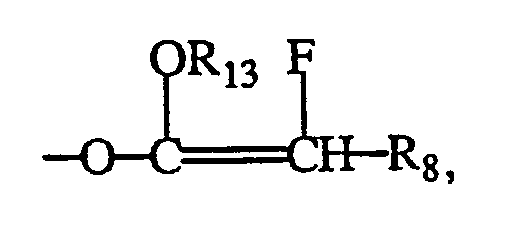
- Bei R₁ kann es sich auch um den Rest eines Enamins oder Enhydrazins handeln, die über ein N-Atom an das Metall Me gebunden sind. Es kann sich um lineare oder cyclische Enamine bzw. Enhydrazine handeln, die bevorzugt bis zu 20, besonders 2 bis 16 C-Atome enthalten. Die cyclischen Enamine und Enhydrazine können 3 bis 8, besonders 4 bis 6 Ringatome enthalten, wobei der Ring aus Atomen der Gruppe C, O, S und N gebildet sein kann. Das N-Atom der Enamingruppe kann substituiert sein, bevorzugt mit C₁-C₈-Alkyl, Phenyl, Benzyl oder mit Schutzgruppen wie z.B. (R₆)₃Si-.
- Der Enaminrest bzw. Enhydrazinrest kann z.B. der Formel

- R₁ als Rest eines Enols kann auch ein Ketonenolat sein, das besonders bis zu 16, insbesondere 4 bis 16 C-Atome enthält. Diese Enolate können sich ableiten von β-Ketoaldehyden, 1,3-Diketonen, β-Ketocarbonsäureestern und β-Ketocarbonsäureamiden. Die Estergruppe enthält bevorzugt Reste von aliphatischen C₁-C₆-Alkoholen. Das N-Atom in der Amidgruppe kann 1 oder 2-fach substituiert sein, bevorzugt mit C₁-C₆-Alkyl. Beispiele sind: β-Ketobutyraldehyd, Acetylaceton, Benzoylaceton, Acetylessigsäureethylester und Acetylessigsäureamid.
- Der Rest R₁ kann ein- oder mehrfach, bevorzugt ein- bis dreifach, besonders ein- oder zweifach substituiert sein. Ist der Substituent Alkoxy oder Alkylthio, so enthält dieser bevorzugt 1 bis 6 C-Atome. R₇ ist bevorzugt der Rest eines aliphatischen Alkohols mit 1 bis 6 C-Atomen. Es kann sich z.B. um Reste aliphatischer oder cycloaliphatischer Alkohole handeln. Beispiele sind Methoxy, Ethoxy, n-und i-Propoxy, n-, i- und t-Butoxy, Pentoxy, Hexyloxy, Cyclopentyloxy und Cyclohexyloxy.
- R₆ enthält als Alkyl bevorzugt 1 bis 6, besonders 1 bis 4 C-Atome. Das Alkoxy, Alkylthio, -S-C₂-C₄-Alkylen-S- und -O-C₂-C₄-Alkylen-O- können an ein C-Atom gebunden sein; es handelt sich dann um Acetal-oder Ketalgruppen.
- Das Sekundäramino in der Bedeutung als Substituent kann der Formel -NR₁₈R₁₉ entsprechen, worin R₁₈ und R₁₉ C₁-C₁₂-, bevorzugt C₁-C₆-Alkyl, Cyclopentyl, Cyclohexyl, Phenyl, Benzyl oder (R₆)₃Si- sind, oder R₁₈ und R₁₉ zusammen C₃-C₆-Alkylen, 3-Oxapentylen oder -Si(R₆)₂-C₂-C₃-Alkylen-Si(R₆)₂- bedeuten und R₆ die zuvor angegebene Bedeutung hat.
- In einer bevorzugten Untergruppe ist R₁ gegebenenfalls ein- oder mehrfach mit Sekundäramino, Cyano, Nitro, C₁-C₆-Alkylthio, C₁-C₆-Alkoxy oder -COR₇, worin R₇ C₁-C₁₂-Alkoxy ist, substituiertes lineares oder verzweigtes C₁-C₁₂-Alkyl, C₂-C₁₂-Alkenyl, C₂-C₁₂-Alkinyl, Cycloalkyl oder Cycloalkenyl mit 3 bis 8 Ring-C-Atomen, C₆-C₁₂-Aryl, C₇-C₁₆-Alkaryl oder -Aralkyl, C₈-C₁₆-Alkaralkyl, C₈-C₁₆-Aralkenyl, C₉-C₁₆-Alkaralkenyl, C₈-C₁₆-Aralkinyl oder C₉-C₁₆-Alkaralkinyl; oder ein über das Enolsauerstoffatom oder über das Enaminstickstoffatom gebundener Rest eine Enols, Enamins oder Enhydrazins.
- In einer weiteren bevorzugten Untergruppe ist R₁ gegebenenfalls ein- oder mehrfach mit Sekundäramino, Cyano, Nitro, C₁-C₆-Alkoxy, C₁-C₆-Alkylthio oder -COR₇, worin R₇ C₁-C₁₂-Alkoxy ist, substituiertes lineares oder verzweigtes C₁-C₆-Alkyl, C₂-C₆-Alkenyl, C₂-C₆-Alkinyl, Cycloalkyl oder Cycloalkenyl mit 3 bis 6 Ring-C-Atomen, Phenyl, (C₁-C₁₀-Alkyl)phenyl, Phenyl(C₁-C₂-alkyl), (C₁-C₈-Alkyl)phenyl(C₁-C₂-alkyl), Phenyl-vinyl, Phenylethinyl oder Phenylpropargyl, (C₁-C₈-Alkyl)phenylvinyl, (C₁-C₈-Alkyl)-phenylethinyl oder (C₁-C₇-Alkyl)phenylpropargyl; oder ein über ein Enolsauerstoffatom oder Enaminstickstoffatom gebundener Rest eines Enols, Enamins oder Enhydrazins mit bis zu 20 C-Atomen.
- Besonders bevorzugt ist R₁ gegebenenfalls ein- oder mehrfach mit Sekundäramino, Cyano, Nitro, C₁-C₆-Alkoxy, C₁-C₆-Alkylthio oder -COR₇, worin R₇ C₁-C₁₂-Alkoxy ist, substituiertes Methyl, Ethyl, Vinyl, Allyl, Crotonyl, Ethinyl, Propargyl, Cyclopentyl, Cyclohexyl, Cyclopentenyl oder Cyclohexenyl, Phenyl, Methylphenyl, Benzyl, 1-Phenyl-eth-2-yl, Methylbenzyl, Phenylvinyl, Methylphenylvinyl, Phenylethinyl, Phenylpropargyl, Methylphenylethinyl, Dimethylphenylethinyl oder -propargyl; oder ein über das Enolsauerstoffatom oder über das Enaminostickstoffatom gebundener Rest eines Enols, Enamins oder Enhydrazins mit 2 bis 16 C-Atomen.
- Insbesondere stellt R₁ Methyl, Ethyl, Allyl oder den Rest eines Esterenolats dar, das mit Sekundäramino substituiert sein kann.
- R₂ in der Bedeutung von Cyclopentadienyl oder Indenyl kann substituiert sein, beispielsweise mit 1 bis 5, zum Beispiel 1 oder 2 Substituenten. Geeignete Substituenten sind zum Beispiel Alkyl mit bevorzugt 1 bis 6 C-Atomen, Alkenyl mit bevorzugt 2 bis 6 C-Atomen, Alkoxy mit bevorzugt 1 bis 6 C-Atomen, Cycloalkyl mit bevorzugt 5 oder 6- Ring-C-Atomen, Aryl mit bevorzugt 6 bis 12 C-Atomen, Aralkyl mit bevorzugt 7 bis 13 C-Atomen, Trialkoxysilyl mit bevorzugt 1 bis 6 C-Atomen in den Alkoxylgruppen, Trialkylsilyl mit bevorzugt 1 bis 6 C-Atomen in Alkylgruppen, Halogen, bevorzugt F, Cl und Br oder R₆SO₂- mit R₆ bevorzugt gleich Phenyl Tolyl, Benzyl oder C₁-C₆-Alkyl. Aryl ist besonders Phenyl, und Aralkyl ist besonders Benzyl.
- Wenn Me für Titan steht, enthält R₂ in der Bedeutung von Cyclopentadienyl oder Indenyl bevorzugt keinen, oder 1 bis 5, besonders 1, 2 oder 3 Substituenten. Wenn Me für Zirkonium oder Hafnium steht, enthält R₂ in der Bedeutung von Cyclopentadienyl oder Indenyl bevorzugt 3 bis 5 Substituenten, besonders Methyl- oder Trialkylsilylgruppen.
- In einer bevorzugten Ausführungsform bedeutet R₂ gegebenenfalls mit C₁-C₆-Alkyl, C₂-C₆-Alkenyl, C₁-C₆-Alkoxy, Cycloalkyl mit 5 oder 6 Ring- C-Atomen, Phenyl, Benzyl, Trialkoxysilyl mit 1 bis 6 C-Atomen in den Alkoxygruppen, Trialkylsilyl mit 1 bis 6 C-Atomen in den Alkylgruppen, F, Cl, Br, oder R₆SO₂- substituiertes Cyclopentadienyl oder Indenyl.
- In einer anderen bevorzugten Ausführungsform bedeutet R₂ gegebenenfalls mit C₁-C₆-Alkyl oder Trimethylsilyl substituiertes Cyclopentadienyl.
- Besonders bevorzugt ist R₂ Cyclopentadienyl, Pentamethylcyclopentadienyl, Trimethylsilylcyclopentadienyl, Bis- oder Tri(trimethylsilyl)cyclopentadienyl.
- Für R₃ und R₄ in der Bedeutung als Kohlenwasserstoffreste gelten die gleichen Bevorzugungen wie für R₁. Beispiele sind für R₁ aufgezählt worden. R₃ und R₄ enthalten als Alkyl bevorzugt 1 bis 18, besonders 1 bis 12 und insbesondere 1 bis 6 C-Atome. Beispiele sind Methyl, Ethyl, n- oder i-Propyl, n-, i-oder t-Butyl, Pentyl, Hexyl, Heptyl, Octyl, Nonyl, Decyl, Undecyl, Dodecyl, Tetradecyl, Hexadecyl, Octadecyl und Eicosyl. Besonders bevorzugt sind Methyl, Ethyl, Propyl und Butyl. R₃ und R₄ enthalten als Cycloalkyl bevorzugt 5 oder 6 Ring-C-Atome. Beispiele sind Cyclopentyl, Cyclohexyl und Methylcyclohexyl. R₃ und R₄ zusammen als Gruppe -CnH2n- bedeuten lineares oder verzweigtes Alkylen mit 3 bis 7, bevorzugt 4 bis 6 C-Atomen in der Alkylengruppe. Besonders bevorzugte Substituenten für R₃ und R₄ sind -F, -Cl, C₁-C₆-Alkylthio oder C₁-C₆-Alkoxy.
- In einer bevorzugten Ausführungsform sind R₃ und R₄ unabhängig voneinander H, C₁-C₁₂-Alkyl, C₂-C₁₂-Alkenyl, gegebenenfalls mit C₁-C₄-Alkyl substituiertes Cycloalkyl oder Cycloalkenyl mit 5 oder 6 Ring-C-Atomen, Phenyl, Naphthyl, Benzyl, C₁-C₆-Alkylphenyl oder C₁-C₆-Alkylbenzyl oder R₃ und R₄ zusammen -CnH2n- mit n gleich 4 bis 6, die unsubstituiert oder mit -CN, -F, -Cl, -Nitro, C₁-C₆-Alkylthio oder C₁-C₆-Alkoxy substituiert sind.
- In einer anderen bevorzugten Ausführungsform sind R₃ und R₄ unabhängig voneinander H, C₁-C₆-Alkyl, z.B. Methyl, Ethyl, Propyl und Butyl, gegebenenfalls mit C₁-C₄-Alkyl substituiertes Cyclopentyl oder Cyclohexyl, Phenyl, Benzyl, C₁-C₆-Alkylphenyl oder C₁-C₆-Alkylbenzyl oder R₃ und R₄ zusammen Penta- oder Tetramethylen.
- Eine bevorzugte Untergruppe sind solche Verbindungen, worin R₃ H und R₄ oder R₃ und R₄ einer der zuvor definierten Kohlenwasserstoffreste sind.
- Y in Formel I steht besonders für C. Wenn dieses C-Atom chiral ist, so umfassen die Verbindungen der Formel I Diastereomere. R₃R₄Y kann R₃R₄Si sein, worin R₃ und R₄ bevorzugt C₁-C₆-Alkyl besonders C₁-C₄-Alkyl darstellen. R₃R₄Y kann auch -SiR₃R₄-O-SiR₃R₄- sein, worin R₃ und R₄ bevorzugt C₁-C₄-Alkyl bedeuten.
- R₅ stellt als Aryl bevorzugt C₆-C₁₀-Aryl dar und ist besonders Phenyl oder Naphthyl. Als Heteroaryl stellt R₅ bevorzugt fünf- oder 6-gliedriges Heteroaryl mit einem Heteroatom aus der Gruppe O, S und N dar. R₅ stellt als Aralkyl bevorzugt Benzyl oder Naphthylmethyl und Heteroarylmethyl dar, wobei das Heteroaryl 5 oder 6 Ringglieder enthält und Heteroatome aus der Gruppe O, S und N. Beispiele für Heteroaryl sind Pyridyl, Furyl, Thiophenyl und Pyrryl. Die Substituenten Alkyl, Alkoxy und Alkylthio enthalten bevorzugt 1 bis 6 C-Atome. Sekundäramino ist bevorzugt Di(C₁-C₄-Alkyl)-amino. Sekundäraminocarbonyl ist besonders Di(C₁-C₄-Alkylamino)-carbonyl. Die gleichen Bevorzugungen gelten für die entsprechend substituierten Methylreste als Substituenten.
- R₅ kann als Alkyl, Alkenyl und Alkinyl den für R₁ angegebenen Bevorzugungen entsprechen.
- R₅ bedeutet bevorzugt C₂-C₄-Alkenyl, 2-Furyl oder C₆-C₁₀-Aryl, das unsubstituiert oder mit C₁-C₆-Alkyl oder F substituiert ist. Das Aryl ist bevorzugt Methylphenyl, Pentafluorphenyl, Phenyl oder Naphthyl. R₅ bedeutet besonders Propenyl, Phenyl, Pentafluorphenyl, Methylphenyl oder Furyl.
- Eine bevorzugte Ausführungsform sind Verbindungen der Formel I, worin
R₁ lineares oder verzweigtes C₁-C₄-Alkyl, C₂-C₆-Alkenyl, oder gegebenenfalls mit C₁-C₄-Alkyl substituiertes Cycloalkyl oder Cycloalkenyl mit 3 bis 6 Ring-C-Atomen, oder Phenyl, Benzyl, C₁-C₆-Alkylphenyl oder C₁-C₆-Alkylbenzyl darstellt, das unsubstituiert oder mit Sekundäramino, Cyano, Nitro, C₁-C₆-Alkoxy, C₁-C₆-Alkylthio oder -COR₇, worin R₇ C₁-C₁₂-Alkoxy ist, darstellt, oder R₁ einen über ein Enolsauerstoffatom oder ein Enaminostickstoffatom gebundener Rest eines Enols, Enamins oder Enhydrazins mit bis zu 12 C-Atomen bedeutet,
R₂ Cyclopentadienyl ist, das unsubstituiert oder mit C₁-C₄-Alkyl oder Trimethylsilyl substituiert ist,
Y für C steht,
R₃ H ist oder die Bedeutung von R₄ hat und
R₄ C₁-C₁₂-Alkyl, Phenyl, Benzyl, Cyclopentyl oder Cyclohexyl darstellt oder
R₃ und R₄ zusammen Tetra- oder Pentamethylen bedeuten,
R₅ für C₂-C₄-Alkenyl, Phenyl, Pentafluorphenyl oder Furyl steht, und
Me vierwertiges Titan, Zirkonium oder Hafnium bedeutet. - Die C(1)- und C(2)-Atome in Formel I weisen bevorzugt R,R- oder S,S-Konfiguration auf. Stellt Y in Formel I ein chirales C-Atom dar, so können die C(1)- und C(2)-Atome auch in R,S- oder S,R-Konfiguration vorliegen.
- Eine besonders bevorzugte Ausführungsform sind Verbindungen der Formel I, worin R₁ C₁-C₄-Alkyl, Allyl oder der Rest eines Esterenolats mit 2 bis 12 C-Atomen ist, das mit Sekundäramino substituiert sein kann, R₂ gegebenenfalls mit Methyl oder Trimethylsilyl substituiertes Cyclopentadienyl bedeutet, R₃ H darstellt oder die Bedeutung von R₄ hat und R₄ C₁-C₆-Alkyl ist, R₅ Propenyl, Phenyl oder Pentafluorphenyl oder Furyl bedeutet, Me für vierwertiges Titan, Zirkonium, Hafnium und Y für C stehen.
- Die Verbindungen der Formel I können hergestellt werden, indem man eine Verbindung der Formel II

R₁⊖-M⊕ (III)
in Gegenwart eines inerten Lösungsmittels und inerten Schutzgases umsetzt, wobei R₁, R₂, R₃, R₄, R₅, Me und Y die oben angegebenen Bedeutungen haben, Z für ein Anion steht und M⊕ für Li⊕, Na⊕, K⊕, MgX⊕, ZnX⊕, CdX⊕, HgX⊕, CuX⊕ oder quaternäres Ammonium steht, wobei X Halogen bedeutet. - In der Gruppe M⊕ der Formel III steht X bevorzugt für Cl, Br oder I. M⊕ bedeutet bevorzugt Li⊕, MgCl⊕, MgBr⊕, ZnCl⊕, ZnBr⊕, CdCl⊕, CdBr⊕ oder Tetraalkylammonium mit 1 bis 6 C-Atomen in den Alkylgruppen. Besonders bevorzugt bedeutet M⊕ MgX⊕ und Li⊕, worin X Cl, Br oder I ist.
- Als Anion Z kommen z.B. PF₆⊖-, SbF₆⊖-, BF₄⊖-, CF₃COO⊖, Sulfonat (z.B. Tosylat), und besonders Cl⊖ oder Br⊖ in Frage.
- Die Verbindungen der Formel II sind ein weiterer Gegenstand der Erfindung. Sie sind in einfacher Weise durch die Umsetzung von 1 Mol eines Salzes der Formel
(R₂)MeZ₃
mit 1 Mol einer Verbindung der Formel IV
- Die Umsetzung kann bei Temperaturen von -78 bis +100°C, bevorzugt -20 bis 40°C, vorzugsweise in einem inerten Lösungsmittel, wie z.B. Kohlenwasserstoffen (Toluol, Xylol), Ethern (Diethylether, Tetrahydrofuran, Dioxan, Ethylenglykoldimethylether) erfolgen. Zweckmässig wird die Reaktion unter Schutzgasatmosphäre, zum Beispiel Argon, und in Gegenwart einer basischen Verbindung durchgeführt, um das entstehende HZ zu binden. Geeignete basische Verbindungen sind zum Beispiel Alkalicarbonate, wie Natriumcarbonat und Natriumbicarbonat sowie Amine, besonders tertiäre Amine, wie z.B. Triethylamin. Weitere geeignete Basen sind LiH, KH, NaH, Lithiumsekundäramide (Lithiumdiisopropylamid), Lithiummethyl, Lithiumethyl, Lithium-, Natrium- und Kaliumhexamethyldisilazid, Methylmagnesiumchlorid oder Diethylzink. Die Reaktionslösung kann direkt weiterverwendet werden. Zur Isolierung der Verbindungen wird das ausgefallene Salz abfiltriert und das Lösungsmittel entfernt. Die so erhaltenen Rohprodukte können ohne Reinigung weiterverwendet werden.
- Die Herstellung der Verbindungen der Formel I erfolgt zweckmässig bei Temperaturen von -78 bis +40°C, bevorzugt -20 bis 40°C, und in einem inerten Lösungsmittel. Geeignete Lösungsmittel sind insbesondere Ether. Die Reaktion wird unter Schutzgas, z.B. Argon durchgeführt. Ausgefallene Salze können abfiltriert werden. Das gegebenenfalls nach Entfernen des Lösungsmittels erhaltene Rohprodukt kann direkt weiterverwendet werden.
- Die erfindungsgemässen Verbindungen eignen sich hervorragend als enantioselektive Reaktanden für Reaktionen mit prochiralen Aldehyd-, Keto- und/oder N-substituierten Imingruppen. Besonders vorteilhaft ist, dass je nach Wahl der R,R- bzw. S,S-Konfiguration an den C-Atomen C(1) und C(2) in Formel I beide Enantiomere hergestellt werden können. Sie eignen sich insbesondere zur Uebertragung von Allylgruppen, sowie Enol-, Enamin- und Enhydrazingruppen durch Aldolreaktion. Ein weiterer Gegenstand der Erfindung ist diese Verwendung. Bei den Carbonylverbindungen handelt es vorzugsweise um prochirale Aldehyde und Ketone. Als Reaktionsprodukte erhält man in hohen Ausbeuten chirale sekundäre oder tertiäre Alkohole bzw. sekundäre Amine oder Aminosäuren mit hohem Ueberschuss eines Enantiomeren. Die Synthese von chiralen Wirkstoffen im Bereich der Pharmaka und Agrarchemikalien hat grosse Bedeutung erlangt. Die erfindungsgemässen Verbindungen eignen sich zur Herstellung von entsprechenden Zwischenprodukten für die Synthese solcher Wirkstoffe oder um in der Endstufe der Synthese solcher Wirkstoffe Gruppen mit chiralen C-Atomen einzuführen. So können z.B. in hohen Ausbeuten Pheromone für die Insektenbekämpfung hergestellt werden. Als Beispiel sei (+)- oder (-)-Ipsenol genannt, das gemäss dem in der EP-A-0 254 685 beschriebenen Verfahren hergestellt werden kann unter Verwendung eines erfindungsgemässen Titankomplexes (siehe Beispiel 17).
- Die erfindungsgemässen Verbindungen sind darüber hinaus preisgünstig aus billigen Ausgangsstoffen herstellbar. Als Derivate von natürlichen Verbindungen können sie mittels biologischer Abbaumethoden umweltfreundlich entsorgt werden, zumal Titan bzw. Titanoxid bekannterweise physiologisch unbedenklich ist.
- Ein weiterer Gegenstand vorliegender Erfindung ist ein Verfahren zur Herstellung von be vorzugt chiralen sekundären und tertiären Alkoholen und sekundären Aminen, das dadurch gekennzeichnet ist, dass man vorzugsweise prochirale Aldehyde, Ketone, N-substituierte Aldimine oder Ketimine mit 1 Mol einer Verbindung der Formel I pro Mol Aldehyd-, Keto- oder Imingruppe umsetzt. Bei dem Substituenten im Imin kann es sich um die zuvor erwähnten Reste wie Alkyl, Alkenyl, Cycloalkyl, Aryl und Aralkyl handeln. Sind diese Reste durch Carboxyl oder Carboxylestergruppen substituiert, erhält man als Reaktionsprodukte Aminosäuren bzw. deren Ester. Weitere geeignete Substituenten sind z.B. R₆SO₂- und Acyl mit bevorzugt 1 bis 8 C-Atomen, das mit -F substituiert sein kann. Beispiele sind Acetyl, Mono-, Di- und Trifluoracetyl, Benzoyl und Fluorbenzoyl.
- Die Reaktion wird vorteilhaft bei Temperaturen von -80 bis 30°C in Gegenwart eines inerten Lösungsmittels und unter Schutzgas durchgeführt. Zur Isolierung des Reaktionsproduktes wird zweckmässig hydrolysiert, das Produkt extrahiert und in üblicher Weise gereinigt. Geeignete inerte Lösungsmittel sind beispielsweise Ether oder Kohlenwasserstoffe, wie Pentan, Hexan, Cyclohexan, Methylcyclohexan, Benzol, Toluol, Xylol, Diethylether, Tetrahydrofuran, Dioxan, Nitrile, wie z.B. Acetonitril, oder chlorierte Kohlenwasserstoffe, wie z.B. Methylenchlorid, Chloroform oder Chlorbenzol.
- Die nachfolgenden Beispiele erläutern die Erfindung. Cp steht für Cyclopentadienyl.
- Zu einer Lösung von 0,55 g (2,5 mmol) Cyclopentadienyl-titantrichlorid in 50 ml Diethylether werden 1,24 g (2,5 mmol) (4S,5S)-2-(t-Butyl)-4,5-[bis(diphenylhydroxymethyl)]-1,3-dioxolan zugegeben. Zu dieser Reaktionslösung wird innert 30 Minuten bei Raumtemperatur (RT) eine Lösung von 0,56 g (5,5 mmol) Triethylamin in 10 ml Diethylether zugetropft. Die hellgelbe Suspension wird bei RT für weitere 12 Stunden gerührt und das gebildete Triethylaminhydrochlorid unter Argon abgenutscht und dreimal mit 10 ml Ether gewaschen. Die so erhaltene Reaktionslösung kann direkt weiterverwendet werden. Zur Isolation des Komplexes wird das Lösungsmittel am Vakuum abdestilliert. Es werden zwei Diastereomere im Verhältnis 4:1 gebildet.
- ¹H-NMR-Spektrum (CD₂Cl₂, 400 MHz): 7,20-7,70 (m, 20H, Ph); 6,26 (s, 5H, Cp); 4,86 (d, J = 6,5 1H, H-C(4) oder H-C(5)); 4,79 (d, J = 6,5, 1H, H-(C5) oder H-C(4)); 3,43 (s, 1H, H-C(2)); 0,84 (s, 9H, C(CH₃)₃).
- ¹³C-NMR-Spektrum (CD₂Cl₂, 100 MHz): 147,22 (s, Ph); 146,79 (s, Ph); 142,83 (s, Ph); 142,17 (s, Ph); 128,73 (d, Ph); 128,59 (d, Ph); 128,24 (d, Ph); 128,08 (d, Ph); 172,99 (d, Ph); 127,92 (d, Ph); 127,91 (d, Ph); 127,89 (d, Ph); 172,59 (d, Ph); 127,53 (d, Ph); 127,47 (d, Ph); 127,33 (d, Ph); 117,32 (d, Cp); 109,42 (d, C(2); 97,88 (s, C(Ph)₂O); 97,27 (s, C(Ph)₂O); 83,83 (d, C(4) oder C(5)); 80,30 (d, C(5) oder C(4)); 35,51 (s, C(CH₃)₃); 24,74 (q, C(CH₃)₃.
- ¹H-NMR-Spektrum (CD₂Cl₂, 400 MHz); 7,20-7,70 (m, 20H, Ph); 6,56 (s, 5H, Cp); 5,03 (d, J = 7,5, 1H, H-C(4) oder H-C(5)); 4,78 (d, J = 7,5, 1H, H-(C5) oder H-C(4); 3,44 (s, 1H, H-C(2)); 0,61 (s, 9H, C(CH₃)₃).
- ¹³C-NMR-Spektrum (CD₂Cl₂, 100 MHz): 146,49 (s, Ph); 146,45 (s, Ph); 142,53 (s, Ph); 142,06 (s, Ph); 129,25 (d, Ph); 128,84 (d, Ph); 128,63 (d, Ph); 128,53 (d, Ph); 128,16 (d, Ph); 128,07 (d, Ph); 127,99 (d, Ph); 127,92 (d, Ph); 127,88 (d, Ph); 127,55 (d, Ph); 127,46 (d, Ph); 127,17 (d, Ph); 117,80 (d, Cp); 109,85 (d, C(2); 97,52 (s, C(Ph)₂O); 97,40 (s, C(Ph)₂O); 80,83 (d, C(4) oder C(5)); 80,01 (d, C(5) oder C(4)); 35,30 (s, C(CH₃)₃); 24,38 (q, C(CH₃)₃.
- Die nach a) erhaltene Reaktionslösung wird auf 0°C abgekühlt und 1,8 ml (2,25 mmol) Allylmagnesiumchlorid (1,25 molare Lösung in Tetrahydrofuran) werden innert 5 Minuten zugetropft. Die gelb-braune Suspension wird 1 Stunde bei 0°C gerührt. Die so erhaltene Reaktionslösung wird direkt weiterverwendet.
- Zu einer Lösung von 0,55 g (2,5 mmol) Cyclopentadienyl-titantrichlorid in 50 ml Diethylether werden 1,17 g (2,5 mmol) (4R,5R)-2,2-Dimethyl-4,5-[bis-(diphenylhydroxymethyl)]-1,3-dioxolan zugegeben. Zu dieser Reaktionslösung wird innert 30 Minuten bei Raumtemperatur (RT) eine Lösung von 0,56 g (5,5 mmol) Triethylamin in 10 ml Diethylether zugetropft. Die hellgelbe Suspension wird bei RT für weitere 12 Stunden gerührt und das gebildete Triethylaminhydrochlorid unter Argon abgenutscht und dreimal mit 10 ml Ether gewaschen. Die so erhaltene Reaktionslösung wird direkt weiterverwendet.
- ¹H-NMR-Spektrum (CD₂Cl₂, 400 MHz): 7,65-7,27 (m, 20H, Ph); 6,43 (s, 5H, Cp); 5,16 (d, J=7,0, 1H, H-C(4) oder H-C(5)); 4,95 (d, J=7,0, 1H, H-C(5) oder H-C(4); 0,94 (s, 3H, CH₃); 0,50 (s, 3H, CH₃).
- ¹³C-NMR-Spektrum (CD₂Cl₂, 100 MHz): 148,87 (s, Ph); 146,72 (s, Ph); 142,86 (s, Ph); 142,72 (s, Ph); 129,75 (d, Ph); 129,08 (d, Ph); 128,60 (d, Ph); 128,36 (d, Ph); 127,99 (d, Ph); 127,92 (d, Ph); 127,73 (d, Ph); 127,68 (d, Ph); 127,59 (d, Ph); 127,57 (d, Ph); 127,55 (d, Ph); 127,49 d, Ph); 117,48 (d, Cp); 111,71 (s, C(2); 98,65 (s, C(Ph)₂O); 98,06 (s, C(Ph)₂O); 82,12 (d, C(4) oder C(5)); 81,67 (d, C(5) oder C(4)); 27,60 (q, CH₃); 27,00 (q, (CH₃).
- Die nach a) erhaltene Reaktionslösung wird auf 2°C abgekühlt und 1,8 ml werden (2,25 mmol) Allylmagnesiumchlorid (1,25 molare Lösung in Tetrahydrofuran) innert 5 Minuten zugetropft. Die orange Suspension wird 1 Stunde bei 2°C gerührt und unter Argon abgenutscht. Die so erhaltene Reaktionslösung wird direkt weiterverwendet.
- ¹H-NMR-Spektrum (CD₂Cl₂, 250MHz): 7,65-7,27 (m, 20H, Ph); 6,15 (s, 5H, Cp); 5,85 (quint. J=11,5, H-C(2′)) 5,40 (d, J=7,0, 1H, H-C(4) oder H-C(5)); 4,78 (d, J=7,0, 1H, H-(C5) oder H-C(4); 3,36 (d, J=11,5, 4H, H-C(1′), H-C(3′)); 0,72 (s, 3H, CH₃); 0,58 (s, 3H, CH₃).
- ¹³C-NMR-Spektrum (CD₂Cl₂, 62,9 MHz): 148,48 (s,Ph); 147,86 (s,Ph); 143,85 (s,Ph); 143,35 (d, C(2′)); 143,23 (s,Ph); 129,75 (d,Ph); 129,08 (d,Ph); 128,60 (d,Ph); 128,36 (d,Ph); 127,99 (d,Ph); 127,92 (d,Ph); 127,73 (d,Ph); 127,68 (d,Ph); 127,59 (d,Ph); 127,57 (d,Ph); 127,55 (d,Ph); 127,49 (d, Ph); 115,25 (d,Cp); 112,10 (s, C(2)); 94,95 (s, C(Ph)₂O); 88,03 (t, C(1′),C(3′)); 82.30 (d, C(4) oder C(5)); 82.25 (d, C(5) oder C(4)); 27.67 (q, (CH₃); 27.64 (q, CH₃).
- wird ausgehend von (4S,5S)-2,2-Dimethyl-4,5-[bis(diphenylhydroxymethyl)]-dioxolan gemäss Beispiel 2a hergestellt.
- wird ausgehend von [(4S,5S)-2,2-Dimethyl-1,3-dioxolan-4,5-bis(diphenyl-methoxy)]-cyclopentadienylchloro-titan gemäss Beispiel 2b hergestellt.
- Zu 10mmol [(4R,5R)-2,2-Dimethyl-1,3-dioxolan-4,5-bis(diphenylmethoxy)]cyclopentadienyl-chloro-titan, hergestellt analog Beispiel 2a, in 160ml Diethylether wird bei -10°C 10ml (10mmol) (Crotyl)MgCl (1 molare Lösung in Diethylether) zugegeben.Die rostrote Suspension wird 2h bei dieser Temperatur gerührt und unter Argon abgenutscht. Die so erhaltene Reaktionslösung kann eingeengt oder direkt weiterverwendet werden.
- ¹H-NMR-Spektrum (CD₂Cl₂, 250MHz): 7,65-7.15 (m, 20H, Ph); 6,08 (s, 5H, Cp); 5,46 (dxtxq, J= 14,0, 8,5, 1,5, H-C(2′)); 4,82 (dxq, J= 14,0, 6,5, H-C(3′)); 5,11 (d, J=7,0, 1H, H-C(4) oder H-C(5)); 4,47 (d, J=7,0, 1H, H-(C5) oder H-C(4); 2,26 (dxd, J=8,5, 8,5 H-C(1′)); 2,17 (dxd, J=8,5, 8,5 H-C(1′)); 1,67 (dxd, 3H, J=6,5, 1,5, H-(C4′)); 0,68 (s, 3H, C(2)-CH₃); 0,58 (s, 3H, C(2)-CH₃).
- Zu einer Lösung von Brompentafluorbenzol 1,25ml (10mmol) in 30ml Diethylether wird bei -78°C 6,25ml (10mmol) n-ButylLi in Hexan innert 45min zugetropft, auf Raumtemperatur (RT) erwärmt, gerührt und auf 0°C abgekühlt. Zu dieser Reaktionslösung wird 10mmol (4R,5R)-2,2-Dimethyl-1,3-dioxolan-4,5-dicarbonsäure-diethylester, gelöst in 20ml Diethylether langsam zugetropft, 12h bei RT gerührt und durch langsame Zugabe einer gesättigten NH₄Cl Lösung hydrolisiert. Die Emulsion wird 3x mit 80ml Diethylether extrahiert, mit einer gesättigten NaCl Lösung gewaschen über Na₂SO₄ getrocknet und eingedampft. Das Produkt wird durch Flash-Chromatographie (80g SiO₂, Ether/Hexan 1:5) gereinigt.
Ausbeute: 4,63g (56%). - ¹H-NMR-Spektrum (CDCl₃, 250 MHz): 5,43 (s, 2H); 4,95 (s, 2H); 1,40 (s, 6H).
- Wird analog Beispiel 2a, jedoch ausgehend von (4R,5R)-2,2-Dimethyl-4,5-[bis-(di-pentafluorphenylhydroxymethyl)]-1,3-dioxolan hergestellt.
- Die nach Beispiel 5b erhaltene Reaktionslösung wird analog Beispiel 2b umgesetzt und kann direkt weiter verwendet werden.
- Eine Lösung von 97ml n-ButylLi (155mmol) in Hexan wird mit 100ml Diethylether verdünnt, auf -20°C abgekühlt und mit 11,62ml (160mmol) Furan innerhalb von 10min versetzt. Die Reaktionslösung wird langsam auf RT erwärmt, und anschliessend während 4h am Rückfluss erwärmt. Zu dieser Reaktionslösung wird 9,84g (40mmol) (4R,5R)-2,2-Dimethyl-1,3-dioxolan-4,5-dicarbonsäure-diethylester, gelöst in 20ml Ether, unter Eiskühlung langsam zugetropft, anschliessend 2h bei RT und 16h unter Rückfluss gerührt und durch langsame Zugabe von 300ml einer gesättigten NH₄Cl Lösung hydrollsiert. Die Emulsion wird über Hyflo filtriert, 3x mit 200ml Diethylether extrahiert, mit einer gesättigten NaCl Lösung gewaschen, über Na₂SO₄ getrocknet und eingedampft. Das Produkt wird durch Flash-Chromatographie (800g SiO₂, Toluol/Ether 10:1) gereinigt. Ausbeute: 5,10g (30%).
¹H-HMR-Spektrum (CDCl₃, 250 MHz): 7,48-7,36 (m, 4H); 6,48-6,30 (m, 8H); 4,78 (s, 2H); 1,02 (s, 6H).
¹³C-NMR-Spektrum (CDCl₃, 62,9 MHz): 154,3(s), 152,9 (s), 142,4 (d); 111,5 (s); 110,6 (d); 110,3 (d); 109,8 (d), 109,3(d); 80,4 (d); 72,6 (s); 26,7 (q). - Wird analog Beispiel 2a jedoch ausgehend von (4R,5R)-2,2-Dimethyl-4,5-[bis-(di-2-furyl-hydroxymethyl)]-1,3-dioxolan hergestellt.
- Die nach Beispiel 6b erhaltene Reaktionslösung wird analog Beispiel 2b umgesetzt und kann direkt weiter verwendet werden.
- 13,8g (575mmol) Mg-Späne werden in 50 ml Tetrahydrofuran (THF) vorgelegt und 43,7ml 500mmol 2-Brompropen innerhalb von 1,5h zugetropft und 1h am Rückfluss erwärmt und auf 40°C abgekühlt. Zur Reaktionslösung wird 24,6g (100mmol) (4R,5R)-2,2-Dimethyl-1,3-dioxolan-4,5-dicarbonsäure-diethylester, gelöst in 50 ml THF innerhalb 1h zugetropft. Anschliessend wird mit 250ml 2n H₂SO₄ hydrolisiert, die Phasen getrennt und die Wasserphase 3x mit 200ml Diethylether extrahiert, die vereinigten Etherphasen werden 2 x mit einer gesättigten NaCl Lösung gewaschen, über NaSO₄ getrocknet und eingedampft. Das Produkt wird durch Flash-Chromatographie (1kg SiO₂, Ether/Hexan 1:5) gereinigt. Ausbeute: 6,1g (18.9%).
- ¹H-NMR-Spektrum (CDCl₃, 250 MHz): 5,25 (dxq, J=1,5, 0,5, 2H); 5,19 (dxq, J=1,5, 0,5, 2H); 5,11 (dxq, J=1,5, 1,5, 2H); 5,00 (dxq, J= 1,5, 1,5, 2H); 4,40 (s, 2H); 1,80 (dxd J=1,5, 0,5, 6H) 1,72 (dxd J= 1,5, 0,5, 6H); 1,40 (s, 6H)
¹³C-NMR-Spektrum (CDCl₃, 62,9 MHz): 146,1(s); 145,7 (s); 114,3 (t); 113,7(t); 98,4 (s); 80,2 (d); 79,1 (s); 27,2 (q); 21,0(q); 19,4 (q). - Wird ausgehend von (4R,5R)-2,2-Dimethyl-4,5-[bis-(di-2-propenylhydroxymethyl)]-1,3-dioxolan analog Beispiel 2a hergestellt.
- Die nach Beispiel 7b erhaltene Reaktionslösung wird analog Beispiel 2b umgesetzt und kann direkt weiter verwendet werden.
- Wird ausgehend von (4R,5R)-2,2-Diphenyl-4,5-bis(diphenylhydroxymethyl)]-1,3-dioxolan analog Beispiel 2a hergestellt.
- ¹H-NMR-Spektrum (CDCl₃, 250MHz): 7,70-6,40 (m, 30H, Ph); 6,29 (s, 5H, Cp); 5,33 (d, J=7,0, 1H, H-C(4) oder H-C(5)); 5,20 (d, J=7,0, 1H, H-(C5) oder H-C(4);
- ¹³C-HMR-Spektrum (CDCl₃, 62,89MHz): 146,4 (s,Ph); 146,3 (s,Ph); 144,0 (s,Ph); 143,4 (s,Ph); 141,3 (s,Ph); 140,2 (s,Ph); 128,6-126,3 (d, 16C, Ph); 125,4 (d, Ph); 125,2 (d, Ph); 116,8 (d, Cp); 112,2 (s, C(2); 98,4 (s, C(Ph)₂O); 97,8 (s, C(Ph₂O); 84,3 (d, C(4) oder C(5)); 83,5 (d, C(5) oder C(4)).
- Zu einer Lösung von 6,66g (20mmol) Pentamethylcyclopentadienyl-zirkontrichlorid in 150ml Diethylether werden 9,32g (20mmol) (4R,5R)-2,2-Dimethyl-4,5-[bis(diphenylhydroxymethyl)]-1,3-dioxolan zugegeben. Zu dieser Reaktionslösung wird innert 30 Minuten bei Raumtemperatur (RT) eine Lösung von 6,1ml (44 mmol) Triethylamin in 50ml Diethylether zugetropft. Die beige Suspension wird bei RT für weitere 12h gerührt und das gebildete Triethylaminhydrochlorid unter Argon abgenutscht und dreimal mit ca 20ml Diethylether gewaschen. Die so erhaltene Reaktionslösung kann direkt weiterverwendet werden.
- ¹H-NMR-Spektrum (CDCl₃, 250MHz): 7,55-7,18 (m, 20H, Ph); 5,12 (d, J=7,0, 1H, H-C(4) oder H-C(5)); 4,92 (d, J=7,0, 1H, H-(C5) oder H-C(4); 1,95 (s, 15H, Cp*); 0,46 (s, 3H, CH₃); 0,45 (s, 3H, CH₃).
- ¹³C-NMR-Spektrum (CDCl₃, 62,89MHz): 148,5 (s,Ph); 148,2 (s,Ph); 143,6 (s,Ph); 143,4 (s,Ph); 129,8 (d,Ph); 129,5 (d,Ph); 128,6-127,5 (d, 10C, Ph); 123,74 (s, Cp*); 111,62 (s, C(2); 91,38 (s, C(Ph)₂O); 90,19 (s, C(Ph)₂O); 82,16 (d, C(4) oder C(5)); 80,55 (d, C(5) oder C(4)); 27,50 (q, (CH₃); 27,40 (q, CH₃); 11,10 (q, Cp*).
Ph:Phenyl
Cp*: Cyclopentadienyl - Eine Lösung von 5mmol der Zirkonverbindung von Beispiel 9a in 60 ml Diethylether wird auf -74°C abgekühlt, mit 1,5 ml einer 3 molaren CH₃MgBr Lösung in THF versetzt und 2h bei -74°C gerührt. Die so erhaltene Reaktionslösung wird direkt weiter verwendet.
- Wird analog Beispiel 9a) jedoch ausgehend von Pentamethylcyclopentadienyl-hafniumtrichlorid hergestellt.
- ¹H-NMR-Spektrum (CDCl₃, 250MHz): 7,55-7.2 (m, 20H, Ph); 5,08 (d, J=7,0, 1H, H-C(4) oder H-C(5)); 4,92 (d, J=7,0, 1H, H-(C5) oder H-C(4); 2.00 (s, 15H, Cp*); 0,46 (s, 3H, CH₃); 0,43 (s, 3H, CH₃).
- ¹³C-NMR-Spektrum (CDCl₃, 62,89MHz): 148,63(s,Ph); 148,18 (s,Ph); 143,84 (s,Ph); 143,70 (s,Ph); 129,8 (d,Ph); 129,1 (d,Ph); 128,6-127,5 (d, 10C, Ph); 122,14 (s, Cp*); 112,01 (s, C(2); 90,34 (s, C(Ph)₂O); 90,19 (s, C(Ph)₂O); 82,17 (d, C(4) oder C(5)); 80,58 (d, C(5) oder C(4)); 27,56 (q, CH₃); 27,40 (q, (CH₃); 10,87 (q, Cp*).
- Wird analog Beispiel 9b hergestellt jedoch ausgehend von der Hafniumverbindug von Beispiel 10a.
- Eine Lösung von 1,25 mmol der Titanverbindung von Beispiel 2b) in 60 ml Diethylether wird auf -74°C abgekühlt und mit 0,1 ml (1,0 mmol) Benzaldehyd (frisch destilliert) versetzt. Die schwach gelbe, klare Lösung wird 2 Stunden bei -74°C weitergerührt und mit 5 ml einer 5N H₂O/THF Lösung versetzt, auf RT erwärmt, eine weitere Stunde bei dieser Temperatur gerührt, genutscht und am Rotavapor eingeengt. Das Rohprodukt (0,80 g klares farbloses Oel) wird flash-chromatographiert (60 g Kieselgel, 35 cm lang, ⌀ 2 cm, 5 ml/Fraktion, 0,4 bar, Toluol/Ethanol 10:1). Man erhält 0,098 g Produkt. Ausbeute: 66 %, ee: 93 %.
- Eine Lösung von 1,25 mmol der Titanverbindung von Beispiel 2b) in 60 ml Diethylether wird auf -74°C abgekühlt und mit 0,19 ml (0,1 mmol) Caprinaldehyd (frisch destilliert) versetzt. Die schwach gelbe, klare Lösung wird 2 Stunden bei -74°C weitergerührt und mit 5 ml einer 5N H₂O/THF Lösung versetzt, auf RT erwärmt, eine weitere Stunde bei dieser Temperatur gerührt, genutscht und am Rotavapor eingeengt. Das Rohprodukt (1,13 g Klares farbloses Oel) wird flash-chromatographiert (60 g Kieselgel, 35 cm lang ⌀ 2 cm, 5 ml/Fraktion, 0,4 bar, Toluol/Ethanol 10:1) und anschliessend am Kugelrohr destilliert (Kp: ≈ 120-130 bei 0,104 mbar). Man erhält 0,141 g Produkt. Ausbeute: 71 %, ee: 95 %.
- Eine Lösung von 2,25 mmol Titanverbindung gemäss Beispiel 1b) in 120 ml Diethylether wird auf -74°C abgekühlt und mit 0,2 ml (2,0 mmol) Benzaldehyd (frisch destilliert) versetzt. Die beige Suspension wird 2 Stunden bei -74°C weitergerührt und mit 5 ml einer 5N H₂O/THF Lösung versetzt. Die beige Suspension wird auf RT erwärmt, eine weitere Stunde bei dieser Temperatur gerührt, genutscht und am Rotavapor eingeengt. Das Rohprodukt (1,53 g gelbbraunes Oel) wird zweimal flash-chromatographiert (80 g Kieselgel, 25 cm lang ⌀ 2cm, 10 ml/Fraktion, 0,5 bar, Toluol/Ethanol 20:1); (50 g Kieselgel, 25 cm lang, ⌀ 2cm, 15 ml/Fraktion, 0,5 bar, Toluol/Ethanol 15:1). Man erhält 0,2 g Produkt. Ausbeute: 66 %, ee: 82 %.
- Zu einer Lösung von 1,9 g Cyclohexylisopropylamin in 60 ml Tetrahydrofuran werden bei -20 bis -30°C 7,6 ml einer 1,6 M Lösung von Butyl-Lithium in Hexan gegeben. Nach 20 min. kühlt man auf -78°C und tropft eine Lösung von 3,0 g 1,1,3,3-Tetramethyl-1,3-disila-azolidin-N-essigsäure-ethylester in 60 ml Tetrahydrofuran zu. Nach 1 Stunde Rühren bei -78°C werden 161 ml einer 0,083 M Lösung von [(4R,5R)-2,2-Dimethyl-1,3-dioxolan-4,5-bis(diphenylmethoxy)]cyclopentadienyl-chloro-titanat (gemäss Beispiel 2a) in Ether zugetropft. Man rührt während 43 Stunden bei -78°C und gibt die Lösung anschliessend via Stahlkanüle zu einer auf -78°C gekühlten Lösung von 0,97 g Butyraldehyd in 15 ml Tetrahydrofuran. Nach 22 Stunden Rühren bei -78°C werden 1,5 ml Wasser zugegeben, auf Raumtemperatur aufgewärmt und filtriert. Das Filtrat versetzt man mit 24 ml Wasser und 4,8 ml Essigsäure, rührt 2 Stunden bei Raumtemperatur und dampft im Vakuum ein. Eine Probe (5 mg) des Rückstandes wird mit Trifluoressigsäureanhydrid in Methylenchlorid während 2 Stunden deriva- tisiert und durch Kapillar-Gaschromatographie (Chirasil-Val, 90-180°C/2°C pro min.) analysiert. Die Probe besteht demgemäss aus 90,8 % (2S,3R)-Isomer (Retentionszeit 11,7 min.) und 9,2 % (2R,3S)-Isomer (Retentionszeit 10,8 min.). Der Rest des Rohproduktes wird mit 250 ml Ether versetzt und dreimal mit je 100 ml 0,1 N Salzsäure geschüttelt. Die Wasserphase wird zweimal mit je 250 ml Ether extrahiert mit Natronlauge auf pH 4 eingestellt und im Vakuum bei Raumtemperatur auf 50 ml eingeengt. Nach Zugabe von 80 ml Dioxan, 6,7 g Natriumbicarbonat und 5,3 g di-tert.Butyldicarbonat rührt man 15 Stunden bei Raumtemperatur. Das Reaktionsgemisch wird mit 250 ml Diethylether verdünnt, zweimal mit je 250 ml Wasser und gesättigter Kochsalzlösung gewaschen, und die Wasserphasen werden zweimal mit je 250 ml Ether extrahiert. Die organischen Extrakte werden getrocknet (Na₂SO₄) und eingedampft. Die Chromatographie des Rückstandes (Kieselgel, Essigester/Hexan 1:4 bis 1:2) gibt 2,09 g (2S,3R)-tert.Butoxycarbonylamino-3-hydroxy-hexansäure-ethylester.
- Eine Lösung von 4,5 mmol der Titanverbindung von Beispiel 2b in 70 ml Diethylether wird auf -74°C abgekühlt und mit 0,52 g (4,0 mmol) frisch hergestelltem 2,3-O-Isopropylidene-D-glyceraldehyd versetzt. Die orange-gelbe Suspension wird 4 Stunden bei -74°C weitergerührt und mit 30 ml einer wässrigen Ammoniumfluorid-Lösung (45 %) versetzt, auf Raumtemperatur erwärmt, über Nacht bei dieser Temperatur gerührt und über Hyflo genutscht. Die Emulsion wird mit 50 ml Diethylether verdünnt, anschliessend die organische Phase abgetrennt, gewaschen und über Na₂SO₄ getrocknet. Das Rohprodukt (2,5 g klares, gelbliches Oel) wird in 10 ml Pentan suspendiert, 1 Stunde bei Raumtemperatur gerührt und genutscht. Das Filtrat wird flash-chromatographiert (60 g Kieselgel, 20 cm lang, ⌀ 2cm, 30 ml/Fraktion, 0,4 bar, Diethylether/Pentan 1:2) Ausbeute: 0,2 g ee > 95 %.
- Die Herstellung erfolgt gemäss Beispiel 8, aber unter Verwendung der Titanverbindung von Beispiel 3b. Ausbeute: 0,26 g ee > 95 %.
- Zu einer Lösung von 1,12 ml Diisopropylamin in 15 ml trockenem Diethylether (Ether) werden bei -25°C 4,4 ml 1,6M Butyl-Lithium in Hexan gegeben (Argon). Nach 25 min. bei -20°C wird auf -78°C gekühlt und 805 µl Essigsäure-tert.butylester in 10 min. mit der Spritze zugetropft. Nach 45 min. Rühren bei -78°C wird eine frisch zubereitete auf -78°C vorgekühlte Lösung von 4,9 g [(4R,5R)-2,2-Dimethyl-1,3-dioxolan-4,5-bis-(diphenylmethoxy)]cyclopentadienyl-chloroti tanat (gemäss Beispiel 2a) in ca. 100 ml Ether via Kanüle in 15 min. zugegeben. Man rührt 30 min. bei -78°C und 3 Stunden bei -30°C, kühlt auf -78°C und gibt 650 µl Isovaleraldehyd in 5 min. mit der Spritze zu. Nach 2 Stunden bei -78°C werden 20 ml 45 % NH₄F-Lösung zugegeben und das Gemisch wird auf Raumtemperatur erwärmt. Nach 17 Stunden Rühren wird filtriert, das Filtrat wird mit 10 ml gesättigter Kochsalzlösung versetzt und dreimal mit je 100 ml Ether extrahiert. Die organischen Phasen werden mit gesättigter NaCl-Lösung und 1N HCl gewaschen, getrocknet (MgSO₄) und eingedampft. Der Rückstand (5,1 g) wird in 6 ml 2N Natronlauge und 12 ml Methanol 2 Stunden bei 50°C gerührt. Nach dem Abdampfen von Methanol im Vakuum wird dreimal mit je 50 ml Ether extrahiert. Die mit konzentrierter Salzsäure angesäuerte Wasserphase wird dreimal mit je 100 ml Essigester extrahiert. Die Essigesterphasen werden mit zweimal 50 ml gesättigter Kochsalzlösung gewaschen, getrocknet (MgSO₄) und eingedampft. Der Rückstand, 835 mg 1-(R)-3-Hydroxy-5-methyl-hexan-säure mit 78 % optischer Reinheit, wird zweimal aus Cyclohexan (60 ml, 150 ml) umkristallisiert. Ausbeute: 595 mg Produkt mit 96 % optischer Reinheit, Smp. 86°C; [|[α]D=-14,7° (c=1, CHCl₃). Gemäss der Vorschrift in der EP-A-0 254 685 (Beispiel 41d bis 41g) kann hieraus (+)-(R)-Ipsenol hergestellt werden.
- Analog Beispiel 11 jedoch ausgehend von:
[(4R,5R)-2,2-Dimethyl-1,3-dioxolan-4,5-bis-(di-pentafluorphenylmethoxy)]-cyclopenta-dienyl-allyl-titan (hergestellt nach Bsp 5c). Ausbeute: 62%, (ee: 53.7%). - Analog Beispiel 11 jedoch ausgehend von:
[(4R,5R)-2,2-Dimethyl-1,3-dioxolan-4,5-bis-(di-2-furylmethoxy)]-cyclopentadienyl-chloro-titan (hergestellt nach Bsp 6c). Ausbeute: 63%, (ee: 65.5%). - Analog Beispiel 11 jedoch ausgehend von:
[(4R,5R)-2,2-Dimethyl-1,3-dioxolan-4,5-bis-(di-2-propenylmethoxy)]-cyclopentadienyl-chloro-titan (hergestellt nach Bsp 7c). Ausbeute: 53%, (ee: 71.3%). - Eine Lösung 65 ml (4,5mmol) [(4R,5R)-2,2-Dimethyl-1,3-dioxolan-4,5-bis-(diphenylmethoxy)]-cyclopentadienyl-allyl-titan (hergestellt nach Beispiel 2b) wird auf -74°C abgekühlt und 917 mg (4 mmol) tert-Butyl (4S)-2,2-Dimethyl-4-formyl-oxazolidin-3-carboxylat gelöst in 5ml Diethylether zugetropft. Die schwach gelbe, klare Lösung wird 3h bei -74°C weitergerührt und mit 25ml einer wässrigen 45%-igen NH₄F Lösung versetzt, auf RT erwärmt, weitere 12h bei dieser Temperatur gerührt (weisser Niederschlag) und über Celite filtriert. Die wässrige Phase wird abgetrennt und mit 100ml Diethylether extrahiert. Die die organische Phase wird 2x mit 50ml gesättigter NaCl-Lösung gewaschen, mit MgSO₄ getrocknet und eingedampft.
Das Produkt wird durch zweimalige Flash-Chromatographie (220g SiO₂, Hexan/Essigester 2.5:1) bezw. (20g SiO₂, Hexan/Essigester 2.5/ :1) gereinigt.
Ausbeute: 1.007g, 93% , de (ee) 95%, [α]D Rt=-17.0° (c=0.95, C₆H₆). - ¹³C-NMR (C₆D₆, 62,9 MHz, 340K) 24,1(CH₃); 27,0 (CH₃); 28,4 (C(CH₃)₃; 36,1 (C(2′)); 61,9 (C(4)); 64,6 (C(5)); 72,3 (C(1′)); 80,4 (C(CH₃)₃; 94,3 (C(2)); 117,0 (C(4′)); 135,7 (d, C(3′); 153,8 (COO-t-Bu).
- ¹H-NMR (C₆D6, 250MHz, 340K): 1,39 (s, C(CH₃)₃), 1,45 (s, CH₃); 1,62 (s, CH₃); 2,10 (dxdxdxdxd, 1H, J=14,0, 7,0, 7,0, 1,0, 1,0, H-C(2′); 2,30 (dxdxdxdxd, 1H, J= 14,0, 6,5, 3,0, 1,0, 1,0, H-C(2′);3,59-3,73 (m, 2H, H-C(5)); 3,84-3,96 (m, H-C(4), H-C(1′); 4,97-5,08 (m, 2H, H-C(4′)); 5,92 (dxdxdxd J= 17,0, 10,0, 7,0, 6,5, H-C(3′)).
- Wird analog Beispiel 21 hergestellt jedoch unter Verwendung von [(4S,5S)-2,2-Dimethyl-1,3-dioxolan-4,5-bis-(diphenylmethoxy)] -cyclopentadienyl-allyl-titan (Beispiel 3b).
Ausbeute: 1.037g, 95% , de (ee) 99%, [α]D Rt= +4.4° (c=0.985, C₆H₆). - ¹H-NMR (C₆D₆, 250MHz, 340K): 1,39 (s, C(CH₃)₃), 1,46 (s, CH₃); 1,62 (s, CH₃); 2,16-2,23 (m, 2H, H-C(2′); 3,63 (dxd, 1H, 9,0, 6,5, H-C(5)); 3,80-3,92 (m, 3H, H-C(1′), H-C(4), H-C(5)); 4,97-5,12 (m, 2H, H-C(4′)); 5,90 (dxdxdxd J = 17,0, 10,0, 6,50, 6,5, H-C(3′));
- ¹³C-NMR(C₆D₆, 62,9 MHz, 340K) 24,2 (qCH₃); 27,0 (q, CH₃); 28,4 (q, t-Bu); 38,9 (t, C(2′)); 62,0 (d, C(4)); 64,5 (t, C(5)); 72,0 (d, C(1′)); 80,1 (s,t-Bu); 94,4 (s, C(2)); 116,9 (t, C(4′)); 135,9 (d, C(3′); 153,8 (s)).
- Zu einer Lösung von 1,9 g Cyclohexylisopropylamin in 60 ml Tetrahydrofuran werden bei -20 bis -30 °C 7,6 ml einer 1,6M Lösung von Butyl-Lithium in Hexan gegeben. Nach 20 min. kühlt man auf -78 °C und tropft eine Lösung von 3,0 g 1,1,3,3-Tetramethyl1,3-disila-azolidin-N-essigsäure-ethylester in 60 ml Tetrahydrofuran zu. Nach 1h Rühren bei -78°C werden 161 ml einer 0,083 M Lösung von [(4R,5R)-2,2-Dimethyl-1,3-dioxolan-4,5-bis(diphenylmethoxy)]cyclopentadienyl-chloro-titanat (gemäss Beispiel 2a) in Diethylether zugetropft. Man rührt während 43h bei -78°C und gibt die Lösung anschliessend über eine Stahlkanüle zu einer auf -78°C gekühlten Lösung von 0,97 g Butyraldehyd in 15 ml Tetrahydrofuran. Nach 22h Rühren bei -78 °C werden 1,5 ml Wasser zugegeben, auf Raumtemperatur aufgewärmt und filtriert. Das Filtrat versetzt man mit 24 ml Wasser und 4,8 ml Essigsäure, rührt 2h bei Raumtemperatur und dampft schonend im Vakuum ein. Eine Probe (5 mg) des Rückstandes wird mit Trifluoressigsäureanhydrid in Methylenchlorid während 2h umgesetzt und durch Kapillar-Gaschromatographie (Chirasil-Val, 90 - 180°C/2°C pro min) analysiert. Die Probe besteht demgemäss aus 90,8% (2S,3R)-Isomer (Retentionszeit 11,7 min.) und 9,2% (2R,3S)-Isomer (Retentionszeit 10,8 min.). Der Rest des Rohproduktes wird mit 250 ml Diethylether versetzt und dreimal mit je 100 ml 0.1 N Salzsäure geschüttelt. Die Wasserphase wird zweimal mit je 250 ml Diethylether extrahiert, mit Natronlauge auf pH 4 eingestellt und im Vakuum bei Raumtemperatur auf etwa 50 ml eingeengt. Nach Zugabe von 80 ml Dioxan, 6,7 g Natriumbicarbonat und 5,3 g di-tert.Butyl-dicarbonat rührt man 15h bei Raumtemperatur. Das Reaktionsgemisch wird mit 250 ml Diethylether verdünnt, zweimal mit je 250 ml Wasser und gesättigter Kochsalzlösung gewaschen, und die Wasserphasen werden zweimal mit je 250 ml Diethylether extrahiert. Die organischen Extrakte werden getrocknet (Na₂SO₄) und eingedampft. Chromatographie des Rückstandes (Kieselgel, Essigester/Hexan 1:4 bis 1:2) gibt 2,09 g (2S,3R)-tert.Butoxycarbonylamino-3-hydroxy-hexansäure-ethylester.
- Unter Stickstoffatmosphäre werden zu einer Aufschlämmung von 14,0 g Glycin-tert.butylester-hydrochlorid in 200 ml Dichlormethan unter Eiskühlung langsam 44,0 ml Triethylamin und eine Lösung von 23,4 g 1,2-Bis-(chlordimethylsilyl)-ethan in 100 ml Dichlormethan getropft. Nach 19 h Rühren bei Raumtemperatur werden weitere 7 ml Trietylamin und 5,4 g 1,2-Bis-(chlordimethylsilyl)-ethan zugesetzt und nochmals 22 h gerührt. Das Reaktionsgemisch wird mit Pufferlösung (0,41 M Na₂HPO₄ und 0,28 M KH₂PO₄ in H₂O), H₂O und gesättigten Kochsalzlösung gewaschen; die wässrigen Phasen werden zweimal mit Dichlormethan extrahiert. Man trocknet die organischen Phasen mit Na₂SO₄, dampft sie ein und destilliert den Rückstand: 12,7 g 1,1,3,3-Tetramethyl-1,3-disila-azolidin-N-essigsäure-tert.butylester (60-63°C; 0,02 mbar).
- Zu einer analog zu Beispiel 23 aus 0,93 g Cyclohexylisopropylamin, 30 ml THF und 3,8 ml Butyllithium (1,6M in Hexan) hergestellten Lösung von Lithium-cyclohexylisopropylamid werden bei -78°C 1,5 g 1,1,3,3-Tetramethyl-1,3-disila-azolidin-N-essigsäure-tert.butylester in 30 ml THF getropft Nach 1h Rühren bei -78°C werden 105 ml einer 0,063 M Lösung von [(4R,5R)-2,2-Dimethyl- 1,3-dioxolan-4,5-bis(diphenylmethoxy)]-cyclopentadienyl-chloro-titanat (gemäss Beispiel 2a) in Diethylether zugetropft. Man rührt während 21h bei -78°C und gibt die Lösung anschliessend über eine Stahlkanüle zu einer auf -78°C gekühlten Lösung von 0,47 g Butyraldehyd in 10 ml THF. Nach 23 h Rühren bei -78°C gibt man 2,4 ml Essigsäure zu, rührt 15 min, setzt 12 ml Wasser zu, wärmt auf Raumtemperatur auf, rührt 2h und dampft schonend ein. Der Rückstand wird in 0,1 M HCl aufgenommen und dreimal mit Diethylether extrahiert. Die organischen Phasen werden zweimal mit 0,1 N HCl gewaschen. Die vereinigten wässrigen Phasen stellt man mit 2 N NaOH auf pH 4 ein, dampft sie bis zu einem Restvolumen von etwa 50 ml ein, versetzt den Rückstand mit 40 ml Dioxan, 3,36 g NaHCO₃ und 2,39 g Di-tert-butyl-dicarbonat. Nach 18 h Rühren wird das Reaktionsgemisch mit Diethylether verdünnt und zweimal mit Wasser und gesättigter Kochsalzlösung gewaschen; die Wasserphasen werden zweimal mit Diethylether extrahiert. Die organischen Extrakte werden getrocknet (Na₂SO₄) und eingedampft: 4,37 g Rohprodukt. Eine Probe (5 mg) davon wird in 0,3 ml wasserfreier 2 N HCl in Ethanol während 2h auf 100° erhitzt, eingedampft, mit 0,2 ml Trifluoressigsäureanhydrid in 0,3 ml Methylenchlorid während 2h umgesetzt und durch Kapillar-Gaschromatographie (Chirasil-L-Val, 90 - 180°C/2°C pro min.) analysiert. Die Probe besteht demgemäss aus 97,1 % (2S,3R)-Enantiomer (Retentionszeit 11,8 min) und 2,9 % (2R,3S)-Enantiomer (Retentionszeit 10.9 min.). Eine Chromatographie des Rest des Rückstandes (Kieselgel; Essigsäureethylester/Hexan 1:5) liefert 1,03 g (2S,3R)-tert.Butoxycarbonylamino-3-hydroxy-hexansäure-tert.butylester als Oel ([α]D= -10,4°; c=1.3 in Ethanol).
- 0,4 g (0,64mmol) der Titanverbindung hergestellt gemäss Beispiel 4 wird in 40ml Diethylether gelöst, auf -74 °C abgekühlt, mit 0,065ml (0,65mmol) Benzaldehyd versetzt und 2h bei -74°C gerührt. Anschliessend wird die Reaktionslösung mit 20ml einer wässrigen Ammoniumfluoridlösung hydrolisiert,über Nacht bei RT gerührt, über Hyflo filtiert, 3x mit 40ml Diethylether extrahiert, mit einer gesättigten NaCl-Lösung gewaschen, über Na₂SO₄ getrocknet und eingedampft.
- Das Produkt wird durch Flash-Chromatographie (60g SiO₂, Diethylether/Hexan 1:5) gereinigt. Ausbeute: 0.082 g (90%) ee = 98% , de > 97%.
- Eine Lösung von 5mmol der Zirkonverbindung von Beispiel 9b in 60 ml Diethylether wird auf -74°C abgekühlt, mit 0,4ml (4mmol) Benzaldehyd versetzt, 4 Stunden bei dieser Temperatur gerührt und anschliessend mit 30ml einer wässrigen 45%-igen NH₄F-Lösung versetzt. Die beige Suspension wird auf RT erwärmt, weitere 12 Stunden gerührt, genutscht und am Rotavapor eingeengt. Das Rohprodukt (0,81g) wird Flash-chromatographiert (80g Kieselgel, 25cm lang ⌀ 2cm, 30ml /Fraktion, 0,4bar, Diethylether/Hexan 1:5) und im Kugelrohr destilliert. Man erhält 0,303g Produkt. Ausbeute: 62%, ee: 97%.
- Wird anstatt der Zirkonverbindung die entsprechende Hafniumverbindung von Beispiel 10b verwendet, wird das gleiche Produkt erhalten. Ausbeute: 60%, ee 97%.
Claims (22)

Me für vierwertiges Titan, Zirkonium oder Hafnium steht,
R₁ lineares oder verzweigtes Alkyl, Alkenyl, Alkinyl, oder gegebenenfalls mit C₁-C₄-Alkyl substituiertes Cycloalkyl oder Cycloalkenyl, oder Aryl, Alkaryl, Aralkyl, Alkaralkyl, Aralkenyl, Alkaralkenyl, Aralkinyl oder Alkaralkinyl bedeutet, die unsubstituiert oder ein- oder mehrfach mit (C₆H₅)₂P-, (R₆O)₂P(O)-, (R₆)₃Si-, (R₆)₃SiO-, R₆SO₂-, -S-C₂-C₄-Alkylen-S-, -O-C₂-C₄-Alkylen-O-, wobei R₆ für Phenyl, Benzyl oder C₁-C₈-Alkyl steht, Cyano, F, Nitro, C₁-C₁₂-Alkylthio, C₁-C₁₂-Alkoxy, Sekundäramino oder -COR₇, wobei R₇ der Rest eines einwertigen Alkohols ist, substituiert sind; oder R₁ einen über das O-Atom oder N-Atom gebundenen Rest eines Enols, Enamins oder Enhydrazins bedeutet;
R₂ gegebenenfalls durch Alkyl, Alkenyl, Alkoxy, Cycloalkyl, Aryl, Aralkyl, Trialkoxysilyl, Trialkylsilyl, R₆SO₂- oder Halogen substituiertes Cyclopentadienyl oder Indenyl darstellt,
Y für C, Si oder -Si-O-SiR₃R₄- steht,
R₃ und R₄ unabhängig voneinander H, lineares oder verzweigtes Alkyl, Alkenyl, oder gegebenenfalls mit C₁-C₄-Alkyl substituiertes Cycloalkyl oder Cycloalkenyl, oder Aryl, Aralkyl, Alkaryl, Alkaralkyl, Aralkenyl oder Alkaralkenyl oder R₃ und R₄ zusammen -CnH2n- mit n gleich 3 bis 7 bedeuten, die unsubstituiert oder mit -CN, -F, -Cl, -Br, -Nitro, C₁-C₁₂-Alkylthio oder C₁-C₁₂-Alkoxy substituiert sind,
R₅ unsubstituiertes oder mit C₁-C₁₂-Alkyl, C₁-C₁₂-Alkoxy, C₁-C₁₂-Alkylthio, Cyano, Sekundäramino, Sekundäraminocarbonyl, Fluor, C₆-C₁₀-Aryl, R₆SO₂-, C₁-C₁₂-Alkoxymethyl, C₁-C₁₂-Alkylthiomethyl, Sekundäraminomethyl oder Sekundäraminocarbonylmethyl substituiertes Aryl, Heteroaryl, Aralkyl oder Heteroarylalkyl darstellt, oder C₁-C₁₂-Alkyl, C₂-C₁₂-Alkenyl oder -Alkinyl, C₃-C₈-Cycloalkyl oder -Cycloalkenyl bedeutet,
und C(1) und C(2) chirale C-Atome sind, in Form von überwiegend Enantiomeren oder Diastereomeren.
R₁ lineares oder verzweigtes C₁-C₄-Alkyl, C₂-C₆-Alkenyl, oder gegebenenfalls mit C₁-C₄-Alkyl substituiertes Cycloalkyl oder Cycloalkenyl mit 3 bis 6 Ring-C-Atomen, oder Phenyl, Benzyl, C₁-C₆-Alkylphenyl oder C₁-C₆-Alkylbenzyl darstellt, das unsubstituiert oder mit Sekundäramino, Cyano, Nitro, C₁-C₆-Alkoxy, C₁-C₆-Alkylthio oder -COR₇, worin R₇ C₁-C₁₂-Alkoxy ist, darstellt, oder
R₁ einen über ein Enolsauerstoffatom oder ein Enaminostickstoffatom gebundener Rest eines Enols, Enamins oder Enhydrazins mit bis zu 12 C-Atomen bedeutet,
R₂ Cyclopentadienyl ist, das unsubstituiert oder mit C₁-C₄-Alkyl oder Trimethylsilyl substituiert ist,
Y für C steht,
R₃ H ist oder die Bedeutung von R₄ hat und
R₄ C₁-C₁₂-Alkyl, Phenyl, Benzyl, Cyclopentyl, Cyclohexyl darstellt oder
R₃ und R₄ zusammen Tetra- oder Pentamethylen bedeuten,
R₅ für C₂-C₄-Alkenyl, Phenyl, Pentafluorphenyl oder Furyl steht, und
Me vierwertiges Titan, Zirkonium oder Hafnium bedeutet.

R₁⊖-M⊕ (III)
in Gegenwart eines inerten Lösungsmittels und inerten Schutzgases umsetzt, wobei R₁, R₂, R₃, R₄, R₅, Me und Y die in Anspruch 1 angegebenen Bedeutungen haben, Z für ein Anion steht und M⊕ für Li⊕, Na⊕, K⊕, MgX⊕, ZnX⊕, CdX⊕, HgX⊕, CuX⊕ oder quaternäres Ammonium steht, wobei X Halogen bedeutet.

Applications Claiming Priority (4)
| Application Number | Priority Date | Filing Date | Title |
|---|---|---|---|
| CH867/89 | 1989-03-08 | ||
| CH86789 | 1989-03-08 | ||
| CH351189 | 1989-09-28 | ||
| CH3511/89 | 1989-09-28 |
Publications (2)
| Publication Number | Publication Date |
|---|---|
| EP0387196A1 true EP0387196A1 (de) | 1990-09-12 |
| EP0387196B1 EP0387196B1 (de) | 1995-05-03 |
Family
ID=25685952
Family Applications (1)
| Application Number | Title | Priority Date | Filing Date |
|---|---|---|---|
| EP90810152A Expired - Lifetime EP0387196B1 (de) | 1989-03-08 | 1990-02-27 | Komplexe mit optisch aktiven Liganden, Verfahren zu deren Herstellung und deren Verwendung |
Country Status (12)
| Country | Link |
|---|---|
| US (1) | US5047557A (de) |
| EP (1) | EP0387196B1 (de) |
| JP (1) | JPH02289591A (de) |
| KR (1) | KR900014411A (de) |
| AT (1) | ATE122049T1 (de) |
| CA (1) | CA2011584A1 (de) |
| DE (1) | DE59008992D1 (de) |
| DK (1) | DK0387196T3 (de) |
| ES (1) | ES2071802T3 (de) |
| FI (1) | FI94345C (de) |
| IE (1) | IE67618B1 (de) |
| PT (1) | PT93367B (de) |
Cited By (2)
| Publication number | Priority date | Publication date | Assignee | Title |
|---|---|---|---|---|
| WO1997034886A1 (de) * | 1996-03-21 | 1997-09-25 | Basf Aktiengesellschaft | Chirale verbindungen und ihre anwendung als dotierstoffe in flüssigkristallen |
| WO2000066519A1 (fr) * | 1999-04-29 | 2000-11-09 | Ppg-Sipsy S.C.A. | Preparation stereospecifique de composes 4-hydroxyalc-1-ene |
Citations (1)
| Publication number | Priority date | Publication date | Assignee | Title |
|---|---|---|---|---|
| EP0254685A2 (de) * | 1986-07-23 | 1988-01-27 | Ciba-Geigy Ag | Komplexe mit optisch aktiven Zuckerliganden, Verfahren zu deren Herstellung und deren Verwendung |
Family Cites Families (2)
| Publication number | Priority date | Publication date | Assignee | Title |
|---|---|---|---|---|
| JP2519754B2 (ja) * | 1987-09-30 | 1996-07-31 | 株式会社クラレ | 光学活性シアノヒドリンまたはその鏡像体の製造方法 |
| US8343445B2 (en) * | 2008-03-21 | 2013-01-01 | Alstom Technology Ltd | System and method for enhanced removal of CO2 from a mixed gas stream |
-
1990
- 1990-02-16 US US07/481,416 patent/US5047557A/en not_active Expired - Fee Related
- 1990-02-27 DE DE59008992T patent/DE59008992D1/de not_active Expired - Fee Related
- 1990-02-27 EP EP90810152A patent/EP0387196B1/de not_active Expired - Lifetime
- 1990-02-27 DK DK90810152.0T patent/DK0387196T3/da not_active Application Discontinuation
- 1990-02-27 AT AT90810152T patent/ATE122049T1/de not_active IP Right Cessation
- 1990-02-27 ES ES90810152T patent/ES2071802T3/es not_active Expired - Lifetime
- 1990-03-05 FI FI901104A patent/FI94345C/fi not_active IP Right Cessation
- 1990-03-06 CA CA002011584A patent/CA2011584A1/en not_active Abandoned
- 1990-03-07 KR KR1019900002964A patent/KR900014411A/ko not_active Abandoned
- 1990-03-07 IE IE81090A patent/IE67618B1/en not_active IP Right Cessation
- 1990-03-08 JP JP2055200A patent/JPH02289591A/ja active Pending
- 1990-03-08 PT PT93367A patent/PT93367B/pt not_active IP Right Cessation
Patent Citations (1)
| Publication number | Priority date | Publication date | Assignee | Title |
|---|---|---|---|---|
| EP0254685A2 (de) * | 1986-07-23 | 1988-01-27 | Ciba-Geigy Ag | Komplexe mit optisch aktiven Zuckerliganden, Verfahren zu deren Herstellung und deren Verwendung |
Non-Patent Citations (2)
| Title |
|---|
| CHEMISCHE BERICHTE, Band 118, 1985, Weinheim D. SEEBACH et al. "Enantio- selective Addition von Aryl- gruppen an aromatische Alde- hyde mit Aryltitan-Binaphtol- -Derivaten " Seiten 3673-3682 * |
| HELVETICA CHIMICA ACTA, Band 64, Teil III, Heft 7, Nr. 243, 1981, Basel, Schweiz A.G. OLIVERO et al. "Enantio- selective addition of chiral organotitanium derivatives to aldehydes" Seiten 2485-2488 * |
Cited By (4)
| Publication number | Priority date | Publication date | Assignee | Title |
|---|---|---|---|---|
| WO1997034886A1 (de) * | 1996-03-21 | 1997-09-25 | Basf Aktiengesellschaft | Chirale verbindungen und ihre anwendung als dotierstoffe in flüssigkristallen |
| US6099751A (en) * | 1996-03-21 | 2000-08-08 | Basf Aktiengesellschaft | Chiral compounds |
| WO2000066519A1 (fr) * | 1999-04-29 | 2000-11-09 | Ppg-Sipsy S.C.A. | Preparation stereospecifique de composes 4-hydroxyalc-1-ene |
| FR2793488A1 (fr) * | 1999-04-29 | 2000-11-17 | Ppg Sipsy | Preparation stereospecifique de composes hydroxy-4-alcene-1 |
Also Published As
| Publication number | Publication date |
|---|---|
| FI94345C (fi) | 1995-08-25 |
| DK0387196T3 (da) | 1995-07-17 |
| EP0387196B1 (de) | 1995-05-03 |
| ES2071802T3 (es) | 1995-07-01 |
| US5047557A (en) | 1991-09-10 |
| IE900810L (en) | 1990-09-08 |
| DE59008992D1 (de) | 1995-06-08 |
| IE67618B1 (en) | 1996-04-17 |
| ATE122049T1 (de) | 1995-05-15 |
| JPH02289591A (ja) | 1990-11-29 |
| PT93367B (pt) | 1996-02-29 |
| KR900014411A (ko) | 1990-10-23 |
| FI901104A0 (fi) | 1990-03-05 |
| CA2011584A1 (en) | 1990-09-08 |
| FI94345B (fi) | 1995-05-15 |
| PT93367A (pt) | 1990-11-07 |
Similar Documents
| Publication | Publication Date | Title |
|---|---|---|
| Keck et al. | Total synthesis of (-)-colletol | |
| DE69618812T2 (de) | Zwischerprodukte für die hemisynthese von taxanen und deren verfahren zu herstellung | |
| Harcken et al. | Total Syntheses of (−)‐Grandinolide and (−)‐Sapranthin by the Sharpless Asymmetric Dihydroxylation of Methyl trans‐3‐Pentenoate: Elucidation of the Stereostructure of (−)‐Sapranthin | |
| DE4437667A1 (de) | Verfahren zur Herstellung von N,N'-disubstituierten p-Chinondiiminen, deren Verwendung und Methacryloxy- oder Acryloxy-Gruppen enthaltende Organosilane, Verfahren zu deren Stabilisierung und deren Herstellung | |
| DD251352A5 (de) | Verfahren zur herstellung von carbapenem-zwischenverbindungen | |
| EP0456073B1 (de) | Mehrfunktionelle Verbindungen mit alpha-Diazo-beta-ketoester- und Sulfonsäureester-Einheiten und Verfahren zu ihrer Herstellung. | |
| DE2538532C2 (de) | Verfahren zur Abtrennung von stereospezifischer Farnesylessigsäure oder deren Ester aus stereoisomeren Mischungen | |
| EP0387196B1 (de) | Komplexe mit optisch aktiven Liganden, Verfahren zu deren Herstellung und deren Verwendung | |
| EP0254685B1 (de) | Komplexe mit optisch aktiven Zuckerliganden, Verfahren zu deren Herstellung und deren Verwendung | |
| EP0037584A1 (de) | 2.4-Dialkyl-2.6-heptadienale und -heptadienole, Verfahren zu deren Herstellung und ihre Anwendung als Geruchs- und Geschmacksstoffe | |
| HU185330B (en) | Process for preparing /+/-4-substituted-2-indazoles | |
| US5681978A (en) | Method for the stereocontrolled synthesis of stegobinone and useful borane intermediates | |
| DE69012510T2 (de) | Verfahren zur Herstellung von Optisch aktiven Fluor enthaltenden Estern der 3-Hydroxybuttersäure. | |
| EP1070718B1 (de) | Verfahren zur Herstellung von Grignard-Reagenzien und neue Grignard-Reagenzien | |
| DD293589A5 (de) | Komplexe mit optisch aktiven liganden, verfahren zu deren herstellung und deren verwendung | |
| EP0300249B1 (de) | 7-[1H-Pyrrol-3-yl]-substituierte 3,5-Dihydroxy-heptansäuren, ihre entsprechenden delta-Lactone und Salze, Verfahren zu ihrer Herstellung, ihre Verwendung als Arzneimittel, pharmazeutische Präparate und Zwischenprodukte | |
| EP1480988A4 (de) | Reagentien für die asymmetrische allylierung, aldol und tandem-aldol- und allylierungsreaktionen | |
| DE69403412T2 (de) | Verfahren zur Herstellung eines Derivates eines 5-Hydroxy-3-Oxoesters und eine optisch aktive Verbindung davon | |
| JPS6210044A (ja) | HMG−CoA還元酵素阻害剤中間体の製造方法 | |
| EP0542680B1 (de) | Geschützte Formylpentandiole, Hydroxymethylpentandiole, Verfahren zur deren Herstellung und Zwischenprodukte | |
| EP0855395A1 (de) | Verfahren für die Herstellung von Oxetan-2-onen und Zwischenprodukte | |
| DE3620467A1 (de) | Verfahren zur herstellung von (beta)-lactamen und (beta)-lactame | |
| Eremeev et al. | Reaction of aziridines with acetylenic γ-hydroxy aldehydes | |
| CN116916898A (zh) | 制造番茄潜叶虫信息素成分的新方法 | |
| Krasnaya et al. | Synthesis of δ-hetaryl-α, α-dicarbonylalkadienes and a study of their isomerization |
Legal Events
| Date | Code | Title | Description |
|---|---|---|---|
| PUAI | Public reference made under article 153(3) epc to a published international application that has entered the european phase |
Free format text: ORIGINAL CODE: 0009012 |
|
| 17P | Request for examination filed |
Effective date: 19900301 |
|
| AK | Designated contracting states |
Kind code of ref document: A1 Designated state(s): AT BE CH DE DK ES FR GB GR IT LI LU NL SE |
|
| 17Q | First examination report despatched |
Effective date: 19921113 |
|
| GRAA | (expected) grant |
Free format text: ORIGINAL CODE: 0009210 |
|
| AK | Designated contracting states |
Kind code of ref document: B1 Designated state(s): AT BE CH DE DK ES FR GB GR IT LI LU NL SE |
|
| REF | Corresponds to: |
Ref document number: 122049 Country of ref document: AT Date of ref document: 19950515 Kind code of ref document: T |
|
| ITF | It: translation for a ep patent filed | ||
| REF | Corresponds to: |
Ref document number: 59008992 Country of ref document: DE Date of ref document: 19950608 |
|
| REG | Reference to a national code |
Ref country code: ES Ref legal event code: FG2A Ref document number: 2071802 Country of ref document: ES Kind code of ref document: T3 |
|
| REG | Reference to a national code |
Ref country code: DK Ref legal event code: T3 |
|
| GBT | Gb: translation of ep patent filed (gb section 77(6)(a)/1977) |
Effective date: 19950620 |
|
| REG | Reference to a national code |
Ref country code: GR Ref legal event code: FG4A Free format text: 3015979 |
|
| ET | Fr: translation filed | ||
| PLBE | No opposition filed within time limit |
Free format text: ORIGINAL CODE: 0009261 |
|
| STAA | Information on the status of an ep patent application or granted ep patent |
Free format text: STATUS: NO OPPOSITION FILED WITHIN TIME LIMIT |
|
| 26N | No opposition filed | ||
| REG | Reference to a national code |
Ref country code: CH Ref legal event code: PFA Free format text: CIBA-GEIGY AG TRANSFER- NOVARTIS AG |
|
| REG | Reference to a national code |
Ref country code: GB Ref legal event code: 732E |
|
| NLS | Nl: assignments of ep-patents |
Owner name: NOVARTIS AG |
|
| PGFP | Annual fee paid to national office [announced via postgrant information from national office to epo] |
Ref country code: NL Payment date: 19971218 Year of fee payment: 9 Ref country code: FR Payment date: 19971218 Year of fee payment: 9 Ref country code: BE Payment date: 19971218 Year of fee payment: 9 |
|
| PGFP | Annual fee paid to national office [announced via postgrant information from national office to epo] |
Ref country code: DE Payment date: 19971224 Year of fee payment: 9 |
|
| PGFP | Annual fee paid to national office [announced via postgrant information from national office to epo] |
Ref country code: SE Payment date: 19971229 Year of fee payment: 9 |
|
| PGFP | Annual fee paid to national office [announced via postgrant information from national office to epo] |
Ref country code: DK Payment date: 19971230 Year of fee payment: 9 |
|
| PGFP | Annual fee paid to national office [announced via postgrant information from national office to epo] |
Ref country code: GR Payment date: 19971231 Year of fee payment: 9 |
|
| PGFP | Annual fee paid to national office [announced via postgrant information from national office to epo] |
Ref country code: AT Payment date: 19980102 Year of fee payment: 9 |
|
| REG | Reference to a national code |
Ref country code: ES Ref legal event code: PC2A |
|
| PGFP | Annual fee paid to national office [announced via postgrant information from national office to epo] |
Ref country code: GB Payment date: 19980129 Year of fee payment: 9 |
|
| REG | Reference to a national code |
Ref country code: FR Ref legal event code: TP |
|
| PGFP | Annual fee paid to national office [announced via postgrant information from national office to epo] |
Ref country code: ES Payment date: 19980217 Year of fee payment: 9 |
|
| PGFP | Annual fee paid to national office [announced via postgrant information from national office to epo] |
Ref country code: LU Payment date: 19980313 Year of fee payment: 9 |
|
| PGFP | Annual fee paid to national office [announced via postgrant information from national office to epo] |
Ref country code: CH Payment date: 19980326 Year of fee payment: 9 |
|
| PG25 | Lapsed in a contracting state [announced via postgrant information from national office to epo] |
Ref country code: LU Free format text: LAPSE BECAUSE OF NON-PAYMENT OF DUE FEES Effective date: 19990227 Ref country code: GB Free format text: LAPSE BECAUSE OF NON-PAYMENT OF DUE FEES Effective date: 19990227 Ref country code: AT Free format text: LAPSE BECAUSE OF NON-PAYMENT OF DUE FEES Effective date: 19990227 |
|
| PG25 | Lapsed in a contracting state [announced via postgrant information from national office to epo] |
Ref country code: SE Free format text: LAPSE BECAUSE OF NON-PAYMENT OF DUE FEES Effective date: 19990228 Ref country code: LI Free format text: LAPSE BECAUSE OF NON-PAYMENT OF DUE FEES Effective date: 19990228 Ref country code: GR Free format text: LAPSE BECAUSE OF NON-PAYMENT OF DUE FEES Effective date: 19990228 Ref country code: CH Free format text: LAPSE BECAUSE OF NON-PAYMENT OF DUE FEES Effective date: 19990228 Ref country code: BE Free format text: LAPSE BECAUSE OF NON-PAYMENT OF DUE FEES Effective date: 19990228 |
|
| PG25 | Lapsed in a contracting state [announced via postgrant information from national office to epo] |
Ref country code: ES Free format text: LAPSE BECAUSE OF NON-PAYMENT OF DUE FEES Effective date: 19990301 Ref country code: DK Free format text: LAPSE BECAUSE OF NON-PAYMENT OF DUE FEES Effective date: 19990301 |
|
| BERE | Be: lapsed |
Owner name: NOVARTIS A.G. Effective date: 19990228 |
|
| PG25 | Lapsed in a contracting state [announced via postgrant information from national office to epo] |
Ref country code: NL Free format text: LAPSE BECAUSE OF NON-PAYMENT OF DUE FEES Effective date: 19990901 |
|
| REG | Reference to a national code |
Ref country code: CH Ref legal event code: PL |
|
| GBPC | Gb: european patent ceased through non-payment of renewal fee |
Effective date: 19990227 |
|
| PG25 | Lapsed in a contracting state [announced via postgrant information from national office to epo] |
Ref country code: FR Free format text: LAPSE BECAUSE OF NON-PAYMENT OF DUE FEES Effective date: 19991029 |
|
| EUG | Se: european patent has lapsed |
Ref document number: 90810152.0 |
|
| PG25 | Lapsed in a contracting state [announced via postgrant information from national office to epo] |
Ref country code: DE Free format text: LAPSE BECAUSE OF NON-PAYMENT OF DUE FEES Effective date: 19991201 |
|
| REG | Reference to a national code |
Ref country code: FR Ref legal event code: ST |
|
| REG | Reference to a national code |
Ref country code: DK Ref legal event code: EBP |
|
| REG | Reference to a national code |
Ref country code: ES Ref legal event code: FD2A Effective date: 20010503 |
|
| PG25 | Lapsed in a contracting state [announced via postgrant information from national office to epo] |
Ref country code: IT Free format text: LAPSE BECAUSE OF NON-PAYMENT OF DUE FEES;WARNING: LAPSES OF ITALIAN PATENTS WITH EFFECTIVE DATE BEFORE 2007 MAY HAVE OCCURRED AT ANY TIME BEFORE 2007. THE CORRECT EFFECTIVE DATE MAY BE DIFFERENT FROM THE ONE RECORDED. Effective date: 20050227 |