EP0387594A2 - Mischungen aus Polydiorganosiloxan-Polycarbonat-Block-cokondensaten und Pfropfpolymerisaten - Google Patents
Mischungen aus Polydiorganosiloxan-Polycarbonat-Block-cokondensaten und Pfropfpolymerisaten Download PDFInfo
- Publication number
- EP0387594A2 EP0387594A2 EP90103774A EP90103774A EP0387594A2 EP 0387594 A2 EP0387594 A2 EP 0387594A2 EP 90103774 A EP90103774 A EP 90103774A EP 90103774 A EP90103774 A EP 90103774A EP 0387594 A2 EP0387594 A2 EP 0387594A2
- Authority
- EP
- European Patent Office
- Prior art keywords
- weight
- mixtures
- diphenols
- formula
- polycarbonate
- Prior art date
- Legal status (The legal status is an assumption and is not a legal conclusion. Google has not performed a legal analysis and makes no representation as to the accuracy of the status listed.)
- Withdrawn
Links
- 0 CC(C)(C1C=CC(*C2C=CC(O)=CC2)=CC1)O* Chemical compound CC(C)(C1C=CC(*C2C=CC(O)=CC2)=CC1)O* 0.000 description 1
- YXFVVABEGXRONW-UHFFFAOYSA-N Cc1ccccc1 Chemical compound Cc1ccccc1 YXFVVABEGXRONW-UHFFFAOYSA-N 0.000 description 1
Classifications
-
- C—CHEMISTRY; METALLURGY
- C08—ORGANIC MACROMOLECULAR COMPOUNDS; THEIR PREPARATION OR CHEMICAL WORKING-UP; COMPOSITIONS BASED THEREON
- C08L—COMPOSITIONS OF MACROMOLECULAR COMPOUNDS
- C08L69/00—Compositions of polycarbonates; Compositions of derivatives of polycarbonates
-
- C—CHEMISTRY; METALLURGY
- C08—ORGANIC MACROMOLECULAR COMPOUNDS; THEIR PREPARATION OR CHEMICAL WORKING-UP; COMPOSITIONS BASED THEREON
- C08L—COMPOSITIONS OF MACROMOLECULAR COMPOUNDS
- C08L83/00—Compositions of macromolecular compounds obtained by reactions forming in the main chain of the macromolecule a linkage containing silicon with or without sulfur, nitrogen, oxygen or carbon only; Compositions of derivatives of such polymers
- C08L83/10—Block- or graft-copolymers containing polysiloxane sequences
Definitions
- German Offenlegungsschrift 37 17 172 (Le A 25 000) is a process for the production of vinyl copolymers with grafted-on polycarbonate chains, the vinyl copolymer base of which is a graft M n (number average molecular weight, determined by gel permeation chromatography) from 45,000 to 95,000, whose polycarbonate chains have a degree of polycondensation of recurring carbonate structural units from 35 to 70, and which have a weight ratio of vinyl copolymer graft base to grafted polycarbonate chains between 35% by weight and 65% by weight.
- graft M n number average molecular weight, determined by gel permeation chromatography
- the final viscosity is the absolute viscosity of the organic phase of the reaction mixture, determined with a Höppler viscometer, after the polycondensation at 20 ° C. is complete.
- German Offenlegungsschrift 37 17 172 also relates to grafted vinyl copolymers obtainable by the process described above, and also to grafted vinyl copolymers which are characterized in that they contain structural units of the formula (IIIa) wherein R, R1, m, n, r and t have the meaning given for formula (I), p is an integer between 35 and 70 and diphenolate and monophenolate are radicals which are obtained by deducting the phenolic H atoms from diphenols or monophenols result.
- German Offenlegungsschrift 37 17 172 also relates to the use of the grafted vinyl copolymers as modifiers for mixtures of thermoplastic polycarbonates and thermoplastic polystyrenes.
- the grafted vinyl copolymers are excellent compatibilizers for polycarbonate-polystyrene mixtures, so that such mixtures can be used for optical purposes, in particular for optical data storage media.
- the diphenols suitable for the grafting reaction according to DE-OS 37 17 172 are the diphenols customary for the known production of thermoplastic polycarbonates, preferably those of the formula (IV) HO-D-OH, in which D is a double-bonded, organic radical with 6 to 30 ° C. -Atoms, and especially those of formula (II).
- diphenols examples include, for example, 2,2-bis (4-hydroxyphenyl) propane, 2,2-bis (3,5-dimethyl-4-hydroxyphenyl) propane, 2,2-bis (3,5-dichloro- 4-hydroxyphenyl) propane and 1,1-bis (4-hydroxyphenyl) cyclohexane, also polydialkylsiloxane diphenols, as listed below under formula (IIa).
- the graft side chains can contain one or more diphenols condensed, in this connection it should be mentioned that the diphenols of the formula (IIa) are present in the side chains in an amount of at most 20% by weight, based on the total weight of the polycarbonate side chains.
- Suitable monophenols of the chain terminators are, for example, phenol, p-tert-butylphenol, p-cumylphenol and p-isooctylphenol.
- polycarbonates to be used as component A are known as such or can be prepared by known processes. (See or "H. Schnell, Chemistry and Physics of Polycarbonates, Interscience Publishers, New York, 1964).
- Polycarbonates based on the diphenols of the formula (II) are those which contain at least 80% by weight, based on the molar sum of the diphenols to be used, of condensed diphenols of the formula (II).
- Preferred diphenols of the formula (II) are 2,2-bis (4-hydroxyphenyl) propane and 1,1-bis (4-hydroxyphenyl) cyclohexane.
- Suitable chain terminators for the preparation of the polycarbonates of component A) are, for example, phenol, p-tert-butylphenol and p-isooctylphenol.
- the polycarbonates according to component A) are both homopolycarbonates and copolycarbonates.
- Preferred radicals R and R1 in (IIc) are C1-C6-alkyl, which in turn can be substituted by fluorine, chlorine and / or bromine.
- R and R1 radicals in (IIc) are ethyl, propyl, n-butyl, tert-butyl, chloromethyl, trifluoromethyl, phenyl, chlorophenyl and naphthyl; preferred radical for R and R1 is methyl.
- Corresponding vinyl copolymers with medium molecular weights are from US Pat. No. 3,856,886 M n (number average) from 10,000 to 200,000, preferably from 20,000 to 50,000 (column 2, lines 10 to 16 of U.S. Patent 3,856,886). Polycarbonate is also grafted onto these vinyl copolymers, reference being made to US Pat. No. 3,687,895.
- the grafted vinyl copolymers to be used in accordance with the present invention are indeed general my formula of U.S. Patent 3,856,886, but are never the 3 criteria required, namely M n of the graft base from 45,000 to 95,000, recurring carbonate structural units from 35 to 70 in the side chains and weight ratios of polycarbonate chains to graft base between 65% by weight to 35% by weight and 45% by weight to 55% by weight in the patent together disclosed specifically. At least one of these criteria is not always met.
- blends of the grafted vinyl copolymers with other vinyl polymers have no incompatibility symptoms and have an improved saponification stability, improved flow behavior and improved thermal stability. (See column 4, lines 16 to 53 of U.S. Patent 3,856,886 and pages 3/4 of DE-OS 2,019,992).
- the blends of the grafted vinyl copolymers with thermoplastic polycarbonates have improved alkali and hot water resistance, also improved mechanical properties and likewise show no signs of incompatibility. (Column 6, lines 47 to 61 of US Pat. No. 3,856,886 and pages 3/4 of DE-OS 2 019 994).
- the blends of the grafted vinyl copolymers with thermoplastic polycarbonates and with other vinyl polymers have improved alkali and hot water resistance, no incompatibility, improved mechanical and thermal properties and improved flow properties. (See column 10, lines 4 to 36 of US Pat. No. 3,856,886 and pages 3/4 of DE-OS 2 019 993).
- polydiorganosiloxane-polycarbonate block cocondensates are known from other references (see for example DE-OS 33 47 071 (Le A 22 802) and the literature cited there).
- Suitable diphenols of the formula (IV) are those in which -D- is p-phenylene, m-phenylene or which correspond to the formula (IId) wherein Z has the meaning given for formula (II) and Y1 to Y4 are independently H, C1-C4-alkyl, preferably CH3, or halogen, preferably Cl or Br.
- diphenols of the formula (IV) are: 2,2-bis (4-hydroxyphenyl) propane, 1,1-bis (4-hydroxyphenyl) cyclohexane, 2,2-bis (3,5-dichloro-4-hydroxyphenyl) propane, 2,2-bis (3,5-dimethyl-4-hydroxyphenyl) propane, Bis (3,5-dimethyl-4-hydroxyphenyl) ethane, Bis (3,5-dimethyl-4-hydroxyphenyl) methane and Bis (4-hydroxyphenyl) sulfide.
- the diphenols of the formula (IV) or the corresponding diphenolate residues (IV.1) -ODO- (IV.1) are preferably also suitable for building up the polycarbonate side chains in the grafted vinyl copolymers according to component 1) of the present invention, in addition to the diphenolate residues (IIa.1) required according to the invention in amounts which are complementary in each case up to 100% by weight of the polycarbonate side chains.
- Suitable monophenols for the monophenolate residues in the grafted vinyl copolymer structural units of the formula (IIIa) according to component 1) of the present invention are, for example, phenol, p-tert-butylphenol, p-cumylphenol and p-isooctylphenol.
- chain terminators are also suitable for the preparation of the polydiorganosiloxane-polycarbonate block cocondensates to be used according to component 2) of the mixtures according to the invention.
- the compounds of the formula (I) required for the preparation of the grafted vinyl copolymers are either known or can be prepared by known processes. (See, for example, H. Niederprüm, P. Voss, V. Beyl Liebigs Ann., 1973 , 20-32 and Japan Kokai Tokyo Koko 79/122 257).
- Examples of such compounds are, for example, 3-trimethylsiloxystyrene, 4-trimethylsiloxystyrene, 3-trimethylsilyloxy- ⁇ -methylstyrene, 4-trimethylsiloxy- ⁇ -methylstyrene, 2-methyl-4-trimethylsiloxystyrene, 2-methyl-4-trimethylsilox- ⁇ -methylstyrene, 2,6-dichor-4-trimethylsiloxy- ⁇ -methylstyrene, 3-trimethylsiloxy-allylbenzene, 4-trimethylsiloxy-allylbenzene and 4-trimethylsiloxyphenyl-allyl ether.
- the radical-initiated bulk polymerization can take place, for example, as described below:
- the polymerization time depends on the proportion of comonomers of the formula (I) and the desired molecular weight of the vinyl copolymer graft base. If the desired high molecular weight of the graft base and at the same time a high proportion of compounds of the formula (I) are chosen, the polymerization time should be chosen correspondingly longer than if the lower molecular weight of the graft base is desired and / or if the proportion of compounds of the formula (I) is low.
- the resulting, still ungrafted copolymers thus consist of bifunctional structural units of the formula (III) wherein R, R1, m, n, r, t and X have the meaning given for formula (I).
- Inert organic solvents for the grafting reaction are, for example, methylene chloride and chlorobenzene.
- the amount by weight of inert solvent is about 20-25 times, based on the amount by weight of graft base used in the grafting reaction.
- the amount of solvent depends on the amount by weight of graft base used in the graft to be produced; with a small amount of graft base, a smaller amount is sufficient, with a larger amount of graft base in the graft, a larger amount of solvent is required.
- the amount of solvent is of course to be chosen so that the final viscosity obtained falls within the range mentioned above.
- aqueous sodium hydroxide solution or potassium hydroxide solution serves as the aqueous alkaline phase.
- Suitable catalysts are, for example, tertiary amines, e.g. Triethylamine or N-ethylpiperidine.
- the grafting reaction according to the invention leaves open whether all of the grafting sites X of the graft base participate in the grafting reaction; if necessary, pure polycarbonate can be obtained to a lesser extent.
- polydiorganosiloxane-polycarbonate block cocondensates to be used as component 2) according to the invention are known as such (see, for example, DE-OS 33 47 071 (Le A 22 802)).
- the block cocondensates can be both linear and branched.
- the branching can be carried out by incorporating small amounts, preferably between 0.05 and 2.0 mol%, based on diphenols, of three or more than three-functional compounds, e.g. those with three or more than three phenolic hydroxyl groups in a known manner.
- Some of the useful compounds with three or more than three phenolic hydroxy groups are, for example, phloroglucin, 4,6-dimethyl-2,4,6-tri- (4-hydroxyphenyl) -heptane, 1,3,5-tri- (4-hydroxyphenyl) ) -benzene, 1,1,1-tri- (4-hydroxyphenyl) ethane, 2,6-bis (2'-hydroxy-5'-methylbenzyl) -4-methylphenol, 2- (4-hydroxyphenyl) -2- (2,4-dihydroxyphenyl) propane and 1,4-bis (4,4'-dihydroxytriphenylmethyl) benzene.
- Some of the other three-functional compounds are 2,4-dihydroxybenzoic acid, trimesic acid, cyanuric chloride and 3,3-bis (4-hydroxy-3-methylphenyl) -2-oxo-2,3-dihydroindole.
- polydiorganosiloxane-polycarbonate block cocondensates to be used according to the invention can be used as component 2) alone or in a mixture of two or more than two different polydiorganosiloxane-polycarbonate block cocondensates.
- Component 2) can also be a mixture of conventional polysiloxane-free, aromatic, thermoplastic polycarbonates with a relative viscosity of 1.15 to 1.38 and polydiorganosiloxane-polycarbonate block co-condensates with a relative viscosity between 1.15 and 2.5, which are so is composed that the total content of polydiorganosiloxane units in the mixture again corresponds to component 2).
- the siloxane-containing polycarbonates can also contain a content of condensed polydiorganosiloxane diphenols (IIc) of more than 20% by weight, provided that they are mixed with the siloxane-free polycarbonates the content in the polycarbonate mixture is again between 2 and 20% by weight.
- IIc condensed polydiorganosiloxane diphenols
- the mixtures according to the invention can be processing agents customary for vinyl copolymers and thermoplastic polycarbonates, such as e.g. Flow and mold release agents, fillers and reinforcing agents, such as e.g. Talc, chalk or glass fibers, pigments such as e.g. Titanium dioxide or carbon black and / or flame retardants such as e.g. Halogen compounds, antimony oxide, sulfonates, etc. contain.
- processing agents customary for vinyl copolymers and thermoplastic polycarbonates such as e.g. Flow and mold release agents, fillers and reinforcing agents, such as e.g. Talc, chalk or glass fibers, pigments such as e.g. Titanium dioxide or carbon black and / or flame retardants such as e.g. Halogen compounds, antimony oxide, sulfonates, etc. contain.
- the present invention thus also relates to mixtures consisting of components 1) and 2) and at least one additive selected from processing aids, fillers, reinforcing agents, pigments and flame retardants.
- the mixtures according to the invention are preferably produced from the components in extruders.
- kneaders, rollers or mixing vessels are also suitable for the production.
- the present invention thus also relates to a process for the preparation of the mixtures according to the invention consisting of the grafted vinyl copolymers according to component 1) and the thermoplastic, aromatic polydiorganosiloxane-polycarbonate block cocondensates according to component 2) and optionally at least one additive selected from processing aids, fillers, reinforcing agents, Pigments and flame retardants, which is characterized in that components 1) and 2) are mixed in the melt, preferably at temperatures of 280 ° C to 320 ° C, in conventional mixing units, preferably in extruders, and optionally, before or during or after the mixing, at least one additive selected from processing aids, fillers, reinforcing agents, pigments and / or flame retardants is added and incorporated in the amounts required in each case.
- the mixtures according to the invention it may be appropriate to first prepare a concentrate from components 1) and 2) and to dilute it with a larger amount 2) to the desired 1) content.
- the concentrates can be produced in the aforementioned mixing units at temperatures between 50 ° C. and 320 ° C., preferably 150 ° C. and 320 ° C.
- the preparation of the mixtures according to the invention from components 1) and 2) and, if appropriate, the additives mentioned is also from a mixture of the respective solutions of component genes 1) and 2) in aliphatic and / or aromatic halogenated hydrocarbons, such as, for example, CH2Cl2 or monochlorobenzene Evaporation extrusion is possible using a suitable extruder with a device for pre-evaporation, the additives mentioned being optionally added either to the mixture of the respective solutions before the evaporation extrusion or to the melt of components 1) and 2) obtained after the evaporation extrusion.
- the present invention thus also relates to a process for the preparation of the mixtures according to the invention consisting of the grafted vinyl copolymers according to component 1) and the thermoplastic, aromatic rule polydiorganosiloxane-polycarbonate block cocondensates according to component 2) and optionally at least one additive selected from processing aids, fillers, reinforcing agents, pigments and / or flame retardants, which is characterized in that mixtures of the respective solutions of components 1) and 2) in aliphatic and / or aromatic halogenated hydrocarbons is subjected to evaporation extrusion via a suitable extruder with a device for pre-evaporation, where appropriate at least one additive selected from processing aids, fillers, reinforcing agents, pigments and / or flame retardants either the mixture of the respective solutions of components 1) + 2) before the evaporation extrusion or the melt obtained after evaporation extrusion of components 1) + 2).
- the molding compositions of the present invention can be used to produce moldings of any type by known processes.
- moldings can be produced by extrusion or injection molding on the units customary for this.
- moldings that can be produced are body parts and housing parts, for example for electrical devices and apparatus such as household appliances and panels for the construction sector or foils.
- the graft base is obtained by copolymerizing 1,950 g of styrene and 50.0 g (1.29 mol.%) Of 4-trimethylsiloxy- ⁇ -methylstyrene in bulk in the presence of 2 g of ⁇ , ⁇ -azodiisobutyronitrile under nitrogen at 80 ° C. within 29 hours .
- the average molecular weight, determined by gel permeation chromatography, was determined to be Mn 68377 g / mol.
- the graft was first concentrated using a solution of the components polymers made in the relevant polycarbonate.
- the desired settings were homogenized by compounding the concentrates with the respective polycarbonate on a twin-screw extruder.
- test specimens were produced at a melt temperature of 310 ° C. on an injection molding unit.
- strips (dimensions: 435 mm x 50 mm x 2 mm) were produced on a so-called strip tool with a central sprue, the surface of which, particularly near the sprue, was examined for the appearance of delaminations and surface defects (e.g. matt spots) without optical aids.
- test specimens with the dimensions 80 mm ⁇ 10 mm ⁇ 4 mm were produced, which were clamped on bending templates of different radii of curvature in such a way that edge fiber strains ⁇ R of 0.4% and 1.0% resulted.
- the templates with the applied sample were stored for 15 minutes at 70 ° C. in a warming cabinet (with air swirling according to DIN 50 011, 2, 3).
- test fuel according to DIN 51 604 was used as the test fuel, consisting of 50 vol.% Toluene, 30 vol.%. Isooctane, 15% by volume diisobutylene and 5% by volume. Composed of ethanol. After 15 minutes of exposure, the cotton ball was removed and another 15 minutes waited to allow the sample to flash off.
- step feature 1 no visible change 2nd Matted surface 3rd fine cracks 4th strong cracks, breakage
Landscapes
- Chemical & Material Sciences (AREA)
- Health & Medical Sciences (AREA)
- Chemical Kinetics & Catalysis (AREA)
- Medicinal Chemistry (AREA)
- Polymers & Plastics (AREA)
- Organic Chemistry (AREA)
- Compositions Of Macromolecular Compounds (AREA)
- Polyesters Or Polycarbonates (AREA)
- Silicon Polymers (AREA)
Abstract
Gegenstand der vorliegenden Erfindung sind Mischungen bestehend aus Polydiorganosiloxan-Polycarbonat-Blockcokondensaten und gepfropften Vinylcopolymerisaten sowie gegebenenfalls mindestens einem Zusatz ausgewählt aus Verarbeitungshilfsmitteln, Füllstoffen, Verstärkungsmitteln, Pigmenten und Flammschutzmitteln, und Verfahren zu ihrer Herstellung.
Description
- Gegenstand der deutschen Offenlegungsschrift 37 17 172 (Le A 25 000) ist ein Verfahren zur Herstellung von Vinylcopolymerisaten mit aufgepropften Polycarbonatketten, deren Vinylcopolymerisatpfropfgrundlage ein
M n (Zahlenmittelmolekulargewicht, ermittelt durch Gelpermeationschromatograhie) von 45 000 bis 95 000 hat, deren Polycarbonatketten einen Polykondensationsgrad an wiederkehrenden Carbonatstruktureinheiten von 35 bis 70 haben, und die ein Gewichtsverhältnis von Vinylcopolymerisatpfropfgrundlage zu aufgepfropften Polycarbonatketten zwischen 35 Gew.-% zu 65 Gew.-% und 55 Gew.-% zu 45 Gew.-% haben, das dadurch gekennzeichnet ist, daß man 95 Mol-% bis 99,5 Mol-% an Styrol und 5 Mol-% bis 0,5 Mol-% an Verbindungen der Formel (I)
R = H oder C₁-C₄-Alkyl,
R₁ Cl, Br, C₁.C₄-Alkyl, Cyclohexyl oder C₁-C₄-Alkoxy,
m = 0 oder 1,
n = 0, 1 oder 2,
r = 0 oder 1,
t = 0 oder 1 und
X = -O-Si(CH₃)₃ sind,
durch radikalische initierte Massepolymerisation bis zu einem gewünschten Molekulargewicht (M n, Zahlenmittelmolekulargewicht) zwischen 45 000 und 95 000 nach bekannten Verfahren copolymerisiert, und danach das Polymerisat ohne Isolierung mit Diphenolen, Phosgen und Monophenolen in wäßrig-alkalischer Phase unter Zusatz eines inerten organischen Lösungsmittels unter den Bedingungen des Zweiphasengrenzflächenverfahrens umsetzt, wobei die Menge an Diphenol so gewählt ist, daß der Gehalt an Polycarbonatketten im gepfropften Vinylcopolymerisat zwischen 65 Gew.-% und 45 Gew.-%, bezogen auf das Gesamtgewicht des gepfropften Vinylcopolymerisats inclusive aufgepfropften Polycarbonatketten, beträgt, und wobei die Menge an Kettenabbrecher so bemessen ist, daß die mittlere Kettenlänge der aufgepfropften Poly carbonatseitenketten jeweils zwischen 35 und 70 wiederkehrende Carbonatstruktureinheiten aufweist, und wobei die Menge an inerten organischen Lösungsmittel so bemessen sein muß, daß die Endviskosität der organischen Phase der Reaktionsmischung zwischen 5 und 25 mPa.s, vorzugsweise zwischen 10 und 20 mPa.s liegt. - Als Endviskosität ist die mit einem Höppler-Viskosimeter bestimmte absolute Viskosität der organischen Phase des Reaktionsgemisches nach abgeschlossener Polykondensation bei 20° C zu verstehen.
- Gegenstand der deutschen Offenlegungsschrift 37 17 172 sind außerdem gepfropfte Vinylcopolymerisate, erhältlich nach dem vorstehend beschriebenen Verfahren, und außerdem gepfropfte Vinylcopolymerisate, die dadurch gekennzeichnet sind, daß sie Struktureinheiten der Formel (IIIa) enthalten

R, R₁, m, n, r und t die für Formel (I) genannte Bedeutung hanben, p eine ganze Zahl zwischen 35 und 70 ist und Diphenolat und Monophenolat Reste sind, die durch Abzug der phenolischen H-Atome aus Diphenolen bzw. Monophenolen resultieren. - Gegenstand der deutschen Offenlegungsschrift 37 17 172 ist außerdem die Verwendung der gepfropften Vinylcopolymerisate als Modifikatoren für Mischungen aus thermoplastischen Polycarbonaten und thermoplastischen Polystyrolen.
- Gegenstand der deutschen Offenlegungsschrift Nr. 37 17 172 sind außerdem Mischungen von
- A) 70 bis 20 Gew.-%, vorzugsweise 65 bis 40 Gew.-% eines thermoplastischen, aromatischen Polycarbonats auf Basis von Diphenolen der Formel (II)

Z eine Einfachbindung, ein Alkylen-Rest mit 1 bis 8 C-Atomen, ein Alkyliden-Rest mit 2 bis 12 C-Atomen, ein Cyclohexyliden-Rest, ein Benzyliden-Rest, ein Methyl-benzyliden-Rest, ein Bis-(phenyl)-methylen-Rest, -S-, -SO₂-, -CO- oder -O- ist, mitM w (Gewichtsmittelmolekulargewichten, ermittelt in bekannter Weise über die relative Lösungsviskosität) zwischen 15 000 und 120 000, vorzugsweise zwischen 20 000 und 80 000 und insbesondere zwischen 25 000 und 45 000, und - B) 30 bis 80 Gew.-%, vorzugsweise 35 bis 60 Gew.-% eines thermoplastische Polystyrols mit einem
M w (Gewichtsmittelmolekuargewicht, ermittelt durch Gelpermeationschromatographie in bekannter Weise) von 20 000 bis 400 000, vorzugsweise von 30 000 bis 330 000 und insbesondere 60 000 bis 260 000, die dadurch gekennzeichnet sind, daß sie 0,5 Gew.-% bis 15 Gew.-%, vorzugsweise 1,0 Gew.-% bis 12 Gew.-% und insbesondere 2 Gew.-% bis 9 Gew.-%, bezogen auf jeweils 100 Gew.-% an A) + B), an gemäß DE-OS 37 17 172 erhältlichem, gefropftem Vinylcopolymerisat enthalten. - Die gepfropften Vinylcopolymerisate sind ausgezeichnete Verträglichkeitsmacher für Polycarbonat-Polystyrol-Gemische, so daß derartige Gemische für optische Zwecke, insbesondere für optische Datenspeicher, Verwendung finden können.
- Die für die Pfropfreaktion gemäß DE-OS 37 17 172 geeigneten Diphenole sind die für die bekannte Herstellung von thermoplastischen Polycarbonaten üblichen Diphenole, vorzugsweise solche der Formel (IV) HO-D-OH, worin D ein zweibindiger, organischer Rest mit 6 bis 30 C-Atomen ist, und insbesondere solche der Formel (II).
- Beispiele für geeignete Diphenole sind beispielsweise 2,2-Bis(4-hydroxyphenyl)-propan, 2,2-Bis(3,5-dimethyl-4-hydroxyphenyl)-propan, 2,2-Bis(3,5-dichlor-4-hydroxyphenyl)-propan und 1,1-Bis(4-hydroxyphenyl)-cyclohexan, außerdem Polydialkylsiloxandiphenole, wie sie nachfolgend unter Formel (IIa) aufgeführt sind.
- Die Pfropfseitenketten können sowohl ein als auch mehrere Diphenole einkondensiert enthalten, hierbei sei erwähnt, daß die Diphenole der Formel (IIa) in den Seitenketten in einer Menge von maximal 20 Gew.-%, bezogen auf das Gesamtgewicht der Polycarbonatseitenketten, enthalten sind.
- Geeignete Monophenole der Kettenabbrecher sind beispielsweise Phenol, p-tert.-Butylphenol, p-Cumylphenol und p-Isooctylphenol.
- Die als Komponente A) einzusetzenden Polycarbonate sind als solche bekannt oder nach bekannten Verfahren herstellbar. (Siehe bzw "H. Schnell, Chemistry and Physics of Polycarbonates, Interscience Publishers, New York, 1964).
- Polycarbonate auf Basis der Diphenole der Formel (II) sind solche, die zumindest 80 Gew.-%, bezogen auf die Molsumme der einzusetzenden Diphenole, an Diphenolen der Formel (II) einkondensiert enthalten.
- Bevorzugte andere Diphenole, die in Mengen von maximal 20 Gew.-%, bezogen auf die Molsumme der einzusetzenden Diphenole, eingesetzt werden, sind solche der Formel (IIa)

R = C₁-C₆-Alkyl, vorzugsweise CH₃-, und
n = 20 bis 200, vorzugsweise 40 bis 80 sind. - Bevorzugte Diphenole der Formel (II) sind 2,2-Bis-(4-hydroxyphenyl)-propan und 1,1-Bis(4-hydroxyphenyl)-cyclohexan.
- Geeignete Diphenole der Formel (IIa) sind beispielsweise solche der Formel (IIb)

n = 40, 60 oder 80 ist. - Geeignete Kettenabbrecher zur Herstellung der Polycarbonate der Komponente A) sind beispielsweise Phenol, p-tert.-Butylphenol und p-Isooctylphenol.
- Die Polycarbonate gemäß Komponente A) sind sowohl Homopolycarbonate als auch Copolycarbonate.
- Es wurde nun gefunden, daß Gemische aus
- 1) den gepfropften Vinylcopolymerisaten enthaltend Struktureinheiten der Formel (IIIa), in denen als Diphenolat-Reste in den Seitenketten bis zu 20 Gew.-%, vorzugsweise von 15 Gew.-% bis 5 Gew.-% Polydialkylsiloxandiphenole der Formel (IIa), beispielsweise die der Formel (IIb), bezogen auf das Gesamtgewicht der Polycarbonatseitenketten, einkondensiert enthalten sind, und
- 2) Polydiorganosiloxan-Polycarbonat-Blockcokondensate auf Basis von Diphenolen, worin von 2 Gew.-% bis 20 Gew.-%, bezogen auf die Molsumme der einkondensierten Diphenole, Polydiorganosiloxandiphenole (IIc), beispielsweise solche der Formel (IIb), einkondensiert sind,
- Gegenstand der vorliegenden Erfindung sind somit Mischungen bestehend aus
- 1) 0,1 Gew.-% bis 30 Gew.-% an gepfropften Vinylcopolymerisaten enthalend Struktureinheiten der Formel (IIIa)

R = H oder C₁-C₄-Alkyl,
R₁, = Cl, Br, C₁-C₄-Alkyl, Cyclohexyl oder C₁-C₄-Alkoxy,
m = 0 oder 1,
n = 0, 1 oder 2,
r = 0 oder 1,
t = 0 oder 1,
p = eine ganze Zahl zwischen 35 und 70 ist,
und Diphenolat und Monophenolat Reste sind, die durch Abzug der phenolischen H-Atome aus Diphenolen bzw. Monophenolen resultieren, wobei die Pfropfgrundlage von (IIIa) einM n (Zahlenmittelmolekulargewicht, ermittelt durch Gelpermeationschromatographie) von 45 000 bis 95 000, vorzugsweise von 60 000 bis 80 000 hat, wobei der Gehalt an Pfropfgrundlage in (IIIa) zwischen 35 Gew.-% und 55 Gew.-%, vorzugsweise zwischen 40 Gew.-% und 50 Gew.-%, bezogen auf Gesamtgewicht an gepfropftem Vinylcopolymerisat inclusive aufgepfropften Polycarbonatketten beträgt, wobei somit der Gehalt an Polycarbonatseitenketten in (IIIa) zwischen 65 Gew.-% und 45 Gew.-%, vorzugsweise zwischen 60 Gew.-% und 50 Gew.-%, bezogen auf Gesamtgewicht an gepfropftem Vinylcopolymerisat inclusive aufgepfropften Polycarbonatketten beträgt, und wobei die Diphenolat-Reste in (IIIa) bis zu 20 Gew.-%, vorzugsweise von 15 Gew.-% bis 5 Gew.-%, bezogen auf das Gesamtgewicht der Polycarbonatseitenketten, Reste der Formel (IIa.1)
worin "R" und "n" die für die Formel (IIa) bereits genannte Bedeutung haben,
und
- 2) 99,9 Gew.-% bis 70 Gew.-% an thermoplastischen, aromatischen Polydiorganosiloxan-Polycarbonat-Blockcokondensaten auf Basis der Diphenole der Formeln (IIc) und (IV)

R und R₁ unabhängig voneinander C₁-C₂₀-Alkyl und C₆-C₁₄-Aryl bedeuten, welche durch Fluor, Chlor und/oder Brom substituiert sein können, worin "n" eine ganze Zahl von 5 bis 100, vorzugsweise von 20 bis 80 ist und worin -D- ein zweibindiger C₆-C₃₀-Rest eines Si-freien Diphenols ist, wobei von 2 Gew.-% bis 20 Gew.-% Diphenole der Formel (IIc) und von 98 Gew.-% bis 80 Gew.-% Diphenole der Formel (IV), bezogen jeweils auf die Molsumme der im Blockcokondensat der Komponente 2) einkondensierten Diphenole (IIc) + (IV), enthalten sind, mit einemM w (Gewichtsmittelmolekulargewicht, ermittelt in bekannter Weise über die relative Lösungsviskosität) zwischen 15.000 und 38.000 und mit einer relativen Viskosität (gemessen an einer Lösung von 0,5 g Blockkondensat in 1 dl CH₂Cl₂ bei 25°C) von 1,15 bis 1,38, vorzugsweise von 1,20 bis 1,35. - Bevorzugte Reste R und R₁ in (IIc) sind C₁-C₆-Alkyl, die wiederum durch Fluor, Chlor und/oder Brom substituiert sein können.
- Beispiele für R- und R₁-Reste in (IIc) sind Ethyl, Propyl, n-Butyl, tert.-Butyl, Chlormethyl, Trifluormethyl, Phenyl, Chlorphenyl und Naphthyl; bevorzugter Rest für R und R₁ ist Methyl.
- Aus dem US-Patent 3 856 886 sind entsprechende Vinylcopolymerisate mit mittleren Molekulargewichten
M n (Zahlenmittel) von 10 000 bis 200 000, vorzugsweise von 20 000 bis 50 000 (Spalte 2, Zeilen 10 bis 16 des US-Patents 3 856 886) bekannt. Auf diese Vinylcopolymerisate werden ebenfalls Polycarbonat aufgepfropft, wobei auf die US-Patentschrift 3 687 895 verwiesen wird. - Die gemäß vorliegender Erfindung zu verwendenden gepfropften Vinylcopolymerisate sind zwar unter der allge meinen Formel des US-Patents 3 856 886 subsummiert, aber nie sind die geforderten 3 Kriterien, nämlich
M n der Pfropfgrundlage von 45 000 bis 95 000, wiederkehrende Carbonatstruktureinheiten von 35 bis 70 in den Seitenketten und Gewichtsverhältnisse von Polycarbonatketten zu Pfropfgrundlage zwischen 65 Gew.-% zu 35 Gew.-% und 45 Gew.-% zu 55 Gew.-% in der Patentschrift zusammen konkret offenbart. Immer ist mindestens eines dieser Kriterien nicht erfüllt. - In dem US-Patent 3 856 886 werden die gepfropften Vinylcopolymerisate mit Vinylpolymerisaten und/oder thermoplastischen Polycarbonaten abgemischt.
- Aus den Beispielen dieses US-Patents ergibt sich nun, daß für die Abmischungen mit Vinylpolymerisaten, also beispielsweise mit Polystyrol, nur Pfropfpolymerisate mit wenig Pfropfgrundlage ausgewählt werden. (In den Beispielen 1 bis 7a nur jeweils 5 Gew.-% Pfropfgrundlage).
- Aus den Beispielen 8 bis 15 ergibt sich, daß für die Abmischungen mit thermoplastischen Polycarbonaten die Pfropfgrundlage des gepfropften Vinylpolymerisate höher liegt, nämlich zwischen 10 und 30 Gew.-%.
- Aus den Beispielen 16 bis 24 ergibt sich wiederum, daß die eingesetzten Pfropfcopolymerisate eine Pfropfgrundlage von nur 5 Gew.-% haben.
- Die Abmischungen der gepfropften Vinylcopolymerisate mit anderen Vinylpolymerisaten haben keine unverträglichkeitserscheinungen, haben eine verbesserte Verseifungs stabilität, ein verbessertes Fließverhalten und eine verbesserte Thermostabilität. (Siehe Spalte 4, Zeilen 16 bis 53 von US-PS 3 856 886 und Seiten 3/4 von DE-OS 2 019 992).
- Die Abmischungen der gepfropften Vinylcopolymerisate mit thermoplastischen Polycarbonaten haben eine verbesserte Alkali- und Heißwasserbeständigkeit, außerdem verbesserte mechanischen Eigenschaften und zeigen ebenfalls, keine Unverträglichkeitserscheinungen. (Spalte 6, Zeilen 47 bis 61 von US-PS 3 856 886 sowie Seiten 3/4 der DE-OS 2 019 994).
- Die Abmischungen der gepfropften Vinylcopolymerisate mit thermoplastischen Polycarbonaten und mit anderen Vinylpolymerisaten haben eine verbesserte Alkali- und Heißwasserbeständigkeit, keine Unverträglichkeitserscheinungen, verbesserte mechanische und thermische Eigenschaften und verbesserte Fließeigenschaften. (Siehe Spalte 10, Zeilen 4 bis 36 von US-PS 3 856 886 sowie Seiten 3/4 der DE-OS 2 019 993).
- Somit kann man feststellen, daß weder im US-Patent 3 856 886, noch in den entsprechenden deutschen Offenlegungsschriften Nr. 20 19 992, Nr. 20 19 993 und Nr. 20 19 994 die gepfropften Vinylcopolymerisate beschrieben sind; außerdem sind die in diesen Literaturstellen angezogenen thermoplastichen Polycarbonate keine Polydiorganosiloxan-Polycarbonat-Blockcokondensate.
- Polydiorganosiloxan-Polycarbonat-Blockcokondensate sind allerdings aus anderen Literaturstellen bekannt (siehe beispielsweise DE-OS 33 47 071 (Le A 22 802) und die dort angezogene Literatur).
- Der Gegenstand der vorliegenden Erfindung lag jedoch nicht nahe, da in den DE-OS 37 17 172 (Le A 25 000) die dort beschriebenen Mischungen nicht auf ein Verbesserung der Benzinbeständigkeit abzielen.
- Entsprechendes gilt für die Lehre der EP-OS 0 293 908.
- Geeignete Diphenole der Formel (IV) sind solche, in denen -D- p-Phenylen, m-Phenylen ist, oder die der Formel (IId) entsprechen

- Beispiele für Diphenole der Formel (IV) sind:
2,2-Bis-(4-hydroxyphenyl)-propan,
1,1-Bis-(4-hydroxyphenyl)-cyclohexan,
2,2-Bis-(3,5-dichlor-4-hydroxyphenyl)-propan,
2,2-Bis-(3,5-dimethyl-4-hydroxyphenyl)-propan,
Bis-(3,5-dimethyl-4-hydroxyphenyl)-ethan,
Bis-(3,5-dimethyl-4-hydroxyphenyl)-methan und
Bis-(4-hydroxyphenyl)-sulfid. - Die Diphenole der Formel (IV) bzw. die entsprechenden Diphenolat-Reste (IV.1) -O-D-O- (IV.1) sind vorzugsweise auch zum Aufbau der Polycarbonatseitenketten in den gepfropften Vinylcopolymerisaten gemäß Komponente 1) der vorliegenden Erfindung geeignet, und zwar neben den erfindungsgemäß erforderlichen Diphenolat-Resten (IIa.1) in den jeweils bis zu 100 Gew.-% der Polycarbonatseitenketten komplementären Mengen.
- Geeignete Monophenole für die Monophenolatreste in den gepfropften Vinylcopolymerisatstruktureinheiten der Formel (IIIa) gemäß Komponente 1) der vorliegenden Erfindung sind beispielsweise Phenol, p-tert.-Butylphenol, p-Cumylphenol und p-Isooctylphenol.
- Diese Kettenabbrecher sind auch für die Herstellung der erfindungsgemäß einzusetzenden Polydiorganosiloxan-Polycarbonat-Blockcokondensate gemäß Komponente 2) der erfindungsgemäßen Mischungen geeignet.
- Die Herstellung der erfindungsgemäß als Komponente 1) einzusetzenden gepfropften Vinylcopolymerisate ist in der deutschen Offenlegungsschrift 37 17 172 (Le A 25 000) wie folgt im einzelnen beschrieben:
- Die zur Herstellung der gepfropften Vinylcopolymerisate erforderlichen Verbindungen der Formel (I) sind entweder bekannt oder nach bekannten Verfahren herstellbar. (Siehe beispielsweise H. Niederprüm, P. Voss, V. Beyl Liebigs Ann., 1973, 20-32 und Japan Kokai Tokyo Koko 79/122 257).
- Beispiele für solche Verbindungen sind beispielsweise 3-Trimethylsiloxystyrol, 4-Trimethylsiloxystyrol, 3-Trimethylsilyloxy-α-methylstyrol, 4-Trimethylsiloxy-α-methylstyrol, 2-Methyl-4-trimethylsiloxystyrol, 2-Methyl-4-trimethylsilox-α-methylstyrol, 2,6-Dichor-4-trimethylsiloxy-α-methylstyrol, 3-Trimethylsiloxy-allylbenzol, 4-Trimethylsiloxy-allylbenzol und 4-Trimethylsiloxyphenyl-allylether.
- Eine Möglichkeit zur Herstellung der Verbindungen der Formel (I) besteht darin, daß man die entsprechenden Phenole (Ia), welche den Verbindungen der Formel (I) entsprechen, worin jedoch X = OH ist, mit Hexamethyldisilazan bei 150° C umsetzt (H. Niederprüm, P. Voss, V. Beyl, Liebigs Ann., 1973, 20-32).
- Die radikalisch initierte Massepolymerisation kann beispielsweise wie nachstehend beschrieben, erfolgen:
- 95-99,5 mol.-% Vinylaromat und 0,5-5 mol-% einer Verbindung der Formel (I) werden unter Stickstoffatmosphäre mit 0,05-0,25 Gew.-% α,α′-Azodiisobutyronitril, bezogen auf die eingesetzte Gewichtsmenge an Vinylaromaten, versetzt und 20-40 Stunden bei 60-100° C polymerisiert. Die Reaktionsbedingungen bzgl. Temperatur und Initiatorkonzentration entsprechen denen bekannter Verfahren (siehe auch Houben-Weyl Band 14/1, "Makromolekulare Stoffe" Seite 753 f.f., Georg Thieme Verlag, Stuttgart 1962).
- Die Polymerisationszeit richtet sich nach dem Anteil an Comonomeren der Formel (I) und dem angestrebten Molekulargewicht der Vinylcopolymerisatpfropfgrundlage. Bei angestrebtem, hohem Molekulargewicht der Pfropfgrundlage und gleichzeitigem, hohem Anteil an Verbindungen der Formel (I) ist die Polymerisationszeit entsprechend länger zu wählen als bei einem angestrebten niedrigeren Molekulargewicht der Pfropfgrundlage und/oder bei niedrigem Anteil an Verbindungen der Formel (I).
- Die resultierenden, noch ungepfropften Copolymerisate bestehen somit aus bifunktionellen Struktureinheiten der Formel (III)
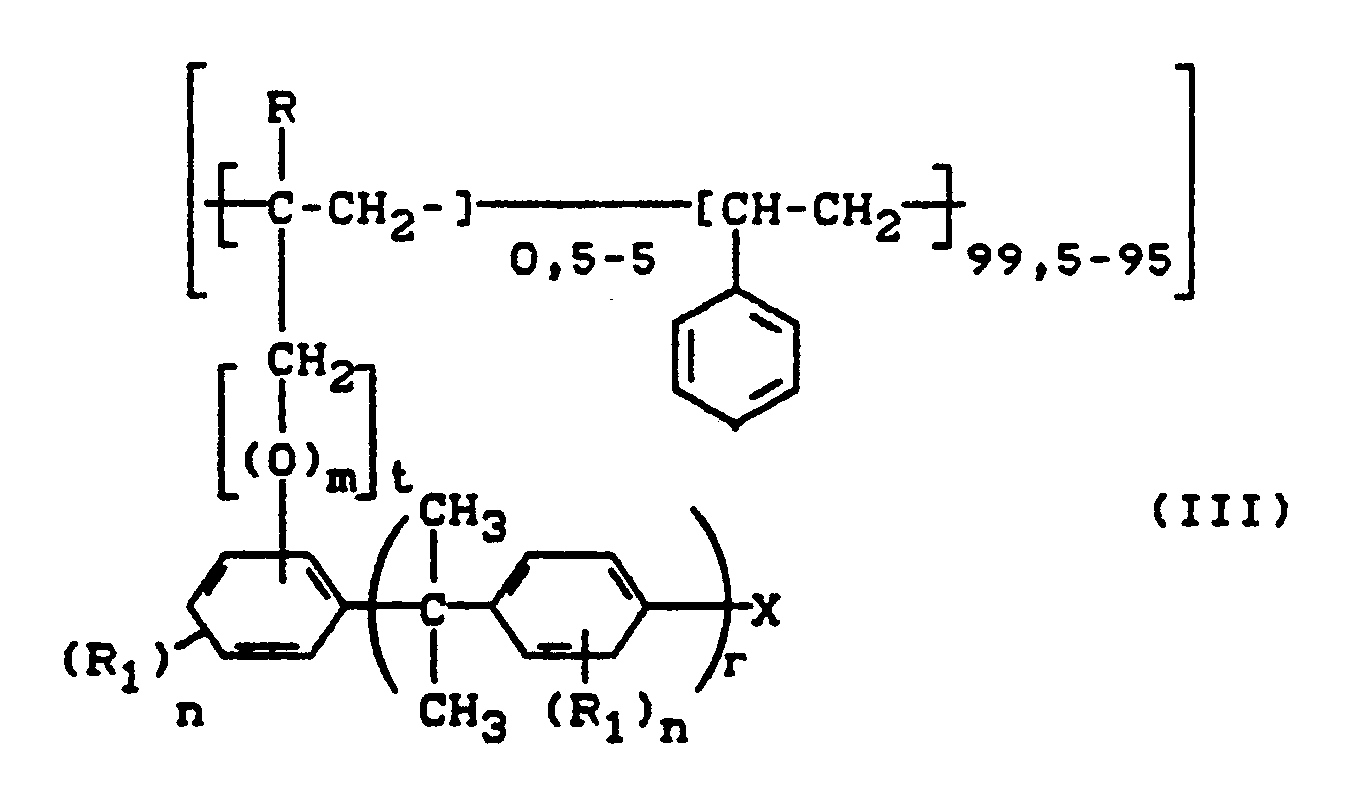
R, R₁, m, n, r, t und X die für Formel (I) genannte Bedeutung haben. - Inerte organische Lösungsmittel für die Pfropfungsreaktion sind beispielsweise Methylenchlorid und Chlorbenzol.
- Die Gewichtsmenge an inertem Lösungsmittel beträgt etwa das 20-25 fache, bezogen auf die in der Pfropfungsreaktion eingesetzte Gewichtsmenge an Pfropfgrundlage. Die Menge an Lösungsmittel richtet sich nach der jeweils eingesetzten Gewichtsmenge an Pfropfgrundlage im herzustellenden Pfropf; bei geringer Menge an Pfropfgrundlage reicht eine geringere Menge, bei einer höheren Menge an Pfropfgrundlage im Pfropf wird eine größere Menge an Lösungsmittel benötigt. Die Menge an Lösungsmittel ist natürlich so zu wählen, daß die erhaltene Endviskosität in den anfangs erwähnten Bereich fällt.
- Als wäßrige alkalische Phase dient beispielsweise wäßrige Natronlauge oder Kalilauge.
- Geeignete Katalysatoren sind beispielsweise tertiäre Amine, wie z.B. Triethylamin oder N-Ethylpiperidin.
- Die resultierenden, gepfropften Copolymerisate enthalten somit Struktureinheiten der Formel (IIIa), welche den Struktureinheiten der Formel (III) entsprechen, worin jedoch
X = -O-[--Diphenolat-] -Monophenolat ist,
worin p eine ganze Zahl zwischen 35 und 70 ist und Diphenolat bzw. Monophenolat Reste wie -O-D-O- bzw.
- Die erfindungsgemäße Pfropfreaktion läßt offen, ob alle Pfropfstellen X der Pfropfgrundlage jeweils an der Pfropfreaktion partizipieren, gegebenenfalls kann reines Polycarbonat in untergeordnetem Maße anfallen.
- Die erfindungsgemäß als Komponente 2) einzusetzenden Polydiorganosiloxan-Polycarbonat-Blockcokondensate sind, wie bereits erwähnt, als solche bekannt (siehe beispielsweise DE-OS 33 47 071 (Le A 22 802)).
- Die Blockcokondensate können sowohl linear als auch verzweigt sein.
- Die Verzweigung kann durch den Einbau geringer Mengen, vorzugsweise zwischen 0,05 und 2,0 Mol.-%, bezogen auf eingesetzte Diphenole, an drei- oder mehr als dreifunktionellen Verbindungen, z.B. solchen mit drei oder mehr als drei phenolischen Hydroxygruppen in bekannter Weise erfolgen.
- Einige der verwendbaren Verbindungen mit drei oder mehr als drei phenolischen Hydroxygruppen sind beisielsweise Phloroglucin, 4,6-Dimethyl-2,4,6-tri-(4-hydroxyphenyl)-heptan, 1,3,5-Tri-(4-hydroxyphenyl)-benzol, 1,1,1-Tri- (4-hydroxyphenyl)-ethan, 2,6-Bis-(2′-hydroxy-5′-methylbenzyl)-4-methylphenol, 2-(4-hydroxyphenyl)-2-(2,4-dihydroxyphenyl)-propan und 1,4-Bis-(4,4′-dihydroxytriphenyl-methyl)-benzol. Einige der sonstigen dreifunktionellen Verbindungen sind 2,4-Dihydroxybenzoesäure, Trimesinsäure, Cyanurchlorid und 3,3-Bis-(4-hydroxy-3-methyl-phenyl )-2-oxo-2,3-dihydroindol.
- Die erfindungsgemäß einzusetzenden Polydiorganosiloxan-Polycarbonat-Blockcokondensate können als Komponente 2) allein oder im Gemisch von zwei oder mehr als zwei verschiedenen Polydiorganosiloxan-Polycarbonat-Blockcokondensaten eingesetzt werden.
- Die Komponente 2) kann auch eine Mischung aus üblichen polysiloxanfreien, aromatischen, thermoplastischen Polycarbonaten mit einer relativen Viskosität von 1,15 bis 1,38 und Polydiorganosiloxan-Polycarbonat-Blockcokondensaten mit einer relativen Viskosität zwischen 1,15 und 2,5 sein, die so zusammengesetzt ist, daß der Gesamtgehalt an Polydiorganosiloxan-Einheiten im Gemisch wiederum der Komponente 2) entspricht.
- In den Fällen, in denen die Komponente 2) eine Mischung aus siloxanhaltigen Polycarbonaten und siloxanfreien Polycarbonaten ist, können die siloxanhaltigen Polycarbonate auch einen Gehalt an einkondensierten Polydiorganosiloxandiphenolen (IIc) von mehr als 20 Gew.-% enthalten, sofern durch Abmischung mit den siloxanfreien Polycarbonaten der Gehalt in der Polycarbonatmischung wiederum zwischen 2 und 20 Gew.-% liegt.
- Die erfindungsgemäßen Mischungen können für Vinylcopolymerisate und thermoplastische Polycarbonate übliche Verarbeitungsmittel, wie z.B. Fließ- und Entformungsmittel, Füllstoffe und Verstärkungsmittel, wie z.B. Talk, Kreide oder Glasfasern, Pigmente, wie z.B. Titandioxid oder Ruß und/oder außerdem Flammschutzmittel, wie z.B. Halogenverbindungen, Antimonoxid, Sulfonate u.a. enthalten.
- Gegenstand der vorliegenden Erfindung sind somit auch Mischungen, bestehend aus den Komponenten 1) und 2) und mindestens einem Zusatz ausgewählt aus Verarbeitungshilfsmitteln, Füllstoffen, Verstärkungsmitteln, Pigmenten und Flammschutzmitteln.
- Die Herstellung der erfindungsgemäßen Mischungen aus den Komponenten geschieht vorzugsweise in Extrudern. Es sind jedoch auch Kneter, Walzen oder Rührgefäße zur Herstellung geeignet.
- Gegenstand der vorliegenden Erfindung ist somit auch ein Verfahren zur Herstellung der erfindungsgemäßen Mischungen bestehend aus den gepfropften Vinylcopolymerisaten gemäß Komponente 1) und den thermoplastischen, aromatischen Polydiorganosiloxan-Polycarbonat-Blockcokondensaten gemäß Komponente 2) und gegebenenfalls mindestens einem Zusatz ausgewählt aus Verarbeitungshilfsmitteln, Füllstoffen, Verstärkungsmitteln, Pigmenten und Flammschutzmitteln, das dadurch gekennzeichnet ist, daß man die Komponenten 1) und 2) in der Schmelze, vorzugsweise bei Temperaturen von 280° C bis 320° C, in üblichen Mischaggregaten, vorzugsweise in Extrudern, vermischt, und gegebenenfalls entweder vor oder während oder nach dem Vermischen mindestens einen Zusatz ausgewählt aus Verarbeitungshilfsmitteln, Füllstoffen, Verstärkungsmitteln, Pigmenten und/oder Flammschutzmitteln in den jeweils erforderlichen Mengen zusetzt und einarbeitet.
- Zur Herstellung der erfindungsgemäßen Mischungen kann es angezeigt sein, zunächst ein Konzentrat aus den Komponenten 1) und 2) herzustellen, und dieses mit einer größeren Menge 2) auf den gewünschten Gehalt an 1) zu verdünnen. Die Herstellung der Konzentrate kann in den vorgenannten Mischaggregaten bei Temperaturen zwischen 50° C und 320° C, vorzugsweise 150° C und 320° C, erfolgen.
- Darüber hinaus ist die Herstellung der erfindungsgemäßen Mischungen aus den Komponenten 1) und 2) und gegebenenfalls den erwähnten Zusätzen auch aus einem Gemisch der jeweiligen Lösungen der Komponentgen 1) und 2) in aliphatischen und/oder aromatischen Halogenkohlenwasserstoffen, wie beispielsweise CH₂Cl₂ oder Monochlorbenzol, durch Ausdampfextrusion über geeignete Extruder mit einer Vorrichtung zur Voreindampfung möglich, wobei gegebenenfalls die erwähnten Zusätze entweder dem Gemisch der jeweiligen Lösungen vor der Ausdampfextrusion oder der nach der Ausdampfextrusion erhaltenen Schmelze der Komponenten 1) und 2) zugesetzt werden können.
- Gegenstand der vorliegenden Erfindung ist somit auch ein Verfahren zur Herstellung der erfindungsgemäßen Mischungen bestehend aus den gepfropften Vinylcopolymerisaten gemäß Komponente 1) und den thermoplastischen, aromati schen Polydiorganosiloxan-Polycarbonat-Blockcokondensaten gemäß Komponente 2) und gegebenenfalls mindestens einem Zusatz ausgewählt aus Verarbeitungshilfsmitteln, Füllstoffen, Verstärkungsmitteln, Pigmenten und/oder Flammschutzmitteln, das dadurch gekennzeichnet ist, daß man Gemische der jeweiligen Lösungen der Komponenten 1) und 2) in aliphatischen und/oder aromatischen Halogenkohlenwasserstoffen der Ausdampfextrusion über geeignete Extruder mit einer Vorrichtung zur Voreindampfung unterwirft, wobei gegebenenfalls mindestens ein Zusatz ausgewählt aus Verarbeitungshilfsmitteln, Füllstoffen, Verstärkungsmitteln Pigmenten und/oder Flammschutzmitteln entweder dem Gemisch der jeweiligen Lösungen der Komponenten 1) + 2) vor der Ausdampfextrusion oder der nach der Ausdampfextrusion erhaltenen Schmelze der Komponenten 1) + 2) zugesetzt werden.
- Die Formmassen der vorliegenden Erfindung können zur Herstellung von Formkörpern jeder Art nach bekannten Verfahren verwendet werden. Insbesondere können Formkörper durch Extrusion oder Spritzguß auf den hierfür üblichen Aggregaten hergestellt werden.
- Beispiele für herstellbare Formkörper sind Karosserieteile und Gehäuseteile, z.B. für elektrische Geräte und Apparaturen wie Haushaltsgeräte und Platten für den Bausektor oder Folien.
- Die Pfropfgrundlage wird erhalten durch Copolymerisation von 1.950 g Styrol und 50.0 g (1,29 Mol.%) 4-Trimethylsiloxy-α-methylstyrol in Masse in Gegenwart von 2 g α,α-Azodiisobutyronitril unter Stickstoff bei 80° C innerhalb von 29 Stunden.
- Das mittlere Molekulargewicht, ermittelt durch Gelpermeationschromatographie, wurde zu Mn = 68377 g/mol bestimmt.
- Innerhalb von einer Stunde werden bei 20 - 25° C unter Rühren 1,5 kg (15 mol) Phosgen in ein Gemisch aus 2,018 kg (8,85 mol) 2,2-Bis(4-hydroxyphenyl)-propan (BPA); 374,4 eines Polydimethylsiloxanblocks (Mn = 7000 g/mol) mit zwei Bisphenol-A-Endgruppen 45 g (= 3 Mol% bezogen auf BPA) p-tert.-Butylphenol; 4 kg Natronlauge (w = 45 %); 40 l Wasser, 12 kg Chlorbenzol und 2.000 g der unter a) beschriebenen Pfropfgrundlage (w = 100 %) gelöst in 37,2 kg Methylenchlorid eingeleitet. Anschließend werden 14 ml (= 1 mol% bezogen auf BPA) N-Ethylpiperidin zugesetzt und 1 Stunde lang nachgerührt. Die organische Phase wird abgetrennt, elektrolytfrei gewaschen und nach dem Abdestillieren des Methylen chlorids bei 280° C extrudiert. Es wurden 4,2 kg Produkt erhalten, mit einer relativen Lösungsviskosität ηrel = 1,345. Das berechnete Molekulargewicht der Polycarbonatseitenäste/Pfropfstelle beträgt Mn = 15.382 g/mol, was einem Polykondensationsgrad p von 60 entspricht.
- 2. Polydiorganosiloxan-Polycarbonat-Blockcokondensat aus 2,2-Bis-(4-hydroxyphenyl)-propan und

- Zur Herstellung der Mischungen wurden zunächst über eine Lösung der Komponenten Konzentrate der Pfropf polymerisate im betreffenden Polycarbonat gefertigt. Die gewünschten Einstellungen wurden durch Compoundierung der Konzentrate mit dem jeweiligen Polycarbonat auf einem Doppelwellenextruder homogenisiert.
- Die Herstellung der Prüfkörper erfolgte bei 310° C Massetemperatur auf einem Spritzgießaggregat.
- Zur Beurteilung des Verarbeitungsverhaltens wurden auf einem sogenannten Streifenwerkzeug mit zentralem Stangenanguß Streifen (Maße: 435 mm x 50 mm x 2 mm) hergestellt, deren Oberfläche insbesondere in Angußnähe ohne optische Hilfsmittel auf das Auftreten von Delaminiserungen und Oberflächenstörungen (z.B. matte Flecken) untersucht wurde.
- Zur Bestimmung der Benzinbeständigkeit wurden Prüfkörper mit den Maßen 80 mm x 10 mm x 4 mm hergestellt, die auf Biegeschablonen verschiedener Krümmungsradien so eingespannt wurden, daß Randfaserdehnungen εR von 0,4 % bzw. 1,0 % resultierten. Die Schablonen wurden mit aufgebrachter Probe 15 Minuten bei 70° C in einem Wärmeschrank (mit Luftdurchwirbelung nach DIN 50 011, 2, 3) gelagert.
- Die Schablonen mit den Proben wurden aus dem Schrank entnommen und unmittelbar danach ein Prüfkraftstoff-getränkter Wattebausch aufgelegt. Als Prüfkraftstoff wurde ein Testbenzin nach DIN 51 604 verwendet, das sich aus 50 Vol.-% Toluol, 30 Vol.-%. Isooctan, 15 Vol.-% Diisobutylen und 5 Vol.-%. Ethanol zusammensetzt. Nach 15 Minuten Einwirkungsdauer wurde dar Wattebausch entfernt und weitere 15 Minuten abgewartet, um die Probe ablüften zu lassen.
- Anschließend wurden die Prüfkörper mit dem unbewaffneten Auge wie folgt bewertet:
Stufe Merkmal 1 keine sichtbare Veränderung 2 Oberfläche vermattet 3 feine Risse 4 starke Risse, Bruch - Die Ergebnisse sind in folgender Tabelle zusammengefaßt:
Beispiel 1 2* 3* 4* 5* Komponenten: - Gew.-% - 2 100 98,5 97,5 95 90 1 - 1,5 2,5 5 10 Delaminierung: - nein nein nein nein Oberfläche: gut gut gut gut gut T k /°C: <-60 <-60 <-60 <-60 <-60 Benzinbeständigkeit: εR 0,4 % 3 2 2 2 2 εR 1,0 % 4 4 2 2 2 * = erfindungsgemäße Beispiele
Claims (6)
1. Mischungen bestehend aus
1) 0,1 Gew.-% bis 30 Gew.-% an gepfropften Vinylcopolymerisaten enthaltend Struktureinheiten der Formel (IIIa)

worin
R = H oder C₁-C₄-Alkyl,
R₁ = Cl, Br, C₁-C₄-Alkyl, Cyclohexyl oder C₁-C₄-Alkoxy,
m = 0 oder 1,
n = 0, 1 oder 2,
r = 0 oder 1,
t = 0 oder 1,
p = eine ganze Zahl zwischen 35 und 70 ist,
und Diphenolat und Monophenolat Reste sind, die durch Abzug der phenolischen H-Atome aus Diphenolen bzw. Monophenolen resultieren, wobei die Pfropfgrundlage von (IIIa) einM n (Zahlenmittelmolekulargewicht, ermittelt durch Gelpermeationschromatographie) von 45 000 bis 95 000 hat, wobei der Gehalt an Pfropfgrundlage in (IIIa) zwischen 35 Gew.-% und 55 Gew.-%, bezogen auf Gesamtgewicht an gepfropftem Vinylcopolymerisat inclusive aufgepfropften Polycarbonatketten beträgt, wobei somit der Gehalt an Polycarbonatseitenketten in (IIIa) zwischen 65 Gew.-% und 45 Gew.-%, bezogen auf Gesamtgewicht an gepfropftem Vinylcopolymerisat inclusive aufgepfropften Polycarbonatketten beträgt, und wobei die Diphenolat-Reste in (IIIa) bis zu 20 Gew.-%, bezogen auf das Gesamtgewicht der Polycarbonatseitenketten, Reste der Formel (IIa.1)

sind,
worin R C₁-C₆-Alkyl und n 20 bis 200 sind,
und
R = H oder C₁-C₄-Alkyl,
R₁ = Cl, Br, C₁-C₄-Alkyl, Cyclohexyl oder C₁-C₄-Alkoxy,
m = 0 oder 1,
n = 0, 1 oder 2,
r = 0 oder 1,
t = 0 oder 1,
p = eine ganze Zahl zwischen 35 und 70 ist,
und Diphenolat und Monophenolat Reste sind, die durch Abzug der phenolischen H-Atome aus Diphenolen bzw. Monophenolen resultieren, wobei die Pfropfgrundlage von (IIIa) ein
worin R C₁-C₆-Alkyl und n 20 bis 200 sind,
und
2) 99,9 Gew.-% bis 70 Gew.-% an thermoplastischen, aromatischen Polydiorganosiloxan-Polycarbonat-Blockcokondensaten auf Basis der Diphenole dar Formeln (IIc) und (IV)

HO-D-OH (IV),
worin
R und R₁ unabhängig voneinander C₁-C₂₀-alkyl und C₆-C₁₄-Aryl bedeuten, welche durch Fluor, Chlor und/oder Brom substituiert sein können, worin "n" eine ganze Zahl von 5 bis 100, vorzugsweise von 20 bis 80 ist und worin -D- ein zweibindiger C₆-C₃₀-Rest eines Si-freien Diphenols ist, wobei von 2 Gew.-% bis 20 Gew.-% Diphenole der Formel (IIc) und von 98 Gew.-% bis 80 Gew.-% Diphenole der Formel (IV), bezogen jeweils auf die Molsumme der im Blockcokondensat der Komponente 2) einkondensierten Diphenole (IIc) + (IV), enthalten sind, mit einemM w (Gewichtsmittelmolekulargewicht, ermittelt in bekannter weise über die relative Lösungsviskosität) zwischen 15.000 und 38.000, mit einer relativen Viskosität (gemessen an einer Lösung von 0,5 g Blockkondensat in 1 dl CH₂Cl₂ bei 25° C) von 1,15 bis 1,38.
worin
R und R₁ unabhängig voneinander C₁-C₂₀-alkyl und C₆-C₁₄-Aryl bedeuten, welche durch Fluor, Chlor und/oder Brom substituiert sein können, worin "n" eine ganze Zahl von 5 bis 100, vorzugsweise von 20 bis 80 ist und worin -D- ein zweibindiger C₆-C₃₀-Rest eines Si-freien Diphenols ist, wobei von 2 Gew.-% bis 20 Gew.-% Diphenole der Formel (IIc) und von 98 Gew.-% bis 80 Gew.-% Diphenole der Formel (IV), bezogen jeweils auf die Molsumme der im Blockcokondensat der Komponente 2) einkondensierten Diphenole (IIc) + (IV), enthalten sind, mit einem
2. Mischungen gemäß Anspruch 1, dadurch gekennzeichnet, daß sie zusätzlich aus mindestens einem Zusatz, ausgewählt aus Verarbeitungshilfsmitteln, Füllstoffen, Verstärkungsmitteln, Pigmenten und/oder Flammschutzmitteln bestehen.
3. Verfahren zur Herstellung der Mischungen des Anspruchs 1, dadurch gekennzeichnet, daß man die Komponenten 1) und 2) in der Schmelze in üblichen Mischaggregaten vermischt.
4. Verfahren zur Herstellung der Mischungen des Anspruchs 1, dadurch gekennzeichnet, daß man Gemische der jeweiligen Lösungen der Komponenten 1) und 2) in aliphatischen und/oder aromatischen Halogenkohlenwasserstoffen der Ausdampfextrusion über geeignete Extruder unterwirft.
5. Verfahren zur Herstellung der Mischungen des Anspruchs 2, dadurch gekennzeichnet, daß man die Komponenten 1) und 2) in der Schmelze in üblichen Mischaggregaten vermischt und entweder vor oder während oder nach dem Vermischen mindestens einen Zusatz ausgewählt aus Verarbeitungshilfsmitteln, Füllstoffen, Verstärkungsmitteln, Pigmenten und/oder Flammschutzmitteln in den jeweils erforderlichen Mengen zusetzt und einarbeitet.
6. Verfahren zur Herstellung der Mischungen des Anspruchs 2, dadurch gekennzeichnet, daß man Gemische der jeweiligen Lösungen der Komponenten 1) und 2) in aliphatischen und/oder aromatischen Halogenkohlenwasserstoffen der Ausdampfextrusion über geeignete Extruder unterwirft, wobei mindestens ein Zusatz ausgewählt aus Verarbeitungshilfsmitteln, Füllstoffen, Verstärkungsmitteln, Pigmenten und/oder Flammschutzmitteln entweder dem Gemisch der jeweiligen Lösungen der Komponenten 1) + 2) vor der Ausdampfextrusion oder der nach der Ausdampfextrusion erhaltenen Schmelze der Komponenten 1) + 2) zugesetzt werden.
Applications Claiming Priority (2)
| Application Number | Priority Date | Filing Date | Title |
|---|---|---|---|
| DE19893907912 DE3907912A1 (de) | 1989-03-11 | 1989-03-11 | Mischungen aus polydiorganosiloxan-polycarbonat-blockcokondensaten und pfropfpolymerisaten |
| DE3907912 | 1989-03-11 |
Publications (2)
| Publication Number | Publication Date |
|---|---|
| EP0387594A2 true EP0387594A2 (de) | 1990-09-19 |
| EP0387594A3 EP0387594A3 (de) | 1991-09-18 |
Family
ID=6376088
Family Applications (1)
| Application Number | Title | Priority Date | Filing Date |
|---|---|---|---|
| EP19900103774 Withdrawn EP0387594A3 (de) | 1989-03-11 | 1990-02-27 | Mischungen aus Polydiorganosiloxan-Polycarbonat-Block-cokondensaten und Pfropfpolymerisaten |
Country Status (3)
| Country | Link |
|---|---|
| EP (1) | EP0387594A3 (de) |
| JP (1) | JPH02272061A (de) |
| DE (1) | DE3907912A1 (de) |
Cited By (2)
| Publication number | Priority date | Publication date | Assignee | Title |
|---|---|---|---|---|
| EP0442086A3 (en) * | 1990-02-15 | 1992-07-22 | Bayer Ag | Graftcopolymers, their preparation and their use |
| EP0461482A3 (en) * | 1990-06-12 | 1992-10-14 | Bayer Ag | Process for the preparation of compositions containing rubbers and aromatic polyesters |
Family Cites Families (4)
| Publication number | Priority date | Publication date | Assignee | Title |
|---|---|---|---|---|
| CA953442A (en) * | 1970-04-24 | 1974-08-20 | Hugo Vernaleken | Composition comprising polycarbonate |
| DE3617511A1 (de) * | 1986-05-24 | 1987-11-26 | Bayer Ag | Flammwidrige, thermoplastische formmassen |
| DE3717172A1 (de) * | 1987-05-22 | 1988-12-08 | Bayer Ag | Vinylcopolymerisate mit aufgepfropften polycarbonatketten, ihre herstellung und verwendung |
| CA1304851C (en) * | 1987-06-05 | 1992-07-07 | Eizi Ukita | Molding material for optics |
-
1989
- 1989-03-11 DE DE19893907912 patent/DE3907912A1/de not_active Withdrawn
-
1990
- 1990-02-27 EP EP19900103774 patent/EP0387594A3/de not_active Withdrawn
- 1990-03-07 JP JP5387890A patent/JPH02272061A/ja active Pending
Cited By (2)
| Publication number | Priority date | Publication date | Assignee | Title |
|---|---|---|---|---|
| EP0442086A3 (en) * | 1990-02-15 | 1992-07-22 | Bayer Ag | Graftcopolymers, their preparation and their use |
| EP0461482A3 (en) * | 1990-06-12 | 1992-10-14 | Bayer Ag | Process for the preparation of compositions containing rubbers and aromatic polyesters |
Also Published As
| Publication number | Publication date |
|---|---|
| JPH02272061A (ja) | 1990-11-06 |
| DE3907912A1 (de) | 1990-09-13 |
| EP0387594A3 (de) | 1991-09-18 |
Similar Documents
| Publication | Publication Date | Title |
|---|---|---|
| DE69914352T2 (de) | Witterungsbeständige blockcopolyestercarbonate und diese enthaltende polymerlegierungen | |
| EP0193121A2 (de) | Thermoplastische Formmassen auf Basis von Polysiloxan-Polycarbonat-Blockcopolymeren | |
| DE3203905A1 (de) | Polycarbonat-formmassen mit verbesserter flammwidrigkeit | |
| DE2211199C3 (de) | Wärmeformbeständige Massen auf der Basis von Styrol-Polymerisaten | |
| DE60203418T2 (de) | Polycarbonatharz | |
| DE2353383C2 (de) | Polycarbonat-Formmassen | |
| EP0387570B1 (de) | Mischungen aus Polydiorganosiloxan-Polycarbonat-Block-Cokondensaten mit Siloxanen und kautschukelastischen Polymerisaten | |
| EP0065728B1 (de) | Neue Copolyestercarbonate und deren Abmischung mit bekannten Polycarbonaten zu thermoplastischen Formmassen | |
| DE102009055188B4 (de) | Zusammensetzung aus Polycarbonatharz sowie verzweigtes Polycarbonatharz und Formkörper daraus | |
| EP0258689B1 (de) | Mischungen aus Polydiorganosiloxan-Polycarbonat-Blockcokondensaten und Polyisobutylenen | |
| EP0413205A2 (de) | Polysiloxan-Polycarbonat-Blockcopolymere auf Basis spezieller Dihydroxydiphenylcycloalkane | |
| DE60118394T2 (de) | Transparente Zusammensetzung enthaltend ein Polycarbonat und ein Methylmethacrylat-Copolymer | |
| EP0472064A2 (de) | Ternäre Mischungen | |
| EP0387594A2 (de) | Mischungen aus Polydiorganosiloxan-Polycarbonat-Block-cokondensaten und Pfropfpolymerisaten | |
| DE2904832A1 (de) | Thermoplastische massen, verfahren zu ihrer herstellung sowie ihre verwendung | |
| DE2019994C3 (de) | Gemische von polycarbonatgepfropften Mischpolymerisaten und Polycarbonaten | |
| DE3808840A1 (de) | Thermoplastische formmassen enthaltend aliphatische polycarbonate | |
| DE69228587T2 (de) | Verfahren zur Herstellung von matten thermoplastischen Harzzusammensetzungen | |
| EP0077415B1 (de) | Mischungen von Polycarbonatelastomeren mit einkondensierten hydrierten Dimerfettsäureestern mit Polyolefinen und gegebenenfalls anderen Polycarbonaten | |
| DE3408709C2 (de) | ||
| EP0391191B1 (de) | Poly(meth) acrylate mit aufgepfropften Polycarbonatketten, ihre Herstellung und Verwendung | |
| DE112005003036T5 (de) | Thermoplastische Harzzusammensetzung und Formkörper | |
| WO2000037562A1 (de) | Verwendung von jod- und/oder bromhaltigen polycarbonaten für formteile mit hohem röntgenkontrast sowie damit hergestellte formteile | |
| EP0442062B1 (de) | Monofunktionelle Polyacrylate, ihre Herstellung und Verwendung zur Herstellung von Polycarbonaten | |
| EP1141080B1 (de) | Verwendung von oligomeren jodierten polycarbonaten |
Legal Events
| Date | Code | Title | Description |
|---|---|---|---|
| PUAI | Public reference made under article 153(3) epc to a published international application that has entered the european phase |
Free format text: ORIGINAL CODE: 0009012 |
|
| 17P | Request for examination filed |
Effective date: 19900302 |
|
| AK | Designated contracting states |
Kind code of ref document: A2 Designated state(s): DE ES FR GB IT NL |
|
| PUAL | Search report despatched |
Free format text: ORIGINAL CODE: 0009013 |
|
| AK | Designated contracting states |
Kind code of ref document: A3 Designated state(s): DE ES FR GB IT NL |
|
| STAA | Information on the status of an ep patent application or granted ep patent |
Free format text: STATUS: THE APPLICATION HAS BEEN WITHDRAWN |
|
| 18W | Application withdrawn |
Withdrawal date: 19920601 |