EP0387595B1 - Heterocyclische Verbindungen - Google Patents
Heterocyclische Verbindungen Download PDFInfo
- Publication number
- EP0387595B1 EP0387595B1 EP90103779A EP90103779A EP0387595B1 EP 0387595 B1 EP0387595 B1 EP 0387595B1 EP 90103779 A EP90103779 A EP 90103779A EP 90103779 A EP90103779 A EP 90103779A EP 0387595 B1 EP0387595 B1 EP 0387595B1
- Authority
- EP
- European Patent Office
- Prior art keywords
- substituted
- unsubstituted
- alkyl
- formula
- compounds according
- Prior art date
- Legal status (The legal status is an assumption and is not a legal conclusion. Google has not performed a legal analysis and makes no representation as to the accuracy of the status listed.)
- Expired - Lifetime
Links
- 150000002391 heterocyclic compounds Chemical class 0.000 title claims description 3
- 125000003118 aryl group Chemical group 0.000 claims description 26
- 150000001875 compounds Chemical class 0.000 claims description 23
- 125000001072 heteroaryl group Chemical group 0.000 claims description 17
- 229910052760 oxygen Inorganic materials 0.000 claims description 15
- 125000001997 phenyl group Chemical group [H]C1=C([H])C([H])=C(*)C([H])=C1[H] 0.000 claims description 14
- 239000000049 pigment Substances 0.000 claims description 14
- 125000004178 (C1-C4) alkyl group Chemical group 0.000 claims description 13
- 229910052739 hydrogen Inorganic materials 0.000 claims description 13
- 125000000217 alkyl group Chemical group 0.000 claims description 12
- 239000001257 hydrogen Substances 0.000 claims description 12
- UFHFLCQGNIYNRP-UHFFFAOYSA-N Hydrogen Chemical compound [H][H] UFHFLCQGNIYNRP-UHFFFAOYSA-N 0.000 claims description 11
- 229910052736 halogen Inorganic materials 0.000 claims description 11
- 150000002367 halogens Chemical class 0.000 claims description 11
- 125000000753 cycloalkyl group Chemical group 0.000 claims description 10
- 229910052757 nitrogen Inorganic materials 0.000 claims description 10
- 150000002431 hydrogen Chemical class 0.000 claims description 7
- 125000000623 heterocyclic group Chemical group 0.000 claims description 6
- 125000001424 substituent group Chemical group 0.000 claims description 6
- JUJWROOIHBZHMG-UHFFFAOYSA-N Pyridine Chemical group C1=CC=NC=C1 JUJWROOIHBZHMG-UHFFFAOYSA-N 0.000 claims description 4
- 229910006074 SO2NH2 Inorganic materials 0.000 claims description 4
- NOIXNOMHHWGUTG-UHFFFAOYSA-N 2-[[4-[4-pyridin-4-yl-1-(2,2,2-trifluoroethyl)pyrazol-3-yl]phenoxy]methyl]quinoline Chemical compound C=1C=C(OCC=2N=C3C=CC=CC3=CC=2)C=CC=1C1=NN(CC(F)(F)F)C=C1C1=CC=NC=C1 NOIXNOMHHWGUTG-UHFFFAOYSA-N 0.000 claims description 3
- 229910006069 SO3H Inorganic materials 0.000 claims description 3
- CZPWVGJYEJSRLH-UHFFFAOYSA-N Pyrimidine Chemical compound C1=CN=CN=C1 CZPWVGJYEJSRLH-UHFFFAOYSA-N 0.000 claims description 2
- 125000004093 cyano group Chemical group *C#N 0.000 claims 1
- 239000000460 chlorine Substances 0.000 description 25
- -1 dibenzofuranyl Chemical group 0.000 description 17
- 229910052794 bromium Inorganic materials 0.000 description 12
- 238000006243 chemical reaction Methods 0.000 description 12
- 229910052801 chlorine Inorganic materials 0.000 description 12
- 229910052731 fluorine Inorganic materials 0.000 description 10
- 125000003107 substituted aryl group Chemical group 0.000 description 9
- ZMXDDKWLCZADIW-UHFFFAOYSA-N N,N-Dimethylformamide Chemical compound CN(C)C=O ZMXDDKWLCZADIW-UHFFFAOYSA-N 0.000 description 8
- 150000001299 aldehydes Chemical class 0.000 description 8
- 229910052717 sulfur Inorganic materials 0.000 description 8
- 239000000975 dye Substances 0.000 description 7
- 125000001624 naphthyl group Chemical group 0.000 description 7
- QTBSBXVTEAMEQO-UHFFFAOYSA-N Acetic acid Chemical compound CC(O)=O QTBSBXVTEAMEQO-UHFFFAOYSA-N 0.000 description 6
- 125000005842 heteroatom Chemical group 0.000 description 6
- 239000004922 lacquer Substances 0.000 description 6
- 239000003973 paint Substances 0.000 description 6
- 125000000547 substituted alkyl group Chemical group 0.000 description 6
- 239000004952 Polyamide Substances 0.000 description 5
- 125000000113 cyclohexyl group Chemical group [H]C1([H])C([H])([H])C([H])([H])C([H])(*)C([H])([H])C1([H])[H] 0.000 description 5
- 125000001511 cyclopentyl group Chemical group [H]C1([H])C([H])([H])C([H])([H])C([H])(*)C1([H])[H] 0.000 description 5
- 229920002647 polyamide Polymers 0.000 description 5
- 239000000126 substance Substances 0.000 description 5
- 125000005346 substituted cycloalkyl group Chemical group 0.000 description 5
- 238000006467 substitution reaction Methods 0.000 description 5
- 125000004169 (C1-C6) alkyl group Chemical group 0.000 description 4
- 125000004070 6 membered heterocyclic group Chemical group 0.000 description 4
- UHOVQNZJYSORNB-UHFFFAOYSA-N Benzene Chemical compound C1=CC=CC=C1 UHOVQNZJYSORNB-UHFFFAOYSA-N 0.000 description 4
- 239000003054 catalyst Substances 0.000 description 4
- 238000004043 dyeing Methods 0.000 description 4
- 238000000034 method Methods 0.000 description 4
- 229920003023 plastic Polymers 0.000 description 4
- 239000004033 plastic Substances 0.000 description 4
- 239000002904 solvent Substances 0.000 description 4
- 125000006702 (C1-C18) alkyl group Chemical group 0.000 description 3
- 125000002373 5 membered heterocyclic group Chemical group 0.000 description 3
- LYCAIKOWRPUZTN-UHFFFAOYSA-N Ethylene glycol Chemical compound OCCO LYCAIKOWRPUZTN-UHFFFAOYSA-N 0.000 description 3
- OKKJLVBELUTLKV-UHFFFAOYSA-N Methanol Chemical compound OC OKKJLVBELUTLKV-UHFFFAOYSA-N 0.000 description 3
- GWEVSGVZZGPLCZ-UHFFFAOYSA-N Titan oxide Chemical compound O=[Ti]=O GWEVSGVZZGPLCZ-UHFFFAOYSA-N 0.000 description 3
- YXFVVABEGXRONW-UHFFFAOYSA-N Toluene Chemical compound CC1=CC=CC=C1 YXFVVABEGXRONW-UHFFFAOYSA-N 0.000 description 3
- 229960000583 acetic acid Drugs 0.000 description 3
- 239000012362 glacial acetic acid Substances 0.000 description 3
- 125000001570 methylene group Chemical group [H]C([H])([*:1])[*:2] 0.000 description 3
- 230000005012 migration Effects 0.000 description 3
- 238000013508 migration Methods 0.000 description 3
- 239000000203 mixture Substances 0.000 description 3
- 150000002825 nitriles Chemical class 0.000 description 3
- 239000000123 paper Substances 0.000 description 3
- 229920000642 polymer Polymers 0.000 description 3
- 238000002360 preparation method Methods 0.000 description 3
- JEXVQSWXXUJEMA-UHFFFAOYSA-N pyrazol-3-one Chemical class O=C1C=CN=N1 JEXVQSWXXUJEMA-UHFFFAOYSA-N 0.000 description 3
- 125000000229 (C1-C4)alkoxy group Chemical group 0.000 description 2
- 125000004191 (C1-C6) alkoxy group Chemical group 0.000 description 2
- FXWFZIRWWNPPOV-UHFFFAOYSA-N 2-aminobenzaldehyde Chemical compound NC1=CC=CC=C1C=O FXWFZIRWWNPPOV-UHFFFAOYSA-N 0.000 description 2
- KAKZBPTYRLMSJV-UHFFFAOYSA-N Butadiene Chemical compound C=CC=C KAKZBPTYRLMSJV-UHFFFAOYSA-N 0.000 description 2
- 229920000877 Melamine resin Polymers 0.000 description 2
- YNAVUWVOSKDBBP-UHFFFAOYSA-N Morpholine Chemical compound C1COCCN1 YNAVUWVOSKDBBP-UHFFFAOYSA-N 0.000 description 2
- LRHPLDYGYMQRHN-UHFFFAOYSA-N N-Butanol Chemical compound CCCCO LRHPLDYGYMQRHN-UHFFFAOYSA-N 0.000 description 2
- UFWIBTONFRDIAS-UHFFFAOYSA-N Naphthalene Chemical compound C1=CC=CC2=CC=CC=C21 UFWIBTONFRDIAS-UHFFFAOYSA-N 0.000 description 2
- CTQNGGLPUBDAKN-UHFFFAOYSA-N O-Xylene Chemical compound CC1=CC=CC=C1C CTQNGGLPUBDAKN-UHFFFAOYSA-N 0.000 description 2
- 239000004698 Polyethylene Substances 0.000 description 2
- 239000004793 Polystyrene Substances 0.000 description 2
- KAESVJOAVNADME-UHFFFAOYSA-N Pyrrole Chemical compound C=1C=CNC=1 KAESVJOAVNADME-UHFFFAOYSA-N 0.000 description 2
- 239000002262 Schiff base Substances 0.000 description 2
- 150000004753 Schiff bases Chemical class 0.000 description 2
- CDBYLPFSWZWCQE-UHFFFAOYSA-L Sodium Carbonate Chemical compound [Na+].[Na+].[O-]C([O-])=O CDBYLPFSWZWCQE-UHFFFAOYSA-L 0.000 description 2
- PPBRXRYQALVLMV-UHFFFAOYSA-N Styrene Chemical compound C=CC1=CC=CC=C1 PPBRXRYQALVLMV-UHFFFAOYSA-N 0.000 description 2
- QAOWNCQODCNURD-UHFFFAOYSA-N Sulfuric acid Chemical compound OS(O)(=O)=O QAOWNCQODCNURD-UHFFFAOYSA-N 0.000 description 2
- KKEYFWRCBNTPAC-UHFFFAOYSA-N Terephthalic acid Chemical compound OC(=O)C1=CC=C(C(O)=O)C=C1 KKEYFWRCBNTPAC-UHFFFAOYSA-N 0.000 description 2
- 230000002378 acidificating effect Effects 0.000 description 2
- WNLRTRBMVRJNCN-UHFFFAOYSA-N adipic acid Chemical compound OC(=O)CCCCC(O)=O WNLRTRBMVRJNCN-UHFFFAOYSA-N 0.000 description 2
- 150000001298 alcohols Chemical class 0.000 description 2
- 229920000180 alkyd Polymers 0.000 description 2
- 125000003710 aryl alkyl group Chemical group 0.000 description 2
- 125000001797 benzyl group Chemical group [H]C1=C([H])C([H])=C(C([H])=C1[H])C([H])([H])* 0.000 description 2
- 230000015572 biosynthetic process Effects 0.000 description 2
- 150000001735 carboxylic acids Chemical class 0.000 description 2
- 235000019438 castor oil Nutrition 0.000 description 2
- 239000004359 castor oil Substances 0.000 description 2
- SYGWYBOJXOGMRU-UHFFFAOYSA-N chembl233051 Chemical compound C1=CC=C2C3=CC(C(N(CCN(C)C)C4=O)=O)=C5C4=CC=CC5=C3SC2=C1 SYGWYBOJXOGMRU-UHFFFAOYSA-N 0.000 description 2
- 238000000576 coating method Methods 0.000 description 2
- 230000008878 coupling Effects 0.000 description 2
- 238000010168 coupling process Methods 0.000 description 2
- 238000005859 coupling reaction Methods 0.000 description 2
- 125000002147 dimethylamino group Chemical group [H]C([H])([H])N(*)C([H])([H])[H] 0.000 description 2
- JBKVHLHDHHXQEQ-UHFFFAOYSA-N epsilon-caprolactam Chemical compound O=C1CCCCCN1 JBKVHLHDHHXQEQ-UHFFFAOYSA-N 0.000 description 2
- ZEMPKEQAKRGZGQ-XOQCFJPHSA-N glycerol triricinoleate Natural products CCCCCC[C@@H](O)CC=CCCCCCCCC(=O)OC[C@@H](COC(=O)CCCCCCCC=CC[C@@H](O)CCCCCC)OC(=O)CCCCCCCC=CC[C@H](O)CCCCCC ZEMPKEQAKRGZGQ-XOQCFJPHSA-N 0.000 description 2
- 238000000227 grinding Methods 0.000 description 2
- NAQMVNRVTILPCV-UHFFFAOYSA-N hexane-1,6-diamine Chemical compound NCCCCCCN NAQMVNRVTILPCV-UHFFFAOYSA-N 0.000 description 2
- 229940083761 high-ceiling diuretics pyrazolone derivative Drugs 0.000 description 2
- 238000001746 injection moulding Methods 0.000 description 2
- 239000000976 ink Substances 0.000 description 2
- 239000000543 intermediate Substances 0.000 description 2
- 229920002521 macromolecule Polymers 0.000 description 2
- 238000002156 mixing Methods 0.000 description 2
- 239000007800 oxidant agent Substances 0.000 description 2
- RZXMPPFPUUCRFN-UHFFFAOYSA-N p-toluidine Chemical compound CC1=CC=C(N)C=C1 RZXMPPFPUUCRFN-UHFFFAOYSA-N 0.000 description 2
- 229920000728 polyester Polymers 0.000 description 2
- 229920000573 polyethylene Polymers 0.000 description 2
- 229920002223 polystyrene Polymers 0.000 description 2
- WRHZVMBBRYBTKZ-UHFFFAOYSA-N pyrrole-2-carboxylic acid Chemical class OC(=O)C1=CC=CN1 WRHZVMBBRYBTKZ-UHFFFAOYSA-N 0.000 description 2
- 229920002994 synthetic fiber Polymers 0.000 description 2
- 239000012209 synthetic fiber Substances 0.000 description 2
- 125000000999 tert-butyl group Chemical group [H]C([H])([H])C(*)(C([H])([H])[H])C([H])([H])[H] 0.000 description 2
- 239000008096 xylene Substances 0.000 description 2
- OCJBOOLMMGQPQU-UHFFFAOYSA-N 1,4-dichlorobenzene Chemical compound ClC1=CC=C(Cl)C=C1 OCJBOOLMMGQPQU-UHFFFAOYSA-N 0.000 description 1
- ACHCBYYDZPAJBR-UHFFFAOYSA-N 1H-pyrrolo[3,2-b]azepin-2-one Chemical class N1=CC=CC=C2NC(=O)C=C21 ACHCBYYDZPAJBR-UHFFFAOYSA-N 0.000 description 1
- 125000004201 2,4-dichlorophenyl group Chemical group [H]C1=C([H])C(*)=C(Cl)C([H])=C1Cl 0.000 description 1
- XNWFRZJHXBZDAG-UHFFFAOYSA-N 2-METHOXYETHANOL Chemical compound COCCO XNWFRZJHXBZDAG-UHFFFAOYSA-N 0.000 description 1
- CMWKITSNTDAEDT-UHFFFAOYSA-N 2-nitrobenzaldehyde Chemical class [O-][N+](=O)C1=CC=CC=C1C=O CMWKITSNTDAEDT-UHFFFAOYSA-N 0.000 description 1
- BISHACNKZIBDFM-UHFFFAOYSA-N 5-amino-1h-pyrimidine-2,4-dione Chemical class NC1=CNC(=O)NC1=O BISHACNKZIBDFM-UHFFFAOYSA-N 0.000 description 1
- HRPVXLWXLXDGHG-UHFFFAOYSA-N Acrylamide Chemical compound NC(=O)C=C HRPVXLWXLXDGHG-UHFFFAOYSA-N 0.000 description 1
- NLHHRLWOUZZQLW-UHFFFAOYSA-N Acrylonitrile Chemical compound C=CC#N NLHHRLWOUZZQLW-UHFFFAOYSA-N 0.000 description 1
- WKBOTKDWSSQWDR-UHFFFAOYSA-N Bromine atom Chemical compound [Br] WKBOTKDWSSQWDR-UHFFFAOYSA-N 0.000 description 1
- 0 CCC(N)=C(C)* Chemical compound CCC(N)=C(C)* 0.000 description 1
- 101100516554 Caenorhabditis elegans nhr-5 gene Proteins 0.000 description 1
- 229920002284 Cellulose triacetate Polymers 0.000 description 1
- ZAMOUSCENKQFHK-UHFFFAOYSA-N Chlorine atom Chemical compound [Cl] ZAMOUSCENKQFHK-UHFFFAOYSA-N 0.000 description 1
- PXGOKWXKJXAPGV-UHFFFAOYSA-N Fluorine Chemical compound FF PXGOKWXKJXAPGV-UHFFFAOYSA-N 0.000 description 1
- 101100203602 Hypocrea jecorina (strain QM6a) sor7 gene Proteins 0.000 description 1
- 238000006147 Japp-Klingemann synthesis reaction Methods 0.000 description 1
- 238000006000 Knoevenagel condensation reaction Methods 0.000 description 1
- 239000004640 Melamine resin Substances 0.000 description 1
- SECXISVLQFMRJM-UHFFFAOYSA-N N-Methylpyrrolidone Chemical compound CN1CCCC1=O SECXISVLQFMRJM-UHFFFAOYSA-N 0.000 description 1
- AFBPFSWMIHJQDM-UHFFFAOYSA-N N-methyl-N-phenylamine Natural products CNC1=CC=CC=C1 AFBPFSWMIHJQDM-UHFFFAOYSA-N 0.000 description 1
- GRYLNZFGIOXLOG-UHFFFAOYSA-N Nitric acid Chemical compound O[N+]([O-])=O GRYLNZFGIOXLOG-UHFFFAOYSA-N 0.000 description 1
- 239000004743 Polypropylene Substances 0.000 description 1
- ZLMJMSJWJFRBEC-UHFFFAOYSA-N Potassium Chemical compound [K] ZLMJMSJWJFRBEC-UHFFFAOYSA-N 0.000 description 1
- XBDQKXXYIPTUBI-UHFFFAOYSA-M Propionate Chemical compound CCC([O-])=O XBDQKXXYIPTUBI-UHFFFAOYSA-M 0.000 description 1
- WTKZEGDFNFYCGP-UHFFFAOYSA-N Pyrazole Chemical compound C=1C=NNC=1 WTKZEGDFNFYCGP-UHFFFAOYSA-N 0.000 description 1
- 229920000297 Rayon Polymers 0.000 description 1
- ATJFFYVFTNAWJD-UHFFFAOYSA-N Tin Chemical compound [Sn] ATJFFYVFTNAWJD-UHFFFAOYSA-N 0.000 description 1
- 229920001807 Urea-formaldehyde Polymers 0.000 description 1
- SMEGJBVQLJJKKX-HOTMZDKISA-N [(2R,3S,4S,5R,6R)-5-acetyloxy-3,4,6-trihydroxyoxan-2-yl]methyl acetate Chemical compound CC(=O)OC[C@@H]1[C@H]([C@@H]([C@H]([C@@H](O1)O)OC(=O)C)O)O SMEGJBVQLJJKKX-HOTMZDKISA-N 0.000 description 1
- NNLVGZFZQQXQNW-ADJNRHBOSA-N [(2r,3r,4s,5r,6s)-4,5-diacetyloxy-3-[(2s,3r,4s,5r,6r)-3,4,5-triacetyloxy-6-(acetyloxymethyl)oxan-2-yl]oxy-6-[(2r,3r,4s,5r,6s)-4,5,6-triacetyloxy-2-(acetyloxymethyl)oxan-3-yl]oxyoxan-2-yl]methyl acetate Chemical compound O([C@@H]1O[C@@H]([C@H]([C@H](OC(C)=O)[C@H]1OC(C)=O)O[C@H]1[C@@H]([C@@H](OC(C)=O)[C@H](OC(C)=O)[C@@H](COC(C)=O)O1)OC(C)=O)COC(=O)C)[C@@H]1[C@@H](COC(C)=O)O[C@@H](OC(C)=O)[C@H](OC(C)=O)[C@H]1OC(C)=O NNLVGZFZQQXQNW-ADJNRHBOSA-N 0.000 description 1
- PNZVFASWDSMJER-UHFFFAOYSA-N acetic acid;lead Chemical compound [Pb].CC(O)=O PNZVFASWDSMJER-UHFFFAOYSA-N 0.000 description 1
- 229940081735 acetylcellulose Drugs 0.000 description 1
- 125000000641 acridinyl group Chemical group C1(=CC=CC2=NC3=CC=CC=C3C=C12)* 0.000 description 1
- NIXOWILDQLNWCW-UHFFFAOYSA-N acrylic acid group Chemical group C(C=C)(=O)O NIXOWILDQLNWCW-UHFFFAOYSA-N 0.000 description 1
- 229920000122 acrylonitrile butadiene styrene Polymers 0.000 description 1
- 239000004676 acrylonitrile butadiene styrene Substances 0.000 description 1
- 239000001361 adipic acid Substances 0.000 description 1
- 235000011037 adipic acid Nutrition 0.000 description 1
- 125000003172 aldehyde group Chemical group 0.000 description 1
- 150000007933 aliphatic carboxylic acids Chemical class 0.000 description 1
- 239000002168 alkylating agent Substances 0.000 description 1
- 229940100198 alkylating agent Drugs 0.000 description 1
- KCNKJCHARANTIP-SNAWJCMRSA-N allyl-{4-[3-(4-bromo-phenyl)-benzofuran-6-yloxy]-but-2-enyl}-methyl-amine Chemical compound C=1OC2=CC(OC/C=C/CN(CC=C)C)=CC=C2C=1C1=CC=C(Br)C=C1 KCNKJCHARANTIP-SNAWJCMRSA-N 0.000 description 1
- 150000001408 amides Chemical class 0.000 description 1
- 150000001412 amines Chemical class 0.000 description 1
- 150000001413 amino acids Chemical class 0.000 description 1
- 238000010719 annulation reaction Methods 0.000 description 1
- 239000000010 aprotic solvent Substances 0.000 description 1
- 150000004945 aromatic hydrocarbons Chemical class 0.000 description 1
- 239000002585 base Substances 0.000 description 1
- 125000003785 benzimidazolyl group Chemical group N1=C(NC2=C1C=CC=C2)* 0.000 description 1
- 125000004604 benzisothiazolyl group Chemical group S1N=C(C2=C1C=CC=C2)* 0.000 description 1
- 125000004603 benzisoxazolyl group Chemical group O1N=C(C2=C1C=CC=C2)* 0.000 description 1
- 125000000499 benzofuranyl group Chemical group O1C(=CC2=C1C=CC=C2)* 0.000 description 1
- 125000001164 benzothiazolyl group Chemical group S1C(=NC2=C1C=CC=C2)* 0.000 description 1
- 125000004196 benzothienyl group Chemical group S1C(=CC2=C1C=CC=C2)* 0.000 description 1
- 125000004541 benzoxazolyl group Chemical group O1C(=NC2=C1C=CC=C2)* 0.000 description 1
- 239000004305 biphenyl Substances 0.000 description 1
- 235000010290 biphenyl Nutrition 0.000 description 1
- 125000006267 biphenyl group Chemical group 0.000 description 1
- GDTBXPJZTBHREO-UHFFFAOYSA-N bromine Substances BrBr GDTBXPJZTBHREO-UHFFFAOYSA-N 0.000 description 1
- 244000309464 bull Species 0.000 description 1
- 125000000609 carbazolyl group Chemical group C1(=CC=CC=2C3=CC=CC=C3NC12)* 0.000 description 1
- 125000002837 carbocyclic group Chemical group 0.000 description 1
- 229920002301 cellulose acetate Polymers 0.000 description 1
- 229920001727 cellulose butyrate Polymers 0.000 description 1
- 239000004568 cement Substances 0.000 description 1
- 238000007385 chemical modification Methods 0.000 description 1
- 239000003240 coconut oil Substances 0.000 description 1
- 235000019864 coconut oil Nutrition 0.000 description 1
- 238000009833 condensation Methods 0.000 description 1
- 230000005494 condensation Effects 0.000 description 1
- 238000007796 conventional method Methods 0.000 description 1
- 229920001577 copolymer Polymers 0.000 description 1
- 125000000332 coumarinyl group Chemical group O1C(=O)C(=CC2=CC=CC=C12)* 0.000 description 1
- 125000004122 cyclic group Chemical group 0.000 description 1
- 125000001559 cyclopropyl group Chemical group [H]C1([H])C([H])([H])C1([H])* 0.000 description 1
- 229940117389 dichlorobenzene Drugs 0.000 description 1
- 235000014113 dietary fatty acids Nutrition 0.000 description 1
- 239000002270 dispersing agent Substances 0.000 description 1
- 239000006185 dispersion Substances 0.000 description 1
- 238000009826 distribution Methods 0.000 description 1
- 238000001035 drying Methods 0.000 description 1
- 229920001971 elastomer Polymers 0.000 description 1
- 239000000839 emulsion Substances 0.000 description 1
- 230000032050 esterification Effects 0.000 description 1
- 238000005886 esterification reaction Methods 0.000 description 1
- 150000002148 esters Chemical class 0.000 description 1
- 125000001495 ethyl group Chemical group [H]C([H])([H])C([H])([H])* 0.000 description 1
- 238000001125 extrusion Methods 0.000 description 1
- 239000000194 fatty acid Substances 0.000 description 1
- 229930195729 fatty acid Natural products 0.000 description 1
- 150000004665 fatty acids Chemical class 0.000 description 1
- 239000011737 fluorine Substances 0.000 description 1
- 239000011888 foil Substances 0.000 description 1
- 230000022244 formylation Effects 0.000 description 1
- 238000006170 formylation reaction Methods 0.000 description 1
- 125000002541 furyl group Chemical group 0.000 description 1
- 239000011521 glass Substances 0.000 description 1
- 239000003292 glue Substances 0.000 description 1
- 150000002334 glycols Chemical class 0.000 description 1
- 239000008187 granular material Substances 0.000 description 1
- 125000002883 imidazolyl group Chemical group 0.000 description 1
- 125000003453 indazolyl group Chemical group N1N=C(C2=C1C=CC=C2)* 0.000 description 1
- 125000001041 indolyl group Chemical group 0.000 description 1
- 238000009413 insulation Methods 0.000 description 1
- 125000000959 isobutyl group Chemical group [H]C([H])([H])C([H])(C([H])([H])[H])C([H])([H])* 0.000 description 1
- 125000001449 isopropyl group Chemical group [H]C([H])([H])C([H])(*)C([H])([H])[H] 0.000 description 1
- 125000002183 isoquinolinyl group Chemical group C1(=NC=CC2=CC=CC=C12)* 0.000 description 1
- 125000001786 isothiazolyl group Chemical group 0.000 description 1
- 150000003951 lactams Chemical class 0.000 description 1
- 239000000944 linseed oil Substances 0.000 description 1
- 235000021388 linseed oil Nutrition 0.000 description 1
- 239000007788 liquid Substances 0.000 description 1
- 238000004519 manufacturing process Methods 0.000 description 1
- 229910052751 metal Inorganic materials 0.000 description 1
- 239000002184 metal Substances 0.000 description 1
- 125000005395 methacrylic acid group Chemical group 0.000 description 1
- 125000002496 methyl group Chemical group [H]C([H])([H])* 0.000 description 1
- 150000007522 mineralic acids Chemical class 0.000 description 1
- 238000000465 moulding Methods 0.000 description 1
- 125000004108 n-butyl group Chemical group [H]C([H])([H])C([H])([H])C([H])([H])C([H])([H])* 0.000 description 1
- 125000004123 n-propyl group Chemical group [H]C([H])([H])C([H])([H])C([H])([H])* 0.000 description 1
- 229910017604 nitric acid Inorganic materials 0.000 description 1
- 239000012299 nitrogen atmosphere Substances 0.000 description 1
- 125000004433 nitrogen atom Chemical group N* 0.000 description 1
- 230000000269 nucleophilic effect Effects 0.000 description 1
- 238000005580 one pot reaction Methods 0.000 description 1
- 239000001053 orange pigment Substances 0.000 description 1
- 239000011368 organic material Substances 0.000 description 1
- 150000002905 orthoesters Chemical class 0.000 description 1
- 125000002971 oxazolyl group Chemical group 0.000 description 1
- 230000003647 oxidation Effects 0.000 description 1
- 238000007254 oxidation reaction Methods 0.000 description 1
- 238000010422 painting Methods 0.000 description 1
- 150000002978 peroxides Chemical class 0.000 description 1
- JRKICGRDRMAZLK-UHFFFAOYSA-L persulfate group Chemical group S(=O)(=O)([O-])OOS(=O)(=O)[O-] JRKICGRDRMAZLK-UHFFFAOYSA-L 0.000 description 1
- ZUOUZKKEUPVFJK-UHFFFAOYSA-N phenylbenzene Natural products C1=CC=CC=C1C1=CC=CC=C1 ZUOUZKKEUPVFJK-UHFFFAOYSA-N 0.000 description 1
- 230000000485 pigmenting effect Effects 0.000 description 1
- 125000003386 piperidinyl group Chemical group 0.000 description 1
- 239000002798 polar solvent Substances 0.000 description 1
- 239000004417 polycarbonate Substances 0.000 description 1
- 229920000515 polycarbonate Polymers 0.000 description 1
- 229920000139 polyethylene terephthalate Polymers 0.000 description 1
- 229920000098 polyolefin Polymers 0.000 description 1
- 229920001155 polypropylene Polymers 0.000 description 1
- 229920002635 polyurethane Polymers 0.000 description 1
- 239000004814 polyurethane Substances 0.000 description 1
- 239000011118 polyvinyl acetate Substances 0.000 description 1
- 229920002689 polyvinyl acetate Polymers 0.000 description 1
- 239000004800 polyvinyl chloride Substances 0.000 description 1
- 229920000915 polyvinyl chloride Polymers 0.000 description 1
- BWHMMNNQKKPAPP-UHFFFAOYSA-L potassium carbonate Substances [K+].[K+].[O-]C([O-])=O BWHMMNNQKKPAPP-UHFFFAOYSA-L 0.000 description 1
- 229910000027 potassium carbonate Inorganic materials 0.000 description 1
- 239000002243 precursor Substances 0.000 description 1
- 239000003755 preservative agent Substances 0.000 description 1
- 125000003373 pyrazinyl group Chemical group 0.000 description 1
- 150000003217 pyrazoles Chemical class 0.000 description 1
- 125000003226 pyrazolyl group Chemical group 0.000 description 1
- 125000002098 pyridazinyl group Chemical group 0.000 description 1
- UBQKCCHYAOITMY-UHFFFAOYSA-N pyridin-2-ol Chemical class OC1=CC=CC=N1 UBQKCCHYAOITMY-UHFFFAOYSA-N 0.000 description 1
- UMJSCPRVCHMLSP-UHFFFAOYSA-N pyridine Natural products COC1=CC=CN=C1 UMJSCPRVCHMLSP-UHFFFAOYSA-N 0.000 description 1
- 125000005494 pyridonyl group Chemical group 0.000 description 1
- 125000004076 pyridyl group Chemical group 0.000 description 1
- 229940083082 pyrimidine derivative acting on arteriolar smooth muscle Drugs 0.000 description 1
- 150000003230 pyrimidines Chemical class 0.000 description 1
- 125000000714 pyrimidinyl group Chemical group 0.000 description 1
- 150000003233 pyrroles Chemical class 0.000 description 1
- 150000003239 pyrrolones Chemical class 0.000 description 1
- 125000000168 pyrrolyl group Chemical group 0.000 description 1
- 125000005493 quinolyl group Chemical group 0.000 description 1
- 150000003839 salts Chemical class 0.000 description 1
- 239000004576 sand Substances 0.000 description 1
- 229910000029 sodium carbonate Inorganic materials 0.000 description 1
- MNWBNISUBARLIT-UHFFFAOYSA-N sodium cyanide Chemical compound [Na+].N#[C-] MNWBNISUBARLIT-UHFFFAOYSA-N 0.000 description 1
- 239000007858 starting material Substances 0.000 description 1
- 125000000565 sulfonamide group Chemical group 0.000 description 1
- 125000000542 sulfonic acid group Chemical group 0.000 description 1
- 150000003460 sulfonic acids Chemical class 0.000 description 1
- 230000008961 swelling Effects 0.000 description 1
- 238000003786 synthesis reaction Methods 0.000 description 1
- 239000004753 textile Substances 0.000 description 1
- 125000001544 thienyl group Chemical group 0.000 description 1
- 239000011135 tin Substances 0.000 description 1
- 239000004408 titanium dioxide Substances 0.000 description 1
- 125000004306 triazinyl group Chemical group 0.000 description 1
- 235000013311 vegetables Nutrition 0.000 description 1
- 229920002554 vinyl polymer Polymers 0.000 description 1
- XLYOFNOQVPJJNP-UHFFFAOYSA-N water Substances O XLYOFNOQVPJJNP-UHFFFAOYSA-N 0.000 description 1
- 210000002268 wool Anatomy 0.000 description 1
Classifications
-
- C—CHEMISTRY; METALLURGY
- C07—ORGANIC CHEMISTRY
- C07D—HETEROCYCLIC COMPOUNDS
- C07D471/00—Heterocyclic compounds containing nitrogen atoms as the only ring hetero atoms in the condensed system, at least one ring being a six-membered ring with one nitrogen atom, not provided for by groups C07D451/00 - C07D463/00
- C07D471/12—Heterocyclic compounds containing nitrogen atoms as the only ring hetero atoms in the condensed system, at least one ring being a six-membered ring with one nitrogen atom, not provided for by groups C07D451/00 - C07D463/00 in which the condensed system contains three hetero rings
- C07D471/14—Ortho-condensed systems
-
- C—CHEMISTRY; METALLURGY
- C07—ORGANIC CHEMISTRY
- C07D—HETEROCYCLIC COMPOUNDS
- C07D487/00—Heterocyclic compounds containing nitrogen atoms as the only ring hetero atoms in the condensed system, not provided for by groups C07D451/00 - C07D477/00
- C07D487/02—Heterocyclic compounds containing nitrogen atoms as the only ring hetero atoms in the condensed system, not provided for by groups C07D451/00 - C07D477/00 in which the condensed system contains two hetero rings
- C07D487/04—Ortho-condensed systems
-
- C—CHEMISTRY; METALLURGY
- C09—DYES; PAINTS; POLISHES; NATURAL RESINS; ADHESIVES; COMPOSITIONS NOT OTHERWISE PROVIDED FOR; APPLICATIONS OF MATERIALS NOT OTHERWISE PROVIDED FOR
- C09B—ORGANIC DYES OR CLOSELY-RELATED COMPOUNDS FOR PRODUCING DYES, e.g. PIGMENTS; MORDANTS; LAKES
- C09B57/00—Other synthetic dyes of known constitution
Definitions
- the invention relates to heterocyclic compounds of the formula (I) Processes for their preparation and their use as dyes or pigments, in particular for dyeing or pigmenting high-molecular organic material or as paint pigments.
- Alkyl (R, R1) is preferably C1-C6-alkyl, particularly preferably C1-C4-alkyl. Examples include: methyl, ethyl, n- and i-propyl, n-, i- and t-butyl.
- Cycloalkyl (R, R1) preferably represents mono-, bi- and tricyclic C3-C10 cycloalkyl, particularly preferably cyclopropyl, cyclopentyl, cyclohexyl.
- Aryl (R, R1, Z) preferably represents those carbocyclic-aromatic radicals which contain 1, 2, 3 or 4, in particular 1 or 2 rings, for.
- Hetaryl (R, R1, Z) preferably represents those heterocyclic aromatic radicals which contain 1, 2, 3 or 4, in particular 1 or 2 five-, six- or seven-membered rings, at least one of which is 1, 2 or 3, preferably contains 1 or 2 heteroatoms from the series O, N, S.
- heterocyclic aromatic radicals are: Pyridyl, pyrimidyl, pyrazinyl, triazinyl, furanyl, pyrrolyl, thienyl, quinolyl, coumarinyl, benzofuranyl, benzimidazolyl, benzoxazolyl, dibenzofuranyl, benzothienyl, dibanzothienyl, indolyl, carbazolyl, pyrazolyl, Imidazolyl, oxazolyl, isoxazylyl, indazolyl, benzthiazolyl, pyridazinyl, cinnolonylonylonyl, phthalazonylidyl, benzopyridonylidylylidonylidyl Pyrimidonyl, quinoxalonyl, phthalazonyl, dioxapyrimidinyl, pyridonyl, isoquinolonyl, isoquinolinyl,
- the alkyl and cycloalkyl radicals R5 and R6 can, for. B. by Cl, Br, F, -CN, -OH, mono-C1-C4-alkylamino, di-C1-C4-alkylamino, phenyl or naphthyl by Cl, Br, F, C1-C6-alkyl and C1 -C6-Alkoxy may be substituted or heterocyclic radicals of a 5- or 6-membered heterocyclic ring system may be substituted with 1 or 2 heteroatoms from the series O, N, S, to which a benzene ring may be fused.
- the ring B in formula (I) can be an aromatic or heteroaromatic ring of the type mentioned for aryl (R, R1, Z) or hetaryl (R, R1, Z), which is in addition to the two substituents at the fusing sites can carry the substituents listed above for substituted aryl and hetaryl.
- B can also represent a non-aromatic heterocyclic radical which contains 1, 2, 3 or 4, in particular 1 or 2 five, six or seven-membered rings, at least one of which is 1, 2, 3 or 4, preferably 1 or 2 Contains heteroatoms from the O, N, S series.
- These heterocyclic radicals B can in turn be substituted by optionally substituted aryl or hetaryl, which have the meaning given above.
- (IX) can exist in various tautomeric forms.
- W and B also have the meanings given above, B being preferably heterocyclic rings.
- the CH2 group in formula (IX) must be CH-acidic by suitable substitution in ring B so that it can react with the aldehyde group (or its equivalent) in (VIII).
- the reaction is conveniently carried out under the known conditions of Knoevenagel condensation, i. H. in a suitable solvent in the presence of an acidic or basic catalyst.
- suitable solvents are alcohols, glycols, aromatic hydrocarbons and aliphatic carboxylic acids and their amides.
- Suitable acidic catalysts are carboxylic acids, sulfonic acids and amino acids, suitable basic catalysts are aliphatic amines. If an appropriate anil (Schiff base) is used as the aldehyde (VI) or (VIII), it is not necessary to add a catalyst when carrying out the reaction in alcohols or carboxylic acids.
- the reaction temperatures are between 20 and 150 ° C, preferably between 80 and 130 ° C.
- Suitable cyanide salts are NaCN and KCN
- suitable oxidizing agents are peroxides, persulfates, halogens, lead tetraacetate and nitric acid.
- the reaction with the cyanides takes place at 0-120 ° C, preferably at 10-40 ° C.
- the oxidation is carried out at 0-20 ° C.
- Azole carboxylic acid derivatives of type (VII) are also known in large numbers and are easily accessible.
- Pyrrole derivatives are e.g. B. described in EP-A 0 184 981.
- Pyrazole derivatives are accessible by the Japp-Klingemann reaction of diazotized amines with acetic amber esters in a variety of substitution patterns (R. Heckendorn, Bull. Soc. Chim. Belg. 95 (1986), 921).
- VIII The components (VIII) are accessible from azole precursors (VII) by orthoester reactions [e.g. BO Wolfbeis, Mn. Chem. 112 , 369 (1981)].
- component (IX) which has the group WH specified above and in a suitable position a C-H-acidic methylene group.
- the new substances of the formula (I) are dyes or pigments and, depending on the substitution, are suitable either for dyeing synthetic fibers in yellow to violet tones or for use as paint or plastic pigments in yellow to red tones. Some dyes have very good thermal stability and can be used for the mass dyeing of plastics.
- the compounds of the formula (I) are obtained in a form which is suitable for the pigment application or can pass through known aftertreatment processes are converted into the appropriate form, e.g. B. by dissolving or swelling in strong inorganic acids such as sulfuric acid and discharge on ice.
- the fine distribution can also be achieved by grinding with or without grinding aids such as inorganic salts or sand, optionally in the presence of solvents such as toluene, xylene, dichlorobenzene or N-methylpyrrolidone.
- the color strength and transparency of the pigment can be influenced by varying the aftertreatment.
- the compounds of formula (I) are suitable for a wide variety of pigment applications due to their fastness to light and migration. They can be used for the production of very real pigmented systems, in a mixture with other substances, preparations, paints, printing inks, colored paper and colored macromolecular substances. Mixing with other substances such.
- the term paint is used for. B.
- Printing inks are to be understood as those for paper, textile and tin printing.
- the macromolecular substances can be of natural origin such as rubber, through chemical modifications are obtained, such as acetyl cellulose, cellulose butyrate or viscose, or are produced synthetically, such as polymers, polyadducts and polycondensates.
- Plastic masses such as polyvinyl chloride, polyvinyl acetate, polyvinyl propionate, polyolefins, e.g. B.
- the substances pigmented with the claimed products can be in any form.
- B aromatic polyesters or cellulose triacetate, which are colored in yellow to violet tones with good general fastness properties.
- Example 13 If the procedure of Example 1 is followed and pyrrolone derivatives are used instead of pyrazolone derivatives, pyrroloazepinones (orange pigments) for which Example 13 is intended to be obtained.
- Example 15 If the reaction described in Example 1 is carried out in an aqueous-alcoholic solvent, pyrazolone derivatives containing sulfonic acid groups can also be used, which leads to water-soluble dyes, which is what Example 15 stands for.
- connection 17 parts of the connection be with 9 parts of the connection refluxed in 100 ml glacial acetic acid for 18 h. There will be 11 parts of the connection isolated.
- the pigmented lacquer is applied to paper, glass, plastic or metal foils and baked at 130 ° C for 30 minutes.
- the coatings have very good light and weather resistance and good fastness to over-painting.
- 0.2 g of pigment according to Example 6 are mixed with 100 g of polyethylene, polypropylene or polystyrene granules.
- the mixture can either be sprayed directly at 220 to 280 ° C. in an injection molding machine, or processed into colored bars in an extrusion press or colored skins on the mixing mill.
- the rods or skins are optionally granulated and sprayed in an injection molding machine.
- the orange-colored moldings have very good fastness to light and migration.
- synthetic polyamides of caprolactam or adipic acid and hexamethylenediamine or the condensates of terephthalic acid and ethylene glycol can be colored at 280-300 ° C., if appropriate under a nitrogen atmosphere.
Landscapes
- Chemical & Material Sciences (AREA)
- Organic Chemistry (AREA)
- Plural Heterocyclic Compounds (AREA)
- Nitrogen Condensed Heterocyclic Rings (AREA)
- Pharmaceuticals Containing Other Organic And Inorganic Compounds (AREA)
- Compositions Of Macromolecular Compounds (AREA)
Description
- Die Erfindung betrifft heterocyclische Verbindungen der Formel (I)

Verfahren zu ihrer Herstellung sowie ihre Verwendung als Farbstoffe oder Pigmente, insbesondere zum Färben oder Pigmentieren von hochmolekularem organischen Material oder als Lackpigmente. - In der Formel (I) bezeichnen:
- R
- H, gegebenenfalls substituiertes Alkyl, gegebenenfalls substituiertes Cycloalkyl, gegebenenfalls substituiertes Aryl, gegebenenfalls substituiertes Hetaryl,
- A
- C-R¹ oder N
- R¹
- gegebenenfalls substituiertes Alkyl, gegebenenfalls substituiertes Cycloalkyl, gegebenenfalls substituiertes Aryl, gegebenenfalls substituiertes Hetaryl,
- X,Y
- O, NH,
- Z
- Wasserstoff, -CN, gegebenenfalls substituiertes Aryl, gegebenenfalls substituiertes Hetaryl,
- W
- O, N-R⁵,
- R⁵
- Wasserstoff, gegebenenfalls substituiertes Alkyl, gegebenenfalls substituiertes Cycloalkyl, gegebenenfalls substituiertes Aryl, einen gegebenenfalls substituierten heterocyclischen Rest,
- B
- einen gegebenenfalls substituierten carbocyclisch-aromatischen oder heterocyclischen Ring, an die ein oder mehrere weitere Ringe ankondensiert sein können.
- Alkyl (R, R¹) steht vorzugsweise für C₁-C₆-Alkyl, besonders bevorzugt für C₁-C₄-Alkyl. Beispielhaft seien genannt: Methyl, Ethyl, n- und i-Propyl, n-, i- und t-Butyl.
- Cycloalkyl (R, R¹) steht vorzugsweise für mono-, bi- und tricyclisches C₃-C₁₀-Cycloalkyl, besonders bevorzugt Cyclopropyl, Cyclopentyl, Cyclohexyl.
- Die Alkyl- und Cycloalkylreste (R, R¹, W) können z. B. durch Cl, Br, F, -CN, -OH, C₁-C₆-Alkoxy, Mono-C₁-C₄-alkylamino, Di-C₁-C₄-alkylamino, Phenyl oder Naphthyl, die durch Cl, Br, F, C₁-C₆-Alkyl und C₁-C₆-Alkoxy substituiert sein können oder Reste eines 5- oder 6-gliedrigen Ringsystems mit 1 oder 2 Heteroatomen aus der Reihe 0, N, S, an das ein Benzolring ankondensiert sein kann, substituiert sein.
- Aryl (R, R¹, Z) steht vorzugsweise für solche carbocyclisch-aromatischen Reste, die 1, 2, 3 oder 4, insbesondere 1 oder 2 Ringe enthalten, z. B. Phenyl, Diphenyl und Naphthyl.
- Hetaryl (R, R¹, Z) steht vorzugsweise für solche heterocyclisch-aromatischen Reste, die 1, 2, 3 oder 4, insbesondere 1 oder 2 fünf-, sechs- oder siebengliedrige Ringe enthalten, von denen mindestens einer 1, 2 oder 3, bevorzugt 1 oder 2 Heteroatome aus der Reihe O, N, S enthält.
- Als heterocyclisch aromatische Reste seien beispielhaft genannt:
Pyridyl, Pyrimidyl, Pyrazinyl, Triazinyl, Furanyl, Pyrrolyl, Thienyl, Chinolyl, Cumarinyl, Benzofuranyl, Benzimidazolyl, Benzoxazolyl, Dibenzofuranyl, Benzothienyl, Dibanzothienyl, Indolyl, Carbazolyl, Pyrazolyl, Imidazolyl, Oxazolyl, Isoxazolyl, Thiazolyl, Indazolyl, Benzthiazolyl, Pyridazinyl, Cinnolyl, Chinazolyl, Chinoxalyl, Phthalazinyl, Phthalazindionyl, Phthalimidyl, Chromonyl, Naphtholactamyl, Benzopyridonyl, ortho-Sulfobenzimidyl, Maleinimidyl, Naphtharidinyl, Benzimidazolonyl, Benzoxazolonyl, Benzthiazolonyl, Benzthiazolinyl, Chinazolonyl, Pyrimidonyl, Chinoxalonyl, Phthalazonyl, Dioxapyrimidinyl, Pyridonyl, Isochinolonyl, Isochinolinyl, Isothiazolyl, Benzisoxazolyl, Benzisothiazolyl, Indazolonyl, Acridinyl, Acridonyl, Chinazolindionyl, Chinoxalindionyl, Benzoxazindionyl, Benzoxazinonyl und Naphthalimidyl. - Die Aryl- und Hetarylreste (R, R¹, Z) können beispielsweise durch Halogen, wie Chlor, Brom, Fluor, CN, R², OR³, SR³, NR⁵R⁶, COOR⁷, NR³COR⁷, NR³COOR⁷, NR³CONR⁵R⁶, -NHSO₂R⁷, -SO₂R⁷, SOR⁷, SO₂OR⁷, CONR⁵R⁶, SO₂NR⁵R⁶, -N=N-R¹⁰, OCOR⁷ und OCONHR⁷ substituiert sein.
- R²
- bezeichnet gegebenenfalls substituiertes Alkyl, insbesondere C₁-C₆-Alkyl, besonders bevorzugt C₁-C₄-Alkyl. Als Substituenten seien beispielhaft genannt: Cl, Br, F, -CN, -OCOR⁷, -OR³, -COOR⁷, -SR³, -CONR⁵R⁶, -OCONHR⁷.
- R⁵ und R⁶
- bezeichnen Wasserstoff, gegebenenfalls substituiertes Alkyl, insbesondere C₁-C₁₈-Alkyl, vorzugsweise C₁-C₄-Alkyl, gegebenenfalls substituiertes Cycloalkyl, insbesondere Cyclopentyl und Cyclohexyl, gegebenenfalls substituiertes Aryl, insbesondere Phenyl, Naphthyl und Diphenylyl, und einen gegebenenfalls substituierten heterocyclischen Rest, insbesondere den Rest eines 5- oder 6-gliedrigen heterocyclischen Ringes mit 1, 2 oder 3 Heteroatomen aus der Reihe O, N, S, an den ein Benzolring ankondensiert sein kann.
- Die Alkyl- und Cycloalkylreste R⁵ und R⁶ können z. B. durch Cl, Br, F, -CN, -OH, Mono-C₁-C₄-alkylamino, Di-C₁-C₄-alkylamino, Phenyl oder Naphthyl, die durch Cl, Br, F, C₁-C₆-Alkyl und C₁-C₆-Alkoxy substituiert sein können oder heterocyclische Reste eines 5- oder 6-gliedrigen heterocyclischen Ringsystems mit 1 oder 2 Heteroatomen aus der Reihe O, N, S, an das ein Benzolring ankondensiert sein kann, substituiert sein.
- Auch können R⁵ und R⁶ in der Gruppe -CONR⁵R⁶ zusammen unter Einschluß des N-Atoms einen 5- oder 6-gliedrigen heterocyclischen Ring, z. B. einen Morpholin- oder Piperidinring bilden.
- Die Aryl- und Aralkylreste R⁵ und R⁶ können beispielsweise durch Cl, Br, F, C₁-C₁₈-Alkyl, vorzugsweise C₁-C₄-Alkyl, C₁-C₁₈-Alkoxy, vorzugsweise C₁-C₄-Alkoxy, substituiert sein.
- R⁷
- bezeichnet Wasserstoff, gegebenenfalls substituiertes Alkyl, vorzugsweise C₁-C₄-Alkyl, gegebenenfalls substituiertes Cycloalkyl, insbesondere Cyclopentyl und Cyclohexyl, gegebenenfalls substituiertes Aralkyl, insbesondere Phenyl- und Naphthyl-C₁-C₄-alkyl, vorzugsweise Benzyl, gegebenenfalls substituiertes Aryl, insbesondere Phenyl und Naphthyl und einen gegebenenfalls substituierten heterocyclischen Rest, insbesondere den Rest eines 5- oder 6-gliedrigen Ringes mit 1, 2 oder 3 Heteroatomen aus der Reihe O, N, S, an den ein Benzolring ankondensiert sein kann.
- Die für R⁷ genannten Reste können beispielsweise wie die entsprechenden Reste R⁵ und R⁶ substituiert sein.
- R³
- bezeichnet Wasserstoff oder nimmt die Bedeutungen von R⁵ an.
- R¹⁰
- bezeichnet den Rest einer Kupplungskomponente, vorzugsweise einer Kupplungskomponente aus der Benzol-, Naphthalin-, Pyrazol- oder Pyridonreihe oder einen gegebenenfalls durch Cl, Br, F, C₁-C₄-Alkyl oder C₁-C₄-Alkoxy substituierten Phenylrest.
- Der Ring B in Formel (I) kann ein aromatischer oder heteroaromatischer Ring, der für Aryl (R, R¹, Z) oder Hetaryl (R, R¹, Z) genannten Art sein, der zusätzlich zu den beiden Substituenten an den Anellierungsstellen
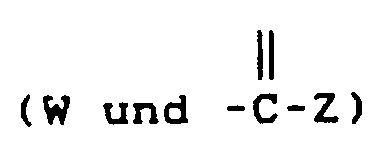
die oben für substituiertes Aryl und Hetaryl aufgeführten Substituenten tragen kann. - Ferner kann B auch für einen nichtaromatischen heterocyclischen Rest stehen, der 1, 2, 3 oder 4, insbesondere 1 oder 2 fünf-, sechs- oder siebengliedrige Ringe enthält, von denen mindestens einer 1, 2, 3 oder 4, bevorzugt 1 oder 2 Heteroatome aus der Reihe O, N, S enthält. Diese heterocyclischen Reste B können wiederum durch gegebenenfalls substituiertes Aryl oder Hetaryl substituiert sein, welche die oben angegebene Bedeutung haben.
- Besonders bevorzugte Ringe B sind gegebenenfalls substituierte Aromaten mit oben angeführter Bedeutung und die nachfolgend gezeigten, substituierten Pyrazol-, Pyridin oder Pyrimidinderivate (Anellierungsstellen mit W und C-Z angedeutet) oder ihre tautomeren Formen.

In den Formeln (II), (III) und (IV) bezeichnen: - R¹¹
- aromatischer oder heteroaromatischer Rest von oben angeführter Bedeutung mit oben angeführter Substitution (siehe R, R¹, Z),
- R¹²
- -CN, -COOR⁷, -CONR⁵R⁶, wobei R⁵, R⁶ und R⁷ die oben angeführte Bedeutung besitzen,
- R¹³
- Halogen oder OR³, wobei R³ die oben angegebene Bedeutung besitzt.
- Die Substituenten R⁵ und R⁶ in Formel (IV) besitzen ebenfalls die oben angegebene Bedeutung.
- Bevorzugte erfindungsgemäße Verbindungen sind solche der Formel (I), worin W = N-R⁵, wobei R⁵ die oben genannte Bedeutung hat, X = Y = 0, Z = H, -CN, gegebenenfalls substituiertes Aryl, A = N, C-Alkyl, das substituiert sein kann, C = Aryl, das substituiert sein kann und B = substituierter aromatischer Ring, substituierter Pyrazol-, Pyrimidin- oder Pyridinring.
- Besonders bevorzugt sind Verbindungen, die in einer ihrer tautomeren Formen den Formeln Va - Vd entsprechen.

In diesen Formeln haben die Reste R, A, R⁵, R⁶, R¹³, R¹¹, R¹² und Z die oben angegebenen Bedeutungen;
Besonders bevorzugt steht - R
- für Phenyl, das durch 1 oder 2 Substituenten aus der Reihe -SO₃H, Halogen (Cl, Br), -CN, C₁-C₄-Alkyl, -SO₂NH₂ substituiert sein kann.
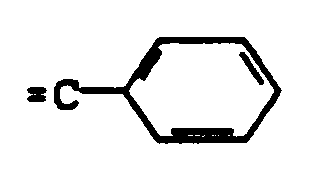
- Neben N steht A besonders bevorzugt für

- R¹⁴, R¹⁵
- bezeichnen Wasserstoff, Halogen, OR³ oder NR⁵R⁶, wobei R³, R⁵ und R⁶ die angegebenen Bedeutungen besitzen.
- Die Verbindungen der Formel I mit Z = H erhält man, indem man entweder Aldehyde der Formel

(oder deren funktionelle Derivate, z. B. deren Schiff'sche Basen), worin B und W die oben angegebenen Bedeutungen besitzen, mit Verbindungen der Formel
worin R, R⁷ und A die oben angegebenen Bedeutungen besitzen, umsetzt, oder indem man formylierte (und gegebenenfalls als Anil geschützte) Derivate von (VII), nämlich Verbindungen des Typs
mit C-H-aciden Heterocyclen des Typs
umsetzt. (IX) kann in verschiedenen tautomeren Formen vorliegen. - In den Formeln (VIII) und (IX) bedeuten:
U = OR³ oder NHR⁵; R³, R⁵, R⁷ und R' besitzen die oben angegebenen Bedeutungen. - W und B besitzen ebenfalls die oben angegebenen Bedeutungen, wobei für B bevorzugt heterocyclische Ringe in Frage kommen.
- Die CH₂-Gruppe in der Formel (IX) muß durch geeignete Substitution im Ring B so C-H-acide sein, daß sie mit der Aldehydgruppe (oder deren Äquivalent) in (VIII) reagieren kann.
- Die genannten Umsetzungen können über Zwischenstufen verlaufen, die unter Protonenwanderung(en) zu einer tautomeren Form der Formel (I) umlagern.
- Die Umsetzung erfolgt zweckmäßigerweise unter den bekannten Bedingungen der Knoevenagel-Kondensation, d. h. in einem geeigneten Lösungsmittel in Gegenwart eines sauren oder basischen Katalysators. Geeignete Lösungsmittel sind Alkohole, Glykole, aromatische Kohlenwasserstoffe und aliphatische Carbonsäuren und deren Amide.
- Geeignete saure Katalysatoren sind Carbonsäuren, Sulfonsäuren und Aminosäuren, geeignete basische Katalysatoren sind aliphatische Amine. Wird als Aldehyd (VI) oder (VIII) ein entsprechendes Anil (Schiff'sche Base) eingesetzt, so kann bei Durchführung der Reaktion in Alkoholen oder Carbonsäuren auf Zugabe eines Katalysators verzichtet werden.
- Die Reaktionstemperaturen liegen zwischen 20 und 150° C, vorzugsweise zwischen 80 und 130° C.
- Die Reaktion zu (I) beinhaltet zwei Schritte, nämlich eine Kondensation eines Aldehyds (oder Aldehydäquivalents) mit einer aktiven Methylengruppe sowie eine intramolekulare Veresterung oder Lactambildung (= Reaktion der Gruppe -WH mit der Gruppe CO₂R⁷), die aber in einer Eintopfreaktion ablaufen. Eine Zwischenisolierung eines Primärprodukts ist nicht erforderlich bzw. gar nicht durchführbar.
- Die Herstellung von Verbindungen der Formel (I), worin Z = CN, erfolgt beispielsweise dadurch, daß man Verbindungen der Formel (I), worin Z = H, in einem polaren Lösungsmittel wie Dimethylformamid mit Cyanidsalzen umsetzt und gleichzeitig oder anschließend mit einem Oxidationsmittel behandelt. Solche Reaktionen sind prinzipiell bekannt (vergl. DE-A 28 44 299 und DE-A 29 55 546).
- Geeignete Cyanidsalze sind NaCN und KCN, geeignete Oxidationsmittel Peroxide, Persulfate, Halogene, Bleitetraacetat und Salpetersäure.
- Die Umsetzung mit den Cyaniden erfolgt bei 0 - 120° C, vorzugsweise bei 10 - 40° C.
- Die Oxidation wird bei 0 - 20° C durchgeführt.
- Verbindungen der Formel (I), worin Z = Aryl oder Hetaryl und W = NH darstellen, werden hergestellt durch Umsetzung von β-Aminoketonen des Typs
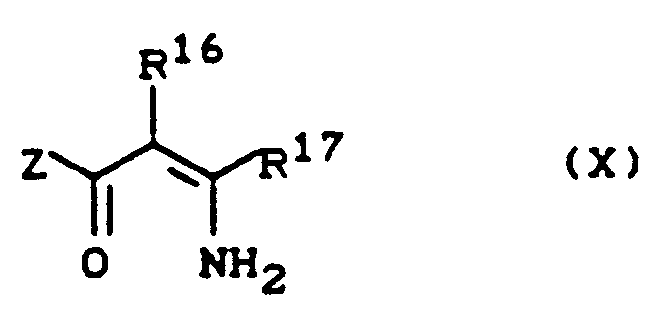
worin - Z
- einen gegebenenfalls substituierten Aromaten oder Heteroaromaten darstellt und
- R¹⁶ und R¹⁷
- gemeinsam die Reste eines ankondensierten, gegebenenfalls substituierten Aromaten oder Heteroaromaten darstellen,
- Verbindungen der Formel (I), worin W = N-Alkyl, werden hergestellt, indem man Verbindungen des Typs I mit W = NH in einem dipolar aprotischen Lösungsmittel wie Dimethylformamid in Gegenwart einer nichtnucleophilen Base wie Kalium- oder Natriumcarbonat mit Alkyltosylaten als N-Alkylierungsmittel umsetzt. Auch solche Reaktionen sind prinzipiell literaturbekannt [z. B. H. Langhals, T. Potrawa, Chem. Ber. 120, 1075 (1987)].
- Die als Ausgangsmaterial verwendeten Aldehyde (VI) mit WH=OH oder NH₂ sind bekannt bzw. nach üblichen Methoden leicht zugänglich. Carbocyclische Derivate sind zum Beispiel in DE-A 24 15 661, DE-A 10 98 125 und DE-A 23 63 548 beschrieben.
- Andere sind aus literaturbekannten halogenierten Nitrobenzaldehyden leicht zugänglich. Heterocyclische Vertreter von (VI) sind z. B. aus Aminouracilderivaten durch Vilsmeier-Formylierung zugänglich (K. Hirota et. al, Synthesis 1984, 589).
- Azolcarbonsäurederivate des Typs (VII) sind ebenfalls in großer Zahl bekannt und gut zugänglich. Pyrrolderivate sind z. B. in EP-A 0 184 981 beschrieben. Pyrazolderivate sind durch Japp-Klingemann-Reaktion von diazotierten Aminen mit Acetbernsteinester in vielfältigem Substitutionsmuster zugänglich (R. Heckendorn, Bull. Soc. Chim. Belg. 95 (1986), 921).
- Die Komponenten (VIII) sind aus Azolvorläufern (VII) durch Orthoesterumsetzungen zugänglich [z. B. O. Wolfbeis, Mn. Chem. 112, 369 (1981)].
- Als Komponenten (IX) kann man nahezu jeden beliebigen Heterocyclus einsetzen, der die oben näher bezeichnete Gruppe WH und in geeigneter Position eine C-H-acide Methylengruppe besitzt.
- Die neuen Substanzen der Formel (I) sind Farbstoffe bzw. Pigmente und eignen sich, je nach Substitution, entweder zum Färben von synthetischen Fasern in gelben bis violetten Tönen oder zum Einsatz als Lack- bzw. Kunststoffpigmente in gelben bis roten Tönen. Manche Farbstoffe besitzen eine sehr gute Thermostabilität und können zum Massefärben von Kunststoffen eingesetzt werden.
- Die Verbindungen der Formel (I) mit Z ≠ CN, W = NH und X = Y = O sind gelbe bis rote Substanzen und finden vorzugsweise als Pigmente Verwendung, können je nach ihrer Struktur und der Art der zu färbenden Polymeren jedoch auch als polymerlösliche Farbstoffe für z. B. Polystyrol, Polyamide, ABS, vor allem für lineare Polyester, insbesondere Polyethylenterephthalate eingesetzt werden. Die Verbindungen der Formel (I) fallen in einer für die Pigmentanwendung geeigneten Form an oder können durch an sich bekannte Nachbehandlungsverfahren in die geeignete Form überführt werden, z. B. durch Lösen oder Quellen in starken anorganischen Säuren wie Schwefelsäure und Austragen auf Eis. Die Feinverteilung kann auch durch Mahlen mit oder ohne Mahlhilfsstoffen wie anorganischen Salzen oder Sand, gegebenenfalls in Anwesenheit von Lösungsmitteln wie Toluol, Xylol, Dichlorbenzol oder N-Methylpyrrolidon erzielt werden. Farbstärke und Transparenz des Pigmentes können durch Variation der Nachbehandlung beeinflußt werden.
- Die Verbindungen der Formel (I) eignen sich aufgrund ihrer Licht- und Migrationsechtheit für die verschiedensten Pigmentapplikationen. So können sie zur Herstellung von sehr echt pigmentierten Systemen, in Mischung mit anderen Stoffen, Zubereitungen, Anstrichmitteln, Druckfarben, gefärbtem Papier und gefärbten makromolekularen Stoffen verwendet werden. Unter Mischung mit anderen Stoffen können z. B. solche mit anorganischen Weißpigmenten wie Titandioxid (Rutil) oder mit Zement verstanden werden. Zübereitungen sind z. B. Flushpasten mit organischen Flüssigkeiten oder Teige und Feinteige mit Wasser, Dispergiermitteln und gegebenenfalls Konservierungsmitteln. Die Bezeichnung Anstrichmittel steht z. B. für physikalisch oder oxidativ trocknende Lacke, Einbrennlacke, Reaktionslacke, Zweikomponentenlacke, Dispersionsfarben für wetterfeste Überzüge und Leimfarben. Unter Druckfarben sind solche für den Papier-, Textil- und Blechdruck zu verstehen. Die makromolekularen Stoffe können natürlichen Ursprungs sein wie Kautschuk, durch chemische Modifikation erhalten werden wie Acetylcellulose, Cellulosebutyrat oder Viskose oder synthetisch erzeugt werden wie Polymerisate, Polyadditionsprodukte und Polykondensate. Genannt seien plastische Massen wie Polyvinylchlorid, Polyvinylacetat, Polyvinylpropionat, Polyolefine, z. B. Polyethylen oder Polyamide, Superpolyamide, Polymerisate und Mischpolymerisate aus Acrylester, Methacrylestern, Acrylnitril, Acrylamid, Butadien, Styrol sowie Polyurethane und Polycarbonate. Die mit den beanspruchten Produkten pigmentierten Stoffe können in beliebiger Form vorliegen.
- Die Verbindungen der Formel (I) mit Z = H, CN und W = O und N-Alkyl eignen sich hervorragend zum Färben von synthetischen Fasern aus z. B. aromatischen Polyestern oder Cellulosetriacetat, die in gelben bis violetten Tönen mit guten Allgemeinechtheiten gefärbt werden.
- In den nachfolgenden Beispielen bedeuten "Teile" Gewichtsteile
- 9 Teile 1-(2,4-Dichlorphenyl)-3-ethoxycarbonyl-pyrazolon-5 und 11 Teile des durch p-Toluidin geschützten o-Aminobenzaldehyds werden in 300 Teilen Eisessig 5,5 Stunden lang am Rückfluß gekocht. Es wird heiß abgesaugt und mit Eisessig und Methanol bis zum farblosen Ablauf gewaschen. Man erhält 14 Teile der Verbindung

Verfährt man nach den Angaben des Beispiels 1 und setzt entsprechend substituierte Pyrazolonester und Aminobenzaldehydäquivalente ein, so erhält man die in folgender Tabelle aufgeführten Pigmente und Farbstoffe der Formel (XI)
Bsp. R¹⁸ R¹⁹ R²⁰ R²¹ R²² R²³ Ausbeute λmax [nm] (DMF) 2 Cl H Cl H Cl H 78 440 3 Cl H H Cl Cl H 51 464 4 H H Cl H Cl H 74 458 5 H H Br H H H 84 447 6 H H Cl H H H 89 7 H H Br H Cl H 76 8 Cl H H Cl H H 72 436 9 H CN CN H H NMe₂ 80 484, 506 10 H H t-Butyl H H NEt₂ 66 490 11 H H Cl H H NMe₂ 60 486 12 H H SO₂NH₂ H H H 91 442 - Verfährt man nach den Angaben des Beispiels 1 und setzt statt Pyrazolonderivaten Pyrrolonderivate ein, so erhält man Pyrroloazepinone (orangefarbene Pigmente) für die Beispiel 13 stehen soll.
-

Stellvertretend für solche Vertreter der Formel (I), die als Ring B einen sechsgliedrigen Heterocyclus tragen, sei Beispiel 14 angeführt. -

Führt man die in Beispiel 1 beschriebene Reaktion in einem wässrig-alkoholischen Lösungsmittel durch, können auch sulfonsäuregruppenhaltige Pyrazolonderivate eingesetzt werden, was zu wasserlöslichen Farbstoffen führt, wofür Beispiel 15 steht. - färbt Wolle und Polyamid in klarem Orangeton

- 17 Teile der Verbindung

werden mit 9 Teilen der Verbindung
in 100 ml Eisessig 18 h lang am Rückfluß gekocht. Es werden 11 Teile der Verbindung
isoliert. - 4 g feingemahlenes Pigment gemäß Beispiel 6 werden in 92 g eines Einbrennlackes folgender Zusammensetzung dispergiert:
33% Alkydharz
15% Melaminharz
5% Glykolmonomethylether
34% Xylol
13% Butanol
Als Alkydharze kommen Produkte auf Basis synthetischer und pflanzlicher Fettsäuren wie Kokosöl, Rizinusöl, Rizinenöl, Leinöl u.a. in Frage. Anstelle von Melaminharzen können Harnstoffharze verwendet werden. - Nach erfolgter Dispergierung wird der pigmentierte Lack auf Papier-, Glas-, Kunststoff- oder Metall-Folien auftragen und 30 Minuten bei 130° C eingebrannt. Die Lackierungen besitzen sehr gute Licht- und Wetterbeständigkeit sowie gute Überlackierechtheit.
- 0,2 g Pigment nach Beispiel 6 werden mit 100 g Polyethylen, Polypropylen oder Polystyrolgranulat gemischt. Die Mischung kann entweder bei 220 bis 280° C direkt in einer Spritzgußmaschine verspritzt, oder in einer Strangpresse zu gefärbten Stäben bzw. auf dem Mischwalzwerk zu gefärbten Fellen verarbetet werden. Die Stäbe bzw. Felle werden gegebenenfalls granuliert und in einer Spritzgußmaschine verspritzt.
- Die organgefarbenen Formlinge besitzen sehr gute Licht- und Migrationsechtheit. In ähnlicher Weise können bei 280-300° C, gegebenenfalls unter Stickstoffatomosphäre, synthetische Polyamide aus Caprolactam oder Adipinsäure und Hexamethylendiamin oder die Kondensate aus Terephthalsäure und Ethylenglykol gefärbt werden.
Claims (10)
- Heterocyclische Verbindungen der Formel
 R Wasserstoff, gegebenenfalls substituiertes Alkyl, gegebenenfalls substituiertes Cycloalkyl, gegebenenfalls substituiertes Aryl, gegebenenfalls substituiertes Hetaryl,A C-R¹, N,R¹ gegebenenfalls substituiertes Alkyl, gegebenenfalls substituiertes Cycloalkyl, gegebenenfalls substituiertes Aryl, gegebenenfalls substituiertes Hetaryl,X,Y O, NH,Z Wasserstoff, -CN, gegebenenfalls substituiertes Aryl, gegebenenfalls substituiertes Hetaryl,W O, N-R⁵,R⁵ Wasserstoff, gegebenenfalls substituiertes Alkyl, gegebenenfalls substituiertes Cycloalkyl, gegebenenfalls substituiertes Aryl, einen gegebenenfalls substituierten heterocyclischen Rest undB einen gegebenenfalls substituierten carbocyclisch-aromatischen oder heterocyclischen Ring, an den ein oder mehrere weitere Ringe ankondensiert sein können, bezeichnen.
 - Verbindungen gemäß Anspruch 1, bei denen X = Y = O, W = N-R⁵, Z = H, -CN, gegebenenfalls substituiertes Aryl, A = N, C-Alkyl, das substituiert sein kann, C-Aryl, das substituiert sein kann und B = substituierter aromatischer Ring, substituierter Pyrazol-, Pyrimidin- oder Pyridinring.
- Verbindungen gemäß Anspruch 1 oder 2, die in einer ihrer tautomeren Formen der Formel

in derR¹⁴, R¹⁵ Wasserstoff, Halogen, OR³, NR⁵R⁶ bezeichnen,R³ für Wasserstoff steht oder die für R⁵ genannten Bedeutungen hat undR⁶ die für R⁵ genannten Bedeutungen hat. - Verbindungen gemäß Anspruch 1 oder 2, die in einer ihrer tautomeren Formen der Formel
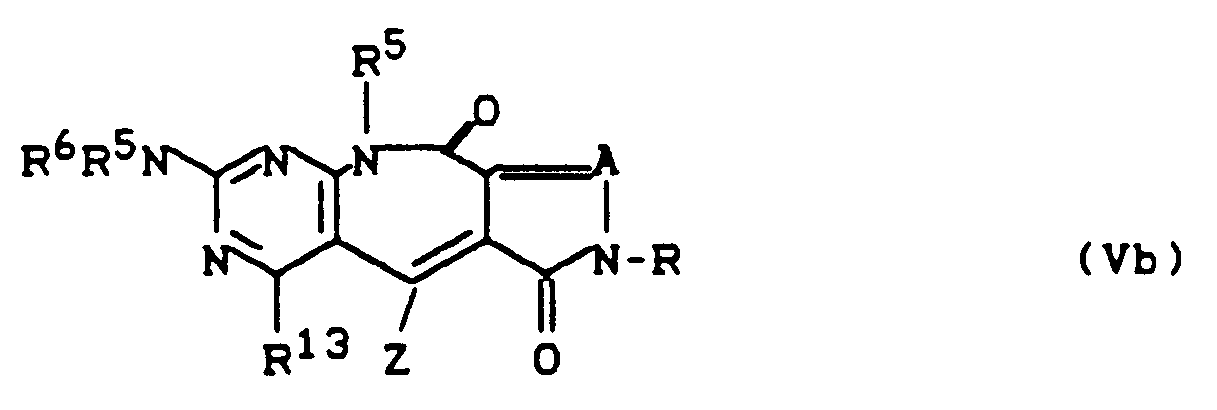
in derR⁶ die für R⁵ genannten Bedeutungen hat undR¹³ Halogen oder OR³ bezeichnet undR³ für Wasserstoff steht oder die für R⁵ genannten Bedeutungen hat. - Verbindungen gemäß Anspruch 1 oder 2, die in einer ihrer tautomeren Formen der Formel

in derR¹¹ einen gegebenenfalls substituierten Aryl oder einen gegebenenfalls substituieren Hetarylrest bezeichnet. - Verbindungen gemäß Anspruch 1 oder 2, die in einer ihrer tautomeren Formen der Formel

in derR¹¹ einen gegebenenfalls substituierten Aryl oder einen gegebenenfalls substituierten Hetarylrest,R¹² -CN, -COOR⁷, -CONR⁵R⁶ bezeichnen,R⁶, R⁷ die für R⁵ genannten Bedeutungen haben. - Verbindungen gemäß den Ansprüchen 1 bis 6, bei denenR für Phenyl steht, das durch 1 oder 2 Substituenten aus der Reihe -SO₃H, Halogen, -CN, C₁-C₄-Alkyl, -SO₂NH₂ substituiert sein kann.
- Verbindungen gemäß den Ansprüchen 1 bis 7, bei denen A N oder
- Verwendung der Verbindungen gemäß den Ansprüchen 1 bis 8 als Farbstoffe oder Pigmente.
- Verwendung der Verbindungen gemäß den Ansprüchen 1 bis 8 mit Z ≠ -CN, W = N-H und X = Y = O als Pigmente.
Applications Claiming Priority (4)
| Application Number | Priority Date | Filing Date | Title |
|---|---|---|---|
| DE3908036 | 1989-03-11 | ||
| DE3908036 | 1989-03-11 | ||
| DE3909595 | 1989-03-23 | ||
| DE3909595A DE3909595A1 (de) | 1989-03-11 | 1989-03-23 | Heterocyclische verbindungen |
Publications (3)
| Publication Number | Publication Date |
|---|---|
| EP0387595A2 EP0387595A2 (de) | 1990-09-19 |
| EP0387595A3 EP0387595A3 (de) | 1991-07-17 |
| EP0387595B1 true EP0387595B1 (de) | 1994-05-25 |
Family
ID=25878744
Family Applications (1)
| Application Number | Title | Priority Date | Filing Date |
|---|---|---|---|
| EP90103779A Expired - Lifetime EP0387595B1 (de) | 1989-03-11 | 1990-02-27 | Heterocyclische Verbindungen |
Country Status (3)
| Country | Link |
|---|---|
| EP (1) | EP0387595B1 (de) |
| JP (1) | JPH02283770A (de) |
| DE (2) | DE3909595A1 (de) |
Families Citing this family (1)
| Publication number | Priority date | Publication date | Assignee | Title |
|---|---|---|---|---|
| US6184226B1 (en) | 1998-08-28 | 2001-02-06 | Scios Inc. | Quinazoline derivatives as inhibitors of P-38 α |
Family Cites Families (2)
| Publication number | Priority date | Publication date | Assignee | Title |
|---|---|---|---|---|
| US4228168A (en) * | 1978-11-22 | 1980-10-14 | Tanabe Seiyaku Co., Ltd. | Azepino [1,2,3-lm]-β-carboline compounds and pharmaceutical composition thereof |
| DE3401574A1 (de) * | 1984-01-18 | 1985-07-25 | Bayer Ag, 5090 Leverkusen | Azinpigmente, verfahren zu ihrer herstellung sowie ihre verwendung |
-
1989
- 1989-03-23 DE DE3909595A patent/DE3909595A1/de not_active Withdrawn
-
1990
- 1990-02-27 DE DE59005786T patent/DE59005786D1/de not_active Expired - Fee Related
- 1990-02-27 EP EP90103779A patent/EP0387595B1/de not_active Expired - Lifetime
- 1990-03-06 JP JP2052868A patent/JPH02283770A/ja active Pending
Also Published As
| Publication number | Publication date |
|---|---|
| JPH02283770A (ja) | 1990-11-21 |
| DE59005786D1 (de) | 1994-06-30 |
| EP0387595A3 (de) | 1991-07-17 |
| EP0387595A2 (de) | 1990-09-19 |
| DE3909595A1 (de) | 1990-09-13 |
Similar Documents
| Publication | Publication Date | Title |
|---|---|---|
| EP0133156A2 (de) | Neue 1,4-Diketopyrrolo-(3,4-c)-pyrrole | |
| DE2814526A1 (de) | Isoindolinpigmente, verfahren zu deren herstellung und verwendung | |
| DE3937633A1 (de) | Heterocyclische verbindungen und deren verwendung als pigmente und farbstoffe | |
| DE2615394A1 (de) | Verfahren zum faerben thermoplastischer kunststoffe in der schmelze | |
| DE2254625C3 (de) | Disazopigmente und deren Verwendung | |
| EP0673979B1 (de) | Cyaniminogruppen enthaltende Fluoreszenzfarbstoffe | |
| EP0036388B1 (de) | Isoindolinverbindungen, Verfahren zu deren Herstellung und Verwendung | |
| EP0151393B1 (de) | Azinpigmente, Verfahren zu ihrer Herstellung sowie ihre Verwendung | |
| EP0168343B1 (de) | Neue Metallkomplexe, Verfahren zu ihrer Herstellung ihre Verwendung zum Färben von hochmolekularem organischem Material | |
| EP0036834B1 (de) | Verfahren zur Herstellung von Metallkomplexen von Isoindolinazinen | |
| EP0101954B1 (de) | Isoindolazine, Verfahren zu ihrer Herstellung sowie ihre Verwendung | |
| EP0190692B1 (de) | Bis-isoindolinpigmente und ihre Verwendung | |
| DE3525109A1 (de) | Heterocyclische vrbindungen | |
| EP0403812B1 (de) | Diketopiperazin Derivate, deren Herstellung und deren Vervendung zum Färben von Kunststoffen | |
| EP0349489A2 (de) | Hochmolekulares organisches Material enthaltend ein Metallkomplexpigment auf Hydrazonbasis | |
| DE3533949A1 (de) | Heterocyclische verbindungen | |
| EP0036835B1 (de) | Verfahren zur Herstellung von Metallkomplexen von Isoindolinazinen | |
| EP0673940B1 (de) | Cyaniminogruppen enthaltende Pyrrolo(3,4-c)pyrrole | |
| EP0387595A2 (de) | Heterocyclische Verbindungen | |
| EP0163609A2 (de) | Verfahren zum Färben von hochmolekularem organischem Material, neue polycyclische Verbindungen sowie deren Herstellung | |
| US5258511A (en) | Pyrazoloazepinones and methods of using such pyrazoloazepinones to dye synthetic fibers and to pigment pastes, paints, printing inks, colored paper and colored macromolecular substances | |
| DE2429286A1 (de) | Neue disazopigmente und verfahren zu deren herstellung und verwendung | |
| DE2925136A1 (de) | Bis-methin-pigmente und verfahren zu deren herstellung | |
| EP0477528B1 (de) | Piperazin-2,5-dion und Piperazin-2-on Derivate | |
| EP0349809A2 (de) | Metallkomplex-Pigmente |
Legal Events
| Date | Code | Title | Description |
|---|---|---|---|
| PUAI | Public reference made under article 153(3) epc to a published international application that has entered the european phase |
Free format text: ORIGINAL CODE: 0009012 |
|
| 17P | Request for examination filed |
Effective date: 19900307 |
|
| AK | Designated contracting states |
Kind code of ref document: A2 Designated state(s): CH DE FR GB LI |
|
| PUAL | Search report despatched |
Free format text: ORIGINAL CODE: 0009013 |
|
| AK | Designated contracting states |
Kind code of ref document: A3 Designated state(s): CH DE FR GB LI |
|
| 17Q | First examination report despatched |
Effective date: 19931011 |
|
| GRAA | (expected) grant |
Free format text: ORIGINAL CODE: 0009210 |
|
| AK | Designated contracting states |
Kind code of ref document: B1 Designated state(s): CH DE FR GB LI |
|
| PG25 | Lapsed in a contracting state [announced via postgrant information from national office to epo] |
Ref country code: GB Effective date: 19940525 Ref country code: FR Effective date: 19940525 |
|
| REF | Corresponds to: |
Ref document number: 59005786 Country of ref document: DE Date of ref document: 19940630 |
|
| EN | Fr: translation not filed | ||
| GBV | Gb: ep patent (uk) treated as always having been void in accordance with gb section 77(7)/1977 [no translation filed] |
Effective date: 19940525 |
|
| PG25 | Lapsed in a contracting state [announced via postgrant information from national office to epo] |
Ref country code: LI Effective date: 19950228 Ref country code: CH Effective date: 19950228 |
|
| PLBE | No opposition filed within time limit |
Free format text: ORIGINAL CODE: 0009261 |
|
| STAA | Information on the status of an ep patent application or granted ep patent |
Free format text: STATUS: NO OPPOSITION FILED WITHIN TIME LIMIT |
|
| 26N | No opposition filed | ||
| PG25 | Lapsed in a contracting state [announced via postgrant information from national office to epo] |
Ref country code: DE Effective date: 19951101 |