EP0387706A2 - Lentille de contact dure peréable à l'oxygène - Google Patents
Lentille de contact dure peréable à l'oxygène Download PDFInfo
- Publication number
- EP0387706A2 EP0387706A2 EP90104440A EP90104440A EP0387706A2 EP 0387706 A2 EP0387706 A2 EP 0387706A2 EP 90104440 A EP90104440 A EP 90104440A EP 90104440 A EP90104440 A EP 90104440A EP 0387706 A2 EP0387706 A2 EP 0387706A2
- Authority
- EP
- European Patent Office
- Prior art keywords
- contact lens
- hard contact
- group
- oxygen permeable
- trimethylsiloxy
- Prior art date
- Legal status (The legal status is an assumption and is not a legal conclusion. Google has not performed a legal analysis and makes no representation as to the accuracy of the status listed.)
- Granted
Links
Images


Classifications
-
- C—CHEMISTRY; METALLURGY
- C08—ORGANIC MACROMOLECULAR COMPOUNDS; THEIR PREPARATION OR CHEMICAL WORKING-UP; COMPOSITIONS BASED THEREON
- C08F—MACROMOLECULAR COMPOUNDS OBTAINED BY REACTIONS ONLY INVOLVING CARBON-TO-CARBON UNSATURATED BONDS
- C08F30/00—Homopolymers or copolymers of compounds having one or more unsaturated aliphatic radicals, each having only one carbon-to-carbon double bond, and containing phosphorus, selenium, tellurium or a metal
- C08F30/04—Homopolymers or copolymers of compounds having one or more unsaturated aliphatic radicals, each having only one carbon-to-carbon double bond, and containing phosphorus, selenium, tellurium or a metal containing a metal
- C08F30/08—Homopolymers or copolymers of compounds having one or more unsaturated aliphatic radicals, each having only one carbon-to-carbon double bond, and containing phosphorus, selenium, tellurium or a metal containing a metal containing silicon
-
- C—CHEMISTRY; METALLURGY
- C08—ORGANIC MACROMOLECULAR COMPOUNDS; THEIR PREPARATION OR CHEMICAL WORKING-UP; COMPOSITIONS BASED THEREON
- C08F—MACROMOLECULAR COMPOUNDS OBTAINED BY REACTIONS ONLY INVOLVING CARBON-TO-CARBON UNSATURATED BONDS
- C08F230/00—Copolymers of compounds having one or more unsaturated aliphatic radicals, each having only one carbon-to-carbon double bond, and containing phosphorus, selenium, tellurium or a metal
- C08F230/04—Copolymers of compounds having one or more unsaturated aliphatic radicals, each having only one carbon-to-carbon double bond, and containing phosphorus, selenium, tellurium or a metal containing a metal
- C08F230/08—Copolymers of compounds having one or more unsaturated aliphatic radicals, each having only one carbon-to-carbon double bond, and containing phosphorus, selenium, tellurium or a metal containing a metal containing silicon
-
- G—PHYSICS
- G02—OPTICS
- G02B—OPTICAL ELEMENTS, SYSTEMS OR APPARATUS
- G02B1/00—Optical elements characterised by the material of which they are made; Optical coatings for optical elements
- G02B1/04—Optical elements characterised by the material of which they are made; Optical coatings for optical elements made of organic materials, e.g. plastics
- G02B1/041—Lenses
- G02B1/043—Contact lenses
-
- G—PHYSICS
- G02—OPTICS
- G02C—SPECTACLES; SUNGLASSES OR GOGGLES INSOFAR AS THEY HAVE THE SAME FEATURES AS SPECTACLES; CONTACT LENSES
- G02C7/00—Optical parts
- G02C7/02—Lenses; Lens systems ; Methods of designing lenses
- G02C7/04—Contact lenses for the eyes
Definitions
- the present invention relates to oxygen permeable hard contact lenses, and more specifically to oxygen permeable hard contact lenses formed of copolymers comprising specific compounds as constituents.
- MMA methyl methacrylate
- fluoroalkyl methacylate fluoroalkyl methacylate
- silicone methacrylate which do not contain water
- conventional hard contact lenses which do not contain water, comprising MMA as their principal constituent have almost no oxygen permeability, and hence they have a significant drawback of being difficult to be continuously worn over a long period of time.
- Conventional hard contact lenses comprising silicone methacrylate as their principal constituent are, while they have higher oxygen permeability than those comprising MMA as principal constituent, still insufficient for a long-period continuous use and low in wettability and further have a drawback of being readily soiled with lipids and the like.
- JP-B-8769/1987 and JP-A-28127/1984 disclose an oxygen permeable hard contact lense comprising fluoroalkyl methacrylate and siloxanylalkyl(glycerol) (meth)acrylate.
- JP-A-131518/1985, 57612/1986, 281116/1986, 281216/1986, 285426/1986 and 54220/1987 disclose an oxygen permeable hard contact lens comprising siloxanylpropyloxy ethyl (meth)acrylate and alkyl (meth)acrylate or alkyl itaconate. Further, JP-A-87102/1986 and 38419/1987 disclose an oxygen permeable hard contact lens comprising fluoroalkylsiloxanyl(glycerol) (meth)acrylate.
- US-A- 4,711,943 discloses a water-containing soft contact lens formed of a material having both an amide structure and a siloxane structure and having water content of 15 to 60%, an oxygen permeability of at least 25 x 1010 cm3 ⁇ cm/cm2 ⁇ sec ⁇ cmHg, a tear strength of at least 1.0 g/mm2 and an elongation of at least 80%.
- An object of the present invention is to provide a hard contact lens which has not only high oxygen permeability, but excellent wettability as well, thus giving a comfortable feel when worn.
- Another object of the present invention is to provide a hard contact lens which is highly machinable and, moreover, has high mechanical strength.
- Still another object of the present invention is to provide a hard contact lens which shows high resistance to soiling so that it does not frequently require chemical solution treatment.
- a hard contact lens comprising a copolymer having specific monomer units as its constituents has high oxygen permeability, high wettability and high resistance to soiling and, at the same time, is satisfactory in mechanical strength and transparency.
- the present invention provides a contact lens formed of a copolymer comprising as its essential constituents: a siloxanylalkylamide unit represented by the formula (I): wherein R1 is a methyl group or a hydrogen atom, R2 is a hydrogen atom or a hydrocarbon group having 1 to 15 carbon atoms, n is an integer of 1 to 3, X1 , X2 and X3 may be the same or different and are each a methyl group, a trimethylsiloxy group, an organosiloxy group having not more than 16 Si atoms or a Z group which is a group represented by the formula (II) wherein R1, R2 and n are same as defined above, X4 and X5 may be the same or different and are each a methyl group, a trimethylsiloxy group, an organosiloxy group having not more than 16 Si atoms or a Z group which is the same as above; and a monomer unit containing fluorine.
- the obtained resin is improved in oxygen permeability but becomes soft and fragile. It therefore is preferred that the number of Si atoms be 1 to about 10 per amide group.
- the copolymer used in the present invention can be prepared by copolymerizing 30 to 80 weight parts of a monomer represented substantially by the following formula (I′) : wherein R1, R2 and n are as defined above, and X1, X2 and X3 may be the same or different and are each a methyl group, a trimethylsiloxy group, an organosiloxy group having not more than 16 Si atoms or a Z′ group which is a group represented by the formula (II′) wherein R1 , R2 and n are same as defined above, X4 and X5 may be the same or different and are each a methyl group, a trimethylsiloxy group, an organosiloxy group having not more than 16 Si atoms or a Z′ group which is the same as above; with 70 to 20 weight parts of a monomer containing fluorine.
- a monomer represented substantially by the following formula (I′) wherein R1, R2 and n are as defined above,
- the monomers represented by formula (I′) are for example those represented by the following formula (III) : wherein R1 and R2 are the same as before. More concrete examples are: N-[tris(trimethylsiloxy)silyl]propylacrylamide, N-[tris(trimethylsiloxy)silyl]propylmethacrylamide, N-methyl-N-[tris(trimethylsiloxy)silyl]propylacrylamide, N-methyl-N-[tris(trimethylsiloxy)silyl]propylmethacrylamide, N-propyl-N-[tris(trimethylsiloxy)silyl]propylacrylamide, N-propyl-N-[tris(trimethylsiloxy)silyl]propylmethacrylamide, N-heptyl-N-[tris(trimethylsiloxy)silyl]propylacrylamide, N-heptyl-N-[tris(trimethylsiloxy)silyl]propy
- Examples of other monomers are, e.g. those represented by the following formula (IV) : wherein R1 and R2 are as defined above; more concretely, N-[methylbis(trimethylsiloxy)silyl]propylacrylamide, N-[methylbis(trimethylsiloxy)silyl]propylmethacrylamide, N-methyl-N-[methylbis(trimethylsiloxy)silyl]-propylacrylamide and N-methyl-N-[methylbis(trimethylsiloxy)silyl]propylmethacrylamide.
- R1 and R2 are as defined above; more concretely, N-[methylbis(trimethylsiloxy)silyl]propylacrylamide, N-[methylbis(trimethylsiloxy)silyl]propylmethacrylamide, N-methyl-N-[methylbis(trimethylsiloxy)silyl]propylmethacrylamide.
- N-[tris(pentamethyldisiloxy)silyl]propylacrylamide N-[tris(pentamethyldisiloxy)silyl]propylmethacrylamide
- N-methyl-N-[tris(pentamethyldisiloxy)silyl]propylacrylamide N-methyl-N-[tris(pentamethyldisiloxy)silyl]propylacrylamide
- N-[bis(trimethylsiloxy)mono(pentamethyldisiloxy) silyl]propylmethacrylamide N-methyl-N-[bis(trimethylsiloxy)mono(pentamethyldisiloxy)silyl]propylacrylamide
- methacrylamide-based monomers are preferred from the viewpoint of oxygen permeability and mechanical strength, in which more preferred are N-[tris(trimethylsiloxy)silyl]propylmethacrylamide and N-methyl-N-[tris(trimethylsiloxy)silyl]propylmethacrylamide. These monomers may be used singly or in combination.
- the above monomers can be obtained by for example first conducting co-hydrolysis/condensation reaction of a silane coupling agent represented by the following formula (V): R2 -NHCH2CH2CH2Si(OCH3)3 (V) wherein R2 is the same as defined above, with an alkyl ether of the corresponding silanol, to obtain an intermediate compound and then reacting the intermediate compound with a (meth)acryloyl chloride.
- V silane coupling agent represented by the following formula (V): R2 -NHCH2CH2CH2Si(OCH3)3 (V) wherein R2 is the same as defined above, with an alkyl ether of the corresponding silanol, to obtain an intermediate compound and then reacting the intermediate compound with a (meth)acryloyl chloride.
- These monomers have high oxygen permeability due to the presence of a silane or siloxane bond at one end of their molecules, and can be, due to the presence of a double bond at the other end of their molecules, copolymerized with another monomer having an unsaturated bond. Furthermore, these monomers are, since they possess an amide bond which is hydrophilic, compatible with other hydrophilic monomers, thereby causing the obtained copolymers to tend to be more hydrophilic than known silicone compounds.
- a monomer represented by formula (I′) is copolymerized with another monomer containing fluorine, and the obtained copolymer is formed into a lens by a known process such as cutting and grinding.
- the contact lens can also be directly prepared by conducting the above copolymerization in a mold for lens.
- the above copolymerization with 30 to 80% by weight, more preferably 35 to 70% by weight, of the monomer represented by formula (I′) and 70 to 20% by weight, more preferably 65 to 30% by weight, of another monomer containing fluorine.
- Examples of the monomer containing fluorine are, among others, fluoroalkyl (meth)acrylates, fluorohydroxyalkyl (meth)acrylates, fluoroalkyl itaconates, fluoroalkyl fumarates and fluorostyrene derivatives.
- fluoroalkyl (meth)acrylates and fluorohydroxyalkyl (meth)acrylates are, among others, 2,2,2-trifluoroethyl methacrylate, 2,2,2-trifluoroethyl acrylate, 2,2,3,3-tetrafluoropropyl methacrylate, 2,2,3,3-tetrafluoropropyl acrylate, 2,2,3,3,3-pentafluoropropyl methacrylate, 2,2,3,3,3-pentafluoropropyl acrylate, 2,2,2-trifluoro-1-trifluoromethylethyl methacrylate, 2,2,2-trifluoro-1-trifluoromethylethyl acrylate, 2,2,3,3-tetrafluoro-t-amyl methacrylate, 2,2,3,3-tetrafluoro-t-amyl acrylate, 2,2,3,4,4,4-hexafluorobutyl methacrylate, 2,2,3,4,4,4,4
- fluoroalkyl itaconates examples include bis-2,2,2-trifluoroethyl itaconate, t-butyl-(2,2,2-trifluoro-1-trifluoromethyl)ethyl fumarate, isopropyl-(1,1,2,2-tetrahydroperfluoro)octyl fumarate and pentafluorostyrene.
- hydrophilic monomer or a crosslinking agent may be added for the purpose of improving wettability.
- hydrophilic monomer used here are methacrylic acid, 2-hydroxyethylmethacrylate, 2-hydroxyethylacrylate, N-vinylpyrrolidone and dimethylacrylamide; and examples of the crosslinking agent are ethylene glycol dimethacrylate, ethylene glycol diacrylate, diethylene glycol dimethacrylate, diethylene glycol diacrylate, triethylene glycol dimethacrylate, triethylene glycol diacrylate, tetradecaethylene glycol dimethacrylate, tetradecaethylene glycol diacrylate, allyl methacrylate, allyl acrylate, trimethylolpropane trimethacrylate, trimethylolpropane triacrylate, 1,3-butanediol dimethacrylate, 1,3-butanediol diacrylate, 1,4-butanediol dimethacrylate,
- 1,10-decanediol dimethacrylate is, since it provides contact lenses having high mechanical strength, preferred for the purpose of obtaining the oxygen permeable hard contact lenses of the present invention.
- These crosslinking agents are used generally in an amount of 0.1 to 20% by weight, preferably in an amount of 0.5 to 15% by weight.
- copolymers comprising as essential constituents, N-[tris(trimethylsiloxy)silyl]propyl methacrylamide, 2,2,2-trifluoroethyl methacrylate and 1,10-decanediol dimethacrylate are most desirable for obtaining the oxygen permeable hard contact lenses of the present invention.
- alkyl (meth)acrylates there may further be added alkyl (meth)acrylates, silicone (meth)acrylates, vinyl esters, styrene compounds, allyl compounds or the like to the extent not to adversely affect the required characteristics of the contact lens, such as oxygen permeability, transparency and resistance to soiling.
- These compounds may, if ever, be used generally in an amount of not more than 50% by weight based on the weight of the copolymer composed of siloxanylamide units and fluorine-containing monomer units.
- alkyl (meth)acrylates having 4 to 19 carbon atoms are preferably used in view of oxygen permeability, mechanical strength, wettability and resistance to soiling.
- alkyl (meth)acrylates are, among others, methyl methacrylate, methyl acrylate, ethyl methacrylate, ethyl acrylate, isopropyl methacrylate, isopropyl acrylate, t-butyl methacrylate, t-butyl acrylate, isobutyl methacrylate, isobutyl acrylate, t-amyl methacrylate, t-amyl acrylate, 2-ethylhexyl methacrylate, 2-ethylhexyl acrylate, lauryl methacrylate, lauryl acrylate, cyclohexyl methacrylate and cyclohexyl acrylate.
- the catalyst is appropriately selected from for example benzoyl peroxide 2,2′-azobisisobutyronitrile, 2,2′-azobismethyl isobutylate and 2,2′-azobisdimethylvaleronitrile.
- the polymerization catalyst is preferably used in an amount of 0.01 to 5% by weight based on the weight of the whole mixture.
- the copolymer thus obtained is cut and ground to give contact lenses.
- the mixture of the above monomers can be polymerized in a mold to directly form a lens.
- part means “parts by weight”, and various characteristics were measured as follows: Oxygen permeability was measured with Oxygen Gas Permeator available from Rikaseiki Kogyo Co., Ltd. Vickers hardness was measured with a micro hardness tester, Model MVK-F, available from Akashi Seisakusho Co., Ltd. Contact angle was measured with Goniometer-type contact angle meter, Model G-1, available from Erma Optical Works Ltd. The contact angle is a measure for wettability and a smaller contact angle indicates better wettability.
- a circular specimen taken from the copolymer having a diameter of 13 mm and a thickness of 1 mm was immersed in a physiological saline solution containing 0.1% by weight of lysozyme (egg albumen, available from Wako Pure Chemical Industries Ltd.) at a room temperature for 48 hours.
- the specimen was taken out from the solution and air-dried.
- the specimens before and after the immersion was tested for transmittance of a visible light with wavelength of 400 nm using a double-beam spectrophotometer (Model 228A, available from Hitachi, Ltd.). Smaller reduction in the transmittance by the immersion means higher resistance to soiling.
- a 1000-ml Erlenmeyer flask containing 500 g of distilled water was charged with 25.0 g of a commercially available 3-aminopropyltriethoxysilane (LS3150, made by Shin-Etsu Chemical Co., Ltd.) and 71.0 g of methoxytrimethylsilane (LS510, made by Shin-Etsu Chemical Co., Ltd.).
- the mixture was stirred with a magnetic stirrer at room temperature for 16 hours, and then allowed to stand still.
- the resulting supernatant was separated and the bottom layer was subjected to extraction with ethyl ether.
- the distillate was a colorless transparent liquid with low viscosity.
- Gas chromatography with FID detector sicone: SE-30, column: 3 mm ⁇ x 3 m, column temperature: 70 ⁇ 200°C at a temperature raise rate of 5°C/min
- the distillate was a viscous, colorless and transparent solid.
- the infrared absorption spectrum and gas chromatogram of the substance were as shown in FIGURES 1 and 2, respectively.
- the infrared absorption spectrum had a peak of double bond at 1660 cm ⁇ 1, one of Si-O-Si at 1050 cm ⁇ 1, one of methyl group at 2950 cm ⁇ 1, ones of Si-CH3 at 1250 cm ⁇ 1 and 840 cm ⁇ 1, and one of N-H at 3300 cm ⁇ 1.
- the distillate was a colorless transparent liquid with low viscosity.
- Gas chromatography with FID detector silicone: SE-30, column: 3 mm ⁇ x 3 m, column temperature: 70 - 200°C at a temperature raise rate of 5°C/min
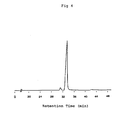
- FID detector silycone: SE-30, column: 3 mm ⁇ x 3 m, column temperature: 70 - 200°C at a temperature raise rate of 5°C/min
- the distillate was a viscous, colorless and transparent liquid, which had a refractive index at 20°C of 1.435.
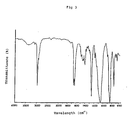
- the infrared absorption spectrum and gas chromatogram of the substance were as shown in FIGURES 3 and 4, respectively.
- the infrared absorption spectrum had a peak of double bond at 1640 cm ⁇ 1, one of Si-O-Si at 1060 cm ⁇ 1, one of methyl group at 2950 cm ⁇ 1 and ones of Si-CH3 at 1250 cm ⁇ 1 and 840 cm ⁇ 1.
- a mixture was prepared from 30 parts of the N-[tris(trimethylsiloxy)silyl]propylmethacrylamide obtained in Reference Example 1, 10 parts of methyl methacrylate, 50 parts of 2,2,2-trifluoroethyl methacrylate and 10 parts of ethylene glycol dimethacrylate.
- a polymerization catalyst of 2,2′-azobisdimethylvaleronitrile was added in an amount of 0.15 part to the mixture.
- the resulting mixture was taken into a 20-ml capacity polypropylene test tube, and, after replacement of the internal air with nitrogen gas, the tube was sealed.
- test tube was immersed in a constant-temperature water-circulating bath and the contents were permitted to polymerized at 35°C for 65 hours, at 40°C (or 24 hours and at 50°C for 5 hours, successively.
- the test tube was put in a hot-air drying oven and further subjected to polymerization at 80°C for 2 hour, at 100°C for 1 hour and finally at 110°C for 1 hour.
- the polymer thus obtained was colorless transparent solid.
- the polymer gave, by cutting and grinding, a hard contact lens.
- a mixture was prepared from 30 parts of the N-methyl-N-[tris(trimethylsiloxy)silyl]propylmethacrylamide obtained in Reference Example 2, 10 parts of methyl methacrylate, 50 parts of 2,2,2-trifluoroethyl methacrylate and 10 parts of ethylene glycol dimethacrylate.
- a polymerization catalyst of 2,2′-azobisdimethylvaleronitrile was added in an amount of 0.2 part to the mixture.
- the resulting mixture was taken into a polypropylene test tube, and, after replacement of the internal air with nitrogen gas, the tube was sealed.
- test tube with the contents was heated at 40°C for 64 hours, at 50°C for 5 hours, at 80°C for 2 hour, at 100°C for 1 hour and finally at 120°C for 1 hour, to effect polymerization.
- the polymer thus obtained gave a hard contact lens by cutting and grinding.
- the characteristics of the polymer are shown in Table 1.
- Example 1 was repeated with the composition shown in Table 1 which includes as silicone monomer the bottoms by the vacuum distillation for the synthesis of N-[tris(trimethylsiloxy)silyl]propylmethacrylamide in Reference Example 1, the bottoms being a compound having 2 or more methacrylamide groups in the molecule thereof, to obtain a polymer.
- Table 1 which includes as silicone monomer the bottoms by the vacuum distillation for the synthesis of N-[tris(trimethylsiloxy)silyl]propylmethacrylamide in Reference Example 1, the bottoms being a compound having 2 or more methacrylamide groups in the molecule thereof, to obtain a polymer.
- Table 1 which includes as silicone monomer the bottoms by the vacuum distillation for the synthesis of N-[tris(trimethylsiloxy)silyl]propylmethacrylamide in Reference Example 1, the bottoms being a compound having 2 or more methacrylamide groups in the molecule thereof, to obtain a polymer.
- Table 1 which includes as
- Example 1 was repeated except for using 30 parts of 3-methacryloxypropyltris(trimethylsiloxy)silane instead of 30 parts of N-[tris(trimethylsiloxy)silyl]propylmethacrylamide to obtain a polymer.
- the contact lens prepared from the thus obtained polymer was of characteristics as shown in Table 1.
- Example 1 was repeated with mixtures comprising compositions shown in Table 2, to obtain polymers.
- the polymers were then formed, by cutting and grounding, into hard contact lenses each having a base curve of 7.50 mm, a diameter of 8.8 mm and a power of -3.00.
- the lenses were subjected to a compression test using a tensile tester (AUTOGRAPH, Model AGS-50A, available from Shimadzu Corporation). The lenses were compressed radially at a rate of 200 mm/min until breakage. The results are summarized in Table 2.
Landscapes
- Chemical & Material Sciences (AREA)
- Health & Medical Sciences (AREA)
- Physics & Mathematics (AREA)
- Medicinal Chemistry (AREA)
- Polymers & Plastics (AREA)
- Organic Chemistry (AREA)
- Chemical Kinetics & Catalysis (AREA)
- General Physics & Mathematics (AREA)
- Optics & Photonics (AREA)
- Ophthalmology & Optometry (AREA)
- General Health & Medical Sciences (AREA)
- Addition Polymer Or Copolymer, Post-Treatments, Or Chemical Modifications (AREA)
- Eyeglasses (AREA)
Applications Claiming Priority (2)
| Application Number | Priority Date | Filing Date | Title |
|---|---|---|---|
| JP58788/89 | 1989-03-10 | ||
| JP5878889 | 1989-03-10 |
Publications (3)
| Publication Number | Publication Date |
|---|---|
| EP0387706A2 true EP0387706A2 (fr) | 1990-09-19 |
| EP0387706A3 EP0387706A3 (fr) | 1992-02-26 |
| EP0387706B1 EP0387706B1 (fr) | 1994-10-26 |
Family
ID=13094312
Family Applications (1)
| Application Number | Title | Priority Date | Filing Date |
|---|---|---|---|
| EP90104440A Expired - Lifetime EP0387706B1 (fr) | 1989-03-10 | 1990-03-08 | Lentille de contact dure peréable à l'oxygène |
Country Status (5)
| Country | Link |
|---|---|
| US (1) | US5162391A (fr) |
| EP (1) | EP0387706B1 (fr) |
| KR (1) | KR950008564B1 (fr) |
| AU (1) | AU619661B2 (fr) |
| DE (1) | DE69013542T2 (fr) |
Cited By (2)
| Publication number | Priority date | Publication date | Assignee | Title |
|---|---|---|---|---|
| US5670594A (en) * | 1995-10-24 | 1997-09-23 | Menicon Co., Ltd. | Low water-absorptive ocular lens material, low water-absorptive ocular lens shaped product made thereof, low water-absorptive ocular lens made thereof and process for its production |
| EP0862068A3 (fr) * | 1996-12-06 | 1999-01-27 | Toray Industries, Inc. | Articles médicaux en matière plastique |
Families Citing this family (11)
| Publication number | Priority date | Publication date | Assignee | Title |
|---|---|---|---|---|
| EP0443986A1 (fr) * | 1990-02-23 | 1991-08-28 | Ciba-Geigy Ag | Lentilles ophthalmiques à base de fluoropolymères amorphes |
| US5391591A (en) * | 1990-10-31 | 1995-02-21 | Menicon Co., Ltd. | Oxygen permeable hard contact lens materials comprising a fluoroalkyl(silicon-containing alkyl) fumarate copolymer |
| US5739236A (en) * | 1991-04-24 | 1998-04-14 | Biocompatibles Limited | Biocompatible zwitterion polymers |
| US6090901A (en) * | 1991-07-05 | 2000-07-18 | Biocompatibles Limited | Polymeric surface coatings |
| US6743878B2 (en) | 1991-07-05 | 2004-06-01 | Biocompatibles Uk Limited | Polymeric surface coatings |
| JP3108550B2 (ja) * | 1992-11-11 | 2000-11-13 | 株式会社メニコン | 軟質眼用レンズ材料 |
| US5424468A (en) * | 1994-02-01 | 1995-06-13 | Korea Institute Of Science And Technology | Polymeric contact lens material of improved oxygen permeability |
| WO2003032051A1 (fr) * | 2001-10-09 | 2003-04-17 | Kuraray Co., Ltd. | Lentille de contact dure permeable a l'oxygene |
| KR101345280B1 (ko) | 2006-05-24 | 2013-12-26 | 엘지디스플레이 주식회사 | 패턴형성용 레진 조성물 및 이를 이용하는 인-플레인프린팅 공정방법 |
| JP6132723B2 (ja) * | 2013-09-25 | 2017-05-24 | 信越化学工業株式会社 | ラジカル重合性基含有シリコーン化合物及びその製造方法 |
| TW201918524A (zh) * | 2017-10-31 | 2019-05-16 | 鴻海精密工業股份有限公司 | 硬性透氧性眼用鏡片材料及硬性透氧性眼用鏡片 |
Family Cites Families (20)
| Publication number | Priority date | Publication date | Assignee | Title |
|---|---|---|---|---|
| GB1604519A (en) * | 1977-07-25 | 1981-12-09 | Bausch & Lomb | Polysiloxane polymers and contact lens and other biomedical articles formed therefrom |
| US4327203A (en) * | 1981-02-26 | 1982-04-27 | Bausch & Lomb Incorporated | Polysiloxane with cycloalkyl modifier composition and biomedical devices |
| JPS5928127A (ja) * | 1982-08-07 | 1984-02-14 | Shin Etsu Chem Co Ltd | 酸素透過性硬質コンタクトレンズ |
| JPS58194014A (ja) * | 1982-05-08 | 1983-11-11 | Shin Etsu Chem Co Ltd | 酸素透過性硬質コンタクトレンズ |
| US4495361A (en) * | 1983-04-29 | 1985-01-22 | Bausch & Lomb Incorporated | Polysiloxane composition with improved surface wetting characteristics and biomedical devices made thereof |
| US4652622A (en) * | 1983-04-29 | 1987-03-24 | Bausch & Lomb Incorporated | Polysiloxane composition with improved surface wetting characteristics and biomedical devices made thereof |
| JPS60131518A (ja) * | 1983-12-20 | 1985-07-13 | Nippon Contact Lens Seizo Kk | コンタクトレンズ材料 |
| JPS6157612A (ja) * | 1984-08-23 | 1986-03-24 | Nippon Contact Lens:Kk | コンタクトレンズ材料 |
| JPH06100734B2 (ja) * | 1984-09-20 | 1994-12-12 | セイコーエプソン株式会社 | コンタクトレンズ |
| US4829137A (en) * | 1985-01-29 | 1989-05-09 | Bausch & Lomb Incorporated | Continuous-wear highly oxygen permeable contact lenses |
| US4711943A (en) * | 1985-04-26 | 1987-12-08 | Sola U.S.A. Inc. | Hydrophilic siloxane monomers and dimers for contact lens materials, and contact lenses fabricated therefrom |
| JPS61281116A (ja) * | 1985-06-07 | 1986-12-11 | Nippon Contact Lens:Kk | コンタクトレンズ材料 |
| JPS61281216A (ja) * | 1985-06-07 | 1986-12-11 | Nippon Contact Lens:Kk | コンタクトレンズ材料 |
| JPS61285426A (ja) * | 1985-06-12 | 1986-12-16 | Nippon Contact Lens:Kk | コンタクトレンズ材料 |
| JPS6238419A (ja) * | 1985-08-13 | 1987-02-19 | Seiko Epson Corp | コンタクトレンズ |
| JPS6254220A (ja) * | 1985-09-03 | 1987-03-09 | Nippon Contact Lens:Kk | コンタクトレンズ材料 |
| US4633003A (en) * | 1985-11-25 | 1986-12-30 | Alcon Laboratories, Inc. | Siloxane monomers for ophthalmic applications |
| DE3708308A1 (de) * | 1986-04-10 | 1987-10-22 | Bayer Ag | Kontaktoptische gegenstaende |
| JPH01503072A (ja) * | 1987-01-07 | 1989-10-19 | チヤン,シン‐シウン | 湿潤性、親水性、軟性及び酸素透過性の共重合体組成物 |
| US4911986A (en) * | 1987-02-09 | 1990-03-27 | Dow Corning Corporation | Curable silicone compositions comprising vinyl monomer |
-
1990
- 1990-03-01 US US07/487,211 patent/US5162391A/en not_active Expired - Lifetime
- 1990-03-08 DE DE69013542T patent/DE69013542T2/de not_active Expired - Fee Related
- 1990-03-08 EP EP90104440A patent/EP0387706B1/fr not_active Expired - Lifetime
- 1990-03-09 AU AU51220/90A patent/AU619661B2/en not_active Ceased
- 1990-03-09 KR KR1019900003100A patent/KR950008564B1/ko not_active Expired - Fee Related
Cited By (4)
| Publication number | Priority date | Publication date | Assignee | Title |
|---|---|---|---|---|
| US5670594A (en) * | 1995-10-24 | 1997-09-23 | Menicon Co., Ltd. | Low water-absorptive ocular lens material, low water-absorptive ocular lens shaped product made thereof, low water-absorptive ocular lens made thereof and process for its production |
| EP0862068A3 (fr) * | 1996-12-06 | 1999-01-27 | Toray Industries, Inc. | Articles médicaux en matière plastique |
| US5994488A (en) * | 1996-12-06 | 1999-11-30 | Toray Industries, Inc. | Plastic articles for medical use |
| KR100528421B1 (ko) * | 1996-12-06 | 2006-01-27 | 도레이 가부시끼가이샤 | 신규 중합체 및 이를 포함하는 안과용 렌즈용 플라스틱 제품 |
Also Published As
| Publication number | Publication date |
|---|---|
| AU5122090A (en) | 1990-09-13 |
| EP0387706B1 (fr) | 1994-10-26 |
| KR950008564B1 (ko) | 1995-08-03 |
| US5162391A (en) | 1992-11-10 |
| KR900014447A (ko) | 1990-10-24 |
| DE69013542D1 (de) | 1994-12-01 |
| EP0387706A3 (fr) | 1992-02-26 |
| DE69013542T2 (de) | 1995-05-04 |
| AU619661B2 (en) | 1992-01-30 |
Similar Documents
| Publication | Publication Date | Title |
|---|---|---|
| US5177168A (en) | Polymeric compositions useful in oxygen permeable contact lenses | |
| US4235985A (en) | Polymer for contact lens and contact lens made thereof | |
| US5496871A (en) | Fumarate and fumaramide siloxane hydrogel compositions | |
| US5032658A (en) | Polymeric compositions useful in oxygen permeable contact lenses | |
| EP0231572B1 (fr) | Compositions à base de polymères de silicone-sulfone ou silicone-sulfone-fluorocarbone et lentilles de contact | |
| US5023305A (en) | Oxygen-permeable hard contact lens material with excellent impact resistance | |
| EP0387706B1 (fr) | Lentille de contact dure peréable à l'oxygène | |
| EP0219312A2 (fr) | Compositions à base de polymères fluorés et leur emploi dans la fabrication de lentilles de contact | |
| CN1222155A (zh) | 用于降低硅氧烷水凝胶的模量的单体单元 | |
| JPS6255122B2 (fr) | ||
| WO2002081485A1 (fr) | Monomere, polymere et lentille oculaire et lentille de contact obtenues a partir de ceux-ci | |
| EP0524557B1 (fr) | Composition pour lentille oculaire | |
| EP0219884B1 (fr) | Composition pour lentille de contact dure | |
| US4824922A (en) | Acrylic silicate compositions and methods and highly oxygen-permeable polyacrylates made therefrom | |
| EP2921497B1 (fr) | Composé de silicone et utilisation de celui-ci | |
| JPS6336646B2 (fr) | ||
| JP2532151B2 (ja) | 酸素透過性硬質コンタクトレンズ | |
| JP4622071B2 (ja) | モノマー、ポリマー、眼用レンズおよびコンタクトレンズ | |
| JPS63257720A (ja) | 酸素透過性硬質コンタクトレンズ | |
| CA1251882A (fr) | Produits tres permeables a l'oxygene pour verres de contact; compositions a base de ces produits | |
| JP3083359B2 (ja) | 酸素透過性硬質コンタクトレンズ | |
| EP0425831A2 (fr) | Lentille de contact | |
| JP2803152B2 (ja) | コンタクトレンズ | |
| JPH04154826A (ja) | 酸素透過性高分子材料の製造方法 | |
| JP3073247B2 (ja) | 眼用レンズ材料 |
Legal Events
| Date | Code | Title | Description |
|---|---|---|---|
| PUAI | Public reference made under article 153(3) epc to a published international application that has entered the european phase |
Free format text: ORIGINAL CODE: 0009012 |
|
| AK | Designated contracting states |
Kind code of ref document: A2 Designated state(s): DE FR GB IT |
|
| PUAL | Search report despatched |
Free format text: ORIGINAL CODE: 0009013 |
|
| AK | Designated contracting states |
Kind code of ref document: A3 Designated state(s): DE FR GB IT |
|
| 17P | Request for examination filed |
Effective date: 19920625 |
|
| 17Q | First examination report despatched |
Effective date: 19940202 |
|
| GRAA | (expected) grant |
Free format text: ORIGINAL CODE: 0009210 |
|
| AK | Designated contracting states |
Kind code of ref document: B1 Designated state(s): DE FR GB IT |
|
| REF | Corresponds to: |
Ref document number: 69013542 Country of ref document: DE Date of ref document: 19941201 |
|
| ITF | It: translation for a ep patent filed | ||
| ET | Fr: translation filed | ||
| PLBE | No opposition filed within time limit |
Free format text: ORIGINAL CODE: 0009261 |
|
| STAA | Information on the status of an ep patent application or granted ep patent |
Free format text: STATUS: NO OPPOSITION FILED WITHIN TIME LIMIT |
|
| 26N | No opposition filed | ||
| REG | Reference to a national code |
Ref country code: GB Ref legal event code: IF02 |
|
| PGFP | Annual fee paid to national office [announced via postgrant information from national office to epo] |
Ref country code: FR Payment date: 20030310 Year of fee payment: 14 |
|
| PGFP | Annual fee paid to national office [announced via postgrant information from national office to epo] |
Ref country code: DE Payment date: 20030320 Year of fee payment: 14 |
|
| PG25 | Lapsed in a contracting state [announced via postgrant information from national office to epo] |
Ref country code: DE Free format text: LAPSE BECAUSE OF NON-PAYMENT OF DUE FEES Effective date: 20041001 |
|
| PG25 | Lapsed in a contracting state [announced via postgrant information from national office to epo] |
Ref country code: FR Free format text: LAPSE BECAUSE OF NON-PAYMENT OF DUE FEES Effective date: 20041130 |
|
| REG | Reference to a national code |
Ref country code: FR Ref legal event code: ST |
|
| PGFP | Annual fee paid to national office [announced via postgrant information from national office to epo] |
Ref country code: GB Payment date: 20070307 Year of fee payment: 18 |
|
| PGFP | Annual fee paid to national office [announced via postgrant information from national office to epo] |
Ref country code: IT Payment date: 20070627 Year of fee payment: 18 |
|
| GBPC | Gb: european patent ceased through non-payment of renewal fee |
Effective date: 20080308 |
|
| PG25 | Lapsed in a contracting state [announced via postgrant information from national office to epo] |
Ref country code: GB Free format text: LAPSE BECAUSE OF NON-PAYMENT OF DUE FEES Effective date: 20080308 |
|
| PG25 | Lapsed in a contracting state [announced via postgrant information from national office to epo] |
Ref country code: IT Free format text: LAPSE BECAUSE OF NON-PAYMENT OF DUE FEES Effective date: 20080308 |