EP0388942A2 - Film de polyamide résistant à la chaleur - Google Patents
Film de polyamide résistant à la chaleur Download PDFInfo
- Publication number
- EP0388942A2 EP0388942A2 EP90105385A EP90105385A EP0388942A2 EP 0388942 A2 EP0388942 A2 EP 0388942A2 EP 90105385 A EP90105385 A EP 90105385A EP 90105385 A EP90105385 A EP 90105385A EP 0388942 A2 EP0388942 A2 EP 0388942A2
- Authority
- EP
- European Patent Office
- Prior art keywords
- polyamide
- temperature
- film
- heat
- aromatic
- Prior art date
- Legal status (The legal status is an assumption and is not a legal conclusion. Google has not performed a legal analysis and makes no representation as to the accuracy of the status listed.)
- Ceased
Links
Images
Classifications
-
- C—CHEMISTRY; METALLURGY
- C08—ORGANIC MACROMOLECULAR COMPOUNDS; THEIR PREPARATION OR CHEMICAL WORKING-UP; COMPOSITIONS BASED THEREON
- C08J—WORKING-UP; GENERAL PROCESSES OF COMPOUNDING; AFTER-TREATMENT NOT COVERED BY SUBCLASSES C08B, C08C, C08F, C08G or C08H
- C08J5/00—Manufacture of articles or shaped materials containing macromolecular substances
- C08J5/18—Manufacture of films or sheets
-
- C—CHEMISTRY; METALLURGY
- C08—ORGANIC MACROMOLECULAR COMPOUNDS; THEIR PREPARATION OR CHEMICAL WORKING-UP; COMPOSITIONS BASED THEREON
- C08J—WORKING-UP; GENERAL PROCESSES OF COMPOUNDING; AFTER-TREATMENT NOT COVERED BY SUBCLASSES C08B, C08C, C08F, C08G or C08H
- C08J2377/00—Characterised by the use of polyamides obtained by reactions forming a carboxylic amide link in the main chain; Derivatives of such polymers
- C08J2377/06—Polyamides derived from polyamines and polycarboxylic acids
Definitions
- the present invention relates to a heat resistant polyamide film. More particularly, the present invention relates to a biaxially stretched polyamide film having a high heat distortion initiation temperature, which is capable of maintaining the shape and properties of the film without deformation even at high temperatures.
- Polyamide films are widely used as base films for packaging by virtue of the excellent toughness, heat resistance, cold resistance, transparency, printability and chemical resistance.
- the sterilizing method tends to be sophisticated year by year, and as is observed in the retort or high retort foodstuffs, foods are first put in packaging bags and then sterilized at a high temperature for a long period of time. Therefore, the base films are required not to undergo a deformation such as shrinkage or expansion at high temperatures.
- the heat resistance of plastics includes the one represented by a heat distortion temperature in a short period of time and the one represented by heat resistance for a long period of time (UL temperature index).
- UL temperature index the heat resistance for a long period of time
- This heat distortion temperature is measured by a method wherein a material is gradually heated under a predetermined load, whereby the temperature at which the material starts to undergo a distortion is taken as an index for heat resistance.
- ASTM D648 or ASTM D1637 may be mentioned. Between the two methods, ASTM D1637 whereby a load for elongation is exerted to the material, is more suitable for the determination of the heat distortion temperature of films.
- the present inventors consider that the method (iii) of blending a polymer having high heat resistance and the method (iv) of introducing heat resistant functional groups to the main polymer chains, are effective for presenting polyamide films which are useful as highly heat resistant inexpensive packaging base materials.
- a highly heat resistant polymer is highly crystalline, and it is difficult to biaxially stretch it.
- a sheet obtained by quenching a molten resin has white turbidity, and fine crystals are present in the sheet. Since such fine crystals serve as the starting points for rupture during stretching, it is impossible to obtain a biaxially stretched film continuously or constantly.
- the present inventors have conducted extensive studies on various polyamides with an aim to develop a highly heat resistant polyamide film which can be biaxially stretched and which has a particularly high heat distortion initiation temperature. As a result, they have found a polyamide film which meets such requirements.
- present invention provides a heat resistant polyamide film which is obtained by melt-extruding into a sheet a polyamide composition
- polyamide (A) a heat resistant highly crystalline polyamide
- a substantially amorphous sheet product is obtained at the stage of quenching from the melt, which makes the biaxial stretching possible.
- the biaxial stretching by the orientation crystallization by the biaxial stretching, followed by heat setting, the high crystallinity inherent to the polyamide resin is developed to attain the high heat resistance.
- the biaxial stretching a continuous production is possible, and a thin film can be produced at a high speed, whereby an inexpensive heat resistant polyamide film can be obtained at a low production cost.
- the heat resistant polyamide film according to the present invention has a heat distortion initiation temperature of at least 130°C, which is substantially higher than that of a usual polyamide film.
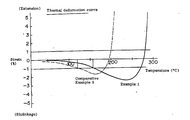
- the Figure is a graph of a thermal deformation curve drawn on the basis of the data collected at the time of determining the heat distortion initiation temperature.
- the heat resistant polyamide film of the present invention is prepared by forming a polyamide composition comprising a polyamide (A) and a semi-aromatic polyamide (B) into a film by a specific method.
- the polyamide (A) constituting the heat resistant polyamide film of the present invention is a polyamide obtained by the polycondensation of diaminobutane and adipic acid, i.e. nylon 46.
- This polyamide has a structure in which four methylene groups (-CH2-) are regularly arranged between amide groups (-NHCO-). From this symmetrical structure and the high amide group concentration, the polyamide (A) has a high melting point and high crystallinity by itself.
- the semi-aromatic polyamide (B) constituting the heat resistant polyamide film of the present invention is a polyamide containing an aliphatic diamine and an aromatic dicarboxylic acid in an amount of from 80 to 100% by weight of the polyamide-constituting components.
- a subsidiary polyamide-constituting component constituting from 0 to 20% by weight of the polyamide-constituting components is a lactam and/or an aliphatic diamine and an aliphatic dicarboxylic acid.
- the semi-aromatic polyamide (B) is a copolyamide.
- aliphatic diamine a linear aliphatic diamine having from 2 to 12 carbon atoms such as ethylene diamine, tetramethylene diamine, hexamethylene diamine or decamethylene diamine, or a lower-alkylated (e.g. a methylated or ethylated) or halogenated derivative thereof, is employed.
- ethylene diamine tetramethylene diamine
- hexamethylene diamine or decamethylene diamine or a lower-alkylated (e.g. a methylated or ethylated) or halogenated derivative thereof.
- a lower-alkylated e.g. a methylated or ethylated
- aromatic dicarboxylic acid the one wherein the aromatic ring is a benzene ring or a naphthalene ring, or a lower-alkylated (e.g. a methylated or ethylated) or halogenated derivative thereof, preferably isophthalic acid and/or terephthalic acid, may be employed.
- a lower-alkylated e.g. a methylated or ethylated
- halogenated derivative thereof preferably isophthalic acid and/or terephthalic acid
- an intramolecular amide polymerizable by ring-opening polymerization particularly the one having from 4 to 12 carbon atoms, preferably caprolactam or lauryl lactam, may be employed.
- aliphatic dicarboxylic acid a dicarboxylic acid having from 4 to 12 carbon atoms, such as succinic acid, glutaric acid, adipic acid, pimelic acid, suberic acid, azelaic acid or sebacic acid, or a lower-alkylated (e.g. a methylated or ethylated) or halogenated derivative thereof, may be employed.
- a dicarboxylic acid having from 4 to 12 carbon atoms, such as succinic acid, glutaric acid, adipic acid, pimelic acid, suberic acid, azelaic acid or sebacic acid, or a lower-alkylated (e.g. a methylated or ethylated) or halogenated derivative thereof, may be employed.
- a lower-alkylated e.g. a methylated or ethylated
- the aliphatic diamine and the aliphatic dicarboxylic acid, or the lactam used as the subsidiary polyamide-constituting component are not particularly limited with respect to their types.
- the aliphatic diamine is preferably tetramethylene diamine or hexamethylene diamine
- the aliphatic dicarboxylic acid is preferably adipic acid
- the lactam is preferably ⁇ -caprolactam.
- a polyamide composition prepared by mixing the polyamide (A) having high crystallinity and the semi-aromatic polyamide (B) which shows no substantial crystallinity.
- the limit in the weight ratio of the polyamide (A) and the polyamide (B) varies depending upon the proportions of the components constituting the polyamide (B).
- a polyamide composition obtained by mixing means that various additives may be incorporated as the case requires in accordance with the manners commonly employed for thermoplastic resins. Accordingly, to the mixture of the polyamides (A) and (B), usual additives such as an external lubricant to stabilize the extrusion, a filler to adjust the surface roughness of the film, etc. may further be added. Of course, the formation of such a composition may be conducted during the kneading at the time of film-forming (as described in detail hereinafter).
- the polyamide composition as described above is melted and kneaded by an extruder, and then extruded by e.g. a T-die in the form of a sheet, which is then quenched on a casting roll to which quenching water is circulated.
- This process is the same as the sheeting of a usual crystalline resin, and the heating temperature of the resin is at least the melting point and less than the decomposition temperature.
- the temperature of the casting roll is lower than the glass transition temperature Tg of the resin and at least the dewpoint temperature so as to avoid the condensation of moisture in the atmosphere on the roll surface. Further, it is possible and desirable to improve the quenching effect by pinning the sheet tightly to the roll surface by an electrostatic Coulomb force by providing a wire electrode in the vicinity of the contact line where the sheet is in contact with the roll surface for the first time at the upper portion of the casting roll and applying a direct current voltage between the electrode and the roll.
- the polyamide sheet which is substantially amorphous without orientation, obtained by quenching, is then biaxially stretched at least 2.0 x 2.0 times in the longitudinal and transverse directions. If the stretching in each direction is less than 2.0 times, no adequate orientation will be imparted to the polyamide sheet, and it will be impossible to obtain a polyamide film having high heat resistance even if the temperature conditions for the subsequent heat setting are changed. Namely, to obtain a heat resistant polyamide film having a heat distortion initiation temperature of at least 130°C, stretching of at least 2.0 x 2.0 times in the longitudinal direction x the transverse direction, is essential in addition to the above-mentioned combination of the polyamides (A) and (B) and the blend ratio.
- the biaxial stretching may be conducted by simultaneous biaxial stretching in accordance with the tenter method, successive biaxial stretching in accordance with the tenter method, or simultaneous biaxial stretching in accordance with a tubular method, or any other method.
- the stretching temperature is preferably as low as possible, provided it is at least the glass transition temperature Tg of the mixture of the polyamides (A) and (B). However, if the stretching temperature is close to Tg, a high tension will be exerted due to the resiliency of the sheet, and it is practically preferred that the temperature is at a level of Tg + (5 to 100°C) to reduce the load to the stretching machinery.
- heat setting is conducted at a temperature of at least 205°C.
- the heat setting is a method which comprises applying a heat while maintaining the stretching rate and exerting the tension and which is intended to help the growth of fine crystals in the film and to maintain the stretched film in the stretched state after releasing the tension. This is a quite common method for the stretching of a crystalline resin.
- this heat treatment temperature is set at a temperature of at least 205°C. If the heat treatment is lower than this temperature, it will be difficult to obtain a polyamide film having high heat resistance.
- the heat treatment at a temperature of at least 205°C is essential in addition to the above-mentioned combination of the polyamides (A) and (B), the blending ratio thereof and the specified stretching rate.
- the upper limit of the heat treatment temperature is as high as possible, provided that it is lower than the melting point of the mixture of the polyamides (A) and (B). However, even if the temperature is lower than the melting point, partial melting is likely to be initiated. Therefore, the upper limit of the heat treatment temperature is usually at a level of Tm - (5 to 30°C).
- the polyamide film of the present invention is a film having high heat resistance, and its heat distortion initiation temperature is at least 130°C.
- the heat distortion initiation temperature is the temperature at which a distortion of ⁇ 1% takes place when a film is gradually heated in an oil bath under an elongation load in accordance with ASTM D1637-61.
- ASTM D1637-61 As mentioned above, a distortion of ⁇ 2% is specified in ASTM D1637, but the present inventors have adopted a distortion of ⁇ 1% to more severely check the quantity of the distortion and use it as an index for heat resistance.
- Other conditions such as the shape of the sample, the temperature raising speed, etc. are all the same as specified in ASTM D1637.
- the film of the present invention has excellent heat resistance which has not been observed with commercially available polyamide films, as will be shown in the Examples given hereinafter. Therefore, the film of the present invention is useful not only as a packaging material but also as an insulating material for electric appliances rotating at a high speed, or for magnetic tapes, video tapes, flexible printed circuit boards, coating material for electric wires or filtration membranes. Thus, it is very useful.
- a composition comprising 80% by weight of a nylon 46 resin ("TS400", manufactured by DSM Company, Netherlands) and 20% by weight of a semi-aromatic nylon resin "X-21", manufactured by Mitsubishi Kasei Corporation) was mixed with 0.05% by weight, based on the composition, of methylenebisamide (methylenebisstearoamide) by a V-type tumbler, and the mixture was extruded by a 40 mm extruder at a barrel temperature of 280, 295 or 305°C and a T-die at a die temperature of 305°C in the form of a sheet, which was then wound up while being quenched by a casting roll to which quenching water of 25°C was circulated.
- methylenebisamide methylenebisstearoamide
- a tungsten wire having a diameter of 0.1 mm was extended at a position 10 mm above the position (the contact line) at which the molten resin was in contact with the casting roll, and a voltage of 12 Kv was applied between the roll and the wire with the wire side being negative, to effect close contact by an electrostatic Coulomb force.
- the sheet peeled off from the casting roll was transparent and had a thickness of about 100 ⁇ m.
- This substantially non-stretched sheet was stretched 2.5 x 2.5 times in both the longitudinal (MD) and transverse (TD) directions at 150°C by a tenter method, then heat-set at 270°C for 20 seconds, and wound up to obtain a film having a thickness of 15 ⁇ m.
- a film was prepared in the same manner as in Example 1 except that 90% by weight of the nylon 46 resin and 10% by weight of the semi-aromatic nylon resin were mixed.
- the hydrothermal shrinkage and the heat distortion initiation temperature of this film are shown in Table 1.
- a film was prepared in the same manner as in Example 1 except that 95% by weight of the nylon 46 resin and 5% by weight of the semi-aromatic nylon resin were mixed.
- the hydrothermal shrinkage and the heat distortion initiation temperature of this film are shown in Table 1.
- a film was prepared in the same manner as in Example 1 except that 20% by weight of the nylon 46 resin and 80% by weight of the semi-aromatic nylon resin were used.
- a film was prepared in the same manner as in Example 1 except that the stretching rate was changed to 2.0 x 2.0 times.
- a film was prepared in the same manner as in Example 1 except that the stretching rate was changed to 3.0 x 3.0 times.
- a film was prepared in the same manner as in Example 1 except that the stretching rate was changed to 2.0 x 2.0 times and the heat setting temperature was changed to 230°C.
- a film was prepared in the same manner as in Example 1 except that the stretching rate was changed to 2.0 x 2.0 times and the heat setting temperature was changed to 180°C.
- Nylon 6 resin (“Novamid 1022CMK” manufactured by Mitsubishi Kasei Corporation) was extruded by a 40 mm extruder at a barrel temperature of 190, 220 or 240°C and a T-die having a die temperature of 240°C, in the form of a sheet, which was wound up under quenching on a casting roll to which quenching water of 25°C was circulated. Then, in the same manner as in Example 1, the film was closely in contact with the casting roll by the electrostatic Coulomb force. The sheet peeled off from the casting roll, was transparent and had a thickness of about 150 ⁇ m.
- This substantially non-stretched sheet was stretched 3.2 x 3.2 times in the longitudinal and transverse direction at 70°C by a tenter method, then heat-set at 195°C for 20 seconds and wound up to obtain a film having a thickness of 15 ⁇ m.
Landscapes
- Chemical & Material Sciences (AREA)
- Engineering & Computer Science (AREA)
- Manufacturing & Machinery (AREA)
- Materials Engineering (AREA)
- Health & Medical Sciences (AREA)
- Chemical Kinetics & Catalysis (AREA)
- Medicinal Chemistry (AREA)
- Polymers & Plastics (AREA)
- Organic Chemistry (AREA)
- Shaping By String And By Release Of Stress In Plastics And The Like (AREA)
- Manufacture Of Macromolecular Shaped Articles (AREA)
- Compositions Of Macromolecular Compounds (AREA)
Applications Claiming Priority (2)
| Application Number | Priority Date | Filing Date | Title |
|---|---|---|---|
| JP70125/89 | 1989-03-22 | ||
| JP1070125A JP2718749B2 (ja) | 1989-03-22 | 1989-03-22 | 耐熱性ポリアミドフィルム |
Publications (2)
| Publication Number | Publication Date |
|---|---|
| EP0388942A2 true EP0388942A2 (fr) | 1990-09-26 |
| EP0388942A3 EP0388942A3 (fr) | 1990-12-05 |
Family
ID=13422516
Family Applications (1)
| Application Number | Title | Priority Date | Filing Date |
|---|---|---|---|
| EP19900105385 Ceased EP0388942A3 (fr) | 1989-03-22 | 1990-03-21 | Film de polyamide résistant à la chaleur |
Country Status (3)
| Country | Link |
|---|---|
| US (1) | US5143983A (fr) |
| EP (1) | EP0388942A3 (fr) |
| JP (1) | JP2718749B2 (fr) |
Cited By (5)
| Publication number | Priority date | Publication date | Assignee | Title |
|---|---|---|---|---|
| WO2001025311A1 (fr) * | 1999-10-05 | 2001-04-12 | Dsm N.V. | Copolyamide a base de tetramethylene terephthalamide et hexamethylene terephthalamide |
| US6743849B2 (en) | 2000-07-06 | 2004-06-01 | Dsm Jsr Engineering Plastics Kabushiki Kaisha | Thermoplastic resin composition |
| WO2009060480A1 (fr) * | 2007-11-06 | 2009-05-14 | Agriplast S.R.L. | Film de protection comportant une ou plusieurs couches de polyamide et s'utilisant dans l'agriculture pour former une isolation thermique et une barrière contre les pesticides, et procédé de production correspondant |
| EP2431419A1 (fr) * | 2011-06-21 | 2012-03-21 | DSM IP Assets B.V. | Composition de polyamide résistant au jaunissement |
| US9610794B2 (en) | 2012-12-27 | 2017-04-04 | Samsung Sdi Co., Ltd. | Thermal transfer film, and organic electroluminescent device prepared using same |
Families Citing this family (8)
| Publication number | Priority date | Publication date | Assignee | Title |
|---|---|---|---|---|
| JP2616711B2 (ja) * | 1994-09-14 | 1997-06-04 | 東レ株式会社 | 磁気記録媒体 |
| JPH09300456A (ja) * | 1996-05-09 | 1997-11-25 | Toray Ind Inc | ポリアミドシートおよびその製造方法 |
| JP2000006341A (ja) * | 1998-06-19 | 2000-01-11 | Toyobo Co Ltd | ガスバリア性積層フィルム |
| CA2386717A1 (fr) * | 2001-05-21 | 2002-11-21 | Kuraray Co., Ltd. | Composition a base de polyamide |
| JP4619767B2 (ja) * | 2004-12-17 | 2011-01-26 | 積水化成品工業株式会社 | 熱成形品の製造方法 |
| FR2933414B1 (fr) * | 2008-07-07 | 2010-08-13 | Arkema France | Polyamide, composition comprenant un tel polyamide et leurs utilisations |
| CN102282201B (zh) * | 2009-01-16 | 2015-03-11 | 帝斯曼知识产权资产管理有限公司 | 透明的膜 |
| CN108878745A (zh) * | 2017-05-12 | 2018-11-23 | 住友化学株式会社 | 非水电解液二次电池间隔件用多孔层及非水电解液二次电池用层叠间隔件 |
Family Cites Families (7)
| Publication number | Priority date | Publication date | Assignee | Title |
|---|---|---|---|---|
| US4120928A (en) * | 1976-04-19 | 1978-10-17 | Toyo Boseki Kabushiki Kaisha | Production of biaxially stretched film of polyamide blend |
| JPS536355A (en) * | 1976-07-07 | 1978-01-20 | Toray Ind Inc | Polyamide films |
| JPS60220731A (ja) * | 1984-04-17 | 1985-11-05 | Unitika Ltd | ポリアミドフィルムおよびその製造方法 |
| NL8602729A (nl) * | 1986-10-30 | 1988-05-16 | Stamicarbon | Copolyamide en een werkwijze voor de bereiding ervan. |
| JPH01131275A (ja) * | 1987-11-16 | 1989-05-24 | Mitsui Petrochem Ind Ltd | ポリアミド組成物 |
| DE3823803A1 (de) * | 1988-07-14 | 1990-01-18 | Basf Ag | Thermoplastische formmassen auf der basis von polyamidmischungen |
| JP2001332978A (ja) * | 2000-05-18 | 2001-11-30 | Sony Corp | データストリーム変換装置とその方法、可変長符号化データストリーム生成装置とその方法、および、カメラシステム |
-
1989
- 1989-03-22 JP JP1070125A patent/JP2718749B2/ja not_active Expired - Lifetime
-
1990
- 1990-03-21 EP EP19900105385 patent/EP0388942A3/fr not_active Ceased
-
1991
- 1991-09-06 US US07/758,511 patent/US5143983A/en not_active Expired - Fee Related
Cited By (9)
| Publication number | Priority date | Publication date | Assignee | Title |
|---|---|---|---|---|
| WO2001025311A1 (fr) * | 1999-10-05 | 2001-04-12 | Dsm N.V. | Copolyamide a base de tetramethylene terephthalamide et hexamethylene terephthalamide |
| US6747120B2 (en) | 1999-10-05 | 2004-06-08 | Dsm Ip Assets B.V. | Copolyamide based on tetramethylene terephthalamide and hexamethylene terephthalamide |
| US6743849B2 (en) | 2000-07-06 | 2004-06-01 | Dsm Jsr Engineering Plastics Kabushiki Kaisha | Thermoplastic resin composition |
| WO2009060480A1 (fr) * | 2007-11-06 | 2009-05-14 | Agriplast S.R.L. | Film de protection comportant une ou plusieurs couches de polyamide et s'utilisant dans l'agriculture pour former une isolation thermique et une barrière contre les pesticides, et procédé de production correspondant |
| EP2431419A1 (fr) * | 2011-06-21 | 2012-03-21 | DSM IP Assets B.V. | Composition de polyamide résistant au jaunissement |
| WO2012175293A1 (fr) * | 2011-06-21 | 2012-12-27 | Dsm Ip Assets B.V. | Composition de polyamide anti-jaunissement |
| US9181429B2 (en) | 2011-06-21 | 2015-11-10 | Dsm Ip Assets B.V. | Anti-yellowing polyamide composition |
| TWI568793B (zh) * | 2011-06-21 | 2017-02-01 | Dsm智慧財產有限公司 | 抗黃化聚醯胺組成物 |
| US9610794B2 (en) | 2012-12-27 | 2017-04-04 | Samsung Sdi Co., Ltd. | Thermal transfer film, and organic electroluminescent device prepared using same |
Also Published As
| Publication number | Publication date |
|---|---|
| JPH02248433A (ja) | 1990-10-04 |
| EP0388942A3 (fr) | 1990-12-05 |
| US5143983A (en) | 1992-09-01 |
| JP2718749B2 (ja) | 1998-02-25 |
Similar Documents
| Publication | Publication Date | Title |
|---|---|---|
| US5143983A (en) | Heat resistant polyamide film | |
| US4120928A (en) | Production of biaxially stretched film of polyamide blend | |
| JP2000302952A (ja) | ポリエステル樹脂組成物 | |
| US4098860A (en) | Production of biaxially drawn film of polyamide blend | |
| JP6358837B2 (ja) | 半芳香族ポリアミドフィルム | |
| JPH0753737A (ja) | ポリエステル系シュリンクフィルム | |
| GB2205572A (en) | Process for the preparation of a polyphenylene sulphide resin | |
| US3449299A (en) | Manufacture of highly transparent sheets from amorphous polyamides | |
| JPH04314741A (ja) | ポリアミドフィルム | |
| US4699973A (en) | Polytetramethyleneadipamide film | |
| US4992514A (en) | Process for the production of shaped articles | |
| EP0135815A2 (fr) | Feuille de polyamide orientée en sens biaxial | |
| JPS6241261A (ja) | 熱収縮性ポリアミドフイルム | |
| JP2616221B2 (ja) | 樹脂組成物 | |
| EP0819728B1 (fr) | Feuille soufflée en polyester | |
| JP2001002800A (ja) | ガスバリヤー性ポリエステルフィルムおよびその製造方法 | |
| US4859390A (en) | Process for the production of polyamide mouldings | |
| WO1996006125A1 (fr) | Film en polyester thermofixe a etirage biaxial presentant une resistance accrue au retrait thermique | |
| KR100203526B1 (ko) | 폴리아미드 필름의 제조 방법 | |
| CN109705565B (zh) | 一种以含氟聚合物为成核剂的尼龙材料及其制备方法 | |
| CA2323204A1 (fr) | Melanges miscibles multiconstituants de nylons a proprietes ameliorees | |
| KR100213310B1 (ko) | 폴리아미드 필름 | |
| JPH0551525A (ja) | ポリアミド系樹脂組成物およびその延伸フイルム | |
| JPH02300237A (ja) | ポリアミド系フィルムまたは繊維 | |
| JP2001064415A (ja) | 滑り性の改良されたポリアミドフィルム及びその製造方法 |
Legal Events
| Date | Code | Title | Description |
|---|---|---|---|
| PUAI | Public reference made under article 153(3) epc to a published international application that has entered the european phase |
Free format text: ORIGINAL CODE: 0009012 |
|
| AK | Designated contracting states |
Kind code of ref document: A2 Designated state(s): DE FR GB NL |
|
| RAP1 | Party data changed (applicant data changed or rights of an application transferred) |
Owner name: MITSUBISHI KASEI POLYTEC COMPANY |
|
| PUAL | Search report despatched |
Free format text: ORIGINAL CODE: 0009013 |
|
| AK | Designated contracting states |
Kind code of ref document: A3 Designated state(s): DE FR GB NL |
|
| 17P | Request for examination filed |
Effective date: 19910418 |
|
| 17Q | First examination report despatched |
Effective date: 19920915 |
|
| RAP1 | Party data changed (applicant data changed or rights of an application transferred) |
Owner name: MITSUBISHI KASEI CORPORATION |
|
| STAA | Information on the status of an ep patent application or granted ep patent |
Free format text: STATUS: THE APPLICATION HAS BEEN REFUSED |
|
| 18R | Application refused |
Effective date: 19950213 |