EP0389023A2 - Structures absorbantes avec moyens de contrôle de l'odeur - Google Patents
Structures absorbantes avec moyens de contrôle de l'odeur Download PDFInfo
- Publication number
- EP0389023A2 EP0389023A2 EP90200545A EP90200545A EP0389023A2 EP 0389023 A2 EP0389023 A2 EP 0389023A2 EP 90200545 A EP90200545 A EP 90200545A EP 90200545 A EP90200545 A EP 90200545A EP 0389023 A2 EP0389023 A2 EP 0389023A2
- Authority
- EP
- European Patent Office
- Prior art keywords
- odor
- absorbent
- sheet
- topsheet
- fluid
- Prior art date
- Legal status (The legal status is an assumption and is not a legal conclusion. Google has not performed a legal analysis and makes no representation as to the accuracy of the status listed.)
- Withdrawn
Links
Images
Classifications
-
- A—HUMAN NECESSITIES
- A61—MEDICAL OR VETERINARY SCIENCE; HYGIENE
- A61F—FILTERS IMPLANTABLE INTO BLOOD VESSELS; PROSTHESES; DEVICES PROVIDING PATENCY TO, OR PREVENTING COLLAPSING OF, TUBULAR STRUCTURES OF THE BODY, e.g. STENTS; ORTHOPAEDIC, NURSING OR CONTRACEPTIVE DEVICES; FOMENTATION; TREATMENT OR PROTECTION OF EYES OR EARS; BANDAGES, DRESSINGS OR ABSORBENT PADS; FIRST-AID KITS
- A61F13/00—Bandages or dressings; Absorbent pads
- A61F13/15—Absorbent pads, e.g. sanitary towels, swabs or tampons for external or internal application to the body; Supporting or fastening means therefor; Tampon applicators
- A61F13/45—Absorbent pads, e.g. sanitary towels, swabs or tampons for external or internal application to the body; Supporting or fastening means therefor; Tampon applicators characterised by the shape
- A61F13/47—Sanitary towels, incontinence pads or napkins
- A61F13/476—Sanitary towels, incontinence pads or napkins characterised by encircling the crotch region of the undergarment, e.g. with flaps
-
- A—HUMAN NECESSITIES
- A61—MEDICAL OR VETERINARY SCIENCE; HYGIENE
- A61F—FILTERS IMPLANTABLE INTO BLOOD VESSELS; PROSTHESES; DEVICES PROVIDING PATENCY TO, OR PREVENTING COLLAPSING OF, TUBULAR STRUCTURES OF THE BODY, e.g. STENTS; ORTHOPAEDIC, NURSING OR CONTRACEPTIVE DEVICES; FOMENTATION; TREATMENT OR PROTECTION OF EYES OR EARS; BANDAGES, DRESSINGS OR ABSORBENT PADS; FIRST-AID KITS
- A61F13/00—Bandages or dressings; Absorbent pads
- A61F13/15—Absorbent pads, e.g. sanitary towels, swabs or tampons for external or internal application to the body; Supporting or fastening means therefor; Tampon applicators
-
- A—HUMAN NECESSITIES
- A61—MEDICAL OR VETERINARY SCIENCE; HYGIENE
- A61F—FILTERS IMPLANTABLE INTO BLOOD VESSELS; PROSTHESES; DEVICES PROVIDING PATENCY TO, OR PREVENTING COLLAPSING OF, TUBULAR STRUCTURES OF THE BODY, e.g. STENTS; ORTHOPAEDIC, NURSING OR CONTRACEPTIVE DEVICES; FOMENTATION; TREATMENT OR PROTECTION OF EYES OR EARS; BANDAGES, DRESSINGS OR ABSORBENT PADS; FIRST-AID KITS
- A61F13/00—Bandages or dressings; Absorbent pads
- A61F13/15—Absorbent pads, e.g. sanitary towels, swabs or tampons for external or internal application to the body; Supporting or fastening means therefor; Tampon applicators
- A61F13/51—Absorbent pads, e.g. sanitary towels, swabs or tampons for external or internal application to the body; Supporting or fastening means therefor; Tampon applicators characterised by the outer layers of the pads
- A61F13/511—Topsheet, i.e. the permeable cover or layer facing the skin
- A61F13/51104—Topsheet, i.e. the permeable cover or layer facing the skin the top sheet having a three-dimensional cross-section, e.g. corrugations, embossments, recesses or projections
-
- A—HUMAN NECESSITIES
- A61—MEDICAL OR VETERINARY SCIENCE; HYGIENE
- A61F—FILTERS IMPLANTABLE INTO BLOOD VESSELS; PROSTHESES; DEVICES PROVIDING PATENCY TO, OR PREVENTING COLLAPSING OF, TUBULAR STRUCTURES OF THE BODY, e.g. STENTS; ORTHOPAEDIC, NURSING OR CONTRACEPTIVE DEVICES; FOMENTATION; TREATMENT OR PROTECTION OF EYES OR EARS; BANDAGES, DRESSINGS OR ABSORBENT PADS; FIRST-AID KITS
- A61F13/00—Bandages or dressings; Absorbent pads
- A61F13/15—Absorbent pads, e.g. sanitary towels, swabs or tampons for external or internal application to the body; Supporting or fastening means therefor; Tampon applicators
- A61F13/51—Absorbent pads, e.g. sanitary towels, swabs or tampons for external or internal application to the body; Supporting or fastening means therefor; Tampon applicators characterised by the outer layers of the pads
- A61F13/511—Topsheet, i.e. the permeable cover or layer facing the skin
- A61F13/512—Topsheet, i.e. the permeable cover or layer facing the skin characterised by its apertures, e.g. perforations
-
- A—HUMAN NECESSITIES
- A61—MEDICAL OR VETERINARY SCIENCE; HYGIENE
- A61F—FILTERS IMPLANTABLE INTO BLOOD VESSELS; PROSTHESES; DEVICES PROVIDING PATENCY TO, OR PREVENTING COLLAPSING OF, TUBULAR STRUCTURES OF THE BODY, e.g. STENTS; ORTHOPAEDIC, NURSING OR CONTRACEPTIVE DEVICES; FOMENTATION; TREATMENT OR PROTECTION OF EYES OR EARS; BANDAGES, DRESSINGS OR ABSORBENT PADS; FIRST-AID KITS
- A61F13/00—Bandages or dressings; Absorbent pads
- A61F13/15—Absorbent pads, e.g. sanitary towels, swabs or tampons for external or internal application to the body; Supporting or fastening means therefor; Tampon applicators
- A61F13/84—Accessories, not otherwise provided for, for absorbent pads
- A61F13/8405—Additives, e.g. for odour, disinfectant or pH control
-
- A—HUMAN NECESSITIES
- A61—MEDICAL OR VETERINARY SCIENCE; HYGIENE
- A61L—METHODS OR APPARATUS FOR STERILISING MATERIALS OR OBJECTS IN GENERAL; DISINFECTION, STERILISATION OR DEODORISATION OF AIR; CHEMICAL ASPECTS OF BANDAGES, DRESSINGS, ABSORBENT PADS OR SURGICAL ARTICLES; MATERIALS FOR BANDAGES, DRESSINGS, ABSORBENT PADS OR SURGICAL ARTICLES
- A61L15/00—Chemical aspects of, or use of materials for, bandages, dressings or absorbent pads
- A61L15/16—Bandages, dressings or absorbent pads for physiological fluids such as urine or blood, e.g. sanitary towels, tampons
- A61L15/42—Use of materials characterised by their function or physical properties
- A61L15/46—Deodorants or malodour counteractants, e.g. to inhibit the formation of ammonia or bacteria
-
- A—HUMAN NECESSITIES
- A61—MEDICAL OR VETERINARY SCIENCE; HYGIENE
- A61F—FILTERS IMPLANTABLE INTO BLOOD VESSELS; PROSTHESES; DEVICES PROVIDING PATENCY TO, OR PREVENTING COLLAPSING OF, TUBULAR STRUCTURES OF THE BODY, e.g. STENTS; ORTHOPAEDIC, NURSING OR CONTRACEPTIVE DEVICES; FOMENTATION; TREATMENT OR PROTECTION OF EYES OR EARS; BANDAGES, DRESSINGS OR ABSORBENT PADS; FIRST-AID KITS
- A61F13/00—Bandages or dressings; Absorbent pads
- A61F13/15—Absorbent pads, e.g. sanitary towels, swabs or tampons for external or internal application to the body; Supporting or fastening means therefor; Tampon applicators
- A61F13/56—Supporting or fastening means
- A61F13/58—Adhesive tab fastener elements
-
- A—HUMAN NECESSITIES
- A61—MEDICAL OR VETERINARY SCIENCE; HYGIENE
- A61F—FILTERS IMPLANTABLE INTO BLOOD VESSELS; PROSTHESES; DEVICES PROVIDING PATENCY TO, OR PREVENTING COLLAPSING OF, TUBULAR STRUCTURES OF THE BODY, e.g. STENTS; ORTHOPAEDIC, NURSING OR CONTRACEPTIVE DEVICES; FOMENTATION; TREATMENT OR PROTECTION OF EYES OR EARS; BANDAGES, DRESSINGS OR ABSORBENT PADS; FIRST-AID KITS
- A61F13/00—Bandages or dressings; Absorbent pads
- A61F13/15—Absorbent pads, e.g. sanitary towels, swabs or tampons for external or internal application to the body; Supporting or fastening means therefor; Tampon applicators
- A61F13/15577—Apparatus or processes for manufacturing
- A61F2013/15821—Apparatus or processes for manufacturing characterized by the apparatus for manufacturing
- A61F2013/15926—Apparatus or processes for manufacturing characterized by the apparatus for manufacturing for vacuum forming
-
- A—HUMAN NECESSITIES
- A61—MEDICAL OR VETERINARY SCIENCE; HYGIENE
- A61F—FILTERS IMPLANTABLE INTO BLOOD VESSELS; PROSTHESES; DEVICES PROVIDING PATENCY TO, OR PREVENTING COLLAPSING OF, TUBULAR STRUCTURES OF THE BODY, e.g. STENTS; ORTHOPAEDIC, NURSING OR CONTRACEPTIVE DEVICES; FOMENTATION; TREATMENT OR PROTECTION OF EYES OR EARS; BANDAGES, DRESSINGS OR ABSORBENT PADS; FIRST-AID KITS
- A61F13/00—Bandages or dressings; Absorbent pads
- A61F13/15—Absorbent pads, e.g. sanitary towels, swabs or tampons for external or internal application to the body; Supporting or fastening means therefor; Tampon applicators
- A61F13/53—Absorbent pads, e.g. sanitary towels, swabs or tampons for external or internal application to the body; Supporting or fastening means therefor; Tampon applicators characterised by the absorbing medium
- A61F2013/530007—Absorbent pads, e.g. sanitary towels, swabs or tampons for external or internal application to the body; Supporting or fastening means therefor; Tampon applicators characterised by the absorbing medium being made from pulp
-
- A—HUMAN NECESSITIES
- A61—MEDICAL OR VETERINARY SCIENCE; HYGIENE
- A61F—FILTERS IMPLANTABLE INTO BLOOD VESSELS; PROSTHESES; DEVICES PROVIDING PATENCY TO, OR PREVENTING COLLAPSING OF, TUBULAR STRUCTURES OF THE BODY, e.g. STENTS; ORTHOPAEDIC, NURSING OR CONTRACEPTIVE DEVICES; FOMENTATION; TREATMENT OR PROTECTION OF EYES OR EARS; BANDAGES, DRESSINGS OR ABSORBENT PADS; FIRST-AID KITS
- A61F13/00—Bandages or dressings; Absorbent pads
- A61F13/15—Absorbent pads, e.g. sanitary towels, swabs or tampons for external or internal application to the body; Supporting or fastening means therefor; Tampon applicators
- A61F13/53—Absorbent pads, e.g. sanitary towels, swabs or tampons for external or internal application to the body; Supporting or fastening means therefor; Tampon applicators characterised by the absorbing medium
- A61F2013/530481—Absorbent pads, e.g. sanitary towels, swabs or tampons for external or internal application to the body; Supporting or fastening means therefor; Tampon applicators characterised by the absorbing medium having superabsorbent materials, i.e. highly absorbent polymer gel materials
-
- A—HUMAN NECESSITIES
- A61—MEDICAL OR VETERINARY SCIENCE; HYGIENE
- A61F—FILTERS IMPLANTABLE INTO BLOOD VESSELS; PROSTHESES; DEVICES PROVIDING PATENCY TO, OR PREVENTING COLLAPSING OF, TUBULAR STRUCTURES OF THE BODY, e.g. STENTS; ORTHOPAEDIC, NURSING OR CONTRACEPTIVE DEVICES; FOMENTATION; TREATMENT OR PROTECTION OF EYES OR EARS; BANDAGES, DRESSINGS OR ABSORBENT PADS; FIRST-AID KITS
- A61F13/00—Bandages or dressings; Absorbent pads
- A61F13/15—Absorbent pads, e.g. sanitary towels, swabs or tampons for external or internal application to the body; Supporting or fastening means therefor; Tampon applicators
- A61F13/53—Absorbent pads, e.g. sanitary towels, swabs or tampons for external or internal application to the body; Supporting or fastening means therefor; Tampon applicators characterised by the absorbing medium
- A61F2013/530481—Absorbent pads, e.g. sanitary towels, swabs or tampons for external or internal application to the body; Supporting or fastening means therefor; Tampon applicators characterised by the absorbing medium having superabsorbent materials, i.e. highly absorbent polymer gel materials
- A61F2013/530569—Absorbent pads, e.g. sanitary towels, swabs or tampons for external or internal application to the body; Supporting or fastening means therefor; Tampon applicators characterised by the absorbing medium having superabsorbent materials, i.e. highly absorbent polymer gel materials characterized by the particle size
-
- A—HUMAN NECESSITIES
- A61—MEDICAL OR VETERINARY SCIENCE; HYGIENE
- A61F—FILTERS IMPLANTABLE INTO BLOOD VESSELS; PROSTHESES; DEVICES PROVIDING PATENCY TO, OR PREVENTING COLLAPSING OF, TUBULAR STRUCTURES OF THE BODY, e.g. STENTS; ORTHOPAEDIC, NURSING OR CONTRACEPTIVE DEVICES; FOMENTATION; TREATMENT OR PROTECTION OF EYES OR EARS; BANDAGES, DRESSINGS OR ABSORBENT PADS; FIRST-AID KITS
- A61F13/00—Bandages or dressings; Absorbent pads
- A61F13/15—Absorbent pads, e.g. sanitary towels, swabs or tampons for external or internal application to the body; Supporting or fastening means therefor; Tampon applicators
- A61F13/53—Absorbent pads, e.g. sanitary towels, swabs or tampons for external or internal application to the body; Supporting or fastening means therefor; Tampon applicators characterised by the absorbing medium
- A61F2013/530481—Absorbent pads, e.g. sanitary towels, swabs or tampons for external or internal application to the body; Supporting or fastening means therefor; Tampon applicators characterised by the absorbing medium having superabsorbent materials, i.e. highly absorbent polymer gel materials
- A61F2013/5307—Absorbent pads, e.g. sanitary towels, swabs or tampons for external or internal application to the body; Supporting or fastening means therefor; Tampon applicators characterised by the absorbing medium having superabsorbent materials, i.e. highly absorbent polymer gel materials characterized by the quantity or ratio of superabsorbent material
-
- A—HUMAN NECESSITIES
- A61—MEDICAL OR VETERINARY SCIENCE; HYGIENE
- A61F—FILTERS IMPLANTABLE INTO BLOOD VESSELS; PROSTHESES; DEVICES PROVIDING PATENCY TO, OR PREVENTING COLLAPSING OF, TUBULAR STRUCTURES OF THE BODY, e.g. STENTS; ORTHOPAEDIC, NURSING OR CONTRACEPTIVE DEVICES; FOMENTATION; TREATMENT OR PROTECTION OF EYES OR EARS; BANDAGES, DRESSINGS OR ABSORBENT PADS; FIRST-AID KITS
- A61F13/00—Bandages or dressings; Absorbent pads
- A61F13/15—Absorbent pads, e.g. sanitary towels, swabs or tampons for external or internal application to the body; Supporting or fastening means therefor; Tampon applicators
- A61F13/84—Accessories, not otherwise provided for, for absorbent pads
- A61F13/8405—Additives, e.g. for odour, disinfectant or pH control
- A61F2013/8408—Additives, e.g. for odour, disinfectant or pH control with odour control
- A61F2013/8414—Additives, e.g. for odour, disinfectant or pH control with odour control with anti-microbic
-
- A—HUMAN NECESSITIES
- A61—MEDICAL OR VETERINARY SCIENCE; HYGIENE
- A61F—FILTERS IMPLANTABLE INTO BLOOD VESSELS; PROSTHESES; DEVICES PROVIDING PATENCY TO, OR PREVENTING COLLAPSING OF, TUBULAR STRUCTURES OF THE BODY, e.g. STENTS; ORTHOPAEDIC, NURSING OR CONTRACEPTIVE DEVICES; FOMENTATION; TREATMENT OR PROTECTION OF EYES OR EARS; BANDAGES, DRESSINGS OR ABSORBENT PADS; FIRST-AID KITS
- A61F13/00—Bandages or dressings; Absorbent pads
- A61F13/15—Absorbent pads, e.g. sanitary towels, swabs or tampons for external or internal application to the body; Supporting or fastening means therefor; Tampon applicators
- A61F13/84—Accessories, not otherwise provided for, for absorbent pads
- A61F13/8405—Additives, e.g. for odour, disinfectant or pH control
- A61F2013/8408—Additives, e.g. for odour, disinfectant or pH control with odour control
- A61F2013/842—Additives, e.g. for odour, disinfectant or pH control with odour control with active charcoal
-
- A—HUMAN NECESSITIES
- A61—MEDICAL OR VETERINARY SCIENCE; HYGIENE
- A61F—FILTERS IMPLANTABLE INTO BLOOD VESSELS; PROSTHESES; DEVICES PROVIDING PATENCY TO, OR PREVENTING COLLAPSING OF, TUBULAR STRUCTURES OF THE BODY, e.g. STENTS; ORTHOPAEDIC, NURSING OR CONTRACEPTIVE DEVICES; FOMENTATION; TREATMENT OR PROTECTION OF EYES OR EARS; BANDAGES, DRESSINGS OR ABSORBENT PADS; FIRST-AID KITS
- A61F13/00—Bandages or dressings; Absorbent pads
- A61F13/15—Absorbent pads, e.g. sanitary towels, swabs or tampons for external or internal application to the body; Supporting or fastening means therefor; Tampon applicators
- A61F13/84—Accessories, not otherwise provided for, for absorbent pads
- A61F13/8405—Additives, e.g. for odour, disinfectant or pH control
- A61F2013/8408—Additives, e.g. for odour, disinfectant or pH control with odour control
- A61F2013/8423—Additives, e.g. for odour, disinfectant or pH control with odour control with molecular sieves; zeolites
-
- A—HUMAN NECESSITIES
- A61—MEDICAL OR VETERINARY SCIENCE; HYGIENE
- A61F—FILTERS IMPLANTABLE INTO BLOOD VESSELS; PROSTHESES; DEVICES PROVIDING PATENCY TO, OR PREVENTING COLLAPSING OF, TUBULAR STRUCTURES OF THE BODY, e.g. STENTS; ORTHOPAEDIC, NURSING OR CONTRACEPTIVE DEVICES; FOMENTATION; TREATMENT OR PROTECTION OF EYES OR EARS; BANDAGES, DRESSINGS OR ABSORBENT PADS; FIRST-AID KITS
- A61F13/00—Bandages or dressings; Absorbent pads
- A61F13/15—Absorbent pads, e.g. sanitary towels, swabs or tampons for external or internal application to the body; Supporting or fastening means therefor; Tampon applicators
- A61F13/84—Accessories, not otherwise provided for, for absorbent pads
- A61F13/8405—Additives, e.g. for odour, disinfectant or pH control
- A61F2013/8408—Additives, e.g. for odour, disinfectant or pH control with odour control
- A61F2013/8426—Additives, e.g. for odour, disinfectant or pH control with odour control with metallic salts
-
- A—HUMAN NECESSITIES
- A61—MEDICAL OR VETERINARY SCIENCE; HYGIENE
- A61L—METHODS OR APPARATUS FOR STERILISING MATERIALS OR OBJECTS IN GENERAL; DISINFECTION, STERILISATION OR DEODORISATION OF AIR; CHEMICAL ASPECTS OF BANDAGES, DRESSINGS, ABSORBENT PADS OR SURGICAL ARTICLES; MATERIALS FOR BANDAGES, DRESSINGS, ABSORBENT PADS OR SURGICAL ARTICLES
- A61L2300/00—Biologically active materials used in bandages, wound dressings, absorbent pads or medical devices
- A61L2300/10—Biologically active materials used in bandages, wound dressings, absorbent pads or medical devices containing or releasing inorganic materials
- A61L2300/102—Metals or metal compounds, e.g. salts such as bicarbonates, carbonates, oxides, zeolites, silicates
-
- A—HUMAN NECESSITIES
- A61—MEDICAL OR VETERINARY SCIENCE; HYGIENE
- A61L—METHODS OR APPARATUS FOR STERILISING MATERIALS OR OBJECTS IN GENERAL; DISINFECTION, STERILISATION OR DEODORISATION OF AIR; CHEMICAL ASPECTS OF BANDAGES, DRESSINGS, ABSORBENT PADS OR SURGICAL ARTICLES; MATERIALS FOR BANDAGES, DRESSINGS, ABSORBENT PADS OR SURGICAL ARTICLES
- A61L2300/00—Biologically active materials used in bandages, wound dressings, absorbent pads or medical devices
- A61L2300/10—Biologically active materials used in bandages, wound dressings, absorbent pads or medical devices containing or releasing inorganic materials
- A61L2300/108—Elemental carbon, e.g. charcoal
-
- A—HUMAN NECESSITIES
- A61—MEDICAL OR VETERINARY SCIENCE; HYGIENE
- A61L—METHODS OR APPARATUS FOR STERILISING MATERIALS OR OBJECTS IN GENERAL; DISINFECTION, STERILISATION OR DEODORISATION OF AIR; CHEMICAL ASPECTS OF BANDAGES, DRESSINGS, ABSORBENT PADS OR SURGICAL ARTICLES; MATERIALS FOR BANDAGES, DRESSINGS, ABSORBENT PADS OR SURGICAL ARTICLES
- A61L2300/00—Biologically active materials used in bandages, wound dressings, absorbent pads or medical devices
- A61L2300/40—Biologically active materials used in bandages, wound dressings, absorbent pads or medical devices characterised by a specific therapeutic activity or mode of action
- A61L2300/404—Biocides, antimicrobial agents, antiseptic agents
Definitions
- the present invention relates to absorbent structures, such as catamenials, diapers, bandages, adult incontinence garments, and the like, which comprise a "non-stain" topsheet and an odor-control material.
- Disposable products of this type generally comprise some sort of fluid-permeable topsheet material, an absorbent core, and a fluid-impermeable backsheet material.
- Various shapes, sizes and thicknesses of such articles have been explored in an attempt to make their use more comfortable and convenient.
- topsheet materials to replace the old style gauze topsheets.
- such topsheet materials are designed to provide quick passage of the discharged fluids through the topsheet and into the absorbent core.
- Certain topsheets are designed to prevent rewet caused by passage of fluid back through the topsheet, and this adds considerably to consumer comfort.
- topsheet materials which do not, themselves, absorb fluids, a clean, comfortable and sanitary surface is always presented to the discharge point of the body fluid.
- odor-controlling agent in a form which would be amenable to fabrication into absorbent structures without the aforementioned manufacturing difficulties.
- One method would be to combine the odor-controlling agent into a separate sheet of material and place that sheet under the topsheet so that the discharged fluid quickly comes in contact with the sheet containing the odor-controlling agent immediately after passage through the topsheet.
- placing said continuous sheet of material between the topsheet and the absorbent core can undesirably affect the acquisition of fluid by the core.
- the present invention provides a means for overcoming these difficulties by providing the odor-controlling agent in the form of discontinuous pieces, strips, or the like, rather than as a single continuous sheet underlying a nonstain topsheet.
- the present invention provides not only a simplified means for manufacturing absorbent structures having odor-control properties without the difficulties associated with dustiness and drying, and fluid acquisition, noted hereinabove, but also retains the pleasant aesthetic properties afforded by the topsheet.
- J63224734-A (88.09.19) Priority 87JP-058738 (87.03.16) J63224734 ASK KK relates to a paper comprising a powder or fiber obtained by grinding sepiolite, said paper having deodorizing capacity.
- Japanese J63242261-A (88.10.07) 87JP-076111 J63242261 ASK KK relates to an odor-absorbing mat with sepiolite powder, a nonwoven fabric layer, and what appears to be a sheet to which the sepiolite is attached by adhesive.
- U.S. 2,690,415 (9/28/54) by F. A. Shuler teaches particles of odor-absorbing materials uniformly affixed at the interstices of a permeable web by adhesive to provide an odor absorbent medium for, e.g., catamenials. Particulate carbon, silica gel and activated alumina are noted. Shifting/displacement of the particulates is assertedly avoided and the sheet is flexible.
- J87019865 teaches the manufacture of powder (including zeolites) sheets by laminating the powder between a first and second sheet. Powders include activated carbon, zeolite, etc. The abstract indicates use in catamenials or deodorizing materials.
- BE-815446 (Abstract) teaches sanitary towels with chlorophyll crystals or activated carbon, either in the absorbent layer, on the surface, or (per abstract) between.
- ABSCENTS odor-control molecular sieve from Union Carbide
- the present invention relates to absorbent structures, comprising:
- the odor-controlling agent used herein is an antibacterial compound.
- the odor-controlling agent is a water-insoluble particulate odor-absorbing material, or said particulate material in combination with an antibacterial compound.
- Such particulate odor-controlling agents include, for example, members selected from the group consisting of carbon, silica gel, zeolite (or, "molecular sieve"), activated alumina, and mixtures thereof.
- the structures herein have a front face film which comprises a "tapered capillary" sheet (as described more fully, hereinafter).
- Sanitary products made from such structures include adult incontinence garments, absorbent pads (e.g., bed pads), pantiliners, catamenials and diapers, and also include bandages, foot pads, and the like.
- the structures herein have a front face film which comprises a "formed-film” sheet (as described more fully hereinafter).
- Sanitary products of the same type noted above can be prepared from such absorbent structures, including adult incontinence garments, absorbent pads, pantiliners, diapers and, most particularly, catamenials (sanitary napkins).
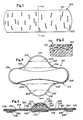
- a highly preferred sanitary napkin is depicted in Figure 3.
- the front-face (or, "topsheet") material used herein is a "nonstaining" hydrophobic, fluid-permeable sheet.
- Hydrophobic sheet materials of the type typically employed in the practice of this invention can be prepared by methods well-described in the patent literature. For example, according to the process of U.S. Patent 4,324,246, Mullane and Smith, April 13, 1982, a sample of thermoplastic material such as 0.0038 cm thick polyethylene film is heated above its softening point. (The softening point is the temperature at which the thermoplastic material can be formed or molded and is less than the melting point of the material.) The heated thermoplastic material in sheet form is then brought into contact with a heated forming screen.
- the forming screen is preferably an apertured wire mesh screen having the desired aperture size, pattern and configuration.
- a vacuum is used to draw the heated film against the forming screen, thereby forming the film into the desired pattern and having the desired hole sizes. While the vacuum is still being applied to the film, a jet of hot air is passed over the film. The hot air jet perforates the film in a pattern corresponding to the pattern and size of apertures in the forming screen.
- Fluid-permeable sheets prepared in the manner of the Mullane et al patent are conveniently referred to as "formed films".
- the caliper of such films is important since, if the caliper is too great, liquid may accumulate in the apertures and not readily pass therethrough.
- the sheets typically have a caliper of less than about 0.075 cm, or preferably less than about 0.064 cm.
- Another formed-film sheet material useful herein is the resilient, 3-dimensional web exhibiting a fiber-like appearance and tactile impression, comprising a fluid-impervious plastic material, with said web having a multiplicity of apertures, the apertures being defined by a multiplicity of intersecting fiber-like elements, all as disclosed in U.S. Patent 4,342,314, Radel and Thompson, August 3, 1982.
- the Radel and Thompson sheet materials can be prepared using hydrophobic plastics such as polyethylene, polypropylene, PVC, and the like, and are well-known for use in absorbent products such as catamenials, and the like.
- tapered capillaries are in the form of a frustrum of a conical surface, but it is to be understood that any generally tapered structure, such as a frustrum of a pyramid or the like with a triangular, square, or polygonal base, is within the term "tapered caplllary"; circular tapered capillaries, however, are used in this description for convenience.
- the tapered capillaries can be asymmetric (i.e., the angle of taper on one side can be different from that on another side) and that the angle of taper can change continuously (i.e., be curved) over the distance from base to apex.
- the angle of taper is defined as the angle of the tangent to the side of the capillary at its point of minimum apex opening dimension.
- the angle of taper suitable for use in topsheets according to the practice of this invention is from about 10° to about 60°.
- Base opening dimension of the capillaries is defined as the maximum open measurement in the plane of topsheet at said tapered capillary.
- Apex opening dimension is defined as the maximum open measurement in the apex of said tapered capillary, which apex is remote from the plane of the topsheet.
- the base and apex opening dimensions are, respectively, the base diameter and the apex diameter.
- Base diameter and apex diameter are hereinafter used interchangeably with, respectively, base opening dimension and apex opening dimension.
- the tapered capillary apex diameter is a diameter which will allow liquid to readily pass from the surface of the topsheet to the underlying absorbent core.
- the apex diameter is from about 0.004 to about 0.100 inch (0.010 to 0.254 centimeter), preferably from about 0.005 to about 0.020 inch (0.013 to 0.051 centimeter).
- the tapered capillary base diameter is selected to satisfy two criteria.
- the first of these is the subjective feel of the surface of the topsheet which contacts the skin of the user. It has been discovered that polyethylene can be made to exhibit pleasing, clothlike, non-waxy attributes when the base diameter is within the range from about 0.006 to about 0.250 inch (0.015 to 0.635 centimeter). Preferably, the base diameter should be within the range of from about 0.030 to about 0.060 inch (0.076 to 0.152 centimeter).
- the second criterion is that the capillary base diameter be small enough to allow an expected liquid droplet to bridge across at least one capillary. This criterion is satisfied by the above dimensions for disposable diapers and sanitary items.
- the height of the tapered capillary is defined as the distance between the outermost surface of the topsheet (i.e., that surface which normally contacts the skin of the user) and the apex of the tapered caplllary. This height, of course, depends upon apex diameter, base diameter, and angle of taper which have been selected as hereinbefore described.
- the height of the tapered capillary should provide a structure with a minimum tendency to collapse in use. The characteristics of the material of construction of the topsheet in large measure determine suitable ranges for the height.
- the height of the tapered capillary can be from about 0.003 to about 0.159 inch (0.008 to 0.404 centimeter).
- a state of relative dryness on the surface of the topsheet implies that most of the liquid which contacts the topsheet is transferred through it to the absorbent element. This in turn implies that each isolated droplet of fluid in contact with the topsheet must be in contact with the base diameter of a tapered capillary.
- This state of affairs can best be achieved if the land area (the area of the topsheet that exists between the bases of the tapered capillaries) is maintained at a minimum.
- the minimum limiting value is the case where conical tapered capillaries or pyramidal tapered capillaries are provided in close packed array (where the periphery of the base of each capillary is in contact on all sides with the periphery of the base of adjacent capillaries).
- the preferred arrangement of minimum land area tends to insure that an individual droplet will contact at least one tapered capillary.
- a preferred arrangement in disposable diapers is where the tapered capillaries as hereinbefore described are in ordered arrangement with from about 30 to about 1500 tapered capillaries per square inch of topsheet (5 to 231 per square centimeter).
- Tapered capillary sheets can be manufactured in any of several ways well known in the art.
- One particularly suitable method is to provide a heated mold with male elements of the shape and arrangement of the desired tapered capillaries (hereinafter a pin mold). Each male element is secured in such a fashion that its apex extends away from the base of the pin mold.
- a portion of sheet material is brought into contact with the heated pin mold between the mold and a resilient backing plate.
- Pressure is applied to the combination of mold, sheet and resilient back plate and tapered capillaries are formed in the sheet to make the tapered capillary topsheet.
- An alternate way of constructing the topsheet is to subject a portion of liquid-impervious material to vacuum forming over an appropriate mold.
- the sheets provided by U.S. Patent 4,463,045 are designed not only to provide a desirable cloth-like tactile impression, but also to substantially eliminate surface gloss.
- sheets made of plastic do not have an undesirably shiny, "plasticky” appearance.
- Such highly-preferred sheet materials can be succinctly described as being a macroscopically expanded three-dimensional plastic "web" having at least one visible surface which appears substantially nonglossy when exposed to light, substantially all of said visible surface exhibiting a regularly spaced, microscopic pattern of discrete surface aberrations, each of said surface aberrations having its amplitude oriented perpendicular to the surface in which said surface aberration originates, each of said surface aberrations having a maximum dimension of less than about 6 mils, as measured in a plane oriented substantially perpendicular to its amplitude, whereby said surface aberrations are not discernible to the normal naked eye when the perpendicular distance between the viewer's eye and the plane of said web is at least about 12 inches, each of said surface aberrations also being free of planar areas which are large enough to inscribe a 4 mil diameter circle and so spaced relative to all adjacent surface aberrations that the maximum diameter of any circle which can be inscribed on any planar surface intermediate said surface aberration
- the 045 sheet materials can have at least a portion of said surface aberrations comprising protuberances projecting generally outwardly from the surface, and can have at least a portion of said surface aberrations comprising depressions projecting generally inwardly from the surface of said web.
- the woven mesh support structure which directly contacts the visible surface of said sheet is comprised of filaments having a diameter between about one and about two mils and a mesh count between about 160 filaments per lineal inch (2.54 cms) by 160 filaments per lineal inch (2.54 cms) and about 400 filaments per lineal inch (2.54 cms) by 400 filaments per lineal inch (2.54 cms).
- Preferred sheets herein are those wherein said surface aberrations have an average amplitude of at least about 0.2 mils, more preferably at least about 0.3 mils. Most preferably, sheets having an amplitude of each of said surface aberrations, as measured perpendicular to the surface in which said surface aberration originates, within the range of about ⁇ 20%, desirably ⁇ 10%, of the average value of the amplitude for all adjacent surface aberrations are used.
- the "sheet” or “film” materials used in the practice of this invention are substantially different from fibrous nonwoven materials, which are characterized by a large number of fibers which overlap each other throughout the thickness of the material.
- the sheets used in the practice of this invention are made from materials (preferably, hydrophobic thermoplastic polymeric materials) which provide a clean-appearing, stain-resistant or “non-staining" surface, in use.
- a synthetic menstrual fluid is prepared by adding approximately 15 grams of the pulp from oranges to 100 mililiters of a 9% sodium chloride solution and blending for about 1 minute. Four grams of crystalline bovine albumin are dissolved in the sodium chloride solution and 33 milliliters of whole blood together with 25 grams of egg white are added. The mixture is stirred until it is uniform. While any synthetic menstrual fluid can be used, it is important that the fibrous and mucosal components of menses be simulated.
- a grading scale for determining the cleanliness rating of various stain-resistant sheets is prepared.
- a substrate which will retain all of the synthetic menstrual fluid placed on it is selected and several substrate samples prepared.
- a spun bonded polyester nonwoven web having a basis weight of 0.5 ounces per square yard (17 g/m2) manufactured by E. I. DuPont deNemours of Wilmington, Delaware and marketed under the tradename T-310 can be used. Varying amounts of the synthetic menstrual fluid are applied to a 2.5 x 7.6 cm rectangular portion of each substrate sample.
- multiple substrate samples can be treated with 0, 0.1, 0.25, 0.50, 1.0, 1.5, 2.0, and 4.0 milliliters of synthetic menstrual fluid.
- No absorbent core is provided beneath the substrate sample. Therefore, all the menstrual fluid placed on the substrate sample remains on the sample.
- the menstrual fluid is allowed to dry and each substrate sample is assigned a value ranging from 0 to 7, respectively.
- the sample treated with no synthetic menstrual fluid is assigned a value of zero and indicates a clean substrate while the sample treated with 4.0 ml of synthetic menstrual fluid is assigned a value of 7 and indicates a heavily soiled substrate.
- the topsheet to be tested for stain qualities is placed over, and in contact with, an absorbent core and 4.0 mls of synthetic menstrual fluid are spread over a 2.5 x 7.6 cm rectangle of the topsheet. After 60 seconds, the topsheet material is removed from the absorbent core and allowed to dry. To facilitate the even distribution of the synthetic menstrual fluid over the test rectangle, a small amount of synthetic menstrual fluid (0.2-0.3 ml) can be spread over the rectangle before the topsheet material is placed over the absorbent core.
- test topsheet material is then visually compared with the grading scale to determine its cleanliness, and can be assigned a cleanliness rating.
- the absorbent material used herein can comprise any of the well-known fluid (e.g., blood-, urine- or menses-) absorbent materials such as cotton cloth, cellulose fibers, "super absorbent” polymers, and mixtures thereof.
- fluid e.g., blood-, urine- or menses-
- absorbent materials such as cotton cloth, cellulose fibers, "super absorbent” polymers, and mixtures thereof.
- fluid-retaining cores comprising absorbent gelling materials (sometimes referred to as “super-sorbers”) are becoming broadly accepted by consumers. Such materials form hydrogels on contact with water (e.g., with urine, blood, and the like).
- absorbent gelling material is based on polyacids, especially polyacrylic acid.
- Hydrogel-forming polymeric materials of this type are those which, upon contact with fluids (i.e., liquids) such as water or body fluids, imbibe such fluids and thereby form hydrogels. In this manner, fluid discharged into the absorbent structures herein can be acquired and held.
- These preferred absorbent gelling materials will generally comprise substantially water-insoluble, slightly cross-linked, partially neutralized, hydrogel-forming polymer materials prepared from polymerizable, unsaturated, acid-containing monomers.
- the polymeric component formed from unsaturated, acid-containing monomers may comprise the entire gelling agent or may be grafted onto other types of polymer moieties such as starch or cellulose.
- Acrylic acid grafted starch materials are of this latter type.
- the preferred absorbent gelling materials include hydrolyzed acrylonitrile grafted starch, acrylic acid grafted starch, polyacrylates, maleic anhydride-based copolymers and combinations thereof.
- Especially preferred absorbent gelling materials are the polyacrylates and acrylic acid grafted starch.
- crosslinking serves to render these preferred hydrogel-forming absorbent materials substantially water-insoluble, and cross-linking also in part determines the gel volume and extractable polymer characteristics of the hydrogels formed therefrom.
- Suitable cross-linking agents include, for example, (1) compounds having at least two polymerizable double bonds; (2) compounds having at least one polymerizable double bond and at least one functional group reactive with the acid-containing monomer material; (3) compounds having at least two functional groups reactive with the acid-containing monomer material; and (4) polyvalent metal compounds which can form ionic cross-linkages.
- cross-linking agents of the foregoing types are described in greater detail in Masuda et al; U.S. Patent 4,076,663; Issued February 28, 1978.
- Preferred cross-linking agents are the di- or polyesters of unsaturated mono-or polycarboxylic acids with polyols, the bisacrylamides and the di-or triallyl amines.
- Especially preferred cross-linking agents are N,N′-methylenebisacrylamide, trimethylol propane triacrylate and triallyl amine.
- the cross-linking agent will generally comprise from about 0.001 mole percent to 5 mole percent of the preferred materials. More preferably, the cross-linking agent will comprise from about 0.01 mole percent to 3 mole percent of the absorbent gelling materials used herein.
- the preferred, slightly cross-linked, hydrogel-forming absorbent gelling materials will generally be employed in their partially neutralized form.
- such materials are considered partially neutralized when at least 25 mole percent, and preferably at least 50 mole percent of monomers used to form the polymer are acid group-containing monomers which have been neutralized with a salt-forming cation.
- Suitable salt-forming cations include alkali metal, ammonium, substituted ammonium and amines. This percentage of the total monomers utilized which are neutralized acid group-containing monomers is referred to as the "degree of neutralization.”
- commercial absorbent gelling materials have a degree of neutralization somewhat less than 90%.
- the preferred absorbent gelling materials used herein are those which have a relatively high capacity for imbibing fluids encountered in the absorbent articles; this capacity can be quantified by referencing the "gel volume" of said absorbent gelling materials.
- Gel volume can be defined in terms of the amount of synthetic urine absorbed by any given absorbent gelling agent buffer and is specified as grams of synthetic urine per gram of gelling agent.
- Gel volume in synthetic urine can be determined by forming a suspension of about 0.1-0.2 parts of dried absorbent gelling material to be tested with about 20 parts of synthetic urine. This suspension is maintained at ambient temperature under gentle stirring for about 1 hour so that swelling equilibrium is attained. The gel volume (grams of synthetic urine per gram of absorbent gelling material) is then calculated from the weight fraction of the gelling agent in the suspension and the ratio of the liquid volume excluded from the formed hydrogel to the total volume of the suspension.
- the preferred absorbent gelling materials useful in this invention will have a gel volume of from about 20 to 70 grams, more preferably from about 30 to 60 grams, of synthetic urine per gram of absorbent gelling material.
- Extractable polymer levels can be determined by contacting a sample of preferred absorbent gelling material with a synthetic urine solution for the substantial period of time (e.g., at least 16 hours) which is needed to reach extraction equilibrium, by then filtering the formed hydrogel from the supernatant liquid, and finally by then determining the polymer content of the filtrate.
- the particular procedure used to determine extractable polymer content of the preferred absorbent gelling agent buffers herein is set forth in Brandt, Goldman and Inglin; U.S. Patent 4,654,039; Issued March 31, 1987, Reissue 32,649.
- the absorbent gelling materials which are especially useful in the absorbent articles herein are those which have an equilibrium extractables content in synthetic urine of no more than about 17%, preferably no more than about 10% by weight of the absorbent gelling material.
- absorbent gelling materials hereinbefore described can be incorporated into the cores of the absorbent articles of the present invention in the form of discrete particles.
- Such absorbent gelling materials can be of any desired shape, e.g., spherical or semi-spherical, cubic, rod-like polyhedral, etc. Shapes having a large greatest dimension/smallest dimension ratio, like needles and flakes, are also contemplated for use herein. Agglomerates of absorbent gelling material particles may also be used.
- the size of the absorbent gelling material particles may vary over a wide range. For reasons of industrial hygiene, average particle sizes smaller than about 30 microns are less desirable. Particles having a smallest dimension larger than about 2 mm may also cause a feeling of grittiness in the absorbent article, which is undesirable from a consumer aesthetics standpoint. Furthermore, rate of fluid absorption can be affected by particle size. Larger particles have very much reduced rates of absorption. Preferred for use herein are absorbent gelling material particles substantially all of which have a particle size of from about 30 microns to about 2 mm. "Particle Size" as used herein means the weighted average of the smallest dimension of the individual particles.
- absorbent gelling material particles used in absorbent cores will depend upon the degree of absorbent capacity desired, and will generally comprise from about 2% to 50% by weight of the absorbent core, more typically from about 5% to 20% by weight of the absorbent core.
- such cores can be prepared by any process or technique which provides a web comprising a combination of the fibers and the gelling material particles.
- web cores can be formed by air-laying a substantially dry mixture of hydrophilic fibers and absorbent gelling material particles and, if desired or necessary, by densifying the resulting web.
- Such a procedure is described more fully in Weisman and Goldman; U.S. Patent 4,610,678; Issued September 9, 1986.
- the air-laid webs formed by such a procedure will preferably comprise substantially unbonded fibers and will preferably have a moisture content of 10% or less.
- the density of the absorbent cores which comprise webs of hydrophilic fibers and absorbent gelling material particles can be of importance in determining the absorbent properties of the cores and of the absorbent articles in which such cores are employed.
- the density of such absorbent cores herein will preferably be in the range of from about 0.06 to about 0.3 g/cm3, and more preferably within the range of from about 0.09 to about 0.22 g/cm3.
- the basis weight of the absorbent cores herein can range from about 0.02 to 0.12 g/cm2.
- Density values for cores of this type can be calculated from basis weight and caliper. Caliper is measured under a confining pressure of 0.137 psi (0.94 kPa). Density and basis weight values include the weight of the absorbent gelling materials and the odor-control material. Density of the cores herein need not be uniform throughout the core. Within the density ranges hereinbefore set forth, the cores can contain regions or zones of relatively higher or relatively lower density.
- the backing sheet is conventional, and can comprise a fluid-impervious polymer sheet, for example polyethylene or polypropylene, that is thin enough to be flexible.
- a polyethylene sheet 0.001-0.5 mm thick is typical.
- Flushable or biodegradable backing sheets can also be used, e.g., with pantiliner devices herein.
- the odor-controlling agent employed in the practice of this invention can be a water-soluble antibacterial compound.
- Such materials include, for example, halogenated phenylene compounds (U.S. Patent 3,093,546), periodic acid (U.S. Patent 3,804,094), various copper compounds, especially copper acetate (U.S. Patent 4,385,632), various quaternary ammonium salts, which are well-known for their antibacterial properties, e.g., cetyl pyridinium chloride, and the like.
- antibacterial compounds can be used conjointly with various particulate materials which, in use in the presence of moisture, release the antibacterial agent.
- Zeolite materials such as zeolites which are bactericidal by virtue of having absorbed therein and thereon various bactericidal cations such as copper, silver and zinc, can be advantageously used in the practice of this invention (U.S. Patent 4,525,410).
- the odor-controlling agent is a water-insoluble particulate odor-absorbing material such as chlorophyll particles, activated carbon granules (8-140 mesh), ion exchange resin (Japanese 87019865), activated alumina, and absorbent zeolite materials, including the well-known "molecular sieve" zeolites of the type A and X zeolites (generally in the 1-10 micron particle size range) and the zeolite materials marketed under the trade name ABSCENTS by the Union Carbide Corporation and UOP, and which are typically available as a white powder in the 3-5 micron particle size range (see: ABSCENTS, A New Approach for Odor Control by A. J. Gioffre, copyright 1988 by the Union Carbide Corporation).
- zeolite materials including the well-known "molecular sieve" zeolites of the type A and X zeolites (generally in the 1-10 micron particle size range) and the zeolite materials marketed under the trade name ABSCENT
- siliceous molecular sieves in which at least about 90, and preferably at least about 95, percent of the framework tetrahedral oxide units are SiO2 tetrahedra and which have a sorptive capacity for water at 25°C and 4.6 torr of less than 10 weight percent.
- aluminosilicate molecular sieves those preferred in the practice of this invention have a framework SiO2/Al2O3 molar ratio of from about 35 to infinity, and preferably from 200 to 500.
- Such siliceous molecular sieves have a pore diameter of at least 5.5 Angstroms, preferably at least 6.2 Angstroms.
- the adsorption capacity for water vapor at 25°C and a water vapor pressure (p/p0) of 4.6 torr is less than 6 weight percent.
- the efficacy of these preferred molecular sieves employed in the practice of the present invention is not dependent upon the presence of the water of hydration in the internal cavities of the microporous structure as a result of their hydrothermal formation. In fact, at least a major proportion, usually substantially all, of this original water of hydration is removed in the process of removing any pore-blocking templating agent which may be present in the adsorbent. Calcination effectively removes any organic moieties.
- water washing or washing with a caustic or dilute mineral acid solution is advantageously utilized to remove extraneous synthesis reactants from the pore system.
- Lowering of the alkali metal content, particularly the nonzeolitic, i.e., occluded alkali metal compounds can also be beneficial. These procedures also serve to remove the original water of hydration.
- siliceous molecular sieves include the microporous crystalline aluminosilicates, i.e., the zeolitic molecular sieves as well as the so-called silica polymorphs. With respect to the latter compositions, their crystal lattices are ideally formed entirely of SiO2 tetrahedral units, but the as-synthesized forms commonly contain at least trace amounts of aluminum derived from aluminum impurities in the synthesis reagents.
- the aluminosilicate molecular sieves comprise the large class of well-known crystalline zeolites.
- odor-controlling agents it is important that their pore system be open so that the internal cavities of the crystals be accessible to the odor molecules.
- aluminosilicates or silica polymorphs produced using large organic templating ions such as tetraalkylammonium ions, it is necessary to remove charge balancing organic ions and any occluded templating material in order to permit adsorption of the odor molecules. In such a removal process and also in the removal of inorganic debris, the original water of hydration is also removed.
- the molecular sieves Upon exposure to the atmosphere, a portion of the water of hydration is reacquired, but this does not affect the characteristics of the molecular sieves which are preferred for the practice of the present invention, i.e., the molecular sieves can be employed in either a hydrated or dehydrated state, but, in general, the dehydrated state is preferred. In the case of most of the dealumination procedures referred to above, the original water of dehydration is also removed, and can similarly be replaced, if desired, for the practice of the invention.
- Gioffre and Marcus disclose that the class of medium to large pore siliceous molecular sieves, from which the original, as-synthesized water of hydration has been substantially removed, and which have a capacity for adsorbed water of not greater than 10, and preferably not greater than 6, weight percent when measured at 25°C and a water vapor pressure (p/p0) of 4.6 torr, function in an extraordinary manner with respect to odor elimination.
- Many of the synthetic zeolites prepared using organic templating agents are readily prepared in a highly siliceous form - some even from reaction mixtures which have no intentionally added aluminum. These zeolites are markedly organophilic and include ZSM-5 (U.S. Patent 3,702,886); ZSM-11 (U.S.
- Patent 4,503,023 issued March 5, 1985 to Skeels et al.
- Halogen or halide compound treatments for zeolites to increase their hydrophobicity are disclosed in U.S. Patents 4,569,833 and 4,297,335.
- Steam-treated zeolite Y, prepared per U.S. Patent 4,331,694, and denominated "LZ-10" is a particularly useful odor-controlling agent.
- zeolite-type materials such as the manganese-aluminum-phosphorus-silicon-oxide molecular sieves described in U.S. Patent 4,793,833, Lok et al, assigned to UOP, can be used herein. See also U.S. Patents 4,604,110; 4,437,429; and 4,648,977, for other zeolitic odor-controlling compositions.
- the absorbent structures herein can optionally, but preferably, be provided with means to hold them in place on or near the user's body to allow the structures to perform their intended function.
- diapers and incontinence garments can be provided with well-known commercially-available tape fasteners.
- Sanitary napkins can be provided with glue stripes facing outward on their backsheet in well-known fashion.
- Various pins, clips and fasteners of well-known types can optionally be employed.
- the odor-control material employed in the practice of this invention is not, simply, the odor-controlling agent, per se , added to the absorbent structure. Rather, the odor-controlling agent is formed into strips, particles, or the like. In a typical method, this forming process involves combining the odor-controlling agent with a suitable carrier material, forming said agent/carrier mixture into a sheet, and then cutting, slicing or otherwise comminuting said sheet into the desired size range. The preparation of an odor-control material in this fashion is illustrated in Example I. Standard papermaking equipment is used.
- Southern Softwood Kraft (SSK) wood pulp is introduced into a papermaking apparatus (Formar, Noble & Wood Company) and passed onto the forming screen of the apparatus. While in the damp state on the forming screen, a 10% (wt.) aqueous suspension of zeolite-type molecular sieve powder (ABSCENTS; Union Carbide Corporation; 3-5 micron average particle size) is sprayed onto the damp pulp at a rate sufficient to give approximately 60% wt. (range 50-62%) ABSCENTS loading on/in the resulting sheet (dry weight basis). The pulp/ABSCENTS mix is thereafter dried (165-179°C) to provide a sheet/ABSCENTS composite which has, generally, the appearance and consistency of commercial paper toweling (caliper ca. 12 mils; basis weight range 42-55 lbs/3000 ft2) (ca. 19-25 kg/280 m2).
- the sheet prepared in the foregoing manner is thereafter comminuted to provide confetti-like pieces 3/32 in. x 5/8 in. (ca. 0.238 cm x 1.59 cm) by passing the above-prepared sheet through a commercial paper shredding machine (Ideal Paper Shredder - Trade Mark DESTROYIT, 4001 Cross-Cut).
- the resulting pieces are a preferred odor-control material employed in the practice of the present invention.
- the "confetti" pieces of odor-control material are then introduced into a fluid-retaining absorbent core which comprises a major portion of fluid-retaining material and a minor proportion of said odor-control material.
- 0.8 g of ABSCENTS-containing odor-control material (60% loading of ABSCENTS) prepared in the foregoing manner is airlaid onto and into the surface and uppermost layers of an airlaid absorbent core comprising 8.5-9.5 grams of fluid-retaining SSK air-felt.
- the core is formed as a pad (surface area 18.14 in2; 117 cm2) which is suitable for use in a sanitary napkin.
- a disposable baby diaper using the odor-control material of Example I is prepared as follows. The dimensions listed are for a diaper intended for use with a child in the 6 to 10 kilogram size range. These dimensions can be modified proportionately for different size children, or for adult incontinence briefs, according to standard practice.
- the diaper of Example II is prepared in standard fashion by positioning the core-plus-odor control material covered with the topsheet on the backsheet and gluing.
- the elastic bands are stretched to ca. 50.2 cm and positioned between the topsheet/backsheet along each longitudinal side (2 bands per side) of the core.
- the inner bands along each side are positioned ca. 55 mm from the narrowest width of the core (measured from the inner edge of the elastic band).
- This provides a spacing element along each side of the diaper comprising the flexible topsheet/backsheet material between the inner elastic and the curved edge of the core.
- the inner bands are glued down along their length in the stretched state.
- the outer bands are positioned ca 13 mm from the inner bands, and are glued down along their length in the stretched state. Since the topsheet/backsheet assembly is flexible, the glued-down bands contract to elasticize the sides of the diaper.
- FIG. 3 and 4 A catamenial product in the form of a sanitary napkin having one or, preferably, two flaps extending outward from its absorbent core is depicted in Figs. 3 and 4. A more detailed description of articles of this type appears in U.S. Patent 4,687,478, Van Tillburg, August 18, 1987.
- sanitary napkin 210 comprises an absorbent means represented by central absorbent means 212 and two flaps 224 and 224′.
- the sanitary napkins will have two flaps. While it is not necessary that the flaps be identical, or, more properly, mirror images one of the other, they preferably are.
- the description of the first will be a description of the second. Discussion of the second will, therefore, be omitted for clarity of exposition.
- Corresponding elements are indicated in the drawings by reference numerals and primed reference numerals.
- Flap 224 is associated with central absorbent means 212 along nonlinear line of juncture 226.
- nonlinear refers to any of various curved, as opposed to straight, lines.
- Flap 224 has distal edge 278 which is remote from line of juncture 226.
- line of juncture 226 is concave relative to distal edge 278. That is to say, line of juncture 226 curves away from distal edge 278.
- nonlinear lines of juncture 226 and 226′ and seam 239 define an absorbent means (central absorbent pad 212) which is narrower in its central region than at its ends. A sanitary napkin narrower in the center than at the ends is generally perceived by the user as more comfortable than a sanitary napkin of uniform width.
- Flap 224 is provided with first axis of flexibility 256 and second axis of flexibility 234.
- FIG. 4 a cross sectional view of sanitary napkin 210 taken along line 2-2, illustrates generally the preferred construction for sanitary napkin 210.
- central absorbent means 212 comprises absorbent core 200, shown curved, which corresponds to the core prepared in Example I, above.
- Central absorbent means 212 and flap 224 both comprise topsheet 214.
- Backsheet 218 is disposed on the side of absorbent core 200 and flap 224 opposite that of topsheet 214. In effect, topsheet 214 forms one surface of flap 224 while backsheet 218 forms the other surface; topsheet 214 also forms one surface of central absorbent means 212, backsheet 218 the other.
- flap absorbent core 230 is interposed between topsheet 214 and backsheet 218.
- flap absorbent core 230 extends throughout napkin 210 and is interposed between absorbent core 200 and backsheet 218. While this is a preferred embodiment primarily for reasons of construction, it is not necessary that flap absorbent core 230 be interposed between absorbent core 200 and backsheet 218.
- Topsheet 214 and backsheet 218 are joined at seam 239 around the entire periphery of sanitary napkin 210. The purpose of this seam is to unite the various elements of the sanitary napkin into a whole. Topsheet 214 is secured to flap absorbent core 230 and backsheet 218 along nonlinear lines of juncture 226 and 226′ by attachment means not illustrated in FIG. 4.
- FIG. 4 Illustrated in FIG. 4 are the adhesive attachment means at central pad adhesive 220 and flap adhesive 236 which are covered by, respectively, central pad release liner 222 and flap release liner 238. These adhesive attachment means are adapted to secure sanitary napkin 210 within the crotch region of an undergarment.
- topsheet 214 is the non-glossy, formed-film, liquid permeable sheet of U.S. Patent 4,463,045, cited hereinabove.
- Topsheet 214 is in close proximity to the skin of the user. Topsheet 214 is compliant, soft feeling and nonirritating to the user's skin.
- topsheet 214 is secured in contacting relation to absorbent core 200. This contacting relationship results in liquid penetrating topsheet 214 faster than if it were not in contact with absorbent core 200.
- Topsheet 214 can be maintained in contact with absorbent core 200 by applying adhesive, preferably in spaced, limited areas, to the inner surface of the topsheet 214.
- suitable adhesives used for this purpose include the acrylic emulsion E-1833BT manufactured by Rohm and Haas Company of Philadelphia, PA and the acrylic emulsion WB3805 manufactured by H. B. Fuller Company of St. Paul, MN. The adhesives can be applied by the same methods as the surfactant is applied to the outer surface of topsheet 214.
- absorbent core 200 is positioned between topsheet 214 and backsheet 218.
- Absorbent core 200 provides the means for absorbing menstrual fluid, and, when prepared in the manner of Example I, for controlling odor.
- Backsheet 218 is impervious to liquids and, thus, prevents menstrual fluid which may be expressed from absorbent core 200 from soiling the clothing of the user.
- the present invention also provides absorbent pads, or the like, comprising a major portion of fluid-retaining material and a minor, but odor-controlling, portion of odor-control material, said odor-control material comprising multiple pieces of comminuted sheet material containing an odor-controlling amount of an odor-controlling agent.
- such pads will comprise from about 1% to about 25%, more generally 3% to 20%, of the odor-control material, the balance comprising the fluid-retaining material.
- These proportions can vary, somewhat, depending on the nature and intensity of the odors being controlled, the specific odor-controlling agent being used, and the loading level of the odor-controlling agent. Olfactory tests can routinely be used to assist the formulator in determining the amounts to be used.
- ABSCENTS-type odor-controlling agent it is preferred to provide from about 0.5 g. to about 3 g. ABSCENTS in a typical sanitary napkin pad weighing from about 4 g. to about 12 g.
- ABSCENTS can be loaded onto a carrier substrate (sheet material) at levels as high as 50-60% to provide an odor-control material
- the amount of odor-control material to be used can be readily determined.
- losses of odor-controlling agent especially solid odor-controlling agents
- the following illustrates the formation of pads, according to the practice of this invention.
- odor-control material comprising odor-controlling agents loaded on paper are prepared, as follows. Odor-Controlling Agent Loading (% wt.) (A) Cupric Acetate 2% (B) Copper-Zeolite A (1-10 microns) 40% (C) Zinc-Zeolite A (1-10 microns) 35% (D) Periodic Acid 0.5% (E) Silica Gel 30% (F) Alumina (1-5 micron) 20% (G) Activated Carbon 12%
- the above-described odor-controlling materials A-G are each formed into absorbent pads in the manner of Example I.
- a highly absorbent, thin pad which can be used in sanitary napkins, disposable diapers, and the like, is prepared by dry-mixing the following components.
- Absorbent pads are prepared by air-laying the above mixture. Pad basis weight 390 g/m2. A hydraulic press can be used to compress the pads to a thickness, typically in the 1-5 mm range. The pads are useful as the absorbent core of thin, comfortable sanitary napkins, diapers, bed pads, and the like.
- Example V The pad of Example V is prepared, but with the SANWET being replaced by "low-extractables" polyacrylate absorbent gelling material, as disclosed by Brandt et al, U.S. Reissue Patent 32,649, cited hereinabove. ABSCENTS loading 1.4 g.
- a typical absorbent pad* suitable for use in a sanitary napkin is characterized by the following parameters. Caliper** 0.69 in. (1.75 cm) Mean Core Wt. (Total) Basis weight 713 g/m2 8.36 g. - Comprising: Dimension 7.5 in x 2.5 in (19.5 cm x 6.35 cm) i) ABSCENTS 1.27 ii) Fluff 5.60 iii) Tissue (to carry ABSCENTS; shredded) 1.49 to 8.36 g *Optionally, with surfactant spray-on **Measured at 0.13 psi (9.14 g/cm2)
- a pantiliner suitable for use between menstrual periods, and which can be disposed of in a toilet comprises a pad according to Example V, interposed between the topsheet of U.S. Patent 4,463,045 and a fibrous, nonwoven, flushable backsheet.
- the absorbent core of Example I is modified by adding 500 ppm cetyl pyridinium chloride to the SSK pulp (spray-on).
- the CPC provides odor control benefits in conjunction with the ABSCENTS odor-controlling agent.
Landscapes
- Health & Medical Sciences (AREA)
- Epidemiology (AREA)
- General Health & Medical Sciences (AREA)
- Engineering & Computer Science (AREA)
- Veterinary Medicine (AREA)
- Public Health (AREA)
- Life Sciences & Earth Sciences (AREA)
- Animal Behavior & Ethology (AREA)
- Heart & Thoracic Surgery (AREA)
- Vascular Medicine (AREA)
- Biomedical Technology (AREA)
- Hematology (AREA)
- Chemical & Material Sciences (AREA)
- Materials Engineering (AREA)
- Absorbent Articles And Supports Therefor (AREA)
- Orthopedics, Nursing, And Contraception (AREA)
- Disinfection, Sterilisation Or Deodorisation Of Air (AREA)
- Solid-Sorbent Or Filter-Aiding Compositions (AREA)
Applications Claiming Priority (2)
| Application Number | Priority Date | Filing Date | Title |
|---|---|---|---|
| US32561989A | 1989-03-20 | 1989-03-20 | |
| US325619 | 1989-03-20 |
Publications (2)
| Publication Number | Publication Date |
|---|---|
| EP0389023A2 true EP0389023A2 (fr) | 1990-09-26 |
| EP0389023A3 EP0389023A3 (fr) | 1991-09-11 |
Family
ID=23268665
Family Applications (1)
| Application Number | Title | Priority Date | Filing Date |
|---|---|---|---|
| EP19900200545 Withdrawn EP0389023A3 (fr) | 1989-03-20 | 1990-03-08 | Structures absorbantes avec moyens de contrôle de l'odeur |
Country Status (11)
| Country | Link |
|---|---|
| EP (1) | EP0389023A3 (fr) |
| JP (1) | JPH0358A (fr) |
| KR (1) | KR900013928A (fr) |
| CN (1) | CN1046093A (fr) |
| AU (1) | AU620225B2 (fr) |
| BR (1) | BR9001300A (fr) |
| CA (1) | CA2011670A1 (fr) |
| FI (1) | FI901355A7 (fr) |
| MA (1) | MA21775A1 (fr) |
| NZ (1) | NZ232976A (fr) |
| PT (1) | PT93466A (fr) |
Cited By (50)
| Publication number | Priority date | Publication date | Assignee | Title |
|---|---|---|---|---|
| EP0389015A3 (fr) * | 1989-03-20 | 1991-08-28 | The Procter & Gamble Company | Structures absorbantes avec moyens de contrôle de l'odeur |
| EP0510619A1 (fr) * | 1991-04-22 | 1992-10-28 | Kimberly-Clark Corporation | Article pour l'absorption des fluides corporels et pour la réduction des odeurs en résultant |
| EP0515477A4 (en) * | 1990-02-12 | 1993-01-27 | The Procter & Gamble Company | High capacity odor controlling compositions |
| EP0515503A4 (en) * | 1990-02-12 | 1993-01-27 | The Procter & Gamble Company | Carbon-containing odor controlling compositions |
| EP0515473A4 (en) * | 1990-02-12 | 1993-02-10 | The Procter & Gamble Company | Odor controlling compositions and articles |
| WO1994022501A1 (fr) * | 1993-03-31 | 1994-10-13 | The Procter & Gamble Company | Articles contenant de petites particules de cyclodextrine pour combattre les odeurs |
| WO1994022500A1 (fr) * | 1993-03-31 | 1994-10-13 | The Procter & Gamble Company | Articles absorbants pour combattre les odeurs, emettant un signal odorant agreable attestant de leur bon fonctionnement |
| US5429630A (en) * | 1992-05-29 | 1995-07-04 | Kimberly-Clark Corporation | Absorbent article and a method of removing said article from an undergarment |
| US5454802A (en) * | 1989-09-20 | 1995-10-03 | Molnlycke Ab | Sanitary napkin or incontinence guard |
| US5454801A (en) * | 1992-10-09 | 1995-10-03 | Mcneil-Ppc, Inc. | Printed polymer coatings and method for making same |
| US5665081A (en) * | 1995-06-26 | 1997-09-09 | Grosse; Kenneth J. | Odor absorbing anal pad |
| EP0811388A1 (fr) * | 1996-06-07 | 1997-12-10 | The Procter & Gamble Company | Articles absorbants sans charbon actif contenant un système de contrÔle des odeurs à base de silice et de zéolite |
| EP0811389A1 (fr) * | 1996-06-07 | 1997-12-10 | The Procter & Gamble Company | Article absorbant perméable à l'air comportant un système de contrÔle des odeurs à base de silice |
| EP0811387A1 (fr) * | 1996-06-07 | 1997-12-10 | The Procter & Gamble Company | Produits absorbants pour l'hygiène féminine contenant un système de contrÔle des odeurs à base de zéolite et de silice |
| USH1732H (en) * | 1994-03-10 | 1998-06-02 | Johnson; Theresa Louise | Absorbent articles containing antibacterial agents in the topsheet for odor control |
| WO1998026808A3 (fr) * | 1996-12-17 | 1998-08-06 | Procter & Gamble | Articles absorbants dotes d'un systeme de suppression des mauvaises odeurs |
| US5944933A (en) * | 1996-06-24 | 1999-08-31 | Kimberly-Clark Worldwide, Inc. | Method for distributing molecular sieve powder |
| EP0963186A4 (fr) * | 1996-06-07 | 2000-12-06 | Procter & Gamble | Articles absorbants a systeme eliminant les odeurs compose de silice, de zeolite et d'une matiere gelifiante absorbante |
| US6623848B2 (en) | 1999-08-20 | 2003-09-23 | Stockhausen Gmbh & Co. Kg | Water-absorbing polymers having interstitial compounds, a process for their production, and their use |
| EP1386621A4 (fr) * | 2000-09-28 | 2004-08-04 | Uni Charm Corp | Procede attenuant l'odeur d'urine et article permettant d'attenuer cette odeur |
| US6926862B2 (en) | 2001-06-01 | 2005-08-09 | Kimberly-Clark Worldwide, Inc. | Container, shelf and drawer liners providing absorbency and odor control |
| EP1829563A1 (fr) * | 2006-03-03 | 2007-09-05 | The Procter and Gamble Company | Materiau thermoplastique absorbante a capacité d'absorption et retention améliorées pour les fluides corporels séreux et protéiniques |
| EP0935452A4 (fr) * | 1996-06-07 | 2008-01-23 | Procter & Gamble | Article absorbant comportant un systeme de lutte contre les odeurs consistant en zeolite et en silice en etroit voisinage |
| US7438875B2 (en) | 2003-10-16 | 2008-10-21 | Kimberly-Clark Worldwide, Inc. | Method for reducing odor using metal-modified silica particles |
| US7582308B2 (en) | 2002-12-23 | 2009-09-01 | Kimberly-Clark Worldwide, Inc. | Odor control composition |
| US7655829B2 (en) | 2005-07-29 | 2010-02-02 | Kimberly-Clark Worldwide, Inc. | Absorbent pad with activated carbon ink for odor control |
| US7666410B2 (en) | 2002-12-20 | 2010-02-23 | Kimberly-Clark Worldwide, Inc. | Delivery system for functional compounds |
| US7678367B2 (en) | 2003-10-16 | 2010-03-16 | Kimberly-Clark Worldwide, Inc. | Method for reducing odor using metal-modified particles |
| EP2198892A1 (fr) * | 2008-12-17 | 2010-06-23 | Sued-Chemie AG | Utilisation d'un support destiné à l'inhibition de l'activité de l'uréase, ainsi que son procédé de fabrication et article absorbant |
| US7754197B2 (en) | 2003-10-16 | 2010-07-13 | Kimberly-Clark Worldwide, Inc. | Method for reducing odor using coordinated polydentate compounds |
| US7879350B2 (en) | 2003-10-16 | 2011-02-01 | Kimberly-Clark Worldwide, Inc. | Method for reducing odor using colloidal nanoparticles |
| EP2345432A2 (fr) | 2002-06-11 | 2011-07-20 | Basf Se | Procédé de fabrication d'esters de polyalcools |
| US8093447B2 (en) | 2006-05-12 | 2012-01-10 | Uni-Charm Corporation | Sweat-absorbent sheet and disposable diaper having the same |
| US8211369B2 (en) | 2003-10-16 | 2012-07-03 | Kimberly-Clark Worldwide, Inc. | High surface area material blends for odor reduction, articles utilizing such blends and methods of using same |
| US8221328B2 (en) | 2003-10-16 | 2012-07-17 | Kimberly-Clark Worldwide, Inc. | Visual indicating device for bad breath |
| WO2013026879A1 (fr) * | 2011-08-23 | 2013-02-28 | Birgit Riesinger | Articles absorbants d'hygiène ou de soins comprenant un composant en forme de bande contenant un proportion d'au moins un métal lourd élémentaire ou présent sous forme d'ions |
| WO2013026912A1 (fr) * | 2011-08-23 | 2013-02-28 | Birgit Riesinger | Article d'hygiène ou de soin comportant une certaine proportion de cuivre ou d'ions cuivre |
| US8409618B2 (en) | 2002-12-20 | 2013-04-02 | Kimberly-Clark Worldwide, Inc. | Odor-reducing quinone compounds |
| CN103612446A (zh) * | 2013-09-30 | 2014-03-05 | 安踏(中国)有限公司 | 一种吸湿发热面料及其制造方法、一种服装 |
| AT13770U1 (de) * | 2012-08-22 | 2014-08-15 | Birgit Riesinger | Absorbierender Hygiene- oder Pflegeartikel aufweisend einen bahnförmigen Bestandteil mit einem Anteil an mindestens einem elementaren oder in ionenform vorliegenden Schwermetall |
| US8809616B2 (en) | 2007-05-23 | 2014-08-19 | International Paper Company | Cellulosic fiber compositions having odor control and methods of making and using the same |
| WO2015094067A1 (fr) * | 2013-12-20 | 2015-06-25 | Sca Hygiene Products Ab | Composition de produit absorbant comprenant un matériau de contrôle des odeurs |
| JP2016502461A (ja) * | 2012-11-12 | 2016-01-28 | エスセーアー・ハイジーン・プロダクツ・アーベー | ポリマーマトリックス中に封入された粒子を含む、押出によって調製される悪臭防止材料 |
| CN105813660A (zh) * | 2013-08-12 | 2016-07-27 | Bsn医疗有限公司 | 具有超吸收性纤维和超吸收性颗粒的伤口护理制品 |
| US10159612B2 (en) | 2013-12-20 | 2018-12-25 | Essity Hygiene And Health Ab | Absorbent product comprising odor control material |
| US10653571B2 (en) | 2015-12-10 | 2020-05-19 | The Procter & Gamble Company | Article comprising odor control composition |
| US20210170064A1 (en) * | 2017-05-08 | 2021-06-10 | Chrisette Duffield | Lined Pad Hybrid |
| US11337866B2 (en) | 2017-10-03 | 2022-05-24 | Kao Corporation | Method for manufacturing absorbent body |
| GB2579945B (en) * | 2017-10-03 | 2022-06-22 | Kao Corp | Method for manufacturing absorbent body and device for manufacturing absorbent body |
| WO2023225083A3 (fr) * | 2022-05-17 | 2024-04-04 | Freestyle World, Inc. | Article absorbant jetable avec agents réducteurs d'odeur |
Families Citing this family (12)
| Publication number | Priority date | Publication date | Assignee | Title |
|---|---|---|---|---|
| MX9206145A (es) | 1992-09-30 | 1994-03-31 | Kimberly Clark Co | Toalla sanitaria curva con paneles de sujecion de prenda. |
| CA2257629A1 (fr) * | 1996-06-07 | 1997-12-11 | The Procter & Gamble Company | Articles absorbants comportant un systeme de limitation des odeurs fait d'un materiau gelifiant absorbant et de silice |
| CN100352022C (zh) * | 1999-12-10 | 2007-11-28 | 株式会社半导体能源研究所 | 半导体器件及其制造方法 |
| US7794737B2 (en) | 2003-10-16 | 2010-09-14 | Kimberly-Clark Worldwide, Inc. | Odor absorbing extrudates |
| US7837663B2 (en) | 2003-10-16 | 2010-11-23 | Kimberly-Clark Worldwide, Inc. | Odor controlling article including a visual indicating device for monitoring odor absorption |
| US7582485B2 (en) | 2003-10-16 | 2009-09-01 | Kimberly-Clark Worldride, Inc. | Method and device for detecting ammonia odors and helicobacter pylori urease infection |
| US7141518B2 (en) | 2003-10-16 | 2006-11-28 | Kimberly-Clark Worldwide, Inc. | Durable charged particle coatings and materials |
| TW200806340A (en) * | 2006-05-12 | 2008-02-01 | Uni Charm Corp | Sweat-absorbent sheet |
| EP3256088B1 (fr) * | 2015-02-09 | 2022-09-07 | Rem Brands, Inc. | Articles comprenant une composition anti-odeurs |
| WO2019069881A1 (fr) * | 2017-10-03 | 2019-04-11 | 花王株式会社 | Absorbant et article absorbant |
| CN107647974A (zh) * | 2017-10-20 | 2018-02-02 | 福建恒安卫生材料有限公司 | 功能性复合芯体的制备方法 |
| CN113556996B (zh) * | 2020-02-20 | 2023-01-10 | 金智娟 | 水解性环保型卫生巾 |
Family Cites Families (9)
| Publication number | Priority date | Publication date | Assignee | Title |
|---|---|---|---|---|
| US3929135A (en) * | 1974-12-20 | 1975-12-30 | Procter & Gamble | Absorptive structure having tapered capillaries |
| US3976074A (en) * | 1975-08-08 | 1976-08-24 | Colgate-Palmolive Company | Absorbent article |
| US4237591A (en) * | 1977-05-23 | 1980-12-09 | Personal Products Company | Deodorant mini-pad sanitary napkin |
| US4324246A (en) * | 1980-05-12 | 1982-04-13 | The Procter & Gamble Company | Disposable absorbent article having a stain resistant topsheet |
| JPS5937956A (ja) * | 1982-08-24 | 1984-03-01 | カネボウ株式会社 | 粒子充填繊維構造物 |
| JPS63242261A (ja) * | 1987-03-31 | 1988-10-07 | 株式会社アスク | 消臭・吸湿マツト |
| US4795482A (en) * | 1987-06-30 | 1989-01-03 | Union Carbide Corporation | Process for eliminating organic odors and compositions for use therein |
| EP0389015A3 (fr) * | 1989-03-20 | 1991-08-28 | The Procter & Gamble Company | Structures absorbantes avec moyens de contrôle de l'odeur |
| US5161686A (en) * | 1989-04-14 | 1992-11-10 | Kimberly-Clark Corporation | Odor-absorbing web material and medical material packages containing the web material |
-
1990
- 1990-03-07 CA CA002011670A patent/CA2011670A1/fr not_active Abandoned
- 1990-03-08 EP EP19900200545 patent/EP0389023A3/fr not_active Withdrawn
- 1990-03-16 PT PT93466A patent/PT93466A/pt not_active Application Discontinuation
- 1990-03-19 FI FI901355A patent/FI901355A7/fi not_active Application Discontinuation
- 1990-03-19 NZ NZ232976A patent/NZ232976A/xx unknown
- 1990-03-19 MA MA22039A patent/MA21775A1/fr unknown
- 1990-03-19 KR KR1019900003634A patent/KR900013928A/ko not_active Withdrawn
- 1990-03-20 BR BR909001300A patent/BR9001300A/pt unknown
- 1990-03-20 JP JP2071764A patent/JPH0358A/ja active Pending
- 1990-03-20 AU AU51464/90A patent/AU620225B2/en not_active Ceased
- 1990-03-20 CN CN90102293A patent/CN1046093A/zh active Pending
Cited By (69)
| Publication number | Priority date | Publication date | Assignee | Title |
|---|---|---|---|---|
| AU620224B2 (en) * | 1989-03-20 | 1992-02-13 | Procter & Gamble Company, The | Absorbent structures with odor control material |
| EP0389015A3 (fr) * | 1989-03-20 | 1991-08-28 | The Procter & Gamble Company | Structures absorbantes avec moyens de contrôle de l'odeur |
| US5454802A (en) * | 1989-09-20 | 1995-10-03 | Molnlycke Ab | Sanitary napkin or incontinence guard |
| EP0515477A4 (en) * | 1990-02-12 | 1993-01-27 | The Procter & Gamble Company | High capacity odor controlling compositions |
| EP0515503A4 (en) * | 1990-02-12 | 1993-01-27 | The Procter & Gamble Company | Carbon-containing odor controlling compositions |
| EP0515473A4 (en) * | 1990-02-12 | 1993-02-10 | The Procter & Gamble Company | Odor controlling compositions and articles |
| EP0510619A1 (fr) * | 1991-04-22 | 1992-10-28 | Kimberly-Clark Corporation | Article pour l'absorption des fluides corporels et pour la réduction des odeurs en résultant |
| US5429630A (en) * | 1992-05-29 | 1995-07-04 | Kimberly-Clark Corporation | Absorbent article and a method of removing said article from an undergarment |
| US5620742A (en) * | 1992-10-09 | 1997-04-15 | Mcneil-Ppc, Inc. | Method for making absorbent articles having printed polymer coatings |
| US5454801A (en) * | 1992-10-09 | 1995-10-03 | Mcneil-Ppc, Inc. | Printed polymer coatings and method for making same |
| KR100322307B1 (ko) * | 1993-03-31 | 2002-07-27 | 더 프록터 앤드 갬블 캄파니 | 향기신호를발생시키는냄새억제용흡수제품 |
| US5733272A (en) * | 1993-03-31 | 1998-03-31 | The Procter & Gamble Company | Absorbent articles for odor control with positive scent signal |
| WO1994022500A1 (fr) * | 1993-03-31 | 1994-10-13 | The Procter & Gamble Company | Articles absorbants pour combattre les odeurs, emettant un signal odorant agreable attestant de leur bon fonctionnement |
| US5429628A (en) * | 1993-03-31 | 1995-07-04 | The Procter & Gamble Company | Articles containing small particle size cyclodextrin for odor control |
| WO1994022501A1 (fr) * | 1993-03-31 | 1994-10-13 | The Procter & Gamble Company | Articles contenant de petites particules de cyclodextrine pour combattre les odeurs |
| US5714445A (en) * | 1993-03-31 | 1998-02-03 | The Procter & Gamble Company | Articles containing small particle size cyclodextrin for odor control |
| USH1732H (en) * | 1994-03-10 | 1998-06-02 | Johnson; Theresa Louise | Absorbent articles containing antibacterial agents in the topsheet for odor control |
| US5665081A (en) * | 1995-06-26 | 1997-09-09 | Grosse; Kenneth J. | Odor absorbing anal pad |
| EP0935452A4 (fr) * | 1996-06-07 | 2008-01-23 | Procter & Gamble | Article absorbant comportant un systeme de lutte contre les odeurs consistant en zeolite et en silice en etroit voisinage |
| EP0811388A1 (fr) * | 1996-06-07 | 1997-12-10 | The Procter & Gamble Company | Articles absorbants sans charbon actif contenant un système de contrÔle des odeurs à base de silice et de zéolite |
| EP0963186A4 (fr) * | 1996-06-07 | 2000-12-06 | Procter & Gamble | Articles absorbants a systeme eliminant les odeurs compose de silice, de zeolite et d'une matiere gelifiante absorbante |
| EP0811389A1 (fr) * | 1996-06-07 | 1997-12-10 | The Procter & Gamble Company | Article absorbant perméable à l'air comportant un système de contrÔle des odeurs à base de silice |
| EP0811387A1 (fr) * | 1996-06-07 | 1997-12-10 | The Procter & Gamble Company | Produits absorbants pour l'hygiène féminine contenant un système de contrÔle des odeurs à base de zéolite et de silice |
| US5944933A (en) * | 1996-06-24 | 1999-08-31 | Kimberly-Clark Worldwide, Inc. | Method for distributing molecular sieve powder |
| WO1998026808A3 (fr) * | 1996-12-17 | 1998-08-06 | Procter & Gamble | Articles absorbants dotes d'un systeme de suppression des mauvaises odeurs |
| AU739247B2 (en) * | 1996-12-17 | 2001-10-04 | Procter & Gamble Company, The | Absorbent articles with odor control system |
| US6623848B2 (en) | 1999-08-20 | 2003-09-23 | Stockhausen Gmbh & Co. Kg | Water-absorbing polymers having interstitial compounds, a process for their production, and their use |
| EP1386621A4 (fr) * | 2000-09-28 | 2004-08-04 | Uni Charm Corp | Procede attenuant l'odeur d'urine et article permettant d'attenuer cette odeur |
| US8536399B2 (en) | 2000-09-28 | 2013-09-17 | Uni-Charm Corporation | Method of reducing urine odor and article functioning to reduce urine odor |
| US6926862B2 (en) | 2001-06-01 | 2005-08-09 | Kimberly-Clark Worldwide, Inc. | Container, shelf and drawer liners providing absorbency and odor control |
| EP2345431A2 (fr) | 2002-06-11 | 2011-07-20 | Basf Se | Procédé de fabrication d'esters de polyalcools |
| EP2345432A2 (fr) | 2002-06-11 | 2011-07-20 | Basf Se | Procédé de fabrication d'esters de polyalcools |
| US8409618B2 (en) | 2002-12-20 | 2013-04-02 | Kimberly-Clark Worldwide, Inc. | Odor-reducing quinone compounds |
| US7666410B2 (en) | 2002-12-20 | 2010-02-23 | Kimberly-Clark Worldwide, Inc. | Delivery system for functional compounds |
| US7582308B2 (en) | 2002-12-23 | 2009-09-01 | Kimberly-Clark Worldwide, Inc. | Odor control composition |
| US7678367B2 (en) | 2003-10-16 | 2010-03-16 | Kimberly-Clark Worldwide, Inc. | Method for reducing odor using metal-modified particles |
| US8168563B2 (en) | 2003-10-16 | 2012-05-01 | Kimberly-Clark Worldwide, Inc. | Metal-modified silica particles for reducing odor |
| US8702618B2 (en) | 2003-10-16 | 2014-04-22 | Kimberly-Clark Worldwide, Inc. | Visual indicating device for bad breath |
| US7754197B2 (en) | 2003-10-16 | 2010-07-13 | Kimberly-Clark Worldwide, Inc. | Method for reducing odor using coordinated polydentate compounds |
| US7879350B2 (en) | 2003-10-16 | 2011-02-01 | Kimberly-Clark Worldwide, Inc. | Method for reducing odor using colloidal nanoparticles |
| US8221328B2 (en) | 2003-10-16 | 2012-07-17 | Kimberly-Clark Worldwide, Inc. | Visual indicating device for bad breath |
| US7438875B2 (en) | 2003-10-16 | 2008-10-21 | Kimberly-Clark Worldwide, Inc. | Method for reducing odor using metal-modified silica particles |
| US8211369B2 (en) | 2003-10-16 | 2012-07-03 | Kimberly-Clark Worldwide, Inc. | High surface area material blends for odor reduction, articles utilizing such blends and methods of using same |
| US7655829B2 (en) | 2005-07-29 | 2010-02-02 | Kimberly-Clark Worldwide, Inc. | Absorbent pad with activated carbon ink for odor control |
| WO2007099515A3 (fr) * | 2006-03-03 | 2008-01-31 | Procter & Gamble | Materiau thermoplastique absorbant presentant une absorption et une capacite de retention accrues pour fluides corporels seriques ou proteiques |
| EP1829563A1 (fr) * | 2006-03-03 | 2007-09-05 | The Procter and Gamble Company | Materiau thermoplastique absorbante a capacité d'absorption et retention améliorées pour les fluides corporels séreux et protéiniques |
| US8093447B2 (en) | 2006-05-12 | 2012-01-10 | Uni-Charm Corporation | Sweat-absorbent sheet and disposable diaper having the same |
| US8809616B2 (en) | 2007-05-23 | 2014-08-19 | International Paper Company | Cellulosic fiber compositions having odor control and methods of making and using the same |
| US9370764B2 (en) | 2007-05-23 | 2016-06-21 | International Paper Company | Compositions and particles containing cellulosic fibers and stabilized-and/or activated-urease inhibitors, as well as methods of making and using the same |
| WO2010069556A1 (fr) * | 2008-12-17 | 2010-06-24 | Süd-Chemie AG | Utilisation d'un support pour l'inhibition de l'activité de l'uréase, et procédé pour sa production et article absorbant |
| EP2198892A1 (fr) * | 2008-12-17 | 2010-06-23 | Sued-Chemie AG | Utilisation d'un support destiné à l'inhibition de l'activité de l'uréase, ainsi que son procédé de fabrication et article absorbant |
| WO2013026879A1 (fr) * | 2011-08-23 | 2013-02-28 | Birgit Riesinger | Articles absorbants d'hygiène ou de soins comprenant un composant en forme de bande contenant un proportion d'au moins un métal lourd élémentaire ou présent sous forme d'ions |
| WO2013026912A1 (fr) * | 2011-08-23 | 2013-02-28 | Birgit Riesinger | Article d'hygiène ou de soin comportant une certaine proportion de cuivre ou d'ions cuivre |
| AT13770U1 (de) * | 2012-08-22 | 2014-08-15 | Birgit Riesinger | Absorbierender Hygiene- oder Pflegeartikel aufweisend einen bahnförmigen Bestandteil mit einem Anteil an mindestens einem elementaren oder in ionenform vorliegenden Schwermetall |
| US9801765B2 (en) | 2012-11-12 | 2017-10-31 | Sca Hygiene Products Ab | Odour control material, method for preparation of an odour control material and an absorbent product comprising the odour control material |
| JP2016502461A (ja) * | 2012-11-12 | 2016-01-28 | エスセーアー・ハイジーン・プロダクツ・アーベー | ポリマーマトリックス中に封入された粒子を含む、押出によって調製される悪臭防止材料 |
| CN105813660A (zh) * | 2013-08-12 | 2016-07-27 | Bsn医疗有限公司 | 具有超吸收性纤维和超吸收性颗粒的伤口护理制品 |
| CN103612446A (zh) * | 2013-09-30 | 2014-03-05 | 安踏(中国)有限公司 | 一种吸湿发热面料及其制造方法、一种服装 |
| US9925096B2 (en) | 2013-12-20 | 2018-03-27 | Sca Hygiene Products Ab | Absorbent product comprising an odor control material |
| RU2639967C1 (ru) * | 2013-12-20 | 2017-12-25 | Ска Хайджин Продактс Аб | Впитывающее изделие, содержащее дезодорирующий материал |
| WO2015094067A1 (fr) * | 2013-12-20 | 2015-06-25 | Sca Hygiene Products Ab | Composition de produit absorbant comprenant un matériau de contrôle des odeurs |
| US10159612B2 (en) | 2013-12-20 | 2018-12-25 | Essity Hygiene And Health Ab | Absorbent product comprising odor control material |
| US10653571B2 (en) | 2015-12-10 | 2020-05-19 | The Procter & Gamble Company | Article comprising odor control composition |
| US20210170064A1 (en) * | 2017-05-08 | 2021-06-10 | Chrisette Duffield | Lined Pad Hybrid |
| US11534348B2 (en) * | 2017-05-08 | 2022-12-27 | Chrisette Duffield | Lined pad hybrid |
| US11337866B2 (en) | 2017-10-03 | 2022-05-24 | Kao Corporation | Method for manufacturing absorbent body |
| GB2579945B (en) * | 2017-10-03 | 2022-06-22 | Kao Corp | Method for manufacturing absorbent body and device for manufacturing absorbent body |
| GB2574987B (en) * | 2017-10-03 | 2022-07-27 | Kao Corp | Method for manufacturing absorbent body |
| WO2023225083A3 (fr) * | 2022-05-17 | 2024-04-04 | Freestyle World, Inc. | Article absorbant jetable avec agents réducteurs d'odeur |
Also Published As
| Publication number | Publication date |
|---|---|
| AU620225B2 (en) | 1992-02-13 |
| MA21775A1 (fr) | 1990-10-01 |
| CN1046093A (zh) | 1990-10-17 |
| CA2011670A1 (fr) | 1990-09-20 |
| BR9001300A (pt) | 1991-04-02 |
| AU5146490A (en) | 1990-09-20 |
| JPH0358A (ja) | 1991-01-07 |
| FI901355A7 (fi) | 1990-09-21 |
| PT93466A (pt) | 1990-11-07 |
| FI901355A0 (fi) | 1990-03-19 |
| KR900013928A (ko) | 1990-10-22 |
| EP0389023A3 (fr) | 1991-09-11 |
| NZ232976A (en) | 1993-05-26 |
Similar Documents
| Publication | Publication Date | Title |
|---|---|---|
| EP0389023A2 (fr) | Structures absorbantes avec moyens de contrôle de l'odeur | |
| EP0515477B1 (fr) | Compositions performantes de limitation des odeurs | |
| EP0515473B1 (fr) | Compositions et articles a limitation des odeurs | |
| EP0389015A2 (fr) | Structures absorbantes avec moyens de contrôle de l'odeur | |
| US5407442A (en) | Carbon-containing odor controlling compositions | |
| AU658137B2 (en) | Carbon-containing odor controlling compositions | |
| USH1579H (en) | Odor-controlling compositions and articles | |
| WO1991012031A1 (fr) | Compositions melangees de limitation des odeurs | |
| EP0835089B1 (fr) | Dispositif d'elimination de mauvaises odeurs | |
| HK1006544B (en) | High capacity odor controlling compositions | |
| HK1012901B (en) | Odor controlling compositions and articles |
Legal Events
| Date | Code | Title | Description |
|---|---|---|---|
| PUAI | Public reference made under article 153(3) epc to a published international application that has entered the european phase |
Free format text: ORIGINAL CODE: 0009012 |
|
| AK | Designated contracting states |
Kind code of ref document: A2 Designated state(s): AT BE CH DE DK ES FR GB GR IT LI LU NL SE |
|
| PUAL | Search report despatched |
Free format text: ORIGINAL CODE: 0009013 |
|
| AK | Designated contracting states |
Kind code of ref document: A3 Designated state(s): AT BE CH DE DK ES FR GB GR IT LI LU NL SE |
|
| 18W | Application withdrawn |
Withdrawal date: 19920217 |
|
| STAA | Information on the status of an ep patent application or granted ep patent |
Free format text: STATUS: THE APPLICATION HAS BEEN WITHDRAWN |
|
| R18W | Application withdrawn (corrected) |
Effective date: 19920217 |