EP0392128A2 - Apprêt pour fibres dans des matériaux composites - Google Patents
Apprêt pour fibres dans des matériaux composites Download PDFInfo
- Publication number
- EP0392128A2 EP0392128A2 EP89630215A EP89630215A EP0392128A2 EP 0392128 A2 EP0392128 A2 EP 0392128A2 EP 89630215 A EP89630215 A EP 89630215A EP 89630215 A EP89630215 A EP 89630215A EP 0392128 A2 EP0392128 A2 EP 0392128A2
- Authority
- EP
- European Patent Office
- Prior art keywords
- fiber
- composite
- hydrosol
- aluminum
- recited
- Prior art date
- Legal status (The legal status is an assumption and is not a legal conclusion. Google has not performed a legal analysis and makes no representation as to the accuracy of the status listed.)
- Granted
Links
- 239000002131 composite material Substances 0.000 title claims abstract description 42
- 238000004513 sizing Methods 0.000 title description 19
- 239000000835 fiber Substances 0.000 claims abstract description 44
- 238000000034 method Methods 0.000 claims abstract description 14
- XAGFODPZIPBFFR-UHFFFAOYSA-N aluminium Chemical compound [Al] XAGFODPZIPBFFR-UHFFFAOYSA-N 0.000 claims abstract description 11
- 229910052782 aluminium Inorganic materials 0.000 claims abstract description 10
- 230000001590 oxidative effect Effects 0.000 claims abstract description 8
- 229910052710 silicon Inorganic materials 0.000 claims abstract description 7
- XUIMIQQOPSSXEZ-UHFFFAOYSA-N Silicon Chemical compound [Si] XUIMIQQOPSSXEZ-UHFFFAOYSA-N 0.000 claims abstract description 6
- 239000007795 chemical reaction product Substances 0.000 claims abstract description 6
- 239000010703 silicon Substances 0.000 claims abstract description 6
- 229910052719 titanium Inorganic materials 0.000 claims abstract description 6
- 239000010936 titanium Substances 0.000 claims abstract description 6
- RTAQQCXQSZGOHL-UHFFFAOYSA-N Titanium Chemical compound [Ti] RTAQQCXQSZGOHL-UHFFFAOYSA-N 0.000 claims abstract description 5
- 238000004519 manufacturing process Methods 0.000 claims abstract description 5
- 229910052726 zirconium Inorganic materials 0.000 claims abstract description 5
- QCWXUUIWCKQGHC-UHFFFAOYSA-N Zirconium Chemical compound [Zr] QCWXUUIWCKQGHC-UHFFFAOYSA-N 0.000 claims abstract description 4
- XLYOFNOQVPJJNP-UHFFFAOYSA-N water Substances O XLYOFNOQVPJJNP-UHFFFAOYSA-N 0.000 claims description 15
- OKTJSMMVPCPJKN-UHFFFAOYSA-N Carbon Chemical group [C] OKTJSMMVPCPJKN-UHFFFAOYSA-N 0.000 claims description 12
- 239000010439 graphite Substances 0.000 claims description 11
- 229910002804 graphite Inorganic materials 0.000 claims description 11
- 239000011159 matrix material Substances 0.000 claims description 6
- PNEYBMLMFCGWSK-UHFFFAOYSA-N aluminium oxide Inorganic materials [O-2].[O-2].[O-2].[Al+3].[Al+3] PNEYBMLMFCGWSK-UHFFFAOYSA-N 0.000 claims description 4
- 239000007800 oxidant agent Substances 0.000 claims description 4
- ZOXJGFHDIHLPTG-UHFFFAOYSA-N Boron Chemical compound [B] ZOXJGFHDIHLPTG-UHFFFAOYSA-N 0.000 claims description 3
- 229910052796 boron Inorganic materials 0.000 claims description 3
- 239000011521 glass Substances 0.000 claims description 3
- HBMJWWWQQXIZIP-UHFFFAOYSA-N silicon carbide Chemical compound [Si+]#[C-] HBMJWWWQQXIZIP-UHFFFAOYSA-N 0.000 claims description 3
- 229910010271 silicon carbide Inorganic materials 0.000 claims description 3
- 229920003235 aromatic polyamide Polymers 0.000 claims 2
- 230000002787 reinforcement Effects 0.000 claims 2
- UQZIWOQVLUASCR-UHFFFAOYSA-N alumane;titanium Chemical compound [AlH3].[Ti] UQZIWOQVLUASCR-UHFFFAOYSA-N 0.000 claims 1
- 238000010348 incorporation Methods 0.000 abstract description 2
- 229910052751 metal Inorganic materials 0.000 description 16
- 239000002184 metal Substances 0.000 description 16
- 239000000243 solution Substances 0.000 description 14
- 230000003647 oxidation Effects 0.000 description 12
- 238000007254 oxidation reaction Methods 0.000 description 12
- 239000011347 resin Substances 0.000 description 12
- 229920005989 resin Polymers 0.000 description 12
- 229910044991 metal oxide Inorganic materials 0.000 description 10
- 150000004706 metal oxides Chemical class 0.000 description 10
- IJGRMHOSHXDMSA-UHFFFAOYSA-N Atomic nitrogen Chemical compound N#N IJGRMHOSHXDMSA-UHFFFAOYSA-N 0.000 description 6
- 150000004703 alkoxides Chemical class 0.000 description 6
- 230000008901 benefit Effects 0.000 description 5
- 238000000576 coating method Methods 0.000 description 5
- 150000001450 anions Chemical class 0.000 description 4
- 239000003795 chemical substances by application Substances 0.000 description 4
- 239000011248 coating agent Substances 0.000 description 4
- 150000004820 halides Chemical class 0.000 description 4
- MHAJPDPJQMAIIY-UHFFFAOYSA-N Hydrogen peroxide Chemical compound OO MHAJPDPJQMAIIY-UHFFFAOYSA-N 0.000 description 3
- 239000002253 acid Substances 0.000 description 3
- 238000006243 chemical reaction Methods 0.000 description 3
- 238000000502 dialysis Methods 0.000 description 3
- 239000012153 distilled water Substances 0.000 description 3
- 238000005516 engineering process Methods 0.000 description 3
- 239000000203 mixture Substances 0.000 description 3
- 229910052757 nitrogen Inorganic materials 0.000 description 3
- 229920001721 polyimide Polymers 0.000 description 3
- 230000035882 stress Effects 0.000 description 3
- 239000004094 surface-active agent Substances 0.000 description 3
- 229920000049 Carbon (fiber) Polymers 0.000 description 2
- 239000004593 Epoxy Substances 0.000 description 2
- MXRIRQGCELJRSN-UHFFFAOYSA-N O.O.O.[Al] Chemical compound O.O.O.[Al] MXRIRQGCELJRSN-UHFFFAOYSA-N 0.000 description 2
- 239000004642 Polyimide Substances 0.000 description 2
- 239000007864 aqueous solution Substances 0.000 description 2
- 239000004917 carbon fiber Substances 0.000 description 2
- 239000003733 fiber-reinforced composite Substances 0.000 description 2
- 238000002360 preparation method Methods 0.000 description 2
- 239000000047 product Substances 0.000 description 2
- 230000003014 reinforcing effect Effects 0.000 description 2
- 239000007921 spray Substances 0.000 description 2
- 238000002411 thermogravimetry Methods 0.000 description 2
- VEXZGXHMUGYJMC-UHFFFAOYSA-M Chloride anion Chemical compound [Cl-] VEXZGXHMUGYJMC-UHFFFAOYSA-M 0.000 description 1
- -1 aluminum alkoxide Chemical class 0.000 description 1
- 150000001408 amides Chemical class 0.000 description 1
- QVGXLLKOCUKJST-UHFFFAOYSA-N atomic oxygen Chemical compound [O] QVGXLLKOCUKJST-UHFFFAOYSA-N 0.000 description 1
- 230000015572 biosynthetic process Effects 0.000 description 1
- 229910052799 carbon Inorganic materials 0.000 description 1
- 230000015556 catabolic process Effects 0.000 description 1
- 238000009833 condensation Methods 0.000 description 1
- 230000005494 condensation Effects 0.000 description 1
- 238000001816 cooling Methods 0.000 description 1
- 230000007797 corrosion Effects 0.000 description 1
- 238000005260 corrosion Methods 0.000 description 1
- 238000002425 crystallisation Methods 0.000 description 1
- 230000008025 crystallization Effects 0.000 description 1
- 238000000354 decomposition reaction Methods 0.000 description 1
- 230000007812 deficiency Effects 0.000 description 1
- 238000006731 degradation reaction Methods 0.000 description 1
- 230000002939 deleterious effect Effects 0.000 description 1
- 230000007613 environmental effect Effects 0.000 description 1
- 230000006353 environmental stress Effects 0.000 description 1
- 150000002118 epoxides Chemical class 0.000 description 1
- 239000003365 glass fiber Substances 0.000 description 1
- 239000008131 herbal destillate Substances 0.000 description 1
- XMBWDFGMSWQBCA-UHFFFAOYSA-N hydrogen iodide Chemical compound I XMBWDFGMSWQBCA-UHFFFAOYSA-N 0.000 description 1
- 239000012784 inorganic fiber Substances 0.000 description 1
- 229910052740 iodine Inorganic materials 0.000 description 1
- PNDPGZBMCMUPRI-UHFFFAOYSA-N iodine Chemical class II PNDPGZBMCMUPRI-UHFFFAOYSA-N 0.000 description 1
- 229910052742 iron Inorganic materials 0.000 description 1
- 238000011068 loading method Methods 0.000 description 1
- 230000014759 maintenance of location Effects 0.000 description 1
- 239000000463 material Substances 0.000 description 1
- 239000012528 membrane Substances 0.000 description 1
- 150000002739 metals Chemical class 0.000 description 1
- 238000002156 mixing Methods 0.000 description 1
- 238000012986 modification Methods 0.000 description 1
- 230000004048 modification Effects 0.000 description 1
- 239000006082 mold release agent Substances 0.000 description 1
- 230000006740 morphological transformation Effects 0.000 description 1
- 238000000465 moulding Methods 0.000 description 1
- TWNQGVIAIRXVLR-UHFFFAOYSA-N oxo(oxoalumanyloxy)alumane Chemical compound O=[Al]O[Al]=O TWNQGVIAIRXVLR-UHFFFAOYSA-N 0.000 description 1
- 239000001301 oxygen Substances 0.000 description 1
- 229910052760 oxygen Inorganic materials 0.000 description 1
- 239000009719 polyimide resin Substances 0.000 description 1
- 229920000642 polymer Polymers 0.000 description 1
- 229920002689 polyvinyl acetate Polymers 0.000 description 1
- 239000011118 polyvinyl acetate Substances 0.000 description 1
- 238000010926 purge Methods 0.000 description 1
- 238000012827 research and development Methods 0.000 description 1
- 150000003839 salts Chemical class 0.000 description 1
- 239000013049 sediment Substances 0.000 description 1
- 239000007787 solid Substances 0.000 description 1
- 230000007928 solubilization Effects 0.000 description 1
- 238000005063 solubilization Methods 0.000 description 1
- 239000002904 solvent Substances 0.000 description 1
- 238000003892 spreading Methods 0.000 description 1
- 239000010902 straw Substances 0.000 description 1
- CIHOLLKRGTVIJN-UHFFFAOYSA-N tert‐butyl hydroperoxide Chemical compound CC(C)(C)OO CIHOLLKRGTVIJN-UHFFFAOYSA-N 0.000 description 1
- 239000003039 volatile agent Substances 0.000 description 1
- 230000004580 weight loss Effects 0.000 description 1
- 238000009736 wetting Methods 0.000 description 1
Images
Classifications
-
- D—TEXTILES; PAPER
- D06—TREATMENT OF TEXTILES OR THE LIKE; LAUNDERING; FLEXIBLE MATERIALS NOT OTHERWISE PROVIDED FOR
- D06M—TREATMENT, NOT PROVIDED FOR ELSEWHERE IN CLASS D06, OF FIBRES, THREADS, YARNS, FABRICS, FEATHERS OR FIBROUS GOODS MADE FROM SUCH MATERIALS
- D06M11/00—Treating fibres, threads, yarns, fabrics or fibrous goods made from such materials, with inorganic substances or complexes thereof; Such treatment combined with mechanical treatment, e.g. mercerising
- D06M11/32—Treating fibres, threads, yarns, fabrics or fibrous goods made from such materials, with inorganic substances or complexes thereof; Such treatment combined with mechanical treatment, e.g. mercerising with oxygen, ozone, ozonides, oxides, hydroxides or percompounds; Salts derived from anions with an amphoteric element-oxygen bond
- D06M11/36—Treating fibres, threads, yarns, fabrics or fibrous goods made from such materials, with inorganic substances or complexes thereof; Such treatment combined with mechanical treatment, e.g. mercerising with oxygen, ozone, ozonides, oxides, hydroxides or percompounds; Salts derived from anions with an amphoteric element-oxygen bond with oxides, hydroxides or mixed oxides; with salts derived from anions with an amphoteric element-oxygen bond
- D06M11/45—Oxides or hydroxides of elements of Groups 3 or 13 of the Periodic Table; Aluminates
-
- D—TEXTILES; PAPER
- D01—NATURAL OR MAN-MADE THREADS OR FIBRES; SPINNING
- D01F—CHEMICAL FEATURES IN THE MANUFACTURE OF ARTIFICIAL FILAMENTS, THREADS, FIBRES, BRISTLES OR RIBBONS; APPARATUS SPECIALLY ADAPTED FOR THE MANUFACTURE OF CARBON FILAMENTS
- D01F11/00—Chemical after-treatment of artificial filaments or the like during manufacture
- D01F11/10—Chemical after-treatment of artificial filaments or the like during manufacture of carbon
- D01F11/12—Chemical after-treatment of artificial filaments or the like during manufacture of carbon with inorganic substances ; Intercalation
- D01F11/123—Oxides
-
- D—TEXTILES; PAPER
- D06—TREATMENT OF TEXTILES OR THE LIKE; LAUNDERING; FLEXIBLE MATERIALS NOT OTHERWISE PROVIDED FOR
- D06M—TREATMENT, NOT PROVIDED FOR ELSEWHERE IN CLASS D06, OF FIBRES, THREADS, YARNS, FABRICS, FEATHERS OR FIBROUS GOODS MADE FROM SUCH MATERIALS
- D06M2200/00—Functionality of the treatment composition and/or properties imparted to the textile material
- D06M2200/50—Modified hand or grip properties; Softening compositions
-
- D—TEXTILES; PAPER
- D06—TREATMENT OF TEXTILES OR THE LIKE; LAUNDERING; FLEXIBLE MATERIALS NOT OTHERWISE PROVIDED FOR
- D06M—TREATMENT, NOT PROVIDED FOR ELSEWHERE IN CLASS D06, OF FIBRES, THREADS, YARNS, FABRICS, FEATHERS OR FIBROUS GOODS MADE FROM SUCH MATERIALS
- D06M2400/00—Specific information on the treatment or the process itself not provided in D06M23/00-D06M23/18
- D06M2400/02—Treating compositions in the form of solgel or aerogel
-
- Y—GENERAL TAGGING OF NEW TECHNOLOGICAL DEVELOPMENTS; GENERAL TAGGING OF CROSS-SECTIONAL TECHNOLOGIES SPANNING OVER SEVERAL SECTIONS OF THE IPC; TECHNICAL SUBJECTS COVERED BY FORMER USPC CROSS-REFERENCE ART COLLECTIONS [XRACs] AND DIGESTS
- Y02—TECHNOLOGIES OR APPLICATIONS FOR MITIGATION OR ADAPTATION AGAINST CLIMATE CHANGE
- Y02T—CLIMATE CHANGE MITIGATION TECHNOLOGIES RELATED TO TRANSPORTATION
- Y02T50/00—Aeronautics or air transport
- Y02T50/40—Weight reduction
Definitions
- the field of art to which this invention pertains is methods for using composites.
- the fiber can be coated with an organic primer or sizing agent to produce a surface which when combined with the matrix resin develops the strengths which meet application requirements.
- organic primer or sizing agent A variety of sizing agents have been used to produce improved bondability including epoxy, polyimide and polyvinylacetate polymers.
- commonly assigned U.S. Patent No. 4,678,820 describes an amorphous hydrated metal oxide primer as a fiber size that provides improved wet strength to a fabricated composite.
- the invention is directed to a method of making a polymeric composite wherein the polymeric composite is more oxidatively stable.
- the method comprises reacting aluminum, titanium, silicon, or zirconium with HBr or HI, oxidizing the reaction product to form a hydrosol and applying the hydrosol to the fiber surface prior to incorporation in a polymeric composite.
- Another aspect of this invention is the use of the above-described composite where it exhibits greater oxidative stability as it is exposed to temperatures of about 100°C to about 900°C.
- the water soluble amorphous hydrated metal oxide sizing for composite fibers provides improved oxidation resistance at elevated temperatures.
- this invention makes a significant advance to the aerospace industry by providing new technology relating to structural composites.
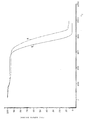
- the Figure graphically depicts the oxidation resistance of unsized graphite fiber and fibers having the sizing of this invention.
- Aluminum is preferred as the metal for the water soluble amorphous hydrated metal oxide sizing of this invention. However it is believed that Ti, Si, Fe, Zr and other hydrosol forming metals or combinations thereof may also be used.
- Any acid HX may be used that results in a metal salt which undergoes oxidation to produce a metal-OH bond.
- X may be Br or I.
- Cl is not preferred since the chloride is not oxidized during the oxidation step described below.
- any oxidizing agent can be used that is water soluble.
- exemplary oxidizing agents are H2O2, O3, organohydroperoxides (e.g. t-butyl hydro peroxide) and ozonides.
- the amorphous hydrated metal oxide sizing of this invention are made by reacting the metal with an acid. It is preferred to use less than an equivalent amount of acid because it is believed this aids in the solubilization of the resulting hydrosol. Then a method is used to increase the metal to anion ratio of the above product. The lowest amount of anion that maintains the hydrosol is preferred since excess halide may lead to corrosion. A preferred method of increasing the metal to anion ratio is the oxidation of the above reaction product. Dialysis (e.g. aqueous dialysis through a semi-permeable membrane) can also be used to increase the metal to halide ratio and will increase the ratio above what can be achieved with oxidation. The reaction is empirically illustrated using aluminum as aAl+3a-b H2O+bHX --- Al a (OH) 3a-b X b +H2
- These water soluble inorganic primer compositions comprise colloidal aqueous solutions of hydrated alumina (aluminum oxide hydrosols) stabilized by small amounts of halide.
- the ratio of a to b in the above formula is about 5/1 to about 800/1. It is preferred that a ratio for a to b of from about 8 to 1 to about 500/1 is used for sizing fibers with the water soluble inorganic sizing because the least amount of anion to maintain the hydrosol is desirable because excess halide may lead to composite matrix decomposition. Ratios of a to b higher than about 30 to 1 may be achieved by dialysis of the solution after oxidation.
- aqueous solutions of hydrated metal oxides are then applied and typically dried, for example, at about 50°C to about 250°C for about 15 minutes. It is believed as the water evaporates from the primer further condensation occurs to produce a polymeric film of greater molecular weight.
- the thickness of this size layer can vary effectively from about 1.5 nm to about 1000 nm. Preferably, the thickness is about 2.5 nm to about 1000 nm. Above about 1000 nm, the layer can be so thick as to create stress risers and to form a weak boundary layer. Below about 1.5 nm, the layer does not provide the properties such as crack propagation resistance at the levels typically required. In addition, it is preferable to apply the sizing to the fiber surface with a plurality of layers as this facilitates removal of volatiles (e.g. water) which can be more difficult to achieve from a single thick application.
- volatiles e.g. water
- Any fiber may be used in the practice of this invention that is useful for making composite articles.
- Examples include amide, carbon, metal, boron, glass, silicon carbide, alumina and KEVLARTM fibers (Dupont DeNemours, E.I., Co., Wilmington, Delaware).
- graphite or glass fibers are used as these provide the properties most desired of composites such as strength and light weight.
- Any conventional resin matrix can be used for the practice of this invention that is useful for making composite articles.
- epoxides or polyimide resins are used as these provide the properties most desired such as good strength. It is especially preferred to use 3501-6TM resin available from Hercules, Inc.
- a chopped fiber composite can be made by mixing chopped fibers coated with amorphous hydrated metal oxide and resin in a mold under pressure and optional heat.
- the metal alkoxide coated composite fibers are then maintained at a temperature of about 25°C to about 300°C as below 25°C the reaction kinetics are typically too slow and above 400°C loss of desirable fiber properties or crystallization of the coating may occur with an accompanying loss of mechanical strength.
- a low surface tension water solution to insure good wetting and spreading of the size on the fiber surface. It is especially preferred to use a water solution that has a surface tension below about 40 dynes/cm. This can be achieved, for example, by the addition to the hydrosol of sufficient amounts of a surfactant such as NP-14TM surfactant (Union Carbide) or FSNTM surfactant (E.I. Dupont DeNemours).
- NP-14TM surfactant Union Carbide
- FSNTM surfactant E.I. Dupont DeNemours
- the reinforcing carbon fibers are dipped into the resin solution to form a tape prior to the molding step.
- the resin impregnated fibers are allowed to dry so that any solvent will evaporate.
- the graphite tape can then be cut into plies (layers of impregnated fibers) of the desired dimensions of the article to be fabricated.
- the plies are then stacked to create the desired thickness, typically in metal molds coated with mold release agent such as Micro Spray ⁇ (Micro-Spray Products Inc.).
- the assembled ply layup is then placed in a press and exposed to pressures and temperatures conventional for the resin system used and application desired.
- the solution was warmed to 50°C and an additional 40 cc of distilled water was added.
- the solution contained some sediment which was removed by centrifuging.
- the resulting solution contained 9.5% solids and gave a Al/I mole ratio of 9.5/1.
- a portion of that solution was diluted to 2 wt. %.
- Unsized, surface treated, Celion G30-500 graphite fiber (BASF Corp.) was drawn through the 2 wt. % solution of hydrated aluminum oxide.
- the resulting coated fibers were heated at 200°C in an air oven to dry and thus produce the amorphous alumina coating.
- the coated fibers were tested for high temperature oxidation resistance using thermogravimetric analysis (TGA). The results are depicted in the Figure. In the Figure, percent weight loss (Y) is graphed against temperature in degrees centigrade (X). There is a significant difference in the thermal oxidative stability as shown by curve (A) (treated graphite) in comparison to curve (B) (untreated graphite).
- This size may be used to advantage in a wide range of composites.
- chopped fiber, filament wound and ordered fiber composites benefit from this primer.
- this invention has been described in terms of a metal alkoxide, a mixture of various metal alkoxides can be used.
- This sizing coating provides improved oxidation resistance at elevated temperatures. At temperatures of about 100°C to about 900°C, this sizing results in more oxidatively stable fibers and hence composites. The resulting properties such as tensile and flexural strengths of composites made with the inorganic fiber sizing are believed at least equivalent or better than composites made using conventional organic fiber sizing. Yet the inorganic sizing agent can be utilized at thinner layers than the 1.0 wt. % loading of layers typical of organic sizing. Thicker layers tend to set up stress risers and to form a weak boundary layer as the components segregate. Also, because of its oxidation resistance the inorganic sizing can be used equally as well with high temperature resins such as polyimides or with low temperature resins such as epoxy systems unlike organic sizing agents which are typically temperature specific.
- composites using the inorganic sized fibers will have improved wet strength retention, be less subject to microcracking and exhibit improved fracture toughness and impact strength properties. Also, the inorganic insulating sheath will have little, if any, deleterious effect on electrical equipment (e.g., cause shorting) should such a composite disintegrate.
- This invention provides an amorphous hydrated metal oxide sizing for fiber reinforced composites resulting in improved oxidation resistance. Thus, it makes a significant advance in the aerospace industry by providing new technology relating to composites.
Landscapes
- Engineering & Computer Science (AREA)
- Textile Engineering (AREA)
- Chemical & Material Sciences (AREA)
- Inorganic Chemistry (AREA)
- Chemical Kinetics & Catalysis (AREA)
- General Chemical & Material Sciences (AREA)
- Reinforced Plastic Materials (AREA)
- Treatments For Attaching Organic Compounds To Fibrous Goods (AREA)
- Inorganic Fibers (AREA)
- Compositions Of Macromolecular Compounds (AREA)
- Moulding By Coating Moulds (AREA)
Applications Claiming Priority (2)
| Application Number | Priority Date | Filing Date | Title |
|---|---|---|---|
| US07/285,922 US4961971A (en) | 1988-12-19 | 1988-12-19 | Method of making oxidatively stable water soluble amorphous hydrated metal oxide sized fibers |
| US285922 | 1988-12-19 |
Publications (3)
| Publication Number | Publication Date |
|---|---|
| EP0392128A2 true EP0392128A2 (fr) | 1990-10-17 |
| EP0392128A3 EP0392128A3 (fr) | 1991-12-11 |
| EP0392128B1 EP0392128B1 (fr) | 1994-02-23 |
Family
ID=23096269
Family Applications (1)
| Application Number | Title | Priority Date | Filing Date |
|---|---|---|---|
| EP89630215A Expired - Lifetime EP0392128B1 (fr) | 1988-12-19 | 1989-12-08 | Apprêt pour fibres dans des matériaux composites |
Country Status (5)
| Country | Link |
|---|---|
| US (1) | US4961971A (fr) |
| EP (1) | EP0392128B1 (fr) |
| JP (1) | JPH02222422A (fr) |
| CA (1) | CA1333031C (fr) |
| DE (1) | DE68913298T2 (fr) |
Cited By (3)
| Publication number | Priority date | Publication date | Assignee | Title |
|---|---|---|---|---|
| WO2008058924A1 (fr) * | 2006-11-15 | 2008-05-22 | Herbert Costard | Procédé de production de matériaux composites à fibres ignifugés ou pré-imprégnés |
| KR101048905B1 (ko) | 2009-05-07 | 2011-07-12 | (주)에스엔에스 | 양모섬유가공용 티타늄하이드로졸, 양모섬유용 복합가공제 및 이를 이용한 양모섬유의 복합가공방법 |
| DE102014212241A1 (de) * | 2014-06-25 | 2015-12-31 | Siemens Aktiengesellschaft | Carbonfasern mit modifizierter Oberfläche sowie Verfahren zur Modifizierung einer Carbonfaseroberfläche und Verwendung der Carbonfaser |
Families Citing this family (2)
| Publication number | Priority date | Publication date | Assignee | Title |
|---|---|---|---|---|
| US5552221A (en) * | 1994-12-29 | 1996-09-03 | The Dow Chemical Company | Polybenzazole fibers having improved tensile strength retention |
| DE102015220145A1 (de) * | 2015-10-16 | 2017-04-20 | Bayerische Motoren Werke Aktiengesellschaft | Kohlenstofffasermaterial, Verfahren zu dessen Herstellung, Faserverbundbauteil enthaltend das Kohlenstofffasermaterial |
Family Cites Families (19)
| Publication number | Priority date | Publication date | Assignee | Title |
|---|---|---|---|---|
| GB654049A (en) * | 1946-11-26 | 1951-06-06 | Colmore Adhesives Ltd | Improvements in and relating to methods of and means for securing adhesion between plastic organic compositions and inorganic materials |
| US2943955A (en) * | 1955-02-21 | 1960-07-05 | Du Pont | Composition and process of forming an adherent polyoxide coating on a surface |
| US2820693A (en) * | 1955-10-24 | 1958-01-21 | Universal Oil Prod Co | Process of making alumina using tin, lead, or germanium as a catalyst |
| US2984628A (en) * | 1956-11-29 | 1961-05-16 | Du Pont | Concentrated zirconia and hafnia aquasols and their preparation |
| US3002854A (en) * | 1957-04-12 | 1961-10-03 | Du Pont | Treatment with titanium organic compositions |
| US3017282A (en) * | 1957-04-12 | 1962-01-16 | Du Pont | Stable, aqueous solutions of organic titanium compounds |
| NL285088A (fr) * | 1961-11-18 | |||
| US3547670A (en) * | 1969-05-28 | 1970-12-15 | Fmc Corp | Metal oxide-phosphoric acid coatings |
| US3657003A (en) * | 1970-02-02 | 1972-04-18 | Western Electric Co | Method of rendering a non-wettable surface wettable |
| US3861978A (en) * | 1973-03-08 | 1975-01-21 | Western Electric Co | Method of joining two bodies after treatment with an inorganic colloid |
| US3989876A (en) * | 1973-12-14 | 1976-11-02 | The Boeing Company | Method of anodizing titanium to promote adhesion |
| US4010247A (en) * | 1974-02-21 | 1977-03-01 | Condea Petrochemie-Gesellschaft M.B.H. | Method for making water dispersible aluminum hydroxide |
| US4376803A (en) * | 1981-08-26 | 1983-03-15 | The Aerospace Corporation | Carbon-reinforced metal-matrix composites |
| JPS6075671A (ja) * | 1983-10-01 | 1985-04-30 | 株式会社河合楽器製作所 | 複合材料用炭素繊維の製造法 |
| US4584108A (en) * | 1983-12-21 | 1986-04-22 | W. R. Grace & Co. | Dispersible alpha alumina monohydrate having increased viscosifying properties |
| US4678820A (en) * | 1985-09-09 | 1987-07-07 | United Technologies Corporation | Amorphous hydrated metal oxide primer for composite fibers |
| US4623591A (en) * | 1985-09-09 | 1986-11-18 | United Technologies Corporation | Amorphous hydrated metal oxide primer for organic adhesively bonded joints |
| FR2600550B1 (fr) * | 1986-05-30 | 1990-10-19 | Meridional Oenologie Centre | Procedes de fabrication de membrane minces composees d'un reseau mineral d'oxydes de titane et de silicium et poudre composee de grains submicroniques en oxydes mixtes de titane et de silicium |
| US4738896A (en) * | 1986-09-26 | 1988-04-19 | Advanced Technology Materials, Inc. | Sol gel formation of polysilicate, titania, and alumina interlayers for enhanced adhesion of metal films on substrates |
-
1988
- 1988-12-19 US US07/285,922 patent/US4961971A/en not_active Expired - Fee Related
-
1989
- 1989-09-28 CA CA000613889A patent/CA1333031C/fr not_active Expired - Fee Related
- 1989-12-08 EP EP89630215A patent/EP0392128B1/fr not_active Expired - Lifetime
- 1989-12-08 DE DE68913298T patent/DE68913298T2/de not_active Expired - Fee Related
- 1989-12-19 JP JP1329404A patent/JPH02222422A/ja active Pending
Cited By (3)
| Publication number | Priority date | Publication date | Assignee | Title |
|---|---|---|---|---|
| WO2008058924A1 (fr) * | 2006-11-15 | 2008-05-22 | Herbert Costard | Procédé de production de matériaux composites à fibres ignifugés ou pré-imprégnés |
| KR101048905B1 (ko) | 2009-05-07 | 2011-07-12 | (주)에스엔에스 | 양모섬유가공용 티타늄하이드로졸, 양모섬유용 복합가공제 및 이를 이용한 양모섬유의 복합가공방법 |
| DE102014212241A1 (de) * | 2014-06-25 | 2015-12-31 | Siemens Aktiengesellschaft | Carbonfasern mit modifizierter Oberfläche sowie Verfahren zur Modifizierung einer Carbonfaseroberfläche und Verwendung der Carbonfaser |
Also Published As
| Publication number | Publication date |
|---|---|
| DE68913298T2 (de) | 1994-06-01 |
| EP0392128A3 (fr) | 1991-12-11 |
| US4961971A (en) | 1990-10-09 |
| DE68913298D1 (de) | 1994-03-31 |
| EP0392128B1 (fr) | 1994-02-23 |
| JPH02222422A (ja) | 1990-09-05 |
| CA1333031C (fr) | 1994-11-15 |
Similar Documents
| Publication | Publication Date | Title |
|---|---|---|
| US4935265A (en) | Method for coating fibers with an amorphous hydrated metal oxide | |
| US4364993A (en) | Sized carbon fibers, and thermoplastic polyester based composite structures employing the same | |
| US4778722A (en) | Reinforcing fibers and composite materials reinforced with said fibers | |
| EP0216518B1 (fr) | Fibre ayant un revêtement de résine thermoplastique | |
| EP0125005B1 (fr) | Matériaux composites à matrice de verre renforcés de fibres | |
| CA1269576A (fr) | Agents d'ensimage | |
| EP0256828B1 (fr) | Matériau inorganique fibreux comme renforcement de matériau composite et procédé de sa fabrication | |
| US4923752A (en) | Sizing for carbon fiber | |
| US4961971A (en) | Method of making oxidatively stable water soluble amorphous hydrated metal oxide sized fibers | |
| US5387468A (en) | Size composition for impregnating filament strands | |
| US4678820A (en) | Amorphous hydrated metal oxide primer for composite fibers | |
| US5112418A (en) | Method for bonding joints with an organic adhesive using a water soluble silane modified amorphous hydrated metal oxide primer | |
| US4596582A (en) | Aramid fiber coated sulfonyl azide | |
| US4832932A (en) | Carbon fiber for composite material | |
| EP0387468A2 (fr) | Apprêt stable amorphe d'oxyde de métal hydraté pour fibres dans des composites | |
| KR970005970B1 (ko) | 수용성 비결정성 수화 금속 산화물 프라이머를 이용하여 유기접착제로 이음매를 결합시키는 방법 | |
| JPS62299568A (ja) | 複合材用無機繊維 | |
| JPS63324A (ja) | 繊維強化プラスチツク複合体及びその製法 | |
| JPH01162853A (ja) | 耐熱性繊維不織布 | |
| JP2756068B2 (ja) | セメント補強用炭素繊維及びセメント複合体 | |
| EP0534981A1 (fr) | Composition d'encollage pour l'impregnation de filaments orientes | |
| JPS63159439A (ja) | ハイブリツド繊維強化複合体 | |
| JPS62297332A (ja) | 無機繊維強化プラスチツク複合体及びその製法 | |
| Ag | Photoluminescent material | |
| JPH08268734A (ja) | セラミック繊維の耐熱性向上法およびセラミック繊維質断熱材 |
Legal Events
| Date | Code | Title | Description |
|---|---|---|---|
| PUAI | Public reference made under article 153(3) epc to a published international application that has entered the european phase |
Free format text: ORIGINAL CODE: 0009012 |
|
| AK | Designated contracting states |
Kind code of ref document: A2 Designated state(s): DE FR GB IT |
|
| PUAL | Search report despatched |
Free format text: ORIGINAL CODE: 0009013 |
|
| AK | Designated contracting states |
Kind code of ref document: A3 Designated state(s): DE FR GB IT |
|
| 17P | Request for examination filed |
Effective date: 19920527 |
|
| 17Q | First examination report despatched |
Effective date: 19921111 |
|
| GRAA | (expected) grant |
Free format text: ORIGINAL CODE: 0009210 |
|
| AK | Designated contracting states |
Kind code of ref document: B1 Designated state(s): DE FR GB IT |
|
| ET | Fr: translation filed | ||
| REF | Corresponds to: |
Ref document number: 68913298 Country of ref document: DE Date of ref document: 19940331 |
|
| ITF | It: translation for a ep patent filed | ||
| PLBE | No opposition filed within time limit |
Free format text: ORIGINAL CODE: 0009261 |
|
| STAA | Information on the status of an ep patent application or granted ep patent |
Free format text: STATUS: NO OPPOSITION FILED WITHIN TIME LIMIT |
|
| 26N | No opposition filed | ||
| PGFP | Annual fee paid to national office [announced via postgrant information from national office to epo] |
Ref country code: FR Payment date: 19951110 Year of fee payment: 7 |
|
| PGFP | Annual fee paid to national office [announced via postgrant information from national office to epo] |
Ref country code: GB Payment date: 19951121 Year of fee payment: 7 |
|
| PGFP | Annual fee paid to national office [announced via postgrant information from national office to epo] |
Ref country code: DE Payment date: 19951122 Year of fee payment: 7 |
|
| PG25 | Lapsed in a contracting state [announced via postgrant information from national office to epo] |
Ref country code: GB Effective date: 19961208 |
|
| GBPC | Gb: european patent ceased through non-payment of renewal fee |
Effective date: 19961208 |
|
| PG25 | Lapsed in a contracting state [announced via postgrant information from national office to epo] |
Ref country code: FR Effective date: 19970829 |
|
| PG25 | Lapsed in a contracting state [announced via postgrant information from national office to epo] |
Ref country code: DE Effective date: 19970902 |
|
| REG | Reference to a national code |
Ref country code: FR Ref legal event code: ST |
|
| PG25 | Lapsed in a contracting state [announced via postgrant information from national office to epo] |
Ref country code: IT Free format text: LAPSE BECAUSE OF NON-PAYMENT OF DUE FEES;WARNING: LAPSES OF ITALIAN PATENTS WITH EFFECTIVE DATE BEFORE 2007 MAY HAVE OCCURRED AT ANY TIME BEFORE 2007. THE CORRECT EFFECTIVE DATE MAY BE DIFFERENT FROM THE ONE RECORDED. Effective date: 20051208 |