EP0392655A2 - Bilderzeugungssystem und -Verfahren - Google Patents
Bilderzeugungssystem und -Verfahren Download PDFInfo
- Publication number
- EP0392655A2 EP0392655A2 EP90302206A EP90302206A EP0392655A2 EP 0392655 A2 EP0392655 A2 EP 0392655A2 EP 90302206 A EP90302206 A EP 90302206A EP 90302206 A EP90302206 A EP 90302206A EP 0392655 A2 EP0392655 A2 EP 0392655A2
- Authority
- EP
- European Patent Office
- Prior art keywords
- raster
- image
- scan direction
- pixels
- bitmap
- Prior art date
- Legal status (The legal status is an assumption and is not a legal conclusion. Google has not performed a legal analysis and makes no representation as to the accuracy of the status listed.)
- Withdrawn
Links
Images



Classifications
-
- G—PHYSICS
- G06—COMPUTING OR CALCULATING; COUNTING
- G06K—GRAPHICAL DATA READING; PRESENTATION OF DATA; RECORD CARRIERS; HANDLING RECORD CARRIERS
- G06K15/00—Arrangements for producing a permanent visual presentation of the output data, e.g. computer output printers
-
- G—PHYSICS
- G09—EDUCATION; CRYPTOGRAPHY; DISPLAY; ADVERTISING; SEALS
- G09G—ARRANGEMENTS OR CIRCUITS FOR CONTROL OF INDICATING DEVICES USING STATIC MEANS TO PRESENT VARIABLE INFORMATION
- G09G5/00—Control arrangements or circuits for visual indicators common to cathode-ray tube indicators and other visual indicators
- G09G5/36—Control arrangements or circuits for visual indicators common to cathode-ray tube indicators and other visual indicators characterised by the display of a graphic pattern, e.g. using an all-points-addressable [APA] memory
- G09G5/39—Control of the bit-mapped memory
-
- G—PHYSICS
- G06—COMPUTING OR CALCULATING; COUNTING
- G06K—GRAPHICAL DATA READING; PRESENTATION OF DATA; RECORD CARRIERS; HANDLING RECORD CARRIERS
- G06K2215/00—Arrangements for producing a permanent visual presentation of the output data
- G06K2215/0002—Handling the output data
- G06K2215/0062—Handling the output data combining generic and host data, e.g. filling a raster
-
- G—PHYSICS
- G09—EDUCATION; CRYPTOGRAPHY; DISPLAY; ADVERTISING; SEALS
- G09G—ARRANGEMENTS OR CIRCUITS FOR CONTROL OF INDICATING DEVICES USING STATIC MEANS TO PRESENT VARIABLE INFORMATION
- G09G2360/00—Aspects of the architecture of display systems
- G09G2360/12—Frame memory handling
- G09G2360/127—Updating a frame memory using a transfer of data from a source area to a destination area
Definitions
- This invention relates to an image generation system and method, and more especially to the structuring, handling, and storing of data in an image generating system.
- An image generation system is the component of an electronic printer or other visual display or transmission system which produces a stream of bits (binary digits) in raster-scan order to be sent to the marking engine of an electronic printer, to a cathode-ray-tube (CRT) screen, to a facsimile (FAX) transmitter, or to any other raster output device.
- CTR cathode-ray-tube
- FAX facsimile
- Image generation systems use random access memory (RAM) to store bit-vectors called words.
- RAM random access memory
- the two basic parts of an image generating system's RAM are the image buffer and the bitmap memory.
- the image buffer accumulates data to be sent to the raster output device.
- the bitmap memory stores bitmaps.
- a bitmap is a block of bits (or bit-groups) mapping the image of a letter, number, punctuation mark, photometrically scanned or computer-generated image, or any other digital image.
- An image generating method consists of three processes: rasterization, bitblt, and readout.
- Rasterization creates bitmaps.
- Bitblt (acronym of "bit block transfer") transfers bit blocks; more precisely, bitblt copies bitmaps to the image buffer.
- Readout sends accumulated data from the image buffer to the raster output device.
- Rasterization occurs comparatively seldom, so its speed is not very important. Sometimes all the rasterization is done just once for the visual display or transmission system, even before it is built. In that case fonts are installed already rasterized.
- bitblt occurs once for each page printed (or displayed or transmitted).
- bitblt occurs thousands of times for each readout, because each separate occurrence of a character requires a separate bitblt.
- Prior art optimizes readout by having image buffer data in raster-scan order. That is, successive bits (or bit-groups) within a word correspond to successive picture elements (pixels) in raster-scan order, and successive words correspond to successive pixel segments along a scan-line.
- Image-buffer word-order would seem insignificant, because the image buffer is part of random access memory, so words may be accessed in any order.
- RAMs often provide a faster burst access mode for a sequence of consecutive words.
- both readout and bitblt speed may depend upon image-buffer word-order.
- the number (i) of bits per bit group may be equal to one or may be greater than one.
- bitblt bit block transfer
- a method of readout of image buffer to a raster output device consisting of: readout of a word of image buffer into a segment of a scanline readout of a word of image buffer to the next segment of a scanline from word address higher than the previous word address by the number of scanlines in the raster output repeat of the previous two steps until the whole scanline has been sent repeat of the previous three steps until all scanlines have been sent.
- Bitmaps may be copied from the bitmap memory to the image buffer using burst mode memory accesses. Bit maps may be transferred in burst mode from the memory to an aligning device for alignment along the raster scan direction, the aligning device then being burst-stored to the image buffer.
- the readout of the image buffer to the raster output device may comprise: reading out a word of image buffer into a segment of a scan line; reading out a word of image buffer to the next segment of a scan line from the word address greater than the previous word address by the number of scan lines in the raster output; repeating the previous two steps until the whole scanline has been sent and repeating the previous three steps until all scanlines have been sent.
- This description relates to an image generating system, and more especially to the structuring, handling, and storing of data in an image generating system so as to use burst-mode memory access for bitblt.
- An image generating system is the component of an electronic visual display or transmission system which produces a stream of bits (binary digits) in raster-scan order to be sent to the raster output device.
- Image generating systems use random access memory (RAM) to store bit-vectors called words.
- RAM random access memory
- the two basic parts of an image generating system's RAM are the image buffer and the bitmap memory.
- the image buffer accumulates data to be sent to the raster output device.
- the bitmap memory stores bitmaps.
- a bitmap is a block of bits (or bit-groups) mapping the image of a letter, number, punctuation mark, photometrically scanned or computer-generated image, or any other digital image.
- An image generating system consists of three processes: rasterization, bitblt, and readout.
- Rasterization creates bitmaps.
- Bitblt (acronym of "bit block transfer") transfers bit blocks; more precisely, bitblt copies bitmaps to the image buffer.
- Readout sends accumulated data from the image buffer to the raster output device.
- successive bits (or bit-groups) within a word correspond to successive pixels in raster-scan order and successive words correspond to a pixel strip across successive scanlines.
- the strip's length in pixels at right angles to the raster-scan direction is the number of scanlines in the generated image, which is also the number of words in the strip.
- the strip's width in pixels along the raster-scan direction is the number of bits (or bit-groups) per word.
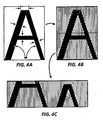
- Figs. 1A and Fig. 4A show binary digital data. Each word is shown as a vertical rectangle 32 times as high as wide, darkened to represent 1-bits, with addresses increasing consecutively from left to right. The raster-scan direction is shown as vertical. A word of RAM shown just above another is at some (fairly large) address displacement above it; words are consecutive if shown side-by-side.
- Figure 1 shows rasterization in the prior art.
- the input shown is a contour description of the letter "A," i.e. a numeric description in terms of stroke lengths, stroke slopes or angles, and the like.
- a direct illustration would be simply a table of these numbers, but the idea is symbolized by Fig. 1A.
- the rasterized version (the bitmap) is shown in Fig 1C.
- the second process is the bitblt, or more accurately the bitblts, plural. There are many bitblts, typically thousands, before an image buffer is ready for readout.
- Figure 2 shows one step in one prior-art bitblt: two words of bitmap memory (Fig. 2A) are shifted and copied into three words of image buffer (Fig. 2C) using an aligning device as follows. First, the word of bitmap memory corresponding to the first 32 bits of a vertical slice of the image is copied (arrow 1) into register R2, then combined with empty register R1 for a double-shift-and-extract operation (arrows 2) into register R5, which is then stored (arrow 3) to the image buffer.
- bitmap memory corresponding to the next (and in the case shown, last) 32 bits of the same vertical slice of the image is copied (arrow 4) into register R3, then combined with register R2 for a double-shift-and-extract operation (arrows 5) into register R6, which is then stored (arrow 6) to the image buffer.
- empty register R4 is combined with register R3 for a double-shift-and-extract operation (arrows 7) into register R7, which is then stored (arrow 8) to the image buffer.
- This whole step is repeated for the words of bitmap memory corresponding to each of the many vertical slices of the image (49 slices in the case shown) to accomplish one bitblt.
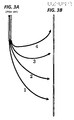
- Figure 3 shows a small part of a prior-art readout: four successive (left-to-right) words of image buffer memory (Fig. 3A) are transmitted (arrows) as part of one scanline (Fig 3B). The entire image buffer's words are transmitted seriatim. (Because the words are transmitted seriatim, a burst access may be used.)
- Figure 4 shows rasterization in accordance with the invention.
- the input shown is a contour description of the letter "A,” identical to Fig. 1A.
- the rasterized version (the bitmap) is shown in Fig 4C, which has the same data as Fig. 1C but differently organized.
- the rasterization method generally comprises: dividing the image into k parallel strips each j pixels along the raster-scan direction by n pixels at right-angles to the raster-scan direction; creating a sequence of n words corresponding to the first strip; and creating (k-1) subsequent sequences, each of n words, corresponding to the subsequent strips.
- Each strip is created by the known process of assigning, to each bit-group in each word of the strip, a numeric value that best represents (i.e approximates the color value of) the corresponding pixel of the image.
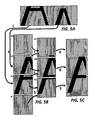
- FIG. 5 shows a step in bitblt in accordance with the invention: two 32-word cells of bitmap memory (Fig. 5A) are shifted and copied into three 32-word cells of image buffer (Fig. 5C) using an aligning device as follows.
- the cell of bitmap memory corresponding to the first 32 bits of 32 vertical slices of the image is burst-copied (arrow 1) into register block B2, then combined with empty register block B1 for 32 double-shift-and-extract operations (arrows 2) into register block B5, which is then burst-stored (arrow 3) to the image buffer.
- the cell of bitmap memory corresponding to the next (and in the case shown, last) 32 bits of the same 32 vertical slices of the image is burst-copied (arrow 4) into register block B3, then combined with register block B2 for 32 double-shift-and-extract operations (arrows 5) into register block B6, which is then burst-stored (arrow 6) to the image buffer.
- empty register block B4 is combined with register block B3 for 32 double-shift-and-extract operations (arrows 7) into register block B7, which is then burst-stored (arrow 8) to the image buffer.
- This whole step is repeated for the cells of bitmap memory corresponding to the other blocks of vertical slices of the image (one more block of 17 slices, in the case shown) to accomplish one bitblt.
- Figure 6 shows a small part of an invention readout: four non-successive, in fact widely-separated (bottom-to-top) words of image buffer memory (Fig. 6A) are transmitted (arrows) as part of one scanline (Fig 6B, identical to Fig. 3B). The words are transmitted in this order until the entire image buffer has been sent.
Landscapes
- Engineering & Computer Science (AREA)
- Physics & Mathematics (AREA)
- General Physics & Mathematics (AREA)
- Theoretical Computer Science (AREA)
- Computer Hardware Design (AREA)
- General Engineering & Computer Science (AREA)
- Image Input (AREA)
- Image Generation (AREA)
- Controls And Circuits For Display Device (AREA)
- Image Processing (AREA)
Applications Claiming Priority (2)
| Application Number | Priority Date | Filing Date | Title |
|---|---|---|---|
| US31945489A | 1989-03-06 | 1989-03-06 | |
| US319454 | 1989-03-06 |
Publications (2)
| Publication Number | Publication Date |
|---|---|
| EP0392655A2 true EP0392655A2 (de) | 1990-10-17 |
| EP0392655A3 EP0392655A3 (de) | 1992-04-29 |
Family
ID=23242303
Family Applications (1)
| Application Number | Title | Priority Date | Filing Date |
|---|---|---|---|
| EP19900302206 Withdrawn EP0392655A3 (de) | 1989-03-06 | 1990-03-01 | Bilderzeugungssystem und -Verfahren |
Country Status (2)
| Country | Link |
|---|---|
| EP (1) | EP0392655A3 (de) |
| JP (1) | JPH02298993A (de) |
Cited By (1)
| Publication number | Priority date | Publication date | Assignee | Title |
|---|---|---|---|---|
| EP0542317A1 (de) * | 1991-11-15 | 1993-05-19 | Seiko Epson Corporation | Anlage zur Herstellung eines Zeichenmusters für einen Seriendrucker |
Family Cites Families (2)
| Publication number | Priority date | Publication date | Assignee | Title |
|---|---|---|---|---|
| US4716554A (en) * | 1985-05-02 | 1987-12-29 | Sparton Corporation | Tapered wiring harness |
| US4893257A (en) * | 1986-11-10 | 1990-01-09 | International Business Machines Corporation | Multidirectional scan and print capability |
-
1990
- 1990-02-28 JP JP2049121A patent/JPH02298993A/ja active Pending
- 1990-03-01 EP EP19900302206 patent/EP0392655A3/de not_active Withdrawn
Cited By (2)
| Publication number | Priority date | Publication date | Assignee | Title |
|---|---|---|---|---|
| EP0542317A1 (de) * | 1991-11-15 | 1993-05-19 | Seiko Epson Corporation | Anlage zur Herstellung eines Zeichenmusters für einen Seriendrucker |
| US5288156A (en) * | 1991-11-15 | 1994-02-22 | Seiko Epson Corporation | Apparatus for generating character pattern for serial printer |
Also Published As
| Publication number | Publication date |
|---|---|
| JPH02298993A (ja) | 1990-12-11 |
| EP0392655A3 (de) | 1992-04-29 |
Similar Documents
| Publication | Publication Date | Title |
|---|---|---|
| US4555802A (en) | Compaction and decompaction of non-coded information bearing signals | |
| US4079458A (en) | High resolution character generator | |
| EP0327003B1 (de) | System zum Generieren von Musterdaten | |
| US7711202B2 (en) | Image enhancement employing partial template matching | |
| EP0320755A2 (de) | Bildverarbeitungssystem und Verfahren unter Benutzung kombinierter Schwarzweiss und Grautonbilddaten | |
| US20050196071A1 (en) | Black white image scaling for optical character recognition | |
| US4007442A (en) | Intermixed line heights and blank line formation in a buffered printer | |
| US5233671A (en) | Image coding method for coding characters using a modified Bezier curve | |
| EP0592770B1 (de) | Verfahren zum Ausfüllen der Bildpunkte innerhalb eines Polygons | |
| EP0592769B1 (de) | Verfahren für die Umsetzung von Bitkarten in einfarbige Daten | |
| US5867612A (en) | Method and apparatus for the fast scaling of an image | |
| US7555170B2 (en) | Image processing apparatus for scaling images | |
| EP0525359B1 (de) | System zur Bildverarbeitung | |
| EP0498873B1 (de) | Punktmatrixbildverbesserung für optische zeichenerkennung | |
| US5592574A (en) | Method and apparatus for expansion of white space in document images on a digital scanning device | |
| US8045215B2 (en) | Printer object list resolutions | |
| US4529228A (en) | Method and apparatus for coding pictorial information for efficient storage, transmission and reproduction | |
| US5548689A (en) | Method to convert bitmaps to monochrome data | |
| US7333238B2 (en) | Rendering a printing device pixel map | |
| US5526474A (en) | Image drawing with improved process for area ratio of pixel | |
| US5708763A (en) | Tiling for bit map image | |
| EP0392655A2 (de) | Bilderzeugungssystem und -Verfahren | |
| JPH09181923A (ja) | バイナリイメージを無損失事前圧縮する方法 | |
| US4649435A (en) | Method and apparatus for coding pictorial information for efficient storage, transmission and reproduction | |
| US5103487A (en) | Image processing method |
Legal Events
| Date | Code | Title | Description |
|---|---|---|---|
| PUAI | Public reference made under article 153(3) epc to a published international application that has entered the european phase |
Free format text: ORIGINAL CODE: 0009012 |
|
| AK | Designated contracting states |
Kind code of ref document: A2 Designated state(s): DE FR GB |
|
| PUAL | Search report despatched |
Free format text: ORIGINAL CODE: 0009013 |
|
| AK | Designated contracting states |
Kind code of ref document: A3 Designated state(s): DE FR GB |
|
| STAA | Information on the status of an ep patent application or granted ep patent |
Free format text: STATUS: THE APPLICATION HAS BEEN WITHDRAWN |
|
| 18W | Application withdrawn |
Withdrawal date: 19920810 |